Introduction
Debate is still open on the relative importance of ecological and evolutionary determinants in species richness and composition of helminth communities in freshwater and marine fishes. In recent years several authors have tried to determine which factors are the key determinants. For example, in a comparative analysis of the helminth fauna of 50 coastal Brazilian fish species, Luque & Poulin (Reference Luque and Poulin2004) reported that the most important correlates for larval helminths were host body length and restricted geographical distribution. In a comparative study of the endoparasite fauna of 53 floodplain Brazilian fish species, Takemoto et al. (Reference Takemoto, Pavanelli, Lizama, Luque and Poulin2005) found that by controlling phylogenetic inertia in the data, catch per unit effort was shown to be the most important predictor.
A significant common factor among these investigations is that both are based on host and parasite lists. Although it is not always possible to avoid the use of this data, extreme care must be taken when attempting to identify helminth species richness determinants because the risk exists of over-generalization and data loss. It is also extremely important to clearly define the temporal and/or spatial scale of any study, as biogeographical and correlative studies, based on host–parasite lists, may provide full support for hypotheses such as the enemy release hypothesis (Coulatti et al., 2004), whereas comparison of local level community data does not support this hypothesis.
The use of host–parasite lists may not consider essential variables such as host age, migratory behaviour, and feeding habits, all of which influence both species richness and composition at the local level. The question remains, however, as to how important these variables are in determining species richness at a local level. If they are essential, then they should exhibit significant statistical associations between relevant biological and environmental variables and parasite species richness and/or other relevant local level community or population descriptors. In addition, a generalist/specialist status or transmission strategies (e.g. allogenic/autogenic) of helminth species may affect whether or not a host species belongs to a host group geographically restricted to a specific location. To test these ideas, phylogenetically unrelated host species would be needed to avoid the risk of working with non-phylogenetically independent statistical observations (see Luque & Poulin, Reference Luque and Poulin2004). These hosts, apart from being sampled at the same time, should belong to the same age group (i.e. adults, juveniles, fingerlings, etc.), and a thorough taxonomical knowledge of their helminth fauna should be available. Data sets meeting these criteria are rare, but from a massive kill of Mayan catfish Hexanematichthys assimilis (Günther) in Chetumal Bay, Mexico (Vidal-Martínez et al., Reference Vidal-Martínez, Aguirre-Macedo, Noreña-Barroso, Gold-Bouchot and Caballero-Pinzon2003), we were able to generate a data set that fulfils them. This consists of four commercially-important fish species that feed and shelter in coastal lagoons in this region including the Mayan catfish H. assimilis and the striped mojarra Eugerres plumieri (Cuvier), both brackish-water residents of coastal lagoons (Castro-Aguirre et al., Reference Castro-Aguirre, Espinoza-Pérez and Schmitter-Soto1999) together with the marine species leatherjacket Oligoplites saurus (Bloch & Schneider) and the Spanish mackerel Scomberomorus maculatus (Mitchill).
The present study therefore describes the helminth infra-communities of four fish species from Chetumal Bay to determine possible associations between environmental and host biological characteristics as factors determining helminth species richness and composition.
Materials and methods
Fish were collected in Chetumal Bay (18°21′–18°52′ N; 87°54′–88°23′ W), using gill-nets placed at a short distance from shore, near the city of Chetumal and around mangrove islands known locally as ‘mogotes’. In August 1999, a total of 50 fish (16 H. assimilis, 26–42 cm in total length; 10 E. plumieri, 17–24 cm in length; 14 O. saurus 22–48 cm in length; and 10 S. maculatus 51–70 cm in length) were collected, frozen, transported to the laboratory, and examined no more than 2 weeks after capture. All organs were individually examined using a dissection microscope whereas helminths were counted in situ and preserved for taxonomical identification. Voucher specimens were deposited in the National Helminthological Collection of Mexico, Universidad Nacional Autónoma de México (CNHE) and the Helminthological Collection of CINVESTAV-IPN, Mérida Unit (CHCM).
Prevalences and mean abundances were calculated for each helminth species according to Bush et al. (Reference Bush, Lafferty, Lotz and Shostak1997). Host-specialist helminth species were those previously reported from fish species of the same genus or fish family, whereas generalist species were those previously reported in fish species from different fish families. Helminth community richness and similarity were calculated separately at the component and infra-community levels (Holmes & Price, Reference Holmes, Price, Anderson and Kikkawa1986) for full (i.e. including every possible infected organ) and intestinal communities. Autogenic species were those completing their life cycles within aquatic environments, with intermediate and definitive hosts. In contrast, allogenic species were those reaching sexual maturity in piscivorous birds or terrestrial mammals (Esch & Fernandez, Reference Esch and Fernandez1993). Species encysted in the intestine wall were not included in the intestinal helminth community analysis.
At the infra-community level, the mean ± SD of the number of species and individual helminths per host examined were calculated. At the component community level, species richness was expressed as the total number of species and the total number of individual helminths per host species in a sample. The Brillouin's diversity index (Magurran, Reference Magurran1988) was calculated for all infra-communities and expressed as the mean ± SD for each host sample. The Berger-Parker dominance index (Magurran, Reference Magurran1988) was calculated at the component community level for the helminth fauna of each host. Similarity was compared using Jaccard's similarity index (Magurran, Reference Magurran1988) for all possible combinations within and between host species at both component and infra-community levels.
To determine the adequacy of the host sample size for each fish species, analyses were done at the infra-community level using the criterion of a standard error less than or equal to 10% of mean species richness (McCune & Grace, Reference McCune and Grace2002). The mean species richness (MSR) standard error (SE)/mean species richness (MSR) ratio values, expressed as a percentage, were: H. assimilis (SE/MSR) × 100 = (0.75/7.44) × 100 = 10.04%); E. plumieri (0.39/5.00) × 100 = 7.88%); O. saurus ((0.40/4.07) × 100 = 9.79%); and S. maculatus ((0.36/4.20) × 100 = 8.54%). Based on these values, the sample size for comparative study at the infra-community level for each host species was deemed to be adequate according to the theoretical considerations of Holmes & Price (Reference Holmes, Price, Anderson and Kikkawa1986). These authors considered each individual host fish as an independent parasite community, meaning that in sampling 10 fish hosts 10 parasite communities have been sampled. Consequently, individual hosts were used as the replication unit.
Variable normality was determined by using rankit plots (Sokal & Rohlf, Reference Sokal and Rohlf1995). Variables with large deviations from normality were log-transformed. A one-way ANOVA was used to determine differences between the mean number of species and individuals per fish species. Where transformation did not improve normality, the non-parametric Kruskal-Wallis (KW) test was used. The significance of all statistical analyses was established at α = 0.05, unless otherwise stated.
The multivariate statistical method known as redundancy analysis (RDA), applied with the CANOCO software (ter Braak & Smilauer, Reference ter Braak and Smilauer1998) was used, to determine possible associations between supplementary environmental and host biological variables, and infra-community and infra-population parameters. By using the detrended correspondence analysis (DCA) the length of the ordination axes scale (gradient) in standard deviation units (SDU) for the species data was found to be between 4.87 and 5.48 SDU. The reason for such wide axes scales is due to few fish with large populations of common parasite species, and there were also many zero values for several rare species, which weighs heavily in favour of the rare species. In these cases, if the lengths of ordination axes are longer than four SDU, then unimodal models, such as canonical correspondence analysis (CCA), are recommended (Jongman et al., Reference Jongman, Ter Braak and van Tongeren1995). However, CCA is best used if sites (i.e. fish) have approximately the same number of parasite individuals (which is not the case due to aggregate distribution of parasite species in fish hosts), or the richest sites are heavily weighted (Legendre & Gallagher, Reference Legendre and Gallagher2001). An alternative is to transform data to Hellinger distance values to control the natural influence of the multiple zeros while conserving values in the data matrix that are similar to those of the Euclidean distance. This is necessary because the best choice among the possible multivariate analyses is redundancy analysis (RDA), which is based on the use of Euclidean distances. In summary, RDA is both a constrained form of PCA and a constrained form of multivariate multiple regression (see Jongman et al., Reference Jongman, Ter Braak and van Tongeren1995 and ter Braak & Smilauer, Reference ter Braak and Smilauer1998).
Covariable analysis was used to control confounding variables such as standard length and weight, and to determine the actual influence of environmental and host biological independent variables upon the infra-community and infra-population (i.e. abundance of each helminth species) parameters for each host species. Monte Carlo tests were used to determine the significance of canonical axes for both helminth parasites and independent variables. The normality of transformed variables was determined by using rankit plots (Sokal & Rohlf, Reference Sokal and Rohlf1995). The use of constrained models produced decreases in the percentage of explained variance, although the models were still statistically significant (Jongman et al., Reference Jongman, Ter Braak and van Tongeren1995).
Results
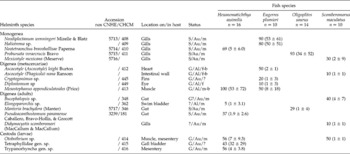
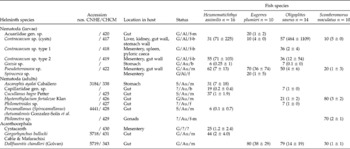
A total of 35 helminth species were found, namely five monogeneans; 10 digeneans (including five in metacercarial stage); three larval cestodes (table 1); 14 nematodes (seven larval); and three acanthocephalans (one larval) (table 2). Most larval species were identified only to genus level because the lack of adults prevented more precise identification. Adult digeneans and nematodes not identified to species level (tables 1 and 2) probably represent new species, but more material is needed for their definitive identification. With the exception of species found in H. assimilis, all helminth species were first records for Chetumal Bay, whereas Neodiplectanum wenningeri from E. plumieri represented a new host record.
Prevalence followed by abundance (±SD) of digeneans and cestodes infecting four fish species from Chetumal Bay, Mexico.

S, specialist; G, generalist; Au, autogenic; Al, allogenic; m, marine origin; f, freshwater origin; b, brackish-water origin.
Prevalence followed by abundance (±SD) of nematodes and acanthocephalans infecting four fish species from Chetumal Bay, Mexico.

S, specialist; G, generalist; Au, autogenic; Al, allogenic; m, marine origin; f, freshwater origin; b, brackish-water origin.
The most frequent and abundant helminth species were Contracaecum sp. larvae in O. saurus and H. assimilis, Contracaecum sp. type 2 and Mesostephanus apendiculatoides in H. assimilis and the monogeneans N. wenningeri and Haliotrema sp. in E. plumieri (tables 1 and 2). Apart from Hysterothylacium fortalezae and Dollfusentis chandleri, none of the adult helminth species was shared among hosts, and in most cases adult forms were host specialists. Only nematode larvae of Contracaecum sp. and Pseudoterranova sp. were found in all host species (table 2). Twenty-four of the 35 helminth species (68%) were autogenic and the remaining 31% were allogenic.
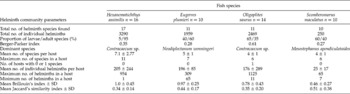
The maximum number of helminth species (17) and individuals (3290 worms) was found in H. assimilis, and the minimum in S. maculatus (10 species). In all but one host (E. plumieri) the helminth communities were numerically dominated by larval stages, with Contracaecum sp. dominating in two hosts and Mesostephanus apendiculatoides in one host (table 3). Berger-Parker index values were generally below 0.45.
Community parameters of the total helminth fauna of four fish species from Chetumal Bay, Mexico.

At the infra-community level, H. assimilis harboured the richest communities with 7 ± 2.7 species, and 205 ± 244 individual helminths per host (table 3). There was a significant difference in the mean number of species, with H. assimilis having a larger number of species with respect to the other three fish species (Kruskal-Wallis test; H = 15.01; df = 3; P < 0.001). There was also a significant difference in the mean number of individuals, with S. maculatus having a lower number with respect to the other three host species (ANOVA; F3,46 = 8.60; P < 0.0001). All individual hosts harboured at least one helminth species. Brillouin's diversity index values were between 0.46 ± 0.27 (in S. maculatus) and 1.0 ± 0.45 (in H. assimilis).
The highest similarity value within a host sample was 0.51 ± 0.38 in S. maculatus, while the lowest (0.34 ± 0.14) occurred in H. assimilis (table 3). Total similarity between hosts was low at both component (0.18 ± 0.43) and infra-community levels (0.16 ± 0.19) (table 4). The highest similarity was recorded between O. saurus and S. maculatus at the component level (0.27), and between O. saurus and E. plumieri at the infra-community level (0.26 ± 0.21). The lowest similarity values were recorded between H. assimilis and S. maculatus at the component community level (0.12), and H. assimilis and E. plumieri (0.01 ± 0.03) at the infra-community level (table 4).
Jaccard's similarity indices±SD between paired helminth faunas of four fish species from Chetumal Bay, Mexico.

Overall mean ± SD of similarity at infra-community level = 0.16 ± 0.19 and at component community level = 0.18 ± 0.43.
Values above and below the diagonal are at infra-community and component community levels respectively.
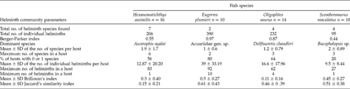
At the component level, the richest intestinal community occurred in H. assimilis (seven species). The lowest number of species was found in E. plumieri (two), while the lowest number of individuals was in S. maculatus (95). The highest Berger-Parker index values of 0.97 and 0.87 were found in E. plumieri and O. saurus respectively, and the lowest of 0.44 in S. maculatus. For intestinal infra-communities, the richest in terms of the number of species per host was found to be 2 ± 0.89 in S. maculatus, but in terms of number of individuals per host, the highest value of 39 ± 33 was recorded in E. plumieri. More diverse infra-communities were found in E. plumieri (Brillouin's index = 0.5 ± 0.27), with only 20% of hosts harbouring one or no species (table 5). Less diverse infra-communities of 0.11 ± 0.16 occurred in O. saurus (table 5). The helminth communities of E. plumieri showed the highest similarity values of 0.61 ± 0.43 within a host sample, while those of H. assimilis the lowest of 0.15 ± 0.29 (table 5).
Community parameters of the intestinal helminth fauna of four fish species from Chetumal Bay, Mexico.

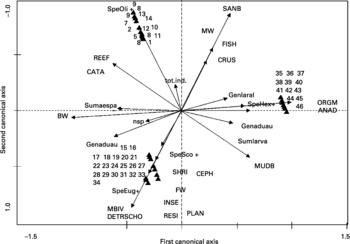
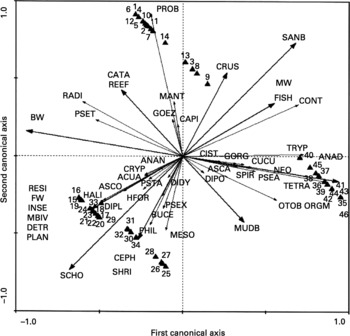
Figure 1 shows the RDA analyses, in which the helminth community parameters of each of the four host species were dependent variables and the environmental and host biological variables (table 6) were independent variables. The analysis was significant for both the first (F-ratio = 15.66; P = 0.0002, 4999 randomizations) and all canonical axes (F-ratio = 12.19; P = 0.0002, 4999 randomizations). Figure 2 shows the RDA analyses for the abundance data of each helminth species (tables 1 and 2) versus environmental and host biological variables (table 6). The analysis was significant for both the first (F-ratio = 18.82; P = 0.0002, 4999 randomizations) and all canonical axes (F-ratio = 15.66; P = 0.0002, 4999 randomizations). The first group was formed by O. saurus individuals, which were restricted to the upper zone of fig. 1 and separated mainly due to the host specialists, such as Probursata veraecrucis and Manteria brachydera. Sampling units (individual hosts) were related to environmental variables such as being a reef fish (REEF), living in marine waters (MW) and sandy beaches (SANDB) and host biological variables such as catadromy (CATA), and feeding on fish (FISH) and crustaceans (CRUS) (figs 1 and 2).
Redundancy analysis (RDA) between environmental and biological variables as independent supplementary variables, and helminth community and population parameters as dependent variables. Acronyms for independent variables are: ANAD, anadromous; BW, brackish-water; CATA, catadromous; CEPH, cephalopods; CRUS, benthic crustaceans; DETR, detritus; FISH, fish consumer; FW, freshwater; INSE, aquatic insects; MBIV, microbivalves; MUDB, mud bottoms; MW, marine waters; ORGM, organic matter; PLA, aquatic plants; REEF, reef fish; RESI, resident; SAND, sandy beaches; SCHO, forming schools; SHRI, shrimps. Acronyms for dependent variables are: Genaduau, generalist autogenic adult helminths; Genlaral, generalist larval allogenic helminths; Genlarau, generalist larval autogenic helminths; nsp, total number of helminth species; SpeSco+, specialist helminths of Scomberomorus maculatus; SpeEug+, specialist helminths of Eugerres plumieri; SpeHex+, specialist helminths of Hexanematichthys assimilis; SpeOli+, specialist helminths of Oligoplites saurus; Sumaespa, sum of the specialist helminth species of all four hosts; Sumlarva, sum of the larval helminth species of all four hosts; tot.ind, sum of all the individual helminths of all four hosts.

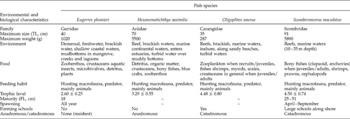
Environmental and biological characteristics of four fish species from Chetumal Bay, Mexico.

FL, furcal length; TL, total length.
All data from http://FishBase.com.
Redundancy analysis (RDA) between environmental and biological variables as independent supplementary variables, and helminth species abundance as dependent variables Acronyms of independent variables are given in fig. 1, whereas those of dependent variables are: ACUA, Acuariidae gen. sp.; ANAN, Ascocotyle (Phagicola) nana; ASCA, Ascarophis ayalai; ASCO, Ascocotyle (Ascocotyle) leighi; BUCE, Bucephalopsis sp.; CAPI, Capillariidae gen. sp.; CIST, cystacanth; CONT, Contracaecum sp.; CRYP, Cryptogonimus sp.; CUCU, Cucullanus bagre; DIDY, Didymocystis scomberomori; DIPL, Neodiplectanum wenningeri; DIPO, Diplostomum sp.; GOEZ, Goezia sp.; GORG, Gorgorhynchus bullocki; HALI, Haliotrema sp.; HFOR, Hysterothylacium fortalezae; MANT, Manteria brachydera; MESO, Mesostephanus appendiculatoides; NEO, Neotetraonchus bravohollisae; OTOB, Otobothrium sp.; PHIL, Philometra sp.; PSEA, Pseudacanthostomum panamense; PSET, Pseudoterranova sp.; PSTA, Spirocerca sp.; PSTE, Philometroides sp.; PSEX, Mexicotyle mexicana; PROB, Probursata veraecrucis; RADI, Dollfusentis chandleri; SPIR, Procamallanus (Spirocamallanus) chetumalensis; TETR, Tetraphyllidea gen. sp.; TRYP, Trypanorhyncha gen. sp.

The second group formed by E. plumieri and S. maculatus was confined to the bottom left corner (fig. 1) but despite being contiguous, each species had its own space, with clear separations between them as a result of their respective host specialists; for example, S. maculatus had its own host specialists such as Didymocystis scomberomori and Mexicotyle mexicana (fig. 2). These individual fish were associated with host biological variables such as feeding on shrimp (SHRI) and cephalopods (CEPH) (figs 1 and 2). In the case of E. plumieri, the host specialists Haliotrema sp. and N. wenningeri were present together with a large group of generalists such as Ascocotyle (Phagicola) nana, Cryptogonimus sp., Ascocotyle (Ascocotyle) leighi and an acuariid nematode (fig. 2). This fish species and its helminths were associated with environmental variables such as being resident (RESI), living in brackish water (BW) and a freshwater environment (FW), and to biological variables such as feeding on aquatic insects (INSE), microbivalves (MBIV), detritus (DETR) and plants (PLA), as well as forming schools (SCHO) (figs 1 and 2).
The third group was formed exclusively of the Mayan catfish H. assimilis, which was separated from other fish species by its specialist helminths (e.g. Ascarophis ayalai, Neotetraonchus bravohollisae, Pseudoacanthostomum panamense or Procamallanus (Spirocamallanus) chetumalensis, fig. 2). However, H. assimilis also harboured a large list of larval autogenic helminths such as tetraphyllidean and Otobothrium sp. cestodes, and nematodes such as Contracaecum sp. and Pseudoterranova sp. This fish species and its helminths were associated with the environmental variable muddy bottoms (MUDB) and to biological variables such as consumption of organic material (ORGM) and anadromy (ANAD) (fig. 1).
The total number of species (nsp) and individuals (tot.ind.) were irrelevant as biological variables (short arrows in fig. 1). This probably resulted from the collapse of abundance data of all four fish species, while the important patterns appeared at the individual host species level.
Discussion
The present results support the original hypothesis that statistical associations did exist between the helminth community and population parameters of the four host species, and the environmental and host biological variables selected as independent variables. Consistent patterns were observed, suggesting that emphasis should be placed on defining a study scale to avoid the misleading impression that these helminth communities are unpredictable. These results support Coulatti et al. (Reference Coulatti, Ricciardi, Grigorovich and MacIsaac2004) in that a clear differentiation must be made between biogeographical/correlative studies using host lists, and helminth community studies at the local level. To further support this idea we interpret and explain the helminth community patterns in all four host species and then explain the association patterns between the parasite community and population parameters, and the environmental and biological variables of all four hosts.
All host species except H. assimilis showed low numbers of species and individuals when compared with results for other marine and estuarine fish from tropical and temperate latitudes (Kennedy et al., Reference Kennedy, DiCave, Berrilli and Orecchia1997; Luque & Oliva, Reference Luque and Oliva1999; Marcogliese, Reference Marcogliese2002). The intestinal helminth infra-communities of all four host species were also found to be depauperate, poor in species number, and less diverse than the helminth communities of other marine fish (Holmes, Reference Holmes, Esch, Bush and Aho1990; Aho et al., Reference Aho, Bush and Wolfe1991; Madhavi & Sai Ram, Reference Madhavi and Sai Ram2000; Sánchez-Ramírez & Vidal-Martínez, Reference Sánchez-Ramírez and Vidal-Martínez2002; Timi & Poulin, Reference Timi and Poulin2003; Garrido-Olvera et al., Reference Garrido-Olvera, García-Prieto and Mendoza-Garfias2004).
Most helminth species identified in the present study have already been reported for marine and estuarine fish from either the Atlantic or Pacific coasts of the Americas (see Nahhas & Cable, Reference Nahhas and Cable1964; Lamothe-Argumedo et al., Reference Lamothe-Argumedo, García-Prieto, Osorio-Sarabia and Pérez-Ponce de León1997; Moravec, Reference Moravec1998; Vidal-Martínez et al., Reference Vidal-Martínez, Aguirre-Macedo, Noreña-Barroso, Gold-Bouchot and Caballero-Pinzon2003). Helminth species composition in the four fish species was dominated by nematodes (15 of 35 species found), with almost 50% of the total helminth species being at the larval stage (17 of 35) (table 2).
Helminth species composition in the fish species from Chetumal Bay seems to be characteristic because the main component consists of nematode larval stages. In this sense, fish from this bay differ from the helminth species composition of the red grouper Epinephelus morio (Valenciennes), a marine fish from the Yucatan Peninsula. A total of 30 helminth species have been reported for E. morio from several locations, most of them digeneans (17 species), with at least 50% of all helminth species at the larval stage (Moravec et al., Reference Moravec, Vidal-Martínez, Vargas-Vázquez, Vivas-Rodríguez, González-Solís and Mendoza-Franco1997; Vidal-Martínez et al., Reference Vidal-Martínez, Aguirre-Macedo, Vivas-Rodríguez and Moravec1997). The helminth species composition of fish from Chetumal Bay also differs from that of the Florida pompano Trachinotus carolinus, which has a total of 24 helminth species, but is numerically dominated by adult digeneans (Sánchez-Ramírez & Vidal-Martínez, Reference Sánchez-Ramírez and Vidal-Martínez2002).
The Mayan catfish H. assimilis harboured richer helminth component communities than the other three fish species studied (table 3). As a consequence of the high dominance of Contracaecum sp. in H. assimilis (0.87 ± 0.38), more diverse infra-communities were present in E. plumieri (0.97 ± 0.25) (table 3). Intestinal helminth infra-communities were richer in S. maculatus and more diverse in E. plumieri (table 5). Differences in species richness and diversity of helminth communities among these four host species may be related to the feeding habits and habitat utilization of the fish host. Both H. assimilis and E. plumieri can be considered as estuarine component fish species, though they differ in their feeding habits and mobility within the lagoon (Schmitter-Soto, Reference Schmitter-Soto1998). Scomberomorus maculatus and O. saurus, in contrast, are strictly marine species that spend short periods in the lagoon, entering only as adults or juveniles for feeding purposes (Blaber, Reference Blaber1997; Medina-Quej & Domínguez-Viveros, Reference Medina-Quej and Domínguez-Viveros1997). This therefore indicates that there should be differences in temporal and spatial exposures to helminth infective stages in Chetumal Bay.
It is difficult to say if the helminth communities of H. assimilis are richer than those of the other fish species because H. assimilis lives in a polluted environment or because of its bottom-feeding habits or a combination of these two factors. Canché-Uuh (Reference Canché-Uuh, Rosado-May, Romero-Mayo and De Jesús-Navarrete2002) suggested that Chetumal Bay acts as a sewage sink, which is directly related to an increase in parasite transmission and this is further supported by the high number of larval stages especially nrematodes in H. assimilis. In the case of O. saurus, the significantly lower number of individuals is probably related to the fact that this is a truly marine fish species that enters the coastal lagoon with its own, previously established suite of helminth parasites. If O. saurus remained in the bay long enough, it would lose most of its helminths as there are no appropriate intermediate hosts to complete their life cycles.
The recorded number of species and individuals, for both total and intestinal helminth communities of fish from Chetumal Bay, at the component and infra-community levels (tables 3 and 5) were within ranges recorded for other estuarine and marine fish from other temperate and tropical regions (Marcogliese, Reference Marcogliese2001). In Mexico, Sánchez-Ramírez & Vidal-Martínez (Reference Sánchez-Ramírez and Vidal-Martínez2002 reported between 8 and 19 (4–12 intestinal only) species at the component community level in the Florida pompano T. carolinus from the coastal waters of the Yucatan Peninsula. For infra-communities, the values were between 4 ± 1 and 6 ± 2 (2 ± 1 to 3 ± 2 intestinal only). Vidal-Martínez et al. (Reference Vidal-Martínez, Aguirre-Macedo, Vivas-Rodríguez and Moravec1997) reported species richness for total helminth communities in the red grouper E. morio of between 6 and 15 at the component community level, and between 3 ± 1 and 6 ± 2 at the infra-community level (intestinal data were not reported). In both cases, several locations were sampled and large fish samples examined. Richer and more diverse helminth communities have been reported in fish from the Bay of Bengal, especially for the tuna Euthynnus affinis (Cantor), with 9 ± 3 species per host, and a Brillouin's index value of 1 ± 0.19 (Madhavi & Sai Ram, Reference Madhavi and Sai Ram2000). Intestinal helminth communities in other tropical fish hosts, such as those of labrid fishes in the Mediterranean Sea, are slightly richer (between 1.95 ± 0.85 and 2.13 ± 0.73 species per host) than those reported in the present study. However, Brillouin's diversity indices of 0.29 ± 0.29 to 0.46 ± 0.33 for these Mediterranean species (Campos & Carbonell, Reference Campos and Carbonell1994) were within the range recorded for fish from Chetumal Bay.
The low Jaccard's index values (table 4) suggest a low similarity at both component and infra-community levels between the host helminth faunas. This may be due to the fact that the fish species entering Chetumal Bay are marine or estuarine species that use this habitat in different ways. Though both H. assimilis and E. plumieri belong to the estuarine component, they have different feeding habits and host vagility (table 6). Eugerres plumieri, for example, has been found in areas of low salinity and in the mouth of the Hondo River (Schmitter-Soto, Reference Schmitter-Soto1998), where it may acquire helminth species such as A. (A.) leighi and Diplostomum sp. from the freshwater component. In contrast, low similarity values within H. assimilis suggest wide host vagility, which enhances random sampling of the helminth species pool available in Chetumal Bay, thus lowering predictability. The marine fish species, O. saurus and S. maculatus, bring their own parasites, such as digeneans and monogeneans, into this environment, and acquire new ones, such as larval nematodes, from the local pool of helminth species.
The RDA analysis showed the group formation to be mainly due to host specialist parasites, though generalists also contributed to this separation. These categories allowed the formation of a natural group, especially in the case of O. saurus and H. assimilis. However, the most relevant result was identifying significant associations between the parasite community and population parameters, and the environmental and biological variables of all four hosts (table 6).
In the case of O. saurus, it was clear that the pelagic condition of this carangid species separates it from the other three fish hosts. This is a reef fish that enters Chetumal Bay and surrounding sandy beaches to feed and seek shelter, consuming crustaceans (shrimps and mysids) and macrofauna such as fish (table 6, FishBase, 2005). The relatively poor helminth community of O. saurus (table 3) can be related to it being pelagic and catadromous (i.e. non-resident in Chetumal Bay). Similarly low numbers of species and individuals relative to other marine fish species have been reported for other carangids, like the Florida pompano T. carolinus from the Yucatan Peninsula (Sánchez-Ramírez & Vidal-Martínez, Reference Sánchez-Ramírez and Vidal-Martínez2002).
Two species (E. plumieri and S. maculatus) in the second host group (fig. 1) were clearly separated by their host specialists, but their biological variables also had an effect. In addition, E. plumieri had a significant number of adult autogenic generalist species (fig. 2) which were not shared with S. maculatus, probably because of its benthic detritivorous feeding habits in Chetumal Bay. Ecological characteristics such as being resident, feeding on insects and plants and forming schools also contributed to separating E. plumieri from S. maculatus (table 6). The fact that E. plumieri is a resident species increases its exposure to larval digeneans such as Ascocotyle (Scholz & Aguirre Macedo, Reference Scholz, Aguirre Macedo, Salgado-Maldonado, García-Aldrete and Vidal-Martínez2000; Vidal-Martinez et al., Reference Vidal-Martínez, Aguirre-Macedo, Scholz, González-Solís and Mendoza-Franco2001) or to larval nematodes like Contracaecum (Vidal-Martinez et al., Reference Vidal-Martínez, Osorio-Sarabia and Overstreet1994) and Pseudoterranova (Vidal-Martinez et al., Reference Vidal-Martínez, Aguirre-Macedo, Noreña-Barroso, Gold-Bouchot and Caballero-Pinzon2003). In contrast, S. maculatus is a large predator that feeds mainly on shrimp and cephalopods (figs 1 and 2), thereby acquiring nematodes such as H. fortalezae that use shrimp and cephalopods as intermediate hosts (Deardoff & Overstreet, Reference Deardoff and Overstreet1981). The low number of larval digeneans in S. maculatus in Chetumal Bay (table 1) is likely to be due to the fish species being non-resident.
The host specialists of H. assimilis are separated from other fish hosts (figs 1 and 2), although H. assimilis also acquired a limited component of generalist larval parasites, especially cestodes. Clearly, this host acquires all these parasites due to its benthic feeding habits, explaining why environmental and biological variables such as mudbottom habitats or consuming organic material were associated with this fish species. However, Chetumal Bay is very shallow with a mean depth of 1.50 m, and it is likely that H. assimilis comes into contact with infected copepods during their daily vertical migrations. Allogenic parasites such as M. appendiculatoides were presumably acquired whilst H. assimilis foraged for fish and crustaceans on the mudbottom of the bay. Helminth species richness and composition for H. assimilis in the present study are similar to those reported by Vidal-Martinez et al. (Reference Vidal-Martínez, Aguirre-Macedo, Noreña-Barroso, Gold-Bouchot and Caballero-Pinzon2003), who suggest a statistical association between the number of M. appendiculatoides and chemical pollution in Chetumal Bay. The anthropogenic impact of indiscriminate sewage discharge into Chetumal Bay is another factor that may affect the parasite fauna of H. assimilis (Canche-Uuh, Reference Canché-Uuh, Rosado-May, Romero-Mayo and De Jesús-Navarrete2002). The sharp rise in organic material resulting from sewage discharge can be expected to cause a concomitant rise in the transmission of autogenic and allogenic larval parasites in the bay, although, this does not manifest itself in the four fish species studied here. Resident fish species were observed to acquire more larval parasites than transient fish hosts due to their longer exposure time in the bay. However, H. assimilis because of its benthic feeding habits acquires more larval parasites than E. plumieri (table 6). This condition makes H. assimilis a good potential bioindicator of habitat quality in Chetumal Bay, which is important since it is becoming increasingly clear that fish parasites can be reliable indicators of ecosystem health (Esch, Reference Esch1971; Marcogliese, Reference Marcogliese2005).
In conclusion, phylogeny does matter because it allows a clear separation of all four host species by their specialist parasites, although living in a specific habitat and feeding upon specific food items also increases the distinction between them. Consequently, we agree with Luque & Poulin (Reference Luque and Poulin2004) and Takemoto et al. (Reference Takemoto, Pavanelli, Lizama, Luque and Poulin2005) that phylogeny is vital, but in addition the ecology of the host at local level and environmental conditions clearly influence the composition of the helminth fauna of each host species. To successfully study these factors, the temporal (ecological versus geological time) and spatial (regional versus local) study scales need to be clearly defined. Also, studies at the compound community level are essential to further our understanding of the relative importance of both phylogenetic and ecological influences on helminth species richness and composition. This was stressed over a decade ago by Guegan & Kennedy (Reference Guegan and Kennedy1993) and Kennedy & Bush (Reference Kennedy and Bush1994) in relation to the use of host lists to search for patterns in helminth community structure. Host and parasite lists will always be important when searching for general patterns, but only a clear definition of study scales will provide accurate results.
Acknowledgements
The authors wish to thank the Centro de Estudios Tecnológicos del Mar, Chetumal, Mexico, for providing fishing facilities and for use of their laboratory. Thanks are also due to Tomás Scholz for his comments on an earlier draft of this manuscript, and to Isabel Jiménez-García, Ana María Jiménez-Cueto, Ana María Sanchez-Manzanilla, Clara M. Vivas-Rodríguez, Gregory Arjona-Torres, Rosa I. Hernández and Ana Teresa Sabasflores-Díaz de León for their assistance in fish examination. The authors appreciate the work of two anonymous reviewers, whose comments substantially improved this manuscript.