Introduction
Dystrophinopathies are devastating neurogenetic developmental disorders characterized by progressive muscular weakness and shortened lifespan and caused by a gene mutation resulting in the absence of dystrophin in skeletal muscle and the brain (Emery, Reference Emery1991). The dystrophinopathies include both Duchenne muscular dystrophy (dystrophinopathy) and Becker muscular dystrophy (BMD). Children diagnosed with dystrophinopathy present with a degeneration of muscle function over time and exhibit both behavioral and cognitive difficulties.
Prior research related to cognition and academic ability in children with dystrophinopathy has shown that IQ is approximately one standard deviation lower than the general population and that overall, verbal IQ is lower than performance IQ (Cotton, Voudouris, & Greenwood, Reference Cotton, Voudouris and Greenwood2001). Notably, children with dystrophinopathy do not have generalized cognitive deficits.
One test where boys with dystrophinopathy have consistently performed more poorly than controls is the digit span measure. Poor performance on digit span is a constant finding across multiple studies, regardless of methodological approach. Boys with dystrophinopathy performed more poorly on digit span when compared to normative data (Dorman, Hurley, & D’Avignon, Reference Dorman, Hurley and D’Avignon1988; Wingeier et al., Reference Wingeier, Giger, Strozzi, Kreis, Joncourt, Conrad and Steinlin2011), controls matched for age and IQ (Anderson, Routh, & Ionasescu, Reference Anderson, Routh and Ionasescu1988; Cotton, Crowe, & Voudouris, Reference Cotton, Crowe and Voudouris1998; Wicksell, Kihlgren, Melin, & Eeg-Olofsson, Reference Wicksell, Kihlgren, Melin and Eeg-Olofsson2004), unaffected siblings (Hinton, De Vivo, Fee, Goldstein, & Stern, Reference Hinton, De Vivo, Fee, Goldstein and Stern2004; Hinton, De Vivo, Nereo, Goldstein, & Stern, Reference Hinton, De Vivo, Nereo, Goldstein and Stern2001), or disabled peers (i.e., spinal muscular atrophy or cerebral palsy) (Billard, Gillet, Barthez, Hommet, & Bertrand, Reference Billard, Gillet, Barthez, Hommet and Bertrand1998; Billard et al., Reference Billard, Gillet, Signoret, Uicaut, Bertrand, Fardeau and Santini1992; D’Angelo et al., Reference D’Angelo, Lorusso, Civati, Comi, Magri, Del Bo and Bresolin2011; Hinton, Fee, Goldstein, & De Vivo, Reference Hinton, Fee, Goldstein and De Vivo2007; Ogasawara, Reference Ogasawara1989; Whelan, Reference Whelan1987).
We have argued that the poor digit span performance reflects a core deficit in verbal span and that this deficit may have wide ranging detrimental effects on language and academic skill development among boys with dystrophinopathy (Cyrulnik, Fee, De Vivo, Goldstein, & Hinton, Reference Cyrulnik, Fee, De Vivo, Goldstein and Hinton2007; Cyrulnik & Hinton, Reference Cyrulnik and Hinton2008; Hinton et al., Reference Hinton, De Vivo, Fee, Goldstein and Stern2004). Others have suggested that the poor performance on digit span primarily reflects more of an executive deficit (Anderson et al., Reference Anderson, Routh and Ionasescu1988; Cotton et al., Reference Cotton, Crowe and Voudouris1998; Donders & Taneja, Reference Donders and Taneja2009; Mento, Tarantino, & Bisiacchi, Reference Mento, Tarantino and Bisiacchi2011; Wicksell et al., Reference Wicksell, Kihlgren, Melin and Eeg-Olofsson2004).
Our argument is data driven and based on our research findings. When individual subtest performance was rank ordered across a large sample of boys with dystrophinopathy whose intellectual function ranged from borderline impaired to high average, findings suggested that immediate verbal memory was a relative weakness for all children with dystrophinopathy, regardless of intellectual level. This finding was not observed among their unaffected siblings or the normative standardization sample (Hinton, De Vivo, Nereo, Goldstein, & Stern, Reference Hinton, De Vivo, Nereo, Goldstein and Stern2000).
Furthermore, when boys with dystrophinopathy were compared to unaffected sibling controls on a wide battery of neuropsychological tests, the findings indicated the dystrophinopathy group performed worse than their sibling controls primarily on measures that relied on intact verbal immediate memory, and no between-group differences were found on tasks of executive skills, again highlighting the specificity of the profile (Hinton et al., Reference Hinton, De Vivo, Nereo, Goldstein and Stern2001). When the association between academic performance and performance on digit span and a measure of executive function (the Children’s Category Test) was investigated within the dystrophinopathy group, only digit span, not the category test, contributed to outcome (Hinton et al., Reference Hinton, De Vivo, Fee, Goldstein and Stern2004).
In addition, when boys with dystrophinopathy were compared to both an unaffected sibling control group and a motor-impaired control group on language and verbal learning tasks, the boys with dystrophinopathy performed significantly more poorly only a task of sentence repetition and a task requiring listening and following instructions, suggesting a selective deficit in the cognitive skills underlying the ability to perform those particular tasks (Hinton et al., Reference Hinton, Fee, Goldstein and De Vivo2007). From these data, we reasoned that limited immediate verbal span may be a core deficit in children with dystrophinopathy. To test this hypothesis, we decided to investigate performance on digit span in a large sample in greater depth.
By examining digit span length from the perspective of Baddeley’s working memory model (Baddeley, Reference Baddeley2012; Baddeley, Allen, & Hitch, Reference Baddeley, Allen and Hitch2011), specific hypotheses can be tested regarding the cognitive constructs involved. According to the model, digit span forward (DSF) measures verbal span, defined as memory capacity recruiting the phonological loop, involving short-term storage and rehearsal, while digit span backward (DSB) measures verbal span and the additional demand of recruitment of the central executive processes, defined as capacity for storage and manipulation of information. If, as we have proposed, the core deficit in dystrophinopathy is limited verbal span, then both forward and backward span length should be shortened. If, however, the deficit is primarily an executive limitation, backward span length should be selectively shortened.
The study has three aims and testable hypotheses. (1) To examine performance on digit span in a large aggregate sample of boys with dystrophinopathy by comparing to both unaffected sibling controls and normative data to replicate prior findings. We hypothesize that boys with dystrophinopathy will perform more poorly than controls on digit span, even when controlling for general level of verbal function. (2) To examine maximum DSF and DSB among boys with dystrophinopathy to test the hypothesis that the primary deficit will be in verbal span (thus affecting both forward and backward span), rather than executive control (primarily affecting backward span). (3) To examine the contribution of digit span performance on reading ability to test the hypothesis that verbal span will contribute significantly to overall reading performance in boys with dystrophinopathy.
Method
For the current study, data were aggregated from several different studies approved by the institutional review board at Columbia University Medical Center (IRB #AAAA5627) and supported by grants from the NICHD (grant number R29 HD34155), NINDS (grant number R01 NS047918-06A2), and the Muscular Dystrophy Association. Digit span data were aggregated from previously published samples (Hinton et al., Reference Hinton, De Vivo, Nereo, Goldstein and Stern2000, Reference Hinton, De Vivo, Nereo, Goldstein and Stern2001) and newly collected data comparing boys with dystrophinopathy with their unaffected siblings between the ages of 6 and 16 years. Each study used the same recruitment criteria and each participant included in the study received the digit span subtest. The aims of the studies were different and in no study was digit span a primary outcome. Thus, 170 boys with dystrophinopathy (106 from published studies and 64 newly collected) and 95 unaffected siblings (67 from published studies and 28 newly collected) were included in the current analyses.
Subjects
Children with dystrophinopathy (N=170) and unaffected sibling controls (N=95) aged 6–16 years old participated. Diagnosis of dystrophinopathy was based on clinical onset of progressive muscular weakness before age 5, accompanied by either molecular assessment of dystrophinopathy gene mutation or muscle biopsy with dystrophin deficiency and compatible with dystrophinopathy. All participants with dystrophinopathy were otherwise healthy, English-speaking males who gave verbal assent to participate in the study. When possible, one unaffected sibling of each proband was recruited for participation. Siblings who met inclusion criteria were aged between 6 and 16 years, within 5 years of the proband’s age, spoke English as their primary language, were in good general health, and agreed to study participation. When more than one sibling met inclusion criteria, priority was given first to male gender and then to closeness in age to proband. Only participants who scored above 70 on a measure of receptive vocabulary were included to try and ensure comparable intellectual levels between the groups and to control for intellectual disability in this sample.
Procedures
Participants were recruited through the Muscular Dystrophy Association (MDA) clinics of Columbia Presbyterian Hospital in New York City, Children’s Healthcare of Atlanta, The Children’s Hospital of Philadelphia, and The Washington University School of Medicine in St. Louis. Newsletters with the study description were also distributed to regional MDA clinics and parent support groups. Participation interest forms were returned to the study personnel at Columbia University Medical Center. Interested participants were then contacted by phone to set up a neuropsychological evaluation either at the hospital or in the family home. In cases where a home evaluation was necessary, the researcher traveled to the participant’s location. Parents of enrolled children gave written informed consent and all participants gave verbal assent. Minimal motor ability was required to complete measures. All measures were completed in English.
Measures
For the purposes of this study, all participants who scored greater than 70 on the Peabody Picture Vocabulary Test – Third Edition (PPVT-III), a measure of receptive vocabulary which correlates with general intellectual functioning (Dunn & Dunn, Reference Dunn and Dunn1997) and who completed the Digit Span subtest of the Wechsler Intelligence Scale for Children – Third Edition (WISC-III) (Wechsler, Reference Wechsler1991) were included. To examine standardized DSF and DSB span lengths, normative data from the Wechsler Intelligence Scale for Children – Fourth Edition (WISC-IV) (Wechsler, Reference Wechsler2003) were used. Additionally, when available, data from the Woodcock-Johnson Reading Composite Score (WJ: Probands N=87, Controls N=45; WJ-III: Probands N=65, Controls N=33) were used to assess reading ability (Woodcock, Reference Woodcock and Johnson1977, Reference Woodcock, McGrew and Mather2001).
Statistical Analysis
Demographic characteristics were summarized with frequencies and percentages.
Aim I: Between-group comparisons of total digit span scaled score
To evaluate the overall performance on WISC-III digit span subtest, raw data were converted to age-scaled standardized scores. An independent samples t test was conducted to determine whether standardized scores differed between probands and sibling controls. Alpha was set at 0.05.
Aim II: Examination of forward and backward length Z-scores
Maximum DSF length and DSB length were determined by the longest number of digits accurately repeated and then converted to Z-scores using WISC-IV normative data. The magnitude of the difference in span length (forward vs. backward) within both groups (probands and sibling controls separately) was examined using converted Z-scores described above. A repeated measures analysis was used to compare probands to sibling controls by trial type (maximum DSF length vs. maximum DSB length), with general level of verbal function (PPVT-III standard score) as a co-variate. Post hoc analyses using Bonferroni adjustment for multiple comparisons were run. Alpha was set at 0.05.
Aim III: Digit span length contribution to reading
To examine reading skills, raw data on three Woodcock Johnson reading tests (Letter-Word Identification, Passage Comprehension, and Word Attack) were converted to age-scaled standardized scores and a reading composite score was derived. Between group analyses of the reading composite standard scores using a factorial analysis of variance (ANOVA), with general level of verbal function as a co-variate were run. Alpha was set at 0.05.
To examine the contribution of digit span performance to reading skills between groups, a one-factor ANOVA was run using digit span scaled score, with general level of verbal function and group status included in the model. Hierarchical multiple regressions were then run to determine predictors of reading outcome: Model I examined the effect of group status; Model II examined the effect of the three cognitive predictor variables, including general level of verbal function (PPVT-III standard score), maximum DSF length (Z-score), and maximum DSB length (Z-score); Model III examined the interactions between group status and each of the cognitive predictors. Alpha was set at 0.05.
All analyses were conducted via SAS 9.4 (SAS Institute, Cary, NC).
Results
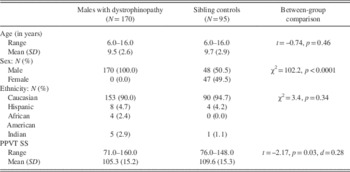
We compared 170 boys with dystrophinopathy to 95 of their unaffected siblings. Demographic data are presented in Table 1. Groups did not differ with respect to age or ethnicity. Groups did differ with respect to gender, such that all probands were males and 50.5% of the sibling controls were male (p<.0001). To ensure that there were no differences between female and male controls, independent sample t tests for all outcome variables were run and no between group differences were found (digit span scaled score, t=0.57, p=.60; maximum DSF Z-score, t=0.94, p=.35; maximum DSB Z-score, t=0.20, p=.84; reading composite score, t=0.01, p=.99; PPVT-III standard score, t=0.86; p=.40). We found that estimated general verbal function was lower in boys with dystrophinopathy compared to controls (p=.03). Of the probands, 150 (88.2%) were diagnosed with dystrophinopathy and 20 (11.8%) were diagnosed with BMD; and 70% of the boys with dystrophinopathy reported using a wheelchair for mobility. Mother’s education in both groups ranged from primary school to graduate/professional degree, with the majority having received some college education.
Participant characteristics.

Note. PPVT SS=Peabody Picture Vocabulary Test – Third Edition standard score.
Aim I: Between-group comparisons of total digit span scaled score
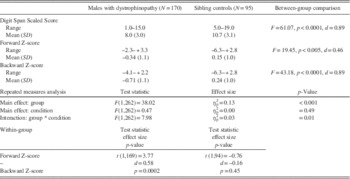
Results of the independent samples t test revealed that children with dystrophinopathy had lower mean total scaled scores on the digit span subtest compared to unaffected sibling controls (F=61.07; p<.0001).
Aim II: Examination of forward and backward length Z-scores
There was a significant main effect for group status (F(1,262)=38.02; ŋp 2=0.13; p<.001) indicating that proband performance significantly differed compared to unaffected siblings; however, there was not a significant main effect for condition (F(1,262)=0.47; ŋp 2=0.00; p=.49) suggesting comparable performance on forward and backward maximum spans. There was a significant interaction between group status (probands vs. sibling control) and condition (maximum DSF vs. maximum DSB) (F(1,262)=7.98; ŋp 2=0.03; p=.005). Post hoc analyses revealed a significant difference between groups on maximum DSF (F=19.45; d=0.46; p<.005) as well as maximum DSB (F=43.18; d=0.89; p<.0001), such that children with dystrophinopathy performed worse on both DSF and DSB compared to unaffected sibling controls. Additionally, probands performed differentially worse on maximum DSB compared to maximum DSF (t(1,169)=3.77; d=0.58; p=.0002), whereas unaffected siblings demonstrated comparable performance on maximum DSB compared to maximum DSF (t(1,94)=−0.76;d=−0.16; p=.45).
Aim III: Digit span contribution to reading
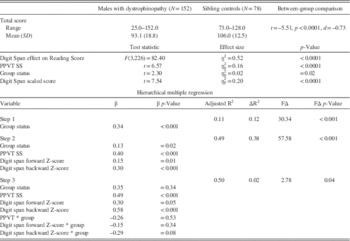
In a subset of the full study sample, 152 probands performed more poorly than 78 sibling controls on the reading composite score (t(1,228)=−5.51; d=−0.73; p<.0001). There was a significant contribution of digit span performance (Table 2), as measured by digit span scaled score, to reading score when general level of verbal function (PPVT-III standard score) and group status were included in the model (F(3,226)=82.40; p<.0001).
Digit span performance.

Hierarchical multiple regression revealed a significant effect of group status in Model I (F(1,228)=30.34; p<.001) and accounted for 12% of the variation in reading scores. In Model II, addition of main effects including general level of verbal function (PPVT-III standard score), maximum DSF length (Z-score), and maximum DSB length (Z-score) along with the group status variable, produced a significant overall model (F(4,225)=56.42; p<.001) accounting for an additional 38% of the variation in reading scores. Model III involved the creation of three interaction terms (i.e., group status × PPVT-III standard score, group status × maximum DSF Z-score, group status × maximum DSB Z-score). Each of these interaction terms was added into Model III with all variables entered into Model II. Model III revealed significant results (F(7,222)=34.19; p<.001), explaining an additional 2% of the variation in reading scores. Nevertheless, none of the interaction terms of group status and each of the cognitive predictors were significant, suggesting that the relationship of these cognitive skills to reading does not vary between groups (Table 3).
Contribution of digit span to reading performance.

Note. PPVT SS=Peabody Picture Vocabulary Test – Third Edition standard score.
Discussion
In the present study, digit span performance in boys with dystrophinopathy was examined in depth to determine whether the consistently observed decreased performance is due primarily to a deficit in immediate verbal memory. Using Baddeley’s model of working memory (Baddeley, Reference Baddeley2012; Baddeley et al., Reference Baddeley, Allen and Hitch2011), the hypothesis that boys with dystrophinopathy have a core deficit in the phonological loop, yielding limited storage of verbal information, was tested. We proposed that this deficit underlies the poor performance consistently observed on digit span and related tasks such as story memory and recalling sentences, in which holding verbal information in temporary storage is necessary.
The results showed that the lowered performance on digit span total scaled score was due to both decreased DSF length (measuring verbal span only) and decreased DSB length (measuring both verbal span and executive control), as hypothesized. The results also indicated, contrary to what we predicted, a significant group by condition interaction, such that for the boys with dystrophinopathy, digit span backward was preferentially worse than for controls. This finding suggests that the central executive plays an additional contributory role to their overall lowered performance on the task. Thus, in boys with dystrophinopathy, decreased verbal span is significant, but not the sole cognitive mechanism to account for decreased digit span performance.
As expected, reading performance was significantly lower among the boys with dystrophinopathy than controls. In reading in general, and among the reading disabled population, verbal short-term memory tasks recruiting the phonological loop and working memory tasks recruiting the central executive have been demonstrated to be two independent systems which reflect distinct constructs that contribute independently (Daneman & Carpenter, Reference Daneman and Carpenter1980; Engle, Tuholski, Laughlin, & Conway, Reference Engle, Tuholski, Laughlin and Conway1999; Siegel, Reference Siegel1994; Swanson, Reference Swanson1994; Swanson & Berninger, Reference Swanson and Berninger1995; Swanson, Xinhua, & Jerman, Reference Swanson, Xinhua and Jerman2009). For the boys with dystrophinopathy, the total digit span score contributed significantly more variance to reading performance than for controls. Moreover, both DSF length and DSB length contributed to reading performance in both groups, yet there were no significant interactions between the groups and forward and backward span lengths on the contribution to reading performance. This finding indicates that the underlying cognitive mechanism is not distinguishable between the groups. Instead, the group with dystrophinopathy can be thought of as a more “extreme” presentation of the combined contributions of verbal span and executive control to reading, without preferential involvement of one cognitive construct over the other.
The study has several limitations. Although the study has the distinct advantage of using familial controls (thus limiting both genetic and educational background biases sometimes found in non-familial controls), to maximize recruitment, this added potential gender and age confounds to the analyses. Specifically, given that dystrophinopathies are X-linked disorders, our proband group is all male. Given that the disease is a rare disorder, by necessity unaffected sisters as well as brothers were included in our control group to increase our sample size (however, wherever possible, preference was given first to male gender in selecting the control participant). Upon examination, we found no differences between female and male controls on the PPVT-III, digit span measure, or reading scores.
Additionally, there is concern that among the sister controls, it is possible that some will be carriers and as such may have subtle cognitive phenotypes themselves. Our IRB did not allow us to test for carrier status among our controls because they were minors, so we cannot determine how many of the girls included are carriers. However, the inclusion of female carriers who may have similar phenotypes would actually make the likelihood of finding significant between group differences more difficult, such that the significant findings reported may, in fact, be even more robust. Sibling controls were chosen who were within 5 years of the proband’s age, again to maximize recruitment in this rare disorder. The age differences between the sibling pairs may also introduce variance in the analyses. However, there were no between group differences in age and the selection randomly included both older (54%) and younger siblings.
Another limitation of the study is that different versions of the Wechsler digit span test (WISC-III and WISC-IV) were used because the digit span data were acquired over time and across studies. We attempted to control for this difference when examining span length by taking maximum span raw data and applying the same (more recent) normative values for the entire sample. Furthermore, data were pulled from various studies and were not collected a priori with the current analysis in mind, such that participants received the measures as parts of different test batteries. Therefore, although individual test administration was standardized across the groups, order of test administration was not. Nonetheless, aggregating the data in this way allowed for presentation of the largest data set of these measures to date.
Furthermore, no data examining oral motor capacity is presented, and it is possible that children’s expressive abilities might well limit their performance on the digit span task in a way that is distinct from either phonological storage or executive control. Although no standardized measure of this skill is presented, all children within the cohort gave verbal assent to participate and all were able to speak. Moreover, prior work from our group showed no significant differences between probands and controls on measures of verbal fluency (Hinton et al., Reference Hinton, De Vivo, Fee, Goldstein and Stern2004) or formulated sentences (Hinton et al., Reference Hinton, Fee, Goldstein and De Vivo2007), which is suggestive of adequate oral motor capacity among individuals with dystrophinopathy. Lastly, using digit span as a measure of phonological storage versus executive control is admittedly limited, and the idea that the constructs can be explicitly separated is perhaps somewhat simplistic. Nonetheless, the measure and the model provided a simple, testable means of investigating a large sample of children with a rare disease, and as such allowed for exploration of underlying cognitive mechanisms.
In summary, the findings do support the hypothesis that verbal span is compromised in the dystrophinopathy group and diminished phonological storage plays a significant role in the lowered reading performance observed. However, the results also indicate that the central executive is compromised as well. Limited phonological storage is a significant and necessary component underlying poor reading performance in this group, yet it is not sufficient to account for the full cognitive phenotype associated with the disorder.
Acknowledgments
Our deepest appreciation goes out to all the families who offered time and support to participate in the study, as well as all the physicians and staff that helped us in its completion. This work was supported by grants from the National Institutes of Health (NINDS, grant number R01 NS047918), (NICHD, grant number R29 HD34155), and the Muscular Dystrophy Association to V.J.H. Disclosures: Leaffer, E.B., Fee, R.J., and Hinton, V.J. declare that they have no conflict of interest.