Introduction
A disaster can be defined as a serious, abrupt event resulting from large-scale destruction of the ecological relationship between humans and the environment, necessitating extraordinary response efforts in the affected communities, as well as assistance from unaffected areas.Reference Gunn1 The time following disaster-producing events often is a state in which the balance between demand and supply of medical services is disturbed.
Disaster medical care systems for severe emergencies in Japan began to be developed after the massive Hanshin Awaji Earthquake of 1995. At the height of that emergency, there was an extraordinarily high demand for medical services due to the large numbers of people injured during the quake. At the same time, the availability of medical services was reduced significantly because hospitals could not function normally due to damaged buildings, cuts to lifeline services, and difficulty in securing medical staff. It was estimated that there were a total of 380 wounded and ailing persons who needed wide-range transport for emergency medical care within the first 24 hours, and a further 120 people who needed treatment within 72 hours. However, in reality, only one person was airlifted by helicopter on the day of the quake, and only a further 17 within the first 72 hours. This strongly highlighted the need for wide-range transport to move large numbers of injured people from the area affected by the event, and the need to dispatch medical care teams to carry out these transfers. Thus, the idea of preparing hospitals to serve as bases to facilitate these processes was raised.Reference Tanaka2–Reference Ishii6
Having learned from these experiences, the Japanese government has worked to provide a disaster medical care system centered on hospitals as disaster management bases. Several core disaster management hospitals were set up in each prefecture, with one such hospital designated for each municipality. In the event of a disaster, these hospitals are to play a core role in disaster medical care facilitation, such as field emergency care, wide-range patient transport, and dispatch of medical support teams.Reference amamoto7–Reference Henmi8
This system aims to address the excess need for emergency services early during a disaster by adding resources while reducing the potential for such need. However, this system alone is unable to address the overwhelming imbalance between service needs and supply. At the time of a disaster, it is necessary to use the available resources in different locations and situations as efficiently as possible. To do this, it is necessary to deploy resources where they will be most effective. Thus, for this study, the emergency and medical service activities in the aftermath of the Chuetsuoki Earthquake were analyzed to determine the types of activities that are most efficient and effective.
Niigata Chuetsuoki Earthquake
The Niigata Chuetsuoki Earthquake, magnitude 6.8, struck on 16 July 2007, at 10:13 a.m. The seismic epicenter of the quake was located offshore near the city of Kashiwazaki in Niigata Prefecture. Fifteen people were killed and 2,345 were injured, 1,319 buildings were destroyed, 857 buildings were damaged severely and 4,764 buildings sustained substantial damaged.
Methods
The emergency patient transports performed as a result of the quake were studied. The patient transport records of the emergency service agencies involved in the earthquake responses were analyzed, and interview surveys were conducted. The interview survey portion was carried out with the comprehensive cooperation of the Kashiwazaki firefighting agency.
Results
Injuries Caused by the Earthquake
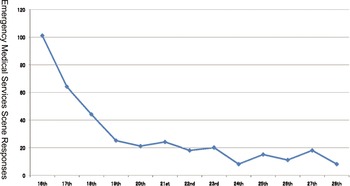
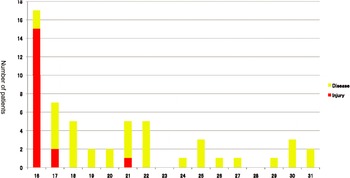
Data related to emergency medical service scene responses are graphed in Figure 1. The rate of emergency attendance remained high for 2 to 3 days after the earthquake. The trend for patients with life-threatening (critical) conditions is graphed in Figure 2. The number of persons with trauama-related injuries caused by the quake decreased after the day of the earthquake.
(Color online) Emergency medical service scene attendance

(Color online) Trend for patients with critical conditions

Overview of Patients on the Day of the Earthquake
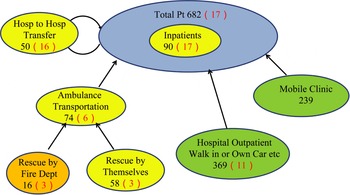
Considering the above findings, the data on the conditions of the patients were analyzed, focusing on the day of the earthquake. A total of 682 persons were treated on the day of the quake. This total is the sum of the number of persons who received treatment at a hospital and those at a first-aid station on the day of the quake. The total number of hospitalized patients was estimated at around 90, comprising 24 admitted to Kariwa-gun General Hospital and 62 who subsequently were transferred to other hospitals, assuming that there were no persons requiring hospitalization who directly went to these other hospitals. The number of patients with life-threatening (critical) conditions was estimated to be 17 on the day of the earthquake, based on the diagnosis and severity of conditions noted in the transport data of the emergency service records. There was a total of 124 patient transfers, of which 74 were directly from an emergency scene to the hospital and 50 were inter-hospital transfers. The data on treated patients on the day of the quake are illustrated in Figure 3.
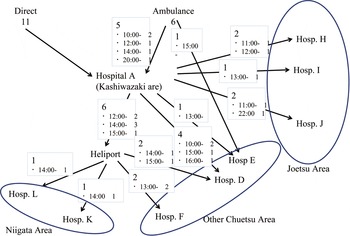
(Color online) Flow of patients on the day of the earthquake ( ( ) = serious case)

Overview of Patients
In the order of severity of their conditions, there were a total of nine deaths (8%), 17 critical injuries (21%), 46 moderate injuries (38%), and 33 slight injuries (33%).
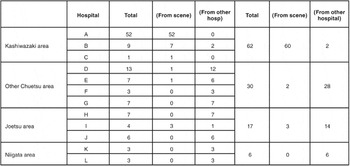
The hospitals to which patients were transported are listed in Table 1. A total of 60 persons were transported to medical facilities in Kashiwazaki, in most cases directly from the emergency scene. Most cases of transport outside the city were transfers between hospitals: 28 to other parts of Chuetsu district outside of the city; 25 to the Joetsu district; and six to Niigata.
Hospitals and number of patients transported

Transport Route of Patients in Critical Condition
The total number of patients in critical condition was 17. Of these, three were rescued and transported to a hospital by firefighters, six were transported by ambulance, and 11 were transported to hospitals privately. Of these, 16 were transferred on to other hospitals, including six by helicopter. The transport of critical patients essentially was completed by around 16:00 h. (Figure 4).
(Color online) Transportation ties and location of hospitals of serious cases (Hosp = hospital)

Meeting the Demand for Emergency Services
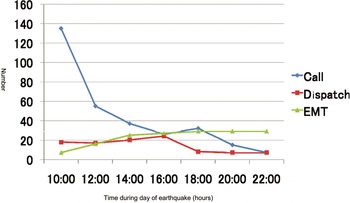
Emergency (“1-1-9”) calls on the day of the earthquake could not be answered adequately up to around 12:00 h. due to phone line congestion. An outline of 119 emergency calls and responses as a time-series is depicted in Figure 5. However, it is assumed that before 12:00 h there were more calls than the available data suggest.
(Color online) Trend of the demand and supply of ambulance services

Comparing the number of cases of emergency service scene attendance and the number of emergency medical teams, it is clear that the response situation improved greatly after 2:00 p.m., when more emergency teams became available. This was confirmed by interview surveys at the emergency scenes.
Emergency Vehicle Operations and Activities
Immediately after the earthquake struck, ambulances responded to service requests, but due to the overwhelming number of requests, there was a dramatic shortage of available vehicles. For this reason, after completing an emergency call, each emergency team and vehicle would return to Kariwa-gun General Hospital, and the hospital was used as a base from which crews were dispatched to emergency scenes or to conduct inter-hospital transfers. After 16:00 h., when sufficient ambulances became available, the gathering point and base of operations was shifted to the Kashiwazaki Fire Station.
When a disaster occurs, the number of available emergency response vehicles becomes grossly inadequate. Therefore, to use these limited resources with maximum effectiveness, it is necessary to concentrate operations. In view of this, the data on emergency vehicle disaster scene attendance and transfer activities were analyzed.
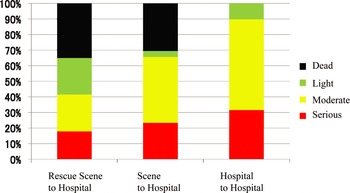
The differences in the severity of the medical condition of the victim by the type of emergency service are graphed in Figure 6. When comparing data on responses at emergency scenes with that of inter-hospital transfers, it is clear that inter-hospital transfers made for fewer dead or slightly injured patients. This indicates a relatively efficient transport operation.
(Color online) Comparison the severity of patient transported

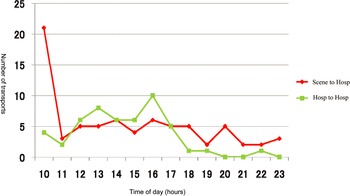
A comparison of these values is graphed in a time-series format in Figure 7. Immediately after the earthquake occurred, emergency vehicles were used chiefly for attending emergency scenes. Then, between 12:00 h and 17:00 h, a large proportion of the vehicles were used for transfers between hospitals. After 18:00 h, most ambulances again were dispatched to emergency scenes.
(Color online) Comparison of number of transports/hour during the day of the earthquake (Hosp = hospital)

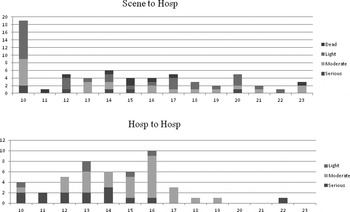
A comparison of the number of emergency scene responses cases and the number of hospital transfers by severity of the patients’ condition also is graphed in the form of a time-series in Figure 8. Inter-hospital transfer was efficient in transporting severely injured patients from early on. Between 13:00 h and 17:00 h, many critical patients were transferred between hospitals, but this does not mean that hospital transfers were given priority over emergency scene attendance.
(Color online) Comparison of severity amd number of patients transported

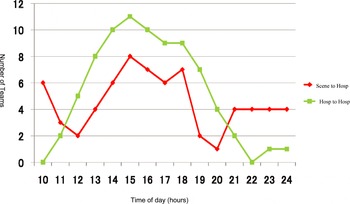
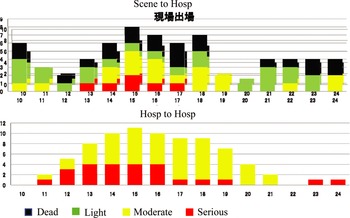
The number of responding emergency medical teams over time, rather than the number of attended cases are in Figures 9 and 10. Inter-hospital transfer was efficient in transporting critically injured patients from early on. Between 12:00 h and 20:00 h, the majority of emergency teams were engaged in inter-hospital transfers. However, inter-hospital transfers for patients in severe conditions were not prioritized.
(Color online) Comparison of the number of emergency response teams over time during the day of the earthquake

Comparison of severity and number of emergency response teams over time

Rescue Activities
The breakdown of rescue activities shows that there were 42 cases of emergency scene responses, 28 rescue incidents, 22 persons rescued by firefighters, and 10 persons rescued by civilians. On the day of the earthquake, the breakdown was 28 cases of emergency scene responses, 19 rescue incidents, 20 persons rescued by firefighters, and 10 persons rescued by civilians. As for transport of rescued people, there were 12 cases of transport by ambulance teams, and eight cases of transport by firefighters or rescue teams.
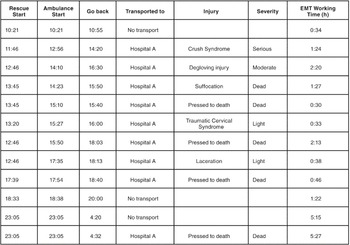
A breakdown of rescue activity duration results in five cases of <1 hour and seven cases of >1 hour. The time lag between identification by a rescue team of a victim needing emergency care and the arrival of an ambulance team was <30 minutes in five cases and >30 minutes in seven cases. From the time immediately following the earthquake until around 17:00 h, there was a shortage of ambulances available to respond immediately to rescue needs. So ambulances participated in some cases during involvement in other incidents. After 17:00 h, when the rate of requests for ambulance services decreased, ambulances again were mostly attending to emergency requests. However, even during the period when ambulances were in short supply, there were four cases in which ambulances were held up for >1 hour (Table 2).
Activity of the emergency medical team (EMT) in the rescue scene (h = hours)

Patient severity in rescue cases was compared with overall emergency scene attendance and with hospital transfers (Figure 6). There was a relatively high incidence of deaths in rescue incidents, but the proportion of critical patients was relatively low compared to that for responses at the emergency scenes and for hospital transfers. However, out of 17 critical patients, three were rescue cases.
Discussion
How long do emergency medical needs continue?
The continuation of emergency medical needs during the acute period of a disaster varies depending on the magnitude of the earthquake and the particular social conditions. Generally, emergency medical needs are thought to continue for about 48–72 hours after the event, but when the damage is great and response resources are limited, the emergency period designation may extend for up to one week or more.Reference Sami, Ali, Zaidi, Rehman, Ahmad and Siddiqui9–Reference Kondo15
With regard to the Niigata Chuetsuoki Earthquake, the period of emergency medical need, during which transport and medical resources were severely lacking relative to the number of casualties, lasted until approximately 17:00 h on the day of the earthquake. By that time, all of the earthquake victims in need of critical medical care had been transported outside of the affected area. Meanwhile, the balance between emergency requests and emergency vehicle availability also had recovered. Accordingly, in this case, the acute emergency period and emergency medical needs were resolved by approximately 17:00 h on the day of the earthquake.
Where Were the Critical Patients?
The system of disaster medical assistance teams (DMATs) has been established in Japan.Reference Kondo, Koido, Morino, Homma, Otomo, Yamamoto and Henmi16 When deciding how to invest in DMATs and other resources, and how to plan for efficient ambulance operations, it is necessary to understand the characteristics of critically injured patients. For example, considering whether patients still are at the scene waiting for assistance from emergency services, or whether they are heading to medical care facilities alone or with the help of others. In the case of the Hanshin Awaji Earthquake, many sick and injured people made it to hospitals on their own or with the help of others.Reference Tanaka3
Seventeen persons suffered life-threatening injuries on the day of the Niigata Chuetsuoki Earthquake. There were no cases of victims with severe external injuries reported from refuges or first-aid stations.
In previous disasters, many severely injured persons were discovered in the course of rescue work.Reference Barbera and Macintyre17–Reference Nagata, Rosborough, VanRooyen, Kozawa, Ukai and Nakayama18 However, even on the scale of this kind of earthquake, there were 14 severely injured people who were not discovered in the course of rescue work, which represented the majority of the total number of critical patients. In addition, it was thought that the majority of critical patients were transported to medical facilities by ambulance. However, after the Niigata Chuetsuoki Earthquake, 11 critical patients—the majority—were not taken to hospital by ambulance. Three critical patients were rescued and six were transported to medical facilities by ambulance. Although these cases do not represent a high proportion, such cases certainly occur with a significant frequency.
Critical patients with life-threatening conditions were taken to hospitals. The need for transport services for critical patients is greater for transfers from one hospital to another than from an emergency scene.
Given this, one can conclude that, after the Chuetsuoki Earthquake, many critical patients traveled to a hospital by themselves or with the help of others. Furthermore, one can assume that, after a larger earthquake, there would be even more people who would be unable to receive medical transport from government emergency services, and therefore, would be compelled to travel to hospitals using other resources.
Efficiency of Ambulances and Ambulance Teams
Relative to the needs in the acute stage of a this event, available ambulances and ambulance teams were grossly inadequate. Therefore, it is necessary to use limited resources as effectively as possible.
From this survey, it was found that inter-hospital transfers accounted for more transports of severely injured patients than did direct responders to emergency scenes. Accordingly, it is more efficient to invest greater resources into inter-hospital transfers, particularly during the initial, acute emergency phase. For the response effort in this earthquake emergency, the ambulances were based at Kariwa-gun General Hospital, and during the period of greatest emergency service needs, more than half of the available resources were deployed for inter-hospital transfers. However, there also were resources deployed to emergency scenes, some of their activities at the scenes were not necessarily effective. It also was learned that, although there were some critical patients at the emergency scenes, the general severity of injuries was not necessarily high. Thus, during the period when transport resources are in short supply, there is a need to maximize efficiency—for example, by attending rescue sites only after seriously injured people are discovered. However, ambulances remained at the scene for long periods of time in some cases.
Based on the experience gained from the Chuetsuoki Earthquake, it is more efficient to concentrate the deployment of transport resources for inter-hospital transfers in order to use ambulances more effectively during the acute phase of emergencies, when resources are in short supply. However, ambulances must be dispatched to the scene when it is confirmed that the assistance of ambulance teams is necessary—for example, when injured people are found at rescue sites.
Furthermore, with respect to ambulance team activities, there have been reports of successful collaboration with DMATs. Collaboration between DMAT and ambulance teams can result in high-quality disaster response actions.
In order to efficiently and effectively implement this kind of operation, it is essential to have a command center or control function capable of centrally managing the operation of ambulance services. It also is necessary to collaborate with DMATs and other medical systems. During the disaster examined in this study, these requirements were met, because Kariwa-gun General Hospital coordinated the ambulance service operations during the acute phase of the emergency.
For future disasters, it may be necessary to set up a command center for ambulance operations within the disaster-affected area and establish it adjacent to the DMAT field headquarters, or alternatively establish a system of collaboration by dispatching a controlling DMAT as a liaison.
Conclusion
The critical medical treatment needs resulting from the Chuetsuoki Earthquake were distributed more or less satisfactorily over the course of a day.
During the acute phase of an emergency, it is difficult to respond to all emergency service requests. In such cases, it is necessary to conduct activities as efficiently as possible by focusing efforts on the most severely injured patients. As inter-hospital transfers are used predominantly for critical patients, it is necessary to give priority to hospital transfers when deploying resources during the acute phase in which ambulances are likely to be in short supply.
While there may be calls to treat seriously injured people at the scene of a disaster, people actually may not be in need of critical care, so it may be inefficient for ambulances to stay for long periods at emergency scenes. To maximize the efficiency of the rescue process, it is necessary to dispatch ambulances according to critical care needs.
The emergency service needs in the event of a disaster may vary over time. In order to respond appropriately to disasters, close information exchange and collaboration between ambulance and firefighting teams, firefighting organizations, DMATs, and medical institutions is essential.
Abbreviations:
DMAT = disaster medical assistance team