Introduction
The term ‘narrow nose’ has both functional and aesthetic connotations. Functionally, the narrow nose can cause symptoms of nasal obstruction due to a narrow nasal valve. Cosmetically, the middle third of the nose may be overly narrow, with a pinched appearance and visible collapse of the lateral walls on inspiration.
The exact site of the nasal valve is contentious. A review of the literature revealed a range of interpretations and definitions regarding the nasal valve region.Reference Wexler and Davidson1
In this review, we describe the aetiology and clinical findings in patients with symptoms relating to a narrow nose, and we present an up-to-date review of the treatment options available.
Anatomy
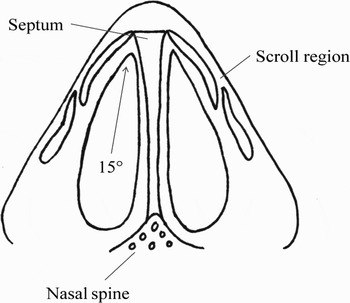
The nasal valve is frequently subdivided into the internal and external nasal valves. The internal nasal valve is defined as the caudal margin of the upper lateral cartilage, the nasal septum and the floor of the nose. The angle between the upper lateral cartilage and the septum, i.e. the nasal valve angle, normally ranges from 10 to 15°. If the inferior turbinate is large, it can contribute to the boundaries of the internal nasal valve (Figure 1).Reference Toriumi, Josen, Weinberger and Tardy2 The external nasal valve refers to the lateral crus of the lower lateral cartilage and the surrounding soft tissues.Reference Wexler and Davidson1
The internal nasal valve.

The upper lateral cartilages are in continuity with the septal cartilage and are well supported at their attachment to the nasal bones; however, they have relatively poor support laterally as this area comprises soft tissue and sesamoid cartilages. They may also show an inward curling which can contribute to narrowing of the nasal valve region.Reference Bruintjes, Van Olphen, Hillen and Huizing3 The lower lateral cartilages encompass the nostrils and are attached laterally to the piriform aperture by dense fibrofatty tissue. If the lateral component of the lower lateral cartilage is poorly supported or is medially displaced, then the lateral wall may collapse on inspiration.Reference Menger4
The scroll area is where the upper and lower lateral cartilages interrelate. Three different configurations are possible. Commonly, the cephalic edge of the lower lateral cartilage overlaps the caudal edge of the upper lateral cartilage (Figure 1).
Physiology
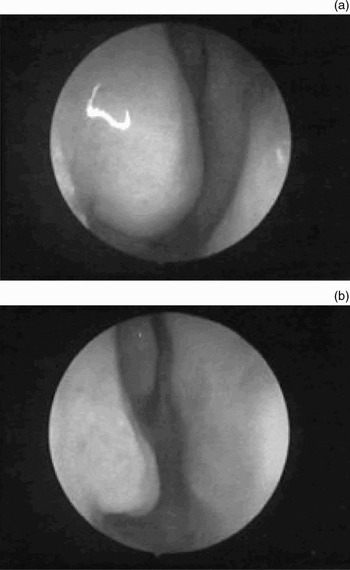
The resistance of the nasal valve area is dependent not only on its static anatomical components but also on its dynamic components. The state of engorgement of the anterior end of the inferior turbinate has a significant effect on nasal resistance. Cole described the nasal valve as the area of maximal airway resistance in the nose, emphasising the importance of the erectile soft tissue elements of the nose.Reference Cole5 Decongestants can produce a 50 per cent reduction in nasal resistance by stimulating α-adrenergic receptors on the nasal mucosa, leading to vasoconstriction of local vessels and reduction of mucosal oedema (Figure 2).Reference Haight and Cole6
Nasal valve region (a) before and (b) after decongestant.

Another important factor is the tendency of the nasal valve to collapse at high airflow rates.Reference Kasperbauer and Kern7 The cross-sectional area of the nasal valve accounts for up to 50 per cent of the nasal resistance in the upper respiratory tract. The valve area will determine the degree of Bernoulli effect; this principle states that the pressure drop is inversely proportional to the square of the cross-sectional area. As rate of airflow through the valve increases the pressure inside the valve decreases, thereby increasing the likelihood of nasal valve collapse. By this principle, some degree of nasal valve collapse is normal with deep inspiration, but individuals with weakened cartilage support or narrow nasal valves are more prone to airflow-induced nasal valve collapse.Reference Schloser and Park8
Physiological studies of intranasal pressure measurements have shown the ‘flow limiting segment’ corresponds to the piriform aperture.Reference Bridger and Proctor9 Some degree of pressure drop does occur over the cartilaginous portion of the nose, but the majority occurs in the first several millimetres of the bony nasal cavum starting at the piriform aperture.Reference Jones, Wight, Stevens and Beckingham10
Pathology
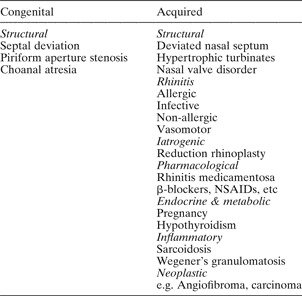
Nasal obstruction is very common, with septal deviations and turbinate hypertrophy causing the majority of airway problems (Table I). In patients who are still symptomatic despite maximal medical therapy and/or seemingly successful surgery to the nasal septum and/or turbinates, alternative reasons for their symptoms must be considered. Deficiencies in anterior nose support may result from ageing, trauma, iatrogenic causes, inflammatory and autoimmune disease, and, less commonly, from a congenital cause.Reference Grymer11
Causes of nasal obstruction

NSAIDS = non-steroidal anti-inflammatory drugs
Internal nasal valve collapse may be seen after previous reduction rhinoplasty when a large portion of the cartilaginous hump has been removed, thus reducing the stability between the upper lateral cartilages and the septum, or in older patients with weakening of the supportive structures of the nose.Reference Toriumi, Josen, Weinberger and Tardy2 The classic ‘tension nose’ patient with short nasal bones, weak upper lateral cartilages, a nasal valve angle of less than 10–15° and thin overlying skin is particularly at risk of valve collapse following rhinoplasty.Reference Nolst Trenite and Nolst Trenite12
External nasal valve collapse is less common, and may be caused by overly aggressive resection of the lower lateral cartilages. Certain patients may also be predisposed to external nasal valve collapse, such as those with narrow, slit-like nostrils, a projecting tip and thin alar sidewalls, or those with caudal septal deflections.Reference Millman13 Vestibular stenosis is an uncommon cause of nasal obstruction, usually resulting from scar formation following nasal surgery.
Nasal piriform aperture stenosis is an uncommon cause of nasal obstruction. The aetiology may be congenital, developmental or traumatic. Patients tend to have a narrow nasal base with slit-like nostrils. Diagnosis can be confirmed on axial computed tomography (CT) imaging.Reference Erdem, Ozturan, Erdem, Akarcay and Cem Miman14
Assessment
Nasal obstruction can be multifactorial; thus, a thorough history and examination are necessary in order to identify the aetiology and to devise a successful treatment plan.
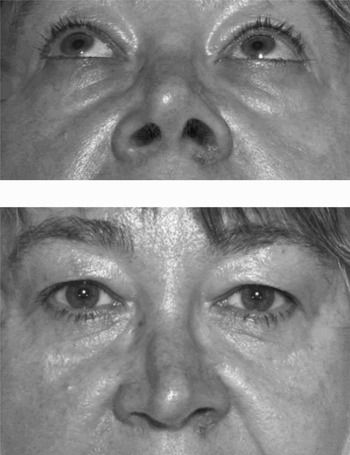
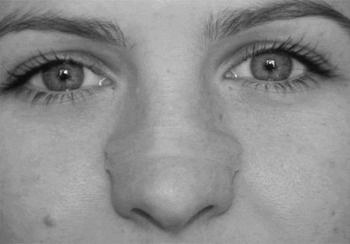
The cosmetic appearance of the nose may be of a pinched tip deformity which collapses on inspiration (Figure 3). There may be evidence of previous trauma or rhinoplasty. In older patients, it is not uncommon to see a ptotic tip or supratip dorsal hump caused by senile loss of tip support.Reference Millman13
Unilateral (right) alar collapse on inspiration.

Internal examination allows assessment for mucosal disease, turbinate hypertrophy and septal deviation. Inspection of the nasal valve area should also be done without a speculum, which may distort the valve angle and thereby prevent differentiation between internal and external nasal valve collapse.Reference Nolst Trenite and Nolst Trenite12 On forceful inspiration, the patient's symptoms are exacerbated, with collapse of the nasal valve area and resultant obstruction.Reference Millman13
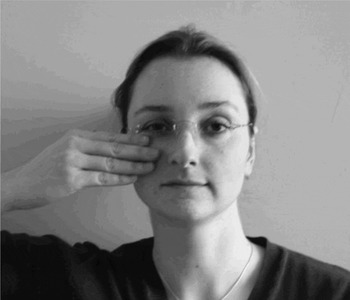
Cottle's manoeuvre (i.e. superolateral traction on the nasofacial groove) will relieve nasal obstruction if there is internal valve collapse (Figure 4). Elevation of the valve area by lifting the lateral crus superolaterally away from the septum with a cotton bud confirms the Cottle's manoeuvre result.Reference O'Halloran15
Cottle's manoeuvre.

If decongestion of the nose completely relieves obstruction, valve collapse is unlikely and medical management is indicated. Rigid endoscopy is recommended to exclude other causes of nasal obstruction such as post-nasal space lesions.
Acoustic rhinometry is a non-invasive, reliable, objective method which can be used to determine the cross-sectional areas of the nasal cavity as a function of the distance from the nostril. Results correlate well with those of CT, rhinomanometry and direct measurements using saline. Acoustic rhinometry is not routinely used in clinical practice but does have an established role for clinical and basic science research.Reference Wexler and Davidson1, Reference Grymer11
Management
Non-surgical treatment
It is important to consider a trial of medical treatment before undertaking any surgical intervention. Nasal steroid sprays, ensuring good compliance, should effectively treat rhinitis, which is a very common finding in the general population.Reference Weiner, Abrahamson and Puy16
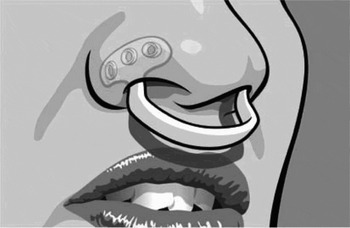
Non-surgical techniques to address nasal valve collapse include the use of external adhesive strips and internal nasal springs that physically hold open the nasal valve (Figures 5 and 6). To many patients, these may be uncomfortable and cosmetically unacceptable options. However, in those individuals who are unfit for or unwilling to undergo surgical intervention, they can offer some symptomatic relief. Roithmann et al. reported that the nasal valve area was smaller in patients with post-rhinoplasty nasal obstruction compared with those with healthy nasal cavities, as shown by acoustic rhinometry; furthermore, they showed that external dilatation was an effective therapeutic approach resulting in a significant increase in the minimum cross-sectional area of the nasal cavities.Reference Roithmann, Chapnik, Zamel, Menna Barreto and Cole17
Alar dilator device.

External nasal dilator strip.

Viaman et al. described the treatment of nasal valve collapse using high frequency transcutaneous and intranasal electric stimulation of nasal muscles in order to strengthen the nasal valve walls.Reference Viaman, Shlamkovich, Eviatar and Segal18 This treatment initially resulted in significant subjective benefit and objective improvement on rhinomanometry, compared with a placebo. Treatment was well tolerated. However, when treatment was stopped, there was a rapid return to the pre-treatment state (as assessed by rhinomanometric data).
Surgical treatment
Methods of correcting internal nasal valve collapse focus on repositioning the upper lateral cartilages or adding structural grafts to support the lateral nasal wall.Reference Toriumi, Josen, Weinberger and Tardy2 External nasal valve collapse can be repaired by realigning cephalically placed lateral crura and placing structural grafts into the alar lobule to provide support and prevent collapse. The choice of technique depends on aetiology, extent of collapse, the experience or preference of the treating ENT specialist, and the patient's preference.
Internal nasal valve collapse
(1) The use of spreader grafts were popularised by Sheen. This technique addressed internal nasal valve collapse, following reduction of a high bony-cartilaginous dorsum by lateral augmentation with autogenous cartilaginous grafts sited paramedially to the septum. These grafts spread the upper lateral cartilages away from the septum and increased the width and strength of the nasal valve, reducing its tendency to collapse. Aesthetically, spreader grafts restore width to a pinched, narrow nose. They can be placed using either a closedReference Sheen19 or an openReference Nolst Trenite and Nolst Trenite12 approach. Submucoperichondrial pockets extending cephalad past the caudal arch of the bony pyramid are developed on both sides, and grafts are placed and secured between the dorsum of the septum and the medial border of the upper lateral cartilages. Khosh et al. reported that 22 of 25 (88 per cent) patients with internal nasal valve dysfunction had subjective improvement of nasal obstruction following nasal valve reconstruction with spreader grafts.Reference Khosh, Jen, Honrado and Pearlman20 A modification of this technique, the upper lateral splay graft, has been described by Guyuron et al. Reference Guyuron, Michelow and Englebardt21 A conchal cartilage graft is placed deep to the upper lateral cartilages via an open approach and spans the dorsal septum. The authors report that the intrinsic spring in the graft elevates the upper lateral cartilages, thus correcting the middle vault collapse and widening the internal nasal valve; however, they caution that there can be excessive widening of the nasal dorsum.
(2) The use of spreader flaps has been described by Gruber et al. as an alternative to the classic spreader graft technique for reconstruction of the middle third of the nose.Reference Gruber, Park, Newman, Berkowitz and Oneal22 In open rhinoplasty, the upper lateral cartilage is released from the cartilaginous septum and nasal bone and rolled up on itself to create a spreader flap that is sutured to the dorsal septum. Gruber et al. reported that, of 21 patients who underwent the procedure, only one had an inadequate nasal width post-operatively.
(3) A spreader graft injection has recently been described for management of internal nasal valve collapse. Calcium hydroxyapatite is injected into the submucoperichondrial and/or submucosal plane at points on the upper lateral cartilage and at the junction of the dorsal septum and upper lateral cartilage, in order to lateralise and strengthen the upper lateral cartilage. Nyte has reported early successful treatment in 23 patients.Reference Nyte23
(4) A conchal cartilage butterfly graft has been used by Stucker and Hoasjoe to repair the internal nasal valve: a butterfly-shaped piece of conchal cartilage was placed across the supratip area in order to increase resistance at the scroll area.Reference Stucker and Hoasjoe24 Fifty-six patients with lateral nasal wall collapse underwent the procedure. All patients reported subjective improvement in nasal airway breathing, and 53 patients reported improvement in the appearance of their nose. Stucker and Hoasjoe advocated the technique for managing severe cases of post-rhinoplasty lateral wall collapse. The technique necessitates an external approach, a second operative site and potentially significant aesthetic change to the nose. Clark and Cook have reported a similar technique for alleviation of post-rhinoplasty internal nasal valve dysfunction, involving placement of a smaller graft through a closed approach.Reference Clark and Cook25 Seventy-two patients with two years’ minimum follow up reported significant subjective improvement of nasal obstruction, with 70 patients (92 per cent) reporting complete resolution. Sixty-two patients (86 per cent) reported an improvement in the appearance of their nose.
(5) The use of alar batten grafts has been described by Toriumi et al. for internal nasal valve or external nasal valve repair.Reference Toriumi, Josen, Weinberger and Tardy2 A strip of cartilage shaped to span from the piriform aperture to the lateral crura is placed in a subcutaneous pocket at the point of maximum lateral nasal wall collapse, using either an open or endonasal approach. Following alar batten grafting, 45 of 46 patients experienced improvement in nasal obstruction. Initial post-operative fullness in the supra-alar region decreased with time, with a reported overall improvement in the cosmetic result. Millman undertook a retrospective review of 21 patients who had undergone alar batten grafting and reported a 100 per cent improvement in nasal obstruction, with six of the 21 reporting minor aesthetic fullness at 12 months’ follow up.Reference Millman13
(6) Implants made from porous polyethylene (a non-resorbable synthetic material which permits in-growth of fibrous tissue inside and around it) are now commercially available. These implants come in a wide variety of preformed shapes and are commonly used for facial reconstruction. Such implants are available for internal nasal valve and external nasal valve collapse. For internal nasal valve collapse, a lateral implant or a porous polyethylene spreader graft can be used. For external nasal valve collapse, a porous polyethylene batten implant is available. Ramakrishnan et al. evaluated the long term outcome of correction of nasal valve collapse with porous polyethylene implants in 12 patients.Reference Ramakrisnan, Danner and Yee26 Complete resolution of nasal symptoms was reported in nine (75 per cent) patients at five year follow up. However, there was significant post-operative infection, implant extrusion (21 per cent; four of 12 patients, five of 24 implants) and need for revision surgery (42 per cent). In contrast, Gurlek et al. used porous polyethylene as nasal spreader grafts in 15 patients with internal nasal valve collapse, and reported neither complication nor recurrence of airway obstruction.Reference Gurlek, Celik, Fariz, Ersoz-Ozturk, Eren and Tenekeci27
(7) Piriform aperture surgery is another alternative for treatment of internal nasal valve collapse. Internal valve collapse due to a narrow piriform aperture is often associated with a prominent soft tissue web from the caudal edge of the upper lateral cartilage to the floor of the nose. Woodhead described removal of bone to widen the piriform aperture, combined with a Z-plasty to lengthen the web to allow the inferior nasal wall to lateralise.Reference Woodhead28 Complications included one case of denervation of the lateral incisor. This author had a personal series of seven patients who had undergone widening of the piriform aperture, of whom five had had good results at six month follow up. One patient reported no improvement, and one reported minimal improvement with temporary numbness of the incisors.
(8) The use of nasal valve suspension was first reported by Paniello, who described a technique involving suspension of the nasal valve to the orbital rim for patients with symptomatic nasal valve collapse. The medial orbital rim is exposed through a transconjunctival incision, and sutures placed through the mucosa either side of the region of collapse are then passed deep to the facial skin and muscles and secured at the orbital rim, either to the orbital periosteum or to a fixation screw. All 12 patients in Paniello's study reported improvement in nasal breathing. Mild widening of the middle third of the nose was noted in six patients. Complications included temporary epiphora and conjunctival suture granuloma.Reference Paniello29 Friedman et al. modified Paniello's technique, utilising a skin crease incision at the infraorbital rim and a bone anchor to secure the suture.Reference Friedman, Ibrahim and Syed30 Persistent partial collapse was reported in five of 86 patients; two patients required revision surgery and one patient developed an abscess. Infraorbital fullness at the level of the bone anchor was noted, but no patients reported significant cosmetic problems.
(9) Repositioning of the upper lateral cartilages may be used in patients with internal nasal valve collapse, or those at risk of developing it following reduction rhinoplasty. Horizontal mattress bending sutures are used to allow the upper lateral cartilage to curve outwardly into the internal nasal valve area. This technique involves an external approach with placement of mattress sutures and reattachment of upper lateral cartilages to the septum to create a T-shaped configuration of the nasal vault. Ozturan et al. assessed the efficacy of this technique to prevent post-operative internal nasal valve collapse in patients with tension nose undergoing reduction rhinoplasty or septorhinoplasty. They reported a statistically significant post-operative improvement in the mean nasal valve angle. Patients and surgeons were satisfied with the cosmetic appearance, and no patients developed post-operative nasal obstruction. Ozturan and colleagues concluded that this method avoided post-operative nasal valve stenosis, but they did not assess its efficacy in treating established internal nasal valve collapse.Reference Ozturan, Cem Miman and Kizilay31
External nasal valve collapse
(1) The lateral crural J flap repair for external nasal valve collapse was reported by O'Hallorhan.Reference O'Halloran15 This author proposed that external nasal valve collapse was due to weakening of the fibroareolar tissue connecting the lateral crus to the piriform aperture, with resultant prolapse of the lateral crura towards the septum and consequent narrowing of the nasal valve. A J-shaped, superiorly and medially based, chondrocutaneous flap is pulled laterally and caudally and excess tissue is excised, in order to correct the functional impairment as well as the cosmetic pinching deformity often associated with external nasal valve collapse. Early results showed subjective improvement in nasal airflow and improvements in cosmetic appearance, with reduced pinching. Interpretation of results is difficult as 10 patients had simultaneous septal, turbinate or sinus surgery.
(2) Repositioning of the lateral crus using a suture technique aims to produce superolateral rotation of the lateral crus, thus increasing the cross-sectional area of the nasal valve and providing additional support for the lateral wall of the nasal vestibule. The lateral crus is mobilised using a delivery technique, the piriform aperture is exposed, and a suture is placed through a drill hole in the piriform aperture and the distal part of the lateral crus. Menger reported improved nasal breathing in all seven patients undergoing this technique.Reference Menger4 Minor aesthetic changes were noted, with slight upward rotation of the nostril. A similar technique used to manage external nasal valve collapse involves upward rotation of the lateral crus.Reference Nolst Trenite and Nolst Trenite12 The lateral crus is repositioned in a pocket deep to the upper lateral cartilage and is secured with sutures. Additional resection of a cephalic strip of lower lateral cartilage reduces the likelihood of a bulky tip.
(3) Alar rim reconstruction was reported by Troell et al., who described a technique to address external and internal nasal valve collapse by placement of cartilage struts in subcutaneous pockets along the inner aspect of the alar rim, in order to provide structural support to the nasal rim and valve area.Reference Troell, Powell, Riley and Li32 When adequate septal cartilage was not available, irradiated cartilage was the preferred graft material. Thirty-nine patients with a positive Cottle's manoeuvre underwent the procedure, which used homologous, irradiated costal cartilage. Eighty-seven per cent were reported to be free of obstruction post-operatively. No comment was made on the aesthetic results of the surgery. There are concerns about resorption and extrusion of homograft cartilage implants; in addition, there is the potential for transmission of infection. It is therefore preferable to use autologous cartilage whenever possible.
(4) The alar strut graft technique, initially described by Gunter and Friedman, involves the placement of a cartilage graft deep to the lower lateral cartilage.Reference Gunter and Friedman33 Using an open approach, a mucosal pocket is created and a cartilage strut is sutured to the deep surface of the lateral crus, overlapping the piriform aperture. Kalan et al. assessed the functional and cosmetic results of this technique in 17 patients undergoing treatment for external nasal valve collapse.Reference Kalan, Kenyon and Seemungal34 At 18 months’ follow up, all patients had subjective relief of nasal obstruction and were satisfied with the cosmetic result.
Conclusion
Although the functionally narrow nose is not a common problem, it presents a significant challenge when it does occur. Proper diagnosis is imperative in order to clearly establish the site of the problem; there may be more than one to address. The choice of surgical technique will depend on the causative pathology, graft material availability, surgical experience and patient choice. As reductive rhinoplasty is a common cause of internal valve collapse, thought must be given to preventing this when performing primary rhinoplasty surgery.