


The question of how people form opinions about inequality and economic redistribution has been subjected to intense scholarly scrutiny for half a century. Politics is, after all, a process that determines “who should get what, when, and how” (Lasswell Reference Lasswell1936), and the question has only become more pertinent as modern welfare states face mounting economic pressures and rising inequality. A broad line of research has emphasized that public opinion about redistribution is shaped by societal structures such as welfare state institutions (e.g., Evans and Kelley Reference Evans and Kelley2018; Jaeger Reference Jaeger2009; Larsen Reference Larsen2007; Svallfors Reference Svallfors1997) and economic inequality levels (e.g., Kelly and Enns Reference Kelly and Enns2010; Trump Reference Trump2018). Although macro-level explanations have produced important insights, an emerging body of research suggests that to grasp public opinion about redistribution fully, it is necessary to incorporate micro-level explanations that consider the psychology underlying redistributive attitudes (Aarøe and Petersen Reference Aarøe and Petersen2014; Fong, Bowles, and Gintis Reference Fong, Bowles, Gintis, Kolm and Ythier2006; Schneider and Castillo Reference Schneider and Castillo2015). One prominent micro-level theory is that people are concerned about the deservingness of welfare recipients when they form redistributive attitudes. Specifically, they use the deservingness heuristic: do the poor make an effort to deserve help? If the poor make an effort but have been hit by bad luck, people feel compassion. In line with this theory, a solid body of research has demonstrated that the belief that the poor make an effortFootnote 1 (e.g., Aarøe and Petersen Reference Aarøe and Petersen2014; Gilens Reference Gilens2000; Sniderman, Brody, and Tetlock Reference Sniderman, Brody and Tetlock1991; van Oorschot Reference van Oorschot2000) and the emotion of compassion are strongly associated with support for redistribution (Petersen Reference Petersen2012; Sznycer et al. Reference Sznycer, Seal, Sell, Lim, Porat, Shalvi, Halperin, Cosmides and Tooby2017).
However, studies on the microfoundation of redistributive attitudes have almost entirely been confined to the facet concerning redistribution to the poor, as research on the deservingness heuristic has specifically been developed to understand how people form help-giving decisions (Petersen Reference Petersen2015; van Oorschot Reference van Oorschot2000). By contrast, the literature still lacks a microfoundation of the other facet: attitudes toward redistribution from the rich. This article contributes novel theory on the nature of public opinion about redistribution from the rich and tests how it is distinct from public opinion about redistribution to the poor. Although canonical models in the social sciences suggest that individual effort (or lack thereof) is the most central criterion by which people are deemed (un)deserving and economic inequality is deemed (un)fair, this article shows that there is an effort asymmetry in public opinion about redistribution: citizens are less concerned about the efforts of the rich than the efforts of the poor. The reason is that the poor, by definition, lack resources, and the main concern is whether they will start obtaining resources themselves once circumstantial constraints have been removed or whether they will choose a free ride even though they receive help. To make this distinction, the deservingness heuristic uses effort cues. By contrast, given that better-off individuals already have resources, it is more consequential to identify whether they are prosocial—that is, whether they are likely to expend their resources in a way that benefits others than themselves. Therefore, I argue that the rich are mainly evaluated on their prosociality (i.e., whether they are greedy or generous). Furthermore, although compassion is the central emotion motivating people to help the poor, I argue that the emotion of admiration is important for shaping attitudes about redistribution from the rich. People at the top are admired if others believe that they contribute to society. Admiration of the top prompts people to accept inequality. Thus, I argue that admiration is associated with opposition to taxing the rich. At the same time, however, people are motivated to improve their own relative social status in society. Social status concerns are connected to the emotion of envy, which ignites a desire to bring down those who are relatively better off (so-called malicious envy; Lange and Crusius Reference Lange and Crusius2015). Thus, I predict that envy is associated with support for taxing the rich.
I employ data from three nationally representative surveys (two from Denmark, including a probability sample, and one from the United States), which include observational measures of the primary variables, to test the hypotheses. Furthermore, I use a survey experiment fielded to a large and socially diverse sample of American respondents, where the effort and prosocial intentions of poor and rich people are randomly assigned. The empirical results support the theory of the distinctiveness of public opinion about redistribution from the rich and have several important implications for the literature. First, scholars often study public opinion about redistribution as if people form opinions about taking from the rich and giving to the poor in similar ways. Yet, this article’s results demonstrate how these dimensions are not an inverse reflection of one another, thus why it can be problematic to only study public opinion about redistribution as one dimension. This point underscores the need for adopting a two-dimensional research approach, as suggested by an emerging body of studies on public opinion about redistribution (Condon and Wichowsky Reference Condon and Wichowsky2020; Horwitz and Dovidio Reference Horwitz and Dovidio2017; Kelley and Evans Reference Kelley and Evans1993; Lupu and Pontusson Reference Lupu and Pontusson2011). Second, although existing theory on economic fairness and deservingness posits that people want to reward others in proportion to their efforts, the findings in this article demonstrate that people are not equally responsive to the efforts of the rich and the poor. Rather, the findings suggest that the public will mainly demand redistribution from the rich if they are viewed as greedy. Third, the results address the persistent puzzle in the literature that rises from the classic model by Meltzer and Richard (Reference Meltzer and Richard1981). This model posits that a majority of citizens would favor redistribution out of self-interest when the wealth distribution in society becomes more skewed toward the top. Yet empirical research demonstrates that economic inequality has no clear association with popular support for redistribution (e.g., Alesina and Glaeser Reference Alesina and Glaeser2004; Kenworthy and McCall Reference Kenworthy and McCall2008). I believe that, in order to solve this Robin Hood paradox, it is necessary to consider public perception of the rich and the emotions people feel toward them. Although self-interest and envy will indeed motivate the public to support taxes on high incomes, admiration of rich people believed to contribute to society will instead lead to opposition toward policies that seek to reduce wealth accumulation at the top.
Macro- and Micro-Level Explanations for Public Opinion about Inequality and Redistribution
The question of how people form opinions about economic inequality and redistribution has been investigated from various perspectives. Often researchers have emphasized the importance of social structural influences at the macro level. These influences include factors like welfare state institutions (Evans and Kelley Reference Evans and Kelley2018; Jaeger Reference Jaeger2009; Larsen Reference Larsen2007; Svallfors Reference Svallfors1997), dominant societal beliefs, political and social structure and cultural legacy (Hadler Reference Hadler2005; Roex, Huijts, and Sieben Reference Roex, Huijts and Sieben2019; Schneider and Castillo Reference Schneider and Castillo2015), and the level and structure of economic inequality in society (Kelly and Enns Reference Kelly and Enns2010; Kenworthy and McCall Reference Kenworthy and McCall2008; Lupu and Pontusson Reference Lupu and Pontusson2011; Trump Reference Trump2018). However, it has also been suggested that macro-level explanations cannot stand alone. They need to be supplemented with micro-level psychological accounts of how people reason about inequality and redistribution. As Arts, Hermkens, and Wijck (Reference Arts, Hermkens, van Wijck, Kluegel, Mason and Wegener1995, 145) note, “certain psychological regularities always and everywhere underlie the evaluation of the distribution of income.” Thus, although countries may differ with respect to the socializing forces that shape public beliefs, the mechanisms connecting these beliefs to opinions about inequality and redistribution are likely similar across cultures (Aarøe and Petersen Reference Aarøe and Petersen2014; Kelley and Evans Reference Kelley and Evans1993; Larsen Reference Larsen2007; Schneider and Castillo Reference Schneider and Castillo2015).
A central micro-level explanation is that people base their opinions about redistribution on fairness and deservingness considerations: people regard inequality to be fair if it corresponds to differences in peoples efforts, but they deem it unfair and favor redistribution if inequality is caused by circumstances that prevent some people from getting ahead by working hard (Alesina and Angeletos Reference Alesina and Angeletos2005; Ballard-Rosa, Martin, and Scheve Reference Ballard-Rosa, Martin and Scheve2017; Durante, Putterman, and van der Weele Reference Durante, Putterman and van der Weele2014; Fong Reference Fong2001; Kelley and Evans Reference Kelley and Evans1993; McCall Reference McCall2013; Rodon and Sanjaume-Calvet Reference Rodon and Sanjaume-Calvet2019). Often researchers have used different labels such as equity, meritocracy, distributive justice, equal opportunity, etc. to study the same or closely related phenomena. All these concepts are consistent with the notion that economic inequality is fairer if it reflects differences in efforts rather than circumstantial factors such as luck and social backgroundFootnote 2 (Arts, Hermkens, and Wijck Reference Arts, Hermkens, van Wijck, Kluegel, Mason and Wegener1995; Kelley and Evans Reference Kelley and Evans1993; Kluegel and Smith Reference Kluegel and Smith1986; Kunovich and Slomczynski Reference Kunovich and Slomczynski2007; McCall Reference McCall2013; Mijs Reference Mijs2019; Roex, Huijts, and Sieben Reference Roex, Huijts and Sieben2019; Schneider and Castillo Reference Schneider and Castillo2015).
The connections between beliefs about individual effort and attitudes about economic redistribution have been found in experiments where the role of effort is manipulated (Chavanne Reference Chavanne2016; Durante, Putterman, and van der Weele Reference Durante, Putterman and van der Weele2014; Gee, Migueis, and Parsa Reference Gee, Migueis and Parsa2017; Krawczyk Reference Krawczyk2010; Rodon and Sanjaume-Calvet Reference Rodon and Sanjaume-Calvet2019) and in cross-sectional studies across countries where the beliefs about the role of efforts vary (e.g., Alesina, Glaeser, and Sacerdote Reference Alesina, Glaeser and Sacerdote2001; Corneo and Grüner Reference Corneo and Grüner2002). Although across cultures people vary in their beliefs about whether people can get ahead by making an effort (e.g., Alesina and Angeletos Reference Alesina and Angeletos2005; Alesina, Stantcheva, and Teso Reference Alesina, Stantcheva and Teso2018), substantial majorities of citizens in 31 out of 31 countries nevertheless share the intuition that income should reflect effort (Evans, Kelley, and Peoples Reference Evans, Kelley and Peoples2010). Thus, although cultural, institutional, and ideological socialization can help explain why people’s perceptions of the role of effort differ across countries (Alesina and Angeletos Reference Alesina and Angeletos2005; Alesina, Stantcheva, and Teso Reference Alesina, Stantcheva and Teso2018; Larsen Reference Larsen2007; Larsen and Dejgaard Reference Larsen and Dejgaard2013), deeper psychological mechanisms account for why it is specifically effort perceptions that people will base their redistributive attitudes on (Aarøe and Petersen Reference Aarøe and Petersen2014).
A Psychological Account of Public Opinion about Economic Redistribution
Why are people so concerned about fairness and deservingness? A central proposition in the literature is that fairness and deservingness norms enable cooperation (Ostrom Reference Ostrom1998; Rabin Reference Rabin1993). Cooperation is mutualism that confers net benefits to oneself and others (Bowles and Gintis Reference Bowles and Gintis2013, 2). People in cooperative systems—like the welfare state—face a problem with noncooperators, who do not expend any effort to contribute to the collective. This problem makes people highly vigilant toward whether others are genuine cooperators. Research has shown that people are eager to reward cooperators and punish people who do not adhere to cooperative norms (Bowles and Gintis Reference Bowles and Gintis2013; Hibbing and Alford Reference Hibbing and Alford2004). The deservingness heuristic is important because it shapes people’s intuitions about cooperation with people who need help. When people consider whether to help others like friends, stressed colleagues, or poor people, the deservingness heuristic prompts people to attend to their effort to assess whether they are genuine cooperators who would reciprocate if they could or noncooperators who would rather free-ride on other people’s efforts (Aarøe and Petersen Reference Aarøe and Petersen2014, 686). The emotion of compassion specifically motivates the individual to protect and cooperate with people who suffer because of underserved circumstances (Goetz, Keltner, and Simon-Thomas Reference Goetz, Keltner and Simon-Thomas2010). Thus, although people feel compassion for poor people who cannot simply make an effort to alleviate their own needs due to sickness or injury, they do not experience compassion when a self-inflicted lack of effort causes need.
Research has found that the deservingness heuristic not only generates intuitions about helping others in everyday interactions but also shapes attitudes toward large-scale help-giving in the form of social welfare (Petersen Reference Petersen2012). An impressive body of research has demonstrated how the deservingness heuristic strongly affects support for social welfare across individual ideologies and across cultures (Gilens Reference Gilens2000; Larsen Reference Larsen2007; Petersen Reference Petersen2012; Sniderman, Brody, and Tetlock Reference Sniderman, Brody and Tetlock1991; van Oorschot Reference van Oorschot2000). Moreover, large studies of widely different welfare systems have shown that compassion is strongly associated with support for social welfare (Petersen et al. Reference Petersen, Sznycer, Cosmides and Tooby2012) and economic redistribution more broadly (Sznycer et al. Reference Sznycer, Seal, Sell, Lim, Porat, Shalvi, Halperin, Cosmides and Tooby2017). Thus, an essential micro-level explanation for popular support for redistribution is compassion for the poor who are perceived as deserving because they make an effort.
The Gap in the Micro Foundation of Redistributive Attitudes
Despite the impressive bodies of research on the deservingness heuristic and economic fairness, there is surprisingly limited research on how people form opinions about the part of the distribution process that concerns the rich. As mentioned, research on the deservingness heuristic has specifically been developed to understand how people form help-giving decisions (Petersen Reference Petersen2015; van Oorschot Reference van Oorschot2000), and the most common approach within the economic fairness literature is to investigate general beliefs about the causes of inequality (effort vs. fortunate circumstances) rather than simultaneously investigating how people perceive the characteristics of the rich and the poor. This gap in the literature is particularly pressing in light of mounting research suggesting that people do not think of inequality in a unidimensional manner. Instead, it is theorized that people conceive of inequality as two distinct relationships: one with the needy and one with the better-off others (Sznycer et al. Reference Sznycer, Seal, Sell, Lim, Porat, Shalvi, Halperin, Cosmides and Tooby2017). Moreover, a two-dimensional structure in redistributive attitudes emerges in factor analyses that correspond to relationships with the needy and the better-offs (Cavaillé and Trump Reference Cavaillé and Trump2015), and a growing number of studies have demonstrated the fruitfulness of a two-dimensional approach to studying inequality and redistributive attitudes (e.g., Condon and Wichowsky Reference Condon and Wichowsky2020; Horwitz and Dovidio Reference Horwitz and Dovidio2017; Kelley and Evans Reference Kelley and Evans1993; Lupu and Pontusson Reference Lupu and Pontusson2011).
There are only a few empirical studies on opinion formation about redistribution from the rich. Although some of them have been inspired by deservingness and fairness theory, none of these studies have investigated the differences in opinion formation about giving to the poor and taking from the rich by simultaneously investigating perceptions of the rich and the poor and the emotions that people feel toward them. Sadin (Reference Sadin2014) demonstrates that various negative perceptions of the rich, such as not earning their wealth and perceived coldness, are associated with support for redistributive policies. Burak (Reference Burak2013) finds that attitudes toward very high incomes (using survey items about a cap on compensation) are not affected by the efforts of the high earners; instead, only charitable giving had an effect. Another study by Ragusa (Reference Ragusa2014) used open-ended questions to show that negative stereotypes about the rich are associated with support for taxing them. Finally, Piston (Reference Piston2018) demonstrates that overall positively/negatively valenced affect toward the rich and the poor are associated with redistributive attitudes. Thus, although negative impressions and overall affect toward the rich play a role, we continue to lack theory and research that specifically address the factors underlying public opinion about taking from the better-offs and test whether they are distinct or simply constitute a reversed image of the factors shaping public opinion about redistribution to the poor. Given the surprisingly limited research on this topic, my ambition is not to provide a comprehensive and conclusive theoretical model of the complex interplay between all relevant trait perceptions and emotions underlying public opinion about taking from the rich. This cannot be achieved in one article. Instead, my ambition is to theoretically develop and rigorously test a line of novel hypotheses about the unique factors shaping attitudes about redistribution from the rich.
The Distinct Nature of Opinions about Redistribution from the Rich
How do people form attitudes about the rich? In contrast to common beliefs, people generally reject complete equality and accept that some people are economically better off than are others (Kelley and Evans Reference Kelley and Evans1993; Norton Reference Norton2014; Starmans, Sheskin, and Bloom Reference Starmans, Sheskin and Bloom2017). Complete economic equality is rarely regarded as fair because it penalizes individuals who contribute more to the collective than do others (Starmans, Sheskin, and Bloom Reference Starmans, Sheskin and Bloom2017). People have a basic tendency to develop norms that encourage productivity and cooperation. They let high contributors keep more of their resources in return for their contributions to the collective (Gurven and Jaeggi Reference Gurven, Jaeggi and Scott2015, 4). Consequently, people accept inequality if they believe that those at the top are cooperators who acquire benefits that exceed the benefits a more egalitarian social structure would yield (Price and Van Vugt Reference Price and Van Vugt2014). Although people accept that some people are better off if they are valuable cooperators, they do not think the rich deserve their elevated position if they are noncontributors who only benefit themselves. Noncooperators at the top can be viewed as social threats, as they might use their position for exploitation. This risk motivates people to undermine the advantageous position of the top because it can limit their opportunities to exploit others. Thus, people are highly sensitive to whether the top can be regarded as valuable cooperators or not (Hibbing and Alford Reference Hibbing and Alford2004).
How do people assess whether the rich are valuable cooperators? I argue that people are most concerned about their prosocial intentions: Are they greedy or generous? Consistent with this argument, research has shown that people are highly concerned about whether political decision makers (who tend to be at the top of the hierarchy of the resources) are cold (Laustsen and Bor Reference Laustsen and Bor2017) and greedy (Hibbing and Alford Reference Hibbing and Alford2004). Such concerns carry even more weight than concerns about the competence of leaders (Laustsen and Bor Reference Laustsen and Bor2017). Still, effort should also be relevant for assessing whether the better-offs are cooperators because effort reflects productivity—that is, the extent to which they are likely to keep obtaining resources in the future. As taking resources from valuable cooperators could harm their work incentives, it is important to let hardworking individuals benefit from their endeavors (Kessler and Norton Reference Kessler and Norton2016; Rowlingson and Connor Reference Rowlingson and Connor2011, 444; Sznycer et al. Reference Sznycer, Seal, Sell, Lim, Porat, Shalvi, Halperin, Cosmides and Tooby2017, 1). Yet I argue that concerns about rich people’s efforts should be secondary because hardworking rich people are not genuine cooperators if they are self-interested and greedy.
If we contrast opinion formation about taking from the rich and giving to the poor, a central difference emerges: people evaluate whether they are cooperators based on different cues. The poor, by definition, lack resources, and the main concern is whether they will start obtaining resources once circumstantial constraints have been removed or whether they will continue to free-ride even though they receive help. To make this distinction, the deservingness heuristic prompts people to attend to effort cues because people who do not make an effort to fend for themselves are free-riders even if they are otherwise perceived as prosocial. In other words, effort cues have higher diagnostic value in identifying noncooperators among poor people than information about their prosocial intentions does. By contrast, given that better-off individuals already have resources, it is more consequential to identify whether they are prosocial—that is, whether they are likely to expend their resources in a way that benefits others than themselves. Thus, prosocial intentions should be the main concern shaping attitudes about taking from the better-offs. It should also be more relevant than effort cues in identifying noncooperators among the rich. Therefore, I expect that the perception that the rich are prosocial increases opposition to taxing them and that this effect is stronger than the effect of the perception that the rich make an effort.
While the emotion of compassion shapes attitudes about redistribution to the poor, I propose that the emotions of admiration and envy shape public opinion about redistribution from the rich. Admiration is important because it influences how people navigate social hierarchies. If people admire people at the top, they accept inequality and the social hierarchy tends to be stable (Maner Reference Maner2017; Sweetman et al. Reference Sweetman, Spears, Livingstone and Antony2013). Admiration is a positive feeling about other people’s excellences, virtues, or accomplishments. People admire high-status others who are prosocial, highly competent, and who have obtained their advantageous position through legitimate means (Onu, Kessler, and Smith Reference Onu, Kessler and Smith2016). Importantly, people admire others whose qualities and achievements do not detract from themselves—in other words, they admire people whose gain is not a loss for the self (Fiske et al. Reference Fiske, Amy, Glick and Xu2002, 896). Admiration motivates learning, imitation, a desire to create social bonds, and deference to the admired individual (Onu, Kessler, and Smith Reference Onu, Kessler and Smith2016). This process should involve respecting the admired individuals’ possessions. Consequently, I argue that the emotion of admiration should discourage the individual from demanding resources from those they admire. Thus, I expect admiration to be associated with opposition to taxing the rich.
Another central motive that should shape public opinion about redistribution from the rich is the desire to retain and improve on one’s own relative social status. An emerging body of research suggests that people become concerned about their own relative social status when they are confronted with people who are economically better off (Condon and Wichowsky Reference Condon and Wichowsky2020; McClendon Reference McClendon2018; Thal Reference Thal2020). Comparisons with others who are better off should ignite the emotion of envy. This is “an unpleasant, often painful emotion characterized by feelings of inferiority, hostility, and resentment produced by an awareness of another person or group of persons who enjoy a desired possession (object, social position, attribute, or quality of being)” (Smith and Kim Reference Smith and Kim2007, 47). Envy motivates the individual to improve their relative position by bringing down those who are the target of envy because their loss—in itself—constitutes a relative gain in social status competitions. Envy motivates people to bring others down (Smith et al. Reference Smith, Turner, Garonzik, Leach, Urch-Druskat and Weston1996) even if it is costly to themselves in absolute terms (Sznycer et al. Reference Sznycer, Seal, Sell, Lim, Porat, Shalvi, Halperin, Cosmides and Tooby2017). This function of envy is called malicious envy (Lange and Crusius Reference Lange and Crusius2015). Two studies have found that dispositional envy (that is, the tendency to experience envy in general) is associated with overall support for economic redistribution (Lin and Bates Reference Lin and Bates2020; Sznycer et al. Reference Sznycer, Seal, Sell, Lim, Porat, Shalvi, Halperin, Cosmides and Tooby2017).Footnote 3 I extend this research by specifically investigating envy of the rich and support for taxing them rather than dispositional envy and the association with overall support for redistribution. Moreover, I investigate both envy and admiration, in contrast to the previous studies that did not include admiration.
Hypotheses on Opinion Formation about Taking from the Better-Off Others
Based on the theory outlined above, I now turn to the specific hypotheses. I test these in tandem with opinion formation about social welfare because this allows me to probe the distinctiveness of opinion formation about taxing the rich.
Hypothesis 1. The perception that the rich are prosocial increases opposition to taxing them. This effect is stronger than the effect of the perception that the rich make an effort.
Hypothesis 2. The more people experience envy when they think about the rich, the more they support taxing them.
Hypothesis 3. The more people experience admiration when they think about the rich, the less they support taxing them.
To assess the distinctiveness of opinion formation about taking from the rich, I simultaneously test Hypothesis 1 and seek to replicate the central finding that effort is the primary concern when people decide whether to help the poor. Specifically, we should find that the perception that the poor make an effort increases support for social welfare. This effect should be stronger than the effect of the perception that the poor are prosocial. I also contrast the tests of Hypothesis 2 and Hypothesis 3 with how emotions are associated with support for providing social welfare to the poor. Specifically, I should replicate the finding that compassion is associated with social welfare support in contrast to envy and admiration that I do not expect to be associated with support for social welfare.
Overview of Data
I employ data from two different welfare systems, Denmark and the United States to test the hypotheses (Hansen Reference Hansen2022). These countries differ on a line of important parameters that could influence how people perceive the rich and the poor and how they form opinions about inequality and redistribution. Denmark and the US are far apart with respect to the levels of economic inequality. Denmark is one of the most economically equal countries globally, whereas the United States is among the most unequal (OECD 2020). The Danish and American welfare systems also rest on different principles. Denmark has a universal welfare system with high taxation and extensive public spending on various services. In contrast, the US has low taxes and few welfare services that typically are based on means testing (Esping-Andersen Reference Esping-Andersen1990). Furthermore, the countries differ markedly concerning population size, which is associated with inequality attitudes (Evans and Kelley Reference Evans and Kelley2007). Yet, most importantly, for the purpose of this research, Danes and Americans have historically differed in their perceptions of whether it is possible to get ahead through hard work. Americans tend to believe that effort is essential, whereas Danes tend to believe that luck is a more important factor (Alesina, Glaeser, and Sacerdote Reference Alesina, Glaeser and Sacerdote2001). Thus, by using data from different welfare systems with different institutions, the generalizability of the theory about how individual-level factors shape public opinion about redistribution is subjected to a hard empirical test (Aarøe and Petersen Reference Aarøe and Petersen2014). In particular, although different cultural settings give rise to different public perceptions of the poor (Larsen and Dejgaard Reference Larsen and Dejgaard2013) and possibly the rich, the psychological mechanisms accounting for why people base redistributive decisions on these characteristics should transcend cultural divides (Aarøe and Petersen Reference Aarøe and Petersen2014). In other words, although there may be cross-cultural divides in the way people perceive and feel about rich and poor people, I nevertheless expect to find similar patterns in the way perceptions and emotions are connected to public opinion about redistribution.
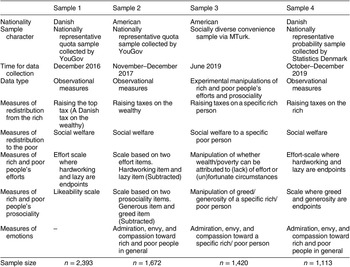
Table 1 provides an overview of the survey data. Sample 1 and Sample 2 were both collected by the survey agency YouGov. The surveys were fielded to nationally representative samples of Danish citizens in 2016 and American citizens in 2017, using quota sampling to match the populations on age, gender, education, and geographical region. In 2019, survey 3 was fielded to a socially diverse nonrepresentative sample of respondents recruited through Amazon Mechanical Turk’s online labor market. Finally, as part of the International Social Survey Project, Survey 4 was fielded by Statistics Denmark to a nationally representative sample of Danish citizens in 2019 using simple random sampling. Sample characteristics for all the samples are available in the online supplementary materials.
Overview of Data and Measures

Research Designs and Measurements
I first present the observational measures obtained in Sample 1, Sample 2, and Sample 4, after which I turn to the measures that were experimentally manipulated in Sample 3. In Sample 1 and Sample 4, perceptions of rich and poor people’s efforts were measured with a standard effort question from the American National Election Studies. Specifically, respondents were asked to place the rich and the poor on a scale from 1 to 7, where 7 means that most people in the group are hardworking and 1 means that most people in the group are lazy. In Sample 2, two items were used to respectively measure effort perceptions of the rich and the poor. Respondents were asked how well the words “Hardworking” and “Lazy” describe the rich (and the poor) on a seven-point scale from “Not at all” to “Extremely well.” These two items were subtracted to provide one effort measure (Hardworking minus Lazy).
As Table 1 shows, I use different measures of perceptions of rich and poor people’s prosociality. Researchers sometimes refer to prosocial intentions as warmth or morality. People like others depending on whether they are perceived as warm and prosocial or cold and antisocial (Fiske, Cuddy, and Glick Reference Fiske, Amy and Glick2007). Thus, I use liking as an indirect measure of prosociality in Sample 1. Specifically, respondents were asked to place each group, the rich and the poor, on a scale from 1 to 7, “where a score of 1 means that you dislike the group very much, and 7 means that you like the group very much.” The measures used in Sample 2 and Sample 4 tap more directly into the theoretical construct of prosociality by focusing on greed–generosity. In Sample 2, two items were used to measure prosociality perceptions of the rich and the poor. Respondents were asked how well the words “Generous” and “Greedy” describe the rich (and the poor) on a seven-point scale from “Not at all” to “Extremely well.” These two items were subtracted to provide one prosociality measure (Generous minus Greedy)Footnote 4. In Sample 4, respondents rated the rich and poor on a seven-point scale ranging from “Greedy” to “Generous.” Sample 2 and Sample 4 measured emotions using a battery of admiration, compassion, and envy toward rich and poor people. Specifically, respondents were asked, on a seven-point scale ranging from “Not at all” to “Very strongly”: “How do you feel when you hear or read about rich people?” (and poor people). Finally, attitudes about taxing the rich were measured by asking respondents whether taxes on the rich should be raised or cut. Attitudes about “giving to the poor” were measured by asking respondents about their support for social welfare. Age, gender, education, race/ethnicity,Footnote 5 income, and party were included as control variables. Full wordings of all measures are available in the online supplementary materials on pages 2–6 and in the overview Table A1 on page 7.
Experimental Manipulations and Measurements
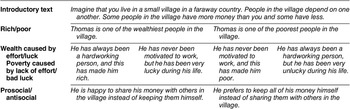
To strengthen the internal validity, a vignette survey experiment was fielded to Sample 3. The vignette experiment presents a fictitious story about a village in which some people are poor and some people are rich (See Table 2). Vignette experiments constitute a classic and widely used approach to investigating how people reason about inequality (Jasso and Rossi Reference Jasso and Rossi1977). The experimental design specifically addresses the risk that the results are affected by omitted variable bias and/or reflect reversed causality. Furthermore, by testing whether the associations hold across different measures of the main variable—both natural variations in perceptions of the rich and poor and experimentally induced perceptions of a specific rich or poor person—I further strengthen the external validity of the findings (Shadish, Cook, and Campbell Reference Shadish, Cook and Campbell2001, 39). Although vignette experiments generally lack realism, they are nevertheless an important methodological tool. As McDonald (Reference McDonald2020, 281) explains, “if scholars are introducing a new theory to better understand public attitudes and wish to isolate a precise mechanism, a hypothetical survey experiment can provide important and valid results.” I address the issues of experimental control and realism by combining observational measures of naturally occurring perceptions of the rich and poor (Samples 1, 2, and 4) with experimentally manipulated presentations of the rich and poor (Sample 3). Moreover, the village story in the vignettes provides a hard test of the argument because population size is associated with inequality attitudes (Evans and Kelley Reference Evans and Kelley2007). Thus, if I find similar opinion formation patterns when people are confronted with a hypothetical small-scale village and with large-scale modern society, there is stronger support for the generalizability of the findings.
Overview of Manipulations in Experimental Conditions

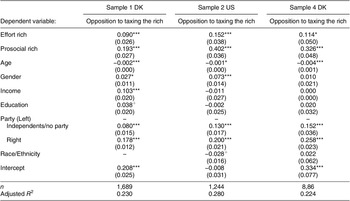
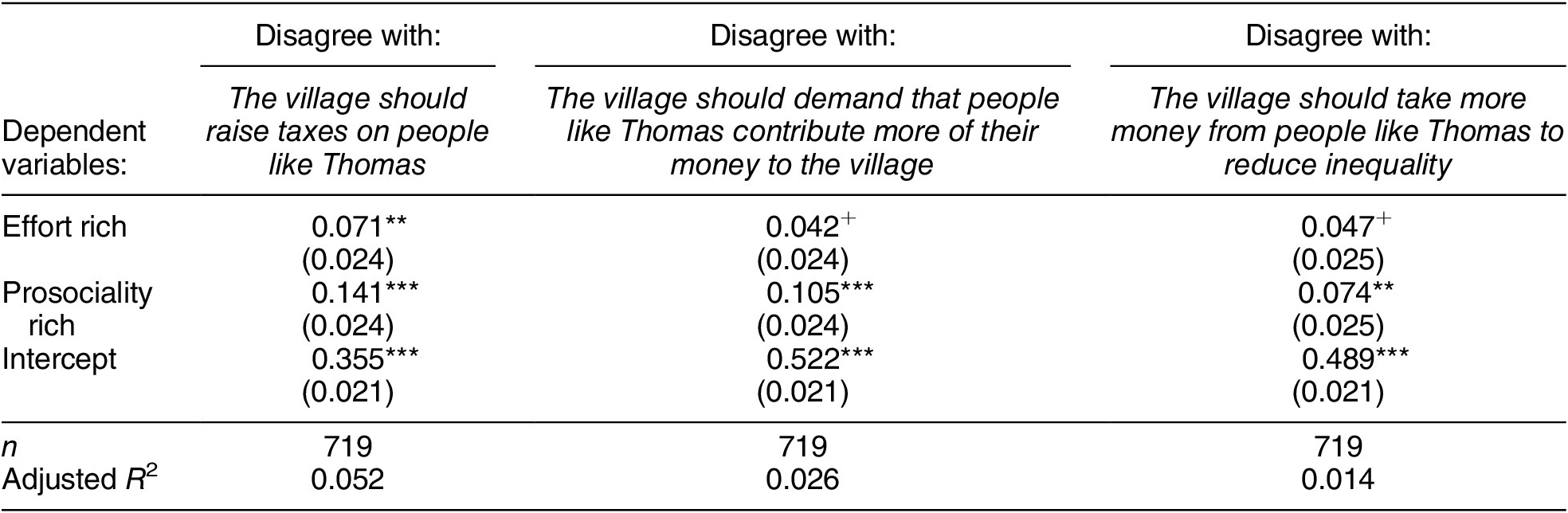
Perceived Effort and Prosociality of the Rich as Predictors of Opposition to Taxing the Rich

Note: Entries are unstandardized OLS regression coefficients with standard errors in parentheses. All variables except age vary between 0 and 1. For Race/Ethnicity, 0 = minority and 1 = majority. In the US, 1 = “white,” and in Denmark 1 = “Born in Denmark.” In the US, Party (Left) = Democrat and Party (Right) = Republican. In Denmark, Party (Left) = left-leaning parties and Party (Right) = right-leaning parties. +p < 0.10, *p < 0.05, **p < 0.01, ***p < 0.001.
The experiment is specifically designed to test the theoretical claim that cues about rich people’s prosociality have a stronger causal effect on opposition to taxing the rich than do cues about their efforts. Yet the experimental design also enables us to probe the distinctiveness of opinion formation about taking from the better-offs by testing whether the effort of the poor has a stronger influence on support for helping them than does their prosociality. An overview of the experimental manipulations is provided in Table 2.
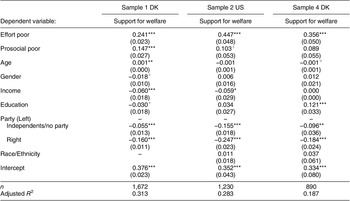
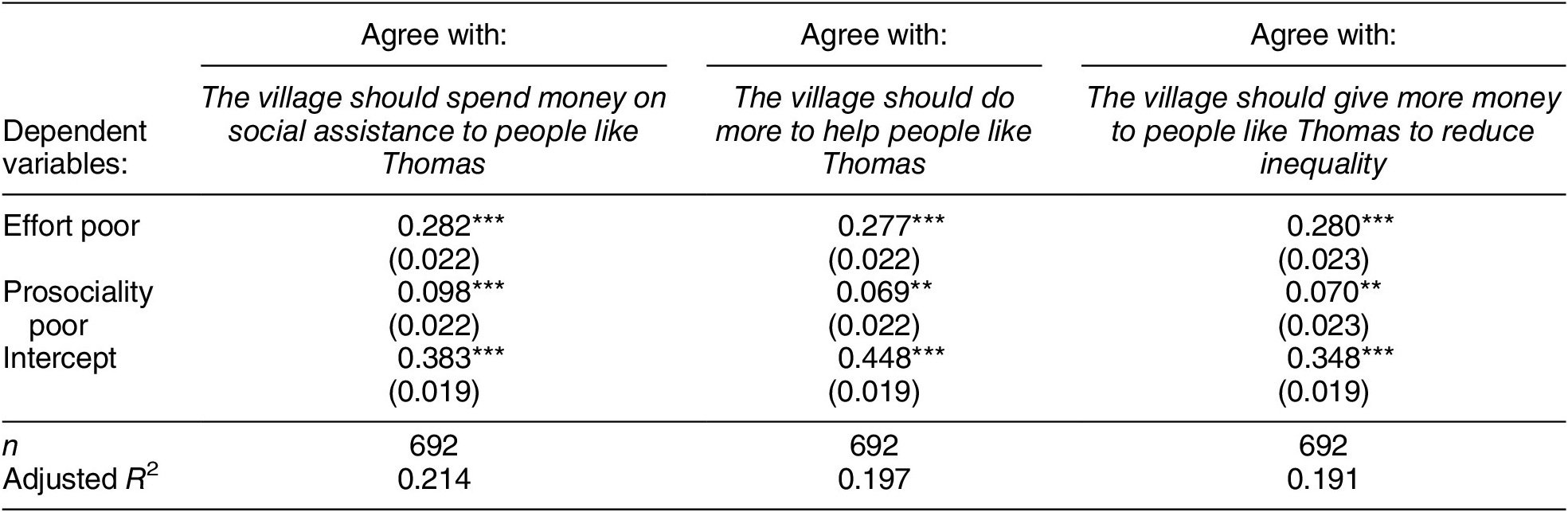
Perceived Effort and Prosociality of the Poor as Predictors of Support for Social Welfare

Note: Entries are unstandardized OLS regression coefficients with standard errors in parentheses. All variables except age vary between 0 and 1. For Race/Ethnicity, 0 = minority and 1 = majority. In the US, 1 = “white,” and in Denmark, 1 = “Born in Denmark.” In the US, Party (Left) = Democrat and Party (Right) = Republican. In Denmark, Party (Left) = left-leaning parties and Party (Right) = right-leaning parties. +p < 0.10, *p < 0.05, **p < 0.01, ***p < 0.001.
The experiment was a 2 × 2 × 2 factorial design that varied on the following dimensions: Rich/Poor × Effort/No effort × Prosocial/antisocialFootnote 6 (Eight conditions in total). Respondents were randomly assigned to one of these conditions. In order to make a clear description of rich and poor people’s efforts, the vignettes described whether wealth (or poverty) was a result of their (lack of) effort or (bad) luck. Thus, respondents are not left wondering why the poor man is poor, although he makes an effort, and vice versa, why the rich man is rich when he does not make an effort. After respondents read the vignette, attitudes about taking from the rich were obtained on a seven-point Likert-type scale ranging from “Strongly agree” to “Strongly disagree” with the following items in the rich condition: “The village should raise taxes on people like Thomas”; “The village should demand that people like Thomas contribute more of their money to the village”; “The village should take more money from people like Thomas to reduce inequality.” In the poor condition, support for helping the poor was measured with the following items: “The village should spend money on social assistance to people like Thomas”; “The village should do more to help people like Thomas”; “The village should give more money to people like Thomas to reduce inequality.” Emotions were measured by asking respondents, “To what extent do you experience the following emotions when you think about a person like Thomas?” Answers on admiration, envy, and compassion were obtained on a seven-point scale ranging from “Not at all” to “Very strongly.” All variables in the four samples were rescaled to range 0–1.
Perceptions of the Rich and Attitudes about Taxing Them—Observational Results
The first step in the analysis is to test Hypothesis 1, stating that perceptions of rich people’s prosociality have a stronger influence on opposition to taxing them than do perceptions of their efforts. I test this association in tandem with the association between perceptions of the poor and support for providing them with social welfare. All correlations between redistributive attitudes and perceptions of the rich and poor are estimated using ordinary least squares (OLS) regression. All tests of statistical significance are two-tailed.
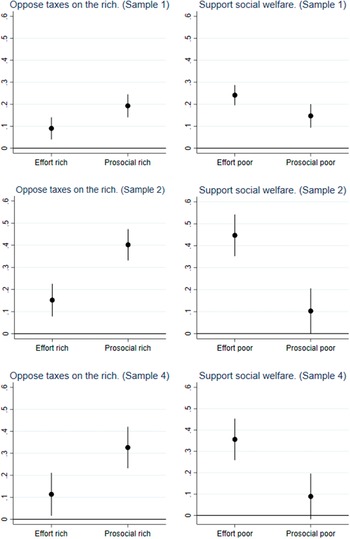
Figure 1 presents the associations between effort and prosociality perceptions, respectively, and attitudes about economic redistribution based on observational data from Sample 1, Sample 2, and Sample 4. To facilitate visual comparison between attitudes toward taking from the rich and giving to the poor, the dependent variables are scaled to indicate support for policies that benefit the rich and poor, respectively. This approach means that higher values indicate opposition to taxing the rich and support for providing social welfare to the poor. As can be seen in the panels on the left in Figure 1, the perceptions that the rich make an effort are associated with opposition to taxing the rich (Sample 1: b = 0.090, p < 0.001; Sample 2: b = 0.152, p < 0.001; Sample 4: b = 0.114, p = 0.023). Importantly, the results also support Hypothesis 1 that perceptions of rich people’s prosociality are more strongly associated with opposition to taxing the rich than perceptions of their effort (Sample 1: b = 0.193, p < 0.001; Sample 2: b = 0.402, p < 0.001; Sample 4: b = 0.326, p < 0.001). This pattern is consistent across the samples in Denmark (Sample 1 and Sample 4) and the US (Sample 2), where prosociality perceptions are twice and three times as strongly associated with opposition to taxing the rich as perceptions of rich people’s efforts. The differences between the associations between opposition to taxing the rich and effort perceptions and the associations between opposition to taxing the rich and prosociality perceptions are also all statistically significant (Test: the effort of the rich − prosociality of the rich = 0. Sample 1: p = 0.024, Sample 2: p < 0.001, Sample 4: p = 0.005).Footnote 7
The Effects of Effort and Prosociality of the Rich on Opposition to Taking from the Rich: Sample 3

Note: Entries are unstandardized OLS regression coefficients with standard errors in parentheses. No effort of the rich and no prosociality (greed) of the rich are reference categories. +p < 0.10, *p < 0.05, **p < 0.01, ***p < 0.001.
Perceptions of Rich and Poor People’s Efforts and Prosociality as Predictors of Attitudes about Economic Redistribution
Note: The dots represent unstandardized beta coefficients. The vertical lines represent 95% confidence intervals. Panels to the left: higher values on the y-axis indicate opposition toward taxing the rich. Panels to the right: higher values on the y-axis indicate support for social welfare to the poor. The estimates are derived from Table 3 and Table 4.

The Effects of Effort and Prosociality of the Poor on Support for Social Welfare: Sample 3

Note: Entries are unstandardized OLS regression coefficients with standard errors in parentheses. No effort of the poor and no prosociality (greed) of the poor are reference categories. +p < 0.10, *p < 0.05, **p < 0.01, ***p < 0.001.
If we turn to the panels on the right side of Figure 1, the pattern is reversed. Perceptions of poor people’s efforts are more strongly associated with support for social welfare (Sample 1: b = 0.241, p < 0.001; Sample 2: b = 0.447, p < 0.001; Sample 4: b = 0.356, p < 0.001) than perceptions of poor people’s prosociality (Sample 1: b = 0.147, p < 0.001; Sample 2: b = 0.102, p = 0.052; Sample 4: b = 0.089, p = 0.104). The differences in the strength between the associations with social welfare support and, respectively, effort and prosociality perceptions are statistically significant across all the three samples (Test: the effort of the poor − prosociality of the poor = 0: Sample 1: p = 0.034, Sample 2: p < 0.001, Sample 4: p = 0.002). This result is consistent with existing research that has shown that the deservingness heuristic mainly prompts people to be concerned about whether recipients made an effort to deserve help (Gilens Reference Gilens2000; Petersen Reference Petersen2015; van Oorschot Reference van Oorschot2000). These results combined provide strong support for H1.
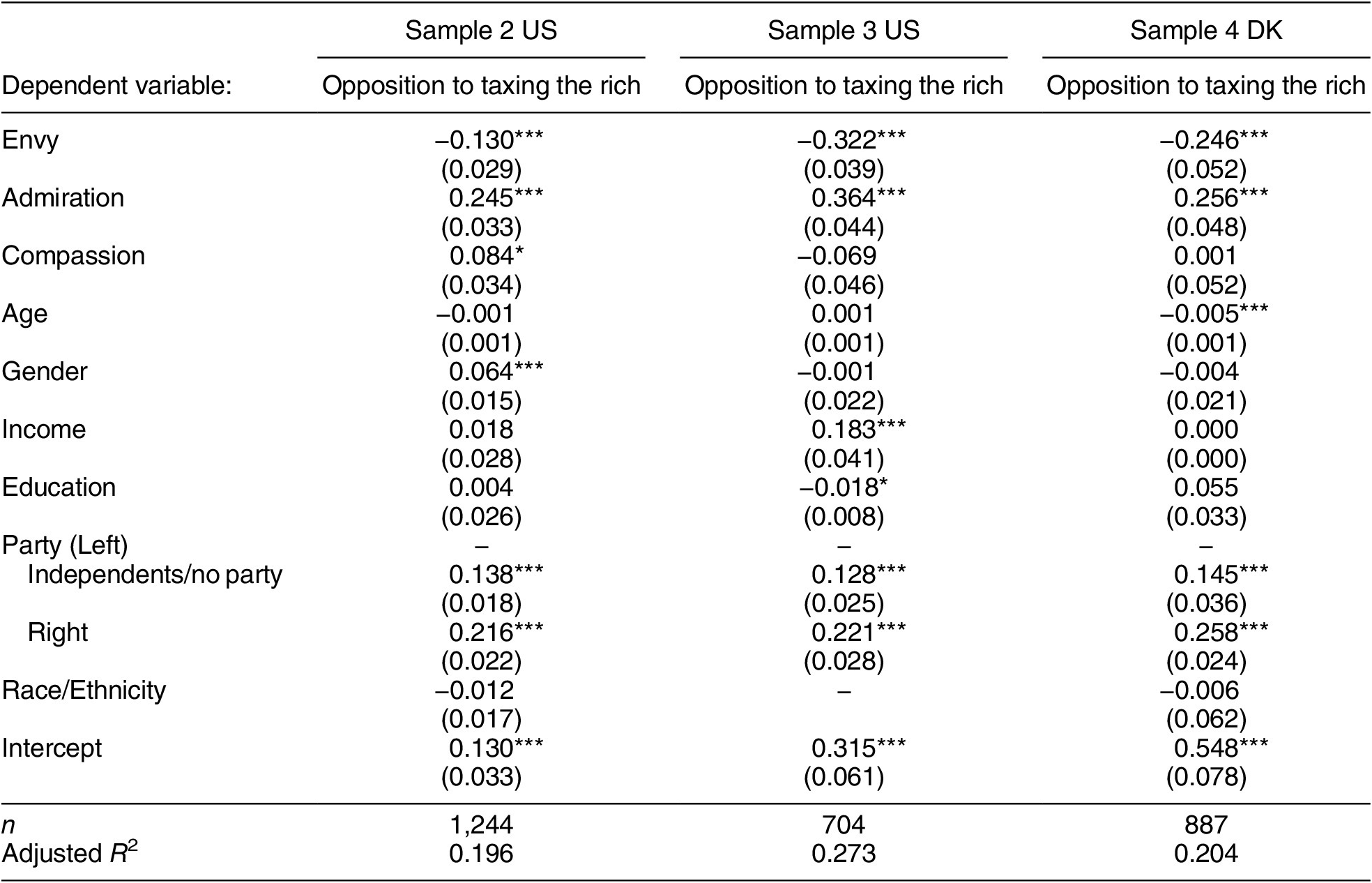
Emotions toward the Rich as Predictors of Opposition to Taxing the Rich

Note: Entries are unstandardized OLS regression coefficients with standard errors in parentheses. All variables except age vary between 0 and 1. For Race/Ethnicity 0 = minority and 1 = majority. In the US, 1 = “white,” and in Denmark 1 = “Born in Denmark.” In the US, Party (Left) = Democrat and Party (Right) = Republican. In Denmark, Party (Left) = left-leaning parties and Party (Right) = right-leaning parties. +p < 0.10, *p < 0.05, **p < 0.01, ***p < 0.001.
Perceptions of the Rich and Attitudes about Taxing Them—Experimental Results
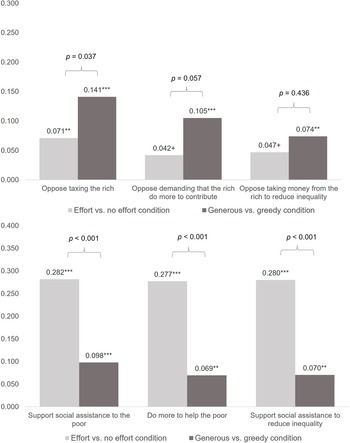
I now turn to the experimental test of Hypothesis 1. Figure 2 presents the results where attitudes about redistribution are the dependent variable. The bars represent the treatment effects as differences between the experimental conditions. The light gray bar is the effect of effort (Mean in the effort condition − Mean in the no effort condition), and the dark gray bar is the effect of prosociality (Mean in the generous condition − Mean in the greed condition).
Emotions toward the Poor as Predictors of Support for Social Welfare

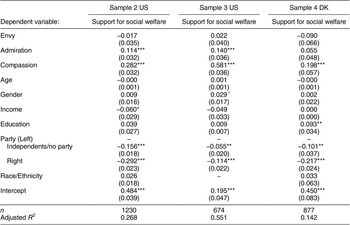
Note: Entries are unstandardized OLS regression coefficients with standard errors in parentheses. All variables except age vary between 0 and 1. For Race/Ethnicity 0 = minority and 1 = majority. In the US, 1 = “white,” and in Denmark 1 = “Born in Denmark.” In the US, Party (Left) = Democrat and Party (Right) = Republican. In Denmark, Party (Left) = left-leaning parties and Party (Right) = right-leaning parties. +p < 0.10, *p < 0.05, **p < 0.01, ***p < 0.001.
Effects of Effort Cues and Prosociality Cues on Attitudes about Economic Redistribution: Sample 3
Note: The bars represent the differences in mean scores for the experimental conditions on attitudes about economic redistribution. The light gray bars represent the difference between the hardworking condition and the lazy condition [Effort–no effort]. The dark gray bars represent the difference between the generous condition and the greedy condition [Generous–greedy]. The significance tests are of the differences between the effects of effort cues and the effects of prosociality cues. The estimates are derived from Table 5 and Table 6.

Overall, the results from the experiment in the top panel support H1: prosociality cues have a stronger effect than effort cues on opposition for redistribution from the rich—at least on two of the three dependent variables. Specifically, the results show that both effort cues and prosociality cues increase “opposition to taxing the rich” (effect of effort cues = 0.071, p = 0.003; effect of prosociality cues = 0.141, p < 0.001). The difference between the effect of effort cues and prosociality cues is statistically significant (p = 0.037). Next, the effect of prosociality cues is more than twice as strong as the effect of effort cues on the dependent variable “opposition to posing demands to the rich.” This difference is marginally significant (p = 0.057). Finally, the difference between the effect of prosociality cues and the effect of effort cues on the dependent variable “oppose taking money from the rich to reduce inequality” is not statistically significant (p = 0.436).Footnote 8 If we turn to support for “giving to the poor,” the pattern reverses. People are much more affected by cues about poor people’s efforts than cues about their prosociality. These results also provide a clear image of the effort asymmetry, as responsiveness to the efforts of the poor is about three times as strong as responsiveness to the efforts of the rich when people form redistributive attitudes.
In summary, the experimental data also support Hypothesis 1 stating that people are more responsive to rich people’s prosociality than their efforts and thus reveal the existence of an effort asymmetry in public opinion about economic redistribution: people are less concerned about the efforts of the rich than about the efforts of the poor.
Emotions and Attitudes about Taxing the Rich
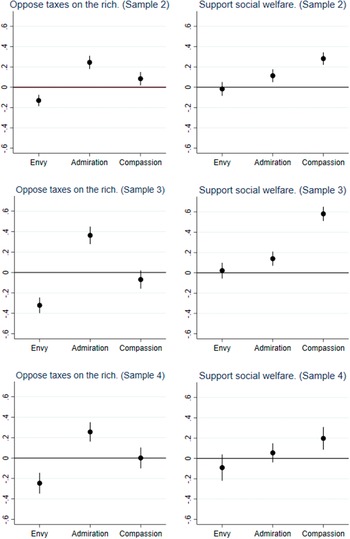
I now turn to the predictions regarding emotions (Hypothesis 2 and Hypothesis 3). Figure 3 presents results from Sample 2, Sample 3, and Sample 4 that all contain measures of emotions. As can be seen in the panels on the left, envy toward the rich is negatively associated with opposition to taxing them (Sample 2: b = -0.130, p < 0.001; Sample 3: b = -0.322, p < 0.001; Sample 4: b = -0.246, p < 0.001). In other words, envy is associated with support for taxing the wealthy across the three samples. This result supports Hypothesis 2. If we turn to the panels on the right side of panel 2, envy of the poor is not associated with support for social welfare in any of the samples. Thus, the results support Hypothesis 2 while also demonstrating that envy shapes redistributive preferences only when it concerns envy of the better-offs and redistribution from them. Turning to the test of Hypothesis 3, the results in the panels on the left side of Figure 3 show that admiration of the rich is strongly associated with opposition to taxing them across all three samples (Sample 2: b = 0.245, p < 0.001; Sample 3: b = 0.364, p < 0.001; Sample 4: b = 0.256, p < 0.001).
Emotions toward Rich and Poor People as Predictors of Attitudes about Economic Redistribution
Note: The dots represent unstandardized beta coefficients. The vertical lines represent 95% confidence intervals. Panels to the left: higher values on the y-axis indicate opposition toward taxing the rich. Panels to the right: higher values on the y-axis indicate support for social welfare to the poor. The estimates are derived from Table 7 and Table 8.

If we contrast with admiration in the panels on the right side of Figure 3, the results show that admiration is positively associated with support for social welfare in the US (Sample 2 and Sample 3), but the associations are substantially smaller than are the associations with opposition to taxing the rich and the association is statistically indistinguishable from zero in Denmark Sample 4 (Sample 2: b = 0.114, p < 0.001; Sample 3: b = 0.140, p < 0.001; Sample 4: b = 0.055, p = 0.249). Last, to further probe the distinctiveness of opinion formation about taking from the rich and giving to the poor, I investigate the role of compassion. As can be seen in the panels on the right, compassion is strongly associated with support for social welfare in all the samples (Sample 2: b = 0.282, p < 0.001; Sample 3: b = 0.581, p < 0.001; Sample 4: b = 0.198, p = 0.001). In contrast, as shown in the panels on the left, compassion is associated only with opposition to taxing the rich in Sample 2 (Sample 2: b = 0.084, p = 0.012; Sample 3: b = -0.069, p = 0.131; Sample 4: b = 0.001, p = 0.981). Across the samples, there is not much evidence that compassion, in strong contrast with admiration, is associated with opposition to taxing the rich. In summary, the results support Hypothesis 2 and Hypothesis 3 and also the distinctiveness of public support for redistribution from the better-offs.
Conclusion
Despite more than half a century of research on how people form opinions about economic redistribution, we have lacked theory and research about how people form opinions about redistribution from the better-offs. This gap is particularly striking as income distributions become more top-skewed and our knowledge expands of how deservingness concerns and emotions influence social welfare attitudes. This article contributes novel theory on the distinct nature of public opinion about taking from the better-offs to advance a broader understanding of popular support for redistribution. Existing research has often employed a unidimensional model of inequality and redistributive attitudes that tacitly tends to assume that the factors shaping attitudes about taking from the rich mirror those shaping attitudes about giving to the poor. Therefore, it follows that people should mainly consider whether the rich make an effort. This article provides a different view: when people form attitudes about redistribution from the rich, they are much more concerned about their prosociality than their efforts. There is also a distinct set of emotions involved in shaping public opinion about redistribution from the rich: envy and admiration.
Of course, more research is needed. I only provide an initial microfoundation by theoretically developing and rigorously testing hypotheses about the unique factors shaping attitudes about redistribution from the rich. Thus, my goal has not been to provide a comprehensive theoretical model of the complex interplay between all relevant trait perceptions, beliefs, and emotions underlying public opinion about taking from the rich. I hope that future research will build on this work to provide a more explicated model of how people form attitudes about redistribution from the rich. In particular, it would be worthwhile to investigate the relative importance of other character traits such as perceived competence (Sadin Reference Sadin2014). Emotions other than envy and admiration could also be relevant. Anger is, for example, important for understanding opposition toward social welfare (Petersen et al. Reference Petersen, Sznycer, Cosmides and Tooby2012), and gratitude toward the rich might be associated with opposition to taxing the rich because this emotion motivates people to cooperate (Sznycer and Lukaszewski Reference Sznycer and Lukaszewski2019). Moreover, more research is needed to uncover the dynamics eliciting admiration and, especially, envy. Theoretically, it has been suggested that people experience envy the most when positive traits provide an advantage in the social competition for scarce resources such as social status, jobs, or attention from valued others (e.g., Hill and Buss Reference Hill, Buss and Smith2008; Sznycer et al. Reference Sznycer, Seal, Sell, Lim, Porat, Shalvi, Halperin, Cosmides and Tooby2017). Consequently, if people believe that other people’s gains constitute a loss for themselves (zero-sum), it should theoretically influence how they respond to the characteristics of the rich and the poor and how they feel about them. Thus, future research should consider whether people have zero-sum or plus-sum beliefs about the economic system so as to improve knowledge about the dynamics eliciting admiration and envy toward the rich.
Turning to the implications of this research, our findings bolster the emerging body of research emphasizing the need to study public opinion about inequality and redistribution as a two-dimensional phenomenon (Cavaillé and Trump Reference Cavaillé and Trump2015; Condon and Wichowsky Reference Condon and Wichowsky2020; Kelley and Evans Reference Kelley and Evans1993; Lupu and Pontusson Reference Lupu and Pontusson2011; Sznycer et al. Reference Sznycer, Seal, Sell, Lim, Porat, Shalvi, Halperin, Cosmides and Tooby2017). Because we cannot necessarily generalize from how people form opinions about giving help to the poor—and economic inequality more broadly—to the way people form opinions about taking from the rich, we might have to revisit and reconsider established notions about public opinion about redistribution. This article provides an illustration: a central finding in the fairness and deservingness literature is that redistributive attitudes are primarily shaped by beliefs about whether people make an effort to get ahead. Yet, my results suggest that the association between redistributive attitudes and effort beliefs is mainly driven by beliefs about poor people’s efforts. Beliefs about rich people’s efforts are much less consequential in contrast to beliefs about whether they are greedy. Thus, I recommend considering the two-dimensional nature of redistributive attitudes in developing theory and research designs in the future. For example, this approach could be used through survey research by more actively comparing attitudes about redistribution from the better-offs to attitudes about giving to the worse-offs and employing this distinction in different types of experiments.
The findings also contribute by advancing our understanding of the emotional foundation of popular support for redistribution in general. While extant research has provided important insights on redistributive attitudes by employing a valence-based approach to emotions (that is, overall positive–negative affect), the present findings show that we can deepen our understanding of redistributive attitudes by focusing on discrete emotions. In general, the emotions of envy and admiration have received surprisingly limited attention in political science despite their importance for understanding status competition and how people navigate in social hierarchies (Onu, Kessler, and Smith Reference Onu, Kessler and Smith2016; Smith and Kim Reference Smith and Kim2007), which is at the core of economic inequality (McClendon Reference McClendon2018).
Last, the results address the persistent puzzle that rising economic inequality has no clear association with popular support for redistribution. The classic model by Meltzer and Richard (Reference Meltzer and Richard1981) derives the expectation that self-interest should motivate a majority of citizens to favor redistribution when the wealth distribution in society becomes more skewed toward the top. The economic fairness perspective leads to the same expectation, as inequality today does not arise from differences in efforts but from an economic system that mainly generates returns on capital (Piketty, Reference Piketty2014). Although studies find that people are more supportive of redistribution if they are concerned about inequality (e.g., Franko, Tolbert, and Witko Reference Franko, Tolbert and Witko2013; Hayes Reference Hayes2014), studies also find that people are unresponsive to rising inequality (Alesina and Glaeser Reference Alesina and Glaeser2004; Kenworthy and McCall Reference Kenworthy and McCall2008), and there are even studies indicating that citizens become more opposed to redistribution when inequality rises (Kelly and Enns Reference Kelly and Enns2010; Sands Reference Sands2017; Trump Reference Trump2018). I believe that solving this Robin Hood paradox requires more scholarly attention on how people think about inequality (Condon and Wichowsky Reference Condon and Wichowsky2020; Starmans, Sheskin, and Bloom Reference Starmans, Sheskin and Bloom2017; Sznycer et al. Reference Sznycer, Seal, Sell, Lim, Porat, Shalvi, Halperin, Cosmides and Tooby2017). People are not necessarily psychologically and intuitively apt at processing large-scale societal trends of economic inequality (Norton and Ariely Reference Norton and Ariely2011). Instead, people are preoccupied with who the economic others are and how they feel about them. Do they make an effort, and are they prosocial? These questions seem to be what citizens in widely different countries, such as Denmark and the US, are most concerned about.
Supplementary Materials
To view supplementary material for this article, please visit http://doi.org/10.1017/S0003055422000582.
DATA AVAILABILITY STATEMENT
Research documentation and data that support the findings of this study are openly available at the American Political Science Review Dataverse: https://doi.org/10.7910/DVN/AZUWVA.
ACKNOWLEDGMENTS
I thank Christian Albrekt Larsen, Rune Slothuus, Lene Aarøe, Michael Bang Petersen, Paul Goren, Rasmus Skytte, Carsten Jensen, Lasse Laustsen, Troels Bøggild, Vin Arceneaux, Rasmus Tue Pedersen, Mathias Osmundsen, Casper Sakstrup, Sanne Lund Clement, and three anonymous reviewers for helpful comments and advice.
FUNDING STATEMENT
This research was funded by Aarhus University and grant CF18-0761 from the Carlsberg Foundation to Sanne Lund Clement.
CONFLICT OF INTEREST
The author declares no ethical issues or conflicts of interest in this research.
ETHICAL STANDARDS
The author affirms that this article adheres to the APSA’s Principles and Guidance on Human Subject Research.




Comments
No Comments have been published for this article.