Introduction
Several studies have attempted to identify the links between objective living conditions of persons aged 60 and above and their subjective wellbeing (SWB), a term which will be used synonymously with life satisfaction in this paper. Despite the diversity of methods and data used, it has been found that good health, an advantageous financial situation and familial integration all have a positive influence on the subjective wellbeing of older persons (Bowling and Windsor Reference Bowling and Windsor2001; Brown, Bowling and Flynn Reference Brown, Bowling and Flynn2004; Doyle Reference Doyle1984; Easterlin Reference Easterlin2001; Fageström et al. Reference Fageström, Borg, Balducci, Burholt, Wenger, Ferring, Weber, Host and Hallberg2007; Ferring et al. Reference Ferring, Balducci, Burholt, Wenger, Thissen, Weber and Hallberg2004; Gabriel and Bowling Reference Gabriel and Bowling2004; George Reference George, Binstock and George2006; Holden and Hatcher Reference Holden, Hatcher, Binstock and George2006; Noll Reference Noll, Marin and Zaidi2007; Von dem Knesebeck et al. Reference Von dem Knesebeck, Hyde, Higgs, Kupfer, Siegrist, Börsch-Supan, Jürges, Mackenbach, Siegrist and Weber2005, Reference Von dem Knesebeck, Wahrendorf, Hyde and Siegrist2007). But these studies have also demonstrated that while objective conditions are significantly tied to SWB, they only partially explain it. In other words, living conditions influence SWB but do not determine it (Delhey Reference Delhey2004). In particular, it has been shown that objectively difficult situations (poor health, familial isolation and poverty) do not necessarily produce a negative view of life. This ‘satisfaction paradox’ has long been identified and is mainly explained by the fact that individuals tend to adjust their aspirations to objective changes in their environment, so that their level of satisfaction remains high (Campbell, Converse and Rodgers Reference Campbell, Converse and Rodgers1996; Veenhoven Reference Veenhoven2000; Walker Reference Walker2005).
This paradox has been observed when comparing age groups, since despite generally having less favourable living conditions, older people are not invariably less satisfied with their lives than younger individuals (Lelkes Reference Lelkes, Marin and Zaidi2007; Schilling Reference Schilling2006). Moreover, some studies have shown that the determinants of SWB differ by age. Older persons place greater importance on health and mobility, while younger persons consider work and their financial situation as the key factors (Bowling et al. Reference Bowling, Bannister, Sutton, Evans and Windsor2002; Noll Reference Noll, Marin and Zaidi2007). Another example is the greater influence among older people of religious practices on SWB (Lelkes Reference Lelkes, Marin and Zaidi2007).
The same paradox can be identified between men and women. Older women are known to have less favourable living conditions than older men throughout Europe. They are more often widowed and, as a consequence, more of them alone (De Jong Gierveld, De Valk and Blommesteijn Reference De Jong Gierveld, de Valk and Blommesteijn2000; Kalogirou and Murphy Reference Kalogirou and Murphy2006; Légaré and Martel Reference Légaré and Martel2003), more often in precarious financial situations (Eurostat 2002) and in poorer health (Cambois, Desesquelles and Ravaud Reference Cambois, Desesquelles and Ravaud2003; Egidi Reference Egidi2003). Yet despite these less favourable conditions, older women report only slightly lower life satisfaction, happiness and self-esteem (Inglehart Reference Inglehart2002; Pinquart and Sörensen Reference Pinquart and Sörensen2001). Some researchers have argued that wellbeing models do not apply in the same way to older men and women, and that gender-specific models are needed (Bourque et al. Reference Bourque, Pushkar, Bonneville and Béland2003; Calasanti Reference Calasanti1996; Pinquart and Sörensen Reference Pinquart and Sörensen2001). From a meta-analysis, Pinquart and Sörensen (Reference Pinquart and Sörensen2000) found that integration in social networks for women was more closely related to life satisfaction than for men, while socio-economic status was more important for the life satisfaction and happiness of men. Furthermore, when older people were asked to name the aspects which were most important for their quality of life, women mentioned functional ability and social relations more frequently than men (Bowling Reference Bowling1995; Wilhelmson et al. Reference Wilhelmson, Andersson, Waern and Allebeck2005). These findings are generally attributed to differences in the socialisation of men and women in these generations: career-centred for the former, family-oriented for the latter. The results, however, apply to older people as a whole, and it is worth asking to what extent they remain valid for persons living alone, when men do not or no longer have a spouse to take care of the familial aspects of life, and when women do not or no longer have the financial support of a partner.
The need for further research on persons living alone is heightened by the finding that the living arrangement is predictive of lower SWB (Jakobsson, Hallberg and Westergren Reference Jakobsson, Hallberg and Westergren2004). Furthermore, those who live alone have specific characteristics and needs, and although residential isolation is in no way synonymous with social isolation, it can place individuals in a vulnerable position. Persons living alone are known to have greater difficulties in carrying out daily household tasks because, unlike those in couples, they do not benefit from shared and specialised roles (David and Starzec Reference David and Starzec1996). Moreover, in cases of disability, the partner is the prime care provider, making it possible to delay – if not altogether avoid – institutionalisation (Carrière et al. Reference Carrière, Keefe, Légaré, Lin and Rowe2007; Freedman Reference Freedman1996). Consequently, dependent older persons living alone are more likely to receive formal help than those living with a partner or in other arrangements (Breuil-Genier Reference Breuil-Genier1998). Finally, living alone is often associated with poorer physical health (especially for men), psychological health, and a more precarious finances (De Santis, Seghieri and Tanturri Reference De Santis, Seghieri, Tanturri, Gaymu, Festy, Poulain and Beets2008; Glaser, Murphy and Grundy Reference Glaser, Murphy and Grundy1997). In more general terms, people living alone are not as well-integrated socially, both in terms of sociability and in their participation in leisure and consumer activities (De Jong Gierveld, Van Tilburg and Lecchini Reference De Jong Gierveld, Van Tilburg and Lecchini1997; Delbès and Gaymu Reference Delbès and Gaymu2003). The determinant factors for SWB could, as a result, be very different for this group.
It should also be noted that in recent decades substantial changes have affected the living arrangements of older people in Europe and in most other developed countries. While the proportions of older people living alone have risen, the proportions of those living with kin (other than partners) outside the nuclear family have decreased (Gaymu et al. Reference Gaymu, Delbès, Springer, Binet, Desesquelles, Kalogirou and Ziegler2006; Pampel Reference Pampel and Rogers1992; Tomassini et al. Reference Tomassini, Glaser, Wolf, Broese van Groenou and Grundy2004; Wolf Reference Wolf1995). While these trends are similar in many countries, clear country-group profiles emerge. The proportions of older people living alone are in general much higher in northern than in southern and eastern Europe. These contrasts are often attributed to the survival of ancestral family systems, with southern Europe characterised by strong family links (Reher Reference Reher1998). More generally, European countries have different solidarity systems with different consequences for families, for instance concerning child care or care for older people. For example, the type of social protection system in part determines how women combine family life and professional careers (Esping-Andersen Reference Esping-Andersen1999). These institutional differences influence gender inequalities in the living conditions of older people, in particular concerning their financial situation (Eurostat 2002). While some studies have emphasised the importance of the link between the socio-cultural context and the SWB of older people (Diener et al. Reference Diener, Gohm, Such and Oishi2000; Fageström et al. Reference Fageström, Borg, Balducci, Burholt, Wenger, Ferring, Weber, Host and Hallberg2007; Ferring et al. Reference Ferring, Balducci, Burholt, Wenger, Thissen, Weber and Hallberg2004; Von dem Knesebeck et al. Reference Von dem Knesebeck, Hyde, Higgs, Kupfer, Siegrist, Börsch-Supan, Jürges, Mackenbach, Siegrist and Weber2005; Noll Reference Noll, Marin and Zaidi2007), research combining gender and cross-national comparative perspectives remain rare (Inglehart Reference Inglehart2002; Tesch-Römer, Motel-Klingebiel and Tomasik Reference Tesch-Römer, Motel-Klingebiel and Tomasik2008).
The main objective of this paper is to analyse gender differences in the life satisfaction of men and women living alone, and to show to what extent these can be explained by inequalities in their familial, economic and health situations. Given these inequalities, one could presume that the impact of these various aspects of life on SWB varies by gender. By using multivariate methods, we therefore seek to determine if the links between objective situations and SWB are the same for men and women living alone. Finally, as gender differences in living conditions are relatively marked across Europe, we verify if the socio-cultural context (taken into account through the country of residence), has an incidence on the determinants of life satisfaction of men and women living alone. For these analyses we used the SHARE data set which includes a single-item question for life satisfaction.Footnote 1 This indicator is commonly used to measure general SWB of older persons and this data set allows an analysis of gender differences in the determinants of life satisfaction in a comparative perspective at the European level.
Data and methodology
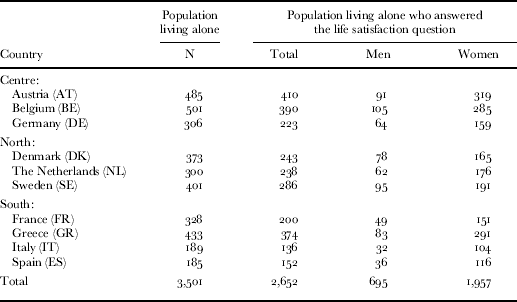
This study uses data from the first wave of SHARE (Survey of Health, Ageing and Retirement in Europe, version 2.0.1) which took place in 2004. A total of 3,501 people living alone and aged 60 or more years in ten countries participated in the survey, of which 695 men and 1,957 women answered the self-completed questionnaire containing the question on life satisfaction (Table 1).Footnote 2 Those who chose to answer this particular questionnaire differed from the total sample: they were in better health, were better educated, younger, and less often lived alone or were widowed, with only slight variation by country. For the population living alone, the selection criteria were mainly health and age.
Sample sizes of population living alone aged 60 or more years by gender and European country, 2004
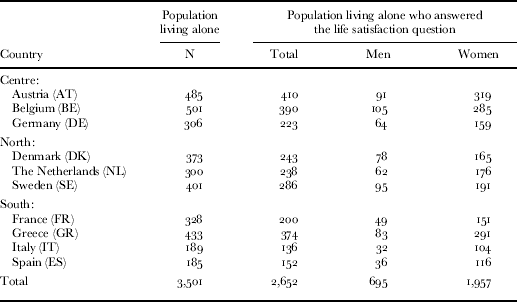
Source of data: SHARE survey, Wave 1, release 2.0.1. For details, see text.
There is a wealth of literature on SWB indicators, which range from single-item questions of life satisfaction to multi-item scales combining different aspects of SWB. The mensurators agree that the diverse measurements are very strongly correlated among themselves and with the essential determinants of SWB (George Reference George, Binstock and George2006; Pinquart and Sörensen Reference Pinquart and Sörensen2000; Smith et al. Reference Smith, Sim, Scharf and Phillipson2004). The exact wording of the single-item question used in the first wave of the SHARE survey was, ‘How satisfied are you with your life in general?’, and the following four answer categories were provided: ‘very satisfied – somewhat satisfied – somewhat dissatisfied – dissatisfied’. Since only 2.5 per cent of those aged 60 or more years living alone declared themselves to be dissatisfied, the two negative categories were merged. The transformed variable was ordinal scaled with three categories – ‘very’, ‘somewhat’ and ‘not’ satisfied.
Using a multiple correspondence analysis (MCA), we have shown that the underlying concept of life satisfaction is the same and understood correctly in all countries included in this study but, as observed in other studies (Christoph and Noll Reference Christoph and Noll2003; Veenhoven Reference Veenhoven1997), the use of the answer categories was not consistent across the countries. For instance, the French respondents used the categories differently from the Danish. In order to control as much as possible for this bias, we have kept a maximum of information on the response nuances by using a three-category variable rather than distinguishing only positive and negative answers. Since proportional odds models impose parallelism across levels of the dependent variable (for each independent variable the same estimated coefficient should apply to each of the comparisons of the different levels of the dependent variable) and this is rarely the case, we used a generalised ordered logistic model (gologit2). The advantage of this model, which was developed for STATA by Williams (Reference Williams2006), lies in its parsimony compared to a multinomial logistic model, and its higher flexibility compared to ordered logistic models. It tests for each independent variable the parallelism assumptions, and where there is violation allows the coefficient to vary across the levels of the dependent variable. In our case, the level ‘not satisfied’ was first compared with the combined levels of ‘somewhat satisfied’ and ‘very satisfied’, and then with the combined cases of ‘not satisfied and somewhat satisfied’ and ‘very satisfied’. The following equation describes such a model. In this example the proportional odds assumptions for X1 and X2 have been maintained, while for X3 the coefficients βi were allowed to vary across the different levels j of the dependent variable.

If the parallel odds assumption has not been violated, an odds ratio that is significant and superior to 1.0 increases the probability of having higher life satisfaction. Where the assumption of proportional odds has been violated and therefore omitted, the interpretation is more nuanced. For instance, if the odds ratio of an independent variable is significant for the first but not for the second level of the dependent variable, this variable increases the probability of being ‘satisfied’ or ‘very satisfied’ with life, compared to ‘not satisfied’, but has no influence on the probability of being ‘very satisfied’ rather than ‘satisfied’ or ‘not satisfied’. In addition to the basic socio-demographic variables (age and marital status), and in accordance with the literature, variables for each of the three domains, family, health and financial situation, have been included in the analysis as assumed determinants of life satisfaction of older persons living alone.
In order to describe the family context, the existence of children, the physical distance between the household of the nearest living child and the parent (under or over one kilometre) and the frequency of contact with the most contacted child (daily or not) were included in the descriptive analysis. For the multivariate analysis, in order to include all persons living alone, whether they were childless or not, we created a variable with three categories: ‘childless’, ‘child and daily contact’ and ‘child and no daily contact’. Indicators for help received and provided in the context of family and the neighbourhood were also added.
Various variables were tested and included to take into account the diverse socio-economic backgrounds of the informants. Education had three categories from the International Standard Classification of Education (ISCED) scale: low, medium, and high. Income was coded on the basis of country-specific terciles of the household income of persons living alone.Footnote 3 Home ownership as an indicator of wealth or economic security in old age was also included. Two variables describing the neighbourhood were taken into account: living in an urban area (as opposed to smaller towns and rural areas), and the availability of public transport and shops in the immediate environment. The health status variable was based on the Global Activity Limitation Indicator (GALI), which measures the degree of limitations in daily activities in three categories: ‘not limited’, ‘somewhat limited’, and ‘severely limited’.Footnote 4 The practice of leisure activities was added as an indicator of social integration.
Some of the above-mentioned variables are discussed only as descriptive findings and were not included in the multivariate analysis because of their strong correlation with other indicators. In addition, several other variables were tested: the duration of widowhood, a housing comfort indicator, the proportion of persons practising a religion, etc. While some results relating to these variables are mentioned in the text, this paper only presents the most relevant model in terms of significance. Explanatory variables were also tested for any potential interactions, but none of these were found to be sufficiently important to be retained.
Before presenting the results of the multivariate analysis, we first discuss the various objective dimensions of the lives of older men and women who live alone. The generalised ordered logistic model was first applied to the sample for all countries combined, and gender is used as an explanatory variable. A weighting system ensured that each country had the same weight, since the sample sizes were quite different. At the second step, country dummies were included as independent variables to control for differences in the socio-cultural contexts. Considering all the possible interactions between gender, country dummies and other explanatory variables would lead to an extremely complex model. We therefore chose to apply the same model separately to men and women, and to the three main regions of Europe – for women only – to verify if the determinants of life satisfaction were always the same, or if certain factors were specific to gender or particular regions.
Results
Descriptive aspects
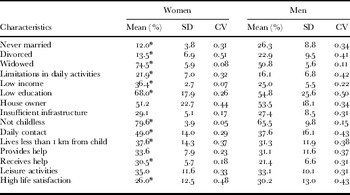
Throughout Europe, women were on average twice as likely as men to live alone (44% and 20%, respectively), and their living conditions differed significantly in several aspects. Women living alone were more likely to declare that they were severely limited by disabilities in their daily activities (22% versus 16%; Table 2). They were also more often than men in difficult socio-economic situations: more likely to have lower educational attainment (68% versus 55%) and lower income (36% of women were in the lowest tercile, compared to 25% of men). No distinction was found in terms of home ownership, however, with around 50 per cent of men and women owning their homes. In terms of family relationships, women were in a more favourable situation. The fact that they were less likely to be never married (12% versus 26%) or divorced (13% versus 23%) undoubtedly contributed to this finding. Moreover, women were more likely to have at least one child (80% versus 65%), and more lived close by (38% versus 31% lived less than one kilometre away) and had more frequent daily contact (49% versus 38%). They were also more likely to be receiving help from their children or from neighbours (31% versus 21%), but there was no difference between men and women in terms of helping other family members or neighbours (34% versus 31%). Neither was there a distinction in terms of the quality of the neighbourhood: fewer than 30 per cent mentioned a lack of public transport or shops, or participating in leisure activities (around 35%).
Objective living conditions of older Europeans living alone by sex, 2004

Notes: SD: standard deviation. CV: coefficient of variation.
Significance level: For difference between men and women: * p<0.01.
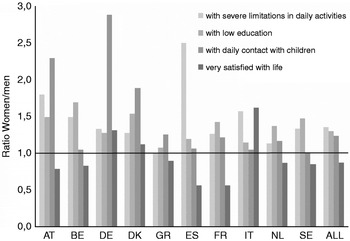
These disparities between men and women living alone were more or less pronounced depending on the country but, except in a few cases, women everywhere had less favourable health and financial resources, and were in a better situation in terms of family support (see Figure 1 for examples). The amount of heterogeneity among the countries varied by the type of indicator, as shown by the coefficients of variation (Table 2). For both sexes, cross-country heterogeneity was stronger for divorcees, those suffering from severe disabilities, homeowners, and those living near one of their children. On the other hand, the proportion of widowed persons, those with the lowest income or with at least one child hardly varied by country. With the exception of the proportion of divorced persons and homeowners, the coefficient of variation was lower for women. In other words, for women these characteristics were less linked to the socio-cultural context than for men.
For selected living conditions and life satisfaction: gender ratio for people living alone by country.

Although strong differences in the living conditions of men and women were found, their declarations about life satisfaction were similar. A slightly higher proportion of women were ‘very satisfied’ with their life (26% compared with 30%). Moreover, the coefficient of variation of this indicator was one of the highest, signalling the strong impact of the socio-cultural context on the degree of life satisfaction. And in opposition to the findings for objective living conditions, this coefficient was slightly higher for women, meaning that life satisfaction might be more linked to the socio-cultural context for women than for men (Table 2).
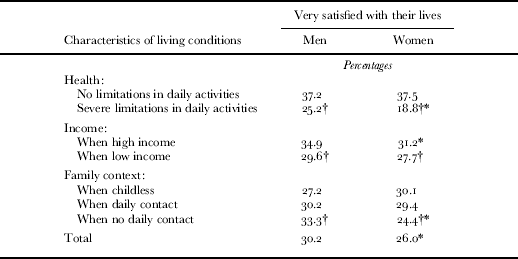
When life satisfaction was measured as a function of living conditions (Table 3), not surprisingly men and women alike were more often very satisfied with their life if they were in good health or in an advantageous financial situation. For instance, only 19 per cent of women with severe disabilities, compared with 37 per cent of those with no disability, declared themselves to be very satisfied with their lives. In line with the literature, however, these figures indicate that very unfavourable situations are not always experienced negatively and vice versa. In the same vein, given identical objective situations for men and women, their perception of things can be different. In the case of high income, a lower proportion of women were very satisfied with their lives than men (31% versus 35%). The same held true in the case of severe health problems (19% versus 25%). The link between life satisfaction and family relationships is more complex. Some studies have shown that the quality of family ties, rather than the quantity, influences SWB (Pinquart and Sörensen Reference Pinquart and Sörensen2000; Veenstra Reference Veenstra2000). Here we observe that women with less frequent contacts with their children declared least often that they were very satisfied with their lives (24%), whereas in the same situation men reported the highest satisfaction levels (33%). Moreover, when men's and women's declaration of life satisfaction significantly differed, it was always the perception of women that was more negative.
Life satisfaction by living conditions of older Europeans living alone by gender, 2004
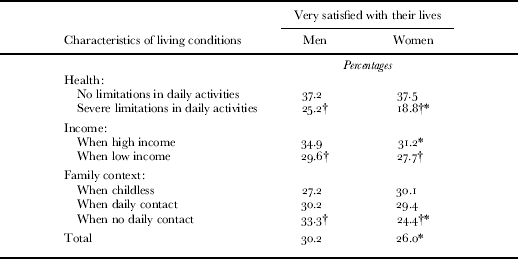
Significant differences: Between categories of same variable and given sex: † p<0.01. Between men and women and given variable: * p<0.01.
The determinants of life satisfaction for men and women: a multivariate analysis
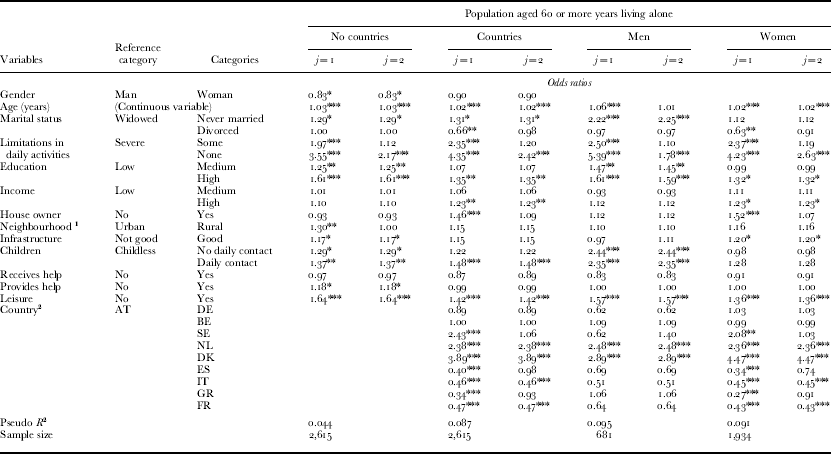
As a first step in gaining a better understanding of the links between living conditions and SWB, the generalised ordered logistic model was applied to the total population living alone, all countries combined. The socio-cultural specificities of each country were taken into account at the second step, when country dummies were added. As for all other applications of the model in this study, and in accordance with the literature, only a small part of the variance of the SWB was explained by the independent variables, but several were strongly and significantly related to life satisfaction. Health was always the strongest determinant of life satisfaction, whichever the subpopulation analysed (Table 4). In almost all cases, however, the different levels of limitations in daily activities did not have the same influence across the various levels of life satisfaction. In general, the probability of being satisfied with life increased with better health status. But only the absence of limitations in daily activities had a positive impact across all satisfaction levels (odds ratios (OR) 3.55 and 2.17). Those with mild disabilities were more likely to be satisfied (OR 1.97) with their lives, but this health status had no significant influence on the probability of being very satisfied with life.
Determinants of life satisfaction of older Europeans living alone by gender and level of dependent variable
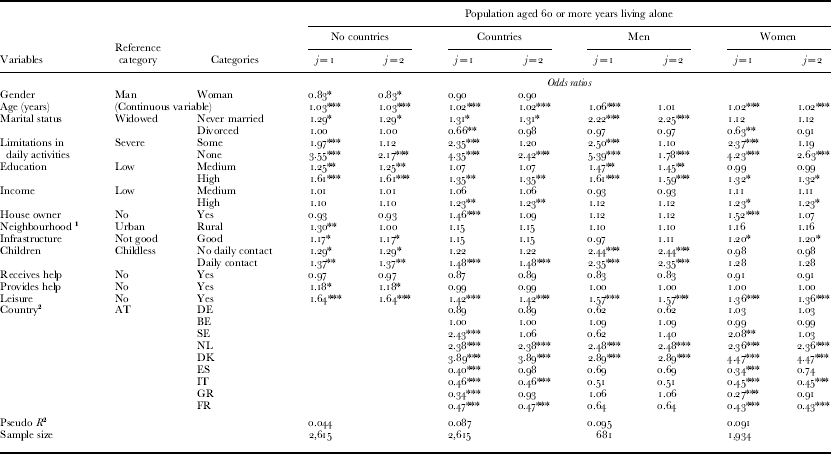
Notes: j=1: first level of dependent variable (not satisfied versus satisfied and very satisfied); j=2: second level of dependent variable (not satisfied and satisfied versus very satisfied). 1. Urban: big city; rural: small town or rural area. 2. For country abbreviations, see Table 1.
Significance levels: * p<0.1, ** p<0.05, *** p<0.01.
The other important determinants of life satisfaction were age (as the only continuous variable: OR 1.03), a higher level of education (OR 1.61) and participating in leisure activities (OR 1.64), and they were followed by having at least one child, especially if the contact was daily (OR 1.37), and living in a small town or in the countryside (OR 1.3). Finally, helping others (family or neighbours), living close to shops and the availability of transport and being male had the least influence. Moreover, most of the last mentioned variables were associated with low statistical significance (p=0.05–0.1), but given the small sample size, we nevertheless retained them for the interpretation while remaining cautious about the validity of their influence.
When the country dummies were included as explanatory variables to control for socio-cultural specificities, the explanatory power of the model improved, but some of the variables ceased to be significant. Being a man or a woman no longer had a significant influence on life satisfaction, and the same applied to living in an urban area, helping others, or living in a well-equipped neighbourhood. As in the previous model, these variables were the least significant. Also as observed in the previous model, advanced age, no severe limitations, a high level of education, daily contact with a child and leisure activities all significantly increased the probability of higher life satisfaction. Moreover, economic variables – having a high income (OR 1.23) and owning a home (OR 1.46) – became significant determinants of life satisfaction, as did marital status. Being divorced, compared to being widowed, had a negative impact on life satisfaction (OR 0.66), while being never-married was a positive factor (OR 1.31).
It can also be noted that the country of residence had a strong influence on life satisfaction, either through country specificities not accounted for by the independent variables or through the different use of the response categories. After controlling for the effect of all variables, living in Sweden (SE), The Netherlands (NL) and Denmark (DK) increased the probability of being satisfied with life (OR 2.38–3.89). On the other hand, the probability of being satisfied with life decreased among those living in France (FR), Italy (IT), Spain (ES) and Greece (GR), with OR values that varied around 0.4. Belgium (BE) and Germany (DE) were not significantly different from Austria (AT), the reference country. This ranking of countries ties in with previous research on the subject (Delhey Reference Delhey2004; Lelkes Reference Lelkes, Marin and Zaidi2007). It illustrates the strong tendency, all other things being equal, for the residents of northern European countries declared themselves satisfied with life, while the contrary was observed in southern Europe. AT, BE and DE, which form the Centre region, were in an intermediate position. These results lead to the conclusion that there is no unique European model for explaining the life satisfaction of older people living alone. Furthermore, the results show that after controlling for country of residence and living conditions, nothing distinguishes the statements of men and women with regard to their SWB.
Applying the model separately to each sex allows us to show the extent to which the previously revealed determining factors for SWB are common to both men and women. No limitations in daily activities (OR 5.39 for men and 4.23 for women), a high level of education (OR 1.61 and 1.32), leisure activities (OR 1.57 and 1.36) and having a more advanced age (OR 1.06 and 1.02) were the only variables that had a positive impact on life satisfaction for men and women alike. But in almost all cases, the OR values were higher for men. Several other factors had an influence on SWB that differed by gender. For men, the fact of having never been married, compared to being widowed, increased the probability for higher life satisfaction (OR 2.22), while it decreased for divorced women (OR 0.63). Having a child, regardless of the frequency of contact, had a significant effect on life satisfaction only for men (OR 2.44 for less than daily contact and 2.35 for daily contact).Footnote 5 Conversely, owning a home (OR 1.52) and, to a lesser extent, having a high income (OR 1.23), affected the life satisfaction only of women; and only for women was the availability of shops and transport in their neighbourhood positively linked to their SWB (OR 1.2). For the total population living alone, a clear country hierarchy emerged concerning life satisfaction, but it differed for men and women. All other things being equal, women had a lower probability of being satisfied with life in IT (OR 0.45), FR (OR 0.43), GR (OR 0.27) and ES (OR 0.34), and a higher probability in SE (OR 2.08), NL (OR 2.36) and DK (OR 4.47), compared to AT, DE and BE. On the other hand, no such socio-cultural effect was observed for men. Only the Danes (OR 2.89) and the Dutch (OR 2.48), when compared to the Austrians, had a higher probability of being more satisfied with life. Contrary to the women, nothing distinguished the declarations of Italian, French or Greek men from those living in the central region of Europe (after having controlled for inequalities in living conditions). On the other hand, all other things being equal, the life satisfaction of European women living alone depended strongly on the socio-cultural specificities of their country of residence.
The determinants of life satisfaction of women by regions: a multivariate analysis
Given the strong influence of the socio-cultural context on the SWB of women, we applied the model separately to each of the three main regions that, in line with other studies (Delhey Reference Delhey2004; Lelkes Reference Lelkes, Marin and Zaidi2007), were clearly distinguished in the previous model (North: SE, DK, NL; Centre: AT, DE, BE; South: GR, ES, IT, FR).Footnote 6 An analysis on the country level or even on the regional level for men was not possible because of small sample sizes. The objective was to show to what extent living in the North or South of Europe affected the determinants of life satisfaction of women (Table 5).
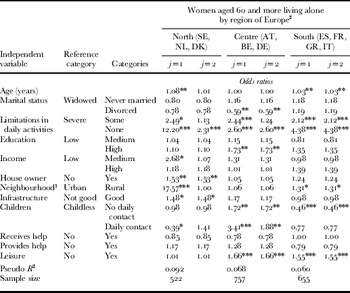
Determinants of life satisfaction of older European women living alone by region and level of dependent variable

Notes: j=1: first level of dependent variable (not satisfied versus satisfied and very satisfied); j=2: second level of dependent variable (not satisfied and satisfied versus very satisfied). 1. Urban: big city; rural: small town or rural area. 2. For country abbreviations, see Table 1.
Significance levels: * p<0.1, ** p<0.05, *** p<0.01.
Good health is the only factor that had a positive impact on the SWB of women in all European countries, although its strength varied. The main difference between the regions was in the impact of ‘no limitations in daily activities’ on the probability of being ‘satisfied’ with life (compared to ‘not satisfied’). The effect was especially strong in northern Europe (OR 12.2), as compared to the Centre (OR 2.6) and the South (OR 4.38). Other variables were significant in only certain regions. Among only the women living in the North, economic variables – home ownership (OR 1.53) and high income (OR 2.68) – and the existence of adequate facilities in their immediate environment (OR 1.48) had a positive but (except the first) only slightly significant impact on life satisfaction. Furthermore, being older (OR 1.08) and, in particular, not living in an urban area (OR 17.57) increased the probability of being satisfied with life. On the other hand, daily contact with one of their children had the opposite effect (OR 0.39), but the variable was only weakly significant.
Only for women living in the Centre did the existence of a child, compared to childlessness, have a positive impact on life satisfaction, especially when the contact was daily (OR 3.41). This was also the only geographic area where a high level of education, compared to a low level, increased the probability of higher life satisfaction, while being divorced, compared to widowed, had a strong negative impact. Practising leisure activities increased life satisfaction for women in these countries (OR 1.66). As for their counterparts in the Centre, participating in leisure activities had a positive effect on the life satisfaction of women in the South (OR 1.55), but unlike the former, they were less satisfied with life when they had less than daily contact with children (OR 0.46). But similar to women in the North, living in a small town or a rural area had a positive but much less important impact on life satisfaction (OR 1.31), as did advanced age (OR 1.03).
Discussion
As observed in previous research, older men and women living alone have very variable financial, familial and economic living conditions. Women are at a greater advantage in terms of family relationships: they are more likely to have at least one child and to have frequent contact with offspring, but there are more with low incomes and educational levels and they suffer more from restrictions in their daily activities. We have demonstrated that having a high level of education and income and, most importantly, no health limitations are among the major determinants of life satisfaction of older people that live alone. This disadvantage in terms of health and socio-economic situation for women might explain why, from a descriptive point of view, they were less likely to report being satisfied with life. All other things being equal, it was found that the degree of life satisfaction for men and women living alone did not differ. Only a slight gender gap was identified in the model for the total European population living alone, and this disappeared after controlling for country-specific factors. Moreover, the separate application of the life satisfaction model to men and to women allowed us to show that no limitations in daily activities, a high level of education, leisure activities and an older age were the only variables that increased life satisfaction for both men and women.
The apparent effect of age may conceal a cohort effect. In fact, the demands or expectations of older cohorts may differ from those of younger ones. The existence of a child influenced SWB only for men, while income level (or home ownership) did so only for women. This contradicts the previously reported finding that, in general, socio-economic factors are more important for men, and social relations factors more important for women (Bourque et al. Reference Bourque, Pushkar, Bonneville and Béland2003; Pinquart and Sörensen Reference Pinquart and Sörensen2000). Nonetheless, those results were for the older population as a whole, and are therefore not directly comparable to our findings for specifically the population of people who live alone. When our model was applied to all those aged 60 or more years, the life satisfaction determinants of men and women were very similar. Children, as well as the socio-economic situation, played a significant role for both men and women, but were slightly more important for men. Income was a little more influential for women.
The particularity of the population living alone has been specified as follows. Given comparable socio-demographic characteristics, income and contact levels, children are of importance only for men and economic factors only for women. If they are not in a couple, or no longer so, older men venture into the familial sphere, traditionally reserved for women. In doing so, their children become the most important source of wellbeing, second only to health. Since the fact of having never married – meaning in general the absence of children – had a positive impact on life satisfaction for men, there may actually be two male subpopulations: those who are alone and independent, and those with family, each with different ideas of what defines quality of life.
For women, conversely, retirement and particularly widowhood (or divorce) only changes long-standing family ties at the margins (Delbès and Gaymu Reference Delbès and Gaymu2003) but has strong financial consequences because their personal (independently-earned) pensions are lower than those of men (Zick and Smith Reference Zick and Smith1988). With advancing age, therefore, financial factors may have increasing influence on the wellbeing of women. The fact that having nearby shops or transport contributed to their SWB also illustrates how important such practical matters are in their lives. Since relatively fewer women than men have access to a private car, they are more dependent on the neighbourhood infrastructure (Von dem Knesebeck et al. Reference Von dem Knesebeck, Wahrendorf, Hyde and Siegrist2007). It should also be mentioned that although family links were not in general significantly related to life satisfaction for women living alone, they were influential in certain countries, but not always in the expected way.
More generally, the life satisfaction of older women living alone, all other things being equal, is shaped much more by their socio-cultural context than is the case for men. Even for this specific subpopulation, we again saw the North–South gradient that has been observed many times, even with other indicators of life perception (Delhey Reference Delhey2004; Fageström et al. Reference Fageström, Borg, Balducci, Burholt, Wenger, Ferring, Weber, Host and Hallberg2007). Overall, the northern European informants more often declared themselves to be satisfied with life than those in the South; the interpretation of this finding has been the subject of copious research. For some, the contrast is a reality (Bolle and Kemp Reference Bolle and Kemp2009), while others see it as an artefact, a reflection of different interpretations of a subjective question or differences in the reporting style (Angelini et al. Reference Angelini, Cavapozzi, Corazzini and Paccagnella2009).
The presented analysis has shown that among older people living alone, the gradient is clearly observable only for women. Among men, only the Danes and the Dutch stood out with their strong tendency to report being very satisfied with their lives. This lesser variability among men may be the result of the greater uniformity of the socialisation of men in these birth cohorts for paid work, whereas for women, having a career and family life and, more generally, their position in society, vary more by country. This heterogeneity in women's living conditions in Europe may be the reason why they have more variable degrees of life satisfaction than men. In investigating this geographical heterogeneity, we have been able to demonstrate that their sources of life satisfaction are very different, depending on whether they live in the North or South. These results are in line with other studies that have shown for the population of older persons as a whole that SWB factors are not the same throughout Europe (Fageström et al. Reference Fageström, Borg, Balducci, Burholt, Wenger, Ferring, Weber, Host and Hallberg2007; Noll Reference Noll, Marin and Zaidi2007; Von dem Knesebeck et al. Reference Von dem Knesebeck, Hyde, Higgs, Kupfer, Siegrist, Börsch-Supan, Jürges, Mackenbach, Siegrist and Weber2005).
For all the European countries included in this study, women living alone agreed in only one aspect: good health is essential for life satisfaction. In northern Europe, the SWB of women living alone depends strongly on their physical and material independence as well as on the neighbourhood characteristics. Being in good health, owning their homes, living in a small town or a rural area but having nevertheless sufficient infrastructure in the surroundings is essential for their SWB. The negative impact of daily contact with children on life satisfaction might be linked to the desire for familial independence. This effect is however only slightly significant. On the other hand, in the Centre, the life satisfaction of women living alone is more influenced by the relationship with others (frequency of contact with children and leisure activities) and by their education level. Finally, women living in the South stood out in that they are less satisfied with life when they have less than daily contact with their children. In southern countries where multi-generational cohabitation is more frequent than in other countries, only the most independent women – financially and psychologically – will choose to live alone. Women without children are not less satisfied with their lives than those who have daily contact with their offspring, probably because they have built a social network that is not centred on the family. On the other hand, those who have less than daily contact with their children are less often satisfied with their lives. In these countries where family ties are traditionally strong (Pitaud and Vercauteren Reference Pitaud and Vercauteren1995; Reher Reference Reher1998), it is worth considering if this result reflects a feeling of discordance between the expectations forged by the value placed upon family and the reality of relationships that are less intense than the norm.
Conclusions
The application of a multivariate model to different homogeneous subpopulations has allowed us to demonstrate that certain determinants of life satisfaction are common to all older persons living alone, while others are gender specific or vary by region. We have thus shown that the hierarchy of factors that have the greatest influence on life satisfaction is not the same for men and women, or for all European countries. With this approach we were also able to identify certain subpopulations which, given their higher risk of not being satisfied with life, ought to be given special attention by public authorities. This is the case for persons in poor health – an essential determinant of life satisfaction for both men and women in all countries – as well as childless men and women in the Centre, women in precarious financial situations from the North, and women with sporadic family contact in the South. Finally, engaging in leisure activities should be encouraged everywhere in Europe, as this practice is nearly always positively correlated with SWB irrespective of gender.
To conclude, certain methodological limitations to the study need to be mentioned. The small size of certain samples, in particular men living alone in the countries of southern Europe, may be behind the non-significance of certain variables. Also, the data are transversal and cannot be transposed to other birth cohorts. Men and women who will form future birth cohorts of older persons living alone might, in effect, have demands and priorities that are different from those of people who are currently older than 60 years. The longitudinal follow-up that is made possible by SHARE will, in this respect, certainly provide a wealth of information.