Introduction
Hydrocalumite-like compounds (HLCs) are anionic clays that are part of the layered double hydroxide (LDH) family. LDHs bear a positive surface charge which attracts anionic species between the layers, where the layers contain two types of metals (Roy et al. Reference Roy, Forano, Malki and Besse1992). The general formula of the HLCs is [Ca2 M 3+(OH)6]+[(A n–)(1/n).mH2O]– where A n– = NO3 –, SO4 2–, or CO3 2– and M 3+ = Al3+, Fe3+, Ga3+, and/or Sc3+ (Leroux et al. Reference Leroux, Léone, Besse, Taviot-Guého, Palvadeau and Rousselot2002; Guo and Tian Reference Guo and Tian2013; Barrado Reference Barrado2015; Sánchez-Cantú et al. Reference Sánchez-Cantú, Camargo-Martínez, Pérez-Díaz, Hernández-Torres, Rubio-Rosas and Valente2015). The c lattice parameter varies with the size and charge of the interlayer anion, while the isomorphic substitution between calcium and aluminum is associated with the a lattice parameter (Pérez-Barrado et al. Reference Pérez-Barrado, Pujol, Aguiló, Cesteros, Díaz, Pallarès, Marsal and Salagre2013).
The chemical and/or physical properties of LDHs differ from those of their individual elements because of a synergistic effect that occurs between the intercalated anions and the layered inorganic matrix. This effect is produced by its two-dimensional design (2D) (Prado et al. Reference Prado, Almeida, De Oliveira, De Souza, Cardoso, Constantino, Pinto, Tronto and Pasa2016). The LDH layered structure is joined by hydrogen bonds and electrostatic attractions between the layers (positively charged) and the interlamellar anions. The thickness of the lamellae is determined by the strength of the bonds between the hydroxyls of the layers and the anions, and the characteristics of the anion, such as orientation, number, and size (Cavani et al. Reference Cavani, Trifirò and Vaccari1991).
HLC with Ca2+, Al3+, and Cl– ions, called hydrocalumite (HC) or Friedel salt, is easy to synthesize, with academic and industrial interest because of its potential for catalysis and metal adsorption. Hydrocalumite has a Ca:M 3+ molar ratio equal to 2 and formula [Ca2Al(OH)6]Cl·2H2O. The structure consists of portlandite-like layers [Ca(OH)2] in which aluminum replaces some of the calcium. The metal cations in the layers have octahedral coordination and are positively charged [Ca2Al(OH)6], and the interlayer space is occupied by water molecules and chloride anions (Terzis et al. Reference Terzis, Filippakis, Kuzel and Burzlaff1987; Leroux et al. Reference Leroux, Léone, Besse, Taviot-Guého, Palvadeau and Rousselot2002; Guo and Tian Reference Guo and Tian2013; Linares et al. Reference Linares, Ocanto, Bretto and Monsalve2014; Barrado Reference Barrado2015; Marsal et al. Reference Marsal, Salagre, Díaz, Cesteros, Pérez-Barrado, Aguiló, Llorca, Pujol and Pallarès2015; Sánchez-Cantú et al. Reference Sánchez-Cantú, Camargo-Martínez, Pérez-Díaz, Hernández-Torres, Rubio-Rosas and Valente2015; Mao et al. Reference Mao, Zhou, Tong, Yu and Lin2017, Reference Mao, Zhou, Keeling, Fiore, Zhang, Chen, Jin, Zhu, Tong and Yu2018).
When calcined, hydrocalumite is converted into a calcium oxide (CaO) and mayenite (Ca12Al14O33) mixture, giving it interesting basic properties and making it very useful in several applications, including in catalysts, catalyst supports, antacid agents, supercapacitors, adsorbents, environmental treatments, additives for polymers, cement, and ceramic pigments (Pérez-Barrado et al. Reference Pérez-Barrado, Pujol, Aguiló, Cesteros, Díaz, Pallarès, Marsal and Salagre2013; Linares et al. Reference Linares, Ocanto, Bretto and Monsalve2014; Chen et al. Reference Chen, Sun, Ruan, Yu, Zhu, Zhang, Zhou, Xu, Liu and Qian2016).
Various methods can be used to synthesize hydrocalumite. Urea hydrolysis employs urea as the precipitating agent, by which the LDH is formed from metal precipitation (heating can be used in this method), giving pure and well crystalline phases. Furthermore, the urea/metal ratio and metal concentration may be altered.
Another synthesis method is the sol-gel method, which yields high purity in the product and enables control of structural properties; this method consists of basic or acidic hydrolysis of the metal precursors. This methodology produces materials with thin layers and large surface area.
In the coprecipitation method, which consists of the addition of a solution containing inorganic salts over another of hydroxide, the metal hydroxides form brucite-like layers. Water molecules and anions are arranged in the interlayer spaces. The pH value is an important parameter for precipitation, and ideally is kept constant. Ions cannot precipitate if the pH is too low, so basic pHs are commonly used. Under high supersaturation conditions, several nuclei are formed and the resulting structures are of lower crystallinity. However, at low supersaturation, structures are formed with a high degree of crystallinity (Barrado Reference Barrado2015).
Coprecipitation is the most used method for LDH and HLC synthesis. Pfeiffer et al. (Reference Pfeiffer, Ávalos-Rendón, Lima and Valente2011) synthesized a hydrocalumite-like compound ([Ca2Al(OH)6]2CO3·mH2O) using an aqueous solution containing metal nitrate and another with potassium hydroxide and carbonate. López-Salinas et al. (Reference López-Salinas, Serrano, Jácome and Secora1996) and Sánchez-Cantú et al. (Reference Sánchez-Cantú, Camargo-Martínez, Pérez-Díaz, Hernández-Torres, Rubio-Rosas and Valente2015) synthesized HLC ([Ca2Al(OH)6]NO3·mH2O) using NO3 – as the charge-compensating anion. The nitrates were solubilized in decarbonated and deionized water while maintaining the Ca/Al ratio of 2. Synthesis was carried out under helium flow to avoid sample contamination with atmospheric CO2. Guo and Tian (Reference Guo and Tian2013) and Wu et al. (Reference Wu, Chi, Bai, Qian, Cao, Zhou, Xu, Liu, Xu and Qiao2010) synthesized HLC (Ca2Al(OH)6Cl(H2O)2•mH2O) by adding dropwise a calcium and aluminum chloride solution (Ca/Al = 2) and a sodium hydroxide solution (2 mol L–1) over a deionized water and ethanol solution (2:3 ratio). Ethanol reduces the CO2 solubility so it prevents contamination of the hydrocalumite by carbonate. Literature regarding the effects of aging time and temperature on HLC synthesis, however, is scarce.
The purpose of the present study was, therefore, to determine the effects of aging time and temperature on the synthesis of hydrocalumite by means of the coprecipitation method, using a water/ethanol solution to prevent contamination from atmospheric CO2, and to uncover the influence of synthesis conditions on the structure, textural properties, thermal stability, and basicity of the products.
EXPERIMENTAL
Hydrocalumite Preparation
The coprecipitation was based on the method of Guo and Tian (Reference Guo and Tian2013). All HCs were synthesized with a Ca/Al molar ratio of 2, as used in most other studies. In addition, synthesis was tested with other molar ratios (Ca/Al = 1, 3, and 4), but in addition to hydrocalumite, katoite (Ca3Al2(OH)) and portlandite (Ca(OH)2) phases were formed. Therefore, the ratio of 2 was preferred. Three solutions were prepared using Sigma-Aldrich reagents (São Paulo-SP, Brazil): solution A containing the metal chlorides (1 mol L–1); solution B containing sodium hydroxide (2 mol L–1); and solution C containing water and ethanol (water/ethanol = 2:3). The precipitation was performed with the aid of a peristaltic pump (manufactured by Milan Equipamentos Científicos Ltda, Colombo, Paraná, Brazil) by which 100 mL of solution A and 100 mL of solution B were dripped simultaneously at a flow rate of 1 mL min–1 over 100 mL of solution C in a Teflon reactor with mechanical agitation. The pH of the reaction mixture was kept at 11.5 so that hydrocalumite could be formed.
After the pumping of solutions A and B was stopped, the gel formed in the reactor was stirred for a further 1 h to complete the precipitation. The suspension so formed was aged in an oven (Ethik Technology Equipment Solutions, Vargem Grande Paulista, São Paulo, Brazil) at 35, 65, or 95°C for 9, 18, or 36 h. The suspension was then vacuum filtered and washed with deionized water (90°C) to neutral pH. Finally, HCs were oven-dried at 100°C for 18 h, and after drying they were ground with a mortar and pestle. The sample names indicated the aging time and temperature, e.g. HC9H35D was aged for 9 h at 35°C. Sample HC36H65D was calcined in air flow (60 mL min–1) at 200, 300, 400, 500, 600, 700, 800, and 1000°C for 120 min. The calcination aimed to reveal the phase transformations that occurred during the thermal analysis.
Hydrocalumite Characterization
A Rigaku Miniflex II diffractometer with graphite monochromator (Rigaku Corporation, Kyoto, Japan) was used for powder X-ray diffraction (XRD) experiments (30 kV, 15 mA, CuKα radiation). The analysis was conducted over the range 5–90°2θ with a 0.05°2θ step using 2 s counting time for each step. The mean crystallite size was calculated in the stacking direction (direction c) with the Scherrer equation (Eq. 1) using the full width at half maximum (FWHM) of the peak corresponding to the (002) plane.

where β(θ) is the FWHM; θ, the Bragg angle; λ, the radiation wavelength; and L, the mean crystallite size.
X-ray fluorescence (XRF) was employed to determine the HC chemical composition, using Rigaku Primini equipment with a Pd tube (Rigaku Corporation, Kyoto, Japan).
Samples oven dried at 100°C were analyzed by Fourier-transform infrared (FTIR) spectroscopy using the KBr method (KBr:HC = 97:3) with a Shimadzu IRPrestige-21 spectrophotometer (Shimadzu Corporation, Kyoto, Japan) over the range 400–4000 cm–1.
The Brunauer, Emmett, and Teller (BET) and Barret, Joyner, and Hallenda (BJH) methods were used to investigate the textural characteristics of the HCs. Specific surface area, average pore size, and pore volume were calculated from N2 adsorption-desorption data acquired with a Micromeritics TriStar II 3020 device (Micromeritics Instrument Corporation, Norcross, Georgia, USA), operating at –196°C followed by outgassing for 24 h at 150°C.
Thermogravimetric analysis (TGA) was performed using a TA SDT Q600 thermogravimetric analysis device (TA Instruments, New Castle, Delaware, USA). 10 mg of sample was heated to 1200°C at 20°C min–1 in a 100 mL min–1 nitrogen flow. After the required temperature was reached, the sample was held at that temperature for 15 min. Chemical species released during heating were identified by analyzing the evolved gases with a coupled Pfeiffer PrismaPlus mass spectrometer (Pfeiffer Vacuum GmbH, Aßlar-HE, Germany). Masses m/e = 18 and 44, corresponding to H2O and CO2, respectively, were monitored. Enthalpy of decomposition was calculated using TA Universal Analysis software.
CO2 temperature programmed desorption (TPD-CO2) was carried out in a conventional device coupled to the Pfeiffer PrismaPlus mass spectrometer to quantify the HC basic sites. 150 mg of sample was pretreated at 150°C for 1 h under He flow (30 mL min–1). CO2 adsorption was performed for 30 min in a 40 mL min–1 flow rate of 10% CO2/He at room temperature. Then the sample was exposed to He flow for 1 h to remove physically adsorbed CO2. Finally, the TPD profile was recorded when the sample was heated at 20°C min–1 to 1000°C using He as the carrier gas at a 40 mL min–1 flow rate.
RESULTS AND DISCUSSION
Hydrocalumite with the chemical formula Ca4Al2O6Cl2·10H2O (JCPDS 31-0245) was synthesized without the formation of secondary phases (Fig. 1). The water-with-ethanol mixture was mainly responsible for the avoidance of CaCO3 formation in the sample because the CO2 solubility was lower in the presence of alcohol. In addition, the decomposition of CO3
2– to CO2 was favorable in ethanol (Xu et al. Reference Xu, Zhang, Chen, Yu, Evans and Zhang2011). The presence of fine and symmetrical peaks revealed that the samples were of good crystallinity (Jia et al. Reference Jia, Wang, Zhao, Liu, Wang, Fan and Zhou2016). The structures formed were monoclinic, group P21/c(14), and the reflections at 11.4, 22.9, 23.6, 31.3, and 39.1°2θ corresponded to the (002), (004), (112), (020), and (
 16) crystalline planes, respectively.
X-ray diffraction profiles of the hydrocalumite samples

Zhang et al. (Reference Zhang, Qian, Shi, Ruan, Yang and Frost2012) investigated hydrocalumite synthesis using a nitrogen atmosphere (to avoid carbonation). Coprecipitation was carried out in the presence of ultrasound. During aging, conventional and microwave heating was used and reflux and autoclaving techniques were applied. However, because an inert atmosphere was used instead of an ethanol/water mixture, katolite formed as a secondary phase, demonstrating the deficiency in that method of synthesis.
The degree of crystallinity was judged by the intensity of the characteristic peak of the (002) plane. Aging the sample at 95°C for 9 h yielded the most intense peak and, thus, the greatest crystallinity, although it was not that much more intense than those from samples aged at 65 and 35°C; peaks from sample HC36H35D were slightly lower.
The unit-cell parameters and the interlayer distance were calculated from XRD patterns (Table 1) using the Jade 5 XRD software. According to Pérez-Barrado et al. (Reference Pérez-Barrado, Pujol, Aguiló, Cesteros, Díaz, Pallarès, Marsal and Salagre2013), the a lattice parameter is related to the isomorphic substitution between the Al3+ and Ca2+ cations and c is related to the interlayer anion size and charge. The number in parentheses (Table 1, calculated by Eq. 2) indicates the amount by which the calculated value differs from the theoretical. This value was generally very small, showing that the calculated values were close to the theoretical value. The parameters were similar among the samples because their stoichiometry was similar.

Lattice parameters and interlayer distance

*From JCPDS 31-0245
The values in parentheses represent the amount by which the sample differs from the theoretical (Eq. 1).
The mean crystallite size was related to aging time and temperature (Fig. 2). The result evaluated the growth rate variation as a function of the aging conditions. According to Pérez-Barrado et al. (Reference Pérez-Barrado, Pujol, Aguiló, Cesteros, Díaz, Pallarès, Marsal and Salagre2013), the Scherrer equation is only sensitive to crystallite sizes smaller than 500 nm. Thus, crystallites with larger dimensions located in the lamellar plane were not detected by this method.
Crystallite size as a function of aging temperature and time

The crystal growth rate increased with increasing aging temperature (Fig. 2). The growth rate was greatest with 9 h of aging (13.8–49.0 nm), compared with 18 and 36 h. Shorter aging times were not tested. Aging at 35 and 65°C showed similar behavior in which the crystallite size increased proportionally with the aging time. At 95°C, however, the trend was the opposite; the diameter decreased with increasing aging time from 9 to 36 h. From among the conditions tested, aging for 9 h at 95°C was identified, therefore, as the optimum synthesis condition.
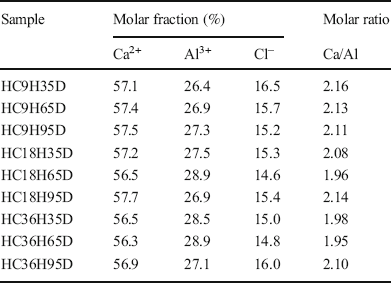
Calcium, aluminum, and chlorine molar fractions were similar for all samples, with the Ca/Al molar ratio close to the theoretical value of 2 (Table 2). Thus, the expected stoichiometry for hydrocalumite was reached. Based on the XRD and XRF results, synthesis by coprecipitation using a water/ethanol mixture was successful.
Chemical composition of the hydrocalumite samples from XRF analysis

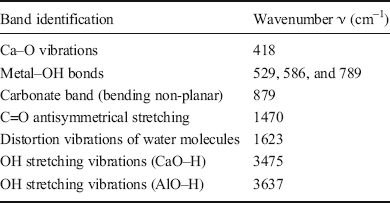
The FTIR spectra (Fig. 3) were characteristic of hydrocalumite (Domínguez et al. Reference Domínguez, Pérez-Bernal, Ruano-Casero, Barriga, Rives, Ferreira, Carlos and Rocha2011; Pérez-Barrado et al. Reference Pérez-Barrado, Pujol, Aguiló, Cesteros, Díaz, Pallarès, Marsal and Salagre2013; Sánchez-Cantú et al. Reference Sánchez-Cantú, Barcelos-Santiago, Gomez, Ramos-Ramírez, Ruiz Peralta, Tepale, González-Coronel, Mantilla and Tzompantzi2016). The peak (Table 3) at 418 cm–1 was due to Ca–O vibrations. Bands centered at 529, 586, and 789 cm–1 were associated with the hydroxyl-to-metal (OH–metal) bonds. The narrow band at 879 cm–1 and the broad band at 1470 cm–1 were associated with the carbonate, indicating that the samples were partially carbonated. FTIR analysis was performed over a time period different from that used for XRD; after some time stored in a vacuum desiccator, the samples adsorbed CO2 from the atmosphere. The carbonation did not occur during synthesis, but during storage, so the presence of a CO2 band in the FTIR spectrum does not mean that the synthesis method failed to prevent hydrocalumite carbonation. The hydrocalumite carbonation during storage was also observed by Pérez-Barrado et al. (Reference Pérez-Barrado, Pujol, Aguiló, Cesteros, Díaz, Pallarès, Marsal and Salagre2013), Wen et al. (Reference Wen, Yang, Yan and Xie2015, Reference Wen, Yang, Xiao, Yang, Xie and Huang2016), and Linares et al. (Reference Linares, Moscosso, Alzurutt, Ocanto, Bretto and González2016).
FTIR spectra

Identification of the IR bands representative of the synthesized hydrocalumites

The small band at 1623 cm–1 was attributed to bending vibrations of adsorbed H2O. The band at 3500 cm–1 was assigned to O–H stretching vibrations of the H2O coordinated to Ca2+ (3475 cm–1) and Al3+ (3637 cm–1). According to the literature, the 879 cm–1 band is probably associated with M–O lattice vibrations (M are metal atoms) (Zhang et al. Reference Zhang, Qian, Shi, Ruan, Yang and Frost2012; Jia et al. Reference Jia, Wang, Zhao, Liu, Wang, Fan and Zhou2016). The FTIR analysis was insensitive to chloride in the hydrocalumite structure because the chloride (negative charge) formed an ionic bond as a counterion to the hydrocalumite layer (positive charge) (Oladoja et al. Reference Oladoja, Adelagun, Ololade, Anthony and Alfred2014).
The N2 adsorption-desorption isotherms of the samples (Fig. 4) were similar and classified according to IUPAC as type IV and type H3 hysteresis (slit-shaped pores), typical of a mesoporous material with pore diameters (Table 4) of 20–500 Å (Cota et al. Reference Cota, Ramírez, Medina, Sueiras, Layrac and Tichit2010; Pérez-Barrado et al. Reference Pérez-Barrado, Pujol, Aguiló, Cesteros, Díaz, Pallarès, Marsal and Salagre2013; Granados-Reyes et al. Reference Granados-Reyes, Salagre and Cesteros2014). However, a very small fraction of macropores was present in the samples; above 0.96 relative pressure, a great increase in the amount of N2 was observed, indicating the presence of macropores, which adsorbed was confirmed by the last point of the pore-size distribution (Fig. 5). The difficulty that N2 molecules have in entering the interlayer space explains the small values for the BET surface area (Pérez-Barrado et al. Reference Pérez-Barrado, Pujol, Aguiló, Cesteros, Díaz, Pallarès, Marsal and Salagre2013). Another factor that contributed to the reduction in surface area was the high hydrocalumite crystallinity (Granados-Reyes et al. Reference Granados-Reyes, Salagre and Cesteros2014).
N2 adsorption/desorption isotherms of samples a HC9H35D, b HC18H65D, and c HC36H95D

Average pore diameter and pore volume as a function of aging time and temperature

Pore-size distribution of the samples: a–c 9 h, d–f 18 h, and g–i 36 h

The N2 physisorption analysis provided the results of total, micropore, and external BET surface areas (Table 5). The values in parentheses indicate the percentage of the total surface area attributable to the micropore and external surface areas. Hydrocalumites aged at 35 and 95°C showed larger BET surface areas after aging for 36 h, and at 65°C the largest surface area was achieved after 18 h. On the other hand, 9 and 18 h of aging at 95°C provided smaller BET surface areas, but for 36 h the area was less at 65°C. The increase in aging temperature promoted an increase in the fraction of the micropore surface area (Table 5), which consequently decreased the external surface area (only sample HC36H95D departed from this trend). Similarly, increasing the aging time tended to increase the micropore fraction and decrease the external surface area. Linares et al. (Reference Linares, Moscosso, Alzurutt, Ocanto, Bretto and González2016) and Prado et al. (Reference Prado, Almeida, De Oliveira, De Souza, Cardoso, Constantino, Pinto, Tronto and Pasa2016) reported small surface area values (10.7 and 25.0 m2 g–1) for hydrocalumite, indicating agreement between values reported in the literature and those observed here (Table 5).
BET surface area (S) as a function of aging time and temperature

The values in parentheses represent the percentage of S total accounted for by micropore or external surface area.
The pore distributions were unimodal with the most frequent pore diameter being in the range 22.4–31.1 Å (Fig. 5). From the N2 physisorption analysis, the mean pore diameter (Table 4) was greater than the modal value because the mean value calculation took into account all distribution values and not just the most frequent value. The micropore and mesopore volumes were also acquired by N2 physisorption analysis (Table 4). At 35°C the pore diameter was smaller after aging for 9 h, but at 65 and 95°C the smallest pore size occurred after 36 h. The largest pore size after 9 h was achieved during aging at 65°C. However, for 18 and 36 h, the largest pore diameter was obtained at 35°C. Only at the aging temperature of 95°C was the pore size related to the BET surface area, in which the increase in pore diameter yielded a decrease in surface area. However, the surface area development was impaired by the high crystallinity; samples HC9H95D and HC18H95D had smaller surface areas because they were more crystalline (Figs. 1 and 2). The variation in the micropore and mesopore volumes followed the same trend as the total area variation, in which the volumes of both micropores and mesopores were larger in the samples with greater surface area. Nevertheless, the pore volume was small, which agrees with the literature (Granados-Reyes et al. Reference Granados-Reyes, Salagre and Cesteros2014). The BET surface area can be related to the pore volume; the sample with the largest mesopore volume had the largest surface area. Therefore, changes in aging conditions were able to modify the hydrocalumite textural characteristics.
The thermogravimetric analysis (TGA) curves highlighted mass loss with increasing temperature (Fig. 6). During the initial 30 min, samples were maintained at constant temperature (~35°C) in order to stabilize the DTG (Fig. 7) and DSC (Fig. 8) signals; during the subsequent 40 min, samples were kept at 1200°C to complete the last mass loss. All TG curves were similar, but some peculiarities can be highlighted. The TGA curves of samples aged for 9 h (Fig. 6a) showed that sample HC9H65D lost 7 wt.% in the non-heating step (~35°C); this stage was maintained under N2 flow (100 mL min–1). This weight decay may have been due to water removal by the flowing dry N2. In the TGA curves of hydrocalumites aged for 18 h (Fig. 6b), sample HC18H35D lost ~2 wt.% in the step without heating. The profile for sample HC18H95D, however, was very different, with the first three stages producing a greater mass loss than the other stages. The TGA profiles of samples aged for 36 h (Fig. 6c) showed that sample HC36H95D lost 3 wt.% in the step without heating.
Thermogravimetric analysis of the samples aged for a 36 h, b 18 h, and c 9 h

Derivative of weight (DTG) over time for samples aged for a–c 9 h, d–f 18 h, and g–i 36 h

Differential scanning calorimetry (DSC) analysis over time for samples aged for a–c 9 h, d–f 18 h, and g–i 36 h

The total mass loss for the samples was between 39 and 41 wt.% (Table 6), with five decomposition stages, except in the case of sample HC36H95D (four stages). According to mass spectrometry coupled to thermogravimetric analysis (TG-MS, Fig. 9), the first mass-loss stage corresponded to decomposition of free water (~142°C); the second and third stages, to decomposition of lattice water and hydroxyl groups (~265–330°C and shoulder extending to ~550°C); the fourth stage, carbonate decomposition (712°C); and the fifth, chloride decomposition as hydrochloric acid (>1000°C). The calcium carbonate (CaCO3) was converted to calcium oxide and CO2 at 700°C (Hills Reference Hills1968). The CO2 present in the samples was, therefore, believed to be chemically bound to the hydrocalumites because its decomposition occurred at high temperature (712°C).
Study of thermal decomposition of hydrocalumites: temperature range, mass loss, and heat of decomposition

Mass spectrometry analysis of sample HC36H65D for m/e of a 44 and b 18

Mass spectrometry (MS) failed to detect HCl because the chloride concentration in the sample was below the equipment detection limit. At 887°C (Fig. 9), a shoulder was observed which could have been due to water (m/e = 18), but all water should have already been released by the time the sample reached this temperature. As this shoulder is within the temperature range of the last mass loss (815–1200°C, see Table 6), it is probably due instead to dehydroxylation of CaClOH, indicating that the chloride may also have been converted to HCl or Cl2. For sample HC36H95D, decomposition stages corresponded to release of (1) free water, (2) lattice water, (3) carbonate, and (4) hydrochloric acid.
TG curves of hydrocalumites presented by Zhang et al. (Reference Zhang, Qian, Shi, Ruan, Yang and Frost2012) indicated three mass-loss stages, with a total loss of 40–49 wt.%, which, according to those authors, is typical of hydrocalumites containing chlorine. The three stages were: (1) 90 to 200°C – free and lattice water, (2) 200 to 400°C – hydroxyl present in the double hydroxide layer, and (3) 400 to 1000°C – chloride that is converted to HCl (Zhang et al. Reference Zhang, Qian, Shi, Ruan, Yang and Frost2012). Domínguez et al. (Reference Domínguez, Pérez-Bernal, Ruano-Casero, Barriga, Rives, Ferreira, Carlos and Rocha2011) also performed thermogravimetric analysis on hydrocalumites, and observed a total mass loss of 39–42 wt.%, where water was removed in two stages, the first at 120°C (13 wt.%) and the second at 310°C (16 wt.%). Chloride was removed (8 wt.%) as hydrochloric acid at temperatures >1000°C. These thermogravimetric analysis results agree, therefore, with other published literature.
The mass loss in the first stage was less for the first five hydrocalumites (Table 6), which indicated lower hydration of these samples. In addition, all samples had a greater lattice water fraction than free water; the sum of stages 2 and 3 was larger than the stage 1 fraction (for HC36H95D the stage 2 fraction was greater than that for stage 1). Looking at the second and third stages, the first five samples had a greater mass loss in the second stage, whereas for samples HC18H95D, HC36H35D, and HC36H65D the third stage had a greater mass loss. This can be related to the temperature range of each stage. When the temperature variation was greater, the mass loss was also greater. Therefore, the results were consistent, where the lattice water was decomposed at higher temperatures because it was more strongly linked to the material structure.
The sample that presented the largest mass loss due to carbonate decomposition (stage 3) was HC36H95D, with a loss of ~16.5 wt.%, followed by samples HC9H35D and HC18H65D (Table 6). On the other hand, much less carbonate was evolved from samples HC18H95D, HC36H35D, and HC36H65D (7.2, 9.2, and 8.4 wt.%). These features of this material were interesting in terms of CO2 capture and sequestration, as reported by Rossi et al. (Reference Rossi, Campos and Souza2019).
The chloride decomposition fraction (stage 4 for HC36H95D and stage 5 for the others) varied slightly among the samples (5.1–6.9 wt.%), which was expected because chloride cannot be captured out of the environment as can water and CO2.
The free water was released from the samples between 35 and 169°C (Table 6). The lattice water was released over five different temperature ranges depending on the sample: (1) 169–453°C for HC36H95D, (2) 169–499°C for HC9H35D and HC18H65D, (3) 169–524°C for HC36H35D, (4) 169–550°C for HC18H95D and HC36H65D, and (5) 169–604°C for samples HC9H65D, HC9H95D, and HC18H35D. The high temperature required to release the lattice water pointed to a strong interaction of the water molecule with the material structure and of hydroxyl with the lamellae cations. Kuwahara et al. (Reference Kuwahara, Tsuji, Ohmichi, Kamegawa, Mori and Yamashita2012) also assumed greater interaction of the hydroxyl groups with cations when the hydroxyl decomposition temperature was higher.
The carbonate decomposition as CO2 also occurred over five temperature ranges, depending on the sample: (1) 453–815°C for sample HC36H95D, (2) 499–815°C for HC9H35D and HC18H65D, (3) 524–815°C for HC36H35D, (4) 550–815°C for HC18H95D and HC36H65D, and (5) 604–815°C for samples HC9H65D, HC9H95D, and HC18H35D. Similarly, as reported for water, the carbonate interacted more strongly with the material structure (forming CaCO3), as evidenced by the high decomposition temperature. Chloride was released as HCl at 815–1200°C in all samples.
Typical DTG curves revealed five (Fig. 7a–h) and four (Fig. 7i) well defined peaks. Mass losses were related to the peaks of these curves, in which larger peaks indicated larger mass losses, corroborating the results presented previously (Table 6). From the DTG curves, the mass-loss regions, temperature ranges, and integration limits were identified accurately, and were needed to calculate the heat involved in each mass-loss region of the DSC curve (Fig. 8).
Downward DSC peaks (Fig. 8) represented endothermic events and one upward peak an exothermic event. Domínguez et al. (Reference Domínguez, Pérez-Bernal, Ruano-Casero, Barriga, Rives, Ferreira, Carlos and Rocha2011) reported endothermic events for water decomposition and exothermic events for chloride decomposition. The DSC curves showed overlapping peaks at stages 3 and 4 (Fig. 8a–e) and at stages 1, 2, and 3 (Fig. 8f–h). For the overlapping peaks, the integration to calculate the heat was made considering the entire region of the peaks. For example, in the peak corresponding to stages 3–4 (Fig. 8a), the two peaks were integrated together, i.e. the heat of sample HC9H35D for stage 3 (Table 6) corresponded to the heat involved in stages 3 and 4. Therefore, an empty space was placed in stage 4. In reality, the value 805 kJ kg–1 referred to stages 3 and 4. The heat was not calculated separately because the endothermic peak of stage 3 was not well defined; this situation was repeated for all overlapping peaks.
In the samples aged for 9 h (samples HC18H35D, HC18H65D, and HC36H95D; Table 6), the heat absorbed to release all free water and part of the lattice water (534–849 kJ kg–1) was calculated in the same integration, but as the mass-loss fraction of the second stage accounted for ~64–72 wt.% of the first two stages, the heat involved in the second stage represented the largest fraction (~68%) of that heat. Note that samples HC9H35D and HC36H95D presented the largest and smallest amounts of heat absorbed in stages 1 and 2 (849 and 534 kJ kg–1), respectively, which infers that water interacted more strongly with the material structure in sample HC9H35D than in sample HC3H95D. On the other hand, the heat absorbed to release all water (1032–1479 kJ kg–1) from samples HC18H95D, HC36H35D, and HC36H65D, calculated using the first three mass-loss stages, revealed that the loss of lattice water (second and third stages) accounted for ~58–65 wt.% of the three stages and the heat involved in the lattice water decomposition was ~62 wt.%, indicating that water was bound more strongly to hydrocalumite in sample HC36H65D than in the other samples.
The DTG peak of the third stage was very small (Fig. 7a–e), indicating a small mass-loss fraction (Table 6). As mentioned previously, in this sample group the heat was calculated by integrating the DSC curve region of stages 3 and 4 because the third endothermic peak was not well defined (superimposed on peak 4). However, the mass-loss fraction for stage 4 was large, ranging from 75 to 89 wt.% (Fig. 7a–e). Based on this, one may assume that the heat absorbed in the third and fourth stages of mass loss (646–856 kJ kg–1) is predominantly associated with carbonate decomposition. For sample HC18H95D and those aged for 36 h, the fourth stage and the third stage (HC36H95D) (Fig. 8f–i) were related integrally to the heat absorbed by the carbonate decomposition. Sample HC36H95D absorbed the largest amount of heat to decompose the carbonate to CO2 (971 kJ kg–1), which led to the belief that CO2 interacted most strongly with the material structure.
Chloride decomposition as hydrochloric acid is exothermic; hence, the negative signal (Table 6) was related to the heat associated with stages 5 and 4 (HC36H95D) and the upward peak (Fig. 8). The heat of chloride decomposition varied from –4708 to –7197 kJ kg–1 (Table 6). Because sample HC9H35D released the greatest heat of decomposition, the chloride in this sample probably interacted more strongly with the hydrocalumite structure. Prado et al. (Reference Prado, Almeida, De Oliveira, De Souza, Cardoso, Constantino, Pinto, Tronto and Pasa2016) observed only a slight mass loss during the exothermic event above 750°C. On the other hand, when the temperature approached 1200°C the mass loss increased. They also reported that between 800 and 1200°C the mass variation was small (2.7 wt.%) and slow, so the mass spectrometer could not detect the decomposed chemical species. The total mass loss was ~39 wt.% (Prado et al. Reference Prado, Almeida, De Oliveira, De Souza, Cardoso, Constantino, Pinto, Tronto and Pasa2016). Results from the present study confirm the observations by Prado et al. (Reference Prado, Almeida, De Oliveira, De Souza, Cardoso, Constantino, Pinto, Tronto and Pasa2016) that the final mass loss was also exothermic with slight mass loss.
Changes in structure due to heat treatments were measured by XRD (Fig. 10). Sample HC36H65D was used as a representative hydrocalumite sample and was heated in a TGA under 60 mL min–1 air flow to 200, 300, 400, 500, 600, 700, 800, or 1000°C, then cooled. The XRD pattern from 200°C treatment revealed that the hydrocalumite structure was not destroyed, but became less crystalline (broader XRD peaks). At 300°C, the hydrocalumite structure was completely destroyed, with the formation of an amorphous material (shoulder at 30°2θ). A similar result was obtained after the 400 and 500°C treatments. As previously mentioned, the sample was carbonated, so a very small peak due to CaCO3 formation was observed.
XRD patterns for sample HC36H65D calcined at a 200°C, b 300°C, c 400°C, d 500°C, e 600°C, f 700°C, g 800°C, and h 1000°C. ♦ – Ca4Al2O6Cl2·10H2O, X – CaCO3, ● – CaO, ■ – Ca12Al14O33, o – CaClOH, and * – unknown

At 600°C, low-intensity peaks assigned to lime (CaO) were formed and the shoulder at 30°2θ remained (Fig. 10); thus, the calcite was completely decomposed at this temperature. At 700°C, a phase mixture composed of mayenite (Ca12Al14O33), lime, and calcium chloride hydroxide (CaClOH) was formed, in which the major peaks of mayenite (33.4°2θ) and lime (37.3°2θ) were of similar intensity. The XRD pattern of the sample heated at 800°C was similar to that calcined at 700°C, but the main lime peak was slightly larger than that of mayenite. In addition, an unknown phase was observed near 31°2θ. At 1000°C, the solid mixture was composed of mayenite and lime and the CaClOH phase disappeared, which corroborated the thermogravimetric analysis result, i.e. that chlorine was released from the sample between 1000 and 1200°C. The main mayenite and lime peaks were of similar intensity. The peak intensity increased from 700 to 1000°C, reflecting the greater crystallinity of the material.
Domínguez et al. (Reference Domínguez, Pérez-Bernal, Ruano-Casero, Barriga, Rives, Ferreira, Carlos and Rocha2011) studied hydrocalumite calcination at 500 and 900°C, and reported an amorphous phase without identification after 500°C heat treatment of a mixture of CaO, Ca12Al14O33, and CaClOH at 900°C. Kuwahara et al. (Reference Kuwahara, Tsuji, Ohmichi, Kamegawa, Mori and Yamashita2012) calcined hydrocalumite to study the material structure. At 400°C, the lamellar structure collapsed, showing a broad peak near 30°2θ (visualized by XRD). This structure was characteristic of an amorphous phase which may be calcium and aluminum mixed oxide. Calcination at 600 and 800°C transformed the material structure into a mixture of lime and mayenite; in addition, the XRD peak intensity increased. The XRD pattern of samples calcined at 1000°C was similar to that at 800°C. These observations confirmed those of Kuwahara et al. (Reference Kuwahara, Tsuji, Ohmichi, Kamegawa, Mori and Yamashita2012).
The results achieved during the present study confirmed the observations of Prado et al. (Reference Prado, Almeida, De Oliveira, De Souza, Cardoso, Constantino, Pinto, Tronto and Pasa2016) that hydrocalumite dehydrates up to 190°C, then partially dehydroxylates up to 570°C. The XRD profiles of samples calcined at 500°C showed the existence of an amorphous phase and crystalline CaCO3. At 700°C, the CaCO3 was converted to CaO, and between 570 and 750°C the decarbonation was responsible for the mass loss as the CO2 signal was verified by MS (m/e = 44). In the sample heated at 750°C, the XRD profiles showed CaO and Ca12Al14O33 crystalline phases. Chloride was decomposed as HCl between 830 and 1000°C (Prado et al. Reference Prado, Almeida, De Oliveira, De Souza, Cardoso, Constantino, Pinto, Tronto and Pasa2016).
CO2-TPD profiles revealed low-intensity peaks from CO2 desorption peaks in the temperature ranges of 100–400°C and 900–1000°C (Fig. 11) and high-intensity peaks between 500–800°C (Fig. 12). The larger peaks were plotted separately so as not to hinder the visualization of the smaller peaks. The basic sites were classified according to their basicity: desorption peaks between (1) 100–250°C – weak, (2) 250–500°C – moderate, and (3) >500°C – strong. According to Kuwahara et al. (Reference Kuwahara, Tsuji, Ohmichi, Kamegawa, Mori and Yamashita2012), hydrocalumites contain basic sites, as demonstrated by weak TPD-CO2 peaks at 97°C and moderate TPD-CO2 peaks at 298°C. The weak sites are attributed to surface hydroxyls and the moderate ones to O2– ions adjacent to the hydroxyls.
CO2 temperature-programmed desorption profiles (TPD-CO2) showing the peaks of low intensity for the samples: a–c 9 h, d–f 18 h, and g–i 36 h

CO2 temperature-programmed desorption profiles (TPD-CO2) showing the peaks of high intensity for the samples: a–c 9 h, d–f 18 h, and g–i 36 h

Quantification of the basic sites (Table 7) showed that hydrocalumites were composed mainly of strong basic sites. Samples aged for 9 h had a larger amount of total basic sites, i.e. the increase in aging time reduced basicity, with the largest number occurring at the aging temperature of 65°C and the smaller number at 95°C, except for sample HC36H95D.
CO2 temperature programmed desorption (TPD-CO2): total amount and distribution of basic sites

aThe number in parentheses is the corresponding percentage of total amount of basic sites.
Conclusions
Characterization of hydrocalumites synthesized by the coprecipitation method under various aging conditions revealed that this method is suitable for the production of pure and crystalline layered double hydroxide with a Ca/Al molar ratio of 2. The water/ethanol mixture used in the synthesis prevented sample poisoning by atmospheric carbon dioxide. The variation of aging time and temperature promoted changes in the structure, textural properties, morphology, thermal stability, and basicity of hydrocalumite. Aging at 95°C was decisive for providing more crystalline samples, and aging for 36 h was best to yield hydrocalumites with larger surface areas (up to 20.2 m2 g–1). Aging at 65°C for 9 h was the optimum condition to maximize the hydrocalumite basicity (1557 μmol g–1).
ACKNOWLEDGMENTS
The authors thank CAPES, CNPq, and FAPERJ for providing financial support for this study, and Greentec/EQ/UFRJ for N2 adsorption analyses.
Compliance with ethical standards
Conflict of Interest
The authors declare that they have no conflict of interest.