Introduction
The 2016 Kumamoto Earthquake (Kumamoto Prefecture, Japan) occurred with two sets of major earthquakes. The first major earthquake occurred on April 14th with a 6.5 magnitude and the second occurred on April 16th with a 7.3 magnitude. Both earthquakes occurred in the center of Kyusyu Island, and the depth of origin was about 10km deep. There was no tsunami from this earthquake, but shaking near the epicenter was huge and resulted in the collapse or damage of houses and buildings. As a result, 82 people lost their lives, 619 people were severely injured, 1,433 had minor injuries, 1,216 houses were completely collapsed, over 700 evacuation shelters were established, and over 11,000 people were evacuated from their homes at one time.
Management of disaster medical relief teams during disasters is one of the major challenges world-wide.Reference Benjamin, Bassily-Marcus, Babu, Silver and Martin1, Reference Santiago, Manuela, Tan, Sañez and Tong2, Reference Hall, Lee, Cartwright, Marahatta, Karki and Simkhada3 In Japan, lessons learned from the 1995 Hanshin-Awaji Earthquake pointed out that disaster medical management must be commanded and coordinated by a disaster medical coordinator who has knowledge and experience with disaster medical relief operations and public health management. Standardization of disaster medical relief teams is also pointed out since there is no organized medical team to respond to disasters. Several prefectural governments appointed a disaster medical coordinator within their own prefecture, and standardization of disaster medical relief teams started with the establishment of the Disaster Medical Assistant Team (DMAT). The DMAT is one of the disaster medical relief teams which responds from the onset of a disaster for a couple of days until other disaster medical relief teams arrive. The DMAT consists of mostly five to six members that include a doctor, a nurse, and a logistician. Disaster medical relief teams are any disaster medial relief team besides DMAT. Those include: Japan Medical Association Team (JMAT), Japan Red Cross Medical Assistance Team (JRC), Japan Rehabilitation Assistance Team (JRAT), Japan Dietetic Association-Disaster Assistance Team (JDA-DAT), and Disaster Psychiatric Assistance Team (DPAT). Those teams are the main response after DMAT dispatch, and they take over medical relief operations from DMAT in each profession. All those improvements from the Hanshin Awaji Earthquake were reconfirmed during the 2011 Great East Japan Earthquake Operation.Reference Morikawa and Shimizu4, Reference Ishii5 When DMAT and other disaster medical relief teams responded to the Great East Japan Earthquake, different command systems among DMAT and the other relief teams, as well as different numbers of responding teams, created a gap in operation. This gap must be improved for the next major disaster to avoid a blank in disaster medical operations.
In this study, evaluation of DMAT’s and the other disaster medical relief teams’ operations for the 2016 Kumamoto Earthquake was conducted to find any improvements from the Great East Japan Earthquake and to extract further lessons learned to improve future expected disaster management.
Methods
Evaluation of all communications logs for DMAT, and the other disaster medical relief teams at the command post, was conducted in July 2016. Communication logs are the standardized logs of any communication that was made at each command post. It records time of information reached, who reported information, who received information, and the content of information. Most of all DMATs and the other disaster medical relief teams have been educated to record this style of communication log. Evaluation was conducted by the authors by reading though all the logs and picking up key events.
During the Kumamoto Earthquake, communication logs were kept by the following disaster medical relief teams and continued until the disaster medical headquarter closed. This communication log was written onto papers on the wall first, then another person typed the hand-written records into the Microsoft Excel file (Microsoft Corp.; Redmond, Washington USA).
Besides the evaluation of communications logs, chronological transitions of command tree charts were also evaluated to examine who was managing disaster medicine at each period of time. Evaluation was conducted by the authors by comparting the charts.
The study was approved by the institutional ethics committee of the Disaster Medical Center of Japan (Tachikawa, Tokyo, Japan).
Results
Transition of the Command System: Prefectural Level
After the first earthquake occurred on April 14th, a DMAT prefectural command post was established at the prefectural office of Kumamoto and controlled DMAT operation within all Medical Areas (MAs) of Kumamoto. After one week, on April 21st, the DMAT command post transformed to the disaster medical relief team command headquarters and was named Kumamoto Medical Aid Management Headquarters and operated not only public health and welfare control, but also a variety of disaster medical relief team distributions with the assistance from each disaster medical relief team organization. To control each disaster medical relief team, such as the Prefectural Medical Relief Team, JRC, JMAT, JRAT, JDA-DAT, and DPAT, this command post also formed and assisted the Kumamoto Medical Coordinator Council to gather the status of all disaster medical relief team operations in progress and to manage strategies for medical relief operations with the attendance from medical-related Kumamoto prefectural government officers.
Transition of the Command System: Medical Area Level
Kumamoto prefecture consisted of 11 MAs. Among the MAs, the most damaged area was located within four MAs which surrounded the earthquake epicenter: Kamimashiki MA, Aso MA, Kikuchi MA, and Kumamoto MA (Figure 1).
Map of Kumamoto Prefecture and Kumamoto Medical Area (MA).
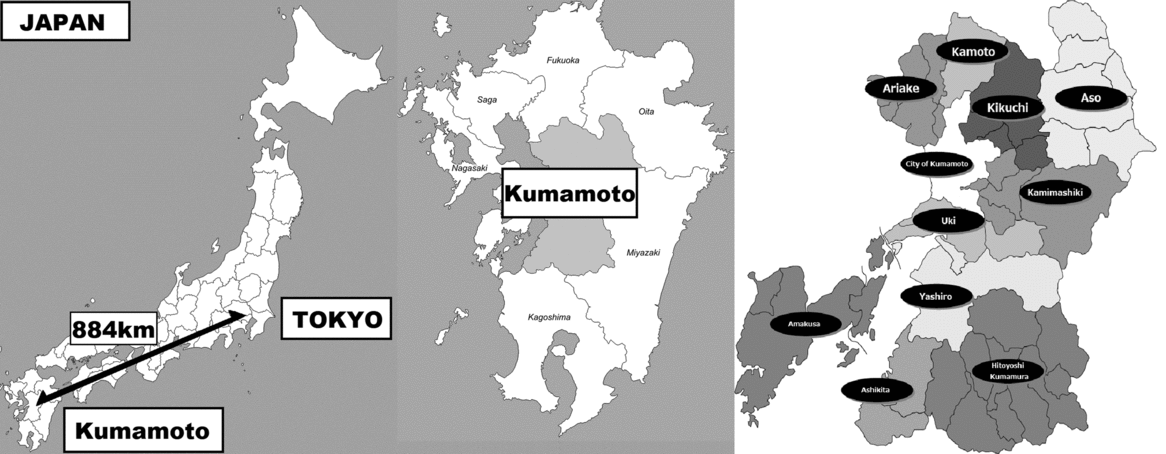
The April 14th earthquake mainly damaged the Kamimashiki MA and the Kumamoto MA; therefore, DMAT operational command posts for each MA were established at the Kumamoto Red Cross Hospital, which was located at the boarder of the Kumamoto MA and the Kamimashiki MA. However, after the biggest earthquake on April 16th, the damage expanded to other neighboring areas. Therefore, DMAT operational command posts were newly set and relocated within each four MAs. Kamimashiki MA’s DMAT operational command post was relocated to Mashiki Health Welfare Center. Kumamoto MA’s DMAT operational command post also relocated into the Kumamoto Municipal City Disaster Management command. For Aso MA, DMAT operational command post was set at Taketa Medical Association Hospital in Oita Prefecture due to the complete collapse of the Aso Great Bridge. Later, Aso MA regained access to the hospitals and the DMAT operational command post moved to the Aso Medical Center. For Kikuchi MA, DMAT operational command post was established at Kawaguchi Hospital first, then was moved to Kikuchi Public Health Office.
The first week of each MA’s medical command post was only for DMAT operational control, which was managed by DMAT itself. However, each DMAT operational command post was later switched to the disaster medical relief team management headquarters to control all other disaster medical relief teams. Each four MA’s disaster medical relief team management command post was closed when all medical relief operations were completed.
DMAT Operation
The DMAT deployment started within Kyushu Island after the April 14th earthquake. Then following the bigger earthquake on April 16th, DMAT dispatched from all 47 prefectures in Japan. A total of 466 teams and 2,071 members were dispatched, and of them 394 teams and 1,931 members were dispatched into the Kumamoto Prefecture.
The DMAT operations included management of command posts, status checks of disaster-affected hospitals through Emergency Medical Information System (EMIS), screening of evacuation shelters, information sharing with other organizations, hospital operation assistance, 1,400 hospitalized patients transferred from 11 damaged hospital, utilization of doctor helicopter, medical care at the evacuation shelter, medical care at the rescue site, and logistic support.
Operation After DMAT Withdrawal
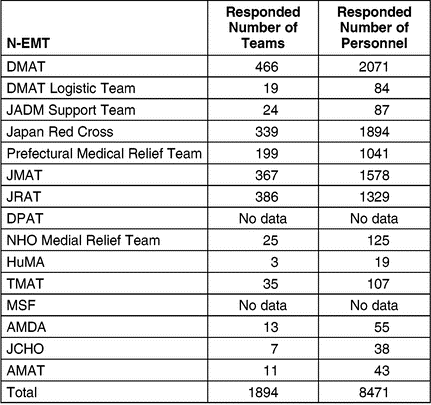
The DMAT command post at the Kumamoto Prefectural Office and DMAT operational command post at each four MAs became disaster medical relief teams’ management and command posts after DMAT withdrawal. Disaster medical relief team management and command post members created phone number lists of all disaster medical relief teams. Disaster medical relief team command posts also produced the standardized medical record keeping system by utilizing the Japanese version of Surveillance in Post Extreme Emergencies and Disasters (J-SPEED). Disaster medical relief teams operated from April 14th through June 2nd, and 1,894 teams and 8,471 members participated (Table 1).
Responded Number of Teams and Personnel among Disaster Medical Relief Teams during the Kumamoto Earthquake

Abbreviations: AMAT, All Japan Hospital Medical Assistance Team; AMDA, Association of Medical Doctors of Asia; DMAT, Disaster Medical Assistant Team; DPAT, Disaster Psychiatric Assistant Team; HuMA, Humanitarian Medical Assistance; JADM, Japan Association for Disaster Medicine; JCHO, Japan Community Health Care Organization; JMAT, Japan Medical Association Team; JRAT, Japan Disaster Rehabilitation Assistant Team; MSF, Médecins Sans Frontières; N-EMT, national Emergency Medical Team; NHO, National Hospital Organization; TMAT, Tokushukai Medical Assistant Team.
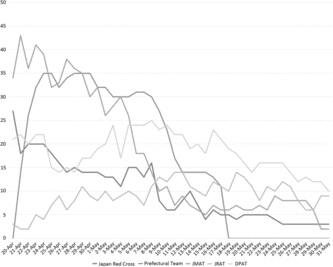
Transition of the participating disaster medical relief team numbers from the selected organizations are showed in Figure 2. Earlier phases of disaster medical relief team participation were mainly medical care, and that was provided by relief teams such as Prefectural Medical Relief Team, JRC, and JMAT. More specialized teams, such as JRAT and DPAT, stayed longer periods to provide more specific medical care in their own profession.
Transition of Selected Disaster Medical Relief Teams Responded Team Number.

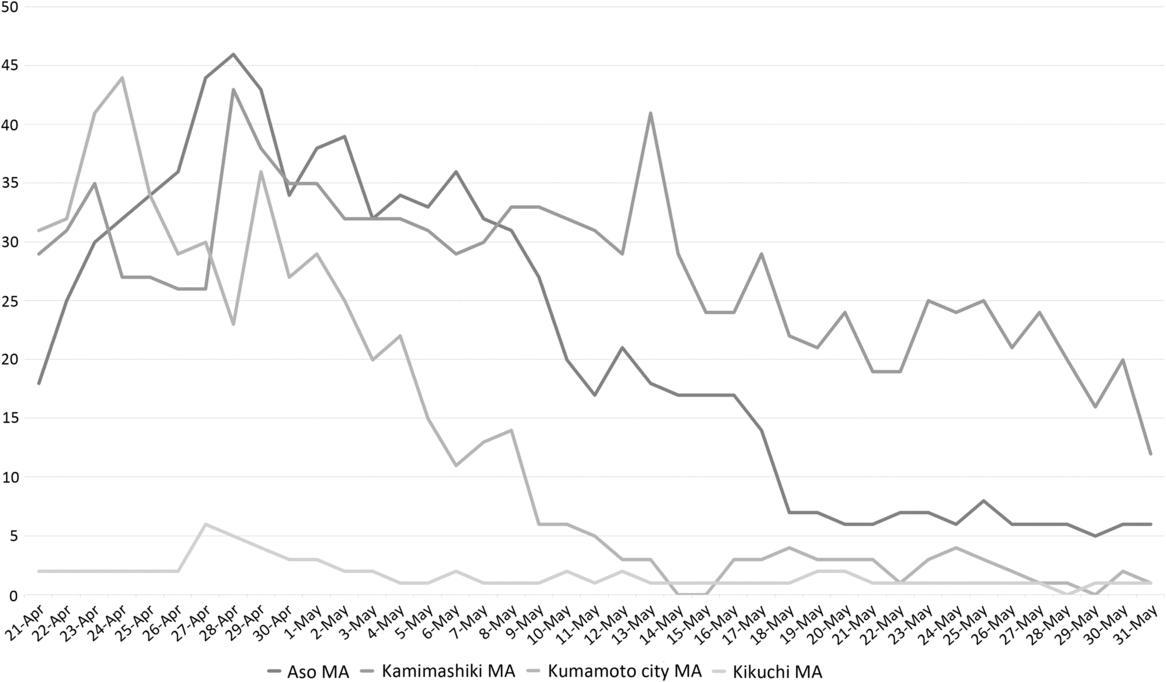
Figure 3 shows the transition of dispatched disaster medical relief team numbers to each MA. A disaster medical relief team was dispatched to the Kumamoto MA, Aso MA, and Kamimashiki MA in the early phases, then was gradually decreased in number.
Transition of Dispatched Disaster Medical Relief Team Numbers to each Medical Area (MA).

The J-SPEED system started on April 16th. By April 26th, all disaster medical relief teams started recording via J-SPEED. Maximum patient number was recorded on April 28th, and then it gradually decreased. Figure 4 shows that medical needs were high in Kamimashiki MA and Aso MA.
Transition of Patient’s Number which was Recorded via J-SPEED System.

An evacuation shelter survey was conducted by DMAT and JRC, and later by a public health nurse from a municipal government office. The results were analyzed and introduced at the Kumamoto Medical Coordinator Council.
The disaster medical relief teams cooperated with prefectural and municipal health departments and assisted public health nurse operations, especially in Aso MA.
The disaster medical relief team also assisted Mashiki Municipal government’s medical department. They helped to construct receiving stations for other arriving disaster medical relief teams, helped to improve highly crowded evacuation shelters, helped to manage extended evacuation shelter plans, helped management of evacuation shelters for the vulnerable people, and supported to operate medical clinic visiting bus.
From prolonged stays at the evacuation shelter, it raised several public health problems such as increased number of deep vein thrombosis patients, increased risk of infectious disease, and heat-related illness. Disaster medical relief teams organized project teams for each problem, which consisted of specialists for each problem and connected prefectural government officers in order to take immediate action for those problems.
Discussion
Has the Medical Coordination System been Transitioned Smoothly?
Kumamoto Medical Aid Management Headquarters was established right before DMAT withdrawal, absorbing the DMAT command post; this resulted in a continuous command control system without any gap among the medical phase transitions. By informing and calling all other disaster medical relief team organizations, Kumamoto Medical Coordinator Council was formed.
At the Aso and Kikuchi MAs, DMAT operational command posts also transited their role of command system smoothly to the next phase and they established a municipal city-level Coordinator Council.
On the other hand, at the Kumamoto City and Kamimashiki MAs, DMAT operational command posts could not coordinate with incoming coordinators, and this resulted in some confusion in the earlier operational transition. This also resulted in delays in cooperation with regional city councils.
In Japan, DMAT is the first medial team to establish command hierarchy at the acute phase of a disaster.Reference Kondo, Koido and Morino6 During this Kumamoto Earthquake, the assistance from Japan DMAT Logistic Team, Kumamoto Prefectural Logistician, and Japanese Association for Disaster Medicine Disaster Medicine Coordination Support Team assisted in the operation of medical command posts, and this has made it possible for a smooth transition of medical command systems from the acute phase to the chronic phase, because all those logistic team members were selected people who were trained well in the management of a medical command post in terms of operational strategy building and its management skills. During education of the Major Incident Medical Management and Support (MIMMS), they stated that there are three steps in disaster medical command.Reference Mackway7 Through experience from major disasters, Japan has also three levels of command: prefectural level, MA level, and municipal council level. Therefore, to conduct a smooth transition in medical command systems at each level, medical liaisons from public health offices from the MA or city councils are required at the early phase of disaster.
Was Registration of Disaster Medical Relief Team and Dispatch Arrangement Functioned?
The DMAT can gather standardized medical information through EMIS. Based on this information, DMATs were dispatched to each disaster site.Reference Kondo, Koido and Morino6 In recent international disaster medical response, the World Health Organization (WHO; Geneva, Switzerland) introduced a standardized medical team registration system.8
In this Kumamoto Earthquake, disaster medical relief team registration started at the prefecture level. Then after establishment of the Medical Aid Management Command post, all registration process had been switched to the MA level. The DMAT team registration form was continuously used for disaster medical relief teams. By collecting all team information, and by collecting medical needs information, those made it possible to create an emergency contact list and helped in the well-functioning of the disaster medical management.
Information for Public Health Needs (Such as Evacuation Shelters) was Collected?
After the 2011 Great East Japan Earthquake, the screening of the evacuation shelter in terms of public health was important.Reference Yamanouchi, Sasaki and Kondo9 Also, clinical record data collection and analysis at the disaster site can be one of the most fundamental medical needs of information.Reference Yamanouchi, Ishii and Morino10 The WHO started to use the SPEED system to learn medical needs of disaster sites, and that has been eliciting good outcomes.11
During the Kumamoto Earthquake, all dispatched disaster medical relief teams and public health nurses cooperated well together collecting evacuation shelter screening information, and they collected all evacuation shelter information in the Kumamoto Prefecture. From disaster medical relief team’s daily report forms, J-SPEED reporting information was able to fill out and was able to analyze the status. On the other hand, there were several problems. Standardized evacuation shelter reporting forms had different versions, and that lead dispatched disaster medical relief teams to get confused. They had difficulty in choosing which reporting form was the right one. Some reporting data were not analyzed quickly enough, and that resulted in obsolescence of the data. Those data were required to clean up and analyze as quickly as possible to process other in-coming daily reports. Public health nurses used the hand-written reporting forms, and those data were electricized in Microsoft Excel format. However, those data were not enough information to create a database and could not perform quantitative analysis. The J-SPEED data collection did not start with well-known announcement among disaster medical relief teams, and that ended up in missed collection of the early phase’s diagnostic data. Those problems require improvements.
Project Management and Achievement
At the time of disaster, there were several public health problems to manage, such as deep vein thrombosis, infectious disease, and heat problems. During the Kumamoto Earthquake, each public health problem was managed by the project team that was organized at the headquarters. The main task of each project was to create connections between each problem’s professionals whom resided away from disaster areas and professionals who lived within the disaster area. This formation of the project team helped to solve each problem. However, there was no appropriate prefectural officers who could coordinate public health management at the prefectural level due to in-experience in disaster situations; this needs to be improved also.
Did Disaster Medical Relief Teams Correspond Well for Medical Needs?
During the Kumamoto Earthquake, a maximum of 183,882 people were evacuated from their own home at one point of time, and a total of 1,673 people were injured. There was a much larger number of evacuated people compared to injured people; this resulted in more needs in public health compared to medical needs for injuries. Disaster medical relief teams collected evacuation shelters’ condition status, such as degree of people congestion, toilet condition, and water sanitation. At the Aso MA, disaster medical relief teams assisted public health nurses to support the survey of public health needs.
Limitations
This study has several potential limitations. First, this study was based on evaluation of communication logs and command tree charts which were recorded by a record keeper at each headquarters. Therefore, the validity of records is unclear. Second, communication logs and command tree charts were evaluated by self-reading. Therefore, the validity of evaluation is also unclear.
Conclusion
In the 2016 Kumamoto Earthquake, a lot of disaster medical relief teams, such as DMAT, responded. Responded teams could provide support to command systems for medical relief, public health, and welfare. This also made it possible to construct consistent medical relief operations under consistent command systems from the acute phase of disaster to the recovery phase. Japan is expecting to have bigger earthquakes in the near future; therefore, immediate education and training of personnel and teams who can provide consistent medical operation is necessary.