Introduction
Western liberal democracies are seeing a surge of anti-immigrant bias. A common justification for opposition to immigration is that immigrants resist cultural and political integration and this threatens natives’ national identity (Card, Dustmann and Preston, Reference Card, Dustmann and Preston2005; Hagendoorn and Sniderman, Reference Hagendoorn and Sniderman2001). Cultural differences are at the core of negative attitudes toward immigrants (see, e.g., Sniderman, Hagendoorn and Prior Reference Sniderman, Louk and Prior2004).
The lack of linguistic assimilation has been identified as a primary cause of fears that immigration can threaten the national culture (Citrin et al., Reference Citrin, Lerman, Murakami and Pearson2007; Dowling, Ellison and Leal, Reference Dowling, Ellison and Leal2012; Hopkins, Reference Hopkins2014b; Newman, Hartman and Taber, Reference Newman, Hartman and Taber2012; Schildkraut, Reference Schildkraut2005, Reference Schildkraut2010). To the extent that language assimilation is an individual choice, persistent language differences are perceived as an unwillingness of the immigrant population to become part of the host country. This perception can generate exclusionary attitudes toward foreign language speakers. In the USA, there is evidence that exposure to even brief uses of Spanish by strangers in public settings generates hostility among natives (Enos, Reference Enos2014; Hopkins, Reference Hopkins2014b; Newman, Hartman and Taber, Reference Newman, Hartman and Taber2012; Paxton, Reference Paxton2006).
Grounded in seminal theories of social identity (Tajfel, Reference Tajfel1981), prejudice (Allport, Reference Allport1979), and ethnocentrism (Kinder and Kam, Reference Kinder and Kam2010), many of these studies regard sentiments toward immigrants as a manifestation of the host population’s ingroup identity, and the extent to which immigrant groups are perceived to be “distinct,” and therefore “distant,” from their own. Such “otherness” can induce natives to develop prejudices leading to discrimination toward immigrants, whom they consider to pose a sociotropic threat to their own group (Hainmueller and Hopkins, Reference Hainmueller and Hopkins2014, 232).
Consistent with these theories, ethno-linguistic differences have been associated with lower social trust (Dinesen and Sønderskov, Reference Dinesen, Sønderskov and Uslaner2018, Reference Dinesen and Sønderskov2015), economic discrimination (Michelitch, Reference Michelitch2015; Riach and Rich, Reference Riach and Rich2002), and violent conflict (Cederman and Girardin, Reference Cederman and Girardin2007; Horowitz, Reference Horowitz1985). However, one of the central insights to emerge from the political science literature on identity politics is that the salience of ethno-linguistic divisions varies over time and across contexts (Chandra and Wilkinson, Reference Chandra and Wilkinson2008); so we should expect ethnic bias and discrimination to covary with the salience of ethnic cleavages (Brewer and Kramer, Reference Brewer and Kramer1985; Cikara and Bavel, Reference Cikara and van Bavel2014; Tajfel, Reference Tajfel1981). While linguistic differences might cause discrimination in some contexts (Gluszek and Dovidio, Reference Gluszek and Dovidio2010; Kinzler et al., Reference Kinzler, Kristin, Jasmine and Spelke2009; Sniderman et al., Reference Sniderman, Peri, Rui and Piazza2002) and assimilation might help reduce bias and intergroup conflict (Hopkins, Reference Hopkins2014b), in countries where the native population has been exposed to a large number of socially integrated immigrants and the state has pursued policies encouraging multiculturalism, linguistic differences might not cause bias and linguistic assimilation might not reduce bias due to other ascriptive differences that are more salient (e.g., religion).
We pursue this insight further in two large field experiments conducted in 30 cities across West and East Germany and involving thousands of subjects. The experiments were designed to create a realistic “micro-environment” (Sands, Reference Sands2017) to measure discrimination in everyday real-world social interactions between natives and immigrants. We experimentally varied the ethno-religious attributes of confederates who were part of an intervention and manipulated the language they used to conduct a conversation in a public space. We then observed how bystanders who could overhear the conversation treat the confederates as a function of the language they used as well as other ethno-religious differences. We tested whether exposure to foreign language-speaking minorities of immigrant background generated bias among natives and whether immigrants who appeared to be linguistically assimilated were treated better than others. Footnote 1 We found that exposure to foreign language use does not cause bias among German natives and that linguistic assimilation does not reduce bias due to ethno-religious differences, which appear to be more salient than linguistic differences in Germany.
Methods
Our field experiment was initially implemented in Germany during the summer of 2018 and replicated in summer of 2019 in a follow-up experiment which shared common treatment arms with the first experiment. The issue of immigration has become increasingly salient in Germany following the large influx of refugees from protracted conflicts in the Middle East. We observed native population behavior toward minorities of immigrant background in the context of common day-to-day, one-shot interactions with strangers in public spaces (train stations). We varied the ethnicity and putative religion/religiosity of confederates who were part of the intervention, as well as the putative extent to which they were linguistically assimilated. We then observed whether bystanders provided help to a confederate in need of assistance as a function of her ethno-religious attributes and her degree of linguistic assimilation. Differential levels of assistance serve as our measure of discrimination in this setting.
Experimental Intervention
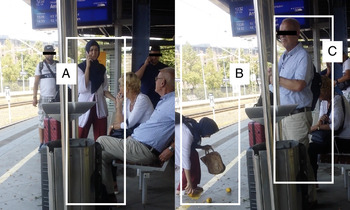
The intervention proceeded as follows: A female confederate approached a bench at a train station where other individuals (bystanders) were waiting for their train (step 1). The confederate got the bystanders’ attention by answering a phone call in either German or a foreign language (Turkish or Arabic), Footnote 2 addressing a friend regarding an innocuous personal matter (step 2). To ensure that the confederate got the bystanders’ attention before the onset of the call, her phone rang with a loud, noticeable ringtone, while she was standing right in front of them. She remained in this location for the entire duration of the call. The phone call revealed the confederate’s putative level of linguistic assimilation. Shortly before the call ended, the confederate dropped fruit (oranges or lemons) from a paper bag that had seemingly torn at the bottom. The fruit dispersed and the confederate appeared to be in need of assistance to pick them up (step 3). We observed whether bystanders who were exposed to the intervention helped the confederate pick up the fruit (step 4). Footnote 3 A pictorial representation of this intervention is included in Figure 1.
Experiment in Progress. Notes: Unknowing bystanders watch and listen as the confederate takes a call, speaking in either German or a foreign language (A). Confederate drops fruits on the platform (B). We observe whether bystanders help the confederate pick up the fruit (C).

Treatment Dimensions
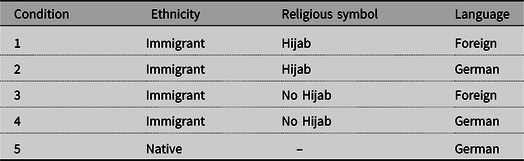
We varied three key experimental dimensions: the ethnicity of the confederate (immigrant or native), her putative religion or religiosity (hijab-wearing Muslim; native; or immigrant with no religious symbols), as well as her putative level of linguistic assimilation (speaking German, Turkish, or Arabic). Footnote 4 A graphical example of how confederates varied with respect to their ethnicity and religion is presented in Figure 2. Prior research has shown that religious differences are salient in Germany and cause discrimination (Choi, Poertner and Sambanis, Reference Choi, Poertner and Sambanis2019). Our focus is whether linguistic assimilation can reduce discrimination due to religious differences. We also test the widely accepted idea that foreign language-speaking non-co-ethnics will be perceived as more culturally distant and will therefore be subject to discrimination by natives (Gluszek and Dovidio, Reference Gluszek and Dovidio2010; Hainmueller and Hiscox, Reference Hainmueller and Hiscox2010). The treatment and control conditions for the experiment are presented in Table 1.
Varying Ethnicity and Religion Treatment Conditions. Notes: A total of 11 confederates of immigrant background were employed across the two experiments. Each immigrant confederate played both the immigrant hijab and the immigrant without the hijab roles within their respective teams. Since we recruited more native Germans, we were able to rotate who played the native German confederate in our iterations.

Treatment Conditions for Language Experiment

Apart from these three dimensions, we maintain putative social class constant both across experimental conditions and across teams of confederates by having the confederates wear similar attire indicative of a middle class background. We mitigate concerns regarding the possibility that differing levels of confederate attractiveness are likely to affect assistance rates by having the same confederate play both the hijab-wearing immigrant and non-hijab-wearing immigrant roles and by using a rather large number of confederates (across teams). We also report in the SI Appendix that our results hold using team fixed effects, which analyze within-team variation in assistance rates across iterations.
Data Collection
The interventions were conducted in 29 train stations across North Rhine-Westphalia, Saxony, and Brandenburg in 2018 and replicated in 23 train stations in North Rhine-Westphalia, Saxony, and Lower Saxony in 2019. We implemented a total of 588 iterations of the intervention, involving 2,560 bystanders over a 3-week period between July and August 2018; and an additional 980 iterations with a total of 2,097 bystanders over 5 weeks from July to August 2019.
For each iteration, research assistants who did not partake in the intervention themselves recorded the behavior of bystanders (coders were not blinded; see SI Appendix for more discussion). The main outcome of interest, which was coded at the iteration level, was whether any bystanders offered assistance to the female confederate in retrieving her possessions. Confederates also noted the total number and gender of bystanders within a pre-specified radius, as well as other characteristics of each iteration. Only bystanders within earshot (i.e., a radius of 3 meters around the confederate) were included. We obtained measurements of ambient noise, Footnote 5 and during a pilot study in May 2019, we collected data to confirm that bystanders could hear the conversation and recall its content (see SI Appendix for more details on share of bystanders with ear phones; and other relevant variables). Footnote 6 The research protocol was reviewed and approved by the University of Pennsylvania Institutional Review Board (IRB Protocols #829824 and #833206). A waiver of the consent process was obtained (see SI Appendix for additional information on ethical and safety considerations).
Results
As specified in our pre-analysis plans, we employ a standard two-tailed difference-in-means test to examine assistance rates at the iteration level across our treatment conditions. When estimating covariate-adjusted average treatment effects (ATEs), we use ordinary least squares regression. The primary results reported in the main text of the paper are based on data that pool observations from experiment 1 (summer 2018) and experiment 2 (summer 2019), since the design remained constant. Results that are disaggregated by each experiment are provided in the appendix, but the results remain substantively unchanged. Footnote 7
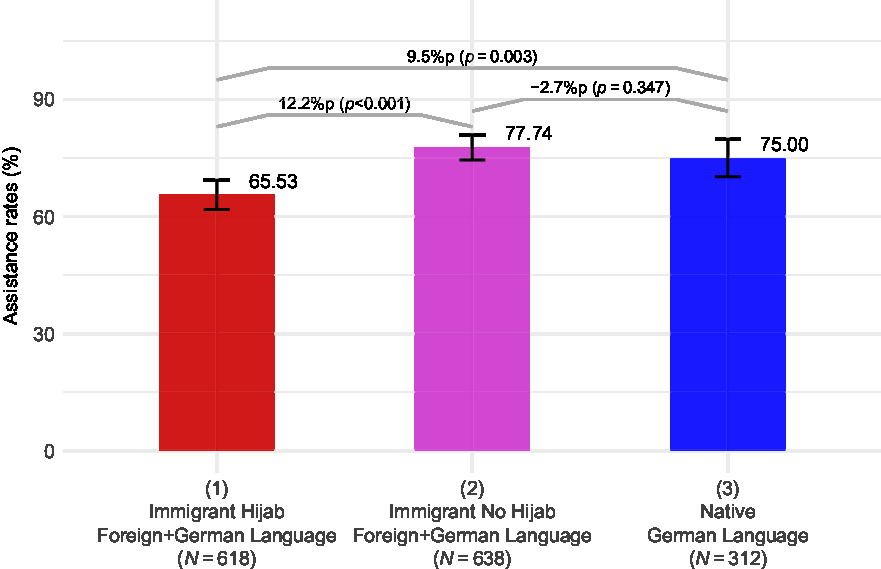
Our main objective is to examine whether linguistic assimilation by immigrants reduces discrimination by natives. Underlying our research is a premise that native populations are inclined to discriminate against minorities of immigrant background. Previous research has reported evidence in support of this premise using a similar research design (Choi, Poertner and Sambanis, Reference Choi, Poertner and Sambanis2019). We briefly show that our experimental setup can replicate and successfully recover discrimination effects against Muslim immigrants in Figure 3. As a comparison of columns (1) and (3) shows, we find that natives are less likely to offer assistance to Muslim immigrant women (ATE: 9.5% points, p = 0.003) but are no less likely to offer assistance to immigrant minorities whose religious beliefs are not made explicit (ATE: −2.7% points, p = 0.347).
Discrimination Against Immigrants: Merged (Experiments 1 and 2). Notes: The bars reflect the mean rate of assistance for each of the treatment conditions, with 95% confidence intervals. The lines that connect the bars are from a two-tailed difference-in-means tests of the conditions, with associated p-values. The figure pools data across experiments 1 (Summer 2018) and 2 (Summer 2019).

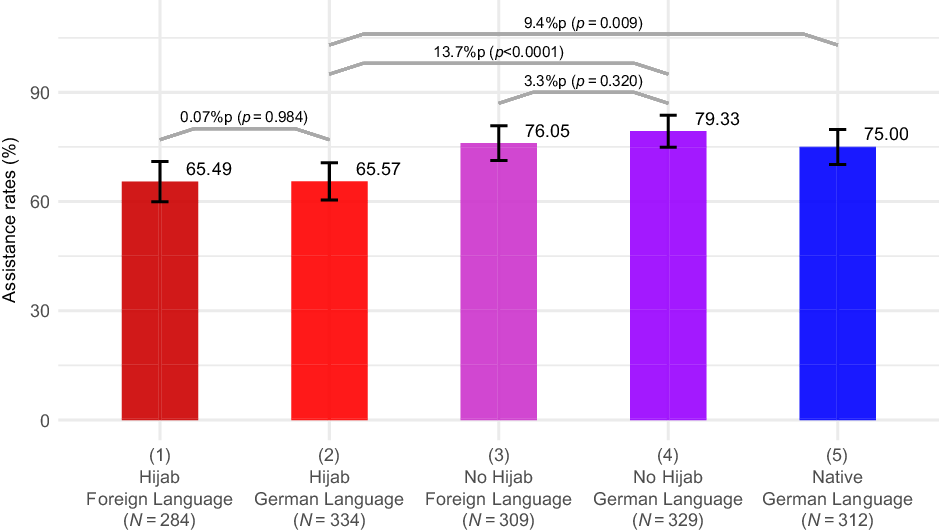
Having established that our experimental design captures discrimination against Muslim immigrants, we now investigate whether linguistic assimilation by immigrants reduces discrimination. We disaggregate help rates for our two immigrant conditions (with and without hijab) by whether the immigrant confederate conversed in Arabic/Turkish or German. We present these results, as well as our native condition (German confederate conducted an identical phone call in German), in Figure 4.
Language Effects: Merged (Experiments 1 and 2). Notes: The bars reflect the mean rate of assistance for each of the treatment conditions, with 95% confidence intervals. The lines that connect the bars are from a two-tailed difference-in-means tests of the conditions, with associated p-values. The figure pools data across experiments 1 (Summer 2018) and 2 (Summer 2019).

Contrary to our expectations – which were grounded on an expansive literature that predicts linguistic difference to be a powerful driver of discrimination against immigrants (Gluszek and Dovidio, Reference Gluszek and Dovidio2010; Hopkins, Reference Hopkins2014a; Kinzler et al., Reference Kinzler, Kristin, Jasmine and Spelke2009; Sniderman et al., Reference Sniderman, Peri, Rui and Piazza2002) – we find no evidence that linguistic assimilation reduces discrimination against immigrants. Bystanders do not offer more help to linguistically assimilated migrants. The point estimates for the assistance rates for hijab-wearing confederates speaking in a foreign language versus German – reported in columns (1) and (2) of Figure 4 – are virtually identical (65.49% vs 65.57%), and the difference is statistically indistinguishable from zero (p = 0.984). Similar results are observed in the assistance rates for our immigrant confederates who did not wear a hijab; columns (3) and (4) show that the difference between these two conditions is around 3% points and fails to reach statistical significance at conventional levels (p = 0.320). In section 5 of the supplement, we disaggregate results by region, showing that our conclusions hold for both East and West Germany; German-speaking immigrant minority confederates were no more likely to be assisted by bystanders than foreign language-speaking confederates (ATE = −0.06%p (p = 0.893) in the former East and −1.4%p (p = 0.828 in the former West). In Table S5 of the supplement, we also disaggregate the results by foreign language used – Turkish vs. Arabic – finding no significant differences in assistance rates.
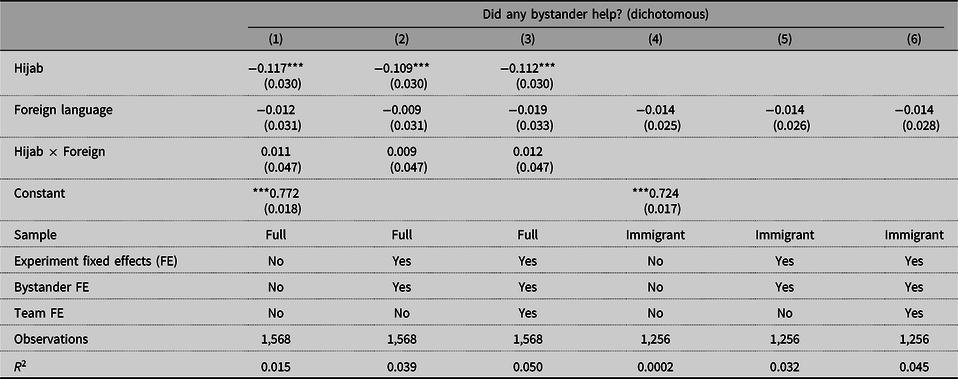
These null effects for linguistic assimilation are confirmed in our covariate-adjusted regression-based analysis, reported in Table 2. Across specifications that include fixed effects for experiment (experiment 1 vs 2), the number of bystanders, and team that conducted each iteration, we fail to recover significant effects in assistance rates between immigrants who conversed in a foreign vs. German language; as reported in columns (4)–(6), the point estimate for the comparison consistently remains at 1.4% points and is statistically indistinguishable from zero.
ATEs for Linguistic Differences (Pooled Experiments 1 and 2)

Notes: Standard errors in parentheses. *p < 0.1; **p < 0.05; ***p < 0.01.
This analysis shows that linguistic assimilation does not reduce discrimination against Muslim immigrant minorities in Germany. This is consistent with the results of other recent studies showing that immigrants cannot do much to counteract bias and discrimination (Vernby and Dancygier, Reference Vernby and Dancygier2019). This result cannot be dismissed by a concern that bystanders might not be able to hear the conversation. In pilot studies conducted in May 2019, we confirmed that bystanders, who were debriefed and interviewed after each iteration, had noticed the confederate and were able to accurately identify that a phone call had happened in their presence (95.3%). More critically, however, in a separate experiment that manipulates the content of the call (Choi, Poertner and Sambanis, Reference Choi, Poertner and Sambanis2020a), we obtain statistically significant results across treatment conditions that can only be attributed to the content of the phone call. We provide additional results using equivalence tests in the SI appendix showing that linguistic assimilation does not have a substantively meaningful impact on discrimination.
Discussion
Previous studies have shown that group threat can be evoked by the proximity of an outgroup (Enos, Reference Enos2014). Foreign language exposure combined with visible ethnic differences can make ingroup–outgroup distinctions salient along the native-immigrant divide, inducing biased behavior against immigrants. Our experiment tested whether anti-immigrant bias can be mitigated by linguistic assimilation and we found no evidence to support this.
A shared language improves mutual understanding and forges tighter bonds within ethnic ingroups (Deutsch, Reference Deutsch1953). Cultural norms and ideas are communicated with language, and learning the language of an ethnic majority facilitates cultural assimilation (Cuellar, Nyberg, Maldonado and Roberts, Reference Cuellar, Nyberg, Maldonado and Roberts1997; Maher, Reference Maher, Seliger and Vago1991) as well as successful economic integration of immigrant groups (Goodman, Reference Goodman2012). It is therefore reasonable to expect that observing immigrants who converse fluently in the host society language reduces feelings of unease among natives. By contrast, during a period of heightened immigration, foreign language exposure might generate an identity threat among native groups, resulting in discrimination toward immigrants.
Yet our findings suggest that the political salience of linguistic difference is moderated by social context. While linguistic assimilation in the USA has been shown to reduce bias toward immigrants, in the German context, linguistic differences are not as salient as religious differences between Christian and Muslim populations. By disentangling the effect of language and religion, we find that in Germany, a country with successive waves of immigration and generations of successfully integrated immigrant communities, ethno-linguistic differences alone do not cause bias in everyday encounters between natives and immigrants. The cause for the lack of significance of linguistic assimilation is not clear; it is possible that increased social contact combined with state policies to encourage multiculturalism has taken Germany to a point where linguistic assimilation is not necessary for immigrants to be treated respectfully and without bias. However, our analysis cannot definitively establish whether policies of multiculturalism are responsible for the decreased salience of linguistic difference and other mechanisms are also plausible. Furthermore, the fact that there are no significant differences across East and West Germany might indicate that factors such as local exposure to immigrants and fear of labor market competition – both of which vary immensely between the former East and West – matter less than the national context. Last, our findings suggest that even if Muslim immigrants integrate or learn the language of the majority, this will not provide them with protection from discrimination as long as religious differences are cognitively and politically salient. In the German context, host language acquisition does not offset bias due to religious difference.
Supplementary material
To view supplementary material for this article, please visit https://doi.org/10.1017/XPS.2020.20