Introduction
The average prevalence of dementia in 28 European Countries was 1.55% in 2012 (Alzheimer Europe, 2013). Primary care physicians (PCPs) may play a central role both in diagnosing dementia and in its further management, yet early dementia is often difficult to diagnose and to distinguish from normal aging in primary care (Hansen et al., Reference Hansen, Hughes, Routley and Robinson2008; Leung et al., Reference Leung2011). Some studies show that more than 50% of persons with dementia have never received a diagnosis of dementia from a physician (Caruana-Pulpan and Scerri, Reference Caruana-Pulpan and Scerri2014). A 2012 review showed that 14–33% of mild dementia and 28–61% of moderate to severe dementia cases were diagnosed in primary care (Chopard et al., Reference Chopard2014; van den Dungen et al., Reference van den Dungen2015). In the short-term, timely diagnosis ensures access to psychosocial and pharmacological interventions (Mori et al., Reference Mori, Ikeda, Kosaka and Donepezil2012). The role of PCPs for timely dementia detection and treatment can be cost-effective, since it may improve symptoms enough to reduce healthcare costs and keep patients living in the community for longer (Barnett et al., Reference Barnett, Lewis, Blackwell and Taylor2014; Caruana-Pulpan and Scerri, Reference Caruana-Pulpan and Scerri2014). This contrasts to a low rate of utilization of standardized dementia tests in primary care. Recurring reasons to explain why accurate dementia evaluations are not done are: insufficient time, difficulty in accessing and communicating with specialists and community social service agencies, low reimbursement, and lack of interdisciplinary teams (Harris et al., Reference Harris, Chodosh, Vassar, Vickrey and Shapiro2009; Pentzek et al., Reference Pentzek2009; Pimlott et al., Reference Pimlott2009; Koch and Iliffe, Reference Koch and Iliffe2010b).
Some PCPs seem to think that diagnosing dementia early is not particularly important and may in fact be harmful to certain patients (Hansen et al., Reference Hansen, Hughes, Routley and Robinson2008). They are skeptical about the advantages of dementia medications and assess the need for a formal diagnosis of dementia within the broader context of older patients’ lives. They are more likely to pursue a formal diagnosis in situations, where it benefits their patients such as accessing specific dementia services (Hansen et al., Reference Hansen, Hughes, Routley and Robinson2008). Another important factor is that dementia is still a stigma in some settings (Batsch and Mittelman, Reference Batsch and Mittelman2012). Although a majority of individuals with or without cognitive impairment may prefer to be informed about a diagnosis of dementia for reasons pertaining to autonomy (van den Dungen et al., Reference van den Dungen2014) PCPs do not always feel comfortable in breaking the bad news. Many physicians also fear to harm the relationship with their patients (Bradford et al., Reference Bradford, Kunik, Schulz, Williams and Singh2009) and, therefore, disclosing a dementia diagnosis should align with the patient's preferences, culture, educational level, and abilities.
The Alzheimer Europe association's report on dementia management in Europe shows heterogeneity. In some countries, PCPs were allowed to establish a diagnosis of dementia and start specific drug treatment reimbursed by universal healthcare insurance. In other countries only secondary care specialists such as neurologists, geriatricians, and psychiatrists were allowed to diagnose and treat dementia (Alzheimer Europe, 2012). No studies have compared dementia management by PCPs in different European countries. Many new short cognitive tests for primary care use have been introduced lately, but few studies have explored the actual use of these tests in real-life primary care.
The aim of this study was to audit the involvement of PCPs in dementia management across 25 European countries and explore attitudes of PCPs beyond national guidelines. The hypothesis is that the perceived rules and regulations could affect PCP's attitudes toward dementia management.
Methods
This study was based on a key informant survey from 25 member countries of the European General Practice Research Network (EGPRN). The steering committee of this project, called the PreDem study, developed a semi-structured questionnaire with seven multiple choice questions, including space for free text comments. The eighth question requested an optional short case story of a dementia patient from the informants’ own practice. Data from the Alzheimer Europe report 2013 (Alzheimer Europe, 2012) inspired many of the questions that were amended after reaching consensus within the PreDem steering committee. The questionnaire's English version is found in online Appendix 1, available as supplementary material attached to the electronic version of this paper at www.journals.cambridge.org/jid_IPG. The informants were all practicing PCPs and were asked to give the general view of the attitude of PCPs in their country. For the 25 countries, national coordinators were identified and contacted face to face by the first author during eight meetings of the EGPRN and WONCA Europe conferences in 2013–2015. National coordinators were responsible to translate the questionnaire into their own languages and to disseminate the questionnaires to at least 15 key informants for countries with a population of >10 million inhabitants; a smaller sample of eight was accepted for smaller countries such as Denmark, Greece, and Ireland; while for Malta and Slovenia, with a very small population, a sample of five. A back translation into English was finally performed for every country by the national key informants. A convenience sampling technique was used when national key informants chose informants from different geographical regions within the same country.
The informants were contacted directly by the national coordinators and the response rates were between 75% and 90%.
We did qualitative analysis of the optional-free text to analyze the reasons for the non-uniformity of the responses and the discrepancies between the official rules and the key informant responses.
Statistical analyses
Descriptive statistics were conducted using IBM SPSS Statistics for Windows, Version 22.0. (IBM, Armonk, NY USA, 2013). In SPSS a two-step cluster analysis was performed, which divided our informants in two groups according to the following variables “perceived right to start drug treatment,” “perceived right to continue drug treatment,” “country,” “feeling responsible for dementia management,” “non-referral to secondary care specialists,” “attitude to establish the diagnosis of dementia on their own,” and “gender.”
Overall goodness-of-fit of clusters that were formed as results was evaluated using a silhouette coefficient. Silhouette measures of less than 0.2 were classified as poor, between 0.2 and 0.5 as fair, and more than 0.5 as good solution quality. Fair or higher was considered acceptable clustering. In our data, the cut-off score for acceptable clustering was 0.3.
Two by two contingency tables with odds ratios and its 95% confidence interval were used to measure the association between categorical variables and then a multinomial logistic regression model was used to assess the association of multiple variables (age class, gender, and perceived prescription rules) with the ordinal response data (attitude of trying to establish a diagnosis of dementia on their own) with a statistical significance threshold of 0.05.
We grouped always and often as positive responses and rarely and never as negative responses to check for the association between the right to prescribe dementia drugs and different attitudes to dementia work up.
Since the responses of the key informant respondents were not unanimous within each country we suggest that a response pattern from at least 2/3 (66%) of the respondents would adequately represent the situation in that country.
Ethics
Except for in Ireland, where ethical approval was requested and obtained, no formal research ethics review was requested at the time of the data collection after national coordinators had checked the research ethics requirements in their countries.
Results
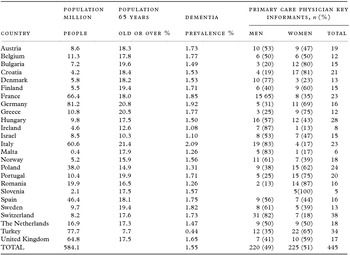
We collected 445 questionnaires from PCP informants in 25 European countries. The distribution of informants divided by gender is presented in Table 1 along with population data and dementia prevalence for each country.
Population characteristics, dementia prevalence, and primary care physicians (PCPs) as key informants in the PreDem – a dementia management study from 25 countries in the EGPRN (European General Practice Research Network)a,b

aValues are given in percent (%) and absolute numbers (n).
bData for dementia prevalence by the Alzheimer Europe Association, 2013.
Participants with complete data could not be distinguished from the less than 10% of participants with incomplete or missing data that were then considered as “Missing Completely At Random” (MCAR) data. We used the “Complete case analysis” method used in SPSS and all participants with incomplete data were removed from the analysis.
Question 1: “Which healthcare professionals are officially responsible for the diagnosis of dementia?”
There was not consensus between informants within the same country. In 13 countries 2/3 or more of the informants answered that PCPs alone or in combination with secondary care specialists are officially responsible for the diagnosis of dementia: Denmark 85%, Germany 100%, Greece 67%, Hungary 71%, Ireland 100%, Norway 95%, Poland 71%, Portugal 80%, Spain 75%, Sweden 100%, Switzerland 89%, The Netherlands 94%, and United Kingdom (UK) 71%. In ten countries 1/3–2/3 of the informants answered accordingly: Austria 48%, Belgium 66%, Bulgaria 46%, Croatia 62%, France 61%, Israel 53, Italy 57%, Malta 50%, Slovenia 60%, and Turkey 41%. In two countries, less than 1/3 of the informants answered accordingly: Finland 13% and Romania 31%.
Question 2: “Which are the most popular dementia screening tests used?”
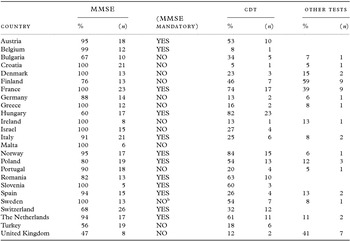
The results are illustrated in Table 2 and shows that the Mini-Mental State Examination (MMSE) was more popular than the Clock Drawing Test (CDT) in all countries except Hungary and was a mandatory test in 12 countries.
“Which are the most popular dementia screening tests used?”a

Abbeviations: MMSE = Mini Mental State Examination; CDT = Clock Drawing Test.
aValues are given in percent (%) and absolute numbers (n).
bIn Sweden the MMSE is not mandatory but recommended.
Question 3: “Are primary care physicians allowed to start prescribing drug treatment for dementia?”
In 13 countries more than 2/3 of the informants answered “YES” to the question: Bulgaria 73%, Denmark 77%, Finland 67%, Germany 100%, Greece 83%, Hungary 96%, Ireland 100%, Malta 83%, Norway 100%, Poland 83%, Sweden 100%, Switzerland 100%, and The Netherlands 72%. In three countries 1/3–2/3 of the respondents answered “YES”: Austria 63%, Belgium 50%, and Portugal 60%. In nine countries less than 1/3 of the informants answered “YES”: Croatia 14%, France 9%, Israel 13%, Italy 22%, Romania 0%, Slovenia 20%, Spain 6%, Turkey 15%, and UK 24%.
Question 4 “Is continued dementia drug treatment reimbursed if prescribed by GPs/primary care physicians in your country?”
In 16 countries more than 2/3 of the informants answered “YES” to the question: Belgium 91%, Denmark 92%, Finland 67%, France 83%, Germany 100%, Greece 92%, Hungary 89%, Ireland 100%, Norway 94%, Poland 96%, Slovenia 100%, Spain 79%, Sweden 100%, Switzerland 97%, The Netherlands 100%, and Turkey 84%. In three countries 1/3–2/3 answered “YES”: Austria 56%, Israel 53%, and UK 59%. In six countries less than one third of the informants answered “YES”: Bulgaria 27%, Croatia 0%, Italy 17%, Malta 33%, Portugal 16%, and Romania 25%.
Question 5: “Do primary care physicians try to establish a diagnosis of dementia on their own?”
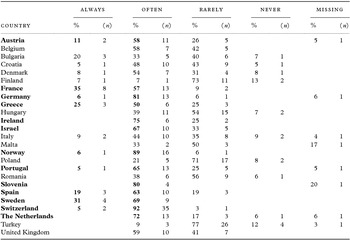
The outcomes for this question are illustrated in Table 3 and show that in 13 countries 2/3 or more of the informants responded that PCPs always or often try to establish a diagnosis of dementia on their own: Austria 69%; France 92%, Germany 87%, Greece 75%, Ireland 75%, Israel 67%, Norway 95%, Portugal 70%, Slovenia 80%, Spain 82%, Sweden 100%, Switzerland 97%, and The Netherlands 72%. In eight countries 1/3–2/3 of the respondents answered accordingly: Belgium 58%, Bulgaria 53%, Croatia 53%, Denmark 62%, Hungary 39%; Italy 53%, Romania 38%, and UK 59%. In four countries less than 1/3 of the informants answered accordingly: Finland 14%, Malta 33%, Poland 21%, and Turkey 9%.
“Do primary care physicians try to establish a diagnosis of dementia on their own?”*

aValues are given in percent (%) and absolute numbers (n).
In bold countries with positive responses (often + always) > 2/3.
Question 6: “Do primary care physicians refer a suspected case of dementia to a secondary care specialist?”
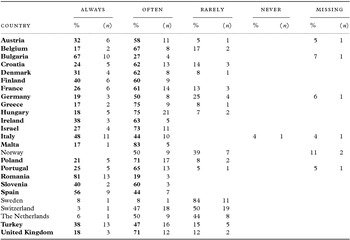
The outcomes for this question are illustrated in Table 4 and show that in 21 countries 2/3 or more of the informants responded that PCPs always or often referred a suspected case of dementia to a secondary care specialist. In three countries 1/3–2/3 the informants answered accordingly: Norway 50%, Switzerland 50%, and The Netherlands 56%. In one country less than 1/3 of the informants answered accordingly: Sweden 16%
“Do primary care physicians refer a suspected case of dementia to a secondary care specialist?”a

aValues are given in percent (%) and absolute numbers (n).
In bold countries with positive responses (often + always) > 2/3.
Question 7: “What would primary care physicians need to be able to detect dementia better?”
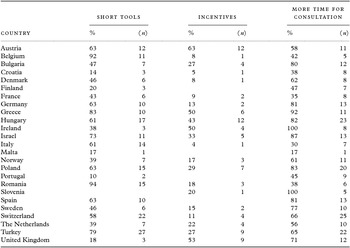
Results are presented in Table 5 and show that in 11 countries “more time for consultation” was mentioned as a need by more than 2/3 of the informants: Bulgaria 80 %, Germany 81%, Greece 92%, Hungary 82%, Ireland 100%, Israel 87%, Poland 83%, Slovenia 100%, Spain 81%, Sweden 77%, and UK 71%. In five countries “short tools” was mentioned as a need by more than 2/3: Belgium 92%, Greece 83%, Israel 73%, Romania 94%, and Turkey 79%. Incentives were mentioned as a need by the majority of the informants in four countries but by less than 2/3: Austria 63%, Greece 50%, Ireland 50%, and UK 53%.
“What would primary care physicians need to be able to detect dementia better?” More than one option is possiblea

aValues are given in percent (%) and absolute numbers (n).
Cluster analysis
The 445 informants were divided into two groups according to a cluster analysis. Group 1 had 220 informants (51%) and Group 2 had 213 informants (49%). The most important predicting variables to allocate the informants in the groups were “perceived right to start drug treatment” (predictor importance (PI) = 1.00), “country” (PI = 0.60) and “perceived right to continue drug treatment” (PI = 0.35).
Group 1 was more “optimistic” about the involvement of PCPs in the dementia work up. Features of group 1 were as follows: “perceived right to start drug treatment” (100%), “perceived right to continue drug treatment” (93%), “attitude to establish the diagnosis of dementia on one's own” (71%), “non-referral to secondary care specialists” (72%), and “feeling responsible for dementia management” (82%). Informants in group 1 come mainly from the following countries: Austria (71%), Denmark (77%), Germany (100%), Greece (83%), Hungary (96%), Ireland (100%), Malta (50%), Norway (100%), Poland (83%), The Netherlands (77%), Sweden (100%), and Switzerland (100%).
Group 2 was more “pessimistic” about the involvement of PCPs in the dementia work up. Features of this group were “perceived right to start drug treatment” (14%), “perceived right to continue drug treatment” (46%), “attitude to establish the diagnosis of dementia on their own” (51%), “referral to secondary care specialist” (93%), and “feeling responsible for dementia management” (52%). Informants in this group came mainly from the following countries: Croatia (100%), Belgium (55%), Bulgaria 60%), Finland (60%), France (91%), Israel (87%), Italy (96%), Malta (50%), Portugal (90%), Romania (100%), Slovenia (80%), Spain (92.9%), Turkey (84%), and UK (88%).
Associations and multivariate analyses
We analyzed possible associations between the perceived permissiveness of the rules and the actual involvement in the dementia work-up.
Association between right to prescribe and responsible for dementia management
A positive association was found between the “perceived right to start drug treatment” and “feeling responsible for dementia management”: Odds Ratio, 3.45; 95% CI, 2.28–5.23. A positive association was also found between the “perceived right to continue drug treatment” and “feeling responsible for dementia management”: Odds Ratio, 2.29; 95% CI, 1.49–3.52.
Association between right to prescribe and establish the diagnosis
A positive association was found between the “perceived right to start drug treatment” and “attitude to establish the diagnosis of dementia on their own”: odds ratio, 1.64; 95% CI, 1.11–2.41. A positive association was also found between the “perceived right to continue drug treatment” and “attitude to establish the diagnosis of dementia on their own”: odds ratio, 1.77; 95% CI, 1.16–2.68.
Association between right to prescribe and non-referral to secondary care specialists
A positive association was found between the “perceived right to start drug treatment” and “non-referral to secondary care specialists”: Odds Ratio, 3.83; 95% CI 2.18–6.73. A positive association was also found between the “perceived right to continue drug treatment” and “non-referral to secondary care specialists”: Odds Ratio, 2.08; 95% CI 1.19; 3.64.
A multivariate analysis was performed to check for other possible factors affecting our results. No significant association between gender of the informants and the outcome “attitude of trying to establish a diagnosis of dementia on their own” was found (χ 2 (3, n = 437) 0.20, p = 0.98), while age was statistically associated with this outcome (χ 2 (12, n = 437) 47.52, p < 0.001).
Post hoc analysis showed that informants 30-years old or younger were less likely to share the attitude of PCPs “trying to establish a diagnosis of dementia on their own” (χ 2 (12, n = 437) 47.70, p < 0.001).
Discussion
This physician informant survey of dementia management in primary care across 25 European countries from 2015 shows that most PCPs were engaged in dementia investigations and assessments. In many countries, PCPs also prescribe dementia drugs but the degree of their engagement varies greatly between countries. The discrepancies in the responses suggest that there is a variability of dementia management within the same country consistent with previous findings (Iliffe et al., Reference Iliffe2009; Tang et al., Reference Tang, Birdi and Robinson2016). The official rules according to the 2013 Alzheimer Europe report regarding who should diagnose dementia and prescribe dementia drugs in the 25 countries participating in our study are listed in online Appendix 2. To be noticed is that in many countries PCPs can diagnose dementia unofficially and prescribe specific dementia drugs to patients that will, however, not be reimbursed by their health insurance.
The positive association that we did find between the right to prescribe dementia drugs and being responsible for the dementia work-up was stronger for the right to write the first prescription by a PCP than only being allowed to continue a prescription first issued by a secondary care specialist.
The MMSE was the most popular cognitive test either used alone or in combination with other tests. The CDT was the second most popular. Other tests (Brodaty et al., Reference Brodaty, Low, Gibson and Burns2006; Milne et al., Reference Milne, Culverwell, Guss, Tuppen and Whelton2008; Upadhyaya et al., Reference Upadhyaya, Rajagopal and Gale2010; Kvitting et al., Reference Kvitting, Wimo, Johansson and Marcusson2013; Petrazzuoli et al., Reference Petrazzuoli2014) were less popular and were used sporadically. In many countries, MMSE was mandatory before prescription of dementia drugs. In other countries it was just recommended. Turkey had the highest number of missing data, which may be related to the low-dementia prevalence in that country. In France, no test was mandatory and the “5 words of Dobois” and the instrumental activities of daily living tool (IADL) were popular tests. PCPs from Finland and the UK had the highest percentage of suggested alternative tests. In Finland, the Consortium to Establish a Registry for Alzheimer's Disease (CERAD) was frequently used while many UK PCPs reported the use of the Six Item Cognitive Impairment Test (6-CIT) (Upadhyaya et al., Reference Upadhyaya, Rajagopal and Gale2010) and the General Practitioner Assessment of Cognition (GPCOG).
According to the official rules and guidelines at the time of data collection (Alzheimer Europe, 2012) only in Germany, Ireland, Norway, Sweden, and Switzerland did PCPs have the right to start treatment with memantine and cholinesterase inhibitors. In Austria, Belgium, Bulgaria, Denmark, Finland, Greece, Hungary, Malta, Poland, Portugal, and The Netherlands it appears that informants were entitled to prescribe even if officially they were not. A possible cause for this discrepancy is that with the advent of cheap generic drugs, reimbursement is not a big problem in most countries. In France, PCPs were not entitled to prescribe dementia drugs for the first time but apparently a few did prescribe anyway and according to open comments from French respondents there was a compulsory requirement of a yearly assessment by a secondary care specialist. In Hungary, dementia was treated in primary care with piracetam and vinpocetin according to open comments. In Malta and Bulgaria, where cholinesterase inhibitors or memantine were not reimbursed even if prescribed by secondary care specialists, PCPs were prescribing piracetam and vinpocentin to a higher degree. In Bulgaria, nicergoline and piracetam were reimbursed even if the efficacy of the latter is controversial.
Possible explanations to the discrepancies between the official rules/guidelines and the PCP's responses to questions 1, 3, and 4 are as follows: (i) different perceptions of rules/guidelines, (ii) the willingness of some physicians to bend rules, and (iii) more than one set of rules in each country (in different regions or for different healthcare insurers). These explanations find support in the rich data from the free text comments to the survey. Consistency between the official rules/guidelines and PCP's responses appear to be better in countries with more permissive regulations (Sweden, Germany, Switzerland, Norway, and Ireland).
According to our 2015 survey, European PCPs seemed to be willing to start dementia investigations and assessments, but time constraints was the major barrier (van Hout et al., Reference van Hout, Vernooij-Dassen, Bakker, Blom and Grol2000; Turner et al., Reference Turner2004; Hinton et al., Reference Hinton, Franz, Reddy, Flores, Kravitz and Barker2007; Bradford et al., Reference Bradford, Kunik, Schulz, Williams and Singh2009; Koch and Iliffe, Reference Koch and Iliffe2010a; Parmar et al., Reference Parmar2014). In France many informants stated that money incentives would help. In Sweden and Norway, PCPs normally have 15–30 minute consultations. However, they can plan for longer consultation time or organize multiple consultations, which is recommended when diagnosing dementia.
Many strategies to improve dementia diagnosis and treatment are described in the Dementia in Europe Yearbooks 2015 (Alzheimer Europe, 2015). This includes the birth of the Dementia Friendly Communities movement with the goal of “transforming our villages, towns, cities, and counties into better places to live for people with dementia.” The overall vision is to “reconfigure the communities that we all live in and mainstream dementia into the everyday life of the community.” In the UK, dementia has been considered a national policy priority and General Practitioners have been put at the center of post-diagnostic care (Department of Health, 2015).
In the last decades, drug expenditure has been one of the major concerns in many European healthcare systems but according to the World Alzheimer report 2015 (Prince et al., Reference Prince, Wimo, Guerchet, Ali, Wu and Prina2015) only 20% of the cost of dementia care are for medical purposes and the medical costs decrease with an earlier more accurate diagnosis (Robinson et al., Reference Robinson, Tang and Taylor2015; Tang et al., Reference Tang, Burn, Taylor and Robinson2015; Michalowsky et al., Reference Michalowsky2016).
Limitations of the study
Since we used a convenience sample of informants the representativeness of PCPs for each country may be questionable although we tried to achieve geographical variation. The national coordinators tried to avoid bias and recruit practicing PCPs with different interests, and not necessarily in dementia or neurologic disease.
Our short questionnaire, inspired by the Alzheimer Europe report, was developed in a multi-step process and refined after a first pilot study. Yet, it was not validated against other measures apart from a face validation procedure.
We cannot rule out the possibility of confounding or alternative explanations to our results, since the survey responses show attitudes and not actual performance. Yet, the results align with previous studies showing variability in dementia management (Iliffe, 2009; Tang, 2016).
Conclusion
According to this 2015 survey to 445 PCPs from most European countries, Israel and Turkey, a majority seemed willing to start dementia investigations and assessments with time constraints as the major barrier. Official rules appeared to affect attitudes to dementia work-up and PCPs that were not entitled to prescribe dementia drugs were more inclined to refer patients with suspected dementia to secondary care. Even in those countries where PCPs were allowed to prescribe specific dementia drugs, referrals to secondary care specialists during follow up was common.
This audit survey study may have implications for healthcare planning and future research in how to manage cognitive impairments facing our ageing global population.
Conflict of interest
None.
Description of authors’ roles
Ferdinando Petrazzuoli and Hans Thulesis conceived the study. Ferdinando Petrazzuoli was responsible for the manuscript and the analysis of the data. Shlomo Vinker, Tuomas H. Koskela, Thomas Frese, Nicola Buono, Jean Karl Soler, Jette Ahrensberg, Radost Asenova, Quintí Foguet Boreu, Gülsen Ceyhun Peker, Claire Collins, Miro Hanževački, Kathryn Hoffmann, Claudia Iftode, Donata Kurpas, Jean Yves Le Reste, Bjørn Lichtwarck, Davorina Petek, Daniel Pinto, Diego Schrans, Sven Streit, Eugene Yee Hing Tang, Athina Tatsioni, Péter Torzsa, Pemra C. Unalan, Harm van Marwijk, Hans Thulesius gave substantial contributions to the acquisition of data and interpretation of data; revised it critically for important intellectual content; and finally approved the version to be published.
Acknowledgments
Thanks to Mariella Stamato, Nurse in Uithoorn (The Netherlands), for help with the recruitment of Dutch PCPs.
The PreDem study was carried out in the European General Practice Research Network (www.egprn.org). Preliminary results were presented during a symposium on “Dementia in primary care” at the WONCA Europe Conference in Istanbul October 2015.
Supplementary material
To view supplementary material for this article, please visit http://doi.org/10.1017/S1041610217000552