1. Introduction
Understanding the structure of song lyrics (e.g., intro, verse, chorus) is an important task for music content analysis (Cheng et al. Reference Cheng, Yang, Lin and Chen2009; Watanabe et al. Reference Watanabe, Matsubayashi, Orita, Okazaki, Inui, Fukayama, Nakano, Smith and Goto2016) since it allows to split a song into semantically meaningful segments enabling a description of each section rather than a global description of the whole song. The importance of this task arises also in Music Information Retrieval, where music structure detection is a research area aiming at automatically estimating the temporal structure of a music track by analyzing the characteristics of its audio signal over time. Given that lyrics contain rich information about the semantic structure of a song, relying on textual features could help in overcoming the existing difficulties associated with large acoustic variation in music. However, so far only a few works have addressed the task lyrics-wise (Mahedero et al. Reference Mahedero, Martínez, Cano, Koppenberger and Gouyon2005; Baratè, Ludovico, and Santucci Reference Baratè, Ludovico and Santucci2013; Watanabe et al. Reference Watanabe, Matsubayashi, Orita, Okazaki, Inui, Fukayama, Nakano, Smith and Goto2016; Fell et al. Reference Fell, Nechaev, Cabrio and Gandon2018). Carrying out structure detection by means of an automated system is therefore a challenging but useful task, that would allow to enrich song lyrics with improved structural clues that can be used for instance by search engines handling real-word large song collections. A step forward, a complete music search engine should support search criteria exploiting both the audio and the textual dimensions of a song.
Structure detection consists of two steps: a text segmentation stage that divides lyrics into segments and a semantic labeling stage that labels each segment with a structure type (e.g., intro, verse, chorus). Given the variability in the set of structure types provided in the literature according to different genres (Tagg Reference Tagg1982; Brackett Reference Brackett1995), rare attempts have been made to achieve the second step, that is semantic labeling. While addressing the first step is the core contribution of this paper, we leave the task of semantic labeling for future work.
In Fell et al. (Reference Fell, Nechaev, Cabrio and Gandon2018), we proposed a first neural approach for lyrics segmentation that was relying on purely textual features. However, with this approach we fail to capture the structure of the song in case there is no clear structure in the lyrics—when sentences are never repeated or in the opposite case when they are always repeated. In such cases, however, the structure may arise from the acoustic/audio content of the song, often from the melody representation. This paper aims at extending the approach proposed in Fell et al. (Reference Fell, Nechaev, Cabrio and Gandon2018) by complementing the textual analysis with acoustic aspects. We perform lyrics segmentation on a synchronized text–audio representation of a song to benefit from both textual and audio features.
In this direction, this work focuses on the following research question: given the text and audio of a song, can we learn to detect the lines delimiting segments in the song text? This question is broken down into two sub questions: (1) given solely the song text, can we learn to detect the lines delimiting segments in the song? and (2) do audio features—in addition to the text—boost the model performance on the lyrics segmentation task?
To address these questions, this article contains the following contributions. Contributions (1a) and (1b) have been previously published in Fell et al. (Reference Fell, Nechaev, Cabrio and Gandon2018), while (2) is a novel contribution.
-
(1a) We introduce a convolutional neural network (CCN)-based model that (i) efficiently exploits the Self-Similarity Matrix (SSM) representations used in the state of the art (Watanabe et al. Reference Watanabe, Matsubayashi, Orita, Okazaki, Inui, Fukayama, Nakano, Smith and Goto2016) and (ii) can utilize traditional features alongside the SSMs (see Section 2 until 2.2).
-
(1b) We experiment with novel features that aim at revealing different properties of a song text, such as its phonetics and syntax. We evaluate this unimodal (purely text-based) approach on two standard datasets of English lyrics, the Music Lyrics Database and the WASABI corpus (see Section 3.1). We show that our proposed method can effectively detect the boundaries of music segments outperforming the state of the art, and is portable across collections of song lyrics of heterogeneous musical genre (see Sections 3.2–3.4).
-
(2) We experiment with a bimodal lyrics representation (see Section 2.3) that incorporates audio features into our model. For this, we use a novel bimodal corpus (DALI, see Section 4.1) in which each song text is time aligned to its associated audio. Our bimodal lyrics segmentation performs significantly better than the unimodal approach. We investigate which text and audio features are the most relevant to detect lyrics segments and show that the text and audio modalities complement each other. We perform an ablation test to find out to what extent our method relies on the alignment quality of the lyrics–audio segment representations (see Sections 4.2–4.4).
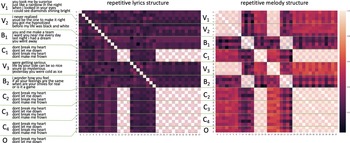
To better understand the rational underlying the proposed approach, consider the segmentation of the Pop song depicted in Figure 1. The left side shows the lyrics and its segmentation into its structural parts: the horizontal green lines indicate the segment borders between the different lyrics segments. We can summarize the segmentation as follows: Verse
 $_{l}$
-Verse
 $_{2}$
-Bridge
 $_{l}$
-Chorus
 $_{l}$
-Verse
 $_{3}$
-Bridge
 $_{2}$
-Chorus
 $_{2}$
-Chorus
 $_{3}$
-Chorus
 $_{4}$
-Outro. The middle of Figure 1 shows the repetitive structure of the lyrics. The exact nature of this structure representation is introduced later and is not needed to understand this introductory example. The crucial point is that the segment borders in the song text (green lines) coincide with highlighted rectangles in the chorus (the C
 $_{i}$
) of the lyrics structure (middle). We find that in the verses (the V
 $_{i}$
) and bridges (the B
 $_{i}$
) highlighted rectangles are only found in the melody structureFootnote
a
(right). The reason is that these verses have different lyrics, but share the same melody (analogous for the bridges). While the repetitive structure of the lyrics is an effective representation for lyrics segmentation, we believe that an enriched segment representation that also takes into account the audio of a song can improve segmentation models. While previous approaches relied on purely textual features for lyrics segmentation, showing the discussed limitations, we propose to perform lyrics segmentation on a synchronized text–audio representation of a song to benefit from both textual and audio features.
Lyrics (left) of a Pop song, the repetitive structure of the lyrics (middle), and the repetitive structure of the song melody (right). Lyrics segment borders (green lines) coincide with highlighted rectangles in lyrics structure and melody structure. (“Don‘t Break My Heart” by Den Harrow).

Earlier in this section, we presented our research questions and motivation, along with a motivational example. In the remainder of the paper, in Section 2, we define the task of classifying lines as segment borders, the classification methods we selected for the task, and the bimodal text–audio representation. In Section 3, we describe our lyrics segmentation experiments using text lines as input. Then, Section 4 describes our lyrics segmentation experiments using multimodal (unimodal or bimodal) lyrics lines, containing text or audio information or both as input. We follow-up with a shared error analysis for both experiments in Section 5. In Section 6, we position our work in the current state of the art, and in Section 7, we conclude with future research directions to provide more metadata to Music Information Retrieval systems.
2. Modeling segments in song lyrics
Detecting the structure of a song text is a nontrivial task that requires diverse knowledge and consists of two steps: text segmentation followed by segment labeling. In this work, we focus on the task of segmenting the lyrics. This first step is fundamental to segment labeling when segment borders are not known. Even when segment borders are “indicated” by line breaks in lyrics available online, those line breaks have usually been annotated by users and neither are they necessarily identical to those intended by the songwriter, nor do users in general agree on where to put them. Thus, a method to automatically segment unsegmented song texts is needed to automate that first step. Many heuristics can be imagined to find the segment borders. In our example, separating the lyrics into segments of a constant length of four lines (Figure 1) gives the correct segmentation. However, in another example, the segments can be of different length. This is to say that enumerating heuristic rules is an open-ended task.
We follow Watanabe et al. (Reference Watanabe, Matsubayashi, Orita, Okazaki, Inui, Fukayama, Nakano, Smith and Goto2016) by casting the lyrics segmentation task as binary classification. Let
 $L=\{a_1, a_2, ..., a_n\}$
be the lyrics of a song composed of n text lines and
 $seg\,:\, L \xrightarrow{} \mathbb{B}$
be a function that returns for each line
 $a_i \in L$
if it is the end of a segment. Here,
 $\mathbb{B}=\{0,1\}$
is the Boolean domain. The task is to learn a classifier that approximates seg. At the learning stage, the ground truth segment borders are observed as double line breaks in the lyrics. At the testing stage, we hide the segment borders and the classifier has to predict them.
As lyrics are texts that accompany music, their text lines do not exist in isolation. Instead, each text line is naturally associated to a segment of audio. We define a bimodal lyrics line
 $a_i = (l_i, s_i)$
as a pair containing both the ith text line
 $l_i$
, and its associated audio segment
 $s_i$
. In the case, we only use the text lines, we model this as unimodal lyrics lines, that is
 $a_i=(l_i)$
.Footnote
b
In order to infer the lyrics structure, we rely on our CNN-based model that we introduced in Fell et al. (Reference Fell, Nechaev, Cabrio and Gandon2018). Our model architecture is detailed in Section 2.2. It detects segment boundaries by leveraging the repeated patterns in a song text that are conveyed by the SSMs.
2.1 Self-similarity matrices
We produce SSMs based on bimodal lyrics lines
 $a_i = (l_i, s_i)$
in order to capture repeated patterns in the text line
 $l_i$
as well as its associated audio segment
 $s_i$
. SSMs have been previously used in the literature to estimate the structure of music (Foote Reference Foote2000; Cohen-Hadria and Peeters Reference Cohen-Hadria and Peeters2017) and lyrics (Watanabe et al. Reference Watanabe, Matsubayashi, Orita, Okazaki, Inui, Fukayama, Nakano, Smith and Goto2016; Fell et al. Reference Fell, Nechaev, Cabrio and Gandon2018). Given a song consisting of lyrics lines
 $\{a_1, a_2, ..., a_n\}$
, a Self-Similarity Matrix
 $SSM_M \in \mathbb{R}^{n \times n}$
is constructed, where each element is set by computing a similarity measure between the two corresponding elements
 $(SSM_{\text{M}})_{ij} = \text{sim}_{\text{M}}(x_i, x_j)$
. We choose
 $x_i, x_j$
to be elements from the same modality, that is they are either both text lines (
 $l_i$
) or both audio segments (
 $s_i$
) associated to text lines.
 $\text{sim}_{\text{M}}$
is a similarity measures that compares two elements of the same modality to each other. In the unimodal case, we compute SSMs from only one modality: either text lines
 $l_i$
or audio segments
 $s_i$
.
As a result, SSMs constructed from a text-based similarity highlight distinct patterns of the text, revealing the underlying structure. Analogously, SSMs constructed from an audio-based similarity highlight distinct patterns of the audio. In our motivational example, the textual SSM encodes how similar the text lines are on a character level (see Figure 1, middle) while the audio SSM encodes how similar the associated melodies are to each other (see Figure 1, right). In our experiments, we work with text-based similarities (see Section 3.2) as well as audio-based similarities (see Section 4.2). While in our motivational example we manually overlay the different SSMs, to find that some structural elements are only unveiled by the melody—and not by the text—in our neural architecture, we overlay different SSMs by stacking them into a single time-aligned tensor with c channels, as described in the following.
There are two common patterns that were investigated in the literature: diagonals and rectangles. Diagonals parallel to the main diagonal indicate sequences that repeat and are typically found in a chorus. Rectangles, on the other hand, indicate sequences in which all the lines are highly similar to one another. Both of these patterns were found to be indicators of segment borders.
2.2 Convolutional neural network-based model
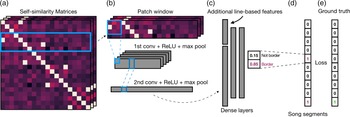
Lyrics segments manifest themselves in the form of distinct patterns in the SSM. In order to detect these patterns efficiently, we introduce the CNN architecture which is illustrated in Figure 2. The model predicts for each lyrics line if it is segment ending. For each of the n lines of a song text, the model receives patches (see Figure 2, step A) extracted from SSMs
 $\in \mathbb{R}^{n \times n}$
and centered around the line:
 $\text{input}_i = \{P^1_i, P^2_i, ..., P^c_i\} \in \mathbb{R}^{2w \times n \times c}$
, where c is the number of SSMs or number of channels and w is the window size. To ensure the model captures the segment-indicating patterns regardless of their location and relative size, the input patches go through two convolutional layers (see Figure 2, step B) (Goodfellow, Bengio, and Courville Reference Goodfellow, Bengio and Courville2016), using filter sizes of
 $(w+1) \times (w+1)$
and
 $1 \times w$
, respectively. By applying max pooling after both convolutions, each feature is downsampled to a scalar. After the convolutions, the resulting feature vector is concatenated with the line-based features (see Figure 2, step C) and goes through a series of densely connected layers. Finally, the softmax is applied to produce probabilities for each class (border/not border) (see Figure 2, step D). The model is trained with supervision using binary cross-entropy loss between predicted and ground truth segment border labels (see Figure 2, step E). Note that while the patch extraction is a local process, the SSM representation captures global relationships, namely the similarity of a line to all other lines in the lyrics.
Convolutional neural network-based model inferring lyrics segmentation.

2.3 Bimodal lyrics lines
To perform lyrics segmentation on a bimodal text–audio representation of a song to benefit from both textual and audio features, we use a corpus where the annotated lyrics ground truth (segment borders) is synchronized with the audio. This bimodal dataset is described in Section 4.1. We focus solely on the audio extracts that have singing voice, as only they are associated to the lyrics. For that, let
 $t_i$
be the time interval of the (singing event of) text line
 $l_i$
in our synchronized text–audio corpus. Then, a bimodal lyrics line
 $a_i = (l_i, s_i)$
consists of both a text line
 $l_i$
(the text line during
 $t_i$
) and its associated audio segment
 $s_i$
(the audio segment during
 $t_i$
). As a result, we have the same number of text lines and audio segments. While the text lines
 $l_i$
can be used directly to produce SSMs, the complexity of the raw audio signal prevents it from being used as direct input of our system. Instead, it is common to extract features from the audio that highlight some aspects of the signal that are correlated with the different musical dimensions. Therefore, we describe each audio segment
 $s_i$
as set of different time vectors. Each frame of a vector contains information of a precise and small time interval. The size of each audio frame depends on the configuration of each audio feature. Specifically, we use a sample rate of 22 kHz to extract from each time frame two sets of features using librosa.feature (McFee et al. Reference McFee, Raffel, Liang, Ellis, McVicar, Battenberg and Nieto2015). We call an audio segment
 $s_i$
featurized by a feature f if f is applied to all frames of
 $s_i$
. For our bimodal segment representation, we featurize each
 $s_i$
with one of the following features:
-
• Mel-frequency cepstral coefficients (
 $\textit{\textbf{mfcc}} \in \mathbb{R}^{14}$
): these coefficients (Davis and Mermelstein Reference Davis and Mermelstein1980) emphasize parts of the signal that are related with our understanding of the musical timbre. The mfcc describe the overall shape of a spectral envelope of a signal as a set of features. We extract 15 coefficients and discard the first component as it only conveys a constant offset.
-
• Chroma feature (
$\textit{\textbf{chr}} \in \mathbb{R}^{12}$
): this feature (Fujishima Reference Fujishima1999) describes the harmonic information of each frame by computing the “presence” of the 12 different notes. We compute a 12-element feature vector where each feature corresponds with each pitch class in western music where 1 octave is divided into 12 equal-tempered pitches.


3. Experiments with unimodal text-based representations
This section describes our lyrics segmentation experiments using text lines as input. First, we describe the datasets used (Section 3.1). We then define the different similarity measures used to construct the SSMs (see Section 3.2). In Section 3.3, we describe the models and configurations that we have investigated. Finally, we present and discuss the obtained results (Section 3.4).
3.1 Datasets: MLDB and WASABI
Song texts are available widely across the web in the form of user-generated content. Unfortunately for research purposes, there is no comprehensive publicly available online resource that would allow a more standardized evaluation of research results. This is mostly attributable to copyright limitations and has been criticized before in Mayer and Rauber (Reference Mayer and Rauber2011). Research, therefore, is usually undertaken on corpora that were created using standard web crawling techniques by the respective researchers. Due to the user-generated nature of song texts on the web, such crawled data is potentially noisy and heterogeneous, for example, the way in which line repetitions are annotated can range from verbatim duplication to something like Chorus (4x) to indicate repeating the chorus four times.
In the following, we describe the lyrics corpora we used in our experiments. First, Music Lyrics Database (MLDB) and WASABI are purely textual corpora. Complementarily, DALI is a corpus that contains bimodal lyrics representations in which text and audio are synchronized.
The MLDB V.1.2.7Footnote c is a proprietary lyrics corpus of popular songs of diverse genres. We use this corpus in the same configuration as used before by the state of the art in order to facilitate a comparison with their work. Consequently, we only consider English song texts that have five or more segments and we use the same training, development and test indices, which is a 60%–20%–20% split. In total, we have 103k song texts with at least 5 segments. Ninety-two percent of the remaining song texts count between 6 and 12 segments.
The WASABI corpusFootnote d (Meseguer-Brocal et al. Reference Meseguer-Brocal, Peeters, Pellerin, Buffa, Cabrio, Faron Zucker, Giboin, Mirbel, Hennequin, Moussallam, Piccoli and Fillon2017), is a larger corpus of song texts, consisting of 744k English song texts with at least 5 segments, and for each song, it provides the following information: its lyrics,Footnote e the synchronized lyrics when available,Footnote f DBpedia abstracts and categories the song belongs to, genre, label, writer, release date, awards, producers, artist and/or band members, the stereo audio track from Deezer, when available, the unmixed audio tracks of the song, its ISRC, bpm, and duration.
3.2 Similarity measures
In the following, we define the text-based similarities used to compute the SSMs. Given the text lines of the lyrics, we compute three line-based text similarity measures, based on either their characters, their phonetics, or their syntax.
-
• String similarity (
$\text{sim}_{\text{str}}$
): a normalized Levenshtein string edit similarity between the characters of two lines of text (Levenshtein Reference Levenshtein1966). This has been widely used—for example Watanabe et al. (Reference Watanabe, Matsubayashi, Orita, Okazaki, Inui, Fukayama, Nakano, Smith and Goto2016), Fell et al. (Reference Fell, Nechaev, Cabrio and Gandon2018). -
• Phonetic similarity(
$\text{sim}_{\text{phon}}$
): a simplified phonetic representation of the lines computed using the “Double Metaphone Search Algorithm” (Philips Reference Philips2000). When applied to “i love you very much” and “i’l off you vary match” it returns the same result: “ALFFRMX”. This algorithm was developed to capture the similarity of similar sounding words even with possibly very dissimilar orthography. We translate the text lines into this “phonetic language” and then compute
$\text{sim}_{\text{str}}$
between them. -
• Lexico-syntactical similarity (
$\text{sim}_{\text{lsyn}}$
): this measure was initially proposed in Fell (Reference Fell2014) to capture both the lexical similarity between text lines as well as the syntactical similarity. Consider the two text lines “Look into my eyes” and “I look into your eyes”: there is a similarity on the lexical level, as similar words are used. Also, the lines are similar on the syntactical level, as they share a similar word order. We estimate the lexical similarity
$\text{sim}_{\text{lex}}$
between two lines as their relative word bigram overlap, and in analogy, we estimate their syntactical similarity
$\text{sim}_{\text{syn}}$
via relative POS tag bigram overlap. Finally, we define the lexico-syntactical similarity
$\text{sim}_{\text{lsyn}}$
as a weighted sum of
$\text{sim}_{\text{lex}}$
and
$\text{sim}_{\text{syn}}$
. The details of the computation are described in the Appendix—Section B.


3.3 Models and configurations
We represent song texts via text lines and experiment on the MLDB and WASABI datasets. We compare to the state of the art (Watanabe et al. Reference Watanabe, Matsubayashi, Orita, Okazaki, Inui, Fukayama, Nakano, Smith and Goto2016) and successfully reproduce their best features to validate their approach. Two groups of features are used in the replication: repeated pattern features (RPF) extracted from SSMs and n-grams extracted from text lines. The RPF basically act as hand-crafted image filters that aim to detect the edges and the insides of diagonals and rectangles in the SSM.
Then, our own models are neural networks as described in Section 2.2, that use as features SSMs and two line-based features: the line length and n-grams. For the line length, we extracted the character count from each line, a simple proxy of the orthographic shape of the song text. Intuitively, segments that belong together tend to have similar shapes. Similarly to Watanabe et al. (Reference Watanabe, Matsubayashi, Orita, Okazaki, Inui, Fukayama, Nakano, Smith and Goto2016)’s term features, we extracted those n-grams from each line that are most indicative for segment borders: using the tf–idf weighting scheme, we extracted n-grams that are typically found left or right from the segment border, varied n-gram lengths and also included indicative part-of-speech tag n-grams. This resulted in 240 term features in total. The most indicative words at the start of a segment were: {ok, lately, okay, yo, excuse, dear, well, hey}. As segment-initial phrases we found: {Been a long, I’ve been, There’s a, Won’t you, Na na na, Hey, hey}. Typical words ending a segment were: {…,., !,., yeah, ohh, woah. c’mon, wonderland}. And as segment-final phrases we found as most indicative: {yeah!, come on!, love you., !!!, to you., with you., check it out, at all., let’s go, …}
In this experiment, we consider only SSMs made from text-based similarities; we note this in the model name as
 $\text{CNN}_{\text{text}}$
. We further name a CNN model by the set of SSMs that it uses as features. For example, the model
 $\text{CNN}_{\text{text}}\text{\{str\}}$
uses as only feature the SSM made from string similarity
 $\text{sim}_{\text{str}}$
, while the model
 $\text{CNN}_{\text{text}}\text{\{str, phon, lsyn\}}$
uses three SSMs in parallel (as different input channels), one from each similarity.
For convolutional layers, we empirically set
 $w_{\text{size}} = 2$
and the amount of features extracted after each convolution to 128. Dense layers have 512 hidden units. We have also tuned the learning rate (negative degrees of 10), the dropout probability with increments of 0.1. The batch size was selected from the beginning to be 256 to better saturate our GPU. The CNN models were implemented using Tensorflow.
For comparison, we implement two baselines. The random baseline guesses for each line independently if it is a segment border (with a probability of 50%) or not. The line length baseline uses as only feature the line length in characters and is trained using a logistic regression classifier.
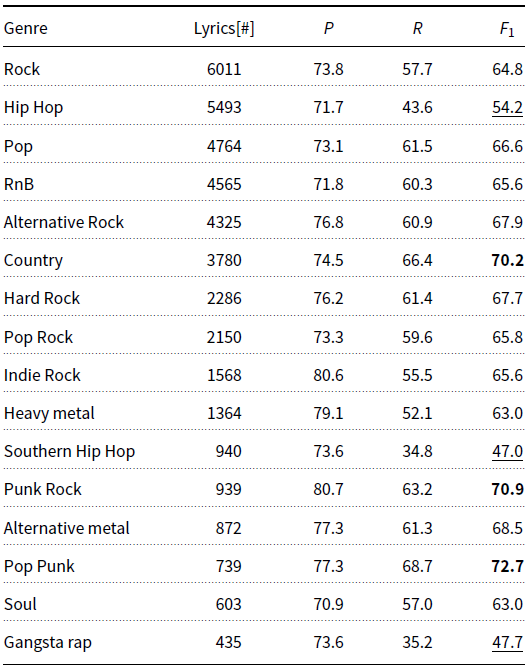
In order to favor comparative analysis, the first experiments are run against the MLDB dataset (see Section 3.1) used by the state-of-the-art method (Watanabe et al. Reference Watanabe, Matsubayashi, Orita, Okazaki, Inui, Fukayama, Nakano, Smith and Goto2016). To test the system portability to bigger and more heterogeneous data sources, we further experimented our method on the WASABI corpus (see Section 3.1). In order to test the influence of genre on classification performance, we aligned MLDB to WASABI as the latter provides genre information. Song texts that had the exact same title and artist names (ignoring case) in both datasets were aligned. This rather strict filter resulted in an amount of 58,567 (57%) song texts with genre information in MLDB. Table 2 shows the distribution of the genres in MLDB song texts. We then tested our method on each genre separately, to test our hypothesis that classification is harder for some genres in which almost no repeated patterns can be detected (as Rap songs). To the best of our knowledge, previous work did not report on genre-specific results.
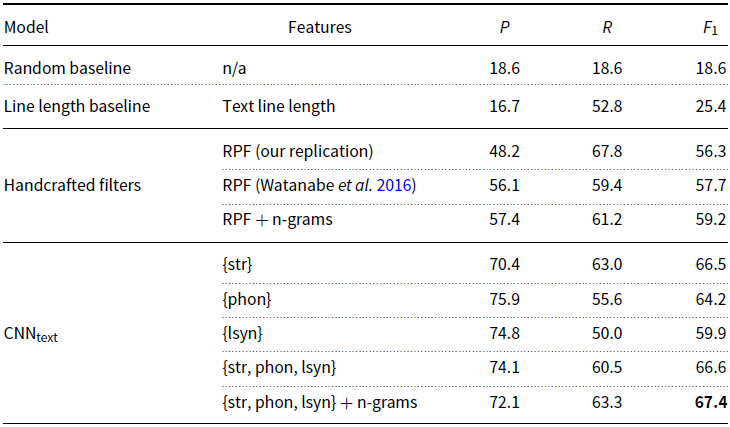
Results with text lines on MLDB dataset in terms of Precision (P), Recall (R), and
 $F_1$
in %

Results with text lines.
 $\text{CNN}_{\text{text}}\{str\}$
model performances across musical genres in the MLDB dataset in terms of Precision (P), Recall (R), and
 $F_1$
in %. Underlined are the performances on genres with less repetitive text. Genres with highly repetitive structure are in bold

In this work, we did not normalize the lyrics in order to rigorously compare our results to Watanabe et al. (Reference Watanabe, Matsubayashi, Orita, Okazaki, Inui, Fukayama, Nakano, Smith and Goto2016). We estimate the proportion of lyrics containing words that indicate the text structure (Chorus, Intro, Refrain, …), to be marginal (0.1%–0.5%) in the MLDB corpus. When applying our methods for lyrics segmentation to lyrics found online, an appropriate normalization method should be applied as a preprocessing step. For details on such a normalization procedure, we refer the reader to Fell (Reference Fell2014), Section 2.1.
Evaluation metrics are Precision (P), Recall (R), and F-score (
 $F_1$
). Significance is tested with a permutation test (Ojala and Garriga Reference Ojala and Garriga2010), and the p-value is reported.
3.4 Results and discussion
Table 1 shows the results of our experiments with text lines on the MLDB dataset. We start by measuring the performance of our replication of Watanabe et al. (Reference Watanabe, Matsubayashi, Orita, Okazaki, Inui, Fukayama, Nakano, Smith and Goto2016)’s approach. This reimplementation exhibits 56.3%
 $F_1$
, similar to the results reported in the original paper (57.7%). The divergence could be attributed to a different choice of hyperparameters and feature extraction code. Much weaker baselines were explored as well. The random baseline resulted in 18.6%
 $F_1$
, while the usage of simple line-based features, such as the line length (character count), improves this to 25.4%.
The best CNN-based model,
 $\text{CNN}_{\text{text}}\text{\{str, phon, lsyn\}} + \text{n-grams}$
, outperforms all our baselines reaching 67.4%
 $F_1$
, 8.2pp better than the results reported in Watanabe et al. (Reference Watanabe, Matsubayashi, Orita, Okazaki, Inui, Fukayama, Nakano, Smith and Goto2016). We perform a permutation test (Ojala and Garriga Reference Ojala and Garriga2010) of this model against all other models. In every case, the performance difference is statistically significant (
 $p < 0.05$
).
Subsequent feature analysis revealed that the model
 $\text{CNN}_{\text{text}}\text{\{str\}}$
is by far the most effective. The
 $\text{CNN}_{\text{text}}\text{\{lsyn\}}$
model exhibits much lower performance, despite using a much more complex feature. We believe the lexico-syntactical similarity is much noisier as it relies on n-grams and POS tags, and thus propagates error from the tokenizers and POS taggers. The
 $\text{CNN}_{\text{text}}\text{\{phon\}}$
exhibits a small but measurable performance decrease from
 $\text{CNN}_{\text{text}}\text{\{str\}}$
, possibly due to phonetic features capturing similar regularities, while also depending on the quality of preprocessing tools and the rule-based phonetic algorithm being relevant for our song-based dataset. The
 $\text{CNN}_{\text{text}}\text{\{str, phon, lsyn\}}$
model that combines the different textual SSMs yields a performance comparable to
 $\text{CNN}_{\text{text}}\text{\{str\}}$
.
In addition, we test the performance of several line-based features on our dataset. Most notably, the n-grams feature provides a significant performance improvement producing the best model. Note that adding the line length feature to any
 $\text{CNN}_{\text{text}}$
model does not increase performance.
To show the portability of our method to bigger and more heterogeneous datasets, we ran the CNN model on the WASABI dataset (as described in Section 3.1), obtaining results that are very close to the ones obtained for the MLDB dataset: precision: 67.4% for Precision, 67.3% Recall, and 67.4% F-score using the
 $\text{CNN}_{\text{text}}\text{\{str\}}$
model.
Results differ significantly based on genre. We split the MLDB dataset with genre annotations into training and test, trained on all genres, and tested on each genre separately. In Table 2, we report the performances of the
 $\text{CNN}_{\text{text}}\text{\{str\}}$
on lyrics of different genres. Songs belonging to genres such as Country, Rock, or Pop, contain recurrent structures with repeating patterns, which are more easily detectable by the
 $\text{CNN}_{\text{text}}$
algorithm. Therefore, they show significantly better performance. On the other hand, the performance on genres such as Hip Hop or Rap, is much worse.
4. Experiments with multimodal text–audio representations
This section describes our lyrics segmentation experiments using multimodal (unimodal or bimodal) lyrics lines, containing text or audio information or both as input. We follow the same structure as in our experiments with text lines, describing the dataset used (see Section 4.1), defining the similarity measures used to construct the SSMs (see Section 4.2), describing the models and configurations that we have investigated (see Section 4.3), and finally presenting and discussing the obtained results (see Section 4.4).
4.1 Dataset: DALI
The DALI corpusFootnote g (Meseguer-Brocal, Cohen-Hadria, and Peeters Reference Meseguer-Brocal, Cohen-Hadria and Peeters2018) contains synchronized lyrics–audio representations on different levels of granularity: syllables, words, lines, and segments. Depending on the song, the alignment quality between text segments and audio segments is higher or lower. In the Appendix (see Section 8), we explain how we estimate this segment alignment quality Qual.
Then, in order to test the impact of Qual on the performance of our lyrics segmentation algorithm, we partition the DALI corpus into parts with different Qual. Initially, DALI consists of 5358 lyrics that are synchronized to their audio track. Like in previous publications (Watanabe et al. Reference Watanabe, Matsubayashi, Orita, Okazaki, Inui, Fukayama, Nakano, Smith and Goto2016; Fell et al. Reference Fell, Nechaev, Cabrio and Gandon2018), we ensure that all song texts contain at least 5 segments. This constraint reduces the number of tracks used by us to 4784. We partition the 4784 tracks based on their Qual into high (
 $Q^+$
), med (
 $Q^0$
), and low (
 $Q^-$
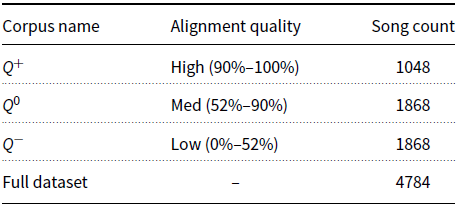
) alignment quality datasets. Table 3 gives an overview over the resulting dataset partitions. The
 $Q^+$
dataset consists of 50,842 lines and 7985 segment borders and has the following language distribution: 72% English, 11% German, 4% French, 3% Spanish, 3% Dutch, 7% other languages.
The DALI dataset partitioned by alignment quality

4.2 Similarity measures
In this experiment, we add to the common choice of text-based similarity measures also audio-based similarities—the crucial ingredient that makes our approach multimodal. In the following, we define the text-based and audio-based similarities that we use to compute the SSMs.
Text similarity: For our model, we produce SSMs based on the string similarity measure as introduced in Section 3.2. The measure is applied on the textual component
 $l_i$
of the multimodal lines
 $a_i$
.
Audio similarities: We have previously defined the process of extracting audio features, as well as the concrete audio features (see Section 2.3). When extracting features from audio segments of different lengths, we obtain feature vectors of different lengths. There are several alternatives to measure the similarity between two audio sequences (e.g., mfcc sequences) of possibly different lengths, among which Dynamic Time Warping
 $T_d$
is the most popular one in the Music Information Retrieval community. Given bimodal lyrics lines
 $a_u, a_v$
, we compare two audio segments
 $s_u$
and
 $s_v$
that are featurized by a particular audio feature (mfcc or chroma) using
 $T_{d}$
:
 \begin{equation*} T_{d}(i, j) = d(s_u(i), s_v(j)) + \min \left\{ \begin{matrix} T_d(i-1, j),\\ \;\;\;\; T_d(i-1, j-1),\\ T_d(i, j-1) \end{matrix}\right\}\end{equation*}
 $T_d$
must be parametrized by an inner distance d to measure the distance between the frame i of
 $s_u$
and the frame j of
 $s_v$
. Depending on the particular audio feature
 $s_u$
and
 $s_v$
are featurized with, we employ a different inner distance as defined below. Let m be the length of the vector
 $s_u$
and n be the length of
 $s_v$
. Then, we compute the minimal distance between the two audio sequences as
 $T_d(m, n)$
and normalize this by the length r of the shortest alignment path between
 $s_u$
and
 $s_v$
to obtain values in [0,1] that are comparable to each other. We finally apply
 $\lambda x. (1-x)$
to turn the distance
 $T_d$
into a similarity measure
 $S_d$
:
 \begin{equation*} S_d(s_u, s_v) = 1 - T_d(m, n) \cdot r^{-1}\end{equation*}
Given bimodal lyrics lines
 $a_i$
, we now define similarity measures between audio segments
 $s_i$
that are featurized by a particular audio feature presented previously (mfcc, chr) based on our similarity measure
 $S_d$
:
-
• MFCC similarity (
$\textbf{sim}_{\textbf{mfcc}}$
):
$S_d$
between two audio segments are featurized by the mfcc feature. As inner distance, we use the cosine distance:
$d(x,y) = x \cdot y \cdot (\lVert x \rVert \cdot \lVert y \rVert)^{-1}$
. -
• Chroma similarity (
$\textbf{sim}_{\textbf{chr}}$
):
$S_d$
between two audio segments are featurized by the chroma feature. As inner distance, we use the cosine distance.





4.3 Models and configurations
Here, the song texts are represented via bimodal lyrics lines, incorporating both text and audio information, and experimentation is performed on the DALI corpus. In order to test our hypotheses which text and audio features are most relevant to detect segment boundaries, and whether the text and audio modalities complement each other, we compare different types of models: baselines, text-based models, audio-based models, and finally bimodal models that use both text and audio features. We provide the following baselines: the random baseline guesses for each line independently if it is a segment border (with a probability of 50%) or not. The line length baselines use as feature only the line length in characters (text-based model) or milliseconds (audio-based model) or both, respectively. These baselines are trained using a logistic regression classifier.
Finally, the last baseline models the segmentation task as sequence tagging by tagging each text line as segment-ending or not ending. This model uses an RNN and the lyrics line is here modeled as the average word vector of all words in the line. The RNN uses GRU cells with 50 hidden states and 300-dimensional word vectors (Pennington, Socher, and Manning Reference Pennington, Socher and Manning2014).
All other models are CNNs using the architecture described previously and use as features SSMs made from different textual or audio similarities as described in Section 4.2. The CNN-based models that use purely textual features (str) are named
 $\text{CNN}_{\text{text}}$
, while the CNN-based models using purely audio features (mfcc, chr) are named
 $\text{CNN}_{\text{audio}}$
. Lastly, the
 $\text{CNN}_{\text{mult}}$
models are multimodal in the sense that they use combinations of textual and audio features. We name a CNN model by its modality (text, audio, mult) as well as by the set of SSMs that it uses as features. For example, the model
 $\text{CNN}_{\text{mult}}\text{\{str, mfcc\}}$
uses as textual feature the SSM made from string similarity
 $\text{sim}_{\text{str}}$
and as audio feature the SSM made from mfcc similarity
 $\text{sim}_{\text{mfcc}}$
.
As dataset, we use the
 $Q^+$
part of the DALI dataset (see Section 4.1). We split the data randomly into training and test sets using the following scheme: considering that the DALI dataset is relatively small, we average over two different fivefold cross-validations. We prefer this sampling strategy for our small dataset over a more common 10-fold cross-validation as it avoids the test set becoming too small.
4.4 Results and discussion
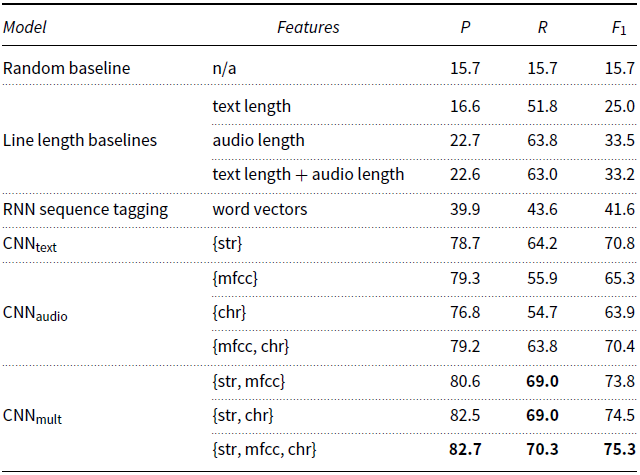
The results of our experiments with multimodal lyrics lines on the DALI dataset are depicted in Table 4. The random baseline and the different line length baselines reach a performance of 15.5%–33.5%
 $F_1$
. Interestingly, the audio-based line length (33.5%
 $F_1$
) is more indicative of the lyrics segmentation than the text-based line length (25.0%
 $F_1$
).Footnote
h
Finally, the word-based RNN sequence tagger performs better (41.6%
 $F_1$
) than the simple baselines, but is vastly inferior to the CNN-based models. Given this finding, we did not try the sequence tagger with additional audio features.
Results with multimodal lyrics lines on the
 $Q^+$
dataset in terms of Precision (P), Recall (R), and
 $F_1$
in %. Note that the
 $\text{CNN}_{\text{text}}\text{\{str\}}$
model is the same configuration as in Table 2, but trained on different dataset

The model
 $\text{CNN}_{\text{text}}\text{\{str\}}$
performs with 70.8%
 $F_1$
similarly to the
 $\text{CNN}_{\text{text}}\text{\{str\}}$
model from the first experiment (66.5%
 $F_1$
). The models use the exact same
 $\text{SSM}_{\text{str}}$
feature and hyperparameters, but another lyrics corpus (DALI instead of MLDB). We believe that as DALI was assembled from karaoke singing instances, it likely contains more repetitive song texts that are easier to segment using the employed method. Note that the DALI dataset is too small to allow a genre-wise comparison as we did in the previous experiment using the MLDB dataset.
The
 $\text{CNN}_{\text{audio}}$
models perform similarly well than the
 $\text{CNN}_{\text{text}}$
models.
 $\text{CNN}_{\text{audio}}\text{\{mfcc\}}$
reaches 65.3%
 $F_1$
, while
 $\text{CNN}_{\text{audio}}\text{\{chr\}}$
results in 63.9%
 $F_1$
. The model
 $\text{CNN}_{\text{audio}}\text{\{mfcc, chr\}}$
performs with 70.4%
 $F_1$
significantly (
 $p<0.001$
) better than the models that use only one of the features. As the mfcc feature models timbre and instrumentation, while the chroma feature models melody and harmony, they provide complementary information to the
 $\text{CNN}_{\text{audio}}$
model which increases its performance.
Most importantly, the
 $\text{CNN}_{\text{mult}}$
models combining text- with audio-based features constantly outperform the
 $\text{CNN}_{\text{text}}$
and
 $\text{CNN}_{\text{audio}}$
models.
 $\text{CNN}_{\text{mult}}\text{\{str, mfcc\}}$
and
 $\text{CNN}_{\text{mult}}\text{\{str, chr\}}$
achieve a performance of 73.8%
 $F_1$
and 74.5%
 $F_1$
, respectively—this is significantly (
 $p<0.001$
) higher compared to the 70.8% (70.4%)
 $F_1$
of the best
 $\text{CNN}_{\text{text}}$
(
 $\text{CNN}_{\text{audio}}$
) model. Finally, the overall best performing model is a combination of the best
 $\text{CNN}_{\text{text}}$
and
 $\text{CNN}_{\text{audio}}$
models and delivers 75.3%
 $F_1$
.
 $\text{CNN}_{\text{mult}}\text{\{str, mfcc, chr\}}$
is the only model to significantly (
 $p<0.05$
) outperform all other models in all three evaluation metrics: Precision, Recall, and
 $F_1$
. Note that all
 $\text{CNN}_{\text{mult}}$
models outperform all
 $\text{CNN}_{\text{text}}$
and
 $\text{CNN}_{\text{audio}}$
models significantly (
 $p<0.001$
) in recall.
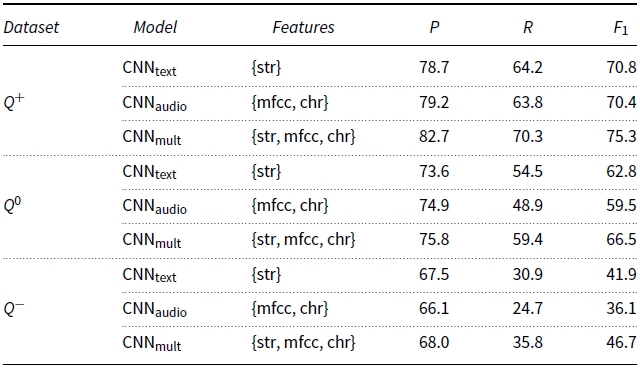
We perform an ablation test on the alignment quality. For this, we train CNN-based models with those feature sets that performed best on the
 $Q^+$
part of DALI. For each modality (text, audio, mult), that is
 $\text{CNN}_{\text{text}}\text{\{str\}}$
,
 $\text{CNN}_{\text{audio}}\text{\{mfcc, chr\}}$
, and
 $\text{CNN}_{\text{mult}}\text{\{str, mfcc, chr\}}$
, we train a model for each feature set on each partition of DALI (
 $Q^+$
,
 $Q^0$
,
 $Q^-$
). We always test our models on the same alignment quality they were trained on. The alignment quality ablation results are depicted in Table 5. We find that independent of the modality (text, audio, mult), all models perform significantly (
 $p < 0.001$
) better with higher alignment quality. The effect of modality on segmentation performance (
 $F_1$
) is as follows: on all datasets, we find
 $\text{CNN}_{\text{mult}}\text{\{str, mfcc, chr\}}$
to significantly (
 $p<0.001$
) outperform both
 $\text{CNN}_{\text{text}}\text{\{str\}}$
and
 $\text{CNN}_{\text{audio}}\text{\{mfcc, chr\}}$
. Further,
 $\text{CNN}_{\text{text}}\text{\{str\}}$
significantly (
 $p<0.001$
) outperforms
 $\text{CNN}_{\text{audio}}\text{\{mfcc, chr\}}$
on the
 $Q^0$
and
 $Q^-$
dataset, whereas this does not hold on the
 $Q^+$
dataset (
 $p\geq0.05$
).
Results with multimodal lyrics lines for the alignment quality ablation test on the datasets
 $Q^+$
,
 $Q^0$
,
 $Q^-$
in terms of Precision (P), Recall (R), and
 $F_1$
in %

5. Error analysis
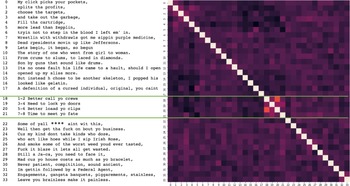
An SSM for a Rap song is depicted in Figure 3. As texts in this genre are less repetitive, the SSM-based features are less reliable to determine a song’s structure. Moreover, when returning to the introductory example in Figure 1, we observe that verses (the V
 $_{i}$
) and bridges (the B
 $_{i}$
) are not detectable when looking at the text representation only (see Figure 1, middle). The reason is that these verses have different lyrics. However, as these parts share the same melody, highlighted rectangles are visible in the melody structure.
Example SSM computed from textual similarity
 $\text{sim}_{\text{str}}$
. As common for Rap song texts, there is no chorus (diagonal stripe parallel to main diagonal). However, there is a highly repetitive musical state from lines 18 to 21 indicated by the corresponding rectangle in the SSM spanning from (18,18) to (21,21). (“Meet Your Fate” by Southpark Mexican, MLDB-ID: 125521).

Indeed, we found our bimodal segmentation model to produce significantly (
 $p<0.001$
) better segmentations (75.3%
 $F_1$
) compared to the purely text-based (70.8%
 $F_1$
) and audio-based models (70.4%
 $F_1$
). The increase in
 $F_1$
stems from both increased precision and recall. The model increase in precision is observed as
 $\text{CNN}_{\text{mult}}$
often produces less false-positive segment borders, that is the model delivers less noisy results. We observe an increase in recall in two ways: first,
 $\text{CNN}_{\text{mult}}$
sometimes detects a combination of the borders detected by
 $\text{CNN}_{\text{text}}$
and
 $\text{CNN}_{\text{audio}}$
. Second, there are cases where
 $\text{CNN}_{\text{mult}}$
detects borders that are not recalled in either of
 $\text{CNN}_{\text{text}}$
or
 $\text{CNN}_{\text{audio}}$
.
Segmentation algorithms that are based on exploiting patterns in an SSM, share a common limitation: non-repeated segments are hard to detect as they do not show up in the SSM. Note, that such segments are still occasionally detected indirectly when they are surrounded by repeated segments. Furthermore, a consecutively repeated pattern such as C
 $_{2}$
-C
 $_{3}$
-C
 $_{4}$
in Figure 1 is not easily segmentable as it could potentially also form one (C
 $_{2}\textit{C}_{3}\textit{C}_{4}$
) or two (C
 $_{2}$
-C
 $_{3}\textit{C}_{4}$
or C
 $_{2}\textit{C}_{3}$
-C
 $_{4}$
) segments. Another problem is that of inconsistent classification inside of a song: sometimes, patterns in the SSM that look the same to the human eye are classified differently. Note, however that on the pixel level there is a difference, as the inference in the used CNN is deterministic. This is a phenomenon similar to adversarial examples in image classification (same intension, but different extension).
We now analyze the predictions of our different models for the example song given in Figure 1. We compare the predictions of the following three different models: the text-based model
 $\text{CNN}_{\text{text}}\text{\{str\}}$
(visualized in Figure 1 as the left SSM called “repetitive lyrics structure”), the audio-based model
 $\text{CNN}_{\text{audio}}\text{\{chr\}}$
(visualized in Figure 1 as the right SSM called “repetitive melody structure”), and the bimodal model
 $\text{CNN}_{\text{mult}}\text{\{str, mfcc, chr\}}$
. Starting with the first chorus, C
 $_{l}$
, we find it to be segmented correctly by both
 $\text{CNN}_{\text{text}}\text{\{str\}}$
and
 $\text{CNN}_{\text{audio}}\text{\{chr\}}$
. As previously discussed, consecutively repeated patterns are hard to segment and our text-based model indeed fails to correctly segment the repeated chorus (C
 $_{2}$
-C
 $_{3}$
-C
 $_{4}$
). The audio-based model
 $\text{CNN}_{\text{audio}}\text{\{chr\}}$
overcomes this limitation and segments the repeated chorus correctly. Finally, we find that in this example, both the text-based and the audio-based models fail to segment the verses (the V
 $_{i}$
) and bridges (the B
 $_{i}$
) correctly. The
 $\text{CNN}_{\text{mult}}\text{\{str, mfcc, chr\}}$
model manages to detect the bridges and verses in our example.
Note that adding more features to a model does not always increase its ability to detect segment borders. While in some examples, the
 $\text{CNN}_{\text{mult}}\text{\{str, mfcc, chr\}}$
model detects segment borders that were not detected in any of the models,
 $\text{CNN}_{\text{text}}\text{\{str\}}$
or
 $\text{CNN}_{\text{audio}}\text{\{mfcc, chr\}}$
, there are also examples where the bimodal model does not detect a border that is detected by both the text-based and the audio-based models.
6. Related work
Besides the work of Watanabe et al. (Reference Watanabe, Matsubayashi, Orita, Okazaki, Inui, Fukayama, Nakano, Smith and Goto2016) that we have discussed in detail in Section 2, only a few papers in the literature have focused on the automated detection of the structure of lyrics. Mahedero et al. (Reference Mahedero, Martínez, Cano, Koppenberger and Gouyon2005) report experiments on the use of standard NLP tools for the analysis of music lyrics. Among the tasks they address, for structure extraction, they focus on lyrics having a clearly recognizable structure (which is not always the case) divided into segments. Such segments are weighted following the results given by descriptors used (as full length text, relative position of a segment in the song, segment similarity), and then tagged with a label describing them (e.g., chorus, verses). They test the segmentation algorithm on a small dataset of 30 lyrics, 6 for each language (English, French, German, Spanish, and Italian), which had previously been manually segmented.
More recently, Baratè et al. (Reference Baratè, Ludovico and Santucci2013) describe a semantics-driven approach to the automatic segmentation of song lyrics, and mainly focus on pop/rock music. Their goal is not to label a set of lines in a given way (e.g., verse, chorus), but rather identifying recurrent as well as nonrecurrent groups of lines. They propose a rule-based method to estimate such structure labels of segmented lyrics, while in our approach we apply machine learning methods to unsegmented lyrics.
Cheng et al. (Reference Cheng, Yang, Lin and Chen2009) propose a new method for enhancing the accuracy of audio segmentation. They derive the semantic structure of songs by lyrics processing to improve the structure labeling of the estimated audio segments. With the goal of identifying repeated musical parts in music audio signals to estimate music structure boundaries (lyrics are not considered), Cohen-Hadria and Peeters (Reference Cohen-Hadria and Peeters2017) propose to feed CNN with the square-sub-matrices centered on the main diagonals of several SSMs, each one representing a different audio descriptor, building their work on Foote (Reference Foote2000).
For a different task than ours, Mihalcea and Strapparava (Reference Mihalcea and Strapparava2012) use a corpus of 100 lyrics synchronized to an audio representation with information on musical key and note progression to detect emotion. Their classification results using both modalities, textual and audio features are significantly improved compared to a single modality.
7. Conclusion
In this article, we have addressed the task of lyrics segmentation on synchronized text–audio representations of songs. For the songs in the corpus DALI where the lyrics are aligned to the audio, we have derived a measure of alignment quality specific to our task of lyrics segmentation. Then, we have shown that exploiting both textual and audio-based features lead the employed CNN-based model to significantly outperform the state-of-the-art system for lyrics segmentation that relies on purely text-based features. Moreover, we have shown that the advantage of a bimodal segment representation pertains even in the case where the alignment is noisy. This indicates that a lyrics segmentation model can be improved in most situations by enriching the segment representation by another modality (such as audio).
As for future work, the problem of inconsistent classification inside of a song (SSM patterns look almost identically, but classifications differ) may be tackled by clustering the SSM patterns in such a way that very similar looking SSM patterns end up in the same cluster. This can be seen as a preprocessing denoizing step of the SSMs where details that are irrelevant to our task are deleted, without losing relevant information. Furthermore, the problem that the bimodal model sometimes fails to detect a segment border, even if the submodels correctly detected that border may be tackled by implementing a late fusion approach (Snoek, Worring, and Smeulders Reference Snoek, Worring and Smeulders2005) where the prediction of the bimodal model is conditioned on the predictions of both the text-based and the audio-based submodels. In alternative to our CNN-based approach, other neural architectures such as RNNs and transformers (Vaswani et al. Reference Vaswani, Shazeer, Parmar, Uszkoreit, Jones, Gomez, Kaiser, Polosukhin, Guyon, Luxburg, Bengio, Wallach, Fergus, Vishwanathan and Garnett2017) can be applied to the lyrics segmentation problem. While our initial experiments in framing the lyrics segmentation task as sequence tagging (see Section 4.3) did not yield results competitive to our CNNs, we believe that experimentation with more recent sentence embeddings, such as those derived from pretrained language models (Devlin et al. Reference Devlin, Chang, Lee and Toutanova2018), can be beneficial. Finally, we would like to experiment with further modalities, for instance with subtitled music videos where text, audio, and video are all synchronized to each other.
Acknowledgements
This work is partly funded by the French Research NationalAgency (ANR) under the WASABI project (contract ANR-16-CE23-0017-01).
A. Measuring the segment alignment quality in DALI
The DALI corpus (Meseguer-Brocal et al. Reference Meseguer-Brocal, Cohen-Hadria and Peeters2018) contains synchronized lyrics–audio representations on different levels of granularity: syllables, words, lines, and segments. It was created by joining two datasets: (1) a corpus for karaoke singing (AMX) which contains alignments between lyrics and audio on the syllable level and (2) a subset of WASABI lyrics that belong to the same songs as the lyrics in AMX. Note that corresponding lyrics in WASABI can differ from those in AMX to some extent. Also, in AMX, there is no annotation of segments. DALI provides estimated segments for AMX lyrics, projected from the ground truth segments from WASABI. For example, Figure A.1 shows on the left side the lyrics lines as given in AMX. The right side shows the lyrics lines given in WASABI as well as the ground truth lyrics segments. The left side shows the estimated lyrics segments in AMX. Note how the lyrics in WASABI have one segment more, as the segment
 $W_3$
has no counter part in AMX.
Lyrics lines and estimated lyrics segments in AMX (left). Lyrics lines and ground truth lyrics segments in WASABI (right) for the song (“Don‘t Break My Heart” by Den Harrow).

Based on the requirements for our task, we derive a measure to assess how well the estimated AMX segments correspond/align to the ground truth WASABI segments. Since we will use the WASABI segments as ground truth labels for supervised learning, we need to make sure, the AMX lines (and hence audio information) actually belongs to the aligned segment. As only for the AMX lyrics segments we have aligned audio features and we want to consistently use audio features in our segment representations, we make sure that every AMX segment has a counterpart WASABI segment (see Figure A.1,
 $A_0 \sim W_0$
,
 $A_1 \sim W_1$
,
 $A_2 \sim W_2$
,
 $A_3 \sim W_4$
). On the other hand, we allow WASABI segments to have no corresponding AMX segments (see Figure A.1,
 $W_3$
). We further do not impose constraints on the order of appearance of segments in AMX segmentations versus WASABI segmentations to allow for possible rearrangements in the order of corresponding segments. With these considerations, we formulate a measure of alignment quality that is tailored to our task of bimodal lyrics segmentation. Let A, W be segmentations, where
 $A=A_0 A_1 ... A_n$
and the
 $A_i$
are AMX segments and
 $W=W_0 W_1 ... W_m$
with WASABI lyrics segments
 $W_i$
. Then the alignment quality between the segmentations A, W is composed from the similarities of the best-matching segments. Using string similarity
 $\text{sim}_{\text{str}}$
as defined in Section 3.2, we define the alignment quality Qual as follows:
 \begin{equation*} \begin{split} Qual(A,W) & = Qual(A_0 A_1 ... A_n, \; W_0 W_1 ... W_m) \\ & = \min_{0 \leq i \leq n}\{ \max_{~ 0 \leq j \leq m}\{\;\text{sim}_{\text{str}}(A_i, W_j)\;\}\;\} \end{split}\end{equation*}
B. Lexico-syntactical similarity
Formally, given two text lines x,y, let
 $\text{bigrams}(x)$
be the set of bigrams in line x. Following Fell (Reference Fell2014) lexical similarity
 $\text{sim}_{\text{lex}}$
between lines x,y is then defined as
 \begin{equation*}\text{sim}_{\text{lex}}(x,y) = \frac{|\text{bigrams}(x) \cap \text{bigrams}(y)|}{\max\{|\text{bigrams}(x)|, |\text{bigrams}(y)|\}}\end{equation*}
To define the syntactical similarity
 $\text{sim}_{\text{syn}}$
, we apply a POS tagger to those word bigrams that do not overlap. Formally, the non-overlapped bigrams are
 $\hat{x}=\text{bigrams}(x) \setminus (\text{bigrams}(x) \cap \text{bigrams}(y))$
and
 $\hat{y}=\text{bigrams}(y) \setminus (\text{bigrams}(x) \cap \text{bigrams}(y))$
. We then apply element-wise a function postag to the non-overlapped bigrams in
 $\hat{x},\hat{y}$
to obtain POS tagged bigrams. Syntactical similarity
 $\text{sim}_{\text{syn}}$
is thus given by:
 \begin{equation*} \text{sim}_{\text{syn}}(x,y) = \left(\frac{|\text{postag}(\hat{x}) \cap \text{postag}(\hat{y})|}{\max\{|\text{postag}(\hat{x})|, |\text{postag}(\hat{y})|\}}\right)^2\end{equation*}
Note that the whole term is squared to heuristically account for the simple fact that there are usually many more words than POS tags and so syntactical similarities are inherently larger than lexical ones since the overlap is normalized by a smaller number of overall POS tags in consideration.
We define
 $\text{sim}_{\text{lsyn}}$
as a weighted sum of
 $\text{sim}_{\text{lex}}$
and
 $\text{sim}_{\text{syn}}$
:
 \begin{equation*} \text{sim}_{\text{lsyn}}(x,y) = \alpha_{\text{lex}} \cdot \text{sim}_{\text{lex}}(x,y) + (1-\alpha_{\text{lex}}) \cdot \text{sim}_{\text{syn}}(x,y)\end{equation*}
We heuristically set
 $\alpha_{\text{lex}} = \text{sim}_{\text{lex}}$
. The idea for this weighting is that when x and y have similar wordings, they likely have high similarity, so the wording should be more important if it is more similar. On the other hand, if the wording is more dissimilar, the structural similarity should be more important for figuring out a lexico-syntactical similarity between two lines. Hence,
 $\text{sim}_{\text{lsyn}}$
can be written as
 \begin{equation*} \text{sim}_{\text{lsyn}}(x,y) = \text{sim}^2_{\text{lex}}(x,y) + (1-\text{sim}_{\text{lex}}) \cdot \text{sim}_{\text{syn}}(x,y)\end{equation*}
We close with an example to illustrate the computation of
 $\text{sim}_{\text{lsyn}}$
:Footnote
i
 $x=``\text{{The man sleeps deeply.}}$
”
 $\Rightarrow \text{bigrams}(x)=\text{\{the man, \textbf{man sleep}, sleep deep\}}$
 $y=``\text{{A man slept.}}$
”
 $\Rightarrow \text{bigrams}(y)=\text{\{a man, \textbf{man sleep}}\}$
 $\Rightarrow \text{sim}_{\text{lex}}(x,y)=\frac{1}{3}$
 $\hat{x}=\text{\{the man, sleep deep\}}$
 $\hat{y}=\text{\{a man\}}$
 $\text{postag}(\hat{x})=\text{\{\textbf{DET NOUN}, VERB ADVERB\}}$
 $\text{postag}(\hat{y})=\text{\{\textbf{DET NOUN}\}}$
 $\Rightarrow \text{sim}_{\text{syn}}(x,y)=(\frac{1}{2})^2=\frac{1}{4}$
 $\Rightarrow \text{sim}_{\text{lsyn}}(x,y)=\left(\frac{1}{3}\right)^2+(1-\frac{1}{3}) \cdot \frac{1}{4}=\frac{1}{9} + \frac{1}{6} \approx 0.28$