Introduction
Schistosomiasis is of great biomedical importance, infecting around 200 million people worldwide, with many more at risk (Chitsulo et al., Reference Chitsulo, Loverde and Engels2004). Schistosomes show a range of specificities to their intermediate hosts. Selection should favour host recognition by miracidia, as only miracidia that locate and penetrate a suitable host species will complete their life cycle. Miracidia are attracted to snail hosts by macromolecular glycoproteins (reviewed in Haas et al., Reference Haas, Haberl, Kalbe and Korner1995) that may originate from the snail's mucous secretions (Haberl et al., Reference Haberl, Kalbe, Fuchs, Strobel, Schmalfuss and Haas1995). The chemical characteristics of these glycoconjugates differ between snail species, and may provide a mechanism for host recognition by miracidia (Kalbe et al., Reference Kalbe, Haberl and Haas1996).
Studies have revealed complex patterns of host choice by schistosome miracidia. For example, host recognition was found to vary between strains of Schistosoma mansoni, with an Egyptian strain showing preference for the host Biomphalaria alexandrina over other non-host snails, whereas two strains that have colonized Brazil showed no preference for their host Biomphalaria glabrata over several other species (Kalbe et al., Reference Kalbe, Haberl and Haas1996). This difference in specificity may reflect the more recent introduction of S. mansoni to South America and hence its more recent co-evolutionary association with B. glabrata (Kalbe et al., Reference Kalbe, Haberl, Hertel and Haas2004), and strain-crossing experiments show that host recognition is heritable and may be linked to host compatibility (Kalbe et al., Reference Kalbe, Haberl, Hertel and Haas2004). Nonetheless, Théron et al. (Reference Théron, Rognon and Pagès1998) demonstrated, in the Brazilian S. mansoni/B. glabrata system, a preference by miracidia for sub-adult snails over adults and juveniles, and suggested that sub-adult snails offer the best opportunity for parasite development and reproduction.
Understanding the role of miracidial host choice in compatibility is important for understanding of epidemiology as well as for development of biocontrol methods, including the potential use of non-transmitting species as a decoy for the miracidia to stop transmission at this point in the life cycle.
The islands of Unguja and Pemba make up Zanzibar, where urinary schistosomiasis caused by Schistosoma haematobium is a public health problem. On Unguja, prevalence varies between regions; and in some northern districts prevalence can be as high as 55% in schoolchildren (e.g. Kinyasini School), whereas only occasional cases are seen in the southern districts (Stothard et al., Reference Stothard, Llewellyn-Hughes, Griffin, Hubbard, Kristensen and Rollinson2002). Water bodies in Zanzibar are inhabited by two allopatric species of Bulinus snail belonging to the Bulinus africanus species group (Brown, Reference Brown1994); B. nasutus occurs in the south and B. globosus in the central and northern parts of Unguja. Molecular data show that B. nasutus and B. globosus are distinct but closely related species (Jørgensen et al., Reference Jørgensen, Jørgensen, Kristensen, Madsen and Stothard2007; Kane et al., Reference Kane, Stothard, Emery and Rollinson2008). Although B. nasutus has been implicated as the intermediate host of S. haematobium on mainland Africa, for example in the Kwale district of Kenya (Kariuki et al., Reference Kariuki, Clennon, Brady, Kitron, Sturrock, Ouma, Ndzovu, Mungai, Hoffman, Hamburger, Pellegrini, Muchiri and King2004), on the Zanzibar islands, only B. globosus is responsible for transmitting S. haematobium (Rollinson et al., Reference Rollinson, Stothard and Southgate2001; Stothard et al., Reference Stothard, Llewellyn-Hughes, Griffin, Hubbard, Kristensen and Rollinson2002). It is therefore of interest to investigate the role of miracidial behaviour on parasite transmission and host specificity in this system.
In the present study choice chambers were used to test the hypothesis that S. haematobium miracidia should show a preference for B. globosus over the allopatric, non-susceptible species B. nasutus. We also compared the frequency of penetration of these two snail species. In addition, the response of miracidia to two species of sympatric, non-intermediate host snails was investigated in choice chambers. Finally, as uninfected snails should represent better potential hosts than infected hosts in terms of resource availability and immune responses, we tested the hypothesis that miracidia should prefer unexposed over patent B. globosus.
Methods
Eggs of S. haematobium from Unguja, Tanzania were isolated from the urine of schoolchildren from the north and central districts. To take account of possible genetic variability between isolates, for each trial, eggs from infected urine from four or more patients were pooled. Most experiments were carried out in the Helminth Control Laboratory, Ministry of Health and Social Welfare, Zanzibar. Owing to a shortage of experimental material, two of the B. globosus versus B. nasutus replicates were undertaken using the same pooled isolates passaged once through Bulinus wrighti (Oman) and hamsters in the Natural History Museum, London. Snails used in the experiments were collected from the following field sites; B. globosus (Marahubi and Chaani, Unguja), B. nasutus (Muyuni, Unguja), Cleopatra ferruginea (Bulbul, Unguja) and Thiara scabra (Chaani Bridge, Unguja). All snails were held in the laboratory and screened for shedding of cercariae. Snails were size matched for the trials to minimize any bias towards smaller or younger individuals.
A Perspex choice chamber was constructed with a row of three equal sized chambers, each containing 20 ml water. Holes in the two connecting walls allowed miracidia to pass from the central chamber to either of the outer chambers. Snails were suspended in each of the outer chambers in bijou tubes with the base removed and replaced with 40 μm gauze to restrict passage of miracidia but allow flow of water and snail chemical cues. A total of 60 miracidia, at least 30 min after hatching, were placed into the middle chamber. After 30 min, holes between chambers were blocked and the number of miracidia from each chamber were counted under a light microscope.
Host choice
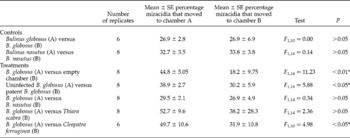
Snail host preference was examined for two control (B. globosus versus B. globosus; B. nasutus versus B. nasutus) and five treatment combinations (B. globosus versus empty chamber; patent B. globosus versus unexposed B. globosus; B. globosus versus B. nasutus; B. globosus versus T. scabra; B. globosus versus C. ferruginea) (see table 1). For each treatment there were 6 or 8 replicates (see table 1) and 60 miracidia were used in each replicate.
The percentage (mean±SE) of Schistosoma haematobium miracidia that moved to chamber A or B when offered a choice of host snails. Means and standard errors were back-calculated. Not all miracidia moved from the central chamber.

* Significant differences.
Penetration of the snail
To compare the penetration by S. haematobium miracidia of B. globosus versus B. nasutus, 40 miracidia were placed in each of three 1.5-litre vessels containing B. globosus and B. nasutus at three different ratios, with 30 snails present in each treatment (see table 2).
Number of individual Bulinus globosus and B. nasutus penetrated by Schistosoma haematobium miracidia. P values from binomial test.

After 24 h, DNA was isolated from individual whole snails using Qiagen DNeasy Tissue kit (Qiagen, Crawley, UK). A polymerase chain reaction (PCR) amplification of DraI repeated sequence of S. haematobium (Hamburger et al., Reference Hamburger, Hoffman, Kariuki, Muchiri, Ouma, Koech, Sturrock and King2004) was performed. This PCR is sensitive enough to detect S. haematobium at low numbers (penetration by a single miracidium; Hamburger et al., Reference Hamburger, He-Na, Abassi, Ramzy, Jourdane and Ruppel2001) and within 24 h after exposure (unpublished data), and trials showed that refractory snails had not destroyed the larvae by this time.
Statistical analysis
Data were analysed using Glim (numerical algorithms, Oxford 1985). Data for the choice of miracidia were proportion data, therefore a binomial error structure was specified, correcting for overdispersion where necessary. The significance of factors was assessed by their deletion from the maximal model, and the change in deviance compared with F tables (Crawley, Reference Crawley1993). Means and standard errors were back-calculated. The frequency of penetration was analysed using a binomial probability test.
Results
Host choice
There was no significant difference in the numbers of miracidia entering chamber A or B in the control treatments (table 1). When offered a choice between B. globosus and an empty chamber, more than twice as many miracidia entered the chamber containing a B. globosus. Miracidia also showed a preference for uninfected B. globosus over B. globosus with patent infections (table 1).
When offered a choice of two different snail species, more miracidia entered the chamber containing B. globosus than entered the chamber containing the sympatric, non-host C. ferruginea. There was also a non-significant trend towards a preference for B. globosus over the sympatric non-host T. scabra. However, the miracidia showed no preference for B. globosus over the allopatric, refractory species B. nasutus.
There was a significant difference between the treatments in the proportion (data arcsin transformed) of miracidia that made a choice of potential host as opposed to remaining the central chamber (F 6,45 = 10.3, P < 0.01). Post hoc (Tukey) tests revealed that the data fell into two homogeneous subsets, P < 0.05: ‘treatment B. globosus versus C. ferruginea and treatment B. globosus versus T. scabra’ and ‘all other treatments’. Hence the miracidia made a clearer choice when presented with B. globosus versus a sympatric snail (C. ferruginea or T. scabra), whereas in the other treatments a greater number of miracidia remained in the central chamber (no choice made).
Penetration of the snail
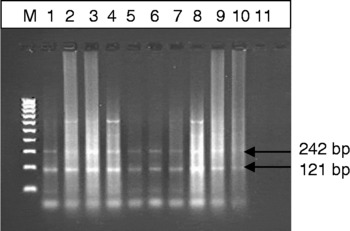
Schistosoma haematobium DNA was detected in both B. globosus and B. nasutus 24 h after exposure, indicating that S. haematobium miracidia were able to penetrate both snail species (fig. 1). Although a higher percentage of B. nasutus than B. globosus was penetrated in each of the three trials, these differences were not significant (table 2).
Representative 1.5% agarose gel showing 121 bp DNA fragments amplified from Schistosoma haematobium in Bulinus globosus and B. nasutus 24 h after exposure to miracidia. The fragment size of DraI is 121 bp; as it is a repeated sequence, there are several bands at multiples of 121 bp. Lanes: M, DNA ladder (100 bp increments); 1–5, infected B. globosus; 6–9, infected B. nasutus; 10, positive control (B. globosus shedding cercariae); 11, negative control (non-exposed B. globosus).

Discussion
The location of a suitable intermediate host by miracidia is essential for trematode parasite transmission. Host location involves dispersal, microhabitat selection, orientation towards the host and finally contact with the host (Kalbe et al., Reference Kalbe, Haberl and Haas1996) and is dependent on different stimuli (Haberl et al., Reference Haberl, Kalbe, Fuchs, Strobel, Schmalfuss and Haas1995; Kalbe et al., Reference Kalbe, Haberl and Haas1996), with host location occurring in response to miracidia-attracting glycoconjugates that are emitted from the snail (Haas & Haberl, Reference Haas, Haberl, Fried and Graczyk1997; Kalbe et al., Reference Kalbe, Haberl, Hertel and Haas2004; Hertel et al., Reference Hertel, Holweg, Haberl, Kalbe and Haas2006). The present data demonstrate that S. haematobium are able to locate B. globosus using olfactory cues, with 45% of miracidia moving towards the snail, but only 18% moving to the empty chamber (table 1). In addition, the miracidia were able to discriminate between uninfected B. globosus and patent B. globosus hosts. This is in accord with studies that demonstrated that S. mansoni miracidia were less attracted to Biomphalaria glabrata which harboured secondary sporocysts than to naïve snails (Magalhães et al., Reference Magalhães, Zanotti-Magalhães and de Carvalho1997; Sire et al., Reference Sire, Rognon and Theron1998). Avoidance of infected hosts should benefit the parasite as infected snails will have reduced resources and will have mounted an immune defence that may also prevent subsequent infections.
Most species of schistosome are only able to develop in single families of mollusc and some species are species specific, often based on geographic location (Adema & Loker, Reference Adema, Loker, Fried and Graczyk1997; Sapp & Loker, Reference Sapp and Loker2000). Schistosoma haematobium develops in B. globosus in numerous places in eastern Africa. In Kenya it develops in both B. globosus and B. nasutus. On the islands of Zanzibar, where the current study is based, S. haematobium only develops in B. globosus (Stothard et al., Reference Stothard, Loxton, Rollinson, Mgeni, Khamis, Ameri, Ramsan and Savioli2000) and has never been found to cause infections in the sympatric snails T. scabra or C. ferruginea, or in the allopatric B. nasutus that occurs in the south of the island (Stothard et al., Reference Stothard, Loxton, Rollinson, Mgeni, Khamis, Ameri, Ramsan and Savioli2000, Reference Stothard, Llewellyn-Hughes, Griffin, Hubbard, Kristensen and Rollinson2002). Our study revealed that S. haematobium miracidia showed a preference for the compatible intermediate host snail, B. globosus, over the sympatric non-transmitting C. ferruginea and there was also a trend towards discrimination against a second non-transmitting sympatric species, T. scabra. Avoidance of non-transmitting host species should be advantageous to the parasite as any miracidia that locate and penetrate a non-host snail will be at a transmission dead end. The ability to recognize a suitable snail host has also been observed for S. mansoni (Kalbe et al., Reference Kalbe, Haberl and Haas1996), Fasciola hepatica and Trichobilharzia ocellata (Kalbe et al., Reference Kalbe, Haberl and Haas1997). This host preference behaviour will benefit the parasite as it will lessen the chances of coming in contact with an unsusceptible species, thus increasing their future infection success (Combes & Moné, Reference Combes and Moné1987; Toledo et al., Reference Toledo, Munoz-Antoli, Perez and Esteban1999). It is interesting, however, that this preference is not absolute (table 1). The ability to locate non-host snails may in fact permit adaptation to novel hosts (Munoz-Antoli et al., Reference Munoz-Antoli, Trelis, Toledo and Esteban2006). For example, strains of S. mansoni introduced to Brazil were found to be less host specific than native Egyptian strains, reflecting selection for adaptation to new potential hosts (Kalbe et al., Reference Kalbe, Haberl, Hertel and Haas2004).
Interestingly, S. haematobium showed no significant preference for B. globosus over the allopatric B. nasutus. Miracidia did not discriminate between these species in either the choice chamber or penetration experiments; there was no difference in infection rates of B. globosus and B. nasutus 24 h after exposure. Although we observed location and penetration of B. nasutus by S. haematobium, patent infection of B. nasutus has not been recorded in Zanzibar (Stothard & Rollinson, Reference Stothard and Rollinson1997; Stothard et al., Reference Stothard, Loxton, Rollinson, Mgeni, Khamis, Ameri, Ramsan and Savioli2000, Reference Stothard, Llewellyn-Hughes, Griffin, Hubbard, Kristensen and Rollinson2002) and laboratory studies have found this host to be refractory to the parasite (Stothard & Rollinson, Reference Stothard and Rollinson1997). The distribution of human infections will limit the frequency with which S. haematobium encounters B. nasutus; infection within the human population on Unguja occurs primarily in the northern and central areas (Stothard et al., Reference Stothard, Loxton, Rollinson, Mgeni, Khamis, Ameri, Ramsan and Savioli2000, Reference Stothard, Mook, Mgeni, Khamis, Khamis and Rollinson2006; Rudge et al., Reference Rudge, Stothard, Basanez, Mgeni, Khamis, Kharmis and Rollinson2008). Therefore, on Unguja, S. haematobium miracidia are unlikely to encounter potential B. nasutus hosts, and so there will be little selective pressure either for avoidance of B. nasutus, or for the parasite to utilize this host. It has been suggested by Stothard et al. (Reference Stothard, Loxton, Rollinson, Mgeni, Khamis, Ameri, Ramsan and Savioli2000) that the transmission of S. haematobium in Zanzibar could be reduced by using the allopatric, refractory B. nasutus as a decoy for the miracidia to stop transmission at this point in the life cycle. Our observation that S. haematobium miracidia did not discriminate against B. nasutus lends support to its potential use in biocontrol in Zanzibar. However, there are strong arguments against the use of B. nasutus in biocontrol as it is a host for S. haematobium elsewhere (Kariuki et al., Reference Kariuki, Clennon, Brady, Kitron, Sturrock, Ouma, Ndzovu, Mungai, Hoffman, Hamburger, Pellegrini, Muchiri and King2004) and co-evolution and local adaptation have been demonstrated for parasites in snail/trematode systems (Lively & Dybdahl, Reference Lively and Dybdahl2000). Hence there is a risk that usage of B. nasutus could, in fact, lead to adaptation and could increase S. haematobium transmission in the long term.
Acknowledgements
This work was funded by a BBSRC CASE award to Fiona Allan and a Health Foundation award to the Natural History Museum and the Helminth Control Laboratory, Ministry of Health and Social Welfare, Zanzibar. Additional support was provided by EU Contract (6th framework programme). We are grateful to all staff at the Helminth Control Laboratory, to Michael Anderson for parasite and snail cultures and to David Johnston for designing the experimental choice chambers. We thank Russell Stothard for helpful discussions and an anonymous referee for helpful comments on the manuscript.