Introduction
In the 1930s, Fascism’s political economy had unintended repercussions on church construction. The Regime’s autarkic policies limited the availability and the affordability of primary materials essential to the casting of bronze bells. Not only did bells serve specific purposes within liturgical functions, but also replacing them with electrical and mechanical devices went contrary to canon law. Nevertheless, such sound systems did present pragmatic advantages (e.g., costs, range, clarity, flexibility) over traditional bell towers so that some parishes acquiesced to the realpolitik. The question as to whether to adopt these technologies reflected the tensions within the Catholic Church towards modernity and modernisation. Moreover, the technology impacted on local Church-State relations because Fascist Party officials appropriated the sound systems for political messaging.
The Catholic Church’s regulations on gramophones and bells
Because bells perform essential functions within parish life, their use is governed by canonico-liturgical regulations, which are detailed in the Codex Iuris Canonici of 1917 (Pio-Benedictine Code of Canon Law). In particular, canon 1169, which states that ‘each church should have bells to call the faithful to Divine Office and other religious practices’ (333), affirms the centrality and necessity of bells for a properly functioning parish.
In the first two decades of the twentieth century, the Sacred Congregation of Rites (defunct as of 8 May 1969) issued several decrees containing provisions on sacred music. The need to clarify the role of music during the liturgy resulted from the proliferation of new instruments. Among these directives, De machina ‘Grammofono’ in sacris functionibus (11 February 1910), expressed the Church’s opposition to the use of musical recordings during the liturgical functions by means of the ‘device people call a Gramophone’ (Sacra Congregatio Rituum 1910, 119).Footnote 1 On 18 May 1917, the Congregation expanded its concerns to include, the organ and those ‘instruments people call tubular bells’ (Sacra Congregatio Rituum 1917, 352–353). To justify the prohibition of the latter, the Sacred Congregation of Rites drew on No 18 of Pope Pius X’s Motu Proprio ‘Tra le Sollecitudini’ (22 November 1903), which stated:
The sound of the organ in song accompaniments, in the preludes, interludes and the like, must not only be performed according to this instrument’s nature, but must have all the qualities that true sacred music has and that have been previously mentioned. (Pius X Reference Pius1903, 393)
The ‘previously mentioned qualities’ had to do with the general principles of sacred music as conveyed by the Motu Proprio: it must contribute to the ‘primary purpose [of the liturgy], which is the glory of God’; it must ‘be holy, and therefore exclude all profanity’; and it must ‘be true art’ (Pius X Reference Pius1903, 389). Thus, as stated in No 16 of the Motu Proprio, the organ and the other musical instruments serve to support the singing, which ‘must always be in the forefront’ (Pius X Reference Pius1903, 393), and should never overwhelm it. No 19 of the Motu Proprio reiterated this directive by prohibiting those musical instruments that could drown out the voice: the piano, ‘the drum, the bass drum, the cymbals, the bells and the like’ (Pius X Reference Pius1903, 393). Because the qualities and characteristics of tubular bells were similar to those of the restricted instruments, the Sacred Congregation of Rites expressed its opposition to their use in church.
The first use of discs and loudspeakers in churches
Emerging sound technologies, however, presented opportunities for entrepreneurial clergy. One of the first instances of a church incorporating modern devices as a cost-saving measure, though to the specific detriment of the local pastor, occurs outside of Italy. The inaugural issue of the radio enthusiast magazine L’antenna notes this development in Kleinow, Germany, where ‘to economise, the evangelical minister was fired and replaced with a loudspeaker’ (GMB 1929, 10) for broadcasting pastors’ sermons from Berlin. The notice mockingly suggests that churches may well become obsolete:
Undoubtedly, if this practice catches on, then, in a not too distant future, all the Protestant sheep will flock to a single pastoral horn, and to economise even more, will find some good brother in Christ to say a few words at the cemetery or at the baptismal font. The problem could also be resolved by using gramophone discs. For a wedding, go to city hall. For daily charity, place a vending machine in the square. Then the only remaining problem is that of divine services at home. (GMB 1929, 10)
In the matter of spiritual counselling, the article proposes hiring a radio host to dispense consolation and counselling: ‘There must certainly exist a Teutonic Herr Kolantuoni!’Footnote 2 Even if sarcastically, the article concludes that ‘In the century of the automatic man […] when we are just practical men, it is logical to fire the pastor and to replace him with a loudspeaker’ (GMB 1929, 10). The facetious tone aside, the concerns expressed were real: Cardinal Pietro Gasparri and Mussolini were negotiating similar questions on the Church’s role in the modern state in the Lateran Treaty (Pollard Reference Pollard1985, 48–74).
Fully embracing modernity, Mgr Faulhaber, Archbishop of Munich and Freising, proclaimed that ‘the time has past when church steeples dominated cities and towns; today, radio antennas keep esteemed company with the bell towers. The loudspeaker has become a herald of God’s kingdom’ (Calcabrina 1932, 35). For Mgr Faulhaber, tradition needed to adapt to modern society.
That same year, the parish priest in Mézilles, France, reported that ‘some country priests, whose churches lacked an organ, a radio, or a choir, for High Mass, play discs of the Kyrie, the Credo, and the Gloria; and the faithful flock to church as if it were the theatre’ (Calcabrina 1932, 35). A priest from Bernese Jura, in the canton of Bern, had installed ‘in his church an amplified sound system: a microphone on the pulpit, loudspeakers in acoustically strategic positions’ (Calcabrina 1932, 35). This coupling of technology with tradition could lead to unintended consequences: in the case of the Swiss church, the electrician, ‘either because he did not understand or pretended not to understand, placed a microphone in the confessional. So that when the mayor’s wife went to confess…’ (Calcabrina 1932, 37). Presumably, the microphone was removed, but the incident demonstrates the power and concomitant danger of this technology that could profane the sacred.
Economic autarky
In Italy, the adoption in churches of such devices occurs in the late 1930s, prompted by the political and economic conditions. On 3 October 1935, General Emilio De Bono invaded Abyssinia from Eritrea. The League of Nations condemned the attack and invoked Article 16, ‘Sanctions of Pacific Settlement’, of The League of Nations Covenant (1919) against Italy as the aggressor state. These multilateral economic actions included both an embargo on arms and ammunition and a ban on exporting raw materials and goods that might assist the war effort. In response, Mussolini’s regime accelerated a policy of autarky, that had already begun following the economic crisis of 1929, by drastically curtailing its imports of fossil fuels, textile fibres, and, for what is of present interest, metals. From 18 November 1935 to 4 July 1936, imports decreased by one-third (Perugini Reference Perugini2014, 249). Although the League of Nations lifted the sanctions on 15 July 1936, the Regime continued its economic policy of self-sufficiency.Footnote 3
While iron could be supplied within the national territory either through mining (e.g., the deposits on Elba) or through recycling scrap, copper presented an insurmountable challenge.Footnote 4 Unlike iron, the vast majority of copper had to be imported: it is present throughout the peninsula – in Tuscany, Montecatini Società Generale per l’Industria Mineraria ed Agricola had copper mining operations at Capanne Vecchie (Massa Marittima), Fenice Massetana (GR), and Caporciano (Montecatini Val di Cecina) – but extraction was rarely cost-effective. Because of the sanctions, the price of copper reached prohibitive levels so that aluminium came to replace it where possible (e.g., conductors and electrical appliances). Even prior to the trade embargo, the rising costs of copper had led to an increase in consumption of aluminium in Italy:
In the 1920s, Italian consumption of aluminum had grown dramatically – from 3,202 metric tons in 1923, to 9,638 metric tons in 1929 – due, primarily, to the high price of copper. […] On average, national production covered only 40 per cent of the nation’s needs in the period between 1923 and 1927, with the rest covered by importing raw aluminum from abroad. Thus, from the point of view of the internal market, the conditions were right for growing productive capacity, an approach that the highest echelons of the Regime vigorously supported. (Perugini Reference Perugini2014, 126)
In other words, the industrial challenges posed by copper’s pricing had preceded the Second Italo-Ethiopian War by over a decade, but the post-1935 economic sanctions and the implementation of autarky exacerbated these market conditions. The copper shortage had an immediate negative impact on church bell production because these bells are normally made of bronze – an alloy of copper and tin, in which the percentage of copper is between 77 and 81 per cent. For new church constructions, the difficulty of procuring bronze bells meant adopting an alternative sound system – a financial decision that could be framed as patriotic.
The church of Sant’Adolfo in Aielli Stazione
The first church in Italy to adopt an electrical sound system was Sant’Adolfo in Aielli Stazione (AQ). For installation, it turned to the Italian firm SABBAEM (Società Anonima Brevetti Barbieri per Applicazioni Elettro Musicali) founded by Father Angelo Barbieri (1875–1950) in 1923. SABBAEM produced pipe organs for churches and cinemas, and, beginning in 1931, mechanical organs. The ‘Barbieri Automatic Organ’ consisted of three components: a transmitter group, a receiver apparatus, and the pipe organ itself. The transmitter group and the receiver apparatus could be attached to any type of organ, which would then require no organist and could play automatically any music that had been previously engraved on rolls of perforated paper. Barbieri modified this technology, creating a substitute for the requisite bells, for Sant’Adolfo.
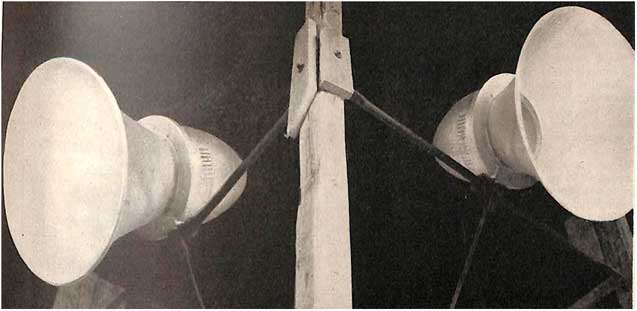
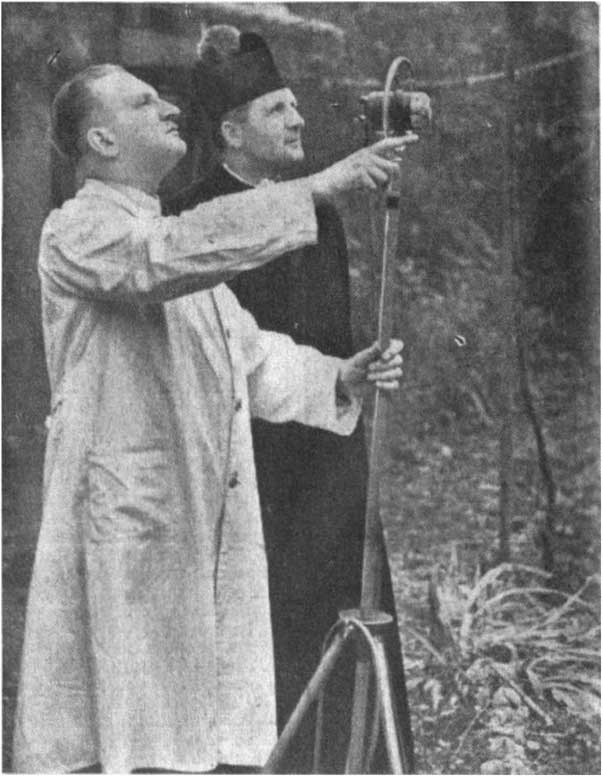
1n 1937, SABBAEM installed 25 steel tubular bells and ‘four loudspeakers to carry the sound … of the tubular bells over great distances’ (Farabegoli Reference Farabegoli2016, 62) on the church’s belfry (Figure 1). These tubular bells were relatively inexpensive and easily transportable (compared to traditional bronze bells); however, while pleasant, their sound did not project – a limitation that the loudspeakers corrected. This was the first example in Italy of a device designed to simulate (and replace) the sound of the customary church bells. Guido Letta, the prefect of Novara, but a native of Aielli, inaugurated the church on 26 September 1937, as a public works initiative.Footnote 5
Two of the four horn loudspeakers installed in the bell tower of the church of Sant’Adolfo in Aielli in 1937. Photograph in La Scienza per Tutti (1 May 1939): 127. Courtesy of the Biblioteca Nazionale Centrale di Roma.

Spurred less by innovation than by necessity, the decision to instal modern technology in lieu of tradition spoke to both costs and national goals:
For the church’s bell tower, they would have had to acquire at least four bronze bells and … therefore, they would have had to spend more than 100,000 lira (a low-end estimate) to purchase a very expensive metal, in accordance with autarky’s objectives, while sanctions were in full effect. (Angeletti Reference Angeletti1939, 127)
Barbieri’s technological solution reproduced and amplified the bell sound without using copper. He also equipped the tubular bells with an electric timer to programme them to toll at preset times. Moreover, they could be played through the mechanical organ with no need for human intervention. The total cost for this innovative and complex installation was ‘much less than half of the estimate for the bronze bells’ (Angeletti Reference Angeletti1939, 127–128), and, as Angeletti went on to comment, ‘a fine example of autarkic production’ (128).
As a priest, Barbieri would certainly have been aware of the Sacred Congregation of Rites’ decree of 1917, which prohibited the use of tubular bells during liturgical functions, but he and Sant’Adolfo allowed the proscriptive peals to stunning effect:
[T]hose who do not know about the system do not notice anything, but they ask themselves by what magic or, if you prefer, miracle, is it possible to listen to such perfect and evocative bell concerts in that town. Matins, allegretto, Ave Maria, and various other musical motifs are automatically reproduced through the electro-acoustic medium. (Angeletti Reference Angeletti1939, 127–128)
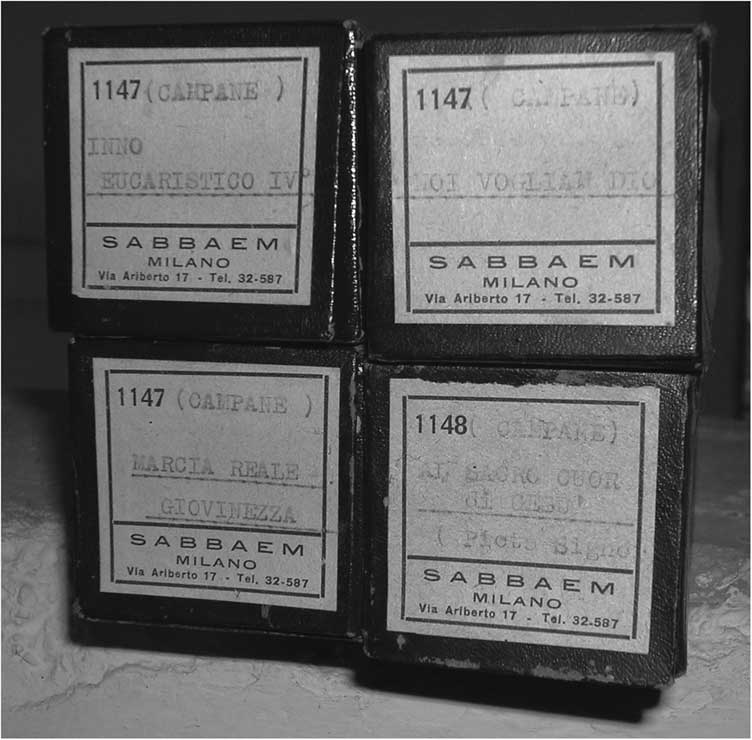
In fact, among the musical rolls found in Sant’Adolfo, four display the notation ‘Bells’ (Figure 2). Barbieri had created these musical rolls to be used expressly for the church’s broadcast system.
Barbieri’s four musical rolls for tubular bells found in the church of Sant’Adolfo in Aielli: Inno Eucaristico IV°; Noi Vogliam Dio; Marcia Reale, Giovinezza; Al Sacro Cuor di Gesù. (Photograph by Mauro Baldazza, Longiano).

Angeletti’s observations suggest that the decision to install tubular bells was not purely economic and they hint at internal tensions in the Church’s competition with modernity (McSweeney Reference McSweeney1980, 237–238). The adoption of technology can be understood as an effort to affirm relevance in the modern world. This pragmatism speaks to another factor: politics. The Church accepted, obtorto collo, this electrical amplification because the financier behind the construction of both Sant’Adolfo and the sound system was the prominent prefect Guido Letta (1889–1963). Hierarch of the Letta clan – uncle of Gianni Letta (Silvio Berlusconi’s confidante) and great-uncle of Enrico Letta (President of the Council of Ministers, 28 April 2013–22 February 2014) – Letta was an influential representative of the National Fascist Party (PNF). As such, he wielded considerable clout in the Marsica area.Footnote 6 In advancing this initiative, Letta was simply drawing on the PNF’s practice of utilising loudspeakers in public spaces as a means to disseminate propaganda. As noted in a 1938 publication, the PNF had loudspeakers installed wherever people might gather: ‘churches, barracks, schools, stadiums, political party headquarters, factories, construction sites, train stations, ships, cars, theatres, cinemas, cafés, associations, dance halls, etc.’ (‘Autoparlanti ovunque!...’ 1938, 216). For the Regime, technology and mass communication constituted central manifestations of modernity (Monteleone Reference Monteleone1980, 96–145; and Reference Monteleone1992, 109–141). In fact, in 1938, over 23,000 loudspeakers were installed in public spaces in Italy (Padovani Reference Padovani2005, 64). Through the proliferation of amplificatory systems, the PNF’s transmissions could reach rural and impoverished areas where few people could afford radios. Not just Mussolini’s image was everywhere (Gundle, Duggan and Pieri Reference Gundle, Duggan and Pieri2013, 161–224), but now his voice as well. In the case of Sant’Adolfo, Letta promoted a means of mass communication modeled on the PNF’s propaganda practices: in both its architecture and technology the church projected an image of modernity (Meduri Reference Meduri2016). That this sound system did not conform to the Sacred Congregation of Rites’ decrees was inconsequential to him.
Letta’s purpose in equipping the church with loudspeakers was not simply an act of patronage or the currying of an indulgence. Instead, he was blurring the lines between the sacred and the secular by dual-purposing the speakers to advance the sacralisation of the political.Footnote 7 The local priest would now broadcast Fascist propaganda songs from the belfry through Barbieri’s state-of-the-art equipment. One of the four extant musical rolls for bells found in Sant’Adolfo is labeled Marcia Reale/Giovinezza, respectively the Kingdom of Italy’s national anthem and the PNF’s triumphal hymn. Normally these songs would be played on official occasions, but, in Aielli, they rang daily from the bell tower because the priest acquiesced to this political infiltration of ecclesiastical space. The same steeple that sent out calls for prayer, now also sent out calls to arms. This conflation of secular and spiritual spheres speaks to the promotion of fascism as a civil religion: Fascist rallies would typically open with a mass, thereby incorporating the physical churches into the pageantry of the cult of the state (Gentile Reference Gentile1996, 82–93). While what happened in the provinces did not necessarily reflect a centralised strategy (Corner Reference Corner2006, 199–206), such accommodations eased local tensions between the two institutions. This diplomatic strain was due, in part, to Pius XI’s lack of explicit support for the Second Italo-Ethiopian War, after which, Mussolini’s anti-clericalism became increasingly pronounced (Ceci Reference Ceci2003 and Reference Ceci2007; Duggan Reference Duggan2013, 249–282). Not all the clergy shared the pope’s reservations: many supported the invasion for both patriotic and proselytistic reasons. One parish priest went so far as to seek permission from his bishop to melt the church bells for the cause (Kertzer Reference Kertzer2014, 229). Mussolini had even sought to curry the Church’s favour by financing the great organ to Milan’s Duomo in 1937 – under the condition that it be ‘autarkic’ (i.e., built by Italians with Italian materials) – but the gesture did not suffice. By 1938, the façade of collegiality had collapsed. For Mussolini the papacy was now “a malignant tumour in the body of Italy to ‘be rooted out once and for all’, because there was no room in Rome for both the pope and himself” (Mack Smith Reference Mack Smith1982, 222–223).
If other propagandistic bell music was broadcast from the Sant’Adolfo, those musical rolls have not survived. Nevertheless, for many local inhabitants, this daily concert became an onerous symbol of their own suffering so that, at the end of the Second World War, they stormed the bell tower and, in an act of misplaced aggression, destroyed the loudspeakers and the tubular bells.
The church of San Protaso in Milan
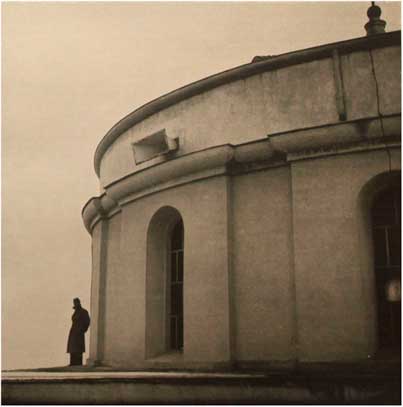
In 1938, another rationalist church, San Protaso, built in Milan’s newly established San Siro industrial area, adopted an electrical sound system more elaborate than that of Sant’Adolfo’s, though in this instance the support for the initiative came from the archdiocese. Cardinal Schuster had consecrated San Protaso five years earlier on 11 April 1933, but the parish was in need of an audio upgrade. In 1934, it had been equipped with a Barbieri mechanical organ, whose use the archdiocese of Milan (under the imprimatur of the same Cardinal Schuster) had approved for religious functions on 10 August 1931 – the year in which Barbieri’s mechanical organs had been introduced. The church, however, lacked bells.
As required by canon 1169 of the Codex Iuris Canonici, churches needed to have ‘a belfry with the usual bells that could gather the faithful together’ (De Luigi Reference De Luigi1939, 36). San Protaso, however, encountered the same financial difficulties that had constrained Sant’Adolfo: the cost of the bells was exorbitant given copper’s scarcity. To equip the church with bronze bells would require some ‘three hundred thousand lire’ (De Luigi Reference De Luigi1939, 36).
San Protaso’s parish priest, Father Alfredo Pozzi, lacked sufficient funding for bells, but found inspiration in Milan’s fairgrounds, whose public address system was clearly audible from a kilometre’s distance. Impressed by the loudspeakers range and amplification, he decided to use them in conjunction with a gramophone as the sound source for his church in lieu of the cost-prohibitive bells:
This alternative was feasible and came at a significantly reduced expense with respect to the cost of the belfry and bronze bells. [He had installed] a gramophonic amplifier of approximately 50-watt output, two loudspeakers for the church, and four horn loudspeakers for the cupola. The system was tested and it worked: the sound emitted was clear, neat, very natural, and it was a delight to hear. (De Luigi Reference De Luigi1939, 37)
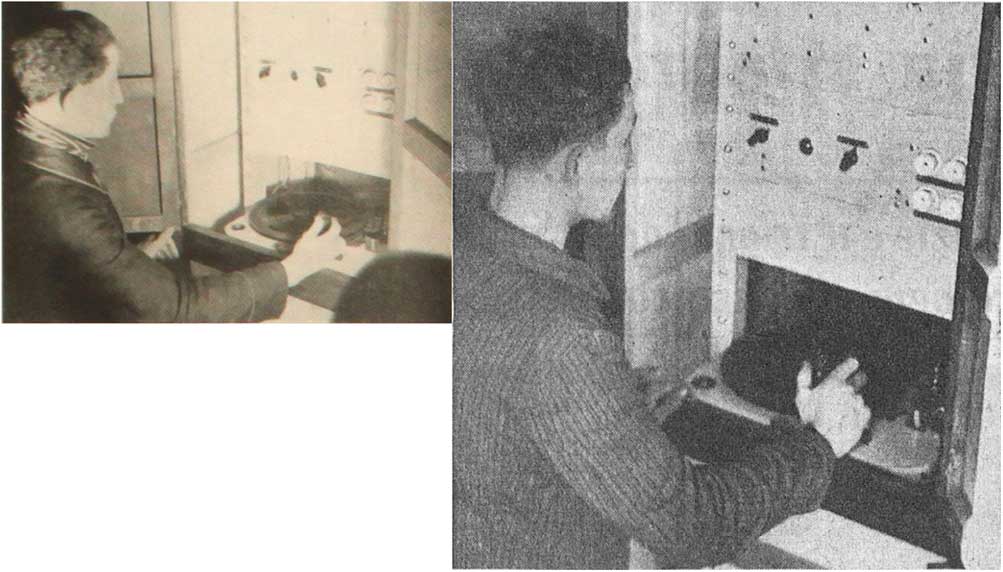
Thus, in San Protaso in 1938, the first fully-fledged sound system, consisting of a gramophone, an amplifier, and loudspeakers (Figures 3 and 4), to replace bells was installed in an Italian church (‘Le campane senza campanile’ 1939, 6).
Closeups of the gramophone and amplifier in the church of San Protaso. Left: Natura: rivista mensile illustrata 11 (1): 36. Courtesy of the Biblioteca comunale centrale ‘Palazzo Sormani’ Milan. Right: Corriere della Sera (Afternoon edition, 29 March 1939): 6. Courtesy of the Archivio Storico del Corriere della Sera, Milan.

A view of one of the four horn loudspeakers installed on the cupola of the church of San Protaso. Natura: rivista mensile illustrata 11 (1): 36. Courtesy of the Biblioteca comunale centrale ‘Palazzo Sormani’ Milan.

The system utilised recordings of bells, but, while various types of musical sound recordings were commercially available (e.g., bell tones for outdoors, discs for organ, for song, and for religious choirs), Father Pozzi also needed recordings of ‘a bell that played Ave Maria, the bell for First Mass, the Death Knell’ (De Luigi Reference De Luigi1939, 37).
Since pressing a disc was a relatively inexpensive process, the parish of San Protaso had recordings made of the rings of well-known bells, including those of the basilica of Santi Siro e Materno in Desio (MB). The Basilica’s eight concert bells, cast by one of the premier bell-makers of the nineteenth-century, Felice Bizzozero, in 1843, enjoyed a stellar reputation and produced a quality recording as reported in the daily Corriere della Sera:Footnote 8
The sounds of those bells were already on discs. They were pressed when a parish priest, whose church did not have a belfry or bells, […] asked his colleague at the Basilica of Desio, Mgr Bandera, if he could record his concert bells. The recording turned out beautifully [Figure 5]. The parish priest, without playing the bells, starts the disc on the gramophone, and the sound is amplified a hundredfold, so that it seems to descend and to spread out as if from a tower. (‘Le “campane del Papa” squillano per i dischi’ 1938, 6)
Sound recording of the concert bells of the Basilica of Desio. Corriere della Sera (17 November 1938): 6. Courtesy of the Archivio Storico del Corriere della Sera, Milan

The first bell arrangement selected was ‘the concert of Desio, because acknowledged as one of the most beautiful. Pius XI [Achille Ratti] defined it as without a doubt “the most beautiful one in the world” when he heard it on a radio broadcast in October 1937’ (‘Le “campane del Papa” squillano per i dischi’ 1938, 6). The Death Knell recording played to similar acclaim at San Protaso:
The deceased was accompanied to the church, its red-brick profile strong and imposing […] A bell rang, and the tolls, beating time in the sky entered sharply and clearly into our ears […] Dong – it seemed as if we could see the clapper make a semi-circle in the air and striking the bronze – and then the ding of the Death Knell. […] And the bells tolled and tolled, and their rings came to us from that church without a bell tower. (De Luigi Reference De Luigi1939, 36)
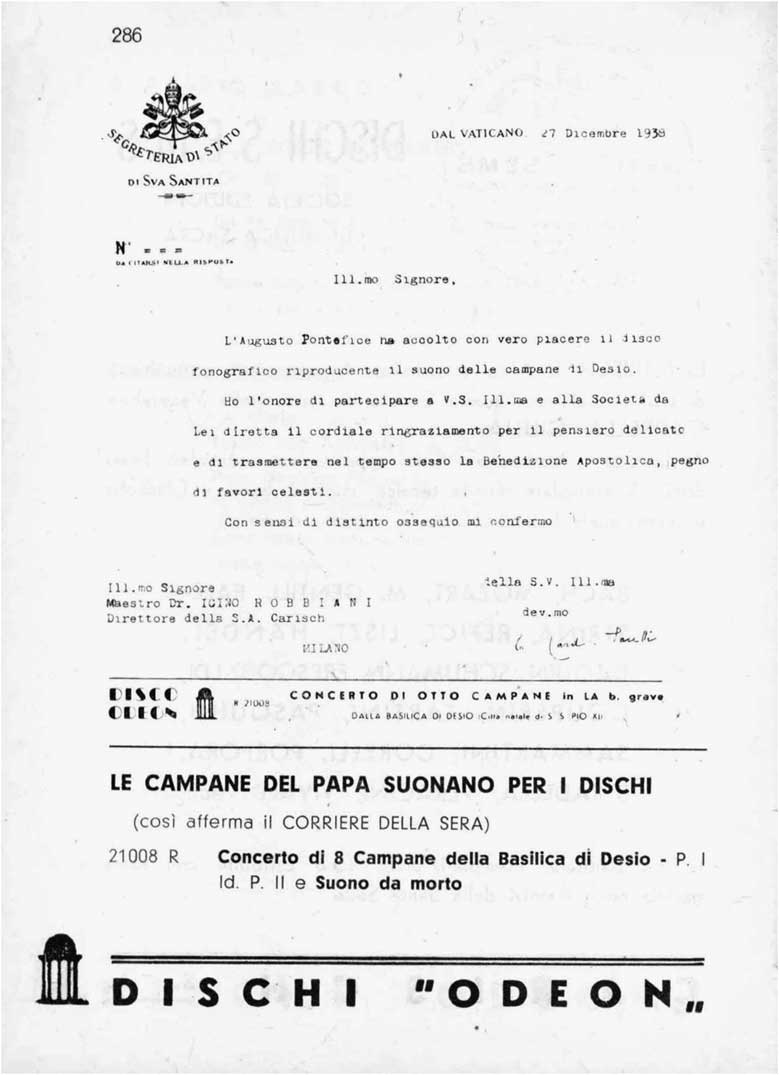
The catalogue advertisement cited the Corriere article in a promotional blurb for the disc, which it listed as Concerto di 8 Campane della Basilica di Desio – P. I Id. P. II e Suono da morto under the series number 21008 R (Catalogo generale dischi Odeon 1939, 286 and 298).
On 27 December 1938, Ratti, who was born in Desio, thanked the Milanese firm of Carisch SA for the recording of the bell concert in his hometown and bestowed upon the company and its director, Igino Robbiani, his Apostolic Benediction (Figure 6). This papal endorsement also found its way into the Odeon catalogue (1939, 286).
Official thanks and Apostolic Benediction of Pope Pius XI to the firm Carisch S.A. for the recording of the Desio bell concert. Catalogo generale dischi Odeon (1 March 1939): 286. Courtesy of the Istituto Centrale per i Beni Sonori ed Audiovisivi, Rome.

Pius XI’s enthusiasm for the recordings reflects his own efforts to modernise the Church so as to reach new audiences: among other innovations, he had charged Guglielmo Marconi with the construction of Vatican Radio in 1929 (Bea Reference Bea1981, 44–48). Nevertheless the prohibition of gramophones (and discs) during liturgical functions remained in effect. Rather than a general solution, the technological escamotage was a provisional remedy for particular historical circumstances.
As with the tubular bells in Aielli, ecclesiastical authorities tacitly approved San Protaso’s sound system. Although a traditionalist, the aforementioned Cardinal Schuster was not resistant to technological innovations. After all, he was the first cardinal in Italy to allow the use of mechanical organs in the context of the liturgy and had permitted the musical arrangement at San Protaso. Moreover, Schuster, who was sympathetic and supportive of Fascism until the promulgation of the 1938 racial laws, had seen the social and political efficacy of the PNF’s loudspeaker strategy and recognised the potential spiritual applications of this technology (Malgeri Reference Malgeri1980, 126–130; Kertzer Reference Kertzer2014, 222 and 350–351).
Indeed, the church’s audio system did not just emit the sound of bells recorded on discs; it was also used ‘to play, from gramophone discs, songs, litanies, and sacred music for the faithful to hear in church, as well as actual complete sermons’ (‘Le campane senza campanile’ 1939, 6). Thanks to this equipment, ceremonies with sound and song accompaniment could be heard ‘contemporaneously both inside and outside the church so that those in the neighbourhood who could not attend church, could follow the services from home as long as they kept their windows open’ (‘Le campane senza campanile’ 1939, 6).
For these liturgical uses the Church must have turned more than one deaf ear because the gramophones and loudspeakers were not being used solely to simulate the sound of real bells, but also to amplify masses and religious ceremonies, thereby manifestly contravening the Sacred Congregation of Rite’s prohibition of 1910.
Mgr Raffaele Casimiri, musicologist, choirmaster at the Archbasilica of St. John in Lateran, and director of the Pontificio Istituto di Musica Sacra, reaffirmed this proscription in no uncertain terms. In 1932, in Note d’archivio per la storia musicale, a journal for which he served as editor, he wrote:
As far as the discs pressed by the Società Polifonica Romana, directed by the undersigned, […] these must never be played in any church for any liturgical function […] because the Church has justly and devoutly – and this bears repeating – prohibited both gramophones and discs from the most holy liturgical functions. (Casimiri Reference Casimiri1932, 64)
Casimiri was writing prior to the Second Italo-Ethiopian War and, therefore, before the copper shortage, but he does not waver from this position. Yet, the benefits of the electrical sound system were difficult to ignore: the cost was a fraction of that of traditional bells – 20,000 lira for the former compared to 300,000 lira for the latter (‘Le campane senza campanile’ 1939, 6) – and the amplification allowed entire neighbourhoods to hear mass and other religious ceremonies. These advantages did not elude either the Church or Father Pozzi, who had realised that if businesses benefited from broadcasting commercial propaganda, then ‘nothing should prevent religious propaganda from adopting the same methods’ (‘Le campane senza campanile’ 1939, 6).
Other churches without bells in Fascist Italy: Milan and Mortegliano
Having granted permission for the use of a gramophone at San Protaso, Cardinal Schuster approved similar arrangements for three new churches in Milan: Santa Maria Beltrade, San Michele Arcangelo e Santa Rita, and San Paolo. As new constructions, these houses of worship faced the same financial challenges that had plagued San Protaso, so they adopted the same economic solution: the installation of gramophones, amplifiers, and horn loudspeakers. Thus in Milan, prior to Italy’s entry into the Second World War, at least four churches were equipped with electronic sound systems rather than traditional bells. In addition, because San Protaso had pioneered the practice and had borne the full cost of financing the disc recordings, the savings for new adoptees of the technology was considerable. Contemporary observers were fully aware of these economic benefits:
And note that since the recordings have already been made and are available commercially, the churches that follow the example of San Protaso […] are faced with far fewer costs. This explains why these innovations are spreading […] even beyond Milan. (‘Le campane senza campanile’ 1939, 6)
That the use in churches of these audio devices was not limited to Milan is evinced by an article, ‘Al Duomo di Mortegliano mancano le campane’ (12 April 1939), in Turin’s daily La Stampa, which reports the installation of an electronic sound system in the duomo of Mortegliano, a small town in the province of Udine. Unlike the churches in Milan and Aielli, however, the neo-Gothic church of Santi Pietro e Paolo was not a new construction – it had been consecrated in 1921, replacing the church of San Paolo (consecrated in 1496). Nevertheless, it too opted to go electric. In 1909, the prefect of Udine, Alessandro Brunialti, had suspended the ringing of San Paolo’s bells due to the precarious condition of the tower, which subsequently, in 1914, was demolished. The large duomo, oversized for the population it served, needed ‘a bell tower worthy of the dimensions and artistic beauty of the church’ (‘Al Duomo di Mortegliano mancano le campane’ 1939, 3), but could not afford the building costs.Footnote 9 An electronic system to amplify and to broadcast the recorded sound of bells proved a convenient and effective solution. This installation in Mortegliano’s duomo was the first such one in Friuli Venezia Giulia. The discs played in Santi Pietro e Paolo expanded the repertoire of those used in the Milanese churches: the recordings were ‘the bell concerts of St Peter’s in Rome and of the famous Beuron Archabbey’ (‘Al Duomo di Mortegliano mancano le campane’ 1939, 3). Technology had made possible a niche phonographic market for a niche musical genre.
The technology of sound system replacements for bells
In the late 1930s several Italian companies, including the Milanese firms of John Geloso SA and Compagnia Generale di Elettricità SpA (a subsidiary of General Electric USA), produced audio systems for outdoors and for spacious environments. The latter firm, along with SABBAEM, had built and installed the sound system for the church of Sant’Adolfo in Aielli, but it is unclear which companies were contracted to instal the audio systems for the other churches discussed above.
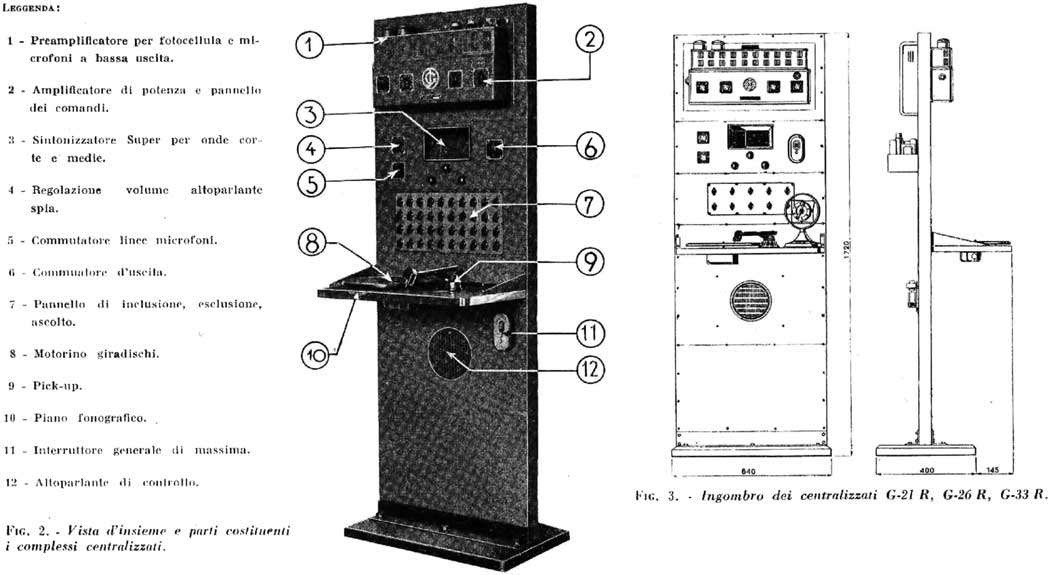
Nevertheless, publications of the period present information and images of these types of sound systems, which certainly did not differ significantly from those installed in the churches of Milan and Mortegliano. For example, the Bollettino tecnico Geloso, a quarterly publication by John Geloso SA, illustrates a centralised audio system equipped with a tuner, turntable, and a preamplifier with microphones so it would be readily adaptable to use in a church (Figure 7). When comparing this illustration with Figure 3 (San Protaso’s gramophone and amplifier), the technical similarities are such that John Geloso SA, or any comparable Italian firm, could have installed this sound system because, by 1938, the technology had become relatively standardised.
Left: Complete system and component parts of the Geloso G-33 R centralised system for sound dispersion. Right: Size and measurements of the Geloso G-21 R, G-26 R, and G-33 R centralised systems. Bollettino tecnico Geloso (Spring 1938): 15-16.

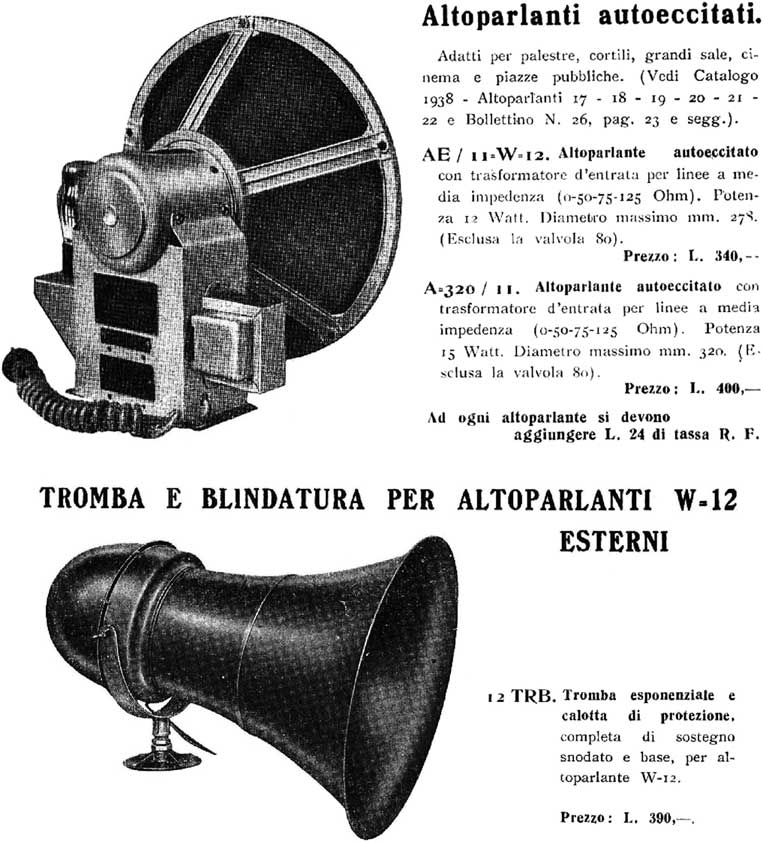
Loudspeakers that could be attached to the Geloso centralised systems were of various types depending on their purpose and on where they would be located. For example, for permanent outdoor installations with direct exposure to the elements, the loudspeaker of choice was the W-12 model, equipped with an exponential horn and protective cap 12 TRB (Bollettino tecnico Geloso 1938, 22–24). The church of San Protaso, which had four horn loudspeakers installed on its cupola, would have been equipped with the Geloso W-12 model (Figure 8) or a comparable one from another firm.
Geloso loudspeaker model W-12 and exponential horn with watertight sheeting for exterior installation. Bollettino tecnico Geloso (Spring 1938): 34-35.

Electronic sound systems in churches in the post-war period
During the war, bells rang a bellicose note: Royal Decree 23 April 1942 (No 505) authorised the Undersecretary of State for War Production to seize church bells. Given the Church’s policy of neutrality, and that some elements, including Cardinal Schuster, were openly critical of the war (Malgeri Reference Malgeri1980, 110–119), Mussolini had little interest in placating the Holy See. In Bergamo alone 1,224 bells were confiscated (Ripristino delle Campane 1958). After the war, the Church continued to grant variances for the installation of loudspeakers on belfries because the bell shortage was acute. In 1950, the Bollettino tecnico Geloso advertised the ‘Exponential horn of 2513 power […] essential for outdoor systems, squares, bell towers, etc’ (Bollettino tecnico Geloso 1950, 18). This marks the first time that Geloso’s quarterly referenced bell towers.
With the economic boom of the late 1950s, however, Italians’ purchasing power increased, as did that of the Church. Now parishes could once again afford to build traditional bell towers so the technological largesse was firmly rescinded. In 1958, the Sacred Congregation of Rites issued the Instructio de Musica Sacra et Sacra Liturgia (Instructions on Sacred Music and Sacred Liturgy), which in chapter 3, under section D, ‘On Musical Instruments and Automatic Machines’, expressly forbade the use of automatic machines, including the gramophone, during liturgical functions as specified in No 71:
The use of automatic instruments and machines, such as the automatic organ, phonograph, radio, tape or wire recorders, and other similar machines, is absolutely forbidden in liturgical functions and private devotions, whether they are held inside or outside the church, even if these machines be used only to transmit sermons or sacred music, or to substitute for the singing of the choir or faithful, or even just to support it. (Sacra Congregatio Rituum 1958, 652)
The proscription was not quite as absolute as it appeared at first blush. The Instructio de Musica Sacra et Sacra Liturgia did provide, as stated in No 71, for the limited use of the gramophone and other automatic machines in church as long as they were not part of liturgical or pious practice:
However, such machines may be used, even inside the church, but not during services of any kind, whether liturgical or private, in order to give the people a chance to listen to the voice of the Supreme Pontiff or the local Ordinary, or the sermons of others. These mechanical devices may be also be used to instruct the faithful in Christian doctrine or in the sacred chant or hymn singing; finally they may be used in processions which take place outside the church, as a means of directing, and supporting the singing of the people. (Sacra Congregatio Rituum 1958, 652)
No 72 also allowed for the use of loudspeakers during services as long as their purpose was purely to amplify the voice of the priest:
Loudspeakers may be used even during liturgical functions, and private devotions for the purpose of amplifying the living voice of the priest-celebrant or the commentator, or others who, according to the rubrics or by order of the pastor, are expected to make their voices heard. (Sacra Congregatio Rituum 1958, 652)
Section G, ‘On Bells’, contained seven articles governing their use – including (No 91) the negative judgment on allowing the gramophone and tubular bells to replace traditional bells: ‘[I]t is strictly forbidden to substitute any kind of machine or instrument which merely imitates or amplifies the sound of bells mechanically or automatically’ (Sacra Congregatio Rituum 1958, 656).
Because the Instructio de Musica Sacra et Sacra Liturgia did not entirely preclude the use of these technologies, the Bollettino tecnico Geloso continued to publicise sound systems for small churches. These systems consisted of an amplifier, a microphone, a turntable, and two loudspeakers that were described as specially designed ‘for the diffusion of voice and music in relatively small spaces’ (Bollettino tecnico Geloso 1962, 70–71). As long as they were not being used during liturgical functions, the Church condoned the use of the gramophone (and of the discs). The quarterly even provided the schematics to optimise the acoustics in churches (Bollettino tecnico Geloso 1962, 72).
In 1966, immediately after the conclusion of the Second Ecumenical Council of the Vatican (8 December 1965), Geloso’s quarterly was publicising an amplifier:
[that] in churches of normal dimensions could be used both inside for religious services and outside to amplify the sound of the electric bells through four horn loudspeakers installed in the bell tower or on the dome of the church. (Bollettino tecnico Geloso 1966, 8)
This direct marketing of sound systems even for liturgical use would suggest that the Church had now accepted the use of electrical bells (and the amplification of their sound), but this is not the case. Nothing in the documents of the Second Vatican Council or even of post-conciliar documents contradicts or invalidates the Instructio de Musica Sacra et Sacra Liturgia of 1958. Instead, the Church’s perspective with respect to the use of any form of recorded music for liturgical purposes has become less rigid and subject to the discretion of national bishops’ councils – an approach that reflects the Church’s affirmation of relevance (McSweeney Reference McSweeney1980, 238). For example, in the United States, the Directory of Masses with Children (1 November 1973) grants an exemption to the proscription. No 32 covers due diligence, but then states: ‘With these precautions and with due and special discretion, recorded music may also be used in masses with children, in accord with norms established by the conferences of bishops’ (Congregation for Divine Worship 1973). Italian bishops, however, have extended this prohibition to cover children’s masses.Footnote 10 The music historian Mauro Casadei Turroni Monti has characterised these sound technologies as ‘modalities that are not entirely welcome, but are allowed [by the Catholic Church’].Footnote 11
What remains today of these bell-replacement systems
The parishes that adopted this technology in the late 1930s tended to be in areas of urban expansion and in rural communities in northern dioceses where the bishop was relatively sympathetic to the Regime (e.g., Cardinal Schuster in Milan and Archbishop Giuseppe Nogara in Udine). However, as the Aielli case demonstrates, southern dioceses supportive of Fascism also participated. Only new churches or parishes in need of a belfry installed these sound systems, so the innovation was limited enough to draw the attention of both the national press and the trade journals. Following the 1942 Royal Decree, however, the adoption of bell-replacement systems became widespread enough for companies to configure them specifically for churches.
Today little remains of these devices designed to simulate the sounds of church bells. All five parishes discussed above (with the exception of San Paolo in Milan that has not responded to our queries) have confirmed that these apparatuses are no longer extant.Footnote 12 Neither the sound system components nor the historical/technical documentation concerning their installation have survived.
The parish of San Michele Arcangelo e Santa Rita in Milan, for example, significantly modified its sound system. In 1939, it operated a gramophone, an amplifier, and horn loudspeakers in lieu of bells, but it now ‘broadcasts the sounds of bells […] with CDs utilising electronic equipment’, which maintains a degree of continuity with its past practices.Footnote 13
Mgr Giuseppe Faidutti of Santi Pietro e Paolo in Mortegliano, confirmed that the electronic system was removed when the new belfry was erected in the 1950s. He does, however, personally recall the use of discs and loudspeakers prior to their dismantling:
I remember very well this amplification system, because as an altar boy I used to visit the sacristy of the duomo every day. But now this apparatus does not exist any more and has left no trace. With the inauguration of the new bell tower, the tallest in Italy, in 1959, new bells, the ones that still play today, were installed. […]. What you found [in the article] in La Stampa was correct: in the sacristy there were several vinyl records [of recordings] of many Italian and European churches that were played through loudspeakers situated at the four ends of the central pinnacle’s base at a height of about 35-40 metres.Footnote 14
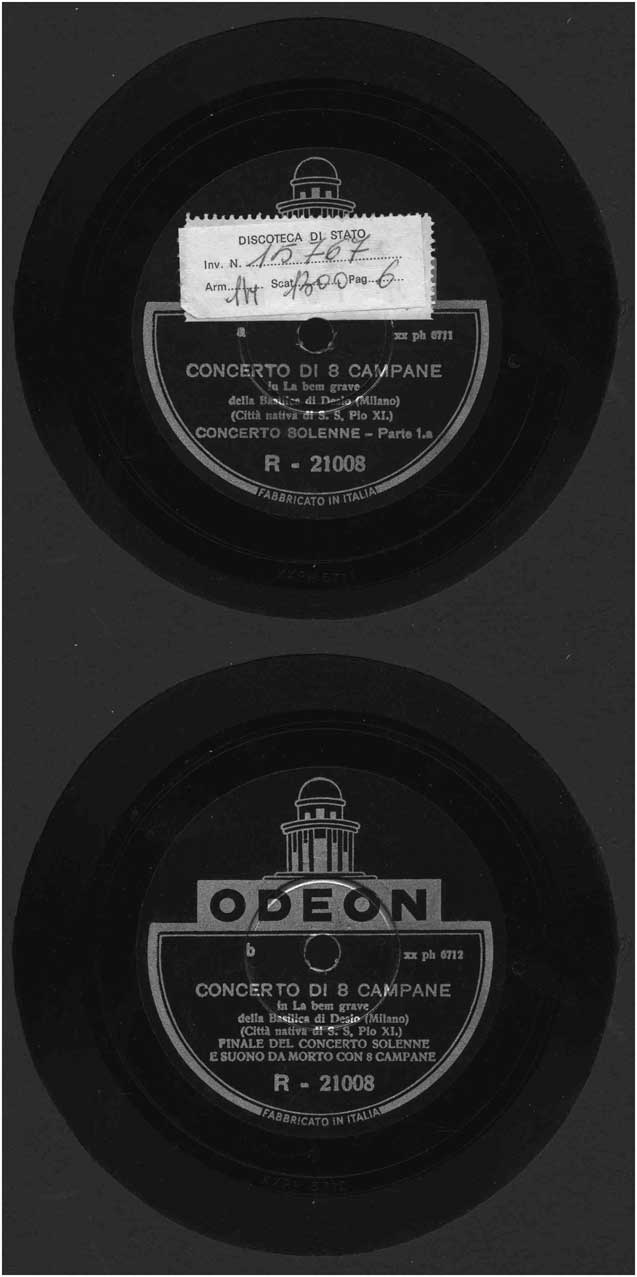
Although the audio systems of that era are no longer in existence, the sound recordings of bells on discs still survive. Among these are those of the basilica of Santi Siro e Materno in Desio from 1938. The Odeon disc, Concerto di 8 Campane della Basilica di Desio – P. I Id. P. II e Suono da morto, of which Pope Ratti was so fond (Figure 6), is today held by the Istituto Centrale per i Beni Sonori ed Audiovisivi in Rome. The Institute’s website contains images of the disc’s A and B sides (Figure 9) as well as audio files of the recordings digitised in mp3 format.Footnote 15
A-Side (above) and B-Side (below) of the original Odeon disc 21008 R of 1938, with the recordings of the Basilica of Desio’s bells. Courtesy of the Istituto Centrale per i Beni Sonori ed Audiovisivi, Rome.

Maestro Silvio Caimi, a member of the Gruppo Campanari della Basilica di Desio, described the history of the bell recordings at Santi Siro e Materno:
The Fonotipia company of Milan made the first recordings in November 1938. These discs are extremely rare – perhaps only three exist in all of Desio. Odeon made a second recording, which like the first was at a speed of 78rpm, in 1945. I jealously preserve a copy of this disc. This recording was reissued at 45rpm in the 1960s. Maestro Andrea Zappa conducted a new performance, which was recorded at 33 ⅓rpm in 1977. Most recently, I served as artistic director for a CD recording in 1998.Footnote 16
What remains of these ‘churches without bells in Fascist Italy’ are mere traces, vestiges of a technology that in its application challenged canon law, blurred the boundaries between sacred and secular, promoted a modern Church, and served the political economy of the Regime. The impact of autarky on liturgical practices has been all but forgotten, but the replacement of bells was more than just an economic decision. Within the Catholic Church it provided an opportunity to counter anti-modernist policy by embracing technology and promoting modernisation. In the Church’s relations to the State at the local level, it demonstrated patriotism and engagement with Fascism.
Acknowledgements
We wish to thank to Dr Albert Lötz in Munich for his invaluable advice and thoughtful discussions. We are also indebted to Franco Severi for his generosity in granting us full access to the archives of the Fondazione Franco Severi Onlus in Cesena, Italy.
Piero Garofalo is Associate Professor of Italian Studies at the University of New Hampshire (USA). Co-editor of Re-viewing Fascism: Italian Cinema, 1922-1943 (Bloomington: Indiana UP, 2002) and co-author of the forthcoming Internal Exile in Fascist Italy: History and Representations of Confino (Manchester: Manchester UP, 2019), his research interests and publications focus on the relationships between politics and culture during the Risorgimento and interwar periods.
Giorgio Farabegoli teaches Mechanical and Technological Disciplines at the Istituto Tecnico Tecnologico ‘Marie Curie’ in Savignano sul Rubicone (Italy). His research interests are in organology, with a particular focus on the historical development of mechanical musical instruments.