Introduction
The deep loess soils of the Palouse region of Eastern Washington and Northern Idaho produce world record dryland winter wheat yields (Schillinger et al., Reference Schillinger, Papendick, Guy, Rasmussen and van Kessel2006). However, adoption of certified-organic grain production in Washington remains low, despite growing demand for organic small grains. Sales of organically produced bread and grain have more than doubled in the past decade in the USA (Greene, Reference Greene2014), and meat and dairy producers have struggled to source organic feed as a result of low organic grain production (Greene et al., Reference Greene, Dimitri, Lin, McBride, Oberholtzer and Smith2009). Of the 950,000 hectares (ha) of winter wheat harvested in Washington in 2011, less than 0.1% of that area was planted to organic wheat (USDA-NASS, 2012). Washington wheat growers reported inadequate organic weed and pest control methods as the main barriers to organic grain production (Jones et al., Reference Jones, Kidwell, Dawson, Jussaume, Goldberger, Krebill-Prather and Glenna2006).
Weeds serve as the primary barrier to conversion to organic production for most regions (Bond and Grundy, Reference Bond and Grundy2001; Rodriguez et al., Reference Rodriguez, Molnar, Fazio, Sydnor and Lowe2009), and there have been calls for more holistic research into weed management in organic systems (Barberi, Reference Barberi2002; Sooby et al., Reference Sooby, Landeck and Lipson2007). Reviews of non-chemical weed management emphasize the use of mechanical and cultural controls, including pre-plant tillage, deep plowing, increased seeding rate, maintaining residue mulch and cover cropping (Bond and Grundy, Reference Bond and Grundy2001; Mason and Spaner, Reference Mason and Spaner2006, Brainard et al., Reference Brainard, Haramoto, Williams and Mirsky2013). In place of herbicides, organic growers rely mostly on pre-plant and in-crop tillage to control weeds, using harrows, hoes and inter-row cultivators. The use of these types of mechanical controls is more restricted on the Palouse, where tillage on the steeply sloped hills raises soil conservation concerns (Schillinger et al., Reference Schillinger, Kennedy and Young2007). Cover cropping is not practiced on the Palouse, an area that receives < 600 mm of rain a year, due to the risk that cover crops could deplete too much soil moisture prior to the grain crop. However, crop diversification can reduce the need for mechanical weed controls by altering control measures and crop life cycles from year to year, especially when perennial forages are integrated into a rotation (Liebman and Davis, Reference Liebman and Davis2000). Crop rotation is an important, established weed management tool that offers growers the opportunity to manage weeds when producing organic grains. Typically, growers use a 3-year winter wheat/spring wheat/spring pea, chickpea (Cicer arietinum) or lentil (Lens culinaris) rotation to alter planting times year to year in order to mitigate pressure from winter annual weeds (Papendick, Reference Papendick1996). In this rotation, pressure from spring annual weeds lowers yields in organic spring cereals, especially spring wheat (Manuchehri, Reference Manuchehri2012). Rotating away from spring cereals to winter cereals or a legume crop leads to increased competition with spring-emerging weeds, which is critical for managing wild oat (Harker et al., Reference Harker, O'Donovan, Irvine, Turkington and Clayton2009).
An added challenge in converting from conventional to organic production is the shift in weed species and weed community composition, which requires changing management tactics to target-specific weed species. Growers who have transitioned land from conventional to organic production have reported differences in weed communities following the transition. A survey comparing weeds on organic and conventional farms on the eastern Canadian prairie found that Canada thistle, wild mustard (Sinapsis arvensis), redroot pigweed (Amaranthus retroflexus) and common lambsquarters (Chenopodium album) were much more prevalent in organic than conventional systems (Entz et al., Reference Entz, Guilford and Gulden2001). In reduced- or no-till organic systems, perennial weeds have been reported as the most problematic for organic producers to control (Samuel and Guest, Reference Samuel and Guest1990; Légère et al., Reference Légère, Shirtliffe, Vanasse and Gulden2013), and can imperil the survival of an entire organic operation. Sooby et al. (Reference Sooby, Landeck and Lipson2007), following a series of meetings with organic producers, identified the need for research into crop rotation and other system-wide approaches for managing the perennial weeds bindweed and Canada thistle. A survey of certified organic small grains and forage producers in the Northwestern USA found that field bindweed and Canada thistle were the most problematic weed species in those organic systems (Tautges and Goldberger, Reference Tautges and Goldberger2015). Where reduced- or no-till is practiced in organic systems, adding competitive crop species to rotations is one of few cultural weed management inputs that could have an impact on reducing perennial weed populations.
Certain cereal crops, such as barley and triticale, have greater competitive ability with weeds than wheat and incorporating them into the rotation could provide a year of successful competition with weeds. Triticale, a hybrid of rye (Secale cereale) and wheat, grows taller than wheat and forms a canopy that intercepts more light, a characteristic associated with reducing weed dry matter and the number of weed inflorescences (Cosser et al., Reference Cosser, Gooding, Thompson and Froud-Williams1997). Triticale has been found to compete well with both monocot and dicot weeds when tall winter varieties were planted, with competitive attributes comparable with those of rye (Beres et al., Reference Beres, Harker, Clayton, Bremer, Blackshaw and Graf2010). On the Palouse, cereal or feral rye (S. cereale) is a troublesome weed in winter wheat, and therefore is not a viable candidate for a rotational crop in organic systems. Triticale has attributes similar to rye but will not contribute to feral rye weed populations, and an emerging market for triticale in Washington makes it a more acceptable crop for growers to plant than rye.
A study in Manitoba, Canada, found that winter triticale in rotation with field pea competed with weeds more successfully than single-year alfalfa, winter rye or wheat preceding pea (Schoofs and Entz, Reference Schoofs and Entz2000). Beres et al. (Reference Beres, Harker, Clayton, Bremer, Blackshaw and Graf2010) observed lower relative weed biomass in tall winter triticale compared with wheat, and similar relative weed biomass between short triticale and wheat in a study in Alberta, Canada. Weed biomass accumulation in barley was also very low, and barley was found to compete with dicot weeds, despite being the shortest cereal in the study (Beres et al., Reference Beres, Harker, Clayton, Bremer, Blackshaw and Graf2010). Barley cultivars grown on the Palouse are generally shorter than wheat; however, Bertholdsson (Reference Bertholdsson2005) observed that barley competed more effectively with weeds than wheat, likely as a result of early, rapid accumulation of biomass and possible allelopathy. Spring barley has historically been a part of wheat rotations on the Palouse and so could be a viable rotational crop with wheat in the region.
Alfalfa as a rotational crop has the potential to compete strongly with weeds and reduce weed populations in cereal rotations. While the low levels of precipitation inherent to dryland systems will limit alfalfa hay yields, alfalfa's extensive root system can tap into water deep below ground that is inaccessible to other plants and thereby outcompete weeds. Alfalfa has been found to decrease weed seed production and emergence in low-input corn and soybean rotations (Clay and Aguilar, Reference Clay and Aguilar1998; Kegode et al., Reference Kegode, Forcella and Clay1999) by increasing the variance of crop phenological cycles. When comparing the competitive ability of alfalfa across several studies, 3 years of alfalfa cropping decreased weed seedling emergence by an average of 75% (Anderson, Reference Anderson2010). A study of 24 organic winter wheat fields found that an alfalfa crop preceding winter wheat limited weed density in the winter wheat crop, especially for spring-emerging weeds (David et al., Reference David, Jeuffroy, Henning and Meynard2005).
In Eastern Washington, wild oat, downy brome and jointed goatgrass are the most prevalent winter annual weeds found in cereal cropping systems (Young and Thorne, Reference Young and Thorne2004; Schillinger and Papendick, Reference Schillinger and Papendick2008), and proliferate in the winter wheat crop of cereal rotations. Canada thistle and field bindweed have been reported to be the weeds most problematic for organic producers to control (Tautges and Goldberger, Reference Tautges and Goldberger2015). Before the advent of herbicides to control Canada thistle and field bindweed, these perennial weeds caused yield losses in small grains ranging from 20 to 90% (Freed, Reference Freed1980; Jacobs, Reference Jacobs2007). Any cropping system designed to produce organic cereals in Eastern Washington must be competitive with these weed species in order to be productive and feasible.
A 7-year cropping systems study was conducted from 2008 to 2014 in Eastern Washington to compare cereal grain yields, soil quality and weed pressure in three organically managed crop rotations with varying fertility sources, and two conventionally managed rotations. Here, we will focus on weed biomass found in the organic crop rotations, with the objective of determining which rotations, and specifically which rotational crops, reduce overall weed pressure in the grain crop and compete well with winter annual and perennial weeds.
Materials and Methods
Site description
Research was conducted at a site near Pullman, WA (46°45′N; −117°4′W) in the Palouse region of Eastern Washington. The field was situated on a west-facing slope on a Palouse silt loam soil (fine-silty, mixed, superactive, mesic Pachic Ultic Haploxerolls). Average annual precipitation for the area is 509 mm with the majority falling between November and March (Gallagher et al., Reference Gallagher, Pittmann, Snyder, Koenig, Fuerst, Burke and Hoagland2010). The field had been transitioned to certified organic management during a crop rotation study conducted from 2003 to 2007 (Gallagher et al., Reference Gallagher, Pittmann, Snyder, Koenig, Fuerst, Burke and Hoagland2010; Borrelli et al., Reference Borrelli, Koenig, Gallagher, Pittmann, Snyder, Burke, Hoagland and Fuerst2012, Reference Borrelli, Koenig, Burke, Gallagher, Pittmann, Snyder and Fuerst2014), and organic certification was maintained throughout the duration of the study.
Cropping systems design
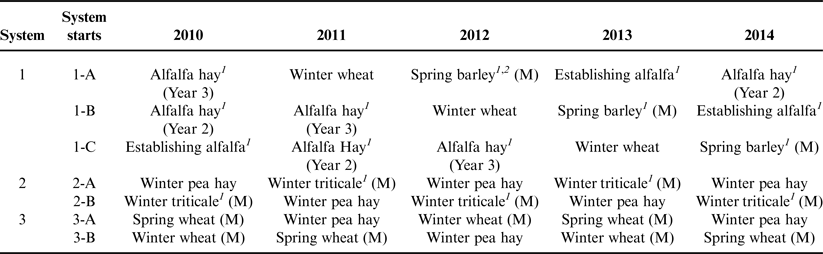
Crop rotations were designed to optimize winter wheat production, the main cash crop in the area, and included a variety of rotational crops to test their ability to build soil fertility and compete with weeds (Gallagher et al., Reference Gallagher, Pittmann, Snyder, Koenig, Fuerst, Burke and Hoagland2010). Reduced-tillage was practiced on this study, where all tillage operations were performed to a maximum depth of 10 cm in order to minimize erosion on the slope where this study was located. In Eastern Washington, low precipitation levels in the summer restrict crop choices in rotations as crops dependent on summer rainfall, such as forages, are generally low-yielding. Past studies have identified winter pea and alfalfa as legumes that achieved the greatest biomass production, weed suppression and soil nitrogen (N) levels (Gallagher et al., Reference Gallagher, Pittmann, Snyder, Koenig, Fuerst, Burke and Hoagland2010; Borrelli et al., Reference Borrelli, Koenig, Gallagher, Pittmann, Snyder, Burke, Hoagland and Fuerst2012). System 1 was a 5-year alfalfa (cv. ‘Ladak’)/orchardgrass (Dactylis glomerata)–alfalfa/orchardgrass–alfalfa/orchardgrass–winter wheat (cv. ‘Brundage 96’)–spring barley (cv. ‘Bob’) rotation. In the establishing alfalfa year, orchardgrass was planted with alfalfa to increase crop competition with weeds. However, as orchardgrass comprised < 10% of standing biomass in Years 2 and 3 alfalfa, the 3 years of alfalfa/orchardgrass cropping in System 1 will be referred to as ‘establishing alfalfa,’ ‘Year 2 alfalfa’ and ‘Year 3 alfalfa.’ System 2 was a 2-year winter triticale (cv. ‘Trimark 336’)–winter pea hay (cv. ‘Windham’) rotation, and System 3 was a 3-year winter wheat (cv. ‘Brundage 96’)–spring wheat (cv. ‘Kelse’)–winter pea hay (cv. ‘Windham’) rotation (Table 1).
Organic cropping system designs from 2010 to 2014, planted at a site near Pullman, WA.

The three organic cropping systems were replicated to observe several crops within a rotation in 1 year. System replicates were planted using a staggered start. For example, System 1 had three replicates, 1-A, 1-B and 1-C, which were planted to establishing alfalfa in 2008, 2009 and 2010, respectively. Crops shown within years correspond to a system replicate, shown here.
M = received quail manure at planting.
1 Alternative rotational crop.
2 Crop failure.
System 1 was intended to represent an ‘alternative’ forage rotation. Alfalfa production is not common on the Palouse, but is grown where a hay market is accessible. System 2 was designed around winter triticale, in an attempt to assess the competitive ability of winter triticale with field bindweed, which was prevalent on site. Winter triticale was considered for a perceived ability to compete successfully with field bindweed, as field bindweed leaves have been reported to be intolerant to shade (Jacobs, Reference Jacobs2007) and winter triticale accumulates biomass early in the season. System 3 was included to represent the most common rotation on the Palouse, where wheat is rotated with a spring pulse crop, though in this rotation winter pea was planted and cut for hay to increase competitiveness with weeds and integrate a mechanical input. A quail farm nearby provided composted quail manure for the study, which was applied as an added source of N just after planting spring barley in System 1, winter triticale in System 2, and winter and spring wheat in System 3 (Table 1). Manure application rates were calculated based on crop yield goals and residual soil N levels and ranged between 2250 and 4850 kg manure ha−1 to supply 115 to 250 kg N ha−1. The trial was arranged in a randomized complete block design with five blocks. The three cropping systems were planted with a staggered start, where the rotations were initiated at the different cropping phases, so that crops within the rotations were replicated in time and space (Posner et al., Reference Posner, Baldock and Hedtcke2008) (Table 1). The seedbed was prepared to a 6-in. depth with a sweep plow and a rotary harrow. Crops were planted with a Fabro minimum disturbance double disc drill with 19 cm row spacing (Fabro Enterprises Ltd., Swift Current, SK, Canada). All organic systems were rotary hoed one to four times as needed after planting to control weeds (Table 2). System 3 winter pea was cut for hay with a swather at first- or mid-bloom. Establishing alfalfa did not accumulate enough biomass to cut for hay, and was rotary mowed to control weeds. Year 2 and 3 alfalfa in all three system replicates yielded one to two cuts per year, depending on summer precipitation.
Secondary tillage operations performed for weed control in organic Systems 1–3.

1 Tillage before fall planting.
2 Tillage before spring planting.
Data collection and analysis
Legume crops were harvested at early bloom, which occurred between 1400 and 1750 accumulated growing degree days, depending on the year. Weeds were sampled just before legume harvest and used to measure the peak weed biomass accumulation in those crops, as little regrowth was observed after cutting. Weed biomass in the grain crops was collected between 2700 and 3150 growing degree days, when biomass accumulation peaked, but before crop and weed dry-down. Three 0.1-m2 quadrats were collected per plot and combined. Plants were collected at ground level and samples sorted by separating crop from weed and then separating weeds by species. Samples were dried in an oven for 3 days at 55°C and biomass was recorded by species. Though the study began in 2008, complete weed biomass sampling was not performed until 2011. Therefore, analysis will be presented for weed biomass data from 2011 through 2014.
Statistical analysis of weed biomass data was performed using the Mixed procedure in SAS (SAS Institute Inc., 2012). Block was treated as a random effect and crop within system and year were treated as fixed effects. Due to the variance in precipitation between years, there was a significant interaction between crop within system and year. Consequently, weed biomass will be calculated as a percentage of total standing biomass to standardize between years, using the equation:
 $$\hbox {Relative weed biomass} (\% ) = {B_i}/{B_t}$$
where B i is the aboveground biomass of the ith weed species and B t the total amount of aboveground biomass, including weed and crop, within a plot. Relative weed biomass computed for crops within systems was then averaged across the 4 years of the study. Relative biomass percentages were transformed using the arcsine square root function to decrease heteroscedasticity (Derksen et al., Reference Derksen, Thomas, Lafond, Loeppky and Swanton1995) where ANOVA was performed.
As the cropping systems in this study were developed as part of a larger study, not all rotational crops included in this paper were followed directly by winter wheat. Therefore, this paper will consist of two parts: in the first, relative weed biomass in the legume rotational crops alfalfa (System 1) and winter pea (System 3) will be compared, and the residual weed suppressive effects will be compared in the following winter wheat crop (winter wheat following alfalfa versus winter wheat following winter pea). In the second part, relative weed biomass in the rotational grain crops spring barley and winter triticale will be compared within the crop only, as these crops are not followed by wheat in the rotations as they were originally designed.
Results and Discussion
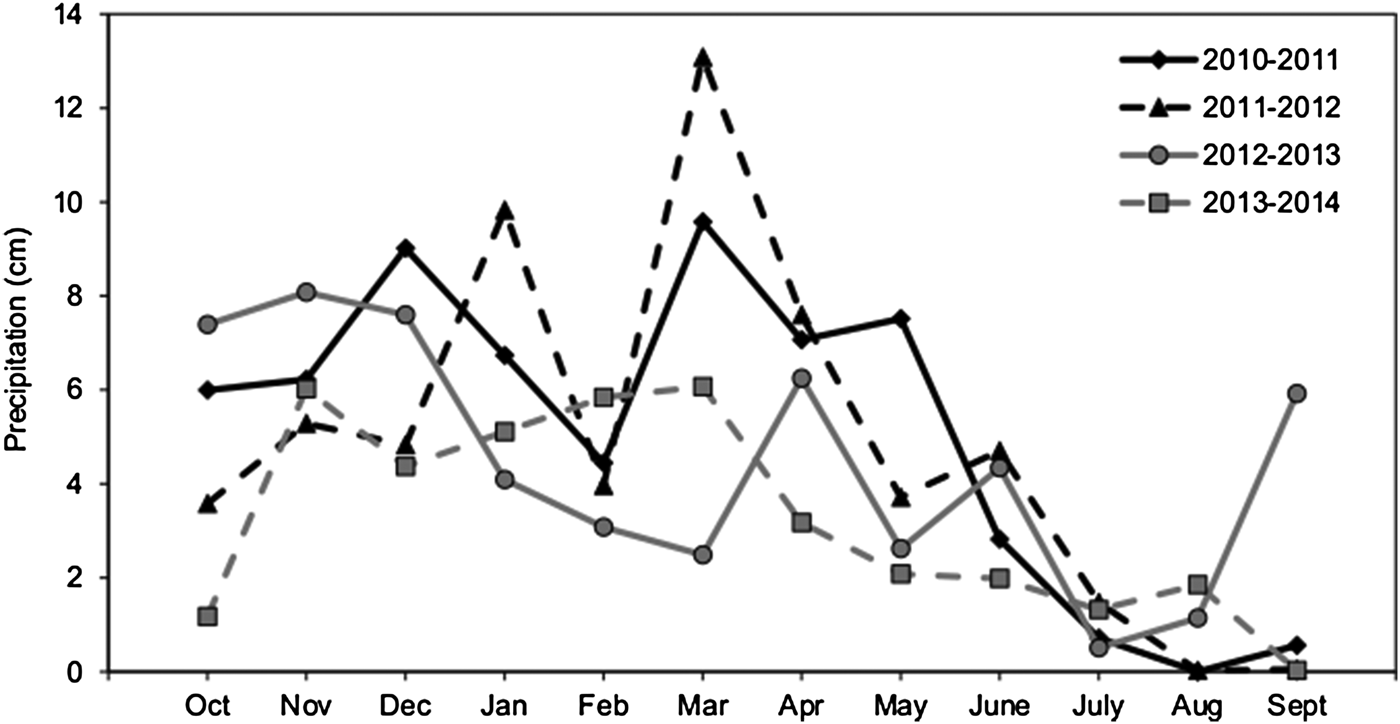
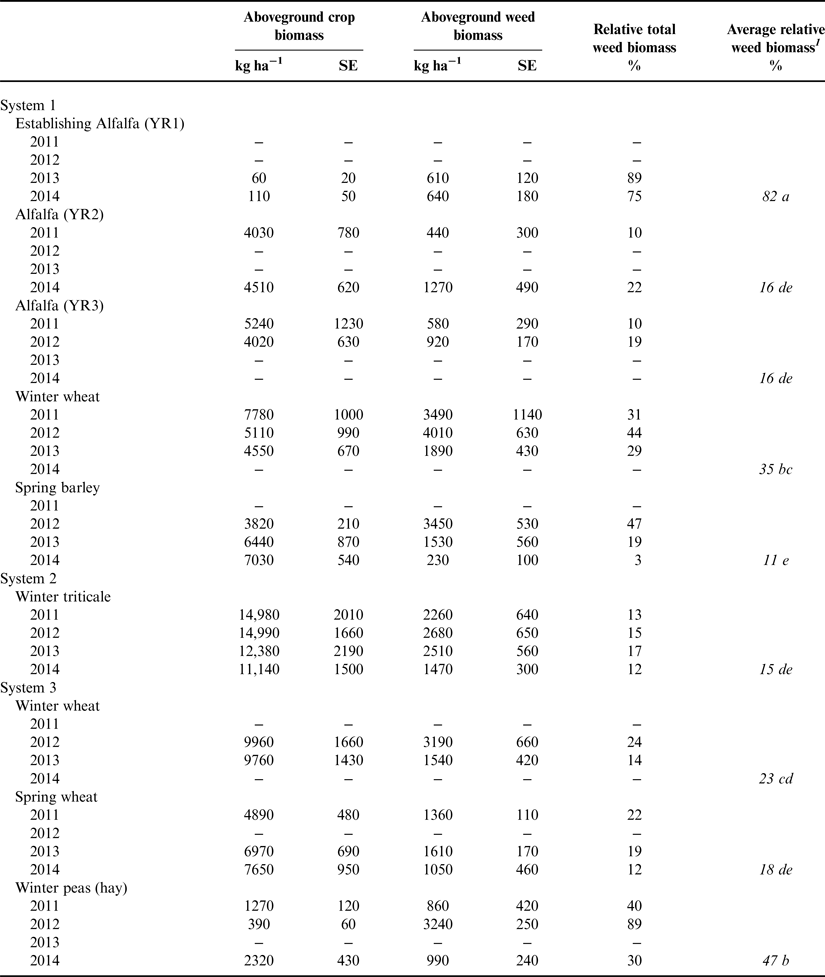
Annual precipitation was highly variable during the period from 2011 to 2014 (Fig. 1). Monthly distribution of rainfall also varied between years, and impacted both crop and weed biomass accrual. In Eastern Washington, precipitation falling between November and April largely determines soil moisture levels available to crops in the summer, and so weed biomass accumulation generally followed moisture patterns. For example, weed biomass accumulation was greatest in System 1 alfalfa, winter wheat and spring barley, System 2 winter triticale and System 3 winter wheat and winter pea (Table 3) in 2012, when spring rain deposition was greater that year than it was in 2011, 2013 and 2014 (Fig. 1).
Monthly precipitation on-site for four water years, corresponding to the winter cropping cycle.

Total aboveground crop and weed biomass dry matter accumulation, collected prior to harvest, at a site near Pullman, WA, 2011–2014. Dashes (−) are placed in years when no system replications were planted to the crop.

SE, std. error.
YR1, Year 1; YR2, Year 2; YR3, Year 3.
1 Average relative total weed biomass was calculated by averaging relative total weed biomass percentages overall years the crop was planted. Letters indicate significant differences at the α = 0.05 level.
Legume rotational crops: Alfalfa and winter pea
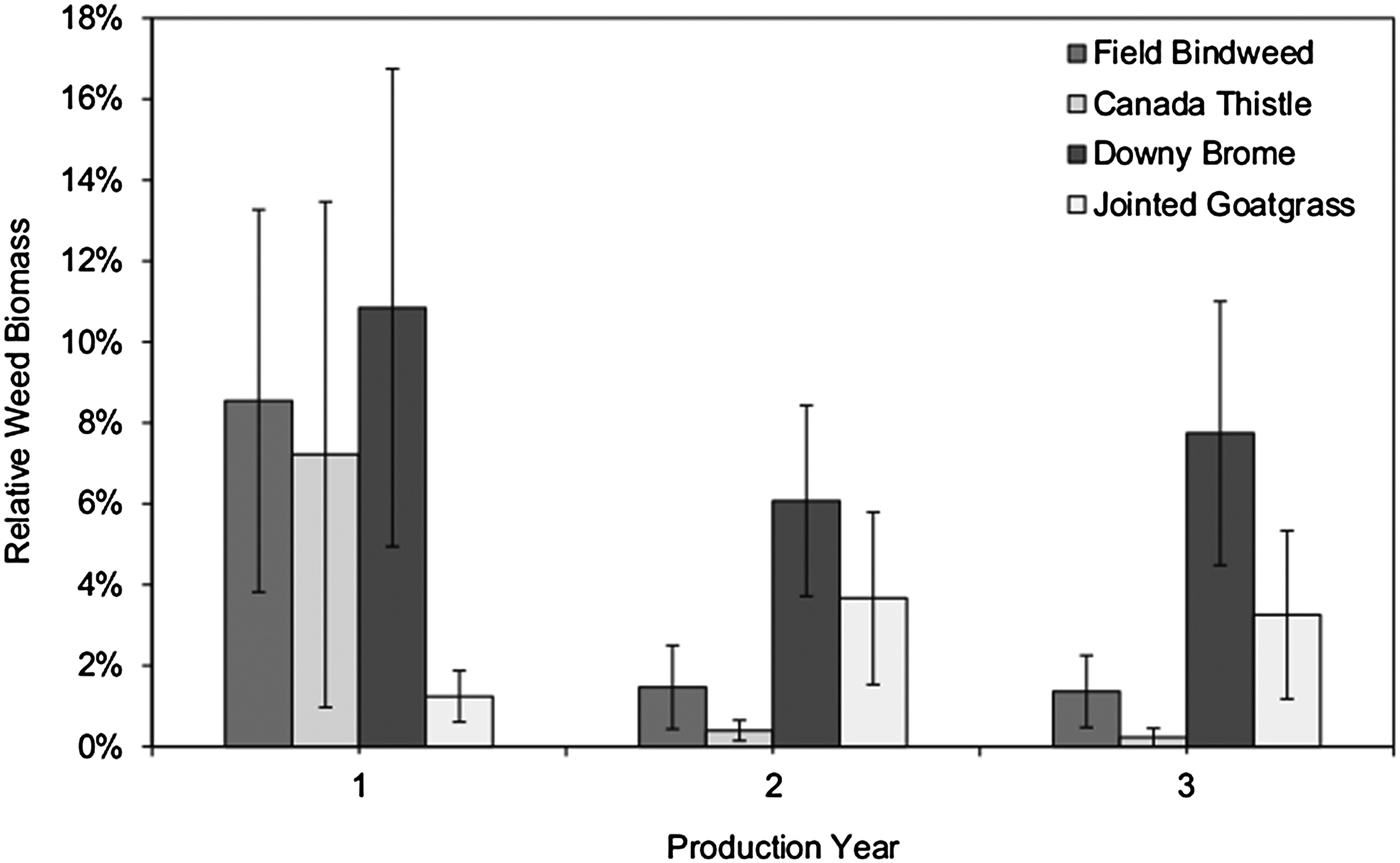
Establishing alfalfa (Year 1) did not compete well with weeds due to late emergence and a failure to reach canopy closure. Slow alfalfa establishment was likely a result of the low soil pH (5.5–6.0) inherent to the site, as alfalfa yield decreases have been observed in soils with pH values lower than 6.5 (Vitosh et al., Reference Vitosh, Johnson and Mengel2000). In the establishment year, weed biomass comprised 75–89% of the stand (Table 3), with weed pressure coming mainly from common lambsquarters, field bindweed, Canada thistle and downy brome. Despite the difficulty of establishing a stand, once developed, alfalfa yielded 3500–6800 kg ha−1 in one to two cuttings (depending on the year). After establishment, Year 2 and 3 alfalfa was competitive with weeds, limiting weed biomass accumulation to 10–22% of aboveground biomass, depending on the year (Table 3). Field bindweed, Canada thistle and downy brome biomass comprised 9, 7 and 11% of total standing biomass, respectively (Fig. 2). However, by the end of alfalfa cropping phase, relative weed biomass of the two perennial weeds, field bindweed and Canada thistle, was lower than in establishing alfalfa (Fig. 2) and comprised 1% or less of total standing biomass. By contrast, alfalfa failed to compete with the winter annual grasses downy brome and jointed goatgrass. Relative weed biomass of downy brome and jointed goatgrass did not change during the 3 years of alfalfa production (Fig. 2). The lack of competition by alfalfa with downy brome and jointed goatgrass was likely due to the early emergence and biomass accumulation of the winter annual grasses.
Relative weed biomass, as a percent of total standing biomass, of two perennial and two winter annual weed species over the three production years of alfalfa, in the 5-year System 1 rotation. Alfalfa was established in the spring of year 1 and terminated in the fall of year 3 at a site near Pullman, WA, 2011–2014.

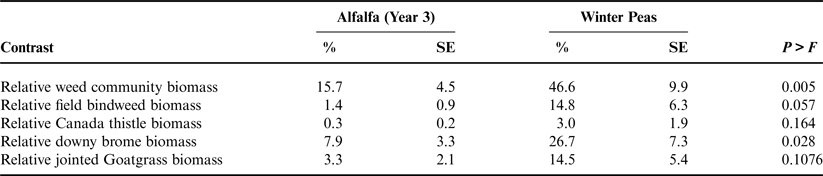
Relative weed biomass was, overall, greater in System 3 winter pea than in System 1 third-year alfalfa. Relative weed biomass ranged from 30% in a dry year (2014) up to 89% in a wet year (2012) in winter pea (Table 3). While pea is not considered to be an especially competitive crop with weeds compared with cereals (Blackshaw et al., Reference Blackshaw, Anderson, Lemerle, Upadhyaya and Blackshaw2007), Canada thistle pressure was moderate in winter pea, comprising 0–5% of total standing biomass in the 3 years System 3 winter pea was grown, which suggests that the winter pea crop included in System 3 is providing some suppression of perennial broadleaf weeds (Table 4). Year 3 alfalfa and winter pea displayed similar competitive ability with Canada thistle, as relative Canada thistle biomass was similar between winter pea and alfalfa. Winter pea did not compete with field bindweed as well as alfalfa. Field bindweed comprised 15% of total standing biomass in winter pea, on average, which was numerically higher than that in alfalfa (Table 4). Downy brome and jointed goatgrass were the most abundant annual weeds in System 3 winter pea, and relative downy brome biomass was higher in winter pea compared with alfalfa (Table 4).
Relative weed biomass, as a percent of total standing biomass, averaged over 2011 and 2012 when both Year 3 alfalfa (System 1) and winter pea (System 3) were present.

SE, std. error.
P-values shown represent the results of pairwise comparisons for relative weed biomass in alfalfa versus winter pea using ANOVA.
Notably, wild oats comprised 15% of total standing biomass in System 3 winter pea in 2014 (data not shown). Wild oats were observed in establishing alfalfa, at a relative biomass of 15%, but no wild oats were found in Year 2 and 3 alfalfa, suggesting that a well-developed alfalfa crop will outcompete wild oat. Relative wild oat biomass in the following winter wheat crop in System 3 did not exceed 2%, suggesting that winter pea in rotation with winter wheat effectively broke the wild oat life cycle, though wild oat was found in System 3 spring wheat following winter wheat, where relative wild oat biomass was 5% on average. Before the advent of herbicides for wild oat control, wild oat had a long history of infesting wheat crops (Cudney et al., Reference Cudney, Jordan and Hall1991) and was especially a problem in spring wheat. The prevalence of wild oat on the Palouse generally precludes growing spring wheat in organic rotations (Manuchehri, Reference Manuchehri2012). While alfalfa was not rotated with spring wheat in this study, future studies could explore if the wild oat suppressive effect observed in alfalfa could carry over into a following spring wheat crop.
Winter wheat following legumes
While relative weed community biomass in alfalfa was lower than in winter pea (Table 4), relative weed biomass in winter wheat following alfalfa was numerically greater than in wheat following winter pea (Table 3). Winter annual and perennial weed biomass were similar in winter wheat following alfalfa and winter pea, but relative volunteer alfalfa biomass was 20%, on average, in winter wheat following alfalfa (Fig. 4). The shallow tillage practices (~10 cm deep) used to reduce soil disturbance and erosion in this study failed to effectively terminate alfalfa. Results suggest that deeper, more aggressive tillage or different timing might be necessary to terminate alfalfa and reduce the risk of competition from volunteer alfalfa in subsequent grain crops.
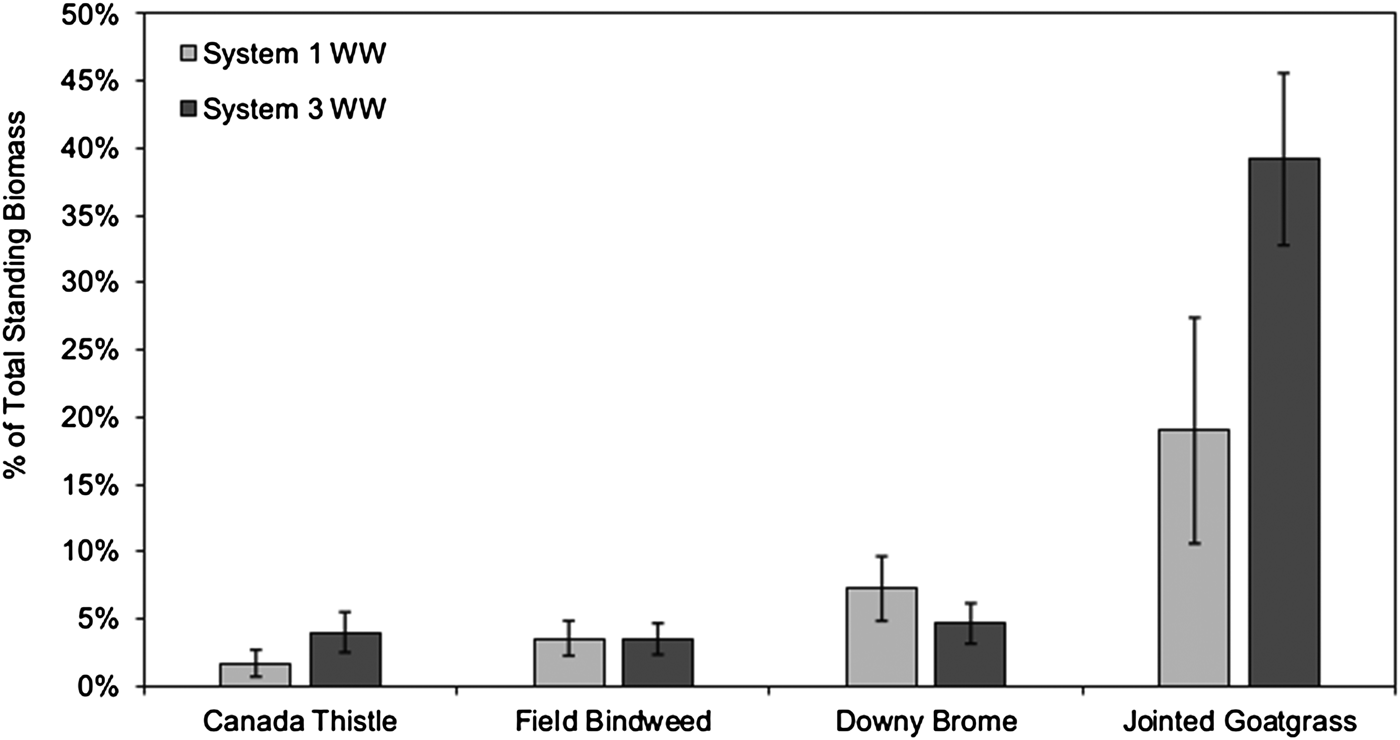
The lack of suppression of downy brome and jointed goatgrass during alfalfa's growth cycle carried over into the following winter wheat crop, where downy brome and jointed goatgrass comprised 7 and 19% of total standing biomass, respectively (Fig. 3). Downy brome biomass in wheat was similar following either alfalfa or winter pea, but jointed goatgrass biomass was higher following pea than alfalfa (Fig. 3). The suppressive effects of both legume rotational crops on perennial weeds carried over into the following winter wheat crop, where field bindweed and Canada thistle biomass levels were low (Fig. 3). Field bindweed biomass in winter wheat following alfalfa and winter pea was similar. However, Canada thistle biomass was lower in winter wheat following alfalfa (Fig. 3), suggesting that in the following winter wheat crop, alfalfa provided superior carryover suppression of Canada thistle compared with winter pea. The competitive ability of 3-year alfalfa with Canada thistle suggested that alfalfa could possibly be used to reduce Canada thistle pressure in an already-infested field. The biggest challenge in using alfalfa for remediation would exist in the establishment year, possibly requiring deep tillage prior to planting to control weeds, or a grass nurse crop to compete with weeds during the establishment when alfalfa growth is usually slow (Sturgul et al., Reference Sturgul, Daniel and Mueller1990; Stanger et al., Reference Stanger, Lauer and Chavas2008).
Relative weed biomass, as a percent of total standing biomass, of four weed species in winter wheat (WW) following alfalfa (System 1) and WW following winter pea (System 3).

Composition of aboveground biomass in System 1 winter wheat (WW) following alfalfa and System 3 WW following winter pea. Life history categories (winter annuals, summer annuals and perennials) correspond to weeds observed in the wheat crop.

While organic alfalfa can be valuable provided that a market is accessible, organic alfalfa production is rare in the region, likely due to the low rainfall during the growing season and lack of profit during the establishment year. Pulse crops, like winter pea in System 3, are more common, though spring pea is generally grown instead of winter pea. The results of this study indicate that 3 years of alfalfa production can lead to greater suppression of Canada thistle and jointed goatgrass in the following winter wheat crop, compared with winter pea. Alfalfa could be used in place of an annual pulse crop as a rotational crop if high levels of Canada thistle and jointed goatgrass are found in wheat crops, and could increase system-wide crop competitiveness in organic rotations.
Grain rotational crops: Spring barley and winter triticale
In 2012, spring barley establishment was poor following a wet spring and crop biomass accumulation was low, which resulted in a lack of competition with weeds and high weed biomass (Table 3). As initial sampling determined grain yields to be below 1000 kg ha−1, the spring barley crop was determined to be a crop failure in 2012 and subsequent analyses include spring barley planted in 2013 and 2014 only. In those drier years when spring barley was successfully established, barley contained lower relative total weed biomass than System 3 winter and spring wheat and similar weed biomass as winter triticale (Fig. 5a). A 55–85% reduction in relative total weed biomass was observed in spring barley following System 1 winter wheat (2012 winter wheat to 2013 spring barley, and 2013 winter wheat to 2014 spring barley; see Table 3). The competitive ability of spring barley with Canada thistle and field bindweed was similar to that of winter wheat, though there was less relative field bindweed biomass in spring barley, compared with spring wheat (Fig. 5c, d).
Relative weed biomass in System 1 spring barley (excluding 2012 due to crop failure), System 2 winter triticale, System 3 winter wheat and System 3 spring wheat. Plots: (a) relative total weed biomass, (b) relative wild oat (WO) biomass, (c) relative Canada thistle (CNT) biomass, (d) relative field bindweed (FB) biomass, (e) relative downy brome (DB) biomass, (f) relative jointed goatgrass (JGG) biomass.

Spring barley competitiveness with winter annual grass weeds was superior to winter wheat, which is not surprising given that spring-planted crops allow for spring tillage to control winter annual weeds. However, relative jointed goatgrass biomass was lower in spring barley, compared with spring wheat, winter triticale or winter wheat (Fig. 5f). Relative downy brome biomass was greater in spring barley than in spring wheat (Fig. 5e). Relative biomass of wild oat, generally a problematic weed in spring-planted cereals, was lower in spring barley than in spring wheat (Fig. 5b).
Unfortunately, the ability of spring barley to decrease weed pressure in wheat planted the following year was not examined in this study, as the crop rotation design of System 1 did not follow spring barley with winter wheat. However, the reduction in weed biomass observed from planting spring barley after winter wheat suggests that spring barley may have the potential to suppress weeds in a following crop. In particular, spring barley following 3-year alfalfa in rotation could lead to multi-year suppression of perennial weeds and could compete with jointed goatgrass, the weed that alfalfa competed with the least. While planting 4 years of potentially low-revenue crops may be economically risky, this strategy could be employed to reclaim or repair fields with large weed infestations without removing them from organic certification. In winter wheat production systems, spring barley could be more effective than spring wheat in competing with certain weed species. Benefits of replacing spring wheat with spring barley could include increased crop competitiveness with field bindweed (Fig. 5d), jointed goatgrass (Fig. 5f) and possibly wild oat (Fig. 5b).
Winter triticale contained lower relative total weed biomass compared with System 3 winter wheat, and similar weed pressure as spring barley and wheat (Fig. 5a). At the initiation of the study it was hypothesized that winter triticale would compete more with field bindweed than other cereal crops, but winter triticale did not fulfill original expectations of superior competitive ability with field bindweed. Winter triticale harbored the greatest relative field bindweed biomass of all organic cereal crops and contained greater relative field bindweed biomass than System 3 winter wheat and spring barley (Fig. 5d). Rather than being shaded out by the thick triticale stems, bindweed twisted around triticale stems until it reached the top of the canopy, thereby accumulating large amounts of biomass. However, winter triticale suppressed Canada thistle, which was widespread throughout the organically managed field. Relative Canada thistle biomass was lower in winter triticale than in spring barley and winter and spring wheat (Fig. 5c).
Of the fall-planted cereals examined in this study, triticale was more competitive with winter annual grass weeds than winter wheat. Jointed goatgrass was the second most abundant weed, after field bindweed, in winter triticale, but relative jointed goatgrass biomass was lower than in System 3 winter wheat (Fig. 5f). The competitiveness of winter triticale with downy brome was superior to winter wheat and spring barley, but equal to spring wheat (Fig. 5e). Winter triticale and winter wheat competed similarly with wild oat, but relative wild oat biomass in winter cereals was lower than in spring wheat (Fig. 5b).
In comparing competitiveness with weeds across all rotational crops in this study, relative weed biomass was similar among winter triticale, spring barley and Year 2 and 3 alfalfa (Table 3). However, relative weed biomass was lower in the alternative rotational crops than in System 3 winter pea (P < 0.001) (Table 3). Pea is often the only rotational crop in wheat production systems on the Palouse, and the findings of this study indicate that alfalfa, winter triticale and spring barley are superior rotational crops compared with pea, in terms of competitiveness with weeds.
Conclusions
Alfalfa, as a legume rotational crop, contained lower relative weed biomass than winter pea and reduced Canada thistle biomass during 3 years of production, an effect that carried over into the following winter wheat crop. Field bindweed also decreased over the 3-year alfalfa production period, though to a lesser extent than Canada thistle. Alfalfa failed to compete with the winter annual grasses downy brome and jointed goatgrass, and winter annual grass weed pressure was high in the following winter wheat crop, though jointed goatgrass biomass was greater in wheat following winter pea. Though wild oat was present in the alfalfa establishment year, very little wild oat was found in cereals following alfalfa. The results of this study indicate that alfalfa has potential as a rotational crop to manage an existing weed infestation, especially for Canada thistle and wild oat. Replacing pea with alfalfa as a rotational crop with wheat could lead to decreased overall weed biomass, and decreased Canada thistle and jointed goatgrass pressure in following winter wheat crop. The inclusion of alfalfa in a crop rotation with wheat, however, would mandate an effective alfalfa termination method, as volunteer alfalfa proved to negatively impact winter wheat following in a rotation.
Spring barley was more competitive with all weeds than winter wheat, and was the most competitive crop with jointed goatgrass of all crops in this study. Barley was more competitive with field bindweed than winter triticale, which was the least competitive with field bindweed of all cereal crops in this study. While winter triticale failed to shade out field bindweed, it was more competitive with Canada thistle than spring barley and wheat and similar to alfalfa. Organic producers struggling to control perennial weeds could incorporate alfalfa and spring barley to suppress field bindweed, and alfalfa and winter triticale to suppress Canada thistle. In organic systems with high winter annual grass pressure, winter triticale could be planted to compete with downy brome, and spring barley could be planted to compete with jointed goatgrass. Both organic and conventional producers could experience increased system-wide suppression of weeds by incorporating alfalfa, winter triticale and spring barley in place of, or in addition to, pea in wheat production systems.
Acknowledgements
The authors wish to thank Dennis Pittmann, formerly of the Department of Crop and Soil Sciences at Washington State University, for his expertise and management of the project. We would also like to extend our thanks to Les and Pat Boyd for allowing us many years’ use of their land. Thanks also to the anonymous reviewers of this manuscript, whose comments and suggestions improved it greatly. Funding for the project was provided by USDA-NIFA Organic Agricultural Research and Extension Initiative (OREI) grant no. 2009-51300-05578.