Introduction
Mass trauma, in the form of political violence (eg, war, political conflict, or terrorism) and natural disasters (eg, earthquakes, hurricanes, or floods), has devastating human and economic effects. 1,2 Youth have been recognized as especially vulnerable to these adversities and a priority for intervention. Reference Lokuge, Shah and Pintaldi3–5 Posttraumatic stress (PTS), in the form of posttraumatic stress disorder (PTSD) and/or PTS symptoms or reactions, is the most commonly studied outcome and has been well-documented in youth exposed to mass trauma. Reference Comer and Kendall6,Reference Wang, Chan and Ho7 A meta-analysis of studies of children and adolescents from around the world revealed that 15.9% of those exposed to a traumatic event developed PTSD. The rate of PTSD was 25.2% for interpersonal trauma and 9.7% for non-interpersonal trauma. Reference Alisic, Zalta and Van Wesel8 Despite the complexities of providing services to address the psychological reactions of youth to mass trauma, an impressive array of interventions has been delivered and evaluated. Several methodological reviews Reference Forman-Hoffman, Zolotor and McKeeman9–Reference Pfefferbaum, Newman and Nelson11 and meta-analyses Reference Brown, Witt, Fegert, Keller, Rassenhofer and Plener12–Reference Tol, Barbui and Galappatti17 evaluating the evidence-base for these interventions have been published. Results of meta-analyses have varied from no intervention effect for PTS Reference Tol, Barbui and Galappatti17 to a small Reference Fu and Underwood13,Reference Purgato, Gross and Betancourt16 or medium Reference Brown, Witt, Fegert, Keller, Rassenhofer and Plener12,Reference Morina, Malek, Nickerson and Bryant14,Reference Newman, Pfefferbaum, Kirlic, Tett, Nelson and Liles15 effect.
Potential Moderators of Intervention Effect
Research findings cluster in three broad areas of potential moderators of mass-trauma outcomes in youth, including aspects of the traumatic event (eg, trauma type or morbidity and mortality rates); the youth (eg, demographics) and populations (eg, targeted or universal) receiving the intervention; and the context of intervention delivery (eg, geographic location or available resources). Reference Bonanno, Brewin, Kaniasty and La Greca18–Reference Norris, Friedman, Watson, Byrne, Diaz and Kaniasty20 Prior meta-analyses of youth mass-trauma intervention studies have examined type of trauma (eg, natural disaster or terrorist event); Reference Brown, Witt, Fegert, Keller, Rassenhofer and Plener12 characteristics of intervention recipients (eg, demographics); Reference Brown, Witt, Fegert, Keller, Rassenhofer and Plener12,Reference Newman, Pfefferbaum, Kirlic, Tett, Nelson and Liles15,Reference Purgato, Gross and Betancourt16 geographic location where studies were conducted; Reference Brown, Witt, Fegert, Keller, Rassenhofer and Plener12,Reference Purgato, Gross and Betancourt16 intervention approach (eg, eclectic, exposure, eye movement desensitization and reprocessing, or cognitive-behavioral); Reference Brown, Witt, Fegert, Keller, Rassenhofer and Plener12,Reference Newman, Pfefferbaum, Kirlic, Tett, Nelson and Liles15 and characteristics of intervention delivery (eg, timing, setting, or provider training). Reference Brown, Witt, Fegert, Keller, Rassenhofer and Plener12,Reference Newman, Pfefferbaum, Kirlic, Tett, Nelson and Liles15
Type of Mass Trauma—Research has revealed contradictory findings regarding the influence of the type of mass trauma on outcomes. Reference Norris, Friedman, Watson, Byrne, Diaz and Kaniasty20–Reference Rubonis and Bickman22 In a review of PTSD in adult samples in 10 systematically-studied disasters, North and colleagues Reference North, Oliver and Pandya21 concluded that there was no association between PTSD and type of disaster (natural disaster versus technological accident versus political violence). A meta-analysis of child disaster studies found no differences in PTS based on event type, Reference Furr, Comer, Edmunds and Kendall19 and a meta-analysis of child intervention studies found no significant moderator effect on PTS based on type of trauma. Reference Brown, Witt, Fegert, Keller, Rassenhofer and Plener12
Intervention Recipients and Populations—Meta-analyses of youth mass-trauma interventions have examined the influence of various characteristics of intervention recipients. Reference Brown, Witt, Fegert, Keller, Rassenhofer and Plener12,Reference Newman, Pfefferbaum, Kirlic, Tett, Nelson and Liles15,Reference Purgato, Gross and Betancourt16 For example, Purgato and colleagues Reference Purgato, Gross and Betancourt16 examined whether participants’ demographics moderated the effect of psychosocial interventions. The interventions were effective for PTS across age group, gender, and geographic region, and in both displaced and non-displaced youth, with a larger effect size in adolescents aged 15 to 18 years compared to younger participants as well as in non-displaced youth compared to their displaced counterparts. Reference Purgato, Gross and Betancourt16 Newman and colleagues Reference Newman, Pfefferbaum, Kirlic, Tett, Nelson and Liles15 also found a larger effect size for interventions delivered to older children compared to younger counterparts.
Typologies used to classify interventions recognize the importance of event exposures, experiences, and/or reactions of the youth receiving the intervention, but these population characteristics have not been examined in prior meta-analyses of intervention studies. Intervention typologies have focused on universal, selective, and indicated populations, or alternatively on universal and targeted populations. Reference Marsac, Donlon and Berkowitz23–Reference Vernberg, La Greca, Silberman, Vernerg and Roberts26 Universal populations include all individuals regardless of their event exposures, experiences, or reactions. Reference Pfefferbaum and North24,Reference Persson and Rousseau27 Targeted populations are selective (including exposed children, at-risk children, and/or children with distress reactions or dysfunction) and indicated (including those with marked distress, early PTS, other comorbid symptoms, or other risk factors for adverse outcome). Reference Marsac, Donlon and Berkowitz23 Targeted populations may be identified through a screening process to determine symptom thresholds and/or risk for psychopathology. Reference Persson and Rousseau27
Context—A host of contextual factors, including economic resources and social support, may influence mass-trauma outcomes. Reference Bonanno, Brewin, Kaniasty and La Greca18,Reference Norris, Friedman, Watson, Byrne, Diaz and Kaniasty20 Economically impoverished and under-developed areas lack the infrastructure and resources for preparedness and response, and changes in support networks following mass trauma may result in inadequate social support and impede recovery. Reference Bonanno, Brewin, Kaniasty and La Greca18 Mass-trauma events generate an increase in the need for services at a time when service infrastructures may be damaged. Meta-analyses of child mass-trauma intervention studies have found no difference in PTS outcomes based on geographic region (Africa and other low-resource regions) Reference Purgato, Gross and Betancourt16 or continent Reference Brown, Witt, Fegert, Keller, Rassenhofer and Plener12 where the study was conducted. Purgato and colleagues Reference Purgato, Gross and Betancourt16 did not explain the rationale for comparing Africa and other regions and did not discuss their failure to find regional differences in the intervention studies included in their meta-analysis, all of which were delivered in low-resource areas. Brown and colleagues Reference Brown, Witt, Fegert, Keller, Rassenhofer and Plener12 did not specify their results in terms of the area’s economic resources or capacity for development, which arguably have the potential to influence mass-trauma and intervention outcomes. These contextual factors may be reflected, for example, in data published by the World Bank Data Help Desk (Washington, DC USA) 28 on the gross national income per capita of member countries of the World Bank. The gross national income is calculated through the Atlas method, which adjusts for inflation in exchange rates and is correlated with quality of life indices such as life expectancy, child mortality, and school enrollment. 28
The Current Review
This meta-analytic review of randomized controlled trials (RCTs) was conducted to determine if mass-trauma interventions were superior to inactive controls in addressing PTS. This study addresses methodological limitations of prior meta-analyses in two ways. First, meta-analyses by Fu and Underwood Reference Fu and Underwood13 and by Newman and colleagues Reference Newman, Pfefferbaum, Kirlic, Tett, Nelson and Liles15 included trials using non-randomized controls, which may have inflated effects. Reference Ioannidis, Haidich and Pappa29 Second, meta-analyses by Brown and colleagues Reference Brown, Witt, Fegert, Keller, Rassenhofer and Plener12 and by Newman and colleagues Reference Newman, Pfefferbaum, Kirlic, Tett, Nelson and Liles15 included trials using active (other interventions) as well as in-active (waitlist, no-treatment) controls, which render the summary effect sizes difficult to interpret for clinicians selecting interventions. The current analysis also augments prior meta-analytic studies by: (1) including more studies than prior meta-analyses; Reference Fu and Underwood13,Reference Purgato, Gross and Betancourt16,Reference Tol, Barbui and Galappatti17 (2) investigating the effectiveness of interventions administered in the aftermath of natural disasters as well as mass violence; Reference Morina, Malek, Nickerson and Bryant14,Reference Purgato, Gross and Betancourt16 and (3) broadening the type of interventions (eg, focused psychosocial support), Reference Purgato, Gross and Betancourt16 the settings (eg, schools), Reference Fu and Underwood13 or the context where the interventions were delivered (eg, low-resource environments). Reference Morina, Malek, Nickerson and Bryant14,Reference Purgato, Gross and Betancourt16 The moderator analysis conducted for this report addressed unsettled issues that are likely to influence service delivery decisions, including the type of trauma, the populations receiving the intervention, and the context of the study. The relationship between the estimates of the intervention effects on PTS and on functional impairment was also assessed. Finally, to guide service decisions about intervention applications, this paper offers an approach to weigh potential benefit and cost-effectiveness using intervention effect estimates.
Report: Search Methodology and Statistical Approach
The inclusion criteria, literature search, and results of the search; coding of included studies; statistical approach to the meta-analysis; and other analyses are described below.
Inclusion Criteria and Literature Search
The RCTs included in this study were selected based on the Population-Intervention-Comparison-Outcome (PICO) paradigm proposed by the Cochrane Collaboration (London, United Kingdom). Reference O’Connor, Green, Higgins, Higgins and Green30 Studies meeting the following criteria were selected: RCTs of (1) psychological and behavioral interventions with no pharmacological component; (2) addressing PTS; (3) in youth, 18 years of age or younger, exposed to mass trauma; and (4) compared against waitlist or no-treatment control conditions.
A literature search was conducted in December 2016 to identify studies of psychological and behavioral interventions for children and adolescents exposed to disasters, natural disasters, terrorism, terrorist events, threat of terrorism, political conflict, war, and/or other mass-casualty events using the following databases: EBM Reviews (Ovid Technologies; New York, New York USA); EMBASE (Elsevier; Amsterdam, Netherlands); ERIC (US Department of Education; Washington, DC USA); Medline (US National Library of Medicine, National Institutes of Health; Bethesda, Maryland USA); PILOTS (ProQuest; Ann Arbor, Michigan USA); PsycINFO (American Psychological Association; Washington DC, USA); PubMed (National Center for Biotechnology Information, National Institutes of Health; Bethesda, Maryland USA); and Social Work Abstracts (EBSCO Information Services; Ipswich, Massachusetts USA). No time limit was placed on date of publication and the search was confined to published research and English language sources. A total of 2,232 unduplicated publications were identified. After reviewing titles and removing 2,060 irrelevant publications (eg, publications on disaster reactions, services, or other sources of trauma), abstracts of the remaining 172 sources were examined. Review of these 172 abstracts resulted in the elimination of 123 publications, including 52 descriptive papers on interventions and services, 31 reporting non-controlled trials, 15 describing intervention reviews, nine on services and service delivery issues, six describing intervention trials using active control conditions, five on interventions used with adults, four on interventions for other types of trauma, and one on intervention development. This left 49 papers that were reviewed in full. Of these 49 papers, 35 were excluded, including 11 describing non-randomized trials, seven that did not assess PTS as an outcome, four reporting studies captured in another publication that was included in the current analysis, three that did not evaluate an intervention, two studying heterogeneous types of trauma, two describing non-controlled trials, two reporting studies with an active control, two with insufficient information to compute the intervention effect (multiple unsuccessful attempts were made by telephone and/or email to contact the authors for additional information), one describing an intervention delivered to parents, and one describing a web-based intervention. One trial that included participants aged 15 to 24 years Reference Betancourt, McBain and Newnham31 was retained because the average age of participants was 18.0 years (SD = 2.4 years). Thus, the search identified 14 RCTs with inactive controls that assessed PTS. The reference sections of these publications and review articles uncovered six additional qualifying studies which were included along with another four studies known to the authors. An updated search in December 2018 identified one additional study meeting the inclusion criteria. Reference Panter-Brick, Dajani, Eggerman, Hermosilla, Sancilio and Ager32 Thus, 25 empirical research studies using randomized controlled design with inactive control groups to assess PTS were identified. Two of the research studies described two interventions Reference Chen, Shen, Gao, Lam, Chang and Deng33,Reference Ertl, Pfeiffer, Schauer, Elbert and Neuner34 for a total of 27 intervention trials from 25 studies (Figure 1; Table 1 Reference Betancourt, McBain and Newnham31-Reference Tol, Komproe and Jordans55 ).
Flowchart of Literature Search.

Study Characteristics of Trials Included in the Current Meta-Analysis

Note: Event Type refers to natural disaster (ND) and political violence (PV); Population refers to targeted (T) and non-targeted (NT) samples. DRC = Democratic Republic of the Congo.
a Because the study excluded participants with clinical levels of posttraumatic stress disorder, the population was classified as non-targeted to allow for clearer comparison with other studies.
Coding of Selected Studies
The outcome variable examined in this review was PTS. The moderator analysis examined the nature of the traumatic experience as political violence or a natural disaster; the population receiving the intervention as either targeted or non-targeted (universal); and the location of the event in a low-, middle-, or high-income country. Targeted populations included children with severe exposure (eg, child soldiers) and/or those who screened positive for specific psychological symptoms; non-targeted populations included children without regard for their trauma exposure or reactions. Income level of the country where the event occurred or where the trial was implemented Reference Ooi, Rooney, Roberts, Kane, Wright and Chatzisarantis49,Reference Ruf, Schauer, Neuner, Catani, Schauer and Elbert52 was used to represent contextual factors such as economic resources and support networks which were not consistently measured or reported in the studies included in this analysis. Location was classified as low-, middle-, or high-income based on information from the World Bank Data Help Desk 28 on the income level of the country during the year the intervention was administered. Two authors independently coded populations with discrepancies settled through consensus of three authors. Table 1 shows a listing and description of the studies.
Statistical Analytic Strategy
For all the statistical tests, Type I error probability (α) was set to 0.05 and all the reported P values are two-tailed.
Meta-Analysis—In studies that reported several post-intervention assessments, only the first assessment was selected for the computation of the intervention effect size to minimize bias due to attrition in subsequent follow-up assessments. Standardized mean difference Hedge’s g was used as the effect size statistic because it corrects for bias in studies with relatively small sample sizes.Reference Hedges56 For cluster randomized studies, intervention effect size was corrected for the clustering by multiplying the variance of the effect size by the design effect D: D = (1 + (M-1)*ICC), where M is the average cluster size and ICC is the intra-cluster correlation of the study outcome. An ICC of 0.1 was used for the cluster-randomized trials that did not provide the ICC for the study sample.
A random effects model using restricted maximum likelihood (REML) was fitted to estimate the meta-analysis parameters and the summary effect of the interventions. For each hypothesized moderator, the size of the intervention effect was computed for each level of the moderator (political violence versus natural disasters, targeted versus non-targeted population, and low- versus middle- versus high-income), and a mixed effects model fitted with REML estimated the difference between these effect sizes. The summary effect sizes, their 95% confidence interval (95% CI; which reflects the precision of the overall estimate), and 80% prediction interval (80% PI; which reflects the range of the true intervention effect) are reported. The 95% confidence intervals for these effect sizes were adjusted with the method proposed by Hartung and Knapp, Reference Hartung and Knapp57 a method shown to have a better coverage probability for the summary effect than alternative techniques, especially when heterogeneity is high and/or sample sizes are small. Reference Partlett and Riley58
As many included studies were conducted by the same research team, a multi-level random effects model (Level 1 = research team; Level 2 = individual studies) was fitted to compute the intra-class correlation and to determine whether the intervention effects were clustered within research teams. Since effect sizes that have not been corrected for measurement errors can be biased downward, a sensitivity analysis was conducted to determine whether adjusting the effect sizes for the instrument reliability would yield different findings. The method developed by Schmidt and Hunter Reference Schmidt and Hunter59 was used to account for these measurement errors in PTS. Internal consistency (measured with Cronbach’s alpha) was the most commonly reported reliability statistic from the studies included in this review. Internal consistency only accounts for random response error and specific factor error, however. It fails to account for transient error. Therefore, 0.04 was subtracted from each of the values of the reported Cronbach’s alpha statistics as recommended by Schmidt and Hunter. Reference Schmidt and Hunter59 When reliability was not reported, Reference Ooi, Rooney, Roberts, Kane, Wright and Chatzisarantis49 the average of the reported reliability statistics was used.
For each model, residual diagnostics was performed to identify outliers and influential points. A Baujat plot was also used to visualize the influence of each study on the overall effect and contribution to the overall heterogeneity. Reference Baujat, Mahé, Pignon and Hill60 Sensitivity analyses through removal of identified outliers and studies with a relatively high influence on the summary effect size were also conducted.
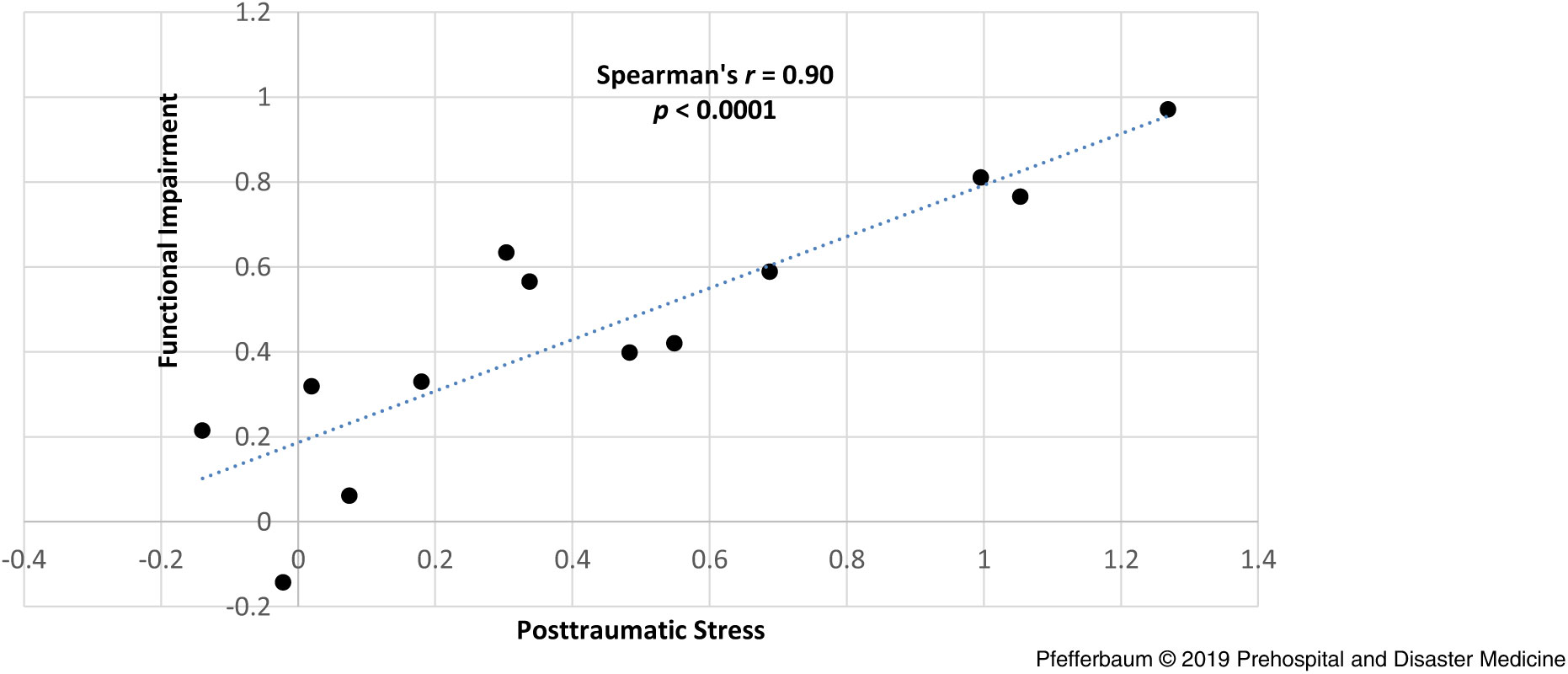
Association between Intervention Effects on PTS and on Functional Impairment—In addition to PTS, functional impairment was assessed in 13 of the 27 intervention trials included in this review. The estimates of the intervention effects on functional impairment in each of these trials were computed. The association between the intervention effects on PTS and on functional impairment was then estimated with the Spearman’s correlation coefficient.
Interpretation of the Results: Number Needed to Treat (NNT) Analysis—The number needed to treat (NNT), an aggregate measure of clinical benefit, was derived from the overall estimated effect size and its 80% PI using a method proposed by Furukawa and Leucht. Reference Furukawa and Leucht61 The prevalence of PTSD in the aftermath of mass trauma when no intervention has been implemented (ie, the control event rate, or CER) was set at 15.9% based on a meta-analysis of studies that assessed PTSD rates using well-recognized diagnostic interviews to examine Diagnostic and Statistical Manual of Mental Disorders (DSM-IV) 62 PTSD criteria in children and adolescents. Reference Alisic, Zalta and Van Wesel8
Assessment of the Methodological Quality of the Included Studies—Six methodological features were rated: random allocation sequence, knowledge of intervention affecting the selection of study participants, deviation from the intended intervention, management of missing outcome data, blinding of outcome assessors, and selective reporting of results.
Assessment of Publication Bias—Publication bias was assessed by visually inspecting funnel plots and by performing the Egger’s regression test for funnel plot asymmetry. Reference Egger, Smith, Schneider and Minder63 The trim and fill analysis Reference Duval and Tweedie64 was conducted to assess the impact of any potential publication bias.
Statistical Software—The following R packages (R Foundation for Statistical Computing; Vienna, Austria) were used for the analysis: (1) compute.es Reference Del Re65 to compute the effect sizes; and (2) metafor Reference Viechtbauer66 and meta Reference Schwarzer67 to fit the random effects and mixed effects models of the meta-analysis, perform the residuals and case-deletion diagnostics, and assess publication bias through funnel plots. The attenuation correction was performed with software designed by Schmidt and Hunter. Reference Schmidt and Hunter59
Report: Results of the Analysis
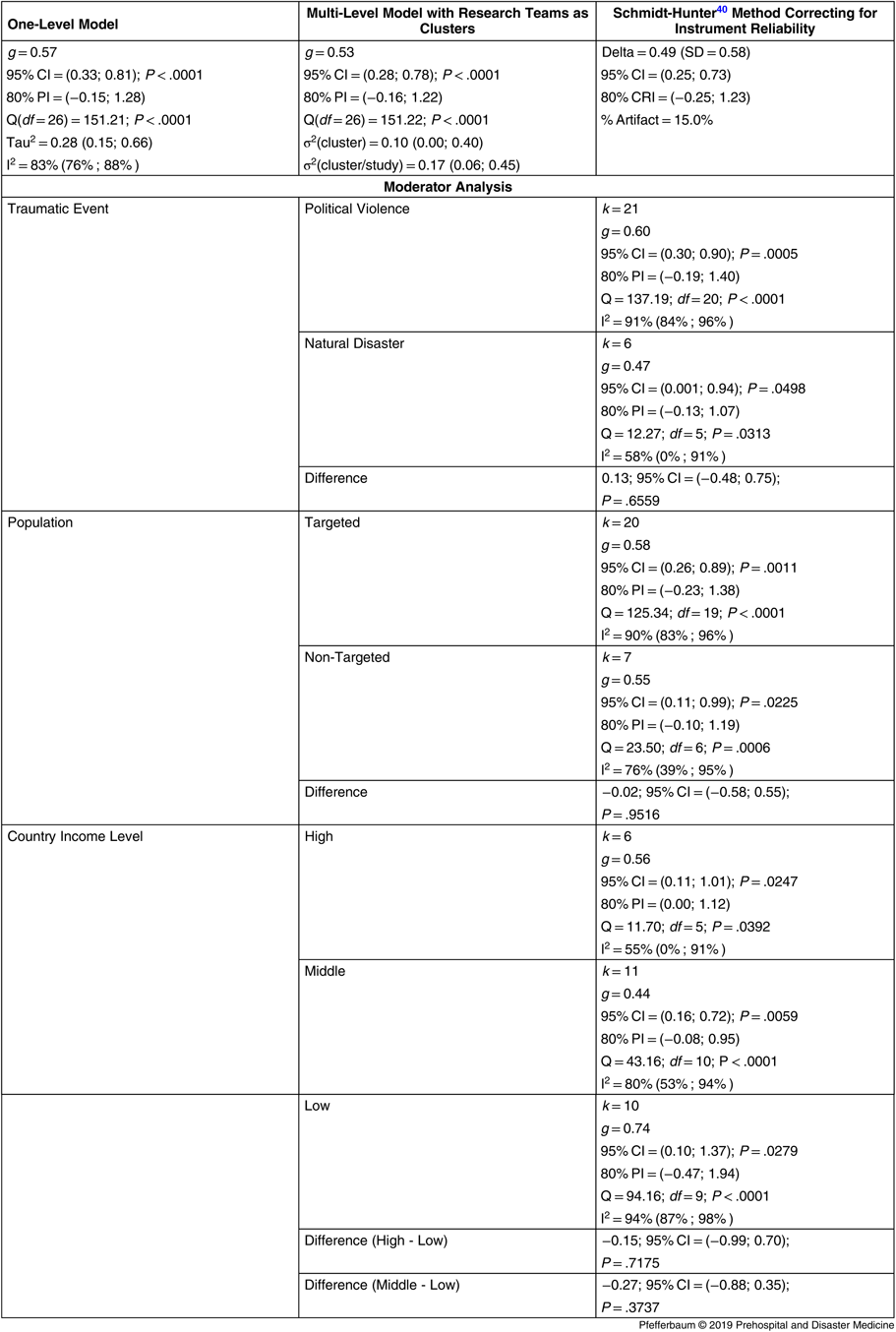
A total of 27 trials (N = 4,662 participants) from 25 studies were selected for the meta-analysis. Of the 25 studies, 19 were implemented following political violence and six were implemented after a natural disaster. With the one-level random effects model, the overall effect size of the 27 intervention trials on PTS was 0.57 (95% CI = [0.33; 0.81]; P < .0001; 80% PI = [−0.15; 1.28]; Figure 2). These results were similar to the findings obtained with the multi-level random effects model and disattenuation correction method (Table 2). The proportion of variation in effect sizes that is due to heterogeneity between studies rather than sampling error (I2) in the one-level model was high (83%; 95% CI = [76%; 88% ]).
Forest Plot of Intervention Effects Relative to Inactive Controls.

Overall Meta-Analysis Findings and Moderator Analysis of Intervention Effects on PTS

Note:% Artifact = proportion of variance accounted for by the measurement artifacts; CI = confidence interval; CRI = credibility interval of delta; Delta = mean true effect size; g = summary intervention effect size (Hedge’s g); I2 = the proportion of variation in correlation estimates that is due to heterogeneity between studies rather than sampling error; k = number of studies; PI = prediction interval; Q = the total amount of dispersion among effect sizes; Tau2 = estimated amount of total heterogeneity.
Residual diagnostics identified two outliers: the studies conducted by McMullen and colleagues Reference McMullen, O’Callaghan, Shannon, Black and Eakin46 (rstudent = 3.83; Cook’s d = 0.40; dfbeta = 0.80) and by O’Callaghan and colleagues Reference O’Callaghan, McMullen, Shannon, Rafferty and Black47 (rstudent = 2.47; Cook’s d = 0.21; dfbeta = 0.50). After removing these two outliers, the overall effect size in a one-level random effects model was 0.44 (95% CI = [0.27; 0.61]; P < .0001; 80% PI = [−0.02; 0.90]). The Baujat plot identified eight studies Reference Betancourt, McBain and Newnham31,Reference Panter-Brick, Dajani, Eggerman, Hermosilla, Sancilio and Ager32,Reference Berger and Gelkopf36,Reference Gordon, Staples, Blyta, Bytyqi and Wilson41,Reference Lesmana, Suryani, Jensen and Tiliopoulos44,Reference McMullen, O’Callaghan, Shannon, Black and Eakin46,Reference O’Callaghan, McMullen, Shannon, Rafferty and Black47,Reference Tol, Komproe and Jordans54 as having a large influence on the summary effect and/or a large contribution to the overall heterogeneity (Figure 3). A random effects meta-analysis without these eight studies yielded a summary effect of 0.37 (95% CI = [0.24; 0.51]; P < .0001; 80% PI = [0.15; 0.60]) with reduced heterogeneity among intervention effect sizes (Q = 23.90; df = 18; P = .1584; I2 = 30% with 95% CI = [0% ; 64% ]).
Baujat Plot Visualizing the Contribution of Individual Studies to the Summary Effect and Overall Heterogeneity.

The moderator analysis using mixed effects models failed to find any statistically significant difference in effect sizes across the categories of the tested moderators (Table 2). The intervention effects on PTS and on functional impairment were highly positively correlated (Spearman’s r = 0.90; 95% CI = [0.66; 0.97]; P < .0001]; Figure 4).
Scatterplot Depicting Relationship between Intervention Effect Size on Posttraumatic Stress and on Functional Impairment (k = 13).

Interpretation of the Results: NNT
The overall estimate of the intervention effect was 0.57, with an 80% PI of (-0.15; 1.28). For a CER of 15.9%, the average NNT is 5.71, indicating that 17.5% of youth receiving the intervention will have a favorable outcome compared to their counterparts not receiving the intervention. For the 80% PI upper bound of 1.28, the NNT is 2.21 (ie, 45.2% of youth receiving the intervention will have a better outcome than those not receiving the intervention). The 80% PI lower bound of -0.15 translates into a harmful effect of the intervention (Number Needed to Harm) of 25.60. In other words, four out of 100 youth receiving the intervention will have an unfavorable outcome compared to those not receiving the intervention.
Risk of Bias in the Included Studies
Three key sources of bias were identified in the selected studies. Influence of knowledge of intervention assignment in the selection of study participants, management of missing outcome data, and blinding status of assessors to participant group assignment emerged as the three most frequent potential sources of bias (Figure 5). Knowledge of intervention assignment may have influenced participant selection in cases where these participants were recruited after randomization had occurred (eg, in the cluster-randomized trials). Nonetheless, the average intervention effect sizes in cluster-randomized trials (k = 10; Hedge’s g = 0.42 with 95% CI = [0.11; 0.74]; P = .0133) and in individual-based randomized studies (k = 17; Hedge’s g = 0.67 with 95% CI = [0.29; 1.02]; P = .0015) were not statistically different (difference = 0.21; P = .3933). The risk of bias due to deviation from the intended intervention was unclear due to lack of information provided in the reports of some of the included studies.
Ratings for Risk of Bias in Included Studies.

Assessment of Publication Bias and Robustness of the Findings
The funnel plot of the standard errors of intervention effect sizes on the corresponding effect sizes was asymmetric. This asymmetry suggests a publication bias, high heterogeneity among studies, and/or the presence of outliers as identified by the residuals diagnostics (Figure 6).
Assessment of Publication Bias with Funnel Plot and With Trim and Fill Analysis.

Discussion
The finding of a medium intervention effect on PTS in RCTs comparing interventions to inactive controls supports the use of psychological and behavioral interventions for youth exposed to mass trauma. Judging from the predictive interval of the summary effect, however, an intervention may perform worse than natural recovery in some cases. Ertl and Neuner Reference Ertl and Neuner68 described a deterioration effect with some participants benefiting from the intervention and others doing worse. The deleterious effect of the intervention on some of the study participants may not be apparent when examining the average effect of the intervention. Although sub-group analyses of intervention effect can help identify specific groups of individuals for whom the intervention may or may not be effective, they usually require large study sample sizes. Thus, the risk of harm should be addressed systematically in future intervention studies.
Intervention effects were statistically significant across all categories of moderators examined in the current analysis, indicating that interventions were effective in the context of both political violence and natural disasters, when delivered to targeted or non-targeted populations, and regardless of the country income level where the interventions were delivered. Only one prior meta-analysis has examined the moderating effect of the type of trauma, Reference Brown, Witt, Fegert, Keller, Rassenhofer and Plener12 and this is the first meta-analysis to examine the populations receiving the intervention and the economic resources of the country where the interventions were delivered. The use of participants’ event exposures, experiences, and reactions to distinguish intervention populations is likely more precise in reflecting the clinical status and needs of the youth receiving the interventions than are the intervention setting (eg, mental health clinic or school) and provider training used in moderator analyses in other meta-analytic research. Reference Brown, Witt, Fegert, Keller, Rassenhofer and Plener12,Reference Newman, Pfefferbaum, Kirlic, Tett, Nelson and Liles15 Besides trauma exposure itself, deficiencies in the social ecology and stressful social conditions (eg, poverty, displacement, unstable and violent living conditions, malnutrition, or disrupted social networks) are a major source of maladaptation for residents in conflict-ridden regions. Reference Miller and Rasmussen69 Prior meta-analyses have examined the continent Reference Brown, Witt, Fegert, Keller, Rassenhofer and Plener12 and region Reference Purgato, Gross and Betancourt16 where interventions were delivered but have not specified their findings in terms of available regional resources, despite the fact that all interventions studied by Purgato and colleagues Reference Purgato, Gross and Betancourt16 were delivered in low-resource environments.
The estimates of the intervention effects on PTS and on functional impairment were strongly positively correlated. Future studies are needed to clarify this relationship, but this finding suggests that the interventions were effective in addressing both PTS and functional impairment or that functioning improved as PTS decreased.
Interpretation of the Results: NNT
Recognizing that effect sizes computed as Cohen’s d (or Hedge’s g) from individual studies or from meta-analyses can be difficult to interpret, Furukawa and Leucht Reference Furukawa and Leucht61 proposed a technique for converting a Cohen’s d estimate into a NNT, a statistic more familiar to clinicians. The current review provides summary effect sizes that can be used to compute the expected clinical benefit and potential harm of interventions for youth exposed to mass trauma. In the illustration of an application of this analysis, a meta-analysis of PTSD studies of trauma-exposed youth populations not seeking or receiving treatment was used to estimate a PTSD rate of 15.9% (95% CI = 11.5; 21.5). Reference Alisic, Zalta and Van Wesel8 Using this rate as the CER in the NNT analysis, the results indicate that 17.5% of youth would be expected to have a favorable outcome over and above those who improve through natural recovery while 4.0% of youth would be expected to have an unfavorable outcome relative to those who do not receive intervention. In making service decisions, PTSD rates for a specific population should be used as the CER, if available. For example, clinically-elevated PTS may be even higher in environments frequently exposed to political violence or natural disaster and in targeted over non-targeted populations; use of these rates would change the NNT outcome. Clinicians and relief agents can perform similar computations with the prevalence of PTSD in their intervention population to predict the potential benefit or harm of an intervention.
Methodological Strength of the Included Studies
The risk of bias analysis revealed several areas of concern related to the studies examined. These included the selection of participants, missing outcome data, and blinding status of assessors. In trials that used a cluster-randomization scheme (k = 10), Reference Berger and Gelkopf36-Reference Berger, Gelkopf and Heineberg38,Reference Gelkopf and Berger40,Reference Jordans, Komproe and Tol43,Reference Ooi, Rooney, Roberts, Kane, Wright and Chatzisarantis49,Reference Qouta, Palosaari, Diab and Punamäki51,Reference Tol, Komproe, Susanty, Jordans, Macy and de Jong53-Reference Tol, Komproe and Jordans55 the recruitment of individual participants after the randomization may have introduced a selection bias and created an imbalance between groups at baseline. Knowledge of participants’ intervention condition before inclusion may have led to differential efforts from the research team in recruiting and enrolling individuals in the trial. Additionally, knowing the intervention arm assignment may have influenced youth or parent consent for inclusion in the trial. The other areas of concern among the included studies involved missing outcome data due to attrition of participants Reference Chen, Shen, Gao, Lam, Chang and Deng33(both trials),Reference Gordon, Staples, Blyta, Bytyqi and Wilson41,Reference Hermenau, Hecker, Schaal, Maedl and Elbert42,Reference Ooi, Rooney, Roberts, Kane, Wright and Chatzisarantis49,Reference Tol, Komproe and Jordans55 and failure to use blinded assessors. Reference Jordans, Komproe and Tol43,Reference Lesmana, Suryani, Jensen and Tiliopoulos44,Reference Pityaratstian, Piyasil, Ketumarn, Sitdhiraksa, Ularntinon and Pariwatcharakul50,Reference Tol, Komproe, Susanty, Jordans, Macy and de Jong53,Reference Tol, Komproe and Jordans55 Finally, the risk of bias due to deviation from the intended intervention was unclear due to lack of information provided in the reports of some of the included studies.
Limitations
A number of potential moderators were not explored in the current meta-analysis because of inconsistencies in descriptions (eg, therapeutic approach or provider training) or difficulty in accurate measurement (eg, casualty rates, time since event, or duration of conflict). The failure to find moderators to explain the heterogeneity in the reported effect sizes may have been due to a lack of sufficient statistical power to detect a significant association. Future studies may benefit from examining other contextual variables measuring available resources, social support, and sociocultural influences. Finally, a larger sample of studies would have allowed the assessment of potential interaction effects among these moderators through sub-grouping (eg, political violence versus natural disasters in low-income countries).
Conclusion
The current review and meta-analysis provide additional evidence that interventions can alleviate PTS and enhance psychosocial functioning in targeted and non-targeted youth populations exposed to political violence and natural disasters regardless of country income level. Altogether, these findings confirm the benefit of PTS interventions world-wide, despite resource limitations in low-middle income countries. The positive association between the effects of the interventions on PTS and functional impairment suggests that interventions confer a concomitant improvement in symptoms and functioning. Hence these interventions, while reducing youth stress symptoms, may enhance their daily functioning. More research is also needed to examine the cost-effectiveness of interventions and to generate models to guide service providers and organizations in service decision making for both targeted and non-targeted populations and in low-, middle-, and high-income countries.
Conflicts of interest
none