Introduction
In the resource-constrained environment of a mass-casualty incident (MCI), tools used for standard clinical evaluation are inapplicable. Although there are a variety of MCI triage systems for adults and children, applying them perfectly and efficiently has been shown to be a challenge, particularly for trainees.Reference Claudius, Kaji, Santillanes, Cicero, Donofrio, Gausche-Hill, Srinivasan and Chang 1 – Reference Wallis and Carley 6 Accuracy, for this study, is the ability of potential first responders to use the triage algorithm to assign patients the correct triage level. When measured in a simple test-taking setting, triage accuracy is 64% to 90% after simple training.Reference Wallis and Carley 6 , Reference Sapp, Brice, Myers and Hinchey 7 However, when assessed in a more realistic, simulated environment, accuracy falls to 50% to 80%.Reference Wallis and Carley 6 Application of the pediatric version of the Simple Triage and Rapid Treatment (JumpSTART) triage algorithm to emergency department patients in one study resulted in a low sensitivity to correctly identify “immediate” patients.Reference Baez, Sztajnkrycer, Smester, Giraldez and Vargas 8 Even with dedicated training, reported accuracy is around 80%.Reference Wallis and Carley 9 , Reference Cicero, Auerbach and Zigmont 10 The time required to triage simulated patients is variable among studies. For example, triage took 23 seconds in one simulated MCI using JumpSTART,Reference Sanddal, Loyacono and Sanddal 11 but in a multi-casualty drill using START,Reference Romig 2 time to triage more than doubled (50.5 seconds) when averaged per patient.
Given the rarity and stressful nature of an actual MCI, the appropriate steps and their order may be difficult to remember and to perform correctly. Critical steps in the algorithm may be omitted and/or unnecessary actions may be performed (eg, repositioning of the airway in a patient who is breathing spontaneously), which have the potential to impact the time spent on triage as well as the accuracy. The primary objective of this report was to examine the association between accuracy and time required for triage and the performance of inappropriate actions. This was broken down into the performance of unnecessary component actions (over-actions) and omission of required actions (under-actions), with the hypothesis that performance of unnecessary actions would increase triage time. Secondarily, overall accuracy and time to triage using JumpSTART in an MCI drill setting were also reported.
Methods
Study Population and Setting
This was a planned, secondary analysis on component actions performed by pre-clinical medical students within a pediatric MCI disaster drill using JumpSTART. A disaster drill was conducted on a single day at a large university medical school with pre-clinical medical students, recruited through an Emergency Medicine student interest group, serving as participants. The University of Southern California (Los Angeles, California USA) Institutional Review Board approved the study. Students received a gift card as compensation for participation.
All students were given a 15-minute didactic lecture on pediatric MCIs and the JumpSTART triage method. Using a block randomization scheme, the order in which each participant encountered the moulaged adult actors and the computer simulations were pre-determined to maximize participant flow and to minimize the effect of ordering on their performance. The participants then triaged 11 simulated patients individually (four moulaged adult actors portraying children and seven computer-simulated patients). The students were allowed to use written notes to assist in the triage process.
Development
Eleven patient cases were developed and assigned a triage category (expectant, immediate, delayed, or minor) based on a chart review of prehospital and trauma center records of actual pediatric trauma patients. For each patient, two attending pediatric Emergency Medicine physicians determined by consensus which component actions were appropriate and which were unnecessary. The six component actions, which have been validated by Cicero et al,Reference Sapp, Brice, Myers and Hinchey 7 correspond to the JumpSTART algorithm decision points: (1) ask to walk; (2) check for spontaneous breathing; (3) reposition airway (chin-lift or jaw-thrust); (4) give five breaths; (5) check pulse; and (6) check for responsiveness (sternal rub). For example, in an ambulatory patient, all actions beyond “ask to walk” are inappropriate over-actions, as the patient should be triaged as minor at this point. Alternatively, omitting the step of asking a patient to walk would be designated an under-action.
Simulations and Data Collection
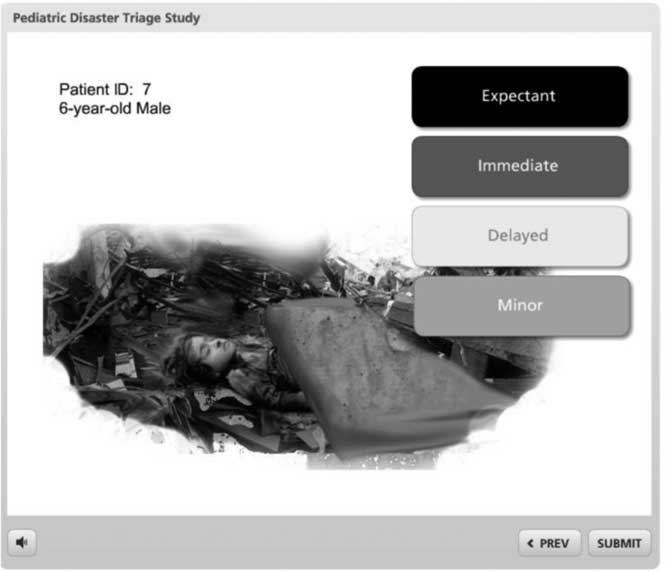
Computerized patients were authored using Articulate Storyline (New York, New York USA) with a two-screen, progressive disclosure case report method using no text. Realistic backgrounds, such as fire and rubble and a soundtrack of amalgamated distress sounds, including crying infants and adults, sirens, and explosions, were inserted. For the computer simulations, participants had a private laptop with headphones. A set of simple command buttons for JumpSTART actions were selectable by the participant (eg, chin lift and check pulse). All six actions always were available for participants to choose. All cases provided information relevant to the JumpSTART algorithm when prompted by the participant, and each case required a triage level assignment prior to advancement (Figure 1). Seven scenarios used the computerized method and represented all four triage levels; however, technical problems were experienced that eliminated time to triage data for four of the scenarios. Otherwise, the software recorded all component actions chosen and final triage levels per patient.
Screenshot of a Computerized Scenario.

The live actors were prepared by pediatric Emergency Medicine attending physicians and were moulaged according to their injury pattern. Actors were briefed on their scenario prior to starting, and they responded in character to questions or actions performed by the subject. Each live actor encounter took place in a private room. Time, triage designation, and component actions performed were recorded by trained observers. Time to triage was documented as the duration between being briefed about the patient to declaring a triage level verbally. Potentially awkward actions, like rescue breaths, could be verbalized rather than performed. No formative feedback was provided during the sessions by the observer. Four scenarios used the live actor method and represented all four triage levels.
Data Analysis
Triage accuracy and performance of component actions were graded as appropriate actions, over-actions, or under-actions for each encounter, according to grading metrics as outlined above.
Descriptive statistics were used to characterize mean time, accuracy, and component action performance. The Kruskal-Wallis was used to compare median times between different triage levels, differences by case, and differences by student. Using generalized estimating equations, a regression analysis was performed for the outcome of time to triage to adjust for correlations within each student. All data were analyzed using SPSS v19 (Armonk, New York USA) and SAS v.3 (Cary, North Carolina USA). Spearman’s rank correlation coefficient was calculated to describe associations between over-actions and accuracy, and for under-actions and accuracy.
Results
Thirty-four first and second year medical students were enrolled. As one student was eliminated from data analysis for failing to complete all scenarios, 33 students were analyzed. Eleven scenarios were included for a total of 363 patient encounters.
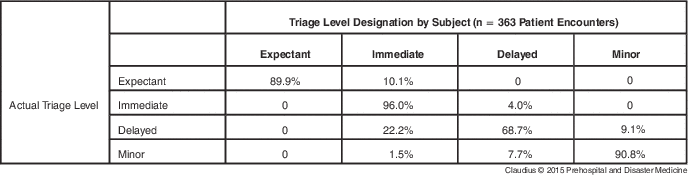
Overall, accuracy of assigned triage designation was 85.7%. Broken down by anticipated triage level, 89.9% of expectant, 96% of immediate, 68.7% of delayed, and 90.8% of minor patients were designated correctly. Table 1 demonstrates the misdesignations that occurred.
Correct and Incorrect Triage Designations

Mean time to triage was 70.4 seconds overall (95% CI, 65.6-74.8 seconds). Time to triage differed between the four triage levels (P<.0001). Mean time to triage was 84.8 seconds for expectant patients (95% CI, 76.9-92.7 seconds), 66.3 seconds for immediate (95% CI, 57.9-74.7 seconds), 66.5 seconds for delayed (95% CI, 57.4-75.6 seconds), and 62 seconds for minor (95% CI, 53.1-70.8 seconds).
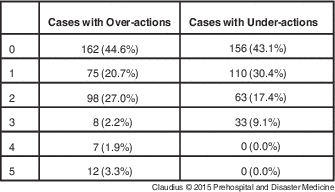
One encounter had missing data on over-actions and under-actions, leading to 362 available encounters for this analysis. Over-actions and under-actions were common, with over-actions occurring in 55.4% of encounters at a median of one per encounter (IQ range=0-2) and under-actions occurring in 56.9% of encounters at a median of one per encounter (IQR=0-2). Table 2 demonstrates the distribution of over- and under-actions per case.
Distribution of Cases with Zero through Five Over- or Under-actions

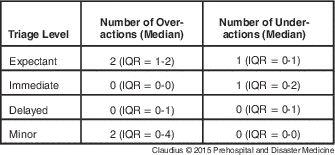
When stratified by triage severity, the number of over- and under-actions were significantly different (P<.0001). These data are captured in Table 3. Individual students demonstrated no significant differences in total over- and under-actions (P=1.0 for over-actions, P=.9 for under-actions), but there were significant differences between scenarios (P<.0001 for both over-actions and under-actions). The most commonly performed over-action was checking the pulse and the most commonly omitted action was asking the patient to walk.
Over- and Under-actions by Triage Level

Both over-actions and under-actions increased time to triage. Each over-action increased triage time by 8.4 seconds (95% CI, 5.4-11.4; P<.001). Each under-action increased triage time by 5.5 seconds (95% CI, 1.3-9.7; P=.009). There was a negative association between over-actions and accuracy of triage designation (rho=−0.131; P=.013), but there was none between under-actions and accuracy (rho=−0.001; P=.985).
Discussion
The accuracy of triage designation in this data set was higher than in prior studies, with the lowest accuracy found in the “delayed” designation group. The time required to assign a triage designation was longer than prior studiesReference Sanddal, Loyacono and Sanddal 11 with the higher triage levels requiring more time. It is likely that the use of pre-clinical medical students with less familiarity of JumpSTART than the paramedics in Jones et al's study prolonged the time to triage. This may also explain why under-actions (omission of critical steps) led to longer times to triage instead of saving time by skipping ahead. With inexperienced novices, the subjects in this study were more likely to have used extra time to use their notes or mentally deliberate their triage severity level designations.
The threshold beyond which a delay in triage time becomes not only statistically, but clinically, significant is not well-defined. A delay of 8.4 seconds per patient theoretically could result in nearly 15 minutes of delay for the final patient and 12 hours of cumulative delay time if the formula (0.5)(N)(N+1)(seconds delay) were to be applied. For the patients who fall into the minor category, and many of those in the delayed triage category, even a several hour delay would be acceptable. However, for a patient with an impending tension pneumothorax or enlarging intracranial injury, 15 minutes of delay might alter the outcome. Simplistically, minimizing delay is ideal. Realistically, a delay of five to 10 seconds per patient will likely have a significant impact on a small percentage of patients.
Mass-casualty incident drills serve a number of purposes, including assessment of triage tools, education of providers, and improvement of performance. Cicero et al determined component actions for JumpSTART that are incorporated into a validated assessment tool for performance beyond accuracy.Reference Jones, White and Tofil 12 Beyond this research, little guidance is available in the literature to assist team leaders improving staff performance.Reference Cicero, Riera, Northrup, Auerbach, Pearson and Baum 13 To the authors’ knowledge, this is one of the few studies that attempts to evaluate the impact of the individual steps in the algorithm on triage efficiency. Because inappropriate actions increased the time required for triage, this may be an appropriate target for feedback following an MCI drill.
Limitations
Admittedly, the causality of the relationships noted was not studied here. It is possible that performance of inappropriate actions is merely a sign of insecurity with the triage algorithm, and not the driver behind triage designation inaccuracy and duration. Regardless, retraining of providers performing an excess of inappropriate actions may allow reinforcement of the algorithm, as well as potentially diminish the time required to assign a triage designation. Further prospective studies are required to determine the effects of selective retraining in this setting. Ideally, participants with different levels of confidence with the algorithms could be compared regarding the delays introduced by over-actions and under-actions to help determine if they are merely a marker, or a cause, of delay, followed by targeted interventions, such as real-time feedback. Comparison of intervention response between novice and experienced providers might lend insight into the utility and optimal setting to apply drilling, evaluation, and feedback related to over-actions and under-actions.
Conclusions
Increasing triage level, performance of inappropriate actions, and omission of recommended actions all were associated with increasing time to perform triage.
Acknowledgement
The authors would like to acknowledge Phung Pham, MS, Leighanne Johnson, MS, and James Koved, MD.