Introduction
Life tables are fundamental tools for analysing the population dynamics of insects and other arthropods, providing a comprehensive description of development, survival, fecundity, and life expectancy, and are widely used to predict population growth potential (Chi, Reference Chi1990; Chi et al., Reference Chi, You, Atlıhan, Smith, Kavousi, Özgökçe, Güncan, Tuan, Fu, Xu, Zheng, Ye, Chu, Yu, Gharekhani, Saska, Gotoh, Schneider, Bussaman, Gökçe and Liu2020). Traditional life tables primarily focus on females and their age-specific characteristics (Hutchison and Hogg, Reference Hutchison and Hogg1984), which may lead to a biased understanding of life-history traits (Huang and Chi, Reference Huang and Chi2012). In contrast, age-stage, two-sex life tables incorporate sexual dimorphism and ontogenetic variation across developmental stages, enabling a more accurate assessment of survival, development, and reproduction in insects with egg, nymphal, and adult stages (Chi et al., Reference Chi, You, Atlıhan, Smith, Kavousi, Özgökçe, Güncan, Tuan, Fu, Xu, Zheng, Ye, Chu, Yu, Gharekhani, Saska, Gotoh, Schneider, Bussaman, Gökçe and Liu2020). Life table parameters can be evaluated under diverse environmental conditions, including constant and fluctuating temperatures, pesticide resistance, and insect–pathogen associations relevant to biological control (Liu, Reference Liu2019; Escobar-Garcia and de Andrade, Reference Escobar-Garcia and de Andrade2025; Aye et al., Reference Aye, Jo and Kim2026). This approach is therefore widely used to assess insect population growth under varied environmental conditions, providing fundamental data to support pest forecasting and integrated pest management strategies.
Cyamophila willieti (Hemiptera: Psyllidae) is a serious insect pest (Yang et al., Reference Yang, Wang and Lv2002; He et al., Reference He, Guang, Zhao, Zhang and Guan2005; Bo, Reference Bo2024) that is widely distributed in regions including Liaoning, Beijing, Shaanxi, Shanxi, Gansu, Ningxia, Hunan, Hubei, Guizhou, and Xinjiang (Wang and Wang, Reference Wang and Wang1996; Qiang and Ma, Reference Qiang and Ma2007; Yang et al., Reference Yang, Zheng and Chen2014). Both nymphs and adults feed on the nectar of the tender shoots and flower clusters of deciduous Styphnolobium japonicum, secreting a waxy substance that coats the branches (Song et al., Reference Song, He, Wang and Gu2019; Liang et al., Reference Liang, Wu, Yang, Sun, Zhao, Yang, Ren, Xiao and Yang2024). This secretion impairs photosynthesis, resulting in premature leaf yellowing and abscission, reduced flowering, and stunted growth of new shoots (Yang et al., Reference Yang, Wang and Lv2002). Styphnolobium japonicum is a deciduous tree in the family Fabaceae. Mature trees can reach 15–25 m in height and have greyish-brown bark and glabrous green current-season branches (Wang, Reference Wang2023). It is characterised by its large, dense crown, straight trunk, and tolerance to drought and cold. As a species native to China, it provides both ecological and ornamental value (Xu et al., Reference Xu, Yan, Lin, Zhen, Liu and Duan2021; Madden et al., Reference Madden, McLachlan, Oketch-Rabah and Calderón2022). However, the waxy substances secreted by C. willieti nymphs and adults can promote sooty mould, resulting in dark, sticky residues on branches that eventually fall to the ground. This not only detracts from the aesthetic value of roadways but also inconveniences pedestrians.
Previous studies have examined the morphological identification, geographical distribution, host damage, and fundamental biological traits of C. willieti (Yang et al., Reference Yang, Wang and Lv2002; Shen et al., Reference Shen, Chang, Zhang, Han, Wang, Zhu and Tian2008a, Reference Shen, Chang, Zhang, Han, Wang, Zhu and Tian2008b; Zhang and Wang, Reference Zhang and Wang2012). In recent years, molecular research focusing on mitochondrial genomes, transcriptomes, and chromosome-level genomes has gradually advanced (Song et al., Reference Song, He, Wang and Gu2019; Xue et al., Reference Xue, Ma, Liu, He, Wu, Li, Cai and Song2024), providing valuable data resources and theoretical support for clarifying its taxonomic status, elucidating its biological characteristics, and improving the theoretical systems for the management of this pest. However, existing studies have largely focused on morphological characterisation, field pest monitoring and evaluations of control efficacy, whereas systematic analyses of this pest’s population ecology remain limited. Notably, no published studies have applied age-stage, two-sex life table analysis based on complete life-cycle data to examine both sexes and distinct developmental stages comprehensively. Consequently, the stage-specific survival patterns, sex-specific differences in development and lifespan, reproductive rhythmicity, reproductive output, and population growth potential of this pest under variable temperature conditions remain poorly characterised. This lack of knowledge restricts comprehensive insight into the population regulatory mechanisms of C. willieti and hinders the accurate identification of its critical reproductive stages and optimal timing for control.
To address this research gap, we applied age-stage, two-sex life table theory to systematically examine the effects of temperature on the development, reproduction, and population growth potential of C. willieti, together with its diurnal oviposition rhythms and oviposition site preferences. We further analysed its life-history traits and oviposition patterns across generations, thereby providing a theoretical basis for the monitoring and management of this pest.
Materials and methods
Experimental insects and host plant
Adults of C. willieti were collected from S. japonicum trees near the Plant Protection Station, Tarim University, Xinjiang, Alaer 843300, China (40°32′46.3″N, 81°16′41.2″E). Young S. japonicum seedlings were used as the host plant and grown in plastic pots measuring 40 cm × 25 cm × 25 cm. The insects were reared for more than two generations under laboratory conditions (25 ± 1 °C, 75 ± 5% relative humidity (RH), and a 16 L:8 D). When the seedlings reached approximately 15 cm in height, they were transferred to rearing cages measuring 50 cm × 45 cm × 40 cm and covered with 200-mesh gauze to maintain the C. willieti colony. The first-, second-, third-, fourth-, and fifth-instar nymphs (Supplementary Fig. 1) and adults (Supplementary Fig. 2) were distinguished based on moulting frequency and morphological characteristics.
Mating experiment
Experimental conditions
The insects were maintained under a photoperiod of 14 L:10 D, with the light phase corresponding to local time from 08:00 to 22:00. Illumination was provided by diffuse natural daylight, and temperature and relative humidity were maintained at 20–26 °C and 40–60%, respectively.
Newly emerged adults of C. willieti were transferred to three separate rearing cages (40 cm × 40 cm × 45 cm), with 50 individuals per cage and a female:male ratio of 1:1.
The mating behaviour of C. willieti adults was observed in rearing cages for seven consecutive days over a 24-h cycle. Observations were conducted at 1-h intervals, with each session lasting 15 min. During each observation period, the number of mating events and the duration of each copulatory event were recorded.
Oviposition preference assay
To assess the oviposition selectivity of C. willieti on different parts of S. japonicum, seedlings were grown individually in 50 mm pots under standardised conditions to minimise phenotypic variation. Custom plastic rearing containers (180 mm in height, 55 mm in lower diameter, and 90 mm in upper diameter) were prepared by removing the base of each container, covering the opening with 200-mesh nylon mesh and inverting the container so that the mesh-covered opening was positioned at the top. Each container was placed over a potted seedling containing adults, and the wider end was sealed with a plastic lid. Oviposition preference assays were performed using 10–15 cm S. japonicum seedlings, which were stratified and randomly assigned to two groups: (A) seedlings from which apical tender shoots had been excised 24 h before the assay and (B) seedlings with intact shoots. Tender shoots were defined as non-lignified apical growth ≤10 mm in length and ≤2 mm in basal diameter, measured 1 mm above the node. Twenty-four healthy, uniform seedlings with at least four pairs of expanded leaves and no visible damage were used in the experiments.
Twenty-four pairs of 4–6-day-old C. willieti (♀:♂ = 1:1) were introduced into rearing cups (Groups A and B). After 3 days, the adults were removed, and the number and distribution of eggs on different plant parts were recorded under a stereomicroscope (Zeiss Stemi 2000-C). Oviposition assays were conducted in a polyhouse under controlled conditions (25 ± 2 °C, 60 ± 10% RH, 16 L:8 D) using a completely randomised design.
Temperature-dependent development, reproduction, and population growth
The experiment was conducted at three constant temperatures (25 ± 1 °C, 29 ± 1 °C, and 33 ± 1 °C, with 75 ± 5% RH and a 16 L:8 D photoperiod). Potted S. japonicum seedlings (pot size: 5.3 cm × 5.3 cm × 5.0 cm) were exposed to a stock colony of C. willieti for oviposition and removed after 12 h. Egg hatching was checked twice daily at 10:00 and 22:00, and first-instar nymphs were transferred to fresh seedlings using a fine paintbrush. To maintain balanced sex ratios, synchronised backup cohorts were reared under similar conditions.
Groups of fifty-five first-instar nymphs were placed in rearing cups, and data on their survival and development were recorded twice daily. Moulting to the next instar was confirmed by the presence of exuviae, and upon adult emergence, males and females were paired at a 1:1 ratio. Any imbalance in the sex ratio was corrected using individuals from the synchronised backup cohorts. Adults were monitored daily for survival and oviposition and these observations continued until the death of all adults. Once oviposition began, host seedlings were replaced daily, and eggs were counted under a stereomicroscope (Zeiss Stemi 2000-C).
The recorded developmental parameters included egg duration, defined as the period from oviposition to hatching; nymphal duration, defined as the period from the first instar to adult emergence; total pre-oviposition period (TPOP), defined as the period from egg laying to the first oviposition by the resulting female adult; and adult pre-oviposition period (APOP), defined as the period from adult emergence to first oviposition.
Life table construction and analysis
The developmental durations of different stages of C. willieti, together with the daily oviposition data obtained from the development, growth, and reproduction experiment described earlier, were used to construct an age-stage, two-sex life table (Chi, Reference Chi1988; Chi and Su, Reference Chi and Su2006; Tuan et al., Reference Tuan, Lee and Chi2014; Chi et al., Reference Chi, You, Atlıhan, Smith, Kavousi, Özgökçe, Güncan, Tuan, Fu, Xu, Zheng, Ye, Chu, Yu, Gharekhani, Saska, Gotoh, Schneider, Bussaman, Gökçe and Liu2020). Data were analysed using TWOSEX-MSChart (Chi, Reference Chi2025), which was used to calculate the relevant biological and demographic parameters.
The intrinsic rate of increase (r) represents the maximum population growth capacity under conditions of unlimited food and space and in the absence of adverse factors. Age was counted from 0, and r was calculated using the bisection iteration method (Chi and Liu, Reference Chi and Liu1985):
 \begin{equation*}\mathop \sum \limits_{x = 0}^\infty {e^{ - r\left( {x + 1} \right)}}{l_x}{m_x} = 1\end{equation*}
where x represents age in days, lx represents the age-specific survival rate at age x, and mx represents the age-specific fecundity at age x, defined as the mean number of offspring produced per individual at that age.
The finite rate of increase (λ) denotes the average daily rate of population increase when the population reaches a stable age-stage distribution and was calculated as follows:
 \begin{equation*}\lambda = {e^r}\end{equation*}
The net reproductive rate (R 0) represents the mean number of offspring produced by an individual over its lifetime and was calculated as follows (Chi and Liu, Reference Chi and Liu1985):
 \begin{equation*}{R_0} = \mathop \sum \limits_{x = 0}^\infty {l_x}{m_x}\end{equation*}
The mean generation time (T) is defined as the average period between the birth of individuals in one generation and the birth of their offspring in the next generation, and represents the time required for the population to increase R₀-fold (Chi and Liu, Reference Chi and Liu1985). It was calculated as follows:
 \begin{equation*}T = \frac{{{\text{ln}}\,{R_0}}}{r}\end{equation*}
The gross reproductive rate (GRR) is the sum of age-specific fecundity (m x) when survival is not taken into account and was calculated as follows:
 \begin{equation*}GRR = \sum \limits_{x = 0}^\infty{m_x}\end{equation*}
In addition, the APOP and TPOP were recorded. The APOP was defined as the period from adult emergence to the first oviposition, whereas the TPOP was defined as the period from egg deposition (age zero) to the first oviposition by the resulting female.
Population growth prediction
The TIMING-MSChart program was used to predict the population growth and age-stage structure of C. willieti for 60 days, starting from an initial cohort of 10 eggs.
Data analysis
Data for mating frequency and oviposition preference were analysed using Microsoft Excel 2021 and IBM SPSS Statistics 23.0.
Mating frequency
Mating frequency data across different time periods were analysed using one-way analysis of variance. Where significant differences were indicated (P < 0.05), the least significant difference test was applied for post hoc multiple comparisons.
Oviposition selectivity
The number of eggs laid by adults under different treatments was analysed using an independent-samples t-test.
The TWOSEX-MSChart was used to calculate life table parameters and estimate their standard errors using the bootstrap method with 100,000 repetitions. Additionally, the TIMING-MSChart program was used to predict population dynamics. All figures were generated using Origin 2021.
Results
Circadian pattern of mating activity
The mating rhythm of C. willieti was strongly dependent on age and developmental stage and was confined to the photophase (Fig. 1). No mating behaviour was observed in adults ≤3 days post-emergence, whereas it occurred consistently in adults aged 4–7 days. Mating activity began at approximately 08:00 h, increased steadily and exhibited two distinct peaks at 12:00 and 17:00 h, after which it declined sharply. Mating frequencies during these peak periods were significantly higher than those recorded at other time intervals (P < 0.05), with the lowest activity again observed at 08:00 h.
Circadian rhythm of mating of C. willieti adults in the laboratory.

Oviposition selectivity
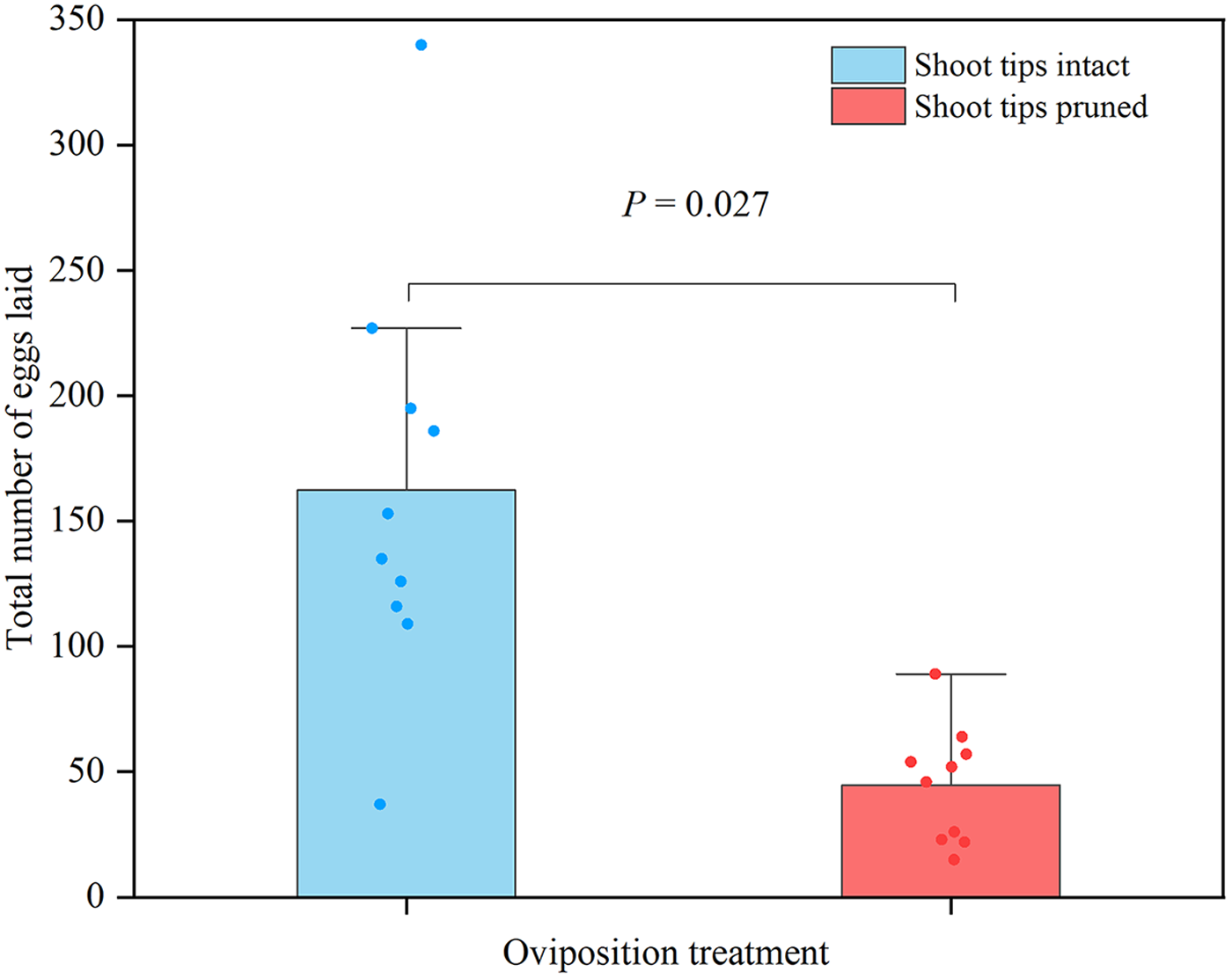
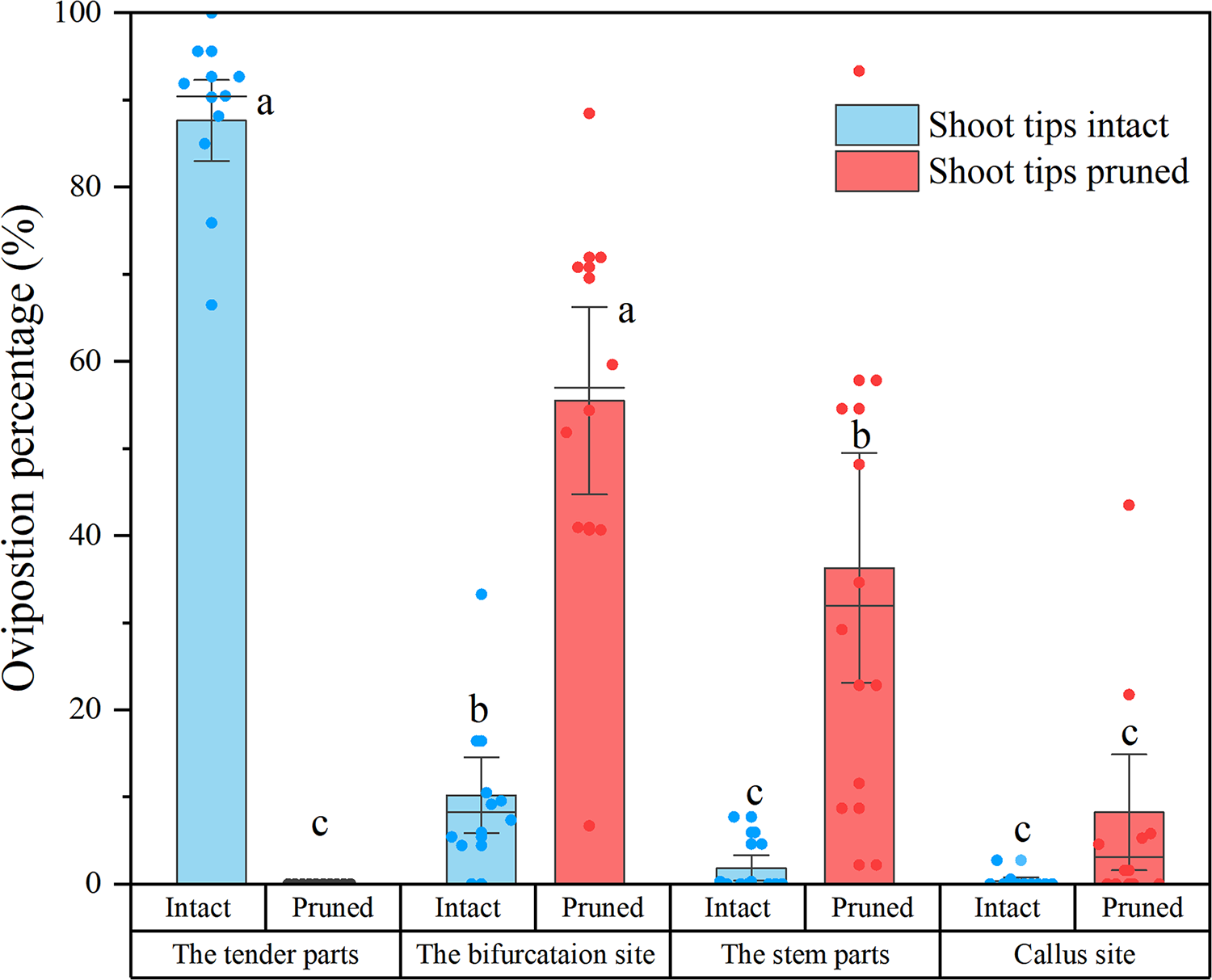
Oviposition preference of C. willieti differed markedly between unpruned and pruned shoots (Figs. 2 and 3). Total egg production was substantially higher in the unpruned treatment than in the pruned treatment, with 1624 and 448 eggs recorded, respectively. In the unpruned treatment, oviposition was concentrated mainly on shoot tips (87.64%), with lower proportions of egg deposition on branch axils (10.18%), stems (1.85%), and callus tissue (0.32%). In contrast, shoot pruning caused a marked shift in oviposition towards branch axils (55.48%), followed by stems (36.29%) and callus tissue (8.24%). Egg deposition on callus tissue did not differ significantly between treatments (P > 0.05). These findings indicate that C. willieti strongly prefers shoot tips for oviposition when they are available but shifts primarily to branch axils and stems after pruning.
Total number of eggs laid by C. willieti on shoots with intact or pruned tips. P indicates significant differences between two treatments of the same plant parts based on an independent sample t-test (P < 0.05).

Oviposition distribution of C. willieti across four plant parts under differential treatments. Different lowercase letters above the bars indicate significant differences by Duncan’s test (P < 0.05).

Figure 3 Long description
Oviposition percentage left parenthesis percent right parenthesis on the vertical axis, ranging from 0 to 100. Category labels on the horizontal axis: The tender parts, The bifurcation site, The stem parts, Callus site. Each category has two bars labeled Intact and Pruned. Legend: Shoot tips intact. Shoot tips pruned. The tender parts: Intact bar at 87.64 with letter a above; Pruned bar at 0.32 with letter c above. Points are plotted over each bar. The bifurcation site: Intact bar at 10.18 with letter b above; Pruned bar at 55.48 with letter a above. Points are plotted over each bar. The stem parts: Intact bar at 1.85 with letter c above; Pruned bar at 36.29 with letter b above. Points are plotted over each bar. Callus site: Intact bar at 0.32 with letter c above; Pruned bar at 8.24 with letter c above. Points are plotted over each bar.
Temperature-dependent development and adult longevity
Life table parameters of C. willieti under constant temperatures are summarised in Table 1. Development from egg to fourth instar was completed under all tested temperature regimes, although survival was substantially lower at 33 °C. Fifth-instar nymphs and adults developed successfully only at 25 °C and 29 °C, whereas development failed at 33 °C due to high mortality. Egg development was slowest at 33 °C (7.42 ± 0.49 days) and fastest at 29 °C (3.69 ± 0.34 days). At 25 °C, C. willieti completed its full life cycle, with the highest fecundity (647.75 ± 52.94 eggs/female) and greater adult longevity; males (28.29 ± 8.40 days) lived longer than females (20.88 ± 4.13 days). Although the life cycle was completed at 29 °C, both survival and fecundity were reduced (47.63 ± 4.26 eggs/female), and sex-based differences in longevity were minimal. Pre-oviposition periods were comparable between 25 °C (APOP, 5.60 ± 0.24 days; TPOP, 24.6 ± 0.48 days) and 29 °C (APOP, 5.20 ± 1.48 days; TPOP, 25.4 ± 2.53 days). In contrast, no adults emerged at 33 °C, confirming the lethal effects of high temperature on later developmental stages.
Life history parameters of the experimental population of C. willieti at different constant temperatures

Table 1 Long description
Life stage durations and reproductive measures are listed as sample size and mean with standard error at 25, 29, and 33 degrees Celsius. Egg duration is 3.81 days at 25 degrees with n 60, 3.69 days at 29 degrees with n 60, and 7.42 days at 33 degrees with n 60. First instar nymph duration is 3.47 days with n 55 at 25 degrees, 3.34 days with n 60 at 29 degrees, and 7.25 days with n 60 at 33 degrees; second instar is 2.13 days with n 53, 2.38 days with n 49, and 4.24 days with n 45. Third instar is 2.03 days with n 52 at 25 degrees, 2.24 days with n 36 at 29 degrees, and 4.00 days with n 29 at 33 degrees; fourth instar is 2.46 days with n 48, 2.34 days with n 25, and 3.86 days with n 7. Fifth instar nymph duration is 4.81 days with n 44 at 25 degrees and 5.80 days with n 17 at 29 degrees, while 33 degrees lists n 0 with no mean reported; preadult duration is 18.68 days with n 44 at 25 degrees and 19.82 days with n 17 at 29 degrees, with n 0 and no mean at 33 degrees. Female adult longevity is 20.88 days with n 20 at 25 degrees and 11.88 days with n 8 at 29 degrees, and male adult longevity is 28.29 days with n 24 at 25 degrees and 13.89 days with n 9 at 29 degrees; both adult longevity rows show n 0 and no mean at 33 degrees. Total longevity is 35.03 days with n 60 at 25 degrees, 17.61 days with n 60 at 29 degrees, and 22.88 days with n 60 at 33 degrees. Adult pre oviposition period is 5.60 days with n 20 at 25 degrees and 5.20 days with n 5 at 29 degrees, and total pre oviposition period is 24.60 days with n 20 at 25 degrees and 25.40 days with n 5 at 29 degrees; both rows show n 0 and no mean at 33 degrees.
Note: Initial cohorts were composed of 60 eggs laid in a restricted time range.
Reproduction and population parameters
The r, λ, R 0, and GRR of C. willieti were highest at 25 °C and were substantially lower at 29 °C. At 25 °C, r was 2.95 times greater, λ was increased by 0.14, R 0 was 34 times greater and GRR was nearly 10 times greater than that recorded at 29 °C (Table 2). These results indicate that elevated temperature strongly suppressed reproductive output and population growth. The mean generation period changed little between 25 °C and 29 °C, increasing slightly from 28.51 to 28.91 days, suggesting that the main effect of temperature was on reproductive performance rather than generation turnover.
Population parameters of C. willieti at two different temperatures

Table 2 Long description
Population parameters are reported for C. willieti at 25 degrees Celsius and 29 degrees Celsius, with columns for n and mean plus or minus standard error. For intrinsic rate of increase r per day, n is 60 at both temperatures, with mean 0.1885 plus or minus 0.0086 at 25 degrees Celsius and 0.0639 plus or minus 0.0178 at 29 degrees Celsius. For finite rate of increase lambda per day, n is 60 at both temperatures, with mean 1.2075 plus or minus 0.0104 at 25 degrees Celsius and 1.0660 plus or minus 0.0187 at 29 degrees Celsius. For net reproductive rate R0, number of offspring produced per individual, n is 60 at both temperatures, with mean 215.92 plus or minus 43.00 at 25 degrees Celsius and 6.35 plus or minus 2.786 at 29 degrees Celsius. For mean generation time T in days, n is 60 at both temperatures, with mean 28.51 plus or minus 0.45 at 25 degrees Celsius and 28.91 plus or minus 1.082 at 29 degrees Celsius. For gross reproductive rate GRR, number of offspring produced per individual, n is 60 at both temperatures, with mean 303.88 plus or minus 56.11 at 25 degrees Celsius and 30.56 plus or minus 12.177 at 29 degrees Celsius.
Age-specific survival rate (lx), age-specific fecundity (mx), and age-specific maternity (lxmx) of C. willieti differed significantly between temperatures (Fig. 4). By day 18, lx had declined to 0.750 at 25 °C, compared with 0.300 at 29 °C. At 29 °C, reproductive output was greatly reduced, with lxmx reaching only 0.65 on day 28, whereas no reproductive peak occurred at 33 °C due to complete mortality before adulthood. The age-stage-specific survival rate (sxj) of C. willieti exhibited distinct stage overlap across all tested temperatures (Supplementary Fig. 3). At 25 °C, the population maintained relatively high survival during early development, followed by a gradual decline, with the N5 survival rate reaching a peak of 0.750. In contrast, survival decreased more sharply during nymphal development at 29 °C, where the peak N5 survival rate was only 0.317. Adult survival was also substantially lower at 29 °C, with the combined female and male survival rate peaking at 0.283, compared with 0.733 at 25 °C. Life expectancy (exj) also declined with increasing temperature, from 22 days (females) and 29 days (males) at 25 °C to 14 and 15 days, respectively, at 29 °C, and was absent at 33 °C (Supplementary Fig. 4). Age-stage reproductive value (vxj) further reflected these trends, with peak female contributions to population growth occurring at 25.5 and 27.5 days under 25 °C and 29 °C, respectively (Supplementary Fig. 5).
Influence of two different temperatures on the age-specific survival rate (lx), age-stage-specific fecundity (fxj), age-specific fecundity (mx), and age-specific maternity (lxmx) of C. willieti.

Figure 4 Long description
A plot labeled 25 degrees Celsius. The horizontal axis is labeled, Age (d), with tick labels from 0 to 65 in increments of 5. The left vertical axis is labeled, Survival rate, with tick labels 0.0, 0.2, 0.4, 0.6, 0.8, 1.0. The right vertical axis is labeled, Fecundity, with tick labels 0, 10, 20, 30, 40. A legend lists l subscript x, f subscript xj, m subscript x and l subscript xm subscript x. A thin line for l subscript x starts near 1.0 at age 0 and steps downward across the age range, reaching about 0.7 by around age 30, then continuing downward to near 0.0 by about age 60. Red circular points for f subscript xj appear mainly from about age 20 to about age 40, with the highest points near the upper part of the fecundity scale around ages in the mid to late 20s and lower points scattered through the 30s. Green triangular points for m subscript x cluster between about age 22 and about age 40, with the highest points around the late 20s to early 30s and lower points toward the late 30s. Blue triangular points for l subscript xm subscript x cluster between about age 22 and about age 40, with the highest points around the late 20s to early 30s and lower points toward the late 30s. The image B showing a plot labeled 29 degrees Celsius. The horizontal axis is labeled, Age (d), with tick labels from 0 to 65 in increments of 5. The left vertical axis is labeled, Survival rate, with tick labels 0.0, 0.2, 0.4, 0.6, 0.8, 1.0. The right vertical axis is labeled, Fecundity, with tick labels 0, 10, 20, 30, 40. A legend lists l subscript x, f subscript xj, m subscript x and l subscript xm subscript x. A thin line for l subscript x starts near 1.0 at age 0 and drops steeply early, reaching about 0.3 by around age 20, then continues downward to near 0.0 by about age 35. Red circular points for f subscript xj are concentrated around ages about 25 to 35, with points staying in the lower part of the fecundity scale. Green triangular points for m subscript x cluster around ages about 25 to 35, also in the lower part of the fecundity scale. Blue triangular points for l subscript xm subscript x cluster around ages about 25 to 35, also in the lower part of the fecundity scale.
Population dynamics prediction
A population simulation initiated with 10 eggs predicted the dynamics of C. willieti over 60 days under different temperature regimes (Fig. 5). At 25 °C, by day 60, the population had developed to F 2 adults and F 3 offspring, with F 3 eggs and all five nymphal instars also present. On day 60, the predicted adult population at 25 °C comprised 682 females and 858 males, totalling 1540 adults. In contrast, at 29 °C, the predicted adult population was only 4.7 females and 6.7 males, totalling 11.5 adults. At 29 °C, adult abundance peaked on day 54 at 7.5 females and 8.4 males, for a total of 15.9 adults, and subsequently declined through day 60. These results indicate that sustained population growth was markedly constrained at 29 °C compared with that at 25 °C.
Population projections of C. willieti at different temperatures (all stages).

Figure 5 Long description
The x-axis represents age in days, from 0 to 60. The y-axis shows numbers in stage as log subscript 10 (x plus 1). Stages include Egg, 1st to 5th instar, Female adult and Male adult. Lines are distinguished by different patterns and markers. At 25 degrees C, stages progress steadily with peaks around day 40 for adults. At 29 degrees C, stages show lower peaks and earlier declines, with adults peaking around day 30. The comparison highlights faster development and higher population at 25 degrees C. Key turning points and fluctuations are visible, indicating temperature impact on population dynamics.
Discussion
Mating frequency, defined as the number of mating events per unit time, is a key parameter for evaluating insect mating systems and reproductive behaviour, as it directly affects individual reproductive success (Zhao et al., Reference Zhao, Qiu, Shi, Wang and Liu2019; Kong et al., Reference Kong, Wang, Guo, Chai, Li and Ma2021). The present results show that mating activity in adult C. willieti follows a clear diel rhythm, with two pronounced peaks at a specific time of day. In 4- to 6-day-old adults, mating activity was mainly concentrated during 10:00–12:00 h and 14:00–16:00 h. Notably, this temporal distribution pattern closely corresponds to the peak mating periods reported for Grapholita molesta (Busck), Sirex noctilio, Sirex nitobei, and Hermetia illucens L. (Schneider, Reference Schneider2020; Kong et al., Reference Kong, Wang, Guo, Chai, Li and Ma2021; Lu et al., Reference Lu, Hao, Bao, Liu, Gao and Qiao2022). This timing of mating activity suggests that daily fluctuations in light and temperature are a primary driver synchronising their reproductive behaviour (Chiabotto et al., Reference Chiabotto, Grosso, Doretto and Meneguz2024; Chahad-Ehlers et al., Reference Chahad-Ehlers, Tagliatela, de Oliveira, Arthur and de Brito2025).
Many insect species select specific micro-locations and environmental conditions for egg deposition (Cury et al., Reference Cury, Prud’homme and Gompel2019; Zhang et al., Reference Zhang, Zhang, Quandahor, Gou, Li, Zhang and Liu2023). In this study, adult C. willieti exhibited a distinct preference for ovipositing on tender shoots. We hypothesise that this behaviour is associated with the nymphal feeding and damage habits. As the most metabolically active tissues, tender shoots contain sap with higher concentrations of free amino acids and soluble sugars, which are crucial for the initial feeding of newly hatched nymphs (Yu et al., Reference Yu, Huang, Ren, Fernández-Grandon, Li, Hafeez and Lu2021; dos Santos et al., Reference Dos Santos, da Silva Santana, Schulz, Cabral, Dos Santos, Lourenção and Baldin2023). Furthermore, the phloem tissues within tender shoots are relatively soft and can be more easily penetrated by the piercing-sucking mouthparts of C. willieti. The structural softness allows psyllids to access nutrients efficiently, thereby enhancing their survival and reproductive success (Johnston et al., Reference Johnston, Stansly and Stelinski2019). Similar findings have been documented in numerous previous studies (Johnston et al., Reference Johnston, Stansly and Stelinski2019; Yu et al., Reference Yu, Huang, Ren, Fernández-Grandon, Li, Hafeez and Lu2021; Yao et al., Reference Yao, Wang and Chen2022; dos Santos et al., Reference Dos Santos, da Silva Santana, Schulz, Cabral, Dos Santos, Lourenção and Baldin2023).
Temperature is a key determinant of insect biology and ecology (Antolínez et al., Reference Antolínez, Olarte-Castillo, Martini and Rivera2022), with effects that are typically non-linear. Within the optimal thermal range, increasing temperature accelerates development and shortens generation time; above the upper limit of this range, however, survival, longevity, and fecundity decline, development is delayed, and successful completion of the life cycle may ultimately be prevented (Antolínez et al., Reference Antolínez, Olarte-Castillo, Martini and Rivera2022). In this study, increasing the temperature from 25 °C to 29 °C did not shorten the preadult developmental period of C. willieti, but significantly reduced immature-stage survival, adult longevity, and reproductive capacity. At 29 °C, the r, R 0, and egg production per female were 66.1%, 97.1%, and 92.6% lower, respectively, than at 25 °C. Moreover, the species failed to complete a generation at 33 °C, indicating that this temperature may approach or exceed its upper thermal limit for development under sustained constant-temperature conditions.
Previous studies have shown that thermal responses in psyllids are typically non-linear, although heat-tolerance ranges vary markedly among species (Milosavljević et al., Reference Milosavljević, McCalla, Morgan and Hoddle2020; Antolínez et al., Reference Antolínez, Olarte-Castillo, Martini and Rivera2022; Zhao et al., Reference Zhao, Han, Fei, Gan, Liu, Lei, Li, Song, Wang, Lou and Jiang2025). For example, the Asian citrus psyllid, Diaphorina citri, can complete development at 35 °C and tolerate brief exposure to daily maximum temperatures of up to 43 °C; however, exposure to 43 °C for 6 h prevents completion of the life cycle. By contrast, Cacopsylla citrisuga completes its full life cycle only between 17 °C and 28 °C and fails to complete a generation at 31 °C. The African citrus psyllid, Trioza erytreae, is better adapted to mild, humid climatic conditions, and its eggs and early-instar nymphs are particularly sensitive to hot, dry environments. These differences demonstrate that heat tolerance and thermal niches vary markedly among psyllid species, potentially reflecting long-term adaptation to their respective native climatic regimes (Queiroz et al., Reference Queiroz, Wrege, Künast, Garrastazu and Burckhardt2018). Consequently, the effects of climate warming on psyllid population dynamics and distribution patterns are likely to be highly species-specific and regionally heterogeneous, and cannot be generalised simply as uniform increases or declines in population abundance.
Based on the findings of this study, C. willieti appears to be relatively sensitive to prolonged exposure to high temperatures. In cooler regions, spring warming may advance the seasonal activity of overwintering adults and, consequently, the onset of oviposition and the occurrence of early-instar nymphs. Although such phenological responses have not been directly demonstrated in C. willieti, comparable warming-related advances have been proposed for other psyllid species (Reeves et al., Reference Reeves, Garratt, Fountain and Senapathi2024). Conversely, in warmer regions, sustained high temperatures may exceed the favourable thermal range of C. willieti, thereby reducing immature survival and reproductive output and suppressing population growth during midsummer. Similar adverse effects of high temperatures on development, survival, and reproduction have been reported in other psyllids (Antolínez et al., Reference Antolínez, Olarte-Castillo, Martini and Rivera2022; Zhao et al., Reference Zhao, Han, Fei, Gan, Liu, Lei, Li, Song, Wang, Lou and Jiang2025). These contrasting responses may alter the timing, magnitude, and duration of seasonal population peaks across regions. Accordingly, the effects of climate warming on the population dynamics of C. willieti are likely to depend on regional thermal regimes and seasonal climatic conditions, although this proposed regional heterogeneity requires validation through field-based studies. Comparable species- and region-specific climatic responses have been identified in distribution studies of other psyllids (Godefroid, Reference Godefroid2023; Ninsin et al., Reference Ninsin, Souza, Amaro, Aidoo, Barry, da Silva, Osei-Owusu, Dofuor, Ablormeti, Heve, Edusei, Agboyi, Beseh, Boafo, Borgemeister and Sétamou2024).
In summary, this study has characterised the mating rhythms, oviposition preferences, and temperature-dependent population growth traits of C. willieti. This species exhibits distinct mating peaks during midday and late afternoon, and preferentially oviposits at the apices of young shoots. Across the three temperatures tested, 25 °C was most favourable for survival, reproduction, and population growth. These findings provide a foundation for predicting seasonal dynamics and population fluctuations, identifying key monitoring periods, and developing region-specific management strategies. It should be noted that this study did not encompass temperatures below 25 °C or variable temperature regimes under field conditions. Future work should further integrate factors such as developmental thresholds, effective accumulated temperature, diurnal temperature fluctuations, host shoot phenology, humidity, food resources, and the influence of natural enemies to construct population dynamics prediction models that more closely reflect real field conditions, thereby supporting targeted control measures.
Supplementary material
The supplementary material for this article can be found at https://doi.org/10.1017/S0007485326101400.
Financial support
This research was supported by the Xinjiang Uygur Autonomous Region Finance Forestry and Grassland Special Project, funded by the China government (grant No. 65000022P00789110010X) and the Natural Science Support Program of XPCC(grant No. 2026DB017).
Competing interests
The authors declare no conflicts of interest.