Psychopathology presents with dizzying arrays and combinations of symptoms, spurring numerous attempts over time to bring order by imposing different classification systems. For much of the history of modern psychiatric classification, imposing diagnostic hierarchies created order. “Organic” conditions were at the top of the hierarchy, followed by psychotic disorders, then mood disorders, and then all remaining disorders (e.g., Foulds, Reference Foulds1976). With the introduction of explicit diagnostic criteria in the third edition of the Diagnostic and Statistical Manual of Mental Disorders (DSM-III; American Psychiatric Association, 1980), these hierarchies were implemented as exclusion criteria, in which one diagnosis could not be made if it was “due to” another disorder (e.g., an individual could only receive an anxiety disorder diagnosis once organic, psychotic, and mood disorders had been ruled out). It was within this same context that Robins and Guze (Reference Robins and Guze1970) proposed their highly influential criteria for validating psychiatric diagnoses, which argued that for a psychiatric disorder to be considered a valid construct, it must be clearly delimited from other disorders and it must remain stable over time rather than being associated with the subsequent development of other disorders.
The DSM-III—Revised (DSM-III-R; American Psychiatric Association, 1987) relaxed diagnostic hierarchies due to evidence that they eliminated meaningful information (e.g., Boyd et al., Reference Boyd, Burke, Gruenberg, Holzer, Rae and George1984; Leckman, Weissman, Merikangas, Pauls, & Prusoff, Reference Leckman, Weissman, Merikangas, Pauls and Prusoff1983). This created a massive unanticipated problem: comorbidity. In the first nationally representative epidemiological study of psychiatric disorders in the United States, the DSM-III-R based National Comorbidity Survey found that more than half of adults with one DSM diagnosis met criteria for at least one additional diagnosis (Kessler et al., Reference Kessler, McGonagle, Zhao, Nelson, Hughes and Eshleman1994). Moreover, comorbidity appears to be even higher in children and adolescents (Angold, Costello, & Erkanli, Reference Angold, Costello and Erkanli1999; Rohde, Lewinsohn, & Seeley, Reference Rohde, Lewinsohn and Seeley1991).
Comorbidity can reflect a number of processes, which can be divided into four general types (Klein & Riso, Reference Klein, Riso and Costello1993; Lilienfeld, Reference Lilienfeld2003): chance (i.e., some individuals have the misfortune to experience multiple independent disorders); spurious (e.g., comorbidity resulting from shared diagnostic criteria across distinct disorders); artifactual (e.g., comorbidity derived by mistakenly splitting one disorder into multiple diagnoses; these diagnoses therefore have the same or highly overlapping etiologies); and causal (i.e., one disorder influences the development of another disorder). We can also distinguish between concurrent and sequential comorbidity, that is, two or more disorders co-occurring at overlapping versus different times.
Comorbidity raises challenges for the Robins and Guze approach to validating psychiatric disorders, because clear delimitation of disorders is difficult when co-occurrence with other disorders is the norm. Moreover, sequential comorbidity suggests that individuals can develop different disorders at different points in time, and that this may not necessarily indicate that the initial diagnosis was incorrect or reflects an invalid diagnostic construct.
The concept of sequential comorbidity is also valuable in that it introduces a temporal perspective to discussions of the co-occurrence of disorders, suggesting that comorbidity is dynamic and can unfold over time. However, sequential comorbidity is agnostic regarding the processes by which this occurs. Moreover, a temporal perspective is part of, but not the same as, a developmental perspective. In developmental psychopathology, the concepts of diagnostic stability and sequential comorbidity are altered in subtle but very important ways by considering two related concepts: homotypic and heterotypic continuity. Similar to Robins and Guze's concept of diagnostic stability, homotypic continuity describes a pattern in which a disorder has a similar manifestation across multiple time points. However, heterotypic continuity represents a very different perspective on both diagnostic stability and sequential comorbidity, because it suggests that the presentation of disorders can change or become more complex over time without necessarily invalidating the initial diagnosis or presuming that the two presentations reflect different disorders. Instead, there may be a form of continuity in which one clinical presentation morphs into, or expands to include, another presentation over the course of development.
Unfortunately, the concept of heterotypic continuity is often invoked in a promiscuous fashion. We rarely know what the underlying process is, so when investigators refer to heterotypic continuity, they are usually making unwarranted assumptions about the developmental continuity of underlying processes or misusing the term when what they really mean is the much broader concept of sequential comorbidity. That is, when one disorder follows another in time, it could truly reflect heterotypic continuity (i.e., factors or processes that are expressed differently over the course of development). However, it might also reflect the occurrence of two independent syndromes at different points in time or a causal relationship between two distinct syndromes (e.g., depression arising in adolescence as a consequence of peer neglect and rejection stemming from childhood social anxiety; Cummings, Caporino, & Kendall, Reference Cummings, Caporino and Kendall2014).
A more recent perspective on comorbidity stems from the growing emphasis on understanding transdiagnostic factors that cut across, or are shared by, multiple diagnostic categories (Nolen-Hoeksema & Watkins, Reference Nolen-Hoeksema and Watkins2011). Examples of potential transdiagnostic factors (which themselves overlap) are neuroticism (or negative emotionality), maladaptive emotion regulation, and rumination. Transdiagnostic factors have the potential to account for comorbidity because they may reflect shared etiological, pathophysiological, or psychopathological processes. Transdiagnostic factors may also be clinical features that contribute to multiple diagnoses. For example, irritability appears in the criteria sets for multiple DSM disorders, and may contribute to comorbidity through shared (transdiagnostic) processes, as well as overlapping diagnostic criteria. However, there has been little consideration of how transdiagnostic processes evolve over time and therefore contribute to heterotypic continuity.
To summarize, by inadvertently bringing the pervasiveness of comorbidity to light, DSM-III-R revealed a landscape in which multiple syndromes co-occur, suggesting that some clinical phenomena and underlying processes are transdiagnostic. Moreover, clinical presentations change shape and morph into other forms over time, as suggested by the concepts of sequential comorbidity and heterotypic continuity. Taken together, these concepts are consistent with the view that psychopathology is characterized by both multifinality (i.e., a single risk factor or clinical problem may develop into multiple clinical phenotypes) and equifinality (i.e., different risk factors or clinical problems may eventually converge in the same phenotypic presentation).
Empirically Derived Models of Classification and the Research Domain Criteria (RDoC)
With the abandonment of a priori diagnostic hierarchies, and the resulting disappearance of a semblance of nosological clarity and parsimony, dissatisfaction with the DSM has mounted, and several alternative approaches to conceptualizing psychopathology have emerged. First, it has been proposed that the traditional top-down approach rooted in the clinical observation and theory that formed the foundation of our current diagnostic system should be replaced by a bottom-up, empirically derived classification system based on latent variable modeling (primarily factor analysis). This approach also tends to be associated with a rejection of the traditional categorical approach to classification in favor of a dimensional perspective, although one does not necessarily entail the other.
Bottom-up empirical classification systems explain comorbidity between categorical disorders (or covariation between symptom dimensions) by modeling higher order latent constructs that account for the associations between the lower order constructs. This approach has produced a consensus model that consists of at least two higher order dimensions: internalizing, or the propensity to express distress inward (including anxiety and depression), and externalizing, or the propensity to express distress outward (including aggression, delinquency, and hyperactivity–impulsivity), with some evidence for a third higher order dimension of psychosis (e.g., Kotov et al., Reference Kotov, Ruggero, Krueger, Watson, Yuan and Zimmerman2011; Wright et al., Reference Wright, Krueger, Hobbs, Markon, Eaton and Slade2013). While there is less agreement on lower levels of classification, there is evidence for further dividing internalizing into distress versus fear. However, as the higher order factors of internalizing and externalizing are themselves moderately correlated, an alternative model positing a general psychopathology factor has also been supported in both adults (Caspi et al., Reference Caspi, Houts, Belsky, Goldman-Mellor, Harrington and Israel2014; Lahey et al., Reference Lahey, Applegate, Hakes, Zald, Hariri and Rathouz2012) and children (Lahey et al., Reference Lahey, Rathouz, Keenan, Stepp, Loeber and Hipwell2015; Olino, Dougherty, Bufferd, Carlson, & Klein, Reference Olino, Dougherty, Bufferd, Carlson and Klein2014). While the nature of this general factor is unknown, several investigators have proposed that it involves individual differences in neuroticism (or negative emotionality), which refers to the propensity to experience and react to stress and frustration with negative affects such as anger/irritability, sadness, and fear, and/or to have difficulty regulating these negative emotional reactions (Hink, et al., Reference Hink, Rhee, Corley, Cosgrove, Hewitt and Schulz-Heik2013; Rhee, Lahey, & Waldman, Reference Rhee, Lahey and Waldman2015).
A second, more top-down and theory-driven approach to conceptualizing psychopathology has been proposed by the National Institute of Mental Health's RDoC initiative. Although RDoC is not a classification system, it provides a framework for research in psychopathology that aims to produce a more valid classification system in the future. Like the empirically based approach, RDoC emphasizes the use of dimensional constructs that range from normal to abnormal functioning. However, unlike the DSM and hierarchical models of psychopathology, which focus almost entirely on psychological symptoms, the RDoC approach is rooted in the literature on biobehavioral systems and emphasizes neural circuits that are common across species, focusing on a handful of domains (e.g., positive valence, negative valence, cognition, arousal/regulation, and social processes) that can be examined across multiple within-person units of analysis (e.g., genes, molecules, cells, circuits, physiology, behavior, and self-report). RDoC explains comorbidity by positing that biobehavioral systems, or domains, cut across traditional diagnostic categories and create heterogeneity within those categories. Thus, the domains in the RDoC matrix are assumed to be transdiagnostic, at least with respect to the traditional diagnostic system.
Although neither of these approaches to conceptualizing psychopathology has systematically incorporated a developmental perspective, both are increasingly recognizing the importance of development (e.g., Casey, Oliveri, & Insel, Reference Casey, Oliveri and Insel2014; Lahey et al., Reference Lahey, Rathouz, Keenan, Stepp, Loeber and Hipwell2015). This is important, because a developmental psychopathology framework has the potential to complement both approaches through its emphasis on the dynamic interplay of different units of analysis across development and its interest in whether risk factors operate uniformly for all people or in the same way for an individual across the life span (Cicchetti, Reference Cicchetti, Beauchaine and Hinshaw2008).
In sum, both empirically derived classification and RDoC suggest that broad transdiagnostic factors give rise to a wide array of clinical presentations, but how these processes lead to particular psychopathological manifestations over the course of development is likely to depend on a host of other biological and environmental features. An important next step is to understand how transdiagnostic factors lead to multiple forms of psychopathology (or multifinality), and how variables at other levels influence the differential development and expression of these factors over time.
These issues are particularly relevant to irritability, which is a prototypical transdiagnostic construct as well as a common focus of clinical concern at all stages of human development. Historically, irritability has been a diagnostic orphan with no formal category of its own, yet it is a criterion for multiple diagnoses. DSM-5 tried to address this problem by introducing the categories of dysphoric mood dysregulation disorder (DMDD) for youth and intermittent explosive disorder for adults, both of which give irritability a central role. Irritability may help account for a great deal of comorbidity, due to both overlapping diagnostic criteria and common underlying processes (e.g., negative emotional reactivity and dysregulation). In addition, as discussed in the next section, follow-up studies indicate that childhood irritability predicts multiple forms of later psychopathology, including both internalizing and externalizing disorders. Hence, it may explain much sequential comorbidity and heterotypic continuity and therefore play a significant role in multifinality. Hence, the current study explores what shapes the expression of irritability over the course of childhood and predicts whether it takes an internalizing versus externalizing path.
Irritability
Irritability is defined as low frustration tolerance characterized by anger and temper outbursts. As a symptom, irritability plays a prominent role in the current psychiatric nosology spanning both the internalizing and externalizing spectrums (e.g., major depressive disorder in youth, DMDD, bipolar disorder, generalized anxiety disorder, oppositional defiant disorder [ODD], intermittent explosive disorder, and borderline and antisocial personality disorder). In addition, it spans the normal–abnormal continuum in that it is a dimensional trait that is common, heritable (Roberson-Nay et al., Reference Roberson-Nay, Leibenluft, Brotman, Myers, Larsson and Lichtenstein2015), and relatively stable in typically developing youth that, at even relatively low levels, places young individuals at risk for later psychopathology and social maladjustment (Copeland, Brotman, & Costello, Reference Copeland, Brotman and Costello2015; Wakschlag et al., Reference Wakschlag, Estabrook, Petitclerc, Henry, Burns and Perlman2015).
To better understand the role of irritability in psychopathology, an emerging body of research has begun to examine persistent irritability's relationship to later psychopathology. There is some evidence that persistent irritability in school-aged children and adolescents is specifically associated with depressive and anxiety disorders in adulthood (Brotman et al., Reference Brotman, Schmajuk, Rich, Dickstein, Guyer and Costello2006; Burke, Reference Burke2012; Leibenluft, Cohen, Gorrindo, Brook, & Pine, Reference Leibenluft, Cohen, Gorrindo, Brook and Pine2006; Stringaris, Cohen, Pine, & Leibenluft, Reference Stringaris, Cohen, Pine and Leibenluft2009), leading some to speculate that irritability is a mood manifestation that shares common risk factors with affective disorders (e.g., Stringaris & Taylor, Reference Stringaris and Taylor2015). However, other studies find that irritability is heterogeneous and its associations with psychopathology are characterized by less specificity. For example, among juvenile offenders, high levels of irritability predicted anxiety and depressive disorders and criminal violent reoffending even when controlling for conduct disorder (Aebi et al., Reference Aebi, Barra, Bessler, Steinhausen, Walitza and Plattnerin press). In a study examining longitudinal outcomes of the irritable dimension of ODD from ages 12 to 25 in a large community sample, there were no differences in the strength of paths from prior irritability to later internalizing and externalizing problems across several assessments (Leadbeater & Homel, Reference Leadbeater and Homel2015). Similarly, in another large longitudinal study, childhood DMDD, a condition characterized by severe and persistent irritability and temper loss, was found to predict greater levels of risky and illegal behaviors, in addition to internalizing symptoms in adulthood (Copeland, Shanahan, Egger, Angold, & Costello, Reference Copeland, Shanahan, Egger, Angold and Costello2014).
This lack of specificity is particularly apparent in studies examining very early manifestations of persistent irritability. Controlling for baseline symptoms, preschool persistent irritability has been shown to predict behavioral disorders (ODD, conduct disorder, and attention-deficit/hyperactivity disorder [ADHD]) in addition to depressive and anxiety disorders across childhood (Dougherty et al., Reference Dougherty, Smith, Bufferd, Stringaris, Leibenluft and Carlson2013, Reference Dougherty, Smith, Bufferd, Kessel, Carlson and Klein2015; Waskchlag et al., 2015). When irritability symptoms are removed from the diagnostic criteria, longitudinal associations between irritability and both later internalizing and externalizing symptoms persist, arguing against the notion that these associations are solely artifacts of overlapping diagnostic criteria (Dougherty et al., Reference Dougherty, Smith, Bufferd, Stringaris, Leibenluft and Carlson2013).
The fact that one individual with persistent irritability can develop internalizing psychopathology while another can develop externalizing psychopathology (and some develop both) points to the possibility that persistent irritability is a transdiagnostic phenotype characterized by multifinality, where a similar initial presentation predicts a variety of dissimilar outcomes. Some researchers have postulated that irritability may be a nonspecific marker of risk that may help us identify etiological processes that are both common and unique across a wide range of psychopathology (Mulraney, Melvin, & Tonge, Reference Mulraney, Melvin and Tonge2014; Wakschlag et al., Reference Wakschlag, Estabrook, Petitclerc, Henry, Burns and Perlman2015).
We currently know very little about the developmental mechanisms through which irritability transitions into subsequent internalizing and externalizing psychopathology across childhood, as well as what distinguishes longitudinal trajectories of irritability characterized by internalizing outcomes from those characterized by externalizing outcomes. Rather than waiting for serious problem behaviors to emerge, the identification of factors that moderate such pathways could allow us to predict the direction in which an individual's psychopathology will manifest. This would have significant implications for the implementation and development of intervention and prevention strategies that specifically target internalizing and externalizing conditions.
One method to identify such mechanisms is to examine neural correlates of cognitive–affective processes, such as error monitoring, which have been implicated in multiple forms of psychopathology (Weinberg, Dieteric, & Riesel, Reference Weinberg, Dieterich and Riesel2015). Event-related potentials (ERPs) are an ideal tool to identify such neural correlates given their low cost and ability to be used in children and adolescents across development (Nelson & McCleery, Reference Nelson and McCleery2008). Specifically, the error-related negativity (ERN), an ERP that represents a neural index of error monitoring, may be a promising candidate to identify divergent developmental pathways that are associated with risk for different forms of later psychopathology. The ERN is a negative deflection of the ERP that is apparent at frontocentral sites approximately 50 ms after the commission of an error. The ERN has excellent internal consistency (Meyer, Bress, & Proudfit, Reference Meyer, Bress and Proudfit2014; Olvet & Hajcak, Reference Olvet and Hajcak2008; Riesel, Weinberg, Endrass, Meyer, & Hajcak, Reference Riesel, Weinberg, Endrass, Meyer and Hajcak2013; Segalowitz et al., Reference Segalowitz, Santesso, Murphy, Homan, Chantziantoniou and Khan2010) and is stable over a 2-year period (Meyer et al., Reference Meyer, Bress and Proudfit2014; Weinberg & Hajack, Reference Weinberg and Hajcak2011), suggesting that it is relatively traitlike. However, the ERN is also potentially malleable, because environmental influences that relate to error sensitivity such as punishment (Riesel, Weinberg, Endrass, Kathamann, & Hajcak, Reference Riesel, Weinberg, Endrass, Kathmann and Hajcak2012), uncertainty (Jackson, Nelson & Proudfit, Reference Jackson, Nelson and Proudfit2015), and punitive parenting (Meyer, Proudfit, Bufferd, et al., Reference Meyer, Proudfit, Bufferd, Kujawa, Laptook and Torpey2015) potentiate the ERN.
While there is a general consensus that the ERN indexes the activity of a performance monitoring system that serves the individual to adjust her/his behavior to meet environmental demands, several theories provide competing explanations of the ERN's functional significance. For example, conflict monitoring theory suggests that the ERN is elicited by the detection and processing of cognitive conflict (Gehring & Fencsik, Reference Gehring and Fencsik2001), whereas reinforcement learning theory (Holroyd & Coles, Reference Holroyd and Coles2002) suggests that the ERN may have an evaluative functioning that signals when an event is worse than expected. Recent conceptualizations also point to the ERN's affective relevance and relationship to threat sensitivity (Proudfit, Inzlicht, & Mennin, Reference Proudfit, Inzlicht and Mennin2013). The commission of an error prompts a defense system activation response, including skin conductance (Hajcak, McDonald, & Simons, Reference Hajcak, McDonald and Simons2003), pupil dilation (Critchley, Tang, Glaser, Butterworth, & Dolan, Reference Critchley, Tang, Glaser, Butterworth and Dolan2005), and the startle reflex (Hajcak & Foti, Reference Hajcak and Foti2008). However, these perspectives may not be mutually exclusive, because the negative affective experience of conflict motivates the immediate initiation of cognitive control (Inzlicht, Bartholow, & Hirsch, Reference Inzlicht, Bartholow and Hirsch2015).
Evidence from ERP source localization studies indicates that the ERN originates in the anterior cingulate cortex (ACC; Carter & van Veen, Reference Carter and van Veen2007; Holroyd & Coles, Reference Holroyd and Coles2002), a part of the frontostriatal system implicated in numerous complex functions including error and performance monitoring, decision making, and reward-punishment processing (Carter & van Veen, Reference Carter and van Veen2007). The ACC comprises two functional subdivisions: the dorsal, or cognitive, part, which projects onto the motor cortex and the prefrontal cortex and the rostral, or the affective part, which projects onto the amygdala, nucleus accumbens, hypothalamus, and insula (Carlson, Cha, & Mujica-Parodi, Reference Carlson, Cha and Mujica-Parodi2013). While some studies have found that the dorsal ACC is the principal generator of the ERN, consistent with the notion that the ERN may be linked to more cognitive processes (Ridderinkhof, Ullsperger, Crone, & Nieuwenhuis, Reference Ridderinkhof, Ullsperger, Crone and Nieuwenhuis2004), other studies have found the ERN to be generated by the rostral or more affective region of the ACC (Taylor, Stern, & Gehring, Reference Taylor, Stern and Gehring2007), lending support to the view that variation in the ERN may reflect individual differences in the integration of affective and cognitive processes during error detection (Weinberg, Reisel, & Hajcak, Reference Weinberg, Riesel and Hajcak2012).
Research suggests that an enhanced (i.e., more negative) ERN is associated with internalizing disorders, particularly generalized anxiety disorder and obsessive–compulsive but also other anxiety disorders and major depressive disorder (Olvet & Hajcak, Reference Olvet and Hajcak2008). An enhanced ERN has been consistently identified in both adults (Weinberg et al., Reference Weinberg, Kotov and Proudfit2015) and children (Ladouceur, Dahl, Birmaher, Axelson, & Ryan, Reference Ladouceur, Dahl, Birmaher, Axelson and Ryan2006; Meyer et al., Reference Meyer, Hajcak, Torpey, Kujawa, Kim and Bufferd2013) with anxiety disorders, as well as in adult depressive disorders (Chiu & Deldin, Reference Chiu and Deldin2007; Holmes & Pizzagalli, Reference Holmes and Pizzagalli2008, Reference Holmes and Pizzagalli2010), though the data on the latter are mixed (e.g., Weinberg, Klein, & Hajcak, Reference Weinberg, Klein and Hajcak2012). There is also evidence that an enhanced ERN may indicate vulnerability for the later development of anxiety. For example, an increased ERN at age 6 predicted the first onset of anxiety disorders by age 9, even when controlling for baseline anxiety symptoms (Meyer, Proudfit, Torpey-Newman, Kujawa, & Klein, Reference Meyer, Proudfit, Torpey-Newman, Kujawa and Klein2015). Furthermore, in another longitudinal study, the ERN moderated the association between early temperamental behavioral inhibition (BI), a temperament profile associated with risk for anxiety disorders, and the development of later anxiety symptoms, such that high levels of early temperamental BI was predictive of later anxiety symptoms only in the presence of an increased ERN (Lahat et al., Reference Lahat, Lamm, Chronis-Tuscano, Pine, Henderson and Fox2014; McDermott et al., Reference McDermott, Perez-Edgar, Henderson, Chronis-Tuscano, Pine and Fox2009).
At the same time, research has indicated that an attenuated (i.e., less negative) ERN is associated with externalizing psychopathology (Hall, Bernat, & Patrick, Reference Hall, Bernat and Patrick2007). For example, studies have shown that aggression, antisocial behaviors, substance use disorders, and impulsivity in adults are individually (Pailing, Segalowitz, Dywan, & Davies, Reference Pailing, Segalowitz, Dywan and Davies2002; Potts, George, Martin, & Barratt, Reference Potts, George, Martin and Barratt2006) and collectively (Hall et al., Reference Hall, Bernat and Patrick2007) associated with a reduced ERN. A diminished ERN has also been identified in juvenile offenders (Vila-Ballo, Hdez-Lafuente, Rostan, Cunillera, & Rodriguez-Fornells, Reference Vilà-Balló, Hdez-Lafuente, Rostan, Cunillera and Rodriguez-Fornells2014), pediatric ADHD patients (Van De Voorde, Roeyers, & Wiersema, Reference Van De Voorde, Roeyers and Wiersema2010), children who exhibit disruptive behaviors (Stieben et al., Reference Stieben, Lewis, Granic, Zelazo, Segalowitz and Pepler2007), and adolescents who have a parent with a substance use disorder (Euser, Evans, Greaves-Lord, Hulzink, & Franken, Reference Euser, Evans, Greaves-Lord, Huizink and Franken2013). In one study aiming to differentiate children with externalizing problems, researchers found the ERN was more blunted among individuals with pure externalizing problems compared to children who exhibited comorbid internalizing and externalizing problems and healthy controls (Stieben et al., Reference Stieben, Lewis, Granic, Zelazo, Segalowitz and Pepler2007). Furthermore, a blunted ERN during early adolescence prospectively predicts the future initiation of substance use (Anokhin & Golosheykin, Reference Anokhin and Golosheykin2015). Thus, a reduced ERN may be a specific marker of externalizing vulnerability.
Because the ERN demonstrates opposing associations with internalizing and externalizing psychopathology and can be reliably elicited in young children, this raises the possibility that the ERN can demarcate distinct developmental pathways from early persistent irritability to later internalizing and externalizing outcomes. That is, the ERN may help identify which children with persistent irritability develop internalizing versus externalizing psychopathology later in life.
The current study sought to examine whether variation in the ERN moderates developmental pathways between preschool persistent irritability and the subsequent emergence of internalizing and externalizing symptoms 6 years later. We hypothesized that among persistently irritable 3-year-olds, an enhanced ERN at age 6 would predict an increase in internalizing symptoms at age 9. We also hypothesized that among those same children, a blunted ERN at age 6 would predict an increase in externalizing symptoms at age 9. We used a structured interview to assess persistent irritability in a large community sample of 3-year-old children. Three years later, children completed a simple go/no-go task while ERPs were recorded. When the children were 9 years old, mothers completed the Child Behavior Checklist (CBCL; Achenbach & Rescorla, Reference Achenbach and Rescorla2000) to assess their child's internalizing and externalizing symptoms. To ensure that we were examining the impact of preschool persistent irritability and the ERN on the subsequent development, rather than the continuation of preexisting internalizing and externalizing symptoms at age 9, we controlled for age 3 CBCL internalizing and externalizing symptoms. In addition, given that internalizing and externalizing symptomatology often co-occur (Anderson, Williams, McGee, & Silva, Reference Anderson, Williams, McGee and Silva1987; Angold et al., Reference Angold, Costello and Erkanli1999; Lahey et al., Reference Lahey, Rathouz, Keenan, Stepp, Loeber and Hipwell2015), we also controlled for age 9 externalizing symptoms when predicting internalizing symptoms and vice versa to identify unique predictors of internalizing and externalizing outcomes, respectively.
Method
Participants
Families (N = 559) with 3-year-old children (M = 3.55 years, SD = 0.43) were recruited through commercial mailing lists. Children with no significant medical condition or developmental disabilities who were living with at least one English-speaking biological parent were eligible to participate. Five hundred and forty-one parents completed a diagnostic clinical interview and questionnaires regarding their 3-year-old child. Of those 541 families, 409 families participated in the age 6 (M = 6.11 years, SD = 0.43) follow-up visit assessment and completed EEG tasks. Eighty-three children were excluded due to poor EEG quality, and data from 1 participant were lost because of technical error. Of the remaining 325 families, 304 mothers completed questionnaires about the child's current internalizing and externalizing symptomatology when he or she was 9 years old (M = 9.14 years, SD = 0.32). This report's final sample (N = 304; 131 females) was 94.7% Caucasian, 3.0% Black or African American, and 2.3% Asian; and 8.9% of the final sample was of Hispanic or Latino origin. In 69.3% of families, at least one parent had a college degree. The institutional review board approved all study procedures. Informed consent was obtained from parents, and families were financially compensated for their time.
Procedure
When the children were approximately 3 years old, mothers reported on their child's current psychopathology. Families were invited back to the lab as close as possible to the child's 6th birthday. After verbal assents from children were obtained, children began the EEG portion of the visit, including a 20-min go/no-go task. At age 9, mothers completed questionnaires to assess for current child internalizing and externalizing symptoms.
Measures
Preschool persistent irritability
Preschool persistent irritability at age 3 was assessed with the Preschool Age Psychiatric Assessment (PAPA; Egger et al., Reference Egger, Erkanli, Keeler, Potts, Walter and Angold2006). A 3-month primary period was used to enhance recall, but symptom onset dates were obtained for all criteria. PAPA items were rated for intensity, frequency, and duration. The intensity rating indicates whether a symptom was absent or present and the extent to which it was intrusive, interfering, and generalizable across activities. A rating of 2 or higher indicates that the symptom was present at a threshold level of intensity. Six items from the PAPA were used to assess irritability (see Dougherty et al., Reference Dougherty, Smith, Bufferd, Stringaris, Leibenluft and Carlson2013, Reference Dougherty, Smith, Bufferd, Kessel, Carlson and Klein2015). Items corresponded to items from the Affective Reactivity Index, a parent- and child-reported chronic irritability scale for older youth (Stringaris et al., Reference Stringaris, Goodman, Ferdinando, Razdan, Muhrer and Leibenluft2012). The PAPA items used included the following: irritable mood (depression section), prone to feelings of anger under minor provocation (depression section), prone to displays of anger under minor provocation (depression section), prone to feelings of frustration under minor provocation (depression section), discrete episodes of temper without violence (ODD section), and discrete episodes of excessive temper with violence or attempts at damage directed against oneself, others, or property (ODD section).
Frequency items reflect the number of occurrences during the last 3 months. Following Brotman et al.'s (2006) and Copeland, Angold, Costello, and Egger's (Reference Copeland, Angold, Costello and Egger2013) procedures for assessing chronic irritability, each item was coded as present if a child was prone to the behavior/feeling at least 45 times in the past 3 months. In addition, to assess whether the child experienced irritable mood states for a long time, this criterion was coded present if the child was rated as having at least a 30-min duration on irritable mood; prone to frustration, annoyance, or anger; or difficulty to recover from temper tantrums. The total irritability scale consisted of the sum of symptoms coded as present according to the intensity, frequency, and duration criterion described above (see Dougherty et al., Reference Dougherty, Smith, Bufferd, Stringaris, Leibenluft and Carlson2013, for further details). The Cronbach α coefficient of internal consistency for the persistent irritability scale was 0.74.
Age 3 and age 9 child internalizing and externalizing symptoms
At the age 3 and age 9 assessments, mothers completed the CBCL 1½–5 and 6–18 (Achenbach & Rescorla, Reference Achenbach and Rescorla2000, Reference Achenbach and Rescorla2001), respectively. The CBCL assesses broadband internalizing (36 and 32 items at age 3 and 9, respectively) and externalizing (24 and 33 items at age 3 and 9, respectively) behaviors in children using a 3-point Likert scale (0 = never true to 2 = very true or often true). Coefficient αs for the internalizing scale were 0.84 and 0.86 at age 3 and age 9, respectively; for the externalizing scale, α = 0.91 at age 3 and α = 0.88 at age 9. At age 9, we also examined the CBCL internalizing (anxious/depression: 13 items, α = 0.79; withdrawn/depression: 8 items, α = 0.71; somatic complaints: 11 items, α = 0.69) and externalizing (rule breaking: 15 items, α = 0.58; aggression: 18 items, α = 0.86; attention problems: 10 items, α = 0.85) subscales.
Error monitoring
The go/no-go task is a computerized task that requires participants to respond to upward-pointing triangles by pressing a mouse button, and to withhold a response to all other triangles. As previously reported (Torpey, Hajcak, Kim, Kujawa, & Klein, Reference Torpey, Hajcak, Kim, Kujawa and Klein2012), the task was administered using Presentation software (Neurobehavioral Systems). The stimuli were green equilateral triangles in four orientations. On 60% of trials, the triangles were vertically aligned and pointed up; on 20% of the trials, the triangles were vertically aligned and pointed down; on 10% of the trials, the triangles were tilted slightly to the right; and on 10% of trials, triangles we tilted slightly to the left.
EEG data acquisition and processing
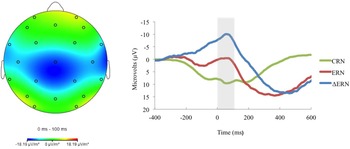
Continuous EEG was recorded using a 32-channel Biosemi system based on the 10/20 system. Data were processed offline with Brain Vision Analyzer (Brain Products, Gilching, Germany). EEG data were referenced to the nose, and high and low pass were filtered at .1 and 30 Hz, respectively. Segments were extracted from the continuous EEG, beginning 500 ms prior to responses. ERP data were corrected for eye movements and blinks using the Gratton, Coles, and Donchin (Reference Gratton, Coles and Donchin1983) method. Artifacts were automatically rejected if a voltage step of more than 50 μV between data points occurred, or if a voltage difference of less than 0.5 μV within a 100-ms interval occurred. After this, data were visually inspected for remaining artifacts. ERP averages were created for incorrect and correct trials. Only errors of commission were classified as incorrect. The baseline of the average activity from –500 to –300 ms prior to the response was subtracted from each data point. The ERN was examined as the difference between the mean amplitude on error relative to correct trials (ΔERN; see Figure 1)Footnote 1 in the window from 0 to 100 ms after the response, at electrode CzFootnote 2 where the difference between error and correct trials was maximal. ERP and behavioral results have been previously reported in the full sample (Meyer et al., Reference Meyer, Hajcak, Torpey, Kujawa, Kim and Bufferd2013; Torpey et al., Reference Torpey, Hajcak, Kim, Kujawa and Klein2012, Reference Torpey, Hajcak, Kim, Kujawa, Dyson and Olino2013).
(Color online) Topographic map of activity (error minus correct) on the left; and response-locked event-related potential waveforms for correct and error trials, as well as the difference waves at electrode Cz on the right.

Data analysis
To examine whether error monitoring moderates longitudinal associations between preschool persistent irritability and later internalizing outcomes in middle/late childhood, multiple regression analysis was performed, in which the dependent variable was child internalizing symptoms at age 9 and independent variables included demographics (child gender and age at ERN assessment), age 3 symptoms (broadband internalizing, externalizing, and persistent irritability), and age 9 externalizing symptoms, number of errors committed, and the interaction between ΔERN and age 3 irritability. As previously mentioned, we included age 3 internalizing and externalizing symptoms to ensure that we were examining the subsequent development of, rather than the continuation of preexisting, internalizing and externalizing symptoms at age 9. We included age 9 externalizing symptoms in order to identify unique predictors of internalizing symptoms, given their frequent occurrence with internalizing symptoms. We included age at the ERN assessment and number of errors committed as covariates in the model given their significant associations with the ΔERN and ERN and the significant association of number of errors with internalizing symptoms at age 9 (see Table 1). To determine whether error monitoring moderates associations between preschool persistent irritability and later externalizing outcomes, we repeated the multiple regression with age 9 externalizing symptoms as the dependent variable, and replaced age 9 externalizing symptoms with age 9 internalizing symptom as an independent variable. In addition, as follow-up analyses, we repeated the multiple regressions, replacing age 9 internalizing and externalizing symptoms as the dependent variable with each of their respective subscales (internalizing: anxious/depressed, withdrawn/depressed, and somatic complaints; and externalizing: attention problems, aggressive behavior, and rule breaking). We continued to adjust for age 3 internalizing and externalizing in these models as some of the subscales in the CBCL 1½–5 do not correspond to the subscales in the CBCL 6–18.
Descriptive statistics and bivariate associations between variables
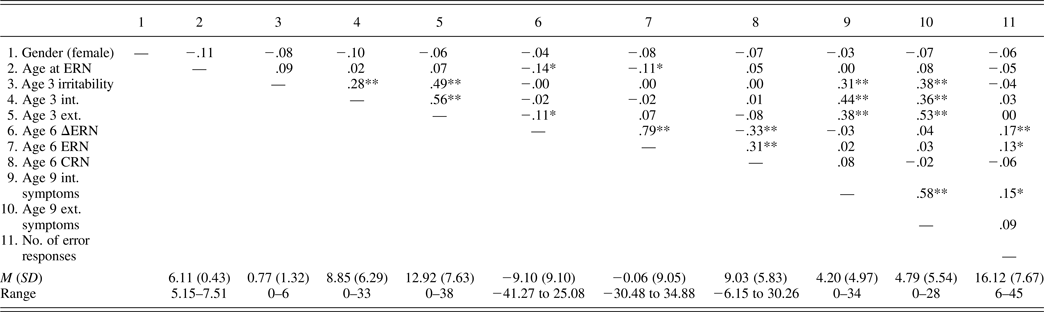
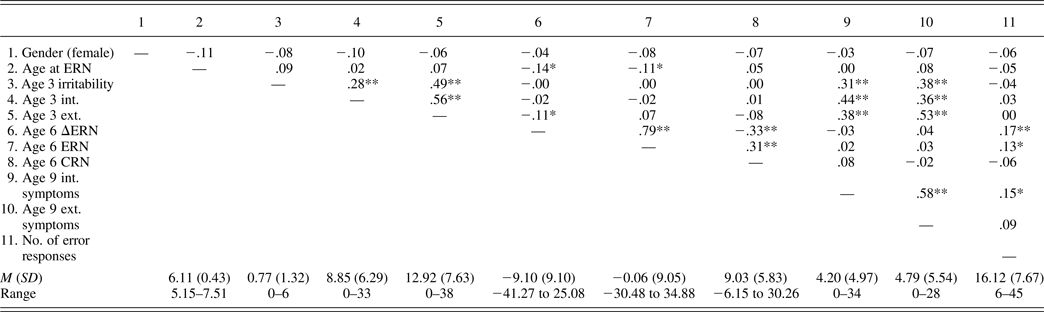
Note: ERN, error related negativity; CRN, correct response negativity.
*p ≤ .05. **p < .01.
Results
Table 1 presents the descriptive statistics and the bivariate correlations of the major study variables. As expected, internalizing and externalizing symptoms at both ages 3 and 9 showed moderate concurrent associations. From age 3 to age 9, both internalizing and externalizing symptoms showed moderate between-construct associations. Consistent with the literature (Dougherty et al., Reference Dougherty, Smith, Bufferd, Stringaris, Leibenluft and Carlson2013, Reference Dougherty, Smith, Bufferd, Kessel, Carlson and Klein2015; Leadbeater & Homel, Reference Leadbeater and Homel2015), age 3 persistent irritability was moderately positively correlated with both concurrent and later internalizing and externalizing symptoms. Both the ΔERN and the ERN were correlated with age and total number of errors, such that a greater differentiation between error and correct trials and a larger negativity to errors was associated with older age and fewer errors. Errors were also associated with greater age 9 internalizing symptoms. A smaller (or more blunted) ΔERN was associated with greater age 3 externalizing symptoms.
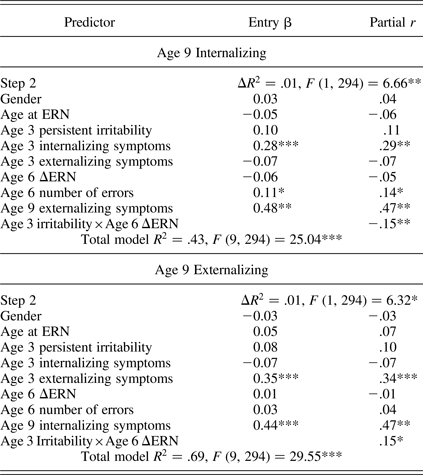
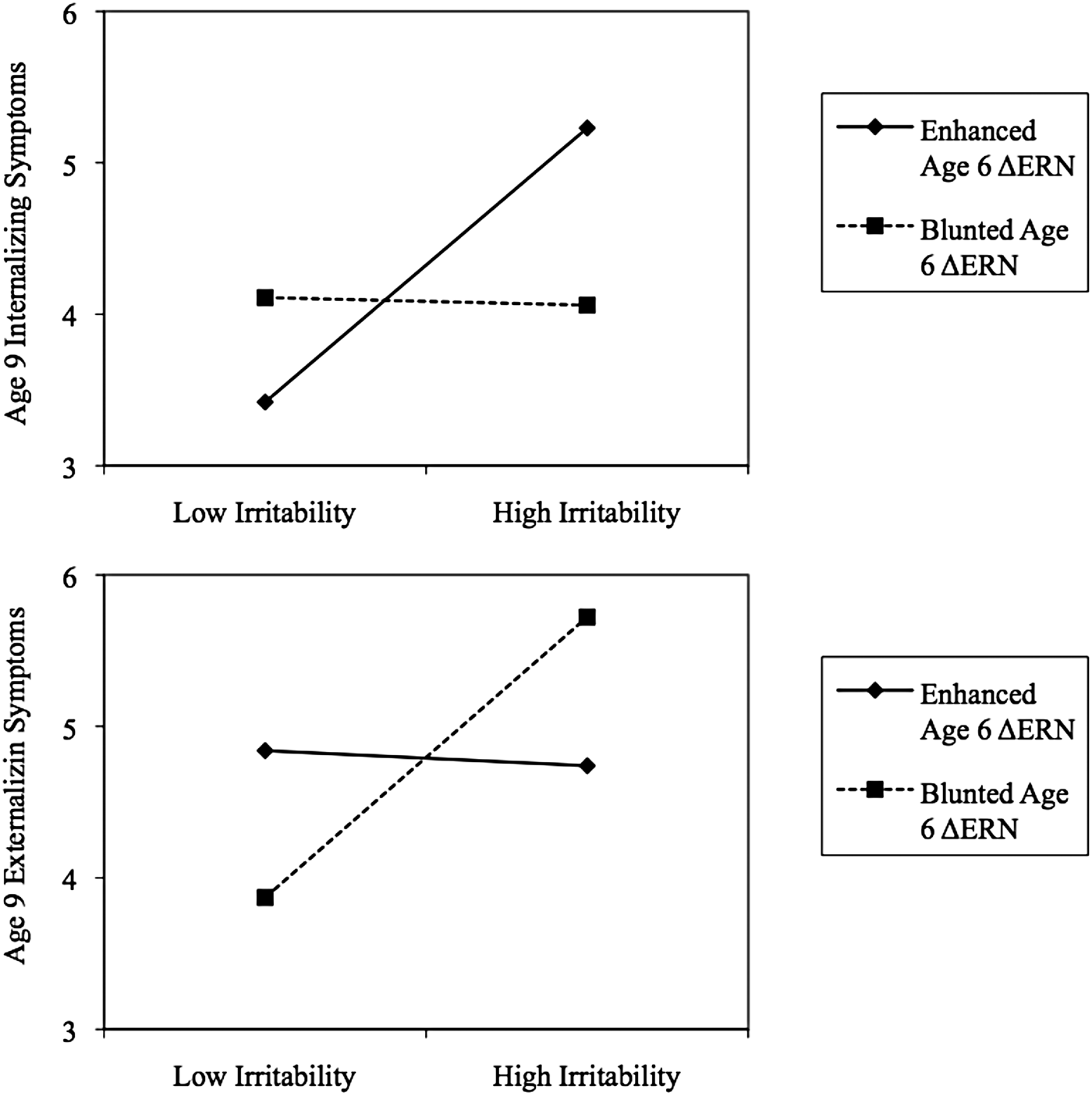
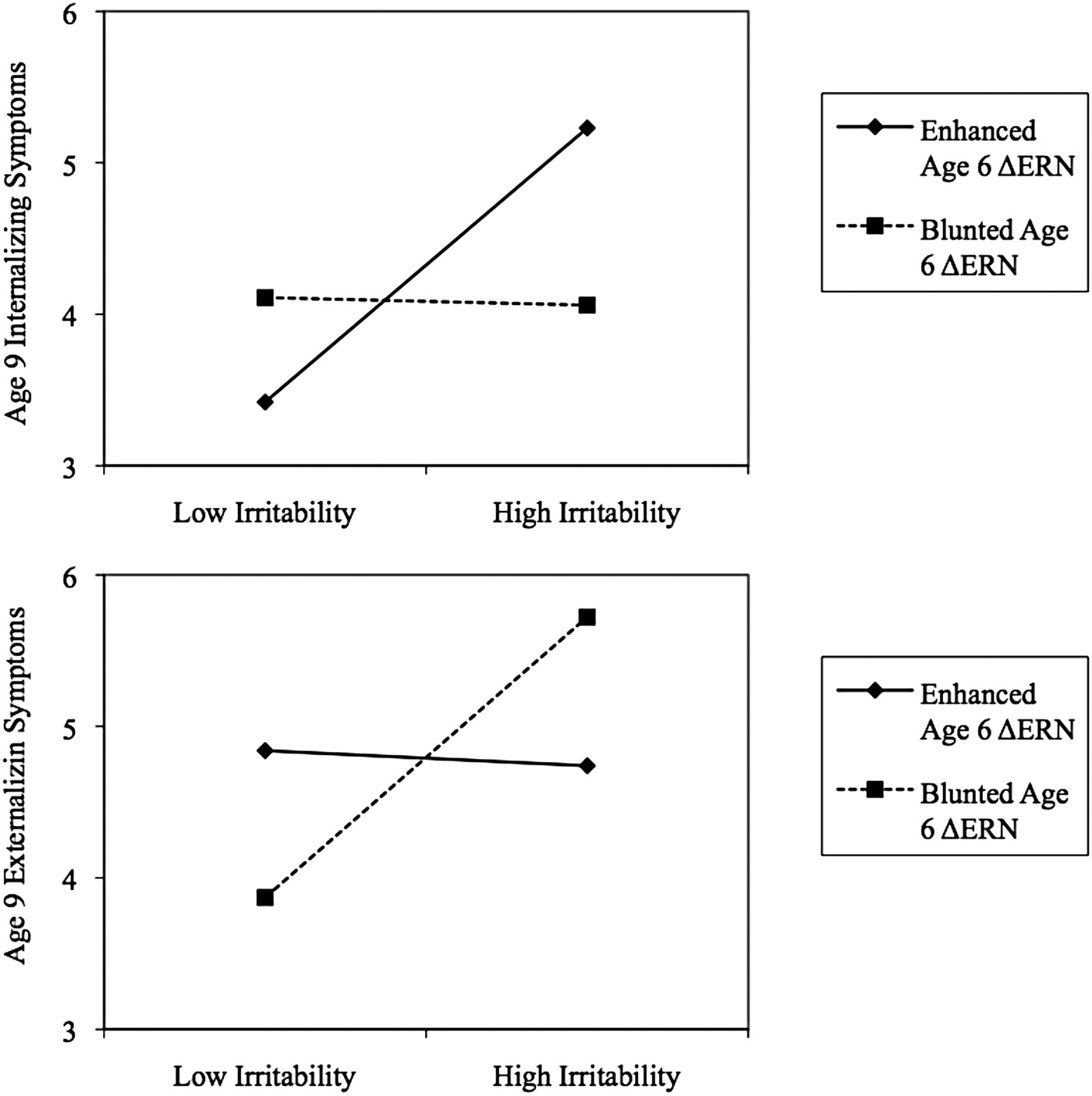
A multiple regression analysis was computed with demographic variables (gender and age at ΔERN assessment), age 3 internalizing and externalizing symptoms, age 6 go/no-go behavioral performance, and age 9 externalizing symptoms to examine whether the ΔERN at age 6 moderates the longitudinal association between age 3 persistent irritability and age 9 internalizing symptoms. Entry standardized regression coefficients, partial rs, ΔR 2, and total model R 2, are presented in Table 2. Greater age 3 internalizing symptoms, age 9 externalizing symptoms, and go/no-go errors significantly predicted greater age 9 internalizing symptoms. There were no significant main effects of the ΔERN or age 3 persistent irritability on age 9 internalizing symptoms. However, the interaction between early persistent irritability and the ΔERN was significant. To probe this interaction, simple slope terms were tested (Aiken, West, & Reno, Reference Aiken, West and Reno1991; see Figure 1). For children with a more enhanced or negative ΔERN, greater early persistent irritability predicted increased internalizing symptoms at age 9 (b = 0.69, t = 2.90, p = .004). However, among children with a smaller, or more blunted, ΔERN, greater early persistent irritability did not predict age 9 internalizing symptoms (b = –0.02, t = –0.10, p = .91). To determine the values of irritability at which varying levels of ΔERN differ significantly on age 9 internalizing symptoms, we conducted a regions of significance test (RoS; Hayes & Matthes, Reference Hayes and Matthes2009). The RoS revealed that when irritability was 0.74 SD above the mean, an enhanced ΔERN was associated with an increase in internalizing symptoms.
Multiple regressions with interactions between age 3 persistent irritability and age 6 change in error related negativity (ΔERN) predicting children's internalizing and externalizing symptoms at age 9
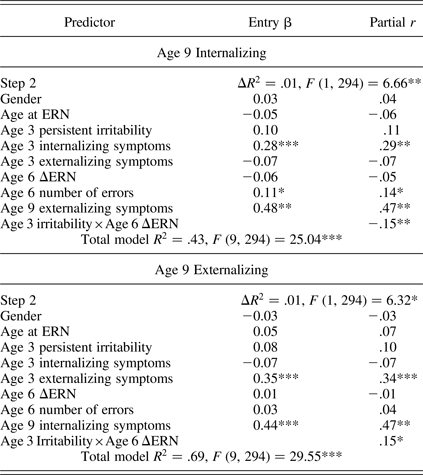
*p ≤ .05. **p < .01. ***p < .001.
Next, we reran the model to examine change in age 9 externalizing symptoms, while controlling for age 9 internalizing symptoms (see Table 2). Greater age 3 externalizing and age 9 internalizing symptoms significantly predicted greater age 9 externalizing symptoms. There were no significant main effects of the ΔERN or age 3 persistent irritability on age 9 externalizing symptoms. However, the interaction between age 3 persistent irritability and ΔERN significantly predicted age 9 externalizing symptoms (see Figure 2). For children with a smaller or less negative ΔERN, greater early persistent irritability predicted increased externalizing symptoms (b = 0.71, t = 2.04, p = .04). However, there was no significant association between early persistent irritability and age 9 externalizing symptoms in children with a greater or more enhanced ΔERN (b = 0.01, t = 0.04 p = .83). The RoS revealed that when irritability was 1.96 SD above the mean, a blunted compared to an enhanced ΔERN was associated with an increase in externalizing symptoms.
Significant interactions between early persistent irritability and the age 6 ΔERN at one standard deviation above and below the mean in predicting age 9 internalizing (top) and externalizing (bottom) symptoms. ERN, Error related negativity.
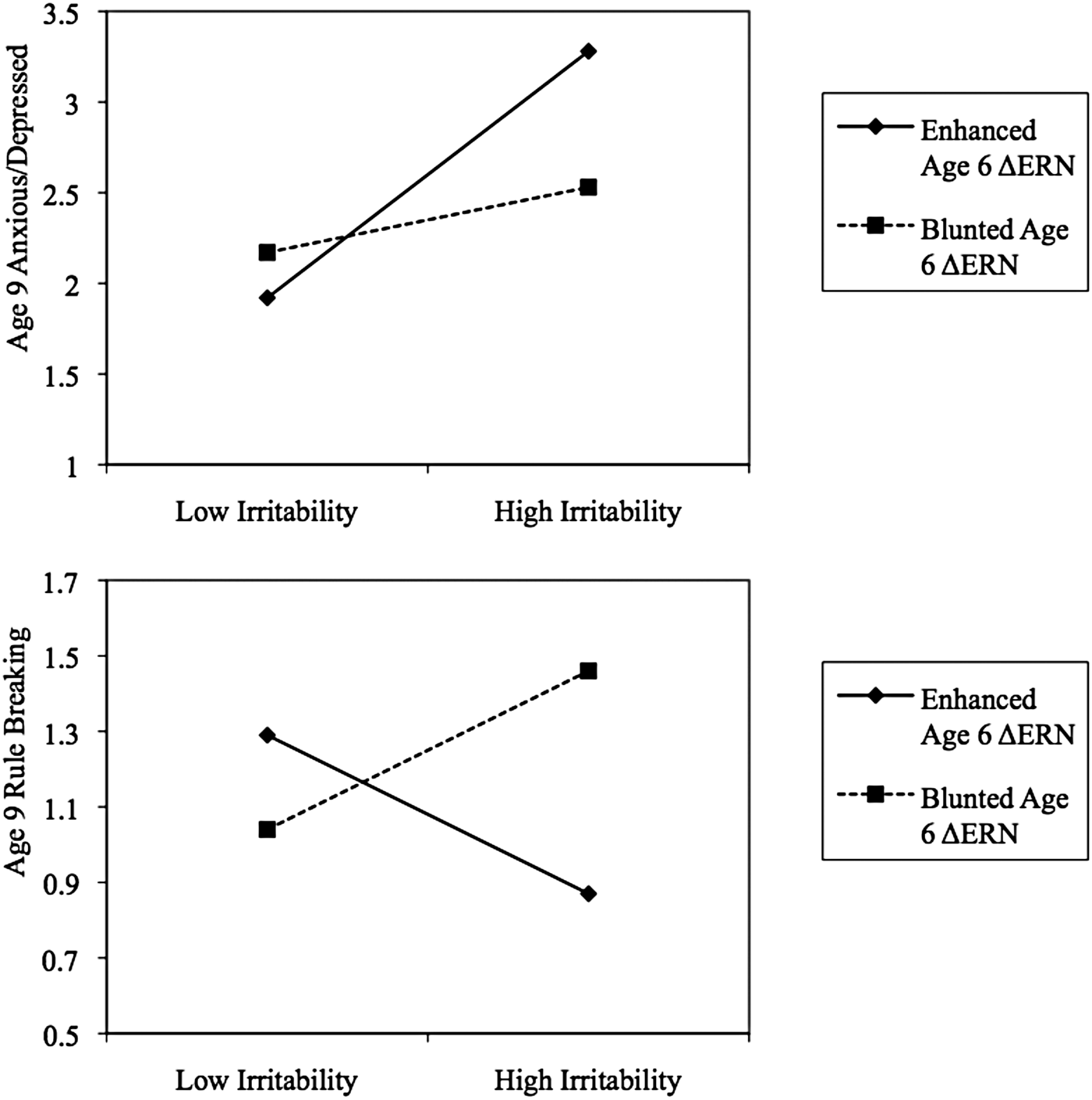
To further examine the specificity of the interaction between early persistent irritability and the ΔERN on age 9 internalizing symptoms, we reran the model examining the development of age 9 internalizing symptoms three more times, replacing age 9 internalizing symptoms with the CBCL anxious/depression, withdrawn/depression, and somatic complaints subscales as the dependent variable. There was a significant interaction between age 3 persistent irritability and ΔERN predicting age 9 anxious/depression (partial r = –.13, p < .05). For children with a larger or more negative ΔERN, greater early persistent irritability predicted increased anxious/depression (b = 0.54, t = 3.61, p < .001; see Figure 3). There was no significant association between early persistent irritability and age 9 anxious/depression in children with a smaller or less negative ΔERN (b = 0.14, t = 0.95 p = .34). There were no significant interactions between age 3 persistent irritability and ΔERN predicting withdrawn/depression (p = .18) or somatic complaints (p = .07). The RoS revealed that when irritability was 0.91 SD above the mean, an enhanced compared to a blunted ΔERN was associated with an increase in anxious/depression.
Significant interactions between early persistent irritability and the age 6 ΔERN at one standard deviation above and below the mean in predicting age 9 (top) anxious/depression and (bottom) rule-breaking symptoms. ERN, Error related negativity.

Finally, to examine the specificity of the interaction on age 9 externalizing symptoms, we also reran the model examining the development of age 9 externalizing symptoms three more times, replacing age 9 externalizing symptoms with the CBCL attention problems, aggressive behavior, and rule breaking subscales as the dependent variable. There was a significant interaction between age 3 persistent irritability and ΔERN predicting age 9 rule breaking (partial r = .17, p < .001). For children with a smaller or less negative ΔERN, greater early persistent irritability predicted increased rule breaking (b = 0.17, t = 2.22, p < .05; see Figure 3). There was also a significant negative association between early persistent irritability and age 9 rule breaking in children with a larger or more negative ΔERN (b = –0.15, t = –1.94, p = .05), such that greater early persistent irritability predicted less rule breaking. There were no significant interactions between age 3 persistent irritability and ΔERN predicting attention problems (p = .93) or aggressive behavior (p = .07). The RoS revealed that when irritability was 0.40 SD above the mean, a blunted compared to an enhanced ΔERN was associated with an increase in rule-breaking behavior.
Discussion
The current study used a multilevel approach to explore how irritability, a transdiagnostic construct that likely contributes to comorbidity, leads to a broad range of multifinal outcomes. We examined if individual differences in the ΔERN, a neural indicator of error monitoring, can predict whether early persistent irritability (a prototypical transdiagnostic construct) is associated with later internalizing versus externalizing outcomes. We found that among children with higher levels of irritability at age 3, an enhanced or more negative ΔERN at age 6 predicted the development of more internalizing symptoms at age 9, whereas a blunted ΔERN at age 6 predicted the development of more externalizing symptoms at age 9. These longitudinal associations were evident after adjusting for preexisting internalizing and externalizing symptoms at age 3.
Prior research indicates that the ΔERN has opposing associations with externalizing and internalizing psychopathology (Hall et al., Reference Hall, Bernat and Patrick2007; Olvet & Hajcak, Reference Olvet and Hajcak2008; Stieben et al., Reference Stieben, Lewis, Granic, Zelazo, Segalowitz and Pepler2007). However, our findings are the first to suggest that in the same group of children, variation in the ΔERN can predict internalizing versus externalizing outcomes over the course of childhood. Thus, in contrast to several commonly researched biomarkers, such as the P300 and diminished autonomic responding, which likely reflect a general vulnerability to psychopathology (Beauchaine & Thayer, Reference Beauchaine and Thayer2015), individual differences in the ΔERN reflect a more specific vulnerability and can distinguish between internalizing and externalizing psychopathology.
Our data raise the possibility that the degree to which children with persistent irritability monitor their behavior, as indexed by the ΔERN at age 6, influences how their emotional distress is experienced and expressed. The ΔERN currently appears as a measure in three RDoC domains: cognitive systems (cognitive control), negative valence systems (sustained threat), and positive valence systems (reward learning). Unfortunately, RDoC does not address the relationships, overlap, or interaction between domains. Thus, it is not clear if the ΔERN fits into any one domain better than others do or whether it derives from multiple, interacting biobehavioral systems. For example, irritable children who engage in more intensive self-monitoring, as indexed by a potentiated or more negative ΔERN at age 6, may be more sensitive to threat and prone to fear and anxiety, and/or they have greater cognitive control resources to inhibit angry and acting-out behavior. Conversely, young children who have a propensity to experience high levels of negative emotional reactivity but who do not monitor their performance may be disinhibited in expressing their distress because of deficient cognitive control and/or a lack of concern about the consequences of their behavior, and therefore manifest it externally in the form of conduct problems.
In the current study, early persistent irritability was associated with both later internalizing and externalizing symptoms. As noted earlier, there is an emerging body of research suggesting that there is a general psychopathology factor that accounts for the shared association between internalizing and externalizing (Caspi et al., Reference Caspi, Houts, Belsky, Goldman-Mellor, Harrington and Israel2014; Lahey et al., Reference Lahey, Applegate, Hakes, Zald, Hariri and Rathouz2012, Reference Lahey, Rathouz, Keenan, Stepp, Loeber and Hipwell2015; Olino et al., Reference Olino, Dougherty, Bufferd, Carlson and Klein2014). This factor is believed to reflect the liability to develop a broad range of psychopathologies (Caspi et al., Reference Caspi, Houts, Belsky, Goldman-Mellor, Harrington and Israel2014; Lahey et al., Reference Lahey, Applegate, Hakes, Zald, Hariri and Rathouz2012). Studies have shown that childhood negative emotionality and emotional dysregulation constructs that overlap substantially with irritability are salient early developmental features of the general factor (Caspi et al., Reference Caspi, Houts, Belsky, Goldman-Mellor, Harrington and Israel2014; Olino et al., Reference Olino, Dougherty, Bufferd, Carlson and Klein2014; Rhee et al., Reference Rhee, Lahey and Waldman2015). Thus, it is plausible that early persistent irritability reflects a nonspecific liability to develop psychopathology (Mulraney et al., Reference Mulraney, Melvin and Tonge2014), and it is the interplay with other biological and environmental factors, such as the ΔERN, that steers the expression of this propensity along a continuum from internalizing to externalizing problems.
There was no main effect of irritability on the ΔERN, suggesting that irritability observed in very young children is heterogeneous with respect to error monitoring. Thus, it remains unclear why some irritable children have a relatively more enhanced or blunted ΔERN. Recent evidence indicates that the ΔERN is heritable (Anokhin, Golosheykin, & Heath, Reference Anokhin, Golosheykin and Heath2008), but the environment also influences its development as harsh parenting (Meyer, Proudfit, Bufferd, et al., Reference Meyer, Proudfit, Bufferd, Kujawa, Laptook and Torpey2015) and uncertainty (Jackson, Nelson, & Proudfit, Reference Jackson, Nelson and Proudfit2015) have been found to potentiate the ΔERN.
In addition, the ΔERN at age 6 did not predict increases in either externalizing or internalizing symptoms in the absence of persistent irritability, suggesting that it is the combination of irritability and variation in error monitoring that contribute to the development of later internalizing and externalizing symptoms. Similar results have been previously found in the context of BI (a temperament profile associated with risk for anxiety disorders) such that an enhanced ERN predicted the development of anxiety symptoms only among children who had a history of high BI (Lahat et al., Reference Lahat, Lamm, Chronis-Tuscano, Pine, Henderson and Fox2014; McDermott et al., Reference McDermott, Perez-Edgar, Henderson, Chronis-Tuscano, Pine and Fox2009).
Our findings that, in irritable children, an increased ΔERN predicted increases in internalizing while a diminished ΔERN predicted increases in externalizing symptoms suggests that variation in the ΔERN may not exist on a continuum that ranges from normal to abnormal functioning, but rather that it may be related to differences in behavioral styles associated with cognitive control, sustained threat, and/or reward learning that may not be pathological on their own, but interact with or possibly even shape the specific expression of a more general liability for psychopathology, like irritability.
The follow-up analyses examining the specificity of early irritability and the ΔERN with respect to internalizing and externalizing outcomes suggest that our findings apply most specifically to anxious/depression symptoms and rule-breaking behaviors, respectively. We also found that persistently irritable children who demonstrated an increased ΔERN at age 6 went on to develop fewer rule-breaking behaviors at age 9. An enhanced ΔERN may therefore also play a protective role against the development of at least some forms of externalizing behaviors. The fact that the ΔERN did not interact with early persistent irritability to predict symptoms of withdrawn/depression or somatic complaints is in line with an accumulating body of research that suggests that associations between ΔERN and internalizing disorders may be primarily driven by the presence of punishment sensitivity that is most characteristic of anxiety disorders, and that the motivational deficits observed in some forms of depression (e.g., anhedonic depression) may blunt the ΔERN (Weinberg et al., Reference Weinberg, Klein and Hajcak2012, Weinberg, Kotov, & Proudfit, Reference Weinberg, Kotov and Proudfit2015). However, the lack of longitudinal associations among early irritability, the ΔERN, and withdrawn/depression may also be due to the restricted range of depressive symptoms in our sample, owing to the young age of the children. Finally, childhood irritability, anxiety, and externalizing disorders all predict depressive disorders in adolescence and adulthood (Cummings et al., Reference Cummings, Caporino and Kendall2014; Stringaris & Goodman, Reference Stringaris and Goodman2009; Stringaris et al., Reference Stringaris, Cohen, Pine and Leibenluft2009). Because an enhanced and blunted ΔERN have both been associated with depression in adults (Chiu & Deldin, Reference Chiu and Deldin2007; Holmes & Pizzagalli, Reference Holmes and Pizzagalli2008, Reference Holmes and Pizzagalli2010; Weinberg et al., Reference Weinberg, Klein and Hajcak2012), it is conceivable that both developmental pathways from early irritability to age 9 internalizing and externalizing symptoms may subsequently converge on depressive outcomes in adolescence or adulthood. However, it will be necessary for future longitudinal studies to examine this possibility.
Although a more blunted ΔERN has previously been linked to aggression (von Borries et al., Reference von Borries, Brazil, Bulten, Buitelaar, Verkes and De Bruijn2010) and ADHD (Van De Voorde et al., Reference Van De Voorde, Roeyers and Wiersema2010), we found no association between the combination of early irritability and a blunted ΔERN to predict their subsequent development. Heterogeneity in aggressive behaviors and attention problems may account for these discrepancies (Dias et al., Reference Dias, Iyer, Carpenter, Cary, Wilson and Mitchel2015; Stieben et al., Reference Stieben, Lewis, Granic, Zelazo, Segalowitz and Pepler2007). For example, persistently irritable children are more likely to exhibit reactive aggression or anger in response to a perceived threat (Berkowitz, Reference Berkowitz1983; Dodge, Reference Dodge1980), which may have dissociable neural correlates from proactive or instrumental aggression characterized by a blunted ΔERN (Stieben et al., Reference Stieben, Lewis, Granic, Zelazo, Segalowitz and Pepler2007).
This study had several strengths. First, we used dimensional measures of internalizing and externalizing symptoms and multiple level of analysis (e.g., neural measures such as the ΔERN) to understand how transdiagnostic factors, such as irritability, lead to multifinality. This approach can guide further exploration of the mechanisms by which other transdiagnostic factors lead to multiple outcomes. Second, we used an unselected community sample, which is important because irritability is common in the course of development. Third, our sample size was large enough and had enough statistical power to examine irritability by ΔERN interactions. Fourth, our prospective longitudinal design allowed us to examine development over a 6-year period.
Despite these strengths, this study also has limitations. First, because there is no validated measure for persistent irritability in preschoolers, we derived our own measure using items from a well-validated diagnostic interview (Egger et al., Reference Egger, Erkanli, Keeler, Potts, Walter and Angold2006) and guided by the content of a well-validated scale for irritability in older children (Stringaris et al., Reference Stringaris, Goodman, Ferdinando, Razdan, Muhrer and Leibenluft2012). Although it was derived ad hoc, our measure has shown good concurrent and predictive validity in previous reports from our group (Dougherty et al., Reference Dougherty, Smith, Bufferd, Stringaris, Leibenluft and Carlson2013, Reference Dougherty, Smith, Bufferd, Kessel, Carlson and Klein2015) and others (Brotman et al., Reference Brotman, Schmajuk, Rich, Dickstein, Guyer and Costello2006; Copeland et al., Reference Copeland, Angold, Costello and Egger2013). Second, we did not examine current manifestations of persistent irritability; thus, we are unable to determine whether and the degree to which variation in the ΔERN influenced the homotypic continuity of irritability. Third, we were unable to assess ΔERN at age 3; hence, we cannot determine how early in development error monitoring begins to influence the link between irritability and internalizing and externalizing symptoms.
The present study is the first to examine the developmental mechanisms through which the transdiagnostic construct of irritability leads to subsequent internalizing and externalizing psychopathology across childhood. Our results suggest that variation in a neural index of error monitoring differentiates, and may even shape, developmental trajectories from preschool persistent irritability to internalizing and externalizing outcomes in middle to late childhood. They also point to the possible utility of using the ΔERN to anticipate which direction a persistently irritable child's subsequent psychopathology is likely to take in order to inform prevention and intervention efforts. An enhanced ΔERN may indicate that a child with persistent irritability will go on to develop primarily internalizing manifestations of psychopathology, whereas a blunted ΔERN may indicate the subsequent development of externalizing psychopathology. These findings underscore the importance of considering the dynamic interplay of different units of analysis across development when examining transdiagnostic constructs and multifinality in youth psychopathology.