Annual incidence of sudden cardiac death (SCD) in Germany is estimated to be 81 per 100,000 persons with higher incidence in men (69 percent) than women (31 percent) (Reference Martens, Sinner, Siebermair, Raufhake, Beckmann and Veith1). Sustained ventricular tachycardia (VT) or ventricular fibrillation (VF) are preceding detectable rhythmic disorders that might lead to sudden cardiac arrest (SCA) and subsequently SCD. VT/VF events were causal in 40 percent of patients with an outpatient cardiac arrest (Reference Sasson, Rogers, Dahl and Kellermann2). The systematic review of Sasson et al. (Reference Sasson, Rogers, Dahl and Kellermann2) reported a pooled survival rate to hospital admission of 23.4 percent and a pooled survival rate to hospital discharge of 7.6 percent for patients after SCA. Only 53 percent of cases were witnessed by bystanders, whereby 32 percent of patients received bystander initiated cardiopulmonary resuscitation (Reference Sasson, Rogers, Dahl and Kellermann2). Based on these numbers, about 50 percent of patients with a SCA remain without immediate and adequate treatment. VT/VF events can be terminated by defibrillation, whereby time to defibrillation correlates with survival. According to Nolan et al. (Reference Nolan, Soar, Zideman, Biarent, Bossaert and Deakin3), each minute of delay before defibrillation reduces the probability of survival to discharge by 10–12 percent.
In 2000, the first wearable cardioverter-defibrillator (WCD) received CE mark in Europe and was approved in 2001 by the United States Food and Drug Administration. Currently, the sole WCD is the LifeVest manufactured by ZOLL Inc., version 4000 and earlier. A detailed description of the LifeVest has been given elsewhere (Reference Klein, Meltendorf, Reek, Smid, Kuss and Cygankiewicz4). The aim of the WCD is to defibrillate timely in the case of a SCA caused by sustained VT/VF, whereby a conscious patient can withhold a shock by pressing two response buttons. All patients are registered into the LifeVest Network, a registry maintained by ZOLL Inc.. Patients sign consent to use their data for research purposes and these deidentified data are commonly used in non-comparative trials. The WCD should be worn all-day long by patients with a potentially temporary high-risk as a bridging method until a final treatment decision can be made (Reference Piccini, Allen, Kudenchuk, Page, Patel and Turakhia5). Medical guidelines recommend the use of a WCD in primary and secondary prevention in patients with ischemic as well as non-ischemic cardiomyopathy indications (class IIa to IIb and LoE C to B-NR) (Reference Al-Khatib, Stevenson, Ackerman, Bryant, Callans and Curtis6). In fall 2018, the results of the first randomized-controlled trial (VEST-trial) in patients after myocardial infarction (MI) were published (Reference Olgin, Pletcher, Vittinghoff, Wranicz, Malik and Morin7). We performed a comprehensive health technology assessment (HTA) with the following aims:
(1) Assess the effectiveness, efficacy, and safety of the WCD in adult persons with high risk for SCD compared to standard treatment considering mortality, morbidity, quality of life (QoL), and safety end points.
(2) Assess the cost-effectiveness of the wearable defibrillator in adult persons with high risk for SCD compared to standard treatment from societal and payer's perspective.
(3) Assess relevant psychosocial, ethical, organizational, and legal aspects of the use of the wearable defibrillator.
Here, we report the results of the HTA concerning effectiveness, efficacy, and safety of the WCD.
Methods
Applied methods are in accordance with manuals for the conduction of HTA in Germany (8;9).
Study population was defined as adult patients with a high risk for SCA and a temporary need for protection for which an implantable cardioverter-defibrillator (ICD) is currently not applicable. Intervention to assess was the WCD LifeVest of ZOLL Inc., version 4000 and earlier versions, currently the only WCD in the market. The WCD was compared to the standard therapy of SCA defined as external defibrillation at home or at public places by bystanders, in-hospital monitoring, or resuscitation by an emergency unit. Implantation of defibrillators, optimization of medical treatment, or catheter ablation are not considered as comparators, as an ICD is usually not indicated when a WCD is used and the other options are not suitable for acute defibrillation in case of a SCA. Furthermore, optimal medical treatment is mandatory for all patients. Outcomes of interest were total mortality, arrhythmia-related mortality, incidence of VT/VF events, appropriate shocks, successful termination of VT/VF events, avoided ICD implantations, improvement of left ventricular ejection fraction (LVEF), QoL as well as compliance, inappropriate shocks, unsuccessful shocks, adverse events, and reasons for termination of WCD use.
We performed literature search on 19 October 2018 in Medline and Embase via ProQuest and on 31 October 2018 in the Cochrane Library as well as the CRD databases. The following search terms were entered and combined by the operator “OR”: “wearable cardioverter defibrillator,” “wearable cardiac defibrillator,” “LifeVest,” “Life Vest,” “wearable defibrillator,” “external defibrillator jacket,” “defibrillator vest,” “portable cardioverter,” “portable defibrillator,” “WCD,” and “lifecor.” Two reviewers independently selected identified publications according to predefined inclusion and exclusion criteria. Publications without primary or secondary data assessment as letters, editorials, or comments were excluded as well as conference abstracts such as they do not give sufficient information concerning study design and potential study limitations. Studies in children and publications not written in English or German language were excluded as well. The HTA reported here aimed to focus on the German care situation. Therefore, additionally to all prospective trials and all retrospective multicenter studies with >2 centers, data of retrospective German studies with ≤2 centers were included, as well. Reviews that did not fulfill methodological standards (e.g., description of a systematic literature search) were not considered. Selection was performed by a two-step approach, first by screening title and abstracts and afterward by screening the full text of eligible articles. The study quality of randomized-controlled trial (RCT) and non-randomized comparative trial (nrCT) was assessed by means of published quality checklists. The study quality of non-comparative trials was assessed using the “Quality Appraisal Tool for Case Series” (Reference Moga, Guo, Schopflocher and Harstall10). Data were extracted and reported separately according to the different evidence levels of included trials. Besides the above-mentioned outcome parameters, data collection included study characteristics, etiology, inclusion and exclusion criteria, demographic data (age, gender, cardiovascular risk factors, and baseline LVEF), and study funding. Due to heterogeneity of included studies and different study types no meta-analysis was performed.
Results
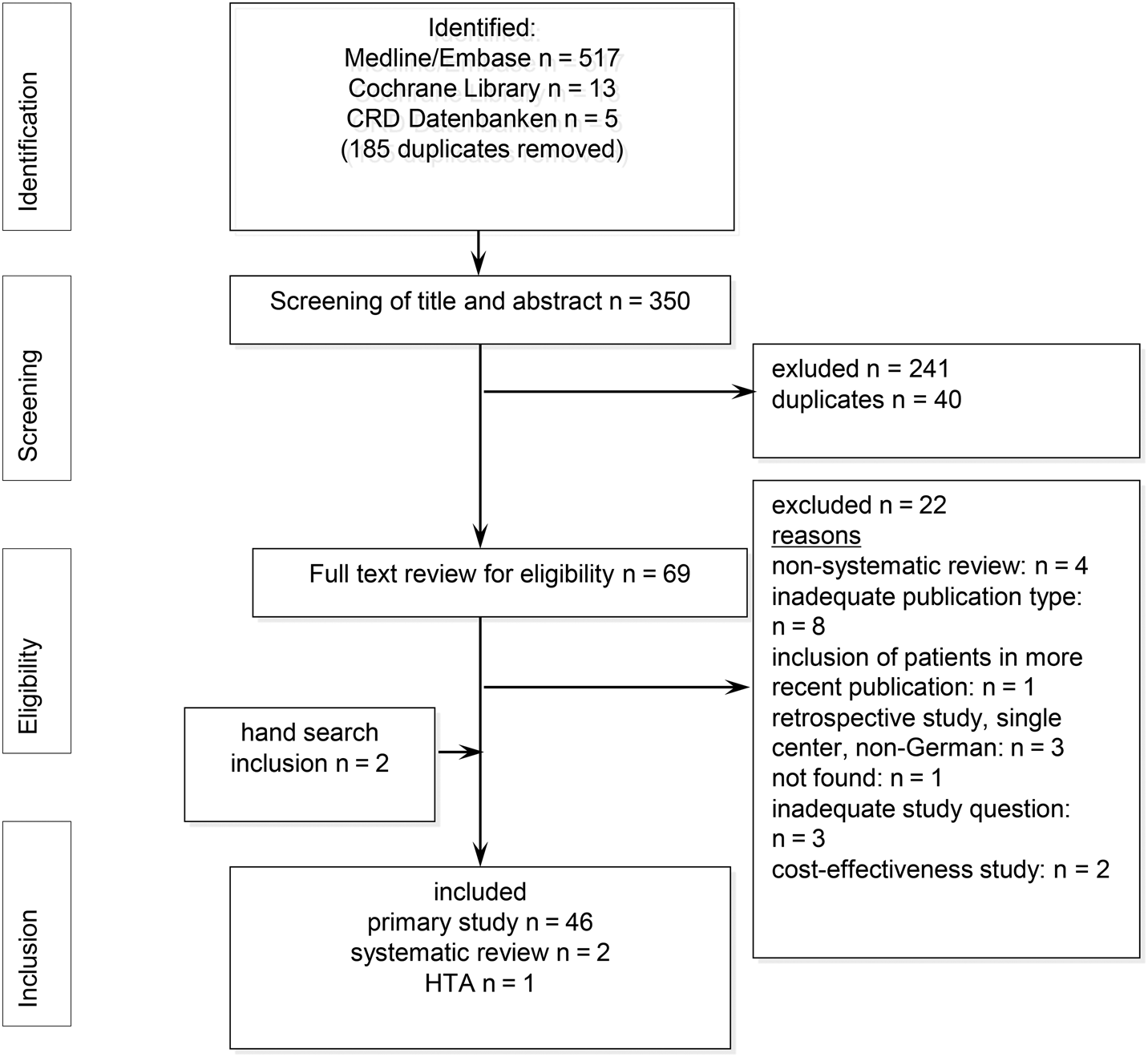
The systematic literature search yielded 350 citations after exclusion of duplicates. After screening of titles and abstracts further forty duplicates were excluded and sixty-nine studies remained for selection by assessing full text. After addition of two citations identified by hand search, forty-six primary studies, two systematic reviews, and one HTA were included for final analysis (see Figure 1). The forty-six primary studies included one RCT (Reference Olgin, Pletcher, Vittinghoff, Wranicz, Malik and Morin7), one nrCT (Reference Zishiri, Williams, Cronin, Blackstone, Ellis and Roselli11), sixteen non-comparative prospective trials (Reference Barraud, Pinon, Laine, Cautela, Orabona and Koutbi12–Reference Sasaki, Shoji, Ishida, Kinjo, Tsushima and Seno27), and twenty-eight non-comparative retrospective trials (4;28–54). The RCT showed a low and the nrCT a high risk of bias. The evidence level of non-comparative trials was estimated to be low and the risk of bias to be high due to the non-comparative study design itself but also due to multiple methodological weaknesses, mainly insufficient description of inclusion and exclusion criteria, lack of reporting of loss-to-follow-up, and unclear definition of outcome measures. A detailed description of the performed quality assessment of all studies is given in the supplementary material.
Flowchart of the selection process.

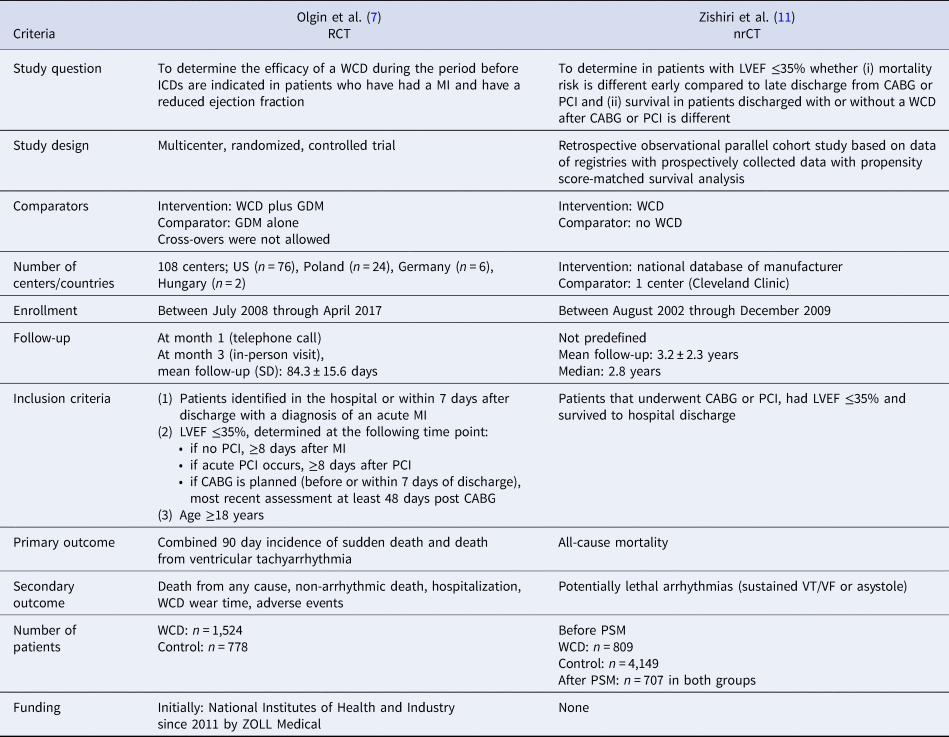
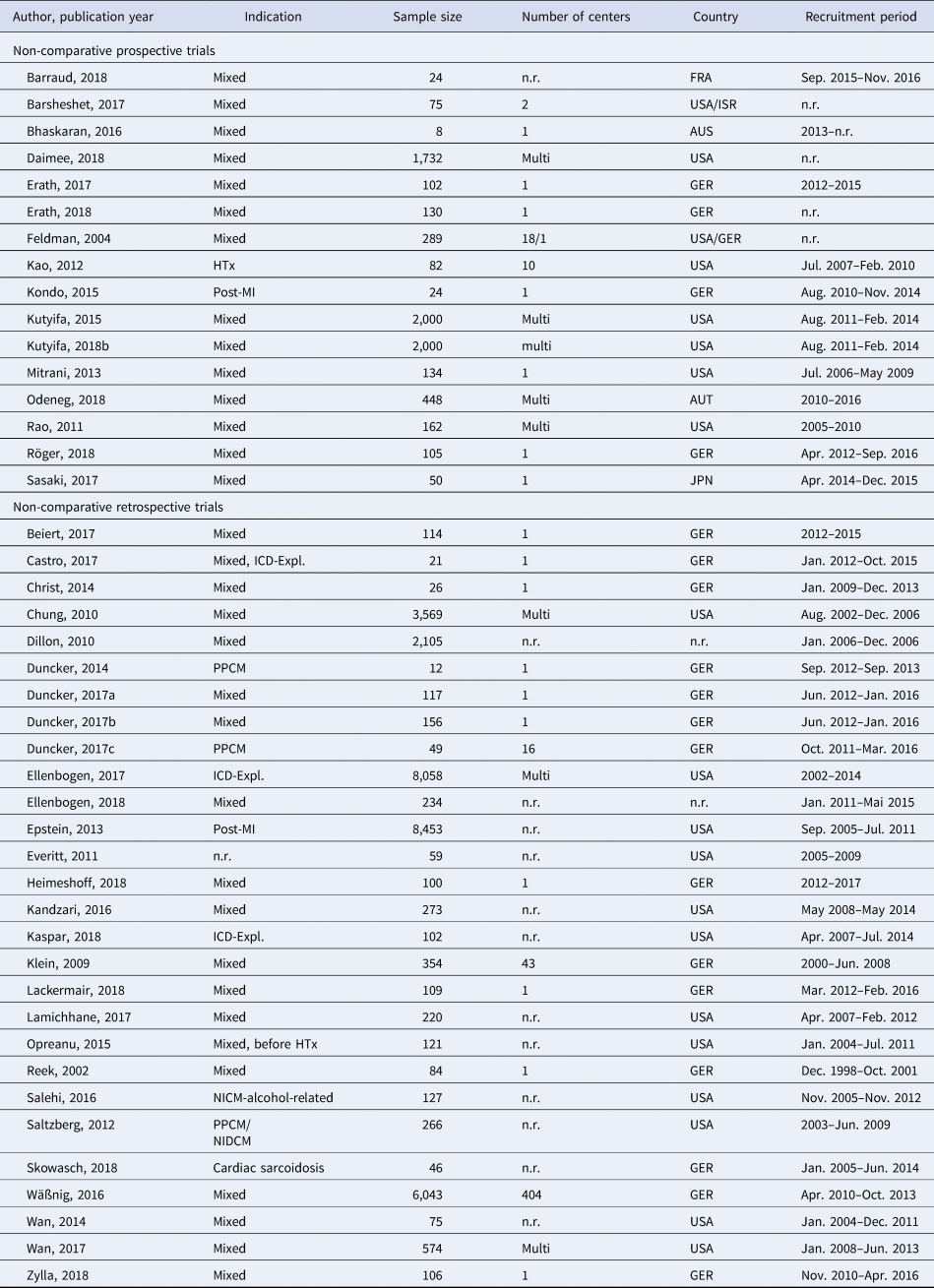
The study design of both comparative studies is presented in Table 1 in detail. Indications, sample size, number of recruiting centers, recruiting countries as well as recruitment period of non-comparative studies are listed in Table 2. Patient recruitment was mainly performed in the USA with 41 percent of studies, followed by Germany with 35 percent of non-comparative studies. Fifty-four percent of the forty-six primary studies were published in the years 2017 and 2018. Funding was mentioned in twenty-three of forty-six primary studies, whereby fourteen studies were funded by the manufacturer of the WCD and in twenty-two studies authors declared affiliation to the manufacturer. Male gender dominated within a range of 56–92 percent of study population, except for studies that investigated women with peripartum cardiomyopathy. Most studies reported median or mean age >50 years. Baseline LVEF was <35 percent with exception of one study that reported baseline LVEF of 57 percent (Reference Sasaki, Shoji, Ishida, Kinjo, Tsushima and Seno27). As the identified systematic reviews and the HTA did not include RCTs their level of evidence was considered to be low. All references that have been considered in these secondary studies are included in our own assessment or were justified excluded, so that the results of the HTA (55;56) and the two systematic reviews (57;58) are not presented here but will be discussed later.
Study design of included comparative trials

CABG, coronary artery bypass graft; GDM, guideline-directed medication; ICD, implantable cardioverter-defibrillator; LVEF, left ventricular ejection fraction; MI, myocardial infarction; n.r., not reported; PCI, percutaneous coronary intervention; PSM, propensity score matching; SD, standard deviation; VF, ventricular fibrillation; VT, ventricular tachycardia; WCD, wearable cardioverter-defibrillator.
Characteristics of non-comparative prospective and retrospective trials

HTx, heart transplantation; ICD-Expl., implantable cardioverter-defibrillator explantation; MI, myocardial infarction; NICM, nonischemic cardiomyopathy; NIDCM, nonischemic dilatative cardiomyopathy; n.r., not reported; PPCM, peripartum cardiomyopathy.
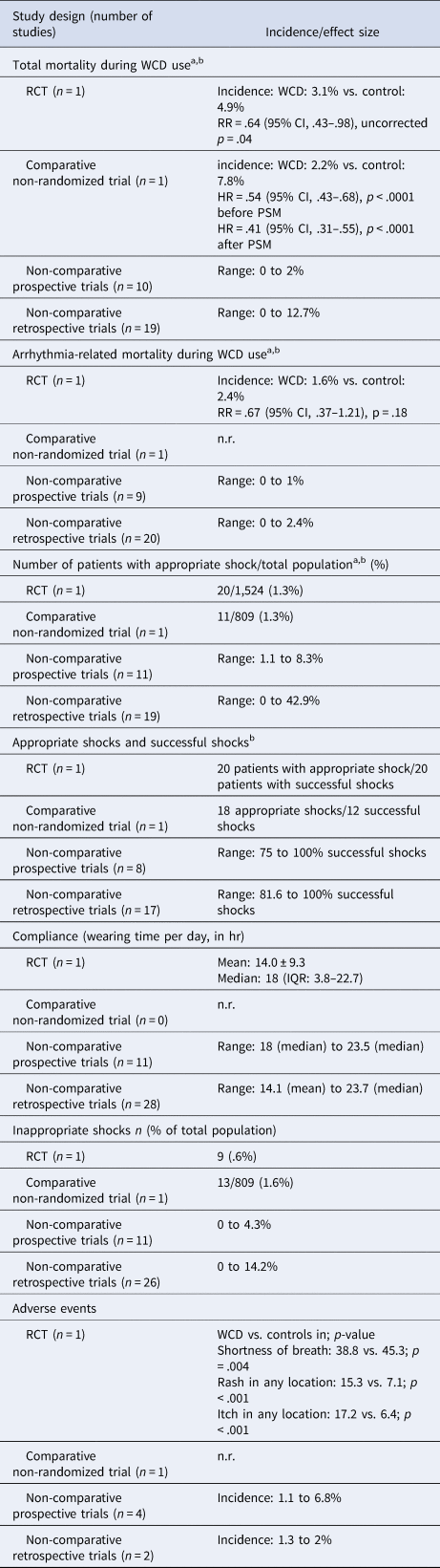
Results for the outcomes total mortality during WCD use, arrhythmia-related mortality during WCD use, percentage of patients with appropriate shock, percentage successful shocks of appropriate shocks, compliance, inappropriate shocks, and adverse events are presented in Table 3. Results of comparative trials suggest that total mortality is significantly reduced during WCD usage, whereas no significant effect was observed for arrhythmia-related mortality. The number of patients with appropriate shock in the total population was rather low (1.3 percent) in comparative trials but must be seen related to the short observation time frame of 1–3 months wear time and showed wider ranges in non-comparative trials. The upper range of 42.9 percent of patients with appropriate shock in total population does not reflect the majority of non-comparative retrospective trials. These data are based on a small sample size (n = 7) of female patients with peripartum cardiomyopathy. Incidence of VT/VF events was reported in non-comparative prospective studies with 0 to 9.2 percent of patients per total study population and 0 to 14.3 percent in non-comparative retrospective studies. Between 75 and 100 percent of shocks were considered as successful, 60 percent of included studies report a success rate of 100 percent.
Results of the main outcome parameters

CI, confidence interval; HR, hazard ratio; IQR, interquartile range; PSM, propensity score matching; RCT, randomized-controlled trial; RR, relative risk; WCD, wearable cardioverter-defibrillator.
a Information based on different wearing lengths of WCD.
b Ranges do not consider studies including study populations with increased mortality due to accompanying illness, e.g., cardiac sarcoidosis (Ellenbogen, 2018, Everitt, 2011, Kandzari, 2016, Skowasch, 2018, Wan, 2014, Wan, 2017).
The VEST-trial found no significant difference between groups with respect to the number of ICD implantations during observation period, but as ICD implantations apart from secondary prevention were not allowed, no difference was expected. According to the nrCT 29 percent of patients received an ICD-implantation, consequently. Fifteen non-comparative prospective and twenty retrospective trials report ICD implantation after study completion within a range of 19.5 to 75.2 percent. To phrase it differently, 25 up to 80 percent of patients do not need an ICD after sufficient waiting time on optimal medical treatment. Improvement of LVEF was reported in a number of non-comparative trials but different thresholds were used, or specifications did not allow to derive, whether a certain threshold was achieved. Eleven non-comparative trials reported the percentage of patients with an improvement > or ≥35 percent LVEF within a range of 0 to 71.4 percent; without two outliers the range lies within 12.6 and 56.4 percent. Both studies reporting outliers, defined as highest and lowest values, were of small sample size what might have influenced the results.
One study reported QoL data as measured by EQ-5D-3L questionnaire and additional free form questions. Based on the results of the EQ-5D-3L 57 to 83 percent of participants stated no problems in the different dimensions of EQ-5D-3L during the usage of the WCD, 16 to 43 percent stated mild problems, and 0 to 5 percent stated severe problems. No comparison group was included.
Compliance as measured by daily wearing time was rather low in the VEST trial with a mean of 14 hours per day. Even though few small non-comparative trials reported similar low values, in most of the trials the mean daily wearing time is ≥20 hours. Between 2 and 33 percent of patients terminated WCD usage due to low compliance or comfort reasons.
Severe adverse events were reported in two studies. Two cases of survived asystole were observed after appropriate shock due to VT/VF (Reference Chung, Szymkiewicz, Shao, Zishiri, Niebauer and Lindsay31). One patient died after unsuccessful defibrillation, as the electrodes of the WCD were not attached adequately (Reference Feldman, Klein, Tchou, Murali, Hall and Mancini18). Shortness of breath was significantly lower during WCD use compared to no WCD use as assessed in the VEST-trial; on the other hand, rash and itching in any location was significantly more frequent with a WCD. According to the study design of the VEST-trial a high number of different adverse events was assessed, however a significant difference in incidence was shown only for the above-mentioned two adverse events.
Online available supplementary materials show the number of primary studies per publication year, mortality according to wearing duration of WCD, relative frequency of successful shocks according to number of studies, relative frequency of inappropriate shocks according to number of publications, and hours per day wearing time versus wearing duration in days.
Discussion
This report presents the currently best available evidence for a systematic and transparent assessment of the WCD. For the first time the results of a recently published RCT as well as the results of a nrCT were considered in an HTA. Subsequently, the assessment of the efficacy of the WCD was based on high level evidence obtained of one RCT whereas effectiveness assessment was based on lower level evidence comprising results of one nrCT as well as prospective and retrospective analysis of registry data based on trials of up to 8,453 patients, each.
One limitation of our HTA is the inclusion criteria for non-comparative studies with restrictive exclusion of retrospective studies with data assessment ≤2 non-German study centers. Although the proportion of German retrospective single-center studies amounted to 22.7 percent of non-comparative studies with 4.6 percent of the respective patient population this may or may not have impacted the findings of our study. A number of studies that were included in other systematic reviews were not included in our own work, mainly because publication type was a conference abstract. We consider the expected bias as very low. We further did not contact study authors to clarify methodological questions, what might have an impact on quality assessment of studies.
One might consider the conduction of a meta-analysis as was performed by other authors of systematic reviews. We decided against the provision of a meta-analysis as the study populations, reported follow-up time, wearing time and definition of end points varied across the studies, and therefore might lead to relevant heterogeneity and we could not ensure that patients were double counted through inclusion of studies with overlapping populations. This assumption was confirmed by the substantial heterogeneity as reported in other meta-analyses. An exception represents the homogeneous rate of VT/VF termination following appropriate treatment, which was reported in the meta-analysis by Nguyen et al. (Reference Nguyen, Weeda, Kohn, D'Souza and Noreika57) as successful in 95.5 percent of patients (95 percent confidence interval [CI], 92.0–98.0). However, the presentation of study results with point estimates and ranges according to evidence level seemed to be the more transparent and conservative approach.
The included HTA and the two systematic reviews considered different inclusion and exclusion criteria for study selection and defined the comparators differently to ours (55;57;58). Nguyen et al. (Reference Nguyen, Weeda, Kohn, D'Souza and Noreika57) do not define comparators explicitly, whereas Uyei and Braithwaite compare the WCD to other resuscitation methods (e.g., ICD and external defibrillators) or the option “not wearing a WCD.” Ettinger et al. include ICD, guideline-directed pharmacological therapy, guideline-directed radiofrequency (catheter) ablation, and automated external defibrillators as comparators. Guideline-directed pharmacological therapy is not an alternative to the WCD, but should be provided to all patients, accordingly to patients with an indication for a WCD, too. According to medical guidelines a waiting period before implantation of an ICD is mandatory for defined patients. These patients are candidates for a WCD, and the ICD is no alternative to these patients during the waiting period. Furthermore, patients with an indication for a guideline-directed radiofrequency (catheter) ablation are generally no candidates for a WCD, as they should obtain an ablation.
The limitation to comparative trials in the HTA of Ettinger et al. (Reference Ettinger, Stanak, Huic, Hacek, Ercevic and Grenkovic55) leads to a neglect of comprising albeit minor grade evidence though this evidence might be helpful for the assessment of effectiveness of the WCD in a real-life setting. We agree with Sperzel et al. (Reference Sperzel, Staudacher, Goeing, Stockburger, Meyer and Oliveira59) that the best available evidence including retrospective non-comparative trials should be presented in an HTA rather than data of preselected study designs.
Also, the selection of comparators showed discrepancy between the previous published HTA (Reference Ettinger, Stanak, Huic, Hacek, Ercevic and Grenkovic55) and our work. In our opinion, guideline-directed medication (GDM), implantation of an ICD, or guideline-directed radiofrequency ablation are not adequate comparators as they are not indicated for the termination of sustained VT/VF events in the case of a SCA. Furthermore, an improvement of LVEF during optimization of GDM has regularly been observed and might lead to a reduced ICD implantation rate. Therefore, medical guidelines recommend a waiting period of 40 days after MI and/or 90 days after revascularization or start of GDM prior to ICD implantation (Reference Al-Khatib, Stevenson, Ackerman, Bryant, Callans and Curtis6). The WCD is used to bridge this waiting period. Accordingly, the comparator arm of the VEST trial did not consider additional therapy besides the mandatory GDM. Interestingly, the definition of comparators for the WCD was changed within an update of the HTA from options for management of risk for SCA to “realistic” comparators as in-hospital monitoring including pharmacological therapy. This perception emphasizes that event reduction of VT/VF and SCA is not the therapeutic aim of a WCD.
In 2017, the Agencia Gallega para la Gestión del Conocimiento en Salud (ACIS) conducted an HTA as an update of the included HTA of the EUnetHTA working group of Ettinger et al. (55;56). According to the inclusion and exclusion criteria of the preceding HTA, again solely prospective studies but no retrospective studies were considered and six additional prospective case series were included. The results on safety data demonstrate a low rate of inappropriate shocks of .7 percent, .1 percent unsuccessful shocks, and one patient who died. Total mortality accounts to 1 percent, appropriate shocks to 1.5 percent, withhold shocks to 1.2 percent, and the success of first shock was reported to be 100 percent in four included trials and 83 percent in another trial (Reference Maceira-Rozas, Puñal Riobóo and Varela Lema60). As this HTA was published in Spanish language it was not included in our HTA.
Incidence of VT/VF was frequently assessed in clinical trials as outcome parameter to assess the effectiveness of the WCD but in our opinion its meaningfulness is worth discussion. Basically, the incidence of VT/VF events is not influenced by the use of the WCD. The WCD does not have direct influence on heart rhythm except for his capability of terminating sustained VT/VF events.
According to the authors of the VEST trial there was no significant difference between both study groups in arrhythmia-related mortality, whereas in total mortality a relative risk of .64 (95 percent CI, .43–.98; uncorrected p = .04) was observed in the intention-to-treat (ITT) analysis. Assessment of total mortality in ITT-analysis lost significant difference when applying correction for multiple testing. Remarkably, sixteen of the twenty-five patients adjudicated with SCD in the WCD group did not wear the WCD at the time of death, illustrating the high potential for reducing SCD on one hand and the importance of compliance on the other hand. Additionally, the authors report an as-treated analysis, defined as event rates per 100 person-month of wearing the WCD. This as-treated analysis resulted in a rate ratio of .26 (95 percent CI, .14–.48; p < .001 uncorrected and after Bonferroni correction) for total mortality and a rate ratio of .43 (95 percent CI, .21–.91; p < .03 uncorrected) for arrhythmia-related mortality. These numbers highlight that the effectiveness of the WCD is depending on the compliance of the patient and his willingness to wear the WCD.
Currently, QoL during the WCD usage has not been investigated sufficiently. Only one trial (Reference Lackermair, Schuhmann, Kubieniec, Riesinger, Klier and Stocker44) reported the results of a validated QoL assessment tool, namely EQ-5D-3L. Most patients had no problems in one of the five dimensions of the EQ-5D-3L but anxiety and/or depression was a relevant topic for 43 percent of patients. Additional non-validated questions revealed that the number of experienced WCD alarms influenced the fear of WCD shocks but no further dimensions. These results correspond with the results of the study of Zylla et al. (Reference Zylla, Hillmann, Proctor, Scholz and Zitron54) who report no relationship between inadequate alarms and compliance (r = .055, p = .578). As the study of Lackermair et al. (Reference Lackermair, Schuhmann, Kubieniec, Riesinger, Klier and Stocker44) had no comparator arm it remains unclear how patients without a WCD rate their QoL in a situation with a high risk for SCD and strong dependence on bystanders and their adequate reaction in the case of a SCA. Results of the VEST trial regarding QoL are not published yet but might help for a better understanding of patient's point of view in the future. The authors of the included HTA (Reference Ettinger, Stanak, Huic, Hacek, Ercevic and Grenkovic55) conducted a focus group interview, but due to methodological weaknesses the results of these interviews are misleading. Main weakness is the small sample size of n = 5 patients, of whom none had knowledge or experience with the WCD.
Conclusions and Policy Implications
Results of this HTA concerning effectiveness, efficacy, and safety of the WCD are based on clinical studies of varying levels of evidence. The included RCT, reflecting the highest level of evidence, did not show a significant difference in its primary end point arrhythmia-related mortality, whereas there was a significant reduction in the secondary end point overall mortality in the WCD group. Further available evidence of lower evidence level demonstrates that the WCD detects VT/VF events reliably, shows a high rate of appropriate shocks and a high successful termination rate of VT/VF events. The WCD appears to be an appropriate and reliable treatment in the case of SCA due to sustained VT/VF events and preventive option whereas long-term risk management strategies are being determined. Efficacy and effectiveness are depending on daily wearing time and therefore on patient's compliance, which is satisfactory in the majority of studies. Data of RCT and registries with great sample sizes show that the WCD is a safe intervention.
Supplementary material
The supplementary material for this article can be found at https://doi.org/10.1017/S0266462320000379.
Conflict of Interest
Pamela Aidelsburger, Janine Seyed-Ghaemi, and Christian Guinin report grants from Zoll CMS GmbH, Germany, during the conduct of this study. Andreas Fach has nothing to disclose.