INTRODUCTION
Numerous studies have reported a negative relationship between a community's religiosity and its likelihood of electing women. Cross-national research, for example, finds that a country's religious characteristics typically better predict the percentage of seats held by women in the national legislature than either its economic development or level of democracy (Inglehart, Norris, and Welzel Reference Inglehart, Norris and Welzel2002). Similarly, American states with higher membership rates in Christian congregations nominate and elect fewer women to local, state, and national positions than states with lower populations of religious residents (Vandenbosch Reference Vandenbosch1996; Merolla, Schroedel, and Holman Reference Merolla, Schroedel and Holman2007). The effects of religious variables on rates of female candidacies are particularly powerful in congressional elections; United States House of Representatives districts with comparatively few religious adherents are twice as likely to elect female representatives as similarly situated, but more religious, districts (Setzler, forthcoming).
While this body of research establishes a correlation between religious factors and female candidates’ election, aggregate-level studies neither test nor rule out any of the causal mechanisms for why women are less likely to win in more religious communities. Some scholars speculate that these electoral challenges are directly linked to religious voters’ reluctance to support female candidates (Merolla, Schroedel, and Holman Reference Merolla, Schroedel and Holman2007). However, other researchers suggest a dearth of female candidacies in more religious districts may be the main culprit behind the underrepresentation of women in Congress (Lawless and Fox Reference Lawless and Fox2010; Palmer and Simon Reference Palmer and Simon2006). In the present article, our main goal is to clarify what role, if any, individual voters’ religious attributes play in their Election Day decisions about female candidates. Specifically, we analyze data from the 2010 and 2012 Cooperative Congressional Election Studies to consider how religious exposure and tradition affect vote choices in mixed-gender contests for the United States House of Representatives.
RELIGIOUS EXPOSURE AND PREJUDICE AGAINST FEMALE POLITICIANS
Previous research has documented the effects of religious exposure on adherents’ political values, beliefs, and behaviors (e.g., Adkins et al. Reference Adkins, Layman, Campbell and Green2013; Campbell, Green, and Layman Reference Campbell, Green and Layman2011; Layman Reference Layman1997). This significant body of work identifies several reasons why more frequent religious exposure might reduce an individual's likelihood of voting for a female congressional candidate. First, many religious organizations devote considerable effort and resources to advocating for policies that preserve conventional social and gender roles (Whitehead Reference Whitehead2012; Reference Whitehead2013; Wilcox, Chaves, and Franz Reference Wilcox, Chaves and Franz2004; Kaufmann Reference Kaufmann2002). In recent years, religious groups throughout the United States have mobilized adherents to secure electoral and legislative outcomes consistent with traditional views of a woman's role in the nuclear family (Clarkson Reference Clarkson2013; Domke and Coe Reference Domke and Coe2008; Kaufmann Reference Kaufmann2002). During the 2012 election, for example, one powerful advocacy group — the Faith and Freedom Coalition — worked with local leaders to distribute 30 million voting guides in over 100,000 churches (Palmer Reference Palmer2014; Vogel Reference Vogel2014).
Second, many religious leaders and church teachings intentionally inculcate and reinforce stereotypes that undermine gender equality (Whitehead Reference Whitehead2012; Reference Whitehead2013). Researchers, thus, find that a person's religious exposure typically corresponds with views questioning female leaders’ desirability in public life (Setzler and Yanus, forthcoming; Davis and Greenstein Reference Davis and Greenstein2009). A 2008 survey administered by the Pew Research Center, for example, asked respondents whether women “should return to their traditional roles.” Just 19% of respondents who do not regularly attend worship services believed women should maintain their traditional roles. In contrast, 34% of respondents who attend worship services weekly agreed with this view.
Finally, many contemporary churches continue to maintain male-dominated decision-making structures that are justified to adherents by religious doctrines (Whitehead Reference Whitehead2012; Reference Whitehead2013). As a result, religious individuals disproportionately believe women are less effective leaders than their male counterparts. In the same study cited above, Pew's researchers asked if women's underrepresentation in national political offices is because “Generally speaking, women don't make as good leaders as men.” Weekly worship attendees were more than 40% more likely to agree with this statement than respondents who did not regularly attend services. Weekly attendees also were much more likely than less frequent worshippers to believe that female politicians are “not tough enough” to hold political office and that men are better leaders on international affairs, defense issues, and crime and security concerns (Pew Research Center 2008, np).
In sum, there is a compelling prima facie case that highly devout religious voters’ evaluations of female candidates may be distorted by pro-male biases created by exposure to messages and decision-making models that reinforce patriarchy. Religious exposure, however, is certainly not the only variable affecting individuals’ vote choices. Previous research by both religion and gender scholars provides a basis to anticipate that the effect of religion on individuals’ willingness to vote for women may vary depending on adherents’ religious traditions and candidates’ partisanship.
VARIATIONS IN SUPPORT FOR FEMALE LEADERSHIP ACROSS RELIGIOUS TRADITIONS
Studies comparing evangelical Protestants, Catholics, and mainline Protestants frequently report large attitudinal and behavioral differences across the groups (e.g., Driskell, Embry, and Lyon Reference Driskell, Embry and Lyon2008; Smith and Walker Reference Smith and Walker2013). These effects may be present even when religious exposure has little effect on political behavior (e.g., Layman Reference Layman1997). As a result, religion and politics scholars urge researchers to consider both religious activity and tradition when trying to explain complex political activities, including voting behavior (Smidt, Kellstedt, and Guth Reference Smidt, Kellstedt, Guth, Smidt, Kellstedt and Guth2009).
Two areas where the major American religious traditions diverge considerably are their views on gender roles and the extent to which adherents apply religious doctrines to make judgments about public leaders (CBE International 2007; Olson and Warbler Reference Olson and Warber2008; Deckman Reference Deckman and O'Connor2010). Many mainline Protestant congregations strongly urge their parishioners to pursue gender equality in society, and women frequently hold prominent public roles within mainline Protestant congregations (Deckman Reference Deckman and O'Connor2010). Indeed, a majority of both mainline and black Protestant churches now ordain women, although some scholars report that support for female leadership within black Protestantism is “ambivalent, at best,” especially when compared to the progression of gender equality within mainline Protestantism (Deckman Reference Deckman and O'Connor2010, 546).
In contrast, evangelical Protestant and Catholic churches — attended by over half of the nation's faithful individuals — still reserve all top leadership posts for men (CBE International 2007). Moreover, many congregations within these two traditions continue to rationalize their discriminatory arrangements as morally desirable and consistent with divinely allocated gender traits, roles, and competencies (Deckman Reference Deckman and O'Connor2010; Hunt Reference Hunt and O'Connor2010; Whitehead Reference Whitehead2013; Wilcox, Chaves, and Franz Reference Wilcox, Chaves and Franz2004). Evangelical Protestant churches, in particular, embrace doctrinal assumptions critical of female leadership in the public sphere (Deckman Reference Deckman and O'Connor2010; Merolla, Schroedel, and Holman Reference Merolla, Schroedel and Holman2007; Wilcox, Chaves, and Franz Reference Wilcox, Chaves and Franz2004), and their members are particularly likely to question female politicians’ leadership abilities (Setzler and Yanus, forthcoming). While Roman Catholic leaders have become more open recently to permitting women to hold significant lay leadership positions, “the stark reality is that ultimate decisions on almost all fronts are still reserved to the all-male clergy” (Hunt Reference Hunt and O'Connor2010, 490).
CAN PARTISANSHIP OVERRIDE RELIGION'S INFLUENCE?
There is substantial evidence to suggest that religious tradition and exposure may affect an individual's probability of supporting a female candidate. However, recent gender and politics scholarship also raises the possibility that partisan factors could override at least some of the influence of religious variables. In particular, the expectations, challenges, and rewards facing female candidates vary substantially depending on whether the woman is running as a Republican or as a Democrat (e.g., Dolan Reference Dolan2014; Dolan and Lynch Reference Dolan and Lynch2014; Hayes Reference Hayes2011; Sanbonmatsu and Dolan Reference Sanbonmatsu and Dolan2009). This “party gap” has rich historical roots, extending at least as far back as the 1960s McGovern-Fraser reforms, which were designed to increase the representation of women in the Democratic Party (Palmer and Simon Reference Palmer and Simon2006). Today, it manifests itself not only in the political institutions, but also in voters’ expectations of female Republican and Democratic candidates’ issue positions, competencies, and political behaviors (Sanbonmatsu and Dolan Reference Sanbonmatsu and Dolan2009). Further, this party gap leads to significant differences not only in the representation of women in the two parties, but also in female candidates’ rates of victory in some types of electoral contests (Palmer and Simon Reference Palmer and Simon2006).
In fact, the effects of partisan stereotypes are so powerful that they may even overshadow the electoral consequences of gender (Hayes Reference Hayes2011). Dolan (Reference Dolan2014; see also Dolan and Lynch Reference Dolan and Lynch2014), for example, reports that even among voters who hold strongly pro-male leadership biases, the primary factor influencing general election vote choice is whether or not the respondent and the female candidate share a party identification. Importantly, this research does not control for the religious variables we consider here. Its conclusions, however, suggest that religion may have a more modest effect on strong partisans’ support for female candidates in congressional general elections.
HYPOTHESES
The discussion above yields four hypotheses. First, the robust literature linking aggregate religiosity with reduced support for female candidates (Vandenbosch Reference Vandenbosch1996; Merolla, Schroedel, and Holman Reference Merolla, Schroedel and Holman2007; Setzler, forthcoming) leads us to anticipate that voters’ likelihood of supporting a female congressional candidate will vary with their religious exposure. Specifically, individuals who attend worship services more frequently will be less likely to cast their ballot for a woman than otherwise similar, but less devout, respondents.
Our second hypothesis is that religious exposure's effect on a person's likelihood of supporting a female candidate will vary based on the voter's religious tradition. Specifically, we expect that the emphasis on patriarchy in evangelical Protestant and Catholic congregations will make their adherents disproportionately unlikely to vote for women. In contrast, because most mainline Protestant congregations now embrace gender equality in their organizational structure and messaging, we anticipate that their most faithful adherents will vote for female candidates at least as frequently as non-religious individuals. Compared to other traditions, it is difficult to anticipate a priori black Protestants’ response to female candidates. On the one hand, many historically black churches still do not ordain women, and these congregations often privilege men's concerns (Deckman Reference Deckman and O'Connor2010). On the other hand, political equality is a priority for many black churches, which makes their members more sympathetic to gender equality policies (McKenzie and Rouse Reference McKenzie and Rouse2013; Lockerbie Reference Lockerbie2013).
The remaining hypotheses examine the effects of partisanship as a determinant of vote choice. Specifically, our third hypothesis postulates that the relationship between a person's religious characteristics and their likelihood of voting for a woman will vary with the female candidate's partisanship. This expectation is based on gender and politics scholarship documenting substantial differences in the way voters perceive female Democratic and Republican candidates (e.g., Dolan Reference Dolan2014; Dolan and Lynch Reference Dolan and Lynch2014; Hayes Reference Hayes2011; Sanbonmatsu and Dolan Reference Sanbonmatsu and Dolan2009; Palmer and Simon Reference Palmer and Simon2006).
Our fourth and final hypothesis reflects the previous finding that strong partisans are largely immune to gender stereotypes when voting in general elections (Dolan Reference Dolan2014; Dolan and Lynch Reference Dolan and Lynch2014). Thus, we expect that independent voters and partisan leaners will be disproportionately susceptible to religious factors’ influences.
DATA AND METHODS
We test our expectations using data collected in the 2010 and 2012 Cooperative Congressional Election Studies (CCES) (Ansolabehere Reference Ansolabehere2010; Ansolabehere and Schaffner Reference Ansolabehere and Schaffner2012). These surveys were conducted in two phases using national stratified samples; questions related to attitudes and demographics were administered prior to the elections in September and October, while items related to voting were asked after the elections in late November. Combining data from multiple elections provides a sample of over 18,000 voters living in districts with mixed-gender general election contests for the United States House of Representatives.
Key Variables
To gauge religiosity's impact on an individual's probability of voting for a woman, we relied on a post-election survey item asking respondents to recall the person for whom they had voted in the House elections. We matched this information with additional variables in the CCES that identified each candidate's gender.
Our key explanatory variables are religious exposure and tradition, but our hypotheses also anticipate that both factors’ effects may be impacted by partisanship. We assessed religious exposure using the standard measurement of how often a respondent attends religious services. Specifically, the scale ranges from 1 to 6 (1 = respondents who “never” attend; 6 = respondents who attend “more than once a week”).Footnote 1
Each respondent's religious tradition was determined using the Pew Forum for Religious and Public Life's (2008) modification of Steensland, Robinson, and Wilcox's (Reference Steensland, Robinson and Wilcox2000) religious typology. This widely used classification system separates Americans into six religious traditions based on their core theological principles and memberships in national religious organizations (e.g., Brint and Abrutyn Reference Brint and Abrutyn2010; McKenzie and Rouse Reference McKenzie and Rouse2013). We specifically consider the five largest religious groups: evangelical Protestants (27% of the sample), Catholics (26%), mainline Protestants (16%), black Protestants (7%), and secular Americans (23.5%, and the reference category for most of our analyses). Following other scholars’ lead (e.g., Blouin, Robinson, and Starks Reference Blouin, Robinson and Starks2013), we dropped from our analyses respondents who fell into Steensland, Robinson, and Wilcox's “other” category, which combines traditions as diverse as Judaism, Mormonism, Hinduism, and Islam. As a second modification for conceptual clarity, we identified respondents as non-religious seculars only if they met Steensland, Robinson, and Wilcox's definition of being unaffiliated (i.e., identified as atheist, agnostic, or “nothing in particular”), and also indicated that they neither saw religion as “important in their life,” nor prayed on a regular basis. Since we hypothesize that religious exposure's effects will vary according to an adherent's religious tradition, our multivariate models also employ interactive terms.
We examine partisanship in several ways. First, to assess the effect of candidate partisanship on individual vote choice, we follow Dolan (Reference Dolan2014) and Dolan and Lynch (Reference Dolan and Lynch2014). Specifically, we measured the distance between a voter's partisan identity — based on a traditional seven-point scale — and that of the female candidate in their district. Our measure of partisan congruence ranges from 0 to 6, where 0 = no congruence (the respondent is a strong partisan in the opposite party) and 6 = full congruence (the respondent is a strong co-partisan of the female candidate).
Our models also examine whether independents, including party-leaners, are more likely than strong partisans to allow religion-based gender biases to influence their vote choice. To differentiate between weaker partisans and other voters, we use a question that asks respondents to self-identify as a Democrat, Republican, or independent (follow-up questions further classify independents into several groups, including party leaners). Democrats and non-partisan respondents exist in roughly equal numbers, while a modestly smaller share (27%) identifies as Republican.
Control Variables
Following previous researchers’ lead (e.g., Dolan Reference Dolan2014; Fulton Reference Fulton2014; Hayes Reference Hayes2011), we control for various demographic, political, and district-level factors that might affect an individual's probability of casting a ballot for a female House candidate. Our respondent-level controls include gender (1 = female), age (in years), education (1 = did not complete high school, 2 = high school graduate, 3 = college graduate, 4 = at least some graduate education), political interest (1 = never or hardly at all follow public affairs to 4 = follow public affairs “most of the time”), and race (1 = white, 0 = other primary racial identification).
Macro-level socio-demographic and political variables may also affect voters’ probability of voting for a female candidate (e.g., Dolan and Lynch Reference Dolan and Lynch2014; Fulton Reference Fulton2014). To control for socio-demographic factors, we use Palmer and Simon's (Reference Palmer and Simon2006; Reference Palmer and Simon2012) “women-friendly” district index. This measure is based on the finding that women are more likely to be elected from geographically compact, urban and diverse districts. Women-friendly districts also have higher median incomes and percentages of college graduates. In contrast, fewer female candidates win election in areas that are Republican, southern, blue-collar, or have higher rates of married women and children in public schools. The women-friendly index, thus, is created by assigning one point to a congressional district for each instance where its mean score is higher than the district average for an index item positively correlated with female representatives’ election. Districts are also assigned one point if their score is lower than the district average for index items negatively correlated with female representatives’ election.Footnote 2
We supplement district-level demographic controls with several dichotomous measures of political factors likely to shape voters’ views toward female candidates (e.g., Dolan Reference Dolan2014; Fulton Reference Fulton2014; Ondercin and Welch Reference Ondercin and Welch2009). These include whether or not the district has a female incumbent (1 = yes), whether or not the district has an open seat (1 = yes), and whether or not the election is a competitive race (1 = no candidate received more than 55% of the vote).
Finally, because the purpose of this article is to isolate the effects of individual-level religious factors on voting for women, all of our models include a district-level control for religiosity. This measure is operationalized as the share of a district's residents who belong to any religious congregation. It was calculated by mapping county-level religious affiliation estimates from the 2010 Religious Congregations Membership Survey on to 2010 and 2012 congressional district boundaries, following the techniques described in Setzler's (forthcoming) examination of district-level religious variables and aggregate voting patterns.
FINDINGS
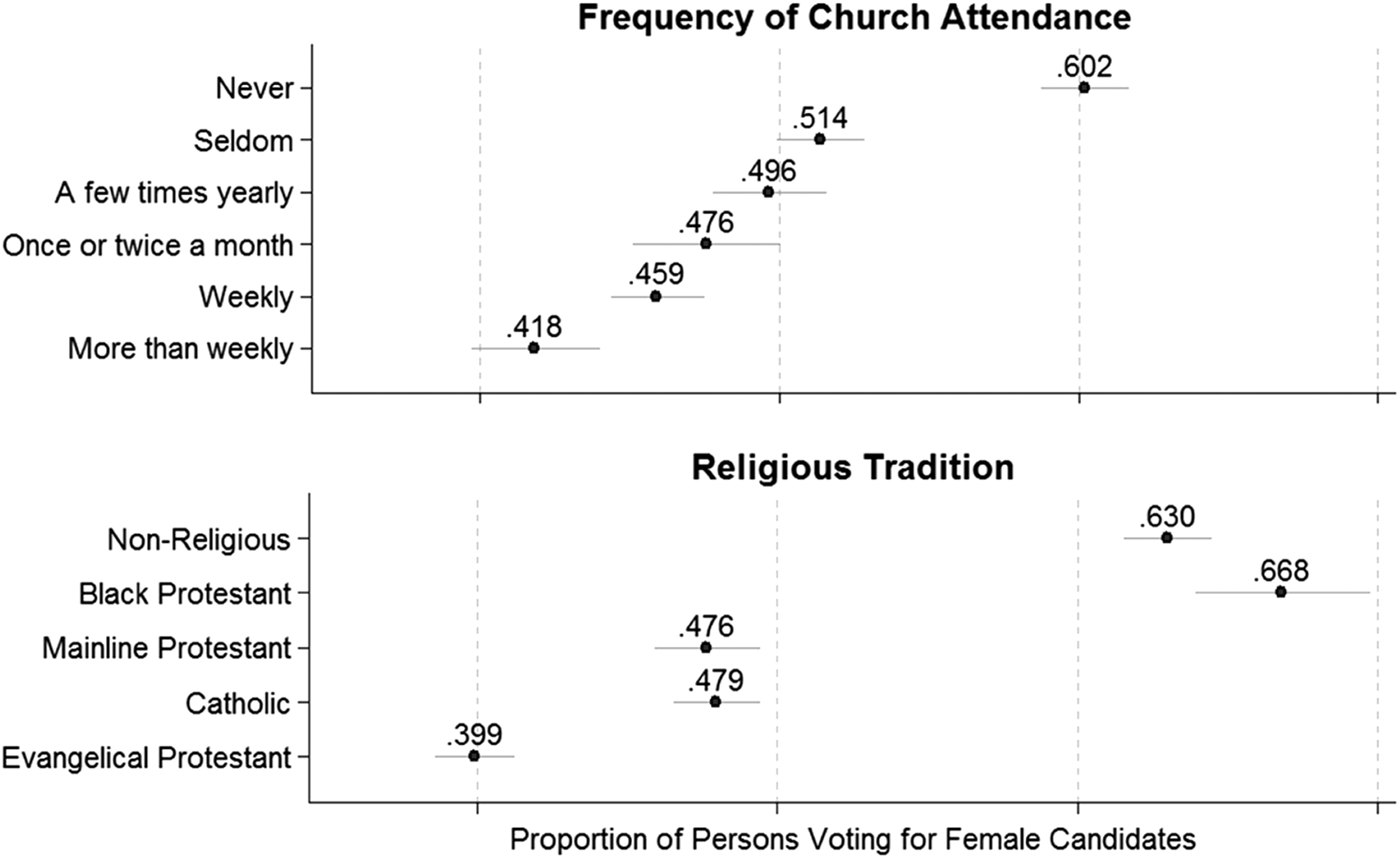
We expect that an individual's probability of voting for a female United States House of Representatives candidate will be negatively correlated with their religious exposure. The top panel in Figure 1 provides preliminary evidence for this hypothesis. Variations in individuals’ religious exposure correspond to substantial differences in the proportion of voters selecting the female candidate in mixed-gender races. More than 60% of respondents who never attend religious services voted for the female candidate, while just over 40% of voters who attend religious services more than once per week supported the female candidate.
Religious characteristics and the proportion of voters selecting female candidates in mixed-gender United States House of Representatives general elections, 2010–2012. Note: Frequency statistics are for all general election races featuring Democratic and Republican candidates of different genders. Bars denote 95% confidence intervals.

Descriptive analyses also provide support for our hypothesis that the effects of religious exposure may vary with religious tradition. The relationship between religious tradition and an individual's probability of voting for a female candidate is illustrated in the bottom panel of Figure 1. While 60% of non-religious respondents and more than two-thirds of black Protestants voted for a woman, less than 40% of evangelical Protestants did so. Taken together, the panels of Figure 1 provide evidence for a relationship — at least, absent control variables — between religion and voting behavior.
Multivariate Analyses
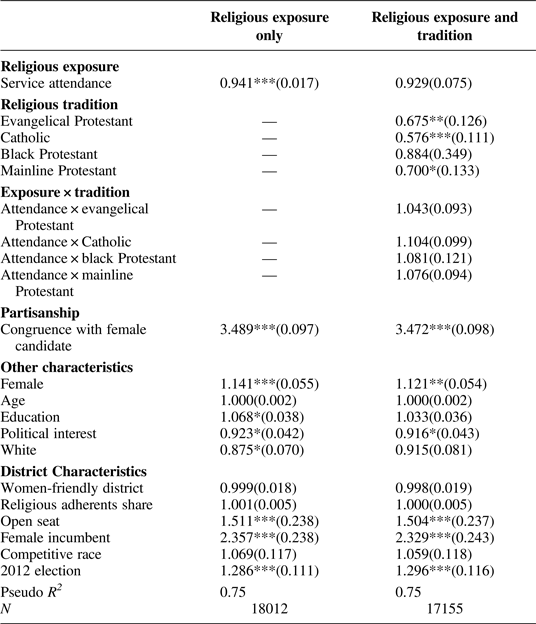
To more deeply examine the relationship between religious exposure, religious tradition, partisanship, and voting for women, we analyze several logistic regression models. We begin by reconsidering our first hypothesis. Before controlling for religious tradition, the model shown in the first column of Table 1 provides evidence that religious exposure significantly predicts individuals’ probability of voting for a woman. Consistent with our descriptive analyses, we observe that the less frequently an individual attends religious services, the greater their probability of voting for a woman. The substantive effect of religious exposure is very slight in comparison to other factors, but robust to controls. The difference in the predicted probability of voting for a woman between those who do not attend religious services (pr = 0.516) and those who attend more than once weekly (pr = 0.490) is approximately three percentage points. Women, those who are more educated, individuals who are interested in politics and white voters also are more likely to select a female candidate. Political context is important as well; female candidates garner more votes when there is an open seat or as an incumbent.
Religious characteristics and the likelihood of voting for a female candidate

Note: Logistic regression results. Cell entries are odds ratio estimates. Parentheses list robust standard errors adjusted for the clustering of observations within congressional districts. *p < 0.10, **p < 0.05, ***p < 0.01.
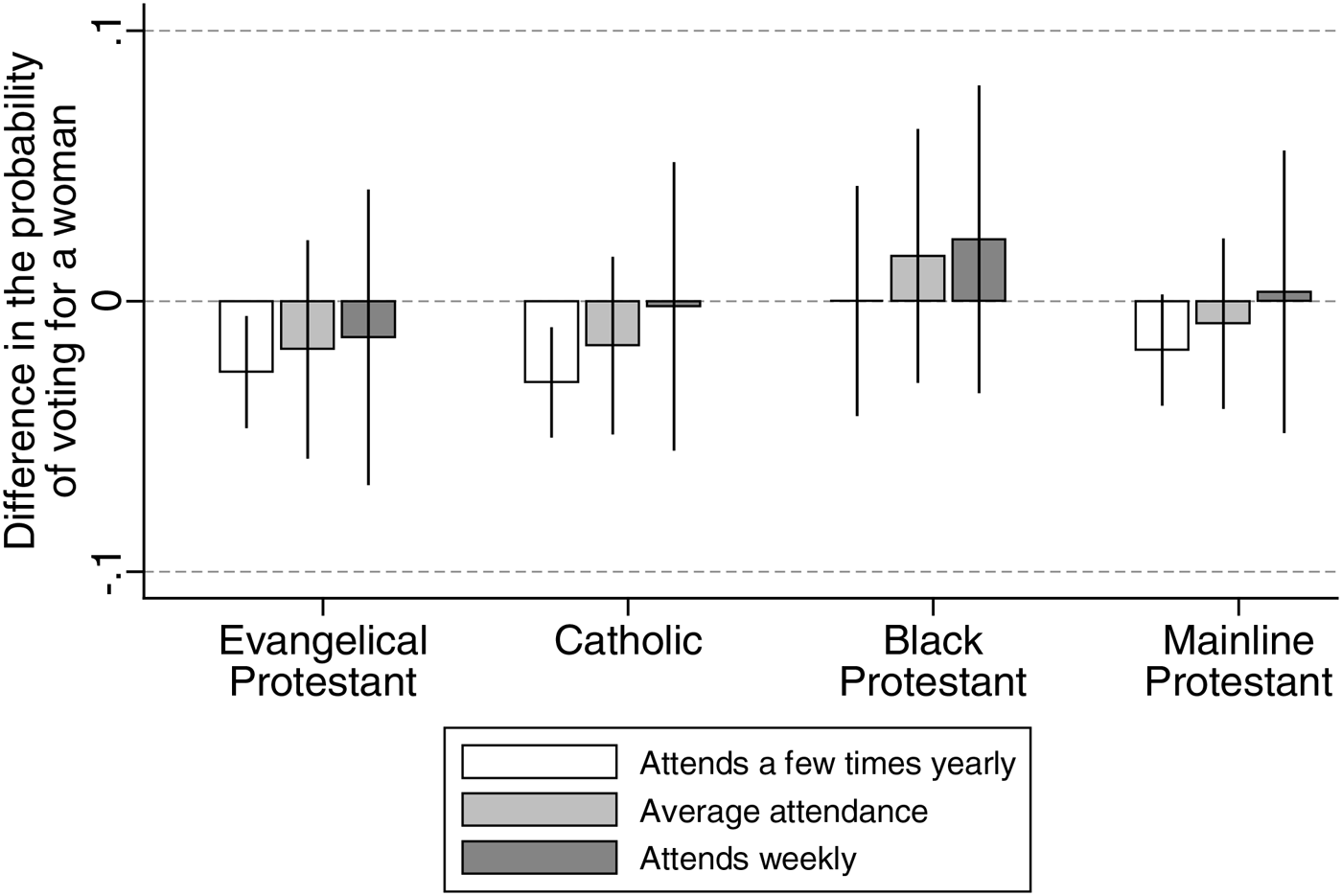
Table 1's second column allows us to consider our hypothesis that religious exposure's effects may vary with an individual's religious tradition. Assessing this influence requires consideration of interactions between religious exposure and tradition. To assist in interpretation, we graph the marginal effects of varying levels of religious exposure across each of the religious traditions. The baseline comparison for all groups is the probability that a non-religious person voted for a female candidate. The results, illustrated in Figure 2, provide little support for our expectation that religious factors affect individuals’ support for female candidates. The only significant differences between secular Americans and their similarly situated religious peers are for evangelical Protestants and Catholics who attend church a few times per year. These respondents are modestly less likely than non-religious voters to support a female candidate. These effects’ substantive magnitude, however, is quite small, and run in the opposite direction of the hypothesis that evangelicals and Catholics with the highest levels of religious exposure will be more likely to vote against female candidates.
Marginal effect of increased religious exposure on the probability of voting for a female candidate by a voter's religious tradition. Note: Bars represent differences in the predicted probability that persons in the noted groups voted for the female candidate in their mixed-gender United States House of Representatives race when compared to the probability for otherwise similar but non-religious persons. All other independent variables are held constant at their mean marginal effect. The lines indicate 95% confidence intervals for the estimates.

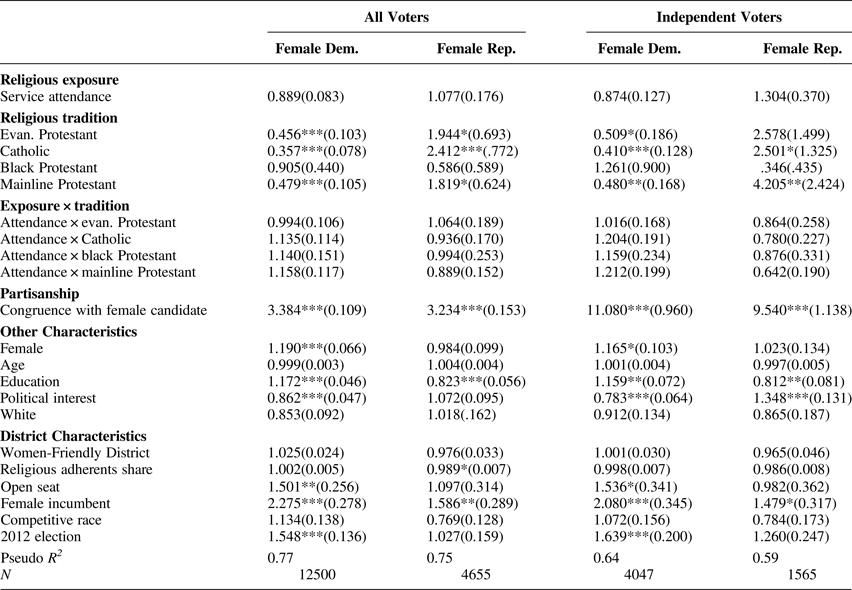
Our third hypothesis posits that religious factors’ effect on the probability of voting for a female candidate will vary for Democratic and Republican women. We examine this expectation in the models shown in the first two columns of Table 2; each analysis predicts the likelihood that a voter will support the Republican candidate in their district's contest. We find preliminary evidence to support our claim. Religious tradition and exposure are positively correlated with an individual's likelihood of voting for a Republican female candidate and voting against a Democratic female candidate. Without examining religious variables’ effect for male candidates, however, it is unclear whether these effects are best explained by the female candidate's gender or partisanship. In other words, while evangelical Protestants and Catholics are more enthusiastic about voting for Republican women than their non-religious peers, these voters might be even more likely to vote for a male Republican candidate.
Religion and the likelihood of voting for women by candidate party

Note: Logistic regression results. Cell entries are odds ratio estimates. Parentheses list robust standard errors adjusted for the clustering of observations within congressional districts. *p < 0.10, **p < 0.05, ***p < 0.01.
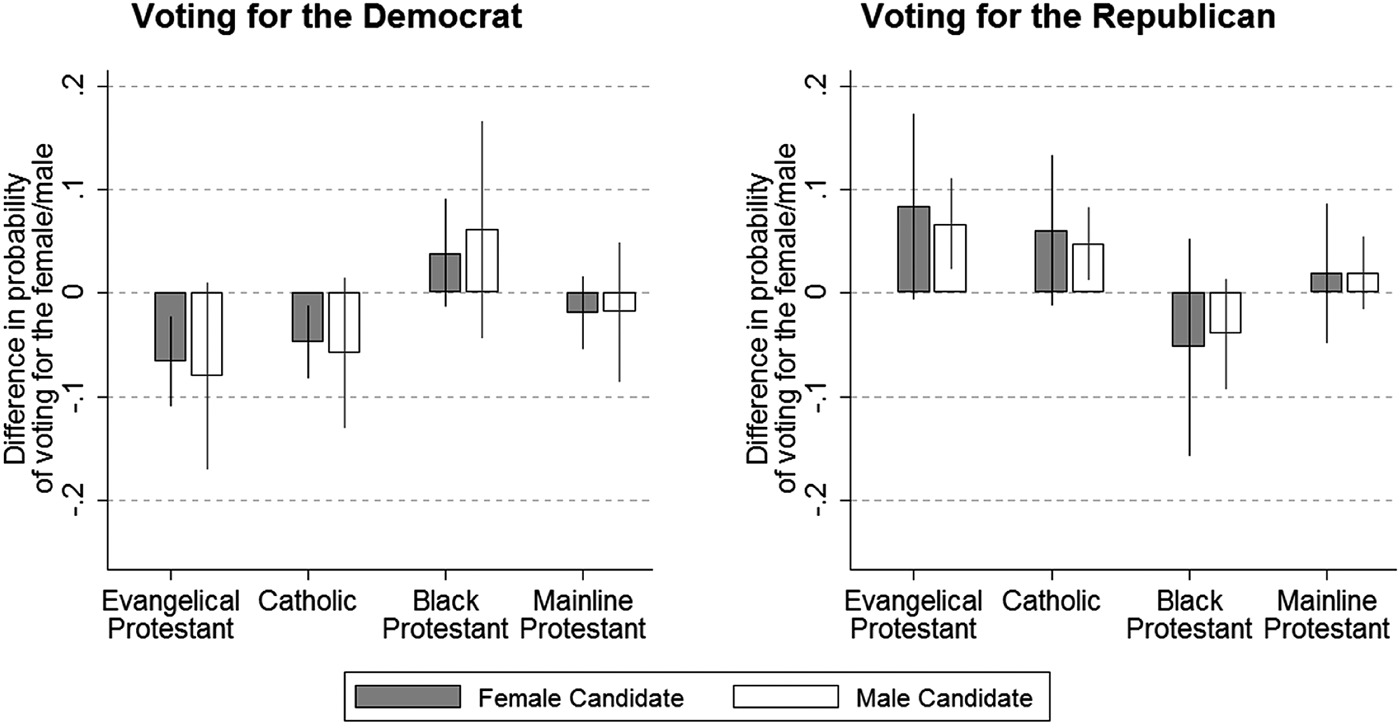
To more deeply examine the differential effects for male and female candidates of both parties, we generate the marginal effects estimates displayed in Figure 3. After accounting for religious exposure and tradition, respondents’ probabilities of voting for male and female candidates of each party generally are quite close. There are, however, some meaningful differences. Evangelical Protestants and Catholics are less likely to vote for female than male Democrats (about 7% and 4%, respectively, when compared to the gap for non-religious respondents) and more likely to vote for female than male Republicans (about 7% and 5%, respectively). One potential explanation for this finding may be that Republican female candidates who employ “God talk” in their political campaigns are perceived to be more ideologically extreme than men delivering similar messages. This enables these women to build support among religious identifiers. In contrast, Democratic female candidates’ ability to make electoral appeals to evangelical and Catholic voters may be constrained by the fact that such attempts often alienate more moderate and progressive voters, whose support is necessary to win general elections (Calfano and Djupe Reference Calfano and Djupe2011).
Marginal effect of religious tradition on the probability of voting for female and male house candidates by the candidates’ party. Note: Bars represent differences in the predicted probability that persons in each religious tradition voted for the female/male candidate in their mixed-gender United States House of Representatives race when compared to estimates for otherwise similar, but non-religious individuals. The amount of religious exposure is held constant at the mean level for individuals belonging to each tradition, and all other variables are held constant at their mean marginal effect. The lines indicate 95% confidence intervals for the estimates.

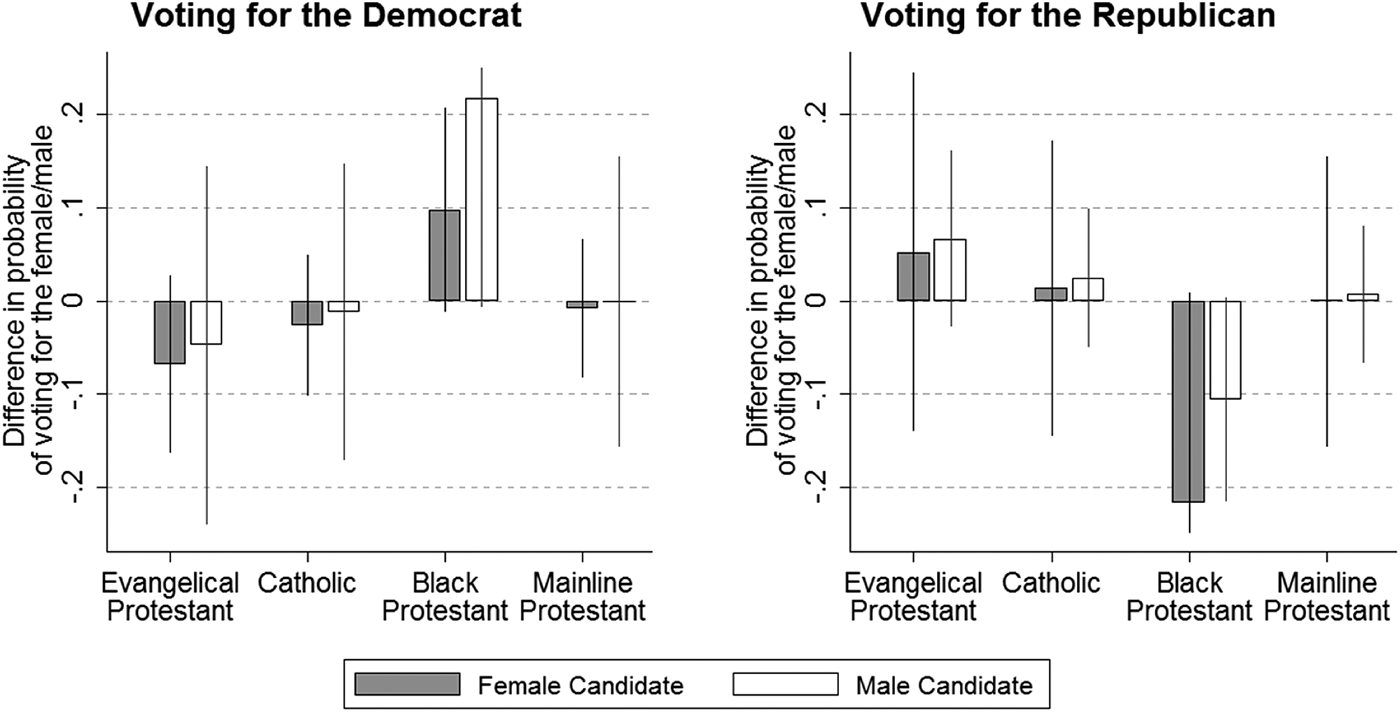
In addition to noting the effects of the candidates’ partisanship, it is important to underscore the effects of a voter's own partisanship vis-à-vis that of the candidate. In all of the models shown in Table 2, the distance between a voter's partisanship and that of the female candidate is the most powerful determinant of whether or not a voter selects the female candidate. This finding is consistent with recent gender and politics research reporting that partisanship trumps the influence of pro-male biases in determining voters’ actions in mixed-gender congressional general elections (e.g., Dolan Reference Dolan2014; Dolan and Lynch Reference Dolan2014). Moreover, contrary to our fourth hypothesis, these effects are consistent regardless of whether a voter is a strong or weak partisan. As shown in the third and fourth columns of Table 2 and illustrated in Figure 4, we find no evidence to support the claim that religious identifiers are behaving any differently than their non-religious peers.
Marginal effect of religious tradition on the probability of an independent voting for female and male candidates by the candidates’ party. Note: Bars represent differences in the predicted probability that persons in each religious tradition voted for the female/male candidate in their mixed-gender United States House of Representatives race when compared to estimates for otherwise similar, but non-religious individuals. The amount of religious exposure is held constant at the mean level for individuals belonging to each tradition, and all other variables are held constant at their mean marginal effect. The lines indicate 95% confidence intervals for the estimates; to facilitate visual comparison across the plots, the intervals for black Protestants are truncated at pr = ± 0.25.

DISCUSSION AND CONCLUSION
Our analyses are both consistent with and a departure from previous studies examining the relationship between gender, partisanship, and candidate support. On one hand, we find some evidence that religious variables affect vote choice in mixed-gender congressional elections. Evangelical Protestant and Catholic voters, who comprise more than half of our sample, are less likely to support Democratic female candidates than Democratic male candidates, and more likely to vote for Republican women than Republican men. The five to seven percentage point electoral advantage enjoyed by female Republican candidates is particularly noteworthy when we consider the number of congressional races that are won and lost by a similar margin (e.g., Fulton Reference Fulton2014). In 2010 and 2012, for example, 19 contests involving Republican women were decided by a margin of less than seven percentage points; nearly half of these contests were decided by a margin of less than five percentage points.
On the other hand, partisan identities’ clearly continue to play the central role in determining candidate support (e.g., Dolan Reference Dolan2014; Dolan and Lynch Reference Dolan and Lynch2014; Hayes Reference Hayes2011). In each of the models we present, party congruence between the voter and the candidate is the strongest predictor of vote choice. This finding is particularly remarkable when one considers the great lengths to which several of the nation's most prominent religious traditions continue to go to maintain patriarchy within their congregations and in society. Despite these efforts, religiously derived pro-male leadership biases are not the primary motivator of faithful individuals’ vote choice in congressional general elections. In fact, we might go so far as to say that if devoutly religious individuals are willing to put aside their religious convictions to vote for a co-partisan, there may be little in modern American politics that can lead most strong partisans to defect and support a congressional candidate from the other party.
Our findings, further, demonstrate that individual variations in religious exposure and tradition are not the cause of the strong macro-level correlations between district-level religiosity and lower rates of voting for women (Vandenbosch Reference Vandenbosch1996; Merolla, Schroedel, and Holman Reference Merolla, Schroedel and Holman2007; Setzler, forthcoming). In fact, evangelical Protestants and Catholics are more likely to vote for Republican female candidates than their otherwise similar peers, indicating the gender gap in representation can be traced back to the fact that Republicans simply aren't running or nominating enough female candidates. Our findings show that if Republicans were running the same number of female congressional candidates in general elections as Democrats, the modest underperformance of Democratic women among religious voters would be more than cancelled out by their disproportionately high support for Republican women.
Future studies, therefore, should aim to explore how or if religiosity influences candidate behaviors at earlier stages of the electoral process. Religion-derived gender biases may, for example, influence candidates’ views of their own political qualifications and their initial decision to run for office — a particular concern given that we know that women are generally more reluctant candidates than their similarly-qualified male counterparts (Lawless and Fox Reference Lawless and Fox2010). Religious identities and practices may also shape the way that women campaign and are evaluated as they seek their party's nomination, particularly in mixed-gender primary elections. Virtually nothing is known, for example, about how women candidates may vary their campaign messaging when dealing with unusually religious or secular primary electorates.
In addition to examining how religious exposure and tradition may affect candidates, scholars might also examine whether and how religion affects primary election turnout and vote choice. Devoutly religious individuals, for example, may be less inclined to turn out or support the female candidate in contests where party labels are not a factor, thereby limiting the number of female candidates who appear on the general election ballot and creating the filtering effect we observe in our analysis.