Introduction
In 2012, worldwide, over 800 000 deaths resulted from suicide and suicide accounted for 1.4% of all deaths, making it the 15th leading cause of death and the second leading cause of death in 15- to 29-year-olds (World Health Organization, 2014a ). Harmful use of alcohol and alcohol use disorders (AUD) (World Health Organization, 2014b ) are one of the main risk factors for suicidal behavior (i.e. death by suicide and suicide attempts). Of the suicide disability-adjusted life years (DALYs) that are attributable to mental and substance use disorders in 2010, alcohol dependence was responsible for the second largest proportion (13.25%), only behind major depressive disorder (Ferrari et al. Reference Ferrari, Norman, Freedman, Baxter, Pirkis, Harris, Page, Carnahan, Degenhardt, Vos and Whiteford2014). The attributable fraction for alcohol on suicide in 2012 was estimated to be 20% of all DALYs (World Health Organization, 2014a ; Fig. 14).
Two dimensions of alcohol use, including (1) acute use of alcohol (AUA) shortly prior to a behavior/event and (2) chronic AUD, are associated with suicide fatalities (heretofore referred to simply as suicide) and non-lethal suicide attempt (heretofore referred to simply as suicide attempt) (Norström & Rossow, Reference Norström and Rossow2016). The extent of research on AUA and AUD in relation to suicide and suicide attempt (suicidal behavior) has not been uniform. The vast majority of research on alcohol-related risk for suicidal behavior has focused on the role of AUD (for reviews, see Berglund & Ojehagen, Reference Berglund and Ojehagen1998; Conner et al. Reference Conner, McCloskey and Duberstein2008; Norström & Rossow, Reference Norström and Rossow2016) and recent meta-analyses have shown elevated risk for these outcomes by AUD (Roerecke & Rehm, Reference Roerecke and Rehm2014; Darvishi et al. Reference Darvishi, Farhadi, Haghtalab and Poorolajal2015). Notably, although correlated, AUA and AUD are distinct constructs (see Conner et al. Reference Conner, Bagge, Goldston and Ilgen2014). For example, studies have shown that AUA increases risk for suicidal behavior after adjusting for AUD (Borges & Loera, Reference Borges and Loera2010) and among those with a history of AUD, many instances of suicidal behavior occur outside instances of acute intoxication (Simon et al. Reference Simon, Swann, Powell, Potter, Kresnow and O'Carroll2002; Wojnar et al. Reference Wojnar, Ilgen, Jakubczyk, Wnorowskaa, Klimkiewicz and Brower2008). Further, there are different proposed mechanisms underlying relationships between AUA and AUD and suicidal behavior (Conner & Duberstein, Reference Conner and Duberstein2004; for a discussion, see also Bagge & Sher, Reference Bagge and Sher2008; Conner et al. Reference Conner, Bagge, Goldston and Ilgen2014).
As the focus of this study is on AUA and suicidal behavior, we will here briefly address possible underlying mechanisms for this association. First, consistent with the diathesis–stress model and related approaches (Mann et al. Reference Mann, Waternaux, Haas and Malone1999), AUA may trigger suicide attempt in vulnerable individuals. Due to alcohol's acute effect on neurotransmitters and cognitive functions, AUA may propel suicide attempts through various mechanisms: by increasing dysphoria, aggressiveness and impulsivity (Oquendo & Mann, Reference Oquendo and Mann2000); by weakening or removing barriers to self-harm; and by narrowing the ability to find alternative coping strategies (Hufford, Reference Hufford2001; Cherpitel et al. Reference Cherpitel, Borges and Wilcox2004; Bagge & Sher, Reference Bagge and Sher2008). From a sociological point of view, Durkheim's theory and concepts (1897/1951) offer a parallel line of thought. Here, anomie is defined as the social condition of unregulated persons and according to Durkheim, anomic suicide results from man's activity lacking regulation by society and his consequent sufferings (Durkheim, Reference Durkheim1897). AUA, or a state of alcohol intoxication, can be regarded as representing a ‘time-out’ from the set of social norms regulating and controlling behavior (Room, Reference Room2001). Within this framework, AUA may therefore be considered as a form of anomie, that is, a condition in which normal control mechanisms are weakened or eliminated (Skog, Reference Skog1991; Cherpitel et al. Reference Cherpitel, Borges and Wilcox2004). Thus, the destructive consequences of AUA for social regulation (‘anomic intoxication’) are one way to explain why AUA may trigger suicidal behavior (Skog, Reference Skog1991). Although most studies of alcohol-related suicidal behavior pertain to the role of AUD, controlled evidence on the role of AUA in death by suicide (e.g. Branas et al. Reference Branas, Richmond, Ten Have and Wiebe2011; Kaplan et al. Reference Kaplan, Huguet, McFarland, Caetano, Conner, Nolte and Giesbrecht2016) and suicide attempt (e.g. Borges et al. Reference Borges, Cherpitel, Orozco, Bond, Ye, MacDonald, Rehm and Poznyak2006; Bagge et al. Reference Bagge, Lee, Schumacher, Gratz, Krull and Holloman2013) has been accumulating.
While there are reviews reporting on the prevalence of AUA prior to suicide attempts (Cherpitel et al. Reference Cherpitel, Borges and Wilcox2004) and two reviews reporting on AUA as a risk factor for suicidal behavior (Borges & Loera, Reference Borges and Loera2010; Conner, Reference Conner2015), no review has used a meta-analytic approach to estimate common odds ratios (ORs) of the effect of AUA on suicide attempts (Norström & Rossow, Reference Norström and Rossow2016). Such estimates are essential for quantifying the causal effect of AUA on suicide attempts and for estimating the disease burden attributable to alcohol consumption. While it is well accepted that AUD affects the risk of suicide and these risks have been used in calculations of the burden of alcohol, the dimension of AUA has not been fully incorporated in these calculations. The aim of the current study is therefore to report a meta-analysis of epidemiological studies on the effect of AUA on suicide attempt. We report here only on AUA and suicide attempt because so far, to the best of our knowledge, only two studies have provided OR estimates for AUA and suicide (Branas et al. Reference Branas, Richmond, Ten Have and Wiebe2011; Kaplan et al. Reference Kaplan, Huguet, McFarland, Caetano, Conner, Nolte and Giesbrecht2016).
Method
For this review, the English-language literature on Medline, PsycINFO and Google Scholar was searched for original articles, critical review reports and other meta-analyses on alcohol use and suicide. All references in the English language with ‘alcohol’ and ‘suicide’ or ‘suicide attempt’ or ‘suicidal’ or ‘suicidality’, which reported OR estimates for the period ranging from 1996 to 2015, were included and reviewed. Further, only studies that reported on AUA and suicide attempt were considered. Other reviews were inspected for missing references. A prior review by one of us (Conner, Reference Conner2015) listed the results of six published studies reporting estimates of the ORs of AUA on suicide attempts (Borges & Rosovsky, Reference Borges and Rosovsky1996; Powell et al. Reference Powell, Kresnow, Mercy, Potter, Swann, Frankowski, Lee and Bayer2001; Borges et al. Reference Borges, Cherpitel, MacDonald, Giesbrecht, Stockwell and Wilcox2004, Reference Borges, Cherpitel, Orozco, Bond, Ye, MacDonald, Rehm and Poznyak2006; Branas et al. Reference Branas, Richmond, Ten Have and Wiebe2011; Bagge et al. Reference Bagge, Lee, Schumacher, Gratz, Krull and Holloman2013). For the current analysis we included these studies and also added the results of one recent study (Borges et al. Reference Borges, Cherpitel, Orozco, Ye, Monteiro, Hao and Benegal2016). Also available after Conner (Reference Conner2015) is a new report from Bagge & Borges (Reference Bagge and Borgesin press) that is an extension of her prior work (Bagge et al. Reference Bagge, Lee, Schumacher, Gratz, Krull and Holloman2013) which now includes 363 suicide attempts (representing an increase of 171 cases). The report from Borges et al. (Reference Borges, Cherpitel, Orozco, Ye, Monteiro, Hao and Benegal2016) is also an extension of a prior study (Borges et al. Reference Borges, Cherpitel, Orozco, Bond, Ye, MacDonald, Rehm and Poznyak2006) (based on 152 cases of suicide attempt) that now includes 272 cases of suicide attempt (representing an increase of 120 cases).
While new reports are available on cross-sectional samples of patients seeking treatment for a suicide attempt, that usually report exclusively on the presence of alcohol use prior to an attempt (for example, as in Boenisch et al. Reference Boenisch, Bramesfeld, Mergl, Havers, Althaus, Lehfeld, Niklewski and Hegerl2010), we focused here on controlled studies with non-suicide attempters serving as the control group (in case–control studies) or another time window serving as a within-subject control period (in case–crossover studies). We concentrated on studies where the ORs are interpretable as the risk of suicide attempt associated with alcohol consumption prior to the attempt compared with no use of alcohol prior to the attempt. Use of alcohol prior to a suicide attempt was defined by individuals’ self-reported alcohol use within 3–24 h prior to the attempt along with one study that based it on positive blood alcohol level. Definitions of suicide attempt varied depending on the report, but most were cases of attempts that led to a medical consultation, usually in emergency settings, suggesting serious attempts. A new report from Iran on 305 cases of suicide attempt (Ghanbari et al. Reference Ghanbari, Malakouti, Nojomi, De Leo and Saeed2015) which did report an OR [21.9, 95% confidence interval (CI) 8.0–59.8] associated with AUA was not included in our meta-analyses because information regarding the control period needed for the calculation was not included.
Common ORs and 95% CIs using random effects in meta-analyses for any AUA and varying levels of AUA were calculated using STATA software. We pooled the effect size for suicide attempt after alcohol use across studies using the DerSimonian and Laird random-effects method implemented in the ‘metan’ command (Harris et al. Reference Harris, Bradburn, Deeks, Harbord, Altman and Sterne2008; Stata Statistical Software, 2013). Publication bias was assessed by visual inspection of funnel plots depicting the standard normal deviate of the estimates (the OR divided by its standard error) against their precision (inverse of the standard error): it is expected that symmetrical funnel plots will depict studies scattered around a line running through the origin (at standard normal deviate equal to zero), with a slope that indicates the size and direction of the effect. This was supported using Egger's regression-based test, where asymmetry was assessed, due to the small number of studies included, with an intercept's p < 0.10 (Egger et al. Reference Egger, Davey, Schneider and Minder1997). Between-study heterogeneity was quantified by I 2 and Cochran's Q (Higgins et al. Reference Higgins, Thompson, Deeks and Altman2003). I 2 can be interpreted as the percentage of the total variance due to between-study heterogeneity.
Ethical standards
This work uses data already published in scientific journals.
Results
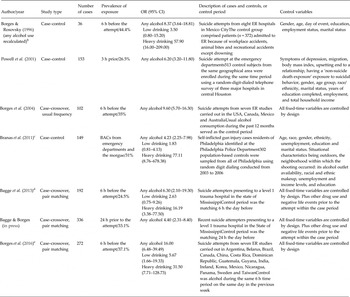
Table 1 presents the main data and characteristics from the seven studies that estimated the association for AUA and suicide attempt. The studies analysed data from trauma hospitals/emergency room admissions in 19 countries. Three studies used a case–control design and the remaining four used the case–crossover strategy. The reference period for AUA prior to suicide attempt varied across studies; from 3 to 24 h. Two studies (Bagge et al. Reference Bagge, Lee, Schumacher, Gratz, Krull and Holloman2013; Bagge & Borges, in press) are not independent samples. Bagge et al. (Reference Bagge, Lee, Schumacher, Gratz, Krull and Holloman2013) reported on a reduced sample that included levels of drinking; later, Bagge & Borges (Reference Bagge and Borgesin press) reported on a larger sample of any AUA, but did not report on levels of drinking. We thereby used the latter report (Bagge & Borges, Reference Bagge and Borgesin press) for the estimate of ‘any alcohol use’ in meta-analyses for Fig. 1 and the report from 2013 (Bagge et al. Reference Bagge, Lee, Schumacher, Gratz, Krull and Holloman2013) for estimating levels of drinking for meta-analyses in Figs 2 and 3. Similarly, Borges et al. (Reference Borges, Cherpitel, MacDonald, Giesbrecht, Stockwell and Wilcox2004) reported first in 2004 on 102 suicide attempts and subsequently provided in 2016 data on 272 attempts (including the 102 reported before) from a larger set of emergency departments. Prevalence of any AUA in those seven studies ranged from 26.5% to a high 44.4% (mean prevalence = 33%) and ORs ranged from a low 4.2 to a high 16.0. The number of variables and the substantive relevance of control variables across all case–control studies varied widely. In case–crossover studies, by design all time-constant variables (such as age and gender) are kept constant and thus are controlled by design. Trait variables, such as impulsivity, are also constant and other psychiatric variables (such as mood disorders and AUD) are also kept constant, to the extent that they are not acute episodes. Four out of these seven studies provide estimates for three alcohol consumption levels (no acute consumption being the first level). Definitions of ‘low’ and ‘high’ consumption varied across studies, as seen in Table 1. Across studies ‘low drinking’ levels varied from 0.001–100 g to blood alcohol concentration (BAC) < 0.10 mg/dl and 1–3 drinks for females/1–4 drinks for males; ‘heavy drinking’ levels varied from >100 g to BAC ⩽0.10 mg/dl and 4+ drinks for females/5+ drinks for males.
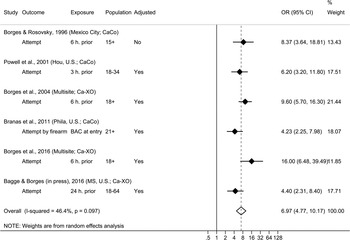
Forest plot showing effect sizes for suicide attempt according to any acute alcohol use in individual studies. Heterogeneity Q = 9.32 (5 degrees of freedom); p = 0.097; Egger's test for small-study effects p = 0.251. OR, Odds ratio; CI, confidence interval; CaCo, case–control; Hou, Houston; Ca-XO, case–crossover; Phila, Philadelphia; MS, Mississippi. Borges et al. (Reference Borges, Cherpitel, MacDonald, Giesbrecht, Stockwell and Wilcox2004) multisite (four countries): USA, Canada, Mexico and Australia. Borges et al. (Reference Borges, Cherpitel, Orozco, Ye, Monteiro, Hao and Benegal2016) multisite (17 countries): Argentina, Belarus, Brazil, Canada, China, Costa Rica, Dominican Republic, Guatemala, Guyana, India, Ireland, Korea, Mexico, Nicaragua, Panama, Sweden and Taiwan.

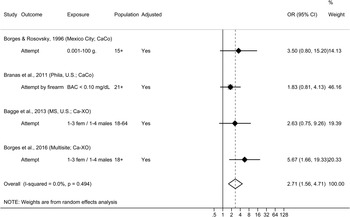
Forest plot showing effect sizes for suicide attempt according to ‘low acute alcohol use’ in individual studies. Heterogeneity Q = 2.4 (3 degrees of freedom); p = 0.494. Egger's test for small-study effects p = 0.251. OR, Odds ratio; CI, confidence interval; CaCo, case–control; Phila, Philadelphia; BAC, blood alcohol concentration; MS, Mississippi; Ca-XO, case–crossover; fem, female. Borges et al. (Reference Borges, Cherpitel, Orozco, Ye, Monteiro, Hao and Benegal2016) multisite (17 countries): Argentina, Belarus, Brazil, Canada, China, Costa Rica, Dominican Republic, Guatemala, Guyana, India, Ireland, Korea, Mexico, Nicaragua, Panama, Sweden and Taiwan.

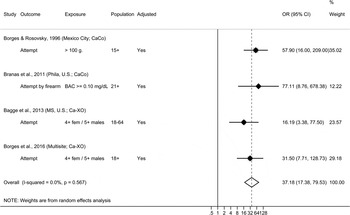
Forest plot showing effect sizes for suicide attempt according to ‘heavy acute alcohol use’ in individual studies. Heterogeneity Q = 2.02 (3 degrees of freedom); p = 0.567. Egger's test for small-study effects p = 0.879. OR, Odds ratio; CI, confidence interval; CaCo, case–control; Phila, Philadelphia; BAC, blood alcohol concentration; MS, Mississippi; Ca-XO, case–crossover; fem, female. Borges et al. (Reference Borges, Cherpitel, Orozco, Ye, Monteiro, Hao and Benegal2016) multisite (17 countries): Argentina, Belarus, Brazil, Canada, China, Costa Rica, Dominican Republic, Guatemala, Guyana, India, Ireland, Korea, Mexico, Nicaragua, Panama, Sweden and Taiwan.

Studies with OR estimates for acute alcohol use and suicide attempt (any acute alcohol use, low and heavy drinking) a

OR, Odds ratio; CI, confidence interval; ER, emergency room; BAC, blood alcohol concentration.
a ORs are adjusted for the list of control variables.
b ‘Low drinking’ = 0.001–100 g alcohol; ‘heavy drinking’ = >100 g alcohol.
c ‘Low drinking’ = BAC < 0.10 mg/dl; ‘heavy drinking’ = BAC ⩽0.10 mg/dl.
d ‘Low drinking’ = 1–3 drinks for females/1–4 drinks for males; ‘heavy drinking’ = 4+ drinks for females/5+ drinks for males.
e ‘Low drinking’ = 1–3 drinks for females/1–4 drinks for males; ‘heavy drinking’ = 4+ drinks for females/5+ drinks for males.
Fig. 1 shows the forest plot ORs and 95% CIs for any AUA in individual studies and the pooled OR from random-effect models, while Figs 2 and 3 shows these ORs for ‘low’ and ‘high’ acute alcohol levels. Although there was no evidence for heterogeneity or publication bias within any of the three figures, nonetheless we used random-effect estimates in order to be conservative. Examination of all studies included in Fig. 1 revealed increased ORs of suicide attempt after any AUA. The common OR from meta-analysis was 6.97 (95% CI 4.77–10.17). The result for the meta-analyses for case–control studies was OR = 5.72 (95% CI 3.84–8.51) and for case–crossover studies was OR = 8.39 (95% CI 4.27–16.51). While the pooled OR estimate is higher for the case–crossover studies, a homogeneity test suggested that ORs from both type of studies are similar (homogeneity test 1.55, p = 0.213). Evidence from four studies, presented in Figs 2 and 3, suggests that a lower level of consumption increased acute risk for suicide attempt, with a common OR from meta-analysis of 2.71 (95% CI 1.56–4.71). High levels of AUA resulted in even greater odds of suicide attempt (common OR from meta-analysis was 37.18, 95% CI 17.38–79.53).
Discussion
This is the first study to use meta-analytic techniques to determine the magnitude of the effect of AUA on suicide attempt. Any AUA was associated with increased risk of a suicide attempt, with a common OR from meta-analysis of 6.97 (95% CI 4.77–10.17). Furthermore, dose–response results indicated that the higher the amount of AUA consumed the greater the risk, with ‘low levels of acute drinking’ resulting in an OR of 2.71 (95% CI 1.56–4.71) and ‘high levels’ had much greater odds of suicide attempt, showing an OR of 37.18 (95% CI 17.38–79.53). The obtained prevalence of AUA preceding a suicide attempt is in line with previous reviews on this topic (e.g. Cherpitel et al. Reference Cherpitel, Borges and Wilcox2004). Importantly, since the mere presence (prevalence) of AUA does not inform the magnitude of AUA-related risk for suicide attempts, the current review adds to the literature by solely focusing on studies using controlled designs to allow for estimates of risk.
The estimates of AUA on risk for suicide attempt derived from case–crossover studies are over and above the effects of chronic alcohol use (such as AUD), which suggest that there are specific mechanisms by which AUA poses risk for suicide attempt. Along these lines, AUA's role in suicidal behavior by increasing proximal suicidal ideation was reported in a recent study by Bagge et al. (Reference Bagge, Littefield, Conner, Schumacher and Lee2014). Specifically, the study demonstrated that during the 24 h prior to a suicide attempt, the AUA within a specific hour led to increased intensity of suicidal ideation in the subsequent hour, controlling for the prior hour level of suicidal ideation. There are also data to indicate that the motives for alcohol use prior to a suicide attempt are heterogeneous, including the deliberate use of alcohol to facilitate the attempt, for example in an effort to numb fears about attempting (see Bagge et al. Reference Bagge, Conner, Reed, Dawkins and Murray2015). Accordingly, a ‘one size fits all’ explanation will not suffice for understanding the role of AUA in suicide attempts.
The observed dose–response relationship between AUA and suicidal behavior may be explained by an immediate dose-dependent effect of AUA on the central nervous system. There are indications of a dose–response relationship between BAC (intoxication level) and acute effects on aggressiveness and impulsivity (Gustafson, Reference Gustafson1993; Dougherty et al. Reference Dougherty, Marsh-Richard, Hatzis, Nouvion and Mathias2008; Caswell et al. Reference Caswell, Morgan and Duka2013), on feelings of sadness (or mood) (Heinz et al. Reference Heinz, Mann, Weinberger and Goldman2001) and on cognitive functions (Peterson et al. Reference Peterson, Rothfleisch, Zelazo and Pihl1990; Popke et al. Reference Popke, Allen and Aule2000). Thus, high alcohol doses, as compared with lower doses, seem to produce stronger effects on mood and cognitive states that play a causal role in suicidal behavior.
More empirical research on mechanisms that may underlie the AUA–suicide attempt relationship is needed, yet there are numerous ethical and practical challenges to such research (Conner et al. Reference Conner, Bagge, Goldston and Ilgen2014). For instance, laboratory-based experiments focused on providing alcohol/inducing distress to currently suicidal patients may be ruled out due to ethical concerns. From a practical standpoint, the low incidence of suicide attempts makes it impractical to conduct prospective analysis (such as using ecological momentary assessment) to study drinking and other factors occurring within the hours of a suicide attempt. Moreover, asking a participant to continue to document his/her experience within an acute suicidal crisis would necessitate the use of a rescue intervention that would alter the course of the acute factors being studied (Conner et al. Reference Conner, Bagge, Goldston and Ilgen2014). An ethically acceptable yet rigorous approach is the use of an expanded timeline followback design to pinpoint potential mechanisms (e.g. increased levels of distress) underlying the relationship between AUA and suicide attempts (as developed in Bagge et al. Reference Bagge, Lee, Schumacher, Gratz, Krull and Holloman2013). In addition, future research using much larger samples are needed to determine specially for what subgroups (e.g. combination of distal risk factors), AUA poses increased risk for suicide attempt. Integration and simultaneous analysis of both vulnerability/distal and acute factors would provide critical information for comprehensive and integrated suicide models and ultimately inform suicide prevention efforts.
Limitations
There are a number of limitations. We drew on our collective experience with this research literature and conducted an electronic search but, as with any meta-analysis, there is the potential for missed studies. This study uses data from reports of patients from different countries, and given the low number of studies available to meta-analyses we were not able to determine how effects differ by individual characteristics (e.g. age, gender, social class) or at the country level or by cultural context. Prior studies conducted by Cherpitel et al. (Reference Cherpitel, Ye, Bond, Borges and Monteiro2015) on possible effects of a country-level drinking pattern determined by the World Health Organization (WHO) country's detrimental drinking pattern (Rehm et al. Reference Rehm, Monteiro, Room, Gmel, Jernigan, Frick and Graham2001) showed that countries with the most detrimental drinking patterns may have increased alcohol attributable fractions for injuries than countries with a lower detrimental drinking pattern. Others (Norström & Rossow, Reference Norström and Rossow2016) also showed that the relationship between alcohol use and suicide may vary at the population level across cultures with different drinking patterns. Whether such variations could be present on the relationship between AUA and suicide attempt remains a matter of future inquiry. In the three obtained case–control studies the list of control variables varied widely, with only one study controlling for symptoms of depression (Powell et al. Reference Powell, Kresnow, Mercy, Potter, Swann, Frankowski, Lee and Bayer2001) and none controlling for pattern of alcohol consumption. Importantly, habitual alcohol use is controlled by design in the case–crossover studies that were analysed. With this design, variables that do not vary day-to-day (e.g. gender, history of mood and substance use disorders, chronic drinking patterns, childhood abuse, personality traits) are controlled for by study design (because subjects act as their own control). Thus, obtained results are not an artifact of chronic drinking or other fixed factors. Nonetheless, other variables that can fluctuate day-to-day (such as episodes of anger, mood swings, use of other substances and acute stressful events) may influence results. Only the case–crossover studies conducted by Dr Bagge's research group (Bagge et al. Reference Bagge, Lee, Schumacher, Gratz, Krull and Holloman2013; Bagge & Borges, Reference Bagge and Borgesin press) adjusted for other acute exposures including proximal use of other drugs and acute negative stressful life events.
Conclusion
The current study found that any AUA is associated with increased likelihood of a suicide attempt, particularly at high doses. Such data should be incorporated into estimates of the burden of disease associated with alcohol use which currently only incorporates alcohol's chronic effects on both acute and chronic conditions. We conclude that AUA plays an important role in suicide attempts and should be considered strongly in theory and clinical practice.
Acknowledgements
This work was carried out while G.B. was on a consultancy for the Management of Substance Abuse (MSB), Department of Mental Health and Substance Abuse (MSD), WHO (Geneva, Switzerland). C.J.C. was supported by a grant from the US Institute of Alcohol Abuse and Alcoholism (5 R01 AA013750). The study received no financial support.
Declaration of Interest
None.