

En 1555 paraît à Rome l’Histoire des peuples du Nord, rédigée par l’ancien évêque d’Uppsala Olaus Magnus. Dans cette œuvre monumentale, Magnus aborde de nombreux aspects de la société scandinave, parmi lesquels le commerce avec l’Islande auquel participaient, à l’en croire, les marchands anglais et hanséatiques. Ce dernier point faisait l’objet de controverses, car l’Islande appartenait alors au royaume du Danemark et un tel commerce remettait en cause le droit d’étape de Bergen, en Norvège. Toutefois, loin de s’attarder sur les querelles politiques, Magnus nous offre en lieu et place une tirade moralisatrice sur la propension à la violence manifestée par les marchands pour arriver à leurs fins :
Il est déplorable de voir les marchands, que ce soit dans leurs eaux territoriales ou sur des mers étrangères, s’attaquer et se massacrer les uns les autres, au péril de leur vie et de leurs biens, pour l’appât du gain ou même pour venger leurs familles. Il ne leur saute pas aux yeux que, partout, ils sont exposés au vol et au pillage, sans qu’il leur soit nécessaire d’aiguiser eux-mêmes l’épée pour faciliter leur propre perte. Les plus éminents de ces marchands habitent dans les villes wendes de Brême, Rostock, Wismar et LübeckFootnote 1.
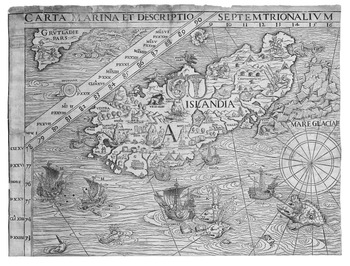
Magnus illustre ces propos par une gravure représentant un navire hambourgeois canonnant un vaisseau écossais. Celle-ci apparaît d’ailleurs également dans sa Carta marina de 1539 (fig. 1)Footnote 2. Pour l’auteur, il va de soi qu’au milieu du xvie siècle, activités commerciales et recours à la violence sont étroitement mêlés.
L’Islande sur la Carta marina de 1539
Source : Munich, Bayerische Staatsbibliothek, Mapp. VII, 1 ; Olaus Magnus, Carta marina et descriptio septemtrionalium terrarum ac mirabilium rerum in eis contentarum diligentissime elaborata anno dni 1539.

Les historiens et historiennes de l’économie ont en général ignoré ce passage de l’Histoire des peuples du Nord. Après tout, les observations de Magnus entrent en contradiction avec l’image d’acteurs pacifiques ouvrant la voie au capitalisme, communément associée aux marchands du Moyen Âge tardif. Or le lien suggéré par l’ancien évêque entre commerce et brutalité accrédite des thèses récentes sur l’omniprésence de la violence – plus particulièrement de l’extorsion de marchandises – dans la résolution des conflits entre marchands dans la mer Baltique et l’Atlantique nord tout au long du Moyen Âge tardifFootnote 3. Selon cette nouvelle approche, tous les acteurs de la sphère maritime pouvaient avoir ou avaient effectivement recours à la violence pour arriver à leurs fins, tout en cherchant à la justifier par des arguments juridiques. Pourtant, la description que fait Magnus du comportement des marchands anglais et hanséatiques en Islande semble aller au-delà de ces thèses : elle suggère que ces hommes recouraient à la force non seulement dans le cadre de doléances personnelles, mais aussi afin d’obtenir et de garantir un accès à des marchés disputésFootnote 4. Le présent article soutient que le recours à la violence comme moyen d’exclure ses rivaux de marchés a constitué une pierre angulaire de la transformation de l’économie maritime dans la Baltique et l’Atlantique nord de 1400 à 1600. L’étude remet en contexte l’émergence et le déploiement de la notion de piraterie dans le cadre d’une stratégie visant à criminaliser certains acteurs au cours de la période. Les pirates et les corsaires n’existaient peut-être pas en tant que tels avant l’époque moderne, mais la piraterie et la course fonctionnaient déjà comme de puissantes constructions discursives.
La criminalisation de certaines pratiques économiques par le biais de concepts tels que la « piraterie » à la fin du Moyen Âge et au début de la période moderne est traditionnellement associée aux processus de construction de l’ÉtatFootnote 5. Toutefois, une analyse approfondie des sources de la ville hanséatique de Lübeck et de ses voisines montre que les personnes marginalisées et traitées en criminelles par les élites urbaines parce que « pirates » étaient en réalité leurs concurrents économiques, qu’elles cherchaient à exclure des relations politiques, sociales et économiques existantes. En tant que slogan, la « lutte contre les pirates » peut donc être envisagée comme l’une des tactiques employées par les élites urbaines à partir de 1400 pour exercer et étendre leur pouvoir dans un contexte de transformation économique structurelle. Notre thèse rejoint ici les travaux de Lauren Benton, Jeppe Mulich et Christophe Picard, qui ont également analysé l’usage de la « piraterie » comme arme discursive, que ce soit pour discréditer une puissance coloniale rivale dans l’océan Indien et les Caraïbes aux xviiie et xixe siècles ou pour présenter les conflits interreligieux dans la Méditerranée à l’époque moderneFootnote 6. Tout en s’inscrivant dans leur sillage, nous souhaitons souligner combien ces pratiques discursives ont contribué à restructurer la vie économique, et non pas seulement les rapports de pouvoir. Dans le même temps, nous affirmons que ces tactiques ont radicalement transformé l’identité des élites urbaines qui les ont déployées.
Le concept de « piraterie » semble doté d’une vie propre, d’autant qu’il a profondément façonné l’imaginaire et la vision du monde de ces élites urbaines. En 1550, les conseillers et les marchands de villes hanséatiques telles que Lübeck ont intériorisé une conception d’eux-mêmes comme de courageux héros cernés par des « pirates », créateurs d’une véritable hétérotopie dans la Baltique et l’Atlantique nordFootnote 7. Un riche ensemble de textes, de pratiques et d’objets matériels (tels les trophées de pillage – drapeaux, armes, etc.) commémore, dans la ville même, la violence subie par ces hommes aux mains des « pirates » et les mesures prises pour lutter contre cette menace. Loin d’être des phénomènes marginaux confinés à des lieux liminaux tels que l’Islande, les actes de violence à l’encontre de concurrents économiques font partie intégrante de la transformation du monde économique dans la Baltique et l’Atlantique nord de la fin du Moyen Âge. En outre, parce qu’elles sont souvent célébrées par les élites urbaines qui les ont commises, ces violences s’inscrivent aussi dans le paysage urbain.
Dès lors, ces élites urbaines gagnent à être considérées comme des « communautés de violence », c’est-à-dire des communautés tirant leur cohésion du fait de se représenter comme subissant et perpétrant la violence ensemble. Notre usage de ce terme dérive des notions de Gewaltgemeinschaft (communauté violente) et de Beutegemeinschaft (communauté de pilleurs), forgées par les historiens, historiennes et anthropologues allemands pour décrire des groupes de mercenaires ou d’entrepreneurs de violenceFootnote 8. David Nirenberg a également utilisé cette expression dans son œuvre maîtresse sur les conflits interreligieux dans la péninsule Ibérique aux xiiie et xive sièclesFootnote 9. La recherche sur la Gewaltgemeinschaft n’a pas prêté attention aux travaux de D. Nirenberg – peut-être en raison de l’origine anthropologique des concepts allemands –, mais son étude de la fonction de la violence dans les interactions quotidiennes de groupes sociaux qui n’étaient ni marginalisés ni professionnels dans leur usage de la force trouve ici un écho intéressant. Les recherches de D. Nirenberg ont un autre intérêt majeur dans notre perspective – soit montrer que les formes de violence et de stigmatisation doivent être comprises, dans leur contexte, comme des actions ritualisées symbolisant un conflit économique et politiqueFootnote 10. Loin de banaliser les actes violents, comme certains ont pu le soutenirFootnote 11, son approche permet surtout de les considérer comme partie intégrante des structures économiques prémodernes. Notre usage du concept de « communautés de violence » se concentre ainsi sur le rôle, encore peu étudié, de la violence dans les interactions économiques des élites urbaines du Moyen Âge tardif, unies par l’exclusion radicale d’autrui à la fois à travers leurs discours et leurs pratiques violentes.
Quatre étapes scanderont notre parcours. D’abord, nous étudierons un récit tiré de la Lübecker Ratschronik, la chronique officielle du conseil municipal de Lübeck, où figure la première mention du terme « pirate » dans un texte en bas allemand vernaculaire. À partir de ce point d’appui, nous retracerons la genèse de l’idée de « lutte contre les pirates » et son instrumentalisation dans les villes de la Hanse au cours du xve siècle. Dans un deuxième temps, nous montrerons la corrélation entre l’émergence de ce concept à Lübeck et l’évolution de la structure économique de la région, plus particulièrement la réorganisation des marchés et des réseaux de distribution au Moyen Âge tardif. Dans un troisième temps, nous nous pencherons sur le cas de la guilde des Bergenfahrer de Lübeck et verrons comment les tentatives ponctuelles de cette guilde visant à criminaliser ses concurrents en les qualifiant de pirates, justifiant ainsi sa propre violence, ont fini par se structurer en un discours argumenté et une vision du monde solides et durables. Enfin, nous examinerons les rituels, les monuments et les textes grâce auxquels ces arguments ont donné naissance à des identités nouvelles et distinctes au sein d’élites urbaines comme les Bergenfahrer.
La « piraterie », une catégorie criminalisante au xve siècle
Ces dernières années, la recherche sur la violence maritime dans la Baltique et l’Atlantique nord aux xive et xve siècles a opéré un tournant remarquable. En 2017, dans un article qui a fait date, Gregor Rohmann propose de regarder « au-delà de la piraterie et de la course » et avance qu’il a fallu attendre le droit international moderne pour que soit fixée la séparation entre violence légitime et illégitime en mer ; il serait par conséquent fallacieux d’appliquer celle-ci aux époques antérieuresFootnote 12. Pendant le Moyen Âge tardif, tous les acteurs de la sphère maritime pouvaient se montrer violents, et tous justifiaient cette violence par des revendications juridiques et des pratiques sociales courantes telles que la faide (un système de vengeance privée). Certes, il existait un vivier de professionnels de la violence, mais il s’agissait simplement d’hommes qui offraient leurs services pour mener à bien les faides et faire valoir les droits revendiqués. Selon G. Rohmann, il convient donc d’éviter totalement le terme « piraterie » dans les analyses de cette période. Dans la plupart des cas de violence maritime, coupables et victimes étaient liés par un long passé de discorde et cherchaient à sortir vainqueurs de leurs conflits respectifsFootnote 13. La prise par la force de navires ou de marchandises n’était jamais que l’une des nombreuses tactiques, allant de l’arbitrage à la guerre ouverte, pour y parvenir : dans n’importe quel conflit, toutes ces options restaient envisageablesFootnote 14. De ce point de vue, la violence maritime n’était ni spontanée ni arbitraire : elle représentait un moyen pour les parties de mener leurs conflits, et leurs soutiens, clients, mécènes ou partenaires n’y échappaient pas. La légitimité ou l’illégitimité d’un acte de violence particulier résultait ainsi d’âpres négociations entre des revendications concurrentes dans le contexte d’un conflit donné.
La thèse de G. Rohmann remet en cause l’idée, pourtant bien ancrée en histoire juridique, économique et urbaine, d’une opposition entre, d’une part, des marchands et des villes paisibles et progressistes et, d’autre part, des « pirates », des contrebandiers et des naufrageurs issus de la ruralité ou de la noblesseFootnote 15. Elle soulève par ailleurs de nouvelles questions quant à l’utilité sociale de la qualification de marchands ou de contrebandiers. Si G. Rohmann et d’autres ont démontré que la catégorie « piraterie » ne devrait plus figurer dans la boîte à outils analytique des médiévistes, il n’en a pas moins existé un discours contemporain sur ce phénomène, vilipendant voire diabolisant certains acteurs de la BaltiqueFootnote 16. S’il n’y avait pas de « pirates » dans cette région aux xive et xve siècles, pourquoi qualifiait-on les actions de certaines personnes de « piraterie » ? Pour quelles raisons ce discours est-il apparu ? Qui le mobilisait et dans quel but ? Si nous envisageons l’émergence du discours sur la piraterie comme un processus de criminalisation et d’exclusion (économique), peut-être pourrons-nous répondre à ces questionsFootnote 17.
Un discours criminalisant et marginalisant
Au Moyen Âge tardif, Lübeck était l’une des plus grandes villes du Saint-Empire romain germanique en même temps qu’un important carrefour commercial, redistribuant les marchandises sur des axes est-ouest comme nord-sudFootnote 18. Elle comptait parmi les membres les plus éminents de la Hanse, groupe d’intérêts de marchands et de villes établi de longue date qui s’étendait de la Livonie à la Hollande et de l’île de Gotland à Cologne. En 1454, Johann Hertze, l’un des scribes de la ville, rédige l’entrée suivante dans la Lübecker Ratschronik, la chronique officielle du conseil municipal :
Cette année, la ville de Lübeck a armé des navires de paix [vredeschippe] contre des larrons de mer et des pirates [seerover unde piraten]. Ils se sont emparés d’un petit navire de larrons de mer, en ont battu beaucoup jusqu’à ce que mort s’ensuive et ont amené les autres à Lübeck. Là, [les prisonniers] ont été jugés et décapités, car ils avaient avoué avoir commis des larcins et des preuves ont été trouvées dans leur bâtimentFootnote 19.
Ce passage est frappant. Dès la première phrase, Hertze délégitime les adversaires de Lübeck et justifie la violence de la ville. Les navires lübeckois sont nommés vredeschippe, c’est-à-dire gardiens de la paix, associant ainsi les actions de la cité à une noble cause. Plus généralement, l’auteur formule un jugement à la fois moral et légal sans appel sur les adversaires de Lübeck, en les désignant comme seerover unde piraten : ce double qualificatif inhabituel marque non seulement leurs actions, mais leur existence même du sceau de l’illicite et de l’illégitime. La description de Hertze reprend vraisemblablement le discours public de l’époque, étant donné la manière dont Lübeck a traité ces supposés « pirates », qui ont été soit battus à mort sur place, soit exécutés après avoir avoué leurs crimesFootnote 20. La rhétorique de Hertze comme le traitement du groupe par le conseil municipal affirment donc avec vigueur le bien-fondé des actions de Lübeck tout en marginalisant ses adversaires. Ces derniers ne sont plus vus comme des égaux ; ils deviennent un groupe d’agents criminels susceptibles d’être combattus par tous les moyens. À notre connaissance, cet extrait comporte la plus ancienne mention du terme « pirates » (piraten) dans un texte en bas allemand vernaculaire. Si l’on considère l’histoire du terme latin (lui-même dérivé du grec ancien), le caractère novateur de la description de Hertze apparaît plus significatif encore.
Le concept de piraterie est fort difficile à saisir ; nous ne pouvons guère qu’esquisser son histoire au Moyen Âge. Dans les textes médiévaux, le mot est généralement employé pour désigner des comportements spécifiques, presque comme un terminus technicus : même un individu menant une faide légitime pouvait agir « de manière pirate » (piratarum more) ou « comme un voleur » (latronum more)Footnote 21. En fait, l’application juridique du terme « pirate » à une personne semble correspondre à une évolution ultérieure. En France, par exemple, le mot n’acquiert ce sens qu’à la fin du xve siècle et connote clairement l’exclusion et la criminalisation, comme l’a montré récemment Pierre Prétou. Relevant que la violence maritime a été décrite d’autres manières durant le plus clair du Moyen Âge tardif, l’historien émet l’hypothèse que l’usage du terme à partir de 1480 s’inscrit dans une « invention » de la piraterie par la cour de France dans le but de discipliner ses sujets en merFootnote 22. En outre, pendant longtemps, la « piraterie » ne paraît pas associée directement à la violence en mer. Ainsi, en Angleterre vers 1400, « piraterie » est l’un des nombreux termes utilisés pour désigner la rébellion et la haute trahisonFootnote 23. Une attestation claire d’une association du terme « piraterie » à la violence maritime figure dans un ajout à la décrétale pontificale lue dans les églises le Jeudi saint : en 1229, le pape Grégoire IX ordonne que toute personne apportant son soutien à des « pirates » soit excommuniéeFootnote 24. Dans la Baltique, cependant, peu de sources latines des xiiie et xive siècles mentionnent les « pirates » ; bien que le terme soit employé de façon péjorative au xve siècle, il n’est ni strictement associé à la violence maritime illégitime ni employé comme terme juridiqueFootnote 25. En somme, lorsque Hertze, juriste de formation, écrit sur les piraten, il introduit non seulement un mot latin en bas allemand, mais il le mobilise aussi d’une manière spécifique pour justifier la violence de la ville et marginaliser ses adversaires.
C’est à l’évidence dans la littérature antique et son héritage que les lettrés du Moyen Âge tardif tels que Hertze ont rencontré le terme. Dans la France médiévale, comme l’a prouvé P. Prétou, circulaient des anecdotes sur Pompée et César combattant les pirates dans des textes vernaculaires comme Les faits des Romains (Li Fet des Romains), écrits à partir du xiiie siècle. Si, par le truchement de l’aristocratie et des juristes, elles se sont lentement répandues jusqu’à la juridiction du parlement de Paris, le concept de « piraterie » visant à criminaliser la violence maritime n’est toutefois devenu prédominant qu’à la fin du Moyen ÂgeFootnote 26. Thomas Heebøll-Holm distingue deux façons de penser la « piraterie » selon deux discours antiques, qu’il appelle les paradigmes augustinien et cicéronienFootnote 27. La cité de Dieu (De civitate Dei) d’Augustin d’Hippone relate la rencontre d’Alexandre le Grand avec un magnat et larron de mer local, que l’empereur qualifie de « pirate ». L’homme s’insurge et laisse entendre qu’Alexandre fait pratiquement la même chose : c’est seulement sa grande armée et sa vaste flotte qui font de lui un conquérant (imperator) plutôt qu’un « brigand » (latro) et un « pirate » (pirata)Footnote 28. On peut interpréter cette histoire de bien des manières, y compris comme une illustration du caractère relatif du concept de « piraterie ». Néanmoins, au Moyen Âge, elle introduisait le plus souvent une réflexion sur le gouvernement juste et injuste. Au prisme de cette lecture, les remarques du larron de mer étaient perçues comme une description fidèle du règne d’Alexandre : celui-ci était effectivement un baron-bandit et un tyran, idée sur laquelle Augustin s’appuyait déjà pour expliquer la translatio imperii (transfert de pouvoir) du conquérant grec aux RomainsFootnote 29. Le conseil de Lübeck a sans doute fait usage de cette interprétation en 1370, lorsque les villes de la Hanse ont justifié leur faide contre le roi Valdemar IV du Danemark en avançant que celui-ci ne pratiquait pas le jus naufragii (droit d’épave) comme il sied à un monarque, mais s’emparait de marchandises ainsi que le feraient « des tyrans et des pirates » (tyrannos et piratas)Footnote 30. D’autres interprétations sont cependant possibles : John de Salisbury, par exemple, se concentre sur la grâce magnanime qu’accorde Alexandre à son interlocuteurFootnote 31, tandis que le poète François Villon dépeint le larron de mer comme un roi-bandit courageux, qualifié de pirate par les puissants uniquement par opportunismeFootnote 32.
Dans son Traité des devoirs (De officiis), Cicéron brosse un portrait fort différent du pirate, présenté comme « l’ennemi commun de tous » (communis hostis omnium) ou, selon les traductions, comme « l’ennemi du genre humain »Footnote 33. Loin d’être de simples adversaires, soumis aux règles du jus gentium (droit des gens) qui régissait les conflits normaux, les pirates se situent hors du cadre de la société humaine, n’étant liés par aucune loi, aucun serment ni aucune promesse. Contrairement à la vision augustinienne, la compréhension qu’a Cicéron de la piraterie suppose, sans autoriser pour autant aucun relativisme, une exclusion absolue de l’adversaire, ce qui n’est pas sans rappeler l’entrée rédigée par Hertze dans la Lübecker Ratschronik en 1454. D’ailleurs, à partir de 1450, la chancellerie de Lübeck renforce son arsenal juridique sur la question. Dix ans après les événements relatés par Hertze – qui est élu conseiller en 1460 –, le conseil de la ville acquiert une vaste collection de manuscrits juridiques, dont une copie du De officiis de Cicéron. Sa bibliothèque contient aussi le Tractatus de repressaliis de Bartole, qui distingue les formes de violence privées légitimes et illégitimes, ainsi que d’autres traités du même auteur et de son disciple Balde, dans lesquels s’élabore la tradition médiévale tardive de la souveraineté sur l’espace maritimeFootnote 34. Dans le commentaire d’un passage du 49e livre du Digeste, Bartole écrit que les « pirates » (pyrate) ne sauraient être comparés aux « ennemis » (hostes) ordinaires puisqu’ils ont décidé de vivre en opposition au principe de « confiance » (fides) et sont donc des « ennemis du genre humain » (hostes humani generis)Footnote 35. Par conséquent, selon lui, mener une guerre publique (bellum publicum) contre ces gens serait à la fois légal et justeFootnote 36.
Que déduire de l’acquisition de ces codex par le conseil de Lübeck et de la possibilité que des juristes aient effectivement lu les éléments sur la piraterie qu’ils contenaient ? Le conseil a-t-il adopté des notions juridiques tirées du droit romain ? Faut-il voir en Hertze un disciple de Bartole ? Nous proposons pour notre part une interprétation plus pragmatique des faits. Quand Balde et Bartole parlaient de combattre de prétendus « pirates », c’était afin de justifier les revendications de républiques urbaines et de princes italiens désireux d’étendre leur souveraineté à la mer et aux îles avoisinantes, comme le défendait Bartole dans des conclusions rédigées pour la ville de PiseFootnote 37. Rien ne permet d’affirmer que Hertze aurait fait de même pour Lübeck, en revendiquant la souveraineté de la ville sur la Baltique – encore que le conseil ait parfois émis des revendications sur des eaux territorialesFootnote 38. Cela dit, Hertze avait vraisemblablement compris que la notion de « piraterie » pouvait servir à justifier la violence en mer, même si son interprétation du concept était plus proche de celle de Cicéron que de l’argument juridique de Bartole. Hertze est allé au-delà du projet des juristes italiens du xive siècle, qui consistait à définir des eaux territoriales pour permettre et cautionner la lutte contre de prétendus « pirates », où qu’ils soient. Ainsi, son usage du terme « pirate » n’est probablement pas lié à la transposition systématique d’un droit, mais plutôt à l’adaptation et à l’élaboration progressive d’un terme utile pour justifier les pratiques violentes de la ville au service d’intérêts économiques spécifiques. L’adoption sélective et souple de termes et de fragments particuliers du droit romain et de la philosophie cicéronienne n’était, là encore, qu’un moyen parmi d’autres pour arriver à cette fin.
Aujourd’hui, les historiennes et historiens considèrent généralement que les pratiques de violence maritime médiévales et la conception augustinienne de la piraterie présentent des caractéristiques communesFootnote 39. Le critère pour être considéré comme un « pirate » dépendrait purement et simplement de l’issue d’un conflit : l’emploi du terme révèlerait qui avait été vaincu. Cependant, l’entrée de Hertze de 1454 dans la Lübecker Ratschronik ainsi que l’acquisition et l’utilisation des textes de Cicéron et de Bartole par le conseil semblent indiquer qu’au milieu du xve siècle, Lübeck s’est mise à mobiliser une interprétation de la « piraterie » proche de celle formulée par Cicéron dans De officiis. Cette vision ne se contentait pas de délégitimer les actes violents de ses adversaires : elles visaient leurs personnes mêmes, en les criminalisant, en les marginalisant et en les accusant de menacer la paix que Lübeck et ses vredeschippe travaillaient si durement à maintenir. Pour mieux comprendre les implications de ce glissement, intéressons-nous maintenant au lendemain des campagnes de Lübeck contre les seerover unde piraten décrits par Hertze afin de dévoiler l’identité de ceux qu’il appelait « pirates ».
Au-delà du discours : Olaf Axelsson et ses « pirates »
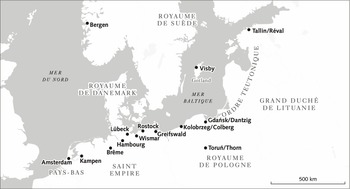
Peu après l’exécution des seerover unde piraten par Lübeck, un capitaine quitte le port, peut-être pour rejoindre la Livonie (fig. 2). Alors qu’il longe les côtes de Gotland, Olaf Axelsson, le bailli de l’île, s’empare de son navire. Selon Hertze, cette action allait « à l’encontre de Dieu et de la loiFootnote 40 ». Cependant, Axelsson rétorque que, puisque Lübeck a capturé et fait décapiter ses serviteurs, il est en droit de mener une faide contre la ville. Hertze n’est pas de cet avis et, compte tenu du fait qu’il est l’un des juristes experts de Lübeck, son récit des événements dans la Ratschronik reflète sans doute la position du conseil : les individus décapités avaient avoué être des pirates de Poméranie, aussi le tribunal était-il parfaitement en droit de les exécuter. En revanche, Axelsson n’avait quant à lui aucune légitimité à mener une faide contre la ville.
La mer Baltique au xve siècle
Crédit : Lukas Jentsch et Harm Schwerdtfeger.

En réalité, il y a de bonnes raisons de tenir pour vraie la version d’Axelsson. Non seulement d’autres sources confirment que les condamnés de Lübeck étaient bien à son serviceFootnote 41, mais il a su mobiliser toute une série de soutiens pour appuyer ses dires. Loin d’être un forban, Axelsson était l’un des neuf frères Axelsson-Tott et appartenait donc à la plus haute strate de l’élite scandinaveFootnote 42. Ses actes peuvent sans difficulté être envisagés comme conformes aux normes et aux pratiques de la faide, certes non écrites, mais bien ancrées dans la Baltique. Après l’exécution de ses serviteurs, Axelsson a capturé un navire de Lübeck en représailles, puis envoyé les marchandises trouvées à bord dans les villes hanséatiques de Colberg, Rostock et Greifswald pour les vendre. Bien que le conseil de Lübeck ait demandé à ces cités d’interdire la vente des marchandises saisies, Colberg et Rostock garantissent la libre circulation à AxelssonFootnote 43. Des lettres envoyées de Colberg indiquent même que le conseil de la ville a joué un rôle d’intermédiaire entre les représentants d’Axelsson et les anciens propriétaires des marchandises dont il s’était emparé. Comme nous l’avons appris d’autres récits de violences et d’extorsions en mer, il s’agissait d’une pratique courante en pareils casFootnote 44. Il est tout à fait possible que les villes hanséatiques de Rostock, Colberg et Greifswald aient laissé Axelsson vendre son butin parce qu’elles avaient accepté ses revendications. Ce dernier semble lui-même juger ses actes légitimes : il n’a aucunement cherché à dissimuler ses agissements et a rendu le navire à ses propriétaires en échange d’une somme substantielle, là encore conformément aux pratiques établies de la faide et de la gestion de conflits dans la Baltique à l’époqueFootnote 45.
Différents éléments de contexte social et politique nous aident à comprendre comment Axelsson a pu s’engager dans ce conflit avec la ville de Lübeck. La première moitié du xve siècle a été caractérisée par de nombreuses querelles ayant impliqué les deux parties et entraîné de longues demandes de réparation. Par exemple, les habitants des villes prussiennes et poméraniennes de la Hanse ont exigé des dédommagements de la part de Lübeck eu égard aux événements consécutifs à la guerre entre les Danois et les Wendes de 1426 à 1434-1435 ; le litige mit longtemps à être tranché. Lorsque des conflits éclataient entre les groupes hétérogènes des bourgeois le long de la côte méridionale de la Baltique, d’aucuns cherchaient de l’aide auprès de magnats scandinaves. Axelsson et Lübeck étaient tous deux impliqués dans les conflits autour de la couronne de Suède à la suite de l’élection de Karl Knutsson Bonde (Charles VIII) en 1449 : le bailli soutint le roi Christian Ier du Danemark tandis que la ville adopta une posture ambivalente. Lors de la montée des tensions entre les villes de Prusse et l’ordre Teutonique, qui conduisit à la guerre de Treize Ans en 1454-1466, on observe une configuration semblable : Axelsson soutient de nouveau le roi du Danemark, allié à l’ordre Teutonique, tandis que Lübeck intervient des deux côtés du conflit. Dans cette sphère de querelles privées et politiques, Axelsson n’est qu’un des nombreux magnats qui combat pour lui-même ou au nom de sa famille, son roi ou sa suite ; son animosité envers la ville de Lübeck est assez emblématique des interactions existant entre tous les acteurs politiques et économiques de la BaltiqueFootnote 46.
Si les entrées de Hertze dans la Lübecker Ratschronik étaient les seules sources dont nous disposions au sujet de cet incident, nous n’aurions qu’une vision limitée des événements. À l’évidence, Hertze s’est évertué non seulement à stigmatiser les actions – qu’il qualifie de violence arbitraire – et les serviteurs – traités en criminels – d’Axelsson, mais aussi à condamner les relations que Colberg et Rostock entretenaient avec le magnat. Là encore, nous avons des raisons de croire qu’il se faisait l’écho d’un point de vue répandu dans la Lübeck d’alors. Dans une lettre envoyée à Gdańsk en 1455, le conseil lübeckois formule sa plainte en des termes peu amènes : Colberg, jadis « une honorable cité de la Hanse », est désormais « un repaire de larrons »Footnote 47. Cette accusation rappelle des éléments du droit romain. En 1446, moins de dix ans avant les événements, Christian von Geren, un scribe de la chancellerie de Lübeck, copie et traduit plusieurs passages du Digeste dans un formulaire utilisé par la ville à des fins juridiques. Ce faisant, il remarque une pratique récurrente tout au long de l’ouvrage : toute personne coupable de brigandage ou troublant la paix doit être exécutée, et ceux qui l’hébergent ou la soutiennent ne méritent pas meilleur traitementFootnote 48. Or la description que fait von Geren de la fonction sociale de la loi – à savoir condamner et sanctionner les malfaiteurs et leurs complices avec fermeté – est fondamentalement différente de celle qu’avait formulée le conseil au début du xve siècle. En effet, en 1416, après des années de dissensions et de conflits à Lübeck, l’ancien conseil avait fini par revenir dans la ville dont il avait été exilé en 1408. À cette occasion, il avait été souligné que l’amitié devait modérer la sévérité de la loiFootnote 49. Lorsque Hertze qualifie de seerover unde piraten les captifs de 1454 (qui étaient sans doute des serviteurs d’Axelsson), lorsque le conseil de Lübeck les fait exécuter et accuse Colberg d’abriter des « larrons », les acteurs semblent faire appel à une conception plus violente de la loi, proche de celle mise en avant par von Geren. On peut avancer que celle-ci s’inscrivait dans une vision bien plus large de la ville, de son conseil et de sa place dans le monde vers 1450.
La Lübecker Ratschronik s’adresse au conseil et à ses membres : elle nous en apprend donc beaucoup sur la manière dont cet organe se percevait et concevait sa place dans la communauté urbaineFootnote 50. Vers 1450, Hertze et d’autres scribes formulent une vision caractéristique de la « piraterie » et du rapport qu’entretient Lübeck avec elle. La ville – autrement dit le conseil, selon ces juristes – était empêtrée dans une lutte contre des « larrons de mer » et des « pirates ». Son objectif était de libérer la mer de ces maux et d’assurer ainsi le commerce du « marchand ordinaire » (gemene copman). Des distinctions sémantiques entre les actes de Lübeck et ceux de ses adversaires venaient renforcer cette vision. Hertze et ses contemporains nomment de supposés larrons de mer, relatent des récits hauts en couleur à leur sujet et détaillent les personnalités qui les soutiennent. À l’inverse, les membres de l’élite lübeckoise apparaissent dans la Ratschronik comme une seule entité agissant au nom du « bien commun » (gemene beste)Footnote 51.
Le bref récit de Hertze sur la « chasse aux pirates » de Lübeck peut par conséquent nous aider à distinguer deux interprétations contradictoires de la violence maritime dans la Baltique vers 1450. D’un côté, nous avons Axelsson, qui agit conformément au cadre moral, culturel et juridique de la faide et adhère à ses normes tacitesFootnote 52. Bien que nous ne soyons pas certains de l’identité des personnes exécutées en 1454, une série de conflits contemporains aurait pu pousser les associés du magnat à s’opposer à Lübeck. De l’autre côté – et quoique contester la légitimité des revendications de ses opposants ait toujours été une pratique de la faide – se tient le conseil de Lübeck qui, au xve siècle, caractérise ces hommes comme des « pirates » et des complices appartenant à un monde hostile, légitimant ainsi leur poursuite et leur exécution. Ce discours diffère de la manière dont les conseils de Lübeck et d’Hambourg avaient dépeint leur conflit contre les « Frères des victuailles » en Frise vers 1400, en ce qu’il soustrait la criminalisation de ses adversaires de tout contexte politique particulierFootnote 53. L’émergence de cet imaginaire s’inscrit dans un contexte de conflits structurels autour de la circulation de marchandises, de personnes et d’argent dans l’ensemble de la Baltique et de l’Atlantique nord du xve siècle. En adoptant cette perspective, les actions d’Axelsson et du conseil de Lübeck peuvent être comprises sous un jour nouveau.
L’économie maritime au xve siècle, toile de fond de la criminalisation
Le xve siècle constitue une période de transformation fondamentale pour l’économie nord-européenne et au-delà. Sur le plan structurel, ces bouleversements fournissent un contexte utile pour comprendre l’évolution des interprétations de la violence maritime au cours de la période. Comme l’ont montré Michel Pauly et Stuart Jenks, une hiérarchie des marchés vient remplacer ce qui était jusqu’alors un réseau souple de foires et de places marchandesFootnote 54. Ainsi, au xive siècle, les marchands des petites villes du duché de Poméranie vendaient des céréales produites localement tout au long des côtes de la Baltique et de l’Atlantique nord ; mais, au xve siècle, les grandes cités voisines comme Stralsund ou Greifswald ont pris le contrôle de la distribution internationale, les commerçants locaux se contentant désormais d’apporter leur grain dans ces plaques tournantes. À la même époque, les grands ports s’arrogent le monopole du commerce de marchandises de longue distance entrant en PoméranieFootnote 55. Ces nouvelles structures de distribution vont marquer l’histoire économique. Récemment, des chercheurs ont tenté d’expliquer ces transformations par la concurrence entre marchés, qui aurait abouti à avantager les villes qui proposaient les frais de transaction les plus faiblesFootnote 56. Cependant, comme d’autres l’ont noté, les villes et les marchés les plus dynamiques étaient dotés d’une organisation institutionnelle qui n’avait rien d’exceptionnelFootnote 57. Pour notre part, la concentration des marchés nous semble plutôt résulter de conflits violents, de l’application de droits d’étape revendiqués et de l’exclusion des concurrents, cette dernière reposant sur la criminalisation de la violence maritime.
L’exclusion structurelle des échanges se négocie sur le plan discursif grâce à différents concepts, parmi lesquels la « piraterie ». Dans les sociétés monarchiques d’Europe de l’Ouest, comme l’Angleterre, la criminalisation de la violence maritime est formulée en termes d’intérêts économiques royaux, de trahison ou de rupture de trêves garanties par le roi. En revanche, dans la Méditerranée, l’Atlantique et une partie de la Baltique, c’est le recoupement des notions criminelles de « piraterie », de pillage d’épave et de contrebande – ainsi que l’accusation de collaborer avec des infidèles et des païens – qui suscite un intérêt grandissant. Les communautés urbaines de la Baltique au Moyen Âge tardif ont particulièrement exploité l’idée d’une hétérotopie économique menaçant le « bien commun »Footnote 58. Dans ce contexte, le concept de « pirate » comme « ennemi du genre humain » séduit de plus en plus. Ainsi, à Lübeck, le conseil et les élites urbaines instrumentalisent cette notion à plusieurs niveaux, de manière à restructurer la géographie de la distribution commerciale dans la Baltique.
À partir de 1390 environ, des villes telles que Lübeck et Hambourg intensifient leurs efforts pour monopoliser les ressources de ce qu’elles considèrent comme leur arrière-pays. Au début du xve siècle, Lübeck organise presque chaque année des expéditions militaires dans des territoires voisins afin de s’emparer de leur production agricole et, plus généralement, de les soumettre à son jougFootnote 59. Après 1420, la ville cherche également à prendre le contrôle des routes commerciales céréalières et à longue distance sur la côte sud de la Baltique et sur l’Øresund, n’hésitant pas à employer la violence, les embargos et à acquérir des territoires aux riches ressources agraires susceptibles d’être utilisés comme des pionsFootnote 60. Pendant ce temps, Hambourg, partenaire de Lübeck située à l’extrémité occidentale de la principale route terrestre entre la Baltique et la mer du Nord, renforce également ses opérations militaires dans son voisinage immédiat. À partir de 1390, les comptes de la ville enregistrent régulièrement des dépenses liées aux expéditions militaires en Frise et dans les marais de l’estuaire de l’Elbe. Cependant, Hambourg ne cherche pas simplement à établir un contrôle indirect sur le fleuve et ses territoires comme la Dithmarse et la Frise : les comptes montrent que ces expéditions rapportent butin et otages, qui sont ensuite rendus en échange de rançons considérablesFootnote 61.
Ces opérations coïncident avec la pénurie de certaines ressources au xve siècle. En période de famine, le commerce de biens agricoles représente un enjeu politique crucial pour les villes, le maintien de réserves de céréales jouant un rôle clef dans la fragile stabilité des gouvernements oligarchiques urbains, qui prétendent pourvoir au bien communFootnote 62. D’ailleurs, lorsque des famines s’abattent sur une large part de l’Europe après 1430, les villes de la Hanse s’efforcent d’autant plus d’appliquer leurs droits d’étape aux produits agricoles transitant dans leurs portsFootnote 63. Des dynamiques similaires sont repérables dans l’Atlantique et dans l’ouest de la Méditerranée au xive siècle, au moment où la violence maritime, l’extorsion de marchandises en mer et la criminalisation des concurrents correspondent à une période de supposée fragilité de la gouvernance et de concurrence autour des ressources alimentairesFootnote 64. La violence maritime évolue donc au gré de la transformation des pratiques économiques au cours de la période.
Les lieux d’étape et les pôles du commerce de longue distance constituent un autre domaine de concurrence. Lübeck, au bord de la Baltique, est reliée à Hambourg et à la mer du Nord par une route terrestre qui, depuis des siècles, représente la plus importante liaison entre les deux mers. À partir de 1400, le conseil de la ville tente de limiter le transit des marchandises sur des routes alternatives entre les deux régions. Ainsi, Lübeck cherche à empêcher les marchands prussiens, anglais ou hollandais d’emprunter la voie maritime par l’Øresund ou les routes terrestres par le Jutland. La correspondance des villes wendes reflète le souci de contrôler l’Umlandfahrt pratiqué pour certaines activités par les Hollandais, par exemple – c’est-à-dire le contournement du Jutland à la voile. Le conseil de Lübeck emploie une vaste gamme de tactiques pour faire valoir son droit d’étape à l’encontre de ses concurrents, y compris l’appel à la solidarité de la Hanse, l’instrumentalisation du bonum commune (bien commun) et la déstabilisation de la Baltique occidentale au moyen de rumeurs et de violences. En 1450, Hans Winter, un conseiller de la ville hanséatique prussienne de Toruń, écrit une lettre au grand maître de l’ordre Teutonique, où il décrit ce processus et explique ses suspicions au sujet des conflits en cours entre les villes wendes, les Hollandais et les Danois, qui nuisent aux intérêts économiques des cités prussiennes. Il soupçonne Lübeck de vouloir bloquer l’Øresund et d’empêcher le commerce direct entre Prussiens et Hollandais : en cas de conflit, tous les flux entre la Baltique et la mer du Nord devraient transiter par la route terrestre et, par conséquent, passer par Lübeck et Hambourg. « Si la guerre éclate, ils chargeront leurs cargaisons et nous déclinerons », écrit Winter au grand maîtreFootnote 65. D’autres membres de l’élite urbaine prussienne suggèrent que les villes wendes souhaitent provoquer une escalade du conflit dans le but d’asseoir leur rôle d’intermédiaire dans le commerce entre la mer du Nord et la Baltique. En 1441, Hinrich Vorrat, maire de Gdańsk, soupçonne les marchands de ces villes de vouloir profiter de la pénurie de sel en Livonie après le blocus de l’ØresundFootnote 66.
La restructuration violente des marchés et des routes commerciales a joué un rôle majeur dans l’affaiblissement des pratiques économiques traditionnelles de la région. Elle s’inscrit dans la création de hiérarchies, où les grandes villes comme Lübeck et Gdańsk étendent leur influence de carrefours commerciaux tandis que leurs concurrentes se trouvent marginalisées. Le conflit entre Axelsson et Lübeck évoqué plus haut est étroitement lié à ces processus de hiérarchisation et de marginalisation ainsi qu’aux bouleversements économiques qui les accompagnent. Des nobles tels qu’Axelsson s’impliquent depuis des siècles dans le commerce à longue distance dans la Baltique. En tant que bailli de Gotland, Axelsson a besoin d’accéder aux réseaux économiques non seulement pour obtenir des vivres pour l’île, tels du grain, de la bière ou du sel, mais aussi pour se fournir, lui et sa cour, en produits de luxe, comme des étoffes et des vêtements. Gotland étant pauvre en ressources naturelles, tous ces biens arrivent par la mer. Or ce type de réseau commercial se superpose souvent à ceux des villes régionales et, parfois, s’y opposeFootnote 67. L’île de Gotland, forte de sa position d’étape entre Novgorod et Lübeck depuis le xiie siècle, a perdu en influence économique depuis son annexion par le Danemark en 1361, au fur et à mesure que Reval et les autres villes livoniennes prenaient la main sur les routes commercialesFootnote 68.
Les magnats établis dans des régions rurales, comme Axelsson, subissent de plein fouet les conséquences de cette marginalisation croissante vis-à-vis du commerce à longue distance, surtout en matière d’approvisionnement. Ils tentent parfois de pallier les disettes en mobilisant leurs réseaux de relations : dans le cas de Gotland, ce réseau s’étend jusqu’à des villes marchandes comme StralsundFootnote 69. Cependant, les baillis peuvent aussi recourir à la violence pour régler les problèmes d’approvisionnement des régions isolées. En 1477, lors d’un conflit avec les villes de Kampen, d’Amsterdam et de Zuiderzee, Iwar Axelsson, le successeur d’Olaf, invoque un traité de 1474 stipulant qu’au moins deux navires hollandais doivent faire escale à Visby chaque année. Selon Iwar, la prise des vaisseaux hollandais est légitime, car les bateaux promis ne sont jamais venus à Gotland. Pour justifier la capture de trois autres navires près de l’île de Bornholm, il prétexte plus tard vouloir collecter, en tant que capitaine royal, le péage que doivent régler les équipages à la couronne du Danemark au moment de leur passage par l’ØresundFootnote 70.
La marginalisation économique de Gotland semble donc avoir mené à une hausse de l’extorsion violente de ressources manquantes à travers le pillage des navires en mer et dans les ports autour de l’île. Pour preuve, le nombre croissant de doléances concernant le pillage d’épaves et la prédation en mer émanant de marchands et de villes hanséatiques à l’encontre de magnats scandinaves de Gotland et d’autres îles, comme Bornholm. La prise de navires et des biens qu’ils transportent a sans doute contribué à marginaliser encore davantage les baillis de Gotland et leur suite vis-à-vis des grands réseaux commerciaux de la Baltique. Désormais, lorsque ces magnats séjournent dans des villes de la Hanse, ils courent le risque d’être arrêtés pour brigandage en mer, comme l’a été Magnus Gren, capturé en 1450 par des mercenaires de LübeckFootnote 71. On trouve la trace de nombreuses demandes de réparation pour pillage d’épave et vol contre Olaf Axelsson. En 1450, par exemple, Werner Vrorip, l’un de ses associés et membre du conseil de Visby, est arrêté à Lübeck sous prétexte de brigandage en merFootnote 72. Rappelons que les baillis eux-mêmes estimaient que leurs actes avaient un fondement juridique : en cas de pillage d’épave, ils invoquaient le jus naufragii, tandis que les extorsions étaient justifiées par leur droit au péage et la souveraineté sur leurs eaux territoriales, le Strom (flot), une notion juridique vraisemblablement empruntée aux villes hanséatiques elles-mêmesFootnote 73. Les frères Axelsson-Tott vont jusqu’à prétendre être les propriétaires légitimes du Kontor (comptoir) hanséatique de Novgorod, en se référant aux droits de Visby promulgués au xiie siècle, afin de justifier la faide d’Erik Axelsson contre les villes livoniennes de la baie de la NévaFootnote 74.
En miroir, les marchands hanséatiques se réfèrent parfois aux mêmes arguments. Ainsi, lorsque Eckard Westranse, un marchand de Gdańsk, menace de poursuivre Olaf Axelsson devant la cour royale allemande en 1450, c’est au motif que le magnat ne l’aurait pas protégé quand on l’a attaqué dans le Strom du roi du Danemark autour de GotlandFootnote 75. Ce que les baillis de Gotland inteprètent comme une pratique légitime ne l’est pas aux yeux des scribes et chroniqueurs tels que Hertze : ceux-ci n’y voient qu’une économie souterraine illicite, animée par des « pirates » sans foi ni loi. Le conseil de Lübeck, étroitement lié aux élites urbaines de RevalFootnote 76, applique également cette stratégie de criminalisation contre des magnats tels qu’Axelsson pour concrétiser son ambition : contrôler les routes commerciales de la Baltique orientale.
En résumé, des pratiques et des réseaux économiques concurrents sont entrés en conflit au xve siècle. Dans ce contexte, la violence maritime a été intégrée aux tactiques de concurrence employées par des villes comme Lübeck dans le but d’entraver l’activité de leurs rivaux et d’établir et renforcer leurs propres réseaux économiques. Parfois, ces guerres économiques se donnaient expressément pour objectif de contrôler ou gouverner la mer, idée que l’on retrouve dans d’autres lieux que la Baltique comme l’illustre le poème chauvin très imagé The Libelle of Englyshe Polycye, écrit en anglais vers 1436Footnote 77. Pour ce faire, les villes comme Lübeck se sont efforcées d’exclure leurs concurrents des échanges économiques légaux tant sur le plan sémantique que pratique, allant même jusqu’à viser leur totale destruction. Dans ce contexte, le concept cicéronien de « pirate » comme « ennemi du genre humain » fut remis au goût du jour : les élites urbaines y virent le moyen de transformer leurs concurrents en membres actifs d’une hétérotopie économique déviante, constituée de pirates, de contrebandiers et de nobles les soutenant. Naturellement, l’émergence de cette notion n’a pas manqué d’affecter les élites urbaines elles-mêmes. La « lutte contre les pirates » n’était pas simplement un discours, mais aussi une pratique qui passait par la noyade, la capture et l’exécution des prétendus pirates ainsi que par les représentations et les commémorations (textes, objets) de ces épisodes. On peut avancer que cette rhétorique performative a transformé les élites urbaines de Lübeck et d’ailleurs en communautés de violence et de pillage : c’est ce processus que nous examinerons à présent en nous intéressant particulièrement à un groupe, les Bergenfahrer de Lübeck.
Criminalisation, cohésion et représentation : les Bergenfahrer de Lübeck
Les Bergenfahrer sont une corporation de marchands gérant l’importation de morue séchée depuis la Norvège – d’où leur nom, qui signifie « voyageurs de Bergen ». Ce commerce repose sur plusieurs privilèges octroyés par les rois norvégiens à certaines villes d’Allemagne du Nord à la fin du xiiie siècleFootnote 78. Chaque année, près de 2 000 Bergenfahrer et leurs serviteurs résident dans un ensemble de bâtiments sur le Tyskebryggen, ou « quai allemand », à Bergen dans le cadre du Kontor de la ville hanséatique. Ils représentent donc non seulement une puissance importante au sein de la cité norvégienne, mais aussi un groupe de pression influent dans la politique de Lübeck et des autres villes hanséatiques, où ils appartenaient à la couche inférieure des élites marchandes urbainesFootnote 79. À Lübeck, il semble que, de tous les acteurs économiques recourant à la violence pour arriver à leurs fins, ils soient les plus visibles. Ils en sont ainsi venus à former un groupe social cohérent qui se présente, tant vis-à-vis de l’extérieur qu’auprès de ses propres membres, comme excellant dans la « lutte contre les pirates ».
Les Bergenfahrer constituent une communauté soudée et relativement fermée sur elle-même. Ceux qu’on appelle les Wintersitzer, qui passent les mois d’hiver en Norvège, subissent des rites initiatiques brutaux appelés Spiele (jeux) et relèvent spécifiquement de la juridiction du Kontor hanséatique. Ils n’ont pas le droit de se marier en Norvège ni de s’y faire naturaliser. Par conséquent, beaucoup restent longtemps célibataires et tendent à choisir d’autres Bergenfahrer comme provisores (exécuteurs testamentaires). Des serments et l’obligation au secret consolident leur cohésion interne. À Bergen, des banquets communs, la dévotion à saint Olaf et la confrérie des saintes Catherine et Dorothée renforcent encore leurs liens sociauxFootnote 80. Le Kontor fixe des règles pour ses membres et les applique, en punissant sévèrement les tentatives de contourner le droit d’étape. Pendant ce temps, à Lübeck, la communauté des Bergenfahrer se manifeste dans les chapelles, les trophées et les pratiques mémorielles qui célèbrent ses réussites et ses morts dans la topographie sacrale de la citéFootnote 81.
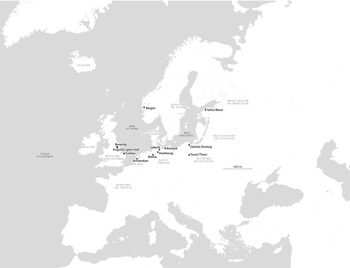
L’Atlantique nord et la Baltique
Crédit : Lukas Jentsch et Harm Schwerdtfeger.

En tant qu’agents économiques, les Bergenfahrer opèrent dans un environnement concurrentiel. Bergen est alors l’étape et le carrefour incontournables pour le commerce nord-atlantique (fig. 3). Selon les privilèges accordés par le roi de Norvège, les routes maritimes au nord de Bergen et des Skattlands – c’est-à-dire l’Islande, les Orcades, les îles Féroé et les Shetland – sont interdites aux marchands étrangers et demeurent entre les mains de ses sujets (ou, après 1397, ceux du roi du Danemark)Footnote 82. Au xve siècle, les Norvégiens de Bergen et de Trondheim contrôlent ces routes, et les Bergenfahrer n’ont pas l’intention de s’attaquer à leurs privilèges. Avec l’aide des corporations plus modestes de Rostock, Wismar et Stralsund, la guilde lübeckoise est déjà parvenue à éliminer la plupart de ses concurrents pour les droits commerciaux au sud au début du siècleFootnote 83, parfois par la force. En 1407, les familles de 80 citadins de Cromer, en Est-Anglie, demandent au roi d’Angleterre de saisir les biens des Bergenfahrer lübeckois alors amarrés à Boston, au motif que certains d’entre eux auraient attaqué leurs proches dans le sud de la Norvège, les auraient dépouillés et noyés, le tout avec l’accord des échevins du Kontor de BergenFootnote 84. Si certains détails ont pu être exagérés par les plaignants, l’épisode reste globalement plausible. En effet, ces détails correspondent à la description que fait Magnus des marchands wendes défendant leurs intérêts économiques dans l’Atlantique nord quelque cent cinquante ans plus tard.
La concurrence dans le Nord semble s’intensifier au cours du xve siècle, entraînant une coalition d’intérêts entre les Bergenfahrer lübeckois et le roi du Danemark, qui devient également roi de Norvège avec l’Union de Kalmar en 1397. La mainmise des Bergenfahrer sur le commerce à Bergen conduit apparemment les marchands anglais et des villes hanséatiques défavorisées – comme Gdańsk et Hambourg – à se livrer à un commerce illégal avec l’Islande. Ces tentatives auraient notamment conduit à une hausse du nombre de faides menées en Islande par des acteurs et groupes variés, parmi lesquels différentes factions de magnats locaux, divers évêques, des marchands d’Angleterre, de Gdańsk et de Lübeck ainsi que les rois d’Angleterre et du Danemark. Bien que les diètes de la Hanse aient plusieurs fois réaffirmé l’interdiction du commerce vers l’Islande, les transgressions se multiplient à partir de 1450. Pour les Bergenfahrer de Lübeck, il faut maintenir les sanctions car faire voile directement vers l’Islande revient non seulement à bafouer les droits des sujets du roi de Norvège, mais aussi à contourner le droit d’étape de Bergen, base de la prospérité des Bergenfahrer. À l’inverse, de puissantes factions à Brême, Hambourg et Gdańsk, très peu présentes à Bergen, comptent bien tirer profit d’un commerce direct avec le Nord-Ouest. Les diètes de la Hanse semblent avoir tenté d’apaiser les deux groupes : elles prohibent la navigation vers l’Islande à plusieurs reprises, en refusant toutefois de punir les contrevenantsFootnote 85. Au cours de la seconde moitié du xve siècle, les Bergenfahrer de Lübeck sont donc confrontés à une concurrence croissante en dépit de leur position privilégiée dans l’Atlantique nord, à la fois de la part des Anglais et des Hollandais, mais aussi d’autres villes de la HanseFootnote 86. Ce n’est pas une coïncidence si c’est à cette époque, précisément, que la guilde des Bergenfahrer fait sien un discours criminalisant la « piraterie » et se met à utiliser délibérément ce terme pour décrire ses rivaux économiques.
Tuer un noble, en faire un « pirate »
À cette fin, les Bergenfahrer développent un puissant discours sur leur propre histoire : ils dépeignent les actes de leurs concurrents scandinaves et anglais comme de la « piraterie » ou de la « contrebande », ou tout du moins comme un soutien aux « pirates » et aux « contrebandiers ». Ironiquement, ils ont d’abord recouru à ces slogans pour justifier des actions scandaleuses qu’ils avaient eux-mêmes commises. En 1455, les membres du Kontor hanséatique de Bergen tuent Olaf Nilsson, le capitaine royal de la ville, ainsi que soixante membres de l’aristocratie norvégienne et l’évêque de Bergen à l’abbaye de Munkeliv, qu’ils incendient ensuite. Ce violent embrasement représente l’issue fatale d’un conflit de plus de dix ans entre les Bergenfahrer et Nilsson. Ce dernier, partisan d’Éric de Poméranie dans le cadre de l’Union de Kalmar, s’est ingénié à renforcer la position des Anglais et des autres concurrents de la Hanse à Bergen. Il est également impliqué dans le commerce avec l’Islande, où il aurait collaboré avec des marchands gdańskoisFootnote 87. Ses efforts provoquent une montée des tensions à Bergen, surtout après la destitution d’Éric du trône de Norvège par le conseil du royaume en 1439. Au cours du règne du roi danois Christian Ier, intronisé en Norvège en 1450 avec le soutien des Bergenfahrer, ces tensions s’intensifient. En 1453, Christian démet Nilsson de ses fonctions de capitaine de Bergen. En 1454, alors qu’il est devenu bailli de Ryfylke, une région au nord de Stavanger située sur la route de la métropole norvégienne, Nilsson libère deux navires anglais dont le Kontor s’était emparé après une attaque des vaisseaux des Bergenfahrer au large de Skagen. L’évêque de Bergen le soutient dans son action. En 1455, le bailli retourne à Bergen dans un climat de controverse, alors qu’il soutient vraisemblablement Knutsson Bonde (le futur Charles VIII) dans sa bataille pour la couronne de Suède. En réponse et à la suite du rétablissement de Nilsson dans ses fonctions de capitaine, les Bergenfahrer s’emparent de ses navires à Bergen. Il est tué peu de temps aprèsFootnote 88.
Assurément, les sources conservées sur cet épisode sanglant posent problème car elles consistent principalement en des entrées de chronique et une lettre au roi du Danemark, dans laquelle les Bergenfahrer et le conseil de Lübeck tentent de justifier leurs actes près de trente ans après les faitsFootnote 89. Toutefois, sur le plan des structures économiques, certains faits sont bien assurés. Ainsi est-il établi que les Bergenfahrer lübeckois et Nilsson se sont retrouvés dans des camps opposés sur deux fronts au moins : lors de la lutte pour la couronne de Suède et durant la contestation du monopole du commerce au nord de Bergen. Leur antagonisme s’inscrit donc dans la transformation économique de l’Europe du Nord, comme dans le cas de Lübeck et d’Axelsson évoqué plus haut. Si les actions des Bergenfahrer sont exceptionnelles, c’est moins par leur brutalité que par le fait d’avoir visé directement les dirigeants de la société scandinave, et pas seulement leur suite.
Nilsson étant membre des plus hautes couches de la noblesse scandinave, son meurtre appelle une réponse. Sa famille entame une faide contre les Bergenfahrer de Lübeck, qui se poursuit jusque dans la dernière décennie du xve siècleFootnote 90. En raison de la destruction de l’abbaye, les Bergenfahrer, mais aussi toute la ville de Lübeck, sont menacés d’excommunication. Face à ce risque, la guilde envoie à Rome un émissaire : von Geren, le juriste qui a traduit des passages du Digeste en 1446, docteur en droit romain et en droit canonique et secrétaire du Kontor de Bergen depuis 1449. Celui-ci parvient à obtenir la clémence de l’évêque de Lübeck, Arnd Westfal, que la curie du pape Calixte III a désigné pour juger l’affaire. Les Bergenfahrer sont seulement condamnés à reconstruire le monastère et à verser une réparation au roi du Danemark. Ce dernier avait d’ailleurs, avant la mort de Nilsson, laissé entendre au conseil de Lübeck qu’il fermerait les yeux si les Bergenfahrer défendaient leurs intérêts à Bergen par tous les moyensFootnote 91.
Devant la cour pontificale notamment, les Bergenfahrer ont donc justifié leur violence avec un certain succès, prétextant avoir lutté contre un « pirate ». Comme le note Tobias Daniels, la criminalisation de piraterie faisait déjà partie de l’imaginaire argumentatif des juristes de la curie. En effet, le pape recevait de nombreuses demandes concernant les conséquences ecclésiastiques de la violence maritime, émanant non seulement des victimes, mais aussi des auteurs qui craignaient pour leur salutFootnote 92. Pour convaincre la curie, von Geren dépeignit Nilsson en adversaire du « bien commun ». La bulle envoyée par le pape à l’évêque de Lübeck, qui absout ses ouailles du crime commis, fait ainsi état de cet argumentaire selon lequel Nilsson a agi « de manière pirate » (more piratico), a rompu des traités et troublé la paix. Tout en subtilité, von Geren est parvenu à faire de Nilsson un « ennemi du genre humain »Footnote 93.
De la criminalisation situationnelle au paradigme de la « lutte contre les pirates »
Le portrait que brosse von Geren de Nilsson dans son rapport à la curie a façonné la mémoire historique de la communauté des Bergenfahrer. Depuis 1448, la guilde lübeckoise conserve ses propres archives et comptes, le Schüttingsrechnungsbuch (livre de comptes). Von Geren commence à y ajouter de brèves notices historiques : c’est là le point de départ d’une tradition historiographique distincte qui vient compléter les memoria (messes commémoratives) de la corporation. Pour justifier la violence des Bergenfahrer devant la curie en 1455, von Geren rassemble également une liste de chefs d’accusation contre Nilsson, rédigée immédiatement après les événements. Après la faide du fils de Nilsson, Olaf Olafsson, contre les Bergenfahrer dans l’Atlantique nord dans les années 1460, von Geren se sert de cette liste ainsi que des notices qu’il a insérées dans les comptes et de la Lübecker Ratschronik comme sources pour rédiger une chronique sur les Bergenfahrer, qu’il intègre dans les dernières pages du Schüttingsrechnungsbuch. Cette chronique sera enrichie jusqu’en 1527Footnote 94. L’expérience de la violence subie et de la violence commise trouve ainsi sa place aux premières pages des archives des Bergenfahrer, modelant leur vision du passé de la guilde. La mémoire des camarades disparus et des efforts pour défendre les intérêts de la corporation et de la ville forge alors l’identité et la cohésion sociale des Bergenfahrer de LübeckFootnote 95.
Pour son compte rendu de la mort de Nilsson, von Geren s’appuie sur la liste de griefs qu’il a lui-même dressée à l’occasion du litige de 1455. Il les regroupe en quelques chefs d’accusation principaux : Nilsson avait rompu des traités, il était un rebelle portant atteinte au « bien commun », il avait soutenu le brigandage maritime et était lui-même un larron de mer. La piraterie n’est qu’une accusation parmi d’autres, à dessein : von Geren cherche à allonger autant que possible la liste des victimes de Nilsson, allant jusqu’à y inclure le roi du Danemark. Ainsi, à en croire son récit, l’ancien capitaine aurait été un allié de Knutsson Bonde, rival de Christian Ier dans la lutte pour la couronne de Suède. Von Geren prétend aussi que Nilsson aurait favorisé les Anglais, en les laissant commercer au nord de Bergen en toute illégalité, et qu’il aurait injustement puni les marchands de la Hanse qui s’étaient emparés des navires anglais. En outre, Nilsson aurait attaqué sans distinction des navires depuis sa base en Suède méridionale et noyé les marins capturés. Contrairement à la Ratschronik du conseil de Lübeck, qui relate les événements de 1455 comme un lynchage brutal commis par les Bergenfahrer et qui désolidarise la ville des actions de ce petit groupe, von Geren affirme, dans sa liste de griefs, que c’est le fils d’un rival local de Nilsson qui a incité un groupe de roturiers allemands et norvégiens à commettre cet acte. Il réitère ces accusations dans sa chronique, mais en quelques mots seulement, employés à la forme passive, laissant planer le doute sur l’identité de l’assassinFootnote 96. De manière générale, von Geren s’ingénie à montrer que Nilsson ne s’est pas contenté de nuire à une poignée d’étrangers : selon lui, ses principales victimes étaient en réalité la couronne et le peuple norvégien. Dans sa chronique, Nilsson est présenté non seulement en pirate, mais en traître, rebelle et malfaiteur opposé au « bien commun » ; en bref, il se rapproche de « l’ennemi du genre humain » du paradigme cicéronien.
Dans les années suivantes, les Bergenfahrer continuent à tenir le même discours, par exemple en 1484 dans une lettre au roi Jean Ier du Danemark, au moment où Axel Olafsson, fils de Nilsson, mène une faide contre Lübeck dans la Baltique et, à Copenhague, des négociations sur les demandes de réparation des héritiers de NilssonFootnote 97. Toutefois, cette caractérisation semble avoir donné lieu à un discours bien plus large sur Nilsson et ses héritiers, qui poursuivent leur faide contre les Bergenfahrer jusqu’à la fin du xve siècle. Sous la plume de von Geren, l’histoire des Bergenfahrer de ces années-là se mue en un récit de violence indue subie et de violence légitime commise. Il met particulièrement l’accent sur l’illégitimité des actes et des revendications des héritiers de Nilsson. Dans le cas de son fils, Olaf Olafsson, le juriste abandonne même l’ordre chronologique pour rendre son récit plus cohérent.
Selon von Geren, Olaf Olafsson aurait, entre 1463 et 1465, pillé entre 8 et 10 navires de Lübeck et de Brême et causé de grands dommages aux Bergenfahrer, qu’il a stylisés comme un personage singulier, « le marchand » (deme copman). En réaction, le copman charge 500 hommes de capturer Olafsson, qui vient de quitter l’Angleterre. La bande passe 9 semaines en mer, mais ne s’empare que d’un petit bateau transportant du vin ; cependant, dans sa fuite, Olafsson se noie et part « retrouver celui qu’il sert » – c’est-à-dire le diableFootnote 98. L’accusation de pacte avec Satan vient enrichir l’imagerie du mal et se marie aisément à l’idée cicéronienne de « piraterie ». Von Geren emploie ensuite un procédé rhétorique déjà utilisé dans la Ratschronik : il met face à face « le marchand », un groupe anonyme unifié, navigant pour le bien commun, et les méchants « pirates », dont il énumère les divers actes de pillage et nomme les bases, les soutiens et les clients, dessinant ainsi un réseau de malfaiteurs maritimes travaillant tous de concert avec le diable.
Le récit du conflit avec Olafsson est fascinant parce que nous disposons d’un ensemble d’éléments fournissant une perspective très différente sur les Bergenfahrer et sur l’interdépendance entre concurrence économique structurelle, violence et criminalisation située. Comme le relate Wendy R. Childs, les marchands anglais de Beverley, Hull et York intentent, en 1465, un procès à deux Bergenfahrer devant la Court of Chancery à Londres. Les Bergenfahrer et des hommes du roi du Danemark avaient attaqué un navire anglais, le George of Beverley, prétendant qu’il avait été volé par Olafsson. Cependant, lors du procès, les marins du George rétorquent que le roi d’Angleterre avait engagé Olafsson pour sécuriser la mer et que l’homme s’était noyé lorsque les Bergenfahrer avaient tenté de le poursuivre. Ils offrent là une interprétation radicalement différente des actions d’Olafsson comme de celles des Bergenfahrer, le premier étant dans son droit et les seconds en tort. Les points de vue divergents des témoins au cours du procès illustrent les interprétations antagoniques de la violence maritime à l’époque et permettent d’appréhender la manière dont les groupes de marchands locaux du nord de l’Angleterre et les Bergenfahrer ont, tous, instrumentalisé la violence maritime dans le commerce nord-atlantiqueFootnote 99. Dans ce contexte, le témoignage des marins anglais montre à nouveau à quel point les discours de justification qui façonnent les récits des événements dans la chronique des Bergenfahrer doivent être mis en perspective. Lorsque von Geren écrit l’histoire de la guilde en tant que communauté de violence, il raconte une histoire destinée à légitimer les attaques brutales du groupe contre ses concurrents économiques.
Envisager ces discours comme de purs instruments rhétoriques dans des conflits d’intérêts économiques serait néanmoins réducteur. La chronique de la guilde des Bergenfahrer n’avait en effet pas pour fonction de justifier leurs actions à un lectorat externe. Elle était lue avant tout par les Bergenfahrer, reflétant et façonnant leur conception d’eux-mêmes en tant que groupe. Pour ces hommes, la « lutte contre les pirates » n’est pas qu’une rhétorique creuse : il s’agit d’une idée qui a durablement forgé l’identité de la corporation, qui a été transmise à la communauté lübeckoise des xve et xvie siècles et mise en scène pour elle.
Cohésion sociale et représentation de la violence maritime dans l’espace urbain
Les Bergenfahrer semblent vivre dans un état d’inquiétude perpétuelle. La chronique de leur Schüttingrechnungsbuch comporte une liste de leurs navires capturés ou coulés entre 1520 et 1527, commémorant les équipages ainsi que les passagères et passagers décédés. Dans la chapelle de la guilde de l’église Sainte-Marie, la paroisse la plus importante de Lübeck, des tableaux représentant les bateaux coulés lors des dernières décennies du xve siècle rappellent ces tragédies maritimesFootnote 100. Jusqu’à la Réforme, les élites urbaines pratiquent aussi les memoria religieux pour les marins noyés ou tués ayant navigué sous leur pavillonFootnote 101. Cependant, les Bergenfahrer ne sont pas la seule élite lübeckoise à se souvenir des sévices subis ou commis. La violence est omniprésente dans les objets disséminés dans l’espace urbain au xve siècle ainsi que dans les pratiques qui s’y rattachent. À travers ces objets et ces manifestations, les élites de Lübeck et d’autres villes de la Hanse apparaissent comme des « communautés de violence », dont l’identité se fonde à la fois sur des exactions et des pillages et sur le slogan fédérateur de la « lutte contre les pirates ».
Ces communautés se représentent dans l’espace urbain par l’intermédiaire de prises de guerre et de trophées autour desquels se greffe une culture festive de processions triomphales. Marc von der Höh a montré à quel point les trophées ont investi les espaces urbains et sacrés de la Pise du Moyen Âge tardifFootnote 102, et l’on peut déceler un phénomène similaire à Lübeck. Des photographies de l’intérieur de l’église Sainte-Marie avant sa destruction lors de la Seconde Guerre mondiale révèlent de nombreux trophées exposés, parmi lesquels un drapeau danois, probablement le plus ancien exemple de Dannebrog que nous connaissionsFootnote 103. Ainsi, différents groupes appartenant aux élites lübeckoises se représentent dans la topographie politique et sacrale de la ville en exhibant prises de guerre et butin. Ils le font parfois au nom du bien de la ville tout entière ou en tant que conseil agissant au nom du « bien commun ». Dans d’autres cas, ils se présentent plutôt comme un groupe exclusif, tels les Bergenfahrer ou – phénomène comparable – les membres de l’Artushof à Gdańsk, qui célèbrent leurs guerres contre l’ordre Teutonique dans l’espace urbain à partir de 1466Footnote 104. Il semble donc que la représentation omniprésente de la violence a joué un rôle crucial dans la constitution de ces élites comme groupes sociaux.
Un bon exemple nous est donné par le pavillon qui trouve place dans l’église Sainte-Marie de Lübeck en 1527 afin de commémorer un conflit du début du xvie siècle entre les Bergenfahrer et un certain Marten Pechlin. Ce dernier était le chef d’une bande de marins mercenaires et avait soutenu le roi danois en exil Christian II dans sa lutte contre Frédéric Ier, nouvellement élu et allié au conseil de LübeckFootnote 105. La principale source sur ce conflit est un récit rédigé par Gert Korffmaker, le Bergenfahrer probablement responsable de la mort de Pechlin. Ce récit est préservé dans la chronique de Hans Reckemann, un autre membre de la corporation. Selon Korffmaker, en 1526, trois navires appartenant aux Bergenfahrer de Lübeck, de Wismar et de Rostock se retrouvent face à Pechlin au sud de la Norvège. Les marchands ont trouvé refuge dans un fjord, d’où ils repèrent au loin un autre navire. Karsten Thode, le capitaine lübeckois, soupçonne ce vaisseau d’appartenir à un « voleur », puisque ce fjord était connu pour abriter ce genre d’individus (« parce que c’est un port de voleurs, où il jette l’ancre »Footnote 106).
Korffmaker décrit l’atmosphère comme très menaçante, avec des « pirates », des espions et des complices partout. Thode envoie un bateau auprès d’un paysan du coin, qui lui confirme qu’un navire de larrons lourdement armé se trouve dans le fjord ; un autre homme conseille aux marins de Lübeck de fuir. Au matin, un vol de corbeaux arrive de l’endroit où mouille le bateau de Pechlin – car le mystérieux navire était bien le sien – pour se poser sur les ponts des vaisseaux des Bergenfahrer et sur les falaises alentour en poussant d’horribles croassements. Dans le manuscrit de la chronique de Reckemann, cet épisode est illustré dans la marge par un corbeau, sous lequel le copiste a indiqué « corbeau, diable » (raven, duvel). Malgré cette atmosphère sinistre, la confrontation entre les Bergenfahrer et Pechlin va prendre une tournure curieusement comique. Thode encourage son équipage à se battre avec bravoure et ordonne de hisser le pavillon pour montrer qu’ils ne comptent pas se rendre. Pechlin (le deve, ou « voleur »), stupéfait, s’écrie que manifestement, des gens sur ce bateau sont prêts à se défendre. Terrifié à cette idée, il est finalement battu à plate couture par les Bergenfahrer. À travers ce stéréotype inversé du « pirate » lâche et effrayé, Pechlin n’apparaît pas en digne adversaire mais en pleutre ridicule ; la narration incite à la dérision et au rire, qui participent à constituer les Bergenfahrer en communauté de violenceFootnote 107. Dans le même temps, Korffmaker veille à peindre Pechlin sous les couleurs les plus sombres. Il conclut son récit par un rappel des actions les plus infâmes prêtées à Pechlin : en une seule journée, il aurait coulé 12 navires et noyé 500 marinsFootnote 108.
En allemand du xve siècle, le terme rover (larron, pillard) est souvent utilisé pour désigner des nobles menant une faide, sans valeur péjorative. À l’inverse, les tribunaux des villes punissent fréquemment le « vol » de mort ; c’est d’ailleurs le crime qui conduit le plus à la peine capitale. La description de Pechlin comme un deve vient donc anticiper et justifier son exécution aux mains des Bergenfahrer. En employant ce terme, Korffmaker représente l’infamie de Pechlin à un niveau qui excède les outrances habituellement utilisées pour décrire la violence maritime comme « piraterie ». Que ce choix lexical soit délibéré apparaît à la lecture d’un autre récit du même conflit, écrit en 1594 par le Bergenfahrer Johann Bulder : « En l’an de grâce 1526, le tyrannique larron de mer [rover] est éliminéFootnote 109. »
De fait, après l’affrontement, les Bergenfahrer traitent Pechlin et son équipage de manière extrêmement brutale. Ils fusillent le chef et nombre de ses hommes et libèrent les marins qu’ils avaient capturés. Les vainqueurs enterrent ensuite leurs camarades tombés au combat dans le cimetière voisin et se partagent le butin, qui comprend des vivres et de la boisson, mais aussi de l’argenterie d’église. Après avoir retiré les ancres, les voiles et le gréement du navire de Pechlin, soustraits du partage du butin, ils brûlent le bateau. Chaque Bergenfahrer qui, comme l’écrit Korffmaker, « a tué avec zèle », reçoit une part s’élevant à 70 mark lübisch, tout comme les héritières et héritiers des marins tuésFootnote 110.
Après une traversée houleuse, la flotte est de retour à Lübeck. Comme le raconte Korffmaker avec fierté, les Bergenfahrer rapportent le pavillon de Pechlin, qui est accroché au-dessus du banc de la guilde dans l’église Sainte-Marie. Rayé de vert et de rose, il était pourtant bien peu spectaculaire, mais semble avoir été riche de connotations. Le livre de comptes de la guilde accorde une place toute particulière au retour triomphal des vainqueurs et l’auteur de l’entrée commente ainsi le pavillon :
Pechlin et ses camarades avaient causé bien des maux sur mer et sur terre en pillant, tuant et jetant des hommes par-dessus bord. En souvenir, l’un de leurs pavillons est accroché au pied de la tour de l’église de Notre-Dame [c’est-à-dire dans la chapelle des Bergenfahrer]Footnote 111.
Ainsi, le pavillon de Pechlin ne symbolise pas seulement le triomphe des Bergenfahrer, mais aussi le caractère maléfique du prétendu pirate. En apportant cet objet à Lübeck, les Bergenfahrer introduisent dans leur ville natale la violence liminale décrite par Magnus quelques décennies plus tard. En exhibant le pavillon dans l’église paroissiale, ils renforcent activement leur perception d’eux-mêmes comme un groupe martial, se défendant et défendant leur ville contre une hétérotopie dangereuse et menaçante, faite de pirates, de larrons de mer et de magnats tyranniques. Ils se représentent de la sorte comme un groupe social cohérent dédié à la « lutte contre les pirates » au sein de la communauté urbaine.
Ce type de trophées est également omniprésent dans d’autres villes de la Hanse comme Gdańsk ou Hambourg où, en 1526, les pavillons du captif Klaus Kniphoff sont portés en procession triomphale jusqu’à l’église de la ville. Ces objets revêtent une valeur symbolique cruciale pour la conception et la représentation de soi des élites urbaines médiévalesFootnote 112. Ils s’intègrent dans un ensemble de pratiques, de rituels et de structures spatiales, où ils sont exposés. Ils donnent une authenticité aux récits des communautés de violence et accréditent leur identité. En même temps, ils servent à perpétuer l’humiliation de l’ennemi, dont la défaite est célébrée. La prise et l’exhibition du pavillon de Pechlin ne sont pas seulement un symbole de la capacité des Bergenfahrer à se défendre : tout comme le récit de Korffmaker, l’affichage du pavillon permet de dénigrer Pechlin et ses hommes et de nier leur égalité par rapport aux Bergenfahrer. Parce qu’il est exposé dans une église, l’objet diabolise littéralement ces adversaires.
Cette étude approfondie de la commémoration des actes commis à l’encontre de Pechlin par les Bergenfahrer révèle les clivages autour desquels a émergé une vision partagée de l’histoire d’un groupe social : la justification de la violence perpétrée par les membres du groupe et la criminalisation, la marginalisation et la diabolisation de leurs adversaires. Dans ce discours, l’histoire des Bergenfahrer est faite de violence subie et accomplie ensemble, dans le cadre d’une lutte sans merci contre les « pirates ». Au début du xvie siècle, il semble que les Bergenfahrer de Lübeck aient pleinement intériorisé le paradigme cicéronien de la « piraterie ».
Dans la Baltique et l’Atlantique nord du xve et du xvie siècle, nous trouvons les traces d’un puissant discours de marginalisation où le concept de « piraterie » et l’exclusion des « pirates » jouent un rôle majeur. Durant cette période, la « lutte contre les pirates » n’est pas un simple trope employé par les juristes, mais une pratique bien établie et répandue dans différents groupes. Grâce à ce cri de guerre, des adversaires sont exécutés, des embargos prononcés et des guerres organisées. Si l’argument a d’abord été utilisé dans des situations particulières, il a ensuite trouvé une application plus large en tant que composante d’une image de soi distincte. Les Bergenfahrer de Lübeck se voient comme des hommes solides, capables de défendre leur position économique et d’éliminer leurs opposants, qu’ils dépeignent comme une menace diabolique au « bien commun ». À l’instar d’autres élites urbaines, les Bergenfahrer intériorisent progressivement une vision de la « lutte contre les pirates », jusqu’à s’imaginer encerclés par une hétérotopie maléfique. Dans leurs villes natales, les trophées qu’ils exhibent leur rappellent cette menace permanente et contribuent à créer une cohésion sociale, non seulement en matérialisant l’inclusion et l’exclusion, mais aussi en commémorant symboliquement la défaite et l’anéantissement de leurs adversaires.
Comment les concurrents des élites de Lübeck communiquent-ils dans ces conflits ? Se réfèrent-ils aux mêmes discours ? De façon frappante, la guilde des marchands naviguant d’Amsterdam à Bergen mobilise un concept très comparable à l’encontre, précisément, de leurs rivaux lübeckois. En 1484, le conseil d’Amsterdam envoie une lettre de doléances au Kontor de Bergen au sujet des violences commises par les Bergenfahrer de Lübeck et, plus généralement, par le Kontor de Bergen : « Tous les bons marchands se doivent de s’aimer [lyeff to hebben], de se soutenir et de ne jamais se faire mutuellement obstacle ; ils ne doivent pas s’effrayer ni recourir à la violenceFootnote 113. »
Malgré les apparences, cette référence à « l’amour marchand » ne diffère pas fondamentalement du paradigme de la « lutte contre les pirates ». Les marchands d’Amsterdam emploient là le même registre du « bien commun » pour justifier l’exclusion de ceux qui agissent à l’encontre de cet « amour ». D’ailleurs, dans la phrase qui suit immédiatement ce passage, le conseil menace de recourir à « d’autres moyens » contre le Kontor pour faire valoir les droits des marchands. Une fois de plus, cet épisode montre qu’en dépit de la riche documentation produite par les Bergenfahrer, les chercheurs et chercheuses ne peuvent se contenter de reproduire les discours que la guilde et ses concurrents utilisent pour justifier leurs actes. Il faut plutôt s’attacher à comprendre comment ces récits étaient utilisés dans un contexte social plus large. L’analyse de la sémantique de la gestion des conflits maritimes, corrélée aux pratiques sociales et économiques, peut nous aider à éclairer d’un jour nouveau les transformations du paysage maritime prémoderne.
La présente étude suggère que les bouleversements économiques de l’Europe du Nord au Moyen Âge tardif – notamment la hiérarchisation des marchés et des réseaux de distribution – ont formé la toile de fond de l’émergence d’un concept de piraterie dont la visée était d’exclure, voire d’éliminer. En d’autres termes, dans cette région au moins, la conception moderne de la piraterie ne résulte pas d’abord de la construction de l’État, mais plutôt d’une dynamique de concentration des marchés. De futures recherches sur d’autres régions de l’Europe maritime prémoderne devront montrer si cet argument est généralisable. Pour ce faire, il faudra peut-être développer de nouvelles conceptions de la relation entre construction étatique et transformation économique. Aux xve et xvie siècles, les agents économiques concurrents dans le Nord – Allemands, Anglais, Hollandais, Scandinaves – négocient l’accès aux marchés dans l’ensemble de ces régions. La violence offre, pour toutes les parties impliquées, un moyen de faire valoir leurs intérêts – et c’est aussi ce que permettent les discours sur la violence. Tous s’appuient sur des arguments juridiques et moraux pour justifier leur recours à la force et délégitimer celui des autres. La « lutte contre les pirates » n’est qu’un argument parmi d’autres au sein de cet arsenal, mais il est puissant : il nourrit la fiction, de plus en plus prégnante, du « marchand ordinaire », appartenant à un groupe social unifié et navigant en toute légalité et amitié ; le pirate, ennemi du bien commun, en est le parfait symétrique. Aujourd’hui encore, cet imaginaire bifrons façonne les perceptions des historiens comme du grand public.