The creators of official discourse in the People's Republic of China (PRC) often characterize 1949 as the beginning of a “new” China and a “new” society. This adjective implies that the revolution sharply divided modern Chinese history into two halves – a “new” and an “old” – that are polar opposites. A special vocabulary grew out of this distinction: under the leadership of the Chinese Communist Party (CCP), the labouring masses “stood up” (fanshen 翻身), “took control” (dangjia zuozhu 当家作主), and, as a consequence, became “the masters of the country” (guojia zhurenweng 国家主人翁). In the early 1950s, this discourse permeated the PRC's first mass-suffrage elections for local people's congresses (difang renmin daibiao dahui 地方人民代表大会). These elections, held over several months in late 1953 and the first half of 1954, were heralded as the beginning of “new” China's democracy.Footnote 1
With the increasing availability of historical archival materials, questions have arisen about this discourse. Were these first elections actually a manifestation of popular sovereignty? Who were the subjects of the election campaign? What was meant by “the people”? Was the “people's democracy” a real thing? Were the 1953–54 elections the beginning of constitutional governance or the continuation of revolution politics? This series of questions can be combined into a core question: were the people the actual “masters of the country”?
Many scholars, especially in the West, undoubtedly would respond in the negative to this final question. Recent work by Elizabeth Perry, however, has qualified this answer. Perry proposes that phrases such as “masters of the country” were not merely “empty verbiage manufactured by a cynical state.” Instead, she argues that the “new democracy,” which the PRC emphasized in its early years, was understood by many as a promise for enhanced participation. Workers and unions in Shanghai embraced this promise and used the state's vocabulary as a rhetorical justification for labour activism in the 1950s.Footnote 2 As Perry's analysis suggests, early PRC notions of “masters of the country” had complex effects and resonances. Taking this rhetoric seriously points to an issue of particular historical significance: the CCP claimed the proletariat as the base of its political power, yet it could not permit the existence of any worker actions or organizations, such as strikes or autonomous labour unions, that could threaten its rule.
The historical content of the “masters of the country” concept reveals how the political discourse of the Maoist era was constructed, how grassroots society reacted to and internalized this discourse, and how reactions differed in various locations. The idea of “masters of the country” was in a permanent state of change; during the Maoist era, different people and locations took turns at playing the lead role on the “national stage.”
This article approaches the rhetoric of Maoist China from the perspective of urban political culture. It analyses and compares the concrete manifestations of the “masters of the country” rhetoric in the first elections for local people's congress delegates in Shanghai and Beijing. The creation, circulation and appropriation of this discourse involved complex interactions between the Party, the state, and society. Its influence was primarily felt in the mindset and affective experiences of the voters themselves.
Propaganda: Defining “Masters of the Country”
The Party's proclamation that “the people have stood up and taken control” was widely circulated in the CCP's pre-1949 base areas and liberated zones. The structural connections between this concept of “popular sovereignty” and national political authority, however, only began with the establishment of the people's congress system in 1953. The September 1949 “Common Programme of the Chinese People's Political Consultative Conference,” the first constitutional document of the new Communist-led nation, mandated that “the state power of the People's Republic of China belongs to the people … [and] the people's congresses and the people's governments of all levels are the organs for the exercise of state power by the people.”Footnote 3 The first election law, enacted in March 1953, gave “all citizens with the exception of reactionaries and non-people of the People's Republic over the age of 18 … the right to vote and to be elected to office, regardless of nationality or race, sex, occupation, social status, religious belief, educational level, wealth, or residency,” and further guaranteed that local people's congresses would be directly elected by the people.Footnote 4 Thus, the voters and their representatives were, as a matter of course, “the masters of the nation.”
In actuality, the notion of “masters of the nation” was a product of the CCP's theory of revolution. It was a discursive strategy for inspiring public participation in the elections, similar to other mass political mobilizations of the 1940s and 1950s. The election propaganda campaign prepared by the Shanghai Party branch clearly reflected this. Various formulations of the “master of the nation” discourse appeared frequently in both its internal reports and its published propaganda materials. Under the direction of the municipal CCP committee's propaganda bureau, city authorities drafted model propaganda speeches which emphasized that the “election system is a truly democratic election system” and that the people should “exercise the right to vote solemnly, participate in the election actively.”Footnote 5 Given that many voters had limited education or were illiterate, these themes were transformed by the media into simpler slogans such as “elect good people, be a good master of the country” (xuan hao ren, dang hao jia 选好人, 当好家) and “it's joyful to be in charge” (dangjia zuozhu xiyangyang 当家作主喜洋洋). Various newspapers, acting troupes and publishing houses also promoted the elections, and created “masters of the country”-themed propaganda art, picture books, lanterns, local operas, stage plays, traditional cross-talk performances (xiangsheng 相声) and traditional talking-singing performances (shuochang 说唱).
In the autumn of 1953, as preparations for the elections in Shanghai began in earnest, local election committees began to report manifestations of the spirit of “mastery” among the masses. Such instances were promoted heavily in print and broadcast media. Not just any voter, however, could be valorized as representing this spirit. Instead, the CCP focused on three specific types of people: the labouring masses (especially industrial workers), women from the lower strata of society, and ethnic minorities. Coverage in Shanghai's authoritative newspaper, The Liberation Daily (解放日报 Jiefang ribao), illustrated this. During the two months of the mass elections' initial phase, the newspaper printed nearly 40 stories about the announcement of voter rolls and the distribution of voter identification cards, 80 per cent of which took place in factories and the remainder in residential neighbourhoods.Footnote 6 Regardless of the setting, the discursive patterns in these stories were virtually identical: all of the “masters” featured in this propaganda campaign narrated their own gratitude for the life-changing benefits of the revolution.
One article interviewed Zhang Liqing 张丽卿, a military spouse who had thrown herself wholeheartedly into election preparation work. She explained her enthusiasm to the reporter:
During the “election” held when the reactionaries ruled, [local officials] shamelessly tried to get people to vote for Pan Gongzhan 潘公展, the chief reactionary. Under reactionary rule, the common people had no guarantees for their life or livelihood, much less anything like “electoral freedom!” … In the past, old ladies like me were looked down upon. Now, we women can participate in the elections … things now are completely different from the past!Footnote 7
The reporting on the reactions from the Muslim Hui community was similar. One interviewee, Li Shoupeng 李寿彭, said that for over forty years he did not dare to acknowledge in public that he was a Hui. When eating out, if others invited him to eat pork, “I could only say that I was a vegetarian.” But, when the topic of conversation turned to the new society and the election law, Li “become ever more enthusiastic,” beaming that “the motherland's treatment of us minorities has been comprehensive. Compared with my father and grandfather, I am really extremely fortunate … my mother is 83 years old this year, and she also says with boundless joy, ‘Without Chairman Mao there wouldn't be a today.’ Her words really represent my family's true feelings.”Footnote 8
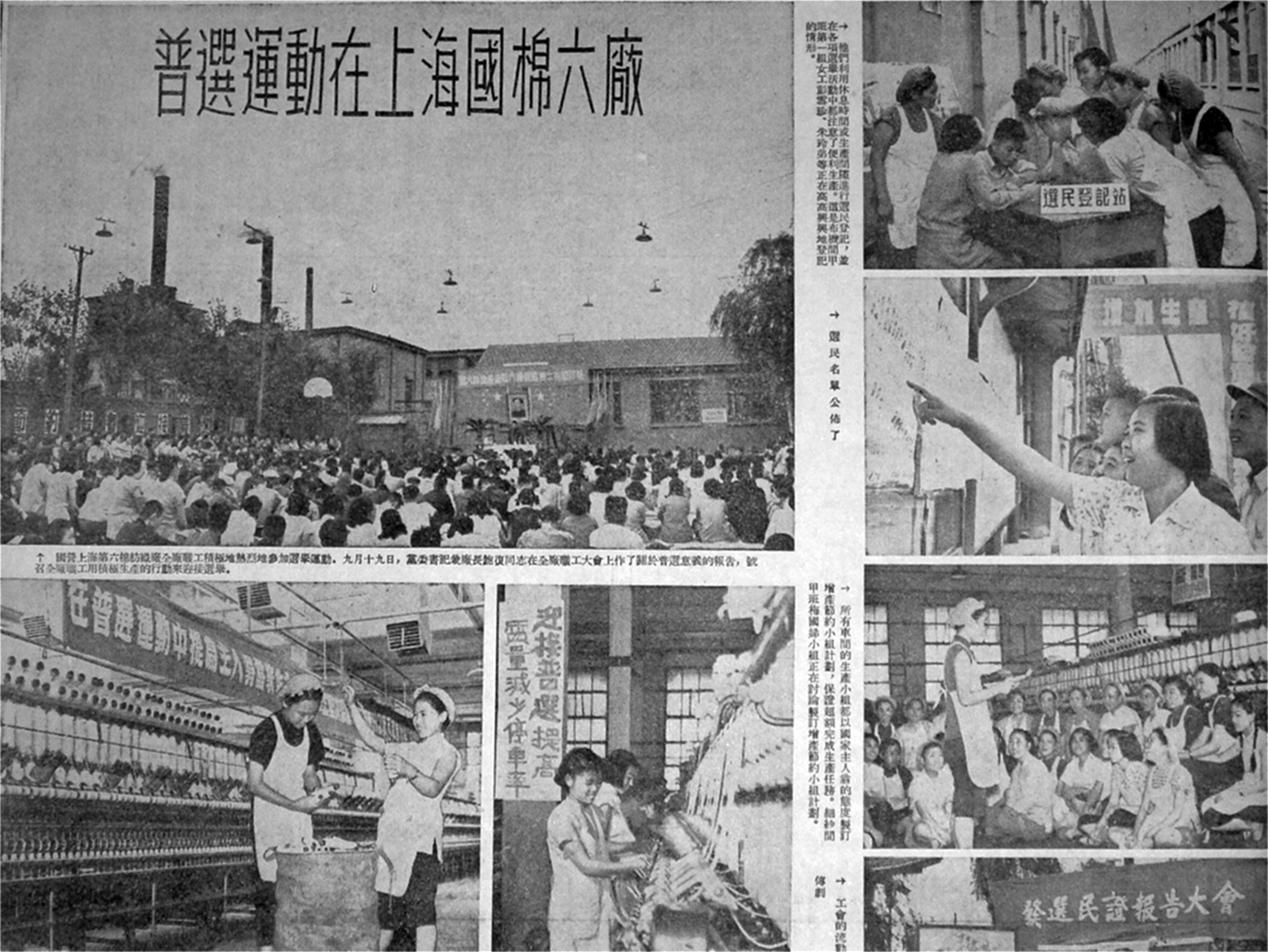
In accordance with the notion of demonstrating this idea of “mastery” in “concrete action,” the “masters” mentioned in these news accounts took incidents from their own lives and linked them to the political climate created by the election. One female worker at Shanghai's Guomian Number 6 Textile Factory 国棉六厂 told a reporter that:
Before the election campaign, I would produce eight or nine pieces of defective cloth each day, but after we began election activities in our factory, [I improved] and in September I only made four and in October only one … Defective cloth is our enemy on the production [front] and needs to be overthrown. I know that reducing the amount of defective cloth produced is a manifestation of being a master.
The newspaper printed this interview under the eye-catching headline, “The Election Taught Me How to Produce Better.”Footnote 9
Shanghai silk worker Mo Qiaoyun 莫巧云 discussed her excitement at seeing the names of voters openly displayed on announcement boards. Before the election, she had been too timid to join factory-wide discussions of production and technological issues for fear that others would gossip about her. After seeing her own name listed as a voter on the big red announcement board, she “felt indescribable happiness,” and resolved that “as a master of the country, I should learn how to drive a vehicle and to change the textile machinery tubes, so that I can help increase production. As long as I just do what's right, why should I fear what others say?” With all of her previous misgivings allayed, she devoted herself to improving her factory's production process.Footnote 10
In addition to written articles, reporters captured images of “mastery.” Shanghai's Liberation Daily and other important propaganda vehicles published numerous images that showcased the glamorous nature of the “masters of the country.” These images – particularly those of female factory workers – reinforced the “working class” nature of the new “masters of the country.” The government expected that these carefully-crafted words and images would inspire the lowest ranks of the labouring masses to participate enthusiastically in the elections. This initial excitement could then be transformed into loyalty to the CCP. Broadly speaking, authorities hoped that their propaganda would transform the elections into a “process of raising the people's political activism and feeling of being the masters of the country” and thus represent “the legitimacy and universality of our country's democratic system.”Footnote 11 Such rhetoric and goals were no different than those used in earlier CCP mass campaigns – this particular mass campaign just happened to be called an “election.”
The Election at Shanghai's Guomian No. 6 Factory

Performance: Making People Feel like “Masters of the Country”
“Masters of the country” propaganda was a discursive strategy designed to whip up popular excitement for the elections. However, troubling early reports from Shanghai indicated a widespread lack of engagement with, or misunderstanding of, the elections. In Huangpu 黄浦 district in the heart of Shanghai, cadres claimed that voters lacked even the most basic vocabulary for describing elections: “Some people have begun calling the election ‘Pudong’ 浦东 or ‘Puxi’ 浦西 [in Shanghai dialect, the pronunciation of puxuan 普选, the term for mass suffrage election, and the place-name Puxi are identical]; upon hearing the word ‘candidate’ [the term for candidate, houxuanren 候选人, sounds as if it could also mean ‘people selected later’], some people take it to mean that others are ‘people selected first’.”Footnote 12 Some neighbourhood cadres misunderstood the phrase “single-candidate election” (deng'e xuanju 等额选举, which includes a character that also can mean “to wait”) to mean “80 people hold a meeting, 40 are elected and 40 wait to be elected.”Footnote 13 Perhaps as a result of this confusion, the authorities found themselves disappointed by some of the early “test” elections held in selected areas. Attendance and participation in “small group discussions” that preceded the voting were problematic, with one report lamenting that “during meetings, the only people who talked were a few activists; the other voters didn't say a word.”Footnote 14
The CCP expected the “masters of the nation” propaganda to create popular acceptance of the particular election procedures adopted in China. These processes, and particularly the method for candidate nominations and the structure of single-candidate elections, allowed for the Party to dominate the elections. Grassroots voters in Shanghai, however, found the procedures neither comprehensible nor acceptable. At the end of 1953, during the beginning of the nomination process, cadres sent the municipal election committee numerous reports reflecting public concerns. Among the complaints were comments that “the nomination system is not democratic, but a bottom-up method would be,” “the candidates have all been picked by the leaders, just like in the era of Nationalist rule; we can't pick the people we want, so we're forced to select people we don't want to choose,” and nominated candidates were derisively compared to “beggars eating dead crabs, enjoying each one.”Footnote 15 This negativity and resistance caused some elections to slip out of the Party's control. In one early voting district, for example, all three of the officially-nominated candidates failed to earn half of the vote and thus were not elected.Footnote 16
This reaction at the grassroots was not entirely unexpected by Party leaders, who had experienced similar attitudes in earlier political campaigns. However, the elections, unlike other political campaigns, could not simply ignore the views of ordinary people. Each voter was entitled to cast a vote and, even though these were single-candidate elections, the participation rate and the number of ballots a candidate received were seen to be important. Moreover, acceptance of this voting process was intimately connected to the broader issue of the average voter's acceptance of the new government. If control over any aspect of the process was lost, then the “universality” and “legitimacy” of the CCP's “people's democracy” would be tarnished.
In response, the Party instigated a mammoth propaganda campaign aimed at reinforcing and further popularizing its “masters of the nation” rhetoric and thus correcting the masses' “ideological problems.” The Party leadership placed great emphasis on rituals and symbolism. The ceremonial aspect of the election process was particularly evident in the announcement of the voter lists, the distribution of voter identification cards, and in the voting meeting itself. Shanghai city leaders and the election committee carefully planned these events, demanding that grassroots work units comport themselves in a serious and respectful spirit and that election meeting venues “undergo redecoration and display a collection of propaganda slogans.”Footnote 17
Officials in Shanghai's local election districts took immediate action. Cadres decorated each voter registration station and every election meeting venue with banners and slogans in order to highlight the festive aspect of voting. Just before and after the election itself, shops on the city's main thoroughfares displayed election materials in their windows. Activists created election-themed pictures and chalk art for display on the streets. Such decorations even appeared in movie theatres, opera houses, cultural palaces and parks. Elements from traditional celebrations in Chinese culture were incorporated into election spectacles.
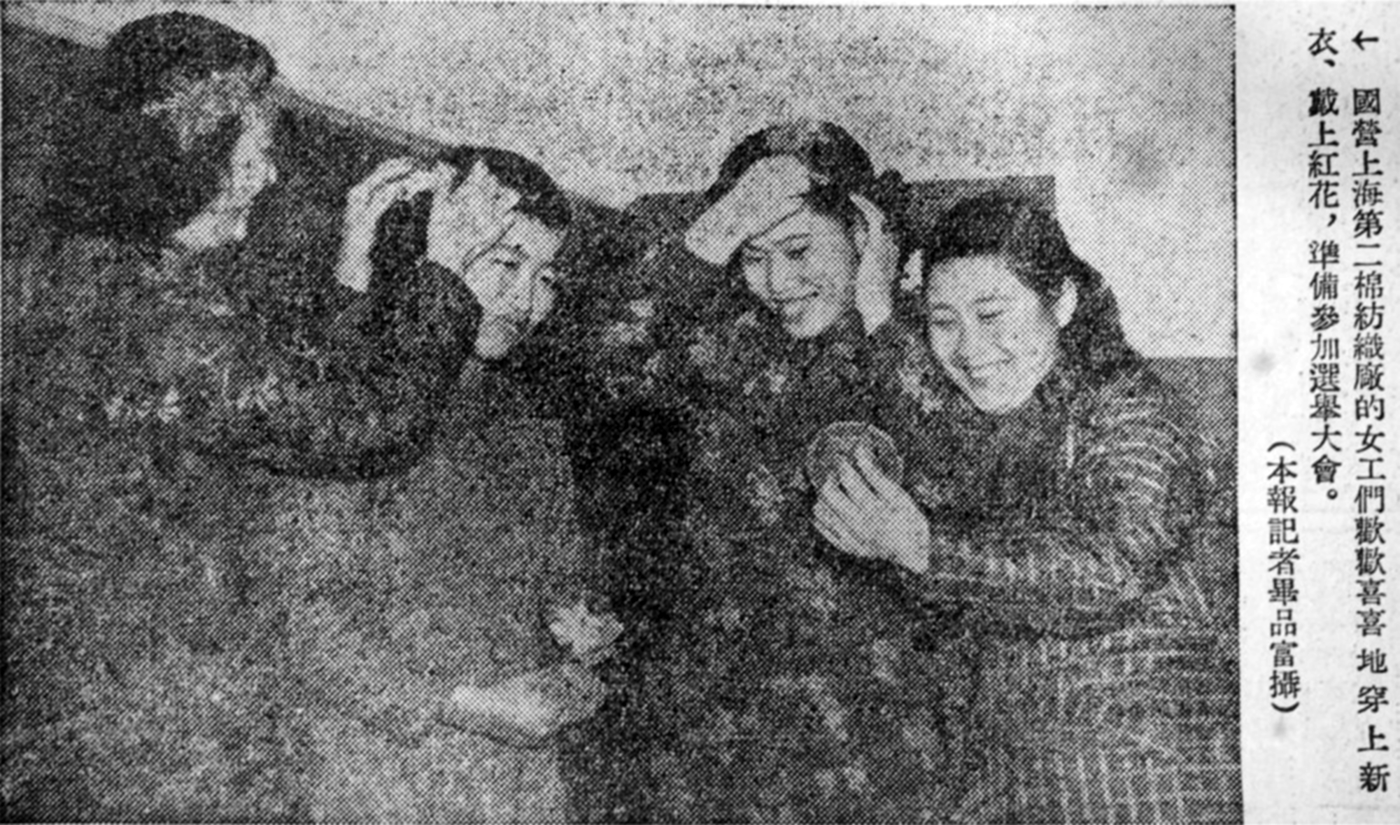
This interweaving of traditional folk customs and contemporary political messages influenced popular perceptions of the elections and the idea of being “masters of the country.” When it was time to vote, this manifested itself in the physical appearance of the voters: many donned new clothes, women wore embroidered shoes, and Hui Muslims bathed, dressed in clean clothes and small white hats in accordance with their customs for an important holiday. Newspaper accounts highlighted how voters felt transformed “from slave to master” when they entered these decorated physical environments.
Female Workers Getting Dressed Up to Participate in the Election
An extensive bureaucratic apparatus supported the dissemination of this message: 9,929 election workers were assigned to the city's 816 electoral districts and 164,372 voter small groups, while 24,966 cadres were involved in voter registration. This enormous team of workers continuously reported on local reactions to the elections. The municipal election committee collected this information, edited it into newsletters, and distributed these back down the chain of command so that grassroots election supervisors could respond to the popular mood in a timely manner. In addition, an internal Party working group was established in each election district as the leadership core for the election process.Footnote 18 From time to time, each district also received reports from the work teams about threats to the electoral process. Alleged offenders were punished at show trials or by specially established “election courts” so that they could serve as negative examples. At the height of the election campaign in Shanghai, eight people were denounced at mass show trials and charged with the crimes of “sabotaging the election” and “counter revolution.” Five of these eight were also accused of murder and received the death penalty, while the remaining three were sentenced to serve prison terms ranging from five to ten years.Footnote 19
At the culmination of the election process, 96.53 per cent of the city's voters fulfilled their role as “masters of the country” by casting their “sacred ballot.”Footnote 20 Although there is no way to determine the many different attitudes the approximately 6.87 million voters had about casting their vote, the very high percentage of voter turnout itself serves as a footnote to the overall success of the rhetorical strategy of “masters of the country.” Grassroots voters became the main actors in the discursive universe of “masters of the country” only for the brief moment of the election process itself.
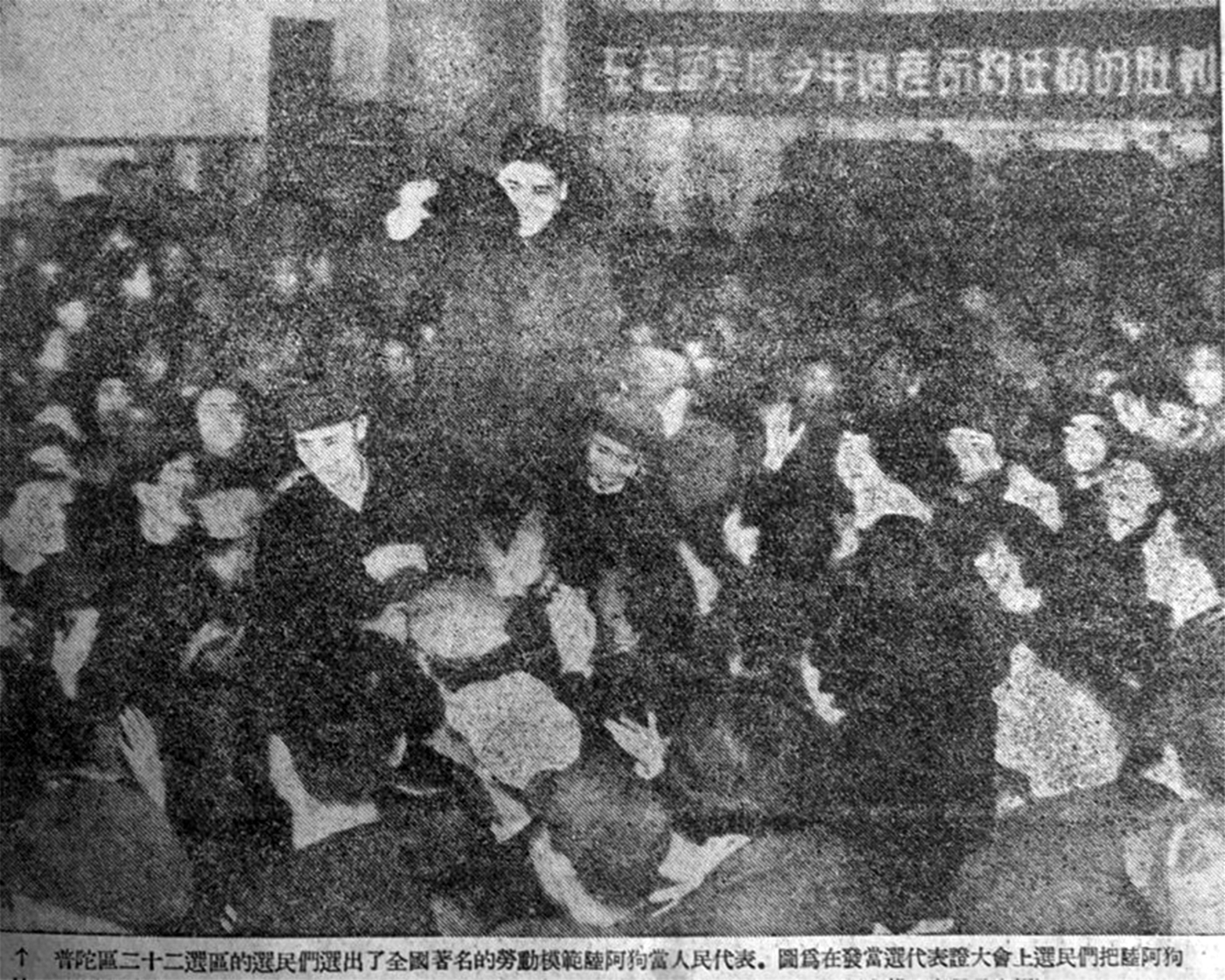
The elections culminated in the creation of local people's congresses in each of Shanghai's urban districts. Citywide, 49.99 per cent of the 4,613 newly-elected delegates were classified as workers (including people who worked in stores and for government agencies), 21.55 per cent were peasants, independent labourers or workers' spouses, 37.55 per cent were CCP members and 8.36 per cent Communist Youth League members.Footnote 21 A handful of these people's congress representatives were characterized by the official media as “exceptional individuals.” One of these was Lu A-gou 陆阿狗, a model worker and the assistant factory manager at the Shanghai Number Two Textile Factory 上海第二纺织机械厂. These particular delegates were not only completely in accordance with the class face of the “masters of the country,” their “progressive accomplishments” also served to make the idea of “masters of the country” even loftier and more inspiring. The Liberation Daily provided extensive coverage of Lu, including a series of stories and pictures about his election, and Lu's own statement on being elected: “owing to the brilliant leadership of Chairman Mao and the Communist Party, the people have seized control of their lives and have taken political power. Today I have just been selected as a delegate. In order to achieve the socialist industrialization of our nation, I will devote myself to my job and will work hard.”Footnote 22 The images of Lu, surrounded by his admiring supporters, taken by a photojournalist, serve to reinforce the “masters of the country” ideal (see Picture 3).
Lu A-gou Surrounded by Supporters
In addition to famous candidates such as Lu, the propaganda campaign also highlighted instances of formerly anonymous members of the “labouring masses” rising to the position of people's congress delegate. Internal reports are filled with stories about the selection of “average” people as people's congress candidates. Participants in the pre-election small group discussions are quoted as saying: “People from all sorts of out-of-the-way places are selected as candidates by the CCP; this is truly wise.”Footnote 23
Both kinds of candidates – the nationally upheld model workers and the ordinary people – shared a common set of characteristics: loyalty to the nation, active participation in government-sponsored political campaigns, and service to those around them. These candidates, however, generally had no previous experience in exercising power, discussing issues of national importance, or representing the needs and voices of the masses to the government. Just like the voters themselves, the elected people's congress delegates found themselves in a discursive world defined by the slogan “masters of the country.”
Outside the Mainstream: Unconventional “Masters of the Country”
The election of representatives to the people's congresses was intended as the culmination of the “masters of the country” propaganda campaign. However, elections in Shanghai produced a number of unconventional “masters” whose circumstances and behaviour did not fit the ideals dictated by the dominant state discourse. One such person was a neighbourhood resident committee chair, Min 闵, who committed suicide after being elected as the local people's congress delegate for Shanghai's North Sichuan Road 北四川路. Why would a person with such a position commit suicide? The North Sichuan Road election committee's detailed investigation did not draw a firm conclusion, but proposed that “most likely” Min's suicide was prompted by “undisclosed background problems.” The proof offered for this analysis was that Min himself, during Shanghai's 1951–53 “democratic reform campaign,” confessed to having problems in his personal political history, but “because his self-confession was not exhaustive enough, [Min] did not pass [political scrutiny], although [the government] did not find serious issues [in his past].”Footnote 24
Economic insecurity influenced Min's state of mind as well. The investigation revealed that Min had been out of work since 1951 and had relied on his two sons to support his family. Min's fortunes had recently taken a turn for the worse: his older son lost his job and his younger son reached the end of his short-term work contract, so Min had borrowed a large sum of money. Min's election during the midst of these personal problems served only to increase his anxiety. During the course of the investigative interviews, neighbours and neighbourhood cadres who knew him thought that Min “had been driven to death by worrying about how to make a living.”Footnote 25 Min, caught between his political problems and his economic insecurities, found himself unable to make the transition from being an ordinary person to being a people's representative, and had no self-belief that he was capable of being a “master.”
While Min's suicide was unique among Shanghai's newly elected delegates, many others shared his financial struggles or problematic background. To take Min's own district of North Sichuan Road as an example, five of the 29 neighbourhood cadres elected to the local people's congress came from “extremely impoverished” households. City leaders paid a great deal of attention to this problem. As a report from the North Sichuan Road district explained, “the people's representatives must be the servants of the people, but for particularly impoverished [delegates] additional considerations can be given.”Footnote 26
In addition to experiencing economic privations, many representatives, similar to Min, also had “political background” problems. Among the 326 neighbourhood cadres elected as people's congress representatives from the ten districts of Huangpu 黄浦, Penglai 蓬莱, Luwan 卢湾, Xuhui 徐汇, Putuo 普陀, North Sichuan Road 北四川路, Zhabei 闸北, Jiangning 江宁, Dongchang 东昌 and Jiangwan 江湾, 14 had been members of religious sects such as the banned Yiguandao 一贯道, two had served as mutual surveillance team leaders during the Japanese occupation, four had been police officers during the Nationalist era, four had been members of the Nationalist Party, and one had participated in the Catholic Church Defence Corps.Footnote 27 Including Min, this meant that nearly 8 per cent of the people's congress delegates from ten districts had complicated political backgrounds. Unlike Min, however, the details of these delegate's pasts had already been fully disclosed to the Party. As a consequence, they did not suffer the extreme anxiety that Min experienced. Could such people, burdened by past political affiliations, really become “masters of the country” in the new socialist state?
Min, as a neighbourhood cadre, experienced an additional source of pressure immediately after his election. The Party had long been concerned with the quality, performance and reliability of neighbourhood cadres in Shanghai. It watched them closely and had launched repeated rectification campaigns directed at them since 1949. Once the election was over, the Shanghai Party Committee decided to “initiate a complete, systematic rectification” of neighbourhood resident committees.Footnote 28 During the period when the newly elected people's congresses began to meet, preparations for the rectification campaign proceeded apace. The campaign lasted a year, wrapping up in April 1955. Of the approximately 110,000 Shanghai cadres targeted by the campaign, 42.5 per cent were removed from their jobs; over 11,000 of those were listed as losing their position for “political” reasons.Footnote 29 Among the 63,382 neighbourhood-level cadres from 22 districts, the investigation revealed that 18,044, or 28.48 per cent of the total, had “political background problems.”Footnote 30
In such an anxious political environment, cadres with complicated histories found themselves in a particularly perilous situation, even including those who had been elected to people's congresses. Min's suicide on 30 April 1954 coincided with the early stages of the rectification campaign. Not long before his suicide, information about the investigation began to leak out, providing him with a strong hint of what was to come. The district report on Min's suicide noted that the recent arrest of the chair of the residents' committee in a neighbouring area left Min “even more terrified.” He became “unwilling to come into contact with local police in the course of his liaison duties” and refused to appear when the local court held hearings. These factors, combined with the “possibility that bad elements in the neighbourhood provoked him by saying that the government would soon deal with him,” led to his suicide.Footnote 31
Although the municipal Party committee repeatedly exhorted rectification campaign work teams to “win over the majority and strike [only] the minority,” the investigations proved tough on all neighbourhood cadres. Under enormous political pressure, over 110 cadres committed suicide during 1954.Footnote 32 Although representatives to the people's congress with problem backgrounds were not targeted in this campaign, the psychological stress they felt can only be imagined.
Beijing: “Masters” of State and Society
The true rulers of the nation – not merely those rhetorically identified as “masters” during the pre-election propaganda campaign – resided in Beijing, where the victorious CCP established its capital in 1949. These included not only Chairman Mao and other high-level CCP leaders, but also the cadres of the central and Beijing city governments. Some of these displayed their own understanding of what it meant to be the real “masters of the country” during the people's congress elections. One report from the Beijing municipal election committee stated that some cadres living in an electoral test district in Xidan 西单 “had poor attitudes” despite working for “top-level organs of the central government.” The personnel director for the All-China Federation of Trade Unions, for example, refused to let election registration workers enter his office, saying “We're busy – how can you possibly come here to look for us!” The report concluded that “the lack of enthusiastic participation in the election by central government cadres is widespread, and their reasons for this are ‘work is busy, there's no free time’ or ‘voting has nothing to do with me.’ Some cadres don't want to have meetings with ordinary community members, feeling that to do so would be to ‘lose status’.”Footnote 33
The Beijing municipal Party committee worried about these “uninterested” cadres on the grounds that “the grassroots election in the city requires cadres to be the backbone, otherwise it will have to depend on unemployed and semi-employed neighbourhood activists.”Footnote 34 Despite its efforts, however, the situation failed to improve. Three months after the reports cited above, another internal report described several central and city-level government work units in the Xidan district as “generally disinterested in electoral participation.”Footnote 35 Such units and their cadres, located in close physical proximity to the national leaders' compound at Zhongnanhai 中 南 海, demonstrated another level of meaning to the phrase “masters of the country”: these were special groups of voters, masters who placed themselves above the masses. They had been in the capital for less than four years, but they had already anticipated the future, true meaning of “masters of the country.”
In contrast to these indifferent cadres, Beijing's intellectual elite sought to use the rhetoric of “masters of the country” as a weapon in their political struggles. The controversy over Peking University professor Zhang Dongsun's 张东荪 voting rights provides a prime example of this. In 1951, Zhang, a noted philosopher, prominent political activist and high-level government official, was accused of leaking national secrets to the United States.Footnote 36 He later received “lenient treatment” and retained his government salary, but was reassigned to the Peking University philosophy department for “reform” in 1952, and was removed from his government posts after 1954. At the beginning of the election process, Zhang “thought that he had never been under state supervision [which would have disqualified him as a voter]” and so he “decided to take part in voter registration” and was listed in the voter rolls.Footnote 37
This created a furore in the university. According to an official account of the incident:
After Zhang Dongsun's name was listed on the voter rolls, Peking University professors discussed this issue avidly and expressed their discontent. Zhou (a progressive) and Xiong (a centre-leftist) asked, “We filed accusations against him long ago, how can his name be on that list?”… Feng demanded the revocation of Zhang Dongsun's membership in the union and the Chinese Philosophical Association, as well as his expulsion from the faculty. Yang also expressed his dissatisfaction. Wu (a moderate) derided the election work group, saying they “didn't solve the problem!” Xiang (a moderate) said “other people who have committed the same crime as Zhang were long ago sent to be ‘reformed through labour’; if I had leaked secrets about the Chinese army going to Korea, my soul would have already left this earth.”… When the voter small group held its meeting, the professors were all extremely angry, criticizing Zhang Dongsun for “insinuating himself into our ranks!”… They unanimously proposed that they should “draw a line between us and the enemy,” and “confiscate Zhang Dongsun's voting rights!” Some of the [politically] moderate professors made the self-criticism that their original opinions about Zhang's right to vote had been influenced by a liberal attitude and were “thought paralysis” and “lacking in the spirit of being a master.”… As of now, more than 20 professors have filed accusations against Zhang Dongsun with the election work group.Footnote 38
On 6 January 1954, the Beijing Haidian 海 淀 district election committee held a hearing to accept the petition for the removal of Zhang's voting rights. Thirteen members of the university represented the more than 80 professors who had joined in the complaint. An “extremely nervous” Zhang attended the meeting, too, along with his spouse. In order to prevent a confrontation between the two sides, the meeting was temporarily adjourned after half an hour and Zhang was asked to leave. After the accusers presented their case, Zhang re-entered the room, admitted that “all of the information provided by the masses is true” and averred that “since the masses feel this way, I can only follow their opinion.”Footnote 39
The available documentary records do not reveal the final outcome of Zhang's case, but they demonstrate how the election process provided a platform for university professors to exercise their control over the rhetoric of mastery.Footnote 40 They followed Mao Zedong's dictate that “election rights are for the people, not for reactionaries,” and obeyed the government's exhortation to take “concrete action” in defence of their political rights.Footnote 41 One member of the Peking University philosophy department explained this clearly: “The Communist Party is truly Marxist-Leninist. The appearance of Zhang's name on the voter rolls allowed it to accomplish three goals: first, to follow the legal procedure scrupulously; second, since the masses will definitely file an accusation against him, it will allow them to draw a line between themselves and the enemy and serve to educate them; third, it will yet again raise the question of Zhang's [place in the new Communist system].”Footnote 42 This, perhaps, can be seen as confirmation of writer Lu Xun's 鲁迅 earlier judgment that Beijing intellectuals were little more than “literary hacks enthralled to officialdom” (guan de bangxian 官的帮闲).Footnote 43
Non-elite Beijing voters, such as the Catholics in Xisi 西四 district's Zhantansi South 旃檀寺南 precinct, appropriated the discourse of “masters of the country” for their own ends, too.
A significant concentration of Catholics, served by six churches, lived in the Xisi district.Footnote 44 Zhantansi South precinct was home to two of these churches and 1,015 Catholic voters, who made up nearly 20 per cent of the district's total of 5,535 voters.Footnote 45 The Xisi Party committee had already decided to reserve two people's congress delegate positions for the entire district's Catholic population.Footnote 46 During the election's nomination phase, the committee discovered that a portion of the Catholics opposed the nomination of a fellow Catholic named Jia 贾, believing that he was “unable to represent the missionaries or the religious community.” Some even vowed not to vote if Jia was nominated.Footnote 47
Many of the Catholics in the area hoped instead to nominate Li Junwu 李君武, the district church's vicar general. Some launched a campaign on his behalf. In one instance, a priest confronted a government-appointed “activist” and berated him: “I have heard from other parishioners that you haven't selected Vicar Li [as a candidate]. Why would you choose Jia? Don't forget that you're a Catholic and that Li Junwu is our vicar.”Footnote 48 The chorus of support for Li grew stronger and direct criticism of Jia increased as the election neared.Footnote 49 As a result, two candidates not proposed by the authorities – Li and another priest named Wang – received enough votes to be candidates for the people's congress.Footnote 50
These events spurred the local Party committee, which already closely monitored the Catholic community, to an even higher level of vigilance. After investigating the situation, the committee decided two things: first, not to increase the number of delegate positions assigned to the Catholics, given that the list of approved candidates had already been announced and they assumed that Jia would have “no problem” winning the election; and second, that “the work group, working through the heads of each voter small group, should explain what the people's democratic rights are, what issues they should pay attention to when voting, what sort of behaviour is damaging to the election, teach the masses to respect their own rights, and that those who interfere with the free exercise of voting rights are breaking the law.”Footnote 51
These measures did nothing to diminish popular support for Li Junwu. On 28 January 1954, the Beijing Party committee's election report claimed that the officially nominated candidates in all of the city's districts “were voted into office, with most receiving 80–90 per cent of the vote, with the highest receiving 99 per cent and the lowest around 70 per cent.” Li Junwu earned over 300 votes, more than any other non-official candidate in Beijing.Footnote 52 Li was not elected to office, of course, but the actions of the Catholic voters who supported him represented a vigorous attempt to play the role of the “masters of the country.”
Officials, intellectuals and ordinary people in Beijing each understood the concept of “masters of the country” differently, yet each group believed that this discourse referred to themselves and saw it as a tool that could be used in politics. Each of these different groups had been steeped in the capital's strong political culture. The political culture of Shanghai could not compare to the intense awareness of politics and power that pervaded Beijing society. The divergent reactions to the people's congress elections, and the different concepts of “masters of the nation” that took hold in the two cities, highlighted this difference.
In light of this, the Beijing Municipal Party Committee needed to prevent and correct independent social actions such as those taken by the Catholics in Zhantansi South precinct. From time to time, they also needed to educate the people not to be overly proud of their position as residents of the capital and to turn their attention to the whole country. On 21 August 1954, the first Beijing municipal people's congress elected Mao Zedong, Liu Shaoqi and Zhou Enlai as part of the city's delegation of 28 to the first National People's Congress. On the same day, the Beijing municipal Party committee's propaganda bureau issued a notice demanding that each work unit's propaganda work must “not emphasize that the election of Mao, Liu, and Zhou is an honour only for the people of Beijing; instead, emphasize that it is an honour for the people of the whole country, because this event reflects the collective desire of the whole population.”Footnote 53
Comparing Shanghai and Beijing: Who Are the Masters?
The contrast between the manifestations of the “masters of the country” discourse within the political cultures of Shanghai and Beijing exposes a larger issue in modern Chinese history: the competition for power, influence and control between these two centres of mainland Chinese life. Beijing's position has long been clear: it is the capital. Shanghai's status has been much more complicated. Within the CCP's discursive structure, Shanghai has had an unclear and ever-shifting role, often tinged with negative connotations: it was called, at various times, the base for the imperialist invasion of China, a playground for adventurers, and a wellspring for bourgeois poison. Could Shanghai, which was the birthplace of both the CCP and China's industrial working class, ever lay an effective claim to power and prestige? Could the city ever be seen as a home to the masters of the new China? Shanghai grassroots society, including the working class, could not be ignored by the CCP, but the Party also could not completely trust this complex social group.
While there were a few examples of group challenges to state power in Shanghai during the election, they differed in character and form from those in Beijing. Most notably, resistance to state-approved candidates could be found in those parts of Shanghai with concentrated Catholic populations. A Shanghai city election committee internal publication warned election coordinators that “Catholics require particular attention” because while they “do not have many opinions about the other candidates we have nominated … when it comes to the Catholic candidates we have nominated and who are close to us, they launch attacks and call them apostates.”Footnote 54 Archival materials that might reveal specific events similar to the organized activities in Beijing, however, are lacking.Footnote 55 Likewise, although some Shanghai officials expressed negative attitudes towards the electoral process, none displayed the vocal resistance that characterized some sectors of Beijing's official class.Footnote 56
Capitalists fared much better than expected in Shanghai's voting. According to the municipal election committee's own self-criticism, “the masses in many districts criticized nominees from worker backgrounds, but not those from capitalist backgrounds … when candidates were introduced, they gave tepid introductions for Party members yet mistakenly exaggerated the accomplishments of capitalists … in some electoral districts, capitalists received more votes than district-level Party cadres.”Footnote 57Although the Shanghai CCP committee accepted responsibility for this result, stating that it “perhaps resulted from biases and incomplete planning in propaganda for the united front policies,” it is much more likely that it was caused by a latent sympathy for the capitalist class inherent within Shanghai's political culture.Footnote 58
The conflict between Shanghai society and the state was thus a “soft” re-emergence of unorganized collective consciousness and historical memory, rather than the hard, organized group actions that characterized the conflicts in Beijing.
It was only during the Cultural Revolution, when the Shanghai Workers' Rebel Faction 上海工人造反派 replaced the Beijing Red Guards with their aspirations of “the nation is our nation,” could Shanghai claim to eclipse Beijing as the home of the “masters of the country.” The Shanghai Workers' General Headquarters 上海工人造反总司令部, as Elizabeth Perry and Li Xun have argued, successfully and uniquely transformed itself from a rebel organization into a long-lasting legitimate organization with administrative authority.Footnote 59 Rebel organizations nationwide, which generally lacked these characteristics, looked to Shanghai as a model during this period.Footnote 60
For that brief moment, Shanghai became the locus of the “masters of the nation” discourse. The Workers' Headquarters itself become the guiding star of the national rebel faction.Footnote 61 Even the Shanghai newspaper, Wenhuibao 文汇报, once considered rightist and bourgeois by Mao Zedong, become a weathervane for political opinion. The Shanghai Workers' Rebel Faction's leadership exercised a measure of national and local authority and its middle ranks wielded great influence in Shanghai work units. The Shanghai Workers' Rebel Faction became a major constituent of national power. They were not just the “masters of the nation” in a rhetorical sense, but actually had significant political, social and cultural power at their disposal.
Shanghai surpassed other cities to become the “master” within the context of the socialist state. Even though this was an unexpected result of the Cultural Revolution, it still reflected an internal logic of historical development: it, like all previous “masters,” had been selected by Mao Zedong. The Shanghai Workers' Rebel Faction differed greatly from the “unconventional masters” that emerged from the grassroots during the people's congress elections of the early 1950s. People's congress delegates, even those who bore the twin burdens of impoverished households and problem political backgrounds, had been elected to office by a legal process. The Workers' Rebel Faction, by contrast, seized power illegally with Mao's support. Their authority was not the result of revolution, nor the product of a modern nation's legal system.
Even this brief moment of mastery, however, was illusory as it had ultimately been determined by forces in Beijing and not in Shanghai. In September 1970, Mao summoned Shanghai leader, Wang Hongwen 王洪文, for a discussion that clarified this point. In his recollections, Wang wrote:
The Chairman asked me: “What have you done since the beginning of the Cultural Revolution?” I began my answer by discussing the first big character poster I had written, the creation of the Rebel Workers' Faction, my visit to Beijing, the creation of the Workers' Headquarters, and the Anting Incident (Anting shijian 安亭事件) [a 1966 railway blockage near Shanghai].
The Chairman said to me: “The CCP municipal committee was very stupid to recognize the Scarlet Guard (chiweidui 赤卫队) instead of the Workers' Headquarters. The Party centre recognized your Workers Headquarters and not the Scarlet Guard, and saw the railway stoppage as a good thing.”
I asked the Chairman: “Did you say, ‘first chop off someone's head and then file a report [i.e. act first and ask for permission later], first there is event, then there is theory’ [in response to the Anting Incident]?” The Chairman said yes. I asked the Chairman if the January seizure of power in Shanghai had happened too soon. The Chairman said, “Seizing power wasn't your invention; that came earlier.” I asked: “are you referring to the reorganization of the Beijing municipal Party committee?” The Chairman said: “Exactly. Yours was a complete seizure of power. The Party centre drew lessons from Shanghai's experiences [and] in some places the army had to help with the seizure of power.”Footnote 62
Two years after this conversation, Wang was elevated to the highest levels of Party leadership. This conversation was both Mao's interview of Wang as a potential successor and a window into the extent to which the highest authority could ignore all institutions and rules in the pursuit of whatever he wanted. Wang Hongwen's rapid ascent came as a gift from the “great leader” in Beijing. The fortunes of the Shanghai Workers' Rebel Faction as an organization were controlled by the “great leader.” The rise and fall of Shanghai's status were likewise his doing. Beijing was always the master.
From the first people's congress election to the Cultural Revolution, another thread of historical logic ran through the various kinds of “masters” of grassroots society. “Masters of the country” propaganda held out, as a metaphor, the possibility that grassroots society could take control of its own fate or that people could make use of the stage provided by political campaigns to vie for control within urban society. The promise of this discourse inspired people throughout the Maoist era and helped propel popular participation in that period's mass political campaigns.
[Translated and adapted from an unpublished manuscript in Chinese by Joshua Hill.]