Introduction
Seed germination is an important event in the life cycle of a plant and depends primarily on environmental conditions. The response of seed germination to abiotic factors is considered an adaptive mechanism (Keeley and Fotheringham, Reference Keeley, Fotheringham and Fenner2000; Vandelook et al., Reference Vandelook, Moer and Van Assche2008; Menezes and Rossi, Reference Menezes and Rossi2011). Eradication of the entire above-ground vegetation by some environmental occurrence leads to the subsequent germination of large numbers of seeds to replenish the changes in the above-ground biomass. Fire is one of the most important factors causing such perturbations in the environment. Smoke generated from fire is recognized as an important entity which promotes seed germination of many plant species (De Lange and Boucher, Reference De Lange and Boucher1990; Brown, Reference Brown1993; Baldwin and Morse, Reference Baldwin and Morse1994; Van Staden et al., Reference Van Staden, Sparg, Kulkarni and Light2006). The ability of aqueous smoke extract to stimulate seed germination has been reported in a wide range of plant families (Roche et al., Reference Roche, Koch and Dixon1997; Jain et al., Reference Jain, Stirk and Van Staden2008). Smoke not only stimulates seed germination but it also promotes seedling growth (Light and Van Staden, Reference Light and Van Staden2004; Kandari et al., Reference Kandari, Kulkarni and Van Staden2012). Recently, the highly biologically active, water-soluble karrikinolide was identified from cellulose- and plant-derived smoke (Flematti et al., Reference Flematti, Ghisalberti, Dixon and Trengove2004; Van Staden et al., Reference Van Staden, Jäger, Light and Burger2004). Karrikinolide (KAR1) is a potent stimulant that enhances the rate of seed germination in several plant species at nanomolar concentrations (Flematti et al., Reference Flematti, Ghisalberti, Dixon and Trengove2004; Stevens et al., Reference Stevens, Merritt, Flematti, Ghisalberti and Dixon2007; Nelson et al., Reference Nelson, Riseborough, Flematti, Stevens, Ghisalberti, Dixon and Smith2009).
Vermicompost leachate (VCL) is produced by the activity of earthworms during the churning process of organic wastes (Ievinsh, Reference Ievinsh2011). Vermicompost contains growth-promoting hormones, which are secreted by the earthworms (Neilson, Reference Neilson1951, Reference Neilson1965; Tomati et al., Reference Tomati, Grappelli and Galli1988). Large amounts of phenolic and humic substances present in VCL show hormone-like effects, which lead to the stimulation of germination and overall growth in a wide range of crops (Atiyeh et al., Reference Atiyeh, Lee, Edwards, Arancon and Metzger2002).
A number of studies have reported the promoting effects of SW, KAR1 and VCL on seed germination and seedling growth from diverse families (Van Staden et al., Reference Van Staden, Jäger, Light and Burger2004; Ievinsh, Reference Ievinsh2011; Kandari et al., Reference Kandari, Kulkarni and Van Staden2011; Kulkarni et al., Reference Kulkarni, Light and Van Staden2011). However, these studies did not consider the physiological and biochemical changes that occur during the development of seedlings under the influence of these plant growth-promoting substances (PGPSs). A clear understanding of the levels of proteins, proline, phenols, amino acids and the activity of alpha-amylase during seedling formation is essential for the appropriate use of these PGPSs. The aim of the present study was to evaluate the effect of SW, KAR1 and VCL on different biochemical aspects during seed germination and seedling growth of Phaseolus vulgaris. All the growth-stimulating effects were compared with that of gibberellic acid, which is one of the key hormones known to be involved in seed germination.
Materials and methods
Seed material
Commercial seeds of red kidney bean (Phaseolus vulgaris, var. Gadra) were purchased from McDonald Seed Company (Pietermaritzburg, South Africa). Seeds were stored at 10°C prior to use.
Smoke-water, KAR1, VCL and GA3 concentrations
The preparation of smoke-water was carried out as detailed by Baxter et al. (Reference Baxter, Van Staden, Granger and Brown1994) with slight modifications. Smoke of dried leaves of red grass (Themeda triandra) was bubbled through a flask containing 500 ml water for 45 min. This concentrate was diluted with distilled water to make 1:250, 1:500, 1:750 and 1:1000 v/v smoke test solutions. Bioassay-guided purification of KAR1 was carried out according to the method of Van Staden et al. (Reference Van Staden, Jäger, Light and Burger2004) and the isolated compound was tested at 10− 7, 10− 8 and 10− 9 M concentrations. Vermicompost leachate was purchased from Wizzard Worms, Rietvlei, KwaZulu-Natal, South Africa and 1:5, 1:10 and 1:20 v/v concentrations were used for the treatments. Gibberellic acid (Sigma-Aldrich, Gauteng, South Africa) solution was prepared and tested at 10− 5, 10− 6 and 10− 7M concentrations.
Germination experiments
Petri dishes (90 mm) containing two layers of filter paper (Whatman No. 1) were used for germination experiments. Healthy seeds were selected for each experiment with four replicates of ten seeds each. Five millilitres of distilled water or test solution were added to each Petri dish and the experiment was conducted at 25°C under continuous dark conditions using light-proof boxes, as described by Kulkarni et al. (Reference Kulkarni, Sparg and Van Staden2006). All observations were carried out under a green safe light (0.3 μmol m− 2s− 1) and the experiment was terminated after 7 d. Subsequently morphological parameters of seedlings were recorded. Seedling axes were used for the determination of physiological parameters.
Protein extraction
The seedling axes harvested after 7 d of germination were used as plant material for the extraction of proteins. Seedling axes from individual replicates were separated from the cotyledons and homogenized. The homogenized plant material (pooled sample) was weighed [10 g fresh weight (FW) for protein extraction and 0.5 g FW for total proline and amino acid estimation] and used for each experiment. Similar experimental procedures were carried out for all replicates. All steps were carried out at 4°C (Luthra and Singh, Reference Luthra and Singh2010) with slight modifications. Seedling axis tissues (10 g FW) were ground to a fine powder in liquid nitrogen and dissolved in ice-cold extraction buffer [0.1 M K2HPO4/KH2PO4 (K-Pi), pH 7], 2% nonyl phenyl ethylene glycol (NP-40), 2.5% sodium l-ascorbate, 1 μg ml− 1 lysozyme (G-Biosciences, St. Louis, Missouri, USA), 1 μg ml− 1 protease inhibitor cocktail (pepstatin, leupeptin and apoprotinin) and 10 mM phenyl methyl sulphonyl fluoride (PMSF), to give a homogeneous mixture. The mixture was incubated for 1 h at 4°C in ice, followed by sonication [3 (cycles) × 10 (min) × 50 (% of power)] and centrifugation at 30,240 × g for 20 min to give a supernatant designated as crude extract. The crude extract obtained from seedling axes was used in all experiments. Total protein concentration in the crude extract was determined with different concentrations of bovine serum albumin (BSA, Sigma-Aldrich) as standard protein, using the Bradford assay (Bradford, Reference Bradford1976).
Alpha-amylase assay
Activity of alpha-amylase was determined according to Yamasaki et al. (Reference Yamasaki, Deguchi, Fujimoto, Masumura, Uno, Kanamaru and Yamagata2006) with some modifications. The material was homogenized in K-Pi buffer (as for protein extraction) and the supernatant was used as a crude enzyme. Crude enzyme (20 μl) was added to the substrate mixture containing 990 μl each of CaCl2 (0.2 mM) and potato starch (0.15%) and incubated for 15 min at 37°C. The reaction was terminated by the addition of 3 ml iodine reagent (0.06% iodine and 0.6% KI in 0.5 N HCl). The absorbance of the reaction mixture was read at 760 nm against a blank (substituting water for potato starch).
Acid phosphatase assay
The acid phosphatase assay was carried out at 37°C (Singh and Luthra, Reference Singh and Luthra2011). Crude enzyme extract (15 μl) was added to the sodium acetate buffer (0.1 M, 985 μl; pH 5.0) containing the substrate para-nitrophenyl phosphate (p-NPP; 2 mM). After incubation for 60 min, the reaction was stopped by adding 2 N NaOH (100 μl); the absorbance of the solution was measured at λmax= 405 nm. A zero time blank containing all the reagents, except for the plant extract, was included in the assay. p-Nitrophenol (p-NP) was used as a standard and results were expressed in nkat mg− 1, where kat represents the conversion of 1 mole of substrate per second.
Total proline quantification
Proline levels were determined using ninhydrin reagent (Bates et al., Reference Bates, Waldern and Teare1973; Kiarostami et al., Reference Kiarostami, Mohseni and Saboora2010) with slight modifications. Samples of 0.5 g (fresh weight) were homogenized in 10 ml 3% sulphosalicylic acid. The total extract was filtered through a double-layered muslin cloth and 2 ml filtrate was mixed with 2 ml acid ninhydrin and 2 ml glacial acetic acid. The reaction mixture was incubated in a water bath at 100°C for 75 min and the reaction was stopped by placing in an ice bath. Further extraction of proline from the reaction mixture was carried out by the addition of 4 ml toluene followed by quick vortexing. The absorbance of the toluene layer was recorded at 520 nm and proline concentration was determined from a standard curve and calculated on a fresh weight basis [μg (g FW)− 1].
Assay of total amino acids
Estimation of total free amino acids was conducted according to the method of Rosen (Reference Rosen1957) with slight modifications. Plant material (0.5 g FW) was hydrolysed in 10 ml 6 N HCl for 6 h at 100°C in a water bath. The total reaction mixture was filtered through a double-layered muslin cloth. One millilitre of filtrate, 0.5 ml acid ninhydrin solution and 0.5 ml of acetate buffer were mixed, followed by incubation at 100°C in a water bath for 15 min. Instantly, 3 ml of 50% isopropyl alcohol–water diluent were added to the mixture after removal from the water bath, and the mixture was shaken vigorously. On cooling to room temperature, the absorbance of the sample was read at 570 nm using a spectrophotometer. Leucine (0.1 M, pH 5.0 in citrate buffer) was used as a standard.
Total phenolic estimation
Estimation of the total phenolics from seedling axes of P. vulgaris was carried out according to Singleton and Rossi (Reference Singleton and Rossi1965) and Li et al. (Reference Li, Cheng, Wong, Fan, Chen and Jiang2007) with slight modifications. Plant extract (100 μl) was added to 2.5 ml of 1:10 diluted Folin–Ciocalteu reagent. After 4 min, 2 ml saturated solution of sodium carbonate (75 g l− 1) was added. After 2 h of incubation at room temperature, the absorbance of the reaction mixture was measured at 760 nm. Gallic acid was used as a standard and results were expressed in milligram gallic acid equivalents to fresh weight (g) of seedling.
Statistical analysis
Data were analysed by one-way analysis of variance (ANOVA). Treatment means were separated by Duncan's multiple range test at 5% level of significance (P < 0.05). GenStat® (14th edition, VSN International, Hemel Hempstead, UK) statistical package was used to analyse the data.
Results
Effect of PGPSs on morphological characters of seedlings
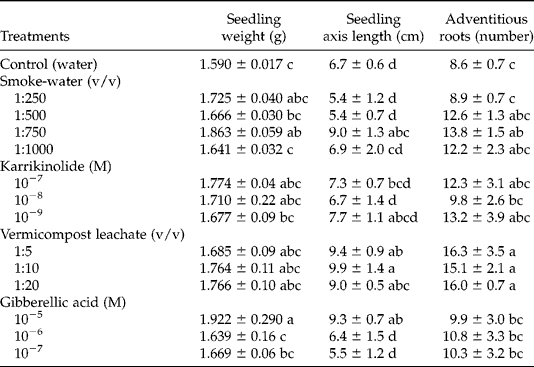
Results of different concentrations of SW, KAR1, VCL and the germination-inducing phytohormone gibberellic acid (GA3) on fresh weight of seedlings of P. vulgaris are shown in Table 1. The maximum weight of seedlings was recorded for the seeds that were germinated in SW at a concentration of 1:750 v/v and GA3 at 10− 5M, which were significantly different from the control. Other concentrations, and KAR1 and VCL, enhanced the weight of seedlings, although these results were not significantly different from controls (Table 1).
The effect of different concentrations of plant growth-promoting substances on morphological growth parameters of Phaseolus vulgaris seedlings. The seeds were germinated under dark conditions at 25±2°C for 7 d

Mean values ( ± SE) in a column with different letters are significantly different according to Duncan's multiple range test (P < 0.05 where n= 4).
The maximum growth of the seedling axis was obtained in seeds germinated with all tested concentrations of VCL, which was significantly different from the control (Table 1). GA3 at high concentration (10− 5M) and SW at 1:750 v/v also significantly increased the length of the seedling axis compared to the control.
The seeds of P. vulgaris germinating under various concentrations of different PGPSs and GA3 showed marked variations in the number of roots. The highest number of adventitious roots was obtained at all tested concentrations of VCL and 1:750 v/v SW, which were significantly different from the control treatment (Table 1). The other concentrations of PGPSs and GA3 increased the number of adventitious roots of germinating seedlings, but these results were not significantly different from the control.
Activity of hydrolytic enzymes
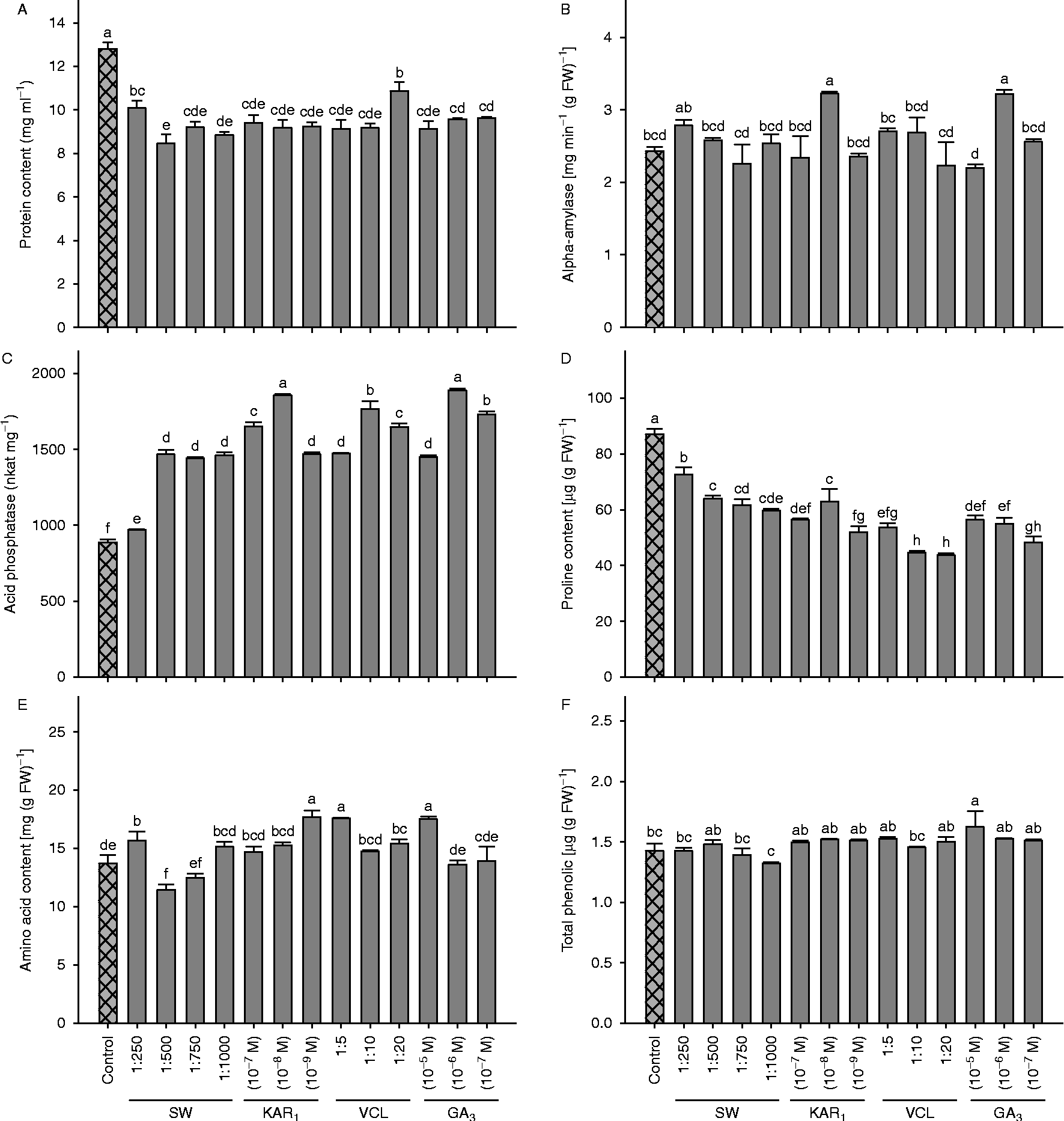
The activity of alpha-amylase was significantly higher [3.225 mg min− 1(g FW)− 1] in the axes of seedlings grown with KAR1 (10− 8M) as compared to the control [2.433 mg min− 1(g FW)− 1] (Fig. 1B). Seedlings treated with a concentration of 10− 6M GA3 also showed a significant increase in the activity [3.21 mg min− 1 (g FW)− 1] of alpha-amylase (Fig. 1B).
Effect of different concentrations of smoke-water (SW v/v), smoke-derived karrikinolide (KAR1), vermicompost leachate (VCL v/v) and gibberellic acid (GA3) on physiological changes during seed germination of Phaseolus vulgaris. The seeds were germinated under dark conditions at 25 ± 2°C for 7 d. Bars ( ± SE) in a figure with different letters are significantly different according to Duncan's multiple range test (P < 0.05 where n= 4).

The highest activity of acid phosphatase (1856.26 nkat mg− 1) was recorded in the seedlings grown with 10− 8M KAR1, and was significantly higher than that of the control (887.8 nkat mg− 1) (Fig. 1C). The seedlings treated with 10− 6M GA3 also showed significantly greater activity of acid phosphatase as compared to the other PGPSs and the control (Fig. 1C).
Changes in total proline content
Estimation of total proline content in axes of P. vulgaris seedlings showed a significant reduction in quantity with different concentrations of PGPSs as well as GA3. The maximum reduction in proline content [43.67 μg (g FW)− 1] was recorded in seeds germinated with 1:20 v/v VCL when compared to the control [87.0 μg (g FW)− 1] (Fig. 1D). Different concentrations of KAR1 and SW also showed a significant reduction in proline content. All examined concentrations of GA3 showed similar results as recorded for the PGPSs.
Total amino acid content
Significantly higher concentrations of amino acids were measured in the seedlings grown with 10− 9M KAR1 [17.7 mg (g FW)− 1] and 1:5 v/v VCL [17.5 mg (g FW)− 1] when compared to the control [13.73 mg (g FW)− 1] (Fig. 1E). Smoke-water (1:250 v/v) and 10− 5M GA3 also significantly increased the amino acid content of the seedling axes (Fig. 1E).
Total phenolic content
The analysis of all samples from different treatments showed very similar quantities of total phenolics in germinating seedlings of P. vulgaris. However, there was an exception for GA3-treated seedlings at 10− 5M, which showed a significantly greater amount of total phenolics compared to the control (Fig. 1F).
Discussion
The examined PGPSs possess gibberellin- and auxin-like activity in plants belonging to different families (Van Staden et al., Reference Van Staden, Jäger, Light and Burger2004; Ievinsh, Reference Ievinsh2011). Gardner et al. (Reference Gardner, Dalling, Light, Jäger and Van Staden2001) have reported hormone-like action of smoke and its interaction with plant growth regulators. We assessed the data of PGPSs in a comparative manner by analysing the influence of different concentrations of the phytohormone gibberellic acid during seedling development. The results of seedling weight justified the effect, in which smoke-water-treated seedlings were heavier and proportional to the GA3 (10− 5M) treatment (Table 1). Even though the results did not differ significantly, generally all tested PGPSs showed a trend in improvement of seedling weight, indicating stimulatory effects.
The fresh weight of a seedling directly or indirectly depends upon the thickness and length of the seedling axes, which represents the hypocotyl and radicle. In comparison to the control, longer seedling axes were observed in VCL-treated (1:10 v/v) seedlings, followed by smoke-water and KAR1 treatments (Table 1). GA3-treated seedlings also showed an improvement in the length of seedling axes but only at higher concentrations. KAR1 (butenolide) isolated from smoke-water showed cytokinin and auxin-like activity by stimulating cell division in the soybean callus bioassay and rooting in the mungbean bioassay (Jain et al., Reference Jain, Stirk and Van Staden2008). KAR1 is the most active constituent of smoke-water for seed germination (Flematti et al., Reference Flematti, Ghisalberti, Dixon and Trengove2004; Van Staden et al., Reference Van Staden, Jäger, Light and Burger2004). The enhanced growth of the seedling axes observed in bean seedlings treated with VCL can be attributed to the presence of phytohormone-like active constituents.
The efficiency of nutrient absorption depends upon the number of active root hairs and results in better growth and development of a plant. In our study, the number of adventitious roots were markedly promoted with VCL (1:5 v/v) and SW (1:750 v/v), whereas there was a non-significant increase with KAR1 (10− 9M). Smoke-water and VCL treatments were effective in improving root growth parameters of banana (Aremu et al., Reference Aremu, Kulkarni, Bairu, Finnie and Van Staden2012). However, the root promoting effects of VCL may vary from genotype to genotype (Lazcano et al., Reference Lazcano, Revilla, Malvar and Dominguez2011).
The expression of alpha-amylase during seed germination is induced by gibberellins (Fincher, Reference Fincher1989). This enzyme hydrolyses endosperm reserves (starch) into soluble sugars, which provide energy for the growth and development of seedlings. Kaur et al. (Reference Kaur, Gupta and Kaur1998) showed an increase in amylase activity and improvement in sugar transport from reserve tissue to growing parts of seedlings in the presence of GA3. A similar and significant induction of amylase activity was observed in seedling axes which received smoke-isolated KAR1 (10− 8M) and GA3 (10− 6M) treatments (Fig. 1B).
The second most common hydrolytic enzyme is acid phosphatase, which catalyses the hydrolysis of phosphate esters at an acidic pH and supplies soluble forms of phosphate to growing parts of the plant (Singh and Luthra, Reference Singh and Luthra2011). Under salinity stress, a reduction in the activity of acid phosphatase has been observed in lettuce seedlings (Nasri et al., Reference Nasri, Mahmoudi, Baatour, Mrah, Kaddour and Lachaal2012), while exogenous application of gibberellic acid increased the activity of acid phosphatase during seed germination of rye and barley (Centeno et al., Reference Centeno, Viveros, Brenes, Canales, Lozano and Cuadra2001). The negative effect of stress is balanced by gibberellic acid which helped in the mobilization of insoluble reserves into soluble forms by increasing the activity of acid phosphatases and amylases (Centeno et al., Reference Centeno, Viveros, Brenes, Canales, Lozano and Cuadra2001). A similar result of acid phosphatase activity was observed in the seeds of P. vulgaris germinated with different concentrations of PGPSs and GA3. The best activity was observed in the seedlings that received KAR1 (10− 8M) (Fig. 1C).
Proline plays an important role in osmotic adjustment to high temperature, drought and salinity stress (Yurekli et al., Reference Yurekli, Urekli, Porgalli and Turkan2004). An increase in proline content has been observed during salinity stress in Vigna radiata (Chakrabarti and Mukherji, Reference Chakrabarti and Mukherji2003; Mohammed, Reference Mohammed2007). Exogenous application of gibberellic acid decreased the proline content in V. radiata induced under salt stress (Mohammed, Reference Mohammed2007). In this study, we observed a consistent reduction in proline content in seedlings germinated with different concentrations of PGPSs. Lower concentrations of VCL caused almost 50% reductions in the overall free proline content.
Amino acids are ionic compounds that form the basic building blocks of proteins. Amino acids also exist in the free form in many tissues. Hence, the measurement of the total free amino acid pool indicates the physiological status of the plants. The majority of free amino acids start accumulating in plants during salinity and other stresses (Simon-Sarkadi et al., Reference Simon-Sarkadi, Kocsy and Sebestyen2002), while application of gibberellic acid reduced the content of total free amino acids in cashew nut kernels (Hariharan and Unnikrishnan, Reference Hariharan and Unnikrishnan1984). Both responses were determined during the present investigation at high and low concentrations of PGPSs. GA3 (10− 5M) caused induction of total amino acid (negative effect) content in seedlings, which is associated with an increase in stress level, while at a low concentration, normal levels of amino acids were observed. Generally, each PGPS influenced the content of free amino acids in seedlings, but SW at low concentrations (1:500 v/v) significantly reduced amino acid levels.
We did not observe any significant changes in the total phenolic content of seedlings germinated with various concentrations of PGPSs. However, a previous study on desert date (Balanites aegyptiaca) has shown marked reduction in phenolic content in plants treated with gibberellic acid (Mostafa and Alhamd, Reference Mostafa and Alhamd2011).
Even though stress was not imposed on the seeds during this study, smoke treatments have shown improved seedling vigour of tef under high temperature and low water potential (Ghebrehiwot et al., Reference Ghebrehiwot, Kulkarni, Kirkman and Van Staden2008). In a recent study, VCL treatment was effective in alleviating salinity stress of tomato seedlings (Chinsamy et al., Reference Chinsamy, Kulkarni and Van Staden2013). The stress-relieving effect in these crops is most likely due the efficient mobilization of biochemicals, as reported in this study.
Conclusions
Our results show that SW, smoke-derived KAR1 and VCL act as growth-promoting substances similar to the phytohormone gibberellic acid. Exogenous applications of SW, KAR1 and VCL increased the fresh weight of seedlings, length of seedling axes and number of adventitious roots. These PGPSs enhanced the activity of important food-reserve hydrolysing enzymes, such as alpha-amylase and acid phosphatase, during germination. Efficient mobilization and solubilization of cotyledonary reserves by these enzymes no doubt resulted in improved growth and development of P. vulgaris seedlings.
Financial support
The University of KwaZulu-Natal, South Africa is thanked for financial support.
Conflicts of interest
None.