1 Introduction
Shetland Scots is the vernacular variety of Scots spoken in the Shetland Islands, an archipelago in the North Atlantic to the north-east of Scotland. Together with the dialect of the neighbouring Orkney Islands, it forms the Insular subgroup of Scots dialects. A typical characterisation of Insular Scots is the following, from Van Leyden (Reference Leyden2004: 16):
Orkney and Shetland dialects are conservative varieties of Lowland Scots with a substantial Norn substratum. It is notable that the vowel system of these dialects is still quite similar to that of Older Scots, and it is comparable to that of other peripheral Scots areas, such as Galloway in south-west Scotland. Scots was apparently taken to the Northern Isles by immigrants from Central Scotland in the sixteenth century at about the same time as it replaced Gaelic in Galloway. Furthermore, many Older Scots words that have been lost for some time in the Fife and Lothian area are still in everyday use in Orkney and Shetland, at least by the older generation.
Such a description of Shetland Scots as essentially Older Scots with substratum influence from Norn, the earlier Scandinavian vernacular of the islands, is commonplace, and examples of this kind are legion (Melchers Reference Melchers, Schneider, Burridge, Kortmann, Mesthrie and Upton2004: 37; Flom Reference Flom1928–9: 145; Rendboe [1985] cited in Smith Reference Smith and Waugh1996: 39; Barnes Reference Barnes, Ureland and Broderick1991: 454–5; Grant & Dixon [1921] cited in Pavlenko Reference Pavlenko1997: 89; Robertson & Graham Reference Robertson and Graham1991: vii). The emphasis placed on the Scandinavian influence on the dialect varies with the context in which the characterisation is made.
The Norn substratum in Shetland Scots is often discussed with reference to a restricted set of characteristics. Among the phonological features linked to Norn are the merger of /θ, ð/ with /t/ and /d/, respectively (th-stopping); the lack of a distinction between /hw/ and /kw/ (hw-confusion); the vowel [ø]; and particular patterns in prosody and vowel length. In morphosyntax, Scandinavian influence is thought to lie behind the generalised use of ‘be’ as a perfect auxiliary, the distinction between familiar and polite forms of the second-person singular pronoun, and a gendered system of anaphoric pronominal reference. More generally, the substratum is often described as strongest in phonology and lexicon, while other areas of grammar are mostly described as Older Scots.
A satisfying explanation of how this particular mix of features came to be has thus far been lacking. Traditional accounts suggest that the Norn-speaking population in Shetland acquired Scots, but did so imperfectly. Their second-language variety, Scots influenced by features carried over from Norn, was the basis for Shetland Scots. However, this process ignores the fact that a large proportion of the Shetland population, probably about a third by 1600 (Donaldson Reference Donaldson and Withrington1983: 13–15), were immigrants from the Scottish mainland, and native speakers of Scots. An account of the development of Shetland Scots cannot ignore the possible influence of such a sizable group, especially as the native population's acquisition of Scots, and subsequent language shift, is likely to have been triggered by the immigration of large numbers of Scots speakers in the mid-sixteenth century in the first place. An analysis of names and surnames in an early seventeenth-century register of testaments has shown considerable levels of inter-ethnic marriage between Scottish immigrants and native Shetlanders (Knooihuizen Reference Knooihuizen2005, Reference Knooihuizen2008b). An explanation of the history of the dialect must do justice to the input from both these population groups in the islands.
Such an explanation was put forward by Millar (Reference Millar2008). He uses the theory of new-dialect formation by Trudgill (Reference Trudgill2004) as a framework for his account. Trudgill's theory accounts for the processes through which contact between speakers of various dialects, typically in a colonial situation, leads to the formation of a focused ‘new dialect’ (a more detailed discussion follows below). The situation in Shetland, with several immigrant dialects and a local non-native variety of Scots, is a parallel to the varied input to colonial Englishes; moreover, this account combines the input from native and non-native speakers of Scots into a single explanation.
Millar supports his argument with metalinguistic commentary about Shetland Scots throughout its development, and with copious examples of phonological, morphosyntactic and lexical features that link the dialect to Norn and various dialects on the Scottish mainland that may have served as input in the process of new-dialect formation. Millar's analysis, however, although it successfully traces back individual features of Shetland Scots to mainland Scots dialects, does not explain how the dialect as a whole may have developed. In this article, I give further support to Millar's theory by showing how the phonology of Shetland Scots as a system, rather than as individual features, can have arisen from the input. I will begin by introducing the theoretical background of new-dialect formation and language-shift varieties, before turning to a discussion of the phonetic and phonological data on Shetland Scots. I conclude with some tentative generalisations and avenues for further research.
2 Theoretical background
2.1 Language-shift varieties
In Sasse's model of gradual language death (Reference Sasse and Brenzinger1992: 18), the version of the target language that the shifting community ends up speaking may show substratum influence from the language they abandoned. Mesthrie (Reference Mesthrie2006: 383) calls these resulting dialects ‘language-shift varieties’. Where Sasse emphasises the lexical substratum, Mesthrie suggests the influence may also be phonological and syntactic. In this section, I discuss how learners’ second language (L2) is affected by their first language (L1) and vice versa, in order to hypothesise how a second-language variety of Scots may have been influenced by Shetlanders’ native Norn.
Brown (Reference Brown and Archibald2000) studied the acquisition of contrasts in consonantal systems, focusing on the acquisition of English by speakers of Chinese, Japanese and Korean. She found that learners could successfully acquire an L2 contrast if they could map the ‘new’ L2 sound on an existing L2 phone. For example, Japanese speakers acquired the English /p–f/ contrast, because they mapped English [f] onto Japanese [ɸ]. Even if no near-enough equivalent is available in the L1, the L2 contrast may still be acquired if the relevant distinguishing feature is active in the L1. Korean speakers, with no /f/ in their L1 system, still acquired the English contrast because the feature [± continuant] is used in Korean to distinguish /t/ and /s/. The latter appears to be a more reliable predictor, as the presence of an L2 sound in the L1 is no guarantee for the acquisition of the L2 contrast: [h] is not retained in English loanwords even by speakers of Québec French dialects that have [h] as an allophone of /ʃ/ or /ʒ/ (Paradis & LaCharité Reference Paradis and LaCharité2001).
Other factors that play a role in L2 acquisition are the age of acquisition and the length of exposure to the target language (Caramazza et al. Reference Caramazza1973; Major Reference Major1992; MacKay et al. Reference MacKay2001; Flege et al. Reference Flege2003; Guion Reference Guion2003; Baker & Trofimovich Reference Baker and Trofimovich2005) and sociolinguistic factors such as the amount of identification with either language group (Flege et al. Reference Flege2003).
Such influence of a native language on a learned language is known as ‘imposition’ (Van Coetsem Reference Coetsem1988: 11) or ‘shift-induced interference’ (Thomason Reference Thomason, Smith and Veenstra2001: 250). This typically involves the retention of more stable L1 features, such as phonology, into the acquired L2. Opposed to imposition is ‘borrowing’, where acquired L2 features are added to less stable L1 features. The stereotypical example is lexical borrowing.
2.2 New-dialect formation
Apart from language contact between Norn and Scots, the development of Shetland Scots also involved contact between different dialects of Scots. In a situation where all dialects in the mixed input have equal prestige (Hinskens Reference Hinskens, Smith and Veenstra2001: 206),and there are no demographic or other reasons to suspect one variety served as a target for acquisition (Siegel Reference Siegel, Smith and Veenstra2001: 182), we may expect an immigrant koiné, or ‘new dialect’, to develop.
A model of how such new dialects develop was proposed by Trudgill (Reference Trudgill2004), based mostly on recordings from the 1940s of the speech of immigrants to New Zealand and their descendants. Trudgill posits a three-stage model (2004: 83–128), where each stage corresponds roughly to one generation.
In Stage I, the original immigrants accommodate to each other, leading to rudimentary levelling. Minority, highly localised, or otherwise socially marked features in the immigrants’ traditional dialects are lost, because speakers omit them from their speech to facilitate communication. In this stage, we may also find ‘interdialect’ features (see below).
Stage II features the first generation of children born in the new location. In this generation, there is still a large amount of inter- and intra-speaker variation, suggesting that a new dialect has not been formed yet. Minority features from the speech of the original immigrants do not survive into this stage, because they were too infrequent to be acquired by the next generation.
In Stage III, the second generation of children focus the new dialect. The variation present in the previous stage is levelled out, and again numerical factors are important: majority forms are selected, while minority features disappear from the mix. In the terms of Labov (Reference Labov2007), the levelling that takes place in Stage I involves language change through ‘diffusion’, while that in Stages II and III involves language change through intergenerational ‘transmission’.
Three processes are particularly prevalent in koinéisation: levelling, unmarking and the development of interdialect features. Levelling refers to the loss of localised features mentioned above, and is usually a question of numbers. If none of the competing features has a majority, a linguistically or socially unmarked feature is preferred over more marked features (unmarking). Alternatively, instead of any of the input features being selected, a new ‘interdialect’ feature may be formed as a compromise. For example, in dialect contact in sixteenth-century Holland, the contributing dialects had different systems with regard to the sounds spelled ei and ij: some dialects showed a merger of these sounds, and the dialects displayed a wide variety of phonetic realisations. The contact resulted in an interdialect feature that was different from all of the input varieties: a merger (the simpler system) with the least locally marked realisation [ɛɪ] (Howell Reference Howell2006: 218–19).
The process of new-dialect formation is subject to two restrictions. The first of these is the ‘founder effect’: the language of the initial immigrant population, the founders of the colony, will have the greatest and most lasting effect on the new dialect. The language of subsequent immigrants will have less influence, unless their numbers and density are high enough to swamp the original immigrants. By extension, the theory only works for tabula rasa situations, where the language in question is not spoken before the migrants arrive – obviously, pre-existing speakers could have a founder effect.
2.3 A combined approach
A number of studies have investigated the influence of immigrants’ second-language varieties on the first-language variety spoken by sedentary populations. For example, Trudgill (Reference Trudgill1997) argues that zero marking on third-person singular present-tense verbs in East Anglian English – he make – stems from contact with Dutch and French second-language speakers in Norwich in the sixteenth and seventeenth centuries. They are thought to have failed to acquire verbal morphology in their English, and their L2 system with zero marking was then taken up through dialect (not language) contact by native speakers in the community. In Trudgill's view (Reference Trudgill1997: 146), one of the prerequisites for this to happen is an existing variability in the L1 speech community, in this case between local -th and incoming -s endings.
Native speakers do not necessarily adopt the second-language variety wholesale. Thomason (Reference Thomason, Smith and Veenstra2001: 261, n. 7) suggests that it is ‘probably much more common’ for ‘original T[arget] L[anguage] speakers [to] acquire some, but not all of the shifting group's interference features, and the interference features that they do acquire may be modified rather than identical to those in the shifting speakers’ version of the TL . . . The last step in this complex sequence of events . . . resembles koinéization . . . rather than contact-induced language change involving sharply divergent linguistic systems.’ If second-language influence is likened to koinéisation, such interference can be incorporated into a model of new-dialect formation. Note also that new-dialect formation by definition involves variability in the L1 speech community, one of Trudgill's prerequisites for L2 variety influence.
There is nothing in Trudgill's model to suggest L2 varieties play a different role in koinéisation than native-speaker varieties. A combined approach, however, will help to clarify how substratum-influenced features are adopted in a new dialect. A first attempt at bringing L2 variety influence into a model of new-dialect formation, in the context of Shetland Scots, was made by Millar (Reference Millar2008: 261−4). He envisages a first stage spanning the seventeenth and eighteenth centuries, in which the early dialects of Scots in Shetland mix and level. Over time, Northern Scots elements in the mix come to dominate East Central Scots elements. Also at this stage is the mutual influence between Scots and a moribund Norn semi-speaker continuum. The second, undated, stage consists of a postcreole-type continuum, ranging from basilectal, heavily Norn-influenced varieties to mesolectal, more purely Scots varieties. The variation from the second stage then focuses in the third stage, from c. 1820 onwards, with Norn influence continuing but gradually lessening in effect.
Millar's model is a possible account of the development of Shetland Scots, and appears consistent with the limited available metalinguistic commentary from the period. However, the dating of the three stages is problematic. It is generally thought the Scots migration peaked in the sixteenth century, and while some immigration may have continued during the seventeenth century, the eighteenth century in particular was a period of growing isolation for the islands (Donaldson Reference Donaldson and Withrington1983; Smith Reference Smith and Simpson1990). With little further immigration after the initial wave, one would expect the first generation of Shetland-born Scots speakers to correspond to Stage II speakers in Trudgill's model. This can have been no later than the seventeenth century, and is unlikely to have been as late as the late eighteenth, as Millar's model suggests.
A further problem is the continued influence of Norn even during the nineteenth century. Although some want to see Norn continuing until that time (e.g. Rendboe Reference Rendboe1987), the more widely accepted reading of the available evidence is that Norn ceased to be Shetlanders’ first language by c. 1700, and was no longer a functionally spoken language by the last quarter of the eighteenth century (e.g. Barnes Reference Barnes1998; Knooihuizen Reference Knooihuizen2008a). As the transfer of Norn phonological features into Scots requires L1 speakers of Norn speaking Scots as an L2, not just L1 speakers of Shetland Scots capable of performative use of Norn, this again requires the process to have started no later than the seventeenth century.
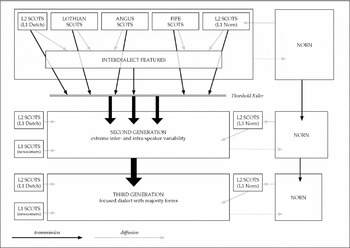
An alternative to Millar's model, adhering more closely to Trudgill's terminology while still making explicit what varieties contributed to the development of Shetland Scots, is shown in figure 1. This representation also details whether features are spread through the community through intergenerational transmission (black arrows) or through face-to-face ‘Labovian’ diffusion (light grey arrows).
The development of Shetland Scots in Trudgill's model of new-dialect formation

In the first generation of original immigrants, people spoke their respective dialects of Scots, whether these were native or non-native. Face-to-face interaction between speakers of different dialects leads to the creation of interdialect features. Features from the various dialects and interdialect features alike are then transmitted to the next generation, subject to them being frequent enough to pass the Threshold Rider, the minimum amount of exposure necessary for these features to be acquired. These Stage I processes are likely to have been no later than the late sixteenth century, shortly after the initial wave of immigration.
Small boxes with different first- and second-language varieties of Scots represent the influence speakers of these varieties may still have had on the dialect in Stages II and III. Because of the Founder Effect, we can expect these influences to have been negligible. Norn is shown in the model for the same reason, including its intergenerational transmission and its influence on Scots (and vice versa). Norn influences Scots only indirectly through an L2 variety. Features ‘imposed’ on L2 Scots are shown as intra-speaker diffusion; they are then diffused into the mix of Scots varieties, and may or may not be taken up by the next generation through intergenerational transmission.
3 Characteristics of Shetland Scots
In the remainder of this article, I will test the hypothesis that Shetland Scots originated in a process of new-dialect formation, by tracing back phonetic and phonological characteristics of the dialect to the combined input of Scots dialects from Angus, Fife and Lothian and L2 Scots with interference features from Norn. I will predominantly use reconstructed data on these varieties from Johnston (Reference Johnston and Jones1997a). Johnston's reconstructions are based on written dialect representations, rhyme patterns, modern dialect data and historical linguistic theory. Especially for Shetland, Johnston (Reference Johnston and Jones1997a: 49–50) admits the dearth of data for the dialect made this a difficult process.
More reliable data based on speaker recordings are available, e.g. in Millar (Reference Millar2007), but these data are not necessarily relevant to the dialect's historical development. The relative isolation of Shetland from the eighteenth century was followed by the oil boom of the late twentieth century, during which the islands’ population changed significantly because of a renewed immigration from the British mainland (Van Leyden Reference Leyden2004: 17). To maintain an accurate picture of the sixteenth- and seventeenth-century dialects, undistorted by additional dialect contact, I have chosen to focus on the reconstructed data.
3.1 Consonants
I begin my discussion of Shetland Scots phonology with consonant features. I will first compare the reconstructed consonant systems of Older Scots and Norn. The following discussion of consonantal features will be based partly on features one would expect to occur from the comparison of the systems, and partly on attested features in Early Shetland Scots.
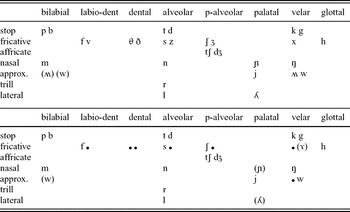
The consonant inventory of sixteenth-century Scots has been reconstructed by Johnston (Reference Johnston and Jones1997a: 98), who posits an absence of regional variation in this system. The reconstructed system, which is largely similar to that of Modern Scots, can be found in table 1. The table also includes the consonant inventory of Norn, relevant because of its possible influence on the L2 variety of Scots spoken by native Shetlanders. The Norn inventory is based on reconstructions by Barnes (Reference Barnes1998: 358–9) and Rendboe (Reference Rendboe1987: 90); differences between the two reconstructions are minor and have no bearing on the further analysis of the Shetland Scots data.
The consonant inventory of Older Scots (top), reconstructed by Johnston (Reference Johnston and Jones1997a), and of Norn (bottom), reconstructed by Rendboe (Reference Rendboe1987) and Barnes (Reference Barnes and Trudgill1984). Black dots in the Norn inventory represent sounds present in Older Scots, but not in Norn.

One of the most striking characteristics of the reconstructed Norn consonant system is the posited lack of voiced fricatives. The acquisition of these sounds in Scots by Norn speakers may have been problematic, witness anecdotal evidence of late eighteenth-century Foula Scots in Low (Reference Low1879: 104–5) of hypercorrected voicing in vorty'th and zaxt z'am ‘fortieth and sixth psalm’. (Low does, however, state that Foula Scots is not representative of all of Shetland speech at the time.) According to Brown's hypothesis, Norn speakers should have been able to acquire a voicing contrast in fricatives as the relevant feature [± voice] was active in stops; their apparent failure to do so reliably may pose a problem for Brown. However, the ‘voicing’ contrast in stops in Scandinavian languages, including closely related Faroese (Thráinsson et al. Reference Thráinsson2004: 43), uses the feature [± aspiration] rather than [± voice]. If Norn functioned similarly, the lack of a feature [± voice] would predict Norn speakers would (initially) fail to acquire the voicing contrast in Scots fricatives.
Low's comment about Foula Scots also concerns h-dropping, the loss of initial /h/ and the hypercorrected prefixing of /h/. This process appears to have been a feature of Norn, at least as a variable process at some point in the history of the language. Barnes (Reference Barnes1998: 13) mentions the form æita (< Old Norse heita ‘are called’) in a fourteenth-century Orkney Norn document, and Low lists hoissan ‘the haddock’ (acc., < Old Norse ýsan, but cf. Faroese hýsan) as a remnant of Foula Norn. Also Older Scots may have had variable h-dropping, although this feature has since disappeared from the mainland (Johnston 1997: 105). The apparent variation in initial /h/ in both Norn and Older Scots may have continued into Early Shetland Scots, at least in some parts of Shetland, although the necessary data to chart the development of this feature are lacking.
Among the more prominent features of Shetland Scots also outside of Foula is the th-stopping in the dialect: the merger of /θ/ and /ð/ with /t/ and /d/, respectively. This is expected, as the sounds are not posited to have been part of the Norn consonant system. However, Barnes (Reference Barnes, Ureland and Broderick1991: 436) notes that
this sits rather ill with Hægstad's view . . . that Old Norse t develops to th (denoting [θ] and [ð]) in medial intervocalic ([ð]) and final postvocalic position ([θ]). Did Norn, or at least Shetland Norn, have [θ] and [ð] even though they were not the reflexes of their Old Norse counterparts? And if so, why did Shetlanders have trouble with the same or similar sounds in Scots?
Reflexes of Old Norse /t/ are written th in the Hildina Ballad, which would have been Hægstad's main source as this is the material he edited (Hægstad Reference Hægstad1900, original version in Low Reference Low1879: 108–12). Material from Jakobsen's dictionary of Shetland Norn (Reference Jakobsen1928–32) does not suggest this was a widespread feature in Norn, nor is there any mention of fricative realisations in Foula speech. The fact that the Scottish Vowel Length Rule applies to historical [ð] > [d] contexts (see 3.3 below) could suggest th-stopping is a later, post-language shift and post-focusing, development.
The loss of the /θ/ and /ð/ phonemes may have been reinforced by the L2 speech of visiting Dutch and Low German speakers. Th-stopping is a salient feature of Dutch and Low German accents in English, and was generally ridiculed in Early Modern plays (Eckhardt Reference Eckhardt1911: 54–5). Their role must however not be overestimated. Dutch herring fishing boats did not start dominating the Bay of Lerwick until the second half of the nineteeth century, well after the language shift and the formation of Shetland Scots (Boelmans Kranenburg Reference Boelmans Kranenburg and Withrington1983: 101). Low-German-speaking Hanseatic merchants did spend summers in Shetland trading directly with the local population from the fifteenth century onwards, but their numbers were limited, with never more than seven ships at any given time, and their presence concentrated in Northern Shetland (Friedland Reference Friedland and Withrington1983: 90–3).
Another salient consonantal feature in Shetland Scots is hw-confusion, the merger of the reflexes of Old English hw /hw/ and cw /kw/. The merged phoneme may have either of the original realisations, geographically distributed with /kw/ on the Westside and part of the Central Mainland, and /hw/ elsewhere (Catford Reference Catford1957a: 73). In transition zones, but also stereotypically in Shetland dialect in general, a word like queen may be pronounced /kwin/ or /ʍin/, and what as /kwɒt/ or /ʍɒt/.
The merger has often been claimed to be a result of a lack of the /hw/ – /kw/ distinction in Norn, based on evidence from Faroese, Icelandic and West Norwegian dialects (Sandøy Reference Sandøy1996: 149; Thráinsson et al. Reference Thráinsson2004: 404). Citing sixteenth-century Norn evidence, Barnes (Reference Barnes1998: 14) notes that ‘[i]t also seems likely that the <quh-> in <quharium> (i.e. ON hverjum ‘each, every’, Shetl. c. 1550) is the traditional Scots written form of earlier English [hw-] rather than a reflection of the common West Scandinavian sound change [hw-] > [kv-].’ With the merger taking place at different times between the fourteenth and eighteenth centuries in the different West Scandinavian languages (Thráinsson et al. Reference Thráinsson2004: 405), it may still have been a variable process in Norn in the sixteenth century.
When the realisations of the merged phoneme focused, Shetland divided into a hw zone and a kw zone. This process is likely to have depended on the proportions of the different population groups, or traditional sociolinguistic factors such as gender or age. The mixed transition zones are similar to the transition zone in the English Fens between unsplit foot = strut /ʊ/ of Northern England and split foot /ʊ/ ≠ strut /ʌ/ of the South. However, explanations given for the Fenland situation (e.g. Britain Reference Britain1997) do not apply to the Shetland transition zones. The Fens were relatively inaccessible marshland, while the Shetland zones are (and, most likely, were) readily accessible from both the hw and the kw zones. Also, whereas the foot–strut split is a complex lexically rather than phonologically based rule, and therefore difficult to acquire, the Shetland situation does not require the acquisition of a new system. The variability in the transition zones is therefore probably best explained with reference to their communication links to both the hw and the kw zones.
A final characteristic of Shetland Scots is the simplification of the alveolar clusters /nd/ and /ld/, a feature also found in Mainland Scots varieties, although to different extents. Johnston's (Reference Johnston and Jones1997a: 101–2) discussion of this feature in Older Scots is very summary; the following is based on his discussion of modern Scots varieties (1997b: 502–3). The clusters /nd/ and /ld/ are always simplified to [n] and [l] in Angus Scots; Fife and Lothian Scots always simplify [nd] clusters, but [ld] clusters only non-medially; and in Shetland Scots both are simplified non-medially only.
It is assumed that Norn followed the other Insular Scandinavian languages, and did not simplify these clusters (Sandøy Reference Sandøy1996: 147); L2 speakers can therefore not have influenced the existence or the patterning of this rule in Shetland Scots, and we must explain it primarily from the three Scots input varieties. This is unproblematic for /ld/ clusters: all three varieties simplified these clusters finally, and two out of three retained the cluster medially. The final simplification and medial retention in Shetland Scots can be distilled from these patterns in purely numerical terms. The /nd/ clusters are not as transparent, however. Final clusters were simplified in all input varieties and expectedly also in Shetland, but although the input varieties also simplify /nd/ clusters medially, Shetland retains [nd]. This realisation is inexplicable from an acquisition point of view.
A possible explanation is that [nd] pronunciations did in fact appear in the input frequently enough for speakers to acquire a difference between medial /nd/ and /n/. Even if [nd] realisations were not in the majority, and the Shetland system can therefore not be explained numerically, the patterning of /nd/ clusters may be explained by analogical extension of the /ld/ cluster patterning, giving rise to an interdialect feature in the dialect. The available data, however, cannot satisfactorily explain the pattern as yet.
The influence of Norn on the Shetland Scots consonant system, then, appears to have been quite substantial. It underlies more salient features like th-stopping and hw-confusion, as well as localised features such as h-dropping and problems with voiced fricatives. Norn influence is less likely for alveolar cluster simplification, which is more likely to be a result of variation between or in the three Scots input varieties.
3.2 Vowels
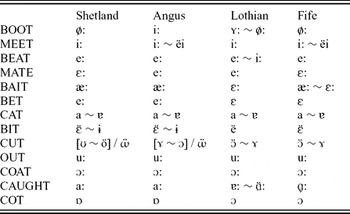
The concept of standard lexical sets (Wells Reference Wells1982) allows for a more systematic approach in the discussion of the Shetland Scots vowel system. Different sets have been developed to be more suitable for a discussion of Scots varieties, e.g. by Catford (Reference Catford1957b, pre-dating Wells’ standard), and Johnston (Reference Johnston and Jones1997a, Reference Johnston and Jonesb). Johnston's reconstructed monophthong vowel systems for relevant regional varieties of Older Scots are shown in table 2.
Vowel realisations by lexical set in sixteenth-century regional varieties of Scots, after Johnston (Reference Johnston and Jones1997a)

Compared to the Scots vowel systems is that of Norn, reconstructed by Barnes (Reference Barnes and Trudgill1984: 358–9) and Rendboe (Reference Rendboe1987: 90). Whereas the two mostly agreed on their reconstructed consonant systems, the two vowel systems they reconstructed are markedly different. Barnes reconstructs an eight-vowel stressed monophthong phoneme system /i e ø ɛ u o ɔ a/, and cites evidence suggesting possible mergers of /e/ with /ɛ/, and of /o/ with /ɔ/. Rendboe's reconstruction, judging from his notation, is phonetic and consists of fourteen vowels [i ɪ e ɛ æ a ə ə: ø y o ɔ å];Footnote 2 there is no attempt at a phonemic inventory.
Shetland Scots, like the three Scots input varieties, showed a clear thirteen-vowel system, with only a few possible cases of mergers of lexical sets. At first sight, the similarities between Shetland and Angus Scots are striking, and a conclusion like Catford's (Reference Catford1957a: 75), that ‘the majority of S[c]ots settlers in Shetland came from the glens of Angus’, is tempting. A systematic discussion of Shetland Scots vowels in a framework of new-dialect formation, however, can qualify this account.
The realisations in the out [u:] and coat [ɔ:] sets did not show any variation between input varieties, and these realisations appeared in Shetland Scots, as expected. The meet and beat sets are equally unproblematic, as despite variation in one or two of the input varieties, all three did share a common realisation in both of these sets, which were adopted as the single realisation in Shetland Scots. Also bait showed variation in the input varieties, but neither of the variants [æ:] and [ɛ:] had a clear majority. The selection of [æ:] is best explained by the avoidance of a possible merger with (most likely) the mate class.
The cat class poses a different problem. The three input varieties showed the same variation between [a] and [ɐ], but despite this similarity one may expect Stage III speakers of the new dialect to focus on a single variant, levelling out this variation like any other variation in the input. Instead we see the variation retained in Shetland Scots, suggesting that focusing cannot only result in a single realisation, but also in variation between two realisations, if this is a transparent, acquirable, majority feature. The exact mechanisms of this cannot be established from this single example.
In three of the lexical sets, the Shetland realisation can be traced back to two of the three Lowland Scots varieties. bait [æ:] corresponds fully to Angus, but to only one of two variants in Fife; bit displays variation in Shetland and Angus [ɛ̈ ~ ɨ], with only one of two variants reinforced by Fife. The realisation [ø:] in boot can be traced back to Fife and one of the Lothian variants. In all three cases, the majority realisation appears to win out.
It must be noted that the short and long [ø] realisations in Shetland boot words are often accredited to ‘a Norn relic’ (Barnes Reference Barnes1998: 28; see also Melchers Reference Melchers, Ejerhed and Henrysson1981: 258–9). This idea goes unchallenged to the extent that Pavlenko (Reference Pavlenko1997: 88) writes the sound is ‘obviously of Scandinavian origin’, but Johnston's data give an alternative explanation of this vowel, that takes both the Norn and Scots input into account. Note that Jakobsen (Reference Jakobsen1921: 86) in his dictionary entry for bød ‘booth’ gives etymologies going back to both ON búð and English booth, but notes that ‘the vowel [ø] almost implies English oo’.Footnote 3
In the remaining five sets, Shetland Scots shared realisations with only one Lowland variety; with the exception of mate (Fife), this is Angus. The cut set is especially interesting, as Shetland and Angus had allophonic realisations in this set: [ʊ ~ ö] before voiced stops, fricatives and labials, and [ ] elsewhere. It is curious that this ‘split cut’ system should be adopted in Shetland Scots, since Lothian and Fife varieties did not have the split (although they did have variation in the cut vowel quality), and processes such as levelling or the development of interdialect features tend to result in less complicated systems. Splits are unlikely to be maintained if the input also contains unsplit varieties (cf. the Early Modern Dutch example in section 2.2 above). Similarly, the fact that the beat–mate and boot–meet mergers from Angus Scots were not maintained in Shetland Scots is contrary to expectations. In order to explain the adoption of a ‘split cut’ system, further details about the linguistic conditioning of the variation in both ‘split’ and ‘unsplit’ varieties would be necessary, but this is a level of detail not available in the reconstructions for Lothian and Fife.
This short analysis shows that despite striking resemblances between Shetland and Angus Scots vowel systems, a monogenetic origin for Shetland Scots in the language of settlers from Angus is unlikely. Such a monogenesis would also not conform to historical evidence of Scots migration to Shetland, which shows migration from Angus as well as from Fife and Lothian, and no evidence of Angus settlers as a founder population (Donaldson Reference Donaldson and Withrington1983).
Catford (Reference Catford1957a: 75; 1957b: 115) posited that the peripheral Scots dialects of Shetland and Northern Angus, as well as Galloway in South-West Scotland, may be remnants of a sixteenth-century Standard Scots. Johnston's reconstructions for Fife and Lothian would then show varieties already having deviated from that standard. This is an attractive explanation, but for the fact that it fails to explain how a Standard Scots could have been adopted in Shetland in a period when even the written language displayed regional variation.
Despite the adoption in Shetland Scots of minority rather than majority variants in some of the lexical sets, this discussion has shown that all vowel realisations in Shetland Scots can be traced back to a source in an immigrant Scots variety. This confirms the traditional idea that Norn influence is limited in the Shetland Scots vowel system (to the vowel [ø], and perhaps not even that), but much more visible in the consonant system. The traditional explanation for this, that ‘Norn speakers with their rich vowel system but relatively small number of consonant phonemes could more readily imitate the vocalic than the consonant distinctions of Scots’ (Barnes Reference Barnes1998: 28), however, does not hold. Not only did the consonant systems reconstructed by Barnes and Rendboe show gaps compared to the Older Scots system, but also the vowel system Barnes posited is much more limited than that in Older Scots, and with six to eight monophthongs hardly merits the description ‘rich’ compared to ten or more vowels in Older Scots.
3.3 The Scottish Vowel Length Rule
The final phonological characteristic of Shetland Scots I discuss in this article is the question of vowel length. Vowel length is allophonic in both Scots and Scandinavian languages; we assume that it was so in Norn too.Footnote 4
In Scandinavian languages, the length of the vowel in stressed syllables is co-dependent with that of the following consonant (Torp & Vikør Reference Torp and Vikør1993: 52). A syllable has either a long vowel or diphthong and a short consonant (V:C), or a short vowel and long consonant or consonant cluster (VC:). In Scots, however, vowel length depends on consonant quality rather than quantity. Most vowels are short, whether they are lax or, unlike in Southern British English, tense. Some tense vowels can have long realisations before a voiced fricative, /r/, or a morpheme boundary. This is an idealisation of the Scottish Vowel Length Rule (SVLR); there is dialectal variation in the phonological contexts that trigger vowel lengthening and the vowels that undergo it.
In her instrumental-phonological work on Orkney and Shetland Scots syllable structure, Van Leyden (Reference Leyden2004: 38) showed that the SVLR applies in these dialects, not only to the traditional SVLR-long contexts, but also to contexts that were historically SVLR-long, but are not so synchronically, e.g. blide < blithe (with th-stopping). I analysed data from the Linguistic Atlas of Scotland (LAS, Mather & Speitel Reference Mather and Speitel1986) to see whether dialectal variation in the SVLR-long contexts and the affected vowels in Shetland Scots and the input varieties support a reading of the development of Shetland Scots as new-dialect formation. Data were collected from LAS for five Shetland varieties (Papa Stour, Walls, Foula, Dunrossness and Scousburgh) and three varieties each from Angus (Migvie, Kirriemuir and Arbroath), Fife (Leuchars, Auchtermuchty and Cowdenbeath) and Lothian (Newhaven, Stow and Tranent).
LAS gives vowel quantity and quality in eleven different phonological environments, divided into categories similar to but broader than lexical sets. Seven monophthong categories are distinguished: the categories \A\, \I\, \O\ and \U\ are fairly straightforward, \E\ conflates the /e/ and /ɛ/ phonemes, and \Y\ and \W\ roughly correspond to the boot and but lexical sets, respectively. In the analysis, I have smoothed over some apparent idiosyncrasies in order to compare the Mainland Scots to the Shetland Scots varieties.
The categories \Y\ and \W\ are unproblematic for the model of new-dialect formation: in both the Mainland input and the Shetland output, vowels in these categories are always short. Similarly, input and output are consistent in the \I\ and \U\ categories, where the ‘classic’ SVLR as described above applies.
In Fife, much of Angus and Newhaven (Lothian), the vowels in the \E\ category are long in all environments. Other Lothian varieties have much more restricted lengthening. In Shetland varieties, lengthening appears to be generalised for \E\, which is an example of a simple pattern from the input being preferred over a more complex pattern. Vowel quality does however seem to have an effect: in Dunrossness and Scousburgh, lengthening outside ‘classic’ SVLR contexts applies to /ɛ/ only, not to /e/. In Foula, \E\ undergoes lengthening outside ‘classic’ SVLR contexts only in the bait set, although the LAS's presentation of the data makes this difficult to verify.
Vowel lengthening in the \A\ and \O\ categories does seem to pose a problem for the notion of Shetland Scots as a new dialect. For the \O\ set, Fife and Newhaven have long vowels in all contexts, Tranent applies the ‘classic’ SVLR, and Angus has mostly short vowels. In Shetland, \O\ is lengthened in ‘classic’ SVLR environments, before /l/, and before nasals. In the \A\ set, long vowels are more frequent in Northern varieties, ranging from always short in Tranent to always long in Kirriemuir. In Shetland, vowels in this set are long in the ‘classic’ environments, as well as when derived from historical /au/ or /al/.
We would expect the diffuse input in these two categories to focus on one of the simple patterns from the input, i.e. generalised lengthening or nonlengthening. The focused Shetland system appears much more complicated than that, but may still be explained by a process of simplification. It is possible that speakers applied the ‘classic’ SVLR system that was transparently at work in other categories, especially \I\ and \U\, to these categories as well, simplifying vowel lengthening rules across categories. Other processes must then explain long vowels in non-‘classic’ environments: compensatory lengthening of the vowel in the monophthongisation of a diphthong or l-vocalisation. This explanation is supported by the patterns in \E\, which also has a ‘classic’ SVLR core with some, in this case realisationally or lexically based, exceptions. (One could argue for compensatory lengthening in various monophthongisation processes in the bait set as well.)
The rules governing vowel length in Shetland Scots, then, support the theory that the variety may have developed in a process of new-dialect formation. Input from different systems in the various immigrant dialects was focused to a fairly regular system. Input and output were mostly invariant in four of the vowel categories; in the others, the different systems gave rise to a ‘classic’ SVLR system, possibly analogous to \I\ and \U\, with additional lengthening contexts accounted for by other processes.
Whereas the phonology of vowel length can be explained exclusively with reference to Scots input varieties, there appears to be some influence of Norn at the phonetic level. Van Leyden (Reference Leyden2002; Reference Leyden2004: 23–40) showed that the inverse correlation between vowel and consonant length in Shetland Scots is much stronger than in Mainland Scots varieties, more or less retaining the Scandinavian pattern. It is possible that learners of Scots whose L1 was Norn applied their native difference in length between short and long vowel to the corresponding categories in Scots. This ‘foreign-accented’ length contrast may then have been taken up by L1 speakers of Scots. (The inverse, a diminishing contrast between short and long vowels under the influence of an L2 variety, has been shown for Latvian in Bond et al. Reference Bond, Stockmal and Markus2006.)
4 Conclusions
In this article, I have attempted to explain the development of Shetland Scots in a way that does justice to the two main elements recurring in most characterisations of the dialect: the idea that it is essentially an archaic variety of Scots brought to Shetland by sixteenth-century immigrants, and the notion of an L2 variety heavily influenced by Shetland's earlier vernacular, Norn. Following Millar (Reference Millar2008), I suggested that the model of new-dialect formation developed by Trudgill would be suitable for such an explanation, if we allow for a Norn-influenced L2 variety to be an equal input in the dialect mixture along with immigrant varieties from Angus, Fife and Lothian. Rather than adopting Millar's model, I adapted Trudgill's original model to make the different L1 and L2 inputs explicit. I also suggested a different dating of the process more in accordance with historical demographic and linguistic developments.
In order to test the hypothesis that Shetland Scots is an L2-influenced new dialect, I analysed several phonological and phonetic features of the dialect, comparing them to the original input. The influence from the supposed L2 Scots spoken by Norn speakers is clearest in consonant phonology, in particular with regard to th-stopping and hw-confusion. Both these developments eliminate a contrast in Scots with a relatively low functional load, and moreover a contrast not found in Norn. In the case of th-stopping, the phonologically least marked variants (alveolar stops rather than dental fricatives) were selected, while in hw-confusion, the most easily learnable system from the mix (a merger) was adopted. Both are processes we expect to find in the koinéisation of new-dialect formation.
The analysis of vowel phonology is complicated by the lack of consensus about the Norn vowel system. It is nonetheless remarkable that all Shetland vowel realisations can be traced back to a realisation in the Scots input. However, the expectations that majority variants would be selected from the input mixture, and that merged categories would be preferred over unmerged or split categories, are not borne out. Instead, there are many similarities with Angus Scots, which can only be explained by settlers from Angus being either the largest or the earliest group; neither of these possibilities is supported by historical demographic evidence.
While Trudgill's model may not successfully account for the range of vowel qualities in Shetland Scots, it does seem to be able to explain vowel quantity. The contexts in which the Scottish Vowel Length Rule applies in the dialect can be explained through koinéisation of very diffuse systems in the input. Shetland Scots adopted a ‘core’ system that is visible in some vowel categories across inputs. This core system was then also adopted for vowels where the input was more variable, resulting in an interdialect feature different from all input varieties.
In conclusion, the discussion of Shetland Scots phonology does not give conclusive evidence against the hypothesis that the dialect originated in a process of new-dialect formation, and such a process must therefore be seen as a possible explanation. It is striking that where the model runs into problems, Shetland Scots usually shares features with Angus Scots, or with Northern Scots in general. Millar (Reference Millar2008: 263) explains this by referring to continuing North-Eastern Scots influence during the Stage II period, in Millar's view around 1800. Although the solution must probably be found in post-immigration contact rather than in an immigration-era Founder Effect, the similarities to Angus Scots in Johnston's reconstructed seventeenth-century data remain in need of an explanation.