Climate change has emerged as a focal point in recent environmental policy debates both at the domestic and global levels. With the 2007 Nobel Peace Prize award for the Intergovernmental Panel on Climate Change (IPCC) and Al Gore whose Oscar-winning documentary helped raise global awareness of the dangers of anthropogenic climate change, the visibility of global climate change as a policy problem soared among the general public and policymakers around the world. More recently, the 2009 Copenhagen Climate Conference convened with delegates from 192 countries and more than 100 heads of states demonstrated that climate change has become a central global agenda involving multiple dimensions of national and international politics and economy.
Latest public opinion surveys indeed show strong consensus among the global public on the seriousness of the climate change problem. For instance, one of the headlines on the World Public Opinion website of the University of Maryland's Program on International Policy Attitudes reads “30-country poll finds worldwide consensus that climate change is a serious problem” (April 25, 2006). Other survey reports run similar headlines such as: “International polls find robust global support for increased efforts to address climate change” (December 5, 2007) or “World publics want more government action on climate change” (July 29, 2009).
While increasing in number and large in scope, these surveys have so far resulted in broad-brushed descriptions of global public opinion about climate change. Unfortunately, there has not been much effort to understand how people perceptions of climate change as well as public support for climate policies vary across different countries or regions. This situation is problematic given that an international agreement or any other global measure to coordinate climate change policy would have to be implemented at the “sub-global” level in the end. Therefore, without a proper understanding of how climate change is viewed in individual countries and different regions, it would be hard to figure out why climate policies with apparently “global” endorsement often fail to earn support among individuals, businesses, and other societal groups, the very targets of climate policies.
This research essay offers an account of how Asians view climate change in comparison to people of other regions (that is, cross-regional differences) as well as how public views of climate change vary in different Asian countries (that is, intra-regional or cross-national differences). In advance to the account of climate change opinion in Asian countries, the following section dwells upon why climate change is a particularly significant problem for the Asian region and why this region is crucial in global effort at mitigation and adaptation of climate change.
Asia and Climate Change
According to various global and regional estimates of climate change impacts, Asia is one of the most vulnerable regions. The 2010 World Development Report, the World Bank's annual flagship publication with the timely title Development and Climate Change, forecasts that rising sea levels due to global warming would submerge much of the Maldives and flood 18% of Bangladesh's land in dire climate change scenarios (World Bank 2010).
The Asian Development Bank projects the economic costs of climate change including risks and environmental disasters due to extreme and unpredictable weather changes to reach 6.7% of annual gross domestic product (GDP) by the end of this century, which is substantially higher than the globally projected cost of 2.6% of annual GDP (ADB 2009). According to the Climate Risk Index, one of the large-scale cross-national indexes of climate change vulnerability, six out of the ten most vulnerable countries to extreme weather events are Asian countries – Bangladesh (ranking first), Myanmar (second), Vietnam (fourth), India (seventh), the Philippines (ninth), and China (tenth) (German Watch Reference German2009).
Not only is climate change a significant threat to the prospects of economic prosperity and environmental sustainability of Asian countries but also the region of Asia holds a key to successful global efforts to fight climate change. As home to the countries with the largest populations and fastest-growing economies, Asia is expected to witness the greatest increase in future energy use. According to the World Energy Outlook; even under the business-as-usual (BAU) scenario, energy use in Asian countries is projected to rise 112% by 2010, as compared to 23% for the OECD and 55% for the world as a whole (IEA 2007). In addition, Asia now contains four of the ten largest emitters of carbon dioxide (China, India, Japan, and South Korea). China itself overtook the US in 2006 as the largest producer of CO2 emissions, although its per capita emission remains far below the US level.
All these data and projections indicate that without significant mitigating actions on the part of Asian countries, it would be extremely difficult to achieve a global reduction in greenhouse gas emissions. At the same time, Asian countries are increasingly exposed to environmental risks and hazards induced by volatile climate events as well as economic ramifications of greenhouse gas controls. This situation has thus made climate change a top priority policy problem in many Asian countries.
Asian Public Opinion on Climate Change
Given the significance of climate change for Asian countries and the importance of the Asian region for effective global action for climate change mitigation, it is of great policy implications to explore how climate change issues are perceived and whether there exists strong support for climate policies in Asian countries. Exploring the contour of public opinion on climate change is of particular importance for assessing the feasibility of government policy actions against climate change. Climate policies, typically imposing significant costs on the part of individuals, companies, non-government sectors, and the national economy, would require a large degree of “buy-in” or acceptance from those affected by such policies (Lorenzoni and Pidgeon Reference Lorenzoni and Nick2006). Indeed, the UN Environmental Program has identified raising awareness of climate change and communicating its risks as one of the key strategies to meet the challenge of climate change (UNEP 2009).
The following presents cross-national and inter-regional analysis of Asian public attitudes about various climate change issues based on recent cross-national surveys, which include: the World Bank Multi-Country Poll (2009), Pew Global Attitudes Project (2006, 2007), BBC World Service Polls (2006, 2007), Chicago Council on Global Affairs Survey (2006), and Globe Scan Poll (2006). (See Appendix for more information on these surveys). This exploration of Asian public opinion deals with three aspects – level of public awareness, degree of public concern, and public views of various policy issues such as urgency of government action, energy policy, and need for international coordination.
Public Awareness of Climate Change
Scholars of environmental public opinion have long debated whether environmental quality is a luxury good that people and nations can enjoy and care about largely when they achieve higher standards of living. Known as the postmaterialism hypothesis, this conjecture has received mixed support from the empirical research on studies of environmental public opinion.Footnote 1
According to the 2006 Pew Global Attitudes Project Survey, public awareness of climate change shows a notable divide between developed and developing regions of the world. Virtually everyone in the advanced countries surveyed in this poll answered that she has heard of the global warming problem, whereas only half of the people from developing countries said so. Within Asia, we find a huge variation in the level of public awareness of climate change. Japan as the most developed nation in this region shows the highest level of awareness (99%), while the rate of people having heard of the global warming problem remains quite low for less developed nations such as Pakistan (12%) and Indonesia (35%). As a fast-growing economy and the largest CO2 emitter, China has a relatively higher rate of people aware of global warming (78%), compared to other developing countries.
Another survey shows a smaller but still considerable gap in public awareness of climate change between developed and developing countries. On average, 87% of citizens living in the advanced region of the world turn out to have heard or read about global warming or climate change according to the 2007 BBC World Service Poll. In contrast, only 57% of citizens of developing countries did so. This rich-poor nation divide in public awareness of climate change is repeated in the Asian region, with the level of awareness much higher in South Korea (94%) than less-developed Asian countries such as Indonesia (28%) and India (48%). Again, China shows a relatively higher level of public awareness of climate change (72%).
Apparently, there is a divide between East Asian and South/Southeast Asian countries in the level of awareness of climate change; East Asian countries surveyed in these two polls (China, Japan, and South Korea) exhibit a much higher level of public awareness than South/Southeast countries. This gap in the level of awareness appears to indicate a different stage of issue development for climate change. For relatively more developed East Asian countries, people have been exposed to the climate change issue, as these countries have had to deal with the Kyoto process of emission controls directly or indirectly.Footnote 2 This implies that the climate change problem has already gone past the “pre-problem” stage in these countries. In contrast, South/Southeast Asian countries are just beginning to embrace it as a public policy issue, with their people and governments only recently grasping the magnitude of the problem (mostly through climate-induced natural disasters like tsunami or sinking islands).
Public Concern About Climate Change
Another batch of the survey questions on climate change address the degree to which people find climate change as a serious issue or feel worried about it. In fact, the degree of public concern about climate change is the most frequently studied aspect of public opinion on climate change, since it is supposed to be directly linked to the level of public support for proactive climate policies.
The 2006 Globe Scan Poll asked a simple question whether climate change is a serious problem. This question was asked of people who had heard of the climate change problem. Overall, the rate of agreement is quite high across all regions of the world – North America (83%), Central and South America (93%), Europe (92%), Africa & the Middle East (82%), and Asia (88%). The degree of public concern among Asians measured by this question thus fall in the middle between the regions of higher concern levels (i.e., Europe and Central/South America) and those of lower levels (North America and Africa/Middle East).
Within Asia, this question shows a relatively small gap between East Asian and South/Southeast Asian countries compared to the questions about climate change awareness. Two of the more developed countries, Japan (98%) and South Korea (94%), take the lead, though other countries closely follow them: India (90%), China (80%), Philippines (86%), and Indonesia (81%).
While the foresaid question was of simple yes-no type, the 2007 Pew Global Attitudes Project asked people to rate the degree to which global warming is a serious problem in terms of four categories (very serious, serious, not serious, and not serious at all). This question thus allows an estimation of the intensity of concern about climate change. The rates of responses saying global warming is very serious or serious reveal a very similar cross-regional pattern to that of the previous question: North America (81%), Central and South America (90%), Western Europe (90%), Eastern Europe (86%), Africa & the Middle East (80%), and Asia (85%). The rate of responses recognizing climate change as a “very serious” problem again shows a similar pattern of cross-regional differences – North America (53%), Central/South America (72%), Western Europe (61%), Eastern Europe (55%), Africa & the Middle East (53%), and Asia (58%). In both categories of responses (i.e., overall and intense level of concern), Asia falls in the middle between the world regions showing higher and lower levels of concern about climate change.
Interestingly, within Asia, there exists a large difference in the level of intense concern between East and South/Southeast Asian countries, despite similar levels of overall concern about climate change. The rate of the “very serious” responses is very high in Japan (78%) and South Korea (75%), yet South/Southeast countries show much lower rates of this response category (India (57%), Indonesia (43%), Malaysia (46%), Pakistan (41%).
There are two notable exceptions to this intra-regional divide on the intensity of public concern about climate change. China shows a relatively low rate of intense concern; only 42% of Chinese recognize global warming as a “very serious” problem. In contrast, Bangladesh, one of the poorest countries in Asia, shows an astonishingly high rate of endorsement of global warming as a very serious issue (85%), which is even higher than the rates for Japan or South Korea.Footnote 3
The most recent cross-national survey on climate change, the 2009 World Bank Multi-Country Poll, contains a different question on the level of public concern about climate change. This question asked when people thought climate change would start to substantially harm people, with the response choices being (i) people are being harmed now, (ii) in 10 years, (iii) in 25 years, (iv) 50 years, (v) in 100 years, and (vi) never. Notably, the perception that climate change was harming people now was more pervasive among Asians (64%) than people in other advanced countries (41%) or those in other developing nations (58%).
Also, within Asia, South/Southeast Asians turn out to find climate change to cause more immediate harm than East Asians do. Eight-six % of Vietnamese and 67% of Bangladeshi answered that people were being harmed now, which are higher than the rates of the same response among Chinese (71%) or Japanese (61%). Given that the perception of climate change inflicting immediate harm reflects greater intensity of the concern, this poll result is at odds with the previous poll result showing a gap between the two sub-regions in the intensity of concern. Yet, the apparently conflicting results may be due to the timing of the survey. The fieldwork for the Pew Global Attitudes Project was undertaken before most of the newsworthy events on climate change (such as the 2007 Nobel Peace Prize Award to the IPCC or the Bali Climate Conference). In contrast, the 2009 World Bank Poll was conducted in the aftermath of all such events, especially just a month before the highly publicized Copenhagen Climate Conference. The results of the latter survey must have been greatly influenced by such high-profile affairs.
Public Support for Climate Change Policies
The level of public awareness and the degree of concern about climate change are important barometers of how the public perceive the issue of climate change, yet perceptions themselves do not automatically translate into strong endorsement of climate change policies. This is because, like any other large-scale public issue requiring significant societal adjustment, successful efforts to address climate change would call for sacrifices or changes of existing patterns of behavior on the part of individuals, businesses, and the public sector. Hence, while well aware of and greatly concerned about the climate change problem, people may be still hesitant to support specific actions to deal with climate change due to the costly changes entailed in such actions. Thus the level of public support for costly actions would be the very indicator of the feasibility of government policies to alleviate climate change impacts.
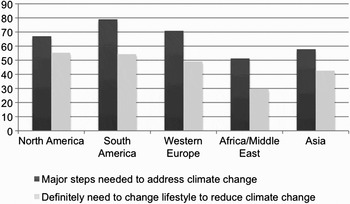
Several questions from the cross-national surveys under examination address the need for actions to deal with climate change. The 2007 BBC World Service Poll asked two questions in this regard – (i) whether one views major or modest steps needed to address climate change and (ii) how necessary one believes it to change lifestyle to reduce the amount of climate change. Figure 1 displays the cross-regional results of the responses to these questions. For both questions, Asian countries show relatively low levels of support for proactive climate policies. Their rates of endorsement of major actions for climate change are notably lower than those of other regions (except for African/Middle East countries which show the lowest level of support).
Cross-regional public support for the need for climate change actions (BBC World Service Poll, 2007)

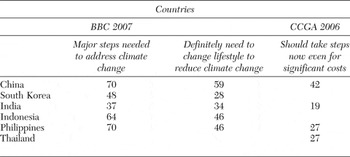
This finding is repeated for a similar question from another poll, the 2006 Chicago Council for Global Affairs Survey. This question is more explicit about the cost implications of climate change actions, which reads “do you agree whether we should begin taking steps now even if this involves significant costs?” Since the number of the surveyed countries is rather small, we cannot reproduce a cross-regional comparison like the previous figure, yet Asian countries show the lowest level of approval (29%), compared to other advanced (61%) or developing regions (38%).
Within Asia, we find a significant variation in public support for costly climate actions. One of the most striking differences from the previous results on public awareness and concern is that South Koreans, while being more aware and more concerned, in fact lend much less support to costly actions to mitigate climate change than Chinese do.
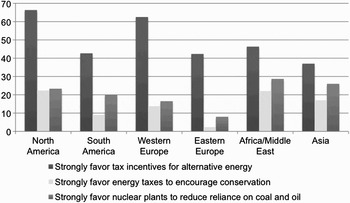
Energy policy has recently become a central pillar of global and national climate change mitigation effort, as climate change debates center around greenhouse gas reductions that have much to do with energy generation and consumption. The 2006 BBC World Service Poll contains interesting questions on energy policy related to climate change. Figure 2 presents three such questions that are of considerable importance to energy policy designs. People were asked about various policy options to reduce greenhouse gas emissions – tax incentives for alternative energy research and development, installment of taxes to encourage energy conservation, and reliance on nuclear energy to reduce fossil fuels.
Cross-regional public endorsement of energy policies to address climate change (BBC World Service Poll, 2006)

This figure reveals large differences across the world regions in public views of different energy policy options. Alternative energy development receives the greatest support for more developed countries in North America and Western Europe, yet it receives the least support in Asian countries! Note, however, that Asians together with people in African/Middle Eastern countries are more favorable to the idea of nuclear energy as an alternative to fossil fuel energy. These two regions also show the greatest support for increasing energy tax to promote conservation.
The last policy-relevant survey questions relate to the problem of sharing the burden of global emission reductions that has taken a center stage of the recent climate change conferences. What is at issue is whether or to what degree developing countries should take responsibility for cutting global emissions of greenhouse gases. One position is that since anthropogenic global warming of the last decade is primarily attributable to the fossil-based industrial growth of advanced countries, it is these countries that should take most of the burden of its abatement. Asking poor countries struggling to catch up with advanced economies to cut emissions is morally or ethically problematic and equivalent to “kicking away the ladder” of economic development.Footnote 4 The other position, while acknowledging the historical responsibility of advanced countries for cleaning up atmospheric concentrations of greenhouse gases, claims that developing countries should also contribute to global emission reduction given the global scope of the climate change problem. Especially, those countries with the fastest-growing manufacturing sector such as BRICs (Brazil, Russia, India, and China) are projected to dominate global emissions in the near future, and therefore global emission reduction efforts without their participation would not be much effective.
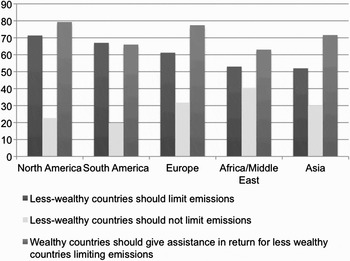
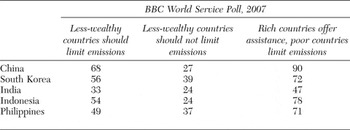
Three survey questions from the 2007 BBC World Service Poll directly address this issue. People were asked whether they agree to the idea that less-wealthy countries should cut emissions along with wealthy countries or should not be expected to do so. Also, the poll sought their views about a potential deal in which rich countries provide financial and technical assistance in return for poor countries’ limiting emissions. Cross-regionally, public responses show an expected pattern according to the level of economic development, as seen in Figure 3. Citizens of developed countries tend to agree more to the proposal for burden sharing between rich and poor countries. In contrast, people in developing countries of Asia, Africa, and the Middle East are more negative about such a proposal. However, Asian countries are more supportive of the rich-poor country deal, compared to other developing regions.
Cross-regional public views of global emission policy (BBC World Service Poll, 2007)

Public Support for Costly Climate Change Actions in Asian Countries (BBC World Service Poll, 2007; Chicago Council on Global Affairs Survey, 2006)

Turning to individual Asian countries, we find interesting variations in public views of global policy on emission reductions. In particular, two Asian countries expected to weigh heavily in future climate deals, China and India, show drastically different levels of public support for the rich-poor country deal. Chinese (90%) are overwhelmingly supportive of the mutual effort to reduce global emissions, whereas Indians (47%) are more skeptical of it.
Public Views of Global Emission Policy in Asian Countries (BBC World Service Poll, 2007)

Concluding Remarks
Although scientific research on global warming and other abnormal climate disruptions has been conducted for many decades, climate change only recently emerged as a central issue of the global and national environmental agenda, apparently drawing broad interest of the general public across the world. In particular, various international global and regional development agencies project Asian countries to be hit hardest by climate change in terms of both economic loss and natural disasters. At the same time, as home to the countries with the fast-growing economies and populations as well as having four of the ten largest greenhouse gas emitters in the world, Asia is expected to be a critical region for successful global effort to meet the challenges of climate change.
Yet proactive climate policies imply significant adjustment in existing behavior and organizations on the part of individuals and various social sectors. It is thus crucial to understand how people perceive and think about various climate change issues in order to figure out whether or how much a potential climate policy proposal is feasible or implementable. Indeed, the Stern Review, a 700-page report on the economics of climate change compiled by Sir Nicholas Stern for the British government in 2006, stresses the importance of understanding public attitudes for responding to the challenge of climate change as follows. “Public understanding of the challenge of climate change is essential to create the political space for governments to introduce and sustain the policies that are required to make the transition to a low carbon economy” (Stern Reference Stern2007).
This essay is an attempt to draw a contour of Asian public opinion on climate change as the basis for effective climate change policies in the region. In regards to public perceptions, the climate change issue seems to have gone middle through the issue-attention cycle in East Asian countries, where most of the general public have not only heard about the problem but also significantly worried about it. In contrast, South/Southeast Asian countries have only recently begun to grasp the magnitude of the climate change problem, though some countries show high sensitivity to the climate change issues due to volatile climate disruptions and disasters. From a cross-regional perspective, Asian countries turn out to lie in the middle between the rich and poor world regions in the level of public awareness and concern about climate change.
Perhaps more important than how the public perceive the issue is how willing or ready people are to accept the likely costs of climate policies. Unfortunately, Asians turn out to be the less supportive of costly actions against climate change than people in other world regions, when the willingness to support costly policy is measured by the responses to the questions asking about the need for major policy measures or changes of lifestyle. Asians are also more negative about installing tax incentives for alternative energy development.
The current survey results about public support for costly climate policies in Asian countries are both interesting and puzzling, because some of the Asian countries have vigorously promoted ambitious climate change policy with renewable energy development as its key component earning the praise of being the exemplars for “green-growth” by the UNEP.Footnote 5 The current findings about Asian public opinion on climate change indicates a significant fissure between the government and the public in their understanding of the need for proactive climate policies, which calls for greater attention by Asian policymakers to how Asians view climate change issues and understand the costs of climate change policies.
Appendix