Introduction
The global age-adjusted prevalence of diabetes in adults is 7.0% (6.1–7.9%) (Sarwar et al. Reference Sarwar, Gao, Seshasai, Gobin, Kaptoge, Di Angelantonio, Ingelsson, Lawlor, Selvin, Stampfer, Stehouwer, Lewington, Pennells, Thompson, Sattar, White, Ray and Danesh2010), and 90% of diabetic patients have type 2 diabetes mellitus (T2DM), of which 77% live in developing countries (Hu et al. Reference Hu, Sawhney, Shi, Duan, Yu, Wu, Qiu and Dong2015). In China, the prevalence of diabetes had reached 9.3% in 2014, with 96.3 million Chinese diabetic patients (Hu et al. Reference Hu, Sawhney, Shi, Duan, Yu, Wu, Qiu and Dong2015). It has been demonstrated that the prevalence of T2DM is two to four times higher in people with schizophrenia (SCZ) than the general population (De Hert et al. Reference De Hert, van Winkel, Van Eyck, Hanssens, Wampers, Scheen and Peuskens2006; van Winkel et al. Reference van Winkel, De Hert, Van Eyck, Hanssens, Wampers, Scheen and Peuskens2006; Smith et al. Reference Smith, Hopkins, Peveler, Holt, Woodward and Ismail2008; Meyer & Stahl, Reference Meyer and Stahl2009; Holt, Reference Holt2015; Stubbs et al. Reference Stubbs, Vancampfort, De Hert and Mitchell2015). This higher rate of T2DM might be due to SCZ itself or antipsychotic medications (Stubbs et al. Reference Stubbs, Vancampfort, De Hert and Mitchell2015). The increasing concern that antipsychotics are associated with an increased risk for T2DM in people with SCZ (Citrome et al. Reference Citrome, Holt, Zachry, Clewell, Orth, Karagianis and Hoffmann2007; Smith et al. Reference Smith, Hopkins, Peveler, Holt, Woodward and Ismail2008; Bou Khalil, Reference Bou Khalil2012; Yogaratnam et al. Reference Yogaratnam, Biswas, Vadivel and Jacob2013) is supported by several pharmaco-epidemiological studies of atypical antipsychotics, especially clozapine or olanzapine (Caro et al. Reference Caro, Ward, Levinton and Robinson2002; Henderson et al. Reference Henderson, Nguyen, Copeland, Hayden, Borba, Louie, Freudenreich, Evins, Cather and Goff2005, Reference Henderson, Vincenzi, Andrea, Ulloa and Copeland2015; Hartling et al. Reference Hartling, Abou-Setta, Dursun, Mousavi, Pasichnyk and Newton2012). Recent studies found fasting glucose abnormalities in 11.9% of chronically medicated SCZ patients (Kusumi et al. Reference Kusumi, Ito, Uemura, Honda, Hayashishita, Miyamoto, Sawayama, Kako, Tsuchida, Hashimoto and Koyama2011), and impaired glucose tolerance (IGT) using the 75 g oral glucose tolerance test (OGTT) in 17.3% of a Japanese SCZ population (Ono et al. Reference Ono, Suzuki, Fukui, Sugai, Watanabe, Tsuneyama, Saito and Someya2013). Interestingly, previous studies also reported an elevated risk of insulin resistance and T2DM not only among first-episode and drug-naïve (FEDN) patients with SCZ but also among their non-SCZ relatives (Ryan et al. Reference Ryan, Collins and Thakore2003; Spelman et al. Reference Spelman, Walsh, Sharifi, Collins and Thakore2007). Spelman et al. (Reference Spelman, Walsh, Sharifi, Collins and Thakore2007) reported an IGT frequency of 10.5% in FEDN patients, 18.2% in first-degree unaffected relatives and 0.0% in healthy control subjects. Moreover, studies from the pre-neuroleptic era have found co-morbid SCZ and T2DM independent of antipsychotic treatment (Mitchell et al. Reference Mitchell, Vancampfort, Sweers, van Winkel, Yu and De Hert2013). However, the reason for this increase in co-morbidity is not well understood but is likely to be multifactorial, with either shared environmental or genetic predisposition to T2DM (Holt, Reference Holt2004; Ferentinos & Dikeos, Reference Ferentinos and Dikeos2012).
SCZ is a psychiatric disorder characterized by deficits in executive function, working memory, attention and memory (Palmer et al. Reference Palmer, Dawes and Heaton2009; Harvey, Reference Harvey2014; Rajji et al. Reference Rajji, Miranda and Mulsant2014; Green et al. Reference Green, Horan and Lee2015). These disturbances in cognition appear to be core features of SCZ (Goff et al. Reference Goff, Hill and Barch2011) and are stable, persisting even after the remission of psychotic symptoms (Rajji & Mulsant, Reference Rajji and Mulsant2008; Harvey, Reference Harvey2009; Paquin et al. Reference Paquin, Wilson, Cellard, Lecomte and Potvin2014; Schreiber & Newman-Tancredi, Reference Schreiber and Newman-Tancredi2014). Diabetes and its related markers such as insulin resistance, hyperglycemia, hypertension and lipid metabolic disorders also are associated with cognitive impairment (Allen et al. Reference Allen, Frier and Strachan2004; Hassing et al. Reference Hassing, Hofer, Nilsson, Berg, Pedersen, McClearn and Johansson2004; Biessels et al. Reference Biessels, Staekenborg, Brunner, Brayne and Scheltens2006; Manschot et al. Reference Manschot, Brands, van der Grond, Kessels, Algra, Kappelle and Biessels2006, Reference Manschot, Biessels, de Valk, Algra, Rutten, van der Grond and Kappelle2007; Kumar et al. Reference Kumar, Looi and Raphael2009). Longitudinal studies have reported that individuals with T2DM have a 1.5- to 2-fold increased risk of diseases associated with cognitive decline, such as Alzheimer's disease and vascular dementia (Biessels et al. Reference Biessels, Staekenborg, Brunner, Brayne and Scheltens2006). Numerous studies also have reported that T2DM is associated with several cognitive deficits including processing speed, executive function, learning, and immediate and delayed memory (Gold et al. Reference Gold, Dziobek, Sweat, Tirsi, Rogers, Bruehl, Tsui, Richardson, Javier and Convit2007; Bruehl et al. Reference Bruehl, Wolf, Sweat, Tirsi, Richardson and Convit2009; Geijselaers et al. Reference Geijselaers, Sep, Stehouwer and Biessels2015; Mayeda et al. Reference Mayeda, Whitmer and Yaffe2015; Moheet et al. Reference Moheet, Mangia and Seaquist2015). Thus, the co-morbidity of SCZ and T2DM may increase the rate and magnitude of cognitive deficits, as we recently showed particularly for immediate memory and attention in chronically medicated SCZ patients (Han et al. Reference Han, Huang, Chen da, Xiu, Kosten and Zhang2013). Here we extend this association between cognitive impairments and IGT to FEDN patients with SCZ.
Studying FEDN patients can minimize the potential impact of confounds, such as illness duration, medication effects, and the psychiatric and medical co-morbidities that are associated with chronic illness (Buckley & Evans, Reference Buckley and Evans2006). Only two studies have reported the rate of IGT in FEDN patients, but the sample sizes were small (n = 38 at the most) (Spelman et al. Reference Spelman, Walsh, Sharifi, Collins and Thakore2007; Sengupta et al. Reference Sengupta, Parrilla-Escobar, Klink, Fathalli, Ying Kin, Stip, Baptista, Malla and Joober2008). We recruited a larger sample of Han Chinese FEDN patients (n = 175) and examined the relationship between IGT and cognitive performance as well as clinical symptoms on the Positive and Negative Syndrome Scale (PANSS). We had two hypotheses. First, the IGT frequency, abnormalities in metabolic biomarkers and cognitive impairment would be higher in the FEDN patients than controls. Second, FEDN patients with IGT would have worse cognitive functioning and clinical symptoms than those without IGT.
Method
Subjects
A total of 175 (male, 80 and female, 95) FEDN in-patients were recruited from Beijing Huilongguan hospital, a Beijing city-owned psychiatric hospital. The definition for first episode was first onset of psychotic symptoms. For FEDN patients, all hospital admissions in series were screened for patients who met the following six criteria:
-
(1) This was an acute episode that met Diagnostic and Statistical Manual of Mental Disorders, fourth edition (DSM-IV) criteria for SCZ, as assessed by two independent experienced psychiatrists using the Structured Clinical Interview for DSM-IV (SCID) at study intake. These patients were followed for 3 months as in-patients after admission and excluded if the second 3-month evaluation was not consistent in diagnosing SCZ.
-
(2) The duration of symptoms was not longer than 60 months at admission.
-
(3) Patients had no prior treatment with antipsychotic medication.
-
(4) Patients were Han Chinese and between 18 and 45 years of age.
-
(5) The current psychotic symptoms were of moderate severity or greater as measured with the Clinical Global Impression – Severity scale (CGI-S) score ⩾4.
-
(6) The patient provided written informed consent and was able to take part in neuropsychological assessment.
The patients had a mean age of 28.7 (s.d. = 9.9) years, a mean duration of illness of 23.4 (s.d. = 19.1) months before admission and a mean education duration of 12.4 (s.d. = 3.6) years.
In all, 31 healthy Han Chinese volunteers (male, 14 and female, 17) were recruited by advertisements in the local Beijing area. The controls had a mean age of 26.9 (s.d. = 5.2) years and a mean education of 12.8 (s.d. = 3.8) years. As a group they were not significantly different from the SCZ in gender, age and education. Current mental status and personal or family history of any mental disorder were assessed by unstructured interviews, and none reported a personal or family history of psychiatric disorder.
We obtained a complete medical history, physical examination and laboratory tests from all subjects. They were in good physical health, and any subjects with medical illnesses or drug and alcohol abuse/dependence except tobacco smoking were excluded. The Institutional Review Board for the Beijing Hui-Long-Guan hospital approved the research protocol, and all subjects provided written informed consent.
Laboratory tests
Serum and plasma samples were collected between 07.00 and 08.00 hours following an overnight fast. All the samples were sent to the laboratory center of the hospital for testing on the same day of blood withdrawal. The blood biochemical tests included: insulin (mU/l), glucose, total cholesterol, triglyceride, high-density lipoprotein and low-density lipoprotein (mmol/l). All these parameters were routinely measured by a technician blind to the clinical situation using the Automatic Biochemical Analyzer (Beckman Coulter AU5811; Beckman Coulter, Inc., USA).
All subjects underwent fasting blood glucose testing using standard procedures. The 75 g OGTT was conducted in the morning after a 12-h overnight fast. Abnormal glucose metabolism was categorized as follows: normal fasting glucose (fasting glucose level of <100 mg/dl), impaired fasting glucose (IFG) (a fasting glucose level of 100–125 mg/dl), IGT (a 2-h glucose level of 140–199 mg/dl after 75 g oral glucose), and diabetic type (a 2-h glucose level of ⩾200 mg/dl), which are consistent with World Health Organization diagnostic criteria for diabetes mellitus. The homeostasis model assessment of insulin resistance (HOMA-IR), which is used to estimate insulin resistance, was calculated using the equation HOMA-IR = fasting plasma insulin (IU/ml) × fasting plasma glucose (mmol/l)/22.5 (Matthews et al. Reference Matthews, Hosker, Rudenski, Naylor, Treacher and Turner1985).
Anthropometric measures
Body weight and height were assessed in a standardized fashion to calculate body mass index (BMI) (weight for squared height, kg/m2). Height was measured to the nearest 1 mm, with the subjects barefooted and standing upright. Body weight was measured with an electronic scale calibrated to ±0.1 kg, and subjects were weighed in light indoor clothing. The waist measurement was taken at the point midway between the iliac crests and the costal margins, and the hip measurement was taken at the most rotund portion of the buttocks. The waist:hip ratio and BMI were calculated for each subject.
Clinical assessment
Two psychiatrists who had more than 5 years of clinical practice experience assessed the psychopathology and symptom severity of the patients using the PANSS and the CGI. To ensure consistent and reliable ratings, the two psychiatrists simultaneously attended a training session in the use of the PANSS and CGI prior to the start of the study. After training, they maintained an intra-class correlation coefficient of greater than 0.8 on both the PANSS and the CGI total scores at repeated assessments during the course of this study.
Cognition measures
The Measurement and Treatment Research to Improve Cognition in Schizophrenia (MATRICS) Consensus Cognitive Battery (MCCB) was individually administered to measure cognitive functioning (Green et al. Reference Green, Nuechterlein, Gold, Barch, Cohen, Essock, Fenton, Frese, Goldberg, Heaton, Keefe and Kern2004). The MCCB is comprised of 10 standardized cognitive measures that are used to calculate seven cognitive domains and a global composite score. The MCCB consists of: the Trail Making Test Part A; Brief Assessment of Cognition in Schizophrenia: Symbol coding; Hopkins Verbal Learning Test; Wechsler Memory Scale Spatial span; Letter–number Span; Neuropsychological Assessment Battery: Mazes; Brief Visuospatial Memory Test; Category fluency; Mayer–Salovey–Caruso Emotional Intelligence Test (MSCEIT): Managing Emotions; and the Continuous Performance Test: Identical Pairs. The seven MCCB domains are: speed of processing, attention/vigilance, working memory, verbal learning, visual learning, reasoning/problem-solving, and social cognition (Barch et al. Reference Barch, Carter, Arnsten, Buchanan, Cohen, Geyer, Green, Krystal, Nuechterlein, Robbins, Silverstein, Smith, Strauss, Wykes and Heinssen2009). Our group previously translated the MATRICS into Chinese and its clinical validity and its test–retest reliability established among controls and SCZ patients (Zhou et al. Reference Zhou, Cui, Wang, Chen, Tan, Zhang, Xue, Song, Wang, Li, Gao and Duan2009).
Statistical analysis
Group differences were compared using Student's two-sample t test or one-way analysis of variance (ANOVA) for continuous variables and χ2 test for categorical variables. Non-parametric tests were used for non-normally distributed variables. Bonferroni corrections were applied to each test to adjust for multiple testing. A univariate analysis was performed to examine the relationship between demographic, clinical and metabolic variables (independent variables) and IGT as the dependent variable. Only those variables that were significantly associated with IGT were included in subsequent logistic regression analyses. Then a logistic regression analysis was performed to adjust potential confounding factors for IGT using IGT as a dependent variable and those variables showing significant difference between IGT and normal glucose tolerance (non-IGT) groups as independent variables. Further, we used stepwise multiple regression analysis with HOMA-IR as the dependent variable to investigate the impact of demographic, weight characteristic and glucose and lipid parameters, as well as the PANSS total and its subscale scores as independent covariates. Continuous variables were expressed as means and standard deviations. The data were analysed by using SPSS, version 15.0 (USA).
Results
Comparison between FEDN patients and healthy controls
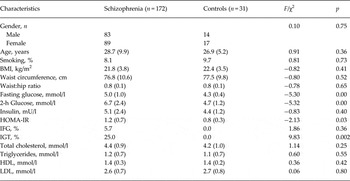
Table 1 shows the demographic data for SCZ and normal controls. The patients did not differ from healthy controls with respect to demographic characteristics (gender, age, education and smoking status), weight characteristics (BMI, waist and hip circumferences or waist:hip ratio) or biochemical measures (plasmas levels of cholesterol, triglycerides, high-density lipoprotein, low-density lipoprotein and insulin). However, the FEDN patients had significantly higher fasting plasma levels of glucose, and 2-h glucose post-loading (both p < 0.001). Insulin resistance, measured with HOMA, was higher in the patients than in the healthy subjects (p < 0.05).
Comparison of clinical and demographic and metabolic characteristics between patients with first-episode schizophrenia and controls

Data are given as mean (standard deviation) unless otherwise indicated.
BMI, Body mass index; HOMA-IR, homeostasis model assessment of insulin resistance; IFG, impaired fasting glucose; IGT, impaired glucose tolerance; HDL, high-density lipoprotein; LDL, low-density lipoprotein.
No significant difference in the rate of IFG was observed between the FEDN patients and healthy controls (5.7% v. 0%; χ2 = 1.86, p = 0.36). However, the frequency of IGT was significantly higher in the patient group than in the healthy control group [25.0% v. 0%; χ2 = 9.83, degrees of freedom (df) = 1, p < 0.01]. Within the patient group, there was no gender difference in the frequency of IGT (24.1% for male v. 25.8% for female) (χ2 = 0.07, df = 1, p = 0.79).
Comparison between IGT and non-IGT patients
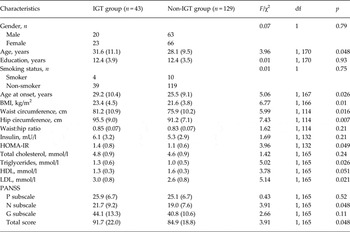
Demographic and clinical differences between IGT and non-IGT patients in Table 2 show that the IGT patients were older (p = 0.048), and acquired SCZ at a later age (F 1,167 = 5.06, p = 0.026), which still remained significant after controlling for age (F 1,166 = 4.59, p = 0.034). Further, after controlling for age and age of onset, the IGT patients had significantly higher levels of waist circumference (p = 0.007), BMI (p = 0.01), hip circumference (p = 0.016), LDL (p = 0.021) and triglycerides (p = 0.026) compared with the non-IGT patients. The IGT patients also displayed higher insulin resistance as calculated by the HOMA-IR than the non-ITG patients (F 1,132 = 3.96, p = 0.049). However, only the differences in waist circumference (p = 0.007) and BMI (p = 0.01) between the patients and controls passed the Bonferroni correction for multiple comparisons. After controlling for age and age of onset, both the PANSS total and the negative symptom subscale scores were higher in IGT patients than in non-IGT patients (both p < 0.05), but the positive symptom and general psychopathology subscale scores did not differ (both p > 0.05).
Comparison of clinical and metabolic characteristics between IGT and non-IGT schizophrenia patients
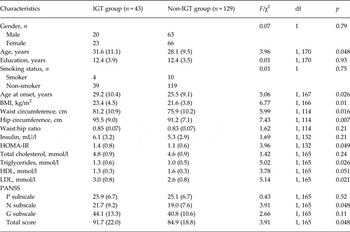
Data are given as mean (standard deviation) unless otherwise indicated.
IGT, Impaired glucose tolerance; df, degrees of freedom; BMI, body mass index; HOMA-IR, homeostasis model assessment of insulin resistance; HDL, high-density lipoprotein; LDL, low-density lipoprotein; PANSS, Positive and Negative Syndrome Scale; P, positive symptoms; N, negative symptoms; G, general psychopathology.
In the logistic regression analysis for associations with IGT, BMI [odds ratio = 1.14, 95% confidence interval (CI) 1.03–1.25, Wald χ2 = 6.97, df = 1, p = 0.008], age at onset (odds ratio = 1.35, 95% CI 1.07–1.70, Wald χ2 = 6.29, df = 1, p = 0.012), age (odds ratio = 0.78, 95% CI 0.62–0.98, Wald χ2 = 4.63, df = 1, p = 0.031) and negative symptom subscore (odds ratio = 1.06, 95% CI 1.00–1.12, Wald χ2 = 3.91, df = 1, p = 0.048) remained significant. In the linear regression analysis for associations with HOMA-IR, fasting glucose (β = 0.44, t = 4.94, p < 0.001) and BMI (β = 0.36, t = 4.18, p < 0.001) were identified as significant predictor factors for HOMA-IR.
Cognitive functioning in patients with IGT v. non-IGT
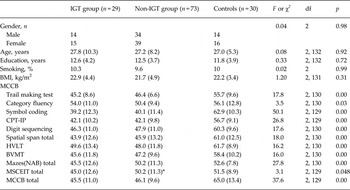
The MCCB total and index scores for the 29 IGT, 73 non-IGT patients and 28 healthy controls are shown in Table 3. The subjects from these three subgroups were matched for demographics including gender, age, education, smoking and BMI (all p > 0.05; Table 3). The MCCB total and 10 subscale scores showed no association with gender, age, age of onset, duration of illness and BMI.
Comparison of the MCCB scores between IGT and non-IGT schizophrenia patients and controls

Data are given as mean (standard deviation) unless otherwise indicated.
MCCB, Measurement and Treatment Research to Improve Cognition in Schizophrenia (MATRICS) Consensus Cognitive Battery; IGT, impaired glucose tolerance; df, degrees of freedom; BMI, body mass index; CPT-IP, Continuous Performance Test: Identical Pairs; HVLT, Hopkins Verbal Learning Test; BVMT, Brief Visuospatial Memory Test; NAB, Neuropsychological Assessment Battery; MSCEIT, Mayer–Salovey–Caruso Emotional Intelligence Test.
* Comparison between IGT and non-IGT groups (p < 0.05).
One-way ANOVA showed significantly lower cognitive scores on the MCCB total and nearly all of its 10 subscale scores (all p < 0.001) except for the MSCEIT and category fluency (both p > 0.05) in patients than normal controls, with effect sizes ranging from 0.36 to 2.09. The IGT patients performed worse than non-IGT patients on emotional intelligence (F = 4.17, df = 3, 95, p = 0.04; Bonferroni corrected p > 0.05), with an effect size of 0.35, but not on any other MCCB subscales.
Discussion
This study had four major findings. (1) The rate of IGT was significantly higher in these early-course SCZ patients than in healthy controls. (2) Higher fasting plasma levels of glucose and 2-h post-loading glucose, as well as insulin resistance, were observed in these early-course SCZ patients than in healthy controls. (3) Several demographic, anthropometric, and clinical differences between the IGT and non-IGT patients included BMI, age, age at SCZ onset, and the PANSS negative symptom subscore. (4) The patients in their early course of illness had significantly poorer cognitive performance than healthy controls, but only on emotional intelligence did the IGT patients show more severe cognitive impairments than non-IGT patents.
IGT prevalence and correlates in FEDN patients with SCZ
To date, only a few studies have conducted standard OGTT in FEDN patients with SCZ (Spelman et al. Reference Spelman, Walsh, Sharifi, Collins and Thakore2007; Sengupta et al. Reference Sengupta, Parrilla-Escobar, Klink, Fathalli, Ying Kin, Stip, Baptista, Malla and Joober2008) or with psychosis (Fernandez-Egea et al. Reference Fernandez-Egea, Bernardo, Donner, Conget, Parellada, Justicia, Esmatjes, Garcia-Rizo and Kirkpatrick2009). Our finding of a 25% IGT rate is somewhat higher than those reported in previous studies by Spelman et al. (Reference Spelman, Walsh, Sharifi, Collins and Thakore2007) (10.5% in FEDN patients and 18.2% IGT in relatives), and Fernandez-Egea et al. (Reference Fernandez-Egea, Bernardo, Donner, Conget, Parellada, Justicia, Esmatjes, Garcia-Rizo and Kirkpatrick2009) (6% IGT). Throughout the world, there exists a large amount of diversity with respect to diabetes prevalence and health expenditure (Hu et al. Reference Hu, Sawhney, Shi, Duan, Yu, Wu, Qiu and Dong2015). Interestingly, the previous epidemiological studies reported that the prevalence rate of diabetes in developing countries is higher (Whiting et al. Reference Whiting, Guariguata, Weil and Shaw2011). More than 80% of diabetic patients live in low- and middle-income countries (Mathers & Loncar, Reference Mathers and Loncar2006). Asian countries were among the top 10 countries for prevalence of diabetes in 2013 (Hu et al. Reference Hu, Sawhney, Shi, Duan, Yu, Wu, Qiu and Dong2015). Hence, in our present study, that our finding of a 25% IGT rate is higher than those reported in the Western countries is consistent with epidemiological findings of a higher prevalence rate of diabetes in Asian countries or in developing countries (Mathers & Loncar, Reference Mathers and Loncar2006; Hu et al. Reference Hu, Sawhney, Shi, Duan, Yu, Wu, Qiu and Dong2015). The influence of expanding economy, abrupt transition of living styles, and social ageing, cultural and economic contexts may be responsible for this discrepancy (Whiting et al. Reference Whiting, Guariguata, Weil and Shaw2011). Another possible explanation is a difference in ethnic background, since several lines of evidence suggest that IGT or diabetes has a strong genetic component (Franks & Pare, Reference Franks and Pare2016), and the allele frequency distribution of the diabetes-related gene polymorphisms, such as transcription factor 7-like 2 (TCF7L2)-rs7903146, varied significantly between Chinese and Caucasian subjects (Wang et al. Reference Wang, Song, Srivastava, Fathzadeh, Li and Mani2015). Thus, interethnic differences in the genotype frequencies of the diabetes-related gene polymorphisms may play an important role in accounting for the different results across the different populations. However, the frequency of IGT of 0% in our healthy control sample is the same as previous reports (Spelman et al. 2007; Fernandez-Egea et al. Reference Fernandez-Egea, Bernardo, Donner, Conget, Parellada, Justicia, Esmatjes, Garcia-Rizo and Kirkpatrick2009). Taken together, these results suggest that newly diagnosed people with SCZ have a higher prevalence of abnormal glucose tolerance than do matched controls. Since the glucose tolerance test is more sensitive than fasting glucose to measure abnormalities in glucose metabolism (Tai et al. Reference Tai, Lim, Tan, Chew, Heng and Tan2000), these results further confirm an association between SCZ and glucose disturbances.
Similar to other studies, we also found that the FEDN patients had higher levels of fasting plasma glucose and insulin, and more insulin resistance than the healthy comparison subjects (Ryan et al. Reference Ryan, Collins and Thakore2003; Dasgupta et al. Reference Dasgupta, Singh, Rout, Saha and Mandal2010; Chen et al. Reference Chen, Broqueres-You, Yang, Wang, Li, Wang, Zhang, Yang and Tan2013; Wu et al. Reference Wu, Huang, Wu, Zhong, Wei, Wang, Diao, Wang, Zheng, Zhao and Zhang2013; Petrikis et al. Reference Petrikis, Tigas, Tzallas, Papadopoulos, Skapinakis and Mavreas2015). These consistent findings from different countries of origin indicate a high rate of IGT, higher levels of fasting glucose and insulin and more insulin resistance in SCZ patients at the early phase of illness unconfounded by drug therapy. Since people with hyperinsulinemia, insulin resistance and IGT are susceptible to develop T2DM and macrovascular disease (Stubbs et al. Reference Stubbs, Vancampfort, De Hert and Mitchell2015), SCZ patients at the early phase of illness appear to be at high risk for developing T2DM and subsequent various cardiovascular diseases, which may explain in part the reduced life expectancy of patients with SCZ. However, the findings of some other studies are not consistent with these results. Arranz et al. (Reference Arranz, Rosel, Ramirez, Duenas, Fernandez, Sanchez, Navarro and San2004) reported no significant increase in insulin levels and insulin resistance among antipsychotic-naïve patients with SCZ. Sengupta et al. (Reference Sengupta, Parrilla-Escobar, Klink, Fathalli, Ying Kin, Stip, Baptista, Malla and Joober2008) reported that FEDN SCZ patients did not show a higher prevalence of the precursors to diabetes (impaired fasting glucose, IGT, insulin resistance) compared with healthy controls. These differences among studies may be related to small sample sizes, the definition of drug-naïve patients, biological heterogeneity or ethnicity, lifestyle, dietary habits, physical exercise habits, smoking or socio-economic status.
There are several possible explanations for the higher IGT rate in FEDN patients with SCZ. First, the association might be because diabetes and SCZ share some genetic risk factors (Fernandez-Egea et al. Reference Fernandez-Egea, Bernardo, Donner, Conget, Parellada, Justicia, Esmatjes, Garcia-Rizo and Kirkpatrick2009). Studies have found an increased prevalence of a family history of T2DM and IGT among relatives of people with psychosis (Arranz et al. Reference Arranz, Rosel, Ramirez, Duenas, Fernandez, Sanchez, Navarro and San2004; Spelman et al. Reference Spelman, Walsh, Sharifi, Collins and Thakore2007; Fernandez-Egea et al. Reference Fernandez-Egea, Bernardo, Parellada, Justica, Garcia-Rizo, Esmatjes, Conget and Kirkpatrick2008a , Reference Fernandez-Egea, Miller, Bernardo, Donner and Kirkpatrick b ). Recently, Lin & Shuldiner (Reference Lin and Shuldiner2010) proposed that shared genetic risk variants can exert pleiotropic effects (i.e. the same DNA sequence causing both phenotypes of SCZ and IGT), as supported by a T2DM risk allele located in TCF7L2 recently being associated with SCZ in two independent populations (Lin & Shuldiner, Reference Lin and Shuldiner2010; Alkelai et al. Reference Alkelai, Greenbaum, Lupoli, Kohn, Sarner-Kanyas, Ben-Asher, Lancet, Macciardi and Lerer2012), and our finding that the insulin-like growth factor II messenger RNA-binding protein 2 gene (IFG2BP2) was associated with SCZ (Zhang et al. Reference Zhang, Hui, Liu, Wang, You, Miao, Sun, Guan, Xiang, Kosten and Zhang2013). Thus, the co-occurrence of glucose metabolism abnormalities or T2DM and SCZ may be caused by shared genetic risk variants. In addition, T2DM is experiencing a rapidly rising prevalence in China. The rapid rise of T2DM prevalence in China is largely believed to be driven by several environmental factors comprising economic development, nutrition transition and changes in lifestyles (Hu et al. Reference Hu, Sawhney, Shi, Duan, Yu, Wu, Qiu and Dong2015). However, several convincing T2DM loci have been identified from large-scale genome-wide association studies and meta-analyses in the Han population (Ma et al. Reference Ma, Wang, Guo, Tian and Wei2015), suggesting that there may exist genetic predisposition in the Han population to develop T2DM. However, the genetic basis of T2DM and SCZ, especially the inter-relationships of their genetic loci, warrants further investigation. Second, obesity and age are well-recognized risk factors for T2DM (Gillett et al. Reference Gillett, Royle, Snaith, Scotland, Poobalan, Imamura, Black, Boroujerdi, Jick, Wyness, McNamee, Brennan and Waugh2012), and we also found that higher BMI, older age and age at SCZ onset were associated with IGT in our sample of patients. Since few of our FEDN patients were obese and most were young, these associations suggested a stronger risk factor than these typical risk factors for T2DM. Moreover, we did not find any differences between the FEDN and controls on 2-h glucose or fasting glucose levels probably due to their matched BMI, waist circumference and waist:hip ratio. However, many additive environmental risk factors such as lifestyle, dietary habits, physical exercise habits and smoking, which could also contribute to a difference between FEDN patients and controls, were not assessed and probably interact with genes important in glucose metabolism pathways.
However, it is worth mentioning that our findings showed later age at onset in the IGT group as compared with the non-IGT group, suggesting that having IGT is somehow protective, and may delay the onset of symptoms/illness. Interestingly, Spelman et al. (Reference Spelman, Walsh, Sharifi, Collins and Thakore2007) reported 10.5% IGT in FEDN patients, but 18.2% IGT in unaffected relatives of the patients, suggesting that patients have less opportunity to have IGT. Taken together, these findings suggest that IGT and FEDN are anti-correlated, meaning that having one is preventing the occurrence of the other. This anti-correlation seems counter to the expected directionality. The exact mechanisms responsible for these findings are unknown, and we currently cannot offer a reasonable explanation for them due to the cross-sectional design of our present study. Thus, the relationships between glucose metabolism, IGT and onset of SCZ, and the mechanisms underlying their associations deserve further investigation.
Comparison of IGT v. non-IGT patients on psychopathology
Compared with non-IGT patients, IGT patients showed older age, higher levels of waist circumference, BMI, hip circumference, LDL and triglycerides as well as higher insulin resistance as calculated by the HOMA-IR, although only the differences in waist circumference and BMI passed the Bonferroni correction. These associations suggested similar risk factors to these typical risk factors for T2DM among the first-episode patients with SCZ at the early stage before antipsychotic treatment. Later, antipsychotic medicines may interact with these risk factors and lead to the development in those vulnerable patients with SCZ.
Further, the IGT patients showed higher PANSS negative symptom subscore than the non-IGT patients. Interestingly, the other two studies in drug-naïve SCZ patients showed that insulin-like growth factor-1 (IGF-1), a key regulator of insulin sensitivity (Venkatasubramanian et al. Reference Venkatasubramanian, Chittiprol, Neelakantachar, Naveen, Thirthall, Gangadhar and Shetty2007), and HOMA-IR (Chen et al. Reference Chen, Broqueres-You, Yang, Wang, Li, Wang, Zhang, Yang and Tan2013) were negatively associated with the PANSS positive symptom subscore. Taken together, these findings provide evidence that an abnormal glucose metabolism may be involved in the psychopathology of SCZ in the early phase of illness. However, Kirkpatrick et al. (Reference Kirkpatrick, Fernandez-Egea, Garcia-Rizo and Bernardo2009) reported that 2-h glucose concentrations were significantly higher in non-deficit patients when compared with deficit subjects, characterized by primary, enduring native symptoms, which is in conflict with our current finding. The exact reasons for this difference are still unknown. Whether this discrepancy may be related to the different clinical status of patients or to interethnic differences in the allelic frequencies of the gene polymorphisms related to glucose metabolisms between Eastern and Western populations deserves further investigation.
One potential basis for this association of abnormal glucose metabolism and clinical psychopathological symptoms of SCZ may be the relationship between glucose homeostasis and the dopamine system. Dopamine receptor proteins are expressed in both murine and human pancreatic islets and stimulation of these islet-derived dopamine receptors attenuated insulin secretion in an autocrine or paracrine fashion (Simpson et al. Reference Simpson, Maffei, Freeby, Burroughs, Freyberg, Javitch, Leibel and Harris2012). Furthermore in vivo, dopamine D2R knockout mice gradually develop glucose intolerance and impaired insulin response to glucose, suggesting a critical role of dopaminergic suppression in function and replication of pancreatic β cells (García-Tornadu et al. Reference García-Tornadu, Ornstein, Chamson-Reig, Wheeler, Hill, Arany, Rubinstein and Becu-Villalobos2010). On the other hand, it has been hypothesized that SCZ involves a dysregulation in brain dopaminergic circuits with excess dopaminergic activity in the mesolimbic pathway that also is associated with the positive symptoms, while reduced dopaminergic signaling in the mesocortical pathway is associated with negative symptoms (Davis et al. Reference Davis, Kahn, Ko and Davidson1991; Miyamoto et al. Reference Miyamoto, Miyake, Jarskog, Fleischhacker and Lieberman2012). Thus, further investigations might elucidate the mechanistic link between psychopathology, glucose metabolism and dopaminergic function in SCZ patients.
IGT and cognitive impairment in SCZ
We found significantly lower cognitive performance on the MCCB and nearly all of its subscales in FEDN patients than normal controls, as have the majority of studies assessing cognitive performance in SCZ patients (Sharma & Antonova, Reference Sharma and Antonova2003; Palmer et al. Reference Palmer, Dawes and Heaton2009), including in those first-episode patients (Aas et al. Reference Aas, Dazzan, Mondelli, Melle, Murray and Pariante2014; McCleery et al. Reference McCleery, Ventura, Kern, Subotnik, Gretchen-Doorly, Green, Hellemann and Nuechterlein2014; Wu et al. Reference Wu, Chen da, Tan, Xiu, Yang, Soares and Zhang2016). Since diabetes is also associated with cognitive impairment (Keefe, Reference Keefe2007; Zhen et al. Reference Zhen, Zhang, Liu, Fang, Tian, Zhou, Kosten and Zhang2013), and we and other studies have shown that T2DM in SCZ is associated with impairment in many domains of cognitive function, we expected greater cognitive impairment in those FEDN patients with IGT (Kumar et al. Reference Kumar, Looi and Raphael2009; Zhen et al. Reference Zhen, Zhang, Liu, Fang, Tian, Zhou, Kosten and Zhang2013). Our prior study showed that SCZ patients with diabetes performed worse than SCZ patients without diabetes in immediate memory (p < 0.01) and total RBANS scores (p < 0.05), and also showed a trend to decreases in attention (p = 0.052) and visuospatial/constructional functioning (p = 0.063), with effect sizes ranging from 0.37 to 0.45 (Han et al. Reference Han, Huang, Chen da, Xiu, Kosten and Zhang2013), suggesting that SCZ patients with diabetes had worse cognitive functioning than SCZ patients without diabetes. Therefore, we particularly expected that memory and processing speed would be impaired, as they are in diabetes (Allen et al. Reference Allen, Frier and Strachan2004; Manschot et al. Reference Manschot, Brands, van der Grond, Kessels, Algra, Kappelle and Biessels2006; Kumar et al. Reference Kumar, Looi and Raphael2009). However, the IGT patients were more impaired than the non-IGT patients only on the MSCEIT, in which our FEDN patients overall did not differ from the controls. Thus, this first study exploring glucose metabolism and cognitive impairment in FEDN patients with SCZ has found little evidence for those cognitive impairments being greater with IGT. This result is not in agreement with our expectation. It may be that the early course of illness of SCZ is more vulnerable to dysfunction of glucose metabolism than the cognitive impairments, but this is speculative. Further research using a longitudinal and prospective design with FEDN patients is needed to clarify the relationship between IGT and cognitive impairments in SCZ. Instead, it appears that the progress of the illness in chronic SCZ patients and probably treatment with antipsychotic drugs are required to show the synergistic (multiplicative) effects of co-morbid diabetes and SCZ on cognitive performance (Han et al. Reference Han, Huang, Chen da, Xiu, Kosten and Zhang2013). Moreover, chronic dysregulation of glucose metabolism appears necessary before other areas of cognitive impairment develop and distinguish SCZ patients with and without T2DM or IGT. Whether SCZ patients with IGT early in their course of illness are more susceptible to having impairments in emotional intelligence is a most interesting question for replication in further studies, but our relatively small sample of 29 FEDN patients with IGT requires replication.
It is worthy of mentioning that the glycated hemoglobin (HbA1c) concentration reflects the mean glucose concentration over a period of 8–12 weeks from both fasting and postprandial glucose concentrations (Geijselaers et al. Reference Geijselaers, Sep, Stehouwer and Biessels2015). In a recent study, HbA1c concentration was significantly higher in SCZ patients with than without diabetes (Zhang et al. Reference Zhang, Han, Zhang, Hui, Jiang, Yang, Tan, Wang, Li and Huang2015). Moreover, several studies have indicated that poorer glycemic control and higher HbA1c are significantly associated with cognitive deficits in both SCZ patients and healthy individuals (Dickinson et al. Reference Dickinson, Gold, Dickerson, Medoff and Dixon2008; Sanz et al. Reference Sanz, Ruidavets, Bongard, Marquie, Hanaire, Ferrieres and Andrieu2013). Hence, lacking HbA1c measures in our current study should be considered as one of the methodological limitations, which will be remedied in the future investigations. In addition, there were only 31 subjects in the control group, which is far fewer than in the patient group. Although it is unlikely to significantly affect the conclusions drawn in the study, the imbalance in the sample size of our subjects may lead to bias in the statistical analysis, which should be remedied in any future investigation.
In summary, our data show a significantly higher IGT rate shown on the standard OGTT in the acute early phase of SCZ patients compared with healthy controls, suggesting that the diagnosis of SCZ itself is associated with diabetes risk that cannot be explained by drugs and weight gain. Thus, this finding has important implications for clinical care in that one would think that avoiding medicines associated with the greatest weight gain is an important strategy in preserving physical health. Since the glucose tolerance test is a more sensitive and stable measure of abnormalities in glucose metabolism, our findings provide an additional marker and further evidence that abnormal glucose metabolism may be involved in the pathogenesis of SCZ. Moreover, BMI, age at onset, age and the PANSS negative symptom subscore were associated with IGT in these patients. The mechanisms by which IGT was associated with clinical symptoms of SCZ are unknown, but possibly through the dysfunctional adjustment of dopaminergic systems for glucose metabolism. Interestingly, these first-episode patients with SCZ displayed a range of cognitive deficits, and IGT patients showed a trend toward more cognitive impairment, especially on emotional intelligence performance, suggesting an impaired effect. Although the underlying mechanisms of association between IGT and cognitive impairment are still unknown, we hypothesize that abnormal glucose metabolism may play a role in cognitive impairment in SCZ. However, our results need to be considered cautiously for three reasons. (1) IGT patients showed lower performance on only one of 12 cognitive subdomains (emotional intelligence index) in the MCCB. (2) The significance for the difference in emotional intelligence index between the IGT and NGT patients is weak (p = 0.04) and did not survive Bonferroni correction. (3) This positive result was based on a comparatively small sample size of 29 IGT patients. A longitudinal design will more definitively establish whether IGT is an early factor for the cognitive decline in SCZ patients early in their course of the illness.
Acknowledgements
Funding for this study was provided by grants from the National Natural Science Foundation of China (81371477), the Beijing Municipal Natural Science Foundation (7132063 and 7072035), the NARSAD Independent Investigator Grant (20314), the Jiangsu Provincial Special Program of Medical Science – New Type Clinical Diagnosis and Treatment Project (BL2013018), and Suzhou Key Medical Center for Psychiatric Diseases (Szzx201509). These sources had no further role in study design in the collection, analysis and interpretation of data, in the writing of the report, and in the decision to submit the paper for publication.
Declaration of Interest
None.