The law and finance hypothesis has suffered sustained assaults from business historians over the past decade. The hypothesis, originally formed by financial economists Rafael La Porta, Florencio Lopez-de-Silanes, Andrei Shleifer, and Robert W. Vishny, has been shown to be largely ahistorical.Footnote 1 The supposedly unique features of American and British corporate capitalism, especially with respect to the flexibility of the laws governing investor protection, have been found to not actually be unique to Britain and the United States, originate in Britain and the United States, or even be true in Britain and the United States.Footnote 2 Following the example of Timothy W. Guinnane, Ron Harris, Naomi Lamoreaux, and Jean-Laurent Rosenthal, business historians have demonstrated that jurisdictions with code-law origins developed various organizational forms (also known as “enterprise forms”) that were more flexible than, and at least as conducive to, modern capitalism as the archetypal Anglo-Saxon corporation.Footnote 3
The historical law and finance debate has now moved on to focus on how organizational hierarchies and governance arrangements explain performance. One angle has been to look at the ways in which company articles of association in common-law jurisdictions were used to substantially modify governance rules.Footnote 4 Another has been to examine how common-law incorporation was used flexibly to create the “hybrid” forms necessary to raise capital while minimizing the impact of principal-agent problems.Footnote 5 And so, while many business school scholars still associate business incorporation with “progress,” and still prescribe the blanket adoption of this organizational form, business historians have shown this view to be an oversimplification.Footnote 6
A parallel debate on the organizational architecture of corporations focuses specifically on their shareholder liability arrangements. Largely confined to the study of banking organizations, this literature employs historical cases to test economic theories.Footnote 7 Studies explore two opposing forces.Footnote 8 Specifically, limiting liability to some ex ante fixed amount mobilizes savings from individuals otherwise discouraged from investing by the larger variance in financial success possible under unlimited liability; however, if shareholders have only limited exposure to downside risks, they may elect managers who promise more volatile and risky business. Corporations have in the past used a variety of shareholder liability arrangements, but the pure limited liability case is now regarded as the “end of business history.”Footnote 9 A number of economic historians have set out to reexamine this feature of corporate capitalism.Footnote 10 But the fact that other organizational forms in code-law jurisdictions could also be used to limit shareholder liability is not currently the subject of academic scrutiny. And despite the fact that many of the same scholars are involved in both the organizational form and the shareholder liability research agendas, little attempt has been made to unify the two literatures. But as the decisions on organizational form and liability arrangements are likely to be made jointly, I argue that these two aspects of business governance must also be studied jointly.
I add to these literatures by analyzing a case from Dutch business history in which the advantages and disadvantages of the limited liability public company are revealed as a direct consequence of the occurrence of a financial crisis. The Netherlands is a jurisdiction where the corporation and limited liability were developed very early, in the seventeenth century, to solve contractual problems faced in trade relationships with the Dutch East Indies.Footnote 11 The country's legal system was then replaced with the Napoleonic Code; the Netherlands is thus among the constituency that the law and finance hypothesis deems to be at a distinct disadvantage. But judging by the legal flexibility available to Dutch business by the turn of the twentieth century, the hypothesis needs to be reexamined. Indeed, Dutch law permitted business organizations to adopt a wide spectrum of arrangements for shareholder liability, ranging from purely limited to totally unlimited liability. Interestingly, these arrangements could be made largely independently of the choice of organizational form; businesses adopting the cooperative form, for example, could also limit the liability of their owners. Comparing the resilience of these different types of business organizations operating in an “underperforming” code-law jurisdiction offers important insights into the relationship between a country's institutional environment and the governance structures adopted by that country's businesses.Footnote 12
I examine a class of businesses that Guinnane, Harris, Lamoreaux, and Rosenthal explicitly highlight as being particularly unsuited to the “classic vanilla” corporate form: small and medium-sized enterprises (SMEs). Indeed, I look at SMEs that are in the business of providing services exclusively to other SMEs: I analyze the fate of the middenstandsbanken, a specialized type of bank that emerged in the Netherlands in the first decades of the twentieth century to serve the financial needs of the middenstand, an antiquated Dutch term for SMEs.Footnote 13 These small savings and loans banks, which in 1918 each had on average 230,000 guilders of capital, suffered severely in the unprecedented financial turmoil of the early 1920s, a period of acute and prolonged debt deflation.Footnote 14 This crisis, which I describe in other work, resulted in the failure of one-third of the banks analyzed in this article.Footnote 15 While constituting a small component of the Dutch banking sector at the time of the crisis, middenstandsbanken represent the principal antecedents of ING Groep NV, one of the world's largest banks today.Footnote 16
I exploit the 1920s shakeout among middenstandsbanken to “test” whether the classic vanilla corporation is the optimal form of business organization for banking business in terms of minimizing failure probability. I then use this case to isolate whether it is these banks’ flexible liability rules rather than their organizational form which helped or hindered their ability to survive and thrive. Indeed, I argue that combining the debate on optimal organizational form with the heretofore always separate discussion on optimal shareholder liability rules in itself represents a novel contribution.
My findings suggest that middenstandsbanken that failed in the 1920s—manifested through either liquidation or distressed acquisition—were statistically no more likely to have a different arrangement concerning shareholder liability than those that survived the crisis intact. If a failure signifies ex post that a bank operated a riskier business model that exposed it more adversely to the 1920s crisis, then this suggests other bank-specific factors—including the composition of their balance sheet—compensated for the increased risk associated with having less additional capital to call up in a crisis.
This result must be read alongside the significantly higher probability of failure experienced by banks that chose the public company form, which could be co-owned by outside investors, rather than the cooperative association form, where the owners were usually the banks’ customers. This finding suggests that the identity of a bank's owners determines its resilience. A middenstandsbank owned cooperatively by groups of its debtors (i.e., savers) and creditors (i.e., borrowers) was less likely to engage in activities that made it susceptible to fail in a systemic crisis than those owned by stakeholders who stood to lose no more than (some agreed multiple of) their invested capital (i.e., shareholders).
The Law and Finance of the Middenstandsbanken
Middenstandsbanken emerged in the first two decades of the twentieth century in response to a view among many SME business owners that they were being priced out of financial markets.Footnote 17 They took their inspiration from Germany's Schulze-Delitzsch savings and loans banks.Footnote 18 Their core business model was to act as financial intermediaries between SMEs: to take in excess funds and lend them to finance projects in retailing and small-scale manufacturing, all with little or no collateral. They introduced current accounts, overdrafts, and check-clearing services to a sector that traditionally relied on cash settlement of bills and used late payment as credit. While the specialized nature of their clientele allowed them to design bespoke products and target their marketing, this strategy also rendered them undiversified.
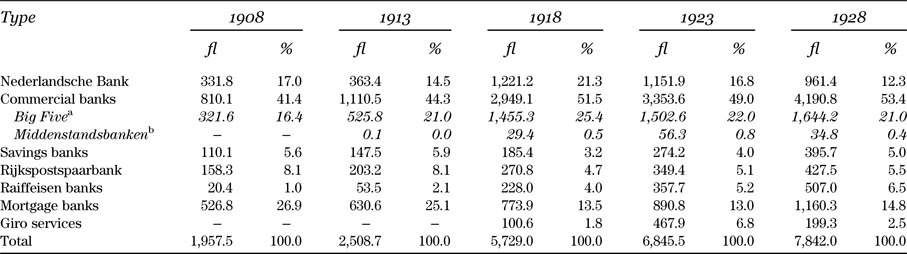
These new SME banks remained insignificant in terms of their aggregate impact on the financing of Dutch business until after World War II. But they became important players in their market niche. Table 1 sets out the size of the different components of the financial services sector between 1908 and 1928.Footnote 19 The plight of the middenstandsbanken is worth studying, despite their small size, because their experimentation with various combinations of organizational forms and liability rules reveals the workings of the law governing business organizations in an important code-law jurisdiction. Their initial organizational diversity, and any subsequent learning as a consequence of their heterogeneous performance in the 1920s, describes the evolutionary path of Dutch banking business.Footnote 20
Total Assets of Dutch Financial Institutions, 1908–1928
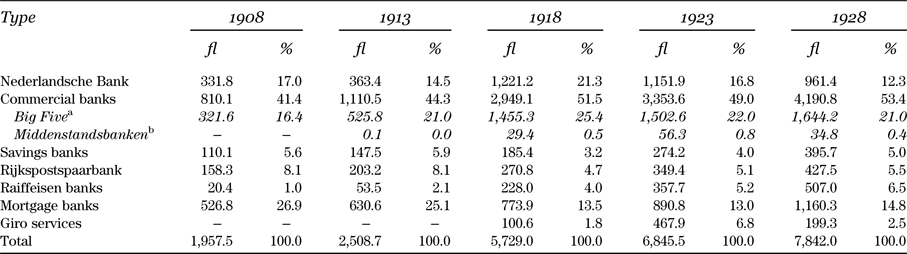
Sources: Adapted from De Nederlandsche Bank, Nederlandse Financiële Instellingen in de Twintigste Eeuw: Balansteeksen en Naamlijst van Handelsbanken (Amsterdam, 2000).
Notes: Expressed in millions of guilders (fl) and percentage of total bank assets (%). a The “Big Five” banks—Amsterdamsche bank, Incasso-Bank, Nederlandsche Handel Maatschappij, Rotterdamsche Bankvereeniging, and Twentsche Bank—today constitute ABN AMRO Bank. b Twelve middenstandsbanken are included in this category. Together with the Rijkspostspaarbank, these banks today constitute ING Bank.
No special organizational form or liability regime was earmarked for banks in Dutch law, but two in particular allowed for a dispersal in ownership. The first was the public company (naamloze vennootschap), which derived its attributes from legislation enacted in 1838 to replace the Napoleonic Code.Footnote 21 The second was the cooperative association (coöperatieve vereeniging), which was specifically designed for either producer- or consumer-owned organizations and dates to legislation from 1876.Footnote 22 The liability arrangements prescribed in both laws were only default rules and could be easily amended using the organization's articles of association (statuten); liability arrangements from legislation represented merely “starting points” and applied only in the absence of alternatives.Footnote 23 J. Déking Dura, an economist and lawyer writing in 1913, went so far as to argue that no practical difference existed between cooperatives and corporations in terms of shareholder liability.Footnote 24 The decision concerning which organizational form to choose was therefore essentially decoupled from the choice of liability regime. Indeed, there was no uniformity in the choice of liability arrangement made by middenstandsbanken; bank founders did not all adopt the standard template of rules set out in either the 1838 or 1876 acts of Parliament nor, apparently, did they gravitate toward the same set of bespoke rules. In practice, then, liability ranged from totally unlimited to “pure” limited liability.Footnote 25
If there was no practical difference among the range of liability options that proceeded from these two organizational forms, how did these forms differ? I suggest they varied in three key respects: share transferability, ownership structure, and management incentive structure. First, with respect to share transferability, cooperative associations always had to maintain “shareholder” (more technically, member) lists, whatever their liability arrangements. The shareholders could only transfer their shareholdings under certain prescribed instances outlined in the articles of association. Meanwhile, under certain conditions, shareholders in public companies could more easily buy and sell their shares.Footnote 26
Second, the shareholding constituency tended to differ between these organizational forms. For public companies, shareholders could include outsiders investing in the bank purely to make a return. By contrast, for cooperative associations, shareholders were typically a constituency that overlapped, sometimes perfectly, with the bank's customers. In this ownership structure, incentives to take risks were quite different; cooperative organizations likely pursued more risk-averse lending policies because shareholders stood to lose their deposits in addition to their share capital.
Third, the incentive structure of bank managers of cooperatives and corporations was likely different as a consequence of legislation. The 1838 law for corporations was quite lenient with respect to the personal responsibility of directors: providing they conducted their business lawfully, they could not be pursued by shareholders for making bad management decisions.Footnote 27 Meanwhile, the 1876 legislation governing cooperatives attempted to align the incentives of directors with those of their organization by making directors “superliable” in the event of failure; directors were considered legally responsible in the case of bankruptcy (Article 11 of the 1876 law) and could be fined by the court if their administration was inadequate (Article 22). This may have made them less inclined to take risks with their depositors’ savings.
Interestingly, the laws governing both cooperatives and corporations were revised in the wake of the 1920s crisis: in 1925, cooperatives were forced to enhance transparency surrounding their liability arrangements; and in 1928, corporations were to clarify the procedure for share ownership transfers and improve the transparency associated with partially paid-up capital arrangements.Footnote 28 These new laws also marked a change in approach by Dutch lawmakers: rather than requiring government approval, new business organizations could be set up without such oversight—but on the condition they opened their books to the public.Footnote 29 The fact that these aspects of the laws were changed, and that considerable legal debate preceded these changes, provides very strong circumstantial evidence that contemporary observers considered pre-1920s legal arrangements governing business transparency and shareholder liability to be important determinants of resilience and, ultimately, convinced policymakers and politicians to revise the country's business law.Footnote 30
Middenstandsbanken also differed in their religious affiliations. The Netherlands was divided into competing socioreligious pillars, each with parallel social, political, and economic institutions.Footnote 31 The consequence of this “pillarization” was that different middenstandsbanken were founded for different social groups living in the same geographic markets. This “banking schism” resulted in a market structure with very low levels of concentration.Footnote 32 But while pillarization clearly affected the scale and scope of banking organizations, it is not obvious that either organizational form or shareholder liability structure was determined by religiosity; it is difficult to attribute any heterogeneity in organizational hierarchies and governance arrangements to socioreligious affiliation.Footnote 33
The Organizational Architecture of the Middenstandsbanken
What was the organizational architecture of the middenstandsbanken? How did their founders combine the various institutional arrangements available to them to create their bespoke hybrid organizations?Footnote 34 I examine archival material on a series of representative case studies to provide some clues to a possible answer.
Probably the best studied of all the middenstandsbanken are the Hanzebanken.Footnote 35 On the eve of the 1920s crisis, three middenstandsbanken shared the Hanzebank brand—although initially linked only by their “ethos” and an agreement not to compete directly with one another. All three Hanzebanken targeted the Catholic market and developed branch networks over their designated diocesan territories. The articles of association of the Hanzebank Den Bosch provides an example of the organizational form and liability structure adopted by these banks.Footnote 36 It was founded as a cooperative. A number of the articles provided protection for its member-shareholders. The bank's managers were obliged to inform shareholders if share capital had to be written down (Article 5). While there was no secondary market in shares, members could sell their share back to the bank at any time—though never above par (Article 11). Quality shareholders were sought: bankrupts could not participate (Article 14), only shareholders could borrow money (Article 17), and managers could confiscate shares if loan repayment deadlines were missed (Article 15). Shareholders were members of the whole bank and thus collectively liable for all its business, not only that of their local branch.
The Boazbanken were a rival group of middenstandsbanken that targeted Protestants. They differed from the Hanzebanken in the way they were organized: member-shareholders were liable for their local bank only, rather than for the whole Boazbank group.Footnote 37 A typical example was the Boazbank in Sneek, established as a cooperative.Footnote 38 Its liability arrangements were complicated: one share in this bank cost 25 guilders, but shareholders had to pay in just 20 percent of par value up front. Shareholders had to increase their stake by 5 guilders per year until the full amount was paid in, or immediately in the case of a capital write-down (Article 36). A maximum of one share per shareholder was enforced (Article 27). The Sneek bank's statutes ensured that shareholders remained liable, proportionally, for a further year following the sale of their share (Article 44). Shareholders did not enjoy much protection from management; shareholder meetings, at which decisions to write off losses could be made (Article 23), required just fourteen days’ notice, and only one-fifth of shareholders was quorum (Article 22). But the fact that managers themselves had to be shareholders ensured some alignment in incentives.
A third group of middenstandsbanken was overtly secular, or neutral, not taking any religious affiliation. Such banks were established in most large towns and cities and took a range of organizational forms and liability regimes. Most were linked to the Algemeene Centrale Bankvereeniging voor den Middenstand (ACBM), established in 1914 to function as a central clearinghouse for the sector and to audit the accounts of all member banks.Footnote 39 The ACBM was itself owned by these member banks, which each had to purchase an equity stake before making use of its services.Footnote 40
A typical example of a neutral middenstandsbank was that of Leeuwarden, established in 1908 as a cooperative.Footnote 41 Member-shareholders could leave at any time, but they would remain liable for any losses for another year (Article 5). They were liable for a further 100 guilders above their capital share pledge of 100 guilders (Article 9); this bank chose double liability. Shareholders had to pay up at least 50 percent of their pledged capital (Article 33), meaning that in practice shareholders could commit just 25 percent of their total liability up front.
Meanwhile, the neutral middenstandsbank in Neede chose the public company form.Footnote 42 But shares in this bank were not “modern” bearer shares; individual shareholders had their name and address recorded in a shareholder register (Article 8). Shares could be transferred to others, but this had to take place under the witness of the bank's directors (Article 10). As with cooperatives, an individual who wished to take out a loan with the bank had to become a shareholder (Article 5).Footnote 43 In contrast to cooperatives, shareholders could own more than one share, but their voting power was capped (Article 23). Shares had to be fully paid up (Article 12) and enjoyed limited liability.
In an unlimited liability bank, shareholders could technically lose all their assets if a call was made on them. Who would purchase such a share? Some indication is given in reports lodged with the Nederlandsche Bank, the Netherlands’ de facto central bank, concerning this very question with respect to three Boazbanken in 1922. The professions of these shareholders was surprisingly varied, including merchants, builders, and farmers. Their wealth also varied significantly. For the Boazbank in Ter Aar, the average estimated nonbanked assets (property, etc.) of the twenty-five agricultural shareholders was 9,000 guilders, versus 15,550 for all seventy-nine shareholders and 45,000 for the chief cashier.Footnote 44 Meanwhile, the average assets of the sixty-eight shareholders in the Boazbank in Amersfoort was 14,900 guilders, while twenty-four shareholders had no assets besides their savings deposits.Footnote 45 Finally, average assets of the thirty-five shareholders in the Boazbank Barneveld was 29,300 guilders; there were no shareholders with no assets and the richest shareholder had assets of 250,000 guilders, placing him among the country's extremely wealthy.Footnote 46
A commission was established to explore changing the organizational architecture of all willing Boazbanken from cooperative associations to public companies.Footnote 47 It concluded in March 1922 that the cooperative form should be maintained because a cooperative bank can just as easily act as a profitmaking commercial enterprise and that the company form would bring only disadvantages; the report's authors were of the view that banks would have to raise at least some expensive share capital to replace the pool of unlimited liability “capital,” something many of its members could apparently ill afford. Given this case, I hypothesize that a bank's choice of organizational architecture was (at least partly) determined by whether it wanted to attract shareholders who could afford to lay down capital, or instead serve those who could not. This would suggest that the choice of liability arrangement may be an indicator of the affluence of members, or the global pool of potential bank shareholders sorted itself into groups by level of liquid assets and chose a bank in which to invest accordingly. However, the fact that the Boazbanken counted some very wealthy individuals among their shareholders suggests wealth alone was not the deciding factor.
The 1920s Banking Crisis and Its Resolution
Between 1920 and 1926, the Netherlands experienced a protracted financial crisis that affected banks and other financial institutions across the country. Banks suffered depositor runs, share-price crashes, illiquid balance sheets, and, eventually, insolvencies. The crisis affected large general banks, smaller provincial banking houses, and specialist banking organizations.Footnote 48 The historiography focuses on the macroeconomic causes of the crisis and holds that it was ultimately a result of banks replacing capital markets during World War I in order to finance growing industrial demand for Dutch goods and services.Footnote 49 Large and sustained declines in aggregate demand and prices in the early 1920s—declines largely due to factors determined abroad and aggravated by expectations of the Dutch guilder's return to the gold standard at prewar parity—put pressure on businesses and, consequently, on the banks that served them. Essentially, the literature argues, failing banks were overexposed to sectors of the economy destined to suffer most at the hands of debt deflation. Undiversified SMEs were particularly affected, and consequently so were their undiversified middenstandsbanken.
While the macroeconomic causes of this crisis are well documented, the microeconomic consequences for different types of banks are not. This is especially the case for the middenstandsbanken, which have been the subject of only one dedicated study to date, authored by a retired banker: J. Stoffer's history of the formation of the Nederlandsche Middenstandsbank (NMB), the bank established in 1927 under the auspices of the Dutch State to subsume those middenstandsbanken that had survived the crisis and remained going concerns.Footnote 50 Aside from an academic debate on the role of middenstandsbanken by economists contemporary to the crisis, very little scholarly discussion exists.Footnote 51 What follows is my attempt to fill this lacuna.
The Nederlandsche Bank was inconsistent in its involvement in the financial sector during the 1920s crisis. It was never particularly enthusiastic about rescuing banks. It carried out some lender-of-last-resort functions, but only on a case-by-case basis, and in some very exotic ways.Footnote 52 For a modern central bank, its actions would be considered woefully inadequate; the Netherlands’ central bank failed to stop bank runs both at large multibranch banks such as the Rotterdamsche Bankvereeniging and at small middenstandsbanken such as the Hanzebanken.Footnote 53 It sought constant government reassurance and support for all its actions; it never acted unilaterally. Overall, then, middenstandsbanken could not rely on a bailout, and investors knew this. Any failures in the shakeout of the 1920s were down to “market forces.” The government intervention in late 1926, which led to the merger of practically all surviving viable middenstandsbanken, does not detract from this fact, as it happened only after the crisis was essentially already resolved.Footnote 54 Indeed, the final, politically motivated, reorganization of the middenstandsbanken is consequently not part of the empirical analysis that follows. Instead my focus is on the problem of understanding the consequences of the heterogeneity in the sector's various organizational forms and liability arrangements for their resilience during the crisis years.
How were bank failures at middenstandsbanken resolved during the crisis? Did the method of crisis resolution differ by organizational form or liability regime choice? Again, I examine a series of case studies to provide some clues to a possible answer. I subsequently use this to inform my empirical analysis.
The Nederlandsche Bank monitored the failure of the Hanzebanken closely in its capacity as supervisor of the administrators appointed to unwind these banks’ portfolios. The central bank had long known the Hanzebanken were in trouble. Reports in June 1923 note how central bankers scrutinized the new plans set out by the Hanzebank in Delft to increase the size of its reserves by offering shareholders the possibility of converting shares into profit participation certificates. The central bank then observed that this Hanzebank's directors had made a call on its shareholders to pay in all outstanding share capital by October 31.Footnote 55
But, while they monitored the Hanzebanken, central bankers decided not to intervene. They obtained a list of all the Hanzebank Delft's customers and conducted a detailed assessment of the financial viability of all its larger customers. The reports note that the bank's capital was likely insufficiently large to cover all its obligations and so the bank must be considered de facto bankrupt. But the central bankers were concerned about the possible fallout of declaring the true position of the bank publicly; they were acutely aware of the possibility of instigating a bank run and so apparently did not start legal proceedings until the Hanzebank Delft's sister bank in Den Bosch collapsed later that year.Footnote 56
The bankruptcy of the Hanzebank in Den Bosch was described in great detail in the contemporary press.Footnote 57 A report written by the bank's bankruptcy administrator, and presented during court proceedings, attributes the bank's failure to a combination of poor management, or even mismanagement, and the debt-deflationary crisis (conjunctuurverliezen). While the former was the consequence of the choices made by financial actors themselves, the latter was due to factors outside the control of these actors. As examples of the former, the administrator notes that the bank paid out a dividend when all its capital was used up in 1920 and 1921, and its managers were contractually guaranteed a good pension even in the event of bankruptcy.Footnote 58
Meanwhile, distressed banks that were forcedly merged in the crisis were typically acquired by the ACBM and run as branches. I am able to reconstruct an account of what happened in such cases from archival material concerning the middenstandsbank in Terneuzen, organized as a public company.Footnote 59 In 1921, it paid an 8 percent dividend, increasing to 9 percent on all shares paid in above the minimum—a means of encouraging shareholders to fully pay in their shares. But by the start of 1923 it had called an extraordinary shareholder meeting, at which a visiting director of the ACBM explained his bank would be willing to take over Terneuzen's viable business and guarantee its deposits. The Terneuzen bank had apparently granted very large loans to businesses that had suffered in the deflation and had adopted poor internal accounting practices that made the management of risks very difficult. Shareholders had to pay up their full outstanding shareholding and then lost ownership rights. They were promised compensation out of any potential future profits of the ACBM.
Modeling Bank Failure
The empirical strategy I employ in the remainder of this article is the analysis of a bankruptcy prediction model. The idea is to see whether, and to what extent, cross-sectional data pertaining to individual middenstandsbanken before the 1920s can predict ex post crisis-period performance in terms of distress status between 1920 and 1926. My purpose is in some respects quite narrow: to discover whether a statistical relationship exists between crisis-period bank distress and banks’ earlier choice of organizational architecture, defined here as the combination of their organizational form and shareholder liability arrangements.
The principal hypothesis on organizational form I test is that the cooperative association was a more appropriate form for SME banking in terms of minimizing financial distress, and ensuring business longevity, as a direct consequence of the fact that their customers were also their owners. Cooperatives lie at the ownership extreme of Henry B. Hansmann's typography of organizational architecture, which, he argues, shapes incentives in ways that discourages risk-taking.Footnote 60 Depositors have less incentive to run on their bank if they co-own and comanage it, and similarly, borrowers have less incentive to renege on their loan repayments. Meanwhile, the potential separation of ownership from “usership” (customers) in the corporation means the incentives of these two stakeholders are not always aligned, rendering market exit a more expedient route to asset recovery.
I explore two alternative hypotheses regarding shareholder liability. The first follows the intuition behind option pricing theory and suggests banks that limit liability should be riskier, because the negative consequences of poor performance are capped.Footnote 61 The second follows from the Coase theorem, which suggests that a bank's liability choice ultimately has very little bearing on its resilience, because liability risk should be offset by other factors, such as the composition of the balance sheet.Footnote 62 I also explore whether liability functioned in the same way for organizations at opposite ends of Hansmann's typography of organizational forms—that is, whether the option pricing approach and the Coase theorem explain the impact of shareholder liability differently for cooperatives and corporations.
The data I collected in this empirical analysis are a sample of eighty-four middenstandsbanken out of the population of ninety-five found to operate in the Netherlands in the fiscal year 1917–1918.Footnote 63 This year was selected because the maximum proliferation of this type of bank occurred then and because it is distant enough from the financial turmoil of the 1920s not to be influenced by it.Footnote 64 This sample includes sixty-two banks that had chosen to be affiliated with the sector's main apex institution, the ACBM, and twenty-two that remained unaffiliated. Data concerning seven middenstandsbanken were excluded because they merged during noncrisis years, between 1918 and 1920. My final sample constitutes seventy-seven banks.
In his official history of the Nederlandsche Bank, Johan de Vries lists all banks that exited the market through liquidation or merger during the 1920s crisis.Footnote 65 Of the seventy-seven banks in my sample, I coded twenty-five as having experienced distress: fourteen were rescued through an acquisition (they were bought by the ACBM and operated as branches), and eleven were bankrupted and liquidated. Much of the sector was consolidated following the conclusion of the crisis. This “megamerger” is left out of the present analysis because it took place outside of the crisis period proper—when the economy had recovered and contemporaries no longer considered banking to be in crisis—and because I argue it was engineered and financed by the Dutch government for mainly political rather than business reasons. The second point is particularly important for the empirical strategy employed here: the government did not actively intervene to save middenstandsbanken until late into 1926, and so any observed distress was resolved by market forces.
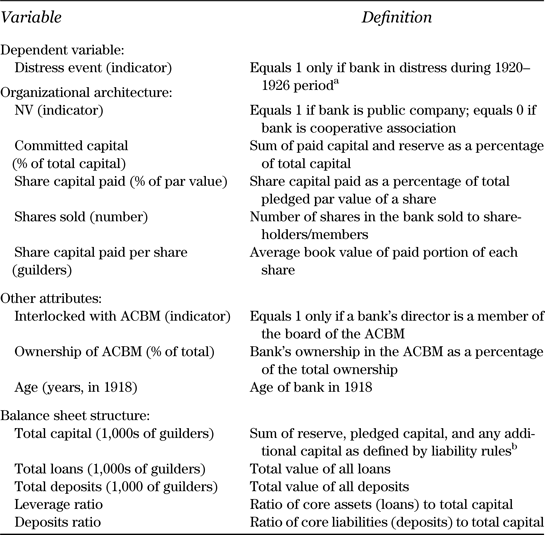
I use discrete choice (logistic) models to estimate whether pre-crisis bank-level characteristics can predict crisis-period distress status:
 $$Log_e\displaystyle{{\pi _i\lpar {Distress} \rpar } \over {1 - \; \pi _i\lpar {Distress} \rpar }} = \; \alpha + \; \beta _1L_i\; + \; \beta _2B_i + \; \beta _3O_i + \; \varepsilon _i$$
where distress is defined as a binominal variable that takes the value of 1 if a bank has experienced distress during the period from 1920 to 1926, and 0 otherwise. L i is a vector of bank-specific variables concerning organizational form and shareholder liability, B i is a vector of bank-specific variables concerning balance-sheet structure, and O i is a vector of other bank-specific attributes—all derived from data collected for the fiscal year 1917–1918 and defined in Table 2. Finally, εi is the bank-specific prediction error. I calculate the area under the curve (AUC) of a receiver operating characteristic as a means of assessing my models’ predictive ability.Footnote 66
Definitions of All Variables Used in Regression Analysis
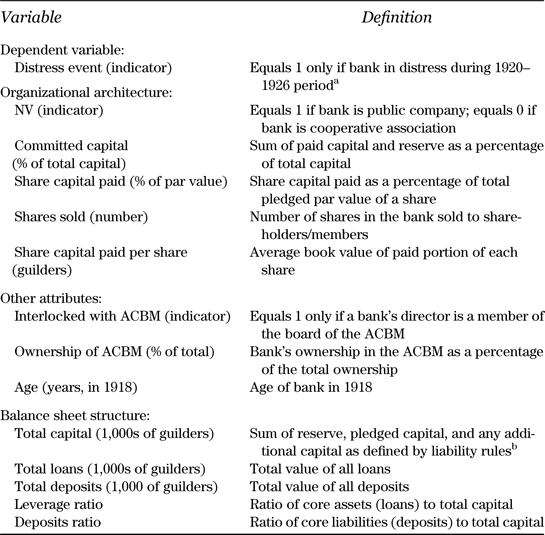
Sources: Author's definitions using data from Johan de Vries, Geschiedenis van de Nederlandsche Bank: Visserings Tijdvak 1914–1931 (Amsterdam, 1989), and the annual reports of all available middenstandsbanken for the 1918 fiscal year held by the International Institute for Social History, Amsterdam. Also at “Jaarverslag en statuten Algemeene Centrale Bankvereeniging voor den Middenstand 1918–1926,” annual reports, 1918, call number 2.25.68: 8005, Historisch Archief De Nederlandsche Bank, Nationaal Archief, The Hague.
Notes: a Liquidation and acquisition events are added together because this analysis aims to predict the incidence of distress rather than the way in which distress is resolved. b I assume the total available capital resources for unlimited liability cooperatives is the total pool of deposits. This is not a heroic assumption as cooperatives are both owned and used by the same individuals. The true pool of capital, incorporating unbanked personal assets of shareholders, was likely to have been larger—but less liquid.
Findings and Implications
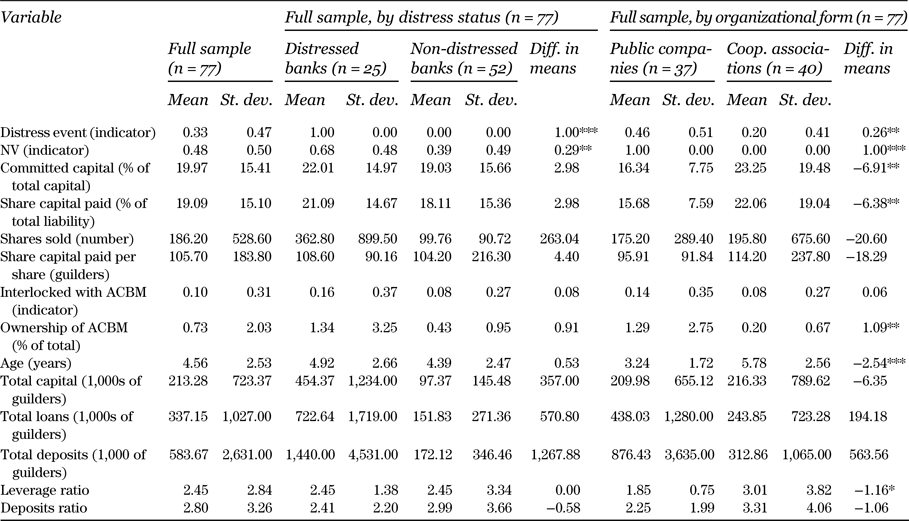
Table 3 reports univariate descriptive statistics for the sample of banks, split by the banks’ fate in the 1920s crisis and by their organizational form. Statistics for the full sample reveal on average that these banks were small, but there was large variation: the average total capitalization in the sample was 213,000 guilders, but the standard deviation is 723,000 guilders. There was also significant variation in the portion of capital that was firmly committed, ranging between 0 and 52 percent. The number of shares (the approximate number of shareholders) ranged between 10 and 4,285, while the value of share capital paid per share ranged between 0 and 1,473 guilders. On average, banks were leveraged by a factor of 2.5 and could only pay back 1 guilder out of every 2.80 deposited. Only 10 percent of banks shared a management interlock with the ACBM.
Summary Statistics for All Variables Used in Regression Analysis for Full Sample, by Distress Status and by Organizational Form, 1918

Sources: Author's calculations using financial data from the annual reports of all available middenstandsbanken for the 1918 fiscal year held by the International Institute for Social History, Amsterdam. Also at “Jaarverslag en statuten Algemeene Centrale Bankvereeniging voor den Middenstand 1918–1926,” annual reports, 1918, call number 2.25.68: 8005, Historisch Archief De Nederlandsche Bank, Nationaal Archief, The Hague.
Notes: Where appropriate, values of 0 were replaced with 0.1 in order to enable logarithmic transformation. Significance in difference in means calculated using two-tailed t–test following Levene's test for equality of variances. Howard Levene, “Robust Tests for Equality of Variances,” in Contributions to Probability and Statistics: Essays in Honor of Harold Hotelling, ed. Ingram Olkin (Stanford, 1960), 278–92. Significance levels indicated as follows: *** = p < 0.01, ** = p < 0.05, * = p < 0.1.
Comparing banks that experienced distress in the 1920s with those that did not suggests that failed banks were significantly more likely to have adopted the public company form, were significantly more capitalized, and had lent out significantly more. Meanwhile, no statistically significant difference in liability arrangements exists between banks that suffered distress and those that did not. Comparing organizational forms suggests that corporations were significantly more likely to have suffered distress, had significantly lower portions of committed capital and paid share capital, were significantly less leveraged, and had larger stakes in the ACBM.
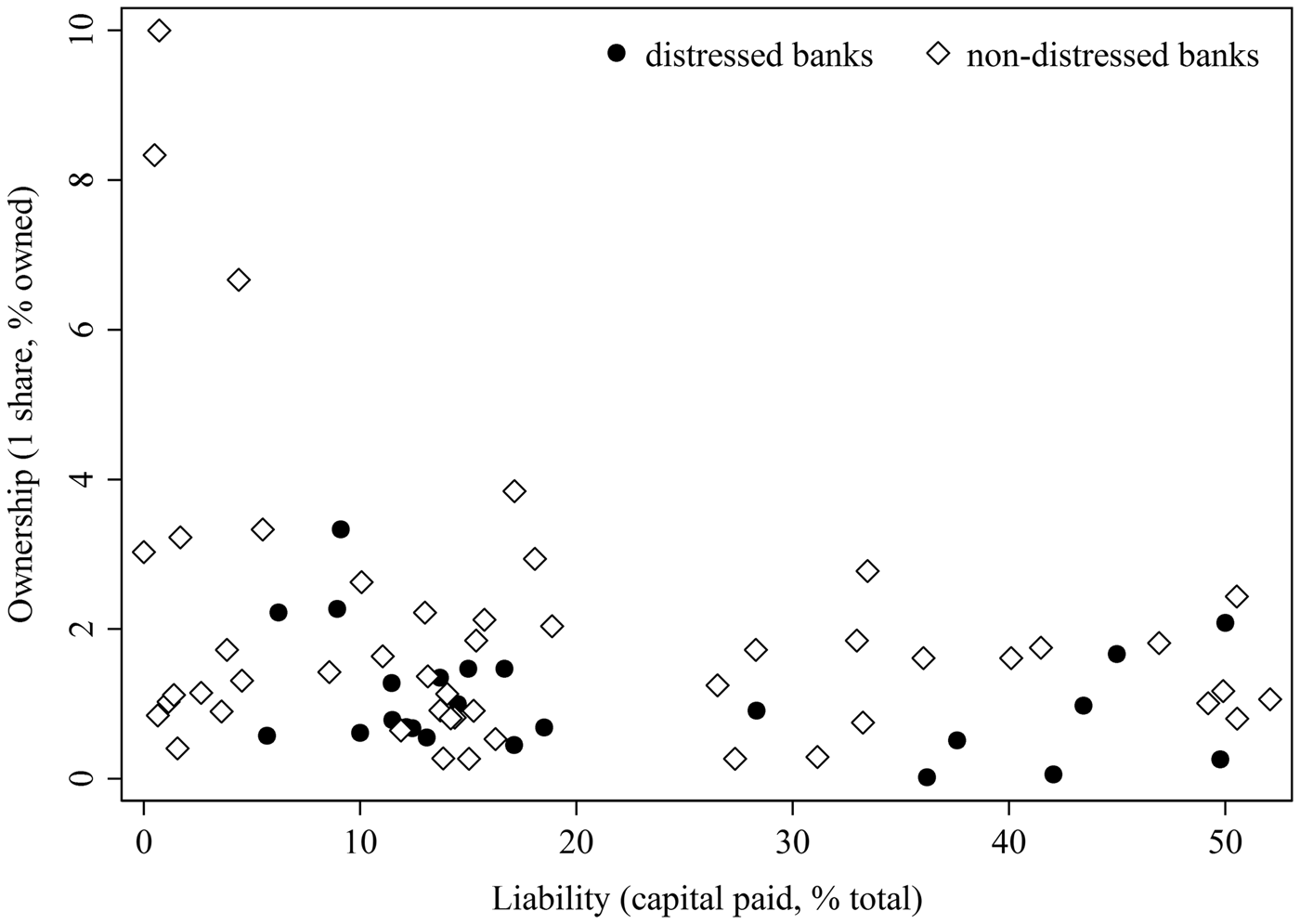
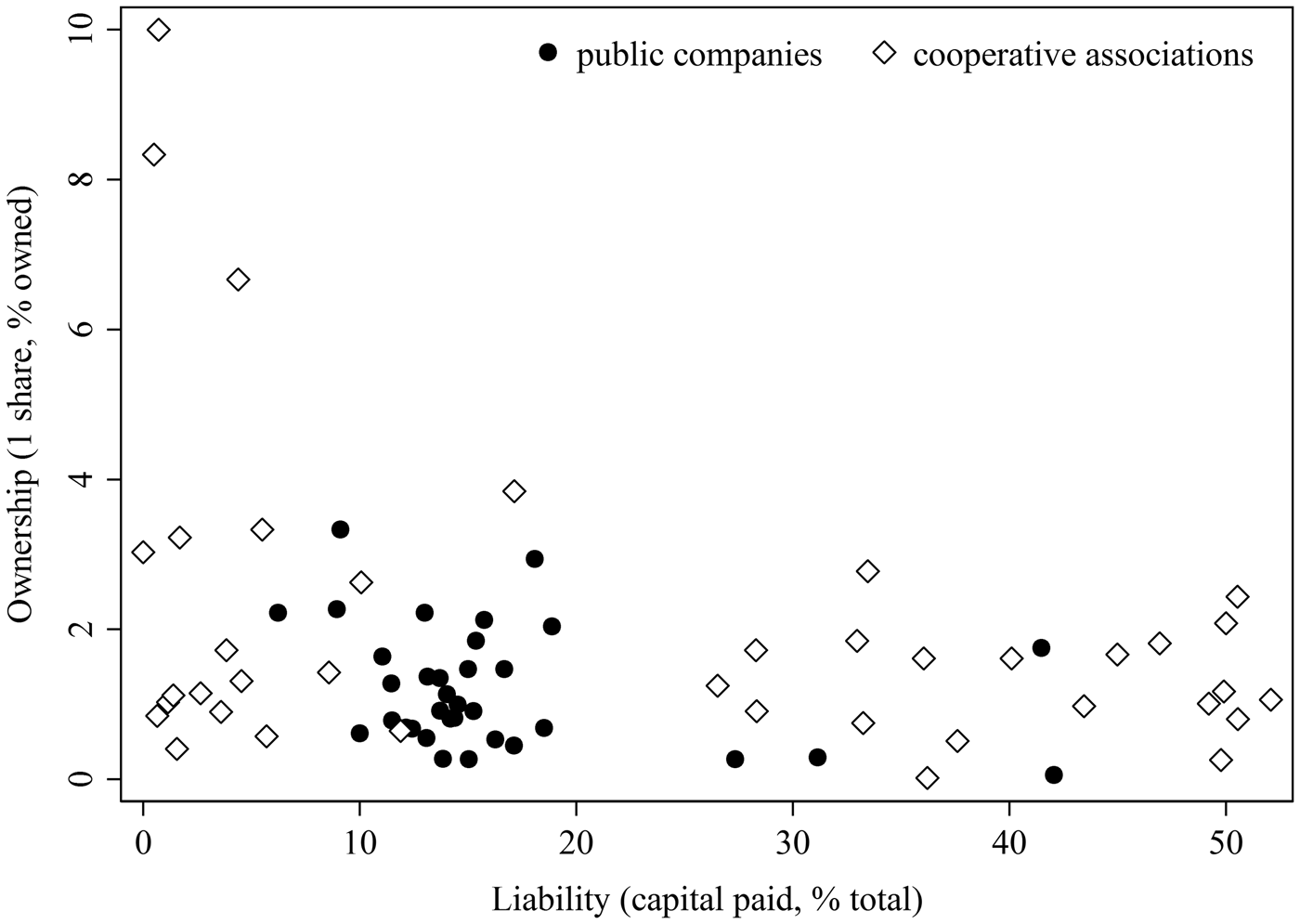
In addition to these descriptive statistics, I also present differences across the sector graphically: Figures 1 and 2 locate all middenstandsbanken in two-dimensional ownership-liability space. Ownership is proxied here by the percentage of a bank that is owned by a shareholder following the purchase of one share. Liability is proxied by the variable committed capital. Banks that failed and survived in the 1920s are indicated separately in Figure 1; public companies and cooperative associations are indicated separately in Figure 2. Together, these figures reveal a clustering of middenstandsbanken that took the public company form, had extended liability regimes that amounted to about 10 and 20 percent of their capital being paid up by 1918, and failed in the 1920s crisis.
Ownership, liability, and distress status. Figure locates all 77 middenstandsbanken in two-dimensional ownership-liability space. Ownership proxied by percentage of bank owned with a single share. Liability proxied by committed capital. Banks that were distressed and non-distressed in the 1920s are indicated separately. (Sources: Author's calculations using financial data from the annual reports of all available middenstandsbanken for the 1918 fiscal year held by the International Institute for Social History, Amsterdam. Also at “Jaarverslag en statuten Algemeene Centrale Bankvereeniging voor den Middenstand 1918–1926,” annual reports, 1918, call number 2.25.68: 8005, Historisch Archief De Nederlandsche Bank, Nationaal Archief, The Hague.)

Ownership, liability and organizational form. Figure locates all 77 middenstandsbanken in two-dimensional ownership-liability space. Ownership proxied by percentage of bank owned with a single share. Liability proxied by committed capital. Banks that were public companies and cooperative associations indicated separately. (Sources: Author's calculations using financial data from the annual reports of all available middenstandsbanken for the 1918 fiscal year held by the International Institute for Social History, Amsterdam. Also at “Jaarverslag en statuten Algemeene Centrale Bankvereeniging voor den Middenstand 1918–1926,” annual reports, 1918, call number 2.25.68: 8005, Historisch Archief De Nederlandsche Bank, Nationaal Archief, The Hague.)

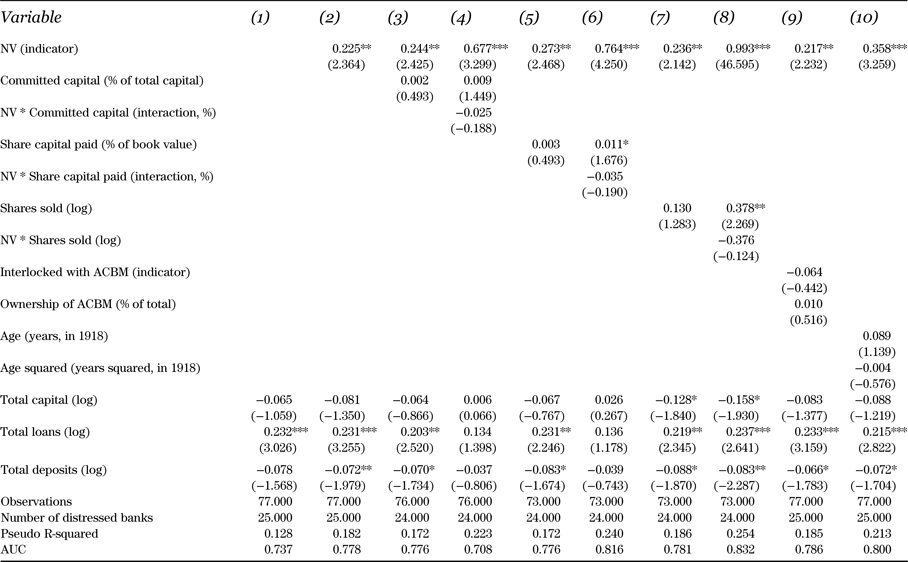
Models (1) and (2) in Table 4 represent the baseline models against which I compare all other models. Model (1) includes only the log transformations of three balance-sheet items: total capital, total loans, and total deposits. Larger banks were more likely to experience distress. Model (2) introduces the organizational form indicator variable, NV. Public companies were 23 percent more likely to fail in the crisis. The variable is statistically significant. Its inclusion also causes total deposits to become statistically significant, which suggests that the two variables are either directly related or codetermined.
Logistic Regressions of Bank Distress, Marginal Effects Estimated from Odds-Ratios at the Means

Sources: Author's calculations using financial data from the annual reports of all available middenstandsbanken for the 1918 fiscal year held by the International Institute for Social History, Amsterdam. Also at “Jaarverslag en statuten Algemeene Centrale Bankvereeniging voor den Middenstand 1918–1926,” annual reports, 1918, call number 2.25.68: 8005, Historisch Archief De Nederlandsche Bank, Nationaal Archief, The Hague.
Notes: The dependent variable is a binomial variable that equals 1 only if a bank was in distress during the period between 1920 and 1926; marginal effects are calculated at the means for continuous variables, and for a discrete change from 0 to 1 for indicator variables; robust z-statistics reported in parentheses, except for interaction terms, where the mean z-statistic is calculated using the procedure outlined in Edward C. Norton, Hua Wang, and Chunrong Ai, “Computing Interaction Effects and Standard Errors in Logit and Probit Models,” Stata Journal 4 (Apr. 2004): 154–67. Significance levels indicated as follows: *** p < 0.01, ** p < 0.05, * p < 0.1.
Models (3) and (4) should be read together. Model (3) introduces committed capital to model (2), which measures the sum of all paid capital and the reserve as a percentage of total capital. It is not statistically significant, which suggests that the degree of additional liability is not an important predictor of stability. The interaction effect between NV and committed capital in model (4) is included to discern whether the additional liability in public companies functions differently to cooperative associations. The model suggests it does not.
As with the previous two models, models (5) and (6) should also be read together. Model (5) introduces share capital paid to model (2), which represents another way of measuring the additional liability available to the bank—this time as a percentage of the total face value of share capital. The inclusion of the interaction term between NV and share capital in model (6) results in this variable becoming statistically significant. This suggests that share capital functioned differently for the two organizational forms. However, this inclusion also renders total loans not statistically significant, again suggesting that the two variables are either directly related or codetermined.
Models (7) and (8) examine whether shares sold, the number of shares sold by a bank, has any bearing on distress probability. Model (7) suggests this number is directly related or codetermined by total capital. The inclusion of the interaction effect with NV in model (8) suggests that the number of shares is an important predictor of bank distress, once the separate effect for public companies is controlled for. This implies that cooperative associations with greater numbers of liable members were more likely to fail on average. Perhaps a larger ownership base made cooperatives behave more like corporations, or reduced the incentives of any one shareholder-member to monitor the decisions of their bank's directors.
Overall, the results suggest it is the composition of a bank's balance sheet that matters for resilience. Comparing these models also suggests that the size and composition of a bank's balance sheet could itself be a function of the organizational form and capital structure; the choice of liability regime influenced failure risk by incentivizing bank managers to run their loans and deposits books in systematically different ways. Indeed, the results imply that the choice of the public company organizational form incentivizes banks to take on more loans, which then results in a higher probability of failure. The direction of causality is, however, open to debate; it is possible that banks’ balance-sheet structure determines their decisions on capital structure. But given the institutional arrangements discussed earlier, it is more plausible that a bank's balance sheet is adapted by bankers (in terms of loans) and their customers (in terms of their deposits) to offset any failure risks associated with the earlier decision on organizational architecture.
Conclusion
In this article, I set out to answer how organizational architecture affects the resilience of banks during systemic financial crises. More specifically, I used Dutch business history to explore, first, how SME banks could create hybrid forms by choosing their own organizational form and liability arrangements and, second, how these banks then performed during a crisis precipitated, at least partly, by factors outside their control. Performance, measured as realized bank distress status in the period of the 1920s crisis before the government intervened, was hypothesized to be unrelated to the choice of liability arrangement if the increased risk from limiting liability could be anticipated and mitigated. If bank shareholders can choose freely among several different investments, then “the market” (shareholders, depositors, borrowers, and other interested stakeholders) pressures managers to behave in ways that offset any systematic difference in risk associated with banks’ liability choice.
The regression analysis suggests that this interpretation, which is based on Stigler's Coase theorem, is consistent with the history of the Dutch case—in a way that is inconsistent with ideas about shareholder liability derived from option pricing theory. The results show that a bank's balance-sheet structure can directly offset its choice of liability arrangements, rendering all liability types equally risky. Given the historical evidence from the case study banks, it is likely that depositors could react more immediately to changing circumstances, while liability regime switching remained a costly and lengthy process. This suggests that SME business owners initially founded or invested in SME banks with organizational features that best reflected their risk type, but that this risk was subsequently offset by how they used their bank.
In addition to this surprising finding with respect to shareholder liability, my results also reveal how banking corporations were, on average, always more vulnerable than banking cooperatives. This is likely to have been partly due to the different incentives of bank directors resulting from business law; directors of cooperatives were superliable. This result is also consistent with the idea in Hansmann's work that the transaction costs associated with recovering the extended portion of shareholder liability from banks founded as public companies are higher.Footnote 67 Market exit manifested through either liquidation or distressed acquisition was perhaps a more expedient route to asset recovery in cases where there exists a separation of ownership from “usership.”
In an important contribution to business history, Guinnane, Harris, Lamoreaux, and Rosenthal challenge the idea that the corporation is always the superior organizational form for business enterprise.Footnote 68 They do so by carefully examining the use of the public company form. They find that French code-law countries were more flexible to the needs of businesses than American and British common-law ones and that, where possible, entrepreneurs switched from the public company to other hybrid forms. They conclude that the corporation has significant disadvantages that make other forms more appropriate in most contexts. My research adds another dimension to their argument: in a legal regime where bespoke liability rules can be adopted—indeed, a legal regime based entirely on code law—it is possible that cooperative associations were more conducive to business longevity than public companies in some financial services. In the specific case of banks targeted at SMEs, putting customers rather than owners in charge results in better outcomes.
One of the central tenets of the law and finance hypothesis is that common law is uniquely conducive to corporate capitalism thanks to its flexibility.Footnote 69 In a new comparison of the history of business law in Britain and the United States, Harris and Lamoreaux argue that investors are better served by laws that offer them flexibility to solve their contracting problems.Footnote 70 They find that the two common-law jurisdictions did not have much in common: British law was more flexible than that of the United States. Considering my research, I posit that Dutch code law was at least as flexible as British common law. Scholars should therefore focus specifically on how business law is interpreted, whatever the legal origin.