Introduction
The developmental origins of disease paradigm relates to development ranging from preconception through childhood and to adolescence where environmental exposures and familial behaviours affect developmental plasticity.Reference Heindel, Balbus and Birnbaum1 Although the prevention of obesity in children has gained political and health importance since the 1980s, the effectiveness of interventions and actions to reduce the rate of weight gain in children have been mixedReference Wang, Cai and Wu2 maybe because of limited time of follow-up and lack of appreciation that the effects of a good or bad start to life might manifest across the lifetime or generations.Reference Heindel, Balbus and Birnbaum1 Early-life intervention to reduce obesity and poor dental health through early-life nutrition will improve health outcomes in later life.
In 2015, there was an increase in activity around action, culminating in two global and one national activity occurring for New Zealand; one global event was the report and associated publications from the World Health Organisation (WHO) commission to end childhood obesity,Reference Gluckman, Nishtar and Armstrong3–5 and the other was the publication of the WHO guidelines for the consumption of sugar.6 The New Zealand Ministry of Health also published their childhood obesity plan,7 which included accountability measures for local district health boards based on body mass index (BMI).
Starting in early life, teeth play an essential role in overall nutrition and health through the life course. In addition to being important for communication through facial expression and speech, they have a role in the first stages of digestion: cutting, tearing and grinding food, helping the tongue form a bolus with saliva and then aiding the process of swallowing. Dental decay, caused by acids produced by bacteria or foods such as sugar, results in pain and suffering. Decay in early life is associated with poor nutritional status including overweight and obesity and diseases such as rheumatic fever.Reference Thornley, Marshall and Bach8 Dental decay therefore is an early-life functional marker of nutritional status and general health, both in the short and long term. The indigenous children of New Zealand, Māori and children from areas of high deprivation experience higher prevalence of overweight and dental decay compared with non-Māori children and children from less-deprived areas.9 In New Zealand, ethnic groups are self or parent identified. At the least detailed level where three ethnic groups are identified, Māori ethnicity takes precedence over all other ethnic groups, then Pacific and the third ethnic group is ‘European and other’ or non-Maori–non-Pacific. Maori make up 15% of the New Zealand population.
The rising prevalence of overweight and obesity in New Zealand children prompted the Ministry of Health to provide funding in 2013 for Sport Waikato, a sports trust serving the Waikato region of New Zealand, to deliver the ‘Under-5-Energize’ (U5E) programme to 121 early childhood centres (ECC) in the Waikato region, with a remit to focus on indigenous Māori children and those living in more deprived areas. The Waikato region covers 9% of the land area of New Zealand and is home for 9.5% of the population of New Zealand. One in five people resident in the Waikato region is Māori. The Waikato child population has two distinct ethnic groups: Māori (36%) and European. Māori are over represented in both obesity statistics and lower socioeconomic status areas.10 The U5E intervention is modelled on the ongoing and successful New Zealand primary school programme, project Energize.Reference Rush, Cairncross and Williams11 A health promotion approach is used with messaging, health service delivery and policy change strategies with a focus on water and milk in preference to sweet drinks (water-only preferred option), more vegetables and fruit, less energy-dense snacks and quality physical activity, including fundamental movement skills. Since 2016, and in recognition of the important role of early-life dental health for long-term health as detailed earlier, U5E was expanded to include a focus on dental hygiene and health.
We have previously analysed regional data from the national and free New Zealand Before School Check (B4SC) and reported that between January 2013 and September 2016, there was no observable change in obesity prevalence.Reference Rush, Obolonkin, Young, Kirk and Tseng12 However, for the children attending the U5Ee centres the prevalence of visible dental decay decreased, with the decrease particularly marked for the indigenous Māori children, in whom the prevalence declined from 19 to 16% (P for trend 0.02). It is important to document the time trend of the impact of U5E on overweight/obesity and dental decay particularly from 2015 onwards when the U5E intervention was fully implemented in all selected preschools (n=121). The aim of the present analysis was to examine secular trends in the prevalence of overweight/obesity and visual dental decay (2013–2017 and 2015–2017), both in New Zealand overall, and specifically in the Waikato region. We also aimed to determine the impact of attendance at a U5E-ECC on these trends and assessed the inter-relationships of overweight and visual dental decay with ethnicity and socioeconomic deprivation.
Method
It is estimated that more than 91% of 4-year-olds across New Zealand have been measured in the free B4SC since 2013.13 For the current study, we obtained 281,680 records from the national B4SC data set for the period January 2013 to December 2017 inclusive from the NZ Ministry of Health. Among other measures, height, weight, sex, age, BMI, WHO BMI z-scores,14 a visible dental decay score, ethnicity, socioeconomic status quintile, location of the child and the childcare centre attended (and hence whether this was an U5E-ECC) were provided.15 The extent of deprivation for the children included in the data set was ranked in quintiles derived from the NZ census and eight dimensions of deprivation by geographical mesh blocks.Reference Atkinson, Salmond and Crampton16 The dimensions of deprivation, calculated as proportions of households for each small area, include no access to internet at home, receipt of a means tested benefit, households with income below a threshold adjusted for household composition, unemployment, no qualifications, not living in own home, living in single parent family, household living space and bedroom occupancy and no access to a car. In the B4SC data set, deprivation (based on the location of the child’s home) is reported on an integral scale of 1 to 5, with 1 being the least deprived and 5 the most deprived. Details of measurement protocols have been reported previouslyReference Rush, Obolonkin, Young, Kirk and Tseng12 and are mandated by the Ministry of Health.13
From the initial set of 281,680 records, we removed any that were incomplete and/or the WHO z-score for height, weight, or implausible BMI z-scores that were <−3 or >+4. In total 3717 were excluded and 277,963 records remained for the whole of NZ. Of these, 25,140 children were located in the Waikato region where U5E is delivered.
Obesity and overweight were defined by the WHO BMI z-criteria as equivalent to the WHO growth standard14 +3.0 and +2.0, respectively. Similarly, underweight and thin were defined as the −2 and −3. Visible decay recorded on an integral scale of 1 (no visible decay) to 6 (visible caries and missing teeth) was recoded to a binary variable with two levels: ‘no visible decay’ and ‘2, 3, 4, 5 or 6 = visible decay exists’ without subclassification on level as numbers were low within each integer.
Deprivation levels were transformed into binary variables where levels 4 or 5 are denoted as ‘high deprivation’, and other levels (1, 2 and 3) as ‘low deprivation’. In addition, child sex, attendance at a U5E-ECC, ethnicity (Māori or non-Māori) were defined as dichotomous categorical variables.
Pacific children showed a unique pattern of high BMI z-score, but were too few in number (n=975 in 5 years in Waikato) for separate analysis and were therefore excluded from the main analysis.
Statistical analysis
Across the 5 years of data collection, and separately for the subperiods 2013–2015 and 2015–2017, respectively, changes in prevalence of overweight, obesity and dental decay over time were assessed using χ2-based test for trend. Changes in mean BMI z-scores across this period were assessed using linear regression. Logistic regression analysis was used to evaluate the effects of the factors of living in highly deprived areas, U5E intervention, Māori ethnicity, overweight and male sex on dental decay; all factors are coded as binary variables in the Waikato regional subset. Odds ratios (OR) and 95% confidence intervals (CI) were calculated. A P-value <0.05 was considered statistically significant. All analyses were conducted using R version 3.0.2.17
Results
National trends
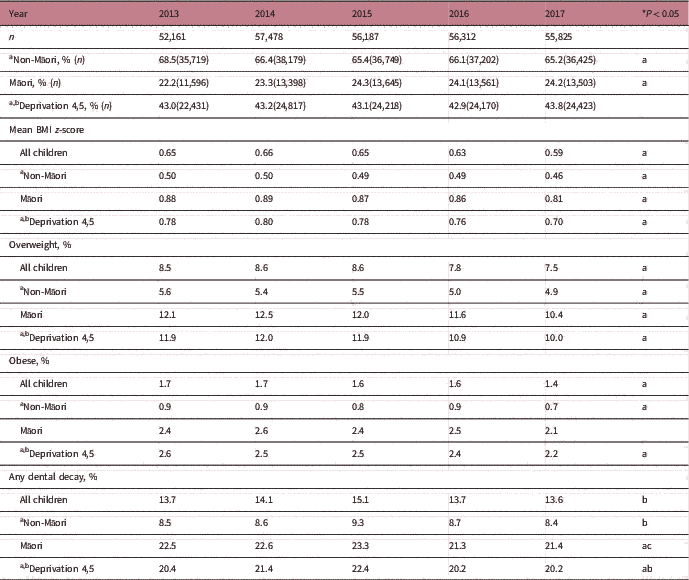
At national level, between 52,000 and 57,500 4-year-old children were measured each year between 2013 and 2017. The proportion of non-Māori–non-Pacific children in the B4SC population decreased by 3.3 percent points (pp) from 68.5 to 65.2% (3.3pp; 95% CI 2.7, 3.9; P<0.0001) and proportion of Māori children increased from 22.2 to 24.2% (2.0pp; 95% CI 1.4, 2.5; P<0.0001) across this period (Table 1). The proportion of children living in high deprivation also increased during 2015–2017 from 43.0 to 43.8% (0.8pp; 95% CI 0.2, 1.4; P=0.008). Across the 5-year period, significant decreases were observed for mean BMI z-score (0.05 units, 0.65–0.59 (0.051; 95% CI 0.040, 0.063; P<0.0001), prevalence of overweight 8.5–7.5% (1.0pp; 95% CI 0.7, 1.3; P<0.0001) and obesity 1.7–1.4% (0.3pp; 95% CI 0.2, 0.4; P<0.0001). Statistically significant declines (all P<0.00001) in mean BMI z-scores and prevalence of overweight was also seen in subgroup analyses of both non-Māori–non-Pacific and Māori children and in those children living in high deprivation areas (Table 1). The prevalence of visible dental decay, however, increased both overall and in non-Māori–non-Pacific (by 1pp, P<0.05) between 2013 and 2015, before decreasing back to 2013 levels between 2015 and 2017. A small but statistically significant decline in prevalence of dental decay was observed for Māori and children living in high deprivation areas from 2013 to 2017, but the levels of dental decay were still higher in these subgroups in comparison with non-Maori children and those living in less-deprived areas (Table 1).
Characteristics of New Zealand 4-year-old children measured in the before school check by survey years, 2013–2017

a Non-Māori and deprivation 4,5 exclude Pacific.
b Deprivation quintiles 4 and 5 are most deprived.
*P<0.05 χ2 asymptotic test for downward trend from preimplementation to year, overweight and obesity defined as WHO BMI z-scores >1.4044 and >2.0517. aSignificant trend 2013–2017. bFlex point as condition in 2013–2015 significant trend, which is opposite to significant trend of 2015–2017. cSignificant trend 2015–2017.
Waikato region trends
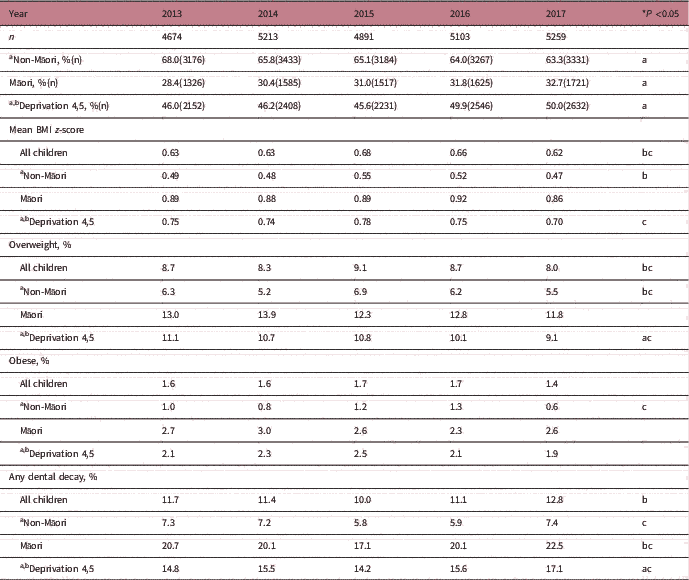
Within the Waikato region, in 2017, the proportion of Māori [32.7% v. 24.2%, a difference of 8.5% (95% CI 6.2, 10.9; P<0.0001)] and children living in high deprivation [50.0% v. 43.8%, a difference of 6.2pp (95% CI 4.2, 8.2; P<0.0001)] were both higher in comparison with overall national data (Tables 1 and 2). Throughout the period 2013–2017, the Waikato children also had higher mean BMI z-score and a higher proportion of overweight and obese children than the general NZ population (Tables 1 and 2). In contrast, the children in the Waikato region exhibited lower rates of visible dental decay than the general NZ population and, unlike national trends, the prevalence of dental decay in the Waikato declined from 2013 to 2015, before increasing from 2015 to 2017 (Table 2).
Characteristics of Waikato region 4-year-old children measured in the before school check by survey years: 2013–2017

a Non-Māori and deprivation 4,5 excludes Pacific.
b Deprivation quintiles 4 and 5 are most deprived.
*P<0.05 χ2 asymptotic test for downward trend from pre-implementation to year, overweight and obesity defined as WHO BMI z-scores >1.4044 and >2. aSignificant trend 2013–2017, bFlex point as condition in 2013–2015 significant trend, which is opposite to significant trend of 2015–2017. cSignificant trend 2015–2017.
Waikato region children by Energize treatment
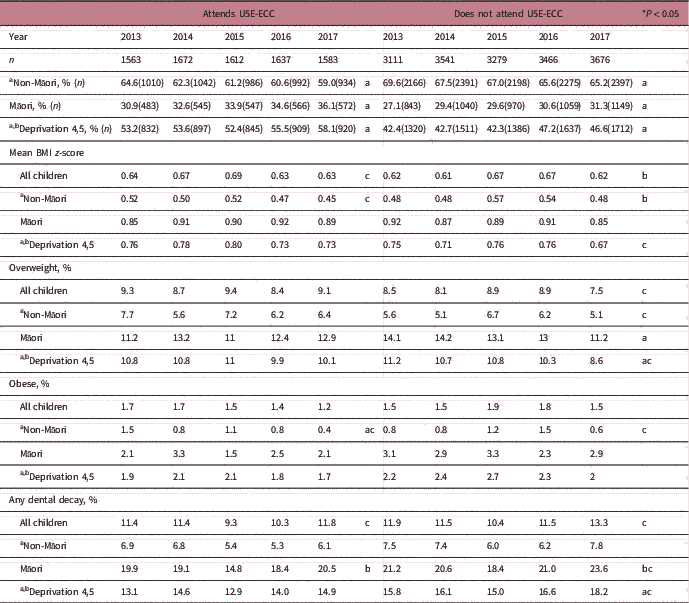
In further analyses, Waikato children were classified according to whether or not they attended an U5E-ECC (Table 3). Across the study period, a greater proportion of Māori children and a greater proportion of children living in higher deprivation regions attended an U5E-ECC compared with those within these subgroups who attended a non-U5E centre – in accordance with the study design. One in three Waikato children attended one of the 121 U5E-ECC selected for the intervention in 2013. Between 2013 and 2017 the proportion of children living in highly deprived areas and identified as Māori increased in both U5E and non-U5E-ECCs. By 2017, 58% of U5E children and 47% of non-U5E were living in high deprivation areas compared with 53 and 42%, respectively, in 2013 (Table 3).
Characteristics of Waikato region 4-year-old children measured in the before school check by survey years, 2013–2017 and Energize treatment

U5E-ECC, Under-5-Energize Early Childhood Centre
a Non-Māori and deprivation 4,5 excludes Pacific.
b Deprivation quintiles 4 and 5 are most deprived.
*P<0.05 χ2 asymptotic test for downward trend from pre-implementation to year, overweight and obesity defined as WHO BMI z-scores >1.4044 and >2.0517. aSignificant trend 2013–2017. bFlex point as condition in 2013–2015 significant trend, which is opposite to significant trend of 2015–2017. cSignificant trend 2015–2017.
From 2013 to 2017 the prevalence of overweight and obesity did not show a statistically significant trend for U5E children but did decrease between 2015 and 2017 in subgroups of non-U5E children who had the highest proportion of overweight and/or obese in 2015 (Table 3). The prevalence of dental decay increased in both U5E and non-U5E children from 2015 to 2017. Throughout the 5-year period, the within-year prevalence of dental decay for U5E children was consistently less than for non-U5E. In 2017 compared with 2013 for Māori, non-Māori-non-Pacific and high deprivation U5E children had proportionally less dental decay than non-U5E (Table 3).
In both New Zealand overall and specifically within the Waikato region, there was a strong association between presence of dental decay and BMI z-score [New Zealand OR 1.18 (CI 1.17, 1.19; P<0.0001), Waikato OR 1.14 (CI 1.10, 1.19; P<0.0001)]; however, these relationships did not persist (P=0.85) when adjusted for ethnicity, gender and deprivation level.
Effects of Energize treatment, deprivation, ethnicity and sex
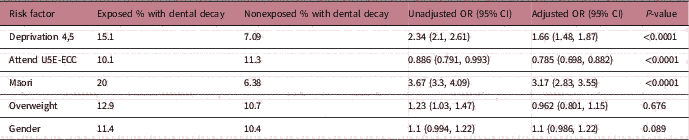
Binary logistic regression was used to examine the relative influence of attendance at an U5E-ECC, deprivation, ethnicity and sex on the presence of any visual dental decay for the Waikato region data pooled from 2013 to 2017. The OR of deprivation for visual dental decay was half (OR 1.49; 95% CI 1.32, 1.67) the effect of Māori ethnicity (OR 2.91; 95% CI 2.59, 3.27). When the data were split by years, the effect of U5E was not detectable within years 2013 and 2014 but was statistically significant starting from 2015 onwards within each year as well as the pooled 2013–2017 data set. Between 2015 and 2017 when the ECC were fully engaged with the programme, the OR (unadjusted) for visible dental decay in the presence of overweight was 1.23, but this became insignificant (OR 0.96; 95% CI 0.80, 1.15; P=0.68) when adjusted for Māori ethnicity (OR 3.17; 95% CI 2.83, 3.55; P<0.0001), deprivation (OR 1.66; 95% CI 1.48, 1.87; P<0.0001) and male gender (OR 1.10; 95% CI 0.986, 1.22) and reduced if also attending an U5E-ECC (OR 0.79; 95% CI 0.70, 0.88; P<0.0001) (Table 4). In other words, in the period 2015–2017, Māori children residing in a highly deprived area were 5.2 times more likely to exhibit visible dental decay at age 4 than non-Māori children residing in the less-deprived areas (Table 4). However, if the child attended a U5E-ECC, the odds of having any visible dental decay were reduced to 4.1 times. The OR of deprivation for visual dental decay was approximately half (OR 1.66) the effect of Māori ethnicity (OR 3.17). When the data were split by year the effect of U5E was not detectable within years 2013 and 2014, but was statistically significant starting from 2015 onwards within each year as well as the pooled 2013–2017 data set. Male children had a higher OR for developing visual dental decay than female children both in the whole of NZ and within the Waikato region.
Unadjusted and adjusted risk factors for children to have any visible dental decay 2015–2017

U5E-ECC, Under-5-Energize Early Childhood Centre; OR, odds ratio
Discussion
These findings suggest that in New Zealand the prevalence of overweight, obesity and visible dental decay in 4-year-old children may be declining overall and this decline is also seen within Māori children and those living in more highly deprived geographical areas. This is in agreement with the analysis of B4SC data from 2010 to 2016.Reference Shackleton, Milne and Audas18 Dental decay is more prevalent with increased body size, for Māori children and children living in the highest deprivation. We report some evidence for a flex point in 2015 in the prevalence of risk factors, that is, a significant trend from 2013 to 2015, which is in an opposite direction to the trend of 2015–2017. Although we cannot show causality between the policy and actions put in place in 2015,Reference Gluckman, Nishtar and Armstrong3, 6, 7 for changes in dental decay and prevalence of overweight and obesity we do show that Māori ethnicity and deprivation are stronger drivers of dental decay than overweight and obesity. This may explain why in New Zealand the trend for prevalence of dental decay to flex and decrease from 2015 when public awareness of the link between sugary drinks and dental decay was increased. Conversely, in the Waikato region where the proportion of Māori children and those living in highest deprivation increased from 2015 to 2017, concomitantly visible dental decay also increased. We were able to determine that the outcome of visible dental decay was independently predicted by living in highest deprivation, Māori ethnicity and not attending an U5E-ECC. Overweight or obesity was found to be not as important as the predictive risk factors such as deprivation, ethnicity or attendance at a U5E-ECC in this analysis.
All children in New Zealand are entitled to free basic oral health services from birth to 17 years, but children from areas of high deprivation are less likely to be enrolled: 91% of children in New Zealand are enrolled with a dental service, 89% in the Waikato, 86% of Māori living in the Waikato and 83% of Māori living in highly deprived areas of the Waikato. In addition, fluoridation of water in the Waikato region occurs in some areas only and this did not change over the time of this analysis. The U5E programme only includes some centres from each area and therefore the effect of fluoridation is unlikely to have an effect on our analysis. The use of fluoride toothpaste is encouraged and the safety of fluoridated water promoted.
Previous studies investigating an association between dental health and overweight or obesity have shown mixed results for young childrenReference Sheller, Churchill, Williams and Davidson19, Reference Vazquez-Nava, Vazquez-Rodriguez, Saldivar-Gonzalez, Lin-Ochoa, Martinez-Perales and Joffre-Velazquez20 but a recent systematic reviewReference Hayden, Bowler and Chambers21 of studies published between 1980 and 2010 reported an overall standard mean difference (0.19; CI 0.06, 0.32) between poor dental health and obesity, although the majority of studies were cross-sectional and included children aged 1–18 years old. The conflicting findings reflect the complex nature of the developmental origins of obesity and dental health and other factors such as socioeconomic status, the available food supply and availability of dental care.
Overweight, one measure of nutritional status, is multifactorial and largely dependent on genetic, intergenerational and early life and in utero factors.Reference Hanson and Gluckman22 Dental decay occurs after dentition starting at around 6 months and a first full set of 20 teeth is usually acquired by the age of 3 years. The presence of visible dental decay in the primary teeth is a more proximal and sensitive marker of nutrition and dental hygiene.Reference Lynch23 More distal but strong influences on child health, nutritional status and growth trajectory are the inter-related environmental factors determined by place of residence such as unemployment, high costs of housing and food insecurity, which are all captured with the measure of deprivation. This environment may result in two forms of malnutrition within a household: over and undernutrition.Reference Tzioumis and Adair24 Overnutrition is simplistically excess energy intake and too rapid weight gain but overall health reflects the quality of the diet and balance in both macro and micro nutrients; specifically for dental health nutrients such as calcium and vitamin C.Reference Li, Wong, Sun, Wen and McGrath25 There are causal pathways relating dental decay to nutritional status. Excess intake of energy which may include sugary drinks results in overweight.Reference Hu26 Overall health is related to the quality and combinations of foods eaten as mandated by dietary guidelines27 and the prevention of dental decay and gum disease is no exception benefitting from, for example, increased fibre in whole plant foods,Reference Li, Wong, Sun, Wen and McGrath25 calcium in milk and drinking water in place of sugary drinks. The effect of the U5E intervention not only could be related to a reduction in consumption of sugary drinksReference Moynihan and Kelly28 but also an increase in fruit and vegetablesReference Moynihan, Makino, Petersen and Ogawa29 which underpins the need for common and holistic messaging around diet and health. We did not measure intake of sugary drinks, fruit and vegetables but these are core messages of the U5E programme.
Health promotion messages supportive of normal growth and healthy teeth have similarities and should occur together early in life.Reference Gerdin, Angbratt, Aronsson, Eriksson and Johansson30 U5E programme is an example in New Zealand which targets deprived groups and shows some efficacy where risk factors for chronic disease cluster togetherReference Sheiham and Watt31 as does the need for a diet based on wholesome foods in sensible quantities, including water and milk as the best drinks.
The ethnicity effect, independent of deprivation, should be investigated further in more detail. Māori may have a genetic predisposition to dental decay, which becomes evident with intergenerational exposure to a physical, social and cultural environment that is not supportive of metabolic and dental healthReference Diderichsen, Andersen, Manuel, Andersen and Bach32 and which is compounded by inequality in access to health services and food insecurity.Reference Becares, Cormack and Harris33
The trends in visible dental decay are supported by the Waikato district health board report (personal communication) for all 5-year children examined from 2013 to 2016, where the mean number of decayed, missing and filled teeth declined in 2015 but increased slightly in 2016; the same pattern seen when only Māori children were considered. This is similar to the 2015 flex point we see in our analysis.
Strengths of this analysis include the high coverage of the data collection, the continuity and size of the data set and the ability to divide the data by factors that inform public health and actions to achieve equity. The B4SC data set has huge potential and statistical power to enable further understanding of the complexity of child development and we are able to demonstrate this principle in this analysis.
The limitations of comparisons are that they are cross-sectional and we have not compared comprehensively by child sex, although the measures of body size are adjusted by gender and age. In addition, the WHO growth centiles14 and the cut-off points for child overweight and obesity may apply differently by the ethnic grouping examined in this analysis; particularly for Māori who, for the same BMI as Europeans, have more muscle and less fat.Reference Rush, Scragg, Schaaf, Juranovich and Plank34 In addition, the measure of deprivation derived from the 2013 census may not apply equally across the 5 years as there are demographic shifts. The index is likely to be revised in the near future as the 2018 census will provide updated information on relative measures of deprivation. In New Zealand at present overall unemployment is decreasing but in the Waikato there are geographical areas where unemployment is higher.35 Furthermore, the check for visual dental decay is a screening check and does not have the same validity or detail as a dental check by a professional. The health professionals that do this visual check are trained and would not be aware of whether a child was attending a U5E-ECC, so bias should be reduced in the comparison.
While of modest importance to population health, these trends signal that there may be a tipping point in the trends of increased body size towards reducing the burden of too rapid growth. However, dental health remains an important issue, as it is a functional marker for the future health of children, particularly Māori and children living in deprived areas. What needs to be understood better is the relationships and differences between nutrition, dental health and early growth, deprivation, access to health care and education by ethnic groups. How this is done requires comprehensive and targeted policies and actions at national and local levels to change the social and physical environment.Reference Gluckman, Nishtar and Armstrong3, Reference Hawkes, Jewell and Allen36 This analysis signals concerns for the future, particularly the increasing number of children living in more deprived areas and the strong influence of deprivation on dental decay and growth. Factors such as ethnicity and deprivation need to be considered when targeting effective actions and funding to prevent dental decay and improve childhood nutritional status including optimal growth for this and future generations.
Financial Support
No financial support was obtained for the preparation of this article.
Conflicts of Interest
The authors declare no conflict of interest.
Acknowledgements
The New Zealand Ministry of Health contracts Sport Waikato to deliver the Under-5-Energize health service. Sport Waikato subcontracts Auckland University of Technology to undertake evaluation for reporting to the Ministry of Health. There was no involvement of the Ministry of Health in the preparation, analysis or writing of this manuscript and no funding was received to cover the costs to publish in open access.
The participation and cooperation of the Sport Waikato Under-5-Energize team educators, parents and communities in process of delivery of the health service is acknowledged with thanks.