Teenage childbearing is internationally recognized as a public health problem associated with a range of risks for both young mothers and their children (Alan Guttmacher Institute, 2010; Centers for Disease Control and Prevention, April 2011). Adolescence is a transitional period marked by social, psychological, and biological changes, and childbearing during this period interferes with normative developmental processes. Teenage childbirth often disrupts young mothers' educational achievement and limits employment opportunities (Fergusson & Woodward, Reference Fergusson and Woodward1999), increasing their risk for substance abuse, mental health problems, and criminal convictions later in life (Coley & Chase-Lansdale, Reference Coley and Chase-Lansdale1998). The offspring born to young mothers also experience poor developmental outcomes, including low birth weight, preterm delivery, and behavioral and developmental problems (Chen et al., Reference Chen, Wen, Fleming, Demissie, Rhoads and Walker2007; D'Onofrio et al., Reference D'Onofrio, Goodnight, Van Hulle, Rodgers, Rathouz and Waldman2009). In addition, teenage childbearing is associated with enormous economic costs for governments and healthcare service providers (Centers for Disease Control and Prevention, April 2011). In the United States, for example, teenage childbirth is associated with $6 billion in lost tax revenue and $3 billion in public expenses per year (Hoffman, Reference Hoffman2006). The poor economic, physical, and mental health outcomes for young mothers and their offspring, as well as the economic costs, make teenage childbearing an important target for public health prevention and intervention efforts.
Although the rates of teenage childbirth in developed nations have declined dramatically since the 1990s, adverse consequences for teenage mothers and their children persist. In Sweden, public health initiatives to provide nationwide comprehensive sex education, access to birth control, and subsidized abortions have resulted in low rates of teenage pregnancy, abortions, and childbirth (Danielsson, Rogala, & Sundstrom, Reference Danielsson, Rogala and Sundstrom2001; Darroch, Singh, & Frost, Reference Darroch, Singh and Frost2001); compared to other developed nations, teenage childbirth is a particularly rare event (7 per 1,000 women 15–19 years old; Singh & Darroch, Reference Singh and Darroch2000). Although the rates are low, there are still far-reaching negative consequences. Teenage mothers are at greater risk for premature death and socioeconomic disadvantage (Olausson, Haglund, & Weitoft, Reference Olausson, Haglund and Weitoft2001; Olausson, Haglund, Weitoft, & Cnattingius, Reference Olausson, Haglund, Weitoft and Cnattingius2004), and their children are more likely to experience violent injuries during childhood (Ekeus, Christensen, & Hjern, Reference Ekeus, Christensen and Hjern2004).
Policymakers seeking to make empirically supported decisions about the best targets for cost-effective public health interventions need research that can identify casual risk factors and the underlying mechanisms that account for these associations (Rutter et al., Reference Rutter, Belsky, Brown, Dunn, D'Onofrio and Eekelaar2010). The majority of existing studies exploring the consequences of teenage childbirth have relied solely on longitudinal or cross-sectional correlational studies. These studies have advanced our understanding of the risk correlates associated with teenage childbearing, but by virtue of their correlational nature, they have not been able to identify causal associations between teenage childbirth and offspring outcomes (Coley & Chase-Lansdale, Reference Coley and Chase-Lansdale1998; Coyne & D'Onofrio, Reference Coyne and D'Onofrio2012).
Developmental Theories: Explaining the Association Between Maternal Age and Offspring Antisocial Behavior
Although previous research suggests that offspring born to teenage mothers are at higher risk for behavior problems and delinquency (Jaffee, Caspi, Moffitt, Belsky, & Silva, Reference Jaffee, Caspi, Moffitt, Belsky and Silva2001; Levine, Emery, & Pollack, Reference Levine, Emery and Pollack2007; Pogarsky, Lizotte, & Thornberry, Reference Pogarsky, Lizotte and Thornberry2003), the underlying mechanisms are poorly understood (Coley & Chase-Lansdale, Reference Coley and Chase-Lansdale1998; Coyne & D'Onofrio, Reference Coyne and D'Onofrio2012; Jaffee et al., Reference Jaffee, Caspi, Moffitt, Belsky and Silva2001; Jaffee, Strait, & Odgers, Reference Jaffee, Strait and Odgers2012). In general, two main hypotheses are used to explain the processes that account for the higher rates of antisocial behavior among offspring of teenage mothers: the social influence hypothesis and the social selection hypothesis.
The social influence hypothesis posits that teenage childbirth is causally associated with poor offspring outcomes, including antisocial behavior, because early childbearing disrupts the developmental trajectory of young mothers, introducing social and economic stressors that constrain their ability to parent effectively (Jaffee et al., Reference Jaffee, Caspi, Moffitt, Belsky and Silva2001). This disruption puts teenage mothers on a trajectory of poverty, poor educational achievement, and ineffective parenting, which are environmental risk factors associated with offspring antisocial behavior (Coley & Chase-Lansdale, Reference Coley and Chase-Lansdale1998). As a consequence of early childbearing, teen mothers have lower educational achievement and constrained employment opportunities (Casares, Lahiff, Eskenazi, & Halpern-Felsher, Reference Casares, Lahiff, Eskenazi and Halpern-Felsher2010; Olausson, et al., Reference Olausson, Haglund and Weitoft2001). In addition, teen mothers are more likely to be single parents (Borkowski, Whitman, & Farris, Reference Borkowski, Whitman, Farris, Borkowski, Farris, Whitman, Carothers, Weed and Keogh2007; Whitman, Borkowski, Keogh, & Weed, Reference Whitman, Borkowski, Keogh and Weed2001). The combination of these factors and other related constructs increases the likelihood that teenage mothers will raise their children in disadvantaged circumstances, marked by poverty and low maternal education attainment, which are subsequently associated with poor outcomes. The social influence hypothesis thus posits that the developmentally disruptive effect of the timing of teenage childbirth specifically causes poor outcomes for teenage mothers and their children.
In contrast, the social selection hypothesis asserts there are biopsychosocial factors that both place certain women at higher risk for teen childbirth and influence the development of the offspring (Coley & Chase-Lansdale, Reference Coley and Chase-Lansdale1998; Jaffee et al., Reference Jaffee, Caspi, Moffitt, Belsky and Silva2001). These factors could account for the association between teenage childbirth and offspring antisocial behavior.
Previous studies suggest that teenage mothers tend to come from more disadvantaged backgrounds than mothers who delay childbirth (Mersky & Reynolds, Reference Mersky and Reynolds2007; Xie, Cairns, & Cairns, Reference Xie, Cairns and Cairns2001). On average, young women who become teenage mothers are more likely to be raised by single parents with low educational attainment in communities with high rates of poverty and crime (Coley & Chase-Lansdale, Reference Coley and Chase-Lansdale1998; South & Crowder, Reference South and Crowder2010). Prior to pregnancy, these young women come from more impoverished homes, have poorer academic achievement before childbirth, and are more delinquent than their peers who delay childbirth (Coley & Chase-Lansdale, Reference Coley and Chase-Lansdale1998; Pogarsky, Thornberry, & Lizotte, Reference Pogarsky, Thornberry and Lizotte2006; Woodward & Fergusson, Reference Woodward and Fergusson1999). These environmental risk factors are also independently associated with poor outcomes for offspring, including antisocial behavior (Lahey, Moffitt, & Caspi, Reference Lahey, Moffitt and Caspi2003; Nagin, Pogarsky, & Farrington, Reference Nagin, Pogarsky and Farrington1997; Pogarsky et al., Reference Pogarsky, Lizotte and Thornberry2003, Reference Pogarsky, Thornberry and Lizotte2006). Offspring raised by mothers with poor education attainment from high poverty communities may be at increased risk for poor outcome regardless of how old their mothers were at childbirth. Offspring antisocial behavior, therefore, could be due to environmental selection factors that influence both the likelihood that a young woman becomes a teen mother and the likelihood that her children experience poor outcomes.
The selection factors accounting for the statistical association between maternal age at birth and offspring antisocial behavior could be environmental and/or genetic. The possibility of genetic selection factors stems from a phenomenon referred to as gene–environment correlation (e.g., Scarr & McCartney, Reference Scarr and McCartney1983). Gene–environment correlation occurs when environmental risks (in this case maternal teenage childbirth) are correlated with genetic risks. There is evidence from behavior genetics studies that age at first childbearing is heritable (Rodgers, Bard, & Miller, Reference Rodgers, Bard and Miller2007), which brings about the possibility that genetic factors passed down from parents to their offspring (due to passive gene–environment correlation) account for the poor developmental outcomes associated with teenage childbearing (Rutter, Reference Rutter2007). Studies, therefore, must account for the possibility that shared genetic liability (the same genetic factors influencing maternal teenage childbirth and offspring development due to passive gene–environment correlation) account for associations between teenage childbirth and offspring antisocial behavior (Lahey & D'Onofrio, Reference Lahey and D'Onofrio2010). It is important to note that the presence of passive gene–environment correlation does not necessitate that shared genetic liability among parents and offspring accounts for the associations between teenage childbirth and offspring development (Rutter, Silberg, & Simonoff, Reference Rutter, Silberg and Simonoff1993). The presence of passive gene–environment correlation, however, raises the possibility that genetic factors could confound the association.
Testing Social Influence Versus Social Selection
Most previous studies exploring the consequences of teenage childbirth have relied on research approaches that do not include design features that can rigorously test the competing hypotheses (Coley & Chase-Lansdale, Reference Coley and Chase-Lansdale1998; Coyne & D'Onofrio, Reference Coyne and D'Onofrio2012). The existing studies generally have relied on using statistical methods (e.g., adding measured covariates in analytical models) to help control for selection factors. However, the reliance on those methods can provide misleading results because of the inability of the studies to include reliable and valid measures of all salient confounding factors (e.g., Rutter, Pickles, Murray, & Eaves, Reference Rutter, Pickles, Murray and Eaves2001). Again, the associations that have been identified may be due to unmeasured genetic or environmental confounds that influence the likelihood of both teenage childbirth and offspring's outcomes.
Randomized experiments are the gold standard for testing causal hypotheses. Ethical and practical constraints prevent the use of randomized experiments for testing associations between teenage childbirth and offspring outcomes. Quasiexperimental designs, however, provide methods for testing causal hypotheses and ruling out alternative hypotheses that do not rely simply on statistical controls (Rutter et al., Reference Rutter, Pickles, Murray and Eaves2001; Shadish, Cook, & Campbell, Reference Shadish, Cook and Campbell2002). In particular, family-based quasiexperimental designs (e.g., sibling and cousin discordance studies) have been used to explore the association between maternal age at childbirth and offspring antisocial behavior (reviews in Coyne & D'Onofrio, Reference Coyne and D'Onofrio2012; Jaffee et al., Reference Jaffee, Strait and Odgers2012). The discordant-sibling design compares outcomes for earlier- and later-born offspring, which controls for unmeasured environmental and genetic factors that are shared by siblings in a nuclear family, in order to test causal hypotheses about environmental effects of teenage childbearing (Lahey & D'Onofrio, Reference Lahey and D'Onofrio2010). Cousin comparisons contrast differentially exposed offspring of sisters discordant for teenage childbirth (i.e., children born to teenage mothers are compared to their cousins who were born to older mothers). These comparisons control for unmeasured genetic (cousins share on average 12.5% of their genetic makeup) and environmental factors that make cousins similar (D'Onofrio et al., Reference D'Onofrio, Turkheimer, Emery, Slutske, Heath and Madden2005). In the children of twins design, differentially exposed offspring of dizygotic (DZ) and monozygotic (MZ) twins are compared to each other. Contrasting the offspring of DZ and MZ twins provides information about possible genetic factors that confound the association between adolescent childbirth and offspring criminal convictions (D'Onofrio et al., Reference D'Onofrio, Turkheimer, Eaves, Corey, Berg and Solaas2003; D'Onofrio et al., Reference D'Onofrio, Turkheimer, Emery, Slutske, Heath and Madden2005; Heath, Kendler, Eaves, & Markell, Reference Heath, Kendler, Eaves and Markell1985).
Several quasiexperimental studies have attempted to differentiate between the specific effects of maternal age at childbearing and the influence of family background characteristics by using sibling- and cousin-comparison analyses. Geronimus, Korenman, and Hillemeier (Reference Geronimus, Korenman and Hillemeier1994) conducted a landmark study using a nationally representative sample to compare children born to teenage mothers with their later-born cousins. The study found no differences in achievement scores between children born to teenage mothers and those born to older mothers, and in some cases, children born to teenage mothers performed better (Geronimus et al., Reference Geronimus, Korenman and Hillemeier1994). The study suggested that the differences in offspring academic achievement were not caused by being born to young mothers; rather, the results suggest that unmeasured factors that make cousins similar account for the increased risk of achievement problems observed among offspring born to teenage mothers. Similarly, Turley (Reference Turley2003) used cousin comparisons to test whether there was a causal association between teenage childbirth and offspring scores on standardized tests of achievement and behavior problems. The cousins had similar achievement scores and behavior problems, regardless of their mothers' age at childbirth. The study also suggested that maternal age at birth is not causally associated with poor offspring academic achievement scores and behavior problems.
Other studies have focused on the association between maternal age at birth and offspring antisocial behavior, and a few quasiexperimental studies have found support for a causal association. A study using sibling comparisons found that maternal age was independently associated with offspring childhood behavior problems (D'Onofrio et al., Reference D'Onofrio, Goodnight, Van Hulle, Rodgers, Rathouz and Waldman2009), which supports a causal association. The study also found the association was moderated by birth order: The association between maternal age at childbirth and childhood behavior problems was stronger for second- and third-born offspring (D'Onofrio et al., Reference D'Onofrio, Goodnight, Van Hulle, Rodgers, Rathouz and Waldman2009).
Harden and colleagues (Reference Harden, Lynch, Turkheimer, Emery, D'Onofrio and Slutske2007) also found support for a causal association between maternal age and adolescent offspring outcomes using a children of twins design. The results suggested that the association between teenage childbirth and offspring behavior and substance use problems remained even when controlling for genetic factors passed down from the twin parents to their offspring and environmental factors shared by cousins (Harden et al., Reference Harden, Lynch, Turkheimer, Emery, D'Onofrio and Slutske2007).
More recently, findings from a sibling-comparison study using data from the Swedish national registries that are analyzed in the current manuscript indicated that maternal focal age at each childbirth was not independently associated with offspring criminal convictions when comparing differentially exposed siblings (Coyne, Långström, Lichtenstein, & D'Onofrio, Reference Coyne, Långström, Lichtenstein and D'Onofrio2012). The findings suggest that the causal mechanism linking early maternal age at childbirth and offspring criminality is shared by siblings and is not specific to each child.
Current Status of Quasiexperimental Studies of Early Maternal Age at Childbirth
The existing quasiexperimental studies of the association between maternal age at childbirth and offspring development are conflicting (Coyne & D'Onofrio, Reference Coyne and D'Onofrio2012; Jaffee et al., Reference Jaffee, Strait and Odgers2012). Given the implications of such studies for public policy (Rutter et al., Reference Rutter, Belsky, Brown, Dunn, D'Onofrio and Eekelaar2010), how do we proceed and more fully explicate the mechanisms responsible for the associations? Research must carefully articulate the hypothesized mechanisms and carefully consider two critical factors: the assumptions inherent in each quasiexperimental design and the specific sample being used.
First, the sibling-comparison approach may not be the most appropriate design for studying the consequences of early maternal age at childbirth. For example, our recent sibling-comparison study (Coyne et al., Reference Coyne, Långström, Lichtenstein and D'Onofrio2012) found no association between the mother's specific age at childbirth and offspring criminal convictions when comparing siblings differentially exposed to teenage childbirth; instead, familial factors or risks (genetic and/or early environmental) shared by all children of a teenage mother accounted for the association. This could be interpreted as being inconsistent with the social influence hypothesis because familial background factors were responsible. Alternatively, the increased risk of criminal convictions for early- and later-born siblings may reflect the cumulative effect of the changes of having a first child at an early age. The subsequent changes in family structure, including diminished financial and social resources in families in which the mother had her first child at an early age, may influence all offspring of the mother (Nagin et al., Reference Nagin, Pogarsky and Farrington1997; Pogarsky et al., Reference Pogarsky, Thornberry and Lizotte2006). It is important to note that sibling comparisons by themselves cannot account for the extent to which one sibling's exposure to a risk factor may influence other siblings in the family, nor can they account for the causal mechanisms associated with environmental factors that are shared by all siblings in a family (Donovan & Susser, Reference Donovan and Susser2011; Lahey & D'Onofrio, Reference Lahey and D'Onofrio2010). Maternal age at the birth of each child therefore may not be as important as maternal age at first birth (MAFB). Researchers have found that MAFB predicts offspring antisocial outcomes better than age at birth for the focal child (Geronimus et al., Reference Geronimus, Korenman and Hillemeier1994; Jaffee et al., Reference Jaffee, Caspi, Moffitt, Belsky and Silva2001; Nagin et al., Reference Nagin, Pogarsky and Farrington1997; Pogarsky et al., Reference Pogarsky, Lizotte and Thornberry2003; Turley, Reference Turley2003).
Second, it is important to utilize samples with adequate variability and include enough offspring born to young women to adequately estimate small to medium associations with offspring development. Both Turley (Reference Turley2003) and Geronimus and colleagues (Reference Geronimus, Korenman and Hillemeier1994), using cousin comparisons, found that poor outcomes in childhood were not due to MAFB. It is important to note, however, that both of the studies included a restricted range of MAFB. Consequently, the studies may not have had the sample size and variability to precisely estimate the associations. Sibling-comparison study of maternal age at childbirth (D'Onofrio et al., Reference D'Onofrio, Goodnight, Van Hulle, Rodgers, Rathouz and Waldman2009) that was conducted on the same sample as Geronimus et al. (Reference Geronimus, Korenman and Hillemeier1994) and Turley (Reference Turley2003) after more women in the original study had children found an independent association between early maternal age at childbirth and offspring antisocial behavior. A restricted range of MAFB may have limited the generalizability of some of the existing cousin-comparison studies.
The current study sought to address the limitations of previous studies of early maternal age at childbirth. We used longitudinal data from Swedish national registries to identify cousins (both children of siblings and children of twins) to (a) test the extent to which MAFB is independently associated with offspring criminal convictions, consistent with a causal association, and (b) determine the extent to which the statistical association between MAFB and offspring criminal convictions was confounded by genetic confounds (due to passive gene–environment correlation) and environmental factors that make cousins similar. To more fully understand the mechanisms through which early MAFB influences offspring antisocial behavior, we used children of siblings and children of twins designs, that is, designs that can explore a risk factor shared by all siblings in a family (here MAFB). To our knowledge, the current study is the first to use a large, population-based sample with great variability in MAFB to test these associations using such designs.
Children of Siblings and Children of Twins Designs
Children of siblings and children of twins designs are genetically informative, quasiexperimental methods to study the association between environmental risk factors shared by all siblings in a nuclear family and offspring outcomes. Rather than comparing unrelated offspring in a population who are differentially exposed to early MAFB (e.g., offspring born to a mother who first gave birth as a teenager compared to an offspring born to an unrelated mother who first gave birth as an adult), these designs compare differentially exposed cousins. In this way, the unexposed cousin serves as a control for environmental and genetic factors shared by offspring in an extended family (D'Onofrio, Reference D'Onofrio, Everitt and Howell2005; D'Onofrio et al., Reference D'Onofrio, Turkheimer, Emery, Maes, Silberg and Eaves2007). In the children of siblings design, the offspring of full sisters are compared. These full cousins share 12.5% of their genetic makeup, but their mothers began childbirth at different ages. The children of twins design is similar: offspring born to discordant DZ and MZ twins sisters are compared to each other. The cousins born to DZ twin sisters, who are similar to cousins born to full sisters, share 12.5% of their genetic makeup. The offspring born to MZ twins, though, share 25% of their genetic makeup: socially they are cousins, but genetically they are half siblings. Contrasting the offspring of DZ and MZ twins provides information about possible genetic and environmental factors that confound the association between early MAFB and offspring criminal convictions (D'Onofrio et al., Reference D'Onofrio, Turkheimer, Eaves, Corey, Berg and Solaas2003, Reference D'Onofrio, Turkheimer, Emery, Slutske, Heath and Madden2005; Eaves, Silberg, & Maes, Reference Eaves, Silberg and Maes2005; Heath et al., Reference Heath, Kendler, Eaves and Markell1985).
The primary advantage of the children of siblings and children of twins designs is the ability to more specifically identify the environmental and genetic mechanisms that account for statistical associations between early MAFB and offspring criminal convictions. First, these designs can identify the degree to which the association between early MAFB and offspring risk of criminal conviction is consistent with a causal influence (supporting the social influence hypothesis) or is due to selection factors (supporting the social selection hypothesis). The strongest test of the theories comes from the comparison of offspring of MZ twins, because the design accounts for genetic and environmental factors that make the adult twins similar. Second, if selection factors are important, the children of siblings and children of twins designs can differentiate between the environmental and genetic selection factors. Combining comparisons of differentially exposed offspring from multiple relative groups (e.g., full sisters, DZ and MZ twin sisters) thus lets researchers measure the extent to which the confounds are due to environmental or genetic selection factors.
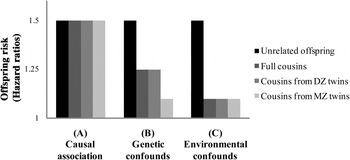
Inferences about the putative causal association between early MAFB and offspring criminal convictions are based on the pattern of results from the children of siblings and children of twins designs. Figure 1 includes the expected patterns of results for different types of association between the risk factor (e.g., teenage first birth) and offspring outcome (e.g., criminal conviction). The results in Figure 1 are from hypothetical analyses comparing women who had their first child as a teenager (15–19 years old at first birth) and women who had their first child as an adult (20 years old or older at first birth). The hazard ratios (HRs) represent the risk for offspring that have been exposed to maternal teenage first birth using different comparison groups. In pattern A, the results are consistent with a causal association (supporting the social influence hypothesis) because the association between MAFB and offspring risk of criminal conviction persists in every comparison group. The association remains controlling for genetic and environmental factors shared by offspring born to MZ twins. In pattern B, the results suggest the statistical association between MAFB and offspring criminal conviction may be accounted for by genetic confounds. The social selection hypothesis would be supported because MAFB is not associated with offspring criminal convictions among offspring of MZ twins. The results suggest the confounding factors are genetic because the magnitude of the association is smaller in cousin comparisons that control for more genetic risk (i.e., the association is somewhat reduced when comparing full cousins and offspring of DZ twins, and the association is further reduced when comparing the offspring of MZ twins). The results in pattern C suggest that environmental confounds account for the association between MAFB and offspring criminal convictions. The selection hypothesis would be again supported because MAFB was not associated with offspring criminality among offspring of MZ twins. The confounding factors would be environmental because the magnitude of the association is reduced in all the cousin comparisons, regardless of degree of genetic relatedness.
Hypothetical patterns of results consistent with a causal association, a statistical association confounded by genetic factors, and a statistical association confounded by environmental factors.

The children of siblings and children of twins designs can help account for confounding factors, but the approach cannot rule out all confounding factors. In particular, the designs cannot account for environmental factors that make the adult twins dissimilar (e.g., environmental factors that influence one twin but not the other twin; D'Onofrio et al., Reference D'Onofrio, Turkheimer, Eaves, Corey, Berg and Solaas2003; Rutter et al., Reference Rutter, Pickles, Murray and Eaves2001). The designs also cannot account for genetic factors passed down from the spouses/partners of the twins (in this case, the fathers; Eaves et al., Reference Eaves, Silberg and Maes2005). To help address these limitations, the current study combines the quasiexperimental design with the inclusion of statistical covariates measuring traits in both parents to help account for additional confounding factors.
Methods
Sample
We merged longitudinal population registries maintained by government and research agencies in Sweden. The Multi-Generation Register (Statistics Sweden, 2006), kept by Statistics Sweden, contains each individual's unique identifier and allows researchers to link all children to their biological mothers and fathers (based on maternal reports) and identify all siblings and offspring of siblings (cousins). All siblings in the current study were full siblings. The database also includes the date of birth for all individuals. The National Crime Register (Fazel & Grann, Reference Fazel and Grann2006) includes information about all criminal convictions of those aged 15 (the age of criminal responsibility) and older since 1960. The register provides detailed information about the timing, nature, and number of all offenses that led to court convictions. The Education Register (Statistics Sweden, 2004) contains information on the highest level of completed formal education. The Migration Register provides information on individuals who immigrated to or emigrated from Sweden. The Cause of Death Register, maintained by the National Board of Health and Welfare, includes information on causes of death for all individuals since 1958. Immigration and death information were used to identify individuals who emigrated or died before they were 15 years old. The Swedish Twin Register contains basic information on all twins born in Sweden since 1886 and was used to identify DZ and MZ twin sisters born from 1955 to 1970 (Lichtenstein et al., Reference Lichtenstein, Sullivan, Cnattingius, Gatz, Johansson and Carlstrom2006). Zygosity in the Swedish Twin Register was determined based on questions about intrapair similarities in childhood, a method that has been validated as 98% accurate (Lichtenstein et al., Reference Lichtenstein, De Faire, Floderus, Svartengren, Svedberg and Pederson2002, Reference Lichtenstein, Sullivan, Cnattingius, Gatz, Johansson and Carlstrom2006).
Inclusion and exclusion criteria
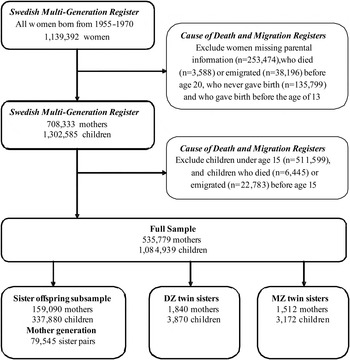
A sample of women born between 1955 and 1970 (n = 1,139,392) was selected from the Multi-Generation Register (see Figure 2). Women missing parental identification information (n = 253,374) and those who died (n = 3,588) or emigrated (N = 38,196) before age 20 were dropped. Women who never gave birth (n = 135,799) and women who gave birth before age 13 (n = 2) also were excluded. In Sweden, the age of criminal responsibility is 15 years old. Therefore, offspring under the age of 15 (n = 511,599) and children who died (n = 6,445) or emigrated (n = 22,783) before age 15 were not eligible for inclusion in analyses for the chosen criminal outcomes. The final sample includes 1,084,939 offspring born to 535,779 different mothers and 621,301 different fathers. The subsample of sister pairs created for the full cousin comparisons included only the two oldest sisters in each family and all of their children. Due to the small number of half cousins (cousins born to maternal half sisters) identified in the Swedish registries during this cohort, half cousins were excluded from the analyses. The sister subsample included 79,545 sister pairs with 337,880 offspring; 14,896 sister pairs were discordant for teenage childbirth (i.e., one sister gave birth as a teenager and the other gave birth as an adult). The intraclass correlation for age at first birth for full sister was 0.56, indicating moderate similarity in age at first birth among sisters within a nuclear family. The twin offspring subsample included DZ twin sisters (n = 1,840) and MZ twin sisters (n = 1,512) and their offspring (n = 7,042). There were 286 DZ twin pairs discordant for teenage first birth and 168 MZ twin pairs discordant for teenage childbirth. The intraclass correlation for age at first birth for DZ sisters was 0.59, which is nearly equal to the intraclass correlation for full sisters, indicating that DZ sisters are also moderately similar in age at first birth. The intraclass correlation for age at first birth was larger for MZ sisters (0.69) than DZ and full-sibling sisters, indicating greater similarity in age at first birth within MZ pairs.
A flowchart of participant inclusion and exclusion criteria.

Measures
MAFB
The Multi-Generation Register includes information about MAFB and the birth order of each live-born child. We measured MAFB as an ordinal, binary, and continuous variable and ran the same models with each form of MAFB as a predictor. To test nonlinear associations, we constructed binary and ordinal versions of MAFB. The binary variable categorized MAFB as teenage first birth if the age at first birth was between 13 and 19 years old and adult first birth if the age at first birth was at least 20 years old. The rate of teenage childbirth in this sample between 1955 and 1970 was 9.8% of all first live births, consistent with other reports (Danielsson et al., Reference Danielsson, Rogala and Sundstrom2001; Darroch et al., Reference Darroch, Singh and Frost2001). The ordinal variable decomposed MAFB into four categories: first birth between 13 and 15 years old, between 16 and 18 years old, between 19 and 23 years old, and 24 years or older (the reference group). The continuous variable recentered MAFB at 24, the mean age of first birth in the full sample.
Measured offspring covariates
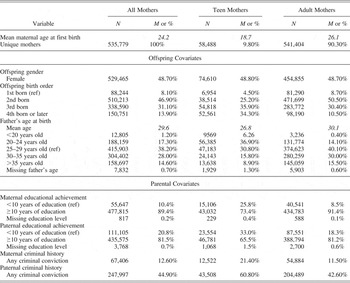
Demographic characteristics of the sample are presented in Table 1. Offspring gender, birth order, and paternal age at birth were included as offspring-specific covariates in all analytic models. The fathers of offspring born to teenage mothers are on average younger (26.8 years old) than the fathers of offspring born to adult mothers (30.1 years old).
Demographic characteristics of offspring and families

Note: Total offspring N = 1,084,939 for analyses.
Measured parental covariates
Maternal and paternal highest level of education and history of criminal conviction were included as covariates. Demographic characteristics of the parents are presented in Table 1. Maternal and paternal educational attainment was indexed as low if their highest level of education was less than 10 years of primary and lower secondary education. In Sweden, Grades 1–9 are compulsory and equivalent to elementary and middle school in the United States and many other developed countries. Dummy codes were created to compare those with low educational attainment and those with missing values to the high educational attainment group. A greater proportion of mothers who began childbearing as teenagers (25.8%) and the fathers of their offspring (33.0%) had low educational attainment as compared to the proportion of mothers who began childbearing as adults (8.5%) and the fathers of their offspring (18.3%). Maternal and paternal history of criminal conviction was based on record of any criminal offense in the National Crime Register through 2004. Similar to the pattern observed with educational attainment, a greater proportion of mothers who began childbearing as teenagers (21.4%) and the fathers of their children (60.8%) had a criminal conviction history as compared to the mothers who began childbearing as adults (11.5%) and the fathers of their children (42.6%).
Offspring criminal outcomes
Offspring history of any criminal conviction was used as the primary outcome for analyses. Sensitivity analyses were conducted on four types of offspring criminal convictions as outcomes in the current study. First, violent crimes were defined according to the Swedish Penal Code as attempted or completed murder, manslaughter, or filicide; assault; kidnapping; illegal restraint; illegal coercion or threats; robbery; threats or violence against an officer; arson; gross violation of a person's (or woman's) integrity; or harassment. Any sexual offense was also included (rape, sexual coercion, child molestation, and sexual harassment including indecent exposure). Aggravated forms of the included offences were included wherever applicable. This corresponds to a definition of violent offending used in earlier scientific reports from Sweden (Fazel, Långström, Hjern, Grann, & Lichtenstein, Reference Fazel, Långström, Hjern, Grann and Lichtenstein2009; Långström, Grann, Ruchkin, Sjöstedt, & Fazel, Reference Långström, Grann, Ruchkin, Sjöstedt and Fazel2009). Second, we identified driving-related crimes committed while under the influence of alcohol or other substance. Third, narcotic drug offenses were defined by the Narcotic Drugs Criminal Act, which includes possession for personal use, supply and manufacture, and consumption. Fourth, we indexed nonviolent crimes as all other crimes (i.e., not related to violent or drug-related offenses).
Analyses were based on first conviction for each of these types of crime (starting from age 15, the age of criminal responsibility). The time to event for these outcomes is based on the date of the first criminal act leading to a criminal conviction. In the current sample, Kaplan–Meier estimates indicated that by 25 years old, 16% (n = 134,160) of the sample had at least one criminal conviction, 4% (n = 31,751) had at least one violent criminal conviction, 2% (n = 16,181) had at least one driving-related conviction, 5% (n = 19,506) had at least one drug-related conviction, and 6% (n = 49,151) had at least one nonviolent criminal conviction.
Statistical analyses
Preliminary analyses
We conducted preliminary analyses to determine whether the association between MAFB and offspring criminal convictions was best modeled as a linear or nonlinear association. We compared the association between MAFB and offspring criminality using three different distributions of MAFB: (a) MAFB measured as an ordinal variable, (b) MAFB considered as a continuous predictor, and (c) MAFB as a continuous and quadratic predictor.
First, we were interested in whether younger teenage first birth (13–15 years old), later teenage first birth (16–18 years old), or first birth during early adulthood (19–23 years old) were related to higher risk of criminal conviction than first birth during adulthood (24 years old and older). We fit Cox regression models testing the unadjusted nonlinear association between MAFB as an ordinal variable and offspring history of any criminal conviction. Cox regression analyses were used to deal with the right-censored outcome measures (i.e., not all of the offspring in the sample had lived through the risk period for criminal convictions). Second, we fit Cox regression models testing the unadjusted linear association between MAFB as a continuous variable and offspring history of any criminal conviction. Third, we compared analyses using linear and quadratic models of association to examine whether the continuous measurement of MAFB was a close approximation of both the ordinal and quadratic results. These analyses provided justification that using a linear model provided a good approximation of the association.
Quasiexperimental analyses
Association between MAFB (continuous) and offspring criminal convictions
Analyses with the continuous measure of MAFB were used to identify the extent to which the association between MAFB and offspring criminal convictions was consistent with a causal influence and to determine the extent to which any confounding factors were due to shared genetic liability between the mothers and their offspring (passive gene–environment correlation). All models statistically controlled for offspring gender, birth order, and father's age at birth. The analyses used robust standard errors to account for the nested nature of the data (i.e., sisters and cousins were nested within extended families).
Six Cox regression models were fit to offspring history of any criminal conviction as an outcome. Model 1 tested the unadjusted association between MAFB and any criminal conviction. This model provided an unadjusted estimate of the association between MAFB and offspring criminal convictions in the entire population of offspring. Model 2 estimated the same associations while including measured parental covariates. This analysis provided an estimate of the association between MAFB and offspring criminal convictions that is statistically independent of the measured parental covariates, the typical manner in which studies have tried to account for selection factors.
Model 3, in contrast, fit a fixed-effects model to test the association between MAFB and offspring criminal conviction in the subsample of full-sister pairs. In these fixed-effects models, comparisons are made within cousin pairs to focus on the within-family effect of MAFB. Cousins are used as controls to account for unmeasured and stable characteristics shared by full cousins (Allison, Reference Allison2006). This model compared differentially exposed full cousins (offspring born to maternal full siblings who began childbearing at different ages). These analyses estimated the association between MAFB and offspring criminal conviction while controlling for unmeasured family-level genetic and environmental factors that make cousins similar (D'Onofrio et al., Reference D'Onofrio, Turkheimer, Emery, Slutske, Heath and Madden2005; Heath et al., Reference Heath, Kendler, Eaves and Markell1985; Silberg & Eaves, Reference Silberg and Eaves2004).
Model 4 and Model 5 compared the children of twins. Model 4 fit a fixed-effects model comparing the criminal conviction history of offspring of DZ twin sisters discordant for age at first birth. Offspring born to DZ twin sisters are genetically equivalent to full cousins and share 12.5% of their genetic makeup. The results of these analyses provide a within twin-family estimate of the association between MAFB and offspring criminal conviction, while controlling for genetic and environmental factors that make cousins born to DZ twin sisters similar. Model 5 fit a fixed-effects model comparing offspring of MZ twin sisters discordant for age at first birth. Because children born to MZ twins are genetically equivalent to half siblings, sharing 25% of their genes, the results of these analyses provide a within twin-family estimate that controls for more genetic factors. Finally, Model 6 fit a fixed-effects model in MZ twin families while also including the measured parental covariates to control for the nuclear family level confounds that are not controlled for in the children of twins design. We included the parental covariates to account for possible confounding variables (e.g., offspring's father's criminal history) that differed between twins and were not controlled for in the children of twins design (Eaves et al., Reference Eaves, Silberg and Maes2005).
Again, using multiple groups of relatives who differ in their relatedness and their exposure to the risk factor (teenage childbirth) allowed us to measure whether shared genetic and environmental background factors account for the statistical association between early childbearing and offspring outcomes (Heath et al., Reference Heath, Kendler, Eaves and Markell1985; Silberg & Eaves, Reference Silberg and Eaves2004). Contrasting the offspring of full sisters, DZ, and MZ twins provides information about (a) the putative causal association between teenage childbearing and criminal conviction and (b) the extent to which any confounding factors are due to shared genetic liability (passive gene–environment correlation; see Figure 1).
In subsequent analyses we specifically tested whether the within extended-family estimate was moderated by zygosity in the children of twins models for each offspring outcome, which provides a statistical examination of the role of passive gene–environment correlation. A model for each outcome measure explored whether the within-family estimate (comparison of the offspring of discordant twins) is different for offspring of DZ and MZ sisters. These models included a variable for the mean MAFB for each twin pair (to estimate between twin-pair differences), a variable for the deviation score for each co-twin sister (to estimate within twin-pair differences), and an interaction between the MAFB deviation variable parameter and zygosity (coded: 0 = MZ, 1 = DZ). The interaction term provided statistical information about the difference between the MAFB parameter estimates from the fixed-effects models (Model 4 and Model 5) to examine whether the within twin-family estimate was larger for the offspring of DZ twins than for the offspring of MZ twins. For further details concerning these models, see D'Onofrio et al. (Reference D'Onofrio, Turkheimer, Emery, Slutske, Heath and Madden2005).
Association between teenage childbirth (binary) and offspring criminal convictions
Most studies focus on the distinction between teenage and adult childbearing. Because we wanted to provide results that can be compared with the existing literature, we also conducted the quasiexperimental analyses using the binary measure of MAFB (first birth as a teenage vs. first birth as an adult). The same six Cox regression models were used to test the association between MAFB and offspring criminal convictions.
Sensitivity analyses
Sensitivity analyses using transformations of the MAFB variable (e.g., continuous and binary) were conducted to check whether the association between MAFB and specific types of criminal conviction outcomes (e.g., violent or driving related) replicated the findings for the general criminal conviction outcome in the primary analyses. We also ran analyses using both transformations of the MAFB variable on a subset of the data that only included the firstborn offspring of each mother to check whether the association between MAFB and any criminal conviction remained. Although the main models controlled for birth order, the sensitivity provided another approach for understanding the role of birth-order effects.
First, analyses were conducted using the continuous measurement of MAFB as a predictor and the other offspring criminal outcomes (violent, nonviolent, driving-related, and drug-related convictions). The same six Cox regression models were fit to these outcomes as were fit to the any criminal conviction outcome. Second, we conducted sensitivity analyses using the binary measure of MAFB as a predictor using the other criminal outcomes (i.e., we ran the models predicting violent, nonviolent, driving-related, and drug-related convictions). Again, the same six Cox regression models were fit to these outcomes as were fit to the any criminal conviction outcome. Third, we repeated the analyses on a subsample of firstborn offspring, using both the binary and continuous measure of MAFB to predict any criminal conviction.
Results
Preliminary analyses
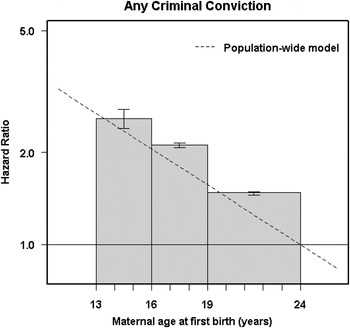
The analyses first compared the ordinal approach of measuring MAFB to a linear, continuous model. The full pattern of results from the ordinal analyses and linear model can be seen in Figure 3. The analyses comparing the linear and quadratic models of association between MAFB and offspring convictions can be found in Figure A.1 in Appendix A. The comparisons suggested a linear model would fit the data well. For example, in both the continuous and the ordinal models, offspring risk of criminal conviction decreases as MAFB increases. We, therefore, conducted the quasiexperimental analyses considering two distributions. First, we used a continuous measure of MAFB because of the increased statistical power of considering MAFB continuously. Second, we used a binary measure of MAFB (comparing teenage childbirth to adult childbirth) because of the heavy emphasis in the literature on specifically examining teenage childbirth.
Hazard ratios with 95% confidence intervals for ordinal survival models.

Quasiexperimental analyses
Association between MAFB (continuous) and offspring criminal convictions
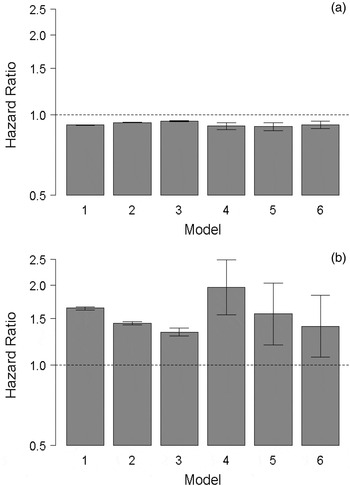
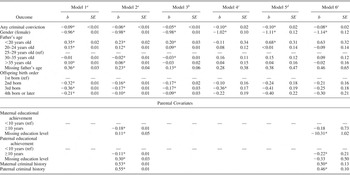
For all analyses, the HRs with corresponding 95% confidence intervals (CIs) for MAFB are shown in Figure 4a and the results are provided in Table 2. MAFB was highly associated with any offspring criminal conviction. Model 1 indicated that for every 1-year increase in MAFB offspring odds of any criminal conviction was reduced by 8% (b = −0.09, HR = 0.92, p < .0001): a HR below 1.00 represents a decrease in the odds of offspring criminal conviction. In Model 2 the parameter associated with MAFB was slightly attenuated (b = −0.06, HR = 0.94, p < .0001), but it remained a strong predictor of offspring criminal convictions after the inclusion of the parental covariates. When comparing differentially exposed full cousins using a fixed-effects approach in Model 3 the MAFB parameter was reduced further (b = −0.05, HR = 0.95, p < .0001), but MAFB remained a significant predictor of any offspring criminal conviction. For every year a mother delayed childbearing, her offsprings' risk of criminal conviction decreased by 5% in comparison to their cousins born to her sister who began childbearing earlier. Model 4 compared cousins born to DZ twin sisters using a fixed-effects model, and the effect of MAFB remained significant (b = −0.10, HR = 0.91, p < .0001). Model 5 compared cousins born to MZ twins, who are genetically equivalent as half siblings, and MAFB still independently predicted offspring criminal convictions (b = −0.08, HR = 0.90, p < .0001). Model 6 compared offspring of MZ twin sisters and included parental covariates to account for potential within twin-family confounds. Including the covariates slightly attenuated the magnitude of the association, but MAFB was still a robust, independent predictor of offspring criminal conviction (b = −0.09, HR = 0.92, p < .0001). The analyses suggest that when statistically controlling for measured covariates and using a quasiexperimental design to rule out genetic factors passed down from mothers to their offspring and environmental factors that make cousins similar, MAFB was still strongly associated with offspring criminal convictions.
Hazard ratios with 95% confidence intervals for survival models with (a) continuous measure of maternal age at first birth and (b) binary measure of maternal age at first birth (teenage vs. adult first birth) as predictors of offspring criminal convictions. Model 1 compares unrelated offspring. Model 2 compares unrelated offspring with family covariates. Model 3 compares offspring of full sisters (cousins). Model 4 compares offspring of dizygotic twin sisters. Models 5 and 6 compare offspring of monozygotic twin sisters.

Parameter estimates and standard errors for survival models with continuous maternal age at first birth predictor of offspring criminal convictions
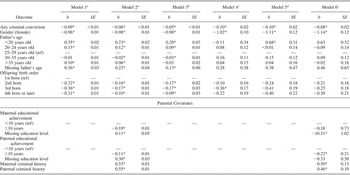
Note. Model 1 compares unrelated offspring. Model 2 compares unrelated offspring with family covariates. Model 3 compares offspring of full sisters (cousins). Model 4 compares offspring of dizygotic (DZ) twin sisters. Models 5 and 6 compare offspring of monozygotic (MZ) twin sisters. The parameters are distributed as logits.
aBased on n = 1,084,939.
bBased on the fixed effects model examining differentially exposed offspring of full sisters (n = 362,471).
cBased on the fixed effects model examining differentially exposed offspring of DZ twin sisters (n = 4,075).
dBased on the fixed effects model examining differentially exposed offspring of MZ twin sisters (n = 3,338).
eBased on the fixed effects model examining differentially exposed offspring of MZ twin sisters with no missing covariate data (n = 3,338).
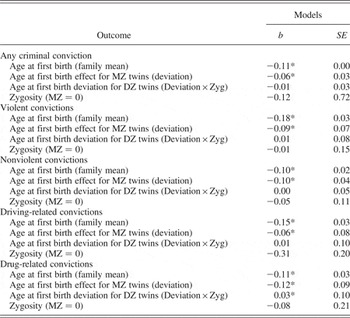
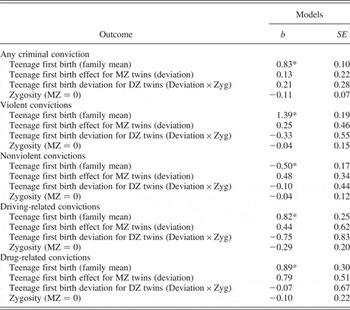
Further analyses to test zygosity as a moderator of the within-family association found the effect did not differ by zygosity (b = −0.01 logits, SE = 0.03), which suggests that the attenuation of MAFB in the comparison of differentially exposed children of MZ twins does not appear to be due to genetic confounds (Table 3).
Parameter estimates and standard errors from linear model testing zygosity as a moderator

Note: Based on models comparing differentially exposed offspring of monozygotic (MZ) and dizygotic (DZ) twin sisters (n = 7,042) for criminal outcomes.
*p < .05.
Association between teenage childbirth (binary) and offspring criminal convictions
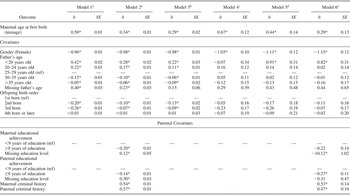
For all analyses, results are shown in Table 4 and the HRs associated with teenage childbirth are presented in Figure 3b. Model 1 indicated that teenage first birth increased the odds of any criminal conviction by a factor of 1.64 (b = 0.50, HR = 1.64, p < .0001). In Model 2 the parameter associated with teenage MAFB was somewhat attenuated (b = 0.36, HR = 1.44, p < .0001), but teenage childbirth remained a strong predictor of offspring criminal convictions after the inclusion of the parental covariates. When comparing differentially exposed full cousins using a fixed-effects model, the teenage childbirth parameter was slightly reduced (b = 0.29, HR = 1.33, p < .0001), but teenage MAFB remained a significant predictor of any offspring criminal conviction when comparing differentially exposed siblings. Model 4 compared cousins born to DZ twin sisters using a fixed-effects model, and the effect of teenage MAFB remained large and statistically significant (b = 0.67, HR = 1.96, p < .0001). Model 5 compared cousins born to MZ twins, and teenage MAFB still independently predicted offspring criminal convictions (b = 0.44, HR = 1.56, p < .0001). Model 6 also compared offspring of MZ twin sisters but included parental covariates to account for potential within twin-family confounds. Including the covariates slightly attenuated the magnitude of the association, but MAFB was still a robust predictor of offspring criminal conviction (b = 0.29, HR = 1.40, p < .0001). Offspring born to a teenage mother, therefore, were 1.4 times more likely to be convicted of any crime than their cousins born to their mother's MZ co-twin who delayed childbearing until adulthood (while also controlling for statistical covariates).
Parameter estimates and standard errors for survival models with binary maternal age at first birth predictor

Note: Model 1 compares unrelated offspring. Model 2 compares unrelated offspring with family covariates. Model 3 compares offspring of full sisters (cousins). Model 4 compares offspring of DZ twin sisters. Model 5 compares offspring of MZ twin sisters. The parameters are distributed as logits.
aBased on n = 1,084,939.
bBased on fixed effects model examining differentially exposed offspring of full sisters (n = 362,471).
cBased on fixed effects model examing differentially exposed offspring of DZ twin sisters (n = 4,075).
dBased on fixed effects model examing differentially exposed offspring of MZ twin sisters (n = 3,338).
eBased on fixed effects model examing differentially exposed offspring of MZ twin sisters with no missing covariate data (n = 3,338).
Further analyses testing zygosity as a moderator found no difference in the estimates for the comparison of offspring of DZ and MZ twin sisters. In these analyses, the within twin-pair effect of MAFB did not differ by zygosity (b = 0.21 logits, SE = 0.28), indicating that the attenuation of MAFB in comparison of differentially exposed children of MZ twins does not appear to be due to genetic confounds (Table 5).
Parameter estimates and standard errors from binary model testing zygosity as a moderator

Note: Based on models comparing differentially exposed offspring of monozygotic (MZ) and dizygotic (DZ) twin sisters (n = 7,042) for criminal outcomes.
*p < .05.
The pattern of results seen in Figure 3b is very similar to the pattern of hypothetical results seen in Figure 2 (Pattern A). Although there is more variability in the HRs seen in Figure 3, the general pattern of results from the comparisons of differentially exposed cousins, offspring of DZ twins, and offspring of MZ twins is consistent with the causal association posited by the social influence hypothesis.
Sensitivity analyses
First, we conducted sensitivity analyses using the continuous measure of MAFB as a predictor with different criminal outcomes. We used the same six Cox regression models to test the association between MAFB and other criminal convictions (violent, driving-related, drug-related, and nonviolent convictions). The pattern of results for these criminal outcomes was similar to the pattern of results seen for any criminal conviction (data not shown, results available upon request). For each of these outcomes, the association remains robust in the final models comparing differentially exposed offspring of MZ twins and including parental covariates. The magnitude of the association between MAFB and these offspring outcomes remained large despite the increase in standard errors (as the prevalence of some of the types of criminal convictions is low).
Second, we conducted sensitivity analyses using the binary measure of MAFB (teenage childbirth) as a predictor using the other criminal outcomes. Again, the pattern of results for these criminal outcomes was similar to the pattern of results seen for any criminal conviction (data not shown, results available upon request). For each of these outcomes, the association remains robust in the final models comparing differentially exposed offspring of MZ twins and including parental covariates. The magnitude of the association between MAFB and these offspring outcomes was large.
Third, we fit the same six Cox regression models in a subsample that was restricted to only the firstborn offspring, using both the binary and continuous measure of MAFB as a predictor and any criminal conviction as the outcome. The patterns of results were commensurate with the results from the analyses using the full sample of offspring (results available upon request).
Discussion
To our knowledge, this is the first study to test whether MAFB is associated with offspring criminal outcomes using children of siblings and children of twins comparisons to account for genetic and environmental factors shared among offspring born in an extended family. The current study was able to account for unmeasured genetic confounds that are shared among offspring born to MZ twins and environmental confounds that make siblings similar. The current study also used family relationships with different degrees of genetic relatedness in a large, population-based sample to examine the extent to which any selection factors are due to shared genetic liability (among mothers and their offspring) and environmental factors.
The results of the study support two main conclusions. First, the results provide support for the social influence hypothesis: the association between early MAFB is independently associated with offspring antisocial behavior. We found offspring born to mothers who begin childbearing earlier were more likely to be convicted of a crime than offspring born to mothers who delayed childbearing. Because the associations between MAFB and offspring criminal convictions persisted in differentially exposed offspring born to full, DZ, and MZ adult siblings, the results are consistent with a causal association between MAFB and offspring criminal convictions. The association is independent of genetic factors passed down from mothers to their offspring, environmental factors shared by cousins, and a number of measured covariates, including paternal age at childbearing and maternal and paternal education level and history of criminal conviction. In the linear models, every year that childbearing was delayed reduced the odds of offspring criminal convictions by approximately 10%. In the binary models, offspring born to mothers who began childbearing as teenagers were 1.4 times more likely to be convicted of any crime than offspring born to mothers who delayed childbearing until adulthood. The results from the sensitivity analyses using specific types of criminal convictions (violent, nonviolent, driving-related, and drug-related convictions) showed similar patterns of association. Consistent with the social influence hypothesis, these results suggest the association between MAFB and offspring criminality persists across many types of criminal behavior.
Second, the magnitude of the association is similar in the children of twins comparisons (i.e., the estimates were comparable in both DZ and MZ comparisons), which does not suggest genetic factors from passive gene–environment correlation account for the association between MAFB and offspring outcomes. The association between MAFB and offspring risk of criminal conviction persists after controlling for genetic and environmental factors shared by offspring born to MZ twins, which suggests the causal association may be better explained by environmental factors specifically associated with early MAFB, such as diminished financial and social resources in families in which the mother had her first child at an early age (Nagin et al., Reference Nagin, Pogarsky and Farrington1997). The findings reiterate how the mechanisms that influence a putative risk factor (early MAFB) are separate from the mechanisms through which the risk factor is associated with an outcome (Rutter et al., Reference Rutter, Silberg and Simonoff1993).
The results from the current study may help to explain the discrepant findings from previous studies. As mentioned earlier, some studies using cousin comparisons have found that selection effects best accounted for the association between MAFB and poor offspring outcomes (Geronimus et al., Reference Geronimus, Korenman and Hillemeier1994; Turley, Reference Turley2003). Our results from a much larger, population-based sample provide support for a causal association (the social influence hypothesis), rather than the influence of selection effects. Other studies found support for a causal association but were either using children of twins design to test the effect of maternal age on offspring mental health outcomes (Harden et al., Reference Harden, Lynch, Turkheimer, Emery, D'Onofrio and Slutske2007) or using sibling comparisons to test the effect of maternal age on offspring behavior problems (D'Onofrio et al., Reference D'Onofrio, Goodnight, Van Hulle, Rodgers, Rathouz and Waldman2009). The results from the current study suggest that the effect of MAFB could help account for the statistical association between maternal age and offspring criminal convictions in the entire population (Coyne et al., Reference Coyne, Långström, Lichtenstein and D'Onofrio2012). Therefore, the lack of difference between early- and later-born siblings born to women who were teenagers when they first gave birth could be due to the carry-over effect of MAFB on all siblings in a nuclear family (Coyne & D'Onofrio, Reference Coyne and D'Onofrio2012).
The results provide support for the causal association between MAFB and offspring criminal outcomes, but this does not clarify which specific factors mediate that association. Previous studies have identified low socioeconomic status, large family size, caretaker changes, and parental criminal convictions as mediators explaining the effect of early MAFB (Jaffee et al., Reference Jaffee, Caspi, Moffitt, Belsky and Silva2001; Nagin et al., Reference Nagin, Pogarsky and Farrington1997; Pogarsky et al., Reference Pogarsky, Thornberry and Lizotte2006). Future studies will need to explore these family-level risk factors as potential mediators. Identifying the processes associated with early age at first birth that increased the risk of poor offspring outcomes will be essential for creating effective and efficient interventions.
Limitations
First, public health services, social attitudes about teenage sexuality, and a relative lack of racial and ethnic diversity in Sweden may make generalizations from these results to other countries, such as the United States, difficult. Teenage childbirth is quite rare in Sweden (7 per 1,000 15- to 19-year-old women) compared to the United States (34 per 1,000 15- to 19-year-old women) and other countries (Kost, Henshaw, & Carlin, Reference Kost, Henshaw and Carlin2010; Singh & Darroch, Reference Singh and Darroch2000). The offspring in the current sample were born from 1969 to 1994, and during this time the teenage birth rate in Sweden declined substantially. Legislation passed in the early 1970s increased access to contraceptive services, and the teenage birth rates in Sweden declined from 40 to 11 per 1,000 15- to 19-year-old women in 20 years (Danielsson et al., Reference Danielsson, Rogala and Sundstrom2001; Darroch et al., Reference Darroch, Singh and Frost2001). The wide availability of services designed to prevent teenage pregnancy and childbirth in Sweden (e.g., national comprehensive sex education and subsidized reproductive health care services) may mean that factors other than accessibility or financial constraints influence teenage women's reproductive decision making. The year in which a young woman first gives birth may influence both her reproductive decision making and the outcomes for her offspring. Overall, it is likely that the developmental pathways of young women who become teenage mothers are varied, and perhaps cohort specific. This potential heterogeneity underscores the importance of future quasiexperimental studies that can explore risk factors associated with teenage childbirth in Sweden and other countries (Coyne & D'Onofrio, Reference Coyne and D'Onofrio2012). Understanding the putative risk factors that increase the likelihood of teenage childbirth can help us to better understand the mechanisms that explain poor outcomes for offspring born to teenage mothers. Our findings also highlight the need for more cross-national research, using large, nationally representative data sets to explore similarities and differences in the patterns of association between teenage childbirth and offspring outcomes in different nations. Differences in the patterns of associations between nations can help us identify potential social and cultural structural factors (e.g., availability of adolescent health services or national educational policies) that influence teenage childbirth (Santelli, Sandfort, & Orr, Reference Santelli, Sandfort and Orr2008).
Second, children of siblings and children of twins designs are not randomized, controlled experiments and cannot determine conclusively if the association is causal. The association between MAFB and offspring criminal convictions could be due to nonshared environmental factors at the twin level (e.g., factors that make twin sisters dissimilar; D'Onofrio et al., Reference D'Onofrio, Turkheimer, Eaves, Corey, Berg and Solaas2003). The children of siblings and children of twins designs also do not account for genetic risk contributed by the fathers of the offspring (Eaves et al., Reference Eaves, Silberg and Maes2005). We used statistical covariates to account for factors unique to each child (paternal age at childbearing, and the mothers' and fathers' criminal history and highest level of educational attainment) to help address these concerns. It is impossible, however, to know if we accounted for every salient confounding factor. In addition, the current study does not include as many statistical covariates as smaller, more intensively studied samples. We therefore encourage researchers to replicate the findings using other children of siblings and twin data sets, as well as other quasiexperimental designs (e.g., adoption studies) with good measurement. Strong causal inferences can only be made when converging results are found using multiple studies and designs (Rutter et al., Reference Rutter, Pickles, Murray and Eaves2001).
Third, these designs assume there is no assortative mating (e.g., nonrandom mate selection for the phenotype being studied). If young women who begin childbearing early exhibit higher levels of antisocial behavior and seek out antisocial partners, their offspring would have both increased genetic risk for later antisocial behavior and increased environmental exposure to parental antisocial behavior. Future studies should specifically include detailed paternal measures to identify whether the effect of MAFB on offspring criminal convictions is due to genetic and environmental contributions from the mates selected by younger mothers compared to older mothers.
Fourth, these designs assume equal environments among all relative groups. This means that differences in risk among offspring would not be due to greater contact between offspring from MZ sisters' families that DZ sisters' families or full sisters' families (D'Onofrio et al., Reference D'Onofrio, Turkheimer, Eaves, Corey, Berg and Solaas2003).
Fifth, the analyses testing zygosity as a moderator found no difference in the estimates for the comparison of offspring of DZ and MZ twin sisters; however, given the small number of discordant twins in the sample, it is possible that these analyses are underpowered and unable to detect a true effect of zygosity.
Sixth, the measure of antisocial behavior we used may not be the best estimate of true antisocial tendencies. We used registered criminal convictions as our measure of antisocial behavior. Since the age of criminal responsibility in Sweden is 15 years, children under age 15 years cannot be convicted, and only criminal behavior from midadolescence into adulthood was possible to capture in the current study. However, using official criminal convictions did not necessarily affect the magnitude of the association between teenage childbirth and offspring criminal behavior, because previous studies suggest the relative risks obtained with self-report and official conviction records overlap considerably (Arseneault, Moffitt, Caspi, Taylor, & Silva, Reference Arseneault, Moffitt, Caspi, Taylor and Silva2000). Previous studies using the current sample have also found converging results to the findings on criminal convictions when exploring related constructs, such as low intellectual abilities, assessment of personality traits, and substance use problems (D'Onofrio et al., Reference D'Onofrio, Singh, Iliadou, Lambe, Hultman and Neiderhiser2010; Lambe, Hultman, Torrang, MacCabe, & Cnattingius, Reference Lambe, Hultman, Torrang, MacCabe and Cnattingius2006). Quasiexperimental research using more precise measures of antisocial behavior, though, should be conducted in the future.
Conclusion
Teenage childbearing is internationally recognized as a public health issue with serious consequences for young mothers and their children. The current study is the first we are aware of to use a large national sample with diversity in MAFB to test causal hypotheses regarding the association between MAFB and offspring criminal convictions. Contrary to some previous findings, the current study suggests the association between teenage childbearing and offspring criminal convictions is consistent with a causal association. The results support the social influence hypothesis that early childbearing disrupts important maternal development that subsequently increases the likelihood of offspring criminal convictions. Therefore, delaying first birth could be a useful strategy for reducing poor outcomes for offspring.
The study combined multiple quasiexperimental designs to rule out possible genetic and environmental confounds shared within nuclear families. These rigorous children of siblings and children of twins comparisons may help to resolve some of the discrepancies in previous studies that were unable to control for risk factors shared by all siblings in a family. Using comparisons of offspring born to MZ twins, the current study was able to account for confounds that are shared among cousins and environmental confounds that make adult siblings similar.
Future research is needed to replicate and extend these findings. Replication studies using genetically informative samples from different nations will allow for cross-national comparisons of the patterns of association. Finally, exploring what processes mediate the causal association, such as poor parenting, large family size, or financial deprivation, will be essential for developing effective prevention and intervention programs that can ameliorate the negative effects of early maternal age at childbirth.
Appendix A
Comparing linear and quadratic models predicting criminal convictions for unrelated offspring.