Don't part with your illusions.
When they are gone you may still exist but you have ceased to live.
Mark TwainFootnote 1I Multiple contexts, multiple meanings
Richard Taruskin, exasperated by a steady stream of often self-indulgent ‘interpretations’ and ‘readings’ of music, recently fired a salvo: ‘To ask “what does it mean?” is death for music; but to ask “what has it meant?” can be illuminating. The one imposes arbitrary limits, the other welcomes all comers to share in the pleasure of engagement and response.’Footnote 2 Justifiably Taruskin bemoans the arbitrariness of methodology often adopted by those who seek to find ‘meaning’ in music. But if no one ever ventured an opinion on a work's meaning for fear of harming it, then what catalogue of ascribed meanings, accumulated over time, would later commentators (such as Taruskin) have at their disposal to examine? In other words, the one activity is not possible without the other; and it seems disingenuous to favour the historical study of interpretation over interpretation itself. Surely Taruskin's point is that it is the imposition of a single definitive and universal meaning on a work of art that is the killer.
Moreover, Taruskin's pronouncement implies that there comes a time when new interpretations cease to be valid. But who will be the arbiter? Who today has the authority to demand a moratorium on ascriptions of meaning to a Beethoven piano sonata or a Shostakovich string quartet? Whether we like it or not, will not listeners, critics, and specialists continue to interpret music from all periods, now and into the foreseeable future? It seems inevitable that as long as we continue to listen to any repertoire we will perpetually try to rationalize – in words, no less – what attracts us to the music, our cumulative responses shaped by the constantly changing contexts in which our listening takes place.
Edward T. Cone famously described music as a ‘language of gesture: of direct actions, of pauses, of startings and stoppings, of rises and falls, of tenseness and slackness, of accentuations’; and ‘instrumental utterance’, in particular, as ‘pure symbolic gesture’.Footnote 3 Because the ‘symbolic gestures of music […] are both meaningless and meaningful’, their expressive content depends on their context.Footnote 4 ‘A composition represents a human action,’ Cone explains, ‘and only in a context of wider human activity is its content revealed.’Footnote 5 Every listener constructs a context from a store of personal experiences (which may include other musical experiences). Because each context is different, no one listener can therefore apprehend a work's content in its entirety. Cone concludes that ‘the total potential content of any musical work is located […] in the relationship among all its contexts and in the illumination thrown on that relationship by the musical structure that unites them’.Footnote 6 In other words, a musical work does not (and cannot) contain a single meaning. Nor can one rely on any single context (historical reception for instance) to illuminate a work's ‘total potential content’. This might explain why Shostakovich continues today to move listeners whose experiences are far removed from those of the Soviet Union and the Cold War. ‘Shostakovich's music holds meaning beyond the social context that produced it,’ notes Sarah Reichardt, adding that ‘a more generalized, albeit Western, audience continues to identify with the music.’Footnote 7 For such listeners there must be something psychologically universal and attractive about it.
Multiple contexts notwithstanding, whatever meaning we give to a work must be grounded in its musical structure. Otherwise any such meaning can be easily dismissed as arbitrary. Cone suggests that for most listeners the mediation of musical structure and the context they bring to it comes naturally: ‘We subconsciously ascribe to music a content based on the correspondence between musical gestures and their patterns on the one hand, and isomorphically analogous experiences, inner or outer, on the other.’Footnote 8 Of course, analysts who commit their observations to paper must consciously reflect upon their subconscious response. But a close relationship between structure and context remains fundamental to a ‘responsible’ interpretation. In a more recent consideration of the same problem James Hepokoski and Warren Darcy put it this way:
Some of the most productive responses to the problem of instrumental music's representational ambiguity are available through heuristic analogy and metaphor. Such approaches are hermeneutic. They are concerned with suggesting reasonable parallels, analogues, and similes within our experience, not with insisting that the single best reading has finally been uncovered within the music […]. These metaphorical analogues are set into motion only through the active participation and individualized interests of the close listener.Footnote 9
My present purpose is to take observations about what I perceive to be important structural processes in Shostakovich's Seventh String Quartet and to move towards an interpretation. My goal, however, is not to unveil the work's ‘true’ meaning. On this point I concur with both Cone and Taruskin: there is no such thing. And I am well aware of the dangers inherent in the act of interpretation, which Taruskin makes clear:
Look what's happened to poor Shostakovich, whose symphonies and quartets, perhaps the twentieth century's paramount examples of music as Bildungsroman, have been turned into political footballs by interpreters who have no ear for music. […] I do not care why they listen as long as they go on listening. But when they tell me they know what a piece objectively means, and that their certainty makes them better listeners than I, then I know that they have stopped listening. The paraphrase is all they hear.Footnote 10
By all means, let us go on listening. But if we want to discuss what it is we are hearing, and how we relate what we hear to our shared experiences, then constructing a paraphrase is unavoidable. The challenge is never to allow the paraphrase to substitute for the thing itself, the music.
II A tale of two deaths, and other resolutions
Shostakovich's Seventh String Quartet, whose cyclic form was already well documented before the Shostakovich ‘wars’,Footnote 11 has in the past decade attracted the attention of several analysts who have trained upon it their excellent ears to offer a variety of interpretations. David Fanning, for instance, notes that the structure is ‘strongly end-weighted’, the first two movements having a ‘provisional feel and the finale reworking aspects of both of them, along with transformations of its own initial fugue-scherzo’.Footnote 12 Characterizing the three movements as ‘alternately playful, sorrowful and hysterical’, he argues that ‘[a]ll the elements are reconciled in the melancholy muted waltz that concludes the work’.Footnote 13 In a similar vein Judith Kuhn describes the Seventh's dialogue with sonata form as ultimately achieving closure. The finale's fugue, she writes, ‘seems to provide an overdue catharsis that enables resolution in the finale's peaceful waltz-epilogue’, thereby creating ‘the clear impression […] that some tension has been worked through over the course of the Quartet, some problem solved’.Footnote 14
Reichardt arrives at a comparable conclusion albeit via a different path. The first movement, she observes, ends with a coda based on material from the transition to the recapitulation and from the first theme; this coda recurs in near-identical form at the very end of the piece. Drawing on the work of Jacques Derrida, Reichardt associates the role of a coda with death, and asks, ‘why must the Seventh String Quartet die twice’?Footnote 15 To answer this question, she turns to the Slovenian philosopher Slavoj Žižek, whose musings on the theories of French psychoanalyst Jacques Lacan suggest an appropriate metaphor according to which there is a distinction between actual and symbolic death: the former is literal; the latter, figurative. If symbolic death is absent, notes Reichardt, ‘a gap forms that is inhabited by the living dead’.Footnote 16 The second movement, she continues, though funereal, cannot fulfil the function of symbolic death because it is too short, lacks substance, and, moreover, ends ambiguously. The third movement's fugue thus represents ‘the pure, mechanical drive of the dead – those whose symbolic destinies were not properly realized in the previous movements’.Footnote 17 Reichardt concludes that ‘the task of remembrance, the second death’ occurs in the quartet's postlude (bar 182 until the end).Footnote 18 The second (and final) coda (bar 336 to the end) frames the quartet from without, signifying the ‘death of the entire piece’.Footnote 19
Reichardt's imaginative interpretation compellingly explains one of the quartet's puzzling features: the ‘reprise’ of the first movement's coda. Her reading, Fanning's, and Kuhn's, each of which is persuasive, nuanced, and individual, share one key point in common: they all seem to endorse a belief in the quartet's satisfactory closure. In this study I propose an alternative interpretation, one that qualifies any such resolution as merely apparent. Although I admit of an aspect of resolution, I challenge the assumption that the quartet ultimately ‘resolves’ the built-up tension.
Yet even as I demarcate my own reading from those of Fanning, Kuhn, and Reichardt, I do not claim that mine is either definitive or better. I assert only that it is different and that its difference stems from my combining of the narrative lens through which I experience the work and the musical details I consider important within it. My ear tells me that rhythm, metre, thematicism, and cyclic form play the key roles, disparate threads that the narrative metaphor allows me to weave into what I hope is a plausible reading.
What I am attempting might fall into what Fred E. Maus has recently dubbed the ‘third stage’ of musicological work on narrative. Whereas the first, ‘optimistic’ stage ‘seemed to promise the resolution of traditional puzzles about musical meaning and interpretation’, and whereas in the second, ‘sceptical’ stage ‘prominent writers chastised musicologists for overidentifying music and narrative’, Maus proposes that we now find ourselves
in a third stage, or nonstage, in which exaggerated claims, positive or negative, are no longer exciting. In my view, analogies to narrative can show their value for music criticism by the insights and experiences they produce, the relationships with music that they help to create. The notion of narrative, brought into interpretative relation with instrumental music, is neither heroic nor scandalously naive. It is something to try, one way and another. I find this nonstage comfortable, inviting an experimental exploratory approach to the performances of music-critical thought.Footnote 20
The kind of exploration I am undertaking, as the reader will soon discover, is analysis firmly focused on the music itself. It is analysis that, while embracing abstract, psychological narratives, is ultimately formalist: it eschews any attempt to merge with the study of historical reception or biography, and in this sense stands apart from the direction that several noted analysts have taken in recent years.Footnote 21
III Analysis: metric instability, the ‘DSCH’ motto, and cyclic form
I have been inspired by Edward T. Cone's notions of ‘musical persona’ and ‘musical agency’, which he develops in his seminal book The Composer's Voice by discussing, in turn, vocal, programme, and absolute music. A song, for instance, consists of a ‘vocal persona’ (the vocal line) and an ‘instrumental persona’ (the accompaniment). ‘The song as a whole is the utterance – the creation – of the complete musical persona,’ he explains.Footnote 22 In programme music individual instruments take on the role of ‘characters’ that Cone calls ‘virtual agents’. But, unlike real characters, ‘instrumental agents move on a purely musical, nonverbal plane’.Footnote 23 Cone extends these ideas to absolute music, which he defines as ‘music in which persona, agent, and idea are verbally unspecified – and, it is important to add, unidentifiable’.Footnote 24 An ‘agent’, in the context of absolute music, is ‘any recognizably continuous or distinctively articulated component of the texture: a line, succession of chords, ostinato, a pervasive timbre’.Footnote 25
In my analysis of Shostakovich's Seventh Quartet I posit a musical persona that by the work's end achieves comfort through an act of denial. By this I mean that the quartet's persona does not actually reach a satisfactory resolution; instead it seems to avoid coming to terms with the violent, angst-ridden fugue – music that demands a powerful response – by reverting to the first movement's rhythmically unstable character. The virtual agents at work in this abstract narrative, namely the agents that act upon one another to tell the ‘story’, are musical features as disparate as themes, instruments, and even processes such as metric instability.
I identify two structural processes that span the entire quartet. The first of these is a little-studied aspect of the quartet (and of Shostakovich's music more generally): the role of rhythm and metre. In particular, I address the significance of the ‘straightened out’ recapitulation of the exposition's metrically unstable first theme group – often noted but never interpreted – as well as the possible meaning of its recontextualized return in the third movement. The second is an account of the unfolding of the [0134] tetrachord across the whole piece and its relation to Shostakovich's famous musical motto, D–E♭–C–B, derived from the German spelling (DSCH) of his Russian initials. I then discuss the interaction of these two processes – or abstract ‘stories’, as I later call them – and enlarge upon the existing wealth of commentary on motif and cyclic form by supplying my own observations on the subject before consolidating my own analysis into a narrative interpretation with psychological undertones.
A First movement: counterpoint in two personas
i) The rhythmic-metric persona: a destabilizing force
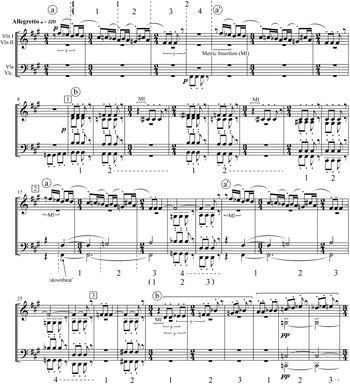
The opening phrase (theme P) has a curiously contradictory quality. On the one hand, its constituent rhythms could not be simpler: a series of instances of rhythmic pattern x ( ) trickles effortlessly down an octave, punctuated by two iterations of y (
 ), itself an exact augmentation of x on the basis of attack-point rhythm (Example 1). Though related, x and y differ in accentuation: the former is end-accented, the latter beginning-accented.
The Russian musicologist Arkady Klimovitsky suggests that y, a frequent presence in Shostakovich, may be another signature, derived from the speech-rhythm and accentuation of the composer's pet-name, Mityenka.Footnote 26 Fanning calls y a ‘fingerprint’.Footnote 27 Kuhn calls it a ‘footprint’, a label I prefer on account of the motif's deliberate foot-stomping character – at least in this piece.Footnote 28 I shall return to the role and significance of the footprint later on.
Given the tendency to hear the two semiquavers of x as grouped with the subsequent quaver, hence as an anacrustic figure, and the clear arrival point at y – the augmentation effect and single-note repetition is an emphatic gesture, confirmed by its exact repetition in the cello – it is natural to hear this phrase as scanning in a regular hypermetre of 1–2–3–4 at the bar level or 1–2 at the two-bar level. The phrase is repeated at bar 5, but one beat ‘late’ – as if the first violin has missed its cue. The one-beat metric insertion destabilizes the regular duple hypermetre, as yet barely established. Duple hypermetre is resumed, but metric regularity is again – and this time more significantly – questioned in the b portion of the aab sentence, which begins at bar 9. Here duple hypermetre at the one-bar level, clearly delineated by two instances of y, is twice destabilized by one-beat metric insertions (the lone violin presentation of y on C♯ will tend to be grouped with the following bars because of proximity and pattern repetition). Much like the break between the two initial a phrases, the effect is one of temporary metrical suspension, but now more pronounced.
What follows at bar 17, again separated by a one-beat metric insertion, is a varied reprise of the sentence. Here the cello and viola enter on the ‘downbeat’, thus confirming the upbeat quality of the phrase opening. The first phrase in this sentence introduces another variety of instability at the hypermetric level by appending an additional bar of y to the end. This means that the repetition of a is delayed by three beats instead of just one (or one hypermeasure and one beat). The second presentation of a (bars 22–8) is also further extended, this time by two bars – a stabilizing duple hypermetrical addendum, though the harmonic content of the last bar, with the violin's F♮ against the F♯–A accompaniment, undermines a convincing sense of closure.
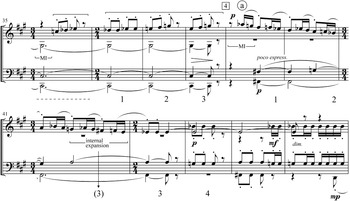
The contrasting b section that follows (bars 29–38), though built on an extension of y, is more rhythmically quirky than anything that has preceded it. It begins with the now-expected one beat of silence, but here the first violin establishes a new grouping of six beats (in three bars) implied by pattern repetition. The first two beats can be heard as either a y cell with its last quaver rest filled in or as two overlapping y cells. The new grouping suggests triple hypermetre, though perhaps contradicted by the entrance of the other instruments on the second hyperbeat of the second hypermeasure (bar 33). The real disruption, however, occurs at bar 35: a crotchet rest in the first violin breaks up the six-beat pattern. This interruption, a momentary suspension of metre, is short-lived: the first violin reiterates the six-beat pattern in the next bars and brings the sentence to a close. The first theme group concludes with a final varied presentation of the opening phrase. For the first time the anacrusis begins on a note other than F♯: it not only begins higher (A♭) but unravels lower, to E♭, the tonal centre of the second theme group. This marks the first time that the x portion of the phrase has been extended.
To sum up, then, in the first theme group a duple hypermetre challenged by one-beat metric insertions (rests) through repetition in different contexts becomes the defining metric anomaly – or character – of the quartet's opening. The duple hypermetre is further jostled about by extensions (e.g. bar 21 and bar 41) and the implication of a triple hypermetre (bars 19–21 and 29–38). Simple and unassuming music thus acquires a slightly lilting, unpredictable, and unstable – even playful – quality, not unlike what one might expect from a scherzo movement.Footnote 29
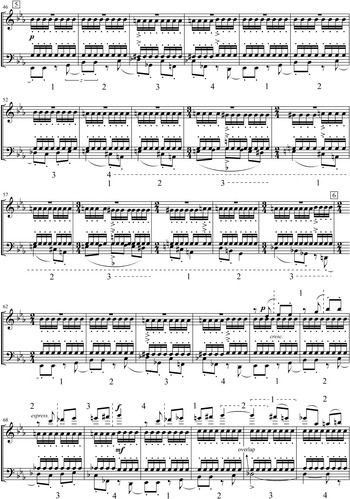
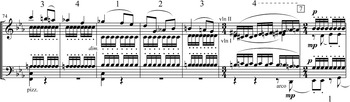
The second theme begins at bar 46 and, like the first, opens with an anacrusis, though here notated as such; whereas the heard and notated metre do not align in the first theme, they do in the second (Example 2). Its generating motivic cell z ( ) is y displaced to the ‘left’ by a quaver. In other words, if y is a ‘downbeat’ gesture, z is definitively ‘upbeat’. The second theme group, like the first, scans in 1–2–3–4 hypermetre but, unlike there, the hypermetre persists for two uninterrupted cycles. The disruption at bar 54 takes the form of a suspension of hypermetre: the fourth hyperbeat of bar 53 is prolonged until bar 61, thanks to the cello's looping melodic motif and the static harmony in the second violin and viola. The effect could be likened to a record skipping before it catches its groove at bar 62.
Shostakovich, String Quartet no. 7, first movement (bars 1–45). © Copyright Boosey & Hawkes Music Publishers Ltd. Reproduced by permission.


Surface events also toy with the hypermetre. The accented change of harmony in bar 49 suggests that the second violin and viola have lost count and have come in ‘early’ (perhaps compensating for the first violin's ‘late’ entries in the first theme group). Accents also accompany other disruptive shifts in harmony: in bars 55, 58, and 61, for instance, in which they also coincide with the insertion of 3/4 bars. And, finally, the expansion of the fourth hyperbeat that starts at bar 53 contains its own hypermetre, a contrasting triple hypermetre in which the third hyperbeats correspond to the inserted 3/4 bars.
First movement (bars 46–80). © Copyright Boosey & Hawkes Music Publishers Ltd. Reproduced by permission.


The stability of four-bar hypermetre is restored, along with the return of the theme, at bar 62. The entrance of the first violin on the second cycle (bar 66), imitating the cello at the half-bar, does not challenge the hypermetre as much as reinforce it, but displaced by one beat. In the ensuing stretto duel with the cello, the violin wins out, and at bar 72, on its way down, resets the four-bar hypermetre. At bar 80 the cello takes over; regular four-bar hypermetre resumes until it is dissolved in the composed ritardando and liquidation of z that closes the second theme group (not shown).
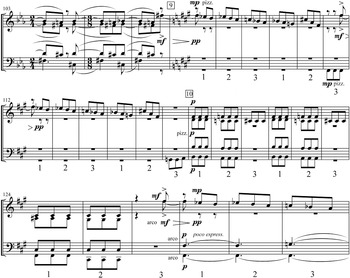
A brief retransition (bars 97–105, not shown) prepares the recapitulation, which features a surprising recomposition of the first theme. Although it returns in the tonic F♯ minor, it is now cast in 3/8, its timbre altered to pizzicato, its motivic content modified, and its internal proportions distorted. It returns with its original melodic contour and sequence of pitches – so this is recomposition almost entirely along rhythmic lines (Example 3). Niall O'Loughlin, Colin Mason, Richard Longman, Kuhn, and others mention the theme's metrical transformation, but only in passing and without investigating its possible significance.Footnote 30 (Mason is among the few even to qualify the first theme's recomposition at all: ‘capricious’ in the exposition, ‘regular’ in the recapitulation.) The same commentators either explicitly or implicitly describe the movement as a sonata form without development. I cannot quibble with the label, yet it glosses over one of the movement's most intriguing features: the principal theme's radical rhythmic transformation.Footnote 31
The role of development is actually embedded in the striking recomposition of the first theme. The original x motif is evened out from to  like lumpy dough flattened by a roller. The new triple metre is felt – not just notated – and because of that, the original pattern of pitch accents is audibly distorted. The motivic flattening is not completely even: the initial F♯ (bars 105–6) is prolonged to a crotchet in duration (via syncopation across the barline), therefore twice the length of each of the subsequent notes in the descending phrase. Moreover, this agogic accent is further emphasized at its reprise by a striking timbral effect: the second violin playing arco to the first violin's pizzicato (bar 111). While the beginning of x is expanded, y is truncated: compared to the exposition, x in the recapitulation is longer (sixteen as opposed to nine quavers) and y is shorter (four as opposed to nine quavers). Note also how the y footprint has been evened out from to . Finally, the one-beat metric insertions are eliminated in favour of an overlap.
First movement (bars 103–29). © Copyright Boosey & Hawkes Music Publishers Ltd. Reproduced by permission.

Despite all these transformations, at the level of hypermetre the recapitulation of the first theme group is indeed, as Mason notes, far more regular. The initial F♯, prolongation notwithstanding, serves an anacrustic function. The overlap between phrase repetitions and the truncation of the y motif in the b part of the sentence eliminate the metric-insertion hiccup effect. The entire sentence, in fact, can now be heard in a triple hypermetre that extends, uninterrupted, not just across the first sentence, but until the final presentation of the main phrase at bar 162 (not shown). The recapitulation of the first theme therefore not only changes metre but is also more stable hypermetrically than in its exposition. Shostakovich had, of course, already experimented with metrically altered recapitulations in his earlier quartets. As Mason observes, the principal theme in the first movement of the First Quartet, originally in 3/4, returns in 4/4. Conversely, in the first movement of the FourthQuartet, a reprise in 4/4 follows an initial exposition in 3/4.Footnote 32 Although the rhythmic-metric reprise of the Seventh Quartet's first theme can therefore be rationalized on the basis of stylistic or historical precedent, its return in the finale – as I shall later demonstrate – complicates matters. In fact, it is the quartet's unusual cyclic structure, when combined with the first movement's peculiar rhythmic qualities, that seems to demand a narrative interpretation.
After the recapitulation of the first theme group the movement gradually winds down. The second theme group returns, as expected, in the tonic F♯ minor and features the relative stability of four-bar hypermetre. The coda, curiously, restores the exposition's inherent metric instability by recalling y in its original setting, namely riddled with destabilizing metric insertions. The movement ends in the major with one last espressivo (i.e. non-staccato) iteration of y.
ii) The thematic persona: [0134] lurking in the shadows
Although the rhythmic-metric transformation of the first theme group commands the bulk of the listener's attention in this neat little sonata-form movement, lurking below the surface is another process whose significance becomes clear only in the ensuing movements. As Kuhn notes, a distinct four-note motif, defined by the intervallic structure semitone–tone–semitone and generalized as the set class [0134], permeates the movement.Footnote 33
Appearances of [0134] (first movement).

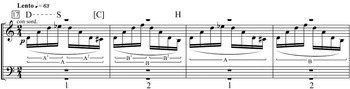
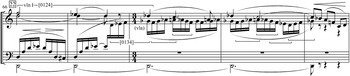
Second movement (bars 1–28). © Copyright Boosey & Hawkes Music Publishers Ltd. Reproduced by permission.


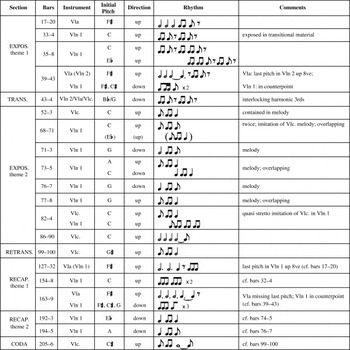
This four-note motto is, of course, a scalar permutation of DSCH.Footnote 34 Table 1 catalogues the appearances of the motto in the first movement, including all instances identified by
Kuhn.Footnote 35 The data are revealing. The vast majority of entries share three characteristics: they begin on either F♯ or C, they ascend, and they are built on or contain the or footprint. Thus, despite subtle rhythmic variations, they have much in common. Consistency and sheer force of repetition suggest a compositional significance that cannot be attributed – at least in this case – to Shostakovich's musical language alone.Footnote 36
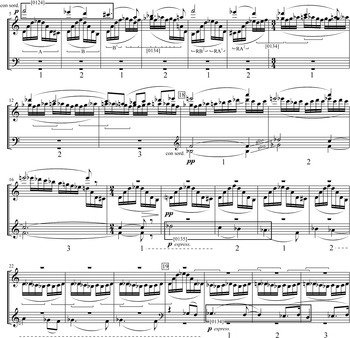
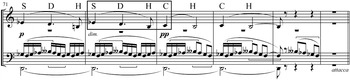
Second movement (bars 66–76). © Copyright Boosey & Hawkes Music Publishers Ltd. Reproduced by permission.


B Second movement: the motto ascends
While rhythmic and metric processes occupy the foreground in the first movement with the DSCH motto percolating almost imperceptibly beneath the surface, in the second movement the locus of the drama seems to shift to pitch and motive. In other words, the rhythmic-metric and thematic personas swap roles: a foreground process moves to the background and vice versa.
The drama in the realm of pitch unfolds upon a rhythmic and metric background in which the subtle shifting of hypermetre from duple to triple, and its occasional suspension, create a floating and dreamy atmosphere. In this movement, free of abrupt metric insertions, metrical intrigue persists, but in an airy interplay of organic lines and shapes (Example 4). At the surface level the muted second violin initiates a steady pulse-stream in semiquavers, arpeggiated and legato – a constantly active but meandering motion that underscores the outer sections of this ternary movement (the viola takes up the pattern upon its return at bar 66 – see Example 5). The first two bars establish one-bar repeating patterns, A and B respectively, that define a duple hypermetre at the one-bar level.
The pitch story is embedded into the gently oscillating rhythmic and metric flux. The initial pattern outlines a D minor triad; added notes function as real (E♭, C♯) and quasi (B♮) neighbours that – along with D, the decorated note itself – hint at DSCH (C♯ standing in for C♮). Though not adjacent, the pitches occur in the right order and are rendered prominent by their placement in registral extremities. At bar 9 the A and B patterns become fragmented and appear in retrograde.Footnote 37 And at bar 11 the arpeggios are squashed into close-interval slithery figures, coinciding with a change of metre to 3/4 and the accompanying gentle and temporary shift to triple hypermetre.
What seems to be disrupting the accompaniment's regularity is the unravelling of a slowly descending lyrical melody in the first violin (bar 5), later echoed in the cello and viola (bars 18 and 26 respectively).Footnote 38 The intervals engendered in the first four notes of each statement of the falling melody, when abstracted into set classes, either correspond to the DSCH set class [0134] or come remarkably close (Table 2). Each entry begins on a different pitch and projects differently ordered tones and semitones. None contains the actual DSCH pitches proper, let alone its actual melodic contour. And yet a subtle narrative process is at play. In relation to the final entry's [0134], the first entry's [0124] sounds intervallically compressed, while the second entry's [0135] feels expanded. Could this be a trial-and-error search for [0134]? Perhaps the movement's opening section, then, in rhetorical terms, poses a question: ‘DSCH?’
Incipits of the lyrical melody (second movement).

A possible answer is meanwhile hovering quite audibly in the compressed serpentine accompaniment pursued by the second violin from bar 11 onwards. The undulating figure embeds a continually overlapping turn, up and down, built on [0134], whose pitches are anticipated in bars 7–8. The meditation on [0134] is fleeting, however: at bar 14 the haunting glissando in parallel fifths in the lower strings breaks up the pattern, and by bar 17 it has restored the initial arpeggiation in time to accompany the next melodic entry, at bar 18 in the cello. But the [0134] undulating pattern soon returns in bars 22–4 and again at bar 26, where, significantly, it accompanies the viola's entry, itself built on [0134]. Here the texture becomes saturated with [0134] for the first time, in both the melody (viola) and the accompaniment (second violin).
The convergence of second violin and viola on [0134] liquidates the accompaniment's steady pulse-stream in the bars leading up to bar 36 (not shown), where it morphs into a dotted repeated-note figure. Over the now stripped-down rhythmic accompaniment the cello and viola introduce a haunting tune in octaves, later answered by the first violin. The entire central section, in C♯ minor, is cast into a regular 1–2–3–4 hypermetre at the bar level, the longest stretch of uninterrupted hypermetre in the piece thus far. The abbreviated return of the opening section occurs at bar 66 (Example 5). Here the first violin restates the initial melodic line (of bar 5) on the same pitches but an octave lower, a gesture that recalls the DSCH ‘question’.
In the movement's last six bars the first violin meanders among the DSCH pitches and in this order: SDH SDHC HCH. For the first time the motto is complete, presented at actual pitch and with all pitches adjacent. This hints at an answer – ‘DSCH!’ – but a feeble one, since the order remains incorrect and, at this pitch level at least, it is immediately liquidated. The undulating accompaniment, however, now in the viola, from bar 68 until the movement's close, dwells obsessively upon [0134]. Moreover, [0134] in its descending, scalar form is cast into relief by repetition, augmentation (bar 73), and – in the last instance – further by isolation (bar 75). The motto's emergence at the movement's close is thus the crystallization of a background process that began at the very start of the piece, from a light simmer in the first movement to surface bubbling in the second; in the finale, the quartet boils over in a [0134]-saturated fugue.
C Third movement: the taming of the motto
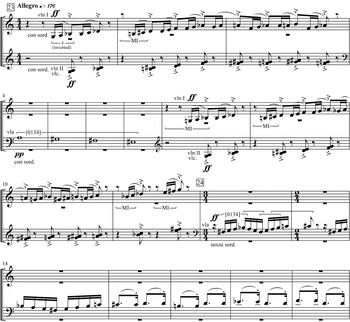
The finale's muscular opening (bars 1–11) immediately recalls the first movement's principal theme, the first violin's stilted ascent an approximate inversion of the initial x-phrase (Example 6). It also shares with the first theme group jolting metric insertions. But the gesture's suddenness and its brutality cause the phrase to crumble, crudely, into its smallest irreducible part: a single cell of x.
Interpolated into this wild outburst is a four-bar chant in the viola marked pp (bars 4–7). The four semibreves are a direct quotation, enharmonically respelled (as the only diatonic setting of [0134] in F♯ minor), of the viola's [0134] motif that was isolated in the concluding bars of the previous movement. The chant also foreshadows what comes next: at bar 12 the viola launches what burgeons into a vicious fugue – an ‘outbreak of violence’, as Eric Roseberry puts it.Footnote 39 The first four notes of the subject, in semiquavers, form an inverted transposition of the viola's chant: in other words, they preserve the semitone–tone–semitone interval order. Moreover, the second beat of the subject, which retraces its steps, contains the same ordering of intervals – as do several of the other groupings. In other words, the fugue subject, like the undulating accompanying figure in the outer sections of the second movement, is saturated with [0134]. But here [0134] has unequivocally assumed the foreground. Besides inversion, the rhythmic relationship between the chant at bar 4 and the fugue subject at bar 12 is one of extreme diminution: from semibreve to semiquaver (though the diminution effect is considerably lessened if the fugue subject is compared with the undulating accompaniment in the second movement).
Third movement (bars 1–18). © Copyright Boosey & Hawkes Music Publishers Ltd. Reproduced by permission.

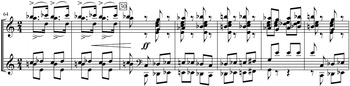
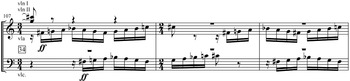
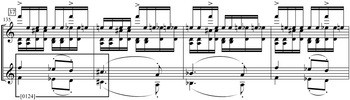
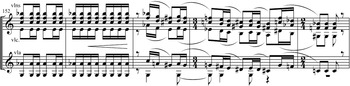
The fugue subject is square and angular in both its head (semiquavers) and tail (dotted rhythm). The answer is set off by a one-beat metric insertion (rest), a device borrowed from the first movement but here applied to even more jarring effect. That the subject's head is an anacrusis is confirmed by the fugue's third entry, that of the first violin on F♯ (bar 25, not shown), which is notated as an anacrusis and without a beat of metric insertion. The alternating placement of accents in the countersubject – now on the beat, now off – contributes to the fugue's fury, though the syncopations, rather than generating metric ambiguity, seem to reinforce the fugue's squareness. The subject is tortured in rapid succession by augmentation, stretto, and other familiar and less familiar fugal devices (see Examples 7 to 10). At bar 58 the viola and cello present the subject (its intervallic content now compressed into semitones) a minor second apart, a grating effect that blurs the tonal centre (Example 7). Soon after, at bar 67 (and again at bar 80, not shown), they hammer out the subject in augmentation, now an octave apart (Example 8). At bar 95 the original subject (beginning on C♯) in the viola and cello is superimposed upon its double augmentation in the second violin (Example 9). And then at bar 107 Shostakovich pulls out all the stops with the introduction of stretto at the crotchet (Example 10). Dissonance and rhythmic activity reach a frenzy by bar 135 (Example 11), at which point the viola and cello present a direct quotation – and at exact pitch – of the first violin's descending melody in the second movement (compare with bar 5, Example 4), here rhythmically reworked. The quotation recalls the search for DSCH undertaken in the second movement. But the violins, busy making the loudest possible racket, are not listening. And so everybody starts screaming at bar 151 (not shown). This leads to the climax of both the movement and the piece (Example 12).
Third movement (bars 55–8). © Copyright Boosey & Hawkes Music Publishers Ltd. Reproduced by permission.

Third movement (bars 64–70). © Copyright Boosey & Hawkes Music Publishers Ltd. Reproduced by permission.

Third movement (bars 94–100). © Copyright Boosey & Hawkes Music Publishers Ltd. Reproduced by permission.

Third movement (bars 107–9). © Copyright Boosey & Hawkes Music Publishers Ltd. Reproduced by permission.

Third movement (bars 135–8). © Copyright Boosey & Hawkes Music Publishers Ltd. Reproduced by permission.

Third movement (bars 152–6). © Copyright Boosey & Hawkes Music Publishers Ltd. Reproduced by permission.

At the peak of this madness, when dissonance has become so utterly saturated that it risks losing its bite, and when syncopation, through overuse, reinforces regularity, the winds of metric instability, originating from the first movement, gust onto the scene and restore ‘order’. This process is paradoxical: instability in the realms of pitch and surface rhythm is exchanged for instability in metre. In other words, the resulting calm remains riddled with uncertainty. And so, at bar 154, these metrically unstable gusts reintroduce the first movement's principal theme (theme P), complete with metrical irregularities (Example 12). At first the theme is harmonized in parallel dissonance – what Longman calls its ‘chordal rendition’ and Viktor Bobrovskiy astutely describes as the theme played in four keys at once.Footnote 40 But this polytonal gesture is soon liquidated and the general atmosphere calms down. ‘Order’ is quickly restored.
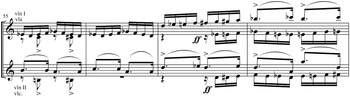
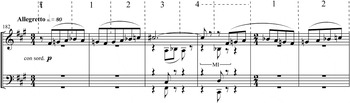
The winds of metric instability dissipate; yet the spell they have cast lingers. At bar 182, marked Allegretto like the first movement, the final episode of the quartet begins – a fourth movement in all but name (Example 13).Footnote 41 It opens with the fugue subject, but completely transformed: slowed to a third of its original tempo, recomposed in 3/4, and regrouped into 5 + 6 legato quavers. Thus modified, it assumes a teetering lilt. The wild fugue has been tamed. While retaining its pitch content (saturation with [0134]), the metrical transformation of the fugue subject radically alters its pitch-accent pattern, as had the transformation of the first theme of the first movement in its recapitulation. Longman describes the resulting mood as ‘serene but withdrawn’.Footnote 42 O'Loughlin speaks of ‘dramatic surrender to a quiet muted section’.Footnote 43 Mason hears in the reformed fugue subject a ‘quick waltz-like tune’.Footnote 44 Indeed, all seem to acknowledge the utter collapse of the fugue in the face of frustration. The cause of this ‘surrender’, I propose, is the return of the first movement's inherent metric instability.
Third movement (bars 182–7). © Copyright Boosey & Hawkes Music Publishers Ltd. Reproduced by permission.

The recast fugue subject (its head at least) is now combined with metric insertions (rests) and receives the same off-kilter treatment that the quartet's opening theme did in the first movement. A new comical, drunken tune complements the first theme group of this small sonata form close. The second theme group – the arco and pizzicato sections beginning respectively at bars 240 and 293 (not shown), both in 3/4 – corresponds to the recapitulated theme P in the first movement (see bar 106 in Example 3). Thus a gradual unwinding of the built-up tension until the movement's close: a tamed fugue subject, a new comical theme, and the return of the y footprint are superimposed and juxtaposed, collage-like. Order is restored – but an order that, like a scherzo, is inherently unstable.
Although the more stable triple-metre version of theme P appears in the concluding Allegretto, suggesting thereby the ‘triumph’ of stability over instability, any sense of ‘resolution’ is effectively undermined by the theme's position within the form – as a now abridged secondary theme. Its reprise is also considerably shortened. Resolution – if there is any at all – is tempered at best by the metrically destabilizing force that frames the concluding section of the quartet. Table 3 summarizes the form of the whole quartet.
Formal overview of quartet including unfolding of two personas.

Metric instability persists in surface details as well. Not only is the new waltzified fugue theme (at bar 182, for instance) rhythmically distorted, but its restatement at bar 185 occurs two beats ‘late’ owing to metric insertion. This, in turn, requires the adjustment of the metre to 2/4 for two bars to permit the theme to ‘get back on track’ at bar 188 (not shown). The same hiccupping metric insertions occur at bars 205 and 219, and in the theme's recapitulation at bars 263 and 279 (not shown). On the heels of the last presentation of the drunken theme at bar 313 (not shown), fragments of theme P (the one allied to the first movement's first theme) are intercut into the texture (bars 319, 323, 328, and 334 – not shown). Stripped of melody and reduced to a steady repeated-note rhythm, the theme continues to disintegrate into the coda (bar 336, not shown), where it sheds its downbeat, and eventually, via augmentation, even loses its triple feel thanks to the composed ritardando.
The codas that punctuate the first and last movements are similar in many respects except one: the latter is in triple time. The final coda does not, however, feel more stable: the waltz-fugue theme that leads into the coda is – significantly – extended by an extra beat (bars 336–8, not shown).
IV Interpretation: comfort of denial
[A]ll the finales in Dmitri Dmitrievich's quartets are tragic in character, unlike those of Beethoven. And I think I know why. Beethoven, more often than not, arrives at a life-affirmative finale, despite all the conflicts and collisions, all that is lived through beforehand in the music's unfolding. Beethoven was a person who believed deeply in, and looked toward, some brightness on the other side of life. But Dmitri Dmitrievich was an atheist and could not see anything beyond human existence. Shostakovich was afraid of death. He could not envision an exodus from human suffering.Footnote 45
If we accept the claim of Valentin Berlinsky, long-time cellist with the Borodin Quartet, that Shostakovich's quartets all end in tragedy, the problem before the interpreter is to characterize the nature of the tragedy in each case. What tragedy, then, does the Seventh Quartet depict?
I propose that the quartet's complete musical persona consists of two elements, akin to two facets of an individual's character: an emerging [0134] motto, and rhythmic and metric instability. These two elements, introduced separately in the first movement, follow their own trajectories across much of the quartet. In this sense they may be viewed as two independent narrative threads that unfold in counterpoint. Often oppositional, their relationship can be likened to a person's inner conflict.
Table 3 tracks the unfolding of the persona's two principal elements across the entire quartet. The bottom row charts the degree of rhythmic-metric stability: from relatively unstable (dark grey) to stable (white). The rhythmic-metric element dominates the first movement while the motto lurks in the background. In the second movement the motto becomes distinctly audible in the undulating accompaniment. Above this figuration float descending melodic strands searching for [0134]. By the movement's end DSCH itself is hinted at and [0134], present in both melody and accompaniment, saturates the texture. In the final bars, isolated in the viola, the motto assumes the foreground.
The third movement begins explosively: the first movement's first theme (theme P), now inverted, reacts powerfully to the emergence of the motto. Partially dormant in the second movement, the rhythmically unstable element is here rudely awakened. But the viola – by now the motto's preferred agent – recalls the motto, this time slowly and assuredly, before turning it into the subject that launches a juggernaut of a fugue. Near the fugue's climax the lyrical melody from the second movement returns, a reminder of the quest for DSCH. But the search is in vain: the fugue crumbles under its own spent energy. At the climax theme P returns with its characteristic metric instability, now more emphatic. The rhythmic element quickly restores a semblance of calm – but it is a strange, unsettling quietude. Similar in design to the first movement (a sonata form without development), the concluding Allegretto has as its first theme a transformation of the fugue subject into a metrically unstable waltz-like tune. Interposed with it is a new ‘drunken’ theme that contributes to a sense of imbalance. In a curious reversal, the second theme is now theme P in its ‘regular’ recapitulation version (though considerably abridged). The expected stabilizing effect does not materialize, however, because of the theme's relegation to a subordinate position in the form.
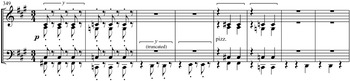
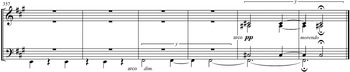
The final coda does little to restore metric stability. Whereas in the near-identical first coda (to the first movement) [0134] lurks only in the background, here [0134] appears prominently in the guise of the lilting fugue-subject waltz tune (bars 336–8, not shown), an extra inserted beat drawing further attention to itself. Meanwhile, the three-quaver rhythmic y footprint appears in its ‘flattened out’ form (lacking its final quaver rest) and reduced to a background pulse (bars 349–50), its distinct character permanently erased (Example 14). The footprint, now augmented, has the last word: first in the cello (bar 359), then in the other instruments as a falsely optimistic F♯ major close (last two bars). Beaten up and bruised by the force of the destabilizing rhythmic element, the motto ultimately finds its ‘identity’. The footprint (the motto's companion?) is likewise accommodated, present only in its ‘subdued’, or ‘regular’, form.
Third movement (bars 349–62). © Copyright Boosey & Hawkes Music Publishers Ltd. Reproduced by permission.


Kuhn describes two interacting elements at play in the quartet: the [0134] motto, which she calls the ‘disruptive force’, and another, more abstract and all-encompassing element that she loosely describes as the ‘structure’. She summarizes their interaction as follows: ‘The process seems to portray the musical structure's attempted suppression of a disruptive force – the motto cell – that nonetheless eventually explodes into its hostile environment. […] The structure cannot reach closure without accommodating the disruptive motto cell; nor can the cell emerge and survive without fitting into the larger structure.’Footnote 46 On some level our readings coincide. But in a key respect they differ: to me, the rhythmic element (and not the motto itself) is the ‘external’, or disruptive, force – a force that acts irrevocably upon the motto. The motto, meanwhile, stands in for the individual, or ‘identity’. In other words, the rhythmic element ultimately suppresses the motto's self-actualization. Although the motto emerges from the background and nears its ‘true’ identity (i.e. DSCH itself, non-transposed and non-permuted), it ultimately fails to accomplish its goal of self-realization.
This may sound far-fetched. But a look at the origins and deployment of DSCH across Shostakovich's oeuvre may help quell some objections. It is well known that Shostakovich's first explicit use of DSCH proper was in the Tenth Symphony (1953), seven years before he completed the Seventh Quartet. But, as Steven Brown notes in his insightful study of the motto's origins, Shostakovich had by then already incorporated the [0134] tetrachord in many earlier works.Footnote 47 Brown posits that the use of [0134] emerged gradually, at first as a natural consequence of Shostakovich's musical language (a result of modal lowering whereby the second and fourth scale degrees of a minor scale are flattened), but also as a result of external influences, including precedents such as BACH and ASCH, and the music of Stravinsky.
By 1960, the year of the Seventh Quartet's composition, DSCH was a conscious musical signature and recognized as such by the public. It is therefore doubtful that Shostakovich could have been unaware of its deployment here (i.e. as various permutations and transpositions of [0134]). From this it follows that the composer crafts a strong statement by so obsessively alluding to the motto as the thematic building block of the entire quartet, by hinting at it at the proper pitch level, by saturating the climactic fugue with it – and yet ultimately withholding DSCH proper. Moreover, in the Eighth Quartet, completed just four months after the Seventh, Shostakovich makes the most extensive and explicit use of DSCH – at its proper pitch level – in his entire oeuvre. So explicit is the motto in the Eighth, in fact, that DSCH appears as the quartet's initial utterance. As Longman puts it, ‘The integral role of the DSCH motto in the Eighth Quartet is almost the opposite of the motto-thematic technique in the Seventh, with stress upon making obvious what the earlier quartet deliberately concealed.’Footnote 48
Withholding DSCH in the Seventh Quartet, then, suggests a lack of resolution: a failed search, failed self-realization, failed self-actualization. In short, an act of denial – the denial of DSCH itself. And DSCH, in the language of the abstract narrative, here symbolizes identity, the self or the individual. Denial presupposes some truth that the subject refuses to acknowledge, perhaps because of the terrifying consequences of so doing. If, in this case, the ‘truth’ is DSCH proper, then why would the quartet's complete musical persona be motivated to deny its realization? How can the search for identity be reconciled with its abandonment? How is that to be understood as ‘denial’? And in what sense can self-actualization be ‘terrifying’?
Here is one possible answer. If the second movement's treatment of [0134] focuses the search for self (DSCH proper), a background process that begins in the first movement, then perhaps the mysterious chant that links the second and third movements – on the ‘wrong’ notes after having almost been crystallized on the ‘right’ ones at the end of the second movement – is the individual's frustrated resignation to its fate. This individual will never find its true self. It is a turning point: moments later the self loses complete control and breaks down into a violent frenzy. Throughout the fugue it kicks and screams, but no matter how much it tries, despite hundreds of repetitions of [0134] in various combinations, the ‘true’ self (DSCH proper) never emerges. At the point at which the individual is about to self-destruct, metric instability comes to its ‘aid’ and restores a semblance of calm. But the price of such assistance is a drug-induced state of denial. The search for identity (DSCH) is abandoned in order simply to make way for existence. And so the self must accommodate itself to an ‘inebriated’ state (the rhythmically distorted waltz version of the fugue subject) in order to survive.Footnote 49
The psychological dilemma implied by this narrative resembles that posed by Henrik Ibsen's morbid play The Wild Duck. Its protagonist, Hjalmar, leads a relatively happy life, though riddled with illusions about his family and career, until challenged to see the ‘truth’ by Gregers, a well-meaning though misguided young man. The ‘truth’ ultimately destroys Hjalmar's marriage and leads to his daughter's suicide. The resulting despair raises the vexing question: if there is no harm done to others, are we better off living a life of illusion, one that is at least superficially stable and happy, rather than confronting the depressing reality of our life, which we may in any case not be prepared to accept? In other words, is denial a necessary and useful mechanism of psychological self-defence? In Act Five Dr Relling puts it this way: ‘Take the life-lie away from the average man and straight away you take away his happiness.’Footnote 50
The comfort that stems from denial might explain how Fanning, Kuhn, Reichardt, and others hear the quartet as achieving a satisfactory resolution. On one level it certainly does: the ending has a soothing, calming quality, a welcome antidote to the earlier violence. But on another level the persistent rhythmic instability and the rhythmic transformation of the square fugue subject into a lilting waltz suggest a resolution that is merely apparent.
In Shostakovich's quartet the search for self may have dire consequences. It is a quest that, in the interest of self-preservation, may best be called off.