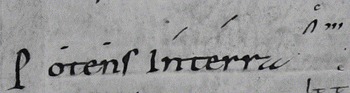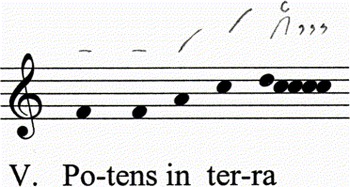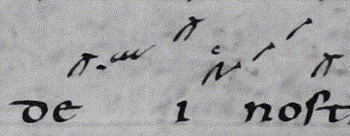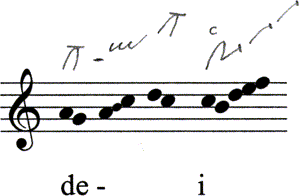


The invention of writing in several parts of the world between the fourth and the first millennia bce ultimately served to encourage the development of new knowledge systems; in its many varieties and functions, writing would become a foundation for changes in cognitive processes.Footnote 1 Whether read as marking the transition from a savage to a civilized culture,Footnote 2 or in less evolutionary fashion,Footnote 3 the availability of writing rendered it possible to pass information of specific kinds from one generation to another, and to others beyond them. That in turn supported aims as diverse as the registration of administrative and economic data, the recording of the history of societies, the rendering of precedent consultable, and sacred display;Footnote 4 eventually, writing became a primary tool of language and in this guise has achieved its most developed forms. The invention in western Europe in the late eighth or early ninth century of ways of notating music – the record of detailed instructions for the delivery of words – can hardly be compared to those earlier moments of invention, so much was the creation of neumatic scripts set within the context of already highly literate communities. Moreover, while the ways of writing verbal language known to Carolingian cantors depended on phonetically formulated groups of symbols and a web of semantic rules, the task they undertook in designing music writing was not to deal with something autonomous, separate from and comparable to verbal language; rather they undertook to show in this music writing specific ways of modulating the Latin language in delivery.
Yet, invention it was: the musical sign systems devised by Carolingian cantors did not rely on those models available to them of musical sounds which could be written. Such models were inherited from Greek theory, as transmitted by late antique Latin writers, above all, Martianus Capella and Boethius.Footnote 5 Greek music theorists had been extremely aware of two ways of thinking about musical sounds, as ‘discrete’ or ‘continuous’, this latter described by Boethius through analogy with the rainbow.Footnote 6 But it was only for the discrete model that Greek theory provided systems rationalised in word and number; such sounds could be heard as a series of individual pitches. These pitches could be named, and their distance at measured intervals systematized; of course, once they were articulated in language, these sounds could be captured in writing. The Greek system set out in Boethius' De musica names each discrete pitch (proslambanomenos, hypate hypaton, etc.);Footnote 7 through the use of names, and knowledge of the place of each pitch in a larger framework such as the ‘greater perfect system’ (two octaves, each of seven steps), it was possible to internally compute the intervallic distance between any two specific pitches.Footnote 8 Such ways of thinking about and handling sounds were certainly available in parts of Carolingian Europe in the first half of the ninth century.Footnote 9 Carolingian music theory provides two further ways of writing discrete musical sounds: both are found in the late ninth-century Musica and Scolica enchiriadis treatises, probably composed in northern France.Footnote 10 In one of these systems, ‘dasia’ symbols function like the Greek names for notes; they represent a kind of code, each sign denoting one pitch within a distinct tetrachord. Such signs are much more concise in written form than the Greek names.Footnote 11 In the other system of discrete-pitch notation used in the Musica and Scolica Enchiriadis treatises, a set of horizontally parallel lines, analogous to strings, represents successive steps within and between tetrachords; onto this foundation text syllables are set, each written on the relevant line.Footnote 12 Where a text syllable is sung to more than one note, part of that syllable is simply repeated from line to line. However close this might seem to the later stave system worked out in eleventh-century theory and widely adopted at that later date, its limitation to texts of music theory in the ninth and tenth centuries is not surprising, since it was cumbersome – greedy for space and slow to write.Footnote 13 None of these discrete-pitch systems was adopted by those concerned with notating the often elaborate chants of the mass and office in the ninth and tenth centuries:Footnote 14 quite the opposite, since none of the diversely initiated neumatic types invented in different parts of Carolingian Europe seems to have set the clear notation of discrete pitches as its principal aim, and none of them achieved that end. The widespread use of notation systems in which pitch – as a quality of musical sound which could be measured – is precisely indicated in writing can be usefully traced back not to the ninth but to the later eleventh and early twelfth centuries.Footnote 15 Indeed, it can be claimed that the invention and development in the eleventh century in both northern and southern Europe of systems of stave notation is the direct consequence of ‘feedback’, a cognitive change brought about by the extensive use of musical notation – and the new attitudes thereby developed as to how such a technique might be exploited.
There is a strong case for arguing that it was the place of music in Christian ritual which primarily determined the nature and forms of the earliest notations for chant melodies.Footnote 16 In the Roman chant tradition inherited by the Carolingians, music acted to render the words of Scripture audible, to interpret the words of Scripture, and to enhance those words, through beauty. On all these levels, music could be perceived as a quality of the delivery of language, its melodies as movements of the voice.Footnote 17 Models for the modulation of language in delivery could be found in the grammatical texts of late antique writers much beloved by Carolingian scholars.Footnote 18 In order to theorize the reality of sound the Carolingians turned to those grammatical models,Footnote 19 above all to their metaphor of a continuum of sound from ‘acute’ (pointed) to ‘grave’ (weighty) quality. By the mid-ninth century at the latest, those concepts of acute and grave had been metaphorically transferred one step further, and could now be expressed in spatial terms, the familiar ‘high’ and ‘low’ sounds.Footnote 20 This paradigm of high and low – the primary element in the notation of pitch and represented in notation by movement up and down the page – has formed a basic principle of music writing in the West ever since. Beyond the height metaphor, at least one form of neumatic notation – written as early as the mid-ninth century – drew even more on grammatical systems for marking changes of delivery in writing. The basis of some palaeofrankish neume forms in the acute, grave and circumflex accents of antique grammar has recently been convincingly demonstrated; moreover, it has also been shown that it was in terms of grammatical accents that the mid-ninth-century music theorist Aurelian of Réôme described musical signs.Footnote 21 Given the issues raised by a 150-year-long dispute about the relation of early musical notations to grammatical accents,Footnote 22 that well-supported conclusion is significant in that it establishes the fact of a perceived link between the two (in the mind of one Carolingian music theorist, at least), and allows further speculation about a stronger association. Whatever the relation between written accents and musical notations, the basis of early neumatic notations in rational thinking about the inflection of language by the singing voice is now beyond dispute.
But why, if Carolingian musicians were familiar with a variety of ways to notate pitch precisely, did they choose not to use such methods for the notation of ecclesiastical chant? Although we cannot know to what extent the use of expensive materials (parchment) and resources (scribes' time, availability of light) was a factor in this choice, it is likely that issues of manufacture were secondary to the realities of musical transmission and the introduction of music writing. Before the ninth century, musicians had been able to consult books of chant texts;Footnote 23 the action of reading through a visually available text formed part of the process of recall, prompting a musician to bring to mind the melody to which it should be sung, phrase by phrase, moment by moment.Footnote 24 The addition of signs for musical delivery over those texts simply shifted the balance between remembering and reading: in the sense that the habit of memory cannot have been destroyed overnight, the addition of musical notation was not a radical step. That memory and recall continued to play a central part in musical practice is abundantly evident in the notations created in the ninth century. These notations remind the reader of sounds that he has heard, but do not provide primary instructions as to how to make those sounds. One aspect of the sheer diversity of these notations is itself indicative of their bond to a practice stored in memory. They could contain information about a great variety of qualities of sound – the shape of a melody, the articulation of each melodic segment, speed, timbre, emphasis, even voice production,Footnote 25 all of this within a overall scheme determined by the layout of text and the link between parts of the melody and text syllables. But, while the ‘aide-mémoire’ character is common to all ninth- and tenth-century chant notations, the ways in which these various elements were handled in writing, and the balance between them, differed from one notation to another. That this should be so is hardly surprising: if oral practice was the primary basis of transmission, the purpose of notation was to lead the reader back into remembrance of it. Many notational marks are so specific to tiny melodic segments – ‘sing this note quickly’, ‘sing this strongly’, ‘use a soft tone here’, ‘in this phrase this note is the climax’, and so on – that they would guide the reader to the immediacy of a previous musical event rather than to a notional ideal. Therefore, divergence of approach to the importance of one element of sound over another in these early notations need not be read as an indication of the insufficiency of notational techniques: for it may spring from the differing judgement of those who designed specific notational types, the habits of individual notators, and the preferences of individual cantors. In other words, divergence of balance between the notated parameters can be used as a lens through which to observe the mechanics of the interaction between memory and writing. That is what will be attempted in this study,Footnote 26 using the ways in which pitch is treated by each of two scribes working in different parts of Europe as a tool for analysis, and for the consideration of attitudes to the possibilities offered by music writing.
CAROLINGIAN NOTATIONS FOR MASS AND OFFICE CHANTS
The invention of music writing in the Frankish kingdoms in the late eighth or first quarter of the ninth century was only one aspect of an intense and manifold engagement with writing in this period.Footnote 27 Above all, the Carolingians were responsible for giving new impetus to the growth of literacy east of the Rhine and to its diversification in a wide area of western Europe; with their educational programme, directed towards the support of understanding the Scriptures, came the development of a new minuscule script, designed to be clear to a wide readership (not only those trained in a specific locality), and to look beautiful on the page.Footnote 28 The expansion of book production, the making of more fine books, and changes to the presentation and arrangement of text on pages in order to support correct reading aloud from them, are all evident consequences of a cultural programme initiated in the last quarter of the eighth century and supported by Charlemagne's sons and grandsons through the 150 years of their domination of western Europe.
This early context for the invention of music writing could not control all the directions in which individual initiatives would lead, once the idea of musical notation had become concrete. The variety of uses (all within an ecclesiastical framework) to which musical notation was quickly put suggests that there were multiple factors working in favour of its early development.Footnote 29 Among the extant examples of notation written in the ninth and early tenth centuries are instances of passages in texts of music theory, passages to be sung by a priest or deacon, and individual examples or repertories of more elaborate chants for the mass and office, sung by the schola or by soloists. Although it has become something of a topos to declare that sources of this latter kind do not survive for the ninth century,Footnote 30 the simple fact is that they do, and in numbers large enough to demonstrate their considerable significance in terms of the functions of music writing (see Appendix). To a scribe these musical situations presented quite different writing tasks: notation in a book of music theory might require different kinds of prompting and/or precision from those needed in a book used in the liturgy, depending on the point at which the theory writer was driving: as noted above, those texts include notations of kinds which never appear in books prepared for liturgical practice. Equally, passages of notation for texts delivered by a priest or deacon (such as the Christmas Genealogy reading and the Easter Exultet) dealt with relatively uncomplicated melodic content based on recitation patterns; the main purpose of these notations was to indicate to the reader how to modulate a simple pattern in relation to specific text phrases. It is only in the chants for the mass and office – including not only the central chant repertories but also the new tropes and sequences – that more elaborate melodies are found. Among these are melodies which, on the one hand, would have most challenged the memories of cantors, and, on the other, presented scribes with the most complex notational tasks. In other words, this is the musical material around which the interaction of orality and literacy, the interface between modes of recall and modes of writing, will have been most intense. This is therefore the material which will offer the richest source of examples for the study of pitch treatment.
The number of sources of notated mass or office chants which can be securely dated in the ninth and early tenth centuries amounts to at least thirty.Footnote 31 Within this body of material, just under half consists of pieces written into books which have nothing to do with music – sometimes just one chant, but sometimes more. In a copy of John Cassian's Institutiones, copied in the seventh century in half uncials (Autun, Bibliothèque municipale S28, olim 24), several chants were added, mostly on one opening (fols. 63v–64r), but also in margins throughout the book;Footnote 32 there is enough text associated with these notations to allow a dating for most of them in the middle third of the ninth century. Mostly, however, such occasional additions to books comprise just one chant, as for example on the last page of Munich, Bayerische Staatsbibliothek clm 9543; here the prosula Psalle modulamina is followed by a colophon identifying ‘Engyldeo’ as the writer, and linking the book with Regensburg in the second quarter of the ninth century.Footnote 33 More significant in the consideration of those factors which determined notational design, and especially pitch treatment, are extant sources of mass and office chants which represent repertorially organized and notated chant books – since it is these rather than the sources of occasional notations which will reflect the work of scribes achieved over a longer period of time than one sitting; likely to have been written at a home institution, and therefore responding to direct daily needs; and, finally, based on notational practice which was to some degree settled. A total of nineteen sources, drawn from nineteen separate books, is composed mostly of fragments, but also two sizeable books (including one in which a substantial portion was prepared for notation, but to which little notation was added). As a group, these sources indicate a practice of chant notation which stretches back to before the middle of the ninth century, and which had become widespread in both western and eastern Francia by the end of the century. These sources are listed in the Appendix, divided into books for the mass and books for the office.
There is a second requirement of source material for this study: to make sense of an investigation of the treatment of pitch, it is essential to begin with fairly extensive examples of the writing of individual scribes. For this reason, the main part of this study will include an examination of notation in the gradual Laon 239, made in the last quarter of the ninth century. None of the other sources listed in the Appendix has enough sustained music notation (or in the cases of palimpsests enough legible examples) to be sufficient for study of procedures of the kind envisaged. For another comparative series of examples I have therefore chosen to use a book notated in the first quarter of the tenth century (Stiftsbibliothek Sankt Gallen 359). In the case of both this and the Laon book, the approaches of their scribes to music writing can be matched to other sources among the fragments listed in the Appendix. This second level of enquiry will allow testing of the results from the first level – whether or not techniques of music writing, especially of the treatment of pitch, can be traced in a wider sphere beyond the two individual books, Laon 239 and SG 359. Following the examination of notation in each of these two books, some space will be dedicated to commentary on the relation between these and the fragmentary sources.
THE TREATMENT OF PITCH IN EARLY MUSIC WRITING: PREVIOUS STUDY
Notation through accents was not yet aware of the fertile principle of layering notes on top of each other. The pitch of tones is not yet expressed by the respective position of signs . . . perhaps no one would even have come to invent intervallic or ‘diastematic’ notation, if liturgical copyists had not had accent neumes available to them; these accent neumes became the primary material with which they worked over a long period, leading them eventually, through many successive transformations, to the perfect expression of the musical scale of tones. (Dom André Mocquereau, writing in 1889)Footnote 34
The primary function of musical notation is usually regarded as the indication of pitch, but this was evidently not the case with the earliest notations. It is essential to realize that the music represented was already known by heart as far as its tonality and pitch content were concerned. The notation reminded the singer of details of phrasing, rhythm, and dynamic, together with some refinements of performance . . . (David Hiley, writing in 1993)Footnote 35
The publication of the first volume of the series Paléographie musicale marked the beginning of modern study of early medieval notations.Footnote 36 In the hundred years between this and David Hiley's handbook of Western plainchant, musicologists had understood that neumatic notations represented the written reflection of an activity which remained fundamentally oral/aural. Nonetheless, the introduction of writing into the domain of ecclesiastical chanting may have caused some shifting of musical sounds from the aural to the visual domain,Footnote 37 allowing cantors to reorganize and reformulate musical material in a new way.Footnote 38 At the very least musical notation introduced a new aspect of textual literacy – a means of writing down ways of delivering text – and thereby caused the interaction between written and oral supports for the performance of liturgical chant to be modified. Where previously a singer had access to written records of the textual phrases which should be sung in the liturgy, now a singer might have access to written records indicating how those textual phrases were to be musically performed. Awareness of that interaction marks Hiley's description as firmly as it is absent from Mocquereau's.
The means of transmission of music was only of secondary interest in these descriptions of early notations, however: it was the ability of early neumatic notations (or lack of it) to indicate pitch on which these writers were commenting. And on this matter there is less disagreement: both writers note a deficiency of pitch information in these notations, Mocquereau through his use of the adjective ‘fécond’ for the principle of ‘superposition’ of notes, setting systems which did not proceed in this manner in a somewhat pejorative light, Hiley indicating that pitch indications were not given a high priority in the ‘earliest notations’. It is in their assessment of the reasons for the absence of pitch indications that the two accounts differ: Mocquereau adopts an evolutionary and teleological position, underlining the long period during which notators had to labour, and the number of steps they had to take, in order to arrive at ‘the perfect expression of a musical scale of sounds’, while, in contrast, Hiley appeals to the purpose of musical notation – as support for a memory-based practice – as a direct explanation for the paucity of pitch information in these notations.
The positions taken by these two writers, at either end of a period of intense historical enquiry into the ‘composition and dissemination of an unwritten tradition of Gregorian chant’ and ‘invention of systems of musical notation and their development as they were adapted for the creation and dissemination of a written tradition of the chant’,Footnote 39 engage with and/or are replicated by others writing in the earlier and later decades of this period. Most prominently, in a book-length study of neumatic notations published in 1912 Peter Wagner dedicated two chapters – ‘The beginnings of diastematy’ and ‘The perfecting of diastematy and its effect on the transmission of chants’ – to examination of the treatment of pitch in early medieval notations.Footnote 40 It is in his study that the fullest statement of the teleological view can be found: ‘it may well seem peculiar, that the – for us so natural – concept of diastematy was arrived at so late’.Footnote 41 Wagner's perceptions of this material are marked by concern with new discoveries, with technical advances, with public acclaim for those who are responsible for them.Footnote 42 He sets out a series of steps by which precise pitch notation was arrived at, without questioning why, according to his interpretation of the source material, it took so long to arrive at the set goal.Footnote 43 He seems not to have considered the consequences of juxtaposing to these neumatic notations early medieval knowledge of Greek music theory, with its diatonic double octave scheme, or indeed the notational systems based on tetrachords or parallel horizontal lines known to late ninth-century music theorists.Footnote 44 The idea that writers of neumatic notation might deliberately have chosen not to integrate precise pitch information into their scripts seems not to have crossed his mind. This is underlined by his use of expressions such as ‘straining to express (in the form of the neumes)’ (p. 258), ‘a primitive sort (of diastematy)’ (p. 266), ‘advances (on the attempts described)’ (p. 266).Footnote 45
At the other end of a century of study of neumatic notations, the 1970s and 1980s were especially rich in relevant publications. The two most comprehensive studies to have been published since Wagner's Neumenkunde appeared almost simultaneously: in 1975, Bruno Stäblein's Schriftbild der einstimmigen Musik (in the series Musikgeschichte in Bildern) and in 1977 – posthumously – Solange Corbin's Die Neumen.Footnote 46 These books include extensive reproductions and transcriptions, and attempt to classify and order examples of different types of neumatic script. On the heels of these broad, palaeographically focused, examinations came a rich series of interpretative studies, from scholars working both in Europe and the USA.Footnote 47 In all of this later material, the fact of a relation between neumatic notation and memory had been realised (even if the consequences of that relation were understood in different ways): the manner of interaction of early notations and memory in musical practice was considered most closely by Leo Treitler in a series of articles, above all ‘Reading and Singing’ (1984) and by Kenneth Levy, also in a series of studies, notably ‘On the Origin of Neumes’ (1987). These remain the most recent substantial studies of the origins and functions of musical notation in the Carolingian period. And it is in the context of Treitler's ‘Reading and Singing’ that an extended consideration of the treatment of pitch in early neumatic notations reappears. Setting notations used for different purposes (pedagogical, liturgical recitation, chants for the schola) apart, Treitler argued that, in this earliest period of use of musical notations, it was only in notations used for pedagogy that the indication of pitch patterns was a principal task, pointing out that ‘there are notational situations from the earliest period in which pitch indication for its own sake really plays no role at all’.Footnote 48 The perception that it was not ‘a primary task of early neumatic writing in practical sources to mark pitch differentiations’Footnote 49 sits convincingly with the account he set out of ‘the entrance of a writing practice into the domain of an oral tradition’.Footnote 50 This provided the basis for Hiley's 1993 statement.
Dom Mocquereau's assessment of the pitch-indication capacities of early neumatic script was only one element in a grander hypothesis about the origins of musical notation and the position of extant sources in relation to those origins.Footnote 51 Critically important to his theory was a division between systems of notation based on ‘neumes-accents’ and those based on ‘neumes-points’ (neumes built up from the acute, grave and circumflex accent signs, and neumes built up from series of individual points).Footnote 52 These categories operated on two levels, on the one hand describing and differentiating extant examples of neumatic notation, and on the other providing openings through which a narrative of the history of musical notation could be explained. Mocquereau's examples of notation in ‘neumes-accents’ were largely drawn from manuscripts held in the library at Sankt Gallen (and this, first, volume of Paléographie musicale was dedicated to a facsimile of SG 339, a gradual copied at this Benedictine abbey in the late tenth century).Footnote 53 In contrast, in the main statement of this theory, Mocquereau did not cite any examples of manuscripts notated in ‘neumes-points’, but provided the broad characterization ‘an immense family of point neumes which, from the tenth century on, invade liturgical manuscripts and end up by completely supplanting the primitive accents’.Footnote 54 In fact he saw the writing of individual points to represent notes as a modification of the system of accent neumes, in parallel to his theory of the history of notation.
As with neume types, Mocquereau's notation history had two parts, and was set out in two phases: first, the earliest signs for musical notations adopted signs for grammatical accents as a graphic basis but were shaped and deployed on the writing surface in imitation of the hand gestures of cantors. This was not an abstract representation of musical sounds of the kind to which modern musicians are used, but a written representation of a physical movement: it was therefore a notation ‘oratoire’ or ‘chironomique’.Footnote 55 In contrast, notations in which written signs (whether detached points or longer ‘joined’ signs) indicated musical sounds directly could be described as ‘musicales’ or ‘diastématiques’. Mocquereau then argued for the anteriority of accent over point neumes, citing (a) the chronology of extant sources; (b) the shapes of the signs in each of his systems (‘simple and natural’ in the first, ‘strange and bizarre’ in the second); (c) the wide geographical diffusion of accent neumes, and the comparative restriction of point neumes; (d) the lack of variation in different examples of accent neumes, compared to a noticeable variation in different examples of point neumes.Footnote 56 In this way he was able to argue for the greater antiquity of accent neumes, and – most significant in the current context – that a system of musical notation which is characterised by a greater amount of pitch information must be younger than a system which has less ability to convey pitch information. This historical relation allowed him to think in terms of a perfected earlier system of accent neumes, which was then corrupted by a later influence, ‘the invasion of points’, explaining why he gave no direct examples of notations in point neumes, but only of notations in which the transition from accent neumes to point neumes could be seen.Footnote 57 There is a curious quality of paradox in Mocquereau's theory, since he considered the early accent-neume system (in reality the notation of specific Sankt Gallen books) to be ‘perfected’, ‘achevée en son genre’Footnote 58 – only to be later corrupted by point neumes – and yet, at the same time, ‘musically’ insufficient.Footnote 59
As an integrated theory of notational origins, and of the interrelation of surviving notations, Mocquereau's ideas have long been set aside: much has since been learned about the dating of extant sources which would force a reconsideration of fundamental elements in his theory, while the goal-orientated treatment of techniques of pitch notation has become unacceptable as a way of reading source material. The issue of a typological division between ‘accent’ and ‘point’ neumes will be taken up again below. The dual ‘cheironomic/diastematic’ theory was last taken seriously in Dom Gregorio Suñol's manual of neumatic notation first published in 1925, with a dedication to Mocquereau;Footnote 60 it was here rather than in volumes of Paléographie musicale that the Mocquereau theory was most fully worked out in terms of actual neume shapes. On accents, Mocquereau's theory has proved to be, like the curate's egg, good in parts, bad in others. As explained above, certain palaeofrankish neume forms were based on grammatical accent signs;Footnote 61 and yet, in the face of this direct connection, there is little evidence to support a universalist theory of neume origins of the kind he proposed.
By the 1950s a new wind was blowing through the work not only of scholars based in universities but also those at the abbey of Solesmes. In this regard 1957 was a rich year: with two studies, both undertaken in France, enormous steps were taken in the sorting out of regional notations, that is, not only in the differentiation between typologies of notation according to their repertory of signs, but also in the mapping out of geographical areas in which specific notations were in use. Solange Corbin's dissertation for the doctorat d'état dealt with neumatic notation in use in ‘les quatre provinces lyonnaises’ (covering large areas of modern France),Footnote 62 while that volume of Le Graduel Romain, Édition critique which listed sources was able to establish relations between regions and notations across the European continent.Footnote 63 Already in 1951 Jacques Hourlier had published a notational study which set a new palaeographical standard, since he was able then to list over 300 medieval sources notated in one kind of notation (Messine), and thereby to sketch out definitively the regions in which such notation was in use;Footnote 64 in 1963 Michel Huglo published a parallel study on sources notated in the so-called ‘Breton’ notation.Footnote 65 All of this was the result of work sustained by the monks of Solesmes over decades, collecting photographs and information about sources, studying their notations, and transcribing and classifying their melodic contents.Footnote 66 It was only now, after the Second World War, that the discovery of a hitherto unrecognised early notation type was announced. The Solesmes team had long been familiar with this notation – named, in their house terminology, ‘notation de St. Amand’.Footnote 67 But the first public report of the existence of ‘Eine alte Neumenschrift’ was made by Jacques Handschin in 1950;Footnote 68 in 1952, Ewald Jammers announced that he and Handschin had settled on the name ‘paläofränkische Schrift’, thus making a rather stronger claim to antiquity than Handschin had seemed comfortable with two years earlier.Footnote 69
In terms of historical investigation into the origin and early period of neumatic notation and the way in which the relation between neumatic signs and pitch information was perceived, Handschin's 1950 article changed the parameters of discussion. Here he was able to demonstrate that notations dominated by ‘point neumes’ could be dated at least as early as those with accent neumes; with this he combined an extensive critique of the accent theory of the origin of neumes, together with a detailed reading of the mid-ninth-century theorist Aurelian's use of terms related to grammatical accents; and – of crucial significance for the present study – he argued that diastematy was not a property of specific neume types, but a way of writing any neumatic script: ‘every type of neume [script] can be [written] in more or less diastematic [manner]’.Footnote 70 With this he knocked the legs out from under the earlier association of diastematy with chronologically later sources, so essential to the approach adopted by Mocquereau. On the previously established division between accent and point neumes, he had much to say; above all, he proposed a different typology, based not on hypotheses about origin or the fact of signs for more than one note being joined or separated, but on the relation between a written graph and a musical tone.Footnote 71 In the notations previously characterised as using point neumes a pitched note was marked in one place on the writing surface, through a point; for these he proposed the description ‘Tonortschrift’. In contrast, the notations usually gathered under the heading ‘accent neumes’ indicated an individual note through a ‘drawn out’ stroke (‘Strecke’) on the writing surface, thus associating an individual pitch with a line, not a point.
Handschin's discussion of the notation of a Greek Gloria in the St-Amand sacramentary Paris BnF lat. 2291 (fol. 16r) demonstrated the highly diastematic quality of a passage of notation which might have been written in the ninth century: although there is essentially no way of dating such neume entries, these might have been added early in the life of that book – as Corbin later argued, before the book was taken to St-Germain-des-Prés in 886.Footnote 72 Through the identification of this entry, written in a type of notation which belonged under the classification ‘point neumes’, Handschin had broken the link between antiquity and accent neumes, between antiquity and a lack of pitch information. In 1957, Jacques Hourlier and Michel Huglo published a response to the palaeofrankish studies by Handschin and Jammers.Footnote 73 The change in approach from Solesmes is noticeable, both in content, with the regional development of scripts rather than their origin placed in the foreground, and then in the way in which neumatic origins could be conceptualised, itself much more informed by knowledge of the regional development of scripts. Hourlier and Huglo proposed that all surviving neumatic scripts derived from a lost original, representing the relation of extant notations in stemma form, without giving chronological preference to what they now called ‘notations-accents’ over ‘notations-points’ or ‘notations-mixtes’.Footnote 74
From this moment on, the older accent-origin based theory could no longer be upheld. While individual elements continued to be supported, they were no longer made to depend on each other: an interesting example is the way in which Stäblein made a strong case for cheironomy in opposition to grammatical accents as the basis for the earliest neumes.Footnote 75 But the most enduring element of the early theory was the idea of division between two classes of neumes,Footnote 76 generally described through regions of use, but depending on physical attributes: Handschin's own list set on one side Aquitanian and Messine notations, and on the other, German, Italian,Footnote 77 French-Norman and English. In Stäblein's classification – to this day the most comprehensive scheme of interrelations between regional neume families set into a chronological frameworkFootnote 78 – the division into families defined as ‘Punktneumen’ and ‘Strichneumen’ was maintained, the second now named the ‘zentraleuropäische Neumenfamilie’.Footnote 79 This included, besides the central French, Italian and German notations which allowed the name, Spanish as well as English notations. The most significant new aspect in Stäblein's systematization of neumatic notations was the perception that not only the palaeofrankish but also the so-called ‘Breton’ neumes belonged to an earlier chronological period than such regional families, and effectively underlay the invention of those later notations. After this, the only other study to attempt a chronological classification of regional neume scripts has been Levy's 1987 ‘On the Origin of Neumes’ and this, for reasons arising from the aims and methodology of the study, was not so much concerned with palaeographical kinship as with the different natures and functions of neumatic notations at different points in the first hundred years of their use. While Levy's source materials and the arguments he draws from them are entirely different from those employed by Mocquereau, his division into Type 1 ‘graphic’ neumes and Type 2 ‘gestural’ neumes mirrors that earlier attempt to categorise surviving examples of notation through the relation between graphic sign and musical sound.
Despite its importance in Handschin's 1950 study, the subject of pitch indication was not further investigated in studies of neumatic notation published in the 1960s and 1970s. In many ways, the position widely adopted did not differ so much from the views of Mocquereau. Stäblein, for example, emphasized the insufficiency of the basic system, again linking it to a hypothesis of origins:
The disadvantage . . . of all neume script is the impossibility of showing the size [measurement] of intervals precisely. This situation was probably accepted by the majority of singers, who learnt their melodies by heart and whose performance was led by the hand gestures of a cantor; however, corruptions experienced here and there could only be rectified according to a variety of solutions (useful and unuseful), until around 1050 the problem was solved.Footnote 80
But eventually, the subject of diastematy was revisited, now in a study in which semiological theory was used as a tool to explore means and types of representation in neumatic scripts, with the central question ‘How did the systems of writing represent?’Footnote 81 Examining Handschin's idea of a ‘Tonortschrift’, Treitler pointed out the inadequacy of that description, since no individual early script – including the palaeofrankish – showed exact intervals; equally the idea of distance indicated by lines drawn between points,Footnote 82 with which Handschin had linked the other family of notations, was also inadequate, since it described certain notations more accurately than others (for example, Beneventan notation but not that of Sankt Gallen). Treitler thus used Handschin's own insight – that diastematy is not a ‘constitutive property of scripts’ – to argue against him.Footnote 83 He then demonstrated the existence of specific scripts written in both adiastematic and diastematic fashion – the manner chosen by an individual notator depending not only on chronology but also function. All of this was concerned with classification, according to a dual mode worked out on the basis of Peirce's iconic and symbolic categories of representation.Footnote 84 The resulting groups are not unlike those which result from the earlier accent and point neume contrast.
For the exploration of the treatment of pitch in early neumatic notations two other features in this study are of more relevance than the discussion of representational modes. One was Treitler's basic methodology in the examination of the behaviour of different neume scripts: this chose as its basic analytical tool the fact of differentiation between two signs for single notes, the punctum and the virga.Footnote 85 The implications of this decision for considerations of the treatment of pitch, and, more broadly, the relation of early neumatic scripts, deserve fuller examination. The other, extremely useful, step was a clarification of the meanings hitherto assembled under the designation ‘diastematy’. Here Treitler distinguished between three phenomena:
(1) directionality as a principle in the formation of individual neumes;
(2) diastematy, which is the representation of melodic interval-size through vertical distance on the writing surface (his italics);
(3) a general tendency to reflect the contours of a melody in the overall contours of the line of neumes but without sufficient precision to reflect the actual intervals of the melody. In such situations one cannot tell whether there was a representational intent or an unconscious response to the melody as it was being written down.Footnote 86
By ‘directionality’ Treitler referred to the basic correspondence between ‘an upward direction [in neumes written] on the page’ and ‘an upward direction in the melodic figure’; this correspondence depended on the height metaphor – a link between the movement of musical sounds and an epistemological principle of spatialization.Footnote 87 The convention whereby the antique concepts of movement between ‘grave’ and ‘acute’ musical sounds became associated with spatial perceptions of ‘low’ and ‘high’ depended on the assimilation of grammatical thinking into rational ideas about music, a process set thoroughly in motion in (and most characteristic of) the Carolingian period.Footnote 88 The most prominent expression of that new convention is in the written treatment of music, in the physical manipulation of written signs, so that they move in an upwards or downwards direction. Thus the pattern of individual neume shapes which represented more than one note themselves embodied information about the direction of melodic movement – but not, before the eleventh century, precise interval size.
With Treitler's three categories of pitch treatment we can perceive a final nail in the coffin of the historical narrative advanced by Mocquereau: ‘a general tendency to reflect the contours of a melody’ (category 3), supported by neume shapes which were themselves ‘directional’ (category 1) would be enough to trigger the singer's memory of a melody. The absence of diastematy (category 2) could not be read as a lack of knowledge of that principle in written form – in Carolingian pedagogical materials there were enough diastematic notations to reveal widespread knowledge of such an approach – but rather as a choice made not to proceed in that manner.
* * *
It may seem easy now to explain how Mocquereau and later Wagner got it wrong – imposing interpretations which reflected their own situation more than Carolingian interests, and using relatively flimsy information about the chronology of extant sources: somewhere along the way it was realised that it was not the intention of early notators of chant melodies to replace precise intervallic memories. And yet, as every scholar who has participated in the long debate about early neumatic notation has grasped, in the early centuries of the use of musical notation, there was no one mindset;Footnote 89 points of view about the notation of pitch were not one-dimensional. Even if the treatment of pitch in notations before the invention of the stave in the mid-eleventh century was not for every notator and reader of notation a problem – to adopt Stäblein's description – nevertheless the fact of invention of the stave, not to speak of Guido d'Arezzo's own comments on the subject,Footnote 90 indicates that some musicians felt the need for more precise indications of pitch in practical notations. The insufficiency of conventional notations (‘the signs which custom has handed down to us’) was remarked on already in the late ninth century by the theorist Hucbald.Footnote 91 For this reason the limiting of knowledge about the notation of pitch to the view that the primary function of musical notation was not to notate pitch would effectively exchange one set of misunderstandings for another, depriving us of insight into the variety and nuance of ways in which pitch was actually handled, and the ways in which this changed in relation to chronology, geography and function. Most directly, in terms of the notations themselves, why was the treatment of pitch in notations grouped under the headings ‘accent neumes’ and ‘point neumes’ apparently so different? How could Mocquereau arrive at such different conceptualizations of their technical foundation? And, if the virga and punctum neumes represented the basis of the whole system, why then were these neumes treated so differently in dissimilar notations – indeed, in the case of the virga actually absent from some notations? The exploration of such questions through palaeographical examination may lead to insights into the mechanics of interdependence between recall and writing, between reading and remembering.
THE TREATMENT OF PITCH IN THE GRADUAL LAON, BIBLIOTHÈQUE MUNICIPALE 239
The earliest, more or less complete, book containing notations for the chants of the mass is Laon, Bibliothèque municipale 239 (henceforth Laon 239).Footnote 92 Although the date of its copying is not precisely known, the period to which it belongs is the last quarter of the ninth century.Footnote 93 Equally, it was almost certainly copied for the Cathedral of Notre-Dame at Laon,Footnote 94 and thus in use by musicians close to one of the celebrated schools of the late ninth century.Footnote 95 The manuscript was notated throughout by one scribe, with the exception of some of the offertory verses. The notation in this book is so nuanced and detailed in its content that it is one of the two neumed sources copied alongside square notation in the Solesmes Graduale triplex.Footnote 96
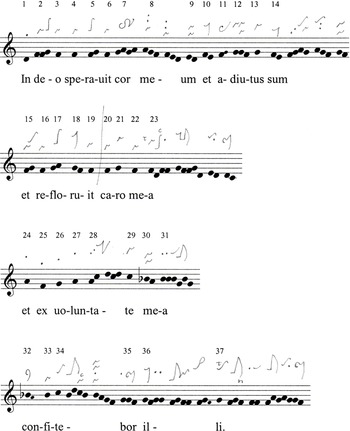
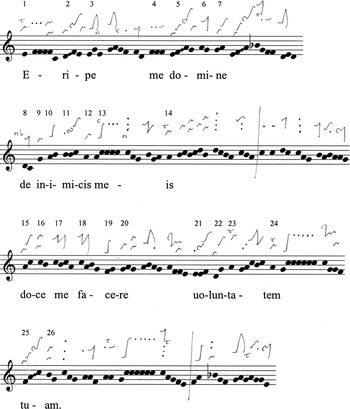
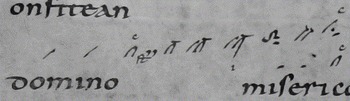
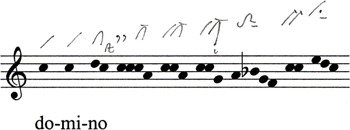
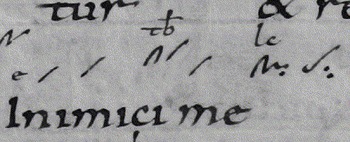
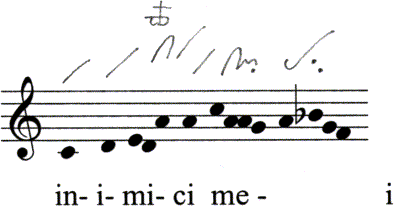
In comparing the notation for the Gradual In deo sperauit in Laon 239 with a version notated in precise pitches (Figure 1a, 1b),Footnote 97 it quickly becomes clear that this northern French scribe invested effort into mapping signs in the space above the text in some representation of (or response to) changes of pitch: between syllables 1 and 2, the movement upwards is clearly seen; on syllables 2–6 the neumes are positioned along a virtual horizontal line corresponding to one repeated pitch (F); and then the step up (a tone) for the first note on syllable 7 is seen in the higher position of the next neume. The first point at which this careful placement of signs in the space above the text in relation to pitch levels breaks down is between syllables 7 and 8: despite being sung at the same pitch, the end of the neume on syllable 7 ‘cor’ is at a different (and lower) vertical level from the first punctum in the falling group of three notes, followed by another three, on syllable 8 ‘me[um]’. The reason for the displacement upwards of that first falling group is easily identified: the scribe needed space to write two groups each of three falling notes, and had to place the first punctum high enough in the space available to be able to fit the rest in. Reading through the rest of the chant simply produces more examples of both situations: the reasonably accurate representation of melodic movement in the placing of marks on the written surface, and the abandonment of this procedure when the combination of neume shape, available writing space, and melodic movement clash in their demands. Certain passages are striking in their clarity of pitch representation: on syllables 15–19 (‘et refloruit’), sung to three pitches set a tone apart (F, G, a), the signs for a succession of separate syllables can be easily read straight from the page;Footnote 98 the same is true of the puncta above syllables 24–7 (‘et ex uo[luntate]’).
Gradual In deo sperauit (Laon 239, fol. 33v, ll. 4–5)

Gradual In deo sperauit (Laon 239, fol. 33v)

This way of responding to the movement of a melody is like later approaches to pitch notation in that signs are moved up or down (or kept on the same level) within the space above the text, but unlike later approaches in its general disregard for the size of intervals: movement up or down is just that, and it is not precisely measured (even if sometimes handled in a careful manner). In consequence, specific vertical positions are not linked to specific pitches. Thus, representation of pitch in terms of height in the space above the text is sequential rather than abstract: above all, the open space is not itself read as mapped in relation to pitch (as in the string model available in the Musica Enchiriadis and, since the mid-eleventh century, on a stave with clefs).
Apart from the positioning of neumes, other characteristics of this notation provide information about pitch. The neumes themselves contain directional information, often rendered visually easy to understand by the way in which the graph of a sign sketches out movement – two ascending notes (pes) shown by  (syllable 5) or
 (also a pes; syllable 15) and two
descending notes (clivis) shown by
 (syllable 18) or
 (syllable 9). Yet not all of these Laon signs are straightforwardly ‘iconic’ in their manner of representation: indeed, the means by which some neumes for two or more notes are rendered more pitch specific, over and above their fundamentally directional design, is certainly by convention. These are the neumes which incorporate at their beginning or end a wavy or curved stroke: such signs are written four times in In deo sperauit. At the end of the neume series over syllables 23, 35 and 37, a sign which can can be read as a modified clivis, representing two falling notes, is written. In this sign, the formation of the opening stroke, before the pen is turned to write a long downwards stroke, is recognisable as this special, modified graph: in each of these three cases, the first note of the modified clivis repeats the previous pitch. The fourth example shows the wavy stroke added not at the beginning but at the end of a sign – in the neumes over syllable 36, attached to a torculus (which itself represents the pitch pattern low–high–low); here the fourth note of the neume is to be sung at the same pitch as the third.
Among the signs for single notes one in particular has a meaning in relation to pitch which renders it both more clarified and more limited in use than other signs for single notes. This sign is written as a line sloping upwards to the right, with both ends turned ( ); it marks one rising note. In In deo sperauit this sign is written in the neume groups over syllables 14 (twice), 15, 23, 34 and 37 (twice). As in this Gradual chant, so throughout the book: this sign is never written on its own, but only as part of longer groups. That contrasts with other graphs which represent single notes, all of which can be written as independent signs, indicating a single note on a single text syllable: the punctum (
 ) and uncinus (
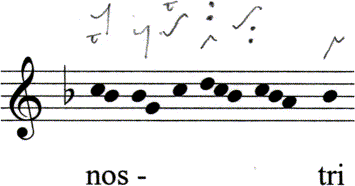
 ). Like other signs in this notation the diagonal stroke is malleable, and may be written long (as the first time over syllable 14, and over 15), short (as over syllable 23), and in lengths in between (all the rest). (At this stage it is unclear whether meaning resides in these differences of size; it is possible that the length of the sign was controlled by the graphic necessities of each context.) The way in which this sign is used in In deo sperauit is unambiguous: it means, in relation to the preceding notes, ‘go up’, and, following the note marked by this sign, ‘go down afterwards’. Both conditions are true for six of the seven instances in this chant; and, read in relation to the descending liquescence on the preceding note group, true also for the first instance on syllable 37. Use in such positions is standard throughout the book. This description of the use of this sign requires qualification, however: in melodic situations of movement up to a single note and then immediately down the sign is often written, but not always. Thus, the sign and the melodic context do not fully correspond to each other. Indeed, the sign can also be found in another
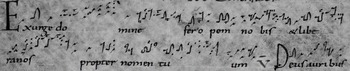
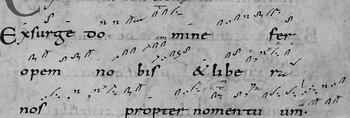
melodic context, in the middle of a rising series of pitches (see Figure 2).Footnote 99 Thus, while the sign always indicates that this note is higher than the preceding one, it does not always indicate that this note is higher than the one which follows.Footnote 100 Nevertheless, in the latter situation, the positioning of neumes in terms of height above the text always clarifies the pitch relations.
From Gradual Exsurge domine fer opem (Laon 239, fol. 35v, l. 9)

My avoidance of the term ‘virga’ for this diagonal stroke is deliberate. It is evident that, as a written sign, the Laon diagonal stroke with turned ends matches the angled or perpendicular stroke used in central French and German (and English and Italian) notations and, since the eleventh century, named ‘virga’.Footnote 101 But the use of this sign in the Laon notation is not at all parallel to its use in the other notations.Footnote 102 In this Laon book it is never written on its own, but only within longer groups of signs (‘compound neumes’); there is, strictly speaking, no ‘virga’. Indeed, the ways in which any signs for single notes (punctum, uncinus and the long stroke) are used in the Laon notation cannot be matched directly to any other neumatic notational system: the sign most often used for one note – the uncinus – has no equivalent in any other type of neumatic notation, and exemplifies a specific and unique design made by the person responsible for shaping the type of notation written by the scribe of Laon 239. The proposal to drop the term virga is more than empty pedantry in this context, since much theorization about the basic procedures of neumatic script, and about the ways in which neumes were fashioned, has taken as its basis a pitch differentiation read in the contrasted graphs of ‘virga’ and ‘punctum’.Footnote 103 As we have seen, that visual contrast is exploited in this Laon book, but only in limited circumstances: in the case of single notes sung to single syllables the Laon scribe does not use contrasted graphs to indicate different pitches but instead the contrasted positioning of signs. (For single notes matched to single syllables, this scribe is certainly interested in contrast – using the punctum and uncinus signs – between which the differentiation sits in the domain of note length and emphasis, not pitch.)
In summary then, the techniques for referring to pitch in the notation for In deo sperauit consist of (a) the contrasted placement of signs in the open space above the text – in a sequential process, not based on a fixed way of reading that open space; (b) the use of signs which, in being directional, reveal the shape of individual sections of the melody; and (c) the use of specific signs which, by convention, contain further specific information about pitch. In terms of pitch, it is evident that this is not a notation which lies on the prescriptive/descriptive continuum: it would never be possible to recreate the relative pitches of this melody from the notation alone. Rather, the signs and their positioning must be read as a support for recall, requiring of the reader that he find in his memory patterns which correspond.
It is difficult to draw a boundary between a ‘prescriptive’ way of writing instructions for something to be sung (or read) and an approach based on recall, since most ways of writing language or music for reading or singing are basically reliant on memory. If the difference between the categories is defined more by focus than boundary, it is the balance between what is written and what has to be summoned from the memory which comes into question. Thus a prescriptive notation would have a stronger balance towards information recorded in writing, and would depend on memory (or convention available through context) for limited and often quite specific elements necessary for delivery. This is the model most familiar to modern musicians, in a variety of guises, and especially as a result of placing the responsibility for musical creation in the hands of individuals whose musical activity may become quite remote from those who remake their music. A recall-based notation would depend rather more heavily on memory, on the flow of thought between the written, visual model and the remembered, aural/oral object; and it will be subject to the ability of the reader to use the guidance provided by the written artefact to delve into and draw out from his memory something he has already heard. Such an approach relies on lively oral exchange between generations and across localities, on closeness between individual musicians, and on continuity in a chain of transmission. In the context of early medieval musical notations, distinguishing between categories of prescriptive and recall-based notations matters, since it helps to steer us away from setting early notations alongside more recent, more prescriptive examples, leading to the evaluation of the early notations as rudimentary and inexact forms of something which was later perfected. Separated from such perceptions these early notations can be read in terms of their own mode of functioning.
The extent to which this Laon notation, moment by moment, guides the reader in useful directions – a hint here, a hint there – is striking, and bespeaks the activity of recall in the way it is described in medieval books about ars memorativa.Footnote 104 Arts of memory teach the creation in the mind of networks of objects and ideas, and of movement along paths through those networks. Recall from a memory organised in this way can be prompted through what Mary Carruthers has named ‘finding tools’, mental devices which stimulate passage along the paths of memory. To understand the handling of melodic pitch patterns in Laon 239 in this way is more useful than thinking of these notations as rough approximations by a scribe who didn't know any better.
The placement of signs in some passages of In deo sperauit is strikingly close to the pitch patterns of the melody. It was not always possible for the scribe of Laon 239 to maintain such a high degree of accuracy, however, the difficulties becoming greater the more elaborate the melody. And yet, understanding his approach to the notation of pitch as mnemonic support, the extent to which this scribe acted to lead his readers in useful directions is marked.
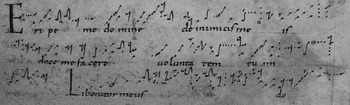
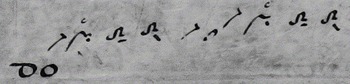
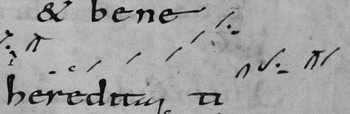
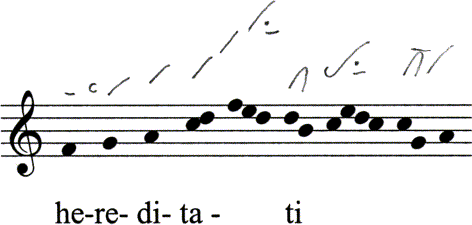
Gradual Eripe me (Laon 239, fol. 38v, ll. 11–13)

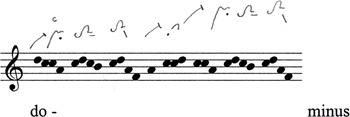
Gradual Eripe me (Laon 239, fol. 38v)

In the Gradual Eripe me the Laon scribe exploited the tools available to him in conspicuous ways (see Figure 3a, 3b).Footnote 105 The degree to which he responded to pitch changes graphically can be seen in tiny details, such as the two zigzag signs over syllables 17 and 18 (‘me fa[cere]’). Here the same neume is written over successive syllables (a sign denoting four notes in the pattern high–low–high–low). But it is not written the same way: the second has a deeper dip in the middle, and then a longer ending stroke: these differences appear to match the different pitch patterns on the two syllables, first cbca, and then cabG. Further along that same line, the scribe had to write a neume to signify two rising notes (pes) covering the interval of a fourth (G c) twice, over syllables 24 (‘[volunta]tem’) and 26 (‘[tu]am’). Constricted on the first occasion by the presence of text immediately above (and the need to write another neume at a still higher level), the perpendicular stroke of the pes is relatively restrained (although still taller than that over syllable 10 ‘[in]i[micis]’ on the line above). Coming towards the end of the second written line, he was less constrained, since the text line above much of the melisma for syllable 26 (‘[tu]am’) was empty. He knew then that he could set the neume which had to be written above the end of the pes (the two-note descending clivis) at a higher level, in turn allowing him to write the pes representing a jump of a fourth in more extended manner than on syllable 24.
The accumulation of signs going in one direction could make things awkward: on syllable 7 ([domi]ne), a series of four signs written at successively higher points on the page is succeeded by falling signs. In this group, the first sign (uncinus) represents a note sung at the pitch E, while the beginning of the last sign (for a three-note group: torculus) – here written higher on the page – represents a note sung a tone lower, on D. Yet here again, the scribe's intense response to his memory of the melody (or, alternatively, awareness of his future reader) is prominent. The next phrase is sung predominantly in a higher tessitura than the first, that is, between G and d. But the melody of the next phrase does not begin immediately at a higher pitch, rather it is launched from the low D on which the first phrase ended. Therefore the scribe wrote ‘nl’ – ‘non levare’, ‘do not go up’ – beside the two-note group (pes) over syllable 8 (‘de’). It is interesting to note that he judged the point at which a warning was necessary to be at the beginning of the phrase, and not between its first and second syllables (that is, syllables 8 and 9) where the melody jumps through a fifth from C to G.
The notation in this Laon book can usefully be compared with that in a group of fragments also present in the Bibliothèque municipale at Laon; while these fragments are so small that it cannot easily be established where they were written, it is likely that they originated in the same region, and even possibly in the same establishment.Footnote 106 These fragments represent a body of musically notated books made during the last third or last quarter of the ninth century, and all notated in this same ‘Messine’ notation;Footnote 107 they also share similar measurements of space between text lines. A bifolium preserved in MS 266, and reported as probably being of earlier date than MS 239,Footnote 108 includes the Gradual Eripe me. Comparison of the two notations is instructive, revealing a strong continuity of practice in the choice of signs and ways of setting out the melody, and the same general attitude to the placing of signs in the space above the text. On a few occasions, the juxtaposition of the two notations for this gradual exposes greater nuance and care on the part of the scribe of Laon 239, but the differences are minimal, and do not disturb the general sense of a shared attitude on the part of their scribes as to how to represent melodic patterns in writing. Thus, in the case of Laon 266 and Laon 239 it can be demonstrated that they share both a repertory of signs and a way of arranging those signs on the written surface. This, and the further comparisons which can be made between notations for specific chants in Laon 239 and the fragments in Laon 9, 121 and 266, indicate an established approach to how chants for the mass could be written down, shared by several scribes working in or around Laon in the last quarter of the ninth century.
THE TREATMENT OF PITCH IN THE CANTATORIUM STIFTSBIBLIOTHEK SANKT GALLEN 359
The manuscript 359 in the Stiftsbibliothek at Sankt Gallen (henceforth SG 359) is the most celebrated example of a book type which contains only the most elaborate mass chants (sung by the cantor, or other soloist), the Graduals, Alleluias and Tracts.Footnote 109 It is made in a long thin format, a shape which corresponds to and may have been determined by the two ivory tablets set on the front of its binding. These date from the sixth century; otherwise the binding consists of patterned silk (dated c. 800), wooden boards, gilded copper and carved pieces of bone. The manufacture of this binding has been dated through dendrochronology of the oak boards between 923 and 931.Footnote 110 The text hand of the book is consistent with this date, although it would also allow an earlier dating, closer to 900. The notation for the main book, leaving aside extensive additions at front and back, was made by one excellent scribe. SG 359 is the second manuscript used for the provision of neumatic notations in the Graduale Triplex.Footnote 111
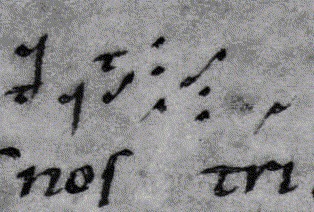
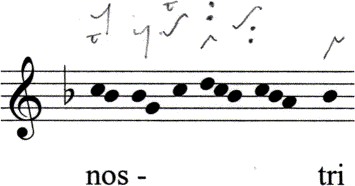
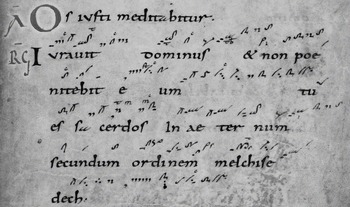
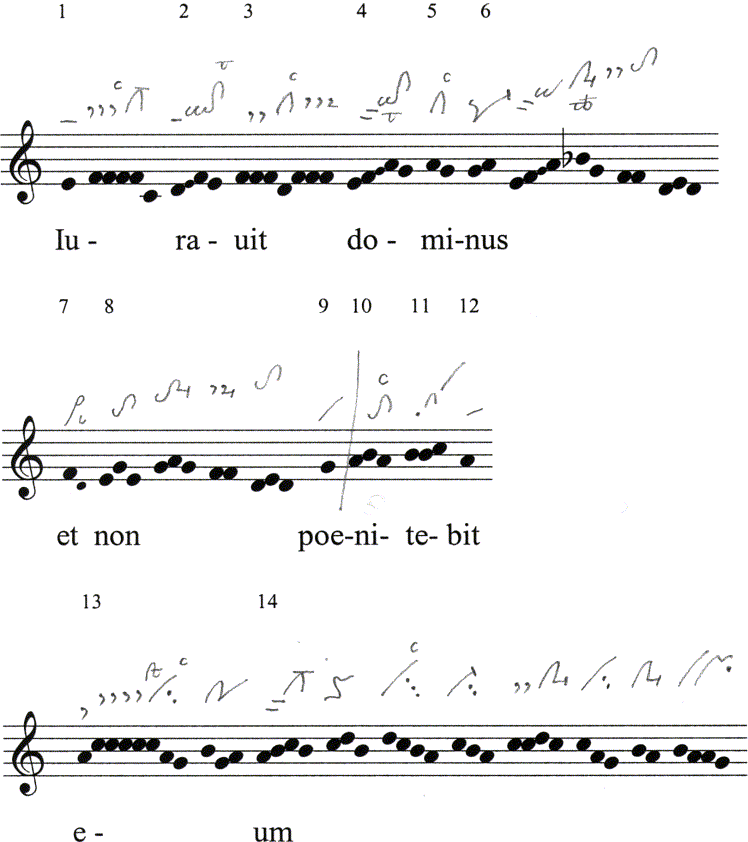
Set beside each other, the notation for the Gradual Iurauit dominus in SG 359 and in a pitched version appear quite different in their way of handling pitch information (see Figures 4a, 4b).Footnote 112 Set on a stave, the modern notation is precise within the parameters of a simple modal scale of eleven notes (C–e, including b♭ and b♮).Footnote 113 In contrast, the neumatic notation gives a general impression of imprecision, made up of short passages which behave differently – some following a contour which seems to match the pitched notation, others ignoring pitch contour altogether, and still others going positively against the pitch-contour patterns in their use of vertical positioning in the space above the text. It is not difficult to understand why Mocquereau should have written of such notation that the ‘fruitful principle’ of ‘stacking in layers of notes was not yet known’.Footnote 114 But we should look more carefully.
Gradual Iurauit dominus (SG 359, p. 47, ll. 11–16)

From Gradual Iurauit dominus (SG 359, p. 47)

Syllables 1, 2, 3 (Iurauit)
1: The pitch rise from the first note to the group of strophae ( ) is mirrored by change of vertical level. After this, the correpondence between pitch and vertical level breaks down quickly, with the placing of the clivis (
 , for
two falling notes).Footnote 115 Instead of being written below the strophae so as to indicate that the pitch it ends on is below these strophae, this clivis is written with the end of its graph on the same vertical level.
2: The first sign ( , tractulus) is written at a vertically lower level than the end of 1, although it is pitched a tone above. The neume group for this syllable follows the pitch pattern in its contour.
3: As in 1, the strophae are succeeded by a clivis which begins and ends on the same vertical level, despite the pitch pattern; and then the strophae following the clivis are written at a higher level, matching the rise in pitch from the second note represented by the clivis (D) to F. As a result notes sung at the same pitch before and after the clivis are written at different vertical levels.
Syllables 4, 5, 6 (dominus)
4: As in 2, the neume group mirrors pitch pattern in its shape.
5: Although standing for the same two pitches as the last two notes on 4 (aG), this clivis is written far below the last part of the neume on 4.
6: The first sign ( , pes quassus) is one of those which convey pitch information in their morphology: through the wavy line (equivalent to an oriscus) this indicates that the pitch of the first note is the same as the last note of 5. After this the neumes are set at successively higher positions in the space, whether or not they indicate a rising or falling pitch:

Syllable 7 (et)
Just one sign (liquescent virga). This is written a little to the right of the text syllable, but not to the right of the previous neume (at the end of the third syllable of dominus). It represents a pitch above the end of the previous syllable. The letter ‘i’ (standing for ‘inferius’) written beside the neume reinforces the direction to be taken for the liquescent sound.
Syllable 8 (non)
Here there are four neume groups, each written successively higher than the preceding one. As on 6 this does not necessarily correspond to pitch contour:

Syllables 9–12 (poenitebit)
9: The single note for the first syllable, at the end of the first line of writing, is written vertically below the level of the previous neume, although the intervallic relation is a rise of a fourth. Written as a virga, the sign contains in itself the information that it represents a higher note than that preceding.
10, 11, 12: these neumes are written without much vertical movement up or down (except with the individual neume shapes). For 11, the salicus ( ), its second element equivalent to an oriscus is written: thus the fact of repetition of a pitch is included within the sign.
Syllables 13, 14 (eum)
13: On this syllable the relation of the signs is very like that of 1 and 3: the long stroke of the climacus ( ) which followed the strophae is written stretching higher than the strophae which precede it, despite being sung at the same pitch. What this stroke indicates is that the puncta which follow are at successively lower pitches (although in written form they are not much lower than the strophae). The last note of the last neume (
 , porrectus) should sound as an a, thus on the same pitch as the first note of 14, which is written vertically far below.
14: As for other previous melismas, the direction of writing edges gradually upwards, whatever the pitch direction between neumes. The last four notes are written using another pitch-indicating sign, the virga strata (virga + oriscus), so that it is clear that the pitches of the third and second last notes are the same (a).
With the exception of ‘i’, all the letters in this passage of notation deal with rhythm and articulation, as follows (in the order they appear):Footnote 116
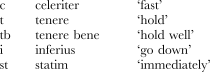
Reading this notation against a diastematic record of the melody reveals a number of behaviours, each of which is repeated. Those behaviours which act to convey pitch information include:
(a) the shaping of individual neumes according to pitch contour (‘directionality’);
(b) the use of individual signs whose shape can be recognised by a reader versed in the conventions of the notation as having pitch content (strophae, virga, punctum, pes quassus, virga strata);
(c) the use of neume groups whose written pattern is common and therefore, by convention, has a specific pitch content;
(d) the use of letters for clarification (in this case, just one, but others are common).
Behaviours which do not coincide with pitch contour, and are not controlled by it, include:
(e) the writing of signs representing notes to be sung at the same pitch at different vertical levels, even in close proximity; this applies both within neume groups and between them;
(f) especially in neumes written in series for one syllable (melismas), the arrangement of the neumes as if between two parallel lines which rise diagonally upwards.
To what extent are these behaviours typical of this notator's practice throughout the book? In fact, some are so basic to the system and well recognised as such that they require no further study here.Footnote 117 Others deserve brief clarification, still others longer consideration.
The shaping of neumes according to pitch contour is a basic given of the system; yet it is worth setting out some of the main conventions. The virga written as a long stroke leaning to the right represents a note higher than the punctum; this convention can apply in whatever order the two signs are written. In the Gradual Iurauit dominus there are no passages where a single note on one syllable is followed by another on another syllable, through which this relation could be seen; but the neume formed from a long stroke followed by descending points, the climacus, is a sign created on the basis of this convention. That neume embodies falling movement in the melody. The opposite direction, movement upwards, is graphically expressed in all of those neumes which include individual strokes written at vertically ascending levels: in Iurauit dominus the pattern formed by two short horizontal strokes (tractuli) followed by another sign (over dominus, dominus), and the series of strophae which begin with a single stropha written lower followed by a series written at one vertically higher level (beginning of the melisma on eum).
The category of neumes whose shape reveals pitch-contour information through convention includes neumes which are made that way from the outset, as well as ‘modified’ neumes – shapes which slightly alter the standard way of writing a neume. For the former class of sign, the main examples are those neumes which graphically incorporate a wavy line – the characteristic pattern of an oriscus, which often represents a note at a repeated pitch: the virga strata, combining a virga and an oriscus, usually representing two notes on the same pitch;Footnote 118 the pes quassus, combining an oriscus and a virga, one of the significations of which is the most obvious, the first note repeating the pitch of whatever preceded it.
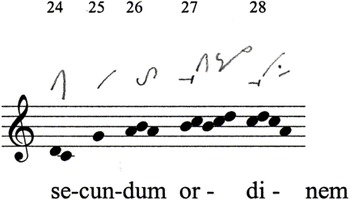
The best example of a neume modified in relation to pitch pattern is the extended clivis (see Figure 5); the normal clivis represents a descending pattern of two notes and is written  , while a modified form is written
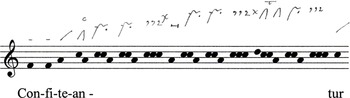
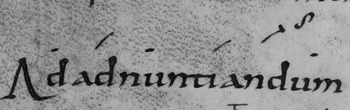
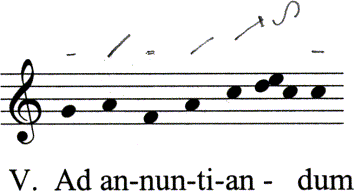
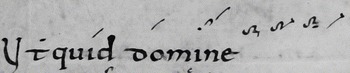
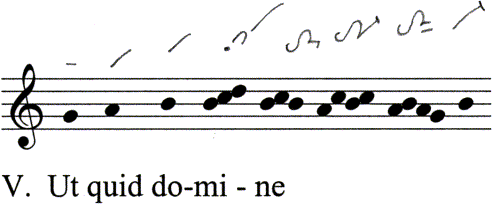
 . This extension can represent a large interval between the notes, such as a fourth: in Figure 6 the extended clivis closely follows two clives each representing the note group ca, an interval of a minor third.Footnote 119 This formula is highly repetitive (sung nine times between the beginning of the verse and the point at which the extended clivis appears), and the notator has taken care to warn the reader of a change, both through the extended stroke of the neume and the addition of the letter ‘i’, ‘go down’. More rarely, the extended clivis could represent arrival at a very low note (as on ‘secundum’ in Iurauit dominus, Figure 5). One other sign which can be modified with similar intentions is the short horizontal stroke (tractulus). Within groups of neumes this can be turned to point diagonally downwards, as in Figure 7:Footnote 120 here two groups of notes following identical pitch contours, but with different pitch contents, are clearly differentiated. Each begins cd, the first continuing cb, the second falling to aF. In both cases the group of notes is represented by a torculus followed by a tractulus, in the
first case with a normal tractulus written horizontally, and in the second case, turned downwards. It is worth noting the combination of modes of signification in some of these individual signs. In the case of the modified clivis, for example, the basic sign represents through convention rather than iconicity. But the modification of this conventional sign, to show a large interval or a low note, is itself straightforwardly iconic.
From Gradual Iurauit dominus (SG 359, p. 47)

From Gradual Misit dominus (SG 359, p. 48, l. 11)


From Gradual Viderunt omnes (SG 359, p. 40, l. 5)


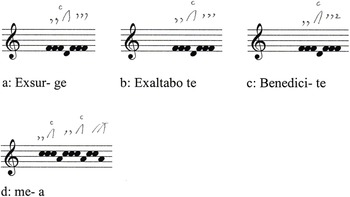
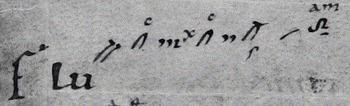
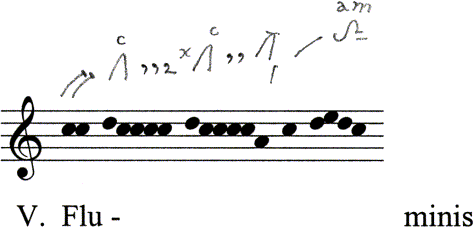
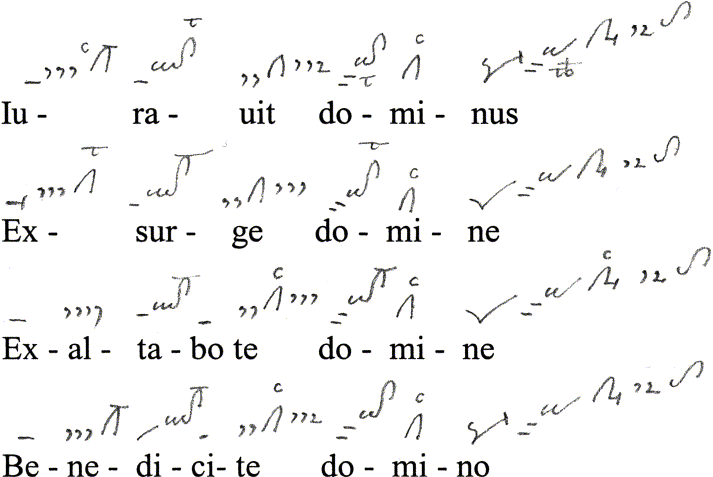
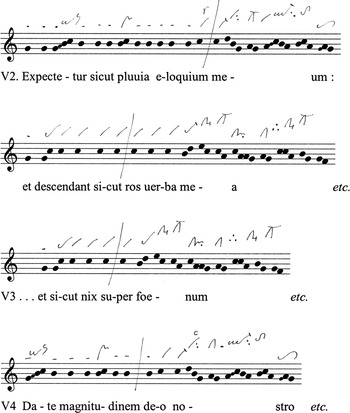
It is not only at the level of individual neumes, single graphs, that this notator's writing functions through conventions of meaning, but at the level of repeated successions of specific graphs. When the recurrence of such written patterns is within chants in a specific mode, or even within chants which belong to the same melodic family, the pitch content of these neume series can be read through direct knowledge of the practice. One such example in Iurauit dominus is on syllable 3 (see Figure 4 above): three strophae followed by a clivis and three further strophae. In the way these are written, on different vertical levels, the pitch contour of recitation on one level, with one lower note shown by the second note of the clivis, is not directly represented. But this way of writing that pitch pattern recurs: within the melodic family to which Iurauit dominus belongs, the same neume series written the same way, and representing the same pitches, can be found in the Graduals Exsurge domine, Exaltabo te and Benedicite domino (see Figure 8a–c).Footnote 121 It can also be found outside this melodic family, for example in the Gradual Tribulationes (Figure 8d),Footnote 122 where it has the similar intervallic content cccacc (recurring), in other words again from the note above a semitone step, falling to a minor third below (‘fa re’ in later medieval terminology). This melodic figure is perhaps even more characteristic of the family to which Tribulationes belongs – the fifth-mode graduals – than the smaller third-mode group. But the limits of signification can be quickly discovered in the fifth-mode melodies, as Figure 9 demonstrates.Footnote 123 This is from the Gradual Adiuuabit, with, at the beginning of the verse Fluminis, a series of neumes including a clivis between groups of strophae, the first group written lower, the second higher. But the pitch contour and intervallic pattern represented is different from that in the series previously illustrated. What this comparison of examples exposes is the association between a written pattern and a specific pitch series, and equally the ambiguity of the writing system, since similar graphs really can have different pitch contents. But it also underlines writing procedures – the habit of writing a clivis starting from the horizontal level of preceding strophae, and then of writing strophae which follow a clivis at a higher horizontal level – that is, whatever the pitch content.
(a) from Gradual Exsurge domine non prevaleat (SG 359, p. 75, l. 8); (b) from Gradual Exaltabo te (SG 359, p. 87, l. 12); (c) from Gradual Benedicite domino (SG 359, p. 134, l. 15); (d) from Gradual Tribulationes (SG 359, p. 68, l. 13)

From Gradual Adiuuabit (SG 359, p. 55, l. 7)

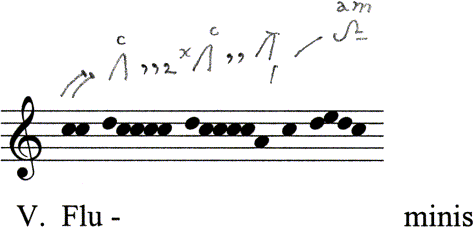
Moving over to the behaviours which appear not to act in parallel to pitch contour, it might be claimed that the diagonal rise to the right in groups of neumes for a melisma is related to the attempt to accommodate the requisite number of signs within a space restricted in its horizontal dimension – as suggested by the treatment of neumes above syllables 6 and 7 of Iurauit dominus (Figure 4 above). Yet further examination of this notator's work exposes that argument as unsustainable. On every page of this cantatorium there are examples of the rising treatment of neumes in situations where there was no shortage of horizontal space: that is, this way of handling the signs was not always, indeed generally not, the result of the placement of text syllables too close to allow enough horizontal distance to write out the neumes. On the verso of the page which contains Iurauit dominus the verse Confiteantur (for the Gradual Misit dominus) offers good comparative examples on the syllables Confiteantur and misericordiae (see Figure 10).Footnote 124 Moreover, in this fine book, bound between ivory tablets and gilded copper, with decorated ivory strips and silk, there is no evidence of shortage of space – quite the opposite. The wide spacing between text syllables is the most immediately obvious evidence of this, while it can also be seen in the layout of chants (with incomplete text lines never filled up). In the vertical dimension the question of restricted space hardly arises, since here we are dealing with a behaviour which uses the space available, even when not suggested by the pitch contour. All of this suggests that, rather than considering the pattern of diagonal rise to be the consequence of immediate musical circumstances, it must be the outcome of a writing habit.
From Gradual Misit dominus (SG 349, p. 48, ll. 10, 12)


Likewise it might be claimed that the writing of signs representing notes to be sung at the same pitch at different vertical levels, even in close proximity, was the simple result of the notator's not having in his head an especially strong sense of the height metaphor: even if he thought in terms of moving to higher positions on the writing surface for ascending patterns of notes and lower for descending patterns, he need not have had an especially precise measure. And yet, in the face of the extreme precision of this scribe's work in relation to articulation and length of notes (above all, as demonstrated through the work of Cardine), an explanation built on lack of awareness of an essential melodic quality, and a resulting imprecision in writing, does not convince.Footnote 125 Even if we allow that this notator was not attempting to provide precise intervallic information, we should admit that his writing is full of momentary references to pitch contour, using a gamut of different techniques.
At this point it is worth bringing back into focus a sense of current ways of understanding the treatment of pitch in such notations as this. The older view whereby it was assumed that such scribes had not yet gained knowledge of diastematically precise notation has certainly been replaced by a kinder assessment: the precise indication of pitch was not the primary aim of such notations, and, in any case, there were many ways of lending a helping hand – through the many techniques of pitch clarification mentioned above. Even in this reading, however, notation is treated as limited in a way which would have critically reduced its usefulness in the late ninth and early tenth centuries. Yet this notation was written by a scribe acknowledged as one of the most outstanding writers of neumatic notation in any extant medieval source. In relation to a situation in which new levels of engagement with script are to be discovered all around, both in the book culture fostered around the emperor Charlemagne and his heirs, and in the local culture at the abbey of Sankt Gallen – by the early tenth century producing books of the highest grade with texts of impeccable quality – to think in terms of a highly developed writing system for music with such a serious design fault does not convince.
AN ALTERNATIVE VIEW
In the face of what have been considered shortcomings in previous studies of the notation of SG 359, two qualities of this scribe's work are extremely striking: his fluency and his consistency. The former is apparent in the absence of signs of hesitation or confusion, and in the regularity of his pen strokes (see Figure 4a above). This regularity becomes especially apparent when notations for similar melodic passages in different chants, copied on different pages, are compared (see Figure 11).Footnote 126 Certain characteristics of the placing of these neumes are repeated every time, whatever the verbal context. Such consistency underlines the systematic quality of this scribe's work: a constancy in choice of symbols, a constancy in his manner of handling them in relation to each other, a constancy of placing in the space above the text. The fact and nature of that system must have been clear to him, even if not to us.
From Graduals Iurauit dominus, Exurge domine non, Exaltabo, Benedicite (SG 359, pp. 47 l. 12, p. 75 l. 8, p. 87 l. 12, p. 134 l. 15)
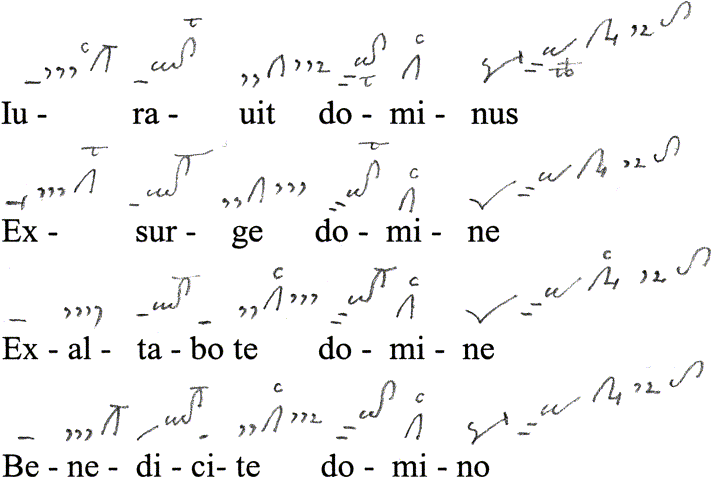
The fluency and ease of this scribe's work must in some way relate to an immediacy of melodic recall. To copy neumatic notation well, without turning it into nonsense, would always have involved musical memory, besides a written exemplar (which would itself need to be read using melodic recall). I set aside the possibility that he worked only from a written exemplar, without using melodic recall, since the level of musical literacy evident in this notation is as good as it gets in the history of neumatic script (as it can be reconstructed from extant sources). His approach would then have required that, for each chant, he bring to mind a memory of how the melody sounded as he wrote the neumes, remembering the musical delivery of a text, with some points drawn out, others sung quickly, and articulations in specific places. That sound memory of each chant must have been as prominent in his oral/aural memory as any abstract sense of melodic contour, aural or visual.
But what he was doing was writing, not singing. And the primary determinants of his positioning of neumes in the space above the text become clear as soon as the signs are read as writing in their own terms, not as a distant version of another system, and requiring translation into that system. His first rule for the placing of neumes was to write the first sign for each syllable beginning from a virtual horizontal line parallel to the ‘x-height’ of the text.Footnote 127 In Figure 12 three horizontal lines trace the path of the line above which the text was written, as follows: (1) the text line itself (ruled in the manuscript in dry-point, and therefore only easily visible in the manuscript itself); (2) the x-height line along the top of the letters; (3) and then the virtual line along which the scribe began neume groups. Only in the case of one syllable, ‘non’, does the neume group begin a little higher than that virtual line. Other cases in this chant where the beginning of the stroke for the first neume does not begin on that virtual horizontal line include ‘[e]um’ on l. 2, ‘[sacer]dos’ on l. 3, ‘ordi[nem]’ and ‘[melchi]se[dech]’ on l. 4. In several of these cases, the reason for the different beginning can be easily deduced. On ‘[e]um’, ‘[ordi]nem’ and ‘[melchi]se[dech]’ the reason was probably an attempt to compensate for a large vertical distance required for the first neume group, or the following melisma; certainly in the third of these cases, a gap in the text – because the next syllable was delayed to the next writing line – allowed him to set neumes into the normal text space. Such a writing behaviour is commonly seen elsewhere in the book, especially in the Alleluia cycle begun on p. 145. Here, for the musical iubilus following the singing of the word ‘Alleluia’, he commonly wrote the first neume for the last syllable of ‘Alleluia’ at a lower vertical level, after the letter ‘a’, and within the space reserved for text (see Figure 13).Footnote 128 Those situations in which he began to write below his normal level can usually be explained in this way, as advance compensation for rising writing patterns. For the neumes (in Figure 12) which begin above the usual level, the possible explanations are more various (although also including compensation). On ‘[sacer]dos’ he had to continue writing a series of strophae, the same neume sign with which the previous syllable ended, and which were sung at the same pitch. So he kept them at the same vertical level. The only easily available explanation for the treatment of the neume for ‘non’ (l. 1), beyond serendipity, is his treatment of the neume for the preceding syllable ‘et’. There he wrote a virga; but the liquescent modulation of that note was to go down, not up, and this he indicated through the curved ending of the virga stroke and through the letter ‘i’ (inferius). The strong sense of that being a lower note may have forced his hand upwards for the beginning of ‘non’.
The Gradual Iurauit dominus (SG 359, p. 47), with lines added to show the relation between the ruled text line, the ‘x’-height line and the line which defines the lower starting point for series of neumes

From Alleluia V. Domine deus salutis (SG 359, p. 148, l. 1)

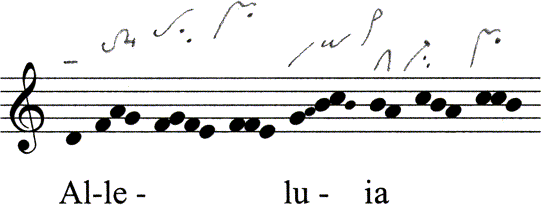
Such ways of explaining exceptions are interesting in that they suggest a tension in the scribe's thinking between his ‘x-height’ writing rule and his melodic recall: cases which support the hypothesis of struggle between the two can be found on most pages of the book. In the middle of the first line of the Gradual Specie tua, a series of three virgae over the syllables ‘et pulchri[tudine]’ lead the level of writing up, corresponding to a rise of a major third for the last of the three (Figure 14a, 14b).Footnote 129 Then, at the next syllable, ‘[pulchri]tu[dine]’, instead of writing a neume group consisting of a clivis and three strophae back at the usual level, he maintained the high vertical position, corresponding to the continuation of the same pitch level in the melody; and this continued for the fourth syllable of the word. Only on the last syllable, again repeating the same neume group (and sung at the same high pitch) did he remember to observe his more usual practice. A similar phenomenon can be seen in the neumes over ‘liberator meus’ in the Gradual Adiutor meus.Footnote 130 Leaving aside these exceptions, which are common enough, but not to the extent of challenging the evidence of a normality of practice, it is clear that this scribe's general approach to the placing of neumes in the space above the text when starting the signs for a text syllable was to begin neume strokes at a specific vertical level. In Iurauit dominus, out of thirty-three syllables, only five do not have neumes starting at the same level. Simple perusal of the pages of this book will reveal that this writing practice was standard throughout. The Sankt Gallen scribe's treatment of the relation between the horizontally controlled line of text and the placing of neumes is so fastidiously observed that we must recognise it as a basic approach to layout of text and music writing in this scribe's work.
From Gradual Specie tua (SG 359, p. 50, ll. 4–8)

From Gradual Specie tua (SG 359, p. 50)

From Gradual Specie tua (SG 359, p. 50)

As the ‘syllable rule’ controls the placing of neumes at the beginning of syllables in this scribe's work, so there is one further writing habit which controls the placing of subsequent neumes. In Iurauit dominus this habit is apparent in the melismas in the first written line for ‘[domi]nus’ and ‘non’ (l. 1), and in the second written line for both syllables of ‘eum’ (see Figure 4 above). Within each of these melismas any new stroke begun after the scribe has lifted his pen will usually be begun at a vertical level close to the end of the last, or higher; although it may be written lower, this is demonstrably the result of having to fit in tall shapes in what comes immediately after. In none of these positions does the scribe return to the lower level of the virtual line at which he wrote neumes at syllable beginnings. This writing procedure – already visually evident in Iurauit dominus – will now be explored in relation to pitch in the Gradual Specie tua (Figure 14a above). At the beginning of the second written line, the syllable ‘tu[a]’ has two neume groups (Figure 14b). The scribe first wrote a clivis ending with a horizontal stroke – this ‘episema’ signifies holding that note longer than any not so modified. Then he lifted his pen and replaced it on the parchment a little further to the right and higher, and wrote a longer, wavy, sign, ending in a point. The pitch relation between the two separate neume graphs is equality: the first ends at the level at which the second begins (c), and most of the pattern represented by the second neume group is sung at a lower pitch level. In the notation of long melismas, this gradual edging upwards can be very pronounced. The melisma on ‘[veri]ta[tem] on the fourth written line of Specie tua provides a typical example (Figure 14c). In the first, closely set, group of neumes, a virga with episema (1) is followed by a torculus (2) and a porrectus (3, with an episema across its last, rising, stroke). In terms of pitch, the opening virga represents a note sung at the same pitch as the last stroke of the third sign, the porrectus – now, because of this way of handling signs, one virga’s height above the first sign. The next group, consisting of two puncta (4) and two virgae (5), both with episemas, is begun a little below the end of the porrectus. These correspond to a pattern which begins a fifth below the preceding passage, rising up to the c already reached. Then the next group, a torculus (6) and porrectus (7, each with an episema) is begun a little below the level of the preceding virga (5), but again ends higher; this passage repeats a recitation pattern on c. The final group, consisting of two puncta (8) and a porrectus (9), maintain this steady rise in height on the page, now almost reaching the text line above, and already in contact with the lower part of the g in ‘regna’; these neumes again represent notes which recite around c. Thus the whole melisma has one pitch level as its focus in sound, yet the written graph is decidedly not written along one horizontal, but at an angle to it. What this reveals is that the placing at a vertical level of any new stroke within a neume group or melisma will not usually be determined by pitch contour, but rather by the previous graphic stroke, and thus by the position of the scribe's fingers at the moment of writing.Footnote 131
To a significant extent that diagonal rise was the direct outcome of the use in this notation of a long, upwards slanted stroke to signify one note: each time the scribe wrote such a sign (or a longer neume including such a stroke) he arrived at a higher level on the writing surface. If his procedure was to begin again close to the point at which he had taken his pen off the writing surface then the direction of writing was bound to follow a rising diagonal direction. But it is also clear that what may have developed through necessity simply became habit: in this book lines of neumes rise, whether or not they need to rise to avoid bumping into neumes for the next syllable or not.
Just as in using the ‘x-height syllable rule’ the scribe sometimes compensated in advance for problems which might arise, so also there is evidence of close awareness of vertical positioning in the control of these rising patterns. The passage of neumes over ‘[mansuetudi]nem’ in l. 5 of Specie tua is informative in this regard (see Figure 14c). Here a series of repetitive patterns, sung at different intervals and with different pitch content, are written in similar neume shapes, consisting of a virga followed by a form based on the clivis with an attached oriscus and punctum. Between these groups the letter x (‘expectare’, ‘wait’) is written, five times in total. From study of the width of strokes it can be seen that these letters were written after the neumes with a different pen, but in spaces left for them by the scribe: there is no reason to imagine a delay in adding them. With the letters set aside, the pattern of the scribe's work in writing the neumes is exactly as described above, with the beginnings of new strokes placed very close to the ends of previous ones: each punctum at the end of the five-note group is very closely followed by a virga at the beginning of the next, although on each occasion written just a little further up the parchment. This applies whether the group of notes to be sung is at a higher or at a lower pitch. It is worth noting that, within each of these groups, there is also a moment when the pen was lifted and replaced on the parchment, between the virga and the beginning of the longer neume; and here, having written an episema across the top of the virga, the scribe must have consciously moved his pen down to a lower point. Had the pen not moved down at that point, the line of neumes would quickly have got out of control.
Once again we can see a line of neumes rising inexorably. I have argued that this habit was not primarily the result of the need not to intrude into the space for neumes for the next syllable – although often enough in this book it had that effect. Yet it could also be the case that this way of writing neumes long pre-dates the making of the cantatorium at Sankt Gallen,Footnote 132 and that it developed in situations in which parchment was less available, with text syllables placed more closely together. It could even be claimed that, in an early stage of the production of notated books for the mass and office, text scribes were not exactly sure how far apart individual syllables must be placed; this would have caused the neumes for one syllable to bump into those for the next so commonly that it could have become second nature to avoid the possibility. Setting aside all of this conjecture, however, we should recognise the interdependence of the syllable rule and the habit of writing in rising patterns: one could not work without the other. Thus, just as the ‘syllable rule’ serves to closely connect musical signs to syllables in the visual dimension, so also this second writing habit ensures that one neume leads clearly to another.
To the rule of beginning notation for each syllable at the same, low, vertical level, and, within melismas, the calligraphic procedure of replacing the pen on the page close to where the last stroke finished, can be added one further strategy for the control of placing neumes in the open space above the text. Other than the design of the virga itself, this is the only approach to the vertical placing of neumes which appears to deal with pitch content. In the Gradual Beatus vir (Figure 15), at the beginning of the verse (‘Potens in terra’), two interlocking procedures indicate successive rises:Footnote 133 first, the horizontal stroke (tractulus) is succeeded by a virga – indicating a higher note on ‘in’, and then, above ‘ter[ra]’, a second virga is written conspicuously higher. Each of these distinctions corresponds to a rising third. This procedure can be used extremely effectively: in the Gradual Viderunt omnes, the rising stroke at the end of a porrectus is followed by two further virgae, each of these diagonally written strokes continuing from the last in an upwards direction (Figure 16).Footnote 134 These three strokes correspond to the pitches d, e, f, right at the top of the range occupied by this melody (F–f).
From Gradual Beatus uir (SG 359, p. 56, l. 10)


From Gradual Viderunt omnes (SG 359, p. 40, l. 2)

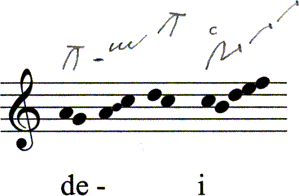
Because of the amount of vertical space available, the thinness of the pen used, and the punctum/virga contrast, it was possible for this scribe to indicate distinct pitch levels using this characteristic of vertical placing when writing single neumes. For the words ‘Ad adnuntiandum’ (Figure 17) he was able to distinguish four pitch levels (corresponding to F, a, c, d) without difficulty.Footnote 135 On occasion the placing of neumes could seem virtually diastematic, so closely do the vertical positions of neumes relate to intervallic pitch patterns (Figure 18).Footnote 136 Nevertheless, the possibility that this scribe's vertical placing of neumes might occasionally be interval-specific is surely illusionary: beside ‘ut quid’ can be set examples such as ‘inimici mei’ (Figure 19),Footnote 137 where the rise of a tone between the first two syllables is distinguished vertically by the same amount of space as a fifth between the clivis and virga over the third syllable. Here the fact of four different pitch levels is conveyed by the successively higher placing of four neumes, virga, virga, clivis, virga, but no sense of larger or smaller intervals is conveyed. Rather, the scribe seems to have been concerned with the length of the clivis notes, adding ‘t[enere] b[ene]’. The distinction through vertical placing of up to four pitch levels is relatively common in this book, when mainly single notes are involved. On at least one occasion the scribe managed to indicate six different levels, with five rises (Figure 20), stretching through a whole octave: F, G, a, c, d, f.Footnote 138 For the last of the neumes in this passage, a climacus (its virga element corresponding to the last note in the rising pattern, f), the scribe was able to use space left empty above the higher text line.
From Gradual Bonum est confiteri (SG 359, p. 75, l. 2)

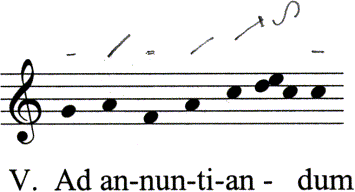
From Gradual Tibi domine (SG 359, p. 84, l. 6)


From Gradual Adiutor meus (SG 359, p. 72, l. 11)

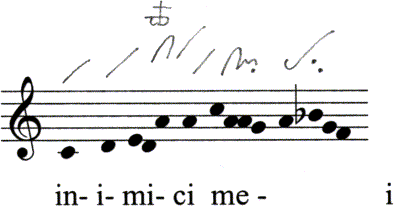
From Gradual Saluum fac populum (SG 359, p. 73, l. 6)


All of these examples of the exploitation of vertical space to indicate pitch sit within passages of writing managed according to the other two procedures studied above. Procedures which favour clarity of reading the text and musical signs together are considerably more fundamental in the design of the notation than purely musical phenomena – and they control writing patterns on every line of every page in the book, while the patterns which respond more immediately to pitch contour are more occasional. These latter patterns confirm that the scribe of this notation was highly conversant with the height metaphor – the relation between placing of musical signs in the space above the text and their relative pitches, as well as with the ways in which different elements in the notational system he had learnt could be combined to produce useful indications of pitch information (the symbolic qualities of the contrasted punctum and virga; the placing of neumes; added letters). Thus, within a system of notation which had been in use at Sankt Gallen since at least the 880s, this scribe strove to clarify pitch contour whenever he could, employing both iconic and symbolic techniques. Nevertheless, this was a notation which balanced the need to show the correct delivery of words and their individual parts against detail of the musical sound of that delivery, with the weight very much on the first more than the second.
This discussion of the type of notation classified by Mocquereau as ‘neumes-accents’, by Handschin as ‘Strecke’ neumes, by Treitler as ‘type A’ (‘symbolic’), has been dedicated exclusively to notation in one book. By the end of the tenth century, notations of this type, but with upward and downward strokes written at different angles (depending on the region), can be identified as far distant as England, Spain, Italy, central and northern France and throughout the whole eastern Frankish or Germanic area. Without going into the detail of regional scripts, and their sometimes very specific ways of handling individual signs, the basis of all of these scripts lies in something akin to the notation written in SG 359. Turning to the period before SG 359 was made, notation of this same broad type can be identified in several sources written in the ninth century, including three with melismatic chants, which may usefully be compared with SG 359. Study of these sources quickly reveals similar procedures for relating text syllables and music and for laying out the neumes over individual syllables. In the remnants of two folios from a gradual, now pasted down at the front and back of Graz, Universitätsbibliothek 748, the movement upwards over single syllables seems even more extreme than in SG 359, in part due to the much more perpendicular axis of this French form of the notation type. This source dates from c. 900 and was written somewhere in western Francia. Another source, also with a Burgundian provenance, provides evidence that these behaviours can be traced back to at least the third quarter of the ninth century: in Autun S28 notation written by one of the earlier notating hands shows the treatment of groups of neumes over single syllables in exactly the same fashion as in SG 359, starting from a low point just above the letters, and continuing in a diagonal direction upwards to the right.Footnote 139 Finally, another source written in the third quarter of the ninth century leads us back to Reichenau, close to Sankt Gallen. A bifolium from an antiphoner, now used as endleaves in Zurich, Zentralbibliothek Rheinau 26,Footnote 140 has neumes laid out according to the same procedures, syllable by syllable, and rising upwards to the right.
This conformity of procedures for organising neumes in the space above the text in three ninth-century witnesses, written well before SG 359, suggests that these approaches to the layout of music writing were part of a specific set of writing strategies, up to the early tenth century at least. Consisting of signs, ways of building further signs, and ways of laying out those signs, this set of strategies appears to form an indivisible unit: even when, as a result of its use in widely distant places, the basic sign set became more developed and diversified, and written at different angles, the procedures for writing those signs in the open space above the text appear not to have altered.
There is one visually obvious way in which the layout of text and music in SG 359 differs from one of these earlier sources. In Rheinau 26 the text is written with the letters of the words close together, very few spaces between words, and no space between syllables for melismas. In contrast to this horizontal conciseness, there is plenty of open space between text lines. In response, the notator wrote neume groups for single syllables in a direction sometimes close to perpendicular – and usually had enough space to do this. This contrast highlights the possibility that this way of organising neumes above the text might ultimately have resulted from lack of space – because of the high cost of parchment, or even from the lack of knowledge of text scribes about how a text written out for musical notation needed to be presented. Each of these factors is likely to have influenced layout and treatment of music writing in some situations. However, it is more difficult to argue for either condition as a primary determinant of what was evidently a fundamental element in this approach to writing music. Were lack of parchment to be the reason, then one might expect to find this approach set aside when parchment was plentiful – as it was in the preparation of SG 359. The work of the SG 359 music scribe reveals him to have been a highly trained and sensitive musician, ambitious to use this music-writing system to encode multiple layers of information. What he was not was a mindless copyist, unaware and unthinking about the possibilities and limitations of the system for music writing he had learnt. It is even more difficult to argue for text scribes as a body to be at fault, not least because anyone trained in music writing will have known before the text scribe put pen to parchment what was needed. At early moments in the creation of this notational type, the requirement for spacing of text syllables will not have been missed. That is, this manner of handling neumes surely belongs to the fundamental design concepts of this way of writing music, rather than resulting from unforeseen and uncontrolled codicological circumstances.
THE TWO SYSTEMS
In this examination of music writing in each of two books and in further groups of fragments, we have been confronted by two entirely different systems for the treatment of pitch. Both systems share basic strategies: the height metaphor; directionality in signs which are generally between one and four notes long; the use of letters to make momentary clarifications; and the movement of signs in the open space above the text, organised syllable by syllable. But where the Laon scribe used movement up and down in the open space above the text to provide much detail of melodic movement, the Sankt Gallen scribe used the space above the text to accommodate movement upwards of groups of neumes, generally without reference to pitch content. Where the Sankt Gallen scribe presented the link of text syllable and musical note or phrase in a way which could be read quickly and easily, beginning each group of signs at a set vertical level, and letting them move diagonally upwards away from the text, the Laon scribe did not return to a set level for each new text syllable, nor do his melismas always move inexorably in the same direction. While the information about the linking of text syllables and melody in the Laon scribe's work is no different from that in SG 359, the presentation of that link is visually much clearer in the Sankt Gallen book. Figure 21 shows the Gradual Exsurge domine fer opem in each of the two books: especially in the passage ‘opem nobis et libe[ra]’ it is simply easier to see quickly how parts of the melody are linked to specific syllables in SG 359. Thus, set beside each other, the main contrast between the two notations is in the balance struck in each between visual clarity of pitch information and visual clarity of the text/music link. Indeed, we now have to recognise not only that the precise notation of pitch was not a basic aim of either of these notations, but also that there existed in the ninth century two differently conceived ways of approaching the notation of pitch.
Gradual Exsurge domine fer opem (Laon 239, ll. 7–8 and SG 359, p. 81, ll. 7–9)


The Sankt Gallen scribe's approach to the relation between the horizontally controlled line of text and the placing of neumes has two graphic advantages: it combines control of the neume groups above the text with visual harmony, the graphic succession of musical signs being tied to and having some of the horizontal properties of the graphic images of words. While the evidence of a source such as Rheinau 26 – where the words (let alone syllables) are not spaced out – in some sense counters this idea of visual harmony, the Reichenau fragment itself underlines the parallelism of procedures – writing text in continuous lines, and writing signs for delivery of this text in continuous lines, each of those lines connected to individual text syllables by proximity. For this reason it may be argued that the basis for these procedures lies not only in the harmony of presentation, but, more fundamentally, in Carolingian views of the relation of music and words.
Since music was primarily a medium for making audible the words of Scripture, the ability of music to act rhetorically in projecting a text, and thus as an interpretative tool for Scripture, was crucial to its importance in the liturgy. The close relation between textual and melodic syntax in Gregorian chant is now familiar to many: in Hucke's words: ‘The basic principle of composition in Gregorian chant is the division of the text into units defined by sense: the melodic phrases correspond to these text units.’Footnote 141 The extent to which this syntactical relation of textual and musical sounds is apparent to modern scholars depends on the reading of sources themselves made by the Carolingians: written evidence does not now go farther back. Whether or not the pronounced control of syntactical relations is itself the result of Carolingian handling of the musical materials they received from their predecessors, or a quality already strongly articulated in that material, it is plain that there was a new level of engagement with this issue on the part of Carolingian musicians: an easily available demonstration is in the mid ninth-century Musica disciplina by Aurelian of Réôme, where the correct association of text syllables and parts of a melodic passage is a recurrent issue.Footnote 142 This musical concern itself depended on other cultural initiatives: the drive to improve speaking and reading in Latin; the need to address God correctly; the communal aspect of the programme, since cantors spoke to God on behalf of others; and the importance of understanding the Scriptures in the right way. As the means of opening an avenue to God for the praise and petitions of those who sang and those on whose behalf they sang, music must relate to this prevailing concern with correctio.Footnote 143
While the development of a new script, ‘Caroline minuscule’, may not itself be a direct outcome of the correctio mentality, the widespread adoption of this script supported the drive to address God in words correctly formulated and delivered. Much information on reading in the monastic office can be gleaned from Carolingian commentaries on the Rule of St Benedict: in these the requirement to read correctly and clearly so that those who listen will understand and be moved is given a great deal of attention.Footnote 144 In a commentary written in the 840s by Hildemar, monk of Corbie, we find the advice that if there are not enough good readers for the reading of lessons in the night office, then one brother should read a series of lessons ‘for it is better, that one who edifies should read three of four lessons or five or six, than that many, who do not edify, should read’.Footnote 145 Should a reader or singer make mistakes ‘while reciting a psalm, responsory, antiphon or reading’, he should immediately do penance.Footnote 146 Much of this expands on ideas already explicit in the Rule itself, or in the earlier Regula magistri.Footnote 147 What is new in the Carolingian reception of these monastic rules is concern with the state of the materials from which a brother reads. Hildemar explains that the abbot should name a brother whose responsibility it is to correct the books used for reading during the Divine Office; those appointed by the abbot to read should practise before this brother, before they read during the office (and presumably, any errors in the book can be corrected at that stage).Footnote 148 Even so, errors may remain in the book: in the same passage Hildemar notes an allowance that, should the book from which the brother reads [in the office] itself be incorrect, then the brother is excused penance.Footnote 149
The Sankt Gallen scribe's habit of beginning the neumes for each syllable at a position vertically immediately above that syllable has a direct relation to this emphasis on correct delivery, on reading and singing which enable the listener to understand the text, and, in consequence, on a specific association between words and parts of a melodic line. This was the most distinct way of making a visual association between a syllable and the pattern of its musical delivery: the requirement for the musical notation always to start at a specific level at the beginning of a syllable, whatever the relation of this part of the melody to what preceded, had the effect of separating the melody into parts. It can also be looked at from another angle: this musical notation represents signs which outline the delivery in sound of a text composed of words. And yet now this element of the delivery of text was to be written discretely, in signs separate from the word text. The syllable-writing rule ensured that there could be no ambiguity in the visual image of links between the now distinctly written-out text and signs for its delivery.
The way in which this manner of writing music above the text can be linked with graphic qualities of the new Caroline minuscule script is compelling. This was an ‘elegant and disciplined script’, ‘characterized by well-proportioned letter forms’, with ‘few ligatures between letters’.Footnote 150 As a ‘product of the reform of written language, which sought to re-establish a uniform system of orthography as well as handwriting’,Footnote 151 Caroline minuscule was ‘particularly clear to read’.Footnote 152 One vital component in producing this clarity was the treatment of letter forms: freed from the all-pervasive ligatures of earlier minuscule scripts, Caroline letter forms were distinct from each other. Yet they were also harmonious in their appearance through a general roundness and equality of size. Above all, ‘the shape of each letter had to be traced so that the cues for legibility’ – those graphic elements which guided the eye – ‘could be recognized easily at the level of the top segment of the letter x’.Footnote 153 We have seen that the virtual line along which neumes are begun sits just above and parallel to a line along the x-height of the letters.
That the Sankt Gallen scribe was well aware of possible shortcomings in relation to pitch treatment in the system he used is evident: it is not so much the possibility that he was aware of another way of writing music (which is very likely),Footnote 154 as that he must have been conscious of the moments when melodic recall could founder, when uncertainty (rather than general forgetfulness) on the part of a well-trained singer could engender doubt about exact pitch content. His notational system offered a host of techniques for clarification where needed – that hardly requires further elucidation. But it is worth offering one last example as an illustration of the kind of situation in which he appreciated the need for clarity in writing. The group of four canticles for the Easter vigil (Cantemus domino, Vinea facta est, Attende celum, Sicut ceruus), share melodic content to a marked degree, that is, not only do they belong to a melodic family (otherwise identifiable in tracts classified in the 8th mode),Footnote 155 but as a group are even more closely related to each other than to the tract melodies. Among the extended simple recitation patterns used in each of the four, there are passages based on G, b and c.Footnote 156 Those passages which recite on c are identifiable through the intonation Gc, thus a simple leap; and in these passages, the note c is repeated for each syllable, without decoration. Those passages which recite on b are approached through a scalic intonation, G, quilisma through a to b, c. And in these passages, besides the simple b for a single syllable, a few syllables (usually the accented syllable in any one word) may be sung to bc. It could be imagined that, for a cantor, the difference between the ‘b’ and ‘c’ recitation passages was assured through these other contrasted features.Footnote 157 But perhaps not: the way in which the SG scribe treated these passages implies awareness of possible confusion. With complete consistency he used repeated virgae for the passages on c, and repeated tractuli for the passages on b (see Figure 22).Footnote 158 No reader would have been left in doubt about the tonal difference between these phrases.
Passages from Canticle Attende celum (SG 359, p. 104, l. 15–p. 105, l. 5)

Such an example as this underlines the extent to which SG 359 presents matured notations, ways of writing music subject to a strong scriptorium discipline and to local conventions of meaning. Those local conventions were so well thought out and so consistently followed that the Sankt Gallen adaptation of the notation type has offered a model of neumatic notation which could be thoroughly analysed by modern scholars. Yet, while this notation type has long been associated with Sankt Gallen, presumably because of the long tradition of reproduction of Sankt Gallen sources,Footnote 159 records such as those in the Autun and Graz sources underline the possibility of the origins of this notation type being western rather than eastern Frankish. In the context of the current discussion, this way of handling text and music writing in relation to each other can be dated as far back as the Laon procedures: there is nothing in the manuscript records which gives chronological priority to either system. Indeed, the extent to which these two approaches to the treatment of pitch and the visual link between signs for text and signs for music share fundamental procedures indicates a shared background: they must represent two refined manifestations of an earlier stage of invention (or inventions). That earlier invention of music writing did not set out to notate pitch precisely: even in the Laon notation, with all its sensitivity to pitch contour, the space in which the music writing is set was not itself mapped out in relation to height; even here the space above the text was considered primarily in terms of text, the neumes set into that space providing a guide to its delivery.
That these early forms of music writing did not attempt to usurp the central role of memory in musical practice is a timely reminder of the context of their invention and development, in a culture which had been formed with the habit of oral transmission and creation, but which invested heavily in literacy of many kinds. Such an example as the Sankt Gallen canticle notations is useful in providing a concrete sense of those moments when melodic recall might founder, and writing could provide especial support. Most of the time, there is likely to have been a wide overlap between processes of melodic recall and music writing: such notational systems as those written by the Laon and SG scribes could not otherwise function. But perhaps not always: and reading these notations may provide many more examples of the occasional narrowing of that overlap, the need for notation to meet with recall in a very precise way in terms of pitch content. Above all, what may look to a modern reader like inconsistency and inaccuracy – lumpiness in terms of the varying amount of information about pitch and lack of intervallic precision most of the time – actually represents a kind of coming and going between recall and writing. Once set on its way, recall could follow a path, directed by signs which would assure its correct movement along the course of the melody; and at those moments where it might be easy to take a wrong direction, a more emphatic signal could be introduced. This is a way of using music writing in a context of highly trained musical memory.
In these techniques for organising neumes in the space above the text can be seen the two universal characteristics of early medieval musical notations described by Treitler: these notations ‘were formed on the principle of directionality – some more exclusively than others – which was based on the spatial metaphor and the conception of melody as movement of the voice; and they were signs for the inflection of language’.Footnote 160 The Sankt Gallen scribe's system simply privileged the second requirement over the first, the Laon scribe's the first over the second. But in neither book was the notation intended by its writers to supplant melodic memory: in both the reader must use the written signs as a way of recovering memories of or recreating from memory the pitch patterns of individual melodies. It is in this sense that any simplistic conceptualisation of the one system as preceding the other, as a foundation for the other – on the basis of the treatment of pitch – misses the point. For that was not the focus of either notation system: rather the information about pitch which was built into each notation seems to have functioned as a starting point, a guide for recall, renewed moment by moment as the reader moves through the chant, and not as a substitute for memory. Given the imprecision of pitch treatment in both books, in comparison with other notated parameters – the music/text link, the articulation of short passages, the duration of individual notes – it could be argued that these detailed notations for elaborate mass chant melodies were designed to be read on two levels: those elements which indicate pitch helped the reader to recall melodic patterns. Then the notation built on top of these recalled patterns, adding other signs or employing strategies of layout to specify how the melodic patterns were to be handled in delivery from one instant to the next. This way of understanding the mechanics of the interaction between memory and music writing suggests that what a ninth-century notated book of mass chant melodies set out to ensure was the good singing of chant texts with correct articulation of text and of music. In order to achieve this, notators relied on good melodic recall, around which they could weave, in writing, the detail of musical delivery.
POSTSCRIPT
As argued above, the dates of copying of the scattered early sources in which these two types of notation appear do not suggest chronological priority of one over the other. What can be seen, as they became diffused through Europe, is the more extensive use of one than the other. Notations with a high proportion of ‘points’ – the Breton, Messine and Aquitanian notations – were eventually written in western, southern and northern France, the Low Countries, and in various northern Italian centres; the type of notation characterised by Mocquereau as ‘neumes-accents’ was transformed into localised regional scripts in northern and eastern central France, England, Spain, northern Italy, Germany, and the whole eastern area beyond. In evidential terms, it was the notation with the least pitch information, not the most, which became the more popular in the late ninth and throughout the tenth and eleventh centuries.

Note
This table includes manuscripts which are fully notated, or for which there is evidence in the ruling and layout of their having been prepared for musical notation. For each source I provide a brief bibliography, including reference to the Gamber and/or Bischoff catalogues, if the manuscript is included there; when available, the date recorded is that provided by Bischoff. K. Gamber, Codices liturgici latini antiquiores, 3 vols. (Spicilegii Friburgensis subsidia; Freiburg (Switzerland), 1963, 1968, 1988); B. Bischoff, Katalog der festländischen Handschriften des neunten Jahrhunderts (mit Ausnahme der wisigotischen): I, Aachen–Lambach, II: Laon–Paderborn (Wiesbaden, 1998–2004). A list of office antiphoners, with and without notation, written before 1000, appears in J. Stenzl, ‘Das Admonter Antiphonar-Fragment aus Cod. 285 (A-Frag)’, Anzeiger der philosophisch-historischen Klasse, 141 (2006), pp. 117–58. I have excluded from this list the plenary missal Milan, Biblioteca Ambrosiana D84 inf. (426 folios). Although this has recently been more securely dated to the late ninth century (probably made just after 896), and has extensive musical notation, the book was not prepared for musical notation, and it is unlikely that this was entered before 900. On this book see especially F. Crivello, La miniatura a Bobbio tra IX e X seculo e i suoi modelli carolingi (Turin, 2001), pp. 24–31, 91–2; and Bischoff, Katalog, ii, no. 2616.
Bibliography (brief)
Albi 44: Bischoff dates this source in the tenth century (Katalog, i, p. 11); Colette has suggested late ninth or early tenth century; Emerson has argued for 890 (on liturgical as well as palaeographical grounds). See Colette, M.-N., ‘Le Graduel-Antiphonaire, Albi, Bibliothèque municipale, 44: Une notation protoaquitaine rhythmique’, in Dobszay, L. (ed.), International Musicological Society Study Group Cantus Planus: Papers read at the 6th Meeting, Eger, Hungary (1993) (Budapest, 1995), pp. 117–139 ; Emerson, J., Albi, Bibliothèque municipale Rochegude, Manuscript 44 (Musicological Studies, 77; Ottawa, 2002) ; on the notation see also E. H. Aubert, ‘Writing Music, Shaping the Medium: Reading Early Notation in MS Albi 44’ (forthcoming).
Darmstadt 749: Gamber, CLLA, under no. 1305. See A. Dold, Palimpsest-Studien I (Texte und Arbeiten, 45; Beuron, 1955), pp. 86–7. This palimpsested antiphoner does not appear in Bischoff's catalogue, but this is probably on the grounds of its extreme illegibility, made clear in Dold's description.
Graz 748: Bischoff, Katalog, i, no. 1457.
Laon 9: Hourlier, Jacques, ‘Trois fragments de Laon’, Études Grégoriennes, 22 (1988), pp. 31–42 .
Laon 121: Hourlier, ‘Trois fragments’; Bischoff, Katalog, ii, no. 2078.
Laon 239: Gamber, CLLA, no. 1350; Bischoff, Katalog, ii, no. 2094.
Laon 266: Gamber, CLLA, no. 1313; Jeffery, Peter, ‘An Early Cantatorium Fragment Related to MS Laon 239’, Scriptorium, 36 (1982), pp. 245–252 + Pls. 29–30; Bischoff, Katalog, ii, no. 2097.
Leiden 25: Gamber, CLLA, no. 1304c; Bischoff, Katalog, ii, no. 2135.
Milan B48 sup.: Bischoff, Katalog, ii, no. 2625.
Munich 6943 and Vienna 3645: Gamber, CLLA, no. 1304a; Unterkircher, F., ‘Fragmente eines karolingischen Chorantiphonars mit Neumen’, Codices manuscripti, 11 (1985), pp. 97–109 ; Bischoff, Katalog, ii, no. 2918.
Munich 14735: Gamber, CLLA, no. 1338*; Bischoff, Katalog, ii, no. 3254. This is a palimpsest, the pages folded and overwritten in the thirteenth century. Arlt, no. XI.36, in C. Stiegemann and M. Wemhoff (eds.), 799: Kunst und Kultur der Karolingerzeit, 3 vols. (Mainz, 1999), ii, pp. 841–2.
Munich 29316/1: Bischoff, Katalog, ii, no. 3421.
Oxford F.4.26: Gamber, CLLA, no. 1304b; Bischoff, Katalog, ii, no. 3773.
Valenciennes 407: Gamber, CLLA, no. 1304d (dating by Bischoff).
Vienna 612: Gamber, CLLA, no. 1304*e (dating by Bischoff).
Wolfenbüttel 510: The dating is by H. Hoffmann, as reported in W. Arlt, no. XI.36, in Stiegemann and Wemhoff (eds.), 799: Kunst und Kultur der Karolingerzeit, ii, pp. 841–2.
Zurich Rheinau 26: Gamber, CLLA no. 1309*; see R. Puskas, Die mittelalterlichen Mettenresponsorien der Klosterkirche Rheinau: Studien zum Antiphonar in Hs Zentralbibliothek Zürich Rh 28 (Baden-Baden, 1984), pp. 61–5.