In many developed democracies, national legislative seats are considered part and parcel of a successful political career, as reflected by both the static ambition and the high reelection rates of such officeholders (Mayhew, Reference Mayhew1974; Fenno, Reference Fenno1978; Shepsle and Weingast, Reference Shepsle and Weingast1987; André et al., Reference André, Depauw and Martin2015; Fowler and Hall, Reference Fowler and Hall2017; Fiva and Smith, Reference Fiva and Smith2018). But in other polities—both developed countries like Italy and developing ones such as India or Brazil—such legislative positions are much less valuable, as documented by the fact that national legislators are constantly trying to “jump” to subnational executive offices, like governorships or mayoralties (Jones et al., Reference Jones, Saiegh, Spiller and Tommasi2002; Samuels, Reference Samuels2003; Pereira and Rennó, Reference Pereira and Rennó2013; Chasquetti and Micozzi, Reference Chasquetti and Micozzi2014; Micozzi, Reference Micozzi2014a; Kerevel, Reference Kerevel2015; Lucardi and Micozzi, Reference Lucardi and Micozzi2016).
Even in those settings, however, politicians uninterested in developing a long-term legislative career may find a national legislative office valuable for other reasons. On the one hand, they may perceive them as windows of opportunity—stepping stones in the path toward a more valuable office. This could be the case, for example, if a legislative seat helps them build ties with voters or party leaders (Chasquetti and Micozzi, Reference Chasquetti and Micozzi2014; Micozzi, Reference Micozzi2014b). Alternatively, politicians may pursue a national legislative position as a consolation prize when better alternatives are either unfeasible or unavailable. Intuitively, competition for the most valued positions is harsher; for politicians who fail to attain them, a seat in the legislature may be better than being left with nothing (Lodola, Reference Lodola2009; Pereira and Rennó, Reference Pereira and Rennó2013; Lucardi and Micozzi, Reference Lucardi and Micozzi2016).
The career of Rosana Bertone, an Argentine politician from the province of Tierra del Fuego, illustrates both logics nicely. In 2001, just a 29-year-old provincial bureaucrat, she was elected to the Chamber of Deputies in a highly atypical election in which the most voted list won the two seats at stake with 31.49 per cent of the vote. Had the second most voted list obtained 441 additional votes (1.27 per cent), Bertone would have been left out of the Chamber. Four years later, she was promoted to the top of the party list, winning reelection easily, and repeated in 2009. In 2011, she ran for the gubernatorial election and barely lost in the second round. Subsequently she moved to the Senate, from where she finally jumped to the provincial governorship in 2015. A few days after losing her reelection bid in June 2019, she announced she would try to return to the Chamber of Deputies in the October legislative election—and was eventually successful.
Bertone's story is of course exceptional; few Argentine politicians, and even fewer women, can show a comparable record. Her revealed motivations, however, seem completely unremarkable. As a young female bureaucrat with no political experience, in 2001 she could not aspire to anything better than the second position in the party list and hope that an exceptional result would place her in the Chamber of Deputies. She got reelected twice, but the fact that she first ran for provincial governor in 2011, failed, sought a seat in the Senate in 2013, exchanged it for the governor's mansion, and sought to return to the Chamber only after losing reelection, strongly implies that she did not want to develop a long-term congressional career—all while acknowledging that a seat in the Chamber was better than nothing.
Taking inspiration from her story, in this paper, we study whether holding a legislative seat in the Argentine Chamber of Deputies can serve as a consolation prize, a window of opportunity, or both. Specifically, we examine whether candidates who barely managed to win a legislative seat were subsequently more likely to get reelected or develop a long-term political career than those who were left out by a handful of votes. Neither outcome is foreordained. Given the relatively limited resources provided by legislative offices in Argentina, a seat in the national legislature may provide little help for jumpstarting a long-term career even for ambitious politicians who try hard. Holding a legislative seat may provide little help for those seeking reelection as a consolation prize, either. Romanian mayors (Klašnja, Reference Klašnja2015) and Indian, Japanese, and Italian legislators (Uppal, Reference Uppal2009; Ariga, Reference Ariga2015; Golden and Picci, Reference Golden and Picci2015) have a zero or even negative incumbency advantageFootnote 1. Whether this holds in the Argentina Congress is thus an empirical question.
Empirically, we employ a regression discontinuity (rd) design adapted to a proportional representation (pr) setting with closed lists to examine whether candidates who barely entered into the Argentine Chamber of Deputies developed a longer career than those who were barely left out. For members of the Partido Justicialista (pj), the results are consistent with the consolation prize story: bare winners are 37–49 percentage points (pp.) more likely to be renominated within the next four years than bare losers, 26–28 pp. more likely to hold a legislative position in the future, and up to 36 pp. more likely to serve in any kind of elected position afterwards. The window-of-opportunity story receives little support, however; the probability of jumping to an executive position is positive—a 13–14 pp. increase in small provinces—but we lack power to estimate it accurately. In contrast, for the Unión Cívica Radical (ucr), estimated effects are both negative and large, though usually statistically insignificant at conventional levels due to low power.
We extend the existing literature in three ways. Following recent interest in the long-term consequences of holding public office (Eggers and Hainmueller, Reference Eggers and Hainmueller2009; Querubín, Reference Querubín2016; Fowler and Hall, Reference Fowler and Hall2017), we examine the effect of winning a seat on a politician's long-term career rather than just her immediate reelection prospects. Second, while the existing literature on political careers and legislative behavior in Latin America has focused on elected representatives (Morgenstern and Nacif, Reference Morgenstern and Nacif2002; Jones et al., Reference Jones, Saiegh, Spiller and Tommasi2002; Samuels, Reference Samuels2003; Crisp and Desposato, Reference Crisp and Desposato2004; Crisp et al., Reference Crisp, Escobar-Lemmon, Jones, Jones and Taylor-Robinson2004; Rosas and Langston, Reference Rosas and Langston2011; Pereira and Rennó, Reference Pereira and Rennó2013; Micozzi, Reference Micozzi2013, Reference Micozzi2014a,Reference Micozzib; Chasquetti and Micozzi, Reference Chasquetti and Micozzi2014; Kerevel, Reference Kerevel2015; Lucardi and Micozzi, Reference Lucardi and Micozzi2016), we compare successful with unsuccessful candidates for legislative office. Finally, we follow pioneering work on Sweden and Norway (Folke, Reference Folke2014; Fiva et al., Reference Fiva, Halse and Smith2019; Kotakorpi et al., Reference Kotakorpi, Poutvaara and Terviö2017; Fiva and Smith, Reference Fiva and Smith2018) and apply a rd to study incumbency effects in a pr setting with closed lists. As far as we know, ours is the first study to employ such method to estimate incumbency effects for legislative candidates in Latin America.
1. Theoretical framework
Assuming that (some) politicians want to develop a long-term career, how can a legislative seat contribute to that purpose? We distinguish between the motivations of individual politicians and the opportunities they face. Schlesinger's (Reference Schlesinger1966) distinction between static and progressive ambition focuses on the first point. Statically ambitious politicians are broadly satisfied with the office they occupy, and thus want to be reelected time and again. Their progressively ambitious peers, in contrast, see their current office as a temporary position from which to move to a more valuable one. But there is also a third possibility: progressively ambitious politicians who behave statically because they have no realistic chance of running (successfully) for a better position (Pereira and Rennó, Reference Pereira and Rennó2013; Lucardi and Micozzi, Reference Lucardi and Micozzi2016).
This underscores the fact that not all elected offices provide good opportunities for satisfying incumbents' aspirations. In the US, legislative seats are valuable in themselves (Schlesinger, Reference Schlesinger1966) and give their holders a substantial advantage over challengers (Lee, Reference Lee2008; Butler, Reference Butler2009; Cattaneo et al., Reference Cattaneo, Frandsen and Titiunik2015; Erikson and Titiunik, Reference Erikson and Titiunik2015; Fowler and Hall, Reference Fowler and Hall2017).Footnote 2 In parliamentary democracies, a legislative career is indispensable for gaining a position in the cabinet, and thus legislators also develop a pattern of static ambition (André et al., Reference André, Depauw and Martin2015). They also enjoy a large electoral advantage, as documented in Canada (Kendall and Rekkas, Reference Kendall and Rekkas2012), Spain (Llaudet, Reference Llaudet2014), or Norway (Fiva et al., Reference Fiva, Halse and Smith2019; Fiva and Smith, Reference Fiva and Smith2018). Interestingly, the European Parliament—farther away from home, far less prestigious, and less influential in policy-making—constitutes an exception to this pattern (Meserve et al., Reference Meserve, Pemstein and Bernhard2009; Sieberer and Müller, Reference Sieberer and Müller2017).
In other latitudes, legislative seats offer few opportunities to influence public policy and comparatively limited resources for campaigning, and thus ambitious politicians are constantly trying to capture other, more valuable positions. Indian, Japanese, or Italian legislators enjoy few electoral advantages or are even disadvantaged when seeking reelection (Uppal, Reference Uppal2009; Ariga, Reference Ariga2015; Golden and Picci, Reference Golden and Picci2015). Similarly, Romanian mayors suffer a large incumbency penalty because voters perceive them as corrupt (Klašnja, Reference Klašnja2015). In Latin America, national legislators often behave like “professional politicians” but “amateur legislators” (Jones et al., Reference Jones, Saiegh, Spiller and Tommasi2002): they want to develop a long-term career, but in a subnational executive position rather than in the national legislature (Samuels, Reference Samuels2003; Micozzi, Reference Micozzi2009; Pereira and Rennó, Reference Pereira and Rennó2013; Chasquetti and Micozzi, Reference Chasquetti and Micozzi2014; Lucardi and Micozzi, Reference Lucardi and Micozzi2016).
Even then, ambitious legislators may try to exploit the opportunities provided by their office—such as submitting budget amendments and information requests, drafting geographically targeted bills, speaking in the plenary, communicating their expertise, or voting against the party line—to increase their visibility and popularity among prospective constituents (Samuels, Reference Samuels2003; Meserve et al., Reference Meserve, Pemstein and Bernhard2009; Treul, Reference Treul2009; Pereira and Rennó, Reference Pereira and Rennó2013; Micozzi, Reference Micozzi2013, Reference Micozzi2014a,Reference Micozzib; Chasquetti and Micozzi, Reference Chasquetti and Micozzi2014; Kerevel, Reference Kerevel2015; Fukumoto and Matsuo, Reference Fukumoto and Matsuo2015; Sieberer and Müller, Reference Sieberer and Müller2017; Alemán et al., Reference Alemán, Slapin and Ramírez2017, Reference Alemán, Micozzi and Ramírez2018). At the very least, they may attempt to remain where they are until the opportunity to jump to a better position appears on the horizon, as Rosana Bertone did.
Thus, in a country like Argentina, where progressive ambition is widely documented (Jones et al., Reference Jones, Saiegh, Spiller and Tommasi2002; Lodola, Reference Lodola2009; Micozzi, Reference Micozzi2009, Reference Micozzi2013, Reference Micozzi2014a,Reference Micozzib), the most interesting question is whether incumbent legislators can leverage their seat into a more valuable executive position in the future. This is the window of opportunity story that Rosana Bertone embodies so well. But even if hers is an atypical case rather than an instance of a more general phenomenon, it may still be the case that legislative seats offer a consolation prize for progressively ambitious incumbents who have little chance of capturing a more valuable position (Lucardi and Micozzi, Reference Lucardi and Micozzi2016). Unlike executive offices, legislative seats do not offer control over a budget—the main source of patronage, name recognition, and arguably corruption in Argentine politics. But they still offer some public visibility, the potential to negotiate a handful of crucial votes with (national or provincial) party leaders, and an attractive salary; they are certainly better than nothing.
Thus, even if incumbent legislators are unsuccessful when seeking an executive career, they may still be more likely to get renominated and serve another legislative term(s) than non-incumbents. Furthermore, we expect these effects to vary by district and/or party. What legislators do to cultivate a personal reputation—drafting targeted bills, advertising the goods brokered for the district, etc.—should be more effective in small-scale constituencies (Crisp et al., Reference Crisp, Escobar-Lemmon, Jones, Jones and Taylor-Robinson2004; Chasquetti and Micozzi, Reference Chasquetti and Micozzi2014; Micozzi, Reference Micozzi2014b), implying that the effect may be stronger in small districts. Alternatively, incumbent legislators may seek to develop a relationship with provincial party bosses, who play a crucial role in both nominating their copartisans and helping them get elected (De Luca et al., Reference De Luca, Jones and Tula2002; Jones et al., Reference Jones, Saiegh, Spiller and Tommasi2002; Calvo and Murillo, Reference Calvo and Murillo2004; Lodola, Reference Lodola2009; Cherny et al., Reference Cherny, Figueroa and Scherlis2018). In turn, these provincial bosses may see an advantage in promoting politicians with whom they get along better or who do a better job once in Congress.
Incumbency effects may also vary by party (Klašnja and Titiunik, Reference Klašnja and Titiunik2017; Feierherd, Reference Feierherd2019). In Argentina, both the governor's party and the Partido Justicialista or pj—which often coincide—tend to be stronger in small districts (Calvo and Murillo, Reference Calvo and Murillo2004). In contrast, the Unión Cívica Radical or ucr faces a predicament: it is weaker than the pj in most provinces, but being a national party forces it to field candidates in many provincial elections it is unlikely to win. To the extent that such candidates are disproportionately chosen among incumbent legislators, these individuals should be less likely to seek and/or obtain reelection even as a consolation prize. The ucr's internal rules further reinforce this point: in several provinces, incumbent legislators must obtain the backing of a supermajority of partisan delegates to gain renomination, a requirement that is absent for their pj counterparts (Caminotti et al., Reference Caminotti, Rotman and Varetto2011). Taken together, this suggests that we should observe a stronger effect for legislators from the governor's party or the pj than among their ucr counterparts.
2. Research design and data
2.1. Case selection
We focus on the Argentine Chamber of Deputies, a well-documented case of nonstatic ambition, multilevel careerism, and pursuit of subnational executive offices. In contrast, their control over financial resources (Calvo and Murillo, Reference Calvo and Murillo2004; Gervasoni, Reference Gervasoni2010; Bonvecchi and Lodola, Reference Bonvecchi and Lodola2011) and candidate nominations (De Luca et al., Reference De Luca, Jones and Tula2002; Lodola, Reference Lodola2009; Cherny et al., Reference Cherny, Figueroa and Scherlis2018) makes governors—and mayors of large cities—crucial political players at the provincial level. This has important implications for congressional performance, notably low reelection rates (Lucardi and Micozzi, Reference Lucardi and Micozzi2016), low degrees of policy specialization (Jones et al., Reference Jones, Saiegh, Spiller and Tommasi2002), and the extensive drafting of purely symbolic bills (Micozzi, Reference Micozzi2009).
Deputies are elected by proportional representation in 24 multi-member districts that are coterminous with the country's 23 provinces plus its capital city. They serve four-year terms, but the Chamber is renewed by halves every two years, with each district electing half of its representatives in each electoral turn. Seats are allocated using the d'Hondt formula, but only among lists that obtained at least 3 percent of registered voters in the district. Candidates are rank-ordered, and no preference votes are allowed. Thus, if a party receives s seats, the first s individuals in the list gain a seat. Legislators who resign, die, or are expelled from the Chamber are replaced by the candidate occupying the s+1th position in the list, and so on. Nominations are controlled by provincial party branches, with the governor, provincial party elites, and the president all playing a role in the process (De Luca et al., Reference De Luca, Jones and Tula2002; Lodola, Reference Lodola2009; Cherny et al., Reference Cherny, Figueroa and Scherlis2018). Since 1993, one in every three candidates must be a woman (Franceschet and Piscopo, Reference Franceschet and Piscopo2008; Htun et al., Reference Htun, Lacalle and Micozzi2013; Barnes, Reference Barnes2016), but other than that, provincial party organizations face few restrictions when making nomination decisions.
2.2. Data
We combined data from three sources. Electoral returns come from Tow (Reference TowN.d). We have assembled a dataset of political careers in Argentina that contains entry and exit dates for all individuals who served as (vice-)president, national minister, (vice-)governor, national senator, national deputy, mayor, member of the 1994 constituent assembly, or member of the Mercosur Parliament, between 1983 and 2015 (n ≈ 11,000). We merged these with a dataset on candidates running for the Chamber of Deputies between 1983 and 2011 (n ≈ 27,000).Footnote 3 For every candidate in every election, we recorded her gender, partisan affiliation, whether she belonged to the governor's party, her position in the party list, and her political experience both before and after the election.Footnote 4 Online Appendix A provides further details.
2.3. Regression discontinuity with closed-list PR
We compare the future careers of candidates who obtained a seat in the Chamber of Deputies to those who failed to make it. For identification, we employ a regression discontinuity (rd) design to focus on marginal candidates: those who were the last to win a seat in a district, or the next in line to receive one. Specifically, we assume that the treatment of interest—winning a legislative seat—is assigned according to the value of a known running variable: all observations for which the value of the running variable falls above a given cutoff are assigned to receive the treatment of interest, while those below the cutoff enter the control group. Throughout this paper, we follow the continuity-based approach, where the identification assumption is that the running variable varies smoothly at the cutoff, while the probability of receiving treatment experiences a sharp “jump” at the discontinuity (Cattaneo et al., Reference Cattaneo, Titiunik and Vázquez-Bare2017).
pr systems feature multiple incumbents, so we exploit the fact that seats are assigned sequentially to compare the candidate that received the last seat that was allocated in a district to the candidate that was closest to win that seat, but failed. We define our running variable, vote change to last seat, as the minimum percentage of votes that must have changed for a party to win or lose a seat, a quantity that depends on the distribution of votes among all parties (Folke, Reference Folke2014).Footnote 5 We provide the intuition for calculating this quantity here; interested readers may find a fuller discussion—as well as accompanying R code—in Appendix B.
Consider the 2013 election in the province of Catamarca. Table 1(a) shows the vote total received by each of the four lists fielding candidates, as well as the quotients that result from dividing these totals by 1, 2, and 3. Panel (b) lists the corresponding candidate names. Following the d'Hondt allocation method, each of the three largest quotients was awarded a seat. As the most voted party, the ucr had the largest quotient (79,512); accordingly, the first seat went to Eduardo Brizuela del Moral. The next largest quotient, 77,148, corresponds to the pj; thus, Néstor N. Tomassi received the second seat to be distributed. The last seat went to the ucr, whose quotient from dividing its vote share by two—39,756—was larger than that of the pj's and the Frente Tercera Posición (ftp)—38,574 and 36,997, respectively.
Running variable example: Catamarca 2013

Elected candidates and marginal losers as well as their quotients are shown in bold and italics, respectively. The empirical analysis is restricted to the two candidates closest to winning or losing a seat in the district (underlined).
Now consider how the ucr could have won all three seats at stake. One possibility is to increase the party's vote total to 231,444, in which case it will triplicate the pj's. Alternatively, the vote total of the pj and the ftp may have decreased by 50,644 and 10,493, respectively, in which case the new distribution of votes would have been {79,512; 26,504; 26,504; 5044}. This second scenario involves a smaller vote change than the former. Thus, for Úrsula Díaz, the third-placed candidate in the ucr's list, vote change to last seat takes the value of -30.77: in order to get elected, a minimum swing of 30.77 percent of the vote ((50,644 + 10,493)/198,701 ≈ 30.77) must have changed in her favor. In contrast, for Silvia L. Moreta, who was located in the second place in the pj's list, vote change to last seat is − 1.19 percent because an increase in the pj's vote of just 2,365 votes (or a similar reduction in the ucr's vote total) would have given her a seat. Concomitantly, for the second-ranked candidate in the ucr's list, Myriam del Valle Juárez, vote change to last seat equals 1.19 percent, while Néstor N. Tomassi, who headed the pj's list, would had lost his seat only if his party's vote total had decreased by at least 40,152. Thus, for him vote change to last seat equals 20.21.
2.4. Outcome variables
For every candidate i running in election year t, we evaluate the effect of winning a legislative seat on five measures of i's future political career. Renomination is a dummy indicating whether i ran again for legislative office at either t + 2 or t + 4, i.e., before the expiration of the term that began at t.Footnote 6 Legislator (after), executive (after), and any office (after) are dummies that indicate whether i served, respectively, in a national legislative position (the national Congress, the 1994 constituent assembly, or the Mercosur Parliament); an executive position (president, vice-president, national minister, governor, vice-governor or mayor); or either of the two, at any moment in the future. Terms served (after) is a count of the total number of executive and legislative terms that i served after t—i.e., excluding the term that began at t. While there is no accepted ranking of the relative desirability of different political positions, it is safe to assume that the top executive positions—(vice-)president, (vice-)governor, and national minister—clearly come at the top, a seat in the Senate is more valuable than one in the Chamber of Deputies, and a seat in the Mercosur Parliament comes last. The relative value of a mayoralty depends in part on the size of the relevant municipality, but the fact that so many legislators actively seek a mayoral position (Micozzi, Reference Micozzi2014b; Lucardi and Micozzi, Reference Lucardi and Micozzi2016) suggests that most ambitious individuals prefer to be mayors rather than national deputies.
2.5. Estimation
Following standard practice, we first identify a reference party and compare candidates from that party that barely won or barely failed to win a seat in different elections. We report results for three alternative reference parties: the incumbent governor's party; the Partido Justicialista (pj); and the Unión Cívica Radical (ucr). In the above example, the analysis would be restricted to Myriam del V. Juárez, who won the last seat to be distributed but could have lost it with a swing of just 1.19 percent of valid votes, and Silvia L. Moreta, who would have captured the seat with such a vote change.Footnote 7 That is, when the reference party is the ucr, Juárez is included in the analysis as a candidate who barely won a seat, to be compared to other ucr candidates who barely lost in different elections; while if the reference party is the pj (or the governor's party), Moreta is included in the sample, to be compared with candidates from the same party who won a seat by a small margin in another election.
We report sharp rd (i.e., intent-to-treat or itt estimates), which require fewer assumptions than fuzzy ones (Cattaneo et al., Reference Cattaneo, Idrobo and Titiunik2019). Specifically, we fit a separate local linear regression to the outcome variable among all observations located within certain distance to the cutoff, employing a triangular kernel that gives more weight to observations closer to the cutoff, and clustering the observations by province. The rd effect is the difference between the predicted value of the polynomial approaching the cutoff from above and that approaching it from below. The procedure minimizes the root mean squared error (rmse) of the estimates; since this quantity is a function of the outcome variable, both the bandwidth and the number of observations may differ between outcomes.
3. Results
3.1. Balance checks
For rd estimates to be interpreted causally, marginal winners and losers must be comparable across a set of pre-treatment characteristics. Figure A8 in the Appendix shows that the density of the running variable does not change discontinuously at the cutoff in any sample, with p-values of 0.40 or higher. Table A3 indicates that candidates who fell above or below the cutoff differ little in terms of covariates such as gender, the lagged value of the outcome variables, or their position in the party list. While some of these non-findings may reflect low statistical power, it is worth noting that p-values are generally large—two-thirds of them are above 0.40—and furthermore Figures A9–A12 show that few variables appear to be unbalanced at the cutoff.
3.2. Visualization
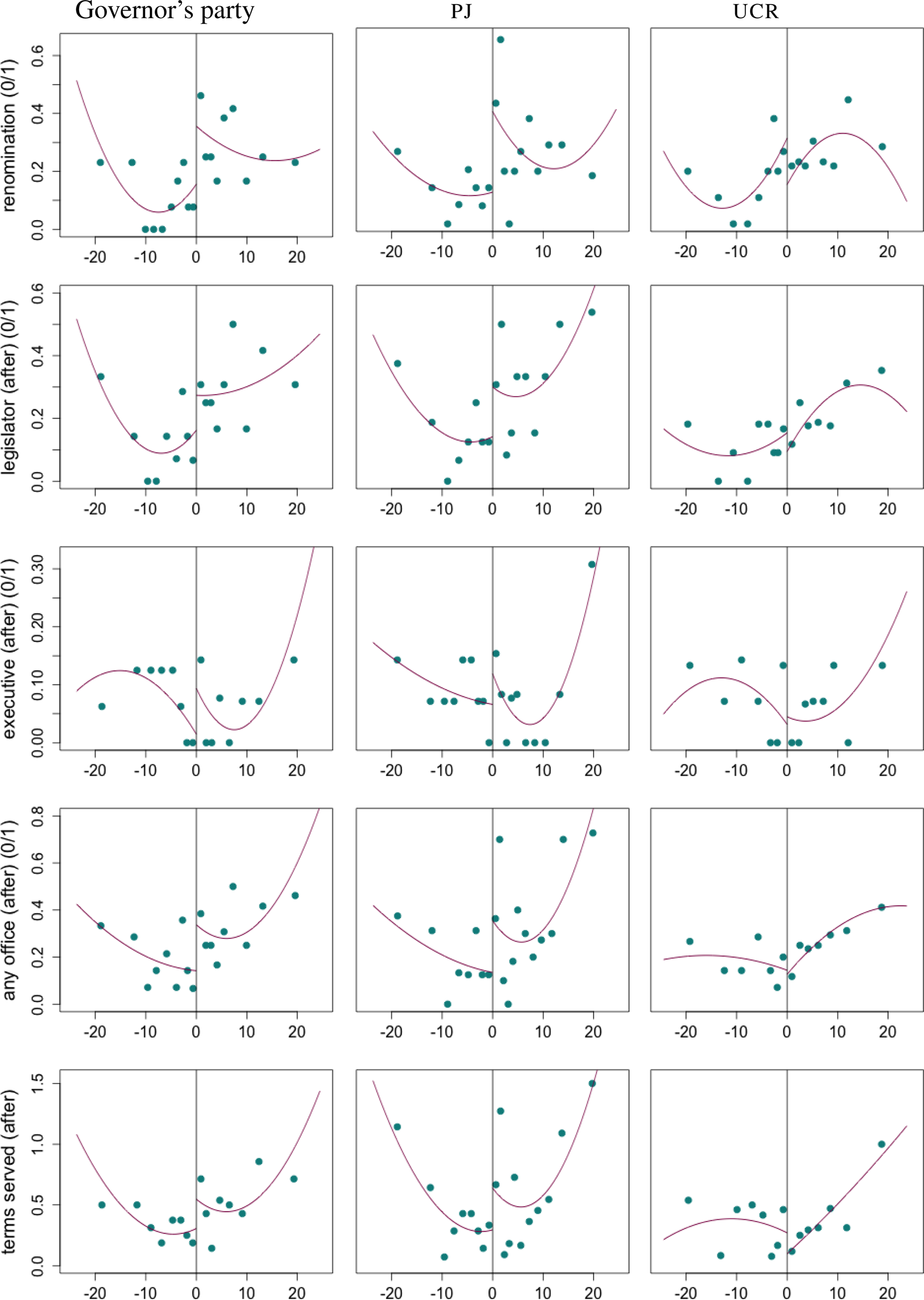
Figures 1 and 2 below examine the distribution of the outcome variables across the range of the running variable. In the all-province sample, candidates belonging to the governor's party or the pj who barely win at t have a (much) higher chance of being renominated within the next four years. Marginal pj winners are also more likely to serve as national legislators and to serve more elective terms in the future. For the ucr, in contrast, most effects look negative. Figure 2 suggests that the relationship is starker in small provinces,Footnote 8 where candidates from the governor's party or the pj who barely win a legislative seat at t have a much better political career at t ′ > t for all outcomes, though it remains to be seen whether such increases are statistically significant. For the ucr, the effect is again negative for renomination, but appears to be zero for the remaining outcomes.
Mimicking variance rd plots with quantile-spaced bins (Calonico et al., Reference Calonico, Cattaneo and Titiunik2015)—All provinces. The lines indicate the fit of a second-order polynomial regression estimated separately at each side of the cutoff, using a uniform kernel.

Mimicking variance rd plots with quantile-spaced bins (Calonico et al., Reference Calonico, Cattaneo and Titiunik2015)—Small provinces (m ≤ 5) only. The lines indicate the fit of a second-order polynomial regression estimated separately at each side of the cutoff, using a uniform kernel.

3.3. Main results
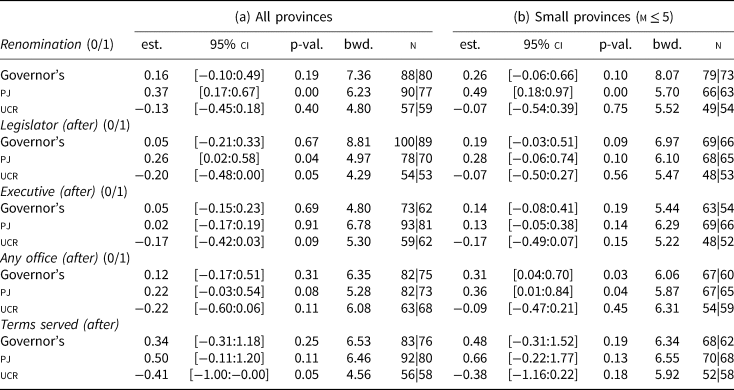
The first and second panels in Table 2 report the sharp rd estimates for the all-province and the small-province samples, respectively. Marginal winners leverage their seat into a consolation prize in the future, especially in small provinces, though the effect is restricted to the pj. This partly reflects the fact that given our limited sample sizes we can only detect relatively large effects. Specifically, we can detect an effect as large as a standard deviation of the outcome variable in the control group (sdC) with 80 percent power, and effective power against such an effect is well above 0.80, but our overall sample sizes—265, 285, and 237 for the governor's party, the pj, and the ucr, respectively—are too small to detect an effect half as large (see Table A4). Since the estimated effects for the pj are relatively large, we have 80 percent power against them; for the governor's party and ucr, in contrast, the estimated effects are substantially smaller, and thus statistically insignificant estimates may be due to low power.
The effect of a legislative seat on a politician's career in Argentina, 1983–2011

Sharp rd estimates. The running variable is vote change to last seat. Samples are restricted to marginal candidates within each reference party. We report conventional point estimates with robust cis and p-values based on the mse-optimal bandwidth proposed by Calonico et al. (Reference Calonico, Cattaneo and Titiunik2014). We clustered observations by province and fitted a separate local linear regression at both sides of the threshold, with a triangular kernel. In panel (a), overall sample size is (142+123=265) for the governor's party, and (149+136=285) and (111+126=237) for the pj and ucr, respectively. In panel (b), overall sample sizes are (128+111=239), (127+124=251), and (100+116=216) for the governor's party, the pj, and the ucr, respectively.
Consistent with the consolation prize story, marginal pj winners are 37–49 percentage points more likely to be renominated than their marginal loser counterparts. The effect is also positive—though roughly half in size and only significant at the 0.10 level in the small-province sample—for the governor's party. To put these numbers in perspective, Appendix Table A1b shows that less than a fifth of marginal candidates sought renomination within the next four years. Higher renomination rates translate into a positive effect on the probability that marginal winners will serve a new legislative term, though the effect sizes are cut by two-thirds, and low power means that in small provinces the estimates are only significant at the 0.10 level. Still, estimated effect sizes are comparable to the probability that a marginal legislator will serve an additional term, which hovers around 21–24 percentage points for the pj and the governor's party (see Table A1b).
Support for the window-of-opportunity story is much weaker. In the full sample, the effect of winning a seat on the probability of obtaining an executive position in the future is positive but small—2 to 5 pp.—and statistically insignificant. The estimates jump to a respectable 13–14 pp. in the small-province sample, but low power means that neither is statistically significant at conventional levels. Indeed, Table A4 shows that to detect an effect as large as the one we report, the number of observations in the treated group should increase by 50–100%. In sum, it is not so much that we find evidence against the window-of-opportunity story (in small provinces), but rather that a positive effect, if it exists, is not large enough to be detected with the sample sizes we have.
The last two sets of results confirm this. The estimates for any office (after) are generally larger in size and more reliable than those for serving as legislator or executive afterwards, especially in small provinces. This makes sense, as this variable combines future legislators and executives, and we found positive effects for both. On the other hand, estimates for the total number of (future) terms served show that bare winners serve around half an additional legislative term in some other position, though the estimates are not statistically significant.
For the ucr, in contrast, all point estimates are negative, though only one—that for the number of future terms served in the all-province sample—is statistically significant at the 0.05 level.Footnote 9 Table A4 shows that the corresponding tests are underpowered, especially for the small-province sample. Still, some effect sizes are quite large, especially in the full sample: − 20 percentage points for the probability of serving as a legislator in the future, − 17 pp. for the probability of gaining an executive seat, and 0.41 fewer terms served in the future. All three are statistically significant at the 0.10 level. This contradicts both the consolation prize and the window-of-opportunity stories. In contrast, the estimates for renomination are much closer to zero, suggesting that the negative effects are not due to the fact that bare ucr winners are shunning executive positions in favor of a legislative career. Rather, marginal ucr winner become less likely to develop any kind of political career afterwards. Our (admittedly speculative) interpretation is that ucr legislators are disadvantaged because they are less likely to count with the support of a copartisan governor than their Peronist counterparts (Calvo and Murillo, Reference Calvo and Murillo2004). This makes them “natural” candidates for an executive position, discouraging the pursuit of reelection, but also reducing their chances of winning a different office. To put it differently, not only is the governor's party (generally the pj) advantaged in terms of resources; it also has a larger and better pool of candidates from which to draw on. Opposition parties often have fewer good candidates, and thus must nominate them for valuable positions that they are unlikely to win. Consistently, Table A1b shows that 43% of marginal ucr candidates occupied the top position of the party list, three to four times more frequently than their peers from the governor's party (9%) or the pj (13%). Unlike their counterparts from other parties, top-ranked ucr politicians are far from sure of winning even a legislative seat.
3.4. Additional results
Table A7 in Appendix F shows that disaggregating the executive (after) variable between mayors and non-mayors hardly changes the results for the governor's party or the pj, though the ucr results are mostly driven by executive positions other than mayor—a strong enough effect to be statistically significant at the 0.01 level. Distinguishing between positions that are roughly equivalent to national deputy—member of the Mercosur Parliament or the 1994 constituent assembly—and those that can be considered more valuable—all executive positions plus national senator—does little to change the results, either.
The plausibility of the consolation prize story is strengthened by the fact that the results are very similar if we restrict the sample to candidates who had no previous experience as executives or national legislators (Table A8), or who were running for the first time (Table A9). To the extent that these are less weighty politicians, the pull of reelection as a consolation prize should be comparatively stronger for them. But despite the considerable reduction in sample size, the point estimates change little, and those for first-time candidates remain statistically significant. In contrast, the negative estimates for the ucr are substantially attenuated; those for inexperienced candidates even become positive, though far from significant.
Nineteen of Argentina's 24 provinces elect an odd number of deputies, and thus have different district magnitudes every two years (Lucardi, Reference Lucardi2019). This may induce ambitious politicians to strategically run in some election years in order to maximize their chances of success.Footnote 10 For example, Table 1 shows that in Catamarca in 2013 the two largest parties were separated by less than 2,500 votes, and thus there was a close competition for the third seat between the second-placed candidate in each list. But had district magnitude been two instead of three—as in 2011 or 2015—the second-placed candidate in either list would have stood little chance of being elected. Thus, Tables A10 and A11 look at elections held under small or large magnitudes, respectively, but only in provinces with an odd number of representatives. Interestingly, candidates elected in small-magnitude years are much more likely to be renominated—with a p-value of 0.06 despite the tiny sample size—but are comparatively unsuccessful in getting reelected or jumping to other positions. The negative effects for the ucr tend to be concentrated in these small-magnitude elections as well. In contrast, candidates from the governor's party or the pj who are elected in large-magnitude years are a whooping 39–56 pp. more likely to capture any other office in the future, and serve roughly one full elective term afterwards—the latter effect being significant at the 0.10 level. These results are compatible both with the claim that there is strategic selection into large-magnitude elections, and with the possibility that marginal candidates elected in large-magnitude years have an easier time getting elected again, though we do not want to make much of these tests because they are certainly underpowered. They do indicate, however, that our results are not being driven by a comparison between high-quality candidates running in large-magnitude elections and low-quality ones contesting low-magnitude races.
Lastly, Tables A12 and A13 show that the positive effect of incumbency on renomination is much stronger for women. This is consistent with the consolation prize story: since female politicians are disadvantaged in terms of access to executive positions (Franceschet and Piscopo, Reference Franceschet and Piscopo2014), they tend to invest somewhat more developing legislative career (Lucardi and Micozzi, Reference Lucardi and Micozzi2016).
3.5. Robustness checks
Appendix Figures A13–A15 show that the estimates reported in Table 2 are quite stable around the optimal bandwidth choice reported in Table 2. Tables A14 and A15 report fuzzy rd estimates that account for the fact that a handful of marginal winners did not assume office, and several marginal losers did, following the death or resignation of a colleague. Regardless of whether we weight these individuals equally or according to the time they actually spent in office, the point estimates change little.
Table A16 shows that controlling for gender, prior experience, election characteristics, and position in the party list does not change the results; if anything, the confidence intervals get smaller, which results in a handful of estimates becoming statistically significant. Interestingly, the estimates that do change are those for the ucr, which almost invariably become smaller in size and are no longer significant, suggesting that part of the explanation for the negative results in Table 2 has to do with the imbalanced candidate characteristics observed in Table A3 and Figures A9–A12. Fitting a second-order polynomial instead of a local linear regression results in similar (Table A17) but underpowered (Table A6) estimates. Using a different version of the running variable that only takes into account how a party's vote share should have changed for it to win or lose a seat (Cox et al., Reference Cox, Fiva and Smith2019) also produces similar estimates, though the cis are predictably wider (Table A18).
4. Conclusion
From the perspective of a progressively ambitious politician, how valuable is a seat in the Argentine Chamber of Deputies? We considered two possibilities: that a seat may provide a window of opportunity for jumpstarting a long-term career; or that it may provide a consolation prize when other possibilities are closed. We found little evidence of the former, but considerably support for the latter, though subject to two caveats: (a) the effect is driven by the pj; and (b) several estimates are statistically insignificant due to low power. A potential explanation, which we leave for future research, is that Argentine deputies, in addition to being relatively well paid, may manage to obtain plum appointments in the private or public sectors after their term is over, as in Britain (Eggers and Hainmueller, Reference Eggers and Hainmueller2009) or Russia (Remington, Reference Remington2008). Indeed, term-limited governors and mayors often run for a legislative position at the end of their terms, implying that when other alternatives are precluded they do see some value in holding a legislative office. The fact that the renomination effect is much stronger for women, for whom winning an executive position is harder, further reinforces the point.
For the ucr, in contrast, the estimated effects are often negative and large, though they fall short of statistical significance. We attribute this to the fact that the pj controlled two-thirds of provincial governorships during this period, which may have forced ucr politicians to run for offices they had little chance of winning. In addition, internal party rules mean that ucr legislators face a higher hurdle at obtaining renomination than their peers from other forces (Caminotti et al., Reference Caminotti, Rotman and Varetto2011). Nonetheless, other explanations are possible. ucr candidates benefitted disproportionately from national-level swings in some elections (1983, 1985, 1997, and 1999), raising the possibility that bare winners and losers in those years may not be comparable to the party's bare losers and winners in other years. Alternatively, voter backlashes due to the party's poor economic performance in 1989 and 2001 (Torre, Reference Torre2003) may have hurt its candidates particularly badly.
On a different note, our focus on marginal candidates may lead some readers to question the external validity of our findings: if such candidates are systematically different from the rest, our results may say little about the effect of a legislative seat on more experienced politicians. Yet most Argentine politicians seeking a seat in the Chamber of Deputies are not former (vice-)presidents, (vice-)governors, or mayors from important cities (see Table A1); they are closer to the marginal candidates studied in this paper than to the “big fish” that head the lists of large parties. Furthermore, Tables A8 and A9 show that the effect sizes for unexperienced and/or first-time candidates are similar to those reported in Table 2, though the reduced sample sizes make the estimates insignificant. In any case, the advantage of holding a seat should be stronger for higher-quality legislators, and thus our estimates should be interpreted as a lower bound.
We presented an innovative approach to estimate the value of a legislative seat in environments where careerism is dynamic and multilevel. We hope this will promote the application of rd techniques in pr systems, which account for roughly half of (democratic) national lower house elections since 1950 (Bormann and Golder, Reference Bormann and Golder2013, Figure 3). Previous work has studied the connection between partisanship and policy (Folke, Reference Folke2014) as well as the formation of political dynasties (Fiva and Smith, Reference Fiva and Smith2018), but the methodology is useful for causally evaluating individual-level careers and behavior in environments where progressive ambition is the norm as well. We are eager to see whether similar results to the ones reported here pop up in other Latin American countries, such as Brazil, Chile, Uruguay, Mexico, or Colombia.
Supplementary material
To view supplementary material for this article, please visit https://doi.org/10.1017/psrm.2019.52.
Acknowledgments
We thank the Asociación Mexicana de Cultura, A.C. for financial support. Ernesto Calvo kindly shared his data on Argentine congressional candidates. Previous versions of this paper were presented at the 2016 mpsa Annual Meeting, the itam Political Science Research Seminar, the 2016 gel–alacip meeting, and the 2018 Latin American PolMeth Meeting. We thank Yann P. Kerevel, Robert Thompson, Stephen Meserve, Vidal Romero, Jeffrey Weldon, José Merino, Eric Magar, Eduardo Alemán, Jorge Gallego, Michelle Torres, Kaitlin Senk, Sofía Vera, Nelson Ruiz, Chris Tausanovitch, and other participants at these venues, as well as Rocío Titiunik and nine anonymous reviewers for their helpful comments. Upon publication, replication data will be uploaded to the authors' websites. The usual disclaimer applies.