INTRODUCTION
Radiocarbon (14C) is a powerful isotopic tool with applications that transcend disciplinary boundaries. In addition to its use for determining the age of archaeological or geologic materials (e.g., Arnold and Libby Reference Arnold and Libby1949), measurements of 14C at natural levels have proven useful for tracing oceanic water masses (e.g., Broecker and Peng Reference Broecker and Peng1982); chronicling complex glacial histories (e.g., Goehring et al. Reference Goehring, Schaefer, Schluechter and Lifton2011); and assessing the flux of oil spill-related petrocarbon to the seafloor (e.g., Chanton et al. Reference Chanton, Zhao, Rosenheim, Joye, Bosman, Brunner, Yeager, Diercks and Hollander2015). Conversely, at concentrations elevated above natural abundances, 14C-labeled substrates may be used as a tracer of biologically mediated transformations of carbon (e.g., Strickland and Parsons Reference Strickland and Parsons1968; Kirchman et al. Reference Kirchman, K’nees and Hodson1985).
The dynamic-range from natural to 14C-labeled materials spans several orders of magnitude in 14C concentrations. To extend measurement capabilities to samples with exceedingly small amounts of 14C (i.e., smaller sample sizes), original counting techniques (i.e., Geiger counting, gas proportional counting, liquid scintillation counting) were replaced by accelerator mass spectrometry (AMS) techniques (e.g., Bennett et al. Reference Bennett, Beukens, Clover, Gove, Liebert, Litherland, Purser and Sondheim1977; Muller et al. Reference Muller, Alvarez, Holley and Stephenson1977, Reference Muller, Stephenson and Mast1978; Nelson et al. Reference Nelson, Korteling and Stott1977). The real advantage of AMS over counting techniques is sample size; whereas 1 g C is required for counting, AMS necessitates 1 mg or less. Measurement of 14C by AMS has grown more precise in recent years (Steier et al. Reference Steier, Dellinger, Kutschera, Priller, Rom and Wild2004), extending low-end detection limits down to 10–16 atoms (Zhao et al. Reference Zhao, Crann, Murseli, St-Jean, Kieser, Wilk, Cornett and Clark2019). In contrast, the transformation of 14C-labeled materials can be measured on the high end of the dynamic range using counting techniques. Labeling molecules with 14C is useful for determining the rates of key carbon transformation processes through microbial biomass, including rates of photosynthetic primary production, chemoautotrophic carbon fixation, and rates of respiration (Strickland and Parsons Reference Strickland and Parsons1968; Kirchman et al. Reference Kirchman, K’nees and Hodson1985; Hill et al. Reference Hill, Warwick and Zubkov2013; Baltar and Herndl Reference Baltar and Herndl2019). The use of 14C in these studies is advantageous specifically because of its high sensitivity, which makes it appropriate for use across a range of environments, including those with low productivity (Peterson Reference Peterson1980). Because 14C is a low energy beta emitter, it is relatively safer to persons who handle it than many other radioisotopic tracers. Whereas naturally occurring 14C concentrations fall below 10–12 atoms 14C (modern atmospheric values =1.176 × 10⁻¹² atoms 14C/12C), commercially available 14C-labeled tracers may be as many as 12 orders of magnitude above natural levels.
Collaboration between researchers using natural-level 14C and those using 14C-labeled materials carries high risk despite the growing transdisciplinary nature of science. Such collaboration could compromise the integrity of natural-level 14C research (i.e., make old samples look anomalously young) and restrict the appropriate use of 14C-labeling experiments through efforts to prevent cross-contamination. Even communication between scientists measuring natural-level 14C and applying 14C-labeled materials can be difficult, due to decades of divergent work separate from one another. Natural-level, AMS 14C data are conventionally reported as fraction modern (Fm) and may be converted to radiocarbon age (14C yr). In contrast, 14C-labeled materials above natural levels discuss abundances in units of total activity [e.g., disintegrations per minute (dpm), curies (Ci), becquerels (Bq)], concentration (e.g., Ci mL–1) or specific activity (e.g., dpm mol–1 of labeled compound). Conversions between the two sets of units may not be straightforward without knowledge of sample size or measurement technique applied.
Though complete separation of researchers using natural-level 14C and those applying 14C-labeled tracers may be feasible in conventional laboratories, it is often unavoidable in community shared spaces (research vessels, shared field stations, shared office spaces at remote research stations) where visiting research groups carry out consecutive projects at either end of the 14C measurement spectrum. In such spaces, strict measures typically limit the use of 14C-labeled materials to avoid the constant worry that a very small amount (< 1 nL) of labeled solution or exposure to 14CO2 will ultimately nullify the results of natural-level 14C work. The need to separate natural-level workers from radiolabeling workers may preclude simultaneous transdisciplinary collaborations where transformative scientific discoveries may otherwise be possible. In many cases, opportunities for potentially transformative science are not undertaken due to logistical difficulty and are passed up at the earliest stages of proposal building.
For collaborative projects in which research efforts rely dually on the measurement of natural-level 14C abundances and the application of 14C-labeled tracers, it is imperative to establish operating protocols that avoid contamination without interfering with the integrity of either type of research. Here we summarize efforts in a remote Antarctic field expedition, wherein the research foci of different research groups revolved around subglacial carbon cycling over a multitude of timescales. Scientific questions regarding geologic history relied on the measurement of 14C at natural levels (e.g., Venturelli et al. Reference Venturelli, Siegfried, Roush and Li2020), whereas questions relating to cellular biosynthesis and respiration relied on the use of 14C-labeled leucine and sodium bicarbonate (e.g., Christner et al. Reference Christner, Priscu, Achberger and Barbante2014; Vick-Majors et al. Reference Vick-Majors, Mitchell, Achberger and Christner2016). With only one access point into the subglacial environment and a limited time window for sample collection (Priscu et al. Reference Priscu, Kalin, Winans, Campbell, Siegfried, Skidmore, Dore, Leventer, Harwood and Duling2021), infrastructure, protocol, and mutual understanding needed to be developed in the planning stages of this project so that both groups could maximize successful research outcomes. We contend that these developments will be useful to a broad subset of researchers using 14C at natural and elevated levels, as well as communities using other analytes/contaminants over wide dynamic ranges (e.g., pulse chase/nutrient research). We outline testing procedures for community laboratory spaces where 14C-labeled materials have been applied in the past, provide remediation strategies for low-level contamination in community shared laboratory space, and outline operating procedures that resulted in a successful, collaborative research effort. These protocols provide a framework for continued success in future research initiatives.
14C CONTAMINATION VERNACULAR
“Contamination” can have a range of definitions that depends largely upon discipline, especially with the broad-ranging applications of 14C measurements. Radiation control groups might consider something to be free of contamination when it falls below levels that are a concern to human health (<104 dpm m–2), but such levels are still much higher than modern atmospheric 14C concentrations. Throughout this paper we refer to contamination from the perspective of natural-level 14C research, such that any substance containing a 14C concentration greater than a Fraction Modern equal to one (>1 Fm, where Fm is the deviation of 14C/12C ratio in a sample from 95% of the 14C concentration in 1950) is considered a contaminant. Although this definition includes 14C elevations that occurred in the atmosphere during and after thermonuclear bomb testing in the 1950s which are also exploited by natural-level radiocarbon researchers, the natural-level work described here involved only older-than-modern samples (pre-1950). It is well-documented that samples containing high concentrations of radiocarbon, colloquially deemed “hot” samples, can be catastrophic for natural-level AMS facilities (Bucholz et al. Reference Buchholz, Freeman, Haack and Vogel2000; Zermeño et al. Reference Zermeño, Kurdyla, Buchholz, Heller, Kashgarian and Frantz2004; Zhou et al. Reference Zhou, Wu, Lange, Lu, Cheng, Xiong, Cruz, Liu, Fu and Zhao2012). However, low-level contamination of older samples, for example Last Glacial Maximum (LGM—26.5 to 19–20 ka; Clark et al. Reference Clark, Dyke, Shakun, Carlson and Clark2009) sediment that may date to the Holocene (11.7 ka to present) after being contaminated, has the potential to result in a substantial misunderstanding of Earth’s history because the contamination is not enough to render the result impossible (e.g., Fm >>1). Such insidious risk, in addition to previously described high-level contamination that is harmful to AMS technology, is why we frame our perspective of contamination from a natural-level standpoint.
EVALUATION OF 14C CONTAMINATION
The risk of 14C contamination in shared research facilities necessitates evaluation of surfaces, keypads, handles, floors, faucets, and other commonly touched areas before samples intended for natural level 14C research enter a space. In an effort to ensure the success of natural-level research after isotopic tracers have been used, radiocarbon researchers employ two types of sampling for contamination, “SWAB” testing and “swipe” sampling. Measurement techniques of these samples is largely a result of the contamination levels each method monitors for. Therefore, the threshold of background 14C levels required for natural-level work in a shared space should be carefully assessed when choosing a contamination testing method.
Because exposure to radioactive materials poses risk for human health, conventional testing can be performed by radiation control groups. However, this testing would not be sufficient to detect contamination that may be deleterious to natural level 14C research. For this reason, the Miami SWAB program was established in 1981 to assess 14C remaining in laboratory spaces and research vessels after U.S. National Science Foundation (NSF)-funded use of radiolabeled tracers. Testing through the Miami SWAB program prescribes covering potentially contaminated surfaces with diluted detergent (Count-Off™) in 1 m2 intervals, absorbing the solution with a sponge, and squeezing collected liquid into a bottle that may be submitted to the Tritium laboratory at University of Miami. Here, particulate material is removed by centrifuging, and the supernatant is analyzed with a liquid scintillation counter (LSC). Results are reported as the amount of radioactivity per unit area, and the SWAB program recommends remediation based on the level detected (Table 1).
SWAB result levels and required remediation as prescribed by the Miami SWAB program (http://www.rsmas.miami.edu/groups/tritium/swab/monitoring-of-shipboardcontamination/).

Even when SWAB testing shows values as high as 10,000 dpm/m2, human health issues are of no concern (Table 1). However, when SWAB testing results are at detection limit (50 dpm/m2) or somewhat higher, scientists using natural level 14C abundances in their research usually opt for AMS-based swipe testing to be used to check for low-level contamination. Swipe testing is an additional, but important, test for natural-level work because contamination requiring no remediation action as outlined by the SWAB program (Table 1), may still put natural-level 14C studies at risk. To test for 14C contamination using AMS-based swipes, a pre-combusted (525°C, 4 hr) quartz fiber filter (Pall TissuQuartz 2.5cm PALL 7200) is moistened with isopropanol and wiped over a surface. Unlike testing with the SWAB program, swipe testing is not confined solely to horizontal/flat surfaces and allows for the testing of areas with high hand traffic (handles, faucets, buttons, keypads). Materials collected on quartz fiber filters are then converted to CO2 by closed-tube combustion in the presence of CuO and Ag, graphitized, and analyzed with an AMS system capable of detecting 14C at natural levels and slightly above natural radiocarbon levels in samples with low carbon content (Elder et al. Reference Elder, Roberts, Walther and Xu2019) (Table 2). Often swipes from pristine surfaces, those with little-to-no carbon, must be diluted with 14C-free carrier in order to produce a large enough sample for measurement. We note that dilution was not necessary to produce measurable amounts of carbon from the swipe testing performed in this study.
AMS-based swipe result levels and first-order interpretation of result. It should be noted that “clean” laboratories (<1 Fm) are often characterized by swipe results of ∼0.6–0.75 which comes from a combination of ambient dirt and dust. A lab that is hygienically very clean, lacking dirt and dust, may result in swipe results nearer 1 Fm due to a lack of 14C-free dust to dilute modern atmospheric values.

As part of the U.S. Antarctic Program, a combination of these methods has been used to assess 14C contamination. Such protocol applies collection methods similar to swipe-testing, wherein a quartz fiber filter is moistened with isopropanol or Count-Off ™ and wiped over a surface. However, the measurement of 14C is performed with LSC due to the likelihood of a swipe sample from this environment containing levels of 14C that could harm AMS equipment. We refer to this combination of testing as “LSC-based swipe testing” below.
PROJECT DESCRIPTION
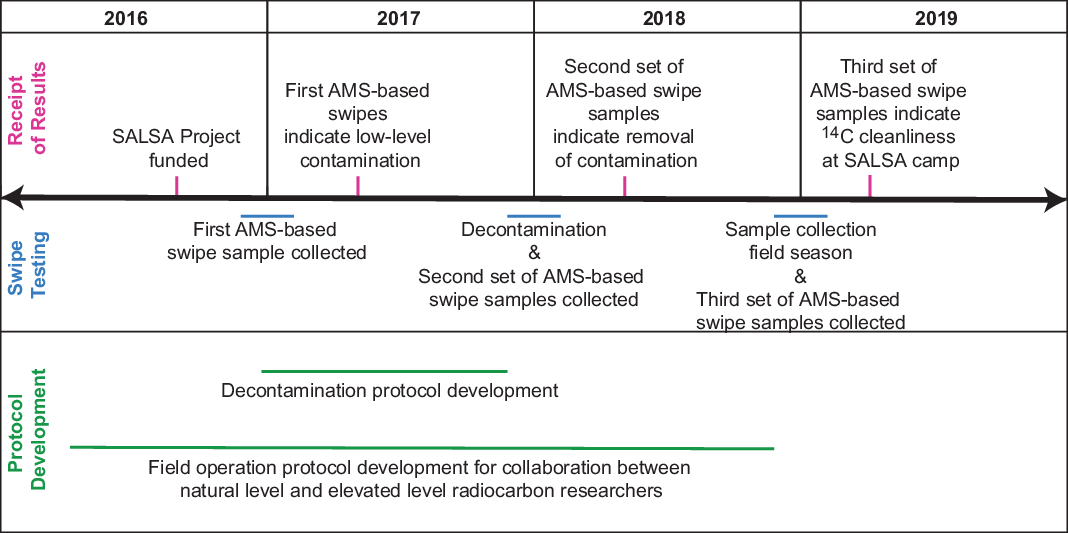
The Subglacial Antarctic Lakes Scientific Access (SALSA) Project was a transdisciplinary research effort centered on understanding the subglacial carbon cycle (Priscu et al. Reference Priscu, Kalin, Winans, Campbell, Siegfried, Skidmore, Dore, Leventer, Harwood and Duling2021). Researchers working on this project deployed to Mercer Subglacial Lake (SLM), ∼600 km from McMurdo Station during the 2018–2019 Antarctic field season. During field operations, workers seeking to evaluate natural-level 14C as well as researchers seeking to utilize 14C-labeled leucine and sodium bicarbonate as isotopic tracers in their experiments obtained subglacial water and sediment samples through a single hot water-drilled borehole (Tulaczyk et al. Reference Tulaczyk, Mikucki, Siegfried and Priscu2014; Rack et al. Reference Rack2016; Priscu et al. Reference Priscu, Kalin, Winans, Campbell, Siegfried, Skidmore, Dore, Leventer, Harwood and Duling2021). In-field sample processing was carried out in mobile laboratories converted from 40-ft shipping containers (see Supplementary Materials). Before SALSA fieldwork, the mobile laboratories used at our remote field site were previously used in a project that applied 14C-labeled bicarbonate and leucine at concentrations 1.6 × 10¹⁰ times greater than modern (Christner et al. Reference Christner, Priscu, Achberger and Barbante2014; Vick-Majors et al. Reference Vick-Majors, Mitchell, Achberger and Christner2016; Vick-Majors et al. Reference Vick-Majors, Achberger, Michaud, Priscu, Di Prisco, Edwards, Elster and Huiskes2020). The challenges posed by collaborating in close quarters, and knowledge of the previous use of our laboratory facilities, rendered it imperative to assess contamination levels in laboratory spaces intended for natural level 14C work and establish protocol for groups with different research goals to work in close quarters at our field site. Planning for the evaluation of 14C at different levels began as soon as the project was funded (August 2016) and continued until field deployment (December 2018) (Figure 1). Here we outline the iterative process of checking for contamination, developing protocol, remediating contamination, and monitoring 14C levels during field operations.
Timeline of preparation and operations for the SALSA Project. Here we highlight the multiyear period over which we spent preparing laboratory spaces and protocols for field operations. The extended timeline is a result of the logistical constraints involved in Antarctic field research and the inaccessibility of our field laboratories.

PROTOCOL DEVELOPMENT AND ENACTMENT
Initial AMS-Based Swipe Testing and Results (2016–2017)
Mobile laboratory containers transported to the SALSA field site had been used during a previous subglacial drilling effort (WISSARD) that employed radiolabeling techniques to assess microbial carbon transformations (described in detail in Christner et al. Reference Christner, Priscu, Achberger and Barbante2014 and Vick-Majors et al. Reference Vick-Majors, Mitchell, Achberger and Christner2016). At the conclusion of WISSARD, LSC-based swipe testing resulted in < 20 dpm/m2, indicating that AMS-based swipe testing could be carried out. We performed AMS-based swipe testing on areas of high hand traffic (i.e., door handles, faucets, cabinets) and surfaces intended for sample and tool placement (bench tops, sinks, floor) in the laboratory intended for natural-level 14C work during the 2016–2017 Antarctic field season, two years prior to SALSA field operations (Figure 1). On benches and floors, swipe testing was confined to 1 m2 spaces to avoid tracking local-scale contamination throughout the entire laboratory space if present. We placed individual quartz fiber filters used to perform each swipe test into pre-combusted glass scintillation vials (525°C, 4 hr) immediately after performing each test. All swipe tests were sent to the National Ocean Sciences Accelerator Mass Spectrometry (NOSAMS) facility for analysis. Results of these initial AMS-based swipe tests indicated higher-than-modern (1.7 Fm) and near-modern (0.97 Fm) 14C concentrations on faucet handles in the laboratory space intended for natural-level samples. Other regions (benches, drains, door handles, and cabinets) in this laboratory were characterized by 14C concentrations typical of ambient indoor laboratory air (0.5–0.7 Fm).
Contamination Remediation and Second Swipe Testing (2017–2018)
We employed a chemically intensive cleaning protocol to the contaminated laboratory space. Radiolabeled substrates in the form of 14C-leucine or H2 14CO3 had been used during WISSARD, however, we had no direct knowledge as to how the contamination came to be (e.g., direct spill vs. secondary tracking from personnel and equipment moving between laboratory spaces). We divided the laboratory into sub-sections to avoid spreading any localized contamination, such as what we detected on the faucets. Sub-sections were limited to 1 m2 on benches and floors, individual handles, and individual faucets. Each individual space was assigned cleaning materials (sponges, spray bottles, towels, garbage bags, gloves) that did not leave the designated space. Each section was wiped with a dilute acid (10% HCl) and isopropanol (100%) to remove potential contamination from inorganic and organic molecules, respectively. Surfaces were rinsed with soap and water and finished with laboratory cleaning solvents RBS 35™ and Count Off™ applied as a spray and wiped off with single-use paper towels. All materials were disposed of immediately in a waste container located outside the laboratory.
Following full cleaning of the laboratory space, we performed another round of AMS-based swipe testing to determine the efficacy of the cleaning protocol. We performed one swipe test for each of the following locations: all door handles, all benches, all floors, and each individual faucet. Results from post-cleaning swipe testing demonstrated successful elimination of contamination in this laboratory space, specifically located on faucets, and reduced concentrations to 0.6–0.7 Fm. Our results suggest a chemically intense cleaning protocol provides thorough remediation for contamination resulting from radiolabeled tracer in both organic and inorganic forms. We were able to apply the lessons learned from our two years of AMS-based swipe testing and contamination remediation to develop a plan for field operations during the 2018 Antarctic field season (Figure 1).
Field Operations (2018–2019)
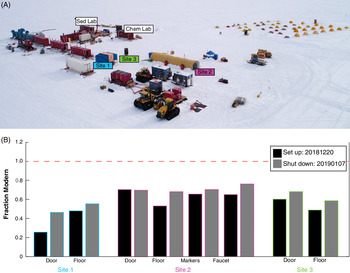
During the two years of AMS-based swipe testing and contamination remediation (2016–2018, Figure 1), we developed a comprehensive plan for field operations during the 2018 SALSA Antarctic field season. Immediately following the cleaning and second round of swipe testing in 2017 (Figure 1), two laboratory facilities were set up at the field site and staged for winter until they were opened in December 2018 for SALSA field operations. One laboratory was designated as a sediment laboratory space, in which natural-level 14C work would be performed. A second laboratory was designated as the chemical laboratory, in which 14C-labeled materials would be used for biological rate experiments (Figure 2). Primary wind patterns were observed and documented before configuration of the camp to ensure that the chemical laboratory was positioned downwind of the sediment laboratory to avoid potential contamination by off-gassing of radiolabeled materials during rate experiments. Personnel were assigned a workspace, and crossover of personnel between workspaces was prohibited. All materials, even laboratory waste, were confined to their designated space until the conclusion of field operations. Crossover was unavoidable, however, in common-use areas such as the mechanical tent where tools and common field miscellany were housed (Site 1; Figure 2), the mess tent where meals were served (Site 2; Figure 2), and lavatories (Site 3; Figure 2).
(A) Drone photograph of SALSA field camp with swipe locations designated by colored boxes. (B) Swipe results from common locations in the camp performed at the beginning of SALSA field operations and upon shut down of camp. The red dotted line indicates that all swipe results fell below concentrations considered contamination. (Please see electronic version for color figures.)

In order to transport materials to and from the SALSA deep field site in Antarctica, boxes are packed by the science party and entered into the science cargo system, handled by cargo staff, unloaded by the staff on board the flight to the field site (Air National Guard or Ken Borek Air depending on aircraft used), and transported to field laboratories by camp staff. This chain of custody is well-documented and designed to minimize the flight resources required to service remote Antarctic camps, but contains several steps in which a box could come into contact with a person or persons that has unknowingly encountered 14C contamination. Therefore, any sample or supply material entering the lab with an unknown chain of custody from shipment to the field site was treated as contaminated. Materials were unboxed outside of the sediment laboratory, often in cold/windy conditions (<0°C), to avoid introduction of potential radiocarbon contamination that may have resulted from contact with chemical laboratory scientists. Where removal of an outer package was not possible, materials were wiped down with dilute acid (10% HCl), alcohol (100% isopropanol), and Count Off™ before entering the sediment laboratory. All packaging and cleaning materials were placed onto paper-covered surfaces to allow surfaces to be easily removed for cleanup. This minimized potential contamination from multiple people handling materials at the unpacking stage from being transferred to materials inside the box.
Any persons working in the chemical laboratory were strictly prohibited from entering the sediment laboratory. This included our education and outreach collaborators who were filming a documentary about the SALSA project; we asked that they dedicate certain clip-on microphones to chemical laboratory researchers and others to sediment laboratory workers, and that they film sequentially in the sediment laboratory first. Though it is possible to minimize cross-contamination of personnel by the removal of shoes, gloves, and outer clothing, we deduced that in high-stress field situations with a finite time of access for samples, as well as rapidly changing weather and the need to enter and exit the laboratories sequentially, the stakes were too high to risk such potential for crossover. As a result, interdisciplinary sample handling was complex. All sediment cores intended for natural level 14C work were packaged in the sediment laboratory and not opened until they arrived at the core repository months later. All sediment samples to be shared between groups were sub-sampled as whole rounds from sediment cores or individual multi-core tubes in the sediment laboratory and transferred to members of the chemical laboratory in a neutral location. Water sampled for natural level 14C work was drawn from a new (not previously used in the field) 10 L Niskin bottle into precleaned and combusted (525°C, 4 hr) glass bottles. Water samples were transferred in secondary containment provided by the sediment lab in a neutral location. Containers were handled with gloved hands until placement in their final location, after which gloves were treated as contaminated and disposed of.
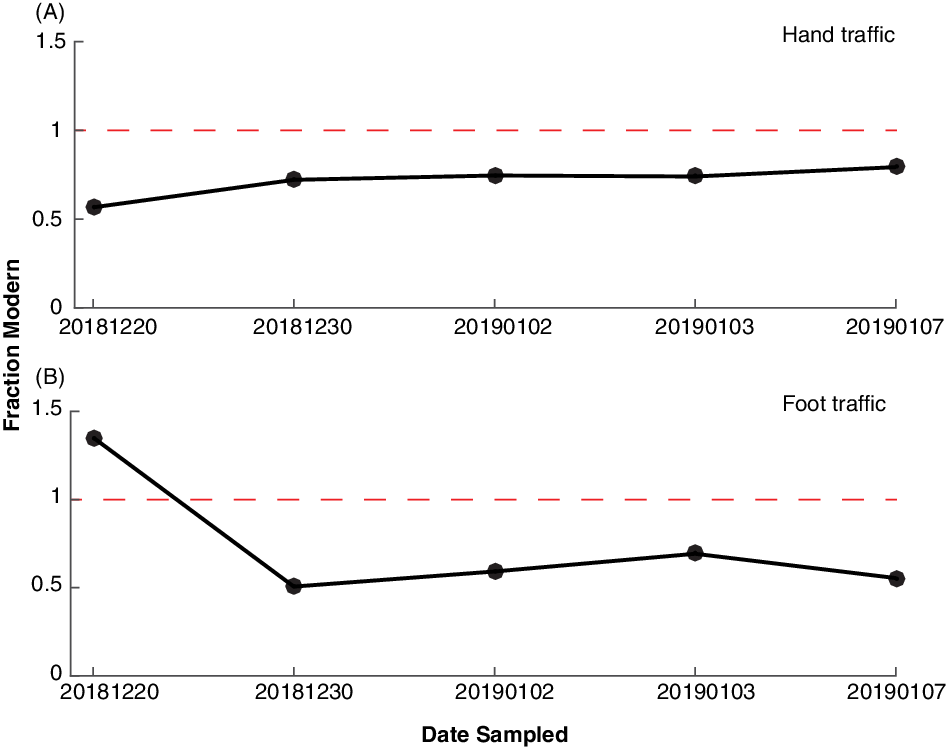
In order to assess the possible spread of contamination from the chemical laboratory, we developed an AMS-based swipe program to be employed during field operations. During this program, we performed swipe testing in set locations at the set up and shut down of camp, as well as every other day during field operations. We performed swipe testing in both communal (mess tent, mechanical facility, lavatories) and science-focused spaces (sediment laboratory, borehole control center); sampling both areas of high hand (faucets, doorknobs, bench surfaces) and foot (steps, doorways) traffic (Figure 2). Experiments applying 14C-labeled materials were confined to the chemical laboratory, and personnel working with radiolabeled chemicals logged all applications. This swipe program was designed to test our working hypothesis that 14C contamination would inevitably spread through our small camp. We expected that periodic swipe testing would allow us to chronicle a time-series of contamination events. Importantly, all SALSA scientists were involved in communication and protocol development during the planning stages of SALSA so that the sensitivity of natural-level work to 14C contamination was at the forefront of our collaborative research efforts. Radiation safety protocols in the chemical laboratory intended to prevent the spread of contamination included the use of laboratory bench paper and secondary containment for all items used in the preparation of radioisotope assays, use of and frequent changing of gloves by radioisotope users, cleaning of benches with 10% HCl and Count-Off™ in between experiments, and containment of pieces of potentially radioactive equipment such as pipettors and consumables such as tape in bags. In addition to these measures, radioisotope users always removed the Tyvek suits that were worn to protect subglacial samples from contamination before leaving the radioisotope area and did not re-use the suits. Swipe testing was performed every other day, and only one instance of an elevated 14C level was detected in the sediment laboratory doorway at a 14C concentration of 1.3 Fm. Time points for two subsequent testing periods after the elevated swipe indicated a return to natural levels (0.5 Fm), likely due to snow-covered boots naturally diluting the already low-level contamination (Figure 3). The indication of elevated 14C concentrations in a doorway but not on door handles or benches indicates that minor, ephemeral contamination was associated with foot traffic, but not with hand traffic, thus highlighting the importance of including floor contamination in protocol development.
Swipe results from the sediment laboratory at SALSA field camp. The red dotted lines indicate that all swipe results fell below concentrations considered contamination after initial swipes of the sediment laboratory floor (20181220).

Avoiding contamination at a remote field site is important, albeit meaningless if samples are subsequently exposed to elevated 14C levels during shipment or storage. We took extra precautions in the packaging of samples intended for natural-level work by packing in the sediment laboratory for northbound shipment. Sediment core materials were wrapped in multiple layers of plastic so that if handled by a contaminated individual, the outer layer could simply be removed without coming into contact with sampled material. This allowed samples to be stored in shared facilities that might not be cleaned to our (natural-level 14C) standards without compromising the integrity of natural-level materials and without interruption of experiments using14C-labeled materials.
DISCUSSION AND CONCLUSIONS
Was This Level of Protocol Development Necessary?
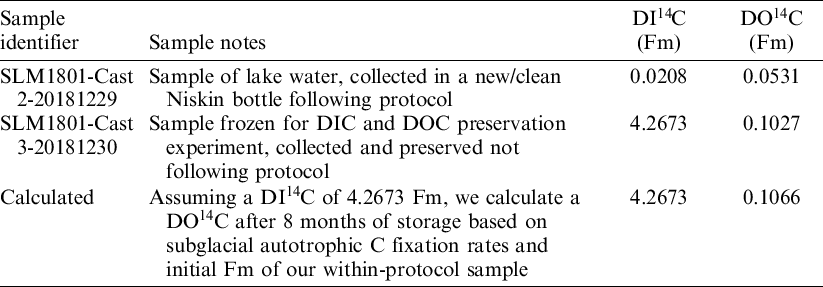
Early avoidance of contamination and success in carrying out simultaneous experiments with high levels of 14C-labeled material and natural-level 14C work during this project begs the question of whether extensive protocol development was necessary. To illustrate how necessary our efforts were, we collected one extra water sample, against the guidelines of our protocol—from a 10 L Niskin bottle that previously entered the chemical laboratory. The off-protocol sample (SLM1801-Cast 3-20181230) was immediately frozen for shipment and remained frozen (–20°C) until just before analysis. For analysis of DO14C, the first step involves the removal of DIC. In this case, we sampled CO2 stripped from DIC with the addition of acid (4 mL of 85% phosphoric acid; McNichol et al. Reference McNichol, Jones, Hutton, Gagnon and Key1994). Following the removal of DIC, we sparged the sample with ultrahigh purity (UHP) helium gas and oxidized it with ultraviolet (UV) light (1200-watt medium pressure mercury arc lamp) for 4 hr in a quartz reactor (following the methods of Beaupré et al. Reference Beaupré, Druffel and Griffin2007; Griffin et al. Reference Griffin, Beaupré and Druffel2010) to assess DO14C. CO2 evolved from DOC during UV oxidation was sparged with UHP helium and cryogenically purified. By sequentially analyzing both inorganic and organic pools of carbon from this same sample for 14C content, we found DO14C concentrations 0.496 Fm higher than our sample taken according to the guidelines of our sampling protocol (before the new Niskin bottle entered the chemical laboratory). Conversely, the DI14C measurement yielded a result of 4 times modern (Fm = 4.2673). During field operations, 14C-labeled sodium bicarbonate was used in uptake experiments within the chemical laboratory, and this sample demonstrates the ease with which the DIC of a lake water sample was contaminated by exposure to 14C-labeled material. The DO14C from the same sample (0.1027 Fm), higher than our uncontaminated, within-protocol sample (0.0531 Fm), suggests that some carry over of contaminated DIC into the DOC pool is possible, despite the sample being stored frozen (Table 3). To assess whether significant carry over can be explained by microbial carbon fixation in storage (–20°C), we calculated what DO14C would be after 8 months of storage with rates of autotrophic carbon fixation similar to those measured in nearby SLW during the WISSARD Project (2.7 nmol C/d/L; Christner et al. Reference Christner, Priscu, Achberger and Barbante2014). The results of this calculation (see supplemental materials) indicate that persistence of rates of inorganic carbon fixation measured in SLW during sample storage would be enough to result in the elevated DO14C concentrations measured in our water sample collected off protocol.
Table of results for dissolved inorganic carbon (DIC) and dissolved organic carbon (DOC) under three scenarios. Row one highlights the results of a measured sample collected based on sample collection protocol. Row two highlights the results of a measured sample, frozen for both DIC and DOC measurements, collected after the Niskin bottle had entered the chemical laboratory (i.e., off protocol). Row three highlights the calculated results of a sample with contaminated DIC had autotrophic rates measured in the subglacial environment persisted through frozen storage.

Both DI14C and DO14C results from the water sample collected off protocol compared to DI14C and DO14C results from the water samples collected following protocol confirm that contamination of 14C was a risk to our experimental design and that our protocol was warranted. Whereas the DI14C analysis of our sample collected off protocol yielded results obviously identified as contamination (Fm>1), the contamination in the DO14C for this same water sample was not (Fm<1). However, when compared to the results of the DO14C sample collected following protocol, and calculations simulating the persistence of microbial life in storage, (Table 3) the higher DO14C can be explained by some carryover from contamination of DI14C. This example highlights not only the risk of obvious contamination (Fm>1 observed in DIC), but also the risk of insidious contamination (observed in DOC) described previously.
Summary of Recommendations
Our paper addresses the realistic risk of transdisciplinary collaboration in field situations between natural-level 14C researchers and researchers using 14C-labeled materials with elevated concentrations and shows that establishment of rigorous contamination protocols can yield high integrity results for both measurements. Clearly, the protocol for this type of work can be improved; our results are intended to encourage others to adapt philosophies, to further improve our practices, and to participate in, rather than avoid, such research opportunities. We make the following direct recommendations for researchers interested in pursuing natural-level 14C research in collaboration with researchers using 14C-labeled materials:
1. Begin developing operating procedures during the project planning stage and assign specific protocol leads to communicate the necessity of 14C cleanliness to all researchers involved in the project (see supplementary materials for example). We attribute the success of our collaboration to the understanding developed in the planning stages of SALSA. It is important to tie operating protocol directly to the research objectives of disparate groups so that both natural-level and elevated-level 14C workers can achieve proposed research objectives without detriment to their individual results. Development of operating procedures prior to 24-hour field operations during SALSA ensured minimal crossover between 14C workers, thus reducing the risk of contamination.
2. Allow enough time to prepare laboratory spaces for natural level 14C work. Due to the remote nature of Antarctic research laboratories and field camps, iterations between testing, cleaning, and sampling take a full field season. This likely will not be the case on most UNOLS or other research vessels or more accessible field stations but will still require some amount of lead time.
3. Perform the appropriate testing in shared spaces. If prior use of 14C-labeled materials is unknown, it may be necessary to perform SWAB testing prior to AMS-based swipe testing. We recommend performing AMS-based swipe testing of all laboratory surfaces where natural-level research will be carried out after SWAB testing results in 14C levels <50 dpm/m2. Ships in the UNOLS fleet, for example, typically undergo routine SWAB testing in coordination with use of radiation laboratories aboard; vessels operated by other national research programs or private vessels may not. The same can be said about other remote research stations.
4. Prepare with a full stock of cleaning reagents. We recommend a chemically intensive, multistep cleaning process based on our success in reducing contamination in the SALSA laboratory space. The chemicals and cleaners chosen should remedy the types of labels used and should not jeopardize other facets of the work (e.g., ammonia-based cleaners should not be used on surfaces where samples for natural-level ammonia analysis will be prepared).
5. Assuming that personnel applying 14C-labeled materials in their experiments are uninformed chemists is good for worst-case-scenario planning, but bad for establishing interpersonal relationships. The same can be said about scientists who use 14C enriched substrates assuming that natural level 14C scientists are being too protective. It cannot be overstated that establishment of rapport, respect, and understanding are extremely important to productive protocol development.
Contamination is not always avoidable, but the success of our research program and cleaning protocol demonstrate that the spread of such contamination can be controlled in a way that allows maximum successful outcomes from transdisciplinary collaborations.
ACKNOWLEDGMENTS
This work was supported by the National Science Foundation as part of the Subglacial Antarctic Lakes Scientific Access (SALSA) project (OPP-1543347) and the NOSAMS internship program (OCE-1755125). We thank Rebecca Ricards, Matthew Kippenhan, and Steve Zellerhoff for their help in keeping SALSA camp radiocarbon clean. This manuscript benefited from comments made by two anonymous reviewers.
SUPPLEMENTARY MATERIAL
To view supplementary material for this article, please visit https://doi.org/10.1017/RDC.2021.55