Introduction
Despite the rich chemical and structural diversity of tellurium oxysalt minerals (Christy et al., Reference Christy, Mills, Kampf, Housley, Thorne and Marty2016a), relatively few contain additional sulfate anions. This seems surprising considering the prevalence of sulfides in the ore deposits in which many tellurium oxysalt minerals form from the weathering of primary minerals, such as hessite, altaite or native Te (e.g. Mills et al., Reference Mills, Kampf, Christy, Housley, Rossman, Reynolds and Marty2014; Missen et al., Reference Missen, Ram, Mills, Etschmann, Reith, Shuster, Smith and Brugger2020, Reference Missen, Etschmann, Mills, Sanyal, Ram, Shuster, Rea, Raudsepp, Fang, Lausberg, Melchiorre, Dodsworth, Liu, Wilson and Brugger2022a) in association with sulfides, such as galena and chalcopyrite. In these environments, sulfur is usually not incorporated into the structures of tellurium oxysalts. Here, we report the new mineral flaggite, which is only the 15th tellurium oxysalt mineral to contain essential sulfate (or thiosulfate) within its structure (Christy et al., Reference Christy, Mills and Kampf2016b; Missen et al., Reference Missen, Mills, Rumsey, Spratt, Najorka, Kampf and Thorne2022b). Bairdite, Pb2Cu2+4Te6+2O10(OH)2(SO4)(H2O) (Kampf et al., Reference Kampf, Mills, Housley, Rossman, Marty and Thorne2013) and tombstoneite, (Ca0.5Pb0.5)Pb3Cu2+6Te6+2O6(Te4+O3)6(Se4+O3)2(SO4)2⋅3H2O (Kampf et al., Reference Kampf, Mills, Housley, Ma and Thorne2021b), are the only other minerals that contain essential Pb, Cu, Te and S, all common elements found in tellurium ore deposits.
Flaggite is named in honour of Arthur L. Flagg (1883–1961). Professionally, Mr. Flagg was a mining engineer; however, first and foremost, mineralogy was his passionate avocation. During his studies at Brown University, Flagg was assigned to work with the USGS on geological quadrangle surveys in central Arizona. He fell in love with the state (at that time still a territory) and, following his graduation in 1906, he moved there to begin a career in mining, geology and mineralogy that spanned more than 55 years. His vast geological and mining experience focusing on Arizona, led to his being regarded as an expert on Arizona mineral resources. Flagg was particularly known as a proponent of educating the public about minerals and promoting the mineral collecting hobby. He was a founder, active member and president of several mining and mineralogical groups including the Mineralogical Society of Arizona, the Small Mine Operators Association, the American Federation of Mineralogical Societies, and the Rocky Mountain Federation of Mineralogical Societies. He lectured and wrote extensively, publishing two books for mineral collectors, Rockhounds and Arizona Minerals (1944) and Mineralogical Journeys in Arizona (1958), several articles on minerals for Arizona Highways and Rocks & Minerals, and papers in the Bulletin of the American Institute of Mining Engineers. In 1949, Flagg was hired by the Arizona Department of Mineral Resources to be the first curator of the Arizona Mineral Museum (now the Arizona Mining and Mineral Museum) in Phoenix, Arizona, a position he held until his death in 1961. The naming of this mineral for Arthur L. Flagg is particularly appropriate in recognition of the inspiration he provided to generations of future collectors and Earth scientists.
The new mineral and name (symbol Flg) were approved by the Commission on New Minerals, Nomenclature and Classification of the International Mineralogical Association (IMA2021-044, Kampf et al., Reference Kampf, Mills, Celestian, Ma, Yang and Thorne2021a). The description is based on one holotype and two cotype specimens deposited in the collections of the Natural History Museum of Los Angeles County, Los Angeles, California, USA; catalogue numbers 64499 (cotype), 64500 (cotype) and 76143 (holotype). Specimens 64499 and 64500 are also cotypes for backite.
Occurrence
Flaggite occurs at the Grand Central mine (coordinates: 31.70250, –110.06194) in the Tombstone district, Cochise County, Arizona, USA, ~1 km south of the town of Tombstone. The three type specimens were originally collected by Sidney A. Williams and were obtained by one of the authors (BT) from Excalibur Minerals. The Grand Central mine exploits a Ag–Au–Pb–Cu–Zn deposit in which the ore, consisting principally of oxidised Ag- and Au-rich galena, occurs in faulted and fractured portions of a large dyke hosted by the Bisbee Group limestone. A good description of the history, geology and mineralogy of the Tombstone district was provided by Williams (Reference Williams1980). Flaggite occurs in cavities in quartz matrix in association with alunite, backite, cerussite, jarosite and rodalquilarite.
Physical and optical properties
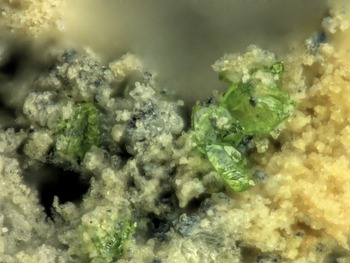
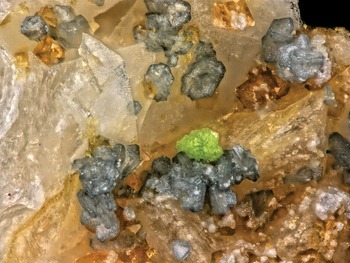
Flaggite crystals are tablets (Fig. 1) up to ~0.5 mm across and up to 0.2 mm thick (Fig. 1). On the cotype specimens, flaggite occurs as thin plates grouped in rosettes up to 0.1 mm in diameter (Fig. 2). Tablets are probably flattened on {010} based on the structure, but crystals are too small and irregular to measure forms. Twinning is ubiquitous, by 180° rotation on [001]. Crystals are lime green to yellow green and transparent with adamantine lustre. The streak is very pale green. No fluorescence was observed in either longwave or shortwave ultraviolet illumination. The Mohs hardness is ~3 based upon scratch tests. Crystals are brittle with irregular fracture. There is one excellent cleavage on {010}. The density could not be measured because it exceeds that of available density liquids and there is an insufficient quantity for physical measurement. The calculated density based on the empirical formula and unit-cell parameters obtained from single-crystal X-ray diffraction data is 6.137 g cm–3 and that for the ideal formula is 6.212 g cm–3. At room temperature, flaggite decomposes in dilute HCl, losing birefringence and becoming white and translucent.
Flaggite tablets (green) with alunite (yellow) on quartz; holotype specimen #76143; field of view 0.45 mm across.

Rosette of flaggite plates (green) with backite (grey) and jarosite (yellow orange) on quartz; cotype specimen #64499; field of view 0.56 mm across.

Optically, flaggite is biaxial (+), with α = 1.95(1), β = 1.96(1) and γ = 2.00(1) measured in white light. The 2V measured using extinction data with EXCALIBR (Gunter et al., Reference Gunter, Bandli, Bloss, Evans, Su and Weaver2004) is 54(2)° and the calculated 2V is 54.0°. The dispersion could not be observed and the optical orientation was not determined because of the difficulty in determining the orientation of the irregularly shaped crystals. The pleochroism is X green, Y light yellow green and Z nearly colourless; X > Y > Z. The Gladstone–Dale compatibility index 1 – (K P/K C) for the empirical formula is –0.012 and that for the ideal formula is –0.003, in both cases in the superior range (Mandarino, Reference Mandarino2007).
Raman Spectroscopy
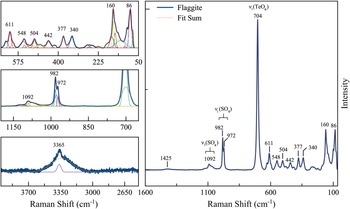
Raman spectroscopy was conducted on a Horiba XploRA PLUS using a 532 nm diode laser, 50 μm slit, 2400 gr/mm diffraction grating and a 100× (0.9 NA) objective. Selected regions of the spectrum recorded perpendicular to the {010} cleavage are shown in Fig. 3. The Raman spectrum is very complex due to the low symmetry of the structure and the large number of independent cation sites. The assignments for the TeO6 v 1 symmetric stretching and SO4 v 1 symmetric stretching are straightforward and are diagnostic for this mineral, and they have been labelled in Fig. 3, as has the weak band at 1092 cm–1 and the broad associated features, which are related to SO4 v 3 antisymmetric stretching. Bairdite on the other hand has only a single SO4 v 1 symmetric stretching band at 977 cm–1 and the TeO6 v 1 symmetric stretching band is located at 721 cm–1 (Kampf et al., Reference Kampf, Mills, Housley, Rossman, Marty and Thorne2013). We do not feel confident in assigning modes to specific bands in the 650 to 300 cm–1 range; however, these all are likely to be due to CuO6 and TeO6 stretching, as well as SO4, CuO6, and TeO6 bending modes. The very weak band at 1425 cm–1 could be due to H2O bending. The spectrum is featureless between the 1425 cm–1 band and the OH stretching region.
Selected regions of the Raman spectrum of flaggite recorded perpendicular to the {010} cleavage with a 532 nm laser. Top left: region for CuO6 and TeO6 stretching, as well as SO4, CuO6, and TeO6 bending modes. Left middle: region for SO4 and TeO6 stretching modes. Left bottom: region for OH stretching modes. Right: overview of Raman spectrum.

Chemical composition
Analyses (8 points) were performed at Caltech on a JEOL 8200 electron microprobe in WDS mode. Analytical conditions were 15 kV accelerating voltage, 10 nA beam current and 2 μm beam diameter. Insufficient material is available for CHN analysis; however, the fully ordered structure unambiguously established the quantitative content of H2O. Analytical data are given in Table 1. The empirical formula based on S = 2 and O = 22 atoms per formula unit is Pb3.88Cu2+3.89Te6+2.08(SO4)2O11(OH)2(H2O) (–0.03 H for charge balance). The ideal formula is Pb4Cu2+4Te6+2(SO4)2O11(OH)2(H2O), which requires PbO 50.78, CuO 18.10, TeO3 19.97, SO3 9.11, H2O 2.05, total 100 wt.%.
Chemical composition (in wt.%) for flaggite.

*Based upon the crystal structure with S = 2 and O = 22 atoms per formula unit.
S.D. – standard deviation
X-ray crystallography and structure refinement
Powder X-ray diffraction was done using a Rigaku R-Axis Rapid II curved-imaging-plate microdiffractometer, with monochromatised MoKα radiation. A Gandolfi-like motion on the φ and ω axes was used to randomiSe the sample and observed d values and intensities were derived by profile fitting using JADE Pro software (Materials Data, Inc.). The powder data are presented in Supplementary Table S1 (see below).
Single-crystal X-ray studies were carried out on a Bruker APEX2 CCD diffractometer equipped with MoKα radiation. The intensity data of flaggite were extracted from a crystal twinned by 180° rotation on [001]. All data were processed using Bruker TWINABS. The crystal structure was solved and refined in space group P1 using SHELX (Sheldrick, Reference Sheldrick2015a, Reference Sheldrick2015b). The refinement using the data from a single component was better than that using both components, so the single-component refinement is reported here. The limited data set, imperfect absorption correction and problems in separating the twinned data compromised the quality of the data resulting in large residual electron densities and problems with anisotropic displacement parameters. Consequently, the non-sulfate O atoms (O17–O44) could only be refined isotropically and several of the Cu, Te and sulfate O atoms, which were refined anisotropically, exhibited markedly prolate or oblate ellipsoids. Data collection and refinement details are given in Table 2, atom coordinates and displacement parameters in Table 3, selected interatomic distances in Table 4 and bond-valence sums (BVS) in Table 5. The crystallographic information file (cif) has been deposited with the Principal Editor of Mineralogical Magazine and is available as Supplementary material. Note that the processing of the twinned structure data required merging of equivalent reflections prior running SHELX. Consequently, there is no R int listed in the deposited cif. The number of reflections before merging and the R int have been included in Table 2.
Data collection and structure refinement details for flaggite.*

*R int = Σ|F o2–F o2(mean)|/Σ[F o2]. GoF = S = {Σ[w(F o2–F c2)2]/(n–p)}½. R 1 = Σ||F o|–|F c||/Σ|F o|. wR 2 = {Σ[w(F o2–F c2)2]/Σ[w(F o2)2]}½; w = 1/[σ2(F o2) + (aP)2 + bP] where a is 0.0241, b is 0 and P is [2F c2 + Max(F o2,0)]/3.
Atom coordinates and displacement parameters (Å2) for flaggite.

Selected interatomic distances (Å) in flaggite.

Bond-valence sums for flaggite*. Values are expressed in valence units.

* Te6+–O bond valence parameters are from Mills and Christy (Reference Mills and Christy2013). All others are from Gagné and Hawthorne (Reference Gagné and Hawthorne2015). Hydrogen-bond strengths are based on O–O bond lengths from Ferraris and Ivaldi (Reference Ferraris and Ivaldi1988). Negative values indicate donated hydrogen-bond valences.
Description and discussion of the structure
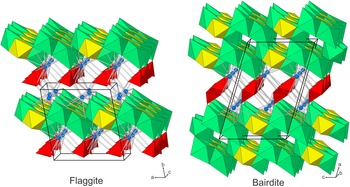
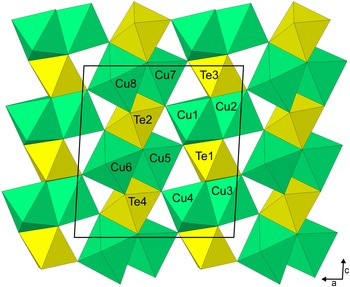
In the structure of flaggite (Fig. 4), individual TeO6 octahedra and pairs of edge-sharing Jahn-Teller distorted CuO6 octahedra link by edge-sharing into chains along [001]. The chains are linked to one another by corner-sharing to form stair-step-like layers parallel to {010} (Fig. 5). The region between the layers contains SO4 tetrahedra and Pb2+. The SO4 tetrahedra link by corner sharing to the apical O atoms of the CuO6 octahedra projecting from only one side of the octahedral layer. The eight distinct Pb2+ atoms bond to either eight or nine O atoms. The Pb2+–O bonds cover a broad range (2.274 to 3.451 Å); however, there are no pronounced lopsided distributions of bond lengths typical of Pb2+ with stereoactive 6s2 lone-pair electrons.
The structures of flaggite and bairdite. Pb atoms are blue, SO4 tetrahedra are red, TeO6 octahedra are yellow, CuO6 octahedra are green. The unit cell outlines are shown with thick black lines.

Stair-step-like layer of edge-sharing TeO6 and CuO6 octahedra in the structure of flaggite. The unit cell outline is shown with thick black lines.

The same types of edge-sharing chains forming stair-step-like octahedral layers occur in the structures of bairdite, Pb2Cu2+4Te6+2O10(OH)2(SO4)(H2O) (Kampf et al., Reference Kampf, Mills, Housley, Rossman, Marty and Thorne2013), timroseite, Pb2Cu2+5(Te6+O6)2(OH)2 (Kampf et al., Reference Kampf, Mills, Housley, Marty and Thorne2010), and paratimroseite, Pb2Cu2+4(Te6+O6)2(H2O)2 (Kampf et al., Reference Kampf, Mills, Housley, Marty and Thorne2010). The structure is most similar to that of bairdite; however, there is a double stair-step layer in bairdite, as well as SO4 groups projecting from both directions into the interlayer (Fig. 4), although it should be noted that the SO4 groups in the bairdite structure are half-occupied. The flaggite structure can be derived from that of bairdite by removing one stair-step layer and the SO4 groups projecting in one direction. An interesting feature of the stair-step-like layers in all of these structures is that they are based upon hexagonal close packing (HCP), not only in terms of the individual steps (or chains), but also with respect to the continuous assembly of steps. In the structural classification of Te oxycompounds of Christy et al. (Reference Christy, Mills and Kampf2016b), flaggite has a structure with monomeric Te6+X 6 as part of a larger structural unit that is an infinite layer.
Acknowledgements
Oleg Siidra, an anonymous reviewer and Structures Editor Peter Leverett are thanked for their constructive comments on the manuscript. A portion of this study was funded by the John Jago Trelawney Endowment to the Mineral Sciences Department of the Natural History Museum of Los Angeles County.
Supplementary material
To view supplementary material for this article, please visit https://doi.org/10.1180/mgm.2022.37