Introduction
The Late Chalcolithic (c. 4600–3100 B.C.E.) was a period of major transformations in southwest Asia. From the eastern Mediterranean to Central Asia, societies grew more complex than the village-based societies that came before. Archaeologists have traced the emergence of urban settlements, intricate administrative systems, long-distance trade, and complex political organisation. Consequently, this period features as a major focus of archaeological research aimed at reconstructing the origins of early complex societies in the Middle East (Algaze Reference Algaze1993; Baldi et al. Reference Baldi, Iamoni, Peyronel and Sconzoin press; Benati Reference Benati, Domenici and Marchetti2018; Butterlin Reference Butterlin2003, Reference Butterlin2018; Marro Reference Marro2012; McMahon Reference McMahon2020; Petrie Reference Petrie2013; Postgate Reference Postgate2002; Rothman Reference Rothman2001).
However, our knowledge of Late Chalcolithic (hereafter LC) developments remains uneven. Most of our data come from the Middle and Upper Euphrates region and the Upper Khabur region of Syria and Turkey (Akkermans and Schwartz Reference Akkermans and Schwartz2003: 181–210; Frangipane Reference Frangipane2018; McMahon Reference McMahon2020; Sagona and Zimansky Reference Sagona and Zimansky2009: 144–171; Schwartz Reference Schwartz and Rothman2001; Ur Reference Ur2010; Wilkinson and Tucker Reference Wilkinson and Tucker1995), and to a lesser extent the eastern Jazira and Tigris region (Abu Jayyab Reference Abu Jayyab and Marro2012, Reference Abu Jayyab2019; Al Quntar and Abu Jayyab Reference Al Quntar, Jayyab, McMahon and Crawford2014; Ball Reference Ball2003; Butterlin Reference Butterlin2009; Gut Reference Gut1995; Kepinski Reference Kepinski2011; Mühl Reference Mühl2013: 101–111; Numoto Reference Numoto1998; Reichel Reference Reichel2008, Reference Reichel2011; Rothman Reference Rothman2002). Decades of research have established that northern Mesopotamia underwent an indigenous development of urbanisation that paralleled the emergence of cities in southern Mesopotamia such as Uruk (Algaze Reference Algaze2008; McMahon Reference McMahon2020; Nissen Reference Nissen and Rothman2001; Oates et al. Reference Oates, McMahon, Karsgaard, al-Quntar and Ur2007; Stein Reference Stein2012). At the same time, the nature of the relationship between northern and southern complex societies remains unclear. The wide spread during the latter part of the LC of a relatively homogeneous set of material culture (ceramics, administrative practices, and architectural features) that developed first in southern Mesopotamia is usually interpreted as an attempt by southerners to access or control the interregional exchange networks that regulated the flow of raw materials (Algaze Reference Algaze1993). Yet despite much research, archaeologists continue to grapple with issues of chronology and different local responses to cultural encounters that are difficult to reconcile within a single model (most recently, Butterlin Reference Butterlin2018: 407–427; Dahl et al. Reference Dahl, Petrie, Potts and Petrie2013; Porter Reference Porter2012; Rothman Reference Rothman and Petrie2013).
East of the Tigris River, evidence for the LC is much scarcer than in northern Mesopotamia. Our knowledge of this region is almost exclusively reliant on outdated sequences from the first half of the twentieth century. The Kuyunjik Mound at Nineveh is the only site where a complete sequence spanning the entire LC has been documented (Gut Reference Gut1995).Footnote 1 The lack of well-documented LC sites in the Trans-Tigridian region, and especially the limited evidence for a southern Mesopotamian presence that is so strikingly visible in northern Mesopotamia, have not gone unnoticed. Only further to the east, at Godin Tepe, is there good evidence for the penetration of southern Mesopotamian, or “Uruk”, material culture into the central Zagros (Rothman and Badler Reference Rothman, Badler, Gopnik and Rothman2011). In his landmark study of the Uruk world, Algaze (Reference Algaze1993: 63–71) could only speculate about the presence of outposts and colonies between the Tigris River and the Zagros Mountains. More recently, both Rothman (Reference Rothman and Petrie2013) and Matthews (Reference Matthews and Petrie2013), echoing earlier work by Henrickson (Reference Henrickson, Stein and Rothman1994), have considered that the Diyala River and the road via Kermanshah to Hamadan formed a major route connecting Uruk Mesopotamia with the Iranian highlands. In contrast, Petrie (Reference Petrie, McMahon and Crawford2014) considers the absence of evidence for Uruk presence in the western Zagros foothills to suggest that the enclave at Godin Tepe was tied to an expansion out of southwest Iran, bypassing the Trans-Tigridian region altogether.Footnote 2 New fieldwork in Iraqi Kurdistan is now rapidly filling in this gap on the archaeological map, resulting in a need for updated chronologies and new interpretive models.
Northeast Iraq (Kurdistan)
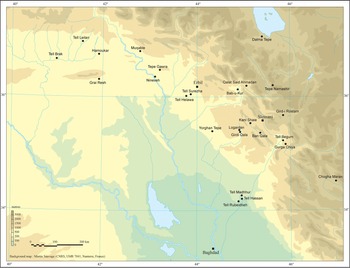
In recent years, the Kurdistan Region of Iraq has become a new hub of archaeological fieldwork. The LC is a primary research focus for several projects targeting sites of this period (Fig. 1) (Carter et al. Reference Carter, Wengrow, Shepperson, Roberts, Lewis, Marsh, Gonzales-Carretero, Sosnowska, D'Amico, Sagan and Lockyear2020; Catanzariti et al. Reference Catanzariti, Tanaka, Maskevich, Otto, Herles and Kaniuth2020; Molist et al. Reference Molist, Bradosty, Breu, Sisa, Alcántara, Cruells, Douché, Mylona, Arnaiz, Saña, Zebari and Gómez-Bach2019; Nieuwenhuyse et al. Reference Nieuwenhuyse, Odaka, Kaneda, Mühl, Rasheed and Altaweel2016; Peyronel and Vacca Reference Peyronel and Vacca2015; Peyronel et al. Reference Peyronel, Vacca, Zenoni, Kopanias and MacGinnis2016; Pfälzner et al. Reference Pfälzner, Qasim, Sconzo and Puljiz2017; Potts et al. Reference Potts, Radner, Squitieri, Ameen, Rohde, Yawar, Herr, Salih, Petchey, Hogg, Gratuze, Raheem and Potts2019; Saber et al. Reference Saber, Salman, Rasheed and Mühl2014; Sconzo Reference Sconzo2019; Skuldbøl and Colantoni Reference Skuldbøl, Colantoni, Kopanias and MacGinnis2016a, Reference Skuldbøl, Colantoni and Iamoni2016b, Reference Skuldbøl and Colantoni2018; Stein Reference Stein2018; Stein and Alizadeh Reference Stein and Alizadeh2014, Reference Stein and Alizadeh2015; Tsuneki et al. Reference Tsuneki, Rasheed, Saber, Nishiyama, Anma, Ismail, Hasegawa, Tatsumi, Miyauchi, Jammo, Makino and Kudo2015, Reference Tsuneki, Rasheed, Saber, Nishiyama, Watanabe, Greenfield, Ismail, Tatsumi and Minami2016; Vallet et al. Reference Vallet, Baldi, Naccaro, Rasheed, Saber and Hamarasheed2017, Reference Vallet, Baldi, Zingarello, Sauvage, Naccaro, Paladre, Bridey, Padovani, Rasheed, Raeuf and Halkawt2019; Wengrow et al. Reference Wengrow, Carter, Brereton, Shepperson, Hamarashi, Saber, Bevan, Fuller, Himmelman, Sosnowska and Gonzalez Carretero2016). While preliminary publications are steadily emerging, as yet there is no complete local ceramic sequence available for the LC. Consequently, projects struggle to relate their data to the frameworks that were established specifically for northern Mesopotamia. Workshops organized in 2018 at the ICAANE in Munich (Baldi et al. Reference Baldi, Iamoni, Peyronel and Sconzoin press), at the Freie Universität in Berlin,Footnote 3 and at the fieldwork house of the Kani Shaie Archaeological Project in Bazian exposed the problems with this approach and revealed the need for a better understanding of the ceramic sequence based on locally-derived archaeological datasets. The matter is further complicated by the observation that the region flourished during the first half of the LC (LC1–2), but many sites were subsequently abandoned or drastically reduced in size. The site of Kani Shaie is one of very few documented exceptions, with a continuous sequence of occupation from the Late Ubaid period to the end of the LC and into the Early Bronze Age (EBA). In this article, we present the ceramic corpus from a step trench designed to retrieve a complete stratigraphic sequence of the mound in order to initiate construction of a region-specific ceramic chronology.
Map of the northern Zagros Piedmont and the eastern part of northern Mesopotamia with the main Late Chalcolithic sites (base map by M. Sauvage).

Kani Shaie and the Bazian BasinFootnote 4
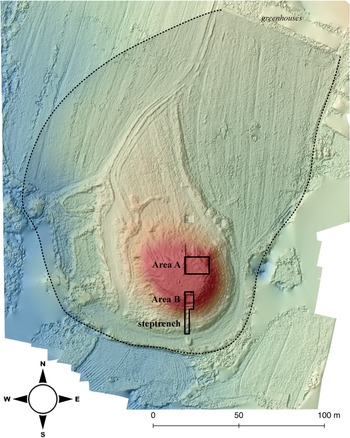
Kani Shaie consists of a small mound standing 14 m above the surrounding surface and covering c. 0.5 ha (Fig. 2) (Renette Reference Renette2016, Reference Renette2018: 196–297; Tomé et al. Reference Tomé, Cabral, Renette, Kopanias and MacGinnis2016). The site is bounded by the Tainal stream to the west and a spring with a small stream leading into the Tainal along its southern edge. Wrapping around the site to the west, north, and east, a low extension of occupational buildup increases the complete area of the site to c. 3 ha.
Digital Elevation Model of Kani Shaie with indication of the main excavation areas.

Kani Shaie sits at the center of the Bazian Basin, which stretches northwest to southeast for about 35 km, with a width of c. 10 km. This basin separates the hilly Piedmont region around Kirkuk to the west from the Tanjaro-Shahrizor plains and the Zagros Mountains to the east, straddling a stretch of the major road that connects Kirkuk with Sulaymaniyah, along which it forms the first real intermontane valley of the Zagros Mountains.
Between 2013 and 2016, the Kani Shaie Archaeological Project (KSAP) conducted three seasons of excavations at the site.Footnote 5 The primary goals of the project consist of obtaining a stratigraphically anchored sequence of material culture for the Bazian Basin and assessing the position of this region in the development of long-distance interaction between Mesopotamia and the Iranian highlands during the LC and EBA. The site of Kani Shaie was selected because surface collection revealed a long history of occupation that could be used to establish a local ceramic typology before conducting a survey of the basin.Footnote 6 The main mound of Kani Shaie was primarily occupied during the Chalcolithic and EBA, allowing direct access to these occupation levels, while later occupation is mainly spread across the low extension around the mound.
Kani Shaie phasing
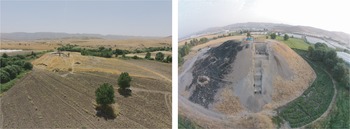
In 2013, KSAP began a sounding 5 m wide on the southern slope of the mound (Area B), which was continued down the slope as a 2.5 m wide step trench in 2015 and 2016 in order to obtain the complete mound sequence within the time constraints (Fig. 3). In addition, a larger area of excavation (Area A) explores the northeastern quadrant of the mound. This open area excavation has so far mainly targeted the EBA occupation, while the LC levels have yet to be reached.
Drone photos of Kani Shaie and the step trench on the southern slope.

Main Mound phase I (MM I) consists of fragments of modern architectural collapse covering the top of the mound. MM II is a Late Ottoman cemetery from the 18–19th century C.E., while a group of large Middle Islamic pits form MM III. MM IV encompasses the EBA occupation, which is a long sequence of architectural levels that form a deposit c. three to four meters thick.
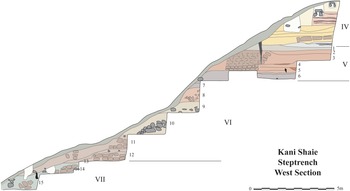
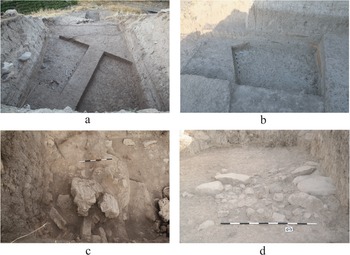
Here we consider the excavation of the LC levels of the step trench as a separate operation with its own internal sequence of levels, which are grouped as part of the Main Mound phasing (Table 1). This step trench operation exposed at least 15 levels of occupation spanning 8.5 m of deposits that can be grouped into three separate phases of the main mound (Fig. 4). MM phase V, spanning c. 2.5 m of deposits, consists of six levels of occupation with relatively large-scale mudbrick architecture. The upper part, phase Va (levels 1–2), is oriented northeast-southwest (Fig. 5a). Level 1 represents the last occupation of the LC, after which there was a hiatus in occupation of unknown duration. Extended exposure of this level and intrusive activity of the initial EBA occupation resulted in poor preservation. The subsequent level 2 was much better preserved and sealed by the architecture and surface of level 1.
Section drawing of the west profile of the step trench highlighting the Late Chalcolithic levels.

Trench photos: (a) level 2; (b) level 5; (c) level 8; (d) level 14.

Kani Shaie Main Mound phasing with level descriptions, elevations (measured from permanent point at the site), proposed periodization, and available carbon dates (phase Vd date is from separate pit).

Level 3 lacks architectural remains in the step trench sounding. Instead, it is defined by ephemeral activity areas forming subphase Vb, which could represent a brief hiatus in occupation.
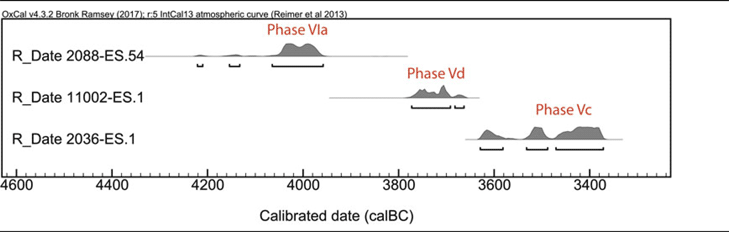
Levels 4–5 form subphase Vc, with large-scale mudbrick architecture oriented northwest-southeast. The level 4 building was destroyed by conflagration, as the spaces were filled with burnt collapse. Two C14 dates from level 4 provide a secure dating of 3530–3370 cal B.C.E. (Table 2). Level 5 is an earlier building with a similar layout that was largely cleaned out before the construction of the level 4 building (Fig. 5b). Finally, subphase Vd consists of level 6, which was only reached in a sounding below the floor of one of the level 5 spaces and in a narrow exposure at the edge of the mound in the step trench. A pit lower on the slope that is most likely contemporary with this level, based on ceramic similarities, produced a C14 date between 3770–3665 cal B.C.E. (Table 2).
AMS dates of three LC contexts from Kani Shaie, processed at Beta Analytic (2036-ES.1), DirectAMS (2088-ES.54), and Keck-CCAMS Group Irvine (11002-ES.1).

The next phase, MM VI, which spans ca. 4.5 m of deposits, is defined by a change in material culture and architectural layout. The upper level 7 was only exposed at the very edge of the mound, where excavations revealed a wall foundation of a single row of stones. Level 8 is particularly well preserved, with the remains of a collapsed mudbrick building (Fig. 5c). Within the pile of burnt bricks and roof fragments were large amounts of pottery, including several broken, but complete, vessels. Underneath the surface of this structure was an intact jar burial carbon dated to 4065–3959 cal B.C.E. (Table 2). This burial contained the remains of a child interred with a cooking pot.
A large collapsed fire installation served to identify the surface of level 9. Level 10 is defined by the presence of a stone wall foundation, but the occupational deposits in this part of the step trench were difficult to identify and were explored at the very end of excavations in 2015. When excavations resumed in 2016, a year of wind, snow, and rain erosion had further obscured these contexts, necessitating the creation of a new step that consisted of small-scale mudbrick architecture in levels 11–12.
MM phase VII, spanning ca. 1.5 m of deposits, consists of three levels. The top level 13 is defined by pits that were dug near the edge of the mound without any identifiable corresponding occupation. Levels 14 and 15 contained small, mudbrick architecture on stone foundations, a stone paved surface, and a small fire installation (Fig. 5d). While these remains appear similar to the phase VI settlement layout, the material culture of these levels warrants the identification of a separate phase.
Development of ceramic production in the LC phases at Kani Shaie
Phase VII
Phase VII at Kani Shaie encompasses the earliest three occupation levels reached at the site until this point. 448 sherds dating to this phase were recovered, of which 104 were diagnostic (23.2%). Bowls dominate the assemblage at 72.8%, while jars and large basins combine for 27.2%. In total, five bowl and two jar forms dominate the assemblage, representing 70% of all diagnostic sherds.
Forms
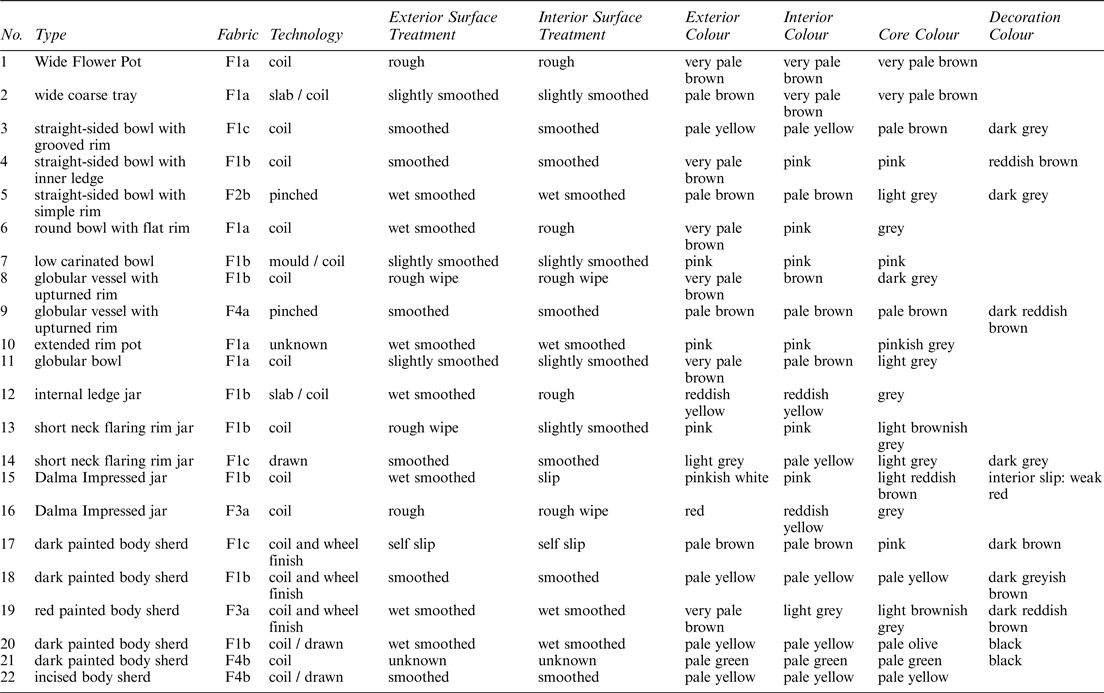
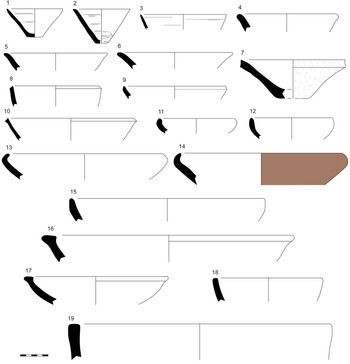
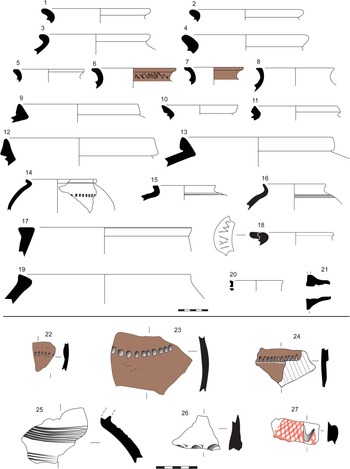
Mass-produced bowls (MPB)Footnote 7 are the most frequent vessel type in phase VII (18.5%).Footnote 8 This is a coarse straight sided bowl that combines coarse vegetal and mineral temper and was fired at a relatively low temperature (Fig. 6: 1). This vessel type occurs at most sites in northeastern Mesopotamia during LC1–2, at least as far south as the Shahrizor and the Hamrin Basin. In the Kurdistan region of Iraq it is mainly known from sites in the Erbil Plain, including Qalinj Agha level A (Hijara Reference Hijara1973: pl. 23), Surezha (Stein Reference Stein2018: fig. 8: 3), and Tell Helawa (Peyronel and Vacca Reference Peyronel and Vacca2015: fig. 12: 1–3). Further south, this type is found at Late Ubaid/LC1 levels at Gurga Chiya (Wengrow et al. Reference Wengrow, Carter, Brereton, Shepperson, Hamarashi, Saber, Bevan, Fuller, Himmelman, Sosnowska and Gonzalez Carretero2016: fig. 12: 23) and Tell Madhhur (Moon and Roaf Reference Moon and Roaf1984: fig. 16: 1–2; Roaf Reference Roaf, Henrickson and Thuesen1989: fig. 3: D3, D11, F16). A similar vessel to the MPB is a wide coarse tray (7%) (Fig. 6: 2), which seems to be exclusive to the Kurdistan region of Iraq and particularly the Shahrizor, where it has been attested in Late Ubaid/LC1 levels at the sites of Gurga Chiya (Wengrow et al. Reference Wengrow, Carter, Brereton, Shepperson, Hamarashi, Saber, Bevan, Fuller, Himmelman, Sosnowska and Gonzalez Carretero2016: fig. 12: 20–22) and Tell Begum (Nieuwenhuyse et al. Reference Nieuwenhuyse, Odaka, Kaneda, Mühl, Rasheed and Altaweel2016: fig. 27: 21–22).
Phase VII ceramics: 1–14: main vessel types; 15–16: Dalma Impressed ware; 17–21: Ubaid Painted ware; 22: incised ware. See Table 3 for details.

Phase VII: description of Fig. 6 illustrated sherds.

Straight-sided bowls with simple rims (11.4%) occur frequently throughout phase VII (Fig. 6: 5). Half of the examples recovered were finer green/buff wares with dark painted geometric designs. Similar examples were found in Ubaid levels at Qalat Said Ahmadan (Tsuneki et al. Reference Tsuneki, Rasheed, Saber, Nishiyama, Watanabe, Greenfield, Ismail, Tatsumi and Minami2016: fig. 2.10: 4), Surezha (Stein Reference Stein2018: fig. 7: 1, 3), and Tell Helawa (Peyronel and Vacca Reference Peyronel and Vacca2015: fig. 10: 3, 7, 10) among many other sites. Variants with an inner ledge (Fig. 6: 4) and a grooved rim (Fig. 6: 3), which are always decorated with simple painted bands, are less common at Kani Shaie. Straight-sided bowls with an inner ledge occur further north at Qalat Said Ahmadan in Ubaid levels (Tsuneki et al. Reference Tsuneki, Rasheed, Saber, Nishiyama, Watanabe, Greenfield, Ismail, Tatsumi and Minami2016: fig. 2.10: 13) and Tell Helawa (Peyronel and Vacca Reference Peyronel and Vacca2015: fig. 10: 13). Grooved rim straight-sided bowls have parallels in the Erbil plain at Surezha (Stein Reference Stein2018: fig. 8: 1–2), Tell Nader (Kopanias et al. Reference Kopanias, Beuger, Carter, Fox, Hadjikoumis, Kourtessi-Philippakis, Livarda and MacGinnis2013: fig. 23: 11), and Tell Helawa (Peyronel and Vacca Reference Peyronel and Vacca2015: fig. 10: 12).
Round bowls with flat rims (Fig. 6: 6) are also relatively common at Kani Shaie (7%), but they seem to be a locally restricted type with good parallels at nearby Gurga Chiya (Wengrow et al. Reference Wengrow, Carter, Brereton, Shepperson, Hamarashi, Saber, Bevan, Fuller, Himmelman, Sosnowska and Gonzalez Carretero2016: fig. 12: 15). Another relatively common vessel (10%) at Kani Shaie is the in-turned globular bowl (Fig. 6: 11). These bowls have many parallels at sites west of the Tigris River and sites north of the Lower Zab River, but they are not as common south of the Lower Zab.
The most common jar shape (8.4%) at Kani Shaie is the short neck flaring jar (Fig. 6: 13–14). Similar forms are found at Gurga Chiya during the Late Ubaid/LC1 (Wengrow et al. Reference Wengrow, Carter, Brereton, Shepperson, Hamarashi, Saber, Bevan, Fuller, Himmelman, Sosnowska and Gonzalez Carretero2016: fig. 12: 7) and Qalinj Agha level A (Hijara Reference Hijara1973: pl. 23). One example was recovered of a jar with an internal ledge (Fig. 6: 12). This vessel is only present within this phase and is known from most Ubaid sites in the region, such as Surezha (Stein Reference Stein2018: fig 8: 5), Tell Nader (Kopanias et al. Reference Kopanias, Beuger, Carter, Fox, Hadjikoumis, Kourtessi-Philippakis, Livarda and MacGinnis2013: fig. 23: 14–15), and Tell Helawa (Peyronel and Vacca Reference Peyronel and Vacca2015: fig. 10: 1–2), as well as in the Hamrin at Tell Abada (Jasim Reference Jasim1985: figs. 124–175) and Tell Madhhur (Moon and Roaf Reference Moon and Roaf1984: fig. 18: 13).Footnote 9 It is also worth mentioning two jar forms that are found at Kani Shaie at low frequency: grooved rim jars and fine small flaring rim jars (Fig. 6: 8–9) with good parallels at Yorghan Tepe (Starr Reference Starr1939: pl. 43: E-F). Finally, a single sherd of an extended rim pot was found in this phase (Fig. 6: 10).
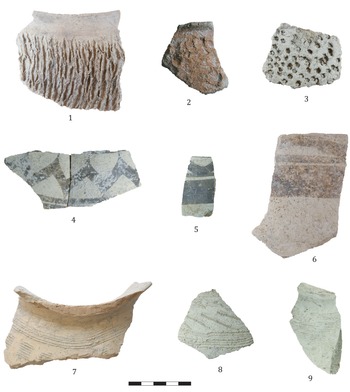
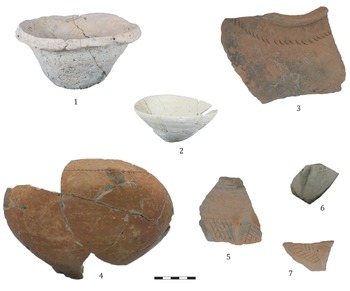
A relatively frequent category of vessels from phase VII belongs to the Dalma Impressed ware (Fig. 6: 15–16; Fig. 7: 1–3) (7.7%).Footnote 10 Dalma Impressed wares have a wide distribution in the central and northern Zagros, for example at Seh Gabi (Henrickson Reference Henrickson1985: fig. 8: 6, 8–11), Chogha Maran, and Tepe Siahbid (Henrickson Reference Henrickson1985: fig. 9; Levine and Young Reference Levine, Young and Huot1987: 33), in addition to the type-site Dalma Tepe (Hamlin Reference Hamlin1975: pl. IIa, IId, fig. 8: C). Recent work in the Kurdistan region of Iraq has uncovered comparative examples from Gurga Chiya (Wengrow et al. Reference Wengrow, Carter, Brereton, Shepperson, Hamarashi, Saber, Bevan, Fuller, Himmelman, Sosnowska and Gonzalez Carretero2016: 265), Surezha (Stein Reference Stein2018: fig. 11), Uch Tepe 3 (Mühl and Nieuwenhuyse Reference Mühl, Nieuwenhuyse and Iamoni2016: fig. 15: 7), and as far west as Yorghan Tepe (Starr Reference Starr1939: pl. 45: E–Q). This distribution shows that the region had ties with the region of Lake Urmia and the central Zagros (Stein Reference Stein2018: 43).
Phase VII–VIb sherd photos: 1–3: Dalma Impressed ware; 4–6: Ubaid Painted ware; 7–9: LC1 incised ware.

Decoration
In total, 47 decorated sherds, painted or incised/impressed, were recovered from Phase VII, representing 10.5% (n: 448) of the total sherds and 45.2% (n: 104) of diagnostic sherds. Painted decoration is the most common at 8% of all sherds (n: 36) and 34.6% of diagnostic sherds (n: 104) and is commonly executed in dark black or brown paint on a buff (n: 22) or light green surface (n: 10) (Fig. 7: 4–6). However, three examples are executed with red paint on a cream or cream slipped surface (Fig. 6: 4, 9, 19), which have parallels at Surezha (Stein and Alizadeh Reference Stein and Alizadeh2017: fig. 14.K). Patterns are limited to a few simple geometric designs. Simple painted bands (Fig. 6: 19–20) and festoons along the rim (Fig. 6: 3–5) are the most common. Other patterns are diagonal bands (Fig. 6: 5), connected lozenges (Fig. 6: 17–18), vertical wavy lines (Fig. 6: 9), and horizontal triangles (Fig. 6: 21). Straight-sided bowls are the most common decorated vessel type (Fig. 6: 3–5), followed by globular bowls and several jars.
Dalma Impressed wares dominate decorated types with surface modification (n: 8). In addition, only three examples of incised decoration were found in phase VII: two comb-incised sherds (Fig. 6: 22) and one with an incised herring-bone pattern. Herring-bone incised vessels are commonly found at Late Ubaid sites throughout the region, such as Tanjaro (Saber et al. Reference Saber, Salman, Rasheed and Mühl2014: fig. 7: 1), Tell Madhhur (Moon and Roaf Reference Moon and Roaf1984: fig. 20: 7, 13), Tell Dayim (Takriti Reference Takriti1960: pl. 7: 43), Surezha (Stein and Alizadeh Reference Stein and Alizadeh2014: fig. 12: top), Tepe Gawra level XIII (Tobler Reference Tobler1950: pl. CXXXI: 217), Abu Husaini (Tusa Reference Tusa1984: figs. 33, 36), and Kudish Saghir (Starr Reference Starr1939: pl. 46: D).
Fabrics
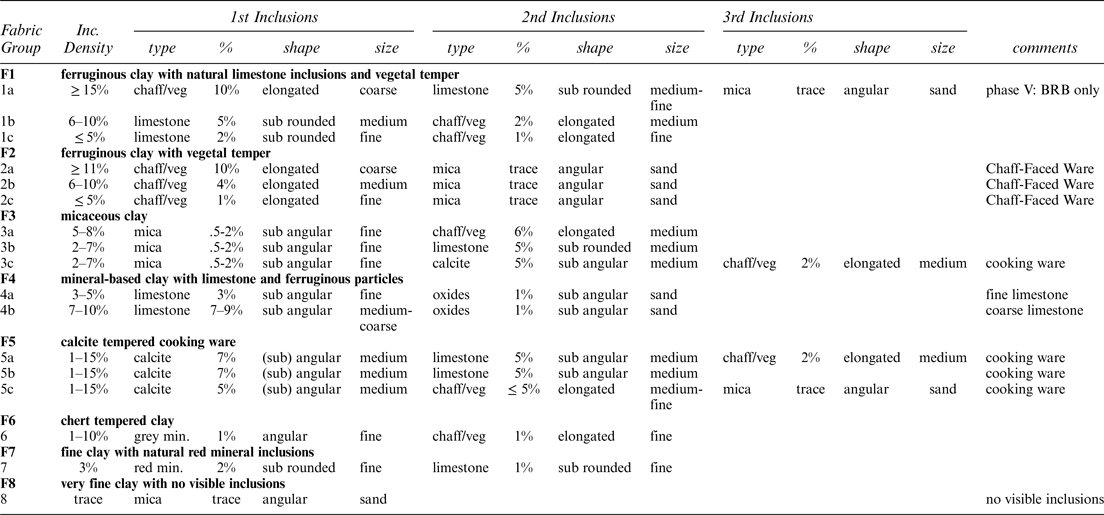
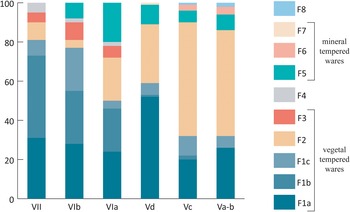
Most of the fabrics seem to be local,Footnote 11 as none of the minerals macroscopically observed seem to have been derived from outside of the immediate vicinity of the site. In total four main fabric groups were observed in the assemblage of phase VII (see Table 4 and Fig. 16, below). The majority of vessels contained vegetal temper to differing degrees, with the exception of F4 (5%) and one example of F3b.
Fabric groups as defined by macroscopic observation during fieldwork and study season.

F1 constitutes 81% of fabrics (F1a 31%; F1b 42%; F1c 8%). Fabric group F2, which has a finer clay texture than group F1 due to the absence of limestone, represents 9% of diagnostic sherds. 5% of diagnostic sherds belong to fabric group F3 (F3a 4%; F3b 1%). Finally, another 5% of diagnostic sherds, all of which are painted and (non-Dalma) incised wares, belong to fabric group F4 (F4a 2%; F4b 3%). Other painted wares are made from F1b and F1c fabrics, with two examples made from F3. Almost all MPBs and wide coarse trays are made from coarse fabrics F1a, with two examples of MPBs made from F2 heavy chaff tempered fabrics. Dalma Impressed wares are made primarily from fabric F1b, with two examples made from F2 and one example from F3.
Forming Techniques and Surface Treatments
As far as can be observed from fragmentary sherds, coiling or coil building seems to be the predominant technique, comprising 87.5% of diagnostic sherds. Hand building or pinching accounts for the rest. In many cases coiling is combined with other building or finishing techniques. Moulding the base and applying a coiled body is seen in two examples of bowls with a rounded base and straight vertical walls (Fig. 6: 7). Wheel finishing, most likely on a slow rotation pivot as a means to smoothen and homogenize the surface, is noted on six examples. This seems to be a practice applied in preparation for painting the vessel, however it also seems to be true of one example of a MPB, where the upper half of the body and rim have striation marks. With the exception of two examples, all the hand-drawn vessels observed were finer painted vessels. Hand-drawing was usually accompanied by wet smoothing of the vessel surface.
The majority (67.3%) of the vessels observed, including decorated wares,Footnote 12 were smoothed by slightly rubbing the surface with a coarse stone or wet smoothed by wiping the surface with a wet cloth or hand. The exceptions to this are the MPBs, coarse trays, and Dalma Impressed wares, as well as individual sherds of larger type groups.
Phase VIb
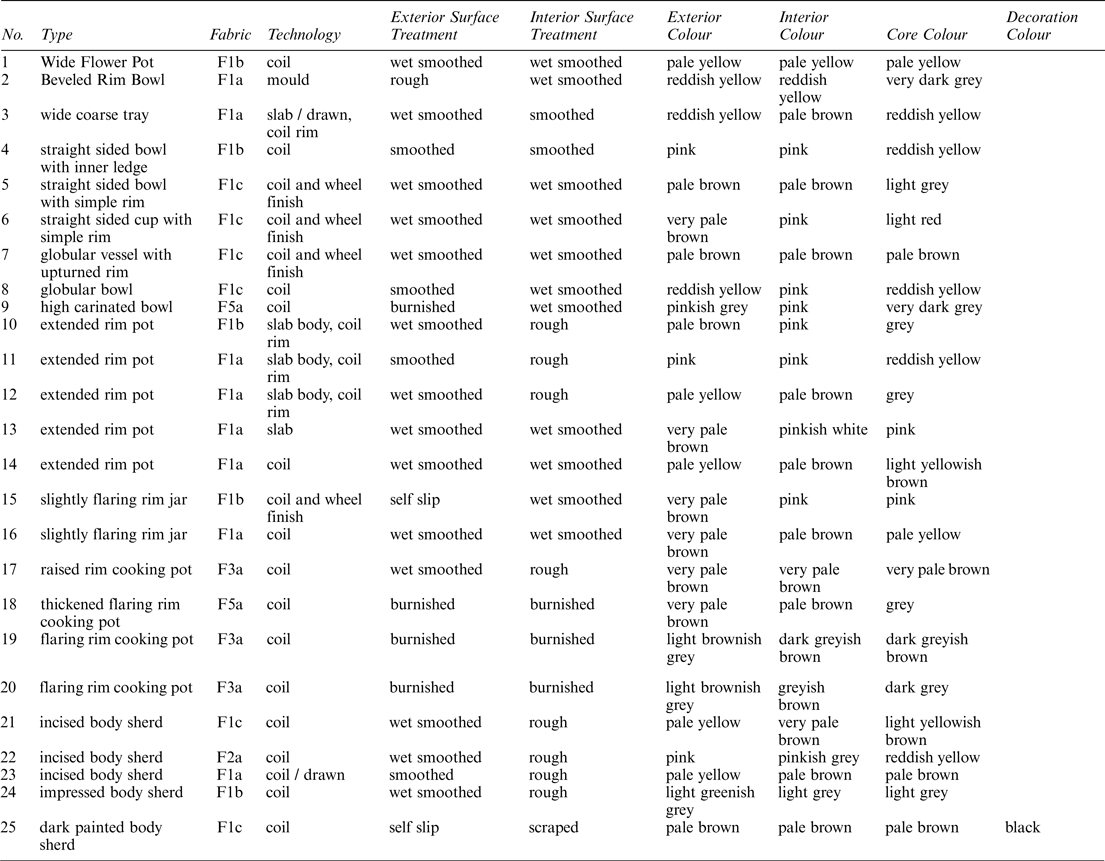
Phase VIb produced a total of 343 sherds, 91 of which were diagnostic (26.5%). This includes rims (n: 63), bases (n: 2) and decorated body sherds (n: 26). Bowls represent 53.9% of the assemblage, while jars and large basins combine for 46.1%. In total, eight vessel forms (four bowls and four jars/basins) dominate the assemblage, representing 68% of all diagnostic rim sherds.
Forms
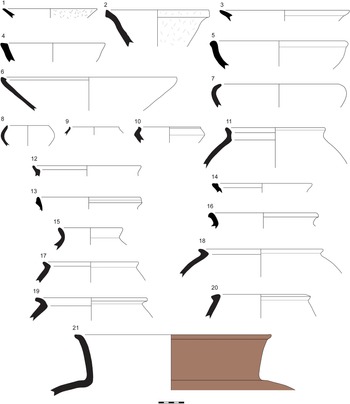
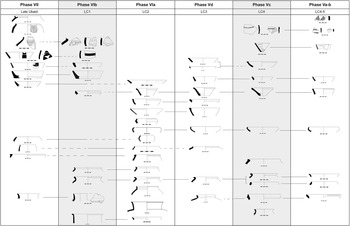
The assemblage from phase VIb shares many features with the phase VII assemblage but also diverges in a visible manner (see Fig. 17, below). MPBs continue to be an essential part of the assemblage, comprising 20% of diagnostic sherds (Fig. 8: 1), while coarse trays remain frequent (6%) (Fig. 8: 3).Footnote 13 One final vessel form that is still present – albeit at low frequency in both phases VII and VIb (2.8–3%) – is a bowl with a rounded base and straight vertical walls, with parallels at Gurga Chiya (Wengrow et al. Reference Wengrow, Carter, Brereton, Shepperson, Hamarashi, Saber, Bevan, Fuller, Himmelman, Sosnowska and Gonzalez Carretero2016: fig. 12: 10; fig. 13). Extended rim pots (Fig. 8: 12) increase from the previous level and form 3% of diagnostic sherds.
Phase VIb ceramics: 1–16: main vessel types; 17–20: cooking pots; 21–24: incised ware; 25: painted ware. See Table 5 for details.

Phase VIb: description of Fig. 8 illustrated sherds.

There is a significant decrease in a number of features and vessel forms during phase VIb: globular bowls decrease from 10% to 4.5%, straight-sided bowls from 11.4% to 3%, straight-sided bowls with inner ledges from 2.8% to 1.5%, short neck flaring jars from 8.4% to 1.5%, and to a lesser extent fine small flaring rim jars from 3% to 1.5%. Most notable is the significant decrease in painted wares. Furthermore, flat rim bowls, straight-sided bowls with grooved rims, jars with internal ledges, and Dalma Impressed wares disappear completely in phase VIb.
Fine ware globular vessels with upturned rims become common in phase VIb (6%) (Fig. 8: 7). This type is a well-fired thin-walled vessel with fine inclusions, which could have been used as a drinking vessel, with parallels at Tell Helawa in the Erbil plain (Peyronel and Vacca Reference Peyronel and Vacca2015: fig. 12: 17–18). Several new types appear in phase VIb. Wide deep basins with vertical or slightly angled bodies become common (7.5%), albeit in a variety of forms. They all have large diameters and outwardly extended ledge rims with variation in shapes (Fig. 8: 10–11, 13–14). Parallels are found across the Kurdistan region of Iraq and beyond at Gurga Chiya (Wengrow et al. Reference Wengrow, Carter, Brereton, Shepperson, Hamarashi, Saber, Bevan, Fuller, Himmelman, Sosnowska and Gonzalez Carretero2016: fig. 12: 17–19), Surezha (Stein and Alizadeh Reference Stein and Alizadeh2017: fig. 14: A), Tepe Gawra level XIIA (Tobler Reference Tobler1950: pl. CXXXVI: 274, 277), Gird-i Pasha (Mühl and Nieuwenhuyse Reference Mühl, Nieuwenhuyse and Iamoni2016: fig. 16: 2–4), Tell Begum (Nieuwenhuyse et al. Reference Nieuwenhuyse, Odaka, Kaneda, Mühl, Rasheed and Altaweel2016: fig. 26: 10), Tell Madhhur (Roaf Reference Roaf, Henrickson and Thuesen1989: fig. 5: H7, K7), and Yorghan Tepe (Starr Reference Starr1939: pl. 49: C). Two vessels of this type were used as child burial urns at Kani Shaie (one in phase VIb and one in phase VIa).
Slightly flaring rim jars continue (6%) but frequently have incised decoration (Fig. 8: 15–16). One of the more common new types found in VIb is a grey, slightly burnished, flaring rim cooking pot (15.2%) (Fig. 8: 18–20). This type is primarily calcite tempered, which distinguishes it from other vessels in the assemblage. Parallels were found at Gurga Chiya in Ubaid/LC1 levels (Wengrow et al. Reference Wengrow, Carter, Brereton, Shepperson, Hamarashi, Saber, Bevan, Fuller, Himmelman, Sosnowska and Gonzalez Carretero2016: fig. 12: 4–6). This type is the first formal cooking pot in the Kani Shaie sequence and continues throughout the LC. Finally, phase VIb also produced the first example of a Beveled Rim Bowl (BRB) (Fig. 8: 2).
Decoration
During phase VIb, decoration drops from 10.5% to 7.5% (n: 26; 28.5% of diagnostic sherds). In a reversion to phase VII, incised wares occur more frequently than painted wares. In total only four painted sherds with simple bands (Fig. 8: 25) (1.1% of sherds; 4.4% of diagnostics) were recovered, compared to 22 incised sherds (6.4% of sherds; 24.1% of diagnostics).
The most common decoration type consists of fine (comb-)incised lines both straight and wavy, primarily executed on jars (Fig. 7: 7–9; Fig. 8: 15–16, 21–23), with parallels at Tell Madhhur (Roaf Reference Roaf, Henrickson and Thuesen1989: fig. 8: J7, J11; fig. 9: J6, J11; fig. 10: K6), Gurga Chiya (Wengrow et al. Reference Wengrow, Carter, Brereton, Shepperson, Hamarashi, Saber, Bevan, Fuller, Himmelman, Sosnowska and Gonzalez Carretero2016: fig. 12: 1–2), Surezha (Stein and Alizadeh Reference Stein and Alizadeh2014: fig. 12: top; Stein and Alizadeh Reference Stein and Alizadeh2017: fig. 14: C), and Yorghan Tepe (Starr Reference Starr1939: pl. 49: C). Occasionally, this decoration is accompanied by herring-bone pattern incisions or stop-gap lines (Fig. 8: 15, 22) as at Tell Madhhur (Roaf Reference Roaf, Henrickson and Thuesen1989: fig. 8: F3, H6, H11; fig. 9: K11; fig. 10: K6) and Surezha (Stein and Alizadeh Reference Stein and Alizadeh2014: fig. 12: top; Stein and Alizadeh Reference Stein and Alizadeh2017: fig. 14: C). Other incised patterns are executed as zigzags or curved slashes. Two examples of impressed applique rope pattern were also recovered from this phase.
Fabrics
F1 continues to dominate the assemblage at 77% (F1a 28%; F1b 27%; F1c 22%) (Fig. 16). F2 drops slightly from 9% to 4% in phase VIb, while F3 increases from 5% to 9%. F4 drops from 5% to 2%, coinciding with the decline in painted wares. A new fabric group, F5 (together with F3c), appears during phase VIb, making up 8% of recorded fabrics, primarily restricted to burnished grey cooking pots. Of these, only one vessel belonged to subgroup F5b without vegetal additions.
Forming Techniques and Surface Treatments
Coiling remains the most common forming technique, at 96.5% of the assemblage. Coiling is combined with other construction and finishing techniques, such as pinching and slow wheel finishing. Only rare examples were completely produced by moulding and pinching. The majority of sherds were smoothed or wet smoothed (77.5%). Only 7.8% were left with rough surfaces, primarily MPBs. Burnishing was present on 13% of vessels, primarily reserved for grey cooking pots.
Phase VIa
Phase VIa produced 526 sherds, of which 112 were diagnostic (21.3%), with bowls being the most common form type (56%), followed by jars (37%) and basins (7%). The most distinct difference between the phase VIa assemblage and that of earlier levels is the complete absence of any decoration.
Forms
Several forms disappear completely by phase VIa: carinated bowls, straight-sided bowls with inner ledges, and coarse trays. Other forms are on their way out during phase VIa: MPBs comprise only 9% of the assemblage, compared to 20% in phase VIb (Fig. 9: 1); in-turned globular bowls decrease from 10% of the assemblage in phase VII to just 2.7% (Fig. 9: 8); straight-sided bowls with simple rims decrease from 11.4% in phase VII to only 0.9%.
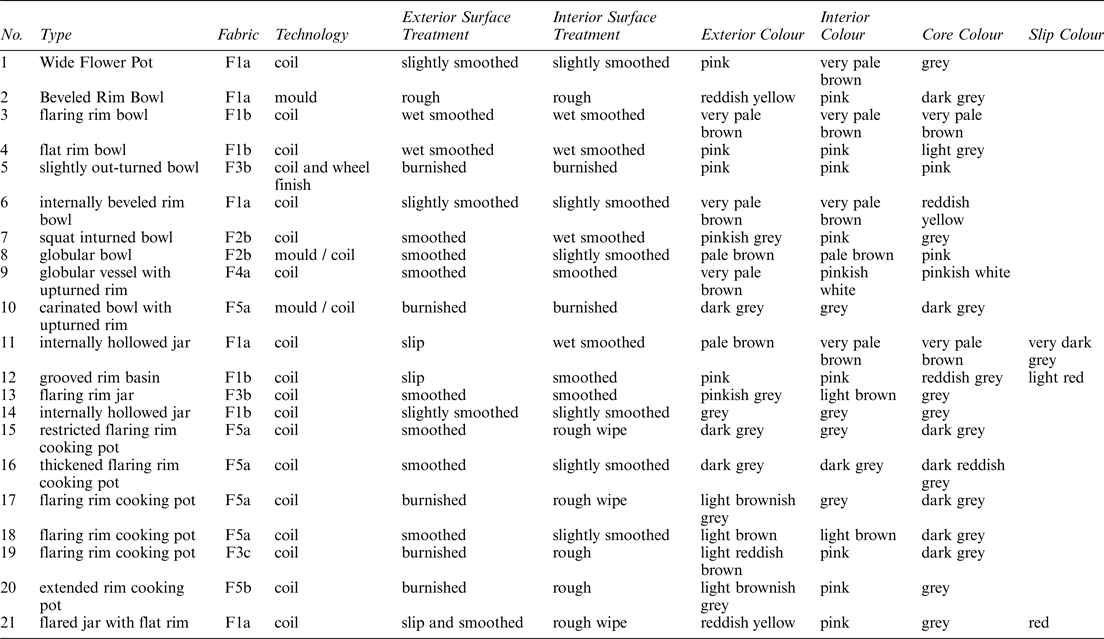
Phase VIa ceramics: 1–14 and 21: main vessel types; 15–20: cooking pots. See Table 6 for details.

Phase VIa: description of Fig. 9 illustrated sherds.

Other types continue at relatively stable or similar frequencies when compared to the preceding phase VIb. These include fine ware drinking cups with upturned rims (5.5%) (Fig. 9: 9), grey burnished cooking pots (16.9%) (Fig. 9: 15–20), collared flaring rim jars (3.5%) (Fig. 9: 13), and deep basins (7%). Just a couple of types increase in frequency from preceding levels, including Beveled Rim Bowls (BRB) (3.5%) (Fig. 9: 2) and flat rim bowls (3.6%) (Fig. 9: 4).
Many new forms appear during phase VIa. The majority of these new forms are various types of bowls, such as flaring rim bowls (1.8%) (Fig. 9: 3), bowls with internal lips (1.8%), slightly outturned bowls (3.6%) (Fig. 9: 5), and squat in-turned bowls (12.5%) (Fig. 9: 7). Internally beveled rim bowls become common (9.8%) (Fig. 9: 6), with parallels throughout northeastern Mesopotamia, including Tell Brak (Oates Reference Oates and Marro2012: fig. 7: 5) and Hamoukar (Abu Jayyab Reference Abu Jayyab and Marro2012: fig. 8: 12–13). One example of a small, black burnished carinated bowl (Fig. 9: 10) also has parallels at Tell Brak (Abu Jayyab Reference Abu Jayyab and Marro2012: fig. 15) and at Qalinj Agha and Helawa (Peyronel and Vacca Reference Peyronel and Vacca2015: fig. 13: 12). Other new forms include one example of a grooved rim basin (Fig. 9: 12), similar to a type found at nearby Logardan (Vallet et al. Reference Vallet, Baldi, Naccaro, Rasheed, Saber and Hamarasheed2017: fig. 18: 7), and internally hollowed jars (2.7%) (Fig. 9: 11, 14) that are well-attested with a wide distribution in LC2, such as at Tell Helawa (Peyronel and Vacca Reference Peyronel and Vacca2015: 13. 4, 6), Nineveh (Gut Reference Gut1995: fig. 55), Tell Brak (Oates Reference Oates and Marro2012: fig. 7: 1), and Hamoukar (Abu Jayyab Reference Abu Jayyab and Marro2012: fig. 9: 4).
Fabrics
F1 still dominates the assemblage in phase VIa, albeit with a significant decrease to 50% (F1a 24%; F1b 22%; F1c 4%), while F2 increases significantly from 4% to 22% in phase VIa (Fig. 16). F3 drops slightly from 9% to 6%, and F4 only comprises 2% of the assemblage, consistent with the continuing decline of painted wares. Finally, F5 increases in frequency from 8% to 20%, reflecting the increased presence of cooking wares.
Forming Techniques and Surface Treatments
Coiling remains the most common forming technique and has been identified in 95.5% of the assemblage. Coiling is sometimes combined with other techniques, such as a moulded base with coiled upper body. This combination is primarily identified on squat in-turned bowls (Fig. 9: 7). Moulding of the entire vessel is largely restricted to BRBs. Two sherds have traces of a combination of coil construction and wheel finishing: a globular vessel with upturned rim and a slightly outturned bowl.
Regarding surface treatment, the majority of vessels are slightly smoothed (70%) by rubbing the surface with a coarse stone or wet smoothed by wiping the surface with a wet cloth or hand. Some vessels, primarily the MPBs, are left without any treatment (17%). Burnishing occurs in 10% of the assemblage and is primarily applied on cooking pots, with the exception of one black burnished carinated bowl. The use of red slip and smoothing first makes its appearance during phase VIa and is applied on 2.6% of the assemblage (Fig. 9: 21).
Phase Vd
314 sherds were recovered from Phase Vd, of which 83 were diagnostic (26.4% of the total sherd count), including 75 rim sherds (23.9% of the total sherd count). The remaining diagnostic sherds are bases and lugs. 58 bowl fragments amount to 77.3% of the rim sherd count, while 17 jar rim sherds form 22.7%.
Forms
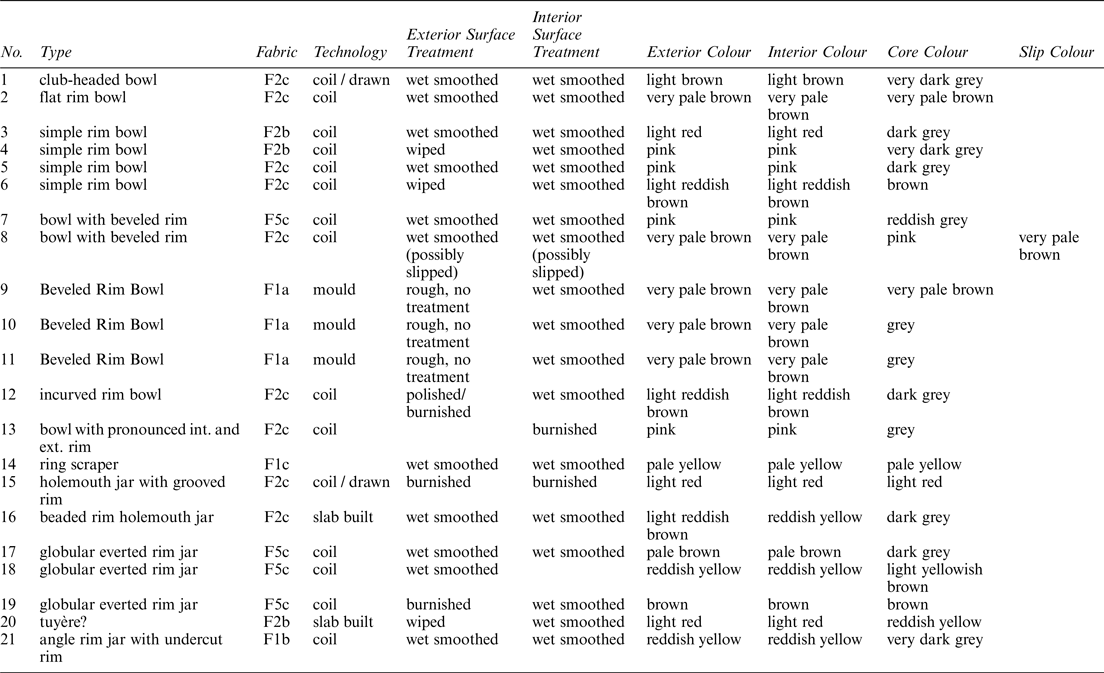
The dominant form within Phase Vd are BRBs (57.3% of the rim sherd count) ranging from a typical oblique profile and beveled rim to a sharply flaring rim (Fig. 10: 9–11). Most are very pale brown in colour with an oxidised core. Other examples range from reddish yellow through to light grey in colour and feature reduced cores.
Phase Vd ceramics: 1–19 and 21: main vessel types; 14: ring scraper; 20: “tuyère”. See Table 7 for details.

Phase Vd: description of Fig. 10 illustrated sherds.

Much finer, thin-walled bowls with a beveled rim are a chronologically sensitive form confined to phase Vd and early phase Vc, albeit relatively rare at only 2.7% (Fig. 10: 7–8). Similar (unpublished) examples occur at Gurga Chiya within the tentatively dated LC2–3 strata, and at Nineveh (Gut Reference Gut1995: pl. 108: S116). Simple rimmed bowls form 6.7% of the phase Vd rim sherds (Fig. 10: 3–6), recalling MPBs such as those from Girdi Resh (Hijara Reference Hijara1976: 74), Tepe Gawra VIII (Rothman Reference Rothman2002: fig. 9: n–o), Girdi Qala and Logardan (Vallet et al. Reference Vallet, Baldi, Naccaro, Rasheed, Saber and Hamarasheed2017: 78), and Nineveh (Gut Reference Gut1995: pl. 55: 819; 63: 901).
Remaining open forms are represented by single sherds. An incurved rim bowl (Fig. 10: 12) compares with examples from LC2–3 levels at Girdi Resh in the Shahrizor (Hijara Reference Hijara1976: 75), Tepe Gawra VIII (Rothman Reference Rothman2002: pl. 22: 2827), Yorghan Tepe (Starr Reference Starr1939: fig. 42: J), Leilan IV (Schwartz Reference Schwartz1988: fig. 53: 12), and Nineveh (Gut Reference Gut1995: pl. 107: S66; 108: S81, S92, S95; 109: S130–131). Another open form features a flattened, protruding exterior rim (Fig. 10: 2), which compares well with LC2–3 examples from Girdi Resh in the Shahrizor (Hijara Reference Hijara1976: 77), Leilan IV (Schwartz Reference Schwartz1988: fig. 58: 2), and Nineveh (Gut Reference Gut1995: pl. 113: S271). A similar variant of this has a more pronounced interior rim (Fig. 10: 13). A single example of a club-headed bowl (Fig. 10: 1) compares with examples from Girdi Resh (Hijara Reference Hijara1976: 76), Nineveh (Gut Reference Gut1995: 248–251), and Hamoukar's Southern Extension (Abu Jayyab Reference Abu Jayyab and Marro2012: fig. 16: 1).
Closed forms are dominated by globular jars with simple everted rims (10.7%) (Fig. 10: 17–19), with a single variant that has a more distinctively upright rim, with close parallels at Tepe Gawra VIII (Rothman Reference Rothman2002: pl. 21: 2779), Girdi Resh (Hijara Reference Hijara1976: 78), and Hammam et-Turkman VB (Akkermans Reference Akkermans and van Loon1988: pl. 107: 99–100; 108: 106; 110: 125). Two beaded rim hole-mouth jar fragments (2.6%) (Fig. 10: 16) have comparative examples at Tell Brak HS6 level 1 (Matthews Reference Matthews and Matthews2003: fig. 3: 16.6), Hamoukar Area Z (Al-Quntar and Abu Jayyab Reference Al Quntar, Jayyab, McMahon and Crawford2014: fig. 6: 15), and Hammam et-Turkman VB (Akkermans Reference Akkermans and van Loon1988: pl. 107: 101).
Remaining closed forms are all documented by single sherds. A jar with a narrow, banded rim and slight concavity (Fig. 10: 21) compares to examples at Hammam et-Turkman VB (Akkermans Reference Akkermans and van Loon1988: pl. 108: 110). A holemouth jar fragment with grooved rim (Fig. 10: 15) has comparative examples from Tell Brak HS1 Level 6 (Felli Reference Felli and Matthews2003: fig. 4: 19.15) and Hammam et-Turkman VA (Akkermans Reference Akkermans and van Loon1988: pl. 101: 46), while a narrow closed jar has a slightly thickened rim and is similar to an example at Grai Resh IIB (Kepinski Reference Kepinski2011: pl. 11.1).
Two sherds offer glimpses into possible craft production at Kani Shaie. A ring scraper (Fig. 10: 14) is a tool that has been found at numerous contemporary sites and is often associated with pottery manufacture (Alden Reference Alden1988; Alden & Minc Reference Alden and Minc2016). One unusual sherd from phase Vd is long with extremely thick walls and a rounded rim and could be part of a tuyère usually associated with metallurgy (Fig. 10: 20), similar to a LC2–4 examples found at Tell Zeidan (Stein Reference Stein2009: fig. 13) and Hamoukar (Reichel Reference Reichel2008: fig. 6). The use of draft furnaces in the fourth millennium B.C.E. is also well-attested on the Iranian Plateau (Matthews & Fazeli Reference Matthews and Fazeli2004; Thornton Reference Thornton2009; Weeks Reference Weeks and Petrie2013).
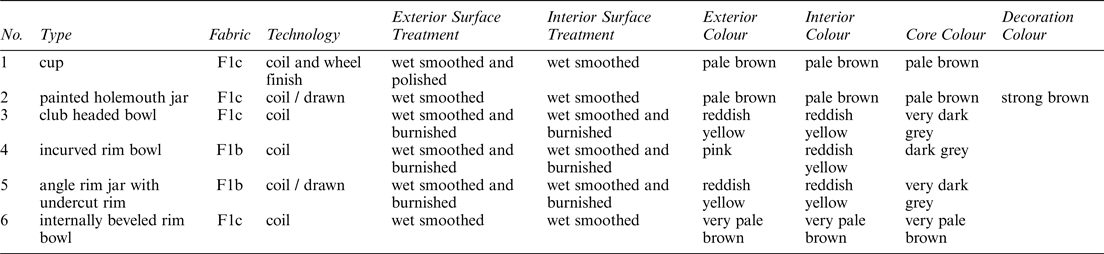
Phase Vd also includes an additional, separate context: a pit dug into level 11. The forms from this pit include a carinated cup with horizontal combing (Fig. 11: 1) with exact parallels at Leilan IV (Schwartz Reference Schwartz1988: fig. 53: 2, 4) and Tepe Gawra VIII (Rothman Reference Rothman2002: pl. 23: 2811), a burnished brown-ware incurved rim bowl (Fig. 11: 4) (Rothman Reference Rothman2002: pl. 22: 2827), and a club-headed bowl (Fig. 11: 3). This pit possibly dates slightly later within LC3 than the other material discussed in this section.
Phase Vd ceramics from pit. See Table 8 for details.

Phase Vd-pit: description of Fig. 11 illustrated sherds.

Decoration
Continuing the declining trend of decorated sherds in previous phases, phase Vd produced no decorated sherds at all.
Fabrics
Throughout phase V, vegetal tempered fabrics continue to dominate the assemblage with c. 90% of the diagnostic sherds (Fig. 16). F1a is still the most common fabric group within Phase Vd, at 52% of total diagnostic sherds, but it was now used exclusively for BRBs. At 30%, F2 continues to grow in importance, becoming the second most common fabric group (F2a 1%; F2b 5%; F2c 24%). Clearly identifiable mineral tempered sherds only form c. 10% of diagnostic sherds throughout phase V. Cooking ware fabric F5 is used almost exclusively for simple everted rim jars, with the exception of a single thin-walled bowl with beveled rim and a hole-mouth jar. A new fabric type F7 is attested by a single sherd but could be intrusive from EBA levels.
Forming Techniques and Surface Treatments
Many sherds from phase Vd are small and only preserve the rim, which does not allow the identification of the complete production process of the original vessels. The small number of sherds that does allow such an assessment might not represent the full range of forming techniques that were used during this period. The crackled exterior and finger impressions and smoothing on the interior indicate that BRBs were mould-made, most likely within an existing BRB (McAdam and Mynors Reference McAdam, Mynors and Killick1988: 40; Miller Reference Miller and Wright1981: 128; Nissen Reference Nissen1970: 137). The remainder of the sherds from phase Vd show evidence of manufacture via coiling. Most of the sherds show evidence for finishing on a rotary device or tournette, with final wet smoothing or wiping of the vessels. Additional surface treatment is relatively rare. Only four sherds show evidence of burnishing, though this was not particular to any specific vessel form.
Phase Vc
Phase Vc is the most pottery-dense phase at Kani Shaie with a total of 1010 sherds, of which 167 were diagnostic (16.5%), including 133 rim sherds (13.2% of the total sherd count). The remaining diagnostic sherds were bases, handles, spouts, and decorated sherds. 75 bowl fragments amount to 56.4% of the rim sherd count, while jars are represented by 48 rim sherds (36.1%), and cups by 10 sherds (7.5%).
Forms
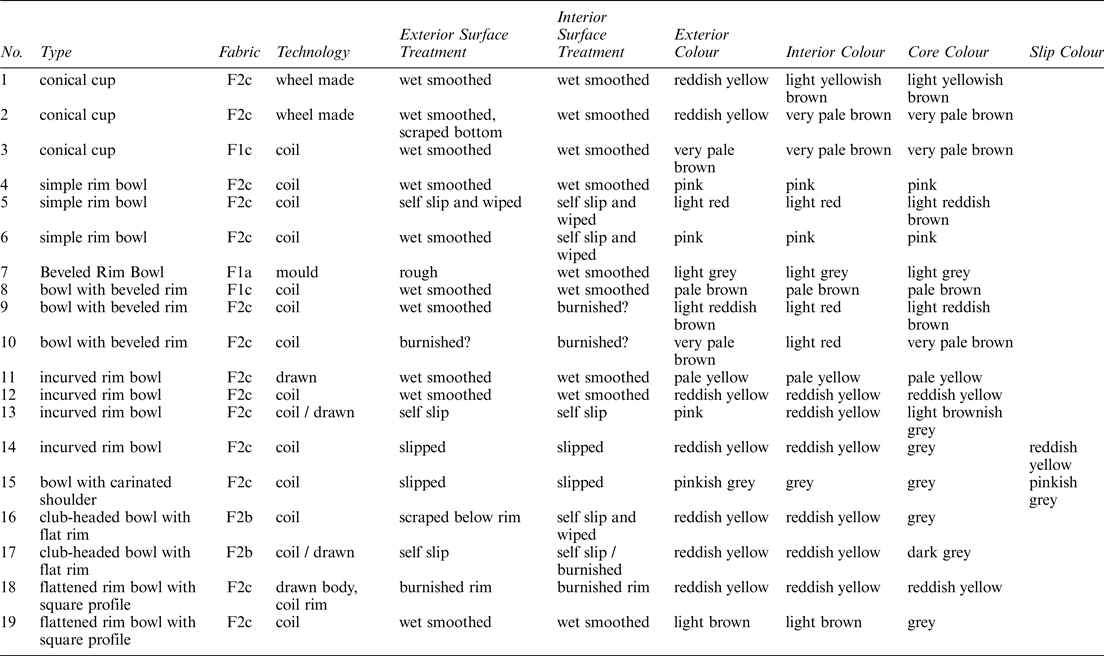
BRBs continue to dominate the phase Vc assemblage, but only at 21% of the rim sherd count, a lower quantity compared to 57.3% in the previous phase Vd (Fig. 12: 7). Such an extreme fluctuation was also observed at Tell Rubeidheh, where BRB quantities range even more, from as little as 15% to >70% (McAdam and Mynors Reference McAdam, Mynors and Killick1988: 40–41).
Phase Vc ceramics: open shapes. See Table 9 for details.

Phase Vc open shapes: description of Fig. 12 illustrated sherds.

Simple bowls with wide, flaring rims continue into phase Vc (16.5%) (Fig. 12: 4–6). Similar bowls occur in LC4 strata at Tell Rubeidheh (McAdam and Mynors Reference McAdam, Mynors and Killick1988: fig. 28: 11), Tell Hassan (Nannucci Reference Nannucci and Mazzoni2012: fig. 2: 5–10, 13–16), Hacinebi (Pearce Reference Pearce, Marro and Hauptmann2000: fig. 13: b–c), and Sheikh Hassan (Boese Reference Boese1995: fig. 9: a, fig. 13: a). Thin-walled bowls with a beveled rim continue in low numbers (3%) into the lower level of phase Vc, but not beyond (Fig. 12: 8–10).
Conical cups with thin walls and a string-cut base occur for the first time in phase Vc, forming 6.8% of the total rim sherd count (Fig. 12: 1–3). Only one example from this total featured a pouring lip, but see below for additional examples assigned to this phase. Such cups are very common at Uruk period sites, with nearby comparative examples from LC4 strata at Gurga Chiya (Wengrow et al. Reference Wengrow, Carter, Brereton, Shepperson, Hamarashi, Saber, Bevan, Fuller, Himmelman, Sosnowska and Gonzalez Carretero2016: fig. 8: 12), Tell Rubeidheh (McAdam and Mynors Reference McAdam, Mynors and Killick1988: fig. 28: 6), Ahmad al-Hattu (Sürenhagen Reference Sürenhagen1979: fig. 4), and Tell Hassan (Nannucci Reference Nannucci and Mazzoni2012: fig. 2: 3–4).
Incurved-rim bowls, which are a common and wide-spread form within LC3–5 assemblages throughout Mesopotamia, increase from 3% to 7.5% (Fig. 12: 11–14). Within the vicinity of Kani Shaie, they are well-documented at Gurga Chiya (Carter et al. Reference Carter, Wengrow, Shepperson, Roberts, Lewis, Marsh, Gonzales-Carretero, Sosnowska, D'Amico, Sagan and Lockyear2020) in the Shahrizor, and at Tell Hassan (Nannucci Reference Nannucci and Mazzoni2012: fig. 3: 27–30) and Tell Rubeidheh (McAdam and Mynors Reference McAdam, Mynors and Killick1988: fig. 28: 10) in the Hamrin basin, where they are noted as amongst the most common form of bowl (ibid: 45). They also occur in the central Zagros at Godin Tepe (Rothman and Badler Reference Rothman, Badler, Gopnik and Rothman2011: fig. 4: 45.1c).
Open vessels found in lower quantities include club-headed bowls with flattened or slightly oblique tops and pronounced interior and exterior rims (3%) (Fig. 12: 16–17), which at present occur exclusively in the earliest level of Phase Vc. They closely resemble LC3 hammerhead bowls, though the form at Kani Shaie features a flat-topped rim rather than the more characteristic oblique profiled rims. Similar examples are documented at Girdi Resh (Hijara Reference Hijara1976: 76), Leilan IV (Schwartz Reference Schwartz1988: fig. 52: 5), and Nineveh (Gut Reference Gut1995: pl. 113: S283–284).
Bowls with a flat, square profile rim total 1.5% within phase Vc (Fig. 12: 18–19) and have parallels in LC2–3 strata at Hammam et-Turkman VB (Akkermans Reference Akkermans and van Loon1988: pl. 104: 79) and slightly later within early LC4 phases at Leilan IV (Schwartz Reference Schwartz1988: fig. 53: 3, 5). Other open forms from phase Vc represented only by single sherds include a bowl with a slight carination to the shoulder (Fig. 12: 15) closely resembling an example from Tepe Gawra VIII (Rothman Reference Rothman2002: pl. 22: 2825). Another sherd belongs to an open bowl with a flattened, protruding exterior rim, with similar LC2–3 examples from Girdi Resh (Hijara Reference Hijara1976: 77) and Nineveh (Gut Reference Gut1995: pl. 113: S271). A variant of this type has a more pronounced interior lip.
Globular jars with simple, everted rims remain the most common closed shape in phase Vc (9%) (Fig. 13: 1–4), with parallels at nearby LC4 sites including Gurga Chiya (Wengrow et al. Reference Wengrow, Carter, Brereton, Shepperson, Hamarashi, Saber, Bevan, Fuller, Himmelman, Sosnowska and Gonzalez Carretero2016: fig. 8: 4–5), Tell Rubeidheh (McAdam and Mynors Reference McAdam, Mynors and Killick1988: fig. 30: 41, 45), Ahmad al-Hattu (Sürenhagen Reference Sürenhagen1979: fig. 10), and Tell Hassan (Nannucci Reference Nannucci and Mazzoni2012: fig. 5: 58, 60–63). Angled rim jars with an undercut rim (5.2%) become prevalent in phase Vc (Fig. 13: 9–14). Some examples feature a slight concavity to the band rim. These jar rims are triangular in profile with a sharply carinated neck, ideal as a support for a lid. Such vessels are well-known from LC4 pottery assemblages at Gurga Chiya (Wengrow et al. Reference Wengrow, Carter, Brereton, Shepperson, Hamarashi, Saber, Bevan, Fuller, Himmelman, Sosnowska and Gonzalez Carretero2016: fig. 8: 6, 8), Tell Rubeidheh (McAdam and Mynors Reference McAdam, Mynors and Killick1988: fig. 31: 57–60), and Tell Hassan (Nannucci Reference Nannucci and Mazzoni2012: fig. 6: 75–81), as well as at Sheikh Hassan (Boese Reference Boese1995: 201, fig. 13: l–n) in western Syria. Necked jars with flat-topped, everted or ledge rims (Fig. 13: 5–8) compare to similar forms from LC4 levels at Tell Hassan (Nannucci Reference Nannucci and Mazzoni2012: fig. 8: 108–110), Tell Rubeidheh (McAdam and Mynors Reference McAdam, Mynors and Killick1988: fig. 32: 80), and Chogha Mish (Delougaz et al. Reference Delougaz, Kantor and Alizadeh1996: pl. 91: I). This form is less common at only 4.5%, but it seems to represent a chronologically sensitive type considering that with only one exception, all examples of these vessels come from phase Vc, particularly the earlier level. Neckless jars with everted, flat topped rims are exclusive to this phase (1.5%) (Fig. 13: 17). Comparative examples are known from Tell Rubeidheh (McAdam and Mynors Reference McAdam, Mynors and Killick1988: fig. 29: 33) and Sheikh Hassan (Boese Reference Boese1995: 227, fig. 13: 1–b), while a similar vessel from Tell Hassan has a slightly different rim (Nannucci Reference Nannucci and Mazzoni2012: fig. 5: 43).
Phase Vc ceramics: closed shapes. See Table 10 for details.

Phase Vc closed shapes: description of Fig. 13 illustrated sherds.

Remaining forms are rare within phase Vc. Jars with narrowed, very short rims (1.5%) (Fig. 13: 19–20) have close parallels at Tell Rubeidheh (McAdam and Mynors Reference McAdam, Mynors and Killick1988: fig. 29: 28–29). Another jar represented by a single documented sherd, unique to this phase, features an upright and flattened rim (Fig. 13: 15) with a comparison at Tell Hassan (Nannucci Reference Nannucci and Mazzoni2012: fig. 8: 105). The example from Kani Shaie is decorated with a horizontal incised band around the shoulder and is characterised by a large quantity of angular mineral temper.
Additional diagnostic forms not included within the above counts include two cannon spouts (Fig. 13: 21) and sherds with rim swellings, or blunt, flattened lips with incised scoring (Fig. 13: 18) that have comparanda at Tell Rubeidheh (McAdam and Mynors Reference McAdam, Mynors and Killick1988: fig. 34: 97) and Chogha Mish (Delougaz et al. Reference Delougaz, Kantor and Alizadeh1996: pl. 98: H–K). Two body sherds with nose lugs find nearby comparisons at Gurga Chiya (Wengrow et al. Reference Wengrow, Carter, Brereton, Shepperson, Hamarashi, Saber, Bevan, Fuller, Himmelman, Sosnowska and Gonzalez Carretero2016: fig. 8: 7), Tell Rubeidheh (McAdam and Mynors Reference McAdam, Mynors and Killick1988: fig. 34: 98–104), and Tell Hassan (Nannucci Reference Nannucci and Mazzoni2012: fig. 9: 139, 10: 152–155), but are otherwise well-documented throughout Mesopotamia.
Three contexts assigned to phase Vc have not been included within the above tallies because they are stratigraphically disconnected from the other contexts. Based on elevations, stratigraphic analysis, and material culture, these contexts clearly belong to phase Vc, but their ceramic assemblage shows some clear differences that are not yet fully understood (Fig. 14). BRBs dominate the assemblage from these contexts, while thin-walled conical cups with string-cut bases are also found in very high quantities in these three contexts, both with and without a pouring lip. Other open forms include incurved rim bowls and wide bowls with flattened, protruding interior rims. Closed forms include red-slipped jars with nose lugs and incised rope cordons, globular jars with simple, everted rims, and jars with triangular profiles and sharply carinated necks. Overall this small sub-assemblage compares well with the broader phase Vc as well as the LC4 assemblages from Gurga Chiya, Tell Rubeidheh, Ahmad al-Hattu, and Tell Hassan, but it contains a much higher ratio of BRBs and thin-walled conical cups than the main phase Vc levels, as well as a much more restricted range of shapes. Whether these differences reflect chronological or functional differences between these contexts remains to be determined.
Phase Vc “Uruk” pottery: 1: BRB; 2: conical cup with string-cut base; 3: jar with fingernail impressions; 4–7: nose-lug jar sherds.

Decoration
19 sherds from phase Vc have decoration (6 painted; 13 incised/impressed); only three of these are rim sherds. This total equates to 11.4% of the total diagnostic sherd count and 1.9% of the total sherd count. One sherd features a reddish-brown painted design of a cross-hatched triangular motif around the shoulder, with traces of a lug handle (Fig. 13: 27). Similar nose-lug jars with painted criss-cross motifs are known from Late Uruk and Jemdet Nasr strata from Central Mesopotamia (Rova Reference Rova and Lebeau2014: 4).
Incised/impressed decoration represents 1.3% of the total sherd count, or 7.8% of diagnostic sherds. Several sherds of closed jars have horizontal combing on the exterior (Fig. 13: 15–16, 25). Similar examples are depicted from Tell Brak HS1 (Felli Reference Felli and Matthews2003: fig. 4: 25.11) and Sheikh Hassan (Boese Reference Boese1995: 83, fig. 20: a–e), as well as from Susa Acropole I:17 (Le Brun Reference Le Brun1978: fig. 34: 12) and Chogha Mish (Delougaz et al. Reference Delougaz, Kantor and Alizadeh1996: pl. 95: K–N). One body sherd has thick incised parallel lines with much thinner incised lines running perpendicular, comparable to a decorative technique seen at Chogha Mish (Delougaz et al. Reference Delougaz, Kantor and Alizadeh1996: pl. 101: E). Rope cordons are also relatively common decorative motifs (Fig. 13: 26). Simple applications include vertical slashes to the shoulder of the vessel (Fig. 13: 22), impressed thumb-print design to the vessel shoulder (Fig. 13: 23), and an applied band of clay with impressed thumb nail design over the top (Fig. 13: 24). One rim sherd has an impressed thumbnail design with an incised horizontal band on the shoulder of the vessel (McAdam and Mynors Reference McAdam, Mynors and Killick1988: fig 36: 123–4).
Fabrics
In phase Vc, F2 becomes the dominant fabric group with 58% of diagnostic sherds (F2a 2%; F2b 12%; F2c 44%), a considerable increase from phase Vd (Fig. 16). F1a decreases substantially from 52% to 20%, but this reflects the significantly lower amount of BRBs in the phase Vc assemblage. The finer fabric F1c, on the other hand, remains relatively constant at 10%. A new fabric type F8, which is very fine with only extremely fine, sand-sized mica inclusions visible, is observed in a single sherd.
Remaining fabric groups show the addition of mineral temper. Cooking ware fabric F5c forms 6% of diagnostic sherds and is still primarily used for everted rim globular jars, although isolated examples of other jar forms also occur. A new fabric type F6, which features the deliberate addition of chert, is attested in 3% of the diagnostic sherds.
Forming Techniques and Surface Treatments
Coiling continues to be the dominant method of ceramic manufacture (58.7%). The rough-out vessel was then drawn and manipulated by the potter using a tournette or similar rotary device with final wet smoothing or wiping of the vessels. Typical thin-walled conical cups have clear evidence for horizontal rill-marks around the vessel and a string-cut base, demonstrative of manufacture on a fast wheel. A trend in the manufacturing of these cups can be observed at Kani Shaie. Three conical cups from the earlier level of phase Vc feature a flint scraped lower body without a string-cut base, a practice reminiscent of the scraping of the bases of MPBs to remove excess clay. It seems that this represents an early variant of the string-cut conical cups noted in late phase Vc and Va–b that never have this scraping. These distinctive cups match examples from “Early Uruk” levels at Logardan (Baldi Reference Baldi and Vallet2017: 57).
Pinched and hand-drawn vessels are very rare, and only two sherds show this forming technique for the body. Slipping of sherds was rare in phase Vc and is not particular to any type or form of vessel. Two distinct slip colours were observed: the first has a red/reddish-yellow colour, while the second, much rarer, slip was grey. Burnishing is also observed, which again is not specific to any type of vessel, but it is more common on closed vessels and vessels that have been slipped. One sherd features a unique pattern burnish and shows a zig-zag pattern applied to the neck of a closed, ledge-rim jar. This rocker pattern is usually applied on squat jars, often spouted or with a strap handle, at Tell Rubeidheh (McAdam and Mynors Reference McAdam, Mynors and Killick1988: fig. 29: 34, 33: 87–88, 35: 105) and Tell Hassan (Nanucci Reference Nannucci and Mazzoni2012: fig. 10: 145) in the Hamrin, as well as at Chogha Mish (Alizadeh Reference Alizadeh2009: fig. 32: K; Delougaz et al. Reference Delougaz, Kantor and Alizadeh1996: pl. 107: H–I).
Phase Va–b
957 sherds were registered from these contexts, of which only 50 were diagnostic (5.2%) whilst 40 were rim sherds (4.2%). Many of the non-diagnostic sherds were very small fragments, which could be a result of a hiatus in occupation and exposure to the elements. The phase Va–b assemblage is dominated by bowls (65%). Cups amount to 12.5%, while closed forms total 22.5%.
Forms
Overall the range of forms in phase Va–b is very limited and probably not fully representative, but it continues the phase Vc assemblage with few additions. BRBs continue to be the most abundant form at 37.5% of the total rim sherd count (Fig. 15: 10–12). Late examples of BRBs from Kani Shaie are characterised by a pink coloured fabric and noticeably taller profile, with contemporary parallels at Mohammed ‘Arab (Roaf and Killick Reference Roaf and Killick1987: 207), Telul eth-Thalathat (Numoto Reference Numoto1998: 53–4), and Susa Acropole I (Le Brun Reference Le Brun1971: fig. 60: 12, 65: 7). Thin-walled conical cups with string-cut bases also continue and total 12.5% of the phase Va–b rim sherd count, including examples with a pouring lip (Fig. 15: 1–4). Similarly, incurved-rim bowls still form 7.5% (Fig. 15: 6–7) and simple rim bowls form 5% (Fig. 15: 5).
Phase Va-b ceramics. See Table 11 for details.

Phase Va-b: description of Fig. 15 illustrated sherds.

Closed forms are relatively rare within phase Va–b: globular jars with everted rims (5%) (Fig. 15: 14), jars with narrow-banded rims and slight concavities around the rim (5%) (Fig. 15: 16), flat-topped jars with everted, ledge rims (5%) (Fig. 15: 13), and a single sherd of a jar with an upright rim (Fig. 15: 15).
Further forms not included in the above tallies are a straight cannon spout and a thumb-impressed pot stand (Fig. 15: 17) that has comparisons at Chogha Mish (Delougaz et al. Reference Delougaz, Kantor and Alizadeh1996: 47, fig. 8: XVI) and Sheikh Hassan (Boese Reference Boese1995: 79: fig. 16: g–h, 80: fig. 17: i, 271: fig. 14).
Decoration
Similar to the previous phase, 10% of the total diagnostic sherds from this phase have decoration, usually an applique rope cordon (6.3%) or an impressed rope cordon (3.1%). Comparative applique rope cordons are noted at, for example, Sheikh Hassan Schicht 10 (Boese Reference Boese1995: 23: fig. 23: g) and Tell Rubeidheh (McAdam and Mynors Reference McAdam, Mynors and Killick1988: fig. 30: 46; 31: 58). Impressed/incised cordons are noted at Gurga Chiya (Wengrow et al. Reference Wengrow, Carter, Brereton, Shepperson, Hamarashi, Saber, Bevan, Fuller, Himmelman, Sosnowska and Gonzalez Carretero2016: 262), Sheikh Hassan (Boese Reference Boese1995: 201: fig. 13: l–n), and Tell Rubeidheh (McAdam and Mynors Reference McAdam, Mynors and Killick1988: fig. 32: 78).
One sherd features a horizontal band of incised triangles around the shoulder of the vessel (Fig. 15: 21). Such sherds with incised triangular motifs frequently occur within Late Uruk period ceramic assemblages, with comparative examples from Tell Rubeidheh (McAdam and Mynors Reference McAdam, Mynors and Killick1988: fig. 34: 99) and Godin Tepe (Badler Reference Badler and Postgate2002: fig. 17; Rothman and Badler Reference Rothman, Badler, Gopnik and Rothman2011: fig. 4: 47). Another decorated sherd features a double row of rope cordons applied horizontally to the vessel shoulder (Fig. 15: 20). Single rope cordons are well known within contemporary Uruk assemblages, however double-rope cordons are less common. A similar example is depicted from Tell Rubeidheh (McAdam and Mynors Reference McAdam, Mynors and Killick1988: fig. 32: 75).
Fabrics
F2 continues to dominate phase Va–b at 54% of total diagnostic sherds (F2a 2%; F2b 4%; F2c 48%) (Fig. 16). F1a, used only for BRBs, represents 26% of the total diagnostic sherd count, while F1c remains relatively stable at 6%. Mineral tempered fabrics F5c (8%) and F6 (4%), as well as F8 (2%) remain consistent and overall rare.
Forming Techniques and Surface Treatments
Rates of fabric group occurrences per phase (percentage of diagnostic sherds).

Chronological development of main ceramic types throughout the LC at Kani Shaie.

As in the previous phase, two pottery types show form-specific methods of manufacture: BRBs are all made in an existing mould, and thin-walled, string-cut cups have horizontal rill-marks around the vessel indicative of manufacture on a fast-wheel. Final surface treatment was limited to wet smoothing of the exterior and interior of the vessels, presumably while the vessels were still on the wheel or tournette.
The remainder of diagnostic rim sherds from phase Va–b all show coiling as the principal method of manufacture, with finishing or wet smoothing of the vessel via a wheel or tournette. Surface treatment beyond wet smoothing is rare within this phase, with only one example of a red slip applied to the interior and exterior surface of the banded rim jar with everted rim and flat top, and only one example of burnishing to one of the incurved rim bowls.
Chronology
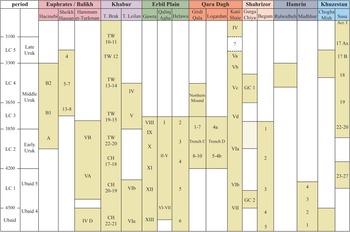
In order to begin constructing a regionally relevant ceramic chronology using local sequences, we have avoided as much as possible forcing a priori the Kani Shaie phases into the LC framework that derives mainly from northern Mesopotamian sites. Nevertheless, general similarities in material culture with distant sites allow a preliminary assessment of contemporaneity, pending a robust carbon dated chronology (Fig. 18).Footnote 14
Chronology chart of major LC sequences from northern Mesopotamia, the Trans-Tigridian Corridor, and Khuzestan.

The earliest excavated levels at Kani Shaie, phase VII, can be dated to the late Ubaid/LC1 transition. The best parallels are found in levels said to be Ubaid to LC1 at Tell Helawa, Gurga Chiya, Surezha, and Tell Madhhur. Defining this transition remains a contested issue. At Surezha, carbon dates seem to push the onset of LC1 to the beginning of the fifth millennium B.C.E. (Stein Reference Stein2018: 42; Stein and Alizadeh Reference Stein and Alizadeh2017: 86). However, the parameters used to assign the ceramic assemblage of Surezha to LC1 differ from those used by other projects. Similarly, at Gurga Chiya, phase GC2 is assigned to the late Ubaid period, even though material from this phase has parallels with assemblages assigned to LC1 at Tell Helawa and Surezha (Carter et al. Reference Carter, Wengrow, Shepperson, Roberts, Lewis, Marsh, Gonzales-Carretero, Sosnowska, D'Amico, Sagan and Lockyear2020). We assign Kani Shaie phase VII to the very end of the late Ubaid period, based on the significant presence of painted sherds and Dalma Impressed ware, while the already high percentage (18.5%) of MPBs may herald the LC1.
Phase VIb, on the other hand, can be reliably assigned to LC1, based on parallels with Gawra XII and assemblages from Tell Helawa and Surezha. In the step trench, this phase occupies almost four meters of deposits that show a remarkable consistency in material culture. This suggests that the LC1 period at Kani Shaie might have lasted quite a long time, which could at least partially explain differences in C14 dates for the same period at sites such as Surezha and Gurga Chiya.Footnote 15 The next phase, VIa, finds its best parallels in LC2 levels at Tell Helawa and Hamoukar.
Phase Vd is not well represented in the step trench. The material finds good parallels in Gawra VIII, while LC2 ceramic types linger, indicating a date early in LC3. Material from a pit lower on the slope could date slightly later in LC3. Phase Vc can be securely dated to LC4, with an assemblage that has its closest comparanda at nearby Tell Rubeidheh and Gurga Chiya. The earliest level of phase Vc (level 5) still displays continuity from LC3, but not the upper level (4). This phase ends in a destruction that has been observed at different locations in the site, followed by a short period of ephemeral activity in level 3. Finally, phase Va–b still has its best parallels at Tell Rubeidheh and other LC4 sites, but new traits herald LC5 characteristics.
Discussion: The regional context of Kani Shaie
Admittedly, the limited exposure of the step trench at Kani Shaie means that the dataset presented here is potentially not fully representative. Nonetheless, considering the dearth of complete LC sequences from the Trans-Tigridian region, this assemblage serves as a steppingstone for the construction of a regional ceramic chronology. Beyond a chronological assessment, our ceramic analysis allows a preliminary analysis of technological practices at Kani Shaie. The macroscopically observed fabric typology presented here is preliminary but reveals broad trends.Footnote 16
In general, the ceramic assemblage of Kani Shaie initially exhibits strong parallels to assemblages of sites in the vicinity and gradually becomes more embedded in the trans-regional networks of the LC, while maintaining regionalized traits. Such a phenomenon is not dissimilar to perspectives on LC developments at large (Baldi Reference Baldi and Iamoni2016; Stein Reference Stein2012). However, this top down approach, which implies that supra-regional processes were enacted upon sites, drawing them ever closer into an overarching Chalcolithic world, needs to take into account micro and medial scales of processes observed at the site level.
To understand social developments pertinent to Kani Shaie, it is useful to envision the various elements within the ceramic assemblage as different units, with their own histories of production embodied in unique chaînes opératoires (Abu Jayyab Reference Abu Jayyab2019). Similarities of wares and vessel types between sites can be understood as resulting from the actions of tightly knit groups of producers who form a distinct ‘community of practice’ constituted through situated learning and apprenticeship (Lave and Wenger Reference Lave and Wenger1991). The habits adopted by these communities of practice produce traditions, reflected in ceramic wares, that can be distinguished from those of other groups (Gosselain Reference Gosselain and Stark1998). If mobility and changing residential patterns form part of a potting community's practices, multiple communities of practice can exist within a given village, while a single community of practice can crosscut multiple villages (Eckert Reference Eckert2008: 2). Through examining how certain traditions and production sequences circulated, we can begin to reconstruct formative historical processes that shaped site assemblages. Such an approach can be used to begin to explain the regional variation of ceramic assemblages and the different degrees of local adoption of foreign vessel types during the LC.
Kani Shaie phase VII produced an eclectic collection of ware groups, with multiple potting traditions existing side-by-side. Worth noting here is the presence of Ubaid-like painted motifs and forms, which suggests that during this phase the inhabitants of the site participated in what has been described as an Ubaid oikumene (Stein and Özbal Reference Stein, Özbal and Stone2007). Judging by macroscopic observations of fabric composition, the Ubaid wares do not seem to have been produced outside of the site or at least outside the valley, however they can certainly be distinguished through elements of their chaînes opératoires. All Ubaid wares recovered were made of finer fabrics. Mineral fabric F4 was exclusively reserved for Ubaid painted and incised wares, while other wares were almost always made with fine chaff and mineral temper. This evidence suggests that during the Ubaid/LC transition at Kani Shaie, Ubaid potting communities of practice were still active at the site, either as persistent remnants of Ubaid traditions, or as part of a still active oikumene of greater Mesopotamian traditions with localized expressions.
Dalma Impressed ware is another distinct tradition that exclusively occurs during phase VII. Dalma Impressed wares occur most commonly in the highlands of the Zagros and only occur in limited numbers in the Trans-Tigridian Piedmont. In the Zagros Mountains, but mainly east of the Chaîne Magistrale, these impressed wares occur together with Dalma Painted ware. However, these do not share many elements in their respective production sequences (Henrickson and Vitali Reference Henrickson and Vitali1987; Sorkhani and Eslami Reference Sorkhani and Eslami2018). A common explanation for these differences in distribution and production is that Dalma Impressed ware was part of the repertoire of mobile communities that frequently moved between the high Zagros valleys and the piedmont during the Middle Chalcolithic (Henrickson Reference Henrickson and Kingery1986, Reference Henrickson, Henrickson and Thuesen1989; Tonoike Reference Tonoike2009, Reference Tonoike2012). The majority of the Dalma Impressed wares from Kani Shaie seem to have been produced locally, with the fabrics predominantly made from a clay containing limestone with vegetal temper inclusions. One sample made from a mica-rich clay could have been brought in from outside the region.
Phase VII also produced MPBs, which is a mass-produced bowl type that became common during LC1–2. However, it would be premature to tie this phase into a typo-chronological scheme that was developed from assemblages west of the Tigris (Schwartz Reference Schwartz and Rothman2001). Alternatively, we suggest that phase VII shares elements that have been traditionally considered Ubaid with some elements that belong in LC1. Without a clear absolute chronology and with limited knowledge of region-specific sequences, we cannot say for certain if the concept of MPBs arrived from the areas west of the Tigris, were an early indigenous practice, or resulted from a more complicated process. What we can say is that the phase VII assemblage of Kani Shaie resulted from the overlap of distinct traditions – conceived in different communities of practice – coming from different directions and coalescing at the site, which is a persistent pattern throughout the entire Kani Shaie sequence.
The next phase, VIb, shows continuity with phase VII in terms of potting practices, but with the addition of new elements, such as grey ware cooking pots that appear for the first time. These pots are unique in terms of their chaîne opératoire, with primarily calcite temper (fabric F5) and micaceous clays. Moreover, the overall shape of these vessels, their surface treatments (smoothing and burnishing), and their firing in a reduced atmosphere distinguish them from other wares at the site. These vessels may represent a change in diet, as they are best equipped to cook gruels and soups, a practice not evident in the previous phase.
Another major shift is seen in decoration preference, with incised wares overtaking painted wares in phase VIb. Changes in potting traditions and aesthetic preferences had clearly shifted, replaced by potting traditions of new communities of practice. These potting communities became much more limited in their interaction networks, restricted mainly to the area between the Upper Zab and Diyala/Sirwan rivers and the Tigris and Zagros Mountains. MPBs are the only ceramic type with a wider distribution, but even within this broad category the MPBs at Kani Shaie belong to a variant (“Wide Flower Pots”) that mainly occurs in the eastern part of northern Mesopotamia. At the same time, disappearance of painted wares, emergence of mass-produced wares, appearance of specialized cooking wares, and increased regionalism are developments that occur throughout southwest Asia in LC1 (Abu Jayyab Reference Abu Jayyab2019; Baldi Reference Baldi and Iamoni2016; Stein Reference Stein2012).
After a period of intra-regional entrenchment, phase VIa (LC2) shows a reemergence of interregional connections. This period is marked by an increase in BRBs, perhaps reflecting new contacts with southern Mesopotamia, together with a decrease of earlier MPBs. While grey cooking pots remain numerous, a number of vessels usually associated with assemblages of the Syrian Jazira, such as internally beveled rim bowls, internally hollowed rim jars, and carinated black burnished wares, become part of the repertoire of the potters at Kani Shaie. Nevertheless, while there is a reemergence of external influences from Mesopotamia, the overall potting traditions at Kani Shaie mostly show continuity from the previous phase while carefully borrowing elements that were circulating through interregional networks.
This trend of gradual adoption of widespread ceramic wares continues into phase Vd. The dominance of vegetal temper together with the lack of surface treatment other than wet smoothing fits well within the broader chaff-faced ware oikumene, demonstrative of the relative homogenisation of ceramic regions across northern Mesopotamia and the northern Zagros (Baldi Reference Baldi and Iamoni2016; Marro Reference Marro2010). However, the phase Vd ceramic repertoire from Kani Shaie retains a distinctly regionalised flavour shared with the LC2–3 strata at Girdi Resh, Girdi Shamlu, and Gurga Chiya in the Shahrizor. In addition to the disappearance of several ceramic shapes, the most noteworthy change from phase VIa to Vd is the remarkable increase of BRBs from 3.5% to over 50% of the diagnostic assemblage, alongside the virtual disappearance of earlier MPBs and the appearance in their place of simple-rimmed bowls.
Phase Vd features a relatively limited range of forms, which are long-lived within the archaeological strata (mainly BRBs and simple everted rim globular jars). Characteristic forms of this phase are few, yet chronologically sensitive. Thin-walled bowls with a beveled rim closely resemble the coarse BRB, but they differ markedly in their finesse and are much less common. The assemblage of this phase is somewhat difficult to place temporally as it lies stratigraphically between the heavily studied LC1–2 horizon and the well-known ceramic forms of the later LC and the Uruk Phenomenon. LC3, in contrast, is an understudied period in the region due to widespread site abandonment (e.g., Helawa: Peyronel and Vacca Reference Peyronel and Vacca2015). The as yet small, but important, phase Vd assemblage from Kani Shaie provides an anchor point that can elucidate the transition from the early to the later LC.
Phase Vc initially shows strong continuity from Vd but sees the rapid introduction of a completely new tradition. BRBs remain the most dominant open form, as well as V-shaped bowls with simple rims and globular jars with plain everted rims. Fine, thin-walled bowls with beveled rims continue yet are found exclusively within the earliest strata of this phase. Similarly, club-headed bowls and flat-topped, square profile bowls that are traditionally associated with earlier LC2–3 strata indicate a prolonged production and conservatism in ceramic trends. On the other hand, several ceramic forms that herald the beginnings of a typical southern “Uruk” ceramic repertoire appear and rapidly increase in importance in the upper level of phase Vc. These include fine conical cups, nose-lugged jars, jars with incised or applique ‘rope cordons’, spouted jars (mainly cannon spouts), and incurved-rim bowls, which closely resemble assemblages from the Hamrin sites. Interestingly, some of the conical cups feature scraped bottoms and bases rather than the slightly later string-cut bases, reminiscent of earlier LC ceramic traditions associated especially with MPBs. This suggests that local potters initially maintained their traditional practice of producing a flat base through scraping before adopting the new technology of production on a fast wheel, resulting in the string-cut bases that commonly define this type.
Macroscopic analysis of production techniques of the vessels mainly indicates continuity with earlier phases. Most vessels from phase Vc show evidence that the vessel rough-out was formed using a tournette or other rotary device, with coils added to form the upper body, and a final coil added for the rim. The continued lack of surface treatment within this phase is a persistent regionalised expression. This is particularly interesting given the contemporary assemblage at Gurga Chiya, where slipping and burnishing is widespread (Wengrow et al. Reference Wengrow, Carter, Brereton, Shepperson, Hamarashi, Saber, Bevan, Fuller, Himmelman, Sosnowska and Gonzalez Carretero2016: 262–263). ‘Classic’ Uruk wares are present at Kani Shaie, mainly out of context at present, but are for as yet unknown reasons less attested within the step trench assemblage (Fig. 14; Tomé et al. Reference Tomé, Cabral, Renette, Kopanias and MacGinnis2016: fig. 4). Furthermore, the frequently asserted dichotomy between ‘local’ LC assemblages with vegetal temper versus ‘Uruk’ assemblages with mineral temper cannot be maintained at Kani Shaie, as has already been observed at other sites in the region (Carter et al. Reference Carter, Wengrow, Shepperson, Roberts, Lewis, Marsh, Gonzales-Carretero, Sosnowska, D'Amico, Sagan and Lockyear2020; Vallet et al. Reference Vallet, Baldi, Naccaro, Rasheed, Saber and Hamarasheed2017: 75).
The assemblage of final phase Va–b is very similar to that of the upper level of Vc. Surface treatment beyond wet-smoothing is virtually absent, and manufacturing of the vessels is still dominated by a mould-made base and lower body, with coils added to form the remainder of the vessel. BRBs still feature as the dominant form of phase Va–b, while conical cups, globular jars with simple everted rims and incurved-rim bowls form the majority of the assemblage. Despite this continuity, phase Va–b sees the introduction of LC5 ceramic characteristics. Dating LC5/Late Uruk assemblages from the region is particularly difficult given the complete absence of securely radiocarbon dated strata belonging to this period. Nevertheless, we tentatively ascribe an early LC5 date to phase Va–b, based on a number of observations. BRBs from this phase are somewhat taller with a more upright stance and a pinker fabric than those of earlier LC phases, which matches observations by Helwing (Reference Helwing and Lebeau2014) and compares well with the BRBs of the EBA in the central Zagros and also observed in phase IV at Kani Shaie. Additionally, increased quantities of conical cups both with and without pouring lip in this phase match observations from the Late Uruk strata of the Uruk Mound at Abu Salabikh (Pollock Reference Pollock1987: 127). The presence of specific decorative elements, particularly incised cross-hatched triangles, is also a later development (Wright Reference Wright and Petrie2013: 68). While drooping spouts are commonly used as a definitive marker of LC5 ceramic assemblages, it is interesting to note that these are at present virtually absent in the wider south-eastern Kurdistan region of Iraq and the Hamrin. Also currently lacking from the admittedly small phase Va–b assemblage are strap-handled jars, twisted handles, sharply carinated bowls, trays, and lids. The excavators of Tell Rubeidheh expressed similar difficulties with dating their ceramic assemblages, even highlighting potential Jemdet Nasr or EBA types (Crawford Reference Crawford and Killick1988: 136). A possible explanation is a higher degree of conservatism in ceramic traditions in the Trans-Tigridian region, resulting in an assemblage that does not match contemporary developments further west.
Conclusion
Despite current debate that increasingly recognizes the regionalised nature of the Ubaid (Carter and Philip Reference Carter and Philip2010) and early LC (Marro Reference Marro2012), the long-term developments of the LC are frequently framed within a cultural evolutionary model that culminates in the dominance of southern Mesopotamia by the end of the fourth millennium B.C.E. Rather than a top-down approach that emphasizes general similarities spread through interregional networks, stability and gradual change in potting traditions at a single site can be analyzed as the reflection of a historical process of creation and dissolution of cultural boundaries. In this discussion of the ceramic development at Kani Shaie, we have taken a bottom-up approach that traces overlapping actions of communities of practice. The significance of the Bazian passage as a conduit for movement between Mesopotamia and the Zagros, in addition to Kani Shaie's access to pasture, farmland, and fresh water sources, should not be downplayed. This geo-historical condition shaped the site, as evidenced by the longevity of occupation. Kani Shaie was a central focus of settlement within the Bazian Basin for millennia, not only during times of intense mobility and interregional interactions, but also in periods of reduced external interaction (e.g. phase VIb).
While changes in potting traditions at Kani Shaie can be interpreted as local choices, it is striking that the community opted to orientate themselves overwhelmingly toward Mesopotamia. This is especially surprising considering that the Bazian Basin provides an environment that has much more in common with the Zagros intermontane valleys than the Mesopotamian lowlands. At present, not a single sherd shows connections with the numerous Chalcolithic Zagros painted traditions that were in use even within a few days travel. This contrasts sharply with the early EBA period at Kani Shaie (phase IV) when the community closely engaged with Zagros potting traditions (Renette Reference Renette2018).
Overall, the Kani Shaie LC ceramic sequence parallels developments that have been observed throughout northern Mesopotamia, while revealing distinctly regional traditions. Assemblages of every period find their best parallels within the Trans-Tigridian region and especially within the southern Kurdistan region of Iraq. While the earlier LC of Kani Shaie shares many elements with sites from the Upper Zab to the Diyala/Sirwan River, the later LC is more narrowly focused on the Adhaim-Diyala/Sirwan River drainage system south of the Lower Zab, encompassing present-day Sulaymaniyah, Kirkuk, and the Hamrin Basin. Additional connections along the western Zagros flanks to Khuzestan (especially Chogha Mish) further support a change in orientation southward. This regionalism of late LC pottery assemblages has been highlighted previously (Trentin Reference Trentin1991: 8) but remains poorly documented and underappreciated. Regionalised ceramic assemblages are not commonly associated with Uruk period archaeology, yet ethnographic examples show just such a scenario, with potters producing similar, although somewhat different, versions of what is traditionally grouped together as a coherent assemblage (Dietler and Herbich Reference Dietler, Herbich, Binder and Audouze1994: 463). Arguably, at Kani Shaie the local potters were tasked with producing vessels within the broader remit of the Uruk phenomenon, whilst maintaining certain specific ceramic forms that more closely served the immediate needs of the local community.