Introduction
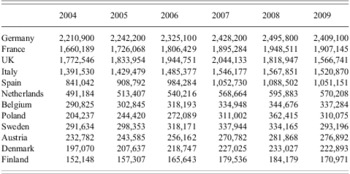
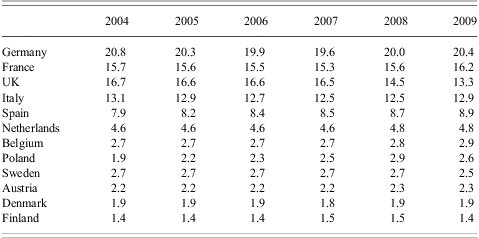
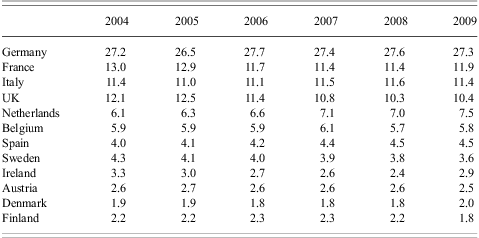
Core–periphery analysis is vital to an understanding of the European Union (EU) and regional development. The European Economic Community (EEC), which would eventually become the EU, was formed in 1957 in order to promote progressive economic integration. However, since economic growth in a capitalist market is uneven, a two-tier division within the EU eventually became evident. This is clearly demonstrated by the fact that the four richest countries in the EU together account for more than half of the EU's total GDP and exports (see Tables 2 and 3, later). All of these countries have a considerable economic impact on neighbouring European states and other parts of the world. However, they also have profound regional economic disparities. In addition, all of these countries, along with the Netherlands, Belgium and Luxembourg, are close to the centre of Europe.
Recognizing that there were depressed regions within both peripheral and core nation-states, the EC adopted a programme with the goal of bringing those regions into convergence. Its programme is essentially a liberal centre–periphery model similar to the one proposed by Friedman. Many of the nation-states within the EC also have their own regional policies and programmes regarding intervention within their own spatial boundaries. To present an approach for comparison this article will focus on two examples of regional policy: Britain's attitude toward regional development in the North and the German programme for integrating East Germany.
The definition of core–periphery relations in this article is taken from I. Wallerstein's world-systems theory. Wallerstein argues that from the sixteenth century onward there has been a gradual incorporation of the world into a European world economy with ‘a global periphery providing the basis for the growth of the core (originally Western Europe)’ (Ref. 1, p. 108). The term semi-periphery is applied to ‘a zone in which a mix of core and periphery processes are at work’ (Ref. 1, p. 113).
Core–Periphery Relations in Europe
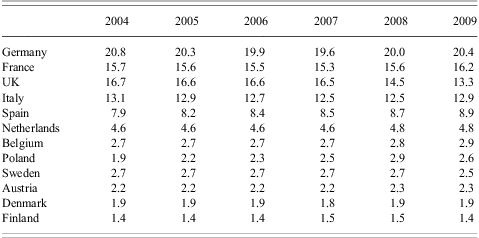
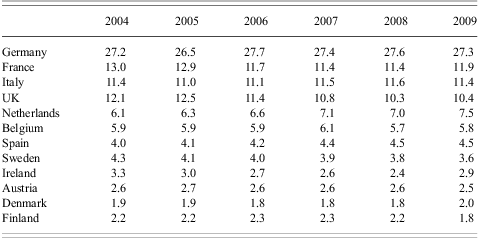
There are different definitions for ‘centre’ and ‘periphery’ in Europe, which are geographical as well as economic. If defined in terms of interdependence and flows of such things as capital, the European centre may be described as ‘an egg-shape centred on Kassel in West Germany with its long axis stretching 2700 km from Barcelona in the South-West to Helsinki in the North-East’ (Ref. 1, p. 391). This is a good model to use as it clearly shows the importance of proximity to the centre. Most of the EU's 12 biggest economies are within or partly within this core (see Table 1). More importantly, the EU's most prosperous regions are within this core. It is responsible for most of the EU's economic output (see Table 2) and most of the EU's exports (see Table 3). This area also has most of Europe's ‘World Cities,’ which Knox and AgnewReference Knox and Agnew1 define as:
dominant centres and sub-centres of transnational business, international finance, and international business services – What Friedman (1986) called the ‘basing points’ for global capital. These ‘world cities,’ it should be stressed, are not necessarily the biggest within the international system of cities in terms of population, employment or output. Rather, they are the ‘control centres’ of the world economy: places that are critical to the articulation of production and marketing under the contemporary phase of world economic development (Ref. 1, p. 47)
GDP at current prices in millions of euros

EU Member State's share of total EU GDP
EU Member States’ contribution to the extra-EU-27 trade, shares in the EU exports (%)
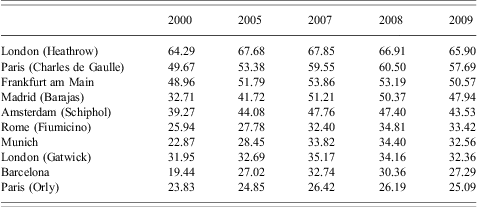
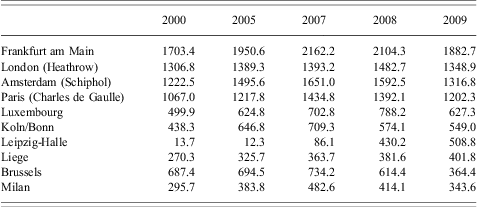
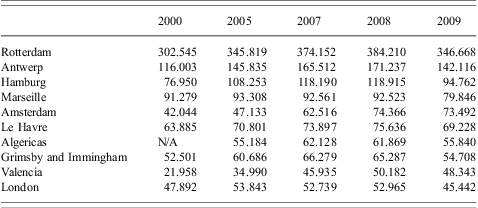
This area also has Europe's biggest airports and seaports, as can be seen in Tables 4, 5 and 6. There are a considerable number of airports outside the core that are among the ten biggest airports for passengers, but the ten biggest airports for cargo are overwhelmingly inside the core. The vast majority of Europe's ten biggest seaports are inside the core as well.
Passenger traffic at EU airports in millions of passengers
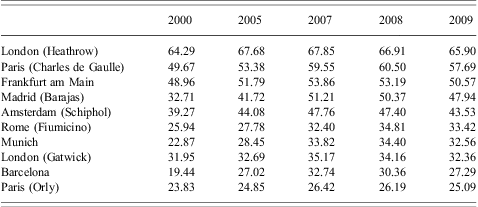
Cargo and mail loaded at EU airports in thousands of tonnes

Freight traffic at EU seaports in million tonnes loaded and unloaded

Source: Eurostat.
Whereas the geographical centre of this core is in Kassel, which is located in the north of the central German state of Hesse, the geographical centre of the entire European Union is located in Gelnhausen in the southern part of Hesse close to Frankfurt. In both cases, the centre is in the state of Hesse in central Germany.
The highest concentration of economically prosperous regions lies close to the geographical centre of Europe, while the poorest regions are on the outermost edges of the continent. ChristallerReference Christaller2 stated that distance plays a very important role. ‘The more developed an economic system is, and the more it operates by free enterprise, the more decisive is the factor of distance’ (Ref. 2, p. 22). Many of Europe's outer regions are located on islands or peninsulas, which greatly increases travel distances to and from the core.
Another advantage of the area close to the centre is that it has a higher population density than the area further away from the centre. According to Christaller:
Densely populated regions generally have a higher consumption of central goods. The fact that the people live closely together causes more frequent social contacts. Subjectively, these contacts result in higher estimation of central goods and greater consumption of them – frequently of a collectivist nature. Objectively, this greater consumption enables the denser population to establish a greater degree of labour specialisation, by which many goods, otherwise produced dispersedly, are now centrally produced. (Ref. 2, p. 33)
Densely populated areas offer bigger markets and a bigger supply of labour. These densely populated areas also tend to be centrally located and within close proximity to each other.
In most European countries, the centre of economic activity is the capital, and Britain is no exception. During the 1980s and early 1990s under then Prime Minister Margaret Thatcher, there was acceptance of uneven development; the secret of economic growth was believed to be through entrepreneurship and the encouragement of winners. Policies have favoured the south over the de-industrializing north, from education to infrastructure investment (Ref. 3, p. 355). However, this approach of going along with the market forces that helped to create the core and periphery has its dangers. In the south, for example, the housing and the labour market became ‘severely overheated’. Inflation made the south less competitive and this became a contributing factor in the recession of 1990–1992 (Ref. 3, pp. 358–359). It was during this period that the Canadian Reichman brothers faced bankruptcy due to their over-expansion in Canary Wharf in London. A laissez-faire policy has not closed the economic north–south gap. In fact, this gap has been widening. Some of Thatcher's cabinet ministers and top advisors believed the economic decline in the North was irreversible and there was no point in spending money trying to ‘make water flow uphill.’ They favoured a policy of ‘managed decline’ or ‘managed rundown’ for parts of the North, such as Liverpool. The population of Liverpool had already been declining for decades.
However, the South-East has been paying indirect subsidies to the UK's far-flung regions for years. According to the Centre for Economics and Business Research (CEBR), 20.3% of all taxes collected in London go to support government spending in the rest of the UK, while 22.2% of government spending in North-eastern England is subsidized along with 26% of government spending in Wales and 29.4% of government spending in Northern Ireland. Government spending forms a sizeable chunk of the economy for regions of the UK outside the Southeast.
The south-east corner of England is only 16% of Britain's total area but it has more than a third of Britain's population and more than half of Britain's wealth. It is the part of Britain closest to Europe's centre. It enjoys much lower unemployment and higher wages than the rest of the country. Its economic growth rate is far above the national average. Consequently, more people have been moving to the South-East from the rest of the country, stretching housing, roads, railways and utilities to the limit. For example, the population of London alone is over seven million and has been rising by an average of 90,000 a year, making it Europe's biggest city.
The UK has the largest regional differences for GDP per capita in the EU, with its richest regions having a GDP per capita more than four times as large as its poorest regions, according to Eurostat. This persistent structural weakness was clearly demonstrated by the massive impact of the recession of 2009. While most EU economies experienced a downturn during that year, the UK was the only EU country that saw its GDP shrink below 2004 levels (see Table 1). Soon afterwards, current UK Prime Minister David Cameron instituted a series of drastic budget cuts. These cuts hurt the periphery most of all, which is the most dependent on government spending (see above). The periphery is expected to take much longer to reach pre-recession economic levels.
Reunified Germany would provide an interesting case for the study of whether political intervention can help to bring the eastern peripheral region into convergence with the western core. A longitudinal study of several years would be a worthwhile project. However, this article will discuss centre–periphery relations and some of the mechanisms for convergence between the Eastern and Western regions of Germany. It will then discuss how the reunified Germany appears to be impacting on the core-periphery relations of the broader EU.
As in the UK, Germany has had deindustrialization in the North. However, it can be described as having had only a moderate imbalance among regions (Ref. 4, p. 248). It has pursued a deliberate internal policy of geographically dispersing economic and corporate power, and it is constitutionally obligated to ensure comparable living opportunities throughout the Federal Republic. Furthermore, it has a fairly balanced system of cities (Ref. 4, p. 248).
This is not entirely a function of planning: it was historically blessed by having been divided into 365 principalities until the nineteenth century, each with its own main city (Ref. 5, p. 141). So Germany has a large number of central places. This is especially true of Southern Germany, according to Christaller. He describes an extensive network of central places of a higher order with a population over 500,000 within and close to Southern Germany accompanied by an even larger number of central places of a lower order that have their own complementary regions. The size of these complementary regions is determined by the size of the central place. ‘Remembering the meaning of centrality, we find that the complementary region is that region in which an importance-deficit exists. This importance-deficit is counterbalanced by the importance-surplus of the central place. Thus the region and the central place together make an entity’ (Ref. 2, p. 22; emphasis in original). Christaller adds:
Within the economy of a people united in one state, i.e., within a concrete national economy or within one territory, the conditions under which the individual factors determine the range of a good are fairly similar and manifoldly uniform: for example, in regard to the structure of the population (similar economic conditions, standards of living, customs, and schedules of wants), the cost of the distance (equal tariffs, uniform systems of traffic), and prices, insofar as they are determined by the costs of production (which are influenced by the same system of taxes, revenues, duties, similar wages, etc.).
… Still, it should be considered that southern Germany is composed of individual states which existed for a certain time under quite differing economic conditions, e.g., during the era of mercantilism, during the decline in the unity of the Reich, and during the high points of the absolutely administered territorial states (mostly differences in customs, taxes, and subsidization of certain professions), and that each territory endeavoured at the time to develop its own fixed point – a capital – in the system of central places. These factors have indeed greatly influenced the complete concrete picture of the system of central places in southwestern and central Germany – only compare the Rhine-Main region with, say, upper Bavaria. Since the elimination of most of the independent regions in 1805 and, still more, since the creation of the Reich in 1871, the conditions have become unique. Thus we can now see how the old system of central places develops more and more in the direction of the purely rational form. (Ref. 2, pp. 123–124)
When a nation has only a few cities, and they function as highly concentrated economic centres, the core–periphery processes become more evident.
Germany's central position, its transportation networks, its river systems, as well as the fact that more Eastern Europeans speak German as a second language than any other, gives it an advantage for expanding its markets eastward into the periphery outside the EC.
Germany has the most extensive network of navigable rivers and canals in Europe (see Table 6), the longest canal being the Mittelland Canal, which connects the Rhine to the Oder on Germany's eastern frontier. Hamburg is on the Elbe, which is the Czech Republic's outlet to the North Sea. Hamburg is also near the western entrance to the Kiel Canal, which provides a well-used shortcut for ships travelling from the North Sea to the Baltic Sea. The Danube begins in Germany and flows eastward through numerous East European nations all the way to the Black Sea. And the Rhine, Europe's busiest inland waterway, flows northward from the centre of Europe past Duisburg, Europe's biggest inland port, and into the Netherlands past Rotterdam, Europe's biggest seaport. It is also connected to the Danube River by the Rhine-Main-Danube canal. The Rhine is also an important transportation corridor because heavily-used roads and railways run along its course.
In Europe, the German language is the most widely spoken as a native tongue. This is because it is spoken in Germany, Austria, and much of Switzerland, and it is also an important minority language in Poland, Italy, Romania, the Czech Republic, and Slovakia (Ref. 6, p. 89). The demand for German language instruction in Eastern Europe continues to grow, leaving providers of German language courses struggling to keep up with demand. In terms of Germany's expanding trade to the periphery this would be an advantage.
It is also important to note that if we consider second and third languages, English becomes by far the most widely spoken. It is still the preferred second language in the school systems of most European nations, which is only one of many indicators that the EU is related to a world core. Knox and AgnewReference Knox and Agnew1 state that ‘a second centre of the West European space-economy has emerged: that of the United States, which is now a major supplier of capital, technology, and consumer trends to the whole of Europe – centre and periphery’ (Ref. 1, p. 180).
However, Germany has done a fairly good job of achieving regional equilibrium within its boundaries, and it is important to the world economy that it is able to integrate its Eastern regions. WildReference Wild4 states:
If German integration properly ‘succeeds’, then it will have established a model for the positive incorporation of a former communist economy and society into the West. If it falters, however, it will not only undermine Germany's re-established ‘Mitteleuropa’ role as the geographical ‘fulcrum’ of Europe, but will also severely damage the dynamic of the whole West European economy (Ref. 4, p. 260)
In addition to an older industrial region in the North, Germany also has a newer, more buoyant, high-tech region in the Baden-Wuerttemberg region in the southwest corner of the country, close to the geographical centre of the EU. This region has the highest GDP per capita and the lowest unemployment rate in Germany. Regional government has contributed significantly to the development of new technologies in this region. For example, the ‘Land’ controls housing and by making it available to the workers encouraged skilled workers to migrate to the region (Ref. 7, p. 289). Furthermore, it has worked out contracts with Wales to encourage flows of technology and investment (Ref. 1, p. 403). Another important factor in Baden-Wuerttemberg's success is the high concentration of locally owned businesses and the high level of cooperation within its business community. It should also be noted that Baden-Wuerttemberg has a large number of excellent universities including Germany's two oldest universities, Heidelberg and Tuebingen. Another clear sign of Baden-Wuerttemberg's prosperity is the more than 50,000 people who commute to the state across the Rhine from the French region of Alsace.
In East Germany, one finds a largely rural North and a heavily industrialized South (Ref. 4, p. 256). However, East Germany also tended to reorient industrial production away from its western border and toward the frontiers of its communist neighbours as part of COMECON policy to interlock economies eastward to the Soviet core just as Czechoslovakia and Hungary had been forced to do (Ref. 4, p. 256). At the time of unification, East German industry could be described as overmanned, outdated in methods of production, and producing unmarketable products (Ref. 4, p. 252). Not surprisingly, if viewed in terms of core-periphery relations, one of the first new industrial complexes (a state-of-the-art automobile plant) was located along the Western periphery at Eisenach in Thuringia, the East German region closest to the centre of Europe. In nearby Jena, a precision optics industry, after undergoing extensive restructuring and receiving billions of euros in investment, now flourishes. In the neighbouring state of Saxony, which is the most populous state in the East, Dresden is now a major hi-tech centre and the nearby small town of Glashutte has gained international renown for its watch making industry, which was established more than 150 years ago. It had survived Communism and it now has as over a dozen companies making precision timepieces for discerning customers around the world. Leipzig-Halle international airport in the western part of Saxony has become a major hub for air cargo. This airport continued to show phenomenal growth for air cargo even as other European airports lost air cargo business during the recession of 2009 (see Table 5).
Generous investment grants from both the German government and the EU have made investment in the Eastern regions attractive. Market forces are at work as German companies recognize the locational advantages of cheaper labour and access to new markets in the periphery. For example, Volkswagen, BMW, Opel-GM, and the chemical company BASF have all developed branches in the Eastern regions. Investment from other countries has also been encouraged. The United States, Canada, Sweden, France, the Netherlands, Russia and China have all poured billions of euros into this part of the country.
The Eastern German telephone network needed to be updated to Western standards. Before reunification, telephones were a great luxury, and one often waited years for a telephone hook-up. Now Eastern Germany has the most advanced telecommunications network in the world.
Although both German and foreign investment has been significant in the Eastern regions, their peripheral status is indicated by high unemployment, low salaries and migration to the Western regions for jobs. However, the situation there has been steadily improving. The vast amount of money spent on subsidies and infrastructure improvements is finally starting to pay off. Wages and employment levels are gradually moving more in line with Western levels. As a rule, the parts of East Germany that are closer to the centre such as Thuringia, Saxony and Saxony-Anhalt are economically stronger than those further away from it, helped in part by their extensive networks of top-notch schools and universities. The poorest and most sparsely populated part of Germany remains Mecklenburg-Vorpommern in the northeast corner of the country, which is the German state that is furthest away from the centre.
Germany's industrial growth was made possible by an efficient and well-integrated transport system. To repair and update the severed connections on highways and railroads to the East has been very costly, even with EU subsidies (Ref. 4, p. 259).
Former German president Roman Herzog urged business leaders to become more willing to take risks in investing in both Eastern Germany and in Eastern Europe. He stated that ‘if we don't stabilize the East, the East will destabilize us’. Germany is the largest provider of aid in Eastern Europe and the biggest source for private investment as well. A Federal Ministry report stressed that the flow of capital Eastward would help to stabilize the region. It also stated that ‘investment in the Reformed States creates increased demand particularly for German products … and contributes to securing Germany's international competitive ability’.
In an attempt to support the Eastern German economy, 75 of Germany's 250 largest corporations had joined an organization called ‘Einkaufsoffensiv’ to pledge to buy more Eastern German goods. Since reunification, East German foreign trade has dropped off greatly and there is also a large imbalance in intra-German trade. A member of the Volkswagen supervisory board, Karl Hahn, stated that ‘the intra-German trade figures showed just how much the build-up of the new Federal States was supporting the Western German economy’.
Multinational companies scan the world for the best investment opportunities: their goal is profit and not regional equilibrium within any spatial boundary. East Germany, like the rest of Eastern Europe, has moved from a relationship with the Soviet core to one with the European core. It is going against market forces to expect multinational corporations and foreign private investment so subordinate their profit motive to the ideal of establishing equilibrium in the region.
Hamburg, which is situated near the previous Eastern border, is an illustration of a city that declined when it lost its economic dominance over part of its periphery as the result of trade routes being closed when Germany was divided. Now that the routes are open, it is showing economic growth again. It is now the most important maritime port of entry into Central and Eastern Europe. As a destination for ships as far away as China and Brazil, with well-developed rail services that reach all the way to the Urals and beyond, Hamburg is truly a ‘world city’.
Another German world city that is benefiting from the EU's eastward expansion is Frankfurt am Main, in the geographical centre of the EU. It is a major financial centre and home of the European Central Bank (ECB). Frankfurt's stock exchange is making deep inroads into Eastern Europe with NEWEX, a 50/50 joint venture with the Vienna exchange, which recently acquired the Budapest exchange. NEWEX lists numerous companies as far away as Estonia, Ukraine and Russia. Joint ventures with Moscow and Sofia, Bulgaria are also planned. Frankfurt also has Eurex, the biggest derivatives exchange in the world. Its international airport's central location and immense size make it a major destination for passenger air traffic and it is by far the biggest airport in Europe for cargo (See Tables 4 and 5).
Since reunification, the German government is now concerned about the stability of the East European nations on its restored eastern border. Concern over this is believed to be a factor in Germany advocating the admittance of Poland, the Czech Republic, Slovakia, and Hungary to the EC, which took around 10 to 15 years. Germany also advocated their admittance into NATO, which was completed much sooner. These countries had already pledged to integrate their economies with each other when they signed the Visegrad agreement in 1991. They were fortunate enough to have rich neighbours on their doorstep, such as Germany and Austria, to provide them with generous amounts of aid and investment. These countries have also received the lions’ share of all foreign investment in Eastern Europe. Yet regional disparities began to appear in this part of Europe as well. In the Czech Republic, Slovakia and Hungary, the western parts of these countries are now economically stronger than the eastern parts. An exception to this rule is Poland, where the centre of economic activity is its capital city Warsaw, in the eastern part of the country. Among the Visegrad countries, the Czech Republic, which is closest to the centre, has the largest GDP per capita and the lowest unemployment rate in Eastern Europe. In Romania and Bulgaria, which did not have rich neighbours such as Germany and did not go as far on economic reform as the Visegrad countries, there is much less investment and much less productivity. Their economies also took much longer to rebound to pre-1990 levels and still lag behind the other eastern EU states. This means more peripheral areas to be brought into equilibrium on a supranational level. The Top five investors in Eastern Europe are Germany, the United States, France, the Netherlands and Austria.
A huge part of Germany's success comes from seeking newly emerging export markets, both in Europe and overseas. Germany also has an ‘offshore industrial node’ in the city of Sao Paulo, Brazil, which has been described as ‘Germany's biggest industrial city’ (Ref. 1, p. 224). The population in its metropolitan area exceeded 20 million by the year 2000 (Ref. 8, p. 463). Volkswagen exports engines and transmissions from Sao Paulo to its German factories, and it produces a ‘developing country’ model for direct export (Ref. 8, p. 463). The city is also important to the European core because it is a leading financial centre with a big stock exchange. It is described by J. Friedman as ‘a major world city in the world economy,’ helping to link the Southern Hemisphere with its emerging economies to the core of Europe (Ref. 1, p. 48). The city and state of Sao Paulo account for almost two thirds of Brazil's industrial output, and there is a huge periphery marked by extreme inequity. From a world viewpoint, should Germany be as interested in bringing that hinterland into convergence as it is in bringing the old East Germany into equilibrium? According to Knox and Agnew (Ref. 1, p. 396) membership of the EC appears to increase the polarization of the world periphery: ‘“privileges” extended to non-members are essentially designed to enhance the position of the EC.’
The effectiveness of nation state and supranational policy regarding intervention in the development of peripheral regions has not been conclusively proved or disproved, according to Knox and Agnew (Ref. 1, p. 402). Concerning the core–periphery regional model Friedman states:
An advantaged central region invariably emerges and draws resources from the peripheral regions. Inter-regional equilibrium is seen as possible; but only if government intervenes. (Friedman, quoted in Ref. 1, p. 82)
At the same time that the EU is attempting to achieve equilibrium in its many regions, there are proposals for a more rapid integration of the core. Historically, integration in the core has been more rapid than in the periphery.
Bringing all of these regions into equilibrium is an ideal that will probably never be realized. The core tends to maintain its status over time because it offers advantages in capital, labour and markets (Ref. 1, p. 83).
As crises emerge in the peripheral regions, there is greater economic power within core regions as the periphery becomes more dependent on the core for investment, credit and economic leadership. Core regions will gain more importance at the expense of peripheral ones. As Christaller says: ‘It is interesting that the importance of central places and the sizes of their hinterlands are influenced positively by a crisis’ (Ref. 2, p. 129). According to Knox and Agnew,Reference Knox and Agnew1 regional disparities will continue to grow wider: ‘In overall terms, the removal of internal barriers to labour, capital and trade has worked to the clear disadvantage of peripheral regions and in particular to the disadvantage of those furthest from the European core that is increasingly the ‘centre of gravity’ in terms of both production and consumption. At the same time, integration has accelerated the processes of concentration and centralization, creating structural as well as spatial inequities’ (Ref. 1, p. 391).
Conclusion
Geography, infrastructure and transportation networks all play a vital role in the economic power of regions. For this reason, the majority of Europe's most prosperous regions are within its geographical core and this is expected to continue. Labour and investment continue to flow to the geographical core, and economic integration has greatly accelerated this trend. The elimination of arbitrary economic barriers between countries allows industrial concentration and economic specialization to take place in the most favourable areas irrespective of national borders. As transportation links are improved, travel times between regions become shorter, but it will always be more difficult for companies on the edge of Europe to reach the total European market than for companies in the core. As for the area outside the core, most the regions closer to the core are economically stronger than regions further away from the core.
Within the core itself, there is clear movement of production and capital towards the centre. As the geographical centres of both the core and the EU are in Hesse in central Germany, the highest concentration of economic activity is inside Germany and within close proximity to Germany. Germany itself has numerous major economic centres in various parts of the country, including Central Germany, the Middle Rhine, Baden-Wuerttemberg and Bavaria.
The vast majority of the EU's 12 richest countries are within or partly within the Core. All of these countries have a strong economic influence on countries outside the core. But with the ongoing obliteration of economic barriers between EU countries, it is far more salient to speak in terms of regions and their proximity to Europe's geographical centre. Indeed, the EU's most prosperous regions are to be found close to this centre. The EU's most important cities, airports and seaports are also located close to Europe's geographical centre.
As the boundaries of the EU move east, there has been a corresponding move of the geographical centre of the EU to the East as well, as can be seen with the rise of prosperous regions there close to the centre, but the economic centre of the EU has been moving east much more slowly because the GDP of the Western countries continues to be much higher. As trade and investment continue to flow to the East, regions on the outermost edges of Western Europe will continue to be marginalized and become increasingly more peripheral. The EU's eastward expansion has drastically transformed the economies of Germany and Austria. These countries have radically shifted their economic orientation from West to East and there is a clear movement towards a Europe that is centred on Germany both geographically and economically. This has put a lot of strain on the Paris–Berlin friendship at a time when economic turmoil in the Eurozone has made cooperation between Germany and France more important than ever.
As national borders become more irrelevant, regions within nations will grow in power and importance, especially those near the centre of Europe. The German state of Baden-Wuerttemberg, which is close to the geographical centre of Europe, is a prime example. It has its own office in Brussels and it has used its central location to full advantage by engaging in economic cooperation with nearby regions in other countries such as the French region of Alsace on the other side of the Rhine.
The overall theme of EU policy towards the reasons has been convergence, but efforts to bring peripheral regions more into line with core regions, except in Germany and the East, have for the most part been unsuccessful. The gap between poor regions and rich regions has not become any narrower. It keeps getting wider. Europe's core regions are moving closer together while its peripheral regions are moving further apart.
Bennett Thomas was born and grew up in Canada but has lived in many other parts of the world as well. He was an exchange student at the University of Tuebingen in Germany from 1991 to 1992 where he was engaged in European Studies. From 1997 to 1999 he did postgraduate studies in International Journalism at City University in London with a specialization in European Issues. He has written numerous articles on a wide range of subjects for numerous publications, including Canadian Business magazine.