Introduction
A promising new approach regarding treatment of depressive symptoms is internet-based cognitive behaviour therapy (CBT). The short-term effectiveness of this type of treatment for symptoms of depression has been proven in several studies (Christensen et al. Reference Christensen, Griffiths and Jorm2004; Andersson et al. Reference Andersson, Bergström, Holländare, Carlbring, Kaldo and Ekselius2005; Clarke et al. Reference Clarke, Eubanks, Reid, Kelleher, O'Connor, DeBarr, Lynch, Nunley and Gullion2005). We have also reported a significant effect of internet-based therapy at short-term follow-up (Spek et al. Reference Spek, Nyklíček, Smits, Cuijpers, Riper, Keyzer and Pop2007a). However, there has been very little research conducted on the long-term effects of internet-based treatments. The longest follow-up period so far reported has been 6 months (Andersson et al. Reference Andersson, Bergström, Holländare, Carlbring, Kaldo and Ekselius2005).
The current study evaluated the 1-year follow-up effects of internet-based CBT for subthreshold depression in people aged over 50 years. We compared the effect of internet-based therapy with a waiting-list condition and with group CBT.
Method
Participants
To be included in the study, participants had to meet the following criteria: an Edinburgh Depression Scale (EDS) score of 12 or more, but no DSM-IV diagnosis of depression, signed informed consent, age between 50 and 75 years, access to the internet and the ability to use the internet. Exclusion criteria were: suffering from any other psychiatric disorder in immediate need of treatment (assessed by means of an anamnesis during the interview) and suicidal ideation (assessed in the screening questionnaire and later in depth during the CIDI) (see Spek et al. Reference Spek, Nyklíček, Smits, Cuijpers, Riper, Keyzer and Pop2007a).
Measures
The EDS (Cox et al. Reference Cox, Holden and Sagovsky1987, Reference Cox, Chapman, Murray and Jones1996; Murray & Carothers, Reference Murray and Carothers1990) was used as the screening instrument in this study. For the primary outcome measure, we used the 21-item Beck Depression Inventory – second edition (BDI-II; Beck et al. Reference Beck, Steer and Brown1996). The World Health Organization CIDI (WHO, 1997) was used to assess depression in this study at inclusion.
Procedure
Participants with an EDS score of 12 or more were invited for a face-to-face clinical interview, demographic data were collected, and a structured interview was conducted to assess the DSM-IV criteria of depression. Eligible participants were randomized, and asked to fill in the BDI at home, after which the treatment started. Ten weeks after the start of treatment or after 10 weeks on the waiting-list, participants were asked to complete the post-treatment BDI (Spek et al. Reference Spek, Nyklíček, Smits, Cuijpers, Riper, Keyzer and Pop2007a). One year after the interview, participants were asked to complete another BDI.
The study protocol was approved by the Maxima Medisch Centrum (local hospital) ethics committee, which is certified by the Central Committee on Research involving Human Subjects in The Netherlands.
Interventions
The group CBT protocol was the Coping with Depression Course (Lewinsohn et al. Reference Lewinsohn, Munoz, Youngren and Zeiss1992). It has been shown to be effective (Cuijpers, Reference Cuijpers1998; Allart-Van Dam et al. Reference Allart-Van Dam, Hosman, Hoogduin and Schaap2003, Reference Allart-Van Dam, Hosman, Hoogduin and Schaap2007; Haringsma et al. Reference Haringsma, Engels, Cuijpers and Spinhoven2005) and consists of 10 weekly group sessions on psycho-education, cognitive restructuring, behaviour change, and relapse prevention. The internet-based CBT is an intervention of eight modules. It was studied as a self-help intervention, and no professional support was offered to the participants of this study. The intervention was found to be effective at post-treatment (Spek et al. Reference Spek, Nyklíček, Smits, Cuijpers, Riper, Keyzer and Pop2007a).
Analyses
The target sample size of 300 participants was calculated to yield 78% power to detect a small effect (Cohen's f=0.10). The study was a priori powered to detect a small effect because we wanted to test whether there was a difference between the two interventions. The calculation was based on an ANOVA with an α of 0.05 (Cohen, Reference Cohen1988).
Preliminary analyses included checks for normality and the computation of descriptive statistics. All variables were distributed acceptably close to normal. ANOVAs, t tests and χ2 tests were used to compare people who completed all questionnaires versus non-completers on baseline characteristics.
Analyses regarding the main hypotheses were performed according to the intention-to-treat approach. Missing data were imputed using the multiple imputation procedure of data augmentation in norm (Schafer, Reference Schafer1999), as explained in our previous paper (Spek et al. Reference Spek, Nyklíček, Smits, Cuijpers, Riper, Keyzer and Pop2007a).
The effects of the interventions were tested by means of contrasts. We calculated improvement effect sizes (d impr) by dividing the absolute difference between the post-treatment average score (meanpost) and the pretreatment average score (meanpre) by the pretreatment standard deviation (s.d.pre). An effect size of 0.5 thus indicates that the post-treatment average score is half a standard deviation (of the prescore) larger than the pretreatment average score. For between-group effect sizes, we calculated effect sizes by subtracting the effect size of the experimental group from the effect size of the control group.
We did not conduct the CIDI at the end of the trial. However, we wanted to estimate in how many participants a major depression might have been averted. For this, we used a cut-off score of 13 on the BDI. Scores above 13 can be interpreted as referring to subthreshold depression (see Van der Does, Reference Van der Does2002). For our estimation of averted (subthreshold) depressions, we calculated numbers needed to treat.
Results
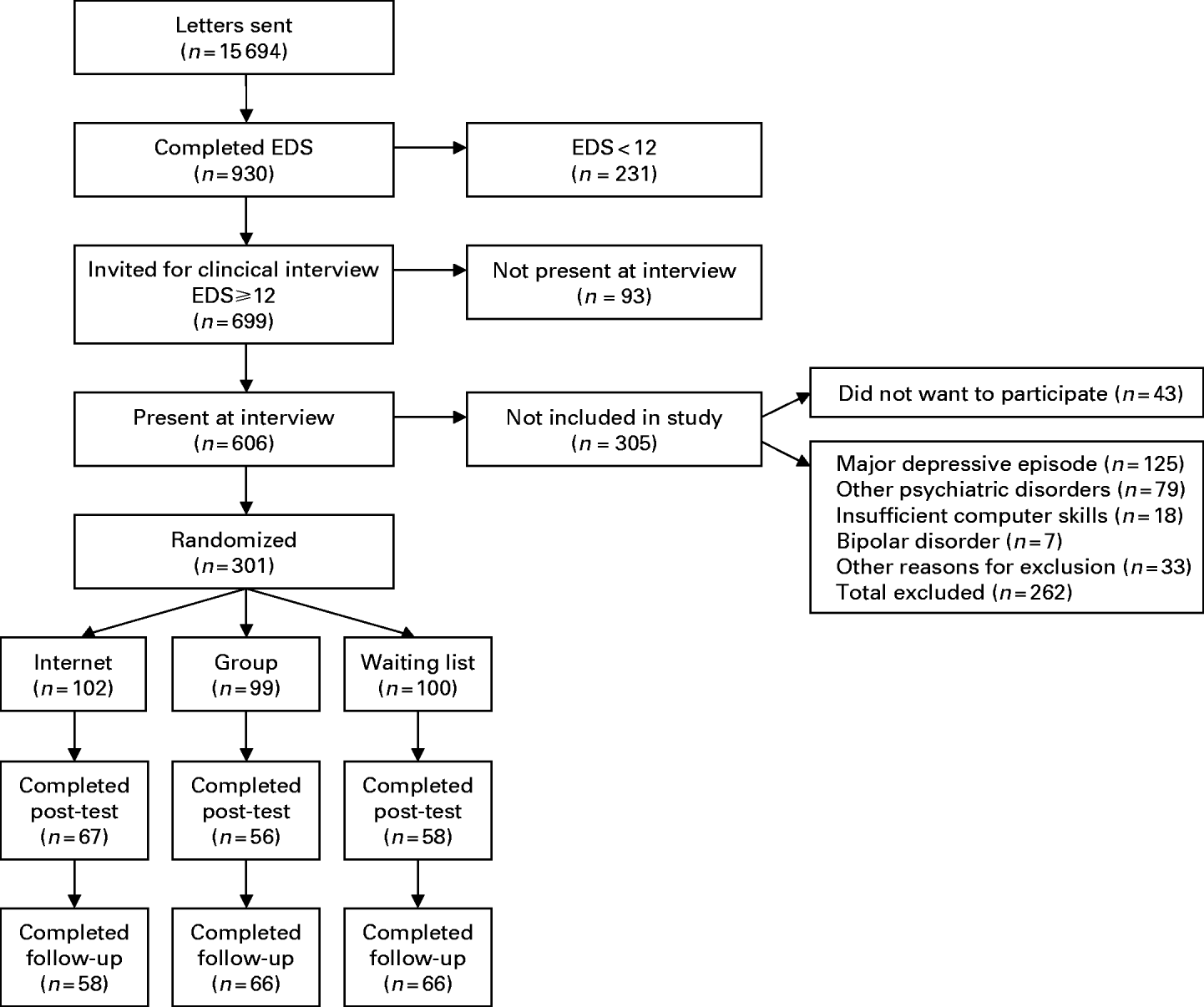
Follow-up measures at 12 months were completed by 58 of 102 participants (57%) in the internet group, 66 of 99 participants (67%) in the group course condition and 66 of 100 participants (66%) on the waiting-list (see Fig. 1). The number of participants who provided follow-up data was larger than the number of participants who provided post-treatment data because at 1-year follow-up there was a larger time window in which questionnaires could be returned. Intention-to-treat analyses were performed on imputed data of all 301 participants.
Flow chart of participants.

At post-treatment, we found that a mean of 98.3% of treatment sessions was completed in the group course and a mean of 78.1% of the modules was completed in the internet-based intervention. Group treatment was completed by 94.5% of the participants; the internet course was completed by 48.3% of the participants. We did not find a dose–effect relationship in the internet-based treatment condition. It is unclear if internet-based treatment participants repeated or continued treatment after the post-treatment assessment. They still had access to the intervention. However, participants in group treatment received a treatment manual that they could continue to use after the end of treatment.
Participants who did not complete follow-up measures did not differ from participants who did complete follow-up measures regarding age, gender, having a partner, educational level, employment status, assigned condition, EDS scores at screening, and BDI baseline scores (Spek et al. Reference Spek, Nyklíček, Smits, Cuijpers, Riper, Keyzer and Pop2007a, Table 1).
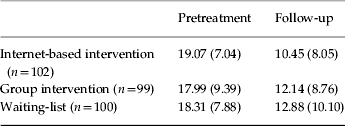
Means (standard deviations) for depressive symptoms according to the Beck Depression Inventory (BDI)

For the intention-to-treat analyses, we fitted contrasts to the imputed data to test the hypotheses about the differences between conditions. The first contrast was designed to test whether internet-based treatment differed from the waiting-list control group. The second contrast was designed to test whether the internet-based treatment and the group CBT were different from each other. The first fitted contrast showed a significant difference between the internet-based treatment and the waiting list condition (p=0.03). We found no difference in effects of internet-based CBT and group CBT (p=0.08). For means and standard deviations of all conditions, see Table 1.
For improvement within the waiting-list control group, we found a large improvement effect size of 0.69. The group CBT condition also had a large improvement effect size (0.62), while an even larger improvement effect size of 1.22 was found within the internet-based treatment condition. When comparing the group treatment with the waiting-list group, we found an effect size of −0.07. For internet-based treatment compared with the waiting-list, we found an effect size of 0.53.
Using the cut-off score of 13 on the BDI, we found that 62% of participants in the internet-based treatment scored below 13 at follow-up, which was 45% for group treatment, and 38% for the control condition. For the internet-based treatment, we found a risk difference of 0.62−0.38=0.26. If we use this risk difference to calculate the number needed to treat, we find that 1/0.26=3.85 people have to be treated for one averted case of (subthreshold) depression. For group treatment, the risk difference is 0.62−0.55=0.07. Calculating the number needed to treat, we find that 1/0.07=14.29 people have to be treated for one averted case of (subthreshold) depression.
Finally, analysis of only complete cases (instead of imputation techniques) showed almost the same results as analyses on imputed data: internet-based treatment differed significantly from the waiting-list condition (p=0.04) but did not differ significantly from group treatment (p=0.13).
Discussion
In this study, 1 year after the start of treatment, internet-based CBT was significantly more effective than a waiting-list condition in people over 50 years of age with subthreshold depression. There was a non-significant trend towards better outcomes for the internet intervention compared to the group treatment.
One year after the start of treatment, we found a moderate effect size of 0.53 for the internet-based CBT compared to the waiting-list condition. The improvement in effect size of 1.22 we found for internet-based CBT roughly corresponds with a 6-month improvement effect size of 1.03 found in the study by Andersson et al. (Reference Andersson, Bergström, Holländare, Carlbring, Kaldo and Ekselius2005).
For group CBT we found an improvement effect size of 0.62, which does not correspond with the 1-year improvement effect size of 0.78 of the same intervention found in an earlier study (Allart-Van Dam et al. Reference Allart-Van Dam, Hosman, Hoogduin and Schaap2007). This might be because our participants preferred to be treated with an internet-based intervention. As only people with access to the internet were eligible for inclusion, many participants expected to participate in the internet-based treatment; some of those who were randomized to the group intervention were disappointed not to be treated by the internet-based treatment.
In this study we were faced with a large amount of missing data: 37% of our participants did not provide follow-up data. This is a common problem even in short-term trials on internet-based treatment for symptoms of depression, as was shown in a recent meta-analysis (Spek et al. Reference Spek, Cuijpers, Nyklíček, Riper, Keyzer and Pop2007b). We dealt with missing values through the application of data augmentation; more information about this procedure can be found in Spek et al. (Reference Spek, Nyklíček, Smits, Cuijpers, Riper, Keyzer and Pop2007a). This technique is regarded as the most conscientious and conservative way to handle missing data.
Apart from the above-mentioned drop-out, this study has several other limitations. Participants could only be included in the study if they had computer skills and access to internet. The participants in this study were more highly educated than the general population in this age group (Statistics Netherlands, 2005). Therefore, it is uncertain whether the results of this study can be generalized to the general population. In addition, as our participants suffered from subthreshold depression, we cannot draw any conclusions about the long-term effects of internet-based CBT on major depressive episodes.
Despite these limitations, our findings suggest that people over 50 years old with subthreshold depression can continue to benefit from internet-based CBT 1 year after the start of treatment. This is an important finding, especially when looking at the current problems we are faced with regarding the treatment of depression. A large number of people suffer from depression and subthreshold depression. With the current capacity and treatments, only 16% of the burden of depression is averted (Andrews et al. Reference Andrews, Issakidis, Sanderson, Corry and Lapsley2004). If, within our current capacity to offer treatment, we only provided evidence-based treatments, we would be able to avert 23% of the burden (Andrews et al. Reference Andrews, Issakidis, Sanderson, Corry and Lapsley2004). Even if we could treat everyone who is suffering from (subthreshold) depression, we could still only avert 34% of the burden of depression (Andrews et al. Reference Andrews, Issakidis, Sanderson, Corry and Lapsley2004). Internet-based treatment for subthreshold depression has three important assets regarding these problems: (1) internet-based treatment is an evidence-based treatment, even 1 year after the start of treatment, (2) internet-based treatment can be used by any number of people, thereby helping us to reach as many people as possible, and (3) it is a treatment that can prevent the occurrence of new depressive episodes.
Acknowledgements
This study was supported by a grant from ZON-MW, The Netherlands Organization for Health Research and Development.
Declaration of Interest
None.