1 The ‘Celtic hypothesis’ and Standard Average European
The ‘Celtic hypothesis’ argues for a significant and formative linguistic influence of Insular Celtic, or more specifically of either its Brythonic branch or of (proto-)Welsh, on Standard English (SE). One of the central questions here relates to the arguments in favor of, and ultimately to the proof for, the assumed effects of such linguistic influence(s). In contact linguistics generally, various criteria have been suggested for interference arising from contact (see, for example, Thomason Reference Thomason2001: 93–4), and these can profitably be applied to the specific Celtic−English interface. However, a further subset of criteria might be developed by drawing on the concept of Standard Average European (SAE), and in my contribution I will attempt to assess some of its potential methodological implications and repercussions.Footnote 1
SAE is said to be ‘a linguistic area (or Sprachbund) in Europe that comprises the Romance, Germanic and Balto-Slavic languages, the Balkan languages, and more marginally also the westernmost Finno-Ugrian languages’ (Haspelmath Reference Haspelmath and Haspelmath2001: 1492).Footnote 2 Relevant in our context are two observations: the (modern) Celtic languages are generally agreed not to belong to SAE,Footnote 3 and English is thought to have only a ‘somewhat marginal status among its European sister languages’: ‘England stands somewhat apart from the European nucleus . . . although it is closely related genealogically to German and has been thoroughly influenced by French’ (Haspelmath Reference Haspelmath and Haspelmath2001: 1505).Footnote 4 Haspelmath (Reference Haspelmath and Haspelmath2001) uses nine features to define a language's attraction to SAE, namely definite and indefinite articles, relative clauses with relative pronouns, ‘have’-perfect, participial passive, dative external possessors, negative pronouns and lack of verbal negation, relative-based equative constructions, subject person affixes as strict agreement markers, and intensifier−reflexive differentiation. On the basis of the attestation of these features in the languages of his corpus, he argues that
[t]he languages in the nucleus (French and German) show the SAE value in all nine of these features. The languages in the next layer (Dutch, other Romance, Albanian) show eight features, the next layer (English, Greek, Romanian) show seven features, and so on. (Haspelmath Reference Haspelmath and Haspelmath2001: 1505)
Czech and the North Germanic languages Icelandic, Norwegian, and Swedish belong to the next layer in Haspelmath's scheme, having the SAE value in six features; Breton has two, Welsh one, and Irish none of his SAE features (Haspelmath Reference Haspelmath and Haspelmath2001: 1505). Note that Heine & Kuteva (Reference Heine and Kuteva2006: 25) accept all languages with five or more of Haspelmath's SAE features as belonging to SAE.
I suggest that the methodological importance of SAE for an assessment of the Celtic hypothesis concerns the question of the existence of linguistic features shared by both SE and Insular Celtic against SAE. In other words: if SE can be shown to be different from SAE, and particularly with regard to SAE features attested in other Germanic languages, it might be indicative if these non-SAE features of SE were also found in Insular Celtic languages. The ‘somewhat marginal status [of English] among its European sister languages’ noticed by Haspelmath could arguably be related to contacts with Insular Celtic, and non-SAE features shared by Insular Celtic and SE could consequently be interpreted as methodological support for the Celtic hypothesis.
The two features in which SE deviates from SAE, according to Haspelmath's criteria, are dative external possessors and intensifier−reflexive differentiation, and it is striking that in both cases SE and Insular Celtic agree against the SAE pattern.
2 Dative external possessors
The dative external possessor, in which a dative NP expresses the affected possessor, as in (1), is typical for SAE. Insular Celtic and SE share the NP-internal expression of the affected possessor, as in (2/3), and it is therefore no surprise that previous discussions of the Celtic hypothesis adduced this feature as a strong argument in its favor.Footnote 5
(1)

‘The queen cut off the king's head.’
(2)
(3)
‘The queen cut off the king's head.’
(4)
‘The queen cut off the king's head.’

3 Intensifier−reflexive differentiation
A differentiation of reflexive pronouns and intensifiers, as in (5a), is said to be typical for SAE,Footnote 6 but in SE and Insular Celtic these are not differentiated, except for the preceding pronominal foci, as is seen in (6/7) and in the English translations of (5a).
- (5)
(a)
‘He keeps talking to himself.‘
(b)
‘The president will himself deal with the matter.’
- (6)
(a)
‘He keeps talking to himself.’
(b)
‘The president will himself deal with this matter.’
- (7)
(a)
‘He is talking to himself.’
(b)
‘The president will himself deal with the matter.’
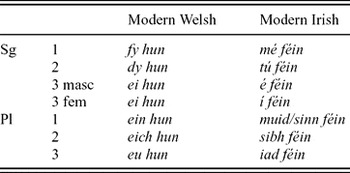
Footnote 7Footnote 8Footnote 9Footnote 9Footnote 11Footnote 12 The forms of intensifiers and reflexives in Welsh and Irish thus consist of a pronominal focus plus hun in Welsh or féin in Irish, as seen in table 1 (see Thomas Reference Thomas1996: 268; Bammesberger Reference Bammesberger1983: 54–6). The pronominal focus in Welsh is a possessive pronoun, whereas in Irish it is a personal pronoun.
Intensifiers and reflexives in Welsh and Irish

Within the family of modern Germanic languages, intensifiers and reflexives are identical only in English and completely unrelated only in German and Yiddish, whereas in the majority of these languages ‘intensifiers form part of the reflexive markers’ (Gast Reference Gast2006: 2).Footnote 14 The rise of the reflexive based on the intensifier is a development within the history of English and related to the loss of the Germanic s-reflexives, ‘a development common to all of the Ingvaeonic, or North Sea Coast, group of West GMC [Germanic] (Old FR[isian], O[ld] E[nglish] and O[ld] S[axon]), where the GMC s-reflexives were given up, and reflexivity was expressed by ordinary personal pronouns’ (Harbert Reference Harbert2007: 179).Footnote 15 But, as pointed out by König & Siemund (Reference König, Haspelmath and Reiter2000: 66–7, 78), the identity seen in English is not a necessary consequence of this loss, since AfrikaansFootnote 16 has developed a new reflexive on the basis of the intensifier without replacing the original intensifier. The direction of this development is by no means rare either: ‘[r]eflexive markers are identical to intensifiers in a wide variety of languages and often develop from intensifiers’ (König & Gast Reference König and Gast2007: 159). König & Gast also provide the following outline of the history of the English reflexives:Footnote 17
After the loss of the counterpart of German [reflexive] sich in Old English, reflexive markers were ‘re-created’ by combining object or possessive forms of personal pronouns with the intensifier -self (him + self > himself). The first contexts to be affected by this process were sentences with verbs denoting stereotypically ‘other-directed situations’ or actions such as give, help, kill, poison, etc., i.e., verbs where the referential identity between subject and an object was highly remarkable . . . The resultant self-forms were originally emphatic expressions for asserting co-reference in unexpected contexts and have preserved some of that quality to this day. Since this system had not become firmly established until Early Modern English it should not come as a surprise that the relatively young reflexive pronouns have not been grammaticalized to the same extent as the reflexive pronouns in German or Romance languages. (König & Gast Reference König and Gast2007: 158–9)
One of the unsolved puzzles of this development is the ‘completely open question why the new complex reflexive pronoun x-self superseded the monomorphemic intensifier self’ (König & Siemund Reference König and Siemund2000: 78).Footnote 18 Another unresolved controversy, according to König & Siemund, concerns the origin of the so-called nominal series of reflexives, i.e. myself, yourself, ourselves, yourselves, herself, and the explicative power of ‘a phonological explanation (i.e. vowel reduction in unstressed syllables) and one based on syntactic criteria, namely the fusion of a possessive pronoun and a nominal self-expression’ (König & Siemund Reference König and Siemund2000: 46) respectively. It may be relevant, however, that a variety of case forms was available in Old English, since the ‘combination personal pronoun + self can of course (like the personal pronoun alone) be used reflexively in the accusative [. . . hine selfne . . .], the genitive [. . . his sylfes . . .], and the dative [. . . him sylfum . . .]’ (Mitchell Reference Mitchell1985: 116).Footnote 19 Linguistic contact and transfer has been proposed as a possible motivation for the rise of the English complex reflexives themselves, and König & Siemund (Reference König, Haspelmath and Reiter2000: 70–1) draw attention to the suggestion that the model of the French type as seen in lui-même may have been responsible, as well as to the refutation of this argument on the basis that ‘complex intensifiers also occur in documents for which the assumption of French influence is highly unlikely’. Borrowing of such forms, in order to fill a functional gap left by the loss of the Germanic s-reflexives in Ingvaeonic, has been suggested for the new Dutch third-person reflexives (zich, zichself) which are said to have been borrowed from Middle Low German, which got them in turn from High German (Harbert Reference Harbert2007: 179).
As argued in detail by Parina (Reference Parina and Birkhan2007), Middle Welsh employs identical forms for intensifiers and reflexives, as do the other two Brythonic languages, Middle Breton and Middle Cornish.Footnote 20 The Middle Welsh complex reflexives and intensifiers consist typically of an anaphoric possessive pronoun + hun or sg hunan/pl hunein, although there are a few instances of personal pronouns, instead of possessive pronouns (Parina Reference Parina and Birkhan2007: 393), and the possessive pronouns ultimately ousted the personal pronouns. In Middle Welsh, the same complex forms may be employed for the attributive intensifier as well, whereas English and German use different words, own and eigen respectively, as seen in (8) and its English and German translations (Parina Reference Parina and Birkhan2007: 392–3):
(8)
‘your own stupidity’
‘deine eigene Tumbheit’
With regard to the functional domains of these forms in Middle Welsh, Parina (Reference Parina and Birkhan2007: 392) suggests that intensification is their core function, also reflected in the higher frequency of intensifying semantics in the corpus analyzed by her. Examples of adnominal and adverbial uses are given as (9) and (10), following Parina (Reference Parina and Birkhan2007: 392):
(9)
‘Gwydion himself attended to him.’
(10)
‘if I cannot myself obtain the kingship . . .’
The emergence of the English system of identity of intensifiers and reflexives has found divergent explanations, and the Celtic hypothesis has played a significant role here: Tristram (Reference Tristram1999: 24) argues for Insular Celtic, and in particular Early Welsh, influence on the English system of complex reflexive anaphors, and she considers the similarities between the two systems to be one of the symptoms of the ‘significant typological disruption which affected both Anglo-Saxon and Brythonic when they came into contact’ (Tristram Reference Tristram1999: 19).Footnote 21 Vezzosi follows a similar line of argument, but with greater focus on intensification as the functional feature shared by the Middle Welsh and Middle English constructions respectively:Footnote 22
Given the typological markedness of the feature under investigation, and the close formal and functional similarity between M[iddle]E[nglish] himself and [Middle]W[elsh] e hun ‘himself’ and given the contact history of English and Celtic, I put forward a tempting and hazardous hypothesis that the ME self-form grammaticalized under the strong substratal influence of Insular Celtic. Accordingly, the univerbation process first affected the intensifier in the exclusive use (and then adnominal use), following the pattern of the MW intensifier (possessive + ‘one’). Such self-forms were then used in (other-directed) situations where disambiguation was necessary and in those syntactic contexts favouring the occurrence of the intensifier (much like the MW e hun). Only later did they start to be simply used as co-reference marker. (Vezzosi Reference Vezzosi, Ritt and Schendl2005: 240)
Lange (Reference Lange2007: 186) gives the Celtic hypothesis some cautious and qualified support, and her findings that ‘intensifying X-SELF became obligatory [in Middle English] much earlier than reflexive X-SELF’ (Lange Reference Lange2007: 179) will certainly be relevant for further comparative work.
The formal similarities between the complex intensifiers and reflexives of both Brythonic and SE are certainly striking, as are the comcomitant typological differences between SE and other West Germanic languages, particularly German – reflected in the isolated position of SE within SAE – and the typological similarities between SE and Brythonic. If one wants to argue for a Brythonic influence on SE, the test case of Frisian is methodologically crucial, since Frisian also lost the original Germanic s-reflexives. It is therefore appropriate to quote in some detail Harbert's summary of the Frisian developments:
FR[isian] appears to have undergone (or is undergoing) a development similar to that of EN[glish]. Reflexives are often still not distinguished (in any person) from the corresponding nonreflexive personal pronoun [for example har ‘her(self)’ . . .]. However, FR[isian] also has a morpheme sels, which as a free morpheme is used to emphasize an associated NP (corresponding to EN[glish] emphatic himself. . . Moreover, har and harsels in reflexive use stand in partially complementary distribution, some contexts allowing only one and others allowing only the other. . ., leading Everaert [Reference Everaert, Koster and Reuland1991] to claim that forms like harsels represent an independent paradigm of reflexive forms . . . Therefore, it appears that all of the GMC languages which participated in the original Ingvaeonic reflexive loss have reconstituted their reflexive paradigms, in various ways. (Harbert Reference Harbert2007: 180)
The new reflexives of SE and Frisian are similar, but not identical, because of the similarities of the linguistic material available in the West Germanic languages to express the required meanings. In my view, it is therefore difficult to argue with any certainty either that the emergence of the new complex reflexives in SE can only be explained in purely language-internal terms or that borrowing from Brythonic/Brythonic influence was the only decisive, or at least one contributing, factor for their emergence. As so often in the case of the Celtic hypothesis, it is perhaps best to postpone final judgement until more data – particularly from other linguistic subsystems in which Insular Celtic and SE would appear to agree against SAE – has been systematically scanned and analyzed, but the hypothesis of linguistic contact, and of linguistic change resulting from it, as suggested by Tristram (Reference Tristram1999), Vezzosi (Reference Vezzosi, Ritt and Schendl2005) and Lange (Reference Lange2007) with different degrees of confidence, remains an attractive option.
4 Inchoative/causative alternation of verbs
I will now turn to another area of typological similarity between SE and Insular Celtic/Brythonic, which has apparently remained unnoticed so far and which is probably closely related to the forms and functions of reflexives in these languages, namely the inchoative/causative alternation of verbs. This phenomenon has been discussed as an areal feature so far only with reference to SAE,Footnote 23 and the deviant behavior of English within Europe, and arguably within SAE, has already been noted (Haspelmath Reference Haspelmath, Comrie and Polinsky1993: 102). According to Haspelmath, this inchoative/causative alternation of verbs is realized in
a pair of verbs which express the same basic situation (generally a change of state, more rarely a going-on) and differs only in that the causative verb meaning [as in 11] includes an agent participant who causes the situation, whereas the inchoative verb meaning [as in 12] excludes a causing agent and presents the situation as occurring spontaneously. (Haspelmath Reference Haspelmath, Comrie and Polinsky1993: 90)
(11)
(12)
Haspelmath (Reference Haspelmath, Comrie and Polinsky1993: 91) distinguishes between three different formal relations of the causative and the inchoative verb respectively: the causative alternation, in which ‘the inchoative verb is basic and the causative verb is derived’, as in (13), the anticausative alternation, in which ‘the causative verb is basic and the inchoative verb is derived’, as in (14), and the nondirected alternation, in which ‘neither the inchoative nor the causative verb is derived from the other’.
(13)
(14)
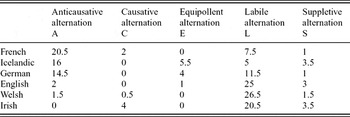
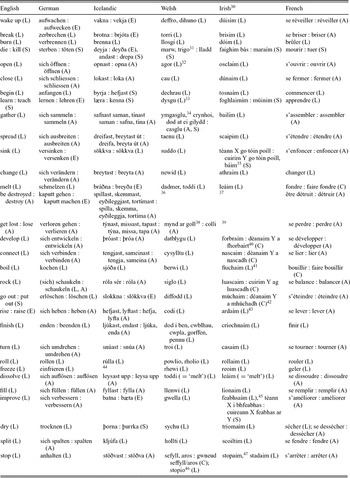
In the nondirected alternation, the relevant subtype for our purposes is the ‘labile alternation’, in which ‘the same verb is used in both the inchoative and in the causative sense’ (Haspelmath Reference Haspelmath, Comrie and Polinsky1993: 92). In an areal perspective, ‘anticausative-prominence is a characteristic feature of SAE’ (Haspelmath Reference Haspelmath and Haspelmath2001: 1497),Footnote 24 and the ‘overwhelming preference for labile verbs in English is [therefore] quite unique’ (Haspelmath Reference Haspelmath, Comrie and Polinsky1993: 102). The only other European languages with a significant but considerably lower incidence of labile verbs are German (L = 11.5) and Greek (L = 16.5). Unfortunately Haspelmath does not supply data for North Germanic languages. Table 2 gives the distribution of the different types of alternations in Haspelmath's sample of thirty-one verb-pairs for English, German, and French, supplemented by the results of my analysis of the relevant pairs in Icelandic, Welsh, and Irish.Footnote 25
Survey of inchoative/causative alternations

Table 2 shows that within this language sample the decline in the number of anticausative alternations correlates with a rise in the number of labile alternations. SE and Welsh have the highest number of labile alternations, and Irish has a significant high number of labile alternations as well.Footnote 28
Regrettably these findings do not provide independent evidence for the effects of linguistic contact between Insular Celtic/Brythonic and SE, and thus for the Celtic hypothesis, since König & Siemund (Reference König, Haspelmath and Reiter2000: 63–5) formulate the general hypothesis that reflexive pronouns cannot be employed in extended, nonreferential uses, for example in anticausative/ergative and middle/facilitative constructions,Footnote 29 in languages that use the same expression for intensifiers and reflexive anaphors:
If a language uses the same expression for intensifiers and reflexive anaphors, it manifests none of the extended uses of reflexive pronouns as markers of derived intransitivity. (König & Siemund Reference König and Siemund2000: 65)
The typological difference seen here between SE on the one side and many West Germanic languages and SAE respectively on the other is due to the loss of Germanic s-reflexives in the prehistory of English and to the rise in English of a new complex reflexive on the basis of the intensifier, and the formal attraction of the two categories. On the basis of the generalization suggested by König & Siemund, anticausatives with a reflexive in extended use, as in German sich heben, versus heben, and Icelandic mediopassives hefjast, lyftast, versus hefja, lyfta, are ruled out in SE, as they are in Welsh and Irish. The concomitant typological similarities between Welsh, Irish, and SE with regard to the incidence of labile verbs is therefore a typological reflex of earlier developments, related to the emergence of new complex reflexives in SE. As suggested above, it is this new system only which is arguably susceptible to an explanation in terms of the Celtic hypothesis.
5 Some methodological conclusions
Methodological lessons for the assessment of the Celtic hypothesis to be learnt from the above discussion concern the necessity to pay due attention, first, to the implicational relations between linguistic developments and, second, to the evidence for the status of linguistic developments within (West) Germanic that one wants to attribute to linguistic contact. My two test cases, the identity of intensifiers and reflexives and the high frequency of labile verbs in Insular Celtic and SE against SAE, which I had originally thought to be unrelated phenomena, turned out to be typologically related, and they therefore do not provide independent evidence for an influence of Insular Celtic on SE. The striking and unusually high incidence in SE of labile verbs (from the perspective of SAE) is a result of the emergence of a new system of reflexives in English on the basis of, and ultimately identical to, intensifiers. Frisian would appear to occupy a crucial position for assessing the factors which contributed to this development, and thus the balance between explanations resorting to language-internal causes or to linguistic contact. However, the hypothesis that linguistic contacts between Celtic/Welsh and English played some role in the emergence of a new system of English reflexives, as suggested by Tristram (Reference Tristram1999), Vezzosi (Reference Vezzosi, Ritt and Schendl2005), and Lange (Reference Lange2007) with different degrees of confidence, remains an attractive option. The restructuring of the system of reflexives would have brought about the rise of labile verbs.
It should be obvious methodologically that one or two linguistic features that could be explained in terms of the Celtic hypothesis with some certainty will not be sufficient to prove this hypothesis, but that a greater number of features explicable in these terms are required. SAE could provide a useful yardstick here and my article set out to explore its methodological potential. The comparison of linguistic features of Insular Celtic languages, of SE, and of SAE will provide helpful and productive insights into the interface between English and the Celtic languages and thus further arguments for the evaluation of the Celtic hypothesis.
Haspelmath's catalogue of inchoative/causative alternation in English, German, and French, supplemented by relevant examples from Icelandic, Welsh, and Irish

30 Irish verbal forms are given in the first-person singular present, except where ‘X’ denotes the presence of a nominal subject, in which case the verbal form is third-person singular present; ‘Y’ denotes the object.
31 The finite forms of marw are formed with bod ‘to be’ plus marw, e.g. mae wedi marw ‘has died’; trigo is used of animals.
32 Intransitive anticausative ymagor is confined to poetic style.
33 Gwenllian Awbery informs me that in the context of educational bureaucracy a distinction is now drawn, probably in order to match the distinction between ‘teach’ and ‘learn’ in English: dysgu ‘to learn’ versus causative addysgu ‘to teach’.
34 Ymgasglu is used with human subjects.
35 Báim lit. ‘to drown’, intransitive ‘sink’ can be expressed with a passive form.
36 Distrywio, dinistrio are transitive verbs, ‘to be destroyed’ is expressed with passive/impersonal forms or analytic passive circumlocutions.
37 Scriosaim is a transitive verb, ‘to be destroyed’ is expressed with a passive form, present tense scriostar.
38 ‘Get lost’ can also be expressed with passive/impersonal forms of colli and by analytic passive circumlocutions with this verb; these uses imply that someone was responsible for the loss.
39 Caillim is a transitive verb, ‘to be lost’ is expressed with a passive form, present tense cailltear.
40 Other analytic idioms with the noun forbairt ‘development’ are also available, e.g. déanaim forbairt ar Y, lit. ‘I do development on Y’.
41 A transitive analytic idiom cuirim Y ag fiuchadh, lit. ‘I put Y at boiling’, is also available.
42 Other analytic idioms are also available, e.g. intransitive imíonn X as, lit. ‘X goes out’, versus transitive cuirim Y as, lit. ‘I put Y out’.
43 Other analytic idioms with the noun airde ‘height’ are also available, e.g., téann X in airde ‘X goes up’ versus cuirim Y in airde ‘I put Y up’.
44 Only intransitive frjósa, transitive meaning is expressed by analytic circumlocutions.
45 Other analytic idioms with the noun feabhas ‘improvement’ are also available, e.g. téann X i bhfeabhas ‘X improves’ versus cuirim feabhas ar Y ‘I improve Y’.
46 Loanword from English.
47 Loanword from English with labile semantics.