Implications
Among important disturbances, such as decreased athletic ability, orthopaedic disorders and poor thermo-regulation, obesity can lead to other health issues including insulin resistance and Equine Metabolic Syndrome, both of which can lead to laminitis. Andalusian horses are considered an easy keeper breed, and their tendency towards obesity together with their characteristic phenotype, make it necessary to propose objective measurements to accurately assess the deposition of adipose tissue beyond the subjective scoring systems. Our results show that fat deposition patterns and body shape according to gender and age, influence the direct comparison among the several morphometric measurements created.
Introduction
Obesity is an emergent problem in domestic horses and pony populations that has health and welfare implications (Giles et al., Reference Giles, Rands, Nicol and Harris2014). In large-scale human populations, anthropometric approaches based on simple clinical measures have been applied to indirectly estimate the body fat content and have demonstrated its usefulness in the prediction of obesity-related metabolic risk (Bosy-Westphal et al., Reference Bosy-Westphal, Geisler, Onur, Korth, Selberg, Schrezenmeir and Müller2006). In the case of equids, there is no consensual definition of obesity and the most widely used indexes for evaluation and categorization of being obese or overweight are the body condition scoring systems (Henneke et al., Reference Henneke, Potter, Kreider and Yeates1983; Carroll and Huntington, Reference Carroll and Huntington1988). However, these methods may be less sensitive to detect variations in body fat distribution (e.g. regional adiposity), observe variations in adiposity over time and also it has been reported that owners cannot accurately estimate the body condition of their horses using these systems (Wyse et al., Reference Wyse, McNie, Tannahill, Murray and Love2008; Mottet et al., Reference Mottet, Onan and Hiney2009; Thatcher et al., Reference Thatcher, Pleasant, Geor and Elvinger2012). On the other hand, some studies have demonstrated the clinical applicability of morphometric measurements to estimate adiposity in horses (Frank et al., Reference Frank, Elliott, Brandt and Keisler2006; Carter et al., Reference Carter, Geor, Staniar, Cubitt and Harris2009a; Dugdale et al., Reference Dugdale, Curtis, Cripps, Harris, Argo and Argo2010) and distinct advantages over subjective evaluation scores. They provide objectivity, do not need previously trained examiners and are able to detect small variations in body condition (Dugdale et al., Reference Dugdale, Curtis, Cripps, Harris and Argo2011b) allowing a precise quantification when corrections in nutritional management are applied to horses (Dugdale et al., Reference Dugdale, Curtis, Cripps, Harris, Argo and Argo2010; Argo et al., Reference Argo, Curtis, Grove-White, Dugdale, Barfoot and Harris2012). Similarly to what happens in human medicine, in horses with laminitis, some morphometric measurements have been used as prognostic indicators (Carter et al., Reference Carter, Treiber, Geor, Douglass and Harris2009b) due to their proven relationship with metabolic derangements (Frank et al., Reference Frank, Elliott, Brandt and Keisler2006; Carter et al., Reference Carter, Treiber, Geor, Douglass and Harris2009b). Morphometric measurements may not reflect the same degree of adiposity due to differences in breed-type morphology (Brooks et al., Reference Brooks, Makvandi-Nejad, Chu, Allen, Streeter, Gu, McCleery, Murphy, Bellone and Sutter2010; Catalano et al., Reference Catalano, Coleman, Hathaway, McCue, Rendahl and Martinson2016). Moreover, there is a very probable influence of intrinsic variables such as the gender and age. Considering these facts, the aims of the present investigation were: (1) to study different body and neck morphometric measurements to determine the characteristics of these in Andalusian horses; (2) to evaluate the effects of gender and age factors that could affect morphometry and; (3) to clarify the relationships among these measurements and general and regional adiposity to identify which are more reliable to assess body condition in this breed.
Material and methods
Design of the study and sample size
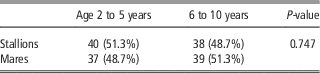
Morphometric measurements on 154 Andalusian horses, including both genders with an age from 2 to 15 years, were collected in this cross-sectional study carried out across three geographic regions of South-East of Spain in 2012. All included animals were healthy based on the results of physical examination, complete blood count, and serum biochemical analysis. Due to the fact that the majority of weight gain occurs through the second trimester of gestation (Lawrence et al., Reference Lawrence, DiPietro, Ewert, Parrett, Moser and Powell1992), pregnant mares (>100 days of gestation) and also lactating mares were excluded in order to avoid confounding factors in the body condition and morphometric evaluation. To evaluate the effect of age on the morphometric measurements, the horses were grouped by age in two groups distinguishing between young horses (2 to 5 years) and adult horses (6 to 15 years), because most of the horses reach their full dimensions at 5 years of age (Čoudková et al., Reference Čoudková, Sachello, Štěrbová, Kleinová, Papoušková, Maršálek and Kovanda2016). The distribution of horses concerning sex and age is shown in Table 1.
Distribution of studied horses according to sex and age

Significance of Pearson’s χ 2 test.
Owners or the person in charge of each horse provided an informed consent form for the participation in the study.
Body condition and cresty neck scoring
Two independent evaluators assessed the body condition score (BCS) (Henneke et al., Reference Henneke, Potter, Kreider and Yeates1983) and cresty neck score (CNS) (Carter et al., Reference Carter, Geor, Staniar, Cubitt and Harris2009a) based on a scale of 1 to 9 for BCS and 0 to 5 for CNS. Average scores of both evaluators were used for data analysis. Horses with a BCS⩾7/9 were considered obese (Giles et al., Reference Giles, Rands, Nicol and Harris2014) and horses with a CNS⩾3/5 were considered cresty neck horses (Carter et al., Reference Carter, Geor, Staniar, Cubitt and Harris2009a).
Morphometric measurements
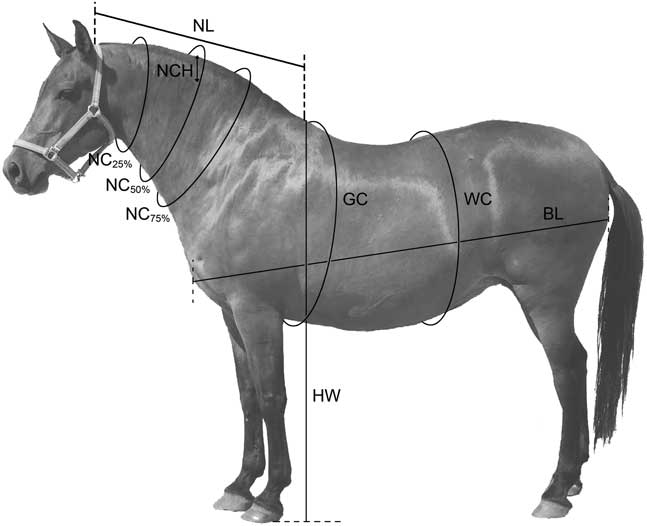
In all, 25 morphometric variables were determined, including four from the body, five from the neck (Figure 1) and 16 from the body and neck crest ratios.
Morphometric measurement sites used in body condition and neck adiposity assessment, with the horse in an appropriate square stance and the neck held in a relaxed upright position at approximately a 45° angle from the horizontal. HW=wither height; BL=body length; GC=girth circumference; WC=waist circumference; NL=neck length; NC=neck circumference; NCH=neck crest height; NC25%=neck circumference at 25% of neck length; NC50%=neck circumference at 50% of neck length; NC75%=neck circumference at 75% of neck length.

Morphometrics taken over the trunk included: (1) height at the withers (HW), the distance from highest point of withers to the ground (Brooks et al., Reference Brooks, Makvandi-Nejad, Chu, Allen, Streeter, Gu, McCleery, Murphy, Bellone and Sutter2010); (2) body length (BL), from the point of the shoulder (intermediate tubercle of the humerus) to a line perpendicular to the point of the buttock (ipsilateral ischiatic tuberosity) (Martinson et al., Reference Martinson, Coleman, Rendahl, Fang and McCue2014); (3) girth circumference (GC), surrounding the thoracic perimeter immediately behind the slope of the withers (at the third thoracic vertebra), caudal to the elbow (olecranon tuber) of both forelimbs and at the time of exhalation, so that the pulmonary volume is not considered (Carter et al., Reference Carter, Geor, Staniar, Cubitt and Harris2009a); (4) waist circumference (WC), around the abdomen coinciding with the point of the umbilicus at two-thirds of the distance from the point of the shoulder to the point of the hip (tuber coxae) and at the end of the expiratory pause (Dugdale et al., Reference Dugdale, Curtis, Cripps, Harris, Argo and Argo2010).
In the neck area, neck length (NL) was measured as a straight line from the poll to the dorsal aspect of the withers (Frank et al., Reference Frank, Elliott, Brandt and Keisler2006). Three neck circumferences (NCs) were evaluated perpendicular to this line. First one, halfway between the poll and the mid-neck length (NC25%), the second one at the midway point between the poll and the dorsal aspect of the withers (NC50%) and the last one halfway between the mid-neck length and the dorsal aspect of the withers (NC75%) (Frank et al., Reference Frank, Elliott, Brandt and Keisler2006). Neck crest height (NCH) was measured over the mid-neck length from the dorsal midline to the interface between the crest and the neck musculature (Carter et al., Reference Carter, Geor, Staniar, Cubitt and Harris2009a). With these measurements, the following ratios were calculated: GC : HW, WC : HW, GC : BL, WC : BL, NC25% : HW, NC50% : HW, NC75% : HW, NC25% : BL, NC50% : BL, NC75% : BL, NC25% : NL, NC50% : NL, NC75% : NL, NC25% : NCH, NC50% : NCH and NC75% : NCH.
To ensure the continuity in the placement of measuring tools, all measurements (cm) were taken by one of the evaluators (always the same) in triplicate and before daily feeding. The measurements were taken from the left side of the horse while it was standing on flat ground in the right position with parallel limbs and neck held in a relaxed upright position at approximately a 45° angle from the horizontal. Neck and trunk circumferences, NCH and NL were measured with a plastified measuring tape (Kruuse, Langeskov, Denmark) and to measure the HW and the BL, a hipometer (specific measuring stick for large animals) (Hauptner, Dietlikon, Switzerland) was employed.
Intraclass correlation coefficients for the trunk and neck morphometric measurements were: 99.5% for HW, 99.4% for BL, 99.2% for GC, 99.0% for WC, 99.3% for NL, 99.2% for NCH, 98.4% for NC25%, 98.2% for NC50% and 98.4% for NC75%. Because the repeatability between different measurements was good (Fleiss, Reference Fleiss1986), mean values of the three measurements were used for statistical analyses.
Statistical analysis
Quantitative variables were reported using mean±SD, CV and range (minimum and maximum). The association between two qualitative variables was checked using Pearson’s χ 2 test. A GLM for each morphometric measurement and ratio (reported using estimated marginal means±residual errors) was applied using sex, age group, obesity status (BCS⩾7) and cresty neck condition (CNS⩾3) as fixed effects and also their paired interactions. Statistical analyses were carried out in SPSS 19.0 for Windows (IBM Corp., Armonk, NY, USA). A weighted Cohen’s κ statistic indicating level of agreement was performed using StatsToDo (available at https://www.statstodo.com/CohenFleissKappa_Pgm.php). The α error was set at 0.05 and the power was set at 0.80.
Results
Description of studied parameters
Data were collected from 154 Andalusian horses: 78 stallions (50.6%) and 76 mares (49.4%) with an average age of 6.60±3.72 years. The BCS ranged from 3 to 9 with an average of 6.07±1.03. Agreement between the two body condition evaluators was moderate (Cohen’s κ weighted=0.481, CI95%: 0.404, 0.557; P<0.001). In the case of CNS the range was from 1 to 5 with an average of 3.11±0.80. Agreement between the two cresty neck evaluators was substantial (Cohen’s κ weighted=0.691, CI95%: 0.611, 0.770; P<0.001). In all, 26% of the horses were considered to be obese and more than half (69.5%) were classified as cresty neck horses.
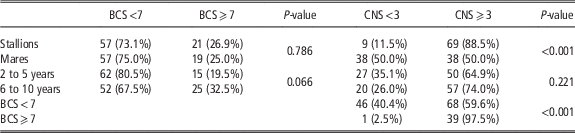
The distribution of horses concerning sex, age, BCS and CNS is shown in Table 2. When the association was analyzed among the fixed factors, it was found that some pairs were independent: sex v. age group (P=0.747), sex v. obesity status (P=0.786), age group v. obesity status (P=0.066) and age group v. cresty neck condition (P=0.221). However, sex and cresty neck condition were associated (P<0.001) with 88.5% of stallions having cresty neck v. 50.0% of mares. Finally, obesity status and cresty neck condition were highly associated (P<0.001), and cresty neck condition was observed in 97.5% of obese and 59.6% of non-obese horses (Table 2).
Distribution of studied horses (n=154) according to sex, age, obesity status and cresty neck condition

BCS=body condition score; CNS=cresty neck score.
Significance of Pearson’s χ 2 test.
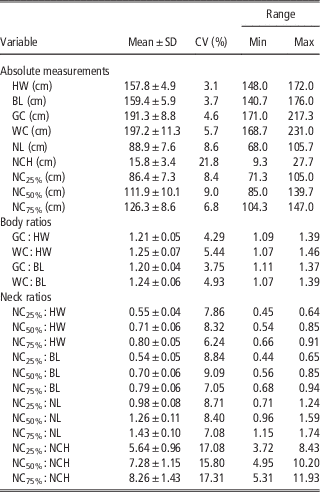
Statistical description of the morphometric measurements and calculated ratios are shown in Table 3. In general, all variables were homogenous, except the variables related with the NCH, which showed large variability evidenced by high CVs.
Description of neck and trunk morphometric measurements (cm) and ratios calculated in the sample (n=154)

HW=height at the withers; BL=body length; GC=girth circumference; WC=waist circumference; NL=neck length; NCH=neck crest height; NC25%=neck circumference at 25% of neck length; NC50%=neck circumference at 50% of neck length; NC75%=neck circumference at 75% of neck length.
Influence of demographic variables on morphometric measurements
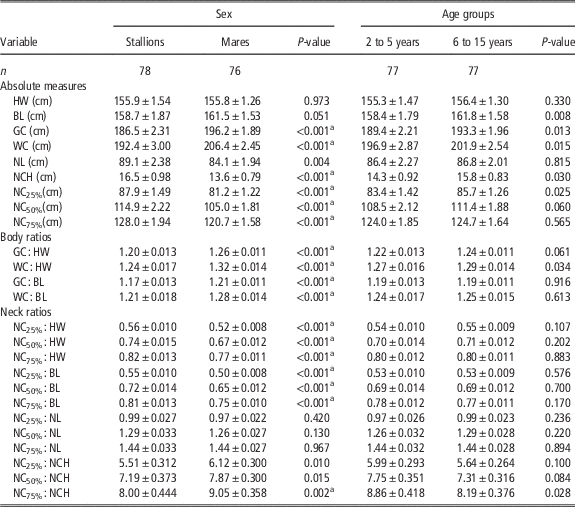
The effect of sex and age on morphometric parameters are shown in Table 4. The two circumferences over the trunk were greater in mares than in stallions (P<0.001), while the stallions presented higher values in all measurements evaluated in the neck area (P<0.001). The age affected BL, GC, WC, NCH and NC25% showing in adult horses higher values (P<0.050).
Statistical association of morphometric measurements (cm) and ratios with demographic variables

HW=height at the withers; BL=body length; GC=girth circumference; WC=waist circumference; NL=neck length; NCH=neck crest height; NC25%=neck circumference at 25% of neck length; NC50%=neck circumference at 50% of neck length; NC75%=neck circumference at 75% of neck length.
a Power value greater than 80%
Morphometric ratios using the GC and the WC adjusted for body size (divided by HW and BL) showed higher values in the case of mares (P<0.001). Similar results were observed when the NCs were adjusted for the NCH. On the contrary, stallions significantly surpassed mares in all neck ratios adjusted for the HW and the BL (P<0.001). Only two ratios (WC : HW and NC75% : NCH) demonstrated differences according to age. Despite all neck measurements having been affected by the gender, when the three NCs were adjusted for the NL, the resulting ratios were independent of both demographic variables considered in the analysis (Table 4).
Influence of adiposity on morphometric measurements
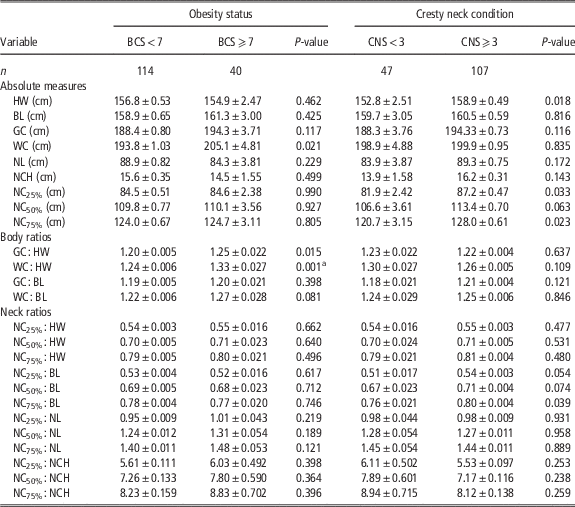
Among all absolute measurements, only the GC and the NC50% were not influenced by overall or regional adiposity (Table 5). The WC was significantly affected only by the obesity status, presenting greater values in those horses with BCS⩾7 (P=0.021). In the case of HW, NC25% and NC75%, these measurements were significantly higher in horses with cresty neck.
Statistical association of morphometric measurements (cm) and ratios with obesity status and cresty neck condition

BCS=body condition score; CNS=cresty neck score; HW=height at the withers; BL=body length; GC=girth circumference; WC=waist circumference; NL=neck length; NCH=neck crest height; NC25%=neck circumference at 25% of neck length; NC50%=neck circumference at 50% of neck length; NC75%=neck circumference at 75% of neck length.
a Power value greater than 80%.
Only the ratios including GC and WC adjusted for the HW showed significant differences according to the obesity status, being greater than the values in the obese horse group. Exclusively the ratio NC75% : BL was significantly associated with cresty neck condition. The rest of the calculated ratios were similar between both adiposity groups (Table 5).
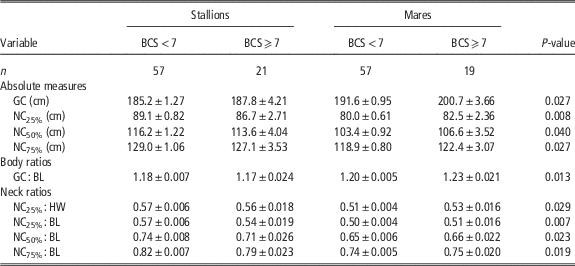
Furthermore, several interactions between sex and adiposity groups could be observed in the multivariate analysis (Tables 6 and 7). Thereby, despite GC, NCs, GC : BL, NC25% : HW and NCs : BL globally having shown significant differences by sex (Table 4), but not by adiposity status (Table 5), significantly greater values for the above parameters were observed in obese mares respect to the other three categories (Table 6).
Statistical association of morphometric measurements (cm) and ratios with interactions between sex and obesity status

BCS=body condition score; GC=girth circumference; NC25%=neck circumference at 25% of neck length; NC50%=neck circumference at 50% of neck length; NC75%=neck circumference at 75% of neck length; BL=body length; HW=height at the withers.
Statistical association of morphometric measurements (cm) and ratios with interactions between sex and cresty neck condition

CNS=cresty neck score; NC25%=neck circumference at 25% of neck length; NC50%=neck circumference at 50% of neck length; NC75%=neck circumference at 75% of neck length; BL=body length; NL=neck length.
a Power value greater than 80%.
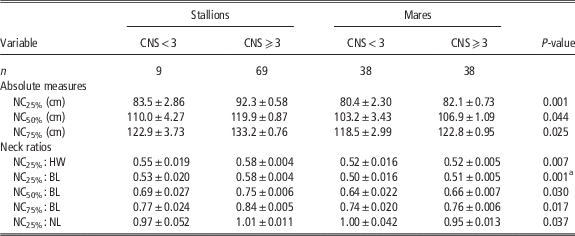
Likewise, in the case of neck morphometry, stallions with cresty neck presented significantly higher values for NCs, NC25% : HW, NCs : BL and NC25% : NL (Table 7) while globally these measurements (except the last one) were significantly greater in stallions (Table 4) and only NC25% and NC75% were higher in horses with cresty neck condition (Table 5).
Discussion
In horses, the application of body measurements has been traditionally used to define their characteristics and general body conformation (Sadek et al., Reference Sadek, Al‐Aboud and Ashmawy2006). Although previous studies have shown a clear distinction in morphometric measurements depending on the breed evaluated (Martinson et al., Reference Martinson, Coleman, Rendahl, Fang and McCue2014; Catalano et al., Reference Catalano, Coleman, Hathaway, McCue, Rendahl and Martinson2016) as well as the influence of gender and age in the values obtained (Pinto et al., Reference Pinto, de Almeida, Quirino, de Azevedo, Cabral, Santos and Corassa2008; Purzyc et al., Reference Purzyc, Kobryńczuk and Bojarski2011), these differences mainly refer to simple measurements of conformational traits. However, in the clinical context, morphometrics have recently emerged as alternative estimators of obesity due to its relationship with scoring systems, body fat percentage and biochemical variables relevant to assess different aspects of metabolism (Henneke et al., Reference Henneke, Potter, Kreider and Yeates1983; Carter et al., Reference Carter, Geor, Staniar, Cubitt and Harris2009a). In this context, Frank et al. (Reference Frank, Elliott, Brandt and Keisler2006) suggested that mean NC could be useful to identify horses at risk of insulin resistance. Afterwards, in a study conducted in horses and ponies some morphometric ratios related to neck and overall adiposity were correlated with basal insulin, glucose, leptin and triglyceride concentrations (Carter et al., Reference Carter, Geor, Staniar, Cubitt and Harris2009a).
Nowadays, little information is available about the use of morphometrics to characterize the obesity in equids. To the authors’ knowledge, this is the first study where the effects of demographic variables and regional and general obesity scores were taken into account, to establish morphometric ratios related to the body condition specifically in Andalusian horses.
Notwithstanding, Andalusian horses are considered a light breed, the average of BCS observed in the present study is similar to those described for draft breeds (6.3±0.9) (Catalano et al., Reference Catalano, Coleman, Hathaway, McCue, Rendahl and Martinson2016) and exceed the values reported in previous studies related to light breeds (5.38±0.72) (Wagner and Tyler, Reference Wagner and Tyler2011). Likewise, the proportion of obese horses was also higher than values reported in other breeds where the same cut-off value was used to determine this condition (Harker et al., Reference Harker, Harris and Barfoot2011; Jensen et al., Reference Jensen, Danielsen and Tauson2016). Similarly, the proportion of cresty neck horses was also higher than in other breeds (Giles et al., Reference Giles, Nicol, Rands and Harris2015). In relation with these findings and as expected, mean values of several morphometrics such as GC (Sadek et al., Reference Sadek, Al‐Aboud and Ashmawy2006; Čoudková et al., Reference Čoudková, Sachello, Štěrbová, Kleinová, Papoušková, Maršálek and Kovanda2016), WC (McGowan et al., Reference McGowan, Dugdale, Pinchbeck and Argo2013), NC50% (Bailey et al., Reference Bailey, Habershon-Butcher, Ransom, Elliott and Menzies-Gow2008; Martinson et al., Reference Martinson, Coleman, Rendahl, Fang and McCue2014; Catalano et al., Reference Catalano, Coleman, Hathaway, McCue, Rendahl and Martinson2016) and NCH (Wray et al., Reference Wray, Elliott, Bailey, Harris and Menzies-Gow2013) were greater compared with previously published data in light horse breeds and ponies. Furthermore, the CV of the measurements made of the trunk and neck area proved to be quite homogeneous, although less than those described in Arabian horses (Sadek et al., Reference Sadek, Al‐Aboud and Ashmawy2006). The differences between Andalusian and other light breed horses may be related to the morphologic standard sought by breeders or, by the idiosyncrasy of the breed.
Influence of demographic variables on morphometric measurements
The Andalusian horse is described as a breed with a significant sexual dimorphism (Stud breeding book of Andalusians, 2002), this term refers to differences in dimensions (absolute measurements) and proportions (ratios) of the body between males and females (Glucksmann, Reference Glucksmann1974). This aspect has been corroborated in an objective way, since most of the absolute morphometric measurements evaluated in this study were significantly different between both sexes. The higher values observed in neck morphometrics, in the case of males compared with females, may be explained due to the fact that the neck crest area contains great amounts of connective tissue within the adipose tissue (Dugdale et al., Reference Dugdale, Curtis, Harris and Argo2011a). This may contribute to a possible functional and sexually dichotomous role (Dugdale et al., Reference Dugdale, Curtis, Harris and Argo2011a). In regard to the measurements taken of the trunk, the greater circumferences values obtained in females compared with males, are similar to results reported in other horse breeds (Rastija et al., Reference Rastija, Baban, Antunovic and Mandic2004; Sadek et al., Reference Sadek, Al‐Aboud and Ashmawy2006). In addition, owing to the higher values obtained by mares in GC and WC measurements; resulting mean values of all body ratios were higher and significantly different between both genders. This indicates that these ratios in a male cannot be compared with the same measurement in a female, as the same value would not imply similar adiposity. At this point, it is interesting to note that, despite the proportion of obese animals assessed by BCS being similar between males and females; when morphometric measurements were used to evaluate the population, gender-related differences in the neck and body condition were highlighted. The differences according to age could be attributed to the change in conformation, muscular development and increase in the fat deposit that takes place in horses as they reach adulthood (Martin-Rosset et al., Reference Martin-Rosset, Vernet, Dubroeucq, Arnaud, Picard and Vermorel2008; Čoudková et al., Reference Čoudková, Sachello, Štěrbová, Kleinová, Papoušková, Maršálek and Kovanda2016).
Influence of adiposity on morphometric measurements
In contrast with those studies showing that GC is affected by adiposity (Thatcher et al., Reference Thatcher, Pleasant, Geor and Elvinger2012), in our case GC was not influenced by adiposity status. In humans, the measurement of WC is a better indicator of abdominal fat accumulation than the body mass index (Lee et al., Reference Lee, Bacha, Gungor and Arslanian2006). In the case of equids, it has been shown that considerable losses in the body mass corresponded to disproportionately small or even absent changes on BCS while morphometrics like the WC were more accurate indexes for assessing and monitoring changes in adiposity (Dugdale et al., Reference Dugdale, Curtis, Cripps, Harris, Argo and Argo2010, Reference Dugdale, Curtis, Harris and Argo2011a and Reference Dugdale, Curtis, Cripps, Harris and Argo2011b). The fact that the WC was in relation with differences in body condition in Andalusians reinforces the sensitivity of this measurement.
Absolute morphometric measurements alone may be uninformative for assessing relative adiposity, thus morphometric ratios that have been shown to be useful for the evaluation of body condition in equids, include the use of a trunk or NC in relation to HW and BL. These ratios represent more than one physical dimension and therefore are more sensitive to compare fat deposits than any individual physical measure (Henneke et al., Reference Henneke, Potter, Kreider and Yeates1983). Recently, the GC : HW ratio has been suggested as the most appropriate objective measure to assess overall adiposity in horses (Carter et al., Reference Carter, Geor, Staniar, Cubitt and Harris2009a). In agreement with this observation, in our case the GC : HW but also WC : HW were the only ratios related to general obesity independently of the neck adiposity. Otherwise, different cut-off values for this ratio have been proposed to estimate an overweight status depending on the horse breed evaluated (Carter et al., Reference Carter, Geor, Staniar, Cubitt and Harris2009a; Jensen et al., Reference Jensen, Danielsen and Tauson2016). The mean value of GC : HW ratio in obese Andalusians was lower than the values described in the literature for overweight (1.27) and obese (1.29) Icelandic horses (Jensen et al., Reference Jensen, Danielsen and Tauson2016). These discrepancies could be probably attributed to the morphology of the horses included and, stand out the need to re-adjust the cut-off values according to each breed specific criteria.
Several morphometric measurements have been described specifically for the assessment of fat deposition along the neck (Frank et al., Reference Frank, Elliott, Brandt and Keisler2006; Bailey et al., Reference Bailey, Habershon-Butcher, Ransom, Elliott and Menzies-Gow2008; Martin-Gimenez et al., Reference Martin-Gimenez, Blas Giral, Aguilera Tejero, Diez de Castro and Aguirre Pascasio2016). Among them points out the use of the NCs due to its associations with the CNS (Carter et al., Reference Carter, Geor, Staniar, Cubitt and Harris2009a). Similarly, in this case, the high percentage of cresty neck horses observed during the study, and that characterize Andalusian purebred horses, corresponded with the large NCs values registered. However, we cannot make the assumption that an increase in their diameter is due to an increase in fat deposition as CNS can only assess the external appearance of the neck and muscle development and conformation may be influencing the scoring process. Moreover, unlike the observations obtained in Icelandic horses where NC50% increased when the BCS increased (Jensen et al., Reference Jensen, Danielsen and Tauson2016), in our study all neck measurements were similar between obese and non-obese horses.
On the other hand, it has been proposed that the NC50% : HW ratio could be used as an alternative adiposity measurement when a horse obtains a value ⩾0.63 (equivalent to a CNS⩾3) (Carter et al., Reference Carter, Geor, Staniar, Cubitt and Harris2009a). Nonetheless, our global mean values as well as the values registered in the obese and cresty neck groups exceeded not only the threshold mentioned above, but also the cut-off value (>0.71) associated with a greater predisposition of developing an endocrinopathic laminitis (Carter et al., Reference Carter, Treiber, Geor, Douglass and Harris2009b). In relation with this, in our study only one mare with value >0.71 for the NC50% : HW ratio (=0.75) had an owner-reported history of laminitis.
Even when the three NCs were put into context by relating them to all neck or body size measures, the resulting ratios showed their stability. This along with the fact that more than a half of the horses classified as non-obese exhibited a cresty neck appearance suggest that at least in this breed, great neck morphometrics are more related to a phenotypic feature and cannot be used to discriminate among obese and non-obese horses.
Finally, similarly to what happens in humans, where the morphometric criteria to define a man as obese varies in comparison with a woman (Lin et al., Reference Lin, Lee, Chen, Lo, Hsia, Liu, Lin, Shau and Huang2002), the interactions observed in our study verify that many morphometric values significantly differ depending on the body condition of males or females.
In our attempt to find out suitable morphometric parameters for assessment of overall and regional adiposity, a series of absolute measurements and ratios were studied here, showing that many breed related morphological characteristics were influencing this evaluation. These results emphasize the necessity to set specific reference values according to the gender and adiposity condition in different breeds.
Acknowledgements
The authors would like to thank Francisco Marin for his role as second BCS and CNS evaluator and his valuable help in measuring all the horses. The authors also thank all horse owners for participation in this study.