INTRODUCTION
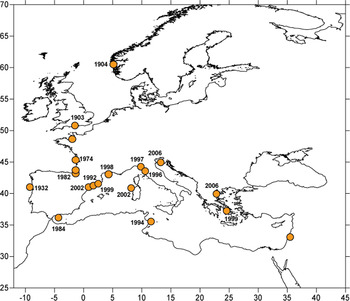
Paracartia grani (Sars, Reference Sars1904) belongs to the Acartiidae family (Copepoda: Calanoida) which is the most abundant family in Thau lagoon (south of France). It is assumed to be a northern species as two females and one male were first collected and described in samples in Plymouth Sound (southern England) in August 1903 (Marine Biological Association, 1957). It was also reported by Sars (Reference Sars1904) from some oyster beds off western Norway and was also observed more recently in coastal waters of the north-eastern Atlantic and North Sea (Gallo, Reference Gallo1981; Razouls et al., Reference Razouls, de Bovée, Kouwenberg and Desreumaux2009). Over the past twenty years, it has progressively appeared in the Mediterranean Sea (Rodríguez & Vives, Reference Rodríguez and Vives1984; Lakkis, Reference Lakkis1990; Belmonte & Potenza, Reference Belmonte and Potenza2001; Daly Yahia et al., Reference Daly Yahia, Souissi and Yahia Kéfi2004; Pane et al., Reference Pane, Boccardo and Mariottini2005; Razouls et al., Reference Razouls, de Bovée, Kouwenberg and Desreumaux2009) (Figure 1). In 1984, P. grani was recorded for the first time in the western Mediterranean, in Málaga harbour close to the Strait of Gibraltar (Rodríguez & Vives, Reference Rodríguez and Vives1984). It was observed 15 years later in Spanish and French coastal waters (references in Pane et al., Reference Pane, Boccardo and Mariottini2005) and for the first time in Thau lagoon in 1998 (L. Euzet, personal communication). However as this latest record was not published, it is still absent from the Thau lagoon fauna list. More recently, it has been reported in the north of the Adriatic Sea (De Olazalbal et al., Reference De Olazalbal, Comici and Umani2006) and in the Aegean Sea (references in Pancucci-Papadopoulou et al., Reference Pancucci-Papadopoulou, Zenetos, Corsini-Foka and Politou2005). However, for the moment, there is no report of P. grani in the Black Sea (Belmonte & Potenza, Reference Belmonte and Potenza2001). Paracartia grani is also present in polluted sites such as harbours of Málaga (Rodríguez & Vives, Reference Rodríguez and Vives1984), Barcelona and Genova (Pane et al., Reference Pane, Boccardo and Mariottini2005) where it persists.
Biogeography (literature record) of Paracartia grani (Copepoda: Calanoida) in Europe in 2011. Records of P. grani were based on Marine Biological Association, 1957; Rodríguez & Vives, Reference Rodríguez and Vives1984; Lakkis, Reference Lakkis1990; Belmonte & Potenza, Reference Belmonte and Potenza2001; Daly Yahia et al., Reference Daly Yahia, Souissi and Yahia Kéfi2004; Pancucci-Papadopoulou et al., Reference Pancucci-Papadopoulou, Zenetos, Corsini-Foka and Politou2005; Pane et al., Reference Pane, Boccardo and Mariottini2005; De Olazalbal et al., Reference De Olazalbal, Comici and Umani2006; Razouls et al., Reference Razouls, de Bovée, Kouwenberg and Desreumaux2009.

The European biogeography of P. grani was determined using a literature review as a basis to suggest a hypothesis for its presence in warmer Mediterranean coastal waters. The influence of P. grani introduction on Thau lagoon Acartia spp. assemblages is also discussed.
MATERIALS AND METHODS
Paracartia grani sampling
Zooplankton samples were collected twice a month between February 2008 and March 2009 at a monitoring station S1, close to Sète channel in Thau lagoon (40°03N 03°41E). A WP2 plankton net with a 200 µm mesh size was used to carry horizontal hauls in the surface layer (maximum 1 m depth) as the lagoon is really shallow with 3.5 m depth at the sampling station. Samples collected were fixed with formaldehyde to a final concentration of 4% and used to determine the biodiversity and abundance of Acartiidae planktonic populations at the station. Samples were split using a Stemple pipette and counted in a Bogorov tray under a binocular microscope.
Long term changes
During the first half of the 20th Century, several zooplankton monitoring studies have taken place at the same sampling station. However these results were never published and data were kept in the archives of the Station Méditerranéenne de l'Environnement Littoral in Sète. The main example regards Professor Louis Euzet (Université Montpellier 2, France) who did follow the plankton population dynamics as well as temperature and salinity for his Master's dissertation and doctoral thesis reports in 1937 and 1938 and between 1949 and 1952. We used his notebooks to extract the population dynamics data at these periods. It has to be specified that he used a WP2 plankton net with a 200 µm mesh size towed in the sub-surface to collect plankton. Those data are semi-quantitative as the abundances, in number of organisms per unit of volume, were not expressly specified, but the proportion of each species versus the total zooplankton was indicated. An additional study published by Lam Hoai in 1982–1983 (Lam Hoai, Reference Lam Hoai1985) was also used for a long term comparison of Acartia spp. population dynamics during the past 60 years. In his study, Lam Hoai (Reference Lam Hoai1985) sampled the first metre of the water column using a 150 µm mesh net.
To allow a comparison between Euzet's records, Lam Hoai's study (1985) and our own data, we only considered copepodite and adult stages. In addition, the percentage of contribution of each Acartia species to the amount of adults was applied to the copepodite abundances when they were not identified at a species level. Results were all presented as percentages of a targeted species versus the total zooplankton abundance.
Temperature data were available for the years 1949, 1950, 1951, 1952, 2008 and 2009. In 2008 and 2009, salinity measurements were also done. For years 2008 and 2009, relationships between each Acartia species abundance and temperature or salinity were investigated by testing the significance of the Pearson correlation coefficient. A similar test was performed for all the years of the dataset between the contribution of each Acartia species to the total zooplankton abundance and temperature to see if temperature was structuring Acartia spp. ecological successions.
RESULTS
During our study in Thau lagoon (February 2008–March 2009), P. grani was detected in zooplankton samples in summer and autumn (June–December 2008). During this period, the surface temperature ranged between 22.4°C in June to 8.3°C in December 2008 with a mean value of 18.0°C.
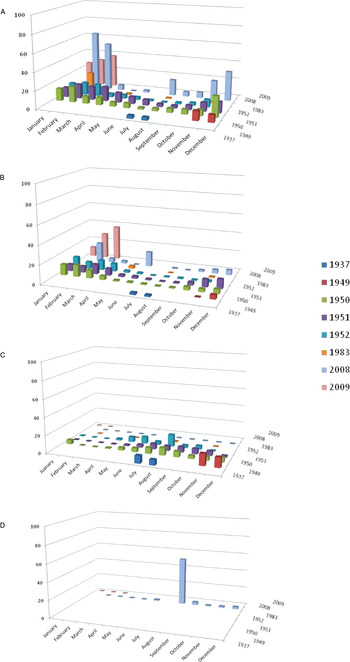
An ecological succession of the different Acartia species can be noticed at the monitoring station, with A. clausi occurring on average from January until March in high abundance (ranging from 8.1% of the total zooplankton abundance in March 1950 up to 65.5% in February 2008) followed by A. discaudata from February to April (highest contribution in March 2009: 36.2%). Both P. grani and P. latisetosa appear to have their maximum abundances, 53.1% in 2009 and 13.6% in 1952 respectively, in August. A second peak of abundance (up to 32.8% in December 2008) of A. clausi is observed from November to December (Figure 2).
Acartia spp. long term contribution to the total zooplankton abundance (%) at S1 in Thau lagoon: (A) Acartia clausi; (B) Acartia discaudata; (C) Paracartia latisetosa; (D) Paracartia grani.

Acartia populations have undergone changes since the 1950s (Figure 2). Both A. clausi and A. discaudata were more common in the later sampling occasions. Paracartia latisetosa has disappeared from the monitoring station since the last sampling in 1983 while P. grani has been present since at least 1998.
DISCUSSION
P. grani population dynamics
Paracartia grani was the most abundant Acartia species in August (2008) where it contributed up to 53% of total zooplankton (2040 ind m−3). This peak was followed by a drastic decline and P. grani disappeared in January (2009) as it has been reported by Rodríguez et al. (Reference Rodriguez, Guerrero and Bautista1995) who described it as the dominant Acartia species in summer in Málaga bay. Similarly, Pane et al. (Reference Pane, Boccardo and Mariottini2005) indicated P. grani occurrence in autumn (from September to December with a peak in October) in the western Harbour of Genova (Ligurian Sea), supporting the results reported by Guerrero (Reference Guerrero1993) at a coastal station in the Alboran Sea. Alcaraz (Reference Alcaraz1977) described P. grani as an opportunist species as it is commonly found in coastal waters but can also be spotted in brackish waters and polluted sites (Rodríguez & Vives, 1984; Pane et al., Reference Pane, Boccardo and Mariottini2005) where it persists.
Long term changes in Acartia spp. populations
Studies on P. latisetosa are rare (Siokou-Frangou & Papathanassiou, Reference Siokou-Frangou and Papathanassiou1991; Belmonte, Reference Belmonte1992, Reference Belmonte1998; Siokou-Frangou et al., Reference Siokou-Frangou, Zervoudaki, Kambouroglou and Belmonte2005). However, this species is known to be encountered generally at high abundances in very confined environments with fresh water inputs and especially in summer (Siokou-Frangou & Papathanassiou, Reference Siokou-Frangou and Papathanassiou1991). It was described in Thau lagoon until the 1950s, as abundant during summer and in low abundances in winter and spring (Fatemi, Reference Fatemi1937; Mathias & Euzet, Reference Mathias and Euzet1951, Reference Mathias and Euzet1962). The last record at our sampling station was in August 1983, in low abundance (less than 1%) (Lam Hoai, Reference Lam Hoai1985). Our monitoring station is mainly under seawater influence and consequently it probably does not represent the ideal environment for P. latisetosa development. However, P. latisetosa might still be present in Thau lagoon in areas closer to the river mouths.
In addition, P. grani presence in the lagoon might date back further than 1998. Paracartia grani is occurring during the warm period as P. latisetosa did. Recent studies have explained how non-native Acartia species are able to colonize coastal areas and estuaries (Seuront, Reference Seuront2005; David et al., Reference David, Sautour and Chardy2007).
Quantitative data on Acartia spp. showed that the species abundances were not significantly correlated with temperature or salinity in Thau lagoon between February 2008 and March 2009 (P > 0.05). Similarly, for each year of the long term series, the contributions of each species to the total zooplankton abundance are not correlated with temperature variation (P > 0.05). Therefore, while climate changes have been shown to modify seasonality and period of dominance of A. tonsa in Narragansett Bay (Sullivan et al., Reference Sullivan, Costello and Van Keuren2007), in Thau lagoon, changes in Acartia spp. community structure have another origin than temperature. In addition, if climate change was to blame, it is likely that temperature would have increased, favouring the thermophile species P. latisetosa (Kritchagin, 1873) which is a dominant species in summer (Fatemi, Reference Fatemi1937; Mathias & Euzet, Reference Mathias and Euzet1962; Lam Hoai, Reference Lam Hoai1985). Surprisingly enough, P. latisetosa has currently totally disappeared from the plankton community at this station.
Introduction in the Mediterranean Sea
The introduction of Paracartia grani in the Mediterranean Sea might first be explained by a natural migration via the Strait of Gibraltar (i.e. Yebra et al., Reference Yebra, Bonnet, Harris, Lindeque and Peijnenburg2011). Indeed, several studies, focused on copepods ecology, have underlined the fact that even though the Strait of Gibraltar and the Almeria–Oran Front are considered important phylogeographic barriers in many marine species there is some evidence of transport of copepods across the Strait of Gibraltar and the Almeria–Oran Front and for some species, populations are not genetically differentiated between the north-eastern Atlantic and the western Mediterranean (Tyrrhenian) based on 16S data (e.g. Yebra et al., Reference Yebra, Bonnet, Harris, Lindeque and Peijnenburg2011). An involuntary introduction could also be the result of human activities: for example transport via ship ballast waters (Belmonte & Potenza, Reference Belmonte and Potenza2001; Pane et al., Reference Pane, Boccardo and Mariottini2005) or bivalve transfers between the Atlantic Ocean and Mediterranean Sea.
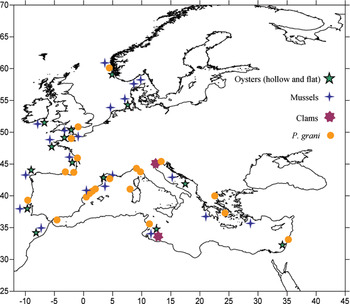
Many alien species introductions have certainly been the result of bivalve transfers (e.g. Mineur et al., Reference Mineur, Belsher, Johnson, Maggs and Verlaque2007 and references therein), and while there is no direct evidence that this has happened with P. grani, several reasons would favour this route. In Thau lagoon oyster transfers have been effective as primary and secondary vectors of macroalgae introductions (Mineur et al., 2007). Paracartia grani ecology has also been closely linked with oyster (Ostrea edulis) production (Audemard et al., Reference Audemard, Barnaud, Collins, Le Roux, Sauriau, Coustau, Blachier and Berthe2001, Reference Audemard, Le Roux, Barnaud, Collins, Sautour, Sauriau, de Montaudouin, Combes and Berthe2002, Reference Audemard, Sajus, Barnaud, Sautour, Sauriau and Berthe2004) as it has been suggested to be one of the intermediate hosts of the protozoan paramyxean parasite Marteilia refringens responsible for marteiliosis, a major disease for bivalve production in Europe. During the cultivation of bivalves, they might be transferred several times (see details for Crassostrea gigas cycle in Mineur et al., Reference Mineur, Belsher, Johnson, Maggs and Verlaque2007). Such transfers are permitted within the European Community and there is no obligation to report them to the relevant authorities (Mineur et al., Reference Mineur, Belsher, Johnson, Maggs and Verlaque2007). Additionally, most distributional records of P. grani are correlated with bivalve farming sites (Figure 3).
Records of Paracartia grani and several bivalves exploited species in Europe.  : P. grani
 : oyster farms
 : mussel farms and
 : clam farms Sars (Reference Sars1904); Gallo (Reference Gallo1981); Rodríguez & Vives (Reference Rodríguez and Vives1984); Lakkis (Reference Lakkis1990); Belmonte & Potenza (Reference Belmonte and Potenza2001); Daly Yahia et al. (Reference Daly Yahia, Souissi and Yahia Kéfi2004); Pancucci-Papadopoulou et al. (Reference Pancucci-Papadopoulou, Zenetos, Corsini-Foka and Politou2005); Pane et al. (Reference Pane, Boccardo and Mariottini2005); De Olazalbal et al. (Reference De Olazalbal, Comici and Umani2006); Razouls et al. (Reference Razouls, de Bovée, Kouwenberg and Desreumaux2009).