Introduction
Recent interest in bilingualism and its cognitive consequences has led to an explosion of studies (Kroll & Bialystok, Reference Kroll and Bialystok2013). While a lot of evidence points to a bilingual executive control advantage (but see Hilchey & Klein, Reference Hilchey and Klein2011; Paap & Greenberg, Reference Paap and Greenberg2013), the exact nature of this advantage is less clear. The bilingual advantage in conflict tasks such as the Simon task (Simon & Rudell, Reference Simon and Rudell1967) has generally been related to bilinguals’ enhanced executive control (Bialystok, Reference Bialystok2001; Bialystok, Craik, Green & Gollan, Reference Bialystok, Craik, Green and Gollan2009; Hilchey & Klein, Reference Hilchey and Klein2011). But executive control encompasses different aspects, such as inhibitory control and attentional control. The bilingualism effect might therefore be a combination of effects, drawing on different aspects of executive control. Empirical evidence is mixed and inconclusive as to which control processes contribute to the bilingual advantage. The present study aimed to elucidate the nature of the bilingual advantage through exploring two aspects, specifically inhibitory control and attentional control.
In what follows, we first introduce the evidence for two accounts, namely that enhanced inhibitory control or enhanced attentional control drives the bilingual advantage in non-verbal conflict tasks. We then introduce ex-Gaussian analysis and explain why it has the potential to tease the two accounts apart.
Bilingual advantage in conflict tasks
Three non-verbal interference tasks have been used most often to investigate the bilingual cognitive advantage, namely the Simon task, the Spatial Stroop task and the Flanker task, the latter sometimes embedded in an Attentional Network Task (ANT). In the Simon task (Simon & Rudell, Reference Simon and Rudell1967), stimuli are presented either in a spatially compatible or incompatible way with the response hand. For instance, if a red square requires a right hand response, then a presentation on the right side of the screen is compatible with the response hand, but a presentation on the left side is incompatible. The classical Simon effect (congruency effect) refers to the finding that participants respond more slowly when the position of the stimulus is not compatible with the response hand, suggesting that extra effort is required to resolve such spatial incompatibility and to overcome the conflict.
Result patterns for the Simon, Spatial Stroop, and Flanker task have been mixed. Bilingual speakers sometimes outperformed monolingual speakers by having smaller congruency effects, sometimes their responses were faster overall, sometimes both patterns were present, and other times no behavioral differences between the two participant groups were reported. When a bilingual advantage was found, it was interpreted in various ways: as enhanced inhibitory control ability (e.g., Bialystok, Craik, Klein & Viswanathan, Reference Bialystok, Craik, Klein and Viswanathan2004; Carlson & Meltzoff, Reference Carlson and Meltzoff2008; Luk, Anderson, Craik, Grady & Bialystok, Reference Luk, Anderson, Craik, Grady and Bialystok2010), as enhanced attentional control ability (e.g., Costa, Hernandez & Sebastian-Galles, Reference Costa, Hernandez and Sebastian-Galles2008) or, very broadly, as enhanced executive functioning (Bialystok, Martin & Viswanathan, Reference Bialystok, Martin and Viswanathan2005a; Bialystok et al., Reference Bialystok, Craik, Klein and Viswanathan2004). Here we focused on enhanced inhibitory control and enhanced attentional control as two candidates for the nature of the bilingual advantage. We next elaborate on these two terms before moving on to discuss evidence in support of each.
Inhibitory control is required when conflicting mental representations lead to different responses. Efficient inhibitory control would therefore result in successful conflict resolution. We will use the term inhibitory control to refer to the processes involved in resolving conflict. With attentional control we mean a more general function that is involved in tasks requiring moderate focus of attention, i.e., a function that is involved in conflict and non-conflict conditions. Within attentional control, two aspects appear to us of special importance for the bilingual advantage. The first is the alertness aspect of attention, proposed by Posner and Petersen (Reference Posner and Petersen1990) as one of three aspects of attention (next to selection and orientation). Alertness refers to sustaining attention or the keeping of vigilant attention (Robertson & Garavan, Reference Robertson and Garavan2004). Here we focus on the ability to actively sustain or engage attention in task performance, or more concretely, the ability to maintain task goals in working memory. To put it differently, failing to sustain such attention would lead to a temporary lapse of attention or a temporary loss of task goals from the working memory. Increased attentional alertness to the task goal by bilingual speakers can, for instance, explain better performance in conditions of high cognitive demand (Costa, Hernandez, Costa-Faidella & Sebastian-Galles, Reference Costa, Hernandez, Costa-Faidella and Sebastian-Galles2009). The second aspect of attentional control that appears to be of special importance here is attentional monitoring as discussed by Hilchey and Klein (Reference Hilchey and Klein2011) and Costa et al. (Reference Costa, Hernandez, Costa-Faidella and Sebastian-Galles2009), i.e., the ability to flexibly increase/decrease the degree of attentional engagement depending on the context.
One way that executive control might contribute to the bilingual advantage is through enhanced inhibitory control. The smaller congruency effect observed for bilinguals in interference tasks has been taken as evidence to support this notion (Bialystok, Craik & Luk, Reference Bialystok, Craik and Luk2008; Linck, Hoshino & Kroll, Reference Linck, Hoshino and Kroll2008; Tao, Marzecova, Taft, Asanowicz & Wodniecka, Reference Tao, Marzecova, Taft, Asanowicz and Wodniecka2011). In the incongruent condition two representations are active, and participants need to overcome a prepotent response activated by the misleading information. Therefore, a reduced congruency effect in bilinguals suggests that they have superior ability to inhibit prepotent responses.
Another way that executive control might contribute to the bilingual advantage is through enhanced attentional control. One major source of evidence for this hypothesis is that bilinguals sometimes show similar congruency effects to monolinguals in interference tasks but perform overall faster than monolinguals (Bialystok, Reference Bialystok2006; Bialystok, Craik, Grady, Chau, Ishii, Gunji & Pantev, Reference Bialystok, Craik, Grady, Chau, Ishii, Gunji and Pantev2005b; Bialystok & DePape, Reference Bialystok and DePape2009; Emmorey, Luk, Pyers & Bialystok, Reference Emmorey, Luk, Pyers and Bialystok2008; Engel de Abreu, Cruz-Santos, Tourinho, Martin & Bialystok, Reference Engel de Abreu, Cruz-Santos, Tourinho, Martin and Bialystok2012; Kapa & Colombo, Reference Kapa and Colombo2013). The finding that bilinguals are faster in all conditions implies that the advantage lies within general cognitive processing, for example the ability to maintain task goals or to attend to goal-relevant information. In addition, there is evidence that bilinguals perform differently from monolinguals in tasks that tap attentional control abilities. For example, bilinguals have been found to show more rapid disengagement of attention (Colzato, Bajo, van den Wildenberg, Paolieri, Nieuwenhuis, La Heij & Hommel, Reference Colzato, Bajo, van den Wildenberg, Paolieri, Nieuwenhuis, La Heij and Hommel2008; Mishra, Hilchey, Singh & Klein, Reference Mishra, Hilchey, Singh and Klein2012). They have also been shown to benefit more from cues kept in working memory in a visual search task, suggesting bilinguals possess enhanced top-down mechanisms of attentional control (Hernandez, Costa & Humphreys, Reference Hernandez, Costa and Humphreys2012). Furthermore, bilingual children have been found to be in general faster on a battery of tasks assessing alerting, auditory selective attention and divided attention (Nicolay & Poncelet, Reference Nicolay and Poncelet2013).
It is important to note that the two accounts of the bilingual advantage in non-verbal tasks are not mutually exclusive. In fact, sometimes both a smaller congruency effect and faster overall reactions have been observed (Bialystok et al., Reference Bialystok, Craik, Klein and Viswanathan2004; Bialystok, Martin, et al., Reference Bialystok, Craik, Grady, Chau, Ishii, Gunji and Pantev2005; Costa et al., Reference Costa, Hernandez, Costa-Faidella and Sebastian-Galles2009; Costa et al., Reference Costa, Hernandez and Sebastian-Galles2008; Martin-Rhee & Bialystok, Reference Martin-Rhee and Bialystok2008), in line with contributions from both enhanced inhibitory control and attentional control. Furthermore, other findings suggest some interaction between general executive demand and the bilingual inhibitory advantage. Bilinguals sometimes only show a smaller interference effect in conflict conditions compared to monolinguals for tasks with elevated demand for controlled attention. For instance, bilingual speakers have been found to show a processing advantage only in a condition with high rate of response switches or with high monitoring demand (Bialystok, Reference Bialystok2006; Costa et al., Reference Costa, Hernandez, Costa-Faidella and Sebastian-Galles2009).
Ex-Gaussian analysis
The current study investigated the contribution of different executive control processes to the bilingual advantage in non-verbal interference tasks by using ex-Gaussian analyses of response time distributions (Heathcote, Popiel & Mewhort, Reference Heathcote, Popiel and Mewhort1991; Schmiedek, Oberauer, Wilhelm, Suss & Wittmann, Reference Schmiedek, Oberauer, Wilhelm, Suss and Wittmann2007). Compared to a traditional analysis, this analysis not only provides a measure of the average level of processing speed, which is typically captured by the mean response time, it also produces a measure for extremely slow responses. As we will explain, these two measures can be argued to be affected differently by the two executive control processes discussed above (inhibitory control versus attentional control) and different results are to be expected depending on which of the executive control processes primarily contributes to the bilingual advantage.
When analyzing response time (RT) as a processing index, it is very typical to focus on mean response times. The mean as the central tendency has been a convenient way to describe the overall performance of a participant group and to compare performance across participant groups or across experimental conditions. However, as pointed out by Balota and Yap (Reference Balota and Yap2011), such comparisons rely on the assumption that response times are normally distributed, which is often not the case. Especially in forced choice tasks, response distributions are typically positively skewed. Therefore, one commonly adopted procedure is to clean or to trim the raw data by removing outlying responses. The distribution tail is treated as ‘outlying responses’ because it is assumed to have abnormal underlying cognitive processes that deviate from those of average responses. However, given the pervasive existence of such long skewed tails, it is hard to deny that there is some commonality within the uncommonness. By ignoring information conveyed by the uncommon responses, the results or interpretations could be limited or at worst even misleading (Balota & Yap, Reference Balota and Yap2011).
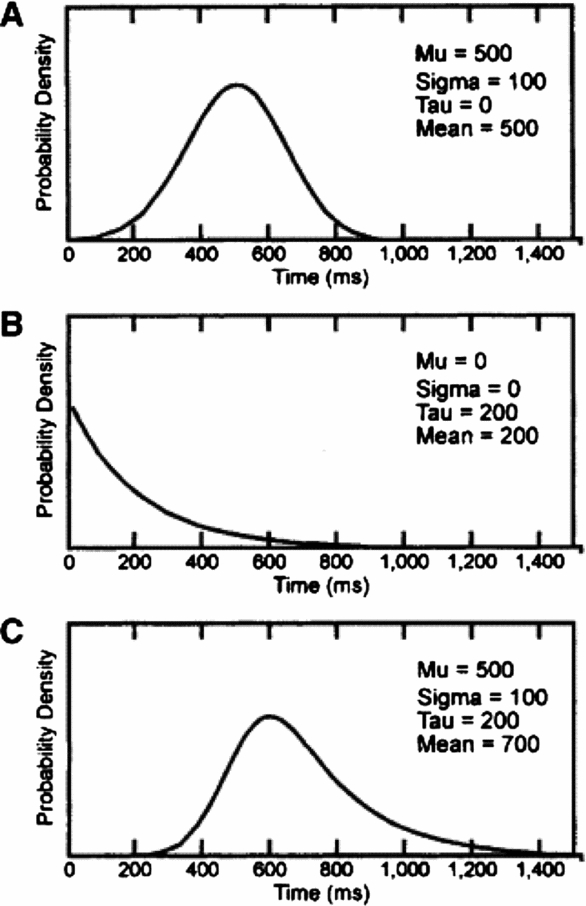
RT distribution analyses can provide more information than traditional analyses of mean response times. There are various mathematical models available to describe RT distributions. The one that has repeatedly been found to produce excellent fit with empirical data and the one that has successfully been used for response conflict tasks is the ex-Gaussian distribution (e.g., Heathcote et al., Reference Heathcote, Popiel and Mewhort1991; Ratcliff, Reference Ratcliff1979; Schmiedek et al., Reference Schmiedek, Oberauer, Wilhelm, Suss and Wittmann2007). The ex-Gaussian distribution results from the convolution of a Gaussian and an exponential distribution. Three parameters characterize the distribution: μ, σ and τ. The mean and variance of the Gaussian part are reflected by μ and σ, respectively; the mean and variance of the exponential part are reflected by τ. The overall mean of the ex-Gaussian distribution is the sum of μ and τ, the overall variance is the sum of σ2 and τ2. Figure 1 illustrates how the convolution of a Gaussian distribution (panel A) and an exponential distribution (panel B) creates a typical RT distribution (panel C). There is no single interpretation of ex-Gaussian parameters (see Table 2 in Matzke & Wagenmakers, Reference Matzke and Wagenmakers2009). But it has been suggested that the μ parameter reflects more stimulus-driven automatic processes, while the τ parameter reflects more attention demanding controlled processes (e.g., Abutalebi, Guidi, Borsa, Canini, Della Rosa, Parris, & Weekes, Reference Abutalebi, Guidi, Borsa, Canini, Della Rosa, Parris and Weekes2015; Balota & Spieler, Reference Balota and Spieler1999; Calabria, Hernandez, Martin & Costa, Reference Calabria, Hernandez, Martin and Costa2011; Hohle, Reference Hohle1965). However, one needs to be very careful with such generalized interpretations. It is very important that the parameters are interpreted within the theoretical framework of a given task (e.g., Balota & Spieler, Reference Balota and Spieler1999). This also means that one needs to always carefully evaluate the mechanisms believed to be relevant for a particular task before applying previous interpretations to new paradigms/findings. Therefore, in what follows, we first discuss results and interpretations of the parameters μ and τ in response conflict tasks before moving on to identify the interpretation that is most consistent with previous findings, considering the processes that are believed to be involved in these tasks.
An example of a Gaussian (A) and an exponential (B) distribution and their convolution into an ex-Gaussian distribution (C). Figure taken from Balota & Spieler (Reference Balota and Spieler1999).

The μ parameter
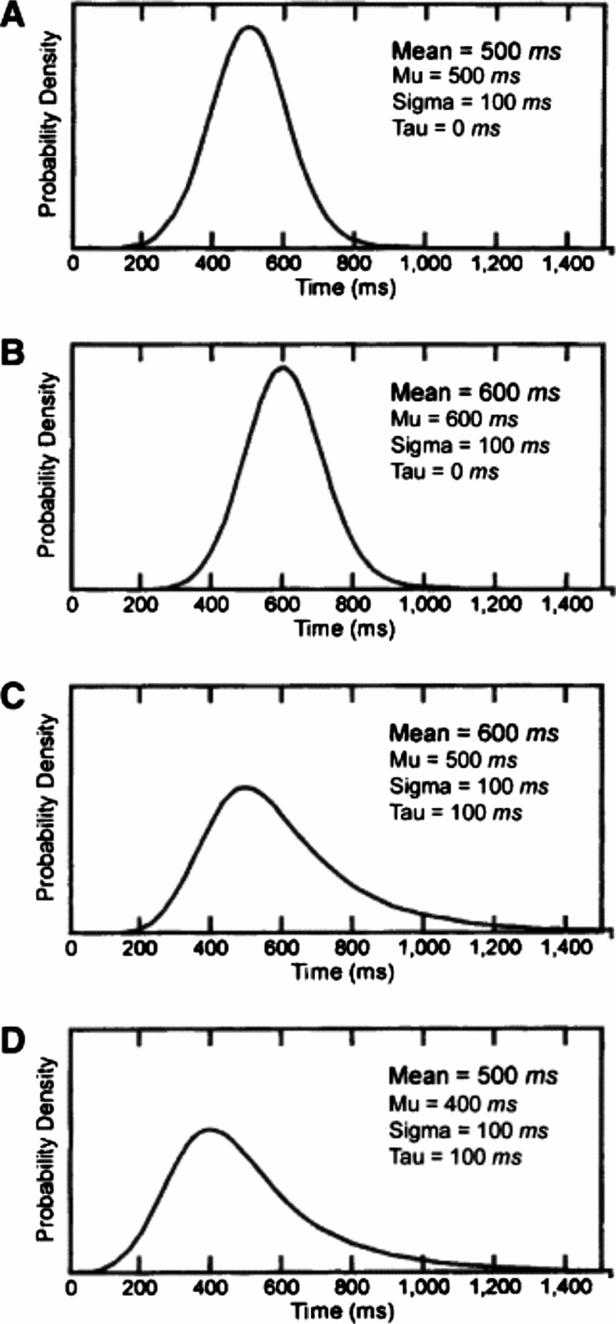
The μ parameter captures the leading edge of an ex-Gaussian distribution. When τ is held constant, an increase in μ results in a positive shift of the distribution (Balota & Yap, Reference Balota and Yap2011). See Figure 2 for an illustration (panels A and B or panels C and D). The μ parameter is usually directly affected by the experimental manipulation of a task, with larger μ values for more demanding conditions than less demanding conditions (e.g., for high versus low frequency items in Balota & Spieler, Reference Balota and Spieler1999). Such a shift in distribution is exactly the pattern observed for conflict tasks (Aarts, Roelofs & van Turennout, Reference Aarts, Roelofs and van Turennout2009; Heathcote et al., Reference Heathcote, Popiel and Mewhort1991; Hervey, Epstein, Curry, Tonev, Arnold, Conners, Hinshaw, Swanson & Hechtman, Reference Hervey, Epstein, Curry, Tonev, Arnold, Conners, Hinshaw, Swanson and Hechtman2006; Leth-Steensen, Elbas & Douglas, Reference Leth-Steensen, Elbaz and Douglas2000; Spieler, Balota & Faust, Reference Spieler, Balota and Faust2000; Tse, Balota, Yap, Duchek & McCabe, Reference Tse, Balota, Yap, Duchek and McCabe2010). For example, for the response distribution of the Colour Stroop task, μ has been found to be significantly larger in the incongruent condition than in the congruent condition (de Zubicaray, McMahon, Eastburn & Pringle, Reference de Zubicaray, McMahon, Eastburn and Pringle2006; Heathcote et al., Reference Heathcote, Popiel and Mewhort1991; Spieler et al., Reference Spieler, Balota and Faust2000; Steinhauser & Hubner, Reference Steinhauser and Hubner2009). The same pattern has also been observed for the Simon task (de Zubicaray et al., Reference de Zubicaray, McMahon, Eastburn and Pringle2006), an adapted version of the Stroop task (similar to the Spatial Stroop task, Aarts et al., Reference Aarts, Roelofs and van Turennout2009), the Letter Flanker task (Blanco & Alvarez, Reference Blanco and Alvarez1994; Spieler et al., Reference Spieler, Balota and Faust2000) and an ANT adapted for children (Epstein, Langberg, Rosen, Graham, Narad, Antonini, Brinkman, Froehlich, Simon & Altaye, Reference Epstein, Langberg, Rosen, Graham, Narad, Antonini, Brinkman, Froehlich, Simon and Altaye2011). And reducing the interference in a Colour Stroop task by spatially separating the colour and the word affected only the μ parameter (Spieler et al., Reference Spieler, Balota and Faust2000). These results fit the idea that whenever conflict is present in a stimulus it needs to be resolved: the interfering information or a response based on this information needs to be inhibited. The conflict resolution therefore consistently adds to the response times and leads to a positive shift of the distribution for the conflict condition (the more difficult it is to resolve the conflict, the more the distribution shifts), without necessarily changing the distribution shape. In other words, an increase in μ reflects the extra processing cost for all responses in conflict conditions.
Possible changes in ex-Gaussian parameters and their effects on the distribution. Figure taken from Balota, Yap, Cortese, and Watson (Reference Balota, Yap, Cortese and Watson2008).

Following the logic that μ reflects the major delay in response when a subject encounters interference, one would expect that a participant group with superior conflict resolution (e.g., through inhibition) ability had a smaller congruency effect in μ. In other words, the distribution shift for a conflict compared to a non-conflict condition should be smaller for a group with superior conflict resolution ability. Therefore, if bilingual speakers have enhanced inhibitory control ability, we would expect that monolingual and bilingual speakers show similar μ in the congruent condition, but bilinguals should have a smaller μ in the incongruent condition than monolinguals.
The τ parameter
The τ parameter, which reflects the tail of the response time distribution has been found to be less affected by condition differences in conflict tasks. In the fore-mentioned studies, τ has been found not to differ between congruent and incongruent conditions; see the Colour Stroop task (Heathcote et al., Reference Heathcote, Popiel and Mewhort1991), the adapted Spatial Stroop task (Aarts et al., Reference Aarts, Roelofs and van Turennout2009) and the Letter Flanker task (Spieler et al., Reference Spieler, Balota and Faust2000). Also, reducing the interference in a Colour Stroop task by spatially separating the colour and the word did not affect τ, but only μ (Spieler et al., Reference Spieler, Balota and Faust2000). Instead, τ has been found to be modulated by attentional control ability that is necessary to maintain the task goal. When comparing performances across participant groups, significantly larger τ has been reported for individuals with attention deficit hyperactivity disorder (ADHD) compared to a healthy control group in various tasks, e.g., in the Conners’ Continuous Performance Test (similar to a Go/No-go task) (Hervey et al., Reference Hervey, Epstein, Curry, Tonev, Arnold, Conners, Hinshaw, Swanson and Hechtman2006), a button pressing task in response to a stimulus circle (Leth-Steensen et al., Reference Leth-Steensen, Elbaz and Douglas2000), as well as in the Attentional Network task, Go/No-Go task, Stop-signal task and N-back task (Epstein et al., Reference Epstein, Langberg, Rosen, Graham, Narad, Antonini, Brinkman, Froehlich, Simon and Altaye2011). Similarly, individuals with very mild dementia of the Alzheimer's type have been found to show significantly larger τ than a healthy control group in a Colour Stroop task, a Simon task and a switching task (Tse et al., Reference Tse, Balota, Yap, Duchek and McCabe2010). When comparing performances within a group but across conditions, Spieler et al. (Reference Spieler, Balota and Faust2000) found increased τ for both congruent and incongruent conditions compared to a neutral condition. This was suggested to be due to participants occasionally switching attention to or devoting more processing to the word dimension rather than the color dimension.
There has been many suggestions that an increased tail of the response time distribution reflects poorer performance of the attentional control system that maintains task goals across time (Tse et al., Reference Tse, Balota, Yap, Duchek and McCabe2010), or in other words, a momentary lapse of attention (Hervey et al., Reference Hervey, Epstein, Curry, Tonev, Arnold, Conners, Hinshaw, Swanson and Hechtman2006; Leth-Steensen et al., Reference Leth-Steensen, Elbaz and Douglas2000; Schmiedek et al., Reference Schmiedek, Oberauer, Wilhelm, Suss and Wittmann2007; Shao, Roelofs & Meyer, Reference Shao, Roelofs and Meyer2012; Unsworth, Redick, Lakey & Young, Reference Unsworth, Redick, Lakey and Young2010). It has been found that working memory measurements are strongly correlated with the τ parameter (Schmiedek et al., Reference Schmiedek, Oberauer, Wilhelm, Suss and Wittmann2007). This finding reinforces the interpretation of τ because working memory capacity can be conceptualized as an attentional control ability required for goal maintenance (Tse et al., Reference Tse, Balota, Yap, Duchek and McCabe2010), and a lapse of attention occurs when such a control fails. This becomes clearer when zooming into the individual response level. A response is likely to be extremely slow when one temporarily loses track of the task goal, be it by attending to something outside the task or by being attracted to a non-relevant feature of the task. This might lead to a delayed processing of the stimulus and/or delayed initiation of a response (Unsworth et al., Reference Unsworth, Redick, Lakey and Young2010). Too much attention to the incongruent feature of the stimulus might also mean that it competes more strongly with the relevant feature and it will take longer to resolve the conflict. It might also lead to an initially wrong response decision that is made on the basis of the wrong information, which is subsequently corrected before the response is executed. When zooming out to the response distribution level, prolonged reactions are reflected in the tail of the distribution, i.e., in τ.
Since τ is driven by extreme responses, while capturing both the degree of extreme responses and the likelihood of such extreme cases, one would expect that people who are less likely to have temporary lapses of attention to have a smaller τ. Therefore, if bilinguals are better at attentional control, τ is expected to be smaller for bilinguals than monolinguals. And this should be the case regardless of the experimental condition (congruent or incongruent condition of a conflict task).
It is important to point out that there has been an alternative interpretation of τ in the bilingual cognitive control literature. Calabria et al. (Reference Calabria, Hernandez, Martin and Costa2011) as well as Abutalebi et al. (Reference Abutalebi, Guidi, Borsa, Canini, Della Rosa, Parris and Weekes2015) interpreted τ as reflecting efficiency in conflict resolution processes, i.e., inhibition. Both base their interpretation on the suggestion that μ reflects rather automatic processes, while τ reflects rather controlled processes (Balota & Spieler, Reference Balota and Spieler1999). And as inhibition is assumed to be a controlled process, it should be reflected in τ. However, there are two points to mention here. First, inhibition is not the only controlled process involved in conflict tasks. There are also attentional control processes and, as argued above, these can similarly be reflected in τ. Related to this, it is noteworthy that Balota and Spieler (Reference Balota and Spieler1999) and Abutalebi et al. (Reference Abutalebi, Guidi, Borsa, Canini, Della Rosa, Parris and Weekes2015) did not clearly distinguish between inhibition and attentional control. Balota and Spieler (Reference Balota and Spieler1999) found longer distribution tails (i.e., increased τ values) in the incongruent condition in a Colour Stroop task for older participants compared to younger participants. They interpreted these longer tails as being due to decrements in efficiency of inhibitory processing; meaning that on some trials additional processing time is needed to resolve the conflict. In other words, an inhibitory system that does not function perfectly can occasionally be slower in inhibiting irrelevant information. Importantly, Balota and Spieler also point out that the increase in τ might mean that older adults more likely experience lapses of attention (Balota & Spieler, Reference Balota and Spieler1999: 476). Similarly, Abutalebi et al. (Reference Abutalebi, Guidi, Borsa, Canini, Della Rosa, Parris and Weekes2015) follows the suggestion that the τ parameter reflects more controlled processing, and, given the task, this means it reflects inhibitory control. But they also note that the smaller τ that they found for bilingual participants in a Flanker task supports the suggestion that bilingual speakers have more efficient attentional control (Abutalebi et al., Reference Abutalebi, Guidi, Borsa, Canini, Della Rosa, Parris and Weekes2015: 207). Thus, in these studies attentional and inhibitory control are not clearly separated. However, the two control processes can be distinguished because they should affect the performance in conflict tasks in different ways. While better attentional control in a participant group should lead to a smaller τ for both incongruent and congruent conditions, more efficient inhibitory control should lead to a smaller τ only in the incongruent condition. For group comparisons it is therefore possible to determine whether a difference in τ is rather due to inhibitory or attentional control differences.
Second, as mentioned above, the general suggestion that μ reflects more automatic processes, while τ reflects more controlled processes needs to be applied with caution. It needs to fit the paradigm and the processes that are assumed to be involved in the task. In the case of Balota and Spieler (Reference Balota and Spieler1999), who seem to be the first to strongly advocate this mapping, they suggested it in relation to a lexical decision task. More precisely, they suggested that in a lexical decision paradigm, automatic processes are sufficient for the majority of the responses, while for some trials (especially low frequency words) these automatic responses might not be sufficient; hence extra slower attention demanding processes (i.e., additional check processes) are required. Importantly, in Balota and Spieler's (Reference Balota and Spieler1999) interpretation, the attention demanding (controlled) processes are assumed to occur for a subset of items, i.e., the slower responses. It therefore makes sense to conclude that τ, which captures only the slower responses of the RT distribution, reflects these controlled processes. In contrast to Balota and Spieler's controlled processes, though, inhibition is necessary for all trials in the incongruent condition of a conflict task, not just the slower ones in the tail of the distribution (reflected by τ). Because anything that affects every response in a distribution should lead to a shift of the distribution, we have therefore argued that a difference in inhibitory control should be reflected in differences in μ. And we have backed up this argument with empirical evidence (larger μ values in incongruent conditions compared to congruent conditions of conflict tasks). Nevertheless, we do not preclude the possibility that a less efficient inhibitory control system could also lead to increased response tails in incongruent conditions. It might be that the inhibition system does not always work optimally and might occasionally struggle to inhibit irrelevant information / conflicting responses. Importantly, though, better inhibitory control in a participant group should in any case manifest itself in the main body of the RT distribution, independent of whether it also affects distribution tails. In other words, if bilingual speakers are better at inhibitory control, they should show smaller μ and potentially τ values in incongruent conditions of conflict tasks compared to monolingual speakers. Therefore, finding smaller bilingual τ values for incongruent conditions without effects on μ cannot be due to superior inhibitory control abilities.
Ex-Gaussian analysis and bilingual speakers
A recent review (Zhou & Krott, Reference Zhou and Krott2015) of studies compared monolingual and bilingual performance in the three most commonly tested non-verbal interference tasks (Simon, Spatial Stroop, and Flanker), focusing on the relation between the inclusion of long responses into analyses and the likelihood of reporting a bilingualism effect. It was found that studies that allowed long responses or those that did not trim extreme responses were more likely to observe a bilingual advantage. This finding suggests that the bilingual advantage in conflict tasks is located in the slower responses rather than in all responses and it should be visible in the tail of response time distributions. Given our argument that an inhibitory advantage should affect all responses, while an attentional advantage should affect response distribution tails, the finding suggests that bilinguals might not possess an enhanced inhibitory control ability, but rather an enhanced attentional control ability. To our knowledge, only two previous studies have compared the performance of monolingual and bilingual speakers in conflict tasks with ex-Gaussian analyses: Calabria et al. (Reference Calabria, Hernandez, Martin and Costa2011) and Abutalebi et al. (Reference Abutalebi, Guidi, Borsa, Canini, Della Rosa, Parris and Weekes2015). The pattern of results rather supports the hypothesis of bilingual enhanced attentional control. But the picture is complex.
Calabria et al. (Reference Calabria, Hernandez, Martin and Costa2011) re-analyzed results of the Flanker component of the ANT originally reported in Costa et al. (Reference Costa, Hernandez and Sebastian-Galles2008) and Costa et al. (Reference Costa, Hernandez, Costa-Faidella and Sebastian-Galles2009) by means of an ex-Gaussian analysis. Results showed that, in contrast to monolinguals, bilinguals had no congruency effect in τ when the experiment contained only 25% inconsistent trials (versus 33%). This by itself could mean that, when conflict situations are relatively rare, bilinguals are better at inhibitory control or they sustain attention better. Their results also revealed an overall speed advantage for bilinguals, in both the Gaussian and the exponential part of response distributions. The authors speculated that the overall speed advantage in the Gaussian component might be due to advanced functioning of the monitoring system. This is in line with the assumption that bilinguals have better attentional control abilities. As argued above, because bilinguals did not show a reduced congruency effect in the Gaussian part of the response distributions, the results suggest that bilinguals might not have an advanced conflict resolution ability. However, while Calabria et al.’s (Reference Calabria, Hernandez, Martin and Costa2011) study is very interesting for the present study, it was not aimed at investigating the role of attentional control. Following a more traditional data analysis approach, the authors removed responses above 3 SD from the data. Although these are very few responses, it is these very long responses that can have a big impact on τ (since it is a reflection of the mean of the tail) and are therefore important if one wants to study the effect of attentional control.
Abutalebi et al. (Reference Abutalebi, Guidi, Borsa, Canini, Della Rosa, Parris and Weekes2015) investigated the bilingual advantage in the elderly using ex-Gaussian analyses, analyzing all responses without trimming the data. Using a Flanker task, they found a bilingual advantage in the τ component in the incongruent condition and the μ component in the congruent condition. However, in terms of statistical analysis, they focused on independent sample t-tests for each parameter and for each condition separately. Therefore, we do not have information about the main effect of Participant Group or about the interaction between Participant Group and Condition. Figure 2 in Abutalebi et al. (Reference Abutalebi, Guidi, Borsa, Canini, Della Rosa, Parris and Weekes2015) shows that, descriptively, bilinguals had smaller τ than monolinguals overall, consistent with the enhanced attentional control hypothesis. The interactions between Group and Condition were not clear from the figure. Therefore it is unclear whether bilinguals showed enhanced inhibitory control as well.
While results from Calabria et al. (Reference Calabria, Hernandez, Martin and Costa2011) and Abutalebi et al. (Reference Abutalebi, Guidi, Borsa, Canini, Della Rosa, Parris and Weekes2015) are very promising, they used the same experimental paradigm. It is essential to investigate effects in various tasks to establish the generalizability of the findings. This is especially important because of the contradictory findings in the literature with regards to a bilingual advantage in conflict tasks (for a review, see Hilchey & Klein, Reference Hilchey and Klein2011; de Bruin, Treccani & Della Sala, Reference de Bruin, Treccani and Della Sala2015). And it addresses the problem that executive function tasks are never pure measures of a particular executive function. They are always contaminated by other task demands.
Other studies investigated how bilingual language abilities such as proficiency affects cognitive control using an ex-Gaussian analytical approach. For example, Tse and Altarriba (Reference Tse and Altarriba2012) used a Colour Stroop task and found that participants’ language abilities interacted with task performance. This implies that using verbal conflict tasks might tap participants’ language abilities rather than non-linguistic cognitive control. Therefore, we focused on non-verbal interference tasks in the current study.
Current study
To investigate the inhibitory and attentional control account of the bilingual advantage in non-verbal conflict tasks, we tested English monolingual and English–Chinese bilingual young adults in the Simon, Spatial Stroop and Flanker tasks. These three tasks were chosen because of three reasons. First, they have been widely used in the bilingual literature and results are very often mixed (see Hilchey & Klein, Reference Hilchey and Klein2011; Zhou & Krott, Reference Zhou and Krott2015). We tested the tasks with a single group of participants in order to determine the consistency of the bilingualism effect. Second, executive control tasks do not provide pure measures of a cognitive function, which is also known as the task impurity problem (Rabbitt, Reference Rabbitt and Rabbitt1997). By using three inhibition tasks, we aimed to target the common cognitive control ability needed for the tasks. Third, we targeted three tasks that do not require any verbal responses (see Colour Stroop task). Bilinguals have been found to be disadvantaged in naming tasks, e.g., bilinguals have been found to be slower than monolinguals when naming pictures in their dominant language (Gollan, Montoya, Fennema-Notestine & Morris, 2005). Their responses in verbal conflict tasks might therefore not only be affected by their domain-general executive function abilities, but also their verbal abilities.
We compared the two participant groups in terms of accuracy rates, traditional condition means (with and without trimming very slow responses), and response distributions (μ and τ) in conflict and non-conflict conditions. If inhibitory control underlies the bilingual advantage in interference tasks, bilinguals should have smaller congruency effects in the Gaussian components (μ) of the response distributions and potentially in the exponential component (τ) in all three tasks. If attentional control underlies the advantage, bilinguals should have shorter tails (τ) regardless of task. And this should be the case regardless of condition. However, as we have seen in Calabria et al. (Reference Calabria, Hernandez, Martin and Costa2011), participants might be able to adjust their attentional control depending on task conditions. We might therefore see a stronger attentional control advantage in harder conditions, i.e., in incongruent conditions. Given the findings by Calabria et al. (Reference Calabria, Hernandez, Martin and Costa2011) and Abulatebi et al. (Reference Abutalebi, Guidi, Borsa, Canini, Della Rosa, Parris and Weekes2015), we might find both smaller congruency effects in the Gaussian part of the response distibutions and shorter tails for bilinguals, which would imply that bilinguals possess both inhibitory and attentional control advantages.
Method
Participants
Ninety-nine participants took part in the experiment: 51 monolingual native English speakers and 48 English–Chinese (Chinese–English) bilingual speakers. They were mostly undergraduate and postgraduate students at the University of Birmingham and participated either for course credits or cash. Apart from those, eight of the bilingual speakers were students of the Chinese University of Hong Kong and were paid for their participation.
For the analysis, participants were selected on the basis of their responses to a questionnaire about their language use history (see Appendix 1), adapted from Silverberg and Samuel (Reference Silverberg and Samuel2004). This questionnaire gathered demographic information such as age and education. Participants were also asked to rate their self-perceived proficiency in English and to list all the languages that they learnt or were able to speak, as well as the age at which they started to learn them. In addition, bilingual speakers were asked to rate their proficiency in Chinese. They also indicated their current language use pattern (e.g., using mainly one language or using both languages on a daily basis). To be classified as bilingual, the following criteria had to be met: the participant (a) learnt English and Chinese before age 10, (b) had more than 50% native-like proficiency in both languages, and (c) used both languages on a daily basis at the time of the experiment, either in the same setting or in different settings.
Monolingual English speakers were defined as follows: the participant (a) did not speak another language fluently (i.e., proficiency level of another language, if any, was below 50%), (b) did not speak another language on a daily basis, and (c) did not learn another language before age 10.
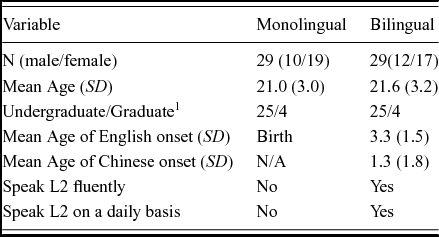
These criteria led to 29 English–Chinese bilingual speakers being included into the analyses. Twenty-two of those grew up with Chinese as their L1, two participants with English as L1, and five were simultaneous bilinguals. 29 monolingual English speakers were randomly selected from those that met the monolingual standard to match the bilinguals in age, t (50) = −.74, p > .05, and education, X 2 (1, N = 58) = 0, p > .05. In addition, bilingual speakers were equally proficient in English and Chinese, t (28) = .13, p > .05. See Table 1 for a summary of the demographic information of the two participant groups.
Demographic Data of Monolingual and Bilingual Speakers

Note. Undergraduate = students pursuing a bachelor's degree or having been awarded a bachelor's degree within the last 12 months. Graduate = students with a master's degree or above.
General design and procedure
All participants went through the same sequence of tasks, namely Flanker task, Spatial Stroop task and Simon task. Participants then completed the language history questionnaire described above.
Flanker task
Material
Using the Erikson Flanker paradigm (Eriksen & Eriksen, Reference Eriksen and Eriksen1974), the current study adapted the procedure by Costa et al. (Reference Costa, Hernandez, Costa-Faidella and Sebastian-Galles2009). Each stimulus consisted of five arrows in a row, with the central arrow being the target and two arrows on each side being the flankers. Each arrow was approximately 0.55 degree in visual angle; distance between arrows was approximately 0.06 degree.
Procedure
In this and the following tasks, participants were instructed to sit approximately 60 cm from the monitor. They pressed a left and a right button to indicate the direction of the central arrow using a Cedrus RB-834 response pad, which also measured response time. Each trial started with a fixation cross for 400 ms followed by the stimulus, which disappeared with the response or after 1700 ms in case of no response. Stimuli appeared randomly either above or below the fixation cross with a 50/50 chance of occurrence. In a congruent trial the central arrow and the flankers pointed to the same direction, in an incongruent trial they pointed to opposite directions. In order to increase the difficulty of the task, 75% of the trials were congruent and 25% were incongruent, which is equal to the high response monitoring condition in Costa et al. (Reference Costa, Hernandez, Costa-Faidella and Sebastian-Galles2009). Twenty-four practice trials were followed by two blocks of 48 trials. The sequence of stimuli was randomized, with a different randomization for each participant.
Spatial Stroop task
Material
The Spatial Stroop task is a modified version of the Simon task. Adapting the design by Bialystok (Reference Bialystok2006), a single arrow was used as the stimulus, 6.5 cm in length with a tail of 0.5 cm in width. The widest point of the arrow was 1.5 cm.
Procedure
Participants pressed a left or right button to indicate the direction of the arrow using a Cedrus RB-834 response pad. Each trial started with a fixation cross for 800 ms and a subsequent 250 ms blank screen. Then an arrow (pointing to the left or right) was presented 7 cm to the left or right of the fixation cross. The target disappeared with the response or after 1000 ms in case of no response, followed by a 500 ms blank screen. Each participant completed 24 practice trials and 64 test trials. In congruent trials, the arrow pointed to the same side as the presentation side on the screen (e.g., the arrow pointed to the right and was presented on the right side of the screen). In incongruent trials, the arrow pointed to the opposite side as the presentation side (e.g., the arrow pointed to the right and was presented on the left side of the screen). Each combination of arrow and position had equal probability of occurrence, which means congruent and incongruent trials occurs equally likely; and the stimuli were presented randomly, with a different randomization for each participant.
Simon task
Material
Stimuli were red or blue squares (2.2 cm by 2.2 cm).
Procedure
The procedure was the same as that of the Spatial Stroop task, except that the stimuli were arranged into pre-determined pseudo-random orders so that each colour and spatial combination occurred with equal likelihood. Participants pressed a left (red) or a right (blue) button to indicate the colour of the stimulus with their index fingers.
Results
Even though extreme responses were left in the analyses, one participant was excluded from the monolingual group who had extreme RTs in the Simon task (i.e., above four standard deviations of the mean RT of all participants). This participant clearly performed the task in a different way from other participants and did this consistently during the experiment. Response accuracies, response speed and estimated ex-Gaussian distribution parameters were analyzed using a 2 (Condition) x 3 (Task) x 2 (Participant Group or Group) mixed design ANOVA, with Group being a between-group factor. Greenhouse-Geisser corrections were performed when appropriate. Bonferroni correction was applied when following up any interaction. When reporting results, we will focus on main effects of Condition and Group as well as on any interactions involving Group.
Accuracy
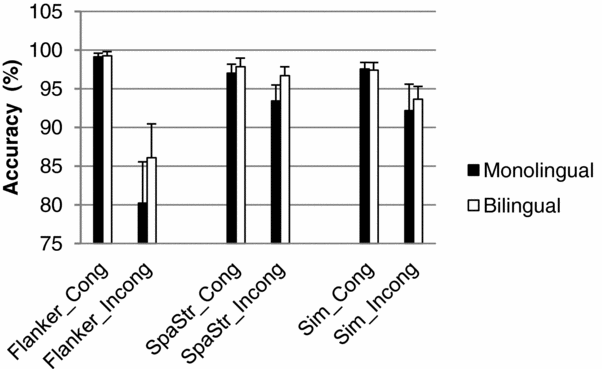
Accuracy rate was the percentage of correct responses and was arcsine-transformed for statistical analyses. For illustration purposes, Figure 3 shows the average accuracy for each group per condition per task.
Accuracy for Flanker task (left), Spatial Stroop task (middle), and Simon task (right) for monolingual and bilingual speakers for congruent (Cong) and incongruent (Incong) conditions. Error bars represent 95% confidence intervals.

The ANOVA showed a significant main effect of Condition, F (1, 55.0) = 106.45, p <.001, ηp 2 = .66. Participants were more accurate in congruent conditions than in incongruent conditions. The main effect of Group was not significant, F (1, 55) = 2.16, p > .05, ηp 2 = .04. Similarly, the two-way interaction between Condition and Group was not significance, F (1, 55) = 1.07, p > .05, ηp 2 = .02. The two-way interaction between Task and Group was significant, F (2, 109.5) = 3.4, p = .037, ηp 2 = .06. Follow up tests revealed that, compared to monolingual speakers, bilingual speakers were more accurate overall in the Spatial Stroop task, F (1, 55) = 4.77, p = .032, ηp 2 = .08; but not the Flanker task, F (1, 55) = 2.6, p > .05, ηp 2 = .05, or the Simon task, F (1, 55) = .12, p > .05, ηp 2 = .002. The three-way interaction of Task, Group and Condition was not significant, F (1.9, 105.3) = 1.09, p > .05, ηp 2 = .02.
Reaction times
Reaction times (RTs) were analyzed in two ways: by a conventional analysis of condition means to allow comparisons to previous findings and by an analysis of RT distributions. The analysis of condition means was done with and without trimming off very slow responses; this allowed us to investigate the effect of data trimming on observing a bilingualism effect. For the RT distribution analysis, response times of accurate responses were fitted with ex-Gaussian distributions for each participant in each condition and each task. The ex-Gaussian distribution parameters μ and τ were estimated using the QMPE software, which uses the quantile maximum likelihood estimation method (Brown & Heathcote, Reference Brown and Heathcote2003). Parameters were estimated for each participant under each condition using five quintiles. All ex-Gaussian parameters were successfully yielded with an average iteration of 14.7. Parameter estimations were all trustworthy according to the technical manual since the exit codes were all below 128. In addition to ex-Gaussian analyses, following Tse et al.’s (Reference Tse, Balota, Yap, Duchek and McCabe2010) suggestion, quantile analyses were conducted to obtain converging evidence for the quality of fit of the RT distributions by the ex-Gaussian models (see appendix 2).
Mean response time analyses
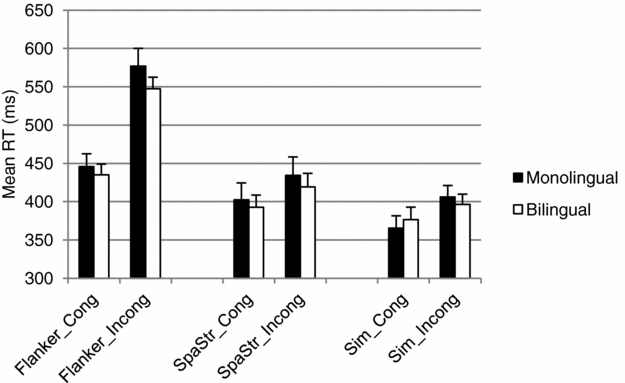
When entering all data (see Figure 4) without taking out outliers, there was a significant main effect of Condition on response times, F (1, 55) = 544.4, p <.001, ηp 2 = .91, with incongruent conditions leading to longer response times than congruent conditions. The main effect of Group was not significant, F (1, 55) = 1.16, p > .05, ηp 2 = .02. Importantly, there was a significant Condition by Group interaction, F (1, 55) = 8.46, p = .005, ηp 2 = .13. Follow-up tests showed that the two participant groups did not differ on mean RTs for congruent stimuli, F (1, 55) = 0.97, p > .05, ηp 2 = .002, but there was a trend for a difference for incongruent stimuli, F (1, 55) = 3.07, p = .09, ηp 2 = .05. This pointed to a difference in terms of congruency effect (incongruent condition – congruent condition) that the two groups suffered. Such difference was confirmed by directly comparing the congruency effect of the two groups. Bilinguals showed significantly reduced congruency effects compared with monolinguals, F (1, 55) = 8.46, p = .005, ηp 2 = .13. Finally, the two-way interaction between Task and Group was not significant, F (2, 109.93) = 1.52, p > .05, ηp 2 = .03, neither was the three-way interaction, F (2, 91.58) = 1.37, p > .05, ηp 2 = .02.
Mean RT without excluding slow responses for Flanker task (left), Spatial Stroop task (middle) and Simon task (right) for monolingual and bilingual speakers for (Cong) and incongruent (Incong) conditions. Error bars represent 95% confidence intervals.

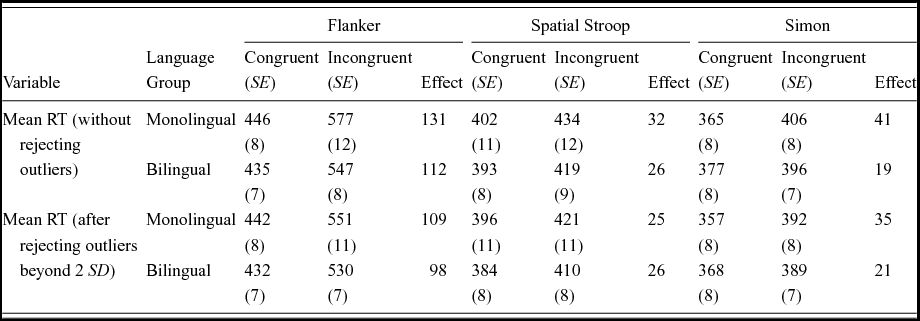
To investigate the effect of data trimming, a traditional analysis of response time means was performed after removing responses above 2SD of the participant's mean RT (see Table 2 for means and SDs with and without removing outliers). Just as with outliers left in, there was a significant main effect of Condition, F (1, 55) = 626.55, p < .001, ηp 2 = .92, and no main effect of Group, F (1, 55) = .62, p > .05, ηp 2 = .01. Interestingly, the two-way interaction between Condition and Group was marginally significant, F (1, 55) = 4.05, p = .05, ηp 2 = .07, which had been highly significant and with a larger effect size when leaving responses above 2SDs in the analysis. Follow up tests revealed no significant difference between the two participant groups in the congruent condition, F (1, 55) = 0.11, p > .05, ηp 2 = .002), nor in the incongruent condition, F (1, 55) = 1.41, p > .05, ηp 2 = .03. An analysis of the congruency effects (incongruent condition – congruent condition) showed only a marginally larger congruency effect for bilinguals than monolinguals across all tasks, F (1, 55) = 4.05, p = .05, ηp 2 = .07, which had been highly significant when leaving slow responses in. As before, there was no interaction between Task and Group, F (2, 109.5) = 1.53, p > .05, ηp 2 = .03, or a three-way interaction, F (2, 103.8) = 1.83, p > .05, ηp 2 = .03. In sum, this additional analysis shows that trimming the data from very slow responses can substantially reduce the bilingual advantage in a conflict task. This also means that the bilingual advantage might be at least partly located in the very slow responses. A detailed inspection of RT distributions as presented below will provide us with more information as to whether an effect is present in the Gaussian and/or the exponential component of the response distributions.
Means of RT Before and After Removing Outliers

Ex-Gaussian analyses
The μ parameter
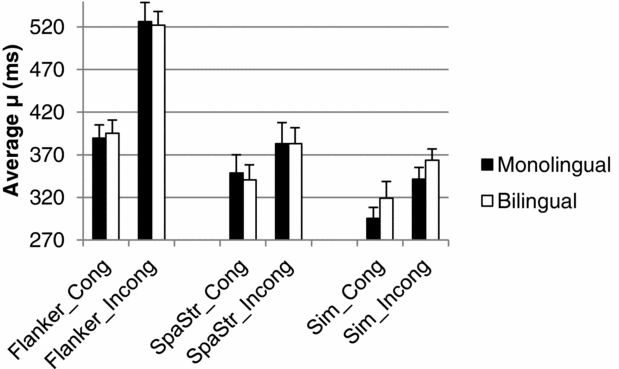
Figure 5 shows the average μ for each group per condition per task. There was a significant main effect of Condition, F (1, 55) = 320.49, p < .001, ηp 2 = .85, with larger μ for incongruent conditions than congruent conditions. There was no main effect of Group, F (1, 55) = .56, p > .05, ηp 2 = .01, indicating that monolingual and bilingual speakers did not differ with respect to μ. The two-way interaction between Task and Group showed only a trend, F (1.9, 106.7) = 2.62, p = .08, ηp 2 = .05. Follow-up analyses showed that the two groups had very similar performance in the Flanker task, F (1, 55) = 0.006, p > .05, ηp 2 = .009, and the Spatial Stroop task, F (1, 55) = 0.09, p > .05, ηp 2 = .002, while monolinguals were overall faster in the Simon task, F (1, 55) = 5.92, p = .02, ηp 2 = .097. Most importantly, there was neither a Condition by Group interaction, F (1, 55) = .02, p > .05, ηp 2 < .01, nor a three-way interaction, F (2,107.2) = .59, p > .05, ηp 2 = .01, meaning that the μ congruency effects were the same for the two participant groups, and this was the case for all tasks.
Means of the Ex-Gaussian parameter μ estimated from individual RT distributions for monolingual and bilingual speakers for congruent (Cong) and incongruent (Incong) conditions. Flanker task (left), Spatial Stroop task (middle) and Simon task (right). Error bars represent 95% confidence interval.

The τ parameter
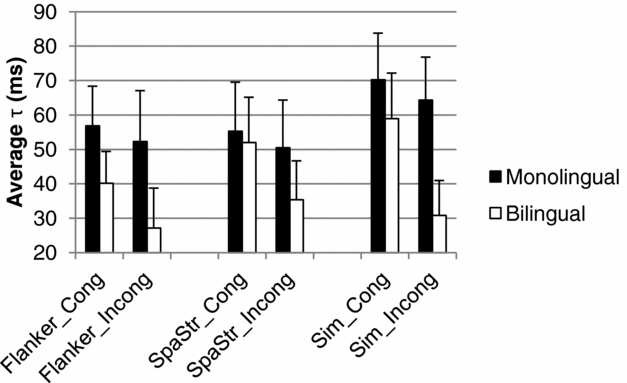
Figure 6 shows the average τ for each group per condition per task. There was a significant main effect of Condition, F (1, 55) = 10.33, p = .002, ηp 2 = .16, with the incongruent condition having smaller τ than the congruent condition. There was a significant main effect of Group, F (1, 55) = 17.91, p <.001, ηp 2 = .25, with bilingual speakers having a smaller τ than monolingual speakers. The two-way interaction between Condition and Group showed a trend, F (1, 55) = 3.51, p = .07, ηp 2 = .06. Follow-up tests revealed that bilingual speakers had significant smaller τ in the incongruent condition, F (1, 55) = 19.89, p < .001, ηp 2 = .26, while this difference was a trend in the congruent condition, F (1, 55) = 3.35, p = .07, ηp 2 = .06. Therefore, the τ was more consistently smaller for bilinguals in the incongruent condition. There was no significant interaction between Task and Group, F (2, 109.5) = 1.28, p > .05, ηp 2 = .02, nor a three-way interaction, F (2, 109.4) = .38, p > .05, ηp 2 = .01, indicating that the τ pattern was consistent across the three tasks for the two participant groups, with bilinguals having a smaller τ in both conditions.
Means of the Ex-Gaussian parameter τ estimated from individual RT distributions for monolingual and bilingual speakers for congruent (Cong) and incongruent (Incong) conditions. Flanker task (left), Spatial Stroop task (middle) and Simon task (right). Error bars represent 95% confidence interval.

Discussion
The aim of the current study was to investigate the contribution of inhibitory control and attentional control to the bilingual advantage by investigating error patterns and utilizing ex-Gaussian analyses of response time distributions in three non-verbal interference tasks. We argue that the result patterns suggest enhanced bilingual attentional control, but not enhanced inhibitory control.
Response accuracies only showed a weak advantage for bilingual speakers in our tasks: bilinguals were more accurate than monolinguals independent of condition, but only significantly so in the Spatial Stroop task. It is not possible to tell whether this was caused by enhanced inhibitory and/or attentional control ability.
The analysis of the mean response times with very slow responses included showed that bilingual speakers had a smaller congruency effect. However, this result cannot distinguish between an advanced bilingual attentional control ability and an enhanced inhibitory control ability. Only when removing very slow responses from the analysis, the picture becomes clearer because it reduced the congruency effect to a trend. Therefore, the difference between monolinguals and bilinguals appears to be rather driven by very slow responses, in line with a difference in attentional control. This also means that previous findings of bilingual advantages based on reaction times in conflict tasks might have overgeneralized effects situated in the response tails to the responses as a whole (see also discussion in Zhou & Krott, Reference Zhou and Krott2015).
Results of the distribution analysis strongly confirm this tentative conclusion. Across all tasks, the Gaussian component (μ) was consistently larger in the incongruent condition than in the congruent condition. This means that μ was sensitive to interference, with average processing times being longer when interference was present. Importantly, the two participant groups did not differ in terms of the congruency effect. Also, we did not observe that bilinguals had smaller μ values than monolinguals. Together this suggests that bilinguals do not appear to resolve conflict better than monolinguals by, for instance, more strongly inhibiting incongruent information.
Importantly, results for the ex-Gaussian parameter τ (i.e., the tail of the RT distribution) are consistent with enhanced bilingual attentional control, or more specifically with enhanced bilingual sustained attention (alertness). The bilingual group had smaller τ values and therefore shorter RT distribution tails regardless of condition (congruent or incongruent) and regardless of task. The τ parameter reflects both the frequency and the degree of excessively long RTs. Therefore, the results mean that bilingual speakers had fewer excessively long RTs, and their extreme responses were not as extreme as those of monolingual speakers. Importantly, this was the case not only in the incongruent condition but also in the congruent condition (even though to a somewhat lesser degree). Therefore, the results of the τ parameter reflect enhanced performance of bilinguals in general, not restricted to situations that request dealing with conflicting information. Furthermore, this enhanced performance was consistent across all three interference tasks, confirming that we are dealing with an ability that is not restricted to a particular task, but rather domain-general. Given that our three interference tasks were relatively similar, the exact extent of the generalizability still needs to be established.
On first sight, finding such consistent results across the three tasks might be surprising because the tasks differ in various respects that can potentially affect strategies and therefore response distributions. First, these tasks do not measure exactly the same cognitive constructs. For instance, the Simon task taps stimulus-response inhibition, whereas the Spatial Stroop task taps stimulus-stimulus inhibition (Blumenfeld & Marian, Reference Blumenfeld and Marian2014). Second, the rate of incongruent/congruent trials differed, with 75/25 in the Flanker task and 50/50 in both the Spatial Stroop and Simon task. The latter difference could have potentially affected the overall level of monitoring (e.g., Costa et al., Reference Costa, Hernandez, Costa-Faidella and Sebastian-Galles2009). Third, the time allowed for making a response differed across the tasks, with 1700 ms for the Flanker task and 800 ms for the other two tasks. This could have altered the response strategy. Despite these task differences, we only observed two isolated differences in results (i.e., a higher bilingual accuracy in the Spatial Stroop task discussed above and faster monolingual μ values in the Simon task discussed below) and neither can be explained by methodological differences. In contrast, we observed a very consistent result pattern across the three tasks with regards to distribution tails. This does not mean that the three tasks measured the same attention construct, but it suggests that bilingualism affects an aspect of cognitive control that is common across the tasks. We suggest that this common aspect is the maintenance of task goals and the prevention of lapses of attention. On the other hand, the individual task differences do suggest that executive control tasks may not all measure the exact same construct, or that not on all attentional conditions bilinguals outperform monolinguals.
A further result of our study was that incongruent conditions led to shorter RT distribution tails than congruent conditions. If a shorter tail reflects increased attentional control, then the results suggest that incongruent trials elevated the level of attentional control and that this was the case in both monolingual and bilingual speakers. The processing system therefore appears to be able to detect incongruent information and increase attentional engagement accordingly. This increase of attentional engagement can be explained with the classic conflict-monitoring system proposed by Botvinick and colleagues (Botvinick, Braver, Barch, Carter & Cohen, Reference Botvinick, Braver, Barch, Carter and Cohen2001; Botvinick, Nystrom, Fissell, Carter & Cohen, Reference Botvinick, Nystrom, Fissell, Carter and Cohen1999). A conflict-monitoring system detects conflict and modulates online shift of attentional control. This has been called upon to explain sequence effects in interference tasks (Gratton, Coles & Donchin, Reference Gratton, Coles and Donchin1992; Wuhr & Ansorge, Reference Wuhr and Ansorge2005), i.e., that the congruency effect is smaller following an incongruent trial compared with a congruent trial. This also explains why a bilingual advantage has been found under more demanding circumstances, for instance in the higher monitoring condition of Costa et al. (Reference Costa, Hernandez and Sebastian-Galles2008), where incongruent trials were relatively rare. This suggests that attentional control is not a static mechanism or ability, but rather context sensitive. Once a response conflict is detected, attentional control is elevated. As a result a person becomes particular vigilant and engages attention to a greater degree, consequently reducing the occurrences of lapses of attention. Last but not least, the tendency for an interaction between Group and Condition suggests that bilinguals might be able to adapt the level of attentional control more swiftly and flexibly than monolinguals. In other words, bilinguals might not only be better at sustaining their attention during a conflict task as suggested in their shorter response tails in general, their conflict monitoring system might also detect a conflict more easily, leading to fast adjustment of attentional control in a conflict condition. Note that the tendency for an interaction between Group and Condition for response distribution tails cannot be interpreted as being due to better inhibitory control in bilingual speakers because, as outlined in the introduction, for such a conclusion, we would have needed to find the same pattern in the Gaussian part of the response distributions.
In contrast to our interpretation of bilinguals’ shorter RT distribution tails as enhanced attentional control ability, one might argue that bilinguals were more eager to respond quickly compared to monolingual speakers. But this cannot be the case because this should have led to a speed-accuracy trade-off. However, bilinguals had shorter response distribution tails while being similarly, if not more, accurate, compared to monolinguals.
Comparing our findings with those of Calabria et al. (Reference Calabria, Hernandez, Martin and Costa2011) and Abutalebi et al. (Reference Abutalebi, Guidi, Borsa, Canini, Della Rosa, Parris and Weekes2015), converging evidence for an attentional account of the bilingual advantage emerges, even though the results are not exactly the same. Our findings for the exponential component of the response distributions are consistent with Calabria et al.’s (Reference Calabria, Hernandez, Martin and Costa2011) finding of overall reduced tails for bilingual speakers. Descriptively, this is also true for Abutalebi et al. (Reference Abutalebi, Guidi, Borsa, Canini, Della Rosa, Parris and Weekes2015), although they did not report whether the main effect of condition was significant. Also, neither of the studies suggests a strong role of inhibitory control, due to the lack of an interaction between Group and Condition in the Gaussian component of the response distributions.
However, Calabria et al. (Reference Calabria, Hernandez, Martin and Costa2011) and Abutalebi et al. (Reference Abutalebi, Guidi, Borsa, Canini, Della Rosa, Parris and Weekes2015) reported additional effects, i.e., an (overall) advantage of bilingualism in the Gaussian component of the response distributions, which was not observed in the present study. Instead, we found some evidence for the opposite, in faster monolingual than bilingual responses in the Gaussian component in the Simon task. It is not clear why the Simon task has led to this result, but given that it was not replicated in the other two tasks, not even in the Spatial Stroop task, which was very similar to the Simon task, it does not seem to be justified to over-interpret this result. Instead we would like to point out two potential causes for the discrepancies between our findings and those of Calabria et al. (Reference Calabria, Hernandez, Martin and Costa2011) and Abutalebi et al. (Reference Abutalebi, Guidi, Borsa, Canini, Della Rosa, Parris and Weekes2015), which are not mutually exclusive. First, the discrepancy could have been caused by differences in the paradigms. While in the present study a ‘pure’ Flanker task was conducted (among other interference tasks), both Calabria et al. (Reference Calabria, Hernandez, Martin and Costa2011) and Abutalebi et al. (Reference Abutalebi, Guidi, Borsa, Canini, Della Rosa, Parris and Weekes2015) conducted an ANT study where stimuli were preceded by cues. Second, the discrepancy might have been caused by the difference in sample population. While Abutalebi et al. (Reference Abutalebi, Guidi, Borsa, Canini, Della Rosa, Parris and Weekes2015) tested elderly adults, the current study tested young adults. The former age group has seen rather consistent evidence for bilingual advantage (e.g., Bialystok et al., Reference Bialystok, Craik, Klein and Viswanathan2004; Bialystok et al., Reference Bialystok, Craik and Luk2008; Salvatierra & Rosselli, 2011). A lack of an effect in the young adult group in the Flanker and Spatial Stroop task in our study might therefore be due to a ceiling effect.
The overall speed advantage in the Gaussian part of the response distributions for bilinguals in Calabria et al. (Reference Calabria, Hernandez, Martin and Costa2011) and Abutalebi et al. (Reference Abutalebi, Guidi, Borsa, Canini, Della Rosa, Parris and Weekes2015) does not support bilingual enhanced inhibitory control abilities because the bilingual advantage was not only present in the incongruent condition. Calabria et al. (Reference Calabria, Hernandez, Martin and Costa2011) suggest that the overall speed advantage reflects a more efficient monitoring mechanism in bilingual participants. Alternatively, this speed advantage could be accounted for by an enhanced attentional control ability. This might be the case if enhanced attentional control in the form of an enhanced alertness of the mental state led to enhanced processing speed. Posner and Petersen (Reference Posner and Petersen1990) proposed that alertness can affect the rate at which a response is selected. Therefore, bilinguals’ overall faster responses in the Gaussian component might either be due to a more efficient monitoring system or to enhanced attentional control, which facilitated responses.
Our finding that bilingual speakers showed enhanced attentional control abilities (smaller τ in all conditions) is also conceptually consistent with Tse and Altarriba (Reference Tse and Altarriba2012) who found for a linguistic Colour Stroop task that L1/L2 proficiency was negatively correlated with the length of the distribution tails (τ), regardless of condition. In other words, more proficient individuals were better at maintaining attention during the task. In contrast to our finding, they also observed that language proficiency modulated the Stroop effect in the Gaussian component (μ), with more proficient individuals having a smaller Stroop effect in the Gaussian component, suggesting that bilinguals with higher proficiency have developed enhanced inhibitory control compared with lower proficiency speakers. However, unlike tasks used in the present study, the Colour Stroop task involves verbal responses. It might be that bilingual's constant exercise of inhibitory control in language production enhances his or her conflict resolution ability in verbal tasks. Our results suggest that such ability does not necessarily transfer to non-verbal tasks.
What remains to be explained is why the bilingual advantage has materialized itself in previous studies that analysed mean RTs sometimes in an overall speed advantage and sometimes in a reduced congruency effect, and sometimes in both. By examining our data we have seen that effects in the tail of response time distributions can translate into effects on response times in a traditional analysis of response means. This suggests that both overall speed advantages and reduced congruency effects can stem from response distribution tails. However, the relation between effects in tails and in mean response times is not a simple one-to-one translation. For instance, in the present study, overall effects in the tails of response distributions were found, but a reduced congruency effect was found instead in the traditional analysis of response means. The latter effect was descriptively present in the tails as well, but did not reach significance. We also found that trimming very slow responses can reduce a bilingual effect in a traditional analysis of condition means. Therefore, as we have argued elsewhere (Zhou & Krott, Reference Zhou and Krott2015), results of traditional analyses likely depend on the combination of data trimming procedures and the effects present in the tails.
Despite being a promising approach, further validation of it is still required to enhance our understanding of what ex-Gaussian parameters are measuring, such as through other behavioral and/or neuroimaging measures. For example, Vasquez, Binns and Anderson (Reference Vasquez, Binns and Anderson2016) used a structural equation modeling approach and suggested a link between the ex-Gaussian parameter τ and the attentional control aspect of executive functioning. Jackson, Balota, Duchek, and Head (Reference Jackson, Balota, Duchek and Head2012) investigated relationships between white matter volumes in the brain and both μ and τ parameter in healthy aging and an early-stage Alzheimer disease population in attentional control tasks, using composite parameters for Stroop, Simon, and a consonant-vowel odd-even switching task. They reported that white matter volumes in various brain regions related to attentional control (frontal regions, posterior cingulate and precuneus) correlated with the composite τ parameter, but not the μ parameter. Their results therefore suggest a link between the τ parameter, distributional skewing and breakdowns in executive function and attentional control in these tasks.
Conclusion
In conclusion, the present study found that bilingual speakers did not show any advantage in terms of the Gaussian component of RT distributions in three non-verbal conflict tasks. However, they had shorter distribution tails in both conflict and non-conflict conditions. Results support the conclusion that not inhibitory control abilities, but enhanced attentional control abilities, or more specifically, enhanced sustained attention and attentional monitoring, underlie the bilingual advantage in conflict tasks. These results show that ex-Gaussian analyses of RT distributions are very useful because they provide more information than analyses of central tendencies and should be used more widely.
APPENDIX 1
Language History Questionnaire
Please indicate your self-perceived proficiency in English by drawing a vertical line on the scale below. The far left end stands for no knowledge in English, and the far right end stands for 100% native-like proficiency.

1. Please indicate your self-perceived proficiency in Chinese by drawing a vertical line on the scale below. The far left end stands for no knowledge in Chinese, and the far right end stands for 100% native-like proficiency.

2. Please draw a vertical line on the scale to indicate the current use of both English and Chinese in oral communications, at home and outside home.

3. Do you speak Chinese (Mandarin or Cantonese) fluently? (By fluently we mean that, for everyday conversations, you are able to converse with native speakers without having to consciously translate).
4. Please list all languages you speak (which reached native or native-like competence) in the order you began to acquire them (since born). Indicate at what age you began to learn each and at what age (approximately) you mastered each:

5. In what setting did you acquire your second (and third, if applicable) language? (e.g., at home, through school, living abroad, other)

6. Language(s) of parents (or primary caretaker, guardian, etc):_________________
7. Please roughly describe your previous language use history using the table provided.
Please specify your own language use experience at different stages of your life till now.

8. Current language use (check the one that applies)
Do you now:
_______use primarily one language? If so, which one? _________
_______use both languages regularly but in different settings (i.e., one at home and one at school, one with friends and one with family, etc.)
_______use both languages every day within the same setting (i.e., use both at home)
9. Do you have friends or family who are also bilingual in the two languages you speak?

10. When speaking with these bilingual friends/family members, do you ever find yourself using both languages within the same conversation or even in the same sentence?
_____________ Yes, frequently
_____________ Yes, but only rarely
_____________ No, never
11. True/False:

12. What is the highest level of certificate that you have got now?

13. If one of your languages is Chinese, please indicate which dialect you speak (e.g., Mandarin, Cantonese etc. . .)
_________________
APPENDIX 2
Quantile Analyses
The goodness of fit between the empirical and theoretical Quantiles reflects the extent to which the ex-Gaussian parameters capture the empirical RT distributions (see e.g., Andrews & Heathcote, Reference Andrews and Heathcote2001). Empirical Quantiles were calculated for each participant, each condition and for each task separately. Responses were first sorted and divided into five bins of equal number of responses. Five bins were used because the ex-Gaussian analyses were based on five bins. The average RT in each bin was then averaged across participants. Theoretical Quantiles were estimated according to the respective best-fitting ex-Gaussian distribution. This was done by line search on the numerical integral of the fitted ex-Gaussian distribution (see footnote 8, Andrews & Heathcote, Reference Andrews and Heathcote2001). The table below shows the average empirical and theoretical Quantile bin values for each task, each condition and each group at bin level. Mixed design ANOVAs were conducted, with Group as a between-group variable and Estimation Method as a within-group variable, to test the effect of the fitting method. For most bins, there was a significant main effect of Method, suggesting a difference between an empirical Quantile bin value and a theoretical bin value. Closer inspection revealed that such discrepancies were mostly small in values, with all of them being within 1 SE of the empirical values. This suggests that overall ex-Gaussian provided reasonably good fit to the data, despite some systematic differences between the empirical and theoretical values. Most important is the lack of an interaction between Group and Estimation Method, meaning that the Estimation Method affected both groups similarly. Therefore, we can rule out the possibility that any potential group differences in the ex-Gaussian parameters were due to model fitting.
Results of Quantile analysis
Empirical and theoretical Quantile bin values for each task, each condition and each bin. F-statistics and p-values for the Main effect of Estimation Method (Method), Group and interaction between Group and Method.