Introduction
Suicide is the second leading cause of death in children aged 10 to 14 (Curtin & Heron Reference Curtin and Heron2019) with a crude rate of 2.57 per 100 000 in the United States (CDC, 2022, June 17). A recent advisory from the U.S. Surgeon General indicates rates in this age range have risen over the past decade, with this rise accelerating during the COVID-19 pandemic (Office of the Surgeon General, 2021). Our understanding of risk factors specific for suicide in middle childhood and early adolescence is limited, as historically the focus has been on older youth (Xiao & Lu, Reference Xiao and Lu2021). Understanding risk factors that are related to suicidal ideation (SI) and suicidal behaviors (SB) in young people is important for informing prevention and intervention efforts, as risk factors may be specific to certain developmental periods. For example, early pubertal development (Wichstrøm, Reference Wichstrøm2000) and academic anxiety (Zhu, Tian, & Huebner, Reference Zhu, Tian and Huebner2019) appear to be particular risk factors for SI and SB in youth.
Positive psychotic-like experiences (PLEs), subthreshold psychosis symptoms such as hearing whispers that are not there (Karcher et al., Reference Karcher, Barch, Avenevoli, Savill, Huber, Simon and Loewy2018), are strongly linked to both SI and SB (Hielscher, DeVylder, Saha, Connell, & Scott, Reference Hielscher, DeVylder, Saha, Connell and Scott2018; Honings, Drukker, Groen, & Van Os, Reference Honings, Drukker, Groen and Van Os2016a). PLEs are particularly common in childhood, and often considered a normative experience, with between 10–60% of children reporting one or more PLE (Karcher et al., Reference Karcher, Barch, Avenevoli, Savill, Huber, Simon and Loewy2018; Poulton et al., Reference Poulton, Caspi, Moffitt, Cannon, Murray and Harrington2000). Nonetheless, PLEs can be distressing and are associated with identified suicide risk factors across the lifespan, including in children (Bromet et al., Reference Bromet, Nock, Saha, Lim, Aguilar-Gaxiola, Al-Hamzawi and Degenhardt2017; Grattan et al., Reference Grattan, Karcher, Maguire, Hatch, Barch and Niendam2021), adolescents (Nishida et al., Reference Nishida, Sasaki, Nishimura, Tanii, Hara, Inoue and Itokawa2010), and adults (DeVylder, Lukens, Link, & Lieberman, Reference DeVylder, Lukens, Link and Lieberman2015). Notably, PLEs may be particularly important to consider for suicide prevention in young people as there is some evidence PLEs are more highly associated with SI and SB (plans and suicide attempts) in younger populations compared to older populations (Bromet et al., Reference Bromet, Nock, Saha, Lim, Aguilar-Gaxiola, Al-Hamzawi and Degenhardt2017). There is evidence suicide risk is also higher prior to the development of psychosis, such as ultra-high risk populations (Pelizza et al., Reference Pelizza, Poletti, Azzali, Paterlini, Garlassi, Scazza and Raballo2020), suggesting early psychotic experiences may be most strongly associated with SI and SB. This may be due to distress associated with emergence of these symptoms and psychotic disorder diagnoses (Pelizza et al., Reference Pelizza, Poletti, Azzali, Paterlini, Garlassi, Scazza and Raballo2020; Ventriglio et al., Reference Ventriglio, Gentile, Bonfitto, Stella, Mari, Steardo and Bellomo2016). While it appears that PLEs are associated with both SI and SB at different points across the lifespan and that SI and SB are important early on in the development of psychosis experiences, the longitudinal nature of this relationship has received sparser research attention. The present study aims to explore this relationship between PLEs and suicidal factors across multiple time points in middle childhood and early adolescence.
The ideation to action framework (Klonsky, Saffer, & Bryan, Reference Klonsky, Saffer and Bryan2018) proposes that risk factors of the transition from ideation to behavior may be different from the risk factors that predict ideation only. PLEs in adults are associated with suicide attempts in those experiencing SI, indicating that PLEs may be associated with the transition from SI to SB (DeVylder et al., Reference DeVylder, Lukens, Link and Lieberman2015). However, it remains unclear how PLEs in middle childhood may predict patterns of future SI and SB (or vice versus), or the transition from SI to SB. Further, recent meta-analyses indicate that PLEs in children as young as 11 are associated with subsequent SI and SB (Yates et al., Reference Yates, Lang, Cederlof, Boland, Taylor, Cannon and Kelleher2019), underscoring the importance of understanding PLEs occurring in younger children.
Several studies have investigated the relationship between PLEs and different suicide trajectories in adolescent to adult populations. PLEs appear to predict the persistence of SI from age 16–17 to age 19–20 (but not from 13–14 to 16–17) (Kelleher, Cederlöf, & Lichtenstein, Reference Kelleher, Cederlöf and Lichtenstein2014). Further, schizotypy symptoms in early adolescence are related to long-term persistence (from age 18–38 years) of suicidal thinking in the general population (O'Hare, Poulton, & Linscott, Reference O'Hare, Poulton and Linscott2021). A persistent SI growth trajectory was also found to be associated with hallucinations experienced by young adults with first-episode psychosis (Madsen, Karstoft, Secher, Austin, & Nordentoft, Reference Madsen, Karstoft, Secher, Austin and Nordentoft2016), evidence that SI over time may be specifically associated with perceptual distortions in an adult sample. Relationships of PLEs with SB trajectories in have not been examined, and to our knowledge, no study has examined the relationship between PLEs and SI symptoms over time in the childhood-early adolescence stage. It is also unclear whether associations with SI and SB are specific to PLEs v. a marker of significant psychopathology in general, as several longitudinal studies in adolescent (Honings et al., Reference Honings, Drukker, van Nierop, van Winkel, Wittchen, Lieb and van Os2016b) and adult (Sullivan et al., Reference Sullivan, Lewis, Gunnell, Cannon, Mars and Zammit2015) samples have found evidence consistent with suicidality being a non-specific marker of psychopathology. Therefore, the current study aimed to clarify the nature and specificity of longitudinal associations between SI and SB with PLEs over time in middle childhood and early adolescence.
The present study investigates the relationship between PLEs and SI and SB over time using data over three time points (baseline, 1-year follow-up, and 2-year follow-up) from ages 9–13 from the Adolescent Brain Cognitive Development (ABCD) study. This is a large scale prospective longitudinal study that follows approximately 118 75 9–10-year-olds from 21 sites longitudinally. The present study is the first to analyze longitudinal associations between PLEs with SI and SB across ages 9 to 13, hypothesizing that there would be strong associations between PLEs with both SI and SB across time, consistent with previous cross-sectional work in this age range (Bromet et al., Reference Bromet, Nock, Saha, Lim, Aguilar-Gaxiola, Al-Hamzawi and Degenhardt2017; Grattan et al., Reference Grattan, Karcher, Maguire, Hatch, Barch and Niendam2021). Follow-up analyses examined how baseline PLEs contribute to the development of SI or SB (as well as how baseline SI and baseline SB are associated with development of PLEs) and the transition from SI to SB, hypothesizing that baseline PLEs would show strong associations with the development and worsening of suicidality at 2-year-follow-up. Given the mixed previous literature, exploratory follow-up analyses analyzed whether suicidality over time is associated with perceptual distortions compared to delusional ideation (Madsen et al., Reference Madsen, Karstoft, Secher, Austin and Nordentoft2016), and whether results are specific to PLEs v. psychopathology more generally (Sullivan et al., Reference Sullivan, Lewis, Gunnell, Cannon, Mars and Zammit2015). This study is amongst the first research to explore whether PLEs in middle childhood predict SI and SB in early adolescence, paving the way for important prevention work.
Methods
Participants
The ABCD Study is a large-scale study tracking 9–10-years-olds recruited from 21 research sites across the United States. ABCD Data Release 4.0 (DOI 10.15154/1523041) includes 3 waves of data: baseline (N = 11 878), 1-year follow-up (N = 11 235), and 2-year follow-up (N = 10 416). See online Supplemental Table S1 for sample sizes for each variable and for information about demographic characteristics for each year of data collection. These data were accessed from the National Institutes of Mental Health Data Archive (see Acknowledgments; see online Supplement for study-wide exclusion details). All procedures comply with the ethical standards of relevant national and institutional committees on human experimentation and the Helsinki Declaration of 1975, as revised in 2008.
Measures
Symptom and functioning measures
Suicidal ideation and behavior (SI and SB). Lifetime SI and SB were assessed using the youth-reported suicidality module from the Kiddie-Structured Assessment for Affective Disorders and Schizophrenia (K-SADS) for DSM-5, a clinical interview validated to assess psychopathology in children and adolescents (Kaufman et al., Reference Kaufman, Birmaher, Axelson, Perepletchikova, Brent and Ryan2013). Lifetime SI was calculated at each time point as the summation of ten dichotomous variables including passive SI (wishing you were dead), active, non-specific SI (thoughts of killing oneself), active SI with a method, active SI with intent, and active SI with intent and a plan. Lifetime SB was calculated at each time point as the summation of fifteen dichotomous variables including preparatory behavior, aborted attempt, interrupted attempt, and actual attempts (Grattan et al., Reference Grattan, Karcher, Maguire, Hatch, Barch and Niendam2021). See online Supplement for analyses examine current SI and current SB, as well as analyses examining lifetime joint SI and SB.
Psychotic-like experiences. As a measure of PLEs, youth completed the Prodromal Questionnaire-Brief Child Version (PQ-BC), a 21-item self-report questionnaire previously validated for use with school-age children using the ABCD sample (Karcher et al., Reference Karcher, Barch, Avenevoli, Savill, Huber, Simon and Loewy2018, Reference Karcher, Loewy, Savill, Avenevoli, Huber, Simon and Barch2020a), which asks about the occurrence of PLEs (e.g. unusual, thought content, perceptual abnormalities) in the past month. Consistent with this previous research (Karcher et al., Reference Karcher, Barch, Avenevoli, Savill, Huber, Simon and Loewy2018), distressing PLEs were calculated as the total number of endorsed questions weighted by level of distress [i.e., 0 = no, 1 = yes (but no distress), 2–6 = yes (1 + score on distress scale)]. PQ-BC distress scores were also divided into delusional ideation and perceptual distortion scores in follow-up analyses (online Supplemental Table S2) (Karcher, O'Brien, Kandala, & Barch, Reference Karcher, O'Brien, Kandala and Barch2019). To examine whether results were specific to distressing PLEs, online Supplemental analyses analyzed total score, or the sum of endorsed questions (i.e. 0 = no, 1 = yes) and number of significantly distressing PLEs, or PLEs with distress scale ratings between 4–6 (Karcher et al., Reference Karcher, Paul, Johnson, Hatoum, Baranger, Agrawal and Bogdan2020b).
General psychopathology. Youth-reported general psychopathology was assessed at the 6-month follow-up (and every six months after including the 2-year follow-up) using an abbreviated form of the Youth Self Report, the child-rated Brief Problem Monitor (BPM) total raw scores (Achenbach, McConaughy, Ivanova, & Rescorla, Reference Achenbach, McConaughy, Ivanova and Rescorla2011). The BPM total score is the summation of 19 items assessing internalizing, externalizing and attention difficulties, with each item scored as 0 = not true, 1 = somewhat or sometimes true, and 2 = very true or often true. The BPM asks youth to report on current psychopathology (i.e. within the past six months).
Covariates. Income was measured as combined household income. Pubertal status was assessed via the caregiver-reported Pubertal Development Scale, with the current study examining the mean of five caregiver-reported questions regarding changes in physical characteristics (e.g. height, body hair, skin), with each question rated on a 4-point scale from 1 = has not begun yet to 4 = seems complete (Petersen, Crockett, Richards, & Boxer, Reference Petersen, Crockett, Richards and Boxer1988). Age, sex, and race/ethnicity (coded as Asian, Black, Hispanic, Multiracial/Multiethnic or White) were also included as covariates.
Statistical analysis
All analyses were conducted in R (R Core Team, 2017). We first examined SI and SB over time using mixed effects linear models (MLMs) with the lme4 package (Bates, Mächler, Bolker, & Walker, Reference Bates, Mächler, Bolker and Walker2015), to examine the overall main effect of time (i.e. intercept) and change over time (i.e. slope) for SI and SB. We also analyzed evidence of main effects or interactions between age and PLEs with either SI or SB as outcomes. Linear mixed-effect model random intercepts were used to adjust for twin and non-twin siblings, research sites, and repeated assessments. To comprehensively investigate change over time, models analyzed main effects and interactions with age for all covariates, including sex, race/ethnicity, income, and pubertal status as covariates. Time was coded as age at assessment. Maximum likelihood estimation was used to handle missing data for all analyses. All continuous predictors were scaled. Every model was false discovery rate (FDR)-corrected across all predictors in the model. See online Supplement for follow-up analyses examining SI and SB over time using latent class analyses and for analyses examining joint SI and SB.
Next, we examined several follow-up MLM models to further characterize associations between SI and SB with PLEs, included whether baseline PLEs were associated with worsening suicidality. First, we investigated whether baseline distressing PLEs predicted: (1) 2-year follow-up SI and SB (as well as whether baseline SI or baseline SB predicted 2-year follow-up PLEs), (2) change from no SI or SB at baseline to either SI or SB at 2-year follow-up, (3) change from SI at baseline to SB at 2-year follow-up.
Next, exploratory models examined whether either delusional ideation and/or perceptual distortions (online Supplemental Table S2 for PQ-BC items defining delusional ideation and perceptual distortions) predicted SI or SB. Lastly, we investigated whether any main effects or interactions between age and PLEs with SI or SB remained when including main effects and interactions between age and general psychopathology. Analytic decisions (e.g. to utilize lifetime SI and SB, to analyze change from no SI or SB to either SI or SB at 2-year follow-up) stemmed from considerations regarding low sample sizes for other analytic possibilities (e.g. only examining current SI or SB). Due to significant skew, distressing PLEs, SI, and SB scores were log-transformed prior to entry into models. Estimates of the magnitude of effects are reported as standardized beta estimates.
Results
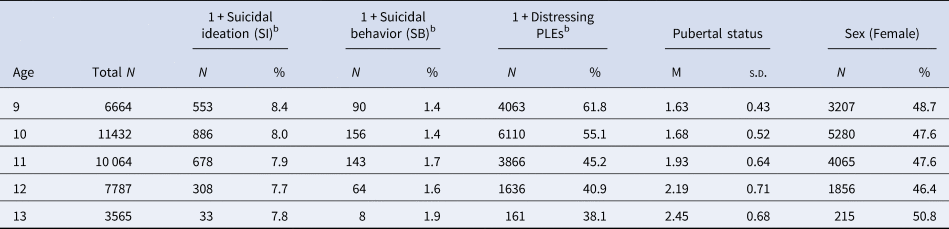
Overall, across all ages and waves, 8.2% of the sample reported at least one SI item and 1.6% reported at least one SB item (Table 1 for endorsement of SI and SB by age).
Characteristics by agea

Abbreviations. N, sample size; %, percentage; s.d., standard deviation.
a See online Supplemental Table S1 for analytic sample sizes for each of the variables.
b Endorsing 1 + item (e.g. endorsing 1 or more SI item).
Associations with suicidality over time
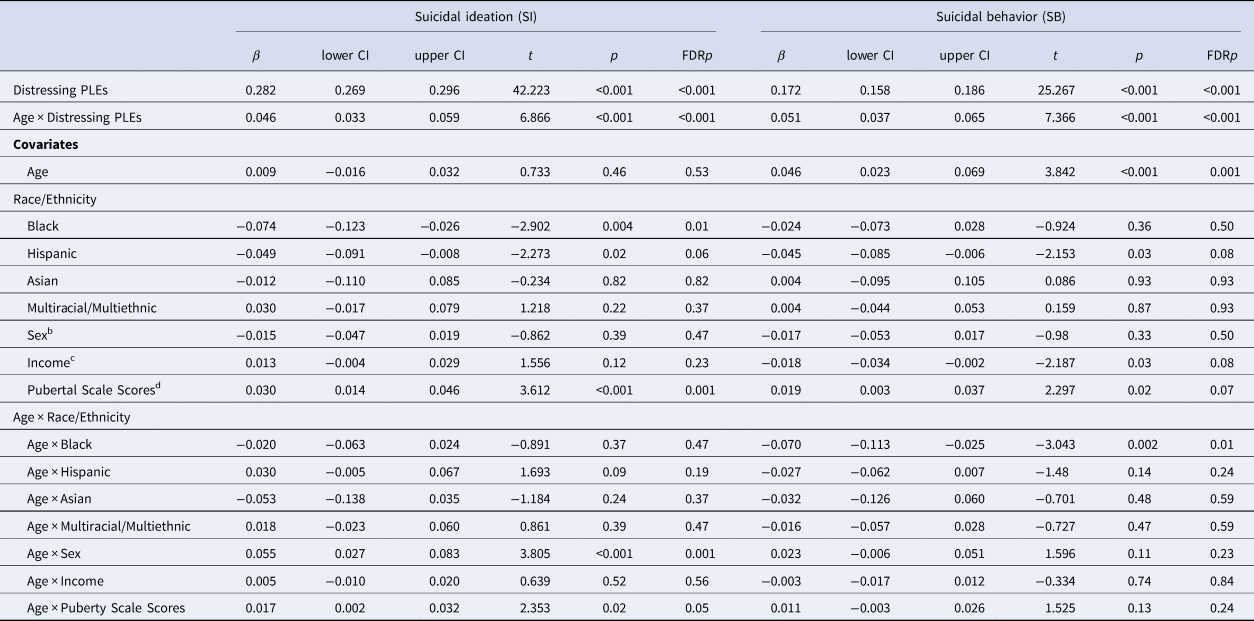
For SI, Black youth reported lower levels of SI (Table 2 for estimates and confidence intervals). More advanced puberty was also associated with greater SI. There was also a sex by age interaction, indicating that endorsement of SI increased as youth grew older for females (β = 0.032, 95%CI 0.002–0.062, p = 0.04), with no strong evidence for this association in males (β = −0.004, 95%CI −0.033 to 0.025, p = 0.76; online Supplemental Fig. S1b).
Model estimates examining associations between SI or SB over time with distressing PLEsa

Abbreviations. β, standardized beta statistic; CI, 95% confidence interval; t, t statistic; p, p value.
a See online Supplemental Table S1 for analytic sample sizes for each of the variables.
b Coded as male = 0 and female = 1.
c Combined household income, which was re-coded in the ABCD Study from 1 = total combined income less than $5000 to 10 = combined family income $ 200 000.
d Caregiver-reported Pubertal Development Scale mean.
For SB, more advanced age was associated with greater SB (Table 2). Additionally, there was a Black youth × age interaction, such that endorsement of SI increased as youth grew older for non-Black youth (β = 0.0255, 95%CI 0.005–0.046, p = 0.01), with if anything a trend towards decreased endorsement of SB as youth grew older for Black youth (β = −0.061, 95%CI −0.125 to 0.003, p = 0.06; online Supplemental Fig. S1b).
Associations between suicidality and PLEs over time
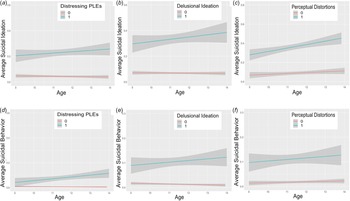
As can be seen in Table 2 and Fig. 1, both SI and SB showed age by distressing PLEs interactions. These interactions were characterized by associations between distressing PLEs and both SI and SB increasing with age, indicating that associations between both SI and SB with distressing PLEs strengthened as youth grew older across ages 9–13. Further, all main effects and interactions with PLEs remained generally consistent when utilizing current SI and SB (note, these models did not include covariates due to limited endorsement of current SI and SB; online Supplemental Table S3), or when examining total PLE or significantly distressing PLEs (online Supplemental Table S4), or when examining joint SI and SB (online Supplement).
Plots illustrate trajectories of youth-reported suicidal ideation (SI) and behavior (SB) across ages 9–13 for PLEs metrics (note, for graphical depiction, PLEs are recoded into: 0 = no PLEs, 1 = 1 + PLEs). The plots show associations between SI across ages 9–13 with (a) distressing PLEs; (b) delusional ideation, (c) perceptual distortions, and associations between SB by age with (d) distressing PLEs, (e) delusional ideation, and (f) perceptual distortions. The shaded areas indicate the 95% conference intervals around the estimated linear slope.

Follow-up analyses for associations between suicidality over time and PLEs
In follow-up analyses to better characterize these findings, we examined baseline distressing PLEs and a priori definitions of SI and SB. First, distressing PLEs at baseline (ages 9–10) predicted both SI (β = 0.138, 95%CI 0.118–0.160, FDRp < 0.001) and SB (β = 0.084, 95%CI 0.063–0.105, FDRp < 0.001) at 2-year follow-up (ages 11–13). SI and SB at baseline also predicted distressing PLEs at 2-year-follow-up (SI: β = 0.149, 95%CI 0.129–0.168, FDRp < 0.001; SB: β = 0.107, 95%CI 0.085–0.129, FDRp < 0.001), indicating that early PLEs are associated with later SI/SB and vice versus.
Distressing PLEs were associated with a change from no SI or SB at baseline to either SI and/or SB at 2-year follow-up (β = 0.100, 95%CI 0.080–0.120, FDRp < 0.001). Further, distressing PLEs were also associated with a change from SI at baseline to SB at 2-year follow-up (β = 0.032, 95%CI 0.011–0.051, FDRp = 0.002), finding that early PLEs are associated with worsening SI/SB.
Additionally, exploratory models analyzed whether SI and/or SB were associated specifically with either delusional ideation or perceptual distortions. As can be seen in Figs 1b and 1e and online Supplemental Table S5, there was evidence that both SI and SB showed age by delusional ideation interactions (βs > 0.071, FDRps < 0.001), with the strength of associations between greater reports of SI and SB with delusional ideation increasing by age. There was also some evidence that both SI and SB showed age by perceptual distortion interactions (βs > 0.058, FDRps < 0.001), with the strength of associations between SI and SB with perceptual distortions also increasing by age (online Supplemental Table S5; Figs 1c and 1f). When simultaneously including delusional ideation × age and perceptual distortions × age in these models, only the delusional ideation × age term remained significant for SI, β = 0.072, FDRp < 0.001 (perceptual distortions: β = 0.012, FDRp = 0.28; online Supplemental Table S5). This provides some evidence that the strengthened association with SI over time was somewhat specific to delusional ideation. However, strengthened associations between SB with both delusional ideation (β = 0.159, FDRp < 0.001) and perceptual distortions (β = 0.102, FDRp < 0.001) remained significant when modeled simultaneously.
Next, we investigated whether the age × distressing PLE results held when including general psychopathology in the model (online Supplemental Table S6). For both SI and SB, both the age by PLEs (βs > 0.040, FDRps<0.001) and the age by general psychopathology (βs > 0.022, FDRps < 0.05) interactions were significant when modeled simultaneously. For SB, the age by PLEs interaction was significantly stronger than the age by general psychopathology interaction (Z = 2.95, p = 0.002), although this was not the case for SI (Z = 0.285, p = 0.39). These interactions were all characterized by the association between SI and SB with either PLEs or general psychopathology strengthening over time. Thus, when accounting for general psychopathology, the age by distressing PLE interaction remained for both SI and SB, with some evidence that for SB, but not for SI, the interaction was stronger for PLEs compared to general psychopathology.
Discussion
The present study provides important novel insights into the longitudinal associations between PLEs and both SI and SB. The findings indicate that both SI and SB show increased associations with PLEs over time in a sample aged 9–13. Further, PLEs were associated with indices of worsening suicidality, including transitioning from SI at baseline to SB at 2-year follow-up. There was also evidence of specificity of associations, including that only for SB (i.e. not SI), there was a stronger association for PLEs over time compared to general psychopathology over time. While both delusional ideation and perceptual distortions showed a strengthening over time for both SI and SB, when modeled simultaneously, for SI, only the delusion ideation by age interaction remained, whereas both remained associated with SB. Given the devastating effects associated with suicidality in youth, these results provide key information about the nature and specificity of the associations between PLEs and suicidality in middle childhood and early adolescence.
Perhaps of greatest importance were findings relating to associations between PLEs and suicidality, suggesting associations strengthened over time. This is consistent with research finding longitudinal associations between SI and SB with PLEs across ages and across severity of psychosis spectrum symptoms (Bromet et al., Reference Bromet, Nock, Saha, Lim, Aguilar-Gaxiola, Al-Hamzawi and Degenhardt2017; Cederlöf et al., Reference Cederlöf, Kuja-Halkola, Larsson, Sjölander, Östberg, Lundström and Lichtenstein2017; Fisher et al., Reference Fisher, Caspi, Poulton, Meier, Houts, Harrington and Moffitt2013; Sicotte, Iyer, Kiepura, & Abdel-Baki, Reference Sicotte, Iyer, Kiepura and Abdel-Baki2021; Sullivan et al., Reference Sullivan, Lewis, Gunnell, Cannon, Mars and Zammit2015). Interestingly, some research indicates the strength of associations between PLEs and SI/SB may weaken in adult samples (Bromet et al., Reference Bromet, Nock, Saha, Lim, Aguilar-Gaxiola, Al-Hamzawi and Degenhardt2017), further indication of the importance of studying these associations in middle childhood and early adolescence. The strengthening of associations over time is important both etiologically and clinically. One possible explanation is that given PLEs become less normative with age (Kalman, Bresnahan, Schulze, & Susser, Reference Kalman, Bresnahan, Schulze and Susser2019), endorsement of PLEs in adolescence may be associated with greater clinical relevance, including greater severity of symptoms and endorsement of other psychopathology, including SI and SB. The finding also may be partially attributable to indirect effects, including the contribution of external variables over time, including increased exposure to traumatic events, loneliness and stigma, and/or increased impulsivity with puberty onset. For clinical practice it appears important to consider age when using PLEs as a predictor of suicide risk, as endorsement may become increasingly concerning towards age 13 as PLEs become less typical.
Analyses also provided some evidence of associations with demographic characteristics. There was evidence that associations with SI increased over time specifically for females, in line with previous work (Cha & Nock, Reference Cha, Nock, Mash and Barkley2014). There are several possible explanations for these findings, including hormones (e.g. estradiol, progesterone), social stressors, and other developmental effects contributing to a stronger association in females than males (Ho et al., Reference Ho, Gifuni and Gotlib2022). Further, there was evidence Black youth showed lowed levels of SI, and that the increase in SB over time was weaker for Black compared to non-Black youth, consistent with previous research (Cha & Nock, Reference Cha, Nock, Mash and Barkley2014) and perhaps pointing to protective factors (e.g. social support). These findings were not hypothesis-driven and are in need of future research.
Follow-up analyses further confirmed the nature of the associations between both SI and SB with PLEs. Higher endorsement of PLEs at the baseline wave of data collection was associated with greater SI and SB at a follow-up wave two years after this initial assessment. However, this does not establish causality, as baseline SI and baseline SB were also associated with 2-year follow-up PLEs, consistent with previous research (Murphy et al., Reference Murphy, Shevlin, Arseneault, Bentall, Caspi, Danese and Fisher2020). Further, baseline PLEs were associated with worsening of SI, including transition from SI at baseline to SB at 2-year follow-up. These findings contribute to a mixed literature on associations between initial PLEs with transition from SI to SB, including some research finding evidence of an association (DeVylder et al., Reference DeVylder, Lukens, Link and Lieberman2015) and other research finding no association (Bromet et al., Reference Bromet, Nock, Saha, Lim, Aguilar-Gaxiola, Al-Hamzawi and Degenhardt2017). Initial PLEs were associated with change from no suicidality at baseline to development of SI or SB at 2-year follow-up, further supporting previous research finding that early PLEs are associated with later SI and SB (Cederlöf et al., Reference Cederlöf, Kuja-Halkola, Larsson, Sjölander, Östberg, Lundström and Lichtenstein2017; Fisher et al., Reference Fisher, Caspi, Poulton, Meier, Houts, Harrington and Moffitt2013). Thus, overall, we found support for the idea that PLEs are associated with worsening of suicidality over time, which may reflect that distress associated with PLEs leads to worsening of SI and SB, somewhat consistent with previous research (Pelizza et al., Reference Pelizza, Poletti, Azzali, Paterlini, Garlassi, Scazza and Raballo2020; Ventriglio et al., Reference Ventriglio, Gentile, Bonfitto, Stella, Mari, Steardo and Bellomo2016). Additionally, this may be attributable to factors such as the experience of adverse life events contributing to both the development of PLEs and SI or SB (Chen & Kuo, Reference Chen and Kuo2020; Turley, Drake, Killackey, & Yung, Reference Turley, Drake, Killackey and Yung2019). Although not indicative of causality, these findings lend support to the notion that PLEs may predate both the onset and exacerbation of SI and therefore may provide a useful clinical marker for worsening suicide risk.
Exploratory models also examined whether associations between SI and SB with PLEs held when including a measure of general psychopathology. For both SI and SB, the interactions between age with PLEs and between age with general psychopathology were significant when modeled simultaneously. Finding a strengthened associated general psychopathology and both SI and SB over time is in line with previous work finding that the association between SI with general psychopathology (Honings et al., Reference Honings, Drukker, van Nierop, van Winkel, Wittchen, Lieb and van Os2016b) or depressive symptoms (Sullivan et al., Reference Sullivan, Lewis, Gunnell, Cannon, Mars and Zammit2015) increased over time. Evidence that when accounting for general psychopathology the strengthened association between SI and SB with PLEs over time remained is also consistent with previous work (Kelleher et al., Reference Kelleher, Cederlöf and Lichtenstein2014). For SB, there was evidence that the strengthened association between SB with PLEs over time was significantly greater than the strengthened association between SB with general psychopathology over time. Thus, somewhat consistent with previous evidence (Nishida et al., Reference Nishida, Shimodera, Sasaki, Richards, Hatch, Yamasaki and Okazaki2014), worsening psychopathology symptoms were associated with increased SI and SB over time, with perhaps SB showing some specificity compared to SI. There are several potential pathophysiological explanations for these findings, including that worsening PLEs may be associated with worsening structural neural deficits (e.g. prefrontal, orbitofrontal), leading to a correspondent increase in impulsivity and reduced emotional regulation, resulting in increased suicidality, perhaps particularly SB (Auerbach, Pagliaccio, Allison, Alqueza, & Alonso, Reference Auerbach, Pagliaccio, Allison, Alqueza and Alonso2021; Matsuoka et al., Reference Matsuoka, Koike, Satomura, Okada, Nishimura, Sakakibara and Takayanagi2020). It is also possible that the reverse is true, that pathophysiological deficits lead to increased suicidality which subsequently lead to increased PLEs. These speculations are in need of direct testing.
Additionally, to further investigate the nature of the association between the age by PLEs with SI/SB interactions, exploratory models also examined associations separately by perceptual distortions and delusional ideation. Initial models indicated age by PLEs interactions with SI and SB for both perceptual distortions and delusional ideation, suggesting both types of PLEs are associated with both SI and SB. However, when both perceptual distortions and delusional ideation were entered into the same model, an age by PLEs interaction with SI only remained for delusional ideation, consistent with some psychosis research (de Cates et al., Reference de Cates, Catone, Marwaha, Bebbington, Humpston and Broome2021). This suggests possible stronger associations between delusional ideation with SI. Interestingly, high risk and first episode research has implicated perceptual distortions as being uniquely associated with SI (Granö et al., Reference Granö, Salmijärvi, Karjalainen, Kallionpää, Roine and Taylor2015; Madsen et al., Reference Madsen, Karstoft, Secher, Austin and Nordentoft2016). There are several potential reasons for these discrepancies with previous research, including the sample age, with the current study perhaps pointing to the importance of delusional ideation in middle childhood for SI. For SB, the strengthened association between both delusional ideation and perceptual distortions with PLEs across time remained when modeled simultaneously. Thus, SB may be more widely associated with PLEs, whereas in the current sample, SI shows some specificity for delusional ideation. Given the exploratory nature of the analyses, future research should further examine these findings, ideally using pre-registered hypotheses.
The present study has several limitations. First, there is limited information about the timing and severity of SI and SB. Due to limited endorsement of current SI and SB, lifetime prevalence was used for the present study, although interactions with PLEs remained when examining current SI and SB (online Supplemental Table S3). However, lifetime estimates preclude knowing exactly when ideation or behavior may have occurred for the young person, information that may be particularly important for SI and SB (Kleiman & Nock, Reference Kleiman and Nock2018). Similarly, the PLEs measure asks about experiences in the last month. The current study did not aim to investigate temporal precedence of SI/SB v. distressing PLEs. Based on previous research (Murphy et al., Reference Murphy, Shevlin, Arseneault, Bentall, Caspi, Danese and Fisher2020), it is possible that SI/SB leads to distressing PLEs. The analyses indicate evidence that baseline PLEs were associated with follow-up SI/SB, and that baseline SI/SB were associated with follow-up PLEs. Future research with more waves of ABCD Study data is required to analyze leading and lagging associations between SI and SB with PLEs. Third, although there was some evidence SI remained somewhat stable over time (Table 1), perhaps not entirely consistent with previous literature (Nock et al., Reference Nock, Green, Hwang, McLaughlin, Sampson, Zaslavsky and Kessler2013). In models not including other covariates (i.e. sex, pubertal status, income), there is a main effect of age, whereby SI increased across age (βs = 0.05, ps < 0.001), although results overall indicate that in the current sample, SB shows a more robust increase over time compared to SI. Fourth, there are limitations to self-report measures, including participants forgetting about experiences between assessments, misunderstanding questions, not disclosing sensitive information, or concerns about the limits of confidentiality with certain disclosures of SI or SB. It is also possible that youth became better reporters of experiences across time, and therefore finding a strengthening of associations between PLEs with SI/SB may be in part due to a reduction of measurement error.
The present study is the first to investigate longitudinal associations between both SI and SB with PLEs over multiple consecutive waves of data in middle childhood and early adolescence. Results highlight the importance of the associations between PLEs with SI and SB in middle childhood and adolescence, a period associated with a number of neural, hormonal, developmental, and social changes (Luciana, Reference Luciana2013). Several notable findings emerged. First, there is evidence SI remain somewhat stable over the ages 9–13 but SB increased over time. Second, there is a strong association between both SI and SB with PLEs, and there is evidence the association strengthens over time. Further, we found evidence that baseline PLEs at age 9–10 are associated with evidence of worsening SI over time. Third, we found some evidence of specificity, such as that when delusional ideation and perceptual distortions where modeled simultaneously, only delusional ideation showed a strengthening association with PLEs over time for SI, although both delusional ideation and perceptual distortions showed a strengthened association over time for SB. Additionally, when accounting for both PLEs and general psychopathology, only SB but not SI showed a significantly stronger association with PLEs over time compared to general psychopathology over time. Overall, youth endorsing distressing PLEs in middle childhood and early adolescence should be monitored for SI and SB, with evidence that PLEs may predict worsening SI and SB over time.
Supplementary material
The supplementary material for this article can be found at https://doi.org/10.1017/S0033291722003166
Acknowledgements
Data used in the preparation of this article were obtained from the ABCD Study (https://abcdstudy.org), held in the NIMH Data Archive (NDA). This is a multisite, longitudinal study designed to recruit more than 10 000 children age 9–10 and follow them over 10 years into early adulthood. The ABCD Study is supported by the National Institutes of Health and additional federal partners under award numbers U01DA041022, U01DA041028, U01DA041048, U01DA041089, U01DA041106, U01DA041117, U01DA041120, U01DA041134, U01DA041148, U01DA041156, U01DA041174, U24DA041123, U24DA041147, U01DA041093, and U01DA041025. A full list of supporters is available at https://abcdstudy.org/federal-partners.html. A listing of participating sites and a complete listing of the study investigators can be found at https://abcdstudy.org/Consortium_Members.pdf. ABCD consortium investigators designed and implemented the study and/or provided data but did not necessarily participate in analysis or writing of this report. This manuscript reflects the views of the authors and may not reflect the opinions or views of the NIH or ABCD consortium investigators. The ABCD data repository grows and changes over time. The ABCD data used in this report came from DOI 10.15154/1523041.
Additionaly, we thank the families participating in the Adolescent Brain and Cognitive Development study.
Author contributions
NRK, KO, SJ, RG developed the study concept. NRK analyzed and interpreted the data. NRK, KO, SJ, and RG drafted the manuscript and provided critical feedback. All authors approved the final version of the manuscript for submission.
Financial support
This work was supported by National Institute of Mental Health (NK, grant number K23MH121792-01).
Conflict of interest
None.