Introduction
As a result of careful longitudinal studies there has been statistically significant confirmation of long-held clinical beliefs about risk factors for suicidal behaviour. Thus, mental disorders, including depression, schizophrenia, substance abuse and personality disorder, adverse childhood events, such as loss of a parent and child sexual abuse, and other factors, such as gender identity concerns, indigenous status and relationship difficulties, are associated with either subsequent serious suicide attempts or with suicide (Goldney, Reference Goldney2008). However, it is not always clear how important each of these potential predictors may be, or what their risk may be in combination. For example, odds ratios (ORs) of 33.4, 16.8, 3.7 and 1.6 have been calculated for mood disorders, non-affective psychosis, personality disorder and substance use disorders respectively for future suicide attempts in individuals aged ⩾18 years (Beautrais et al. Reference Beautrais, Joyce, Mulder, Fergusson, Deavoll and Nightingale1996). In addition, Danish population (aged 9–103 years) attributable risk (PAR) data have indicated that psychiatric illness requiring hospitalization is of overwhelming importance in contributing to suicide, with a PAR of 40.3% compared to the next most significant issues, those being on an aged pension (10.2%), having the lowest quartile income (8.8%), having a sickness-related absence from work (6.4%) and being on a disability pension (3.2%) (Mortensen et al. Reference Mortensen, Agerbo, Erikson, Qin and Westergaard-Nielsen2000; Qin et al. Reference Qin, Agerbo and Mortensen2003). Another Danish population-based nested case–control study of risk factors for suicide in young people showed a PAR of 15.0% for admission for own mental illness and PARs of 3.9% (father) and 6.4% (mother) for parental admission for mental illness (Agerbo et al. Reference Agerbo, Nordentoft and Mortensen2002).
It has also been demonstrated that the impact of multiple risk factors is considerable. For example, in a study that examined clinical risk factors predominantly in those who had attempted suicide, albeit with some parental data included, Beautrais (Reference Beautrais1996) noted that ‘it is clear that with increasing risk factor exposure for suicide attempts, odds of risk of serious attempt rise dramatically’. She calculated that the odds of a serious suicide attempt for those with three or four risk factors compared to those with fewer risk factors was 10.1 [95% confidence interval (CI) 4.3–25.6], and for those with five or more risk factors compared to those with less than three, the OR rose to 127.4 (95% CI 48.6–334.2). Using the same data, Beautrais et al. (Reference Beautrais, Joyce, Mulder, Fergusson, Deavoll and Nightingale1996) reported that the risk of a suicide attempt increased with psychiatric morbidity, with subjects with two or more disorders having an OR of serious suicide attempt 89.7 times that of persons with no psychiatric disorder.
These findings suggest that the overall risk for clinical risk factors is more than a simple additive effect of individual risk factors, and it would seem that, with an increasing number of clinical risk factors, the risk of suicidal behaviour increases considerably. Although this is congruent with clinical experience, it has not yet been incorporated into potentially useful algorithms.
Multiple parental risk factors might also raise the risk of suicidal behaviour in offspring. However, to the best of our knowledge, this has not yet been examined, probably in part because a limiting factor in researching this statistically is the low base rate of suicide among adolescents (Nordentoft, Reference Nordentoft2007). The availability of large population registers has now allowed this issue to be explored in more detail in relation to suicide attempts, although even with such large registers suicide per se cannot be examined.
The present research is a two-generation study of Danish register data designed to examine the relationship between parental risk factors and their offspring's risk for a suicide attempt. The hypothesis was that there existed a dose–response effect from multiple parental risk factors on an offspring's risk for suicide attempt, and that this was more than additive. In addition to a test for trend, we included an assessment of the PAR for multiple parental risk factors. The PAR analyses the number of those exposed to a given risk factor relative to the strength of the risk factor, and provides a theoretical measure of the reduction in incidence, if no individuals were to be exposed to that risk factor. Therefore, an analysis of the PAR gives an insight into the potential for reduction in incidence of a condition, in this case a suicide attempt, from the elimination of either individual or multiple parental risk factors.
Method
Data source
Denmark has several longitudinal administrative registers that are used to administer payment between public authorities and the service providers. They also provide a unique opportunity for longitudinal register-based research. Each individual in Denmark has a personal civil registration number (CPR) (Pedersen et al. Reference Pedersen, Gotzsche, Moller and Mortensen2006). We used these CPR numbers to merge data from various registers, including the Fertility Database (Knudsen, Reference Knudsen1998), the Causes of Death Register (The Danish National Board of Health, 1992), the National Patient Registry (Andersen et al. Reference Andersen, Madsen, Jorgensen, Mellemkjoer and Olsen1999), the Danish Psychiatric Central Register (Munk-Jørgensen & Mortensen, Reference Munk-Jørgensen and Mortensen1997) and the Register of Income.
Sample
A study population of every individual born between 1983 and 1989, and who had ever lived in Denmark, was sampled from the Danish Fertility Database (Knudsen, Reference Knudsen1998). For all cases the date of the first registered suicide attempt was identified. To control the influence of gender and age on risk, a nested case–control study was designed. As recommended by Breslow et al. (Reference Breslow, Lubin, Marek and Langholz1983), a large number of controls (20 non-attempters) were matched to every attempter (case) by gender and age, on the date of the case's suicide attempt (matching date).
A suicide attempt was defined as close as possible to the World Health Organization (WHO) criteria (Bille-Brahe et al. Reference Bille-Brahe, Schmidtke, Kerkhof, De Leo, Lonnqvist, Platt and Sampaio Faria1995). It included a contact for somatic care when given a contact code E4 (suicide attempt) and an ICD-10 diagnosis in the range S617–S619, X60–X84, T36–T60 and T65. For ICD-8 it was defined as given a diagnosis in the range E9500–E9599 and for contact to mental department it was defined as given a suicide attempt diagnosis in the range X60–X84. We searched through all records in the register, which includes all in-patient, out-patient and emergency department (somatic and psychiatric) contacts.
A link to the offspring's biological parents was established and information on parental status of suicide attempts, cause of death, psychiatric history and income was analysed. We only analysed retrospective data, that is data before the offspring's matching date.
Analysis
The case–control data were analysed using conditional logistic regression with each case forming a separate stratum. As the controls were selected randomly within the appropriate risk sets, estimated rates are called rate ratios (RRs; King & Zeng, Reference King and Zeng2002).
Parental characteristics, analysed as risk factors, were coded as dummy variables and analysed on a crude and adjusted level. In the adjusted analysis the risk factors were controlled for potential confounder effects from age of the offspring's mother and the offspring's psychiatric history. To analyse the cumulative effect from the risk factors, the number of risk factors for every individual were counted. Four dummy variables were coded according to the number of risk factors (one, two, three or four risk factors). ‘Zero risk factor’ was held as baseline.
Parental suicide attempt was defined when contact for somatic or psychiatric care was given a suicide attempt diagnosis. Parental death was defined by identifying dead parents and using the cause of death code from the register. Parental psychiatric history was defined as having had a contact for psychiatric care. Parental income was created by adding together both parents' income in the year before the offspring's suicide attempt, adjusting it for inflation and grouping it into four categories: lowest third, middle third, highest third and unknown. Income was unknown if a parent, in the years before the offspring's suicide attempt, died or was partly living abroad.
Trend tests were conducted using the number of exposures as a single variable. The RRs were calculated for this variable and the values compared to RRs in the model with the dummy variables.
The PAR was calculated by the method described by Bruzzi et al. (Reference Bruzzi, Green, Byar, Brinton and Schairer1985).
Results
A total of 403 431 individuals were sampled from the Danish Fertility Database. Among these, 3465 (0.8%) were registered as having made a suicide attempt (case) during the period from their 10th birthday to 31 December 2005. For male offspring the mean age of suicide attempt was 18.2 years and the median 18 years, and for female offspring the mean age was 17.3 years and the median 17 years. In total, 72 765 individuals, including all cases and controls, were analysed.
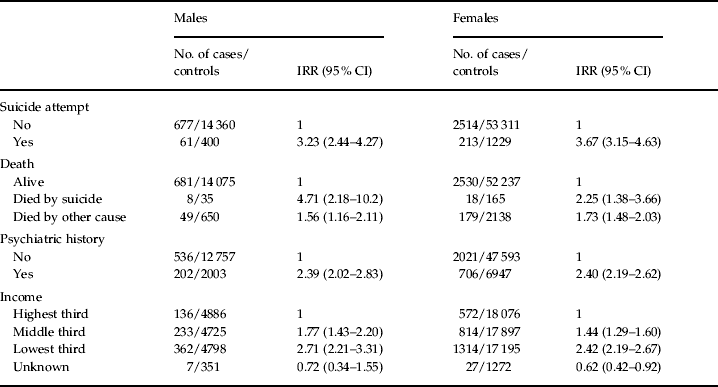
Table 1 shows the numbers of suicide attempts and incidence rate ratios (IRRs) for the various risk factors. There was a significant correlation between parental suicide attempt, death, psychiatric history and a low level of income with the offspring's risk for suicide attempt. Parental characteristics were significant risk factors for both genders. For male offspring the IRRs were in the range 1.56–4.71, and for females in the range 1.44–3.67. In this study parental suicidal behaviour was the strongest risk factor for an offspring's suicide attempt.
Suicide attempt among offspring and parental risk factors
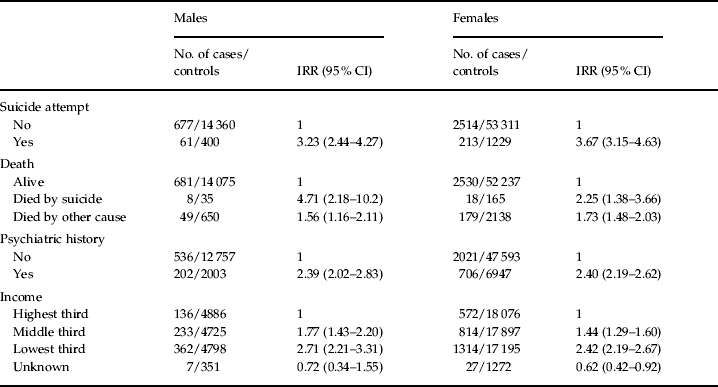
IRR, Incidence rate ratio; CI, confidence interval.
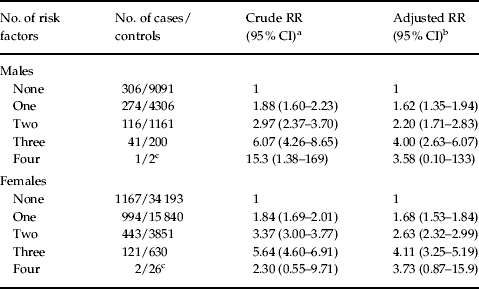
Table 2 shows the impact of cumulative risk factors on an offspring's risk for suicide attempts. ‘No risk factor’ present was set as the baseline. For both genders the risk increased with increasing numbers of risk factors. The presence of one risk factor almost doubled the risk; two risk factors almost tripled the risk; and three risk factors increased the risk sixfold. The rate for four risk factors present should be interpreted with caution because being exposed to all four risk factors at the same time is very rare. The CIs for one, two and three risk factors were not overlapping, and therefore the crude RRs were at a significantly different level. The adjusted analysis showed the same pattern as the crude analysis, although only for females were the confidence levels non-overlapping. Furthermore, the cumulative factor was an independent risk factor after adjusting for confounders.
Suicide attempt among offspring and cumulative effects of parental risk factors
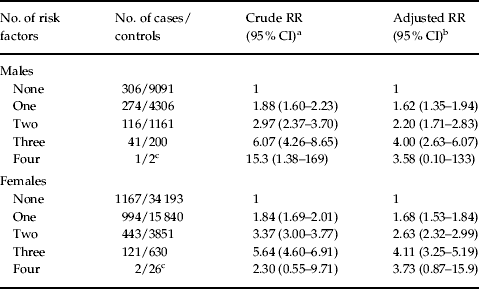
RR, Rate ratio; CI, confidence interval.
a Adjusted for age and calendar time by stratification.
b Additionally adjusted for own psychiatric history and mother's age.
c The rates should be interpreted with caution because of the low numbers.
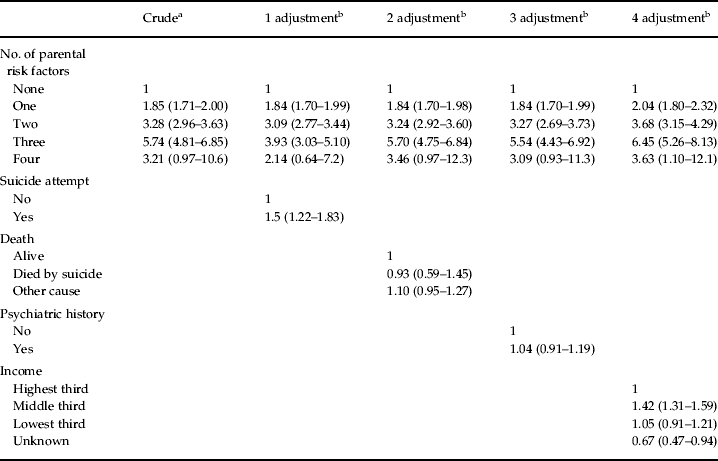
Table 3 shows the results from the analysis where the original risk factors were added to the model in which the number of risk factors was coded as dummy. The analysis shows that only parental suicide attempt and income remained significant. The cumulative risk factors, coded as dummy, were significant in this analysis, suggesting that the dose–response effect was not explained entirely by one of the risk factors.
Suicide attempt among offspring and parental risk factors
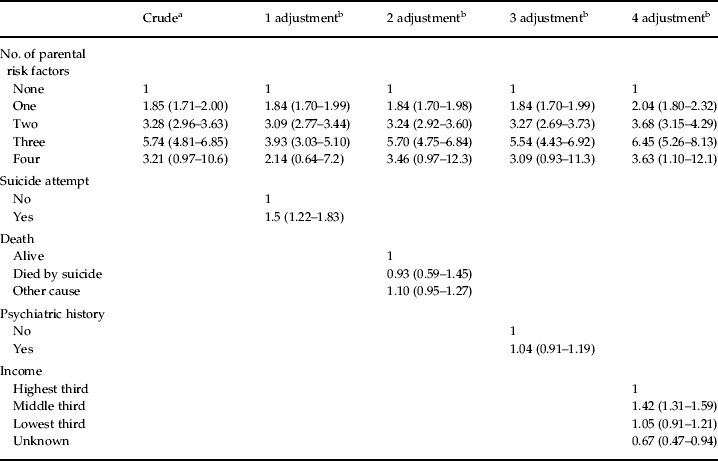
Values given as rate ratio (95% confidence interval).
a Test for reduction to trend: β=0.5822, p<0.0001.
b Adjusted for the factor shown below.
The trend test resulted in a β value of 0.5822, p<0.0001. The baseline was zero risk factors and the RR for one risk factor was 1.79 (RR=e0.5822=1.79), for two 3.20 (RR=e2×0.5822=1.792=3.20), for three 5.74 (RR=e3×0.5822=1.793=5.74) and for four 10.27 (RR=e4×0.5822=1.794=10.27), which are not very different from the RRs shown in the first column in Table 4. The trend test suggests that the numbers of exposures will increase risk in a multiplicative way.
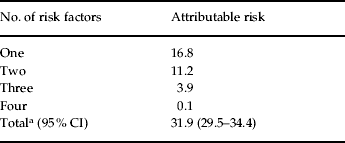
The attributable risk for the four levels of the cumulative risk factor was calculated and is shown in Table 4. If the population was unexposed to the cumulative risk factor, we would expect a reduction of 31.9% in the incidence of suicide attempts. The attributable risk for one risk factor was high because of the high occurrence of individuals with only one risk factor presence. If the risk for exposure to two, three or four risk factors was the same as being exposed to one risk factor, the attributable risk for the four levels would be 26.4%. The difference in the two PARs is 5.5%, so despite the high RRs, few suicide attempts can be attributed to exposure to more than one parental risk factor.
Percentage attributable risk and 95% confidence interval (CI) associated with the cumulative effect of parental risk factors
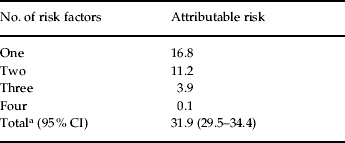
a The attributable risk would be reduced to 26.4% if the risks associated with more than two factors were the same as the risk associated with one factor.
Discussion
This two-generation study demonstrated a significant correlation between parental suicide attempt, death, psychiatric history, low level of income and an offspring's risk for suicide attempt. Furthermore, there was a dose–response relationship between the number of exposures and the risk of suicide attempts, with the increased risk seemingly being a multiplicative effect of individual risk factors. Although multiple risk factors raised the risk significantly, only a few suicide attempts were attributed to being exposed to multiple parental risk factors.
Before discussing these results further, it is pertinent to address potential limitations in this research. Suicide attempts and risk factors were estimated on the basis of routine registers. It has been noted by Nordentoft & Søgaard (Reference Nordentoft and Søgaard2005) that only 37% of all suicide attempts were correctly registered in the National Patient Registry of Denmark, although they also concluded that, when given a contact reason code E4, it reflected ‘that the patient has inflicted self-harm’. Therefore, we accept that not all suicide attempts made by the cohort in the follow-up period were detected. A consequence would be that the present case-population is a selected subgroup of all suicide attempters and that some suicide attempters were used incorrectly as controls. Furthermore, although all residents in Denmark have equal access to health-care services with treatment free of charge, it is probable that some persons who engaged in suicidal behaviour did not seek treatment, and they would not have been detected and would have been in the control group. It may also be pertinent that the Danish suicide rate has, in recent decades, declined significantly (by 63.5% from 1980 to 2006; Centre for Suicide Research, 2010), and part of the decline may be attributed to changes in autopsy rates, whereby suicides are recorded erroneously as unknown cause of death (Nordentoft, Reference Nordentoft2007). Therefore, we expect the parental suicide incidence to be underestimated.
In the crude analysis we found that the risk factors increased risk at different levels. Nevertheless, we chose to weight each risk factor equally when creating the cumulative risk factor. This approach may introduce a bias towards a dose–response effect because individuals with multiple risk factors are more likely to also have the more rare risk factors present (e.g. parental suicide), which in this study is associated with the highest risk, and individuals with few risk factors are more likely to have the more common risk factor present (e.g. low income), which in this study is associated with lowest risk. Nevertheless, the dose–response effect could not be explained by any single risk factor.
It is also important to note that, in the current study, we chose to analyse general parental risk factors rather than the offspring's clinical risk factors. It is reasonable to assume that the correlation between the offspring's clinical risk factors and a suicide attempt would be strong, and therefore we would expect the effect from the cumulative clinical risk factors to be high, as seen in the New Zealand study of Beautrais (Reference Beautrais1996). Indeed, we adjusted for the offspring's own psychiatric admission history rather than including it among the other factors, as psychiatric admission is probably a mediator between parental background and a suicide attempt (Sørensen et al. Reference Sørensen, Mortensen, Wang, Juel, Silverton and Mednick2009).
Notwithstanding these caveats, it is of note that the effect of an increasing number of parental risk factors had a multiplicative effect on risk. However, the increase was by no means as great as that suggested by the report of Beautrais et al. (Reference Beautrais, Joyce, Mulder, Fergusson, Deavoll and Nightingale1996), probably because their study was very much clinically based and it examined more common risk factors among young suicide attempters. Furthermore, in their study it was more likely for suicide attempters to be exposed to more risk factors at the same time, compared to our study. This describes the nature of the risk factors, as the more clinical data, to be better predictors for suicide attempts for young people.
Nevertheless, it is evident that all risk factors do not warrant the same concern. Thus, the strongest risk factors were those related to parental suicidal behaviour. These finding are not new; other studies have shown similar results (Johnson et al. Reference Johnson, Brent, Bridge and Connolly1998). Other studies have also shown parental psychopathology (Mittendorfer-Rutz et al. Reference Mittendorfer-Rutz, Rasmussen and Wasserman2008) and low income (Fergusson et al. Reference Fergusson, Woodward and Horwood2000) as risk factors for offspring suicide attempts.
The trend test shows that the form of the dose–response effect is multiplicative, although not in a strong exponential way. Nevertheless, it demonstrates that a reduction in the number of parental risk factors significantly reduces the risk of a suicide attempt in offspring. However, PAR analysis shows that, if the dose–response effect is eliminated, then the PAR is only reduced by 5.5 percentage points. The reason why the effect from multiple risk factors on PAR is not stronger is that only a few individuals were exposed to multiple risk factors at the same time. In the present study the strongest impact on PAR was not the strength of the individual risk factor but simply the number of risk factors that an individual had been exposed to. This demonstrates the importance in clinical assessment of taking into account the number of risk factors, rather than the strength of any particular individual risk factor.
Conclusion
The fact that the cumulative risk of those factors gives a multiplicative impact has only been analysed infrequently, and clearly it has clinical implications. Indeed, it is probable that clinicians over the years would have understood intuitively the nature of these findings. However, to more fully understand the impact of cumulative risk factors in contributing to suicidal behaviour, it is evident that not only clinical and social factors more proximal to a suicide attempt but also parental characteristics need to be considered, as illustrated by the present results. Further research incorporating these data could provide additional insights into the multiplicative impact of multiple risk factors for suicidal behaviour.
Declaration of Interest
None.