In the early medieval centuries of conversion and colonisation the fortunes of the monastic communities of England and mainland Europe were interwoven: they were animated by a common impulse for worship, work and study, undermined, if not extinguished, by parallel patterns of invasion and (re)conquest, and reinvigorated by the same phases of reform. The ascendancy of the monasteries of Benedictine origin between 1050 and 1200 was derived to a degree from their bonds of observance, spirituality and scholarship which seemed to reach so readily across regional and political boundaries. Yet in the later Middle Ages, and perhaps in particular in the period after the Black Death (1348–50) and the outbreak of papal schism (1378), it seems the common fraternity of monks began to fragment: the transmission of ideas, books and brethren dwindled and supra-national corporate structures and their legislative supervision it seems were all but forgotten.
The Benedictines of northern, central and (some) southern states emerged from the flux of this period reorganised into regional congregations – Bursfeld, Melk, Padua – following a mode of monastic life which had been reformed in the light of the spiritual and theological renewal stimulated by the general councils of the church and the intellectual revival of the Italian humanists.Footnote 1 At the heart of their programme was a refined conception of monastic learning, not only as a disciplinary adjunct to the Opus Dei (as Benedict himself had conceived it), or as a necessary preparation (as papal reformers had presented it) for monks to fulfil their pastoral and priestly obligations, but as the sole foundation on which the professus might raise their pursuit of spiritual perfection: a learning that led them to a true understanding of their vocation, the vera eruditio monasticae of earlier times.Footnote 2 The syllabus of study fused the studia humanitatis with a form of scriptural exposition which the reformers believed to be an evocation of the pure lectio divina of their founder. The priority which the humanists placed upon proficiency in language would provide an ideal preparation for a lifetime's reflection on verbum Dei: ‘the orators, philosophers and poets [of the pagans] and all other cultivators of the good arts’, counselled Abbot Johann von Trittenheim (Johannes Trithemius) of the reformed convent of Sponheim, ‘may greatly help to lead us into [a] knowledge of the holy scriptures’.Footnote 3 The study of letters at Sponheim was so pervasive there was even said to be a dog that understood Greek. ‘Whatever you command of it in Greek’, claimed Conrad Celtis, ‘it willingly obeys.’Footnote 4
The studia litterarum was a perennial theme in the monastic discourse of reform. Cassiodorus (d. c. 585) had challenged Benedict's cenobium, where the only licit cultus was the liturgical labour of the daily office (and the vogue for lettered exchanges was expressly forbidden), with a vision of Vivarium, a living synthesis of secular and sacred learning.Footnote 5 The Carolingian reformers reinvested this model with their own imperatives of mission and the promotion of a common cultural and political identity; in turn their curriculum was restored in the century after 1050 as Benedictine houses became the hub of a spiritual and intellectual renaissance.Footnote 6 A form of monastic humanism flourished, one that did not condone the consumption of secular literature for its own sake but sought ‘to enrich not only their style, their intellectual capital but also their very being’, and perhaps (like seculars of the same period) recognised the power of ‘man and human experience as a means of knowing God’.Footnote 7 The monastic reformers of the fifteenth century did not aim to reprise the humanism of the high Middle Ages, although they would surely affirm the aspiration to enrich style, substance and the sense of being. Their movement represents rather an early (pre-Erasmian) compact of the scholarly values of the humanists and the objectives of the generation of churchmen that presided over the ending of the schism and the (un)settled consequences that followed.
It has always been thought that England's monasteries remained unaffected by this pre-Reformation phase of recovery and renewal. A prospect of the monastic order in post-Black Death England invariably presents an image of institutional stasis and intellectual and spiritual lethargy. Their separation from the European mainstream was apparently a symptom of the country's steady drift into a cultural and devotional backwater. The reception of humanist values was retarded, or so it appears in comparative terms.Footnote 8 The reformed monastic and mendicant orders made only modest progress: a Celestine monastery that foundered, a Brigittine double house whose intellectual and spiritual distinction never matched the undoubted riches of its library, and half a dozen poorly patronised houses of Observant Friars.Footnote 9 Only the Carthusians it seems responded to the continental climate of change. Modern scholars have underlined their role in the transmission of vernacular theology; they were also key agents in the (late) dissemination of devotio moderna spirituality.Footnote 10 Their achievement can be attributed to three principal convents: London, Hinton (Somerset) and Mount Grace (Yorkshire). There was an abundance of hounds in the precincts of the greater abbeys and priories but it appears there was no Hellenist amongst them.Footnote 11
The isolation of monastic England, and the unreformed condition of its institutional structures and internal mode of life, is a story that originates in the order itself. When expatriate Benedictines prepared for a mission into Jacobean England, they laid claim to an unbroken tradition of monastic observance. The governors of the order cast doubt on the status of their former monasteries, observing that England had never formed a congregation comparable to those on the mainland and had been ‘in an earlier stage of evolution’ (as one modern authority delicately expressed it) when its house surrendered to the Henrician regime.Footnote 12 The expatriates did not secure papal recognition for an English congregation for a dozen years (1619) and the reverberations of the dispute determined the tone of the first post-medieval history of English monasticism, Clement Reyner's Apostolatus Benedictinorum in Anglia (1626).Footnote 13
To date modern historians have done little to displace the old narrative. In a famous phrase, David Knowles wrote of the ‘indefinable spiritual rusticity [which] took hold of a majority of houses’, the professed men of this period were ‘several degrees more distant from fervour than they had been in 1300’.Footnote 14 The culture of the cloister was correspondingly homespun: ‘England was far from Italy’, Knowles declared, ‘and the abbeys were not rich enough in manuscripts to give an imaginative impulse to any young scholar.’Footnote 15 His view of the learning of the monasteries, or their lack of it, was shaped by the researches of Roberto Weiss, who regarded his sources with the hauteur that continental observers traditionally reserve for manifestations of English culture. Weiss's verdict was that England's religious orders achieved no ‘particular distinction’ in this period’.Footnote 16 Knowles served as the sole guide for the next generation which drew in greater detail the picture he had sketched for them, of a great graduate enterprise and a standard of life ‘humanely speaking easier’ than in the preceding centuries.Footnote 17
Over the past decade, the prospect of monastic England in this period has been transformed. Documents and texts unknown to, or unused by, Knowles and his disciples have been (re)discovered through new catalogues, critical editions and repertoria; in fact this is true not only for monastic records but also for the intellectual life of this period in general and, in particular, the early reception of humanism.Footnote 18 Moreover, a new outlook on late monasticism has unfolded. There has been a determination to penetrate the institutional structures (and the sources that reflect them) to recover the experience of the individual religious, their ‘mentality’, ‘how they lived and consorted together. . .what they thought and believed’ that earlier historians thought elusive.Footnote 19 There has also been something of a conceptual shift, a greater willingness to recognise that the cultural, religious and social dynamics of the monasteries were shaped not only by the disciplinary demands of the rule and the socio-economic imperatives of the institution, but also in a process of continuous exchange with the world beyond their walls.Footnote 20 Within the personal and permeable culture of the pre-Reformation monk it is possible to see more clearly signs of a response to contemporary intellectual and religious trends of which earlier authorities considered them incapable.
In fact the monastic order in England was never wholly cast adrift from the clerical and ecclesiastical mainstream. Indeed the contribution of the Benedictines to the causes that exercised the clerical establishment, and their pastoral subjects, in the period between the Black Death and the Break with Rome, has been consistently underestimated. To contemporaries, and in particular at moments of perceived crisis, members of these orders were among the most conspicuous and vocal contributors both to public debates and to learned discourse. Certainly in the half-century after 1349, it would appear that the Benedictines were in advance of their secular colleagues in their awareness of and responsiveness to currents of thought passing through the institutional church. The greater matters of the time, the schism in the papacy, the emergence of clerical heterodoxy and the apparent resurgence of popular heresy, elicited a response from the Black Monks that appears to have been coordinated throughout their network and, in the early stages at least, was not matched by any other community of clergy. The president of the General Chapter encouraged, and perhaps selected, Benedictine scholars to confront Wyclif in formal disputation at Oxford.Footnote 21 It seems the same president led at least one scholar to tackle the schism in a treatise intended for a general clerical audience.Footnote 22 Surviving examples of Benedictine sermons from this period suggest there was also some attempt to coordinate a campaign of preaching on these themes. From the style and tone of these texts, it would appear they were not composed for conventual consumption alone: the macaronic character of the recorded transcript or digest might reinforce the impression of a general clerical context for their subsequent (if not initial) reception.Footnote 23 It was a natural continuation of such a campaign that the Benedictines should secure representation among the English delegates attending at the general councils at Pisa (1409), Constance (1414–18) and Basel (1431–8); once more the monks displayed a greater degree of interest in, and enduring hope for, these fora than their counterparts in the secular clergy and episcopacy.Footnote 24 In his Granarium, John Wheathampstead compiled an essay on Concilium that culminated with an account of the achievements of Constance, the condemnation of Wyclif and execution of Hus and the recognition of the authority of the council itself ‘in spiritu sancto legitime congregatum potestatem a Christo immediate habeat’.Footnote 25 Abbot William Curteys of Bury corresponded with one English delegate at Basel on the matter of monastic privilege treated there.Footnote 26 Thomas Rudborne of Winchester Cathedral Priory filled five folios with reflections on the historical background of the East–West union that resurfaced at the Council of Ferrara-Florence (1438–45).Footnote 27 The Black Monks of this period were also sensitive to the internal tensions of identity that animated the regular and secular clergy. In the last quarter of the fourteenth century they appointed themselves the unsolicited champions of Archbishop Richard Fitzralph of Armagh, whose De pauperie saluatoris had reignited academic and popular debate over the purpose of the mendicant friars; here there are also signs of coordination across the Benedictine network.Footnote 28 Clearly they were also conscious of the clamour over the parochial clergy and the problem of pastoral care. The sermons of the Durham Priory preacher Robert Rypon, a proportion of which were probably presented to a mixed clerical audience, display a recurrent concern for the challenges of contemporary clerical (and diocesan) practice.Footnote 29 Perhaps it was inevitable that the Black Monks should respond to these very public controversies since their social origins, their seigniorial and pastoral obligations, positioned them in the orbit of national and regional elites. Yet there are also signs of an awareness of currents of thought and religious practice that were somewhat avant garde. Manuscript evidence recently re-analysed suggests that some Benedictine readers of the period were drawn to Joachimite revelations which had attracted public condemnation in academic and Episcopal injunctions.Footnote 30 Perhaps the most prominent Benedictine chronicler of the period was fascinated by the fleeting presence of the Flagellants in England and their popularity in Italy.Footnote 31 Henry Kirkstead, the Bury novice-master, confronted Hildegardian prophecy through the Pentachronon of Gebeno of Eberbach which he copied for himself.Footnote 32 Adam Easton, Benedictine of Norwich Cathedral Priory and cardinal priest of Saint Cecilia, attached himself to the cause of Birgitta of Sweden, founder of the order of St Saviour; he composed an apologia, Defensorium sanctae Birgittae, in 1389 and in 1391 addressed a letter to the abbess and convent of the order's mother house at Vadstena. Easton expressed a personal devotion to Birgitta and attributed to her his delivery from papal custody in 1385.Footnote 33
It might be objected, of course, that the activities of a handful of high-profile monastic prelates, scholars and preachers are not indicative of the mood of the network as a whole. The career of Adam Easton carried him far from the house of his first profession into a pattern of life and a perspective that bore the imprint of the secular priest.Footnote 34 The presence of texts, or para-textual discourse, connected with these themes in the book collections of a cross-section of convents, however, does suggest that some trace of this engagement had penetrated the monastic enclosure and perhaps the consciousness of the ordinary cloister monk. While they had first passed into monastic hands from the personal collection of a monastic prelate, the common library at Westminster Abbey held a selection of treatises on the schism and councils.Footnote 35 The accuracy and completeness of the conciliar acta incorporated in Thomas Walsingham's Chronica maiora is suggestive not only of direct ties to the English delegates but the presence at St Albans of a now-lost anthology.Footnote 36 William Curteys referred to cedula recording the Basel discussions; it has been suggested that Thomas Rudborne secured a collection of conciliar acta.Footnote 37 The Latin works of Wyclif appear to have been a part of the official provisions of some major monastic collections.Footnote 38 The textual background to the Fitzralph affair was also widely available in Benedictine collections: glosses in a Norwich manuscript are evocative of a lively reader response.Footnote 39 An engagement with popular, reformist and radical patterns of thought can also be glimpsed in surviving and recorded manuscripts; it is possible that there are more such traces to be identified. When the reformer Peter von Rosenheim entered Melk in 1418 he confronted a monastic community apparently unaware of the currents of reform that were palpable – only 300 miles from Constance – in the region at large. By contrast, there can be little doubt the Black Monks of England were fully conscious of the climate of reform.
The greater public and popular engagement of the monastic order between the death of Edward III and the deposition of Richard II bequeathed a powerful, if not unproblematic, legacy to the generations that followed. It is possible that their prominence in the crises of the recent past contributed to the Benedictines renewed stature in the clerical hierarchy, not only on the Episcopal bench but also among the handful of regular religious that now attracted the attention and counsels of the crown.Footnote 40 Internally, the experience of preceding decades appears to have stimulated a spirit of reflection not only on the place of the monastic order in patria cleri, but also on the appropriate forms of the professed life itself. Moreover, there arose a cadre of monk whose education and formation had occurred between 1378 and 1417 that was committed it would appear, to the conversion of these impulses into a systematic process of reform. As men of good (or at least middling) birth professed in early adulthood after a respectable grammar schooling, they were representative of the career monk of this period, but their extended exposure to the academic community, in a syllabus of study that generally culminated in a doctorate, and occasionally a period of regency, set them apart from the majority of their brethren. Their academic prowess projected them early (perhaps prematurely) into ecclesiastical and public affairs: Dr Simon Southerey of St Albans was summoned to the Council of Stamford in 1392 only three years after he had been prior studentium at Oxford; William Weld of St Augustine's Canterbury was among those summoned to a council in January 1399 convened to address the schism.Footnote 41 Their reputations raised largely outside the monastic precincts also led them with remarkable alacrity to the head of their communities. Between 1400 and 1425 a succession of these comparatively youthful candidates of wide academic, administrative and, in some cases, cosmopolitan, experience succeeded as superiors of England's premier abbeys and priories. It seems that contemporaries recognised the distinction of this rising generation and the potential danger it posed to the forces of tradition both sides of the monastic enclosure. The chronicler Walsingham interpreted the Westminster injunctions issued to the Benedictines in 1421 as a defensive response to the advent of new and youthful leadership.Footnote 42
The significance of this constituency in the monastic network should not be overstated but there are grounds for suggesting that it did form an identifiable interest group in the Benedictine General Chapters, the governing body of the order in the northern and southern provinces of England in the first, and perhaps the second decade of the fifteenth century. It was a group that numbered not only the superiors of several principal houses but a selection of successful graduate monks employed in the capacity of proxy delegate to the chapter, or diffinitor, or visitor, in the triennial cycle of capitular visitations.Footnote 43 The surviving accounts of capitular sessions suggest these men cultivated a self-conscious style that distinguished them from other delegates. When called upon to preach, they delivered their collation in Latinis, a format no longer universal either at the general or indeed the daily, conventual chapter. Frequently, the redactor recorded the tone of the sermon as fructuose, or similar terms which might be dismissed as formulaic were it not that surviving sermons have been shown to be replete with the florida verborum venustas connected with the classicising writers of the period.Footnote 44 Moreover, on more than one occasion between 1421 and 1444, members of this apparent group appear associated with proposals for reform. It cannot be coincidental that three of the six representatives selected to treat with the king's advisers after the council at Westminster in 1421 were from the rising generation of graduates already associated, in regional, national and international arenas, with measures of reform.Footnote 45 Prior John Wessington (Washington) of Durham had already invested in learning, completing a purpose-built library by 1418; Abbot Thomas Spofford of St Mary's Abbey, York, had collaborated with secular clergy in the province in the revision of the abbey's liturgical regime; he had also served in the English delegation at the Council of Constance (1414–17); Abbot John Wheathampstead, by some margin the most junior member of this group, had already initiated internal reforms in the network of monasteries under the parental supervision of St Albans.Footnote 46 A fourth member of the group of six was Thomas Elmham, a former Benedictine of St Augustine's Canterbury, who had transferred to the Cluniac congregation and, with royal patronage, taken the priorate of Lenton (Nottinghamshire). Elmham was a formidable scholar and arguably a more accomplished Latinist than these three superiors.Footnote 47
The common intellectual hinterland of these representatives should also be underlined. By the time of the Westminster council each of these monks was well known for their scholarly enthusiasm. Both Wessington and Wheathampstead had embarked on book projects that over the course of their career would transform their conventual collections.Footnote 48 Spofford appears to have been among the earliest English enthusiasts for the literary culture of the Italian humanists, an enthusiasm perhaps initiated at York where the Minster treasurer, John Newton, was also an enthusiast, and possibly fuelled at Constance, where the secular delegates from England are known to have forged connections with continental litterateurs.Footnote 49 There can be little doubt that their commitment to learning was a cornerstone of their own plans for monastic renewal.
The link between intellectual activities and the reinvigoration of observant life was openly articulated only two years after Westminster at the Northampton Chapter of 1423. Alan Kirton, proctor of the Abbot Charwelton of Thorney, a graduate who surely can be counted among the like-minded learned members of the chapter, addressed the delegates on the decline of daily scriptural lectio in the houses he visited regularly (quod in locis per ipsum regulariter visitatis): ‘the life of Martha [i.e., the vita active] is in many ways commendably observed but not that of Mary (vita contemplativa).Footnote 50 Another chapter, the account of which is undated (but perhaps fell before 1426), addressed the analogous issue of appropriate conduct and discourse in the cloister hours and the levity, and non-Latinity, of conventual conversation.Footnote 51 Although Wessington served as capitular president in 1426, and, in turn, Wheathampstead also held the office, it seems subsequent sessions did not return to these themes. Yet the inclinations of this generation were also cultivated outside the chapter. In 1423 Abbot Richard de Boxore of Abingdon sought an Episcopal licence to leave his monastery for three years for further study (at an appropriate studium generale, perhaps abroad) ‘for the defence of the Catholic faith’, barely a year after his election to the dignity. Abbot Wheathampstead also evinced an evangelical zeal and his patronage of the library at Gloucester College, the order's Oxford studium, between 1420 and his death, was perhaps intended to nurture another generation of defenders of orthodoxy.Footnote 52 A trace of continental influence in shaping these impulses should not be discounted. There was no formal business between the Benedictine networks, and international correspondence is scarce in monastic archives, Abbot Spofford attended the reformist chapter at Peterhausen while at Constance, and there is no doubt the venerable Abbot Wheathampstead engaged warmly with Cluniac representatives during their ill-fated English mission in 1458.Footnote 53
A discourse of reform flourished in the Cluniac network, at least for a generation, in the first quarter of the fifteenth century. As Prior of Lenton Thomas Elmham served twice as vicar general for their houses in England (two terms, 1415–19) and appears an advocate, of some impatience, for a process of reform. He began (and perhaps completed) a visitation of convents subject to Cluny in the summer of 1415 and reported: ‘I have found many things that need to be cut away, some to be cured by healing medicine, a few to be strengthened and cherished.’ Briefly, the different branches of the network in England became united under a common cause.Footnote 54 In the decades that followed, the English Cluniacs were diverted by their mother house into a fruitless struggle for the recovery of properties and rights overlooked during the long years of the Anglo-French war; the enmity between England and France also stifled a final attempt at systematic reform initiated by Cluny in 1458.Footnote 55
The English Cistercians shared this restorative impulse although it appears the stimulus came from outside the congregation in the General Chapter at Citeaux and the actions of the English superiors were in response to capitular supervision: the scrutiny and reform of the order's Oxford studium was ordered as early as 1411; plans for a purpose-built house of studies were initiated but were not advanced until Archbishop Chichele proffered a site in 1437.Footnote 56 A general reform of the congregation was promulgated in 1488 but it remains too poorly documented to trace its course and effects.Footnote 57 The infrastructure of the Oxford studium did not develop sufficiently to support a succession of student monks before the close of the fifteenth century, which may explain the signs of a surge in book provisions and scholarship in a number of houses in the decades that followed.Footnote 58
There is no doubt that the force and frequency of the discourse of renewal among delegates to the Benedictine chapters had diminished by the middle decades of the fifteenth century. Mid-century chapter meetings record only routine business; and it may be significant, and not merely the random pattern of manuscript preservation, that the flow of sermons runs dry. The injunctions issued by the General Chapter in 1444 were in large measure a recapitulation of those promulgated a century earlier and, significantly, did not return to matters not fully addressed following the Council of Westminster.Footnote 59 The fading of the early fervour for reform must be seen as the consequence of an inevitable generational shift: the young and energetic superiors of the reign of Henry V were spent by the time of the Yorkist ascendancy over his son. It also brings into sharp focus the failure of the capitular governance to stimulate systematic change. The provincial and general chapters had always struggled to be properly representative: Christ Church Cathedral Priory never recognised their authority and the presidency passed between an unchanging roster of elite abbeys.Footnote 60 The dominance of an elite group of graduates in its deliberations and its delegated roles only increased the degree of detachment from the daily rhythm of observant life in provincial houses.
Yet the absence of a significant measure of reform at the structural centre of monastic England masks the extent to which the learned superiors (and other seniors) of the early and mid-fifteenth century effected change in their own and affiliate communities. The surviving comperta of Episcopal visitations – their capitular counterparts are preserved only as reports delivered in capitulo – are rigid in their formulaic questions and responses and convey no sense of measurable change over time. Where they are preserved, the acta, dicta and gesta of this generation give a glimpse, although a highly partial one of the dynamic transformation, if not reform, of conventual life that many of the greater abbeys and priories witnessed in this period.Footnote 61 The experience of these years is best explored perhaps in the books, both liturgical and ‘library’ volumes, and the original writings, which can be connected with these communities.
A palpable change brought into focus by these books, and one which may have been part of a wider programme of reform, concerned the curriculum of study followed by the younger monks. In the later Middle Ages those entering the cloister could expect to remain under the tutelage of a mature monk for as much as a decade after their profession.Footnote 62 The extended period of custody addressed pragmatic concerns over the unrestricted expansion of the monastic community in a context of diminished resources and also provided the scope for recruits to complete the training in the ‘primitive sciences’ required under capitular and papal canons as the prerequisite for a period of university study.Footnote 63 The syllabus of primitive sciences is scarcely documented either in official legislation or domestic records but in the first century or so of the programme it appears to have adhered closely to the demands of the university arts course. Yet from the first quarter of the fifteenth century, the brethren were provided with a greater diversity of authorities. There appears to have been a change of emphasis, from a curriculum founded on the precepts of Latin grammar and the principles of logic and philosophy, to one that privileged the finer points of language, rhetoric and metre and their possible application in poetry and prose. The profusion of preceptive manuals on rhetoric, anonymous and authored, in monastic anthologies of the period is evidenced in a variety of contemporary library catalogues.Footnote 64 It was perhaps telling of the approach that an (apparently) Benedictine sermon preached in the early fifteenth century placed ‘the colours of rhetoric’ among the liberal arts.Footnote 65 At the greater monasteries it appears that the student monks were now provided with structured readings in these linguistic and literary modes just as, in earlier generations, they had been set to a course in the old and new logic and natural philosophy of Aristotle.Footnote 66 The sequence of texts that opens a collection compiled at Christ Church, Canterbury, may have been prepared for this purpose: two pairs of elementary guides to rhetoric and metre are joined by a selection of orations and epigrams presumably intended to exemplify the principles which the guides introduce.Footnote 67 The literary emphasis of these manuals encouraged the return to the cloister studium of a wide range of Latin ‘readers’, poetry and prose texts of classical and early medieval auctores, which had not been a predominant feature of monastic reading patterns since the twelfth century.Footnote 68 In a number of cases these books were quite literally returned to the cloister from the remote custody, or state of disrepair, in which they had been placed after academic authorities had entered conventual collections. The monks of Worcester Priory recommissioned a tenth-century grammar primer containing the staple authorities of the Carolingian monastery, Priscian's Institutiones grammaticae and Bede's Ars metrica; an anonymous annotator added snatches of verse in a humanist script.Footnote 69 This literature was also the subject of lively activity in new acquisition and production which in some communities may have been coordinated but frequently was furthered by the independent initiative of individual monks. The graduate monks were particularly active in the provision of these texts, recognition perhaps that these readings were the foundation of their higher studies. Hugh Legat, a graduate monk of St Albans Abbey, purchased what appears to have been a series of early quaterni which contained, among other texts, a copy of Ovid's Heroides, comparatively rare in England.Footnote 70 The university environment was the likely source of some of these ‘finds’, perhaps not the collections of the secular university and colleges, which remained small and utilitarian, but the general pool of books that grew between the institutional boundaries constantly renewed through the operation of loan-chests, a vigorous second-hand market and (at least at Oxford) the presence of productive workshops on the city periphery.Footnote 71 This remained a rewarding hunting-ground for monastic readers at the turn of the century and the pre-Reformation period and perhaps a principal source for classical and humanist literature: a note in another Worcester manuscript appears to bear witness to the exchange of books between the brethren and secular clerks at Oxford: among the books recorded are the works of Cicero, Seneca and an unspecified Liber poetrie.Footnote 72
The prominence of the ars dictaminis in the monastery might also be seen as a symptom of the ‘literary turn’ in the cloister curriculum. Dictamen had always been regarded as a valuable tool, and in the fourteenth century, if not before, the composition of conventual letters, indentures and other diplomata had been taught at least to those identified as future administrative officers. Between 1400 and 1450, however, there was a change in the character of the manuals and paradigms that were read and replicated by these students of dictamen. The utilitarian modes of the previous century were replaced by texts that were markedly more literary in character.Footnote 73
From the middle years of the century, and perhaps earlier at a number of the greater abbeys and priories, these established, if previously overlooked, exemplars of Latin poetry and prose were supplemented by contemporary exponents of the new literary culture of the continent. The appearance of these texts in manuscripts both surviving and recorded is suggestive of a wider exposure to early humanism than modern scholars have allowed. Moreover, it was an assimilation that appears to have begun at least as early as any learned community in England. A collection of humanist Latin that entered the library at St Mary's York under the hand of Abbot Spofford is likely to have been completed before his death in 1453. The volume contains orations from a formidable roll call of pioneer and contemporary humanists, Gasparino Barzizza, Poggio Bracciolini, Leonardo Bruni, Leonardo Giustiniani, Antonio Loschi and Francesco Petrarca.Footnote 74 The Christ Church manuscript, compiled at intervals from the 1430s or 1440s to at least the 1460s, contains a selection of humanist encomia and epistles, the exemplars for some of which must have been held at the priory not later than the middle of the century.Footnote 75 The Latin works of Boccaccio and Leonardo Bruni appear to have been known well enough at St Albans to be referenced and summarised by compilers active between 1420 and 1465.Footnote 76
In the next generation these ad hoc acquisitions and compilations appear to have cohered at a number of houses into a coordinated scheme in which the authorities of earlier centuries were substituted with more modish authors and texts. At Worcester there was perhaps a policy of filling conspicuous literary lacunae; a number of manuscripts show signs of restructuring in the last quarter of the fifteenth century; in one case excerpts from Cicero's De amicitia was added to an earlier anthology and annotated in a script displaying humanist features.Footnote 77 John Sucley and Nicholas Hanbury acquired a manuscript containing Bruni's translation of Aristotle's Ethica and Politica which they proffered to their own priory at Worcester ‘ad usum proficuum futurorum’.Footnote 78 William Sellyng's purchases in Italy were made not solely out of personal interest but with the intention of renewing the resources of the priory and its members; a Latin Plutarch was dispatched to Oxford; other texts he acquired served as the exemplars for home-grown compilations.Footnote 79 The sequence of catalogues of the library at Canterbury College, Oxford, from 1501 to 1524 appears to record the systematic replacement of the scholastic textus with representatives of the new learning: the editor of these inventories identifies the Latin text of Aristotle's Politics with the translation of Leonardo Bruni. The catalogue of 1521 also records a sequence of Cicero's rhetorical works and the verse of Horace and Virgil, to reflect perhaps what were now the reference works of the typical college fellow: the personal library of Thomas Goldwell, whose early career spanned the last quarter of the century, matches closely the new accessions to the college library.Footnote 80 Certainly, towards the turn of the century, it was commonplace – and perhaps an expectation – that monks in the early stages of their career might have access to some of the most significant classical and contemporary authorities in the studia humanitatis. Perhaps the most popular primer in early Tudor England, John Holt's Lac puerorum (STC 13604), was provided for the brethren at Norwich Priory; Holt was himself an alumnus of Magdalen College School, an associate of Grocyn and a correspondent of Thomas More.Footnote 81 It is tempting to connect the prints of Agostino Dato (1479) and Lorenzo Traversagni (1480) from the so-called schoolmaster press of St Albans not only, as is often suggested, to the demands of the curriculum at distant Cambridge but also to the needs of the monastic syllabus at the nearby abbey.Footnote 82
The presence of these books is not itself unequivocal proof that patterns of teaching in these communities had changed over the course of the fifteenth century. Yet some corroboration can be found elsewhere. It may be significant that particular collections of texts were provided not only as usum conventus but also more precisely as opus claustralis.Footnote 83 The appearance of a French (presumably) master, Pierre Corré, at Christ Church, Canterbury, as early as the priorate of Thomas Chillenden (d. 1411) may be a sign of a new approach to elementary teaching.Footnote 84 One of the first conventual acts of Abbot Wheathampstead was to revise the terms of employment for an elementary master.Footnote 85 Perhaps the most tangible measure of the cultural shift is the changing character of monastic writing itself. There can be no doubt that in the half-century after 1425 the Black Monks rediscovered forms and genres of Latin writing which had attracted few practitioners within their precincts in the recent past. Most notable was the renewed enthusiasm for epistolography; not only were the classical, medieval and humanist masters consumed but many brethren, and not only the well-connected superiors, entered into correspondence of their own. The collections of John Wheathampstead and Robert Joseph, knowledgeable, if also often clumsy, evocations of the work of (among others) Cicero, Peter of Blois, Petrarch and Bruni are well known,Footnote 86 but the manuscripts of the period also preserve the work of modest grafters in the genre: the anonymous Canterbury, Durham and Glastonbury monks who transmitted personal letters to and from their respective academic studia in the first half of the fifteenth century;Footnote 87 the authors of the satirical model letters who appear to have been connected with seasonal celebrations at the Benedictine Gloucester College;Footnote 88 and the concise letters of friendship copied (and perhaps composed) by the mid-century Worcester monk, John Lawerne, that filled the few blank spaces in his commonplace book.Footnote 89 Versification was also reinvigorated. The revision of monastic verse of the high Middle Ages witnessed in many monastic anthologies of this period should surely be read as a consequence of the renewed emphasis on metre: at Glastonbury, a monk who may be identified with John Matthew, recast and extended the twelfth-century De professione monachorum; at Durham John Wessington (or an anonymous monk working under his influence) returned Lawrence of Durham's verse-exegesis, the Hyponosticon.Footnote 90 The renewed sensitivity to verse is evoked with equal colour in the far from polished couplets frequently found in margins and on pastedowns. It would be wrong to dismiss this doggerel too hastily; many of the most complete examples are commemorative or obituary verses and their acrostics and cryptic dates represent an accurate recreation of an early form.Footnote 91
In the half-century before the Henrician Reformation the literary character of the cloister syllabus can be brought into sharper focus. Here the appointment of secular masters to direct the elementary studies of the brethren is not only glimpsed but fully documented. Here also we have the distinct advantage of the direct witness of a monk that was himself a teacher of novices and juniors. Robert Joseph passed the period from 1521 to 1528 as master of the novices at Evesham Abbey. His letter book contains not only a continuous, reflective commentary on his occupation, but also samples of the lecturae and texts that he prepared for his charges. Clearly the elementary curriculum at Evesham was founded on contemporary and humanist manuals whose precepts were applied and tested with reference to an array of ancient and modern authors. One lecture addressed the Comoediae of Terence.Footnote 92 In correspondence with colleagues and pupils Joseph so frequently echoes the verse of Baptista Mantuanus it seems scarcely credible he was not also a syllabus author.Footnote 93 Joseph expected his pupils not only to study the masters but to emulate them in compositions of their own. He condemned those that ‘follow the Regula Benedicti so superstitiously that they keep their subjects away from letter writing as though from a brothel. Is not this the quickest way to keep good letters away from their monks?’Footnote 94
The level of Latinity in the greater abbeys and priories of this period was high indeed. Here a comparison with the most accomplished humanist authors, or the use of adjectives such as ‘medieval’ and ‘euphusitic’, is unhelpful: it is the contrast their compositions offer to their immediate predecessors that is more meaningful.Footnote 95 These monks were schooled in a style of Latin that was informed by a greater knowledge of the mechanics of the language and the models of classical past than perhaps any generation since the Gregorian reform.
There are fragments that suggest this facility with language extended to experimental forays in Greek. There is a shadowy tradition of Greek at Reading Abbey as early as the thirteenth century; there was an (apparently elementary) guide to Greek in the library at Ramsey Abbey in the early fourteenth century; it has been suggested that a century later at least one monk of Durham Priory was familiar with some Greek vocabulary.Footnote 96 From the middle years of the fifteenth century the evidence is more substantive. A number of Greek texts now entered both conventual and individual book collections. At St Augustine's Canterbury a bi-lingual Greek–Latin psalter was recorded in the late fifteenth-century library catalogue.Footnote 97 Durham Priory procured a copy of Suda's Greek glossary made by the Byzantine scribe Emmanuel of Constantinople.Footnote 98 A Latin–Greek dictionary was among books held by brethren of the Cluniac priory of Monk Bretton (South Yorkshire).Footnote 99 An anonymous monk of Reading secured a Greek Josephus (De bello Judaico, books 9–14) perhaps in the final quarter of the century.Footnote 100 In advance of these houses, and many secular communities of learning, Christ Church, Canterbury, appears to have become a centre of active learning in the ancient language. A manuscript that passed through the hands of mid-century monk Henry Cranbrook contains a leaf bearing notes on the alphabet and vowels in Greek.Footnote 101 It would seem William Sellyng mastered Greek in Italy, probably in Bologna.Footnote 102 It is likely he returned to the priory with Greek texts: in 1488 he completed a Latin translation of Chrysostom's Sermo ad populum consolatorius (Homilia quinta) which is preserved in a Canterbury manuscript; William Ingram's catalogue of 1508 also recorded a Liber grecorum.Footnote 103 There is also a hint that he taught Greek at Canterbury: in a compilation owned by William Worcester (but containing various contemporary writings of monastic origin) are brief notes on Greek grammar, ‘per doctorem Sellyng’.Footnote 104 Whatever its origins, there are some grounds for suggesting that Greek was also alive at Reading Abbey at the turn of the fifteenth century. The sojourn there (for as much as a decade) of the Hellenist scribe Johannes Serbopoulos has been treated as nothing more than an act of cultural patronage on the part of Abbot John Thorne II, and the monastery served merely as a clearing house for codices intended for readers of Greek at Oxford and elsewhere. Yet not all of the intended recipients of Serbopoulos's books have been identified and the sustained patronage seems extraordinarily altruistic if there was no concomitant benefit for the monastery itself.Footnote 105 It is worth noting there was also a notable thirst for Greek learning among those with no training in the language. The Canterbury monk Henry Cranbrook copied Latin translations of, among others, Basil, Plutarch and Xenophon in his portion of a codex that passed through other Canterbury hands.Footnote 106 At St Albans John Wheathampstead plundered the Latin Plutarch and Xenophon in Bruni's translation, although the same scholar's rendering of Aristotle's Politics may not have reached him.Footnote 107 The level of linguistic novelty did not rise to Hebrew, however.Footnote 108
The syllabus of the cloister studium in England evolved therefore in a manner that was not dissimilar to the more instrumental reform of Benedictine convents in Austria, Padua and the Rhineland. For their part the brethren of Bursfeld became so immersed in Greek and Latin literature that the General Chapter intervened to keep them in rational bounds. Here, and in their affiliate houses and congregations, the purpose of the studia litterarum was to provide a foundation for the study of scripture. In particular, the linguistic training of the brethren, in Latin, Greek and, at Padua, Melk and possibly Bursfeld, also in Hebrew, was to prepare them for a purer sort of exegesis. These studies were fostered in a formal school structure not unlike the higher faculties of the university: the brethren were under the direction of lectors that expounded on the biblical languages and the commentary tradition.
There is little to suggest that the studia litterarum in English houses was channelled in a coordinated way towards higher studies in scripture at least before the close of the fifteenth century. The surviving and recorded books of scripture and scriptural commentary display few, if any, of the dynamics found in respects of grammar, rhetoric, the ars dictaminis and Latin literature. Library catalogues suggest that collections of patristic and academic authorities were consolidated and, in a number of cases incrementally enlarged, but their character did not significantly change. The scope and use of the scriptural resources at Durham Priory in this period has been analysed in depth:Footnote 109 here the different traditions of commentaries and glosses, together with the sermon collections, were re-shuffled during the library reorganisation of the mid-fifteenth century. Yet no one mode of study was privileged above another, although the deployment of some thirty volumes of sermons to the cloister cupboards does suggest a particular steer on the independent reading of the brethren during the cloister hours. New accessions to the collection were sporadic but nonetheless determined by conventual priorities, the most important of which appears to have been to fill known lacunae, whether in early, academic or contemporary exegesis. If there was an overriding theme, it was an ‘appetite for the unusual’.Footnote 110 The Durham inventories show scriptural studies managed much as they had been in the fourteenth century (although in different spaces), and perhaps earlier. There were competing demands: the needs of the student monks, at the priory, and at their academic studia, the pastoral responsibilities of the brethren, both internally (in a large cathedral priory) and beyond the precinct, the personal interests of individual readers, and a lingering attachment to the notion of meditative lectio divina. There is no sign that resources, and patterns of reading and study, were refocused to create an exegetical school in the style of the reformed congregations. Though not nearly so well documented as Durham, there is no reason to suppose that at other houses the scene was significantly different.
Yet it is possible that a new approach was adopted at a number of houses in the decades either side of 1500. The anonymous account of Abbot Richard Kidderminster's reign at Winchcombe (Gloucestershire) first noticed by W. A. Pantin evokes a scriptural schola that seems prime facie reminiscent of those pioneered in the reformed congregations.Footnote 111 Lectures were also delivered at Winchcombe although since the Sentences of Peter Lombard was the principal focus the prevailing atmosphere was surely closer to the academic schoolroom. A better match for the Bursfelders is the brief glimpse of scriptural teaching at Evesham Abbey (some twenty years after Kidderminster's arrival at Winchcombe) captured in the letter book of Robert Joseph. Here there appears to have been a tradition of lectures or lectiones on scriptural topics; in the somewhat idiosyncratic (and perhaps untypical) example preserved in Joseph's manuscript the fusion of the linguistic and literary expertise with scriptural exegesis is explicit.Footnote 112 The liberal references in Joseph's letters to the latest examples of scriptural scholarship – Jacques Lefevre d'Etaples, Erasmus – perhaps can be read as an index of the authorities familiar to his pupils.Footnote 113
If their formal training in scripture fell short of the reformed model there was nonetheless a responsiveness in English cloisters to the currents of contemporary theology. Perhaps most striking is the surge of interest in John Chrysostom. The Council of Florence (1431–45) reawakened Western interest in the Greek fathers, a revival to which a substantial corpus of surviving and recorded manuscripts bear witness.Footnote 114 Chrysostom was perhaps the prime focus of these studies in both southern and northern communities: Pope Nicholas V (1447–55) commissioned a translation of the Homiliae from the humanist George of Trebizond.Footnote 115 The English monks seem conscious of the trend at an early stage: copies of Chrysostom and the pseudonymous Opus imperfectum super Mattheum are prominent among new accessions to conventual collections. Thomas of Horstede presented a manuscript containing the homily on Matthew 15:21 to Rochester Priory.Footnote 116 Chrysostom's homilies were among the texts that Prior Sellyng brought to Canterbury from Italy. The subject of his only known translation was one of Chrysostom's homilies and Prior Gladstone had it reproduced, perhaps for wider circulation.Footnote 117 A manuscript of the pseudo-Chrysostom homilies on Matthew which was at Worcester Priory carries readers’ remarks in English, such as ‘loke’ and ‘loke wel’.Footnote 118
It is worth noting that there are hints of a similar response to these trends in (at least) the greater houses of their Cistercian colleagues. A copy of Francesci de Rovere's (Pope Sixtus IV) Tractatus de sanguine Christi bears the ex libris of Hailes Abbey (Gloucestershire) together with an inscription naming ‘Robertus Crombrek commonachus’; the manuscript may have been acquired in Italy since the flyleaves are formed of fragments from an Italian copy of Terence's Comoediae.Footnote 119 This taste for contemporary theology is consistent with the pastoral interests reflected in two surviving manuscripts owned by another Hailes monk of the period, John Brystow: a copy of the sermons of Jacobus de Voragine, which Brystow partly copied, and anthology of penitential texts and sermons. Theological and pastoral studies were perhaps promoted by the pre-Reformation abbot of Hailes, Stephen Segar, who in the shadow of the Dissolution countered Cromwell's preferred preacher with ‘a great clerk. . .a bachelor of divinity of Oxford to catch [him] in [his] sermons’.Footnote 120 It is possible these common patterns of study were reinforced through either personal or institutional collaborations, notwithstanding their corporate differences. Robert Joseph of Evesham wrote to a ‘Brother Evesham’ of Hailes regarding the imminent arrival there of Gabriel Clement of Abingdon; whether Clement sought a change of habit, or a period of study, is unrecorded, but at a personal level at least the Cistercian house was held to be part of the same network of its two Benedictine counterparts.Footnote 121
The English monks were also sensitive to the devotional currents of the day. The promotion of the canonisation of Birgitta of Sweden seems to have cast an impression on a number of Benedictine communities. The Revelationes are recorded in catalogues compiled barely half a century later. A partial copy of the text was made at the Cluniac abbey of Paisley (Renfrewshire); a copy was also recorded in the hands of their brethren at Monk Bretton (South Yorkshire).Footnote 122 Abbot Wheathampstead of St Albans explored the textual background to the Revelationes and copied into one of his commonplace books an encyclical that appears to have come from Syon Abbey.Footnote 123 Their close watch on the councils led monks of the later fifteenth century to the work of Chancellor Jean Gerson. John Porter alias Smythe of Durham owned a copy of his De consolatione theologiae; Robert Holyngbourne of Canterbury had no less than a four-volume edition of the Opera.Footnote 124 It has been claimed that English interest in the devotio moderna was confined to the Carthusians but at least one early manuscript of Thomas von Kempen's Imitatio Christi may be of monastic provenance, perhaps another of the commissioned compilations of Abbot Wheathampstead of St Albans; a fragment of the imitation was incorporated in a collection in the possession of an anonymous monk of Tewkesbury.Footnote 125
So far as it may be recovered from these fragments, the intellectual culture prevailing in English houses of the later fifteenth and early sixteenth centuries provides some parallel with continental Europe. At Bursfeld, Melk and Padua these patterns of study were harnessed to the restoration of pure monastic observance as extrapolated from close, critical readings of the Regula Benedicti and other early codes. The intellectual dynamics identified in monastic England were too diffuse to stimulate such a systematic transformation of conventual life, but there are unmistakable signs of a shift in outlook. The teaching and learning of the cloister studium engendered in these generations a mood of reflection on the nature and use of the monastic vocation. The impulse to trace the history of their own house was reinvigorated: early foundation histories and gestae abbatum were replicated and, in some cases, continued.Footnote 126 These researches were extended by some to the history of the monasteries in England, the British Isles and the entire European story of the order.Footnote 127 Of course, in these collections and compositions there was more than a trace of the traditional monastic taste for narrative, chronology and the collation of the archival fragments. Yet the selection of sources, and the tone of the commentary connected with them, is suggestive of a different object, to unravel, and understand, the evolution of monastic order and its place and purpose in church and polity. Here there is recognition of the plurality of monastic religion and the relationship of the Regula Benedicti to the codes that preceded and followed it. In the longer texts there is also an attempt to locate the monastic tradition in the institutional and theological context of early Christian (and indeed, pre-Christian) history.Footnote 128
These curious compilations have been presented as the death-pangs of the ‘monastic tradition of historiography’.Footnote 129 They might also be read as a response to the corporate challenges of the Fitzralph and Wyclif affairs. Their reverberations had faded, however, before a number of these texts were fully developed. It is not entirely implausible to interpret these researches as a response to public discourse on monastic reform initiated at Constance, brought to the English Benedictines at Westminster in 1421, and continued thereafter in the triennial sessions of their chapter: it is worth noting that three of the six that negotiated the Westminster injunctions, Thomas Elmham, John Wessington and John Wheathampstead, were compilers of texts of this kind.Footnote 130 It is tempting also to connect the character of these collections with the changing culture of cloister studium. Certainly, there was an antiquarianism at work here that was consistent with the priority attached to ancient authorities in the schoolroom. More specifically, the vogue for Latin translations of Greek authorities – Basil, Chrysostom – afforded these compilers fresh insights into, and in the case of some perhaps their first sight of, the world of the monastic pioneers.Footnote 131
Interestingly, there appears to have been a degree of corporate and personal identification with the monastic past uncovered in these compilations. Monastic superiors sought to harness the spiritual – and implicitly at least, the political – power of their historic tradition to the public representation of their own house. In the second half of the fifteenth century, it was perhaps the dominant idiom in their verbal and visual productions, from stained glass to statuary.Footnote 132 In the half-century before the Henrician Reformation, there arose a vogue for professed monks to take a name-in-religion rich in historical resonances, perhaps the patron saint of their own house (Alban, Cuthbert), or of a monastic pioneer of English (Bede, Dunstan) or European acclaim (Basil, Benedict).Footnote 133 These names were common among scholarly brethren but there were a number of instances where they were adopted throughout the house. They may be seen as a self-conscious celebration of the new historicism which now pervaded the order, but where they were adopted by the cohort as a whole, and combined with corporate references to the monastic past, they might be understood to be the expression of a collective search for a purer form of life.
There are some indications that these aspirations passed into a measure of reform, at least in respect of particular monasteries. It is perhaps an index of the impulse for reform that there were local initiatives for the reinvigoration of the Opus Dei at a time that the General Chapter's appetite for such a programme had subsided. Thomas Spofford reorganised the liturgical customs of his community at York as early as 1390.Footnote 134 His purpose was partly pragmatic, to resolve the ambiguities and (probably) contradictions that were the legacy of generations of unsystematic accretions. But his code also offered a greater clarity and purity in the daily offices, a reduction of the number of customary psalms, prayers and responses; perhaps a better evocation of Benedict's Opus. Prior Wessington appears to have presided over a qualitative change in the observance of his monks but did not make significant changes to the ordinal or customary.Footnote 135 There were measures to reinvigorate observance at St Albans under Wheathampstead; in the early sixteenth century at Abingdon under Abbot Thomas Rowland.Footnote 136 This continuing investment in their own office offers a valuable counterbalance to accounts of the Benedictines’ appropriation of secular modes of liturgical performance.Footnote 137
Another measure of reform that appears to have passed through much of monastic England was the return to the tradition of the ars scribendi. Their exposure to humanist scholarship may have underlined the aesthetic and intellectual value of script but it was their reflections on their own past that reminded them of the importance of writing in the monastic life: in Thomas Elmham's Speculum Augustininesium history and script were united as he sought to recreate the script of his sources just as he reproduced their substance.Footnote 138 In his own, and subsequent, generations, a greater number of Benedictines practised book-hands than perhaps at any point since the twelfth century. They not only copied books for themselves but also made compilations for presentation to the monastery. Although surviving copies are too scarce to recover clearly the scriptorial practice of any house, there is an impression that a common style of script and mise en page was cultivated.Footnote 139 These features might be taken to suggest that writing was taught in these houses. If so it was a syllabus that was sensitive to wider currents: a number of monastic manuscripts written, or notated, in the century before 1540 display scripts in humanist style. William Sellyng appears an early exponent of an Italianate hand.Footnote 140 Certainly the first generation of Tudor monks seemed confident with its distinctive rounded letter forms: a nota bene among marginalia in books of Abbot Richard Kidderminster is a model of a humanist N B ligature.Footnote 141 The continental congregations had placed particular emphasis on the ars scribendi in their reform of conventual life: in the Melk network writing manuals were circulated to assist in teaching and ensure commonality.Footnote 142 Here the parallels with their English counterparts are striking. Although there are no analogues to the Melk manual(s), clearly the production of texts was promoted by the monastic superiors of the fifteenth century, and later, and although customaries are too few to document it, it must be that the horarium (and perhaps the space of the monastery) was adapted to create opportunities for students and practitioners of the art.
Neither these signs of change, nor the strain of thought that seems to have stimulated them, cohered into a synthetic movement for reform. The stasis of the General Chapter in the second half of the fifteenth century, and the first decades of the sixteenth, was surely a contributory factor. There is no trace of the engaged and experienced graduates that had animated its sessions between Constance and Basel; such men were still to be found in monastic England, indeed they were the mainstay of its exposure to the intellectual currents from the continent, but the very opportunities the new learning presented to them proved more diverting than the sterile discourse of the triennial chapter. None of the cosmopolitan scholars of this period played a role in the governance of the order, and, of course, the praeceptor of many of them – William Sellyng – presided over a monastery that still refused to recognise their authority. It might also be argued that the attitude of the secular (clerical and royal) authorities in the century before 1540 was less congenial even than it had been in 1421. At Westminster, Henry V may have diverted the rising generation of graduates from any programme of change they might have envisaged but the maladroit affair nonetheless generated further discussion of reform. Seventy years on, however, the campaign of Henry VII and Cardinal Morton on exemption pushed the premier abbeys and priories into a defensive position from which they had barely advanced before Wolsey's monition of 1520.Footnote 143 Of course, there are grounds for suggesting that the structure of monastic England militated against any general process of reform. As the opponents of the expatriate Benedictines alleged in 1607, there had never been an English congregation. Even when the network had been smaller, under Dunstan, say, or Lanfranc of Bec, a common pattern of observance had proved elusive.
It was not perhaps a deliberate acknowledgement of this fact but in the half-century before the Dissolution, the modish impulses of the monastic order turned increasingly outward, to explore and express their interest in humanism and reform in collaboration with like-minds beyond the precinct walls. Their interest in intellectual novelties had led them into scholarly interactions with seculars, clerks and patrons, at least from early in the fifteenth century. John Wheathampstead of St Albans cultivated a wide circle of correspondents; he courted (unsuccessfully) the interest (and learned counsel) of Piero del Monte but secured the patronage of Humfrey, duke of Gloucester, to whom he presented books of the abbey and his own collection.Footnote 144 These contacts were not confined to the superiors and well-travelled graduates. By contrast with his superiors, Henry Cranbrook of Christ Church, Canterbury, appears to have followed a modest, and largely unrecorded course, at the priory, yet exchanged epistles with a wide variety of correspondents, amongst whom were the scholarly earl of Worcester, John Tiptoft, who commended him for his ‘stilo Tulliano comptis’.Footnote 145 These epistolary friendships, formal and informal, flourished down to the Dissolution: the learned monk of the pre-Reformation period was placed within the select circle like minds that cultivated the interest of Erasmus.Footnote 146 It can only be speculated how many letters now lost may have passed between the most prominent scholar monks of this period – John Dygon of St Augustine's Canterbury, Richard Kidderminster of Winchcombe – and some of the most celebrated seculars and their patrons.Footnote 147 From the turn of the fifteenth century, these transactions also became notably collaborative. At a number of houses, secular scholars were welcomed as supernumerary members of the monastic community; John Gwynneth, a learned musician and theologian, sojourned at St Albans during the 1530s; at St Augustine's, Canterbury, Abbot John Essex alias Voche (or Vokes) appears to have cultivated a circle of scholarly contacts, among them the antiquarian John Twyne, cultivated in a manner that might be likened to a salon; the circle was warmly recalled by one writer almost half a century later.Footnote 148 Abbot Hugh Cook alias Faringdon of Reading offered his patronage to the learned Leonard Cox, whose The Arte or Crafte of Rhetorycke (Richard Redman: London, 1532, c. 1535; STC 5947 / 5947. 5), a reworking of Philip Melancthon's Institutiones rhetoricae, was dedicated to him. During his time at Reading Cox is also said to have translated Erasmus's De pueris instituendis.Footnote 149
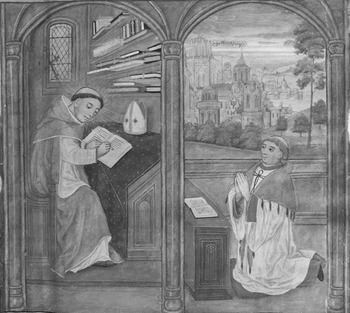
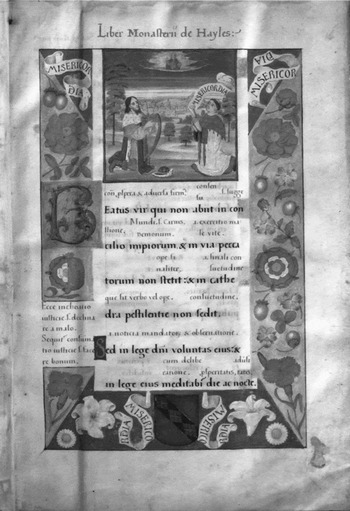
In a handful of cases these contacts were so well founded that they fostered common enterprises in the interests of intellectual and spiritual renewal. The educational foundations sponsored at Bruton, Milton and Winchcombe might be viewed in this light, the fruit of collaborations between the superiors of these houses and secular patrons that shared their humanist preferences.Footnote 150 Interestingly, in these foundations, the monks collaborated not only with like-minded clergy but also laymen. Perhaps the most remarkable of these collaborations was also connected (in a minor way) with Winchcombe, and with the Cistercian abbey of Hailes.Footnote 151 In a period probably between the first and second decades of the sixteenth century, the monks of these houses entered into a rich interaction with local gentleman, Sir John Huddelston, and Christopher Urswick, almoner to Henry VII and subsequently dean of York.Footnote 152 The precise nature of their relationship remains obscure, although the abbots of Hailes and Winchcombe acted as trustees of a school foundation at Winchcombe funded through the bequest of Huddelston's (presumably) widow.Footnote 153 Perhaps this was the final act of a social and patronal connection that had continued for a decade or more before Sir John's death. It seems it was in memory of his ties to Huddelston and their mutual relationship with the brethren of Hailes that Urswick, as Huddelston's executor, presented the monastery with two manuscript books, exemplars of humanist artistry and scholarship. There may have been other books in the donation, although the decoration of the two survivors does suggest that they were intended as companion pieces; their preservation together might corroborate this. The codices comprised a Latin psalter and a Latin translation of the pseudo-Chrysostom's Homilies on Matthew (i.e., the Opus imperfectum).Footnote 154 Both had been procured by Urswick; the psalter was copied in 1514 and presented to Hailes three years later (1517); no date of manufacture is recorded for the Chrysostom but it was donated to the monastery a year after the psalter. The script of both was the work of Pieter Meghen whose skills were employed by a number of English patrons at this date, amongst them Henry VIII. It is likely that Urswick commissioned them for his own use before selecting them for the Hailes donation: both carry illuminated title pages which depict Urswick in decanal robes knelt in prayer before, respectively, the psalmist and Chrysostom at his books (see Figures 1 and 2). There is no indication that Sir John Huddelston was himself a scholar or a commissioner of books, but clearly Urswick considered them a fitting memorial of his connection with the monks of Hailes, and perhaps a symbol of his role in their school foundation.
The Chrysostom presented to Hailes Abbey by Christopher Urswick, here featuring the donor, Wells Cathedral MS 6, fo. 1r.

The psalter presented to Hailes Abbey by Christopher Urswick, Wells Cathedral MS 5, fo. 1r.

This was not the only instance in which Urswick involved himself in the provision of monastic books. He appears to have collaborated in – and perhaps offered his patronage to – a project undertaken by Prior Thomas Goldstone of Canterbury to reproduce William Sellying's translation of Chrysostom's homily, ‘ad populum’; two manuscripts were made, also the work of Pieter Meghen and perhaps Urswick's role was to secure his services. It is possible, though not proven, that both books entered the monastic collection at Christ Church, although one came into the personal possession of Archbishop William Warham at an unspecified point before 1532.Footnote 155 Goldstone also requested a text from Urswick, a copy of Celsus's Dissuasoria, a defence of ecclesiastical possessions and privilege also incorporated in both manuscripts. Urswick was drawn to Goldstone and his community not only for their learning but also, it would appear, for their common outlook on church affairs. His correspondence with the prior showed him to be suspicious of the radical champions of reform and implicitly a staunch supporter of the monasteries. His assistance in the reproduction of humanist scholarship was surely intended as a contribution to this cause.
It is a reflection of the enduring dynamics of English monasticism at the end of the Middle Ages that measures of reform should have been formulated in collaboration with their own clerical and lay patrons. The hereditary founders may have cast off the care of their houses in the shadow of the DissolutionFootnote 156 but many monasteries still maintained a close and often constructive interaction with the clergy and laity of their immediate catchment. Indeed it might be suggested that with the proliferation of provincial schools (in which the monasteries had a patronal interest), the elaboration of the parochial worship (the preference for pricksong polyphony which the monastic churches had pioneered), and the penetration of print culture, there was greater common ground between the cultural and devotional tastes of the brethren and the social community beyond their precinct walls. In the new environment of the pre-Reformation urbs perhaps it was natural for men such as John Essex, Richard Kidderminster and Robert Joseph to live out their humanist values under local horizons, where now there were men of various conditions with whom to share them. Such, of course, were the centrifugal forces that undermined the capitular structures of the order. In the century before 1540, the General Chapter retained its role as supervisor of the monasteries and continued its cycle of triennial visitations (at least to 1527) and its meetings (to January 1532);Footnote 157 but it could not recover the common purpose that briefly animated its sessions in the early fifteenth century. The absence of any capitular canons in the early Tudor period, and the mounting pressure for regulation from the crown and episcopacy, should not obscure the appetite for reform and renewal still to be found in particular houses. In the reigns of Henry VII and his son, the greater abbeys and priories of the Benedictines, and perhaps a number of their Cistercian counterparts, continued the reinvigoration of the claustral syllabus which had begun as much as a century before; so far as can be deduced from a handful of manuscript fragments, their approach to the liberal arts and to scripture bore some resemblance to the curricula cultivated in the congregations of Bursfeld, Melk and Padua. Where they survive, their writings suggest that they also shared their conception of the monastic vocation, as the pursuit of Christ-like perfection through cerebral as well as devotional service. When they challenged the claims of English expatriates in the early seventeenth century, the Europeans were too hasty to cast their former houses as wholly unreformed. Perhaps they were right to argue that the lack of a true congregational structure – the historic devolution and individuality of England's monasteries – had left them vulnerable in the face of a hostile king.