Introduction
It is a truism that the nineteenth century saw a number of significant and profound changes in European musical culture: changes in musical style and associated aesthetics;Footnote 1 significant changes in listening behaviour;Footnote 2 the invention of sound recording and its consequences for listening and performance;Footnote 3 and last but not least changes in the size and nature of the orchestra and the rise of the silent baton conductor.Footnote 4 Historically, the coordination and musical leadership of orchestras has taken a variety of forms (whether directed from the keyboard, the principal violin or shared forms of leadership), but what emerged gradually and variably around the middle of the nineteenth century – and which remains with us in the twenty-first century – was a phenomenon that has come to be regarded as the paradigmatic manifestation of classical music as a whole: the large symphony orchestra directed from a central podium by a silent baton conductor with their back to the audience.
The changes in the scale, organization and function of this iconic ensemble have undoubtedly had important consequences for rehearsal and performance practices, for the distribution of technical and aesthetic agency, and for player experiences. But little or no empirical work has attempted to investigate this complex musical, social and perceptual domain – largely because of the technical challenges that must be overcome to gather appropriate evidence from such a complex data source. This article, which arises from the Arts and Humanities Research Council-funded project ‘Transforming Nineteenth-Century Historically Informed Practice’, describes just such a methodological endeavour in a collaboration with the Royal Academy of Music.Footnote 5 It makes use of a number of innovative digital methods so as to give a detailed and multifaceted picture of a large ensemble in action under four different conditions of direction, which makes use of the presence or absence of a conductor as one variable and an explicit instruction to exploit individual musical agency as a second variable. We investigate three perspectives on these playing circumstances: 1) the consequences for ensemble coordination and expressive timing; 2) the consequences for the players’ own experiences; and 3) the consequences for evaluations of these performances by an independent group of listeners.
The Social Organization of Artistic Work in Nineteenth-Century Orchestras
Changes in orchestral performance style since the advent of recorded sound have been well documented by scholars including Lance Brunner, Robert Philip, Timothy Day and Daniel Leech-Wilkinson,Footnote 6 with early recordings revealing, among other stylistic features, a strikingly different approach to temporal flexibility and ensemble ‘togetherness’ (or vertical alignment) at the turn of the twentieth century than there is today. While the twentieth century undoubtedly witnessed an increase in orchestral performance standards alongside advances in instrument recording technology, the evidence of earlier practices cannot be dismissed simply as the result of poor recording conditions, technological inadequacies or lower artistic standards. If this evidence points to alternative aesthetic attitudes and a distinctly different disposition toward musical ‘ensemble’, it raises crucial questions not only about nineteenth-century musical priorities and aesthetics in relation to their present-day counterparts, but also the distribution of musical agency within orchestras of the later nineteenth century.
An understanding of the changing social organization of orchestral practices in the nineteenth century is still to be established. The teleological narrative of the baton-waving conductor as bringing order and higher musical standards to otherwise chaotic orchestral and operatic organizations and performances is too blinkered and simplistic. Recent accounts of nineteenth-century orchestral practices have shed light on the nuanced social, political and economic conditions that facilitated new types of performance opportunities and larger ensembles, and which afforded the emergence of the orchestral conductor.Footnote 7 Elliot Galkin's account of the history of orchestral conducting documents the variety of approaches to ensemble leadership that existed simultaneously in the nineteenth century throughout Europe, including staff-pounding, bow-waving, and divided forms of leadership, with their corresponding proponents and critics.Footnote 8 The practical differences between a ‘violin-bow’ conductor, a ‘keyboard’ conductor and a ‘baton-wielding’ conductor have less to do with what is or is not in their hand, than with what such individuals are actually doing in rehearsal and performance, the scope and nature of their authority, and their role beyond the podium. The need for leadership (and followership) exists whenever a group of musicians of any size is assembled, though the fluid and dynamic distribution of those roles – often spontaneous and tacit, at other times organized and agreed – may disguise the fact that they exist at all.Footnote 9
A conductor's influence comes from very much more than his or her musical leadership during performance, and it is intimately bound up with their roles as entrepreneurs, administrators and rehearsers – those apparently more mundane functions that are almost entirely out of the public eye. A full understanding of the complex set of financial, social, psychological and musical factors that might start to account for ‘the conductor effect’ is beyond the scope and purpose of this article. What we start with is only the most visible tip of a proverbial iceberg: the manifest circumstances of performance, and the immediate task of describing and demonstrating a viable method by which to rigorously study the consequences of different degrees of distributed or centralized responsibility on a present-day orchestral ensemble – for performers, listeners, and the data of the performance itself. This offers a set of tools with which to explore not only the effects of different circumstances of more or less focal or distributed leadership and agency of the kind that were in evidence at different times and places through the nineteenth century, but also the effects of any number of historical practices from rehearsal techniques to fingerings and bowings. The data that we have collected and analysed are used only to demonstrate the potential of these digital methods. We make no claims in this article for the consequences of twenty-first-century musicians using nineteenth-century practices: that forms the next phase of this research.Footnote 10
Empirical Methods in the Study of Musical Togetherness
Quantitative Studies
It has long been recognized that expert musical performance involves extremely sophisticated control of tempo, timing, dynamics, articulation, pitch, vibrato and timbre. From as early as the late nineteenth century, psychologists (and more recently empirically minded musicologists) have sought ways to quantify, analyse and understand these skills using a range of technologies.Footnote 11 But until a pioneering study of ensemble timing by Rudolf Rasch in 1979, the complexity and ‘data-richness’ of musical performance restricted investigations to solo performance.Footnote 12 Rasch's study was principally concerned with establishing a working method, and presents only a summary view of performance data captured from three professional trios (wind, string and recorder), in which he endorses Seashore's claim that ‘in every artistic musical performance there is constant deviation from what is prescribed in the score’ and that ‘asynchronization of simultaneous notes should be regarded as one of the vital deviations in the performance of music’.Footnote 13
In a number of studies that followed Rasch's lead, the psychological, semiotic and social mechanisms by which ensemble musicians – from piano duet partners to string quartet players – strive towards various kinds of co-ordination and togetherness have been investigated using broadly quantitative methods, including both the analysis of audio and MIDI data, and motion capture methods.Footnote 14 With keyboard performance, MIDI data (from electronic keyboards, Disklavier or Bösendorfer pianos) offer a very direct way to study timing. But other instruments and voices that do not have the capacity to generate MIDI data from the instrumental mechanism necessarily require a method for detecting onsets from audio. While various mechanical and electrical devices have been developed for this purpose over the past century or more,Footnote 15 onsets from present-day digital audio recordings are either manually annotated using a graphical interface and software to assist with annotation (such as Sonic Visualiser),Footnote 16 or employ methods in Music Information Retrieval (MIR) using algorithms and computer learning to identify note onsets automatically. These automated processes have become increasingly reliable for the detection of solo percussive and plucked instruments. But the human voiceFootnote 17 and bowed string instrumentsFootnote 18 present significantly greater problems due to their slower rise times and extremely variable onset profiles.Footnote 19 Furthermore, automatic detection algorithms are commonly geared toward identifying the physical onset time (the time at which the acoustical energy of the note is first detectable) or sometimes an estimate of the perceptual onset time (the time at which a human listener might first detect a change).Footnote 20 The temporal coordination of a performance, however, is arguably associated with the perceptual attack time of notes (the perceived moment of rhythmic placement), rather than their physical or perceptual onsets.Footnote 21 Since ensemble timing depends upon players perceiving that the relevant co-performer(s) have arrived at a given note, an adequate analytical system must also be based on that same information.
Qualitative Studies
As with quantitative research into temporal coordination, qualitative studies of co-performer interpersonal dynamics within musical ensembles – the negotiation of agency and decision-making within the group – have tended to focus on small chamber groups such as piano duos, string or wind trios, quartets and small jazz ensembles.Footnote 22 These studies have used a variety of sociological research methods such as one-to-one and group interviews to explore organizational dynamics,Footnote 23 observation and analysis of live and video recorded rehearsals and performance,Footnote 24 and video-stimulated recall (VSR)Footnote 25 to obtain insight into micro-social interactions within specific musical episodes.Footnote 26 The findings from these studies have underscored the complex moment-to-moment negotiations (verbal, gestural and musical) that are present in small ensemble performance, and which materially shape performance outcomes. But there are very few studies that have explored such interactions within an orchestral environment. While there are practical reasons for this (such as the time-intensive one-to-one data collection methods usually employed in qualitative data collection), it also reflects an underlying assumption that interpersonal communication in larger conducted ensembles simply follows the explicit hierarchy outlined by the system of conductor, section principals and rank-and-file players. Thus, where there have been studies of orchestral dynamics, these have primarily focused on questions of conductors’ leadershipFootnote 27 or the dynamics of unconducted chamber orchestras.Footnote 28 But in a research project aimed at identifying the skills needed to be successful as a professional orchestral musician, Melissa Dobson and Helena Gaunt found that the professional musicians in their study placed more importance on gaining nuanced co-performer communication skills than those needed for following the directions of the conductor, underscoring the need for a deeper understanding of co-performer interaction within large ensembles.Footnote 29
Notwithstanding the evidence from Dobson and Gaunt's research, and sociological studies which reveal that a conductor's authority is negotiated and contingent, only two empirical studies have explored the ways in which instrumentalists negotiate musical decision-making in conducted orchestral rehearsals and performances. Eric Clarke and colleagues mapped the creative process between chamber orchestra musicians, conductor and composer leading up to the premiere of a new composition, using a combination of rehearsal/performance observation and interviews with musicians;Footnote 30 and Cayenna Ponchione-Bailey investigated the dynamics of musicians’ in-the-moment decision-making during the rehearsals and performances of six orchestras,Footnote 31 using an online form of VSR to capture the specific experiences of large numbers of performers within the same ensemble. In this latter method, short video excerpts from an orchestra's rehearsals and performances were uploaded to an online interface and all members of the orchestra, including the conductor, were invited to log on, view the video and leave time-stamped comments about their own experiences during each musical episode. The time-stamping of the comments made it possible to track the interactions of musicians throughout the excerpt and illuminated what influenced musicians’ decision-making about the manner and timing of their musical contributions.
In a related study that took into account audience responses, Ellen Langer and colleagues showed that orchestral recordings made with the instruction to perform mindfully (to ‘actively notice new things about the music’ and ‘create novel distinctions and offer new subtle nuances while playing their parts’) were preferred by a separate group of listeners over performances that aimed to replicate an ideal performance – raising important questions about the effect of different distributions of musical agency on audience judgements.Footnote 32
The limited research on orchestral performance suggests that interpersonal interactions and the negotiation of agency in modern-day orchestral music-making is multi-directional, complex, continually negotiated and dependent on moment-to-moment shifting circumstances within the context of locally accepted conventions and practices. There are many challenges inherent in exploring the consequences of different historical conventions in orchestral practices, but what follows is a set of empirical research tools designed to support such an investigation.
Manipulating Musical Control and Individual Agency
The central aim of the study reported here is to develop a set of rigorous methods that can be used to investigate the consequences – for the experiences of the players, for objective aspects of their playing, and for the responses of listeners – of different conditions of ensemble control and individual agency. An orchestra of student performers at the Royal Academy of Music in London was asked to play the exposition of the first movement of Beethoven's Sixth Symphony for a research workshop under four different conditions that varied the degree of individual responsibility for making musical decisions. At one extreme we aimed to centralize decision-making as much as possible, and at the other to give each of our participants almost unlimited license for musical decision-making. The four conditions make use of the presence or absence of a conductor as one variable; and an explicit instruction to exploit individual musical agency as a second variable. The description of the four conditions, read out to the participants at the workshops was as follows:
• Condition 1 (C1): Conducted-A. Imagine that the orchestra is being recorded for a movie soundtrack. It is important that the ensemble is as precise and professional as possible. Focus on playing the music as specified in the score and by the conductor.
• Condition 2 (C2): Conducted-B. The goal in this condition is not to follow a single person's interpretation of the music, but to respond imaginatively to each other's contributions. Tempo/rubato, articulation, dynamics, phrasing, etc. can all be shaped and changed in response to the playing of others. Don't feel limited to imitation, and feel free to respond to other people's playing in whatever way seems musically appropriate. Section leaders/principals may have a greater role to play while players sharing lines, such as those in sections, should aim to follow their leaders.
• Condition 3 (C3): Not conducted-A. This is the same as condition 2 (i.e. Conducted-B), but without a conductor.
• Condition 4 (C4): Not conducted-B. The only requirement in this condition is that you stay roughly together as an orchestra. The goal is to be as imaginatively engaged with others around you as possible. Section players should feel free to make their own decisions about details of dynamics, fingering, bow strokes, articulation, etc.
A graduate conducting student from the Royal Academy of Music agreed to participate in the study as the conductor in conditions 1 and 2. S/he knew nothing of the aims of the study in advance of the first workshop, nor the conditions in which s/he would participate, but was informed of the music that to prepare in advance. The order of conditions for the workshop was C1, C2, C3, C4.
Large Ensemble Data 1: Performer Experiences and their Representation
One of the most elusive aspects of large ensemble performance is the experiences of the performers themselves. Musicians in a large ensemble rely heavily on peripheral vision, subtle movement cues, and most importantly on listening to colleagues across the orchestra.Footnote 33 On account of this, external observation or motion capture do not allow a researcher to track where individuals are directing their listening attention, or to detect with whom they are communicating musically. In order to address this methodological challenge, the present study builds on the first author's VSR method for collecting experiential data from large ensembles,Footnote 34 making use of a polling app – SocrativeFootnote 35 – to minimize the time between playing and the collection of VSR responses. As described above, the orchestra was asked to play the excerpt three times under each condition so as to familiarize themselves with the condition's instructions. The third playing was recorded with a high-quality digital video camera. After the orchestra had finished playing the excerpt for the third time, a question was sent to the Socrative app on every player's smartphone asking them: ‘Please describe your experience playing under Condition 1 [2, 3 or 4]. Include in your response how successful you feel you were in following/implementing the instructions.’Footnote 36 Approximately five minutes was given for this response. In addition, a 20–30-second section of the final three-minute performance was identified for analysis, and this segment of the video file following the first response was projected onto a large screen in front of the orchestra, in order to prompt reflection on a specific passage of music from the final play-through. The excerpt was played twice after which the players used Socrative to leave their responses to the more specific question: ‘Can you describe what you were hearing, feeling, thinking, doing or responding to during this passage?’. The procedure was repeated for the other three conditions.
The players’ responses to the two questions were complementary, with generalized statements about the experience of playing the entire excerpt under each condition three times providing a context for the more specific reflections on individual passages, bars or notes. The VSR responses reveal individuals’ perceptions of their responsibilities when trying to fulfil each of the conditions as well as how the condition's instructions either facilitated or frustrated their ability to do so. The two sets of responses therefore form one set of data that we treat together in the discussion below.
Findings
Condition 1 (C1) elicited comments that confirm this as a familiar and routine way to engage with this repertoire: ‘Felt quite familiar (similar to performing with an orchestra normally)’ (Violin I-1), ‘No different to usual’ (Cello-1), and ‘playing in that manner and with a conductor is what we all have the most experience of’ (Oboe-1) were typical of many other players’ responses, and the conductor himself described his role as ‘comfortable and familiar’. The orchestral leader, however, observed that s/he felt ‘somewhat restricted due to the pressure to be precise and “correct”’; a bassoonist observed that this was a ‘very literal playing of the music’; and one of the viola players commented that s/he ‘felt like I shouldn't pay as much attention to my fellow section players and that the section leaders weren't very important at all’ – as a less positive reflection of the condition's requirement that players should ‘play the music as specified in the score and by the conductor’. The conductor observed that he was required to assume ‘a more traditional role as director in which I was dictating specifically how to play rather than facilitating collaboration across the ensemble’.
In the VSR responses to C1, players primarily reported on relatively technical issues, such as intonation, balance, matching note lengths and matching up rhythmically with colleagues. Many players described looking to the conductor for coordinating or phrasing information at times, but more frequently directed their attention to their colleagues, listening for intonation and balance and hearing or seeing the body movements of others to achieve good ensemble. When they directed their attention to colleagues for musical information it was usually described in terms of ‘matching’ or ‘responding’ to others when playing the same musical materials. A comment from the principal bassoon sums this up:
I was listening especially to the oboes to blend and tune with them, and the strings to keep in time and balance. I was counting the beats in the bar in my rests and when I was playing I was thinking about where the harmony was progressing so I could phrase the music. I was watching the conductor for any phrasing indications. (Bassoon-1)
Perhaps unsurprisingly, C1 seems to have been a very familiar experience for the orchestra, which is reflected in their generally uncontroversial responses to the questions.
In contrast, the players’ responses in Condition 2 (C2) demonstrate that there was no immediate consensus as to how to manage the increase in artistic agency in the presence of the conductor. Some players reported that the ‘biggest influence … to our performance was the conductor’ and that they were ‘still very much following the conductor's interpretation’ making it difficult to follow the condition's instructions to engage with other players in the orchestra (Flute-1). Others noted that they were ‘almost not aware of what the conductor was doing’ (Cello-1) and were ‘hardly looking at him anyway’ but turning their attention to their colleagues. As a horn player noted, s/he was ‘listening out for the strings and watching their bowing more’.
These differing perceptions were true of other sections of the orchestra. For example, one of the principal string players commented during the video-stimulated recall that s/he was ‘changing some of the bowings and dynamics, with the idea to find a different character and sound’ (Violin II-1) but noted in her general comments that everyone is ‘very used to follow[ing] a conductor and especially when there is one standing there giving exact instructions it's quite hard to make the orchestra or your section respond to your changes’ (Violin II-1). In contrast to the section principal's general perception, the section players reported being very focused on trying to follow their principal's musical lead:
[I] was trying to match the new aspects such as [the] bowing, articulation [and] expression of my leader and respond to it by exaggerating his/her ideas. (Violin II-2)
I think I was stressing somewhat about the bowing at this point, because they were slightly different to how we did them the time before. Was trying to follow the front desk. (Violin II-3)
Other players commented on the advantages of the partially controlled freedom that they experienced, appreciating the combination of guidance and the invitation to contribute individual ideas while interacting with colleagues:
More free to interpret a more individual style whilst still with the security of a conductor for cues and guidance. It was more of a complete team with no hierarchy. (Clarinet-1)
Created an environment where you could play slightly more liberally but while still having the conductor/section leader to follow and take guidance from. … I was listening much more to my neighbour and players in front of me and behind me in the section in this condition rather than in Condition 1 where I felt I was more just following directions. I feel that it created a slightly more relaxed/positive environment amongst the players. (Cello-4)
The same enthusiasm was reflected in the conductor's comment that it was ‘far more exciting’ and ‘unpredictable’, and that by the third iteration the players were ‘working more organically as a chamber ensemble, creating feedback loops among themselves and ultimately creating a less refined but more energized performance overall’.
Other players, however, drew attention to a number of problems. First, and most obviously, rhythmic coordination, which for some was disrupted by their inability to predict what was going to happen next:
It felt really messy and much less comfortable, especially to begin with. I had to listen a lot more and felt really on edge because I didn't know how other people were going to play and it was very difficult to react in time and to play together. It got better through the takes and it got easier to react quickly to what everyone else did. (Oboe-1)
For some, the trade-off seemed to be worth it:
Perhaps not the cleanest performance but definitely a lot more free musically. (Clarinet-1)
It was thoroughly enjoyable, I felt like we were slightly more successful as a wind section in particular though there were still some moments where the articulation and dynamics could've matched more. (Oboe-2)
But there were also concerns about an artificial or forced quality where, for example, ‘trying to be more individual led to some decisions which were not musically justified’ (Violin I-1), or players ‘felt the need to do something different even though it didn't fit with the style’ (Violin II-2). And the instructions did not seem to offer a structure that allowed them to engage musically:
As a string player following the section leader, the variation in interpretation of the part felt limited and it was hard to play much differently than Condition 1. (Cello-3)
Way more difficult condition as it is nothing I would normally do. It was hard to communicate with other people whilst following the leader as they might do something completely different. (Violin II-2)
Significantly for this exploratory study, the players’ responses clearly reflect the changed priorities that the condition was intended to elicit, and they provide insights into both the positive and negative consequences of those changes.
Condition 3 (C3), which mirrors C2 but without a conductor, seems to have resulted in more strongly positive experiences for the players, though there were still tensions between the increase in individual musical agency and the lack of centralized control. Some players’ responses indicated that the increased freedom to express individual musical ideas and to engage with colleagues was balanced by the need to curtail risk-taking so as to maintain ensemble cohesion. While some felt that the group played better together than in any of the earlier conditions, others reported that ‘the ensemble was initially not quite as tight and together as during previous conditions’ (Cello-4), and that it was more challenging to stay together as a group. Overall, and more than during previous conditions, players reported listening to colleagues across the ensemble rather than focusing primarily on the leader or section principals – or the now-absent conductor.
The commentaries confirmed that in comparison to earlier conditions, players throughout the ensemble were more assertive in offering musical ideas and taking responsibility for leadership – ‘more at liberty to make it more lyrical/musical’ (Viola-1).
It felt more free … I felt more responsibility to take some leadership and demonstrate to the others how I was going to play things. (Oboe-1)
I was feeling much more connected with the orchestra because we were starting to listen to each other. I conveyed way more musical ideas and felt more freely the metrum of the piece. (Violin II-2)
From the second desk, the cellist below describes how they were thinking about their own responsibility and role in not only maintaining, but even leading or ‘guiding’ rhythmic coordination within a flexible tempo:
During this condition I felt there was more incentive to take individual initiative in terms of making the music and keeping the ensemble together. I believe I was following the leader more to achieve the ensemble balance but also was thinking about tempo and how if it changed, how I as an individual could guide [it] in making sure it would be together. (Cello-4)
The players’ responses demonstrated a clear sense of group cohesion, responsiveness and ‘of listening to each other a lot more’ (Cello-2), summed up in a stronger sense of a chamber music experience (Violin II-2, Viola-3).
I felt the ensemble as a whole was listening to each other so much better without the conductor. People were also looking up out of the music more and therefore linking seeing who is playing the tune at which point with hearing. This in turn made the ensemble more responsive to everyone's differing interpretations. (Flute-1)
By contrast, other players mentioned a degree of caution in their own playing brought about by the responsibility for coordination resulting from the absence of a conductor. Some reported being ‘more cautious in terms of taking risks and doing things with artist freedom’ (Bass-1) and that there was ‘perhaps a little less individual expression … as initially it felt more stressful to get together’ (Violin I-1).
Feeling a bit anxious because there was no conductor. I was listening a lot more and watching and wasn't doing any rubato or pulling about the tempo in order to stay together. I was responding most to whoever had the tune and adapting to their tempo no matter how they played it in order to stay together with the ensemble. (Violin I-2)
Overall, while the players recognized the challenge for coordination that the absence of a conductor initially presented, they found this condition more comfortable than C2 – primarily, it seems, because it placed musical responsibility and agency firmly in their hands rather than in the uncertain and compromised circumstances of C2.
Finally, the players’ experiences of Condition 4 (C4) indicate a marked bifurcation of attitudes and experiences including mixed feelings about the balance between increased individual freedom and ensemble cohesion. Those comments that indicated wholly positive experiences of playing under the condition emphasized not only that it was ‘fun’ and ‘liberating’ on an individual level but also that they sensed that ‘everyone felt more free playing’ which ‘created a more positive energy’ in the orchestra overall (Cello-4). Two examples from the wind section summarize an experience that was echoed by at least a third of the players:
I think that in general our whole performance was more imaginative and enthusiastic than in any of the previous performances. I was experimenting with different dynamics and articulation. Some of us might have gone over the top, but I think everyone was enjoying themselves thoroughly. (Flute-2)
I don't really know how it came across, but I was having so much fun! I felt that we were all REALLY listening because we knew that anything could happen, and it just felt really refreshing to play without so many limitations. (Horn-1)
But a number of players commented on the destructive consequences of what appeared to be an absence of collective endeavour. For some it was either inappropriate in an orchestral setting where, as one oboist commented ‘individuality is great but we are playing as an orchestra not as soloists so we need to be individual but within the constraints of playing together’ (Oboe-1); or amounted to a lack of respect for the music – the ensemble ‘having to do something different or [trying] to be “creative” … but not for the sake of the music’ (Cello-1).
It was interesting to explore completely new things not on the page [or] coming from a conductor. It didn't benefit the piece whatsoever in my opinion as having very individual ideas that you cannot necessarily follow is not what playing in an orchestra is [about] and is somewhat disrespectful to the music. This isn't something I have done or will do in a symphonic setting. (Clarinet-1)
For one of the bass players, the lack of cohesive ensemble engagement was particularly disappointing:
It didn't feel like we were making music! I felt mostly uninvolved because the communication had gone, left feeling somewhat unfulfilled and desolate. I didn't feel so successful because there was so much energy going in very different directions. (Bass-1)
For the majority, however, the feelings were mixed, with players describing how the ‘freedom and absence of boundaries’ meant that people were ‘enjoying the experience more [which] brought life and vitality to the music’, but that there was a sacrifice for this, as the players were ‘not very in time with each other’ (Flute-1). Along these same lines, a horn player observed that it was ‘a little bit out of control, but people are more willing to express their ideas’. Overall, players' experiences of the collective effort were substantially different in this most unconstrained condition. Some players observed that the orchestra ‘stopped listening to each other’ turning it into ‘less of a collective effort’ (Viola-3), while others perceived that ‘everyone was listening attentively and responding much quicker’ (Violin I-3), and that the orchestra ‘became more attentive to the changes around us and started to engage more with each other’ (Violin II-1).
In summary, we found that this data collection method facilitates gathering important insights into the simultaneous and variably congruent or incongruent experiences and attitudes of a whole orchestra of players, and that these insights clearly – but not always predictably – reflect the consequences of differing conditions of performance. This offers a significant window onto a world that until now has remained almost entirely unresearched, and one with important potential for understanding players’ perspectives on different performing and rehearsing practices.
Large Ensemble Data 2: Capturing, Analysing and Representing String Sound
The second component of our approach is designed to obtain a quantitative account of ensemble timing from each of the individual performances, with a specific focus on the string sections of the orchestra.Footnote 37 Gathering these data involves overcoming a number of technological challenges, stemming from the fact that despite advances in digital signal processing, it is still impossible to disaggregate the performance data of individual instruments from a digital audio recording of the whole group – a necessary requirement for any detailed quantitative analysis of ensemble timing. This is particularly the case for string sections, in which instruments with the same pitch and onset characteristics all play the same sequence of notes. It therefore involves: 1) developing a method to record individual performances simultaneously from all of the individuals in a string section; 2) ensuring that the playing situation is disrupted as little as possible (sightlines, compromises to the musicians’ instruments, sound production, or movement); 3) developing a method to identify note onsets in each individual instrumental recording; and 4) developing analysis tools to visualize and represent the data.
In order to obtain simultaneous individual recordings from multiple string players, avoiding acoustic bleed between closely adjacent sound sources and with minimal disruption, we therefore used an array of contact microphones attached directly to individual instruments. For violins and violas the contact microphones were held with elastic against the back of the instrument with the contact microphone situated near the sound post. Once attached, and with the thin cable tucked over the left shoulder of the player, the player no longer sees or feels the contact microphone, which also has no effect on sound production or sightlines. For cellos and double basses small clip-on contact microphones were attached to the bridge. In the study reported here we used 15 contact microphones, but it is relatively straightforward to scale-up for larger ensembles – given a sufficiently multi-channel audio interface, and the ability to analyse the increasingly large amount of data that results.
While the basic contact microphones used in this study provide the amplitude, frequency and timing information required for our quantitative analysis – sufficient to provide a clear representation of the information necessary to identify note onsets – the sound quality of the recordings from the contact microphones is relatively poor. The contact microphone recordings were therefore supplemented with a high-quality sound recording of the ensemble as a whole, consisting of a conventional digital audio recording from a stereo pair of high-quality Neumann microphones positioned centrally in front of, and above, the ensemble.
Individual sound files and analysis
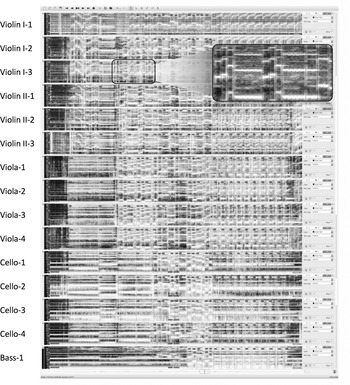
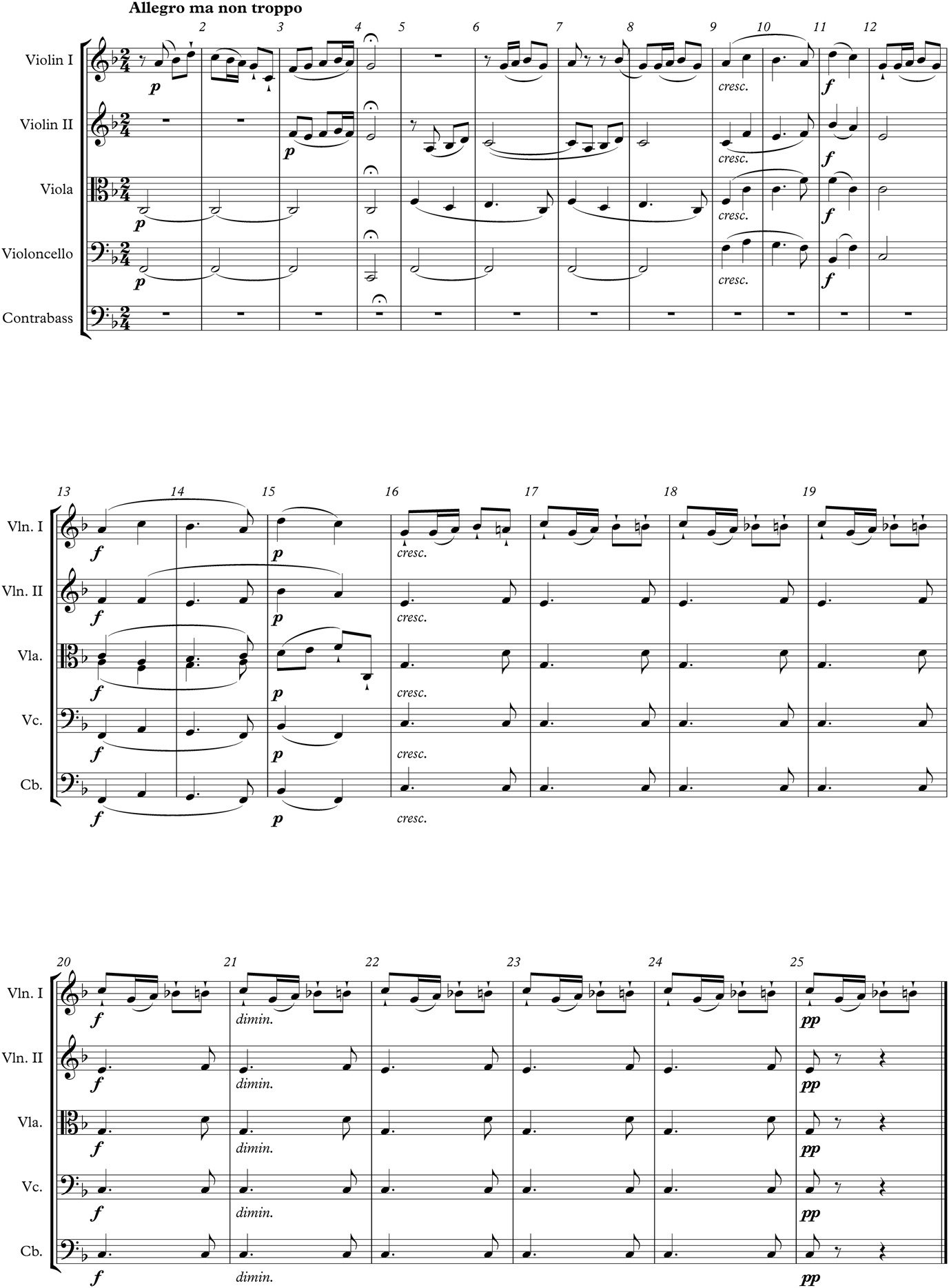
Each individual instrumental sound file, from even a relatively short passage of music, can contain hundreds or thousands of note onsets to be identified. In light of the earlier discussion of the inadequacies of automated methods, this study relies on the hand-annotation of each sound file to identify the perceptual attack time of every note. These annotations are made utilizing the ‘melodic range’ spectrogram and ‘time instants’ annotation functions in Sonic Visualiser. Figure 1 shows a melodic range spectrogram representation in Sonic Visualiser of the contact microphone recordings from 15 string players, for bars 1–25 of the first movement of Beethoven's Sixth Symphony (see Ex. 1). The ‘time instants’ function in Sonic Visualiser allows a user to place a line on the spectrogram where they identify the rhythmic placement of the note. The annotation can be sonically as well as visually marked, enabling the user to listen back and adjust the line until satisfied that the mark is correctly aligned with the perceived onset of the note. In the expanded ‘bubble' attached to Violin 1-3 in Figure 1, the vertical lines represent these perceived onset annotations in the sound file. While this procedure (which involves coordinating the visual representation in Sonic Visualiser with attentive listening to the associated sound file) is extremely labour-intensive, and individual perceptions of attack times will differ, for this study we used a single annotator with a constant method to obtain comparable data across all players.Footnote 38 The timing data from the Sonic Visualiser annotations can then be exported and processed with a purpose-built application to render them into a form suitable for statistical analysis.Footnote 39
Sonic Visualiser melodic range spectrogram representation of bars 1–25 of Beethoven, Symphony No. 6 in F major op. 68, mvt i, showing 15 individual string parts (recorded from contact mics). Time (a total of 30 seconds for this screenshot) on the horizontal axis, and log frequency on the Y axis. Acoustical energy (proportional to loudness) is represented as the brightness of the trace.

Beethoven, Symphony No. 6 in F major op. 68, mvt i, bars 1–25 (strings only)

Findings
The onset data affords a wide variety of analyses, ranging from the global – ascertaining the overall ‘togetherness’ of a passage of music – to the specific temporal relationships between all players in the ensemble at any given metrical position (e.g. the first beat of the bar, or the second quaver of the second beat). For the purposes of this article, we offer an insight into the first 25 bars of the Beethoven movement under the four conditions described above. These data consist of 2992 note onset annotations for 98 metrical positions from 15 string players (three first violins, three second violins, four violas, four cellos and one double bass).
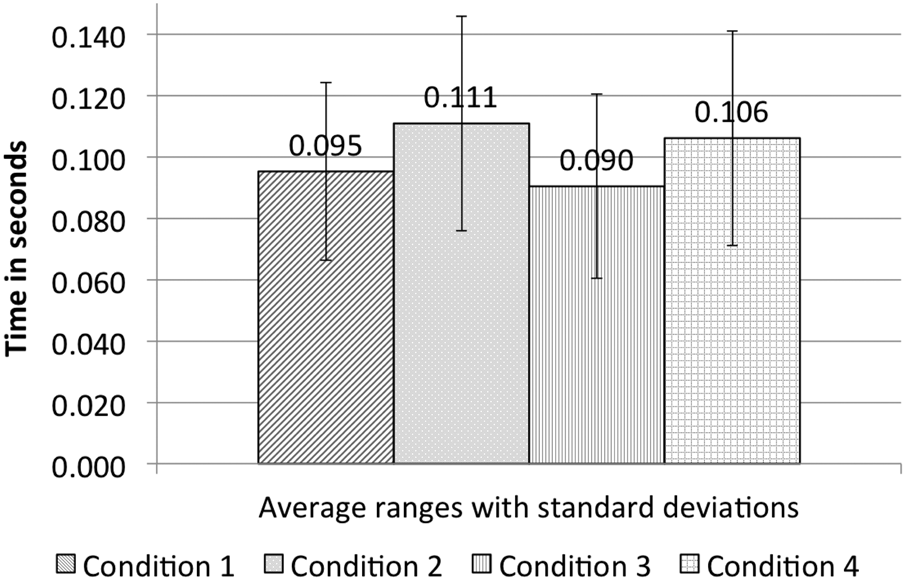
As an overview of the data, Figure 2 shows the average range of the onsets across all metrical positions for each condition. The ‘range’ is the duration (in msec) between the first instrumental onset at a given metrical position and the last – in essence a measure of the asynchrony.Footnote 40 The average ranges for all conditions cluster around 100msec, with C1= 95msec, C2 = 111msec, C3 = 90msec and C4 = 106msec. As we have already seen, the players experienced these conditions as noticeably different in terms of ensemble cohesion; and as we will see in the next section, listeners also perceived the conditions as significantly different in coordination and unity, with C1 and C3 being rated as sounding markedly more together than C2 and C4. On average, however, the values of the ranges varied rather little between conditions with the most extreme difference (between C2 and C3) being only 21msec.Footnote 41 Although this averaging conceals note-by-note variations in the value of the range within each condition, the standard deviations of the ranges for each of the conditions are also very similar (C1 SD = 0.029, C2 SD = 0.035, C3 SD = 0.030, and C4 SD = 0.035).Footnote 42 This suggests two crucial things: 1) relatively small changes in ensemble timing in string ensemble playing result in substantially different performer and listener perceptions of orchestral performances and 2) that the meaningful differences lie at a more nuanced and local level.
Mean onset ranges (duration from first to last onset) across all notes in Beethoven, Symphony No. 6 in F major op. 68, mvt i, bars 1–25, for Conditions 1–4

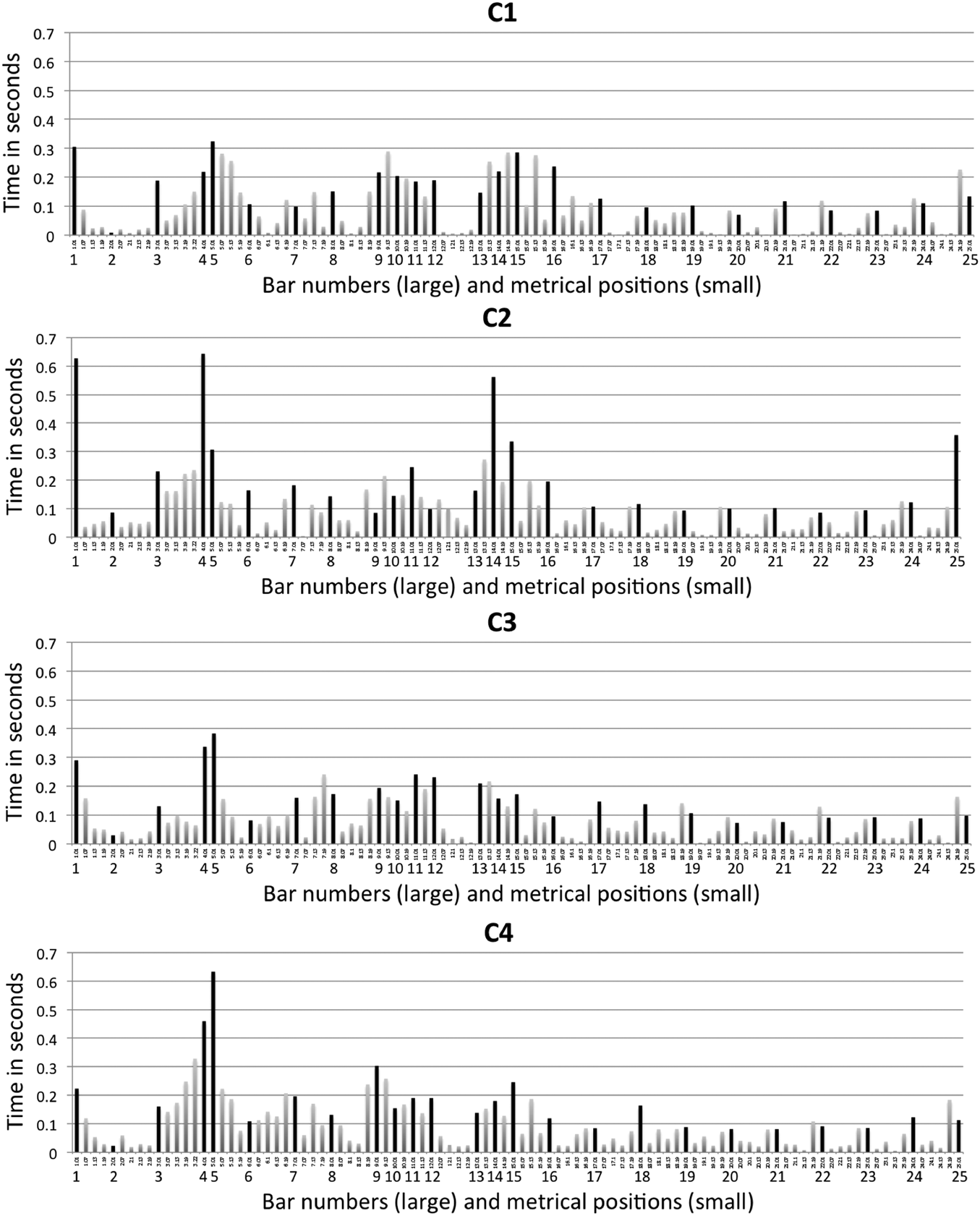
Figure 3 shows a bird's eye view of the ranges of onsets for all performers for each metrical position between the four conditions. The X-axis shows bars (larger font) and metrical positions (smaller font), while the Y-axis shows, note-by-note, the value of the range (in seconds). The darkened data columns indicate the downbeat of each bar.
Onset ranges (duration from first to last onset) at each metrical position in Beethoven, Symphony No. 6 in F major op. 68, mvt i, bars 1–25, for Conditions 1–4

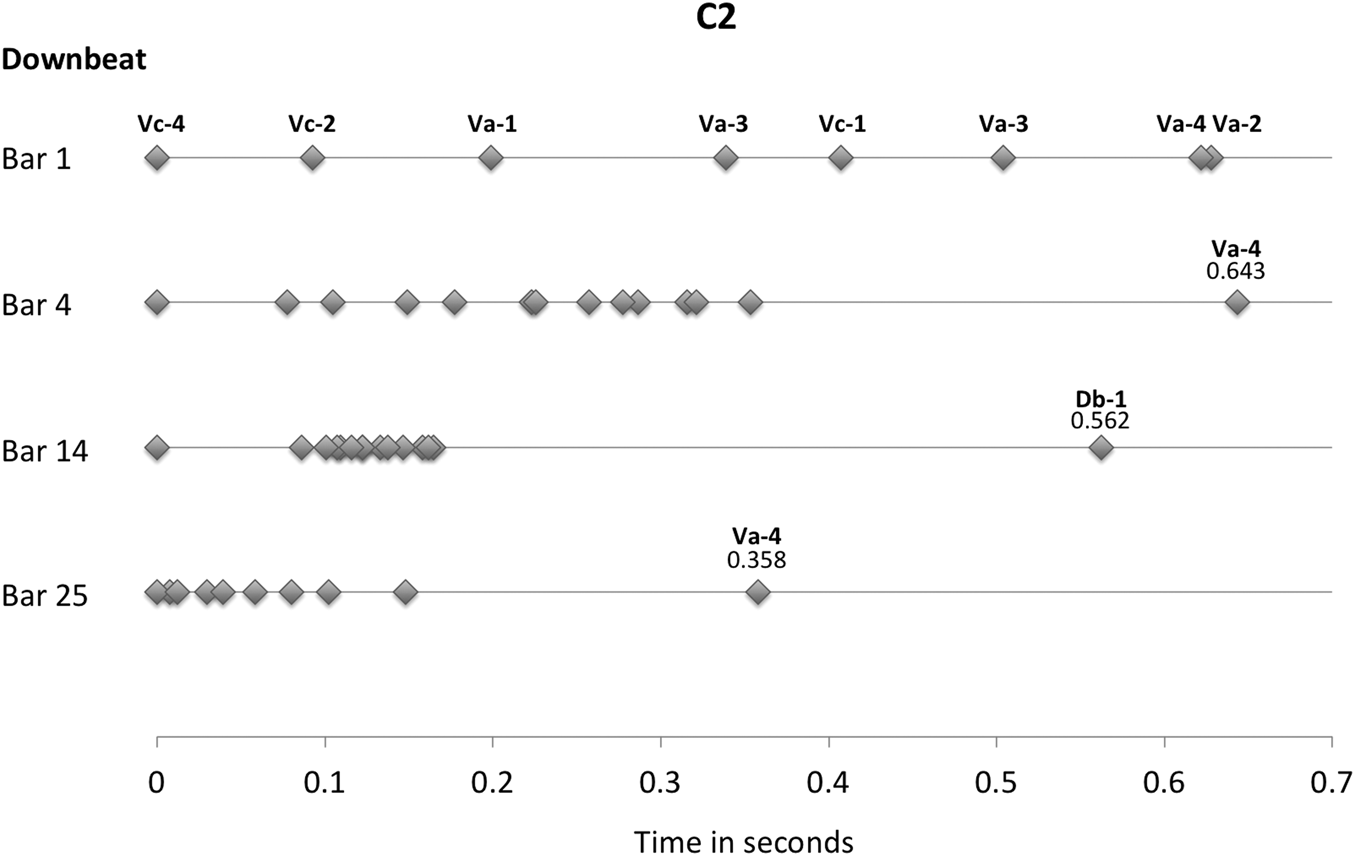
The charts illustrate a tendency for longer note values and louder, more legato passages involving more players (bars 3–6, 9–12 and 13–16) to have greater onset ranges across all four conditions. There are some striking differences however, such as the relatively large ranges in C2 at bars 1, 4, 14 and 25. Taking a closer look at these points to understand what might be going on, Figure 4 shows the onset distribution across individual players of the four largest ranges in Condition 2: the downbeats of bars 1, 4, 14 and 25. Onsets for the downbeat of bar 1 are rather equally distributed within the overall range, with principal players’ onsets embedded in the middle of the range, perhaps suggesting more individual initiative on the part of the section players or differing interpretations of the conductor's gestures for this quiet entrance on a long note in the lower strings. However, in each of the other three metrical positions there are outliers. Viola-4 plays substantially later than the rest of the ensemble on the downbeats of bars 4 and 25, and Bass-1 nearly half a second later on the downbeat of bar 14. The qualitative data collected from the players relating to this performance provides an insight into what is going on here. Viola-4 had apparently taken to heart the instruction to make more individual choices, commenting: ‘There was more freedom in my playing as there were more musical choices that I could make. I was more excited about the music because I didn't have to follow anyone specifically.’ The conspicuously late onset by Bass-1, on the other hand, was apparently due to a missed entry with the player scrambling to join in mid-phrase – an error which seems to have been due to being overly attentive to others’ playing rather than his/her own. S/he wrote: ‘I was listening much more to others and interacting with what other people were doing rather than focusing on (the precision of) my own playing. (I missed my entry on this particular take) – annoyed about this. I was responding to how the violins had played their line a little bit earlier.’
Onsets of individual players on the downbeats of bars 1, 4, 14 and 25 in C2

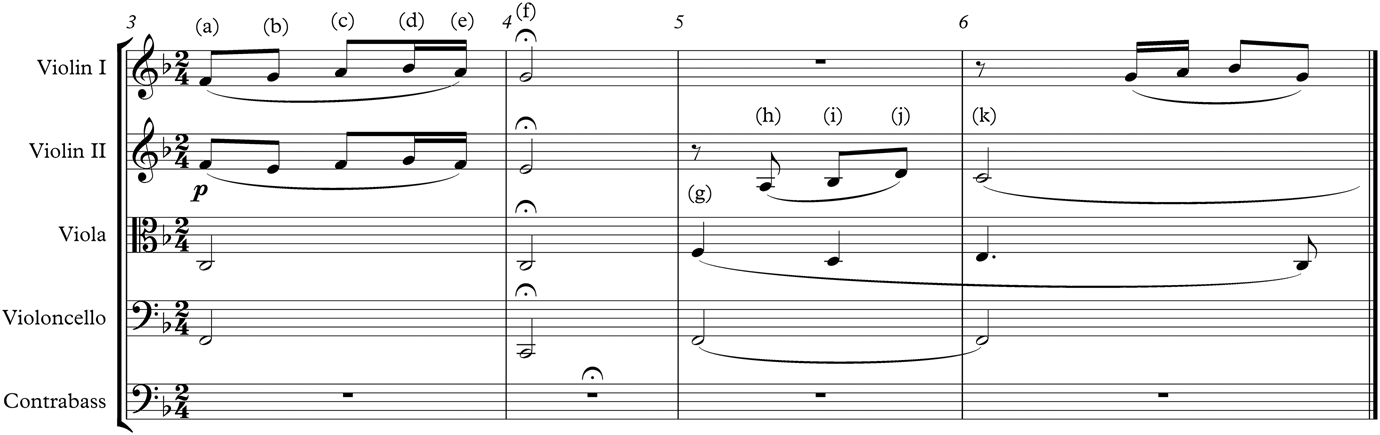
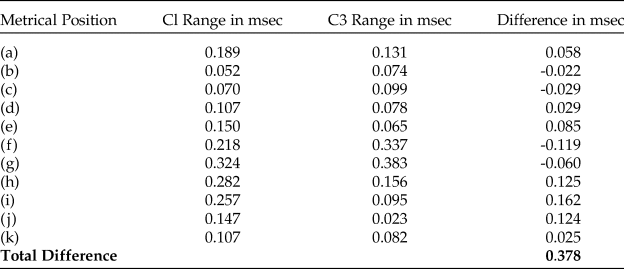
Returning to Figure 3, three sections in the excerpt show peaks in range values across all conditions: 1) Bars 3–6, which contain a pause fermata before which the musicians performed a ritardando (not indicated in the score, but common in modern performance practice) followed by a re-start; 2) Bars 9–12, which are legato and involve a crescendo; and 3) Bars 13–16, which are also legato and involve a subito piano. Most notable is the variation between conditions in bars 3–6 (extract shown in Example 2), with C3 showing the smallest ranges on average and yet the greatest ritardando: bar 3 has a duration of 1.713 sec in C3, compared with 1.600, 1.512 and 1.296 in C1, C2 and C4 respectively. Within a section that requires the negotiation of a tempo change, a pause and a re-start, C3 (the first unconducted condition) was actually more coordinated than any of the other conditions. Table 1 shows the ranges at each metrical position for the C1 and C3 performances of this passage, and the differences between those ranges, the positive total difference value indicating the extent to which the ranges in C1 (conducted) were greater than C3 (unconducted).
Beethoven, Symphony No. 6 in F major op. 68, mvt i, bars 3–6

Ranges at each metrical position in bars 3–6 for C1 and C3, and their differences

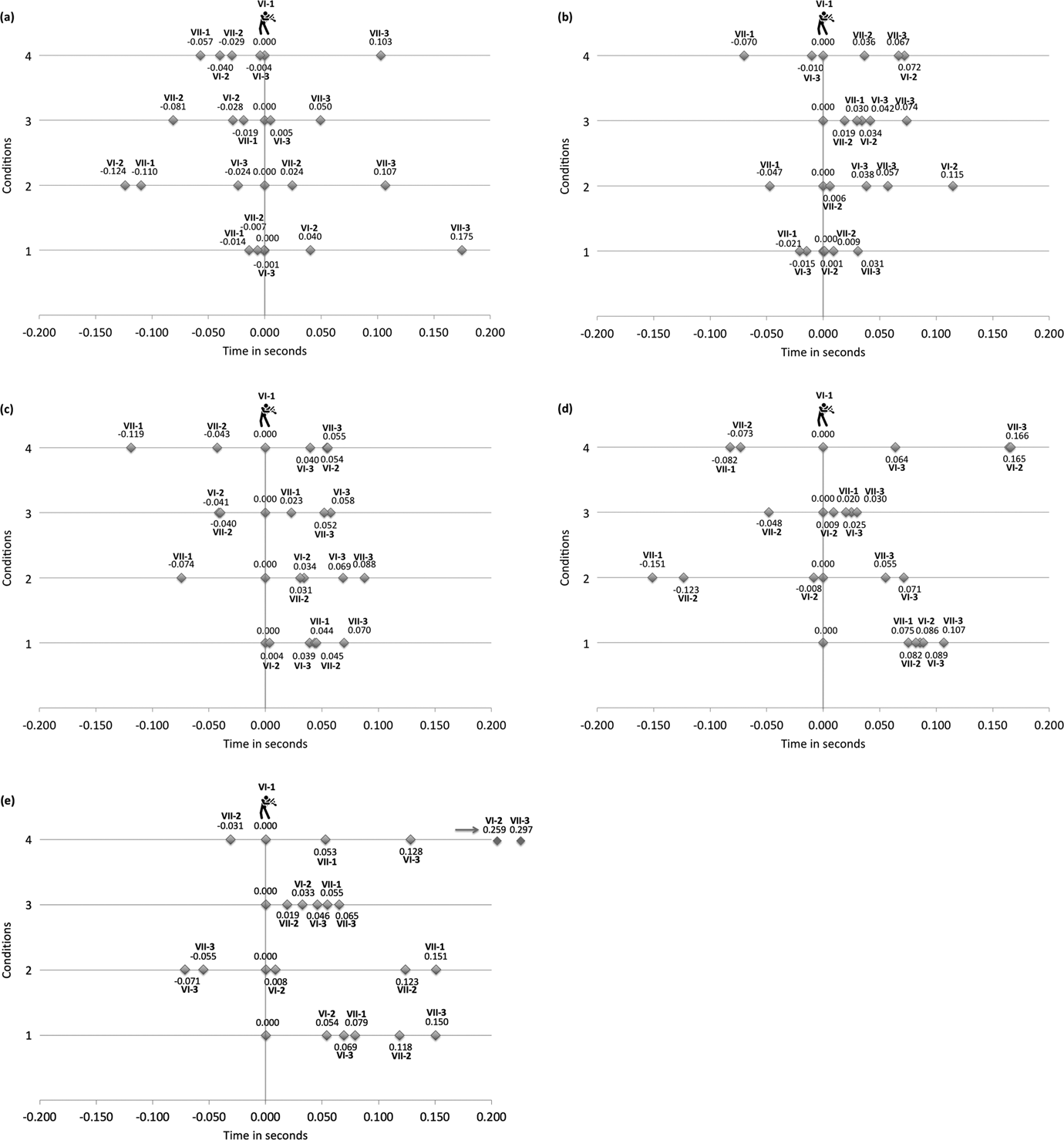
A critical question is how the players engage with one another to accomplish the ritardando under the differing performance circumstances and what the onset data can reveal about these interactions. Figure 5 offers a detailed view of all of the players’ onsets in bar 3 up to and including the downbeat of bar 4. Each part (a–e) of Figure 5 represents an individual metrical position with a comparison of individual musicians’ onsets across the four conditions. It is important to bear in mind that there is no singular time point in relation to which players are ‘early’ or ‘late’, since all such judgements are relative to the ensemble as a whole. In the figure, the leader (Violin I-1) has been (not entirely arbitrarily) selected as the reference point. Players whose onsets occurred before the leader are indicated in negative values to the left of the figure, while onsets that occurred after the leader are indicated on the right-hand side of the figure.
Onsets of individual players at each metrical position (a–e) in bar 3 across all conditions

A number of features emerge from Figure 5, of which we will comment on three here. First, in C1, the onsets of players at each metrical position are predominantly after that of the leader. The few onsets that come before the leader are tightly clustered around the leader, with the largest only 21msec ahead of the leader's onset – a value that is below the generally accepted threshold for the detection of asynchrony.Footnote 43 However at metrical positions (d) and (e) all other players’ onsets are 50 to 150msec after the leader, with the last onset at each metrical position made by a second desk second violinist. These observations suggest that, as instructed, players were both following the conductor and not playing before the leader, reflecting the conventional orchestral hierarchy. The tendency of players to play after the leader at (d) and (e) suggests either a divergence in interpretation of the conductor's ritardando between the leader and the others in the group, or that the players were focused on following the conductor rather than the leader at this point.
Second, in contrast to the delayed playing after the leader, in C3 note onsets were never earlier or later than the leader's onsets by more than 80msec. The pattern of onsets suggests a much more collaborative and distributed approach to ensemble timing – a ‘chamber music’ approach – which was reflected in the players’ experiences as expressed in the qualitative data.
Third, a close look at the distribution of the onsets in both C2 and C4 shows that the principal second violin plays before the leader at (a), (b), (c) and (d) by between 57 and 151msec.Footnote 44 These data are corroborated by the Socrative data of the principal second violinist, who was emphatic about trying to do things differently in these two conditions (changing bowings, dynamics and character), and frustrated that it was difficult to get the other players to follow suit.
The aim of this discussion of the quantitative performance data has been to demonstrate the capacity of this method to capture both broad characteristics and detailed features of the timing data of large ensemble performance in a way that reflects the specific conditions under which the ensemble was instructed to perform. The final perspective, to which we now turn, examines how listeners evaluate these performances.
Large Ensemble Data 3: Listener Evaluations
How do the members of an independent group of listeners evaluate and respond to recordings of the four conditions? The design of this part of the study follows standard methods used widely in research on music perception. Listeners were asked to evaluate the same section of each recording (the four conditions) using eight six-point bipolar rating scales.Footnote 45 The eight bipolar scales were chosen to reflect a range of more technical and evaluative characteristics. With three recordings of each condition, the decision was made to ask for listener evaluations of the third performance from each condition, since this was likely to represent the most practised and stable version. In order to select a manageable section of music, the first 52 bars of the movement – from the start to the beginning of the transition to the second theme – were used, lasting around 50 seconds.
Seventeen undergraduate, graduate and staff members of the Faculty of Music at the University Oxford were recruited to take part on a voluntary basis, and in two separate group sessions listened to the recordings over a high-quality amplifier and loudspeakers in a teaching room in the Faculty. The instructions asked them to rate the recordings on eight 6-point rating scales: Expressive–Inexpressive; Competent–Incompetent; Coordinated–Uncoordinated; Smooth–Rough; Unified–Disjointed; Confident–Unconfident; Shaped–Shapeless; and Lively–Dull. Participants heard each recording in turn twice in immediate succession, after which there was one minute in which they made their judgements, before hearing the next pair. After all four recordings had been played they heard each one for a third time in the same order, again with a minute's pause between each one during which they could make any changes to their earlier judgments, were asked to supply up to three words or short phrases that captured how they would characterize each performance, and indicated the recording that they most enjoyed. The order of the conditions was C2, C4, C1, C3.
Findings
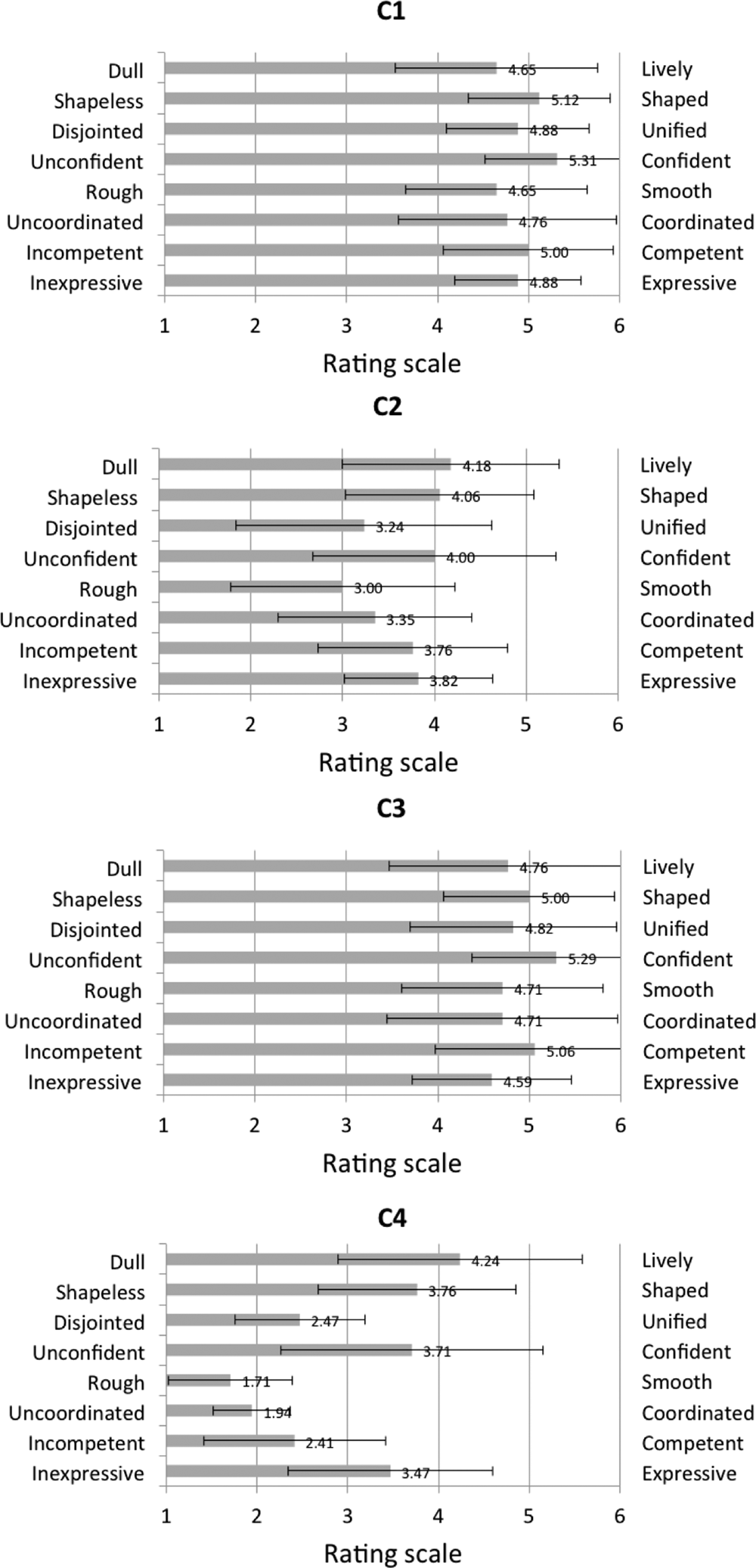
A standard way to analyse rating scale data of the kind collected here is to use multivariate analysis of variance (MANOVA). In simple terms, MANOVA tests whether the average pattern of rating scores (across the eight scales that the listeners used) is significantly different across the four playing conditions. In this case, the analysis of the result shows a highly significant difference between the listeners’ responses to the four conditions.Footnote 46 Figure 6 shows the pattern of mean values for all eight rating scales across the four playing conditions, and demonstrates the different pattern of evaluations made by our listeners. Conditions 1 and 3 show rather similar average profiles, as do conditions 2 and 4.
Mean listener ratings for all eight 6-point scales across the four conditions (C1, C2, C3, C4)

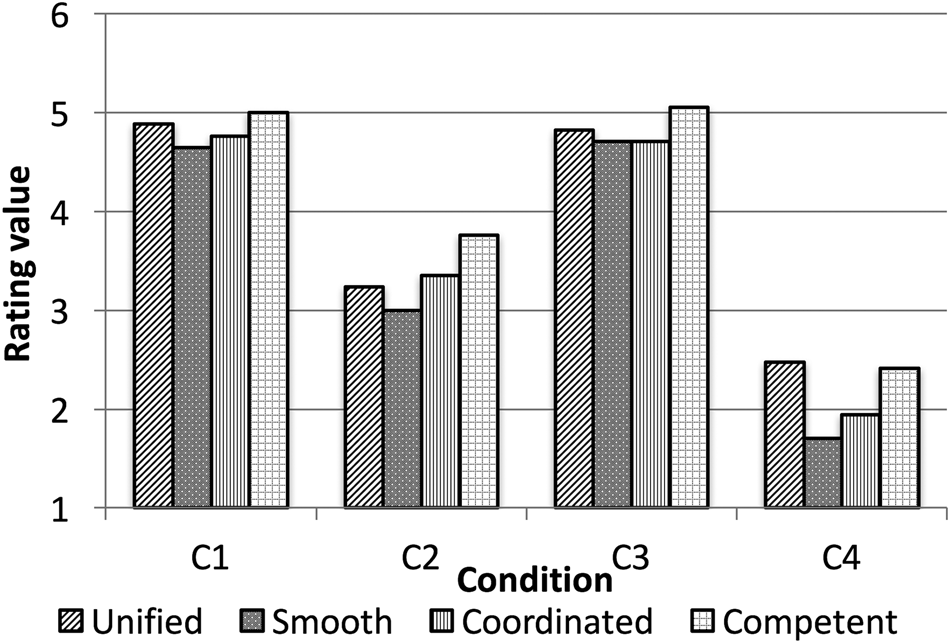
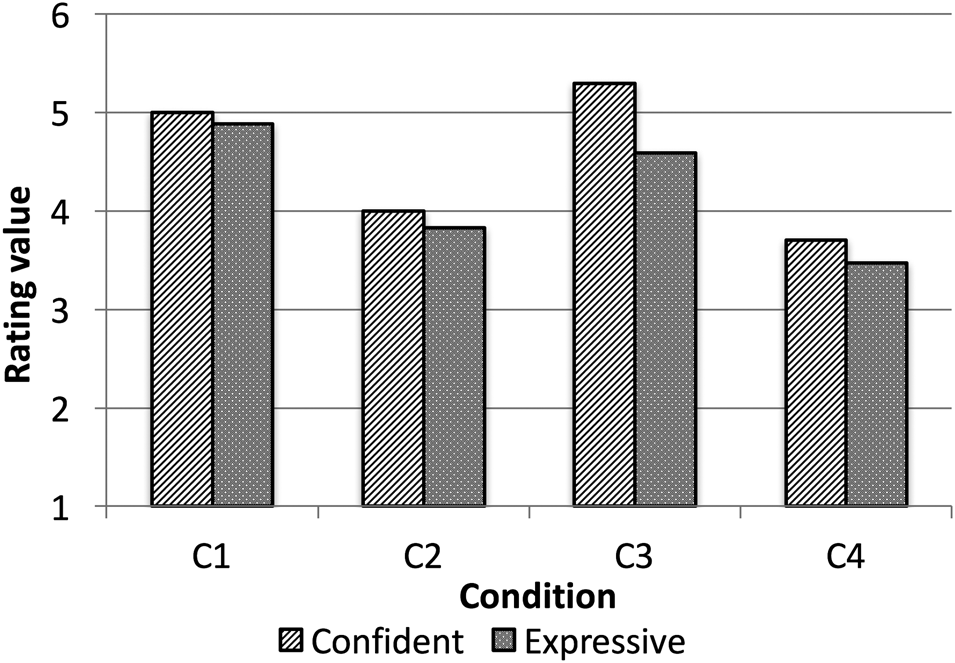
This set of profiles, however, tells us nothing about the roles of the individual rating scales in our listeners’ responses to the four recordings. To determine whether some of the rating scales are more salient in distinguishing the four recordings, we carried out a one-way analysis of variance (ANOVA) on each of the individual rating scales (a total of eight analyses).Footnote 47 Seven of the eight scales gave significant results, with only the ‘Dull–Lively’ scale showing no significant differences. Of the seven, one scale (Unconfident–Confident) showed a result more weakly significant than the other six (a significance level of p < 0.002, as compared to p < 0.0001 for the others). We can also use the value of the F-ratio (the statistic that is the primary outcome of an ANOVA) as an indicator of the salience, or strength, of each of the rating scales – larger F-ratios indicating stronger effects.Footnote 48 Four of the eight scales have particularly large F-ratios: ‘Disjointed–Unified’ (F = 22.40); Incompetent–Competent’ (F = 25.70); ‘Uncoordinated–Coordinated’ (F = 28.00); and ‘Rough–Smooth’ (F = 33.80). In all cases the mean scores follow the same pattern, as shown in Figure 7: C1 and C3 show high values for Coordinated, Unified, Smooth and Competent, with C2 and particularly C4 showing values towards the other end of the scale (Uncoordinated, Disjointed, Rough and Incompetent). Although the effect is not quite as strong, Figure 8 shows that C2 and C4 are also perceived as both less confident and less expressive.
Mean listener ratings for the Unified–Disjointed, Smooth–Rough, Coordinated–Uncoordinated and Competent–Incompetent scales across the four conditions

Mean listener ratings for the Expressive–Inexpressive and Confident–Unconfident scales across the four conditions

The descriptive phrases proposed by the participants to characterize the four recordings unsurprisingly follow the ratings in terms of their positive and negative valence. Categorizing the adjectives or phrases into positive (e.g. assured, dramatic, balanced, fun, exciting, thoughtful, sonorous), neutral (e.g. rustic, varied, bucolic) and negative (e.g. messy, shrill, unbalanced, school orchestra, sloppy, boring, bland) the numbers of negative, neutral and positive descriptors across the four conditions are as shown in Table 2, with C2 and particularly C4 attracting the largest number of negative descriptors, and C1 and C3 the largest number of positive descriptors.
Numbers of negatively, neutrally and positively valenced descriptors across the four conditions

Finally, the pattern of overall preferences shows a picture that largely mirrors the pattern of the rating scales. Eight listeners rated C1 as their preferred recording, two C2, five C3, and two C4. The majority preference for C1, with C3 also receiving strong support, is consistent with the high scores given to those conditions across the rating scales. It is of some interest that C2 and C4, despite their low or very low scores on the rating scales, attract two cases each of listeners who rate them as their preferred recordings. It would be unwise to read too much into these four data points, which may simply be signs of uncertain judgement or a failure to keep the four recordings distinct in memory. But it is possible that they indicate that what might seem to be the perceived ‘inadequacies’ of the C2 and C4 recordings – in terms of competence, coordination, unity and roughness – do not prevent a preference for this kind of playing among at least some of the listeners. The listeners’ own descriptions of the recordings shed some light on these apparently discrepant preferences. Of the two who expressed a preference for C2, only one supplied any descriptive terms, these being ‘edgy’ and ‘visceral’; and of the two who expressed a preference for C4 the descriptive terms are ‘different’, ‘spontaneous’ and ‘springy’ from one, and ‘riotous/boisterous’, ‘rustic/folky’ and ‘oom-pah’ from the other. Set against the corresponding descriptors from those who did not enjoy these recordings (e.g. ‘messy’, ‘rushed’, ‘erratic’, ‘difficult to enjoy’, ‘unbalanced’) this suggests different aesthetic priorities among some of our listeners, who may have been more interested in less predictable approaches to a well-known piece of repertoire. It also is worth noting that one of the participants, a composer and senior member of the Music Faculty at the University of Oxford who worked for a time as a classical music producer for Sony, pointed out that his choice of preferred recording was based on the assumption that this was a recording – which might be heard repeatedly; but that he would have chosen a different version as a one-off live performance.
Summary, Conclusions and Prospects
From Beethoven and Farrenc to Schoenberg and Smyth, the nineteenth century offers an extraordinary body of orchestral and chamber music. For more than four decades scholars and performers have experimented with historically informed approaches to this repertoire, but with little or no empirical evidence about the consequences of such approaches for measurable attributes of the performance, the experiences of players, or the responses of listeners. We have described two digital approaches that overcome some of the technical challenges that are (arguably) responsible for the dearth of such studies. First, using a novel implementation of Video-Stimulated Recall (VSR) employing smartphone technology, we have demonstrated the viability and research potential of acquiring immediate commentary from orchestral musicians on their own experiences of playing under different conditions of orchestral leadership. Second, using a combination of contact microphones for the string players and a conventional digital audio recording, we have given a detailed account of the objective consequences of different conditions of leadership and musical agency on the performance characteristics of an orchestral performance. And third, using standard experimental methods we have shown that independent listeners make distinct judgements about the perceived qualities of, and their own preferences for recordings of these differentiated performances.
How, then, do the findings of each of these perspectives relate to one another? And what does this demonstrate about both the methods that we have designed and their potential in relation to the nineteenth-century historically informed context for which they have been developed? The qualitative judgements of the orchestral musicians themselves demonstrate the complex dynamic that operates in a large ensemble, and both the advantages and the drawbacks that variably distributed agency affords. As the most vertical distribution of authority and direction, C1 was reassuringly familiar to those musicians for whom it was the norm, but it offered little opportunity for musical agency among those who found it prescriptive and constraining. C2 afforded a welcome increase in the scope for independence and engagement to some players, but was complicated for some by the apparent conflict between an explicit instruction to enact a greater degree of musical independence and the presence of a conductor. For yet others the conductor offered an enabling framework of large-scale coordination within which more detailed expressive shaping could be activated. In removing the conductor, C3 eliminated what some experienced as a productive complementarity and others a problematic conflict, with players indicating a stronger sense of their opportunities for individual musical agency, tempered by those who experienced the constraint of having to hold the group together. C4 demonstrated a bifurcation between those who experienced it as the breakdown of the ensemble, an attenuation of musical communication, and a disrespect for the music; and those who felt excited and liberated by the absence of central control and the opportunity for a degree of ‘free play’.
The objective measurements of timing and coordination under the four different conditions demonstrated that temporal ‘togetherness’ is not the province of conducted orchestras alone. While this is nothing new in itself, it is striking that when this group of conservatoire students (who do not play together regularly as an orchestra) played ‘as precisely as possible’ with the aid of a conductor, they were no more synchronized than when they played without a conductor and with the instruction to engage with each other musically, even while negotiating tempo changes and pauses. This quantitative evidence supports the qualitative findings of Dobson and Gaunt, and Ponchione-Bailey,Footnote 49 who found that musicians in professional ensembles rely more on the auditory and visual information coming from colleagues about precisely when and how to play than on the visual information from a conductor.Footnote 50
The data also enabled a detailed investigation of the anatomy of collective string ensemble onsets, including how individual onsets are distributed across a single metrical position, and the relationship of individual players’ onsets to others in the group. The ability to dissect the inner workings of a collection of onsets and to examine their effects on player and listener experiences provides a new means for players to understand the perceptual and aesthetic consequences of different approaches to interpersonal musical alignment.
Our listeners displayed a high degree of consensus in their ratings of the audio recordings, as reflected in the significant patterns of differences across the four playing conditions. C1 and C3 were rated highest in terms of ‘togetherness’ (a composite of coordination, competence, unity and smoothness), expressivity and confidence, with C4 the least highly rated of all four conditions on almost every count. The listeners’ global preferences followed those more analytical ratings, though some listeners indicated a preference for the conditions that showed low ratings apparently based on different aesthetic priorities.
How, then, do the three domains that we have investigated tie up, and what light does each shed upon the others – and upon the possibilities that this approach might afford in historically informed circumstances? The quantitative analysis of performance features demonstrated that players were indeed engaged in following the conditions’ directions for taking on artistic responsibility, showing differing degrees of leadership and followership in relationship to one another. Moreover, the qualitative data from the players proved vital for teasing out the influences (such as intentional deviations vs. the unintentional consequences of other thought processes) that resulted in outlier onsets. Perhaps most surprisingly, while there were very small quantitative differences overall in the size of the onset range between conditions, listeners perceived substantial differences between them – to the degree that one condition sounded ‘professional’ while another sounded like a ‘school orchestra’. This last point illustrates the need to explore more nuanced metrics to understand what listeners are hearing in the various performances.
The prevailing concern with highly coordinated togetherness expressed by many of the players is reflected in both the more analytical judgements of our listeners and in their preferences. Just as some of the players voice concerns about the disruptive consequences of divided attention in C2, or a sense that the ensemble was rudderless in C4, so too did the listeners rate the corresponding recordings as relatively uncoordinated, dis-unified, rough and incompetent, as well as less confident and expressive. But there were a number of other players whose commentaries expressed significant enthusiasm for playing under those less familiar conditions, and a real sense that this was not simply the pleasure of ‘anything goes’, but a genuine valuing of the kinds of ensemble interaction that a more distributed approach to ensemble agency afforded. Just as a small minority of our listeners stated a preference for the rougher, less coordinated recorded extracts, so too some of the players seem to have approached the whole experiment with a somewhat different hierarchy of values – valuing unpredictability and edge-of-the-seat excitement over precision.
Not for the first time, this demonstrates the ways in which the experiences and intentions of performers may diverge from the perceptions and evaluations of listeners – and perhaps particularly when recordings are involved. The acousmatic condition of listening to recordings, in which the physicality of the performance is significantly attenuated by the absence of a visual component, can have a dramatic effect on how listeners’ attention is directed and what expectations may be brought into play – as one of our listeners drew to our attention (see above).Footnote 51 The design of our study does not allow for a comparison between the responses of listeners at the live event and those listening to recordings, but anecdotally it was striking to see (with the emphasis on seeing) how physically engaged some of the players were during the recording of C4, even though this was at the end of a three hour session. It would be interesting to know how much difference, if any, this visual component and the sense of presence that it conveys might have on audience evaluations – an important issue for understanding public reception and assessing longer-term viability of more unfamiliar and ‘risky’ approaches to performance.
The triangulation between all of the components of this study suggests that increased individual artistic agency for orchestral musicians does not necessarily result in less coordinated or precise performances either by quantitative measures or by the judgements of listeners, supporting the findings of Langer and colleagues.Footnote 52 Musicians’ comments indicated that they clearly enjoyed the increased freedom for individual expression, and the quantitative and listener data showed that the ensemble was more successful at negotiating individual ideas and staying together as a group without the presence of a conductor, even though the musicians’ own commentary suggested this was a challenging balance to strike.
While this pilot study has generated some valuable insights into how students within a conservatoire orchestra respond to varying degrees of individual artistic responsibility, more importantly we have demonstrated technological tools that will enable us to get a detailed inside view of the workings of a professional HIP orchestra exploring nineteenth-century performance style. So what are the strengths and limitations of the overall approach? The quantitative and qualitative (experiential) performance data has self-evidently been very fruitful in providing a picture of the complex world of orchestral playing of a kind that is unprecedented. This is new territory, and the possibilities for implementation, and for new research avenues, are many. In the specific case of orchestral and chamber performance of nineteenth-century repertoire, we are applying these same methods to contexts in which the players are steeped in nineteenth-century practices, with audiences ranging from nineteenth-century HIP specialists to the general concert-going public. It would be fascinating to investigate what changes in the objective performance data, and how those changes develop over the course of rehearsal, when nineteenth-century practices are introduced; how the players experience and react to those changes in terms of their comfort and discomfort with ensemble interaction and the sense of their own artistic agency; and how listeners – both in the presence of the performers and listening to recordings – experience and respond to the playing (whether in rehearsal or performance) that they witness. All of these insights potentially have significant consequences for how individual players and whole ensembles understand the consequences of their actions, and how they set about achieving their goals – as well as for understanding how audiences may react to unfamiliar approaches to this often highly familiar repertoire. Not only are these fascinating questions in their own right, they may also have significant implications for how such approaches might be understood from within the playing community and successfully presented to potential audiences.
The methods are not without their limitations, however. One major consideration is the process by which the performance data is extracted from the digital audio files – whether from contact mics or more conventional microphones. At present, because of the slow rise times and diverse note transitions in string playing, the most immediate level of note processing is both extremely laborious and based on subjective judgements made by the annotator(s). Automatic note onset detection has made progress for percussive and plucked instruments, but little progress for bowed-string, wind and brass instruments (or the human voice) in anything other than laboratory circumstances. More automated methods are an urgent priority, both for the volume of data that could then be tackled, and for its reliability for detecting the perceptual attack times implicated in interpersonal musical coordination.
For the purposes of this article we have focused only on timing aspects of the performance data; but there are of course a number of additional domains that are arguably just as critical to the sound and character of an ensemble – and perhaps particularly for an ensemble working with nineteenth-century practices: dynamic shaping within and between instrumental and sectional lines, vibrato, portamento and other forms of pitch inflection and intonation, and the characteristics of different kinds of articulation. If onsets are tricky to detect, then many of these equally vital properties are no less challenging and arguably even harder to identify and document.
A third challenge is how most appropriately to conceptualize and represent the phenomena of which these performance data are the evidence. In this article we have been primarily concerned with aspects of ensemble and togetherness. But togetherness is an ill-defined concept – even if to expert listeners it may be phenomenologically distinct – and has no agreed quantitative counterpart or representation. We have made use of a couple of widely used and very simple descriptive statistics (the range and the standard deviation) to provide a first approximation to a purely temporal notion of togetherness. But there is much more to be considered in arriving at a musically and perceptually appropriate measure, which almost certainly will need to take into account the range of dimensions (dynamics, style of articulation, vibrato and portamento, instrumental balance) that were identified above.
Turning to the player experience data, various innovations in the method used in this study (including the use of Socrative) have contributed to the very short turnaround in the VSR process, and the sense of vividness and immediacy for the participants that this affords. Nonetheless there is no getting around the momentary – or more than momentary – disruption to a rehearsal process that this kind of data collection inevitably constitutes. A second limitation concerns the specificity of the comments that participants are able to provide. In the study, participants were shown extracts of their own playing lasting 20–30 seconds – a section long enough to provide sufficient material to re-immerse them in what they had just been doing, but short enough to focus comments on a specific section of their most recent performance. However, a consequence of replaying the video immediately to the entire orchestra and using the Socrative app to collect commentary rather than using MERID,Footnote 53 the purpose-built online interface designed to allow participants to time-stamp comments directly to the video, was that many comments tended to be somewhat generalized rather than focusing on specific notes or bars. Ideally, individuals would be able to listen to and make time-stamped comments on the video using headphones and their smartphones with the same swift turn-around time that we were able to achieve with our current method.
Finally, the approach to listening. As already mentioned, one issue here is the relationship between the auditory component and the influence of vision and actual presence. We have been using live audience research methods in the larger project of which this study is a part, but outside of specialized audience research facilities such as are available at the Schulich School of Music or the Max Planck Institute for Empirical Aesthetics it is extremely difficult to obtain live audience data of any depth or sophistication.Footnote 54 Our intention is to develop methods in which the possible distinctions between acousmatic and non-acousmatic presentation of performance material could be compared – with obvious consequences for the various ways in which this music might be presented and disseminated.
Forty years ago, Henry Shaffer of the psychology department at Exeter University devised a method to connect a digital computer to a grand piano without affecting either the touch or the sound of the instrument, so as to study the detailed timing of expert musical performance. The first substantial publication from that pioneering development included a detailed investigation of music by one of the iconic figures of nineteenth-century piano music: Frédéric Chopin.Footnote 55 The digital method that Shaffer invented spawned a rich vein of performance research that, among other important advances, played a seminal part in the development of performance studies. Just as the solo piano repertoire is a cornerstone of nineteenth-century music, the nineteenth-century orchestral repertoire has been, and continues to be, a cornerstone of Western art music practices. But while we now have 40 years of research on keyboard performance using increasingly sophisticated digital methods, the equivalent for the orchestral repertoire remains virtually a blank slate. The approach reported in this article is a first step in establishing comparable digital methods – in the hope that similar advances in the empirical study of nineteenth-century orchestral practices might ensue.