INTRODUCTION
The increased recreational use of coastal waters in recent years has led to greater demands for boat-mooring facilities. To meet this demand, the number of marinas has rapidly increased and concerns about their environmental impacts are growing (Chapman et al., Reference Chapman, Dexter and Long1987, and see reviews by Wendt et al., Reference Wendt, Van Dolah, Bobo and Manzi1990; Guerra-García & Garcia-Gómez, Reference Guerra-García and Garcia-Gómez2005; Davenport & Davenport, Reference Davenport and Davenport2006). Although marinas may act as an artificial reef, in increasing habitat complexity, environmental patchiness and biological colonization (Connell, Reference Connell2000), they also play a role as ‘staging posts’ for the distribution of invasive species transported by ballast water or fixed on boat hulls (Fletcher, Reference Fletcher1980; Davenport & Davenport, Reference Davenport and Davenport2006). Marina-structures (e.g. piles and pontoons) may alter water circulation, decrease current flow and by consequence increase natural sedimentation rates (Turner et al., Reference Turner, Thrush, Cummings, Hewitt, Wilkinson, Williamson and Lee1997). Innermost parts of marinas are likely to experience lower water renewal and thus anoxia with detrimental effects on the benthic community (Guerra-García & Garcia-Gómez, Reference Guerra-García and Garcia-Gómez2005). Moreover, the accumulation of contaminants is potentially high in marinas (Chapman et al., Reference Chapman, Dexter and Long1987; Wendt et al., Reference Wendt, Van Dolah, Bobo and Manzi1990; McGee et al., Reference McGee, Schlekat, Boward and Wade1995). Indeed, marinas are likely to be contaminated by a mixture of organic and inorganic chemicals, including: trace elements (Hall et al., Reference Hall, Unger, Ziegenfuss, Sullivan and Bushong1992), tributyltin (Alzieu et al., Reference Alzieu, Sanjuan, Borel and Dreno1989; Alzieu, Reference Alzieu2000), other biocides found in antifouling paints (Biselli et al., Reference Biselli, Bester, Hühnerfuss and Fent2000; Thomas et al., Reference Thomas, McHugh and Waldock2002), polychlorinated biphenyls, chromated copper arsenate, petroleum hydrocarbons and polynuclear aromatic hydrocarbons (Lenihan et al., Reference Lenihan, Oliver and Stephenson1990; Weis & Weis, Reference Weis and Weis1992; McGee et al., Reference McGee, Schlekat, Boward and Wade1995). The application of organotin-containing paints on small boats has now been banned by European Law, however, organotins are still recorded in sediment and a wide spectrum of toxic compounds replacing organotin are currently used (Dahl & Blanck, Reference Dahl and Blanck1996; Biselli et al., Reference Biselli, Bester, Hühnerfuss and Fent2000).
Of all the pollutants associated with marina-related activities, trace metals are one of the most important (Schiff et al., Reference Schiff, Diehl and Valkirs2004). A variety of activities associated with boats can contribute to the input of trace metals including antifouling hull coatings, sacrificial anodes, motor exhaust and hazardous material spills (Schiff et al., Reference Schiff, Diehl and Valkirs2004). Despite these potential environmental threats, few studies have examined the effects of marina-related perturbations on the benthic environment (Wendt et al., Reference Wendt, Van Dolah, Bobo and Manzi1990; Van Dolah et al., Reference Van Dolah, Bobo, Levisen, Wendt and Manzi1992; McGee et al., Reference McGee, Schlekat, Boward and Wade1995, Turner et al., Reference Turner, Thrush, Cummings, Hewitt, Wilkinson, Williamson and Lee1997).
The aim of this study was, therefore, to investigate the environmental effects of perturbation arising from two marinas: Southsea Marina on the south coast of England, and Minimes Marina on the Atlantic coast of France. The present study covered a wide geographical area to determine whether the findings of the present study were widely applicable. Specifically, we assessed: (1) the sediment particle size, heavy metal concentrations (Cu, Cd, Pb and Zn) and organic matter percentage; (2) the elutriate sediment toxicity using algal bioassays; and (3) the benthic macrofaunal community characteristics, at different sites at the two marinas. The complementary measurements of the physico-chemical characteristics and the biological effects (bioassays and in situ macrofaunal benthic community) provide a powerful illustration of the extent and significance of the marina-related perturbation (see the Sediment Quality Triad, developed by Chapman et al., Reference Chapman, Dexter and Long1987). Macrofaunal benthic community is widely used to assess the in situ effects of a perturbation (Pearson & Rosenberg, Reference Pearson and Rosenberg1978). Macrobenthic animals are relatively sedentary and have relatively long life-spans, thus, integrating the water and sediment quality conditions, over time (Pearson & Rosenberg, Reference Pearson and Rosenberg1978). Benthic fauna are particularly vulnerable to the dissolved form of the contaminants, given their contact with sediment particles and interstitial water (Traunspurger & Drews, Reference Traunspurger and Drews1996). The contaminant may also be bioavailable through ingestion by the invertebrates (Chen et al., Reference Chen, Mayer, Quétel, Donard, Self, Jumars and Weston2000). According to general models of pollution (Pearson & Rosenberg, Reference Pearson and Rosenberg1978), a macrobenthic community subject to increased pollution either spatially or temporally will exhibit a decrease in species richness and an increase in abundance as a result of the dominance of opportunistic species.
MATERIALS AND METHODS
Marina characteristics
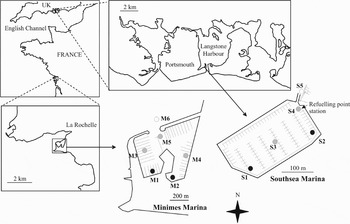
Southsea Marina (Figure 1) is located on the English south coast (Lat 50°47′83 N Long 01°01′77 W) and was opened in 1987. The marina comprises 9 pontoons with 300 berths taking up approximately 1.8 hectares. The marina has a, single, small tidal entrance, and a sill retains water within the marina during low tide. The seafloor within the marina is largely composed of mud and sand, although, pebbles, stones and shells can be found. Minimes Marina (Figure 1) was opened in 1969 and is situated on the west coast of France (Lat 46°08′95 N Long 01°10′27 W). It is one of the largest marinas in Europe with 3300 boat places spread over 40 hectares. The marina has a wide entrance. Dredging is required to maintain the appropriate bottom depths. The channel and entrance are dredged three times a year and each basin is dredged every three years. These activities involve 120,000 m3 of dredged sediment per year.
Location of Southsea Marina in Langstone Harbour (UK) and Minimes Marina in La Rochelle Bay (France) and localization of the sampling sites (round symbols, black for innermost sites, grey for middle and entrance sites and white for outside sites).

Sediment physico-chemical analysis
In September 2001, three sediment samples were collected with a 0.1 m2 modified grab corer at each sampling site in both marinas (Figure 1). From grab samples, three subsamples were collected with a 2-cm diameter plastic syringe from the first undisturbed 5 cm of sediment to analyse heavy metal concentrations. Plastic was used to prevent metal contamination and subsamples were taken from the middle of the sample to prevent potential contamination due to contact with the grab. Each subsample was placed individually into a plastic polyethylene bag and stored at −20°C. Subsamples were freeze-dried for 24 hours, homogenized and stored for subsequent analysis.
Heavy metals: heavy metal (Cd, Cu, Pb and Zn) analyses were made at the Laboratoire de Biologie et d'Écologie Marine in La Rochelle (France), using an Atomic Absorption Spectrophotometer (Varian SpectrAA 250 plus). The method used is described by Fichet et al. (Reference Fichet, Boucher, Radenac and Miramand1999a). The quality of the analysis was evaluated by measuring heavy metal concentrations from certified sediments (MESS-2).
Particle size: sediment samples were homogenized by stirring them manually. Dried sediment was passed through two sieves and separated into three size fractions; >500 µm, 500–63 µm, <63 µm. Particle size was expressed as percentage dry weight retained in each sieve of total dry weight. Although not highly precise, the same method has been employed for each site, which allows a comparison between them.
Organic matter: 200 mg (±0.1 µg) of dried sediment from each site was placed in a furnace for 12 hours at 450°C (Byers et al., Reference Byers, Mills and Stewart1978). While the organic compounds were burnt off in the furnace at this temperature, CaCO3 is not burnt off, thus preventing inaccurate figures for weight loss (Giere, Reference Giere1993). Weight loss was expressed as % OM.
Sediment elutriate toxicity
Zygote collection: the Fucus serratus bioassay was carried out using zygotes. Reproductive receptacles are usually present on F. serratus from October to March (Fletcher, Reference Fletcher, Abel and Axiak1991; Brown et al., Reference Brown, Fletcher and Eaton1998). Fucus serratus was collected from the entrance to Langstone Harbour (Figure 1). To induce gamete release, two terminal receptacles from both male and female plants were placed into a glass crystallizing dish containing 100 ml of Von Stosch (VS) culture medium (solution of pasteurized filtered seawater and nutrients; see Brown et al., Reference Brown, Fletcher and Eaton1998) and left overnight at room temperature to allow the release of sperm and eggs and subsequent formation of zygotes to take place. The above process regularly results in almost 100% egg fertilization (Brown et al., Reference Brown, Fletcher and Eaton1998). After 24 hours, the zygotes were pipetted up in large numbers and cleaned with several washes of VS medium before being distributed into the culture vessels.
Elutriate preparation: 100 ml of wet sediment from each site at both marinas (3 replicates per site) was mixed with 400 ml of VS culture medium (preparation of the medium was made without EDTA to prevent it combining with any free heavy metals). The mixture was left to settle for 24 hours, at room temperature. The supernatant (elutriate) was then carefully siphoned off and diluted with VS medium to give different concentrations of elutriate (0% (control), 1%, 10%, 50% and 100%). Each concentration was prepared in triplicate (N = 3) and placed into Petri dishes (30 ml). An approximately equal number of zygotes were added to each Petri dish and the cultures placed in a growth room at 15°C, 45 µm cm−2 j−1 photon irradiance using white fluorescent tubes, under 16 hour/8 hour light/dark conditions. After incubation, the percentage of F. serratus zygotes that germinated after 72 hours was determined for 30 zygotes in each dish. The concentrations which caused 50% zygote death (LC50) were then determined using linear regression.
Benthic macrofauna
The grab corer samples were sieved gently through a 0.5 mm mesh sieve. The material retained on the sieve was preserved in 5% formaldehyde–saline solution. Infaunal specimens, after sorting, were stored in 70% ethanol. Identification was made to the lowest taxonomic level possible, usually to species level. Sites were characterized in terms of total abundance, number of species, main contributing species (SIMPER) and ecological groups using the biotic index (AMBI) (Borja et al., Reference Borja, Muxika and Franco2003) (see data analysis). The abundance of Hydrobia was highest at marginal sites and could be explained by the ‘wash in’ of the species from Langstone Harbour. In a previous survey (Callier, unpublished observations), a high quantity of empty shells was observed within Southsea Marina and the abundance of ‘alive’ Hydrobia was much lower. It is possible that adults in their floating stage (Newell, Reference Newell1962) were washed into the marina and having settled from the surface water, they were unable to survive in this enclosed area. The abundance of Hydrobia ulvae was given but not included in the analysis to prevent bias.
Data analysis
Differences between sites were tested by ANOVA followed by multiple comparisons (Tukey test) using SYSTAT, for heavy metal concentration, % OM and LC50. Two subsamples of Minimes Marina M3 and M4 were lost during the field work at Minimes Marina. We had 6 sites for macrofauna analysis and only 4 sites (M1, M2, M5 and M6) for other analyses.
Similarities of percentages (SIMPER) were used to determine which species contributed the most to any dissimilarity among sites using PRIMER (Clarke & Warwick, Reference Clarke and Warwick1994). The marine biotic index—AMBI—proposed by Borja et al. (Reference Borja, Franco and Perez2000), was used to establish the ecological quality of the soft-bottom community in Southsea and Minimes marinas. The AMBI, based upon the sensitivity/tolerance of benthic fauna to stress gradients, classifies the species into five ecological groups. The ecological groups correspond to: (I) sensitive to pollution; (II) indifferent to pollution; (III) tolerant to organic matter; (IV) opportunistic of second order; and (V) opportunistic of first order (for details, see Borja et al., Reference Borja, Franco and Perez2000, Reference Borja, Muxika and Franco2003). The distribution of these ecological groups provides a biotic index of 5 levels of pollution classification. Linear regressions between AMBI and abiotic variables were carried out.
Canonical correspondence analysis (CCA, using XLSTAT- ADA) was used to relate the abundance of species to the environmental variables.
RESULTS
Sediment physico-chemical analysis
SOUTHSEA MARINA
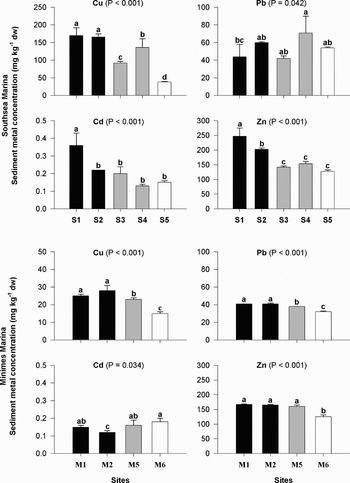
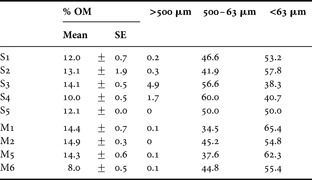
Sediment metal concentrations differed significantly between sites (Figure 2). S1 and S2 (innermost sites) presented the highest Cu and Zn concentrations and S1 presented the highest level of Cd (Figure 2). Concentrations of Cu, Cd and Zn were respectively 4.5, 2.4 and 2 times greater at S1 (inside) than S5 (outside). The highest Pb concentration was recorded at site S4 (Figure 2), a site close to the refuelling point station (see Figure 1). No significant differences in % OM were found between sites (Table 1; F4,5 = 4.787, P = 0.058). Particle size analysis classified all sediments as a mixture of silt–clay (Table 1), with a slightly higher percentage of fine grain particles (<63 µm) at S1 and S2.
Sediment metal concentrations (mg · kg−1 dry weight±SD) of cadmium (Cd), copper (Cu), lead (Pb) and zinc (Zn) for each sampling site at Southsea (S) and Minimes (M) marinas. Note the scale difference for Cu concentration between S and M. Black colour used for innermost sites, grey for middle and entrance sites and white for outside sites. ANOVA results are indicated for each metal. Significant difference between sites when P < 0.05. Pairwise comparison results are given on top of each bar.

Percentage of organic matter (% OM) and percentage of particles of different sizes >500, 500–63, <63 µm, of each sampling site at Southsea (S) and Minimes (M) marinas.

SE, standard error.
MINIMES MARINA
Sediment metal concentrations differed significantly between sites (Figure 2). Metal concentrations were lower than at Southsea Marina, by almost a factor 10 for Cu (Figure 2). M1 and M2 (innermost sites) presented the highest levels of Cu, Pb and Zn. The magnitude of difference between the innermost sites and the outside site was lower than in Southsea. Cu, Pb and Zn concentrations were, respectively, 1.7, 1.3 and 1.4 times greater at M1 than at M6. The highest Cd concentration was found at M6 (outside). The lowest % OM was recorded at M6 (Table 1; F3,4 = 70.043, P = 0.001). Particle size analysis classified all sediments as a mixture of silt–clay, with the highest percentage of fine grain particles (<63 µm) recorded at M1 and M5 (Table 1).
Sediment toxicity
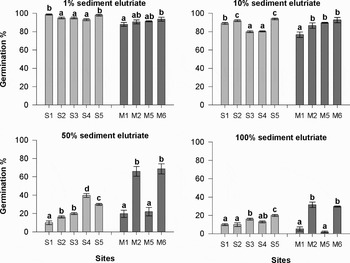
Germination percentages are presented in Figure 3. In control treatment (0% elutriate), 100% of the zygotes had germinated. Overall, the percentage germination decreased with increasing concentration of elutriates sediment. At 1% and 10% sediment elutriate concentrations the percentage germination of F. serratus was greater than 80%. At 50% sediment elutriate concentration, most of the treatment presented percentage germination lower than 50%, except for Minimes sites M2 and M6. Difference in lethal toxicity LC50 between Southsea sites (F4,9 = 50.781, P < 0.001) and between Minimes sites (F3,8 = 122.204, P < 0.001) was significant (Table 2). LC50 calculated using linear regression ranged from 42.3% (S1) to 52.6% (S5). The rank of elutriate toxicity for zygote germination was from the most toxic to the less toxic: S1 = S2 = S3 > S4 > S5. The LC50, ranged from 37.3% (M1) to 72.4% (M6) for Minimes. Rank of elutriate toxicity was from the most toxic to the less toxic M1 = M5 > M2 = M6.
Average germination (%±SD) of Fucus serratus zygotes after 72 hours' exposure to different sediment elutriate concentrations (1, 10, 50 and 100%) from different sites at Southsea Marina (S) and Minimes Marina (M).

Calculation of the concentration which caused 50% zygote death (LC50±SD, from linear regression analysis). Pairwise comparison results are given with different letter when significantly different.

In Southsea Marina, the sediment elutriate toxicity was correlated to the sediment metal concentration Cu, Cd and Zn while in Minimes it was correlated to the % of fine particle (Table 3).
Linear regression between LC50 and abiotic variables. In bold when significant (P < 0.05).

Benthic macrofauna
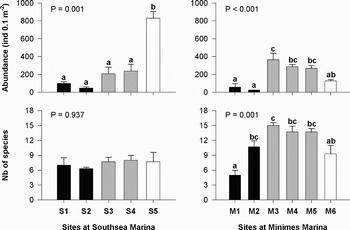
In Southsea Marina, of 23 infaunal species, 18 were annelids, 3 molluscs and 2 were crustaceans (Appendix A). Annelids and molluscs were the most abundant taxa, representing respectively 71% and 29% of the total abundance. Annelids were mostly represented by 4 families: Spionidae, Cirratulidae, Cossuridae and Capitellidae and molluscs by only one species Hydrobia ulvae. An increasing gradient in abundance was observed from inside to outside the marina (Figure 4), S5 (outside) presented the highest abundance (Figure 4). No significant differences were observed in terms of number of species (Figure 4).
Mean abundance and mean number of infaunal species (±SE, N = 3) of macrofaunal individuals at each site at Southsea and Minimes marinas. ANOVA results are given on the figures. Significant difference when P < 0.05. Pairwise comparison results are given with different letter when significantly different. Hydrobia ulvae were not included.

In Minimes Marina, of 47 infaunal taxa, 20 were annelids, 21 were molluscs and 6 were crustaceans (Appendix B). In terms of abundance, the two dominant taxa were the annelids representing 67% of the total abundance and the molluscs representing 33%. The crustaceans represented only 0.2% of the total abundance. Annelids were represented in abundance mostly by three families: Cirratulidae, Cossuridae and Nephtydidae. Three families of molluscs were dominant: Hydrobiidae, Nassaridae and Pyramidellidae. However, the difference in abundance of molluscs between sites can be attributed to a single species, Hydrobia ulvae (Appendix B). The inner sites M1 and M2 presented the lowest abundance and the middle sites M3, M4 and M5 presented the highest abundance (Figure 4). A diminution of abundance at M6 was observed compared to middle sites. The lowest number of species was recorded at M1 (Figure 4).
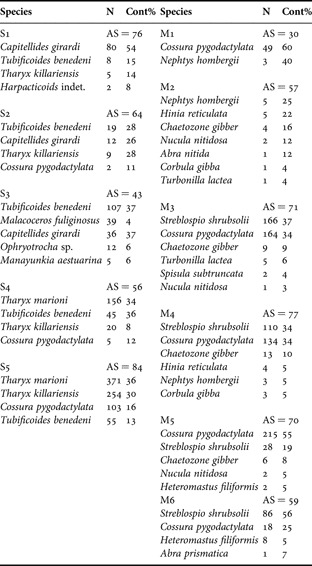
SIMPER analysis (Table 4) indicated that in terms of % contribution, S1 and S2 was characterized by the capitellids Capitellides girardi and the tubificoids Tubificoides benedeni; S3 was also characterized by C. girardi and T. benedeni and by other species with a lower contribution; S4 was characterized by the cirratulids Tharyx marioni and T. benedeni; S5 by the two cirratulids Tharyx killariensis and T. marioni, and by the cossurid Cossura pygodactylata. In Minimes Marina, SIMPER analysis indicated that M1 was characterized by two co-dominant species C. pygodactylata and Nephtys hombergii while M2 was characterized by three co-dominant species N. hombergii, Hinia reticulata and Chaetozone gibber. M3, M4 M5 and M6 were characterized by Streblospio shrubsolii and C. pygodactylata. Streblospio shrubsolii was almost absent at the innermost sites M1 and M2, while present at the middle (M3, M4 and M5) and outside sites (M6).
Results of SIMPER analyses of infaunal species that contribute most to the similarity of compared replicates within a site. Average abundance (N) in ind 0.1 m−2. AS, average similarity; Cont %, percentage contribution. Data were √-transformed. Hydrobia ulvae abundance was excluded from the SIMPER analysis.

indet., indeterminate.
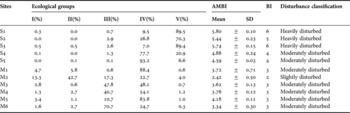
The species recorded at Southsea and Minimes marinas were assigned to one of the five ecological groups (see Borja et al., Reference Borja, Franco and Perez2000) and a percentage of each group was determined for each sampling site (Table 5). A coefficient—AMBI—was calculated which allowed to classify each site in terms of disturbance, with a high AMBI coefficient indicating a poor condition. Sites S1, S2 and S3, the innermost and middle sites at Southsea Marina, were classified as heavily disturbed. Sites S4 and S5 and M1, M3, M4, M5 and M6 were all classified as moderately disturbed (note that S4 and S5 presented a higher coefficient than that of the other sites). Site M2 was classified as slightly disturbed, although this site presented the lowest total abundance (see Figure 4).
Marine biotic index (AMBI) calculated to establish the ecological quality of the soft-bottom community in Southsea and Minimes marinas. I, sensitive to pollution; II, indifferent to pollution; III, tolerant to organic matter; IV, opportunistic of second order; V, opportunistic of first order (Borja et al., Reference Borja, Franco and Perez2000, Reference Borja, Muxika and Franco2003). The distribution of these ecological groups provided a biotic index of disturbance classification.

The AMBI was significantly and positively correlated to the Cu, Cd and Zn metal concentrations and to the LC50 (Table 6) in Southsea, and to the percentage of fine particle (<63 µm) and to the LC50 (Table 6) in Minimes.
Relationships between the AMBI with the abiotic variables and sediment elutriate toxicity (LC50).

Relationships between biotic and abiotic data
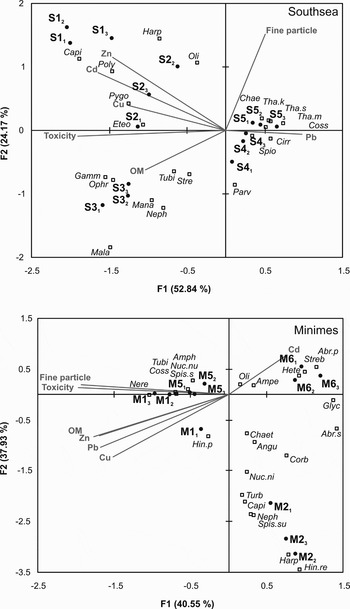
The results of the CCA analysis are given in Figure 5. For Southsea Marina, although the sites/species and the sites/environmental variables were not linearly correlated (permutation test: F = 1.574, P = 0.216), a clear pattern is observed. Most of the inertia is carried by the first axis (F1 = 52.84%), with the second axis we obtain 77.01% of the inertia; the two-dimensional CCA map is enough to analyse the relationships between the sites, the species and the variables. Three groups could be distinguished: group 1 (S1 and S2) and group 2 (S3), classified as heavily disturbed (see AMBI), were the most toxic sediments. Group 1 presented the highest Cu, Cd and Zn concentrations and was dominated by Capitellides girardi. Group 2 presented the highest % OM and was dominated by Tubificoides benedeni, Malacoceros fuliginosus and Ophryotrocha sp. Group 3, classified as moderately disturbed, presented low metal concentration (except for Pb) and was dominated by the cirratulids Tharyx killariensis and T. marioni, and by the cossurid Cossura pygodactylata.
Canonical correspondence analysis including sample sites (round symbols), species abundance (square symbols; see Appendix for complete name) and environmental variables: fine particle (percentage of particle <63 µm); OM (organic matter percentage); toxicity (1/LC50); and metal concentrations (Cu, Cd, Zn and Pb). Very low contributing species were removed from the figures for clarity.

For Minimes Marina, the sites/species and sites/environmental variables were linearly correlated (F = 2.962, P = <0.001). Most of the inertia is carried by the first axis (F1 = 40.55%), with the second axis we obtain 78.48% of the inertia. The sediment toxicity at M1 and M5 was correlated to the high percentage of fine particles. These two sites were dominated by C. pygodactylata. M6 presented the highest level of Cd and was dominated by Streblospio shrubsolii. M2 was dominated by Chaetozone gibber and Hinia reticulata.
DISCUSSION
Overall, metal concentrations were greater in Southsea Marina compared to Minimes Marina. The lowest metal concentrations at Minimes Marina could be explained by: (1) the lower boat density (82.5 boats per ha) compared with Southsea Marina (166 boats per ha); (2) its larger entrance; and (3) the dredging activities at Minimes. Both marinas were characterized by a fine sediment type containing high levels of organic matter, which is to be expected in such stagnant environments (Guerra-García & Garcia-Gómez, Reference Guerra-García and Garcia-Gómez2005).
Sediment contamination
In the analysis of the 4 indicator metals (Cu, Cd, Pb and Zn), an increasing gradient of contamination from outside to inside the marinas was evident, particularly in Southsea Marina. Copper was probably related to the leaching of antifouling paints at both marinas (Schiff et al., Reference Schiff, Diehl and Valkirs2004), whilst zinc was probably related to the anodic protection devices at Minimes; sacrificial zinc anodes being fixed on the piles to protect the structures from corrosion. Bird et al. (Reference Bird, Comber, Gardner and Ravenscroft1996) estimated that the input of zinc from anodes may exceed 1000 kg per year in marinas. The highest concentration of Pb in the proximity of a refuelling point station (S4) at Southsea probably reflected leaded fuel spills. The higher cadmium concentration outside Minimes was probably related to other contaminant sources, such as the chronic Cd input from the Gironde River close to Minimes (Pigeot et al., Reference Pigeot, Miramand, Guyot, Sauriau, Fichet, Le Moine and Huet2006), and to the Rhodia industrial discharges (15 kg of Cd per year in 2000; Anonymous, 2006).
Metal concentration recorded had potential environmental impact (Haynes & Loong, Reference Haynes and Loong2002). Metal concentrations were particularly high in Southsea Marina compared to other marinas (see for comparison Bryan & Langston, Reference Bryan and Langston1992; McGee et al., Reference McGee, Schlekat, Boward and Wade1995; Haynes & Loong, Reference Haynes and Loong2002). It can be argued that in a fine grained, organically richer sediment, as observed in Southsea and Minimes marinas, metal is likely to be adsorbed to the sediment and is, therefore, less biologically available for organisms (Chapman, Reference Chapman1992). The contaminant may, however, become bioavailable through the process of ingestion by the invertebrates. High concentrations of metals in the gut of deposit feeders have already been demonstrated (Chen et al., Reference Chen, Mayer, Quétel, Donard, Self, Jumars and Weston2000). For this reason, deposit feeders are particularly vulnerable. In using bioassays analysis, we wanted to have an insight on the toxicity of the sediment.
Sediment toxicity
The use of bioassays to monitor trace metals in sediments is widely employed since environmental conditions can be controlled and, therefore, the response of the test organism can be evaluated (Brown et al., Reference Brown, Fletcher and Eaton1998; Fichet et al., Reference Fichet, Radenac and Miramand1999b). In this study, the macroalga, Fucus serratus was used as a bioindicator. This species has been shown to be particularly responsive to the soluble trace metals of their ambient surroundings (Phillips, Reference Phillips1977). Scanlan & Wilkinson (Reference Scanlan and Wilkinson1987) noted that newly released eggs of Fucus sp. were particularly sensitive to toxicants and can be used to determine the effects of metal pollution (Fletcher, Reference Fletcher, Abel and Axiak1991). In this study, the bioassays using Fucus serratus indicated differences in sediment toxicity between sites and show that the sites presenting the highest level of metal in Southsea Marina were the most toxic for the zygote germination. A significant correlation between the sediment copper, zinc and cadmium concentrations and the sediment elutriate toxicity (LC50) was observed. La Roche (Reference La Roche2000), using the same method as the present study, has shown that sediment elutriate taken from Langston Harbour (see Figure 1) had also negative effects on the F. serratus zygote percentage germination. In her study, sediment elutriates presenting the highest levels of zinc (0.6 ppm) and copper (0.9 ppm) were the most toxic for the zygotes, inducing only 21.6% germination (with elutriate diluted at 50%) and 10.6% germination (with elutriate diluted at 100%), which is close to our values. At Minimes Marina, the apparent toxicity differed between sites and seems to be more related to the percentage of fine particles. It is possible that, with fine grain, the contaminants in Minimes sediments were potentially more easily resuspended than in coarser sediments and thus more bioavailable (Fichet et al., Reference Fichet, Radenac and Miramand1999b). It is also possible that other contaminants (TBT, Irgarol) present in the sediment, but not measured, have induced this toxicity (Braithwaite & Fletcher, Reference Braithwaite and Fletcher2005). Analysis by the Pasteur Institute (Minimes Marina direction, personal communication) showed that the TBT level in the marina reached 20 µg · kg−1 in the south-west in 2001. Complementary analysis of elutriate composition would have been necessary to support this hypothesis.
Consequences on the benthic communities
The benthic communities at the innermost sites were typical of an impacted benthic community, exhibiting a low abundance and a numerical importance of capitellids (Capitellides girardi) and oligochaetes (Tubificoides benedeni), both pollution-tolerant species (Pearson & Rosenberg, Reference Pearson and Rosenberg1978). Both C. girardi and T. benedeni exhibit features of opportunistic species: short life, high productivity, small body size, rapid development and an invasive ability (Pearson & Rosenberg, Reference Pearson and Rosenberg1978). Tubficoides benedeni is considered to be one of the most successful organisms capable of thriving in environments containing a high concentration of sulphide (Giere et al., Reference Giere, Preusse and Dubilier1999). The high metal concentration in the innermost sediments probably explained the changes in community composition and the decrease in total abundance. The innermost sites were classified as heavily disturbed using the AMBI, based on the sensitivity/tolerance of the species. This index was significantly correlated to the elutriate LC50 and to the concentrations of copper, zinc and cadmium, confirming the potential influence of these contaminants on the benthic communities.
The cirratulids Tharyx killariensi and T. marioni as well as the cossurid Cossura pygodactylata, were almost absent from the innermost sites, while they were the dominant species at the outside sites. Cirratulids were probably affected by the contamination of the sediments (Chen et al., Reference Chen, Mayer, Quétel, Donard, Self, Jumars and Weston2000). Tharyx spp. are typically recorded in low physically-stressed sub-habitats (Thomas, Reference Thomas1987), and this might explain the low abundance of these species inside the marina. Moreover, predation by carnivores recorded inside the marina, such as Nephtys hombergii could be an additional factor to explain the reduced number of Tharyx spp. The cossurid Cossura pygodactylata, was also almost absent from the innermost sites. The first record of C. pygodactylata in Southsea Marina in 1999 (Callier, unpublished observation), indicated that the species was more abundant inside than outside the marina. This spatial variation in 1999 could be explained by the fact that C. pygodactylata was first introduced inside the marina by boats. Since its introduction, the species has colonized the area and probably extended its distribution from inside to outside, indicating that the species probably did not tolerate the environmental conditions at the inside sites.
At Minimes Marina, low infaunal abundance was observed in the confines of the basin. The lowest species richness was also recorded at site M1. All sites were classified as slightly to moderately disturbed, based on the AMBI. The sediment toxicity and the percentage of fine grain seem to have influenced the ecological composition of the macrofauna (AMBI). The lack of relationship between metal sediment concentrations and the AMBI suggests that other contaminants (such as Irgarol or TBT), not analysed during the study (see sediment toxicity section) may have influenced the benthic community. Moreover, Minimes Marina is a dynamic environment. The basins are dredged regularly and contaminated sediments are removed and dumped on another site. Dredging activities probably greatly influence the benthic community pattern.
In addition to the effects of metal contamination, the high level of organic matter may have affected the species composition, in decreasing the diversity and abundance of sensitive species, as described by general models of organic enrichment (Pearson & Rosenberg, Reference Pearson and Rosenberg1978; Weston, Reference Weston1990; Pearson & Black, Reference Pearson, Black and Black2001). The poor water flushing within the marinas, especially in Southsea, could have induced water stagnation resulting in anoxic conditions (McGee et al., Reference McGee, Schlekat, Boward and Wade1995), limited the recruitment of benthic organisms (McGee et al., Reference McGee, Schlekat, Boward and Wade1995) and/or limited the supply of food. The study shows that both marinas have an effect on the local benthic communities, partially due to the presence of high level of contaminants in the inner basins. However, the difference between the two marinas showed the specificity of each marina and the need for further empirical studies to better determine the contribution of the different environmental factors, such as the contaminant concentrations, the hydrodynamics and the dredging activities, on the effects on the benthic environment.
ACKNOWLEDGEMENTS
We thank all the people working at the Institute of Marine Sciences, University of Portsmouth and at the Laboratoire de Biologie et d'Ėcologie Marine, Université de La Rochelle for their assistance in this study. In particular, we thank Dr G. Radenac for his help with the sediment analysis, Dr C.H. Thorp and Dr S. Jarvis for their help in invertebrate identifications and J. Chopelet, C. Delgery and B. Lebreton for their assistance in sediment sampling and invertebrate sorting. We thank the staff of Southsea Marina and Minimes Marina. Thanks also to Drs C. McKindsey, B. Clynick and anonymous referees for their comments on earlier drafts of the manuscript. Finally, the first author would like to thank the British Council for an Entente Cordiale Scholarship.
Appendix
Mean abundance (nb, individuals 0.1 m−2) of each taxa recorded at Southsea Marina (A) and Minimes Marina (B) and at each site (N = 3). †, drifting species coming from the adjacent mud flat.


indet., indeterminate.