The 1990s brought a dramatic resurgence of capital flows to Latin America as governments opened capital accounts following nearly a decade of isolation from global financial markets.Footnote 1 Although international financial liberalization allowed capital-scarce nations to overcome the limits of low domestic savings while stimulating consumption and growth, it also presented considerable challenges to their governments, including diminished monetary policy autonomy, the risk of currency appreciation, monetary expansion, and widening current account deficits. Such risks became all too apparent after the sharp reversal of capital flows that attended the 1982 “debt crisis,” the effects of which ravaged Latin America for nearly a decade. In addition to such potential costs, the benefits of capital account liberalization remain highly contested, particularly as they regard macroeconomic growth.Footnote 2 Nevertheless, one after the other, developing country governments have moved since the 1980s toward varying degrees of capital account openness. A guiding question for scholars is thus to explain when and why governments embrace this policy in spite of its uncertain risks and rewards. And, given the close temporal and geographic proximity in capital account policy maneuvers, to what extent are such decisions in one country causally linked to choices made on this policy in other nations?
To answer these questions, scholars have long emphasized a set of external pressures on capital-scarce nations to attract investment and respond to the incentives of international liquidity.Footnote 3 These system-level influences include international financial institutions such as the International Monetary Fund (IMF), which made capital account convertibility a priority in the 1990s.Footnote 4 Scholarship focused on the international level also has paid close attention to the interdependent nature of such policy choices, which link government action in one country to related policy decisions in other polities.Footnote 5 Both streams of research depart sharply, however, from earlier studies of the political economy of economic reform that overwhelmingly emphasized the domestic coalitions of economic interests that may line up in support of, or in opposition to, financial integration.Footnote 6 For the most part, scholarship joining the domestic and international levels of analysis has portrayed these as competing explanations for the spread of capital account openness.Footnote 7 In few cases have scholars explored the potential mediating role of domestic politics on the international sources of capital openness.Footnote 8 Even more rarely have scholars traced the domestic roots of capital account liberalization to the structural features of a domestic economy; where such aspects are considered, statist economic structures are typically considered “obstacles” to international financial liberalization.Footnote 9
This article departs from earlier literature on both accounts. First, we argue that movements toward capital account openness are path-dependent, and that causal factors at the domestic and international level may be conditioned by structural legacies of earlier economic development strategies, in particular advanced import-substituting industrialization (ISI). This development model, we argue, deeply transformed economic structures through the emergence of a significant industrial export sector, which we expect to engender a powerful coalition of interests supportive of partial capital account liberalization. A legacy of advanced ISI also bears upon cross-national policy diffusion by heightening the salience of capital account decisions by relevant peers and by delimiting such peers as countries that share common structural conditions, therein transecting broad regional or cultural diffusion patterns that have been identified as crucial in prior research on international financial liberalization.Footnote 10
We test our hypotheses along with rival accounts of the adoption and diffusion of capital account liberalization in data from Latin America from 1983–2007.Footnote 11 The statistical results support our expectation that channels of policy diffusion are path-dependent and conditioned by the structural legacies of earlier economic development strategies. Substantively, the analysis reveals that countries that have achieved advanced ISI are more likely to take a moderately liberal capital account position, all else being equal. This has made advanced ISI countries in Latin America more open to international capital flows than countries that achieved less-advanced protectionist industrialization, but less open than the wealthy nations of the Organization for Economic Cooperation and Development (OECD) or poorer agro-export economies found elsewhere. The domestic political economy of capital account liberalization also conditions the importance of diffusion forces in this process, wherein peer effects weigh more heavily when domestic financial sectors are more repressed, and political authority more concentrated, and hence where the potential economic and political costs of opening may be greater.Footnote 12 This result lends support to our contention that governments may rely more heavily on information from the international arena when the stakes in policy adoption are the greatest and the financial costs of a policy “mistake” are higher.Footnote 13 Indeed, errors in this policy arena can produce financial crises with long-term, potentially catastrophic effects.
Explaining Capital Account Liberalization
International Influences
Early research on capital account liberalization brought attention to the technological changes promoting the integration of global capital markets. Such innovations were found to make capital controls increasingly costly, if not impossible to maintain, as offshore capital markets burgeoned.Footnote 14 Convergence upon open capital accounts in the advanced industrial nations in the late 1980s initially suggested the inevitability of international financial integration as domestic political and economic variables seemingly receded in significance.Footnote 15 Research on the domestic politics of financial integration thus began from the assumption of a movement to full capital mobility and sought to explain the varied distributional consequences of openness.Footnote 16 While such analysis worked well for the advanced industrial nations, a different logic altogether appeared among developing nations, which, despite a general movement toward somewhat more open capital flows, produced neither convergence nor similarly high overall levels of liberalization. Despite their capital scarcity, developing countries often retained much broader capital controls.Footnote 17
Such diffidence toward open capital markets brought attention to the array of vulnerabilities and costs associated with financial openness for small and less-diversified economies, particularly where domestic financial systems are repressed or underdeveloped.Footnote 18 Indeed, capital account liberalization forces governments into what is often a difficult trade-off between monetary policy autonomy and exchange rate volatility, as surrender of the latter threatens to dampen both exports and private real investment in capital-scarce nations.Footnote 19 Nevertheless, capital account liberalization has been upheld as a crucial policy means through which governments could attract foreign savings by signaling their commitment to “market discipline”—which functions precisely because this policy change is potentially costly.Footnote 20
The importance of capital account policies for a country's ability to attract foreign investment suggests an important role for international factors in this decision. Indeed, the lowering of barriers to investment flows in one country has direct externalities for other countries that compete with it to attract mobile finance, raising their opportunity cost of failing to liberalize as well.Footnote 21 Such externalities, along with the close temporal clustering of movements toward financial openness across nations, brought the concept of “diffusion” into the focus of scholarly research on financial integration. Evidence of such interdependence in capital account liberalization has been broadly supported in recent empirical work that identifies four principal diffusion mechanisms through which public policies disseminate internationally: emulation, learning, competition, and coercion.Footnote 22
The first of these mechanisms, emulation, involves the social construction of appropriate behavior on the basis of relevant “peer” nations. This includes following prominent states.Footnote 23 Emulation does not seek to resolve specific problems, such as identifying the most appropriate or successful policy; instead, it promotes the achievement of higher status and international acceptance.Footnote 24 Such “mimetic isomorphism”Footnote 25 is shown to be strongest where social contact is most extensive, and among countries sharing common cultural ties.Footnote 26 This makes Latin America a very likely region within which to find such emulation, because nations share extensive cultural, religious, and economic ties.
Even though evidence of region-wide reference groups has been found for the diffusion of public policies in Latin America, there is reason to expect that government actors will not weigh the decisions of all geographic neighbors equally. This is because, as Weyland has found in the case of social policy, some nations in Latin America stand out as more salient policy models than others.Footnote 27 In the case of capital account regulation, we likewise anticipate that policymakers distinguish among nations of the hemisphere, considering some more relevant than others due to commonalities associated with the political and economic legacies of the postwar economic development process.
Decisions made in other nations also offer potentially valuable information from which government actors may learn about policy, including its efficacy and relevance to their home country. Such “learning” involves the incorporation of new information into the formation of beliefs about a policy.Footnote 28 This information may be positive or negative: it may involve gathering inferences from the successes as well as from the failures of relevant peers. Where positive learning (from success) is in play, governments should enact a policy in which previous adopters have achieved some measurable success following its implementation, such as stronger growth.Footnote 29 Conversely, with negative learning they should avoid decisions made by countries that subsequently perform poorly. Whether policymakers respond to success or failure, evidence of learning from the experiences of prior adopters should be distinguishable from more generalized emulation insofar as adoption decisions are tied directly to the performance of previous adopters, rather than the mere fact of adoption.
Indeed, previous research has found that broader economic performance—specifically, economic growth—is a crucial indicator of policy success from which other nations learn.Footnote 30 In the case of capital account liberalization, inflation performance should also matter when government actors determine who is a “successful” liberalizer.Footnote 31 Such learning differs from the bounded learning that Weyland proposes, in which certain sources of information about the success of a policy would be weighed more heavily than others due to cognitive biases.Footnote 32 So far, however, there is not one specific country that is more “representative” of lessons about capital account liberalization in Latin America.Footnote 33 Competition also should matter, wherein relevant peers are defined as countries of similar sovereign risk status seeking to attract international capital.
Whereas these mechanisms focus principally on “horizontal” channels of policy diffusion, the “vertical” mechanism of common exposure to a coercive international actor is also quite relevant to capital account policy. In this vein, research has highlighted the role of the IMF, which vigorously advocated capital account opening in the 1990s. In its starkest form, the coercion hypothesis suggests that the IMF made financial openness a condition for developing countries to receive a loan, therein fanning its adoption across nations.Footnote 34 Chwieroth, however, argues that the IMF's role in diffusion is less about coercion than it is about the dissemination of ideas.Footnote 35 Evidence to support the coercive role of the IMF in the spread of capital account liberalization is decidedly mixed.Footnote 36 Nevertheless, the IMF's prominent role in the formulation of economic liberalization plans in the developing world makes it an important potential channel of diffusion.Footnote 37
Domestic Politics
With the rising imperative of attracting ever-more footloose capital in recent years, less attention has been paid to the domestic interests affected by financial liberalization.Footnote 38 Such neglect may owe to the relative lack of salience of capital account policies for ordinary citizens who are hardly likely to rally around the vague and uncertain implications of financial openness—particularly compared to potentially more prominent issues such as free trade.Footnote 39 Yet, even if shifts in nonremunerated reserve requirements fail to mobilize the median voter, capital account policies are far from uncontentious or apolitical. For openness to global capital may impose direct and concentrated costs on what are often powerful, well-organized, and knowledgeable groups of interests, including once-protected financial and industrial interests.Footnote 40 Such policies bear a significant potential to generate instability—if not crisis—in newly liberalized domestic economies.
Although early scholarship on the domestic politics of liberalization focused on whether authoritarian or democratic settings were more amenable to reform, the numerous instances of successful reform among democracies soon shifted attention to how variations in political institutions (such as the number of veto players they implied) and partisanship affect reform outcomes.Footnote 41 In most cases, the goal of extensive liberalization was assumed, and the question was whether politicians could take the long view and impose reform in the face of potentially hostile voters or legislatures. The insulation of technocratic decision makers within the executive branch thus was viewed as essential to the success of reform. The focus again was on institutions, but in this case on the construction of institutions that were removed from politics and capable of imposing “technocratic” solutions. By contrast, the participation of societal interests in policy formation was seen as risking reform “failure.”Footnote 42 Less often was serious theoretical consideration given to the possibility that more than one viable reform outcome might be in the interests of major societal actors and/or developmentally valuable.
The standard backdrop to the institutionalists' account, rooted in the time inconsistency problems of enacting painful reform, may have been quite appropriate for discussions of trade liberalizations, which often produce serious short-term economic dislocations and have a near intellectual consensus as to their longer-term gains.Footnote 43 In the area of capital account policy, however, not only have reform goals varied widely, with many developing countries committed to regulating financial flows at least in part, but the empirical evidence is also less unequivocal as to the overall merits of extensive international integration, particularly for developing countries.Footnote 44 A domestic political economy of capital account policy thus forces us to rethink the way in which the traditional institutionalist literature has framed both the goals of financial opening, and the role of societal interests in this process.
On the one hand, institutionalist accounts have essentially assumed away the problem of information for decision makers by implying that an “optimal” policy is self-evident. Yet, existing scholarship, discussed above, offers very good reason to doubt such technocratic clarity in the case of capital account opening in the developing world. And since making errors may threaten to induce massively costly financial crises (as in the Latin American “Tequila Crisis” of 1995 and the East Asian financial crisis of 1997), decision makers are likely to seek information as to the probable consequences of different approaches to the regulation of financial flows. This is particularly likely given the risks of volatility in cross-border flows, which may undermine the ability of the state and firms to plan future economic transactions, thereby dampening trade and investment.
At the same time, institutionalist arguments have often overlooked the economic settings and actors that may favor liberalization.Footnote 45 Instead, the interests of reform opponents are typically given theoretical priority.Footnote 46 The result has been to underspecify the policy preferences of domestic constituents, especially those that benefited from statist protections.Footnote 47 What is more, the economic and interest group landscape of formerly protectionist economies are likely to vary widely in regard to preferences over capital account policy. Not only might the historical legacies of earlier development policies create very different postreform economic structures, but we contend that they also may shape the ways in which international diffusion processes operate.
Conditioning Diffusion: Structural Legacies and Financial Opening
We argue that the politics of capital account liberalization are conditioned by the legacies of earlier economic development strategies. Specifically, advanced import substituting industrialization should at once create powerful domestic economic interests favoring partial capital account liberalization, while also delimiting unique challenges that raise uncertainty about the policy's likely effects, therein increasing the value of information drawn from peer decisions. Relevant peers, moreover, are characterized by a meaningful export-oriented industrial sector arising from the common legacy of advanced ISI, rather than by geographic or cultural proximity. Capital account liberalization, and the international channels through which policy models diffuse, thus should be fashioned by important path dependencies that crosscut conventional regional peer groupings.
ISI and Export-Orientation
Our first step to sorting out the political economy of capital account liberalization is to examine the political and structural inheritances of earlier state interventions associated with ISI. ISI was among the most far-reaching economic transformations to emerge in many developing countries during the twentieth century. In various forms, this development model left few, if any, Latin American countries untouched by conscious state efforts to spur local production of industrial products that previously had been imported. Import substitution began as early as World War I with state interventions aimed at protecting infant industries, such as through the establishment of import tariffs and licenses. It also entailed an array of financial measures to channel investment and credit to domestic industries, including through selective foreign exchange rates and rationing, and credit allocation.Footnote 48
Despite these commonalities, significant variations in the nature and extent of ISI efforts across Latin America were apparent by the 1970s. While some industrialization efforts stalled, other countries made the difficult shift toward the second, or advanced stage of ISI, which involved the development of capital-intensive manufacturing, including capital goods and consumer durables, and the export of higher value-added products in nontraditional sectors. In some Southern Cone countries, movements toward manufactured export strategies began as early as the mid-1960s as governments sought to overcome the limited size of domestic markets and to dampen balance of payments pressures.Footnote 49 In Brazil, Argentina, and Mexico, manufactured exports grew dramatically beginning in the 1960s; by 1980, they had become Brazil's principal export.Footnote 50 Such nontraditional export activity continued to grow in the 1980s, despite the crisis, becoming a vital source of foreign currency for capital-scarce economies.Footnote 51 Although the shift to export orientation under ISI is often overlooked, globally competitive exporters were cultivated in some cases through ISI policies; this was, after all, their original goal.Footnote 52 Indeed, in nearly every case of successful export-led industrialization, manufactured exports began under the sponsorship of statist ISI programs.Footnote 53 For countries long dominated by agricultural cultivation and primary-product export, advanced ISI thus bequeathed a profoundly transformed economic structure that, for Armijo and Foucher, “amounted in many countries to a political and social revolution.”Footnote 54 With this profoundly changed economic structure, we expect, came a new set of domestic actors with ties to the international economy with unique interests supportive of partial capital account liberalization.
Legacies for Economic Liberalization
Although scholars have amply documented the pathways from ISI to economic liberalization through economic crisis, less is known about the ISI-era political coalitions that were subsequently reestablished around economic liberalization.Footnote 55 Crucially, the later internationalist coalition differed sharply from that originally buttressing postwar ISI programs. Whereas the early ISI coalition included domestically oriented urban manufacturers, small business, middle-class professionals, and labor unions, liberalization in Latin America was often negotiated by a narrower coalition of large, internationally oriented industrialists and financiers.Footnote 56 This coalitional shift paralleled a change of the industrial-financial structure in advanced ISI countries, such as Mexico, from the state-led credit system that dominated the early ISI era, to bank-led credit systems in the 1980s.Footnote 57 In certain cases, large internationally oriented industries, many of which emerged from the ISI era and were products of the privatization process, joined with domestic banks in conglomerates or through linked governing boards. Chile's Angelini, Cruzat-Larraín, Luksic, and Matte groups, and Mexico's Cemex are emblematic of conglomerates that trace their industrial roots to the ISI era but that merged with financial interests in the post-ISI privatization era.Footnote 58 As a result, sectoral divisions that traditionally cleaved finance and industry on issues of global capital were increasingly blurred.Footnote 59 For Auerbach, the result was that big industrialists in Latin America tended to hold policy positions akin to those of bankers because essentially these groups were “the same people.”Footnote 60 Divisions between mobile and fixed asset-holders thus gave way to cleavages based on firm size and international orientation in advanced ISI countries.Footnote 61
Where internationally oriented industries entered into joint ventures with foreign firms or banks, moreover, these industrialists enjoyed significant political and economic advantage vis-à-vis domestically oriented manufactures. Such ties to multinationals, “enable[d] the advantages of new economic policies toward foreign companies to be combined with the market knowledge and lobbying capacities of local economic groups,” greatly privileging the voice of international business in domestic politics.Footnote 62 For Thacker, economic liberalization in Mexico resulted from the consolidation of a “powerful but economically and politically narrow coalition” that included the largest industrial grupos (financial-industrial groups) under the presidencies of de la Madrid (1982–88) and Salinas (1988–94).Footnote 63
Although internationally oriented industrialists constitute important supporters and beneficiaries of economic liberalization, they were not advocates of fully open capital markets. Instead, they represented a countervailing force to the commitment of many technocrats to fully liberal markets. Even though business leaders supported privatization and deregulation, they demanded that reforms carry provisions to preserve their dominant standing.Footnote 64 Even with such privileges, we expect the broad orientation of export-oriented industrial actors in the advanced ISI countries to be supportive of at least partial capital account liberalization. Such an expectation challenges the conventional statist bias in portrayals of ISI beneficiaries. Yet, as Frieden has argued, tradable producers utilizing nonspecific capital do stand to gain from financial liberalization, which lowers the cost and increases the supply of financial capital relative to the preliberalization era.Footnote 65 Domestic rent seekers also may become supporters of liberalization when they are persuaded that the government will not or cannot provide sufficient rents; in such a case, liberalization provides a second-best option to obtain lower-cost inputs and access to foreign markets.Footnote 66 With the advance of trade liberalization, it was increasingly just the most internationally competitive firms that were left in a position to influence policy.Footnote 67
It is reasonable to expect that small and medium enterprises (SMEs) would equally stand to benefit from the greater access to foreign credit that capital account liberalization promises. However, pervasive and lingering distortions in domestic financial markets in Latin America challenge this assumption. Although emerging markets generally lag behind the developed world in the liberalization of domestic financial sectors and local stock markets, Latin American markets remain particularly beset with distortions such as high concentration, and shallowness that have exaggerated the amplitude of boom-bust cycles and resulted in credit rationing, despite opening to global capital flows.Footnote 68 Such credit rationing is particularly acute for small enterprises, for which access to credit remains a significant challenge.Footnote 69 As Haber observes, “few firms can mobilize capital through the markets, and even the largest exchanges [in Latin America] tend to be dominated by one or two issues.”Footnote 70 Most small and medium businesses in Latin America rely on banks, rather than capital markets, to finance their activities.Footnote 71 Accordingly, prominent observers conclude that the expectation that capital account liberalization would bring economy-wide benefits was “misguided.”Footnote 72 Not only did SMEs depend more heavily on the domestic market than larger industries, but they also lacked the resources and political ties that gave big business such privileged access to elite policymaking circles.Footnote 73 SMEs also suffered politically from both a lack of representation in peak industrial associations, which typically were dominated by big business, and from a dearth of the human and financial resources necessary to influence policy negotiations.Footnote 74 SMEs thus remained notable outsiders of the internationalist coalition shaping financial liberalization in Latin America.Footnote 75
Export-oriented industrialists in Latin America stood to gain quite disproportionally from partial capital account liberalization relative to smaller, domestically oriented producers. For one thing, internationally oriented industrialists affiliated with financial interests could take advantage of innovations in global capital markets such as the securitization of export receivables that their smaller, domestically oriented counterparts could not.Footnote 76 Distortions in domestic financial markets also meant that industrialists tied to the banking sector could obtain low interest rate loans on international markets, while their financial affiliates lent such capital domestically to smaller businesses at much higher interest rates (which were permitted by the removal of interest rate ceilings under financial liberalization).Footnote 77 This privileged access was especially valuable since large industrial firms were much more capital intensive; they required far more credit—and especially dollar credit to finance capital goods and/or technology inputs—on longer terms than smaller, lighter industries. These features of domestic financial markets in Latin America have important implications for the distribution of benefits of capital account opening, which were sharply skewed toward the large, internationally oriented industries and particularly those linked to financial interests. The political consequence was a sharp divergence between the position of small and large industry on macroeconomic policies that affect purchasing power such as capital account liberalization.Footnote 78
We do not wish to overstate the role of domestic industrialists in capital account liberalization—for they were just one factor among an array of important domestic and international forces shaping this decision, and far from a deterministic one at that. However, as part of the domestic coalition facilitating the shift toward more openness to global capital, there is reason to take seriously their willingness and capacity to have their voices heard in this process. Even though technocrats brought their own free-market ideas and inclinations to bear on policy outcomes, capital account liberalization emerged in the context of weakening state autonomy vis-à-vis the financial sector. Indeed, technocrats embracing free-market policy models maintained close ties to the business community during the process of liberalization, with business leaders even taking key sectoral portfolios in countries such as Chile. Such influence should vary cross-nationally with the size and organizational capacity of the export sector, and with the proximity of ties to state actors charged with capital account policymaking.Footnote 79 In advanced ISI countries, we expect these ties and the sectoral weight of internationally oriented exporters to be strongest. Indeed, scholars have documented that where nontraditional export sectors grew out of state-led development projects, business leaders in large industries often retained close ties to technocrats in economic line ministries, which they used to pressure governments for favorable liberalization terms.Footnote 80 In Mexico, for instance, Teichman describes the close proximity between powerful entrepreneurs and policymakers as illustrated by the president of a large export company: “The process of consultation … is largely done on an informal basis between government ministries and individual company executives. My company has excellent relations with the current administration. I can call a minister any time to arrange a meeting.”Footnote 81 For Fernández and Hogenboom, ties between the state and big business were mutually beneficial: “Technocrats and large entrepreneurs established good relations and strong ties in their striving for economic restructuring…. The dependency of the technocratic elite on the support of ‘big business’ for economic restructuring, and the increasingly personal interest of technocrats in becoming members of the entrepreneurial elite made them turn their pro-market agenda into a pro-conglomerates programme.”Footnote 82 The Chilean case is also instructive for the technocratic context in which it occurred. The Chilean military government was widely heralded as among the most liberal in orientation in the world, and Chile imposed severe fiscal retrenchments, rapid trade liberalization, and even a deep privatization of the national pension system. But in the arena of capital regulation, Chile enacted a decidedly moderate reform path, quite far from the preferences of technocratic “Chicago boys.” For Lukauskas and Minushkin, this middle path was forged powerfully by domestic interest group pressures like those outlined above.Footnote 83
The financial importance of the export sector also enhanced its status in domestic policymaking over capital account policies. As nontraditional exports became a prized source of scarce foreign currency, the rising economic power of internationally oriented industrialists was likely to bring greater political clout that would only increase with the foreign exchange needs imposed by debt problems and import demands in the 1980s and 1990s.Footnote 84 Export-oriented manufacturers thus were poised to provide important political support for governments embracing liberalization, countering the protectionist impulses of import-competing firms but stopping well short of advocacy for full financial openness.Footnote 85 In the cases where internationalized firms also remained state-owned, such as Uruguay's ANCAP company in the alcohol and petrochemical sectors, what benefited this sector also directly benefited the state treasury.
It is crucial to emphasize that this internationally oriented industrial sector did not advocate full capital account liberalization. Rather, the ideal policy position for these actors was midway between full liberalization and autarky. This stance drew from the unique dilemma facing exporters, who sought at once to gain access to more affordable credit available through liberalization and to achieve a stable and competitive exchange rate; indeed, the latter may be nearly as important as access to credit and export promotion.Footnote 86 But such preferences confront export-oriented firms with a crucial tension in their desired capital account position: For just as financial openness may offer access to lower-cost finance, it brings the risk of currency appreciation and exchange rate volatility, which harm exports.Footnote 87 Thus, industrial exporters may be expected to advocate a middle-ground position between a liberal and closed capital account, which allows them to mediate between these competing goals. Such a position, by departing from the main contending policy paradigms, should heighten uncertainty about the likely efficacy and implications of this position.
Examples of this middle-ground position in Latin American capital account policies include mixed positions on the restriction of inflows and outflows, bearing the distinctive imprint of export-oriented interests in the formation of government policy. For instance, fearing that real exchange rate appreciation would jeopardize export-led development strategies, governments in Brazil, Chile, and Colombia imposed controls on capital inflows in the early 1990s while carving out exemptions for trade transactions and liberalizing capital outflows.Footnote 88 In Mexico and Brazil, limits on inflows took the form of quantitative restrictions and taxes, whereas in Chile and Colombia, nonremunerated reserve requirements and taxes were used to dampen inflows and avoid excessive appreciation. Such rules often were written explicitly to include exemptions for credit transactions relating to trade, such as by lowering reserve requirements for exporters, therein allowing them access to a larger share of export earnings.Footnote 89 In many cases, controls on inflows were combined with openness to capital outflows, which was expected to dampen the appreciation of domestic currencies.Footnote 90 Colombia, for instance, liberalized outflows in 1992 following a surge of inflows in 1991 that threatened to undercut exports.Footnote 91 These rules also liberalized export surrender requirements for all exporters, allowing local agents to hold offshore stocks (up to a limit), and easing restrictions on the provision of foreign loans. The modal capital account policy among advanced ISI countries in Latin America in the 1990s thus represented a mixed position based on liberal outflows and more restricted inflows, but with specific exemptions written in the latter for trade transactions.Footnote 92
Our basic claim so far is thus consistent with that of Fishlow, who concluded that “liberalization of the financial system and trade may be the consequence of successful industrialization rather than the cause of competitive efficiency.”Footnote 93 Out of the process of deep import-substituting industrialization, we observe the emergence of common economic structures fostering influential export interests supportive of partial capital account opening. In the next section, we argue that the uncertainty surrounding such uncharted, middle-ground positions led to conscious efforts by government actors to learn from the experiences of relevant countries, namely those sharing a similar economic structure arising from their common development path.
ISI and Diffusion
Government actors in advanced ISI countries thus confronted a crucial policy dilemma: charting a course between the opposing paradigms of fully liberal capital account liberalization—as advocated by the IMF and implemented by most advanced industrial nations—and the statist model emblematic of the ISI era. Navigating such new policy terrain heightens considerably the importance of information drawn from other countries facing similar policy dilemmas that had previously liberalized. For even though capital account regulations may be quickly reversed if a policy “mistake” were to occur, the costs of such moves are less reversible, as the effects of currency crises may reverberate in an economy for years. These sunk costs should raise the value of information drawn from previous reform experiences.Footnote 94 Accordingly, we expect policymakers to approach capital account decisions in advanced ISI countries with considerable caution, seeking out information about the likely costs and benefits of different mixes of controls on capital inflows and outflows as they establish their country's capital account position.
Information gained from peer countries facing common dilemmas may be particularly important. In particular, the legacy of advanced ISI should delimit a set of relevant peers sharing comparable domestic economic landscapes characterized by the existence of large export-oriented manufacturing sectors. Such countries face common tensions in regard to their capital account position and thus should be most comparable in terms of estimating the likely impact of a similar policy implemented at home. We therefore depart from research positing that entire regions such as Latin America constitute a single peer group based on shared cultural and economic ties; rather, we expect government actors to discriminate more carefully among countries of the region when seeking relevant policy models.Footnote 95 Other advanced ISI nations also may be competitors for financial investment or in specific export markets, likewise making them relevant to considerations of the opportunity cost of maintaining capital controls. Thus, a common policy legacy may at once define a set of more “relevant” nations at the subregional level from which to draw information about the value and impact of a policy, and it should define a set of direct competitors for global capital flows.
Domestic Politics of International Diffusion
A considerable body of research has sustained the importance of the domestic political economy, particularly government partisanship, in capital account decisions.Footnote 96 According to this research, right-wing governments should be more inclined to liberalize capital accounts on the basis of their ideological inclinations toward free markets, and left-wing governments should be less likely to do so on account of the limits that liberalizing places on expansionary fiscal policies, especially in the developing world. Earlier research also suggests that, given the ex ante lack of salience of capital account policies to the general public (that is, few people may mobilize in the streets to protest anticipated changes in nonremunerated reserve requirements as they might a free trade deal), the domestic politics of capital account liberalization are more likely to follow an ex post logic of blame avoidance.Footnote 97 In such a case, the dilemma for government office-holders is to ensure that a broad coalition of actors bears responsibility for financial liberalization in the event that it is followed by a crash, as is frequently the case in Latin America. Even if reform decisions are effected by technocrats in the executive branch, the governing coalition as a whole may be held accountable for an economic crisis. Concerns for the political fallout associated with the potential (and potentially quite significant) dislocations following capital account liberalization should make adoption of this measure more feasible where governing power is more dispersed, where political leaders may find “political cover” behind a broad political coalition of office-holders who may share blame for the reform outcomes.Footnote 98
The structure of the domestic financial sector also has been shown to matter for capital account decisions. In particular, financial repression undermines the saving and investment functions of a financial sector, impeding the ability of banks to function fully or efficiently while allowing uncompetitive banks to survive.Footnote 99 Capital account liberalization may threaten not only the survival of uncompetitive domestic banks (and a potentially significant revenue stream for governments), but it also may jeopardize the industrial firms reliant on these banks for credit.Footnote 100 Governments with repressed financial sectors thus have been more reluctant to liberalize capital accounts in the developing world.Footnote 101 Accordingly, where financial sectors are more repressed, all else being equal, capital account liberalization should be attenuated. Notably, advanced ISI often entailed extensive financial repression such as through the imposition of high reserve requirements in order to channel credit to selected domestic industries and to finance government spending.Footnote 102 Such requirements generated often-considerable seigniorage for the state, and thus became something that countries with inadequate tax systems, including the more industrialized countries of the developing world, relied upon to finance economic development.Footnote 103 Such repression may therefore temper the liberalizing tendencies of advanced ISI governments.
Conditioning Diffusion
In addition to directly affecting capital account policy, we expect features of the domestic political realm to condition the extent to which international diffusion shapes domestic policymaking. Our logic is that the importance that government actors place on decisions made in other countries should depend on characteristics of the domestic and international political economy: diffusion should matter most when the domestic political features of a nation would otherwise make capital account liberalization unlikely, or at least more politically and financially costly to implement. Accordingly, because executives of the left may have ideological reasons to oppose capital account opening, decisions made abroad should matter more in this decision than they might when executives of the right are in power. Thus it is under the force of competitive pressures or the changing cost of attracting capital that evidence of success abroad might incline governments of the left to enact this reform that is so contrary to their ideological inclinations.
With regard to political authority, we expect that as a consequence of politicians' concern for ex post blame avoidance, diffusion should be a more significant factor in countries that have highly concentrated governing power. Here our expectation is that where there are few checks on government leaders, leaving them very little political cover in the event that opening triggers a financial crisis, decisions abroad may provide vital assurance of the viability and success of the reform. Policy decisions abroad also may extend crucial political cover to which elected officials may point as justification for their action. Thus, politicians holding concentrated political power should be more likely to proceed if like countries have previously done so, and with success. Indeed, political insecurity has been shown to enhance the susceptibility of political leaders to international diffusion.Footnote 104 Thus we expect diffusion forces to be more significant as a predictor of the adoption of capital account liberalization where governments of the left are in power, and where there are fewer checks on governing power, all else being equal.
In the next section we test our expectations that structural legacies of advanced ISI shape movements toward capital account opening directly and indirectly, by mediating the importance and channels of diffusion in the policy process.
Data, Methods, and Empirical Strategy
We propose an empirical evaluation of whether, when, and through what mechanism international diffusion processes affect capital account liberalization in Latin America. We also examine whether structural legacies from an earlier era of inward-looking industrialization have affected choices about openness to capital flows, and the operation of diffusion processes. Summary statistics are reported in an online appendix.
Dependent Variable
Our measure of capital account liberalization is taken from Chinn and Ito.Footnote 105 In this measure, the extent of capital controls is based on the information from the IMF's Annual Report on Exchange Arrangements and Exchange Restrictions (AREAER). The reported value is the first standardized principal component for four indicators of capital account regulation: the use of multiple exchange rates, restrictions on current and capital accounts, and the compulsory turnover of export receipts. A higher value on this index indicates a more open capital account. We use data for Latin America from 1983–2007. In all models we also include a binary regressor (break) that accounts for the structural break in the data source in 1996 that produced a consistent slight shift in the value of the variable.Footnote 106
Diffusion Variables
In keeping with recent approaches to the study of international diffusion, we treat the diffusion process as a subspecies of spatial autocorrelation. Rather than considering the contemporaneous correlation among countries with respect to a policy outcome as an econometric nuisance that must be managed, we model it in alternative, theoretically relevant ways. This method explicitly models diffusion forces as the weighted average of the outcome variable—here, capital account liberalization—in each government's “neighborhood,”Footnote 107 where neighbors are defined not simply in geographic terms, but rather on the basis of other sources of conceptual proximity.Footnote 108 Central to this is the construction of a matrix of weights that specifies diffusion effects as the influence that policy outcomes from each sending country will have on the recipient. These weights will be quite different depending on the diffusion mechanism being studied, enabling us to answer the question of how peer behavior affects policy choices, rather than simply testing whether or not it does.
Crucial in this exercise is the specification of the spatial lag, and thus the content of the W matrix.Footnote 109 Our strategy is to create a series of matrices that operationalize the principal alternative mechanisms by which diffusion is thought to occur across countries: coercion, emulation, competition, and learning. We begin with a simple, baseline formulation: that decisions made anywhere in the Latin American region outside the country in question in the prior period should equally affect capital account liberalization choices. This implies a W matrix that is constant over time, and all off-diagonal entries would be identically one, with the diagonal being zero. The variable that results when this W matrix is multiplied by the dependent variable forms the baseline diffusion effect (all countries).
We next examine alternative, theoretically derived, causal pathways through which diffusion may occur. The first is common exposure to the ideas, policies, and pressures of a pivotal international financial institution, the IMF. We construct a variable (imf) that is coded 1 for years in which countries have entered into an agreement with the IMF, and 0 for other years, lagged one period.Footnote 110 With this variable, we test the vertical diffusion argument that capital account liberalization is adopted in many countries due to common exposure to IMF agreements. We include this variable in all models to separate this “common source” diffusion process from horizontal influences through emulation, competition, and learning.
Next we turn to horizontal (peer) mechanisms of diffusion. One such mechanism emphasizes learning from what might be seen as successful and unsuccessful adopters of the “innovation.”Footnote 111 In this setup, a time-varying matrix weights the effects of peer countries based on relative antecedent economic performance (the difference in growth rates). Our first learning variable (success), assumes that no learning effects emanate from countries whose economic performance is less than that of the country in question, and weights the effect of other peers based on the degree to which their performance exceeds that of the country-year at issue. A second variable probes an alternative form of learning, where information from failure is also used to arrive at policy decisions. This variable (negative learning) assumes that where the economic performance of previous adopters is worse than the country in question, the likelihood of similar policy adoption diminishes systematically, so that the failure is avoided. Finally, we evaluate success via inflation control (inflation performance), wherein diffusion forces an increase in the proportion to which the diffusion source's inflation rate is lower than the home country's.Footnote 112
We also investigate the possibility that competition rather than learning might be driving the diffusion of capital account policy. Competition for capital may encourage countries to adopt policies similar to those of their competitors—here defined as countries with superior financial risk characteristics (competition), which are measured by their EMBI sovereign risk spreads.Footnote 113
Finally, and most centrally, we consider the effect of historical legacies as they influence diffusion processes. If there are path dependencies in economic strategy in Latin America, then we expect countries to borrow policy models from those neighbors who are on the same developmental trajectory. This emulation mechanism thus uses historical legacies to define “similarity.” The critical factor here is the legacy of advanced import-substituting industrialization (isi peer), which distinguishes advanced ISI countries from those that did not undertake industrial deepening. To this end, a weight matrix was constructed that selected countries into one of two sets of peers according to whether countries had proceeded to more advanced ISI by 1980; countries that had done so are considered advanced ISI peers whereas others are considered to be on an alternative development path.Footnote 114 Any off-diagonal matrix entry in which both the row and column country are on the same path is coded 1, otherwise 0, limiting diffusion effects only to those on the same developmental trajectory.Footnote 115
Economic Legacy
We include measures to capture the direct legacy of advanced import-substituting industrialization, and the principal domestic correlates of capital account opening. Specifically, advanced ISI countries (isi) are coded according to a series of specific criteria. First, the economy must be protectionist in 1980; we rely on Sachs and colleagues for these openness data.Footnote 116 Second, following Haggard, there must be a minimum size and scope to the domestic market, for advanced ISI relies heavily on this source of final demand.Footnote 117 We also require that a country have at least two million residents.Footnote 118 Finally, as extensive industrialization is the defining characteristic of advanced ISI economies, we require that the ratio of industrial value added to the gross domestic product (GDP)—averaged during the 1974–84 period—also exceed the global median.Footnote 119
Controls
Changes in capital account policy have been shown to vary systematically with the partisan stripe of the government.Footnote 120 According to this research, right-wing governments should be more inclined than the left to liberalize capital accounts on the basis of their ideological inclinations toward free markets. We control for partisanship using a three-point measure that codes left governments 0, centrist governments 1, and conservatives 2 (partisanship). This variable is taken from the Database of Political Institutions (DPI).Footnote 121
The distributional cost of capital account liberalization in the domestic economy has been found to predict levels of capital account openness in the developing world.Footnote 122 And concerns for ex post blame avoidance have been found to make capital account liberalization more politically viable where political authority is broadly dispersed.Footnote 123 We measure the dispersion of power via the extensiveness of checks and balances on executive authority (checks on authority) as reported in the Database of Political Institutions.Footnote 124
We include controls for domestic economic variables that are likely to be associated with capital account liberalization. We begin with domestic financial repression, measured as the bank reserve-to-asset ratio (bank ra). We control for growth of per capita GDP (growth) and the size of the economy as the natural log of gross domestic product (ln gdp). We control for national wealth using the natural log of GDP per capita (ln gdp/capita), and for the natural log of the antecedent level of inflation (ln(inflation)), which may act as a constraint on financial liberalization.Footnote 125 International incentives to liberalize capital controls have been closely associated with international interest rates as changes in global liquidity account for a substantial share of capital flows to the developing world.Footnote 126 Accordingly, we control for the U.S. Federal Funds rate (us rate), a key benchmark of international liquidity. Finally, we include a measure of the size of the current account deficit (current account), which may capture incentives to liberalize the capital account to finance a growing trade deficit, which we also control for explicitly (trade balance). All time-sensitive controls are lagged one period.
Interactions
We include a set of interactions between our principal diffusion variable, isi peer, and the five key variables discussed above that we expect to mediate the importance of diffusion: bank reserve-to-asset ratios, executive partisanship, checks on authority, IMF, and the U.S. Federal Funds rate. In this way we probe not only the question of through what channel diffusion occurs, but also the issue of when diffusion forces may render a domestic political system more amenable to the adoption of this policy innovation.
Empirical Model
Our estimation strategy implies a pooled cross-sectional time-series analysis. We employ a generalized least squares estimator, and include a control for a linear time trend and fixed effects for 1995 (to capture the global and region-wide effects of the Tequila Crisis and its aftermath, and avoid spurious associations among similarly trended variables). We also correct for first order serial correlation and heteroskedasticity in the errors.
Our empirical approach principally utilizes data on the Latin American region from 1983 through 2007, although we extend our analysis to confirm the robustness of our main findings in a broad developing-world sample in an online appendix. Our main empirical focus on Latin America is justified for several reasons. First, diffusion research has found considerable evidence of systematic peer effects that operate at the regional level, as well as among nations that share cultural legacies.Footnote 127 Indeed, the Latin American region suffered a shared shock—the debt crisis of 1982—which brought the issue of capital account liberalization to the forefront of political agendas throughout Latin America at roughly the same time. We thus set up an especially difficult test for ourselves: to identify pathways within a subset of countries that have hitherto, and for good reason, been identified as obeying common trends. Second, it is critical to note that historical legacies are a central part of our focus, and advanced import-substituting industrialization was most prevalent in the Latin American region (though clearly present elsewhere as well). Indeed, Latin America was both the intellectual and policy center of gravity for all types of ISI, and by the 1960s and 1970s almost every country in the region had some form—advanced or early—of this closed-economy development strategy. By identifying a legacy of advanced ISI that facilitated, rather than simply impeded liberalization, research on capital account reform in Latin America may also bring important new insights to research on the political economy of structural reform.
Results
For Rogers, diffusion is “the process by which an innovation is communicated through certain channels over time among the members of a social system.”Footnote 128 However, it is the determination of those channels, and the conditions under which they matter that is the critical aim of our research. For there is little doubt that international and interdependent forces were at work as capital account liberalization spread throughout Latin America after the debt crisis. Were a simple process of indiscriminate emulation to explain this outcome, such an approach would suggest that the collective wisdom of all other countries in the region (or the world) would systematically influence national policymaking for liberalizing nations. The regional pattern itself would be the source of subsequent decisions to liberalize international capital flows rather than any specific piece of information about previous reforms that would help decision makers discern the merits of the policy. Alternatively, diffusion may operate through subregional channels, which we expect to be defined principally by the legacy of previous economic development models.
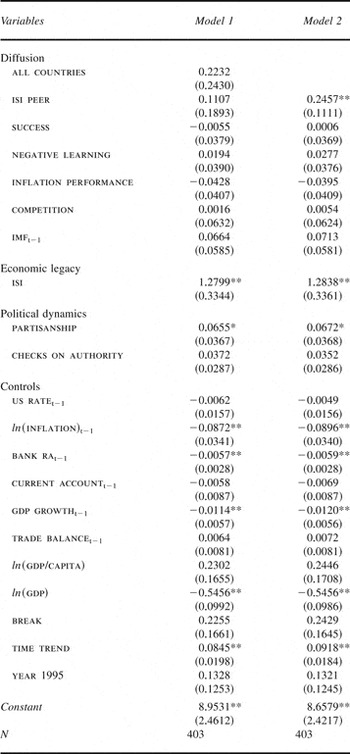
As a starting point, we seek to uncover in Table 1 the existence of distinct pathways of policy diffusion that crosscut this regional grouping. The goal is to assess whether, net of domestic political considerations and other national political-economic differences, diffusion from all, or specific theoretically defined subsets of other countries of Latin America shapes capital account choices. We begin with a specification that evaluates whether mimicry of all others in the region (net of other specific diffusion channels) characterizes the interdependence of capital account diffusion.Footnote 129 The results in Model 1 of Table 1 show that simple emulation of all other countries is not a likely mechanism by which capital account opening diffused in Latin America. While capital account openness responds to executive partisanship (more conservative governments are more open), economy size, and wealth in expected ways, there is no measurable impact of diffusion through emulation of all regional “neighbors'” decisions, or learning (from success only, or from either success or failure). Nor does emulation of advanced ISI peers predict the cross-national spread of capital account policy in this model. We expect these to be a result of too much colinearity (existing by construction) with region-wide mimicry, as is evident in Model 2 of Table 1 where all countries is dropped. Both learning variables nevertheless remain insignificant, suggesting that within Latin America, the force of emulation among like countries weighed more powerfully than medium-term economic results of capital account policies. Alternatively, the necessary reliance on annual macroeconomic data to proxy for policy success or failure may fail to capture the more short-term effects of capital account liberalization to which Latin American governments may respond when evaluating this policy. In such a case, annual macroeconomic data may fail to accurately capture the signals of policy success or failure from which government actors learn.
Emulation, domestic politics, and international pressures in Latin America

Notes: Table shows generalized least squares models, corrected for panel-specific AR-1 autocorrelation. The dependent variable is capital account openness. Standard errors are in parentheses.
* p < .10;
** p < .05.
Table 1 also offers no evidence of vertical diffusion; governments that in the previous year were under IMF agreements had levels of capital account regulation that were indistinguishable from those that were not. Naturally, such a result is far removed from an ultimate contention that any form of vertical diffusion is of little importance to choices about capital account regulation. But it does suggest that attention needs to be squarely placed on the questions of what type of diffusion process(es) might operate, under what circumstances, and in conjunction with what characteristics. In other words, more precise measures of the channels of diffusion are needed, as is closer analysis of the conditions under which those forces matter.
In Models 1 and 2 of Table 1 we also employ our variable that captures, albeit roughly, the presence of an advanced ISI legacy (isi). We expect this variable to have both direct and indirect effects (by shaping diffusion processes) on capital account policy. Here we find even stronger evidence to support our basic contention that countries on the advanced ISI development path are more likely both to adopt capital account liberalization, all else being equal, and to look to a peer group defined by this development pathway when making policy decisions. We see this effect first in the positive and significant coefficients on the isi peer variable in both models, which indicate that, all else being equal, a country is more likely to enact deeper capital account liberalization when other nations on the same development path (either achieving advanced import substituting industrialization or not) have done so. In addition, countries on the advanced ISI path are themselves more likely to liberalize capital flows (relative to the early ISI economies that make up the balance of the region), contravening the widely held notion that the beneficiaries of state intervention reliably line up in opposition to economic liberalization. Instead, such politics are more complicated and require an examination of the specific sectors arising from distinct legacies of the closed-economy era. As expected, the evidence is consistent with our claim that the interests that are dominant in advanced ISI economies are friendlier to at least some degree of capital account deregulation relative to those countries with an economic structure associated with early ISI in the Latin American region.
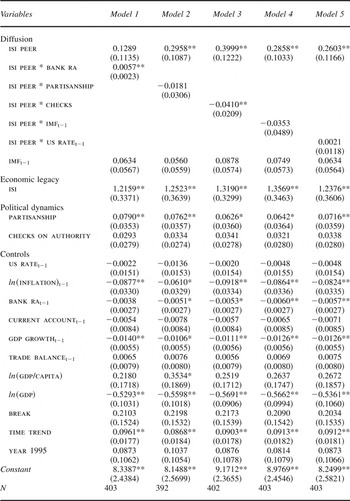
In Table 2, we seek to understand when diffusion forces are likely to be most powerful in shaping capital account policies. In Model 1 of Table 2, we interact our measure of domestic financial repression (bank ra) with isi peer and find a significant and strongly positive result: peer decisions influence capital account liberalization more powerfully when domestic financial sectors are more heavily repressed. Here we posited that the transitional dislocations caused by capital account liberalization would prompt governments to weigh more heavily the decisions made by relevant peer nations to avoid making a policy “mistake.” Indeed, higher bank reserve-to-asset ratios, which indicate more repressed financial sectors, increase the causal weight of peer diffusion forces in government decisions to enact capital account liberalization. While accounting for this conditioning effect, Model 1 also shows support for our other hypotheses regarding the domestic politics of reform: consistent with previous research, executives of the right are more likely to enact capital account liberalization.Footnote 130 The dispersion of governing authority, however, is not a direct predictor of capital account liberalization.
When does diffusion matter in Latin America?

Notes: Table shows generalized least squares models, corrected for panel-specific AR-1 autocorrelation. The dependent variable is capital account openness. Standard errors are in parentheses.
* p < .10;
** p < .05.
In Models 2 and 3 of Table 2, we consider whether domestic partisanship and checks on executive authority mediate the importance of interdependent factors in the adoption of capital account liberalization. The coefficient on the interaction between isi peer and partisanship in Model 2 does not reach statistical significance and thus fails to confirm our expectation that left governments weigh the effect of peer diffusion more heavily than right governments. However, in Model 3, we find that the dispersal of power does systematically mediate the importance of cross-national policy diffusion. Here the coefficient on the interaction between checks and isi peer suggests that where power is more concentrated (fewer checks), the relative paucity of coalition allies with which to share blame for the potential fallout from capital account liberalization may lead to heavier reliance on information from peer decisions when formulating international financial policy. In this case, we posited that political leaders are concerned about the risk of bearing sole political blame for a possible ex post financial crisis; peer decisions thus may provide a potential scapegoat for governments enacting this reform, and information as to its riskiness.
In Model 4, we consider the role of the IMF. Although previous models have not supported the notion that having an agreement in place with the IMF on average produces higher levels of capital account openness, we test whether an IMF accord might condition the importance of horizontal peer diffusion effects. The statistical evidence suggests that being under an IMF agreement does not induce host governments to weigh more heavily the decisions of subregional peers in the decision to liberalize capital accounts. Nor is there evidence again for a direct diffusion effect for those countries subject to an IMF agreement. The direct effect of ISI legacies, ISI peers, and executive partisanship, however, remain significant as predictors of capital account policy in this model. In Model 5, conditions of capital scarcity (high U.S. interest rates) do not systematically increase the weight of ISI peers in the decision to liberalize capital accounts. We do find continued support for the direct effect of the legacy of advanced ISI on capital account opening, and for the pull of executive partisanship where executives of the right again are systematically more likely to liberalize capital accounts, all else being equal.
Our evidence thus suggests a critical role for economic policy legacies in the decision to liberalize capital account restrictions in Latin America. The findings offer both theoretical and empirical contributions to research on the political economy of global economic integration. Substantively, we demonstrate that countries that undertook a heavily statist model of economic development leading to heavy industrialization occupy the middle-ground position on capital account policy, rather than being strict advocates of closure. This finding challenges the view that beneficiaries of statist protections and subsidies under ISI will later constitute distributional coalitions uniformly opposed to economic liberalization. Finally, the results of this analysis make a theoretical contribution by identifying a crucial path-dependent and structural foundation for the adoption and diffusion of open capital account positions that have been predominantly characterized by contemporaneous correlates of capital account policy and an almost exclusive focus on agency. More than simply accounting for domestic and international sources of capital account policy, this research points to the ways in which such policies and their international diffusion patterns may be path-dependent and bound by domestic economic structures, while highlighting the indeterminacies that come from a reliance on institutional accounts that neglect a serious treatment of interests.
Conclusion
Evidence has been building for some time that international diffusion plays an important role in the structuring of national policies governing the flow of capital across borders. At the same time, we have long known that the characteristics of domestic and international political economies of different nations powerfully shape the incentives that govern the liberalization of capital account regulations. Yet, less attention has been paid to the ways in which the structure of the domestic economy, and its roots in earlier policy choices, shape both the nature of international financial policies and the international channels through which policy models diffuse. We have found that the experience of advanced ISI created a crucial structural legacy that at once shapes the pathways of cross-national policy diffusion while also influencing capital account liberalization directly via the domestic political system. This industrial deepening, we posited, created interest groups in export-oriented manufacturing sectors that may support a middle-ground position between the existing paradigms of full economic liberalization and financial autarky. Such a position allows exporters at once to gain access to foreign credit while dampening the risk of currency appreciation from heavy capital inflows. We also found that the structural legacy of advanced ISI may be distinctive enough that countries embracing such a development model now constitute distinctive sets of subregional peers through which policy diffusion occurs.
This analysis joins a growing literature that seeks to move beyond the mere contention that both international and domestic factors are simultaneously relevant to policy choices, by demonstrating more precisely the ways in which they are closely intertwined, and that institutional barriers are the principal reasons for variation in reform outcomes. Specifically, we found that critical features of the domestic and international political economy condition the circumstances under which decisions made in similar countries are most valuable to decision makers, and hence most influential in the policy process. In this regard, we found that diffusion processes are strengthened in two distinct circumstances. First, when the risk of financial crisis in the wake of liberalization is highest—that is, when the domestic financial system is most repressed—decision makers rely more heavily on external information when setting capital account policy. Second, government actors weigh foreign experiences more heavily when the political risks of capital account liberalization (specifically of bearing sole responsibility for a crisis ex post) are the greatest, such as when political power is more highly concentrated. We posited that this effect is evidence of a blame-avoidance logic in such policymaking.
Ultimately, this study has added two important points to our understanding of the political economy of global financial integration. First, the domestic political economy of financial opening bears the heavy imprint of path dependence, wherein earlier policy choices, particularly those redefining the domestic economic structure, systematically shape later policy choices. We have offered a structurally grounded interest theory to explain how coalitions in support of global financial integration may arise, improbably, from a legacy of state-led economic development, and how such legacies also delimit subregional channels through which policy models diffuse. In so doing, we provide a theoretical foundation for domestic interests that are ignored or oversimplified in traditional institutionalist accounts. Second, the analysis suggests that we cannot understand the politics of capital account liberalization without a conjoint model of domestic and international political economy. The two are inextricably intertwined in ways that make efforts to independently asses their effects ill-specified at best, and misleading at worst. Our task has been to theoretically and empirically elucidate how they are intertwined, and thus to further unpack the forces that condition the mechanisms of international policy diffusion and the strength of its effect.