INTRODUCTION
Why are some states more democratic than others? In the African context, the literature has developed a number of answers to this question. Countries with oil and other valuable natural resources are less likely to be democratic (Ross Reference Ross2001), as are those in which political institutions are weaker, and in which neo-patrimonial politics has been more pronounced. Having earlier and deeper experience of plural politics during the colonial period is generally seen to have a positive effect (Cheeseman Reference Cheeseman2015), while low and falling economic growth is understood to represent a significant challenge. However, one factor that is rarely systematically included in cross-national discussions on the quality of democracy in Africa is experiences of war and, by implication, peace. None of the most prominent books on the subject of democratic consolidation in Africa, from Bratton and van de Walle's seminal early work (Reference Bratton and van de Walle1997) to Claude Ake's analysis of the feasibility of democracy on the continent (Ake Reference Ake2000), emphasise the effect of war as a central factor, whether positive or negative.
By contrast, the broader literature on state building and democratisation has often placed war at centre stage while drawing seemingly paradoxical conclusions. The ‘bellicose’ literature (Centeno Reference Centeno2002), famously advocated by Charles Tilly, has identified a number of mechanisms through which war leads to statebuilding: the need to fund armies which triggered greater taxation, boosting government coffers; the need to defend territory which led to investment in stronger borders, creating a monopoly over the legitimate use of force; and, the way in which the experience of conflict generated stronger and more unified national identities. On this basis, Tilly concludes that ‘war made the state, and the state made war’ (Tilly Reference Tilly1992: 42). Implicit within Tilly's model is a connection between this kind of statebuilding and democratisation; when states lacking full political control levy greater taxation they must do so through processes of bargaining, giving away influence in return for revenue, and spurring cries of ‘no taxation without representation’. Thus, in the long run (and it can be a very long run) taxation drives demands for greater accountability, and thus a social contract.
Other scholars present a similarly optimistic view. As Nancy Bermeo (Reference Bermeo2003: 161) has noted, ‘the democratization literature portrays the association between war and democracy to be broadly positive’. This argument tends to follow Tilly in tracing a line between war, the construction of more effective states, and demands for greater accountability. More contemporary analysis has offered a third leg to this argument where civil war is concerned, claiming that where rebel groups engage extensively with civilian populations, this can generate demands for greater rights (Huang Reference Huang2016); and that when the political preferences of the citizenry are sufficiently diverse this can act as an incentive to democratisation (Wantchekon & Neeman Reference Wantchekon and Neeman2002: 459).Footnote 1
Against these arguments, we follow recent Africanist literature in stressing the negative consequences of conflict, in particular civil war. While scholars such as Reno (Reference Reno1999) have done this for the process of statebuilding, we stress the deleterious impact of internal conflict for the quality of democracy. We do this by assessing the impact of civil conflict on democratic consolidation in five East African states. Our argument unfolds in two parts. First, in the following section, we argue that while civil war is broadly recognised to have less positive consequences than inter-state war, this is especially true in East Africa. Subsequently, the second part of our argument traces the impact of civil war on the evolution of democratic (or authoritarian) government. To do this, the latter half of the article focuses on three factors that are often identified as important to the process of democratic consolidation: the quality of political institutions (Bratton & van de Walle Reference Bratton and van de Walle1997), the degree of elite cohesion (Osei Reference Osei2015), and the nature of civil-military relations (Cheeseman Reference Cheeseman2015).
Taking each factor in turn, we explain why it is seen to play such an important role in transitions from authoritarian rule, and how it is undermined by civil conflict. Our method for doing so is to go beyond case studies and global datasets to conduct the kind of focused comparative research that animated Tilly's own findings, looking at enough cases to permit general tendencies to be observed without casting the net so wide that the specific features of each country's experience are overlooked. To this end, we conduct a comparative analysis of the five states of East Africa – Burundi, Kenya, Rwanda, Tanzania and Uganda.Footnote 2 We have deliberately included all five states to ensure variation in terms of both colonial experiences and outcomes, and to allow us to look at processes of democratisation and authoritarianisation. Of these states, we argue that the lower levels of democracy witnessed in Burundi, Rwanda and Uganda are no accident, but relate to their experience of civil conflict. By comparing the experience of these ‘high conflict’ cases with two ‘low conflict’ ones that have avoided prolonged war and have achieved more open and competitive politics – Kenya and Tanzania – we are able to illuminate some of the lasting consequences of civil conflict.Footnote 3
THEORISING CONFLICT AND DEMOCRACY
There are a number of reasons to doubt that inter-state conflict would have ‘Tillyian’ consequences of statebuilding and long-term democratisation in Africa. Tilly himself has questioned whether his analysis applies to developing countries, noting that the principal mechanisms he identifies such as the relationship between war and the expansion of state revenues do not apply in contexts where the military is externally funded and, consequently, no domestic bargaining over taxes and military restraint occurs. Herbst (Reference Herbst2014), meanwhile, suggests that in the African context, the lack of inter-state war and the different incentives facing political leaders mean that these kinds of processes have not taken place, which in turn helps to account for the continent's weak borders.
There are even more reasons to doubt that such a relationship exists in cases of civil war because, as Tilly well understood, its logic is profoundly different to inter-state conflict. Most obviously, the internal nature of civil strife means that states do not develop stronger borders, and the fact that there may be no central government for long periods of time means that the need to prosecute a war does not always lead to higher levels of central taxation. Consequently, the link to enhanced state capacity and demands for greater representation on behalf of the populace is broken, which is likely to stymie the evolution of a social contract (Cheeseman Reference Cheeseman2015: Ch. 2). Instead, in the absence of an effective government administration, rival armies often survive through predation and forced recruitment. At the same time, high levels of inter-communal violence strengthen political identities (LeBas Reference LeBas2006) and heighten inter-ethnic tensions (Reyntjens Reference Reyntjens2013), undermining the emergence of a coherent national identity (Horowitz Reference Horowitz1985). The combined impact of these trends can generate weak states and divided societies.
Despite this, the positive features of domestic conflict continue to be emphasised in the comparative literature, which focuses on alternative mechanisms that are said to promote democratisation. For example, in a recent study entitled The Wartime Origins of Democratisation: Civil War, Rebel Governance and Political Regimes, Reyko Huang suggests that ‘war can have mobilizing effects when rebels engage extensively with civilian populations, catalysing a bottom-up force for change toward greater political rights’ (Reference Huang2016). This bottom-up perspective has been complemented by the more top-down view of Leonard Wantchekon and Zvika Neeman (Reference Wantchekon and Neeman2002), whose analysis of the relationship between the legacy of conflict and the structure of political competition concludes that ‘post-civil war democratization is possible if the political preferences of the citizenry are diverse enough so that each political group assesses a high enough chance of winning post-civil war elections’. Under these conditions, ‘incentives for democratization are generated in part by the fact that protection against expropriation benefits both the warring factions and ordinary citizens’ (Reference Wantchekon and Neeman2002: 459). This, they argue, helps to explain why ‘Civil wars gave birth to democracies in, among others, Mozambique, El Salvador, Liberia, Algeria, Guatemala and Nicaragua’ (Wantchekon & Neeman Reference Wantchekon and Neeman2002: 440).
Although some African cases are cited in this work, the broader Africanist literature casts doubt on how far these claims can be generalised. Both of the accounts cited above place considerable weight on the opinions and agency of ordinary citizens. This is laudable in a literature that too often focuses on elite actors to the expense of the wider population, but seems to underestimate the degree of repression that characterises many African civil wars and their aftermath (Reyntjens Reference Reyntjens2013). Similarly, Huang's emphasis on the capacity of rebel groups to inspire mass mobilisation may hold in the small number of cases in which rebels maintain a high degree of internal democracy and treat civilians more inclusively in the areas under their control, but as Thandika Mkandawire has argued in this journal, these conditions have been rarely held in the African context (Mkandawire Reference Mkandawire2002). As a result, incentives to build strong, plural and impartial political institutions have been limited.
This point is well demonstrated by the work of William Reno (Reference Reno1999), who argues that warlords and other local power brokers are unlikely to see a value in strengthening and investing in the formal state apparatus, which offers greater risks than benefits, and in creating genuinely independent institutions, which would constrain their ability to benefit from the spoils economy. Instead, they find greater opportunities in what Chabal & Daloz (Reference Chabal and Daloz1999) have called ‘disorder as political instrument’, and deliberately work to keep the state weak. In line with this, scholars of African countries such as the Democratic Republic of the Congo and Somalia have demonstrated that prolonged episodes of unrest have done little to promote democratic norms and values, or the state capacity needed to enforce them (Prunier Reference Prunier2009).
The Africanist literature thus casts doubt on the virtue of war for democracy in all but a small number of cases. But despite this, there have been relatively few attempts to theorise precisely how and why conflict reduces the prospects for plural politics. This article represents a first attempt to do this with respect to the countries of East Africa. In the discussion that follows, we proceed by assessing these cases in terms of the quality of political institutions, the degree of elite cohesion, and the nature of civil-military relations. We start by explaining how conflict negatively affects each of these factors, and how via these intermediary variables, it erodes prospects for democratisation. Our analysis is based on a close reading of the secondary literature and extensive periods of fieldwork by the authors, who between them have conducted several months of research in all five countries, over a number of years.
Making this argument effectively requires us to be wary of the risk of endogeneity. It could be the case, for example, that the onset of conflict and the failure of democratic consolidation are both explained by a prior third factor, such that the relationship between conflict and consolidation is illusory. This is a particularly relevant concern in this study given our case selection, as the process of nation building and democratisation in Burundi and Rwanda are often said to have been doomed from independence as a result of the divisive legacy of Belgian colonialism (Uvin Reference Uvin1999), a very different scenario than in nearby Tanzania. We tackle this challenge in two main ways. First, we explicitly recognise that in some cases, certain factors – such as weak institutions – both render civil war more likely and undermine the prospects for democratic consolidation, but argue that it is nonetheless possible to demonstrate through careful process tracing that conflict exacerbates these issues and renders them more potent. Second, we draw on the comparison of Kenya and Uganda to isolate the impact of civil conflict in countries whose starting conditions at independence were more comparable. Indeed, while both states suffered the destabilising effect of British divide-and-rule policies, it was in many ways Kenya, which had experienced the violent Mau Mau rebellion and the prohibition of colony wide parties during the state of emergency (Branch & Cheeseman Reference Branch and Cheeseman2006), that had the greatest challenges to overcome. Tracing the mechanisms through which conflict in Uganda occurred and subsequently undermined the prospects for democratic consolidation, such that it was Kenya that established the more open and competitive political system, allows us to bring the deleterious impact of civil war into sharper relief.
Of course, even with careful process tracing and targeted comparisons, it is difficult to isolate and quantify the specific impact of prior conditions as opposed to the onset of war. Given this, it is important to emphasise that we are not claiming to show that conflict is the most significant factor preventing democratic reform in our cases. Instead, our ambition is much more modest: to demonstrate that conflict in many African states makes democratisation more problematic, and to advance a framework through which to understand why this is the case. Thus, our analysis should not be taken to imply that countries that have avoided war will inevitably become democratic, or that those that have been mired in conflict cannot. In other words, our purpose here is not to argue for the pre-eminence of war,Footnote 4 but rather to flesh out the mechanisms through which conflict contributes to authoritarianism so that these processes can be better understood.
DEMOCRACY AND CONFLICT IN EAST AFRICA
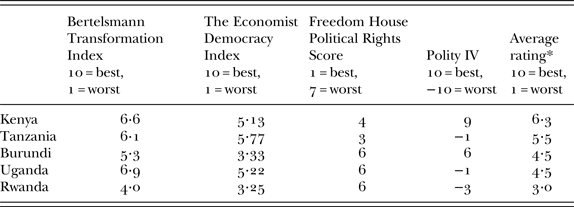
Before we explore our core themes of political institutions, elite consensus and civil-military relations, it is important to explain how we determined that three of our cases are less democratic than the other two. Measuring democracy is complicated and controversial. To avoid any suspicion of cherry picking, we use the democracy scores for all five countries in four commonly used democracy indices, from which we have derived a composite index, in Table I. While all five countries feature political elites with authoritarian tendencies, and there is some inconsistency in the rankings, it is clear that a democratic divide exists within East Africa: on average, Kenya and Tanzania are significantly more democratic states, although there is some inconsistency between the different indices on the exact ranking. It is worth noting that Tanzania's rating may fall in the future due to the authoritarian tendencies of President Magufuli, elected in 2015 and the same may happen to Kenya as a result of the electoral controversy of 2017. The scores for Burundi and Uganda are also likely to fall, though, following recent episodes of state violence and political repression in 2015/2016 and the efforts by Uganda's ruling party to change the constitution to enable President Museveni to run for a sixth term. As a result, the overall pattern is likely to remain the same.
Democracy ratings of East Africa (2014/2015).

*The average rating is calculated by converting all scores to a 0-10 rating in which 10 = best, and then averaging them. Note that this involves inverting the Freedom House score.
We have already noted that the literature has identified a number of different factors that promote democratic consolidation. Our decision to focus on institutions, elites and civil-military relations is based on three criteria. First, as we argue in the sections that follow, these are some of the issues that have attracted most compelling arguments within the Africanist literature on democratisation. Second, they also represent some of the processes that are most likely to be impacted by civil conflict. For obvious reasons, it does not make sense to argue that conflict shapes some of the factors commonly mentioned by comparativists, such as the identity of the former colonial power or the presence of oil. Third, although these themes are prominent within the Africanist literature, they are not unique to the continent; rather, they are central to discussions of democratisation in Latin America and elsewhere (Whitehead Reference Whitehead2002). Thus, if we can show that they are significantly impacted by instances of conflict, our argument will resonate well beyond East Africa.
THE CAPACITY AND INDEPENDENCE OF POLITICAL INSTITUTIONS
One of the most common arguments in the Africanist literature is that variations in the quality of democracy are shaped by the strength and independence of political institutions. Indeed, a number of scholars including Bratton & van de Walle (Reference Bratton and van de Walle1997) and Cheeseman (Reference Cheeseman2015) have posited that strong institutions are central to the process of political reform, in large part because they make possible negotiated and stable transitions – as in the case of South Africa. Following this literature, we understand the capacity and independence of political institutions to refer to their ability to perform the basic tasks set out for them in the constitution and legal system. This is shaped not just by formal rules such as meritocratic appointment processes and security of tenure, but also by informal norms such as whether members of the judiciary and legislature challenge and constrain the powers of the executive in practice (Helmke & Levitsky Reference Helmke and Levitsky2006).
We argue that in the one-party states that emerged in Kenya and Tanzania, formal political institutions were weakened but were never fully destroyed and in some cases have been fortified by the reintroduction of multipartyism. By contrast, in states such as Burundi, Rwanda and Uganda, periods of military rule and/or prolonged conflict have served to further weaken – and in some cases eviscerate – the already problematic political institutions developed under colonial rule, undermining the prospects for democratic consolidation.
The high conflict cases
Belgian colonial rule was authoritarian and paternalistic, ignored the separation of powers, and endorsed divide-and-rule strategies that sowed division between rival elites. It also did little to prepare colonies for majority rule.
The first general elections in Burundi were organised less than a year before independence, and political institutions immediately exhibited considerable fragility, setting the scene for post-colonial instability. However, post-colonial conflict further exacerbated this problematic inheritance, with coups d’état in 1966, 1976 and 1987, political assassinations and purges, and genocide in 1972. These episodes of political conflict undermined what institutions had been developed and consolidated ‘Big Man’ rule. The reign of General Micombero, who seized power in 1966, was marked by personal rule and deinstitutionalisation, which is highlighted by the 1974 constitution that did not provide for a parliament, and gave both executive and legislative power to the president. After another coup that brought Colonel Bagaza to power in 1976, the 1981 constitution introduced a strong presidency that allowed Bagaza to dominate the political system. He was in turn overthrown by Major Buyoya in 1987, a further demonstration of the falling capacity of formal institutions.
After a prolonged period of ethnic politics marked by the exclusion of the Hutu majority, Burundi embarked on a process of ‘reconciliation’ in 1988 under intense international pressure. The next step towards ‘democratisation’ included the promulgation of a democratic constitution in 1992 and general elections in June 1993. These polls were won by the Hutu-dominated opposition party Frodebu, thus putting an end to decades of rule by Tutsi elites. Just months later, the Tutsi-dominated army staged a coup with the aim of preserving the privileges of the former incumbents. President Ndadaye was assassinated, which plunged the country into a decade-long civil war during which political institutions were paralysed.
Following heavy international and regional pressure, the protagonists signed a power-sharing accord in Arusha in August 2000. Thanks to shrewd constitutional engineering, the ethnic divide was largely managed, but the attempt to create new political institutions ultimately failed because there were insufficient foundations to build upon. The 2005 elections brought to power the CNDD-FDD (Conseil national pour la défense de la démocratie-Forces pour la défense de la démocratie), the most important former rebel movement. It set out to consolidate its power, and soon marginalised the political opposition and civil society. Although in principle the formal rules placed considerable constraints on the president, in reality they proved to have little effect.
Instead, President Nkurunziza's repressive strategies prompted opposition parties to boycott the 2010 polls, while his bid for an unconstitutional third term in 2015 led to the exodus of over 200,000 people and provides a further demonstration of the difficulty of enforcing negotiated settlements in institutionally weak post-conflict states. Moreover, those leaving the country included the most prominent representatives of the opposition (and even the moderate leaders of the ruling party), civil society and independent media, further weakening the potential for strong political institutions to emerge.
Rwanda shares Burundi's colonial past. The late introduction of democratic institutions, and the refusal to establish a more inclusive form of politics, meant that Rwanda entered independence with a political system that had particularly shallow roots and no time to develop a supportive set of informal norms. Episodes of conflict further weakened the institutional landscape and undermined the prospects for democratic consolidation. The immediate post-independence period saw 10 years of de facto single party rule that were marked by moments of ethnic violence. In 1973, the army seized power and in 1978 a new constitution, which purported to return Rwanda to ‘civilian’ rule, set up the Mouvement révolutionnaire national pour le développement (MRND) as the single party of which all Rwandans were members by birth. Only the president of the Movement was allowed to be a candidate for the presidency, and there was no distinction between the organs of the Movement and those of the state. This allowed for personal rule; separation of powers existed on paper only.
In 1990, a fresh episode of conflict led to a process of further institutional upheaval, as the Rwandan Patriotic Front (RPF) invaded the country from Uganda, thus starting the civil war that was to end with genocide against the Tutsi, resulting in the loss of over 800,000 lives. The RPF ultimately won the war and, like the CNDD-FDD, immediately set about consolidating its hold on power. Although the government claimed that it adhered to the spirit of the 1993 Arusha Peace Agreement, it quickly began suppressing countervailing voices in politics, the press and civil society. The recent period of mass conflict, and the resulting destruction of the previous institutional landscape, made this task considerably easier.
Parliamentary elections in 2003, 2008 and 2013 and presidential elections in 2003, 2010 and 2017 were held without meaningful opposition and were characterised by intimidation, terror and fraud, resulting in the establishment of de facto single-party rule. Legislation on ‘divisionism’ and ‘genocide ideology’ has allowed the RPF's monopolistic narrative to be entrenched, and the regime has reacted aggressively to opposing voices. Government policy on the most important issues has been decided by a small inner circle of the RPF, without involvement of the cabinet or parliament, and free from judicial oversight (Reyntjens Reference Reyntjens2013). The constitution was amended in 2015, so as to allow Kagame to stand for a third seven-year term and two additional five-year terms after that, thus potentially leaving him in office until 2034. In August 2017, Kagame was re-elected with over 98% of the vote.
Uganda is a somewhat different case. At independence, it was not obvious that the country was headed for a downward spiral. Although the British colonial strategy of indirect rule conferred considerable political privileges on the Buganda Kingdom while also feeding into a North-South socio-economic divide (Apter Reference Apter1961), its institutional legacy was more positive. A legislative council was set up as early as 1921, and the first African member was admitted in 1945. Two competitive multi-party elections were held in advance of independence, and although the polls were problematic, the two main parties split the seats roughly equally.
The 1962 National Assembly elections passed relatively peacefully and were won by a coalition comprising then Prime Minister Milton Obote's Uganda People's Congress (UPC) and the Kabaka Yekka (King First) party, which represented the interests of the elite within the Buganda Kingdom. However, by 1966 the fragile entente between these two parties had collapsed while divisions within Obote's own UPC began to threaten his hold on power. He responded by arresting rivals from within his party, declaring himself President, imposing a new constitution, and stripping the Buganda Kingdom of the federal powers provided for in the Independence constitution. When the Buganda establishment pushed back, Obote sent troops to attack the royal palace, forcing the Kabaka (King) into exile. This clash constituted ‘the first major bloodbath in independent Uganda’ and was followed by a ‘savage and unprecedented slaughter of Baganda’ (Mutibwa Reference Mutibwa1992: 38).
Far from consolidating control, Obote's power grab exacerbated tensions and further undermined his popularity, paving the way for Major-General Idi Amin's successful coup in 1971. Amin's subsequent eight-year rule incapacitated most key state institutions, even if it stopped short of producing a complete institutional vacuum (Hansen Reference Hansen2013). In 1979, the Tanzanian army, aided by a loose coalition of exiled Ugandan forces, invaded and overthrew Amin. A brief, turbulent transition period followed, which culminated in a flawed election in 1980 that brought Obote back to power. A variety of rebel groups soon emerged to fight the Obote II regime. One of these rebel outfits, the National Resistance Army (NRA), took control of Kampala in 1986 and its leader, Yoweri Museveni, became President.
The NRA, known as the National Resistance Movement (NRM) in its civilian form, promised, among other things, to restore democracy. This included introducing a new system of local councils to promote popular participation and oversight whilst also strengthening legislative powers vis-à-vis the executive (Museveni Reference Museveni2000). The implementation of this democratisation agenda nevertheless proved slow as a new constitution was only adopted in 1995. Although the constitution was initially celebrated, it came with the further entrenchment of a ‘no-party’ system, which many equated with one-party rule (Oloka-Onyango Reference Oloka-Onyango, Mugaju and Oloka-Onyango2000; Carbone Reference Carbone2005). Although the legislature asserted a limited form of autonomy and the judiciary also displayed some independence, systematic executive meddling led to what Tripp characterises as Uganda's ‘hybrid regime’: the combination of a constitutional façade and an authoritarian foundation (Tripp Reference Tripp2010).
As the NRM government became ever more personalised and centralised, Museveni and his inner circle found fresh strategies to convert would-be democratic institutions, such as the much-celebrated local councils, into new channels for patronage (Green Reference Green2010). Even the 2005 transition to multi-party politics ultimately served to consolidate NRM control as opposition parties struggled to register and to organise freely (Kiiza et al. Reference Kiiza, Svasand, Tabaro, Kiiza, Makara and Rakner2008). Meanwhile, the simultaneous lifting of presidential term limits ensured that Museveni's personal authority went unchecked. The highly controversial 2016 general elections, with a partisan Electoral Commission overseeing widespread fraud and a post-election crackdown on opposition activity, were a further illustration of this authoritarian trend. And now, less than two years into a new term, the NRM is angling to remove presidential age limits from the constitution, thereby clearing the way for President Museveni – who will have exceeded the 75-year limit – to run for re-election in 2021.
Thus, in all three of these cases, episodes of conflict further undermined the weak institutions inherited from the colonial era, leading to the emergence of vulnerable and pliant political systems. Where political upheaval has been a regular occurrence, contemporary institutions have especially shallow roots and so are poorly placed to resist the will of the executive. One clear indicator of this is that in all three countries the current president flouted or removed presidential term limits in order to stay in office.
The low conflict cases
In stark contrast to the three conflict cases, Tanzania stands out as one of the most stable states in the continent. Although German colonial rule led to the violent suppression of the Maji Maji revolt in 1905–06, after World War I the country was mandated to Britain and in 1946 this relationship was converted into a trusteeship by the United Nations. As a result, colonial rule was not nearly as invasive or exclusionary as in many other parts of the continent, and featured national political associations from the late 1920s onwards.
Tanzania's more positive colonial legacy and post-independence stability created room for aspects of the political process to become institutionalised. Most obviously, a single party ruled until the early 1990s under the guise of the Tanganyika African National Union (TANU), which was later rebranded as Chama Cha Mapinduzi (CCM) following a merger with Zanzibar's Afro-Shirazi Party (ASP) in 1977. Less obviously, despite its status as a de jure one-party state, Tanzania held competitive parliamentary elections every five years from 1965 to 1995, at which point opposition parties were again allowed to contest. Although the one-party legislature remained a weak institution, subordinate to the ruling party, some scholars have argued that it provided an important forum for protest, amplified through high levels of media interest in parliamentary proceedings (Van Donge & Liviga Reference Van Donge and Liviga1986). Moreover, following Tanzania's multiparty transition, and in particular since the mid-2000s, the legislature has emerged as a more assertive body, pushing through institutional reforms and challenging the government over corruption allegations. Following President Nyerere's decision to step down in 1985, Tanzania also institutionalised presidential term limits, with each successive president serving two five-year terms.
The extended reign of the ruling party has, needless to say, created its own set of challenges, notably regarding the independence of key political institutions. There are numerous examples of overlap between partisan and official functions.Footnote 5 The Regional and District Commissioners, for example, are presidential appointees and face routine criticism for their alleged involvement in CCM mobilisation efforts. Constitutional reforms have remained a top-down affair both under one-party rule and after, while limits on press freedom and efforts to co-opt civil society actors have also constrained the space for political dissent (Nyirabu Reference Nyirabu2002). During President Kikwete's term in office (2005–15), this hierarchical control eroded somewhat as opposition parties made significant electoral gains and the legislature strengthened. The consolidation of democratic institutions in Tanzania, while in some ways more advanced than in the ‘conflict’ cases, nevertheless remains fragile. The authoritarian reversals under President John Magufuli, elected in 2015, exemplify this weakness as the new leader has overseen a crackdown on opposition party activity, systematic interference with Parliament and intimidation of government critics (Paget Reference Paget2017).
Unlike Tanzania, Kenya experienced a particularly turbulent colonial era. The violent conquest of the country in the early 1900s was followed 50 years later by the Mau Mau rebellion, which was not only a conflict between Kenyans and colonial forces but also pitted different elements of the Kikuyu ethnic group against one another. The rebellion and the resulting state of emergence from 1952 onwards led to the prohibition of colony wide parties, retarding the development of national politics. Moreover, while elections were organised for the Legislative Council from 1958 onwards, these were initially held on a restrictive franchise that only empowered ‘loyal’ colonial subjects (Branch & Cheeseman Reference Branch and Cheeseman2006).
Yet in stark contrast to Uganda, Kenya did not experience high levels of post-colonial conflict. Instead, President Jomo Kenyatta's careful management of the one-party state that emerged after independence led to a period of political stability, albeit one punctuated by a number of political assassinations. As a result of the absence of prolonged violence, the country's institutional experience has been closer to Tanzania than that of the conflict cases. From 1969 until 1992, Kenya was governed by a single-party system that held regular elections for the legislature and had a National Assembly that was, at least in the ‘golden years’ of the 1960s and early 1970s, one of the most vibrant on the continent. During this era, political stability was sustained by the ‘politics of participation and control’ (Bienen Reference Bienen2015). Participation came through one-party elections for Members of Parliament that were held based on the Westminster model,Footnote 6 and which remained relatively free and fair until the 1980s. Control came through the security forces and the Provincial Administration, a prefectural bureaucracy established under British rule to act as the eyes and ears of the colonial governor (Branch & Cheeseman Reference Branch and Cheeseman2006). Together with Kenyatta's status as the country's ‘founding father’, this combination generated the legitimacy and coercive capacity needed to stabilise the political system (Tamarkin Reference Tamarkin1978).
The reintroduction of multi-party elections in the 1990s created fresh challenges for the regime, and led to significant election-related ethnic clashes in 1992, 1997 and 2007. However, although this violence was tragic and cost over 3,000 lives, it did not lead to the collapse of political institutions that occurred in Burundi, Rwanda and Uganda. In part, this was because the level of violence was comparatively low and localised. Along with the strong coercive institutions at the disposal of the president, this empowered the government to retain overall control, and as a result the state limped through its various crises.
Of course, it is also true that the same coercive institutions were often used to intimidate opposition supporters, and so compromised the potential for democratic transformation. However, over time the stability of the political framework, and the willingness of Kenyan leaders to seek power through the ballot box, facilitated a process of institutional strengthening. Most notably, at times the government has responded to political crises by implementing piecemeal reforms to the structure of the state. For example, following a destabilising episode of post-election violence of 2007/8, a national unity government passed a new constitution that significantly enhanced the independence of key political institutions, while reducing the powers of the presidency. Although the Jubilee Alliance government elected in 2013 has attempted to roll back some of these gains, key elements such as the system of devolution and the independence of the Supreme Court are becoming entrenched.
In both of our non-conflict cases, then, institutional stability, combined with pressure from opposition groups, civil society organisations and international donors, has given rise to gradual processes of institutional strengthening. The latter factor is particularly significant here, because there is considerable evidence that pro-democracy foreign powers are more likely to accept poor quality elections in post-conflict countries, in part because they fear that adopting a tougher stance might result in the resurgence of war (Cheeseman et al. 2017). In this sense, the presence or absence of conflict is particularly significant because it shapes the engagement of influential actors, and so lowers the costs of sustaining authoritarian rule. Thus, this is not just an issue of capacity but also relates to the independence of institutions. In stark contrast to our conflict cases, presidential term limits have become entrenched, and have so far been respected by a number of leaders: Daniel arap Moi and Mwai Kibaki in Kenya, and Ali Hassan Mwinyi, Benjamin Mkapa and Jakaya Kikwete in Tanzania. This cannot be fully explained with reference to the absence of conflict, but it is clear that these iterative processes of democratic consolidation have benefitted from taking place against a backdrop of relative political stability.
ELITE CONSENSUS
We understand elite consensus to refer to the quality of relations between the leaders of rival parties and factions, and of different economic and social groups. Elite consensus is high when rival leaders share common beliefs and goals, and are willing to work across party, ethnic or other lines to achieve these. Researchers such as Anja Osei (Reference Osei2015) and Robert Dahl (Reference Dahl1989) have argued that this kind of cohesion contributes to democratic consolidation by enabling the political class to manage crises and disagreements in a way that prevents the breakdown of the wider political system. Trust and cohesion is also significant because it improves the prospects for a negotiated transition to take place, and makes it more likely that agreement can be reached on the new rules of the game (Karl Reference Karl1990). While the degree of elite consensus is shaped by a variety of different factors – such as divide-and-rule colonial government – a number of scholars have emphasised the significance of episodes of conflict (Horowitz Reference Horowitz1985; Rothchild Reference Rothchild1997).
In line with this analysis, we show that repeated bouts of violence have negatively affected elite relations in Burundi, Rwanda and Uganda, even after periods of rapprochement. By contrast, Tanzania has never experienced notable or sustained conflict, at least on the mainland. Kenya falls between these two extremes, as elections have often been accompanied by state-led violence and ethnic clashes, but these did not lead to conflict on anything like the scale of a civil war; partly as a result, elite relations have remained more cohesive.
The high conflict cases
Burundi and Rwanda have an ethnic setup that is relatively rare in Africa in that it is bipolar, with only two relevant groups, a large majority of Hutu (85–90%) and a minority of Tutsi (10–15%). While political ethnicity existed in pre-colonial times, particularly in Rwanda, a number of measures by the colonial administration rigidified and exacerbated the divide, undermining the potential for a stable political system to evolve.
After independence, trust and consensus remained limited in Burundi, even within the small circle of the ruling military elites, as is shown by the fact that the country experienced coups d’état roughly every 10 years. These were typically palace revolutions that aimed at replacing a military ruler who had come to be seen as a liability for the group in power. Indeed Micombero, Bagaza and Buyoya all hailed from the same area in Bururi province. Each time, the reasons for the coup were the same: end intra-regime tensions, avert threats against the group's hegemony, and re-establish the corporatist power of the army.
Subsequent episodes of ethnic conflict, and the coups themselves, led to a further deterioration in relations between rival political leaders. When the incumbent elites were defeated at the 1993 elections, there was no common ground between them and the unexpected winners. Although President Ndadaye attempted to rectify this by appointing a Tutsi prime minister from the former ruling party and a cabinet that, despite Frodebu's large majority in parliament, offered about one third of positions to the opposition, the old elites feared political marginalisation and the loss of their privileges. In turn, this lack of trust led to the coup of October 1993 (Reyntjens Reference Reyntjens1993).
Even after a peace accord was signed in August 2000, the absence of elite consensus delayed its effective implementation, and it took another five years to peacefully end the transition period. Moreover, the experience of prolonged conflict engendered a form of political paranoia within the new political elite. Although the CNDD-FDD handsomely won the 2005 elections, it failed to transform from a rebel movement into a political party, retaining its bush mentality. This was expressed in two ways. On the one hand, the CNDD-FDD exhibited a ‘siege mentality’, fearing everything and everyone outside its own small circle: the political opposition, urban opinion, civil society, the media and the international community. On the other, it continued to be haunted by internal distrust and competition, and the settling of scores was common. As a result, fresh barriers emerged to democratic consolidation.
Turning to Rwanda, the ethnically inspired violence in 1959–1963 and 1973 abated following the 1973 coup. However, regionalism then became a more prominent divide, pitting northerners against the rest of the country. When the predominantly Tutsi RPF invaded, ethnicity immediately came to the fore again, in part exacerbated because many Hutu felt that the RPF – and thus the Tutsi – got too favourable a deal in the 1993 peace accord. Consequently, this period led to an intensification of distrust and the division of the political elites into two camps, one allying with the former single party MRND, and the other with the RPF. In turn, growing distrust contributed to institutional stalemate and the subsequent resumption of the civil war. Although the victorious RPF later put in place a government of national unity with members of the main parties, this fell apart in August 1995, after which the government gradually eliminated the political opposition and autonomous civil society. Consequently, increasing numbers of politicians, civil servants, military officers and members of the judiciary fled the country in the second half of the 1990s.
The further erosion of trust and consensus during this period, which owed much to the trauma of the genocide itself, is visible on two levels. First, it is clear that the government's commitment to an inclusive political settlement has been extremely limited. This ‘settlement’ was imposed by the RPF, and ‘the political parties that exist in Rwanda today are only tolerated if they agree not to question the definition of political life drawn up by the RPF’ (International Crisis Group 2002: 2). In other words, the ‘settlement’ is that of an RPF cartel (that also includes the military), leaving out all those who do not agree with the ruling party. Second, the manifestation of distrust is also to be found within the RPF itself. From the late 1990s on, a number of RPF members defected, but the watershed came in 2010 when four major (former) high-ranking RPF leaders created an opposition movement, the Rwanda National Congress, after having fled the country. This increased the government's fear of internal subversion, which became apparent in 2014 and 2015 when dozens of people were arrested or ‘disappeared’. High-ranking army officers were prosecuted and sentenced to long prison terms for subversion, conspiracy and insurrection. All this occurred in an atmosphere of denunciations and rumours that confirmed Clark's assessment that ‘the RPF is a deeply divided, fragile, paranoid party’ (Clark Reference Clark2010). Just like the CNDD-FDD, it has failed to shed the practices of a secretive rebel movement.
In Uganda, elite relations towards the end of the post-colonial period were not as antagonistic as in Burundi and Rwanda but quickly deteriorated. The British strategy of indirect rule through the Buganda Kingdom meant that post-colonial governments faced the challenge of maintaining national unity given the privileges given to some and denied others. Scholars nevertheless tend to agree that Obote's poor political management in the independence era was central to the onset of conflict. In particular, his exclusionary rule helped trigger a cycle of violent confrontations that greatly exacerbated elite tensions, leading to a downward spiral from which it proved difficult to return (Mutibwa Reference Mutibwa1992; Low Reference Low, Hansen and Twaddle1988). Obote's split with the Buganda establishment and his suppression of dissent within the UPC fed into existing North-South tensions and left him with a greatly diminished – and ultimately unworkable – coalition propped up by his own northern support base and reinforced by the army.
Yet the situation was to deteriorate still further. After his 1971 coup, Idi Amin initially espoused an anti-sectarian message, which helped win him the support of the Baganda and other groups. However, faced with an economic crisis and mounting opposition, Amin came to depend on an inner circle dominated by elites from his home region of West Nile (Hansen Reference Hansen2013). As Amin's paranoia began to grow, the country became engulfed in domestic and later international conflict that exacerbated ethnic tensions and inter-elite mistrust. In turn, this undermined the effort to engineer a peaceful transition after Amin's overthrow as the groups working to defeat him fragmented into competing politico-military factions.
The subsequent NRA insurgency against the Obote II regime, instituted after Obote's fraudulent 1980 re-election, again espoused an anti-sectarian message, although violations of this principle were tolerated on an opportunistic basis. For instance, retaliation against Northerners living in the central region from which the NRA waged its guerrilla struggle was largely overlooked, and even encouraged (Kasfir Reference Kasfir2005). Branch (Reference Branch2005) argues, moreover, that the marginalisation of northern elites and the continued hostility towards the Acholi and Langi peasantry after the NRM came to power helped prolong the struggle against the Lord's Resistance Army, a brutal insurgency that terrorised the North for 20 years.
That said, the NRM did initially embrace ‘broad based’ government, evident in the inclusion of, for instance, leaders from different political parties and regions in the Cabinet, although these were still mostly southern and from the DP rather than UPC. Over time, however, even this approach was largely abandoned, giving way to a distinct bias in favour of the Ankole – Museveni's own group – in the ruling coalition (Lindemann Reference Lindemann2011a ; Kjaer Reference Kjaer2015). Politicians who defected and challenged Museveni and the NRM were, in turn, branded as ‘wolves’ out to undermine the ‘peace’ that the NRM fought for. Most notably, former NRA rebel, Col. Kizza Besigye, who broke ranks in 1999 and has since stood against Museveni in four presidential elections, has been arrested, physically attacked by security operatives, jailed, driven into exile, and falsely charged with treason and rape. The hostility towards opposition leaders aside, elite relations within the NRM itself remain unsettled. The question of who will succeed Museveni in power has repeatedly divided the President's inner circle and is widely seen to carry the threat of future political instability.
Of course, elite and societal divisions in Uganda do not approach the levels of Burundi and Rwanda. Nonetheless, in all three countries a profoundly suspicious and anxious set of elite relations has been further complicated by episodes of conflict, exacerbating leaders’ deep distrust and encouraging them to eschew compromise in favour of violent strategies – compounding the impact of weak institutions.
The low conflict cases
The degree of elite consensus has been far greater in Kenya and Tanzania. During the colonial period in Tanzania, the majority of the nationalist elite united within TANU as the dominant political party and have remained largely cohesive throughout the subsequent period of one-party rule. Some of this elite cohesion was preserved through concerted efforts to downplay ethnic differences and thereby eliminate societal cleavages as a base around which rival elites could mobilise and challenge the centre. Most notably, President Nyerere's post-independence government pursued nation-building policies, which included the promotion of Swahili as a national language and an explicit ban on references to ethnicity, religion or race in an electoral context.
The relative lack of politicised inter-communal tensions does not, of course, remove the possibility for distrust among elites. Actors within CCM frequently try to de-legitimate the opposition, and the ruling party often resorts to authoritarian tactics to defuse challenges to its authority, for instance by periodically harassing opposition politicians and their supporters. Elite cleavages, however, do not reach the same depth as in neighbouring countries, as demonstrated by the political manoeuvrings around the 2015 president elections. When party stalwart Edward Lowassa lost his bid to secure the CCM presidential nomination, he was able both to leave the ruling party and to find acceptance among the opposition, becoming their presidential flag bearer. Crucially, despite swapping parties, he has not been the target of state-led harassment to anywhere near the same degree as, say, Besigye in Uganda, RPF defectors in Rwanda or CNDD-FDD defectors in Burundi. As noted earlier, the situation has deteriorated under President Magufuli with intimidation of opposition-leaning politicians and businessmen, although this is more a product of Magufuli's authoritarian leadership than any deep-seated elite or inter-ethnic tensions.
The picture is somewhat different in Kenya, where the level of inter-elite trust was relatively low during the colonial era, when the nationalist movement split into two competing coalitions, the Kenya African National Union (KANU) and the Kenya African Democratic Union (KADU). The violence of the Mau Mau rebellion, combined with the inter-party hostility that surrounded early elections, meant that post-colonial governments faced a number of barriers to the construction of national unity. However, the relatively inclusive rule of Kenya's first president Jomo Kenyatta, which included the incorporation of KADU leaders within the KANU government in 1964/5, and the subsequent rise of KADU leader Daniel arap Moi to the Presidency in 1978, integrated these rival groups within one political structure. Ever since, Kenyan politics have been characterised by an unusual combination of political tension and elite cohesion.
Winner-takes-all politics, together with strong ethnic identities, have encouraged leaders to use negative messaging about the danger of a particular leader or community coming to power, and in some cases to deploy political violence in their campaigns (Ferree et al. Reference Ferree, Gibson and Long2014). However, the Kenyan political elite is also remarkably fluid and leaders remain willing to engage with each other, and to share political platforms when the need arises, despite their differences. In part, such accommodative strategies are necessary as a result of the nature of political competition in the country. Because no ethnic group comes close to being a majority of the population, winning elections requires candidates to put together multi-ethnic coalitions. As a result, the political system tends to coalesce into two or three main coalitions before elections and then fragment thereafter as former allies argue as to how to share power if they win, or who was to blame for their defeat if they lose (Cheeseman Reference Cheeseman2008).
This is not to say that Kenya does not suffer from serious ethnic tensions, or that competing leaders have a high level of trust in each other: coalitions are typically fleeting because rival Big Men do not really believe that their supposed allies can be relied upon to protect their interests. But in Kenya, as in Tanzania, these tensions have proved to be much more manageable than in our conflict cases, and the political elite remains capable of both cohesion and cooperation. Most notably, the leaders of the two main parties that fought against each other in the controversial 2007 election, Raila Odinga and Mwai Kibaki, joined forces to push through much needed constitutional reform in 2010. In doing so, they facilitated a process of political reconciliation and democratic renewal that is currently unthinkable in Museveni's Uganda, Kagame's Rwanda or Nkurunziza's Burundi.
CIVIL-MILITARY RELATIONS
The threat posed to civilian governments by military intervention has been highlighted by a number of studies, including Patrick McGowan's (Reference McGowan2003) research on the frequency of coups in West Africa and Philip Roessler's (Reference Roessler2011) recent analysis of the ‘enemy within’. Indicators of the militarisation of politics include strong representation of the security forces in the cabinet, senior military figures regularly expressing their opinions on government policy, and the use of the security forces to resolve domestic political disputes (Tendi Reference Tendi2013).
As Clark (Reference Clark2007) has argued, new democracies are better protected from the risk of coups and from the militarisation of politics if their militaries are effectively civilianised and a norm barring military interference in civilian affairs has been established. We argue that this is much more likely to be the case in former one-party states such as Kenya and Tanzania, where there was a clear separation between the civilian government and the army, or at least a subordination of the military to the institutions of the ruling party. By contrast, where militaries have had a more direct hand in wielding power for many years, they tend to be more politicised. Consequently, leaders in post-conflict countries are more likely and able to violently repress opposition – and in the case of both Uganda and Rwanda now enjoy control over a far more extensive coercive apparatus than previously existed.
The high conflict cases
Burundi has been ruled by military regimes from the mid-1960s. This has resulted in a highly politicised military prone to intervention in civilian affairs. Just months after the country reverted to civilian rule after the 1993 elections, the army intervened again, and put an end to the democratic experiment. After the CNDD-FDD took power in 2005, its main leaders, more used to running a rebel movement than a government, had little idea of how to manage a state. In line with its maquis experience, it focused on capturing state bodies in charge of security and intelligence as well as the means of economic and financial accumulation, and did so very rapidly and successfully. Inside the party, its chairman, Hussein Radjabu, installed a reign of terror similar to the one he and other leaders exercised during the rebel years.
Things did not improve after Radjabu's replacement as party chair and detention in 2007. Instead, attempts by the ‘generals’ inside the party to impose their dominance led to splits and the expulsion of dissidents. In 2009, Nkurunziza reasserted control over the CNDD-FDD with the support of three generals from the police, the army and the intelligence agency. This shift implied a clear choice in favour of authoritarianism and, when needed, the use of violence as a political strategy. The same year, the increasing visibility of the party's youth wing, the imbonerakure, which became more and more involved in violent attacks on opponents, provided further evidence of this evolution. According to information obtained by the United Nations office in Bujumbura in April 2014, army generals were overseeing imbonerakure activities (AFP 2015).
Power struggles within the CNDD-FDD continued later that year, and prominent party members were occasionally threatened by hardliners. The watershed came in 2015 when the CNDD-FDD decided to field President Nkurunziza for a third, unconstitutional term in office. This was preceded by a great deal of debate that led to open confrontation within the party, revealing a struggle between the ‘historicals’/‘military’ faction and the ‘intellectuals’/‘politicians’. On 23 March, 17 high-ranking party cadres signed a declaration opposing the third term. The ‘frondeurs’ were threatened, and many went into hiding and later exile. On 25 April, Nkurunziza's candidacy was proposed by the party congress, and the expulsion of the ‘frondeurs’ was confirmed. After most opposition parties boycotted the polls, Nkurunziza was elected president and the CNDD-FDD won a handsome majority in parliament. Violent protest left hundreds dead, and over 200,000 fled to neighbouring countries.Footnote 7
Rwanda also has a long history of military rule, in its case since the coup of 1973. Although the country formally returned to constitutional government in 1978, a military-civilian coalition remained the major power broker. In 1994, the RPF seized power as a result of military victory instead of a political deal, and was thus in a position to unilaterally impose a political dispensation. It put in place a seemingly civilian regime, but major decisions are taken by a small inner circle in which army and intelligence officers play a dominant role. A good example of this is the repeated deployment of the army in Zaire/DRC, which was done in the absence of a decision by the cabinet and any debate in parliament. Indeed, the RPA's presence alongside the AFDL rebellion was acknowledged only after the end of the 1996–7 war. Rwanda launched a new invasion in August 1998, and its presence in the DRC continued, either directly or through proxies, well after it officially withdrew its troops in July 2002. At home, security forces were used to harass, arrest and even kill dissidents, and to rig elections (Reyntjens Reference Reyntjens2013: 26–56).
Of course, the political system also involved civilians, but it soon became in essence a securocracy.Footnote 8 Dorsey has shown how the army and the intelligence services were the pillars of the regime and how the strict control of space and people was an obsession from the beginning of the war in 1990 (Dorsey Reference Dorsey, Doom and Gorus2000). This is understandable in light of the life experience of the RPF leaders: ‘atrocities and civilian massacres, committed against them, around them, or by them. For them violence was not exceptional; it was a normal state of affairs’ (Prunier Reference Prunier2009: 13). The RPF's worldview and the awareness of its narrow political and social base do not allow sharing and inclusion, let alone competition. Indeed, Verhoeven notes that the RPF's self-perception ‘will continue to clash with ideas of compromise, relativism and empathy that are integral parts of democracy’ (Verhoeven Reference Verhoeven, Campioni and Noack2012: 271).
Although Uganda experienced a period of civilian rule following independence, the military gained in political significance when Prime Minister Obote, with his hold on power increasingly tenuous, came to rely on loyal army officers and Acholi and Langi recruits for support. It was one of these officers, Idi Amin, who later overthrew Obote in a coup. Throughout the Amin years (1971–79), as well as during the subsequent Obote II administration (1980–85), the military retained a prominent position in civilian politics. After it took power, the NRM initially promised to normalise civilian-military relations, but the military remains a key pillar of government.
Most notably, the security forces have maintained a strong presence in formal politics. The military has 10 reserved seats in parliament while former or serving military officers have also been appointed to influential ministerial positions. On another level, corruption within the Uganda People's Defence Force (UPDF) has proved an effective vehicle for enriching and consolidating Museveni's elite inner circle, thereby further politicising the military. For instance, UPDF operations in both the DRC in the 1990s and in Northern Uganda into the 2000s provided opportunities for Museveni's allies to profit from illicit trade and the embezzlement of funds (Tangri & Mwenda Reference Tangri and Mwenda2013). At the same time, the president has remained suspicious of key figures among the military top brass and has responded, in part, by nurturing a special unit of the UPDF, the Presidential Guard Brigade (PGB), which until recently was headed by his son.
The president's management of the armed forces has impacted on political competition and institutional performance. On a rhetorical level, Museveni routinely casts himself as indispensable in taking care of ‘my army’. Meanwhile, many opposition leaders, especially Besigye, view Museveni's regime as a ‘military dictatorship’. The UPDF, police force and loosely aligned paramilitary groups have repeatedly intervened in the operations of key state institutions. Security forces have, for instance, interrupted court hearings, encircled parliament during controversial debates and, more recently, even arrested MPs from inside the House. The military and police force are also heavily implicated in electoral politics. The 2001 and 2006 elections were notorious for their unprecedented level of police and military intervention and brutality, while security forces also responded forcefully to the 2011 post-election “walk-to-work” protests. The 2016 elections again raised serious concerns as security personnel blocked opposition candidates’ campaign efforts and repeatedly arrested Besigye.
In all three of our conflict cases, then, the militarisation of politics that occurred as a result of the takeover of the state by security forces during episodes of post-colonial conflict has never effectively been reversed. The continued heavy presence of security force personnel throughout government, combined with the weak insulation of the security forces from the partisan whim of the executive, has constrained the activities of civil society and opposition parties, undermining the process of democratic consolidation.
The low conflict cases
In both Kenya and Tanzania, the military has been much more effectively civilianised, despite an unpromising beginning. In Tanzania, for example, the army mutinied in 1964. However, President Nyerere's subsequent re-organisation of the army effectively brought it under party control. Many new army recruits were drawn from the TANU Youth League, while local TANU secretaries used the prospect of army jobs to encourage people to take out party cards. At the same time, members of the military and police were allowed to join TANU and participate politically (Bienen Reference Bienen1970).
Partly as a result, military personnel emerged as a significant contingent within Tanzania's ruling coalition. CCM Central Committee members, regional party secretaries and district commissioners include a large percentage of army officers and members of the security forces. These percentages have, if anything, increased following the multi-party transition with, for instance, the percentage of army officers serving as district commissioners rising from 15% in 1982 to 25% in 2012 (Therkildsen & Bourgouin Reference Therkildsen and Bourgouin2012: 16). Some of these figures are misleading, though, as many CCM politicians with an army rank passed through the military as part of their mandatory service, or else worked as political and ideological instructors within a military college, as was the case for former President Kikwete. Moreover, aside the partisan leanings of the military and periodic interventions to quell political dissent, the military remains at a far greater remove from civilian politics than in any of the conflict cases. It has not, for instance, taken to surrounding the legislature or deploying in urban areas to pre-empt protest, as has occurred repeatedly in Uganda.
The benefits of a clear divide between the civilian and military sphere are even clearer in Kenya, where no post-independence leader has been drawn from the armed forces and very few military officers have entered into mainstream politics, for example by taking up cabinet positions. The separation of the military from the government was established early in the independence era, when Jomo Kenyatta moved to staff the security forces with close allies to guarantee their compliance. Thereafter, only during a confused and failed coup attempt in 1982 have the military threatened to usurp civilian leaders. Indeed, one of the most striking features of the Kenyan military has been its absence during major episodes of national crisis. In 2008, for example, President Kibaki decided not to deploy the military in response to the post-election violence, with the exception of one or two isolated instances.
As in Tanzania, the relative absence of direct military involvement in everyday politics should not be taken to imply that the security forces are not politically partisan. The leadership of the military, police and the paramilitary General Service Unit (GSU) – which is tasked with protecting the president – are carefully selected to ensure their loyalty. When the position of the government is challenged, either by ethnic clashes or large rallies for opposition leaders, it is the GSU that the government typically relies on to maintain control (Branch & Cheeseman Reference Branch and Cheeseman2010). However, in contrast to our conflict cases, the broader significance of these coercive institutions has not secured them a dominant voice when it comes to the composition of the government or to government policy, although this changed somewhat in the wake of Kenya's invasion of Somalia in 2011.
Thus, in both Kenya and Tanzania the leadership of the security forces is heavily politicised, but the political role of the military is nonetheless limited. Both the institutional superiority of civilian actors and the long-established norms of military non-intervention help to insulate everyday politics to a greater extent than in our conflict cases. In turn, this creates greater space for multiparty politics to evolve outside the shadow of authoritarian excess.
CONCLUSION: THE PROSPECTS FOR DEMOCRACY IN EAST AFRICA
This article has examined the relationship between conflict and democracy through three factors that play an important role in the process of democratisation. Drawing on five cases from East Africa, we have argued that sustained political violence has contributed to weaker and more pliant political institutions, less cohesive inter-elite relations and the militarisation of the political sphere. Although we have not sought to quantify the impact of conflict, the three mechanisms identified in this paper appear to be influential, especially in combination. Leaders operating in a context of weak institutions and low trust are particularly unlikely to believe that deals negotiated with rivals will hold, and so are prone to try to resolve political crises through force rather than compromise. In turn, where presidents enjoy strong and partisan control over a loyal and effective military, their capacity to rule through coercion is enhanced, and the political space available to opposition parties and civil society is considerably constrained.
While there are a number of other factors that shape the extent of democratic reform, none accounts for the clear divide between Burundi, Rwanda and Uganda, on the one hand, and Tanzania and Kenya, on the other, in a way that would suggest that legacies of conflict do not play a role. For example, the negative impact of natural resources on democratic consolidation cannot help us here, as they are not present in either Burundi or Rwanda in significant quantities, and were found in Uganda only recently (Ross Reference Ross2001). Similarly, the influence of western governments is often seen to be an important factor in democratisation. However, progress towards democratic consolidation in the region does not reflect levels of aid dependency or international intervention, contra the expectations of scholars such as Levitsky & Way (Reference Levitsky and Way2010). Rwanda and Uganda have been considerably more aid dependent than Kenya in recent times, but have failed to democratise nonetheless. As we have suggested, this is partly because of the impact of civil war, which acts as an intervening variable here, encouraging international donors to have more ‘patience’ in post-conflict cases and thus subverts the expectations of the existing literature.
Our main conclusions summarised, it is important to stress what we are not saying. We are not claiming that domestic political conflict is the only factor contributing to authoritarian rule in these states, nor that other factors such as problematic colonial legacies and leadership do not matter. Rather than arguing that conflict is the dominant factor shaping (un)democratic trajectories in East Africa, we have pursued the more modest goal of demonstrating that it has been a contributing factor, and of tracing the mechanisms through which the relationship between conflict and authoritarianism works in the East African context. We have also sought to address the issue of endogeneity, showing how the political trajectories of cases like Uganda and Kenya, which faced similar challenges at independence, diverged over the following decades following episodes of conflict. This instability was triggered, in part, by the poor political management of Obote's government in the 1960s, which led to a descent into bouts of political violence and instability from which Uganda has struggled to recover.
As this example demonstrates, although we have stressed the structural impact of conflict on democratic institutions and the broader political landscape, our analysis also makes space for the importance of leadership, both in terms of the onset of conflict and in terms of the trajectory of East African states more broadly. In other words, we recognise that more and less responsible leadership can ameliorate or exacerbate the challenges that a country faces after a period of civil conflict. We have explained, for example, how President Museveni's determination to stay in power in Uganda has contributed to the weakening of democratic institutions. Similarly, leadership has clearly played an important role in determining whether states profit from peace (Lindemann Reference Lindemann2011b ). As we have shown, the authoritarian impulses and impatience of President Magufuli in Tanzania threaten to erode his country's democratic gains. Kenyan democracy has also faced major challenges in recent years, not least the electoral crisis in 2017 that featured opposition allegations of electoral malpractice and significant political unrest – although it is striking that the contest also saw the Supreme Court became the first judicial body on the continent to nullify the election of a sitting president, once again demonstrating the relative independence of some of the country's political institutions. Fully accounting for the politics of East African states therefore requires us to factor in both structure and agency, which is one reason that we have been careful not to imply any kind of causal determinacy in our analysis. Conflict makes authoritarianism more likely; it does not make it inevitable.
Recognising the potential for leadership to shape state trajectories serves to highlight the barriers to democratisation in the conflict cases discussed in this paper: with the curtailment of term (and age) limits in Burundi, Rwanda and Uganda, it is unclear when new leaders willing to pursue a more inclusive political strategy might emerge. Moreover, even with a change of leadership, far-reaching reform seems unlikely in the absence of a broad consensus on the need to initiate constitutional renewal, undertake a process of national reconciliation, and remove the military from civilian politics (Ottaway Reference Ottaway2003). It is the combination and interaction of all these factors that explains why it is so difficult to build democracy out of conflict in Africa.