HEALTH TECHNOLOGY ASSESSMENT: THE RATIONALE FOR CONSIDERING ETHICAL, LEGAL, AND SOCIAL ISSUES
Health technology assessment (HTA) is typically described as including values considerations within its scope, having been defined as “. . . a multidisciplinary field of policy analysis [that] studies the medical, social, ethical, and economic implications of development, diffusion, and use of health technology” (30). In practice, though, HTAs have focused mainly on questions of technical and clinical effectiveness (Reference Draborg, Gyrd-Hansen, Poulsen and Horder16;Reference Lehoux and Blume37;Reference Lehoux, Tailliez, Denis and Hivon38). While ethical, legal, and social issues (“ELSIs”) are embedded within HTA implicitly by virtue of the inherent normative nature of generating and summarizing evidence (Reference Molewijk, Stiggelbout, Otten, Dupuis and Kievit43), many suggest that they should be more explicitly integrated, based on three main arguments. First, HTA reports that discuss ELSIs may be more useful to policy makers, because ELSIs are important to policy decisions (Reference Autti-Ramo and Makela3;Reference Hofmann28;Reference Johri and Lehoux32;Reference Reuzel, Oortwijn and Decker51). Second, the distinction between clinical or technical issues and ELSIs may be artificial (Reference Grunwald22;Reference Lehoux36;Reference Lehoux and Blume37;Reference Lehoux and Williams-Jones39;Reference Oortwijn, Reuzel and Decker49;Reference Reuzel50). Indeed, appropriately considering clinical evidence and using resources wisely are essential to ethical policy decision making. More profoundly, it has been argued that society and technologies exist in a dynamic relationship (Reference Grunwald22;Reference Lehoux36;Reference Lehoux and Williams-Jones39;Reference Oortwijn, Reuzel and Decker49;Reference Reuzel, Oortwijn and Decker51); as part of a “sociotechnical network” of people (technology designers, users, society) and technologies, a health technology thus both reflects and influences values, such that its normative nature cannot be ignored (Reference Lehoux36, p. 50); directly identifying and incorporating the issues in the process of HTA is an acknowledgement of this normativity. Third, it has been suggested that ELSIs need to be formally integrated in HTA (and in HTA reports) to ensure that they are considered in policy decisions (Reference Autti-Ramo and Makela3;Reference Johri and Lehoux32;Reference Lehoux and Williams-Jones39).
GENETIC SCREENING: ETHICAL, LEGAL, AND SOCIAL ISSUES IN POLICY DECISION MAKING
Considering whether and how to address ELSIs in HTA may be particularly relevant for technologies considered controversial or ethically complex, such as genetic screening programs. The distinguishing features of genetic screening as a technology are its ability to identify risk of heritable or genetic conditions, and the notion that it is a program (including the screening test itself, as well as relevant ancillary services such as education, counseling, and follow-up diagnostic care) that is offered to all members of a population or population sub-group, rather than a test provided to individuals who have specifically sought clinical care or advice (48;56). These features have led to discussions of the particular ELSIs that may be most important to genetic screening policy decisions: the definition of a health problem (e.g., the ethical implications of defining a serious condition in prenatal genetic screening); the purpose of a technology (e.g., for information versus clinical benefits); psychosocial benefits and harms to individuals and families (e.g., from carrier detection, labeling, false positives,); choice and consent (e.g., parents making decisions for children, models of consent and choice in mass screening); privacy and confidentiality (e.g., data protection, family disclosure of information); equity (e.g., targeted versus universal screening, access to screening and follow-up care); and discrimination or stigmatization (e.g., discrimination against carriers of genetic mutations, the disability rights critique of prenatal genetic screening) (e.g., Reference Godard, Kate, Evers-Kiebooms and Ayme18;Reference McNally, Cambon-Thomsen and Brazell42;48).
PURPOSE
The HTA community has recently given considerable attention to the challenge of addressing ELSIs, particularly ethical issues, in HTA reports (e.g., 31;Reference Lehoux and Williams-Jones39;Reference Sacchini, Virdis, Refolo, Pennacchini and Carrasco de Paula53). Here we aim to explore the application of these insights to the example of genetic screening. Specifically, we: (i) Provide a brief overview of contemporary discussions about integrating ELSIs in HTA, drawn from the HTA literature; (ii) Describe key frameworks for evaluating screening programs and/or genetic tests, based on the disease screening and public health genomics literatures, with an emphasis on how ELSIs are addressed in these frameworks; and (iii) Map the screening and genetics policy frameworks to the insights summarized from the HTA literature, with discussion of the implications for approaches to HTA in the field of genetic screening.
To inform our overview of guidance from the HTA literature, we relied on recent reviews and seminal discussion papers, identified in a nonsystematic search using MEDLINE, reference lists of reviews, and focused searching in the International Journal of Technology Assessment in Health Care. To identify evaluation frameworks for disease screening and/or genetic testing technologies, we used nonsystematic MEDLINE searches, reference lists, and searches in the grey literature (e.g., searching the Web sites of the CDC's National Office of Public Health Genomics, the PHG Foundation, and the Genome-based Research and Population Health International Network). Our aim was not to systematically review all existing evaluation frameworks but to describe an illustrative sample of key frameworks published in recent years (since approximately 2000) so as to understand current thinking about the role of ELSIs within approaches to the evaluation of genetic screening programs.
INSIGHTS FROM THE HTA LITERATURE
Analysis within the HTA literature of the conceptual and methodological challenges presented in addressing ELSIs within HTA reports has included both a critical discussion of the scope of ethical issues and social values and how they relate to HTA (i.e., defining the issues); and guidance on methods for addressing them. With respect to the critical discussion, it has been argued that HTA should go beyond an examination of social and ethical issues as impacts of a technology, to a more far-reaching exploration of the dynamic relationships among technology, individuals, and society (a “social shaping” perspective) (Reference Braunack-Mayer5;Reference Grin20;Reference Lehoux36;Reference Lehoux and Blume37;Reference Lehoux and Williams-Jones39;Reference ten Have57). For example, HTA might question why particular technologies are developed, whose interests they serve, how they relate to knowledge, and how they both reflect and influence relationships and power dynamics (Reference Lehoux36;Reference Lehoux and Blume37;Reference ten Have57). Some authors further suggest a “reflexive” approach that explores normative aspects of the HTA process itself (Reference Braunack-Mayer5;Reference Grin20;Reference Hofmann28). Finally, a related development both in HTA and in wider discussions of policy-oriented research, is an emphasis on “contextualizing” findings to increase their relevance for policy (Reference Battista and Hodge4;27;Reference Lehoux, Tailliez, Denis and Hivon38;Reference Lomas, Culyer, McCutcheon, McAuley and Law40). “Contextual evidence” has been described in terms of issues such as current practice patterns, health system factors, or organizational characteristics (Reference Lehoux, Tailliez, Denis and Hivon38); or more broadly as encompassing a broad range of factors beyond scientific evidence that influence policy, including ethical issues (Reference Battista and Hodge4, p.1465; 40, p.15). This relates to the social shaping perspective, because, for example, those who develop and use a technology may be considered part of the relevant social and political context.
In terms of specific guidance on approaches to integrating ELSIs into HTA, three broad categories of methods are apparent in the HTA literature (we note that these are not mutually exclusive and that a distinction is typically not made between the HTA process and the HTA report as a product, such that this description of methods assumes that the process will be reflected in the product): (i) the identification and consideration of ELSI-relevant literature in a knowledge synthesis component of HTA (31;Reference Lehoux and Williams-Jones39); (ii) the involvement of experts in fields such as bioethics, health law, and sociology (Reference Autti-Ramo and Makela3;Reference Braunack-Mayer5;Reference Grunwald22;Reference Hofmann28;31;Reference Lehoux and Williams-Jones39); and (iii) the consideration of “stakeholder” values (e.g., views of patients and families, health professionals, and citizens) (Reference Autti-Ramo and Makela3;Reference Braunack-Mayer5;Reference Grunwald22;31;Reference Lehoux and Blume37;Reference Lehoux and Williams-Jones39;Reference Reuzel50;Reference ten Have57;Reference Van Der Wilt, Reuzel and Banta60). The latter two categories encompass several related approaches. For example, with respect to (ii), although the literature offers few recommendations for the specific contributions of ELSI experts (as direct participants or external consultants), there is ongoing controversy about the appropriate ethical theory and method of analysis (a review of the competing approaches is beyond the scope of this study) (Reference Braunack-Mayer5;Reference Grunwald22;Reference Hofmann28;Reference Sacchini, Virdis, Refolo, Pennacchini and Carrasco de Paula53). In terms of category (iii), stakeholder involvement in HTA, and particularly consumer involvement, encompasses several passive and active approaches and has recently been emphasized in its own right (in addition to the discussion of its potential for addressing ELSIs), in parallel with broader trends highlighting public engagement in health policy decision making (Reference Abelson, Giacomini, Lehoux and Gauvin1;Reference Culyer14;Reference Hailey and Nordwall25;Reference Lehoux and Williams-Jones39;Reference Lomas, Culyer, McCutcheon, McAuley and Law40;Reference Reuzel50–Reference Royle and Oliver52).
EVALUATION FRAMEWORKS FOR SCREENING PROGRAMS AND GENETIC TESTS
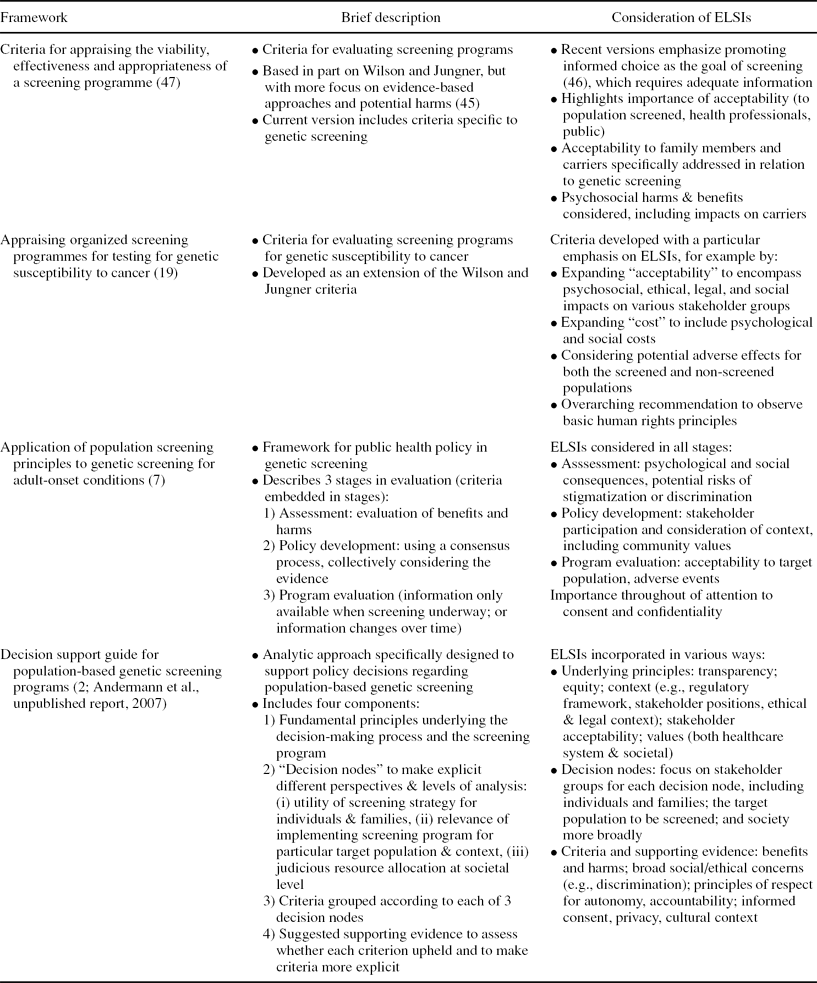
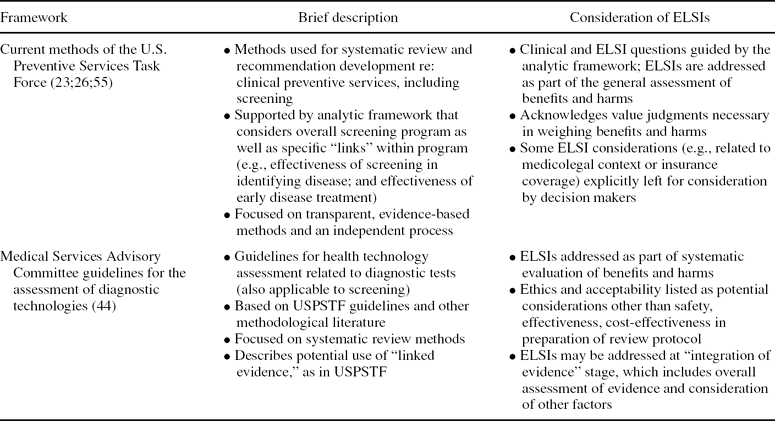
We identified three types of evaluation frameworks from the disease screening and public health genomics literatures, based on the following: (i) established criteria for evaluating disease screening programs; (ii) systematic review methods for evaluating screening and/or diagnostic tests; and (iii) methods for policy-oriented evaluations of genetic tests (Tables 1 to 3).
Frameworks Based on Disease Screening Criteria

Frameworks Based on Methods for Systematic Reviews of Screening Tests

Frameworks for Policy-Oriented Assessments of Genetic Tests

Frameworks Based on Disease Screening Criteria
A common approach to evaluating population-based screening programs uses a set of published criteria, often based on the World Health Organization's principles of disease screening (Reference Wilson and Jungner61). These principles have been updated and adapted, both with a focus on screening programs generally (e.g., 47), and specific to genetic screening (e.g., 19) (Table 1). Given that the purpose of criteria-oriented frameworks is to specify the conditions under which a screening test is considered acceptable (or fundable), and not necessarily how this should be demonstrated, these frameworks have tended to emphasize the particular ELSIs that should be considered, rather than the methods for addressing them.
The original Wilson and Jungner principles incorporate some ELSI-related concepts, including a criterion of public acceptability and two criteria that suggest social value judgments related to priority-setting (one criterion states that the screened condition should be an important health problem; another stipulates that the costs of case-finding should be “economically balanced” in relation to other healthcare costs) (Reference Wilson and Jungner61). Recent adaptations of these criteria have addressed ELSIs more directly by specifying additional issues such as psychosocial benefits and harms, impacts on stakeholder groups, informed choice, equity, discrimination, and human dignity (Reference Goel19;47) (Table 1).
Within the area of genetic screening, some groups have incorporated disease screening criteria within comprehensive frameworks for policy decision making (Table 1). For example, by including a “policy development” stage in the assessment framework (Reference Burke, Coughlin, Lee, Weed and Khoury7) or in presenting a set of underpinning principles as well as key “decision nodes” to guide policy decisions (Reference Andermann, Blancquaert, Beauchamp and Dery2), these frameworks highlight ELSIs that may be particularly important at the decision-making stage (e.g., related to context) (Table 1).
Frameworks Based on Methods for Systematic Reviews of Screening Tests
Frameworks for evaluating screening (or diagnostic) technologies that are based on systematic review methods include methods used by the U.S. Preventive Services Task Force (USPSTF) (Reference Guirguis-Blake, Calonge and Miller23;Reference Harris, Helfand and Woolf26;Reference Sawaya, Guirguis-Blake, LeFevre, Harris and Petitti55) and a related Australian framework from the Medical Services Advisory Committee (MSAC) (44) (Table 2). Both consider research evidence relating to a screening program overall but recognize that often reviewers must rely instead on evidence relating to separate components of a program (e.g., evidence relating to the effectiveness of screening for early disease detection; and evidence on the health impact of early treatment). Both frameworks also mention ELSIs, mainly in relation to psychosocial benefits and harms. Given the nature of the guidelines, literature reviewing is implied as a method for considering ELSIs (Table 2).
Frameworks for Policy-Oriented Assessments of Genetic Tests
Frameworks for policy-oriented evaluations of genetic tests (not necessarily specific to screening) (Table 3) often make reference to the performance criteria suggested by the U.S. Task Force on Genetic Testing: analytic validity (the extent to which a test accurately measures a particular analyte); clinical validity (the extent to which a test predicts clinical phenotype); and clinical utility (the assessment of benefits and harms) (Reference Holtzman and Watson29). As pointed out by Grosse and Khoury (Reference Grosse and Khoury21), the concept of “clinical utility” was initially defined as encompassing all benefits and harms, including social impacts (Reference Holtzman and Watson29), yet recently it has sometimes been defined more narrowly in terms of clinical outcomes, with ELSIs considered separately (e.g., Reference Burke, Atkins and Gwinn6;Reference Haddow, Palomaki, Khoury, Little and Burke24;Reference Kroese, Zimmern and Sanderson35).
A key framework that relies on these criteria is the U.S. “ACCE” model (analytic validity; clinical validity; clinical utility; and ethical, legal, and social issues) for evaluating emerging genetic tests (Reference Haddow, Palomaki, Khoury, Little and Burke24). Several additional frameworks are based in part on ACCE, including the United Kingdom Genetic Testing Network (UKGTN)'s “Gene Dossier” approach to genetic test evaluation (Reference Kroese, Zimmern, Farndon, Stewart and Whittaker34;Reference Sanderson, Zimmern and Kroese54;59), and a framework for assessing genetic tests developed by the Andalusian Agency for Health Technology Assessment (AETSA) (Reference Marquez Calderon and Briones Perez de la Blanca41). In both ACCE and the AETSA framework, ELSIs are included as part of clinical utility and are also summarized as a separate component (Table 3). These criteria-oriented frameworks do include some details regarding methods, which focus on reviewing scientific evidence but also mention expert legal review (Reference Haddow, Palomaki, Khoury, Little and Burke24) and the need to consider local context (Reference Marquez Calderon and Briones Perez de la Blanca41) when addressing ELSIs. Finally, recent developments in this area include the Evaluation of Genomic Applications in Practice and Prevention (EGAPP) project, initiated as a follow-up to ACCE (Reference Teutsch, Bradley and Palomaki58) (Table 3); and recent work that places a strong emphasis on the purpose of a genetic test (i.e., for morbidity or mortality reduction, health information, or reproductive decision making) (Reference Burke and Zimmern9;Reference Burke, Zimmern and Kroese10) and broadens the scope of clinical utility to include a range of ELSIs and other factors (Reference Burke and Zimmern9) (Table 3).
A related framework is the “three-domain model” developed in Ontario, Canada, for technology assessment and coverage decision making regarding emerging predictive genetic tests (Reference Giacomini, Miller and Browman17) (Table 3), which uses a unique approach to address uncertainty in whether a test meets the standard for any given criterion. ELSIs are considered mainly in defining a technology's purpose (which is presented as a fundamental step in framing an evaluation) and in documenting costs and benefits. Finally, Caulfield and colleagues (Reference Caulfield, Burgess and Williams-Jones12) proposed an analytic framework for evaluating genetic tests based on a Canadian generic healthcare coverage decision-making model (Reference Deber, Narine and Baranek15). This framework presents a series of thresholds to determine whether a genetic test should be offered and whether it should be covered (Reference Caulfield, Burgess and Williams-Jones12) (Table 3). The framework integrates ELSIs throughout and emphasizes overall moral acceptability as the first threshold.
INTEGRATION AND IMPLICATIONS FOR HTA IN GENETIC SCREENING
From the HTA literature, we summarized above recent discussions about the definition and scope of ELSIs in relation to HTA; as well as discussions about what “addressing” or “integrating” ELSIs might entail in practice. Specifically, authors have recommended including within HTA not only those ELSIs that may be viewed as impacts of technologies, but also those that describe the complexity of the relationship between technologies and society, including the social and political context in which technologies are developed and used. We described three broad approaches recommended in the HTA community for integrating ELSIs in HTA: literature synthesis, involvement of ELSI experts, and consideration of stakeholder values.
From the disease screening and public health genomics literatures, we identified three types of evaluation frameworks (based on disease-screening criteria, systematic review methods, and policy-oriented evaluations of genetic tests). ELSIs relevant to genetic screening that were mentioned in the frameworks included human rights, eugenics, accountability, transparency, equity, autonomy, stigmatization and discrimination, psychosocial harms and benefits, acceptability to stakeholders, choice and consent, privacy and confidentiality, and intellectual property (Tables 1 to 3). In accordance with current discussions in the HTA literature, several of these issues (e.g., human rights, eugenics, and stigmatization) suggest some consideration in an evaluation of how the development of technologies both reflects and contributes to societal and cultural values. Issues such as equity, acceptability, privacy, and intellectual property relate to the social and political context surrounding genetic screening policy decisions.
Although not all of the disease screening and genetic test evaluation frameworks described specific methodological approaches, where methods were stated or suggested, we found examples of the same three approaches to addressing ELSIs that were identified in the HTA literature (Tables 1 to 3). For example, the systematic review-based frameworks (Reference Harris, Helfand and Woolf26;44) and some genetic test evaluation frameworks (e.g., 24) emphasized knowledge synthesis methods. Involvement of ELSI experts was rarely explicitly mentioned (although see 24); however, we did not review the composition of the groups who developed the frameworks or that of policy evaluation bodies, so this does not suggest that ELSI expertise is not incorporated in practice. The need to consider stakeholder values was frequently mentioned and three frameworks directly recommended stakeholder participation (Reference Burke, Coughlin, Lee, Weed and Khoury7;Reference Burke and Zimmern9;Reference Caulfield, Burgess and Williams-Jones12). Finally, three frameworks placed particular emphasis on the need to address context (Reference Andermann, Blancquaert, Beauchamp and Dery2;Reference Burke, Coughlin, Lee, Weed and Khoury7;Reference Burke and Zimmern9).
Putting this together, it seems useful to consider how the issues defined as ELSIs in the field of genetic screening may be integrated with the methods identified for their consideration. For example, an assessment of psychosocial harms and benefits might best be carried out using systematic review methods; assessing public acceptability suggests a need to consider stakeholder values; and issues such as human rights, privacy, and intellectual property likely require input from experts in health law or bioethics. This mapping of methods against issues also reveals the implications of the choice of method on ELSI considerations. For example, systematic review methods may prioritize ELSIs that are amenable to empirical assessment (e.g., individual benefits and harms) rather than broader societal issues.
In turn, this relates to a discussion of whether ELSIs are best considered separately from other elements of an evaluation, or integrated throughout the HTA process (Reference Hofmann28). In genetic screening, their treatment as a separate entity has been argued to have hindered the role of ELSIs research in contributing to population health (Reference Burke, Khoury, Stewart and Zimmern8), and some authors have integrated ELSIs to avoid their marginalization (Reference Goel19). Based on the above, though, if ELSIs are embedded into an assessment of clinical utility, there is a risk that evaluations may focus more narrowly on “benefits and harms”, excluding considerations that are important but cannot easily be reduced to an “effectiveness” dimension (unless clinical utility itself is viewed more broadly [e.g., 9]). For example, a critical examination of the perspectives and roles of patients, healthcare providers, and commercial interests (i.e., the sociotechnical network surrounding a screening test [36]) may improve our understanding of why and how a test is developed and used, and yield insights into how it might be regulated (Reference Burke and Zimmern11–Reference Caulfield13).
Finally, accepting the argument that it is important to incorporate ELSIs into HTA for genetic screening and recognizing (as we have described) that there are methods for doing so, a key remaining question is how to judge impact. What criteria should we use to decide whether a chosen method is appropriate and whether it has been applied well? To address this question we might turn to the stated reasons for incorporating ELSIs in HTA. For example, if the intent of addressing ELSIs is to increase the relevance of HTA to policy makers and other target audiences, then some measure of usefulness (based on the views of these groups) will be necessary. However, if part of the rationale for addressing ELSIs is an argument that ELSIs should be considered in HTA (regardless of whether policy makers would find HTAs that address ELSIs more useful), evaluation of the process will be more complex. The rapid evolution of the technologies involved in genetic screening presents a further challenge in assessing the impact of HTA methodology.
Others have also recognized the challenges in evaluating approaches to considering ethics in HTA (Reference Hofmann28;Reference Reuzel, Oortwijn and Decker51) and in evaluating ethical guidelines for health policy generally (Reference Kenny and Giacomini33). Kenny and Giacomini compared the current development of ethical guidelines to earlier stages in the field of clinical guidelines development, whereby guidelines were taken at face value and used to evaluate practice; now the guidelines themselves are subject to evaluation (Reference Kenny and Giacomini33). Similarly, ethics guidelines for health policy will eventually themselves require assessment, including, where possible, the accumulation of empirical evidence. In the meantime, Hofmann notes that while we cannot ensure a high-quality ethical analysis in HTA, “. . . we may still discuss the goodness of an inquiry. An assessment that spells out the relevant moral aspects related to a technology and makes it easy for the reader to get hold of the moral complexity will be better than one that does not” (Reference Hofmann28, p. 317).
CONTACT INFORMATION
Beth K. Potter, PhD (bpotter@uottawa.ca), Assistant Professor, Department of Epidemiology & Community Medicine, University of Ottawa, 451 Smyth Road, Ottawa, Ontario K1H 8M5, Canada
Denise Avard, PhD (denise.avard@umontreal.ca), Associate Professor, Centre de recherche en droit public, University of Montreal, 3101 chemin de la Tour, Montréal, Quebec H3T 1J7, Canada
Ian D. Graham, PhD (Ian.Graham@cihr-irsc.gc.ca), Associate Professor, School of Nursing, University of Ottawa, 451 Smyth Road, Ottawa, Ontario K1H 8M5, Canada; Vice President, Department of Knowledge Translation, Canadian Institutes of Health Research, 160 Elgin Street, 9th Floor, Address Loc 4809A, Ottawa, Ontario K1A 0W9, Canada
Vikki A. Entwistle, PhD (V.A.Entwistle@dundee.ac.uk), Social Dimensions of Health Institute, University of Dundee, 11 Airlie Place, Dundee DD1 4HJ, UK
Timothy A. Caulfield, LLM (tcaulfld@law.ualberta), Professor & Research Director, Health Law Institute, Law Centre, University of Alberta, 89 Avenue and 111 Street, Edmonton, Alberta T6G 2H5, Canada
Pranesh Chakraborty, MD (pchakraborty@cheo.on.ca), Assistant Professor, Department of Pediatrics, University of Ottawa, 451 Smyth Road, Ottawa, Ontario K1H 8M5, Canada; Clinical Metabolic Geneticist, Department of Genetics, Children's Hospital of Eastern Ontario, 401 Smyth Road, Ottawa, Ontario K1H 8L1, Canada
Christine Kennedy, MSc, DPhil, MD (ckennedy@queensu.ca), Assistant Research Professor, Department of Community Health Sciences, University of Calgary, 3330 Hospital Drive NW, Calgary, Alberta T2N 4N1, Canada
Marissa McGuire, MSc (marissa.mcguire@mail.mcgill.ca), Research Assistant, Department of Epidemiology & Community Medicine, University of Ottawa, 451 Smyth Road, Ottawa, Ontario K1H 8M5, Canada
Glenn G. Griener, PhD (glenn.griener@ualberta.ca), Associate Professor, Departments of Public Health Sciences and Philosophy, University of Alberta, 2–40 Assiniboia Hall, Edmonton, Alberta T6G 2E7, Canada
Mark Montgomery, MD (mark.montgomery@calgaryhealthregion.ca), Clinical Associate Professor, Department of Pediatrics, University of Calgary, 2888 Shaganappi TR NW, Calgary, Alberta T2B 4L7, Canada; Pediatric Respirologist, Cystic Fibrosis Clinic, Alberta Children's Hospital, 2888 Shaganappi Trail NW, Calgary, Alberta T3B 6A8, Canada
George A. Wells, PhD (gawells@ottawaheart.ca), Professor, Department of Epidemiology & Community Medicine, University of Ottawa, 451 Smyth Road, Ottawa, Ontario K1H 8M5, Canada; Director, Cardiovascular Research Methods Centre, University of Ottawa Heart Institute, 40 Ruskin Street, Room H1-1, Ottawa, Ontario, K1Y 4W7, Canada
Brenda J. Wilson, MBChB, MSc (bwilson@uottawa.ca), Associate Professor, Department of Epidemiology & Community Medicine, University of Ottawa, 451 Smyth Road, Ottawa, Ontario K1H 8M5, Canada